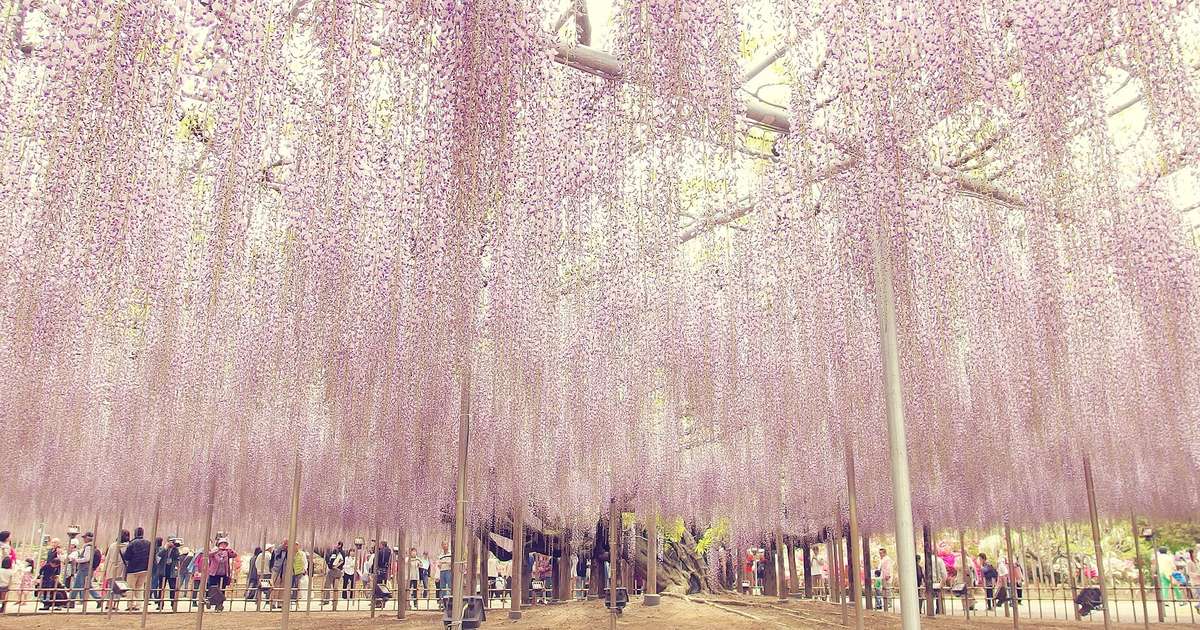
Ashikaga Flower Park in Tochigi does not publish a ticket price. Not "prices vary by season" in the ordinary sense — the official fee page states, in large type, that admission is decided early on the morning of the day, and adds that the fee changes according to how well the flowers are blooming. What the park publishes instead are bands: ¥900–2,300 for adults across the April–May wisteria window, ¥400–800 for daytime entry from July to December. That single design decision means any specific "admission is ¥X" figure is only the price on one particular morning. The park's own English page puts it bluntly: "Please contact us for details of the event period and admission fees as they may vary depending on how the flower blooms," and the same disclaimer is repeated on all eight of its seasonal pages. This guide covers how the floating system works, why the winter illumination is the one fixed price on the whole table, why Tobu's Ashikagashi Station is not the nearest station, and whether the annual pass is worth it (it is not).
- Admission is a band, not a price — officially "decided early on the morning of the day". Any guide quoting one number is quoting one day.
- The night illumination is the exception: ¥1,500 adults, ¥800 children — the only fixed line on the fee table.
- Nearest station is JR Ashikaga Flower Park (opened 2018, 3-minute walk). Tobu's Ashikagashi has no shuttle, but three workable routes exist.
- The pass that looks right is wrong: the Furatto Ryomo Tobu Free Pass excludes the JR Ryomo Line and the park station. Advance e-tickets are not sold at konbini.
- Skip the annual pass: ¥6,800 needs three peak wisteria visits to break even.
📖 Contents
- 1. The floating admission system
- 2. Hours, closures and the rules that never float
- 3. Getting there: three routes from Tokyo, Oyama and Takasaki
- 4. Ticket traps: what works and what does not
- 5. Eight flower seasons — wisteria is only one
- 6. The winter illumination and a contested title
- 7. 1997: moving a 130-year-old tree
- 8. Is the annual pass worth it?
- 9. Eating, shopping and the rules people break
- 10. Planning: pairing it with Hitachi Seaside Park
- 11. FAQ
The floating admission system
Most large paid gardens in Japan hand you a fixed fee table. Ashikaga is one of the very few that openly declines to. Its fee page is built around a live block at the top — "today's admission and opening hours" — updated each morning with the actual figure, above a table that lists only ranges. Four official statements sit on that one page:
- "Admission is decided early on the morning of the day."
- "The fee varies according to how the flowers are blooming. Please enquire by telephone for details."
- "Opening hours change with the season."
- And in the wisteria block: "Period, hours and fees all vary with the state of the bloom."
This is not a quirk of the Japanese page. The English site asks you to contact the park because fees "may vary depending on how the flower blooms". The Traditional Chinese site goes further and tells readers to ask at the service window. And every one of the park's eight seasonal chapter pages carries the same line in its footer: the admission fee changes with the bloom. Three language versions, eight pages, one message. This is a long-standing pricing philosophy, not a temporary measure.
Does the band actually move? Yes. On 7 August 2026 the site showed the next day at ¥600 adult / ¥300 child — the middle of the ¥400–800 band for that period. The park is neither parked at the ceiling nor giving the floor away.
The published bands
| Period (official 2026 table) | Adult | Child (age 4 to elementary) | Type |
|---|---|---|---|
| Jan 1 – Mar 31 | ¥500–900 | ¥300–500 | Band |
| Apr 1 – May 31 (wisteria) | ¥900–2,300 | ¥500–1,200 | Band · highest of the year |
| Jun 1 – Jun 30 | ¥800–1,300 | ¥400–700 | Band |
| Jul 1 – Dec 30 (daytime) | ¥400–800 | ¥200–400 | Band · lowest of the year |
| Oct 17 – Feb 14 (evening illumination, planned) | ¥1,500 | ¥800 | Fixed |
Look at the shape of that table: only the evening row is a single number. The park does not explain why, so here is my reading, offered as a reading and not as official policy — at night you are buying lights, and lights do not have a bad day; by day you are buying a living bloom, where a great day and an average day are genuinely different products, and the park chose to price that difference rather than hide it.
Whatever the reason, the practical consequence matters: autumn and winter daytime is the cheapest the park ever gets (¥400–800), while the evening in the same months is close to the most expensive (a flat ¥1,500). If you want a quiet walk among flowers on a budget, an autumn daytime visit is the best value on the calendar. If you came for the lights, stop hunting for a discount — that number does not move.
Wisteria season has a second table — do not mix them up
During the wisteria festival the park sells a dedicated one-day ticket on its own band: adults ¥1,200–2,300, children ¥600–1,200. The 2026 festival ran 11 April to 17 May (officially "planned"). Note the floor: ¥1,200, not the ¥900 on the general April–May row. ¥900 is only reachable in the shoulder strips of 1–10 April and 18–31 May. When the wisteria is genuinely open, entry starts at ¥1,200.
2027 dates have not been announced. The only durable official statement is that the flowers peak "over the one month from mid-April to mid-May", with exact dates published annually.
The figures you can actually write down
- Groups: 10% off the day's rate for parties of 20 or more.
- Disability discount: ¥200 off on presenting a disability certificate at the window, covering the holder plus one companion (two people total); not combinable with other discounts.
- Child rate: age 4 through elementary school.
- Coin lockers: ¥500 large (8 units, 77×34×56cm) and ¥300 small (16 units, 37×34×42cm), beside the Shopping House at the main gate.
Spring's evening discount is not the winter evening ticket
A third system causes a lot of confusion. In spring, the park runs a light-up on the same ticket with a time-of-day discount: in 2026 it ran 15 April to 24 May plus 29–31 May, and entering after 17:30 cost ¥200 less than the daytime rate, with a further ¥100 off for email members. The park's own worked example: a ¥2,300 daytime rate becomes ¥2,100 in the evening, or ¥2,000 with the member coupon.
Winter is a different animal. The "Garden of Illuminated Flowers" is its own line on the fee table at a flat ¥1,500 — it is not "daytime minus ¥200". That ¥200 reduction is a rule attached to a different line of the fee table and does not carry over to the winter illumination.
One genuinely useful money angle: the park periodically issues free or discounted entry coupons to its email members and LINE followers during quiet seasons (it ran a free-entry campaign in summer 2026). These are irregular and not guaranteed, but thirty seconds on the official site before you travel occasionally pays for lunch.
Hours, closures and the rules that never float
Hours move too, just less dramatically. The standard table says 10:00–17:00, but from 1 June 2026 the park announced 9:00–17:30 — proof that it really does adjust. Evening sessions during the illumination run 15:30–20:30 on weekdays and 15:30–21:00 on weekends and holidays, with the lights coming on around 16:30–17:00, and the park plans to extend hours by 30 minutes from mid-November to early January.
These rules do not float, and knowing them saves grief:
- Last ticket sales: 30 minutes before closing.
- Last admission is 16:30 during 10:00–17:00 operation.
- No re-entry. Ducking out for lunch and coming back does not work here.
- The shopping area is normally free to enter without a ticket — except during wisteria season, when it falls inside the paid zone. The park's FAQ and its news post give different end dates for that paid window, so I will not quote one; just do not assume you can wander in for manju in spring.
The closure rule is "the third Wednesday and Thursday of February, plus 31 December". Applying that rule to 2027 gives 17–18 February — but treat that as my arithmetic, not an announcement, and check the site. For reference, the 2025-26 illumination ended on 15 February 2026 and the park then closed on 18–19 February. There is also a summer maintenance closure each year on dates that shift (in 2026 it was 31 August to 6 September).
Getting there: three routes from Tokyo, Oyama and Takasaki
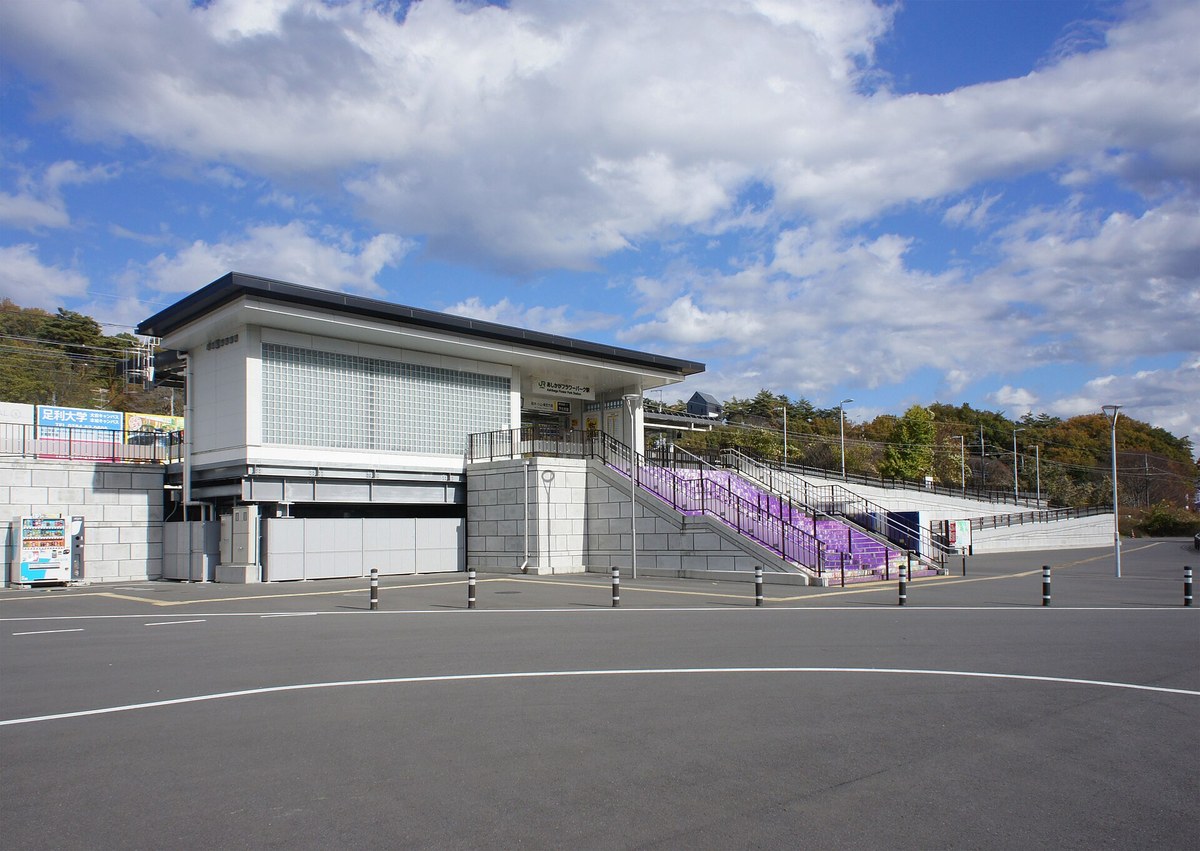
The headline: the nearest station is Ashikaga Flower Park Station on the JR Ryomo Line, opened in April 2018 — the first new JR station in Tochigi Prefecture in 35 years, built for this park. It is a 3-minute walk to the gate, a figure the park and Tobu both publish independently.
The complication is that many visitors arrive on the Tobu limited express "Ryomo", which serves Ashikagashi Station on the Tobu Isesaki Line. Similar name, different company, different system — and the park states plainly that no shuttle bus runs from Ashikagashi to the park.
What I will not do is repeat the line, common in travel guides, that getting off at Ashikagashi wrecks your day. It does not. There are three routes:
| Route | How it works | Best for |
|---|---|---|
| 1. Via Kuki (park's suggestion) | Tobu Isesaki Line → transfer at Kuki to the JR Tohoku Main Line → transfer at Oyama to the JR Ryomo Line → park station | Travellers boarding in south Tokyo who want to be on JR metals the whole way |
| 2. Via Tatebayashi (park's suggestion) | Tobu Isesaki Line → transfer at Tatebayashi to the Tobu Sano Line → transfer at Sano to the JR Ryomo Line → park station | Anyone already holding a Tobu ticket and wanting to use it |
| 3. Walk from Ashikagashi (Tobu's own instruction) | Limited express Ryomo direct to Ashikagashi → walk about 15 minutes to JR Ashikaga Station → JR Ryomo Line → park station | Light luggage, decent weather, and a preference for fewer transfers |
My honest read on the trade-off: with heavy luggage, small children, older travellers or rain, do not take route 3 — fifteen minutes through town dragging a case or holding an umbrella is miserable. But if you are travelling light, route 3 has the fewest transfers of the three: one comfortable 70-minute direct run from Asakusa, a walk, then one short local hop. Plenty of people will take that deal.
Published journey times (from the park and the Ashikaga tourism association): about 40 minutes on the Ryomo Line from Oyama, about 60 minutes from Takasaki; the Tobu limited express Ryomo is about 70 minutes Asakusa to Ashikagashi and about 60 minutes from Kita-Senju. From the airports: Narita via Keisei to Nippori, Joban Line to Kita-Senju, then Ryomo (about 60 minutes on the Ryomo leg); Haneda via Keikyu to Asakusa, then Ryomo (about 70 minutes). Budget 1.5 to 2 hours door to door.
One warning from the park itself is worth quoting because it clearly comes from experience: on the way home, Ashikaga Flower Park Station is expected to be extremely crowded, so arrive early — and top up your IC card in advance. This is a small station, and when the park empties everyone funnels onto one platform at once; standing in a ticket-machine queue at that moment is how you miss a train. Load enough on your Suica or PASMO before you go. For which card to carry and whether it can live in your phone, see our Suica vs ICOCA comparison.
Driving and parking
You will see "6,000 free parking spaces" quoted everywhere. That is the peak-season figure. The park's FAQ is more precise: 300 spaces for ordinary cars in normal periods, rising to about 6,000 including overflow lots in busy periods. The main lot holds 40 large buses and 300 cars, and the park notes the main lot is sometimes closed off for tour coaches; the lot in front of the West Gate is open 24 hours.
Official drive times from the expressway (normal conditions): Sano-Fujioka IC on the Tohoku Expressway about 20 minutes via Route 50; Ota-Kiryu IC on the Kita-Kanto Expressway about 25 minutes; Ashikaga IC about 20 minutes; Sano-Tanuma IC about 17 minutes; Izuruhara Smart IC about 15 minutes. The park's own comment on driving is disarmingly candid: visitors arriving by car "can come smoothly on weekdays". It says nothing about weekends, which tells you everything.
Finally: there is no scheduled highway bus you can simply buy a seat on. The park's access page covers only car and rail. It does list bus tours departing from across Japan, but explicitly directs enquiries to travel agencies — those are package coach tours, not a public route service.
Ticket traps: what works and what does not
Avoid: the Furatto Ryomo Tobu Free Pass
Its free-travel zone covers Tobu lines and designated buses around Tatebayashi, Sano, Ashikaga, Ota, Kiryu, Isesaki and Midori; it is valid three days; it costs ¥2,440 for adults from Asakusa (¥1,250 child), ¥2,240 from Koshigaya, ¥1,970 from Kasukabe, ¥1,590 from Hanyu, ¥1,490 from Kawamata, with limited-express surcharges extra. It looks tailor-made for this trip.
Tobu states explicitly that it does not include the JR Ryomo Line or Ashikaga Flower Park Station. The final link to the gate is exactly the part it cannot cover. Buy it if you are genuinely touring northern Kanto on Tobu lines for three days; do not buy it as a flower-park ticket.
Consider: the Spring Flower Tour Ticket (Ashikaga)
This is the one Tobu actually built for wisteria season: it bundles park admission with a round trip from your chosen station to Morinji-mae plus a rail free zone (Morinji-mae to Ashikagashi, Tatebayashi to Sano). In 2026 it sold from 11 April to 31 May, valid on the day of use only: from Asakusa, ¥3,190 for 11 April–17 May and ¥2,590 for 18–31 May; from Kuki, ¥2,450 and ¥1,850.
Notice that the price break falls exactly at the end of the wisteria festival — which is the floating-price system showing through from another angle, since the admission component is worth different amounts on different dates. Tobu even footnotes it: "admission varies by the day of entry." The catch: the 2026 edition has expired and no 2027 edition has been announced. If you are planning a spring trip, confirm on Tobu's site whether it returns.
Know: advance e-tickets exist, but not at konbini
The park sells date-specified electronic advance tickets — officially "electronic tickets are date-specified and usable every day". It also states that they are not sold at convenience stores. The Japanese konbini ticket machine covers most attractions; the park has explicitly excluded itself.
So how do you buy? Two channels: the official online advance sale, or the ticket window on the day. Buying at the window is perfectly viable — bring cash or a card — the only cost is queueing on busy days (wisteria weekends, illumination weekends). We do not currently carry a partner ticket link for this park, so rather than pushing you toward something we cannot verify, we are simply telling you where the tickets are.
Exists: a combined ticket with Hitachi Seaside Park
The park has run a joint ticket with Hitachi Seaside Park, marketed as Japan's "two great scenic spots", with the pitch that advance tickets let you skip the ticket queue. The official wording on how to use it is genuinely flexible: you can do both parks as a single day trip, but because the validity periods differ, you can also stay overnight and tour both, or visit each as a separate day trip.
Check the joint ticket price on the ticketing platform the park links to before you decide whether it beats buying the two admissions separately. For bloom timing on the Ibaraki side, see our Hitachi Seaside Park guide.
Eight flower seasons — wisteria is only one
Most visitors assume the park is only worth the trip in wisteria season. The park disagrees loudly: it divides the year into eight flower chapters, each with its own headline act. This table is the fastest way to work out what you would actually see on your dates.
| Ch. | Season | Headline act (official figures) | Official bloom period |
|---|---|---|---|
| 1 | Early spring | Winter peonies in 50 flower houses; about 25 winter-red plum trees | Winter peony Jan–late Feb; wintersweet early Jan–early Mar |
| 2 | Spring flower festival | About 30,000 tulip bulbs, rapeseed, bridal wreath | Tulips early Mar–mid Apr; cherry late Mar–early Apr |
| 3 | Wisteria Story | Three great wisteria trellises, an 80m white wisteria tunnel, yellow laburnum | Wisteria mid Apr–mid May; azalea mid Apr–early May |
| 4 | Rainbow Garden | 2,500 roses, 1,500 rhododendrons, 500 clematis | Roses mid May–mid Jun; clematis late Apr–mid Jun |
| 5 | Blue & White Garden | Irises and hydrangeas in a blue-white palette | Hydrangea early Jun–early Jul; iris early–late Jun |
| 6 | Water fairies | About 1,500 tropical water lilies (day- and night-blooming) | Water lily late Jun–late Nov; crape myrtle Jul–late Sep |
| 7 | Purple & Rose Garden | 300,000 amethyst sage plants | Amethyst sage early Oct–mid Nov |
| 8 | Garden of Illuminated Flowers | Park-wide illumination | Late Oct–mid Feb |
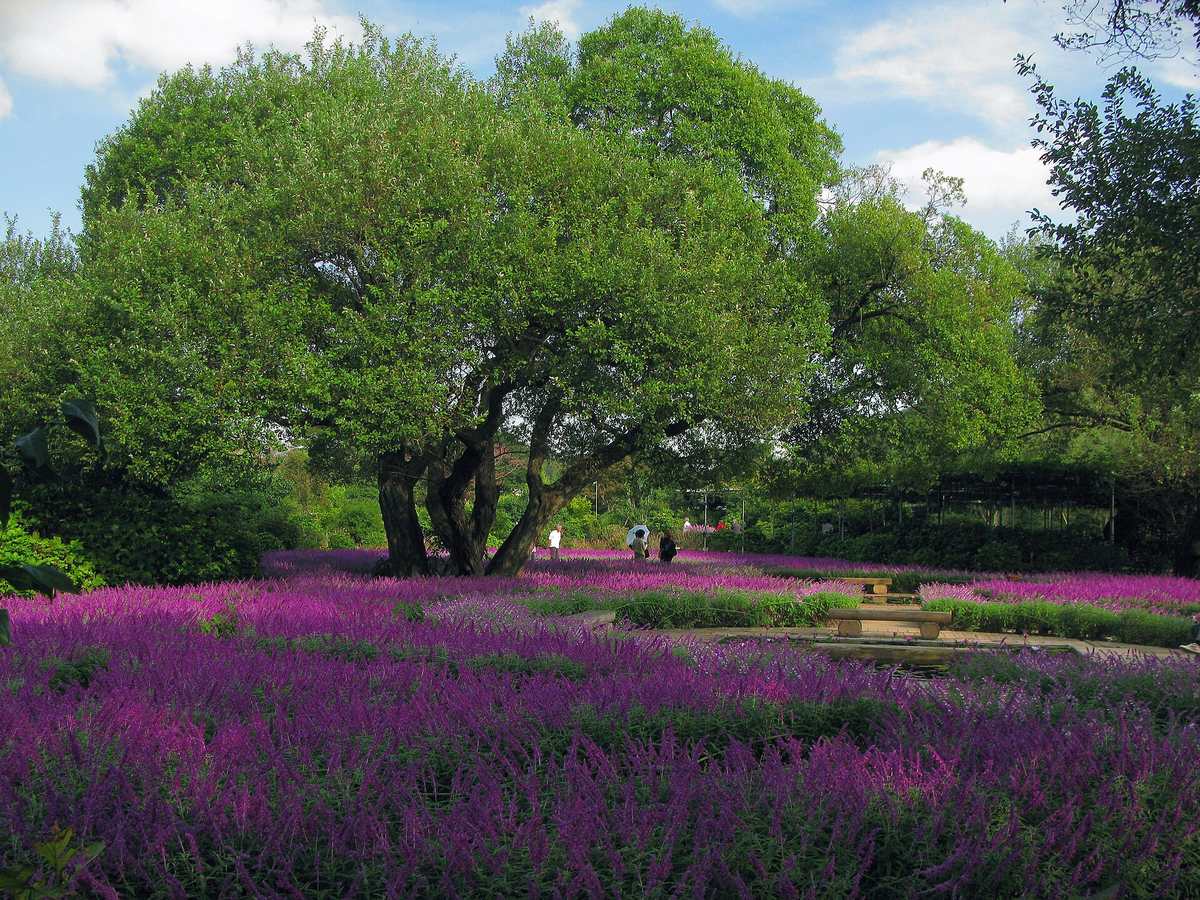
Read that table carefully and an underrated window jumps out: mid-to-late October. Chapter 7's 300,000 amethyst sage plants run to mid-November, and chapter 8's illumination begins in late October — they overlap. You can walk a field of purple in the afternoon and stay for the lights. Combine that with daytime admission sitting in its lowest band of the year, and October is arguably better value than the famous wisteria season. Fewer people know it.
Wisteria: the numbers and the running order
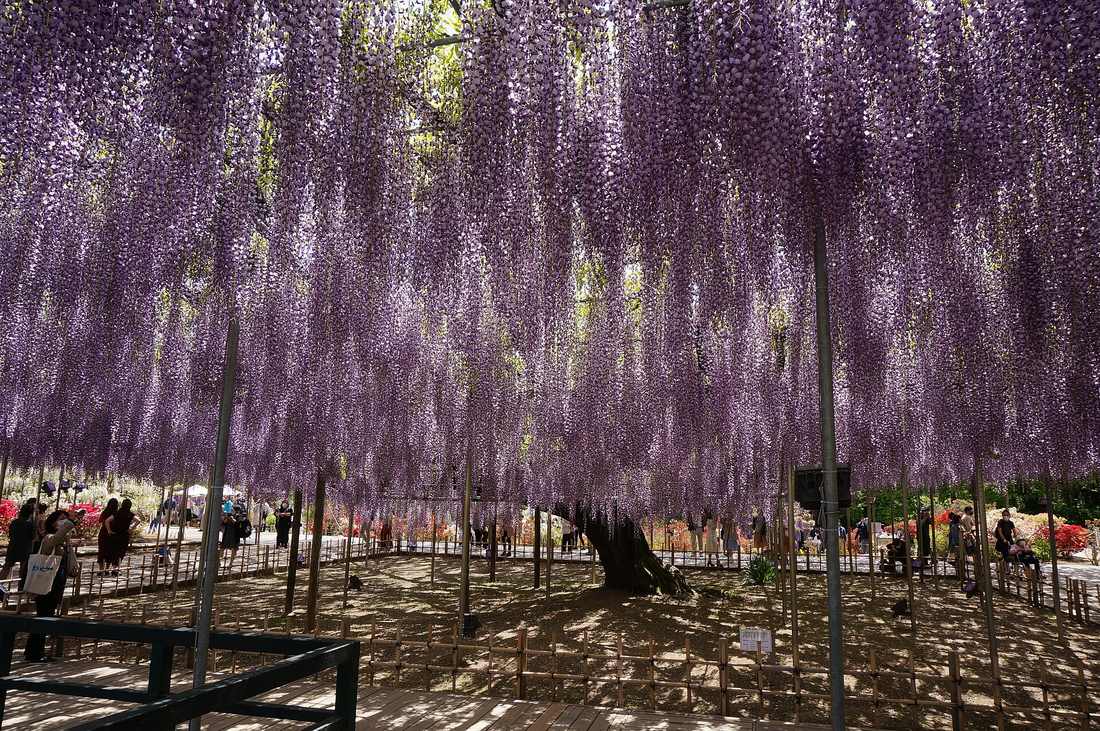
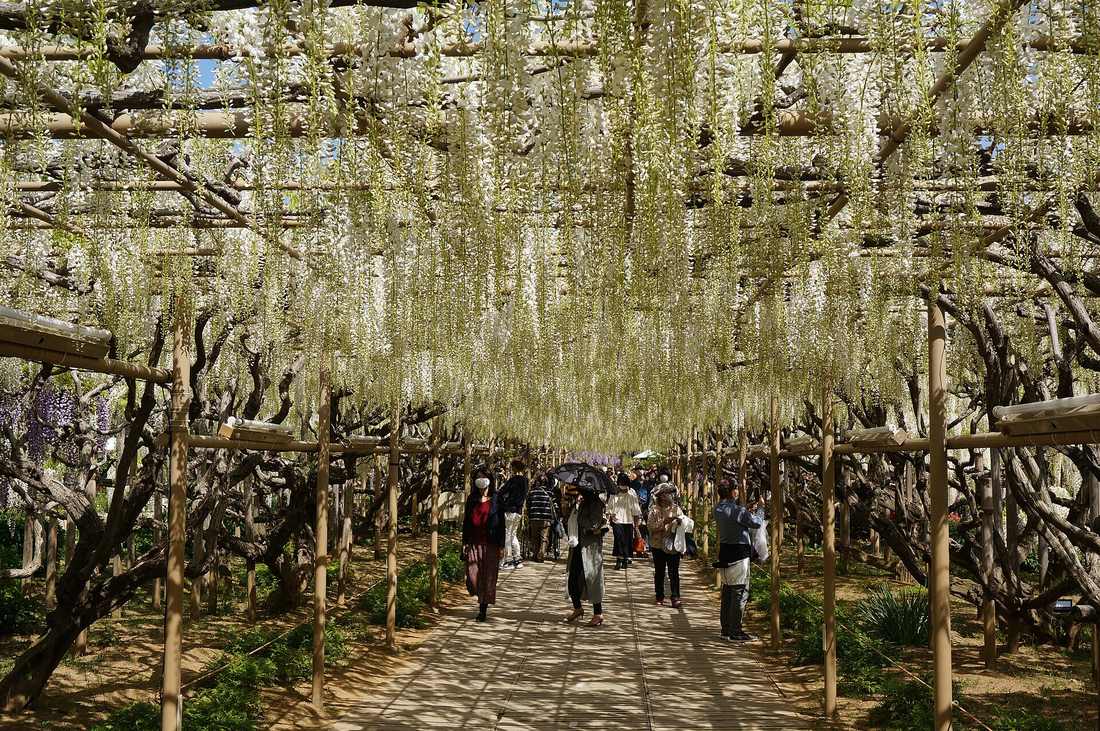
Wisteria is still the reason the park is famous, and the official figures explain why it is not just another trellis:
- Three great wisteria trellises, 160 years old, each covering 600 tatami mats of area
- A double-flowered (yae) great wisteria trellis, which the park calls rare worldwide
- An 80-metre white wisteria tunnel
- Four great wisteria trees — three Noda Kyushaku and one Yae Kokuryu
- Those four trees and the 80m white tunnel are designated Tochigi Prefecture Natural Monuments
- The yellow laburnum is, in the park's words, considered difficult to cultivate in Japan
The key planning fact is that wisteria here does not bloom all at once. The varieties run in relay — pale red, then purple, then white, then yellow — which is why the park says the wisteria can be enjoyed for over a month. Official typical peaks:
| Variety | Typical peak |
|---|---|
| Pale red wisteria | Mid to late April |
| Great wisteria | Late April to early May |
| Yae Kokuryu wisteria | Late April to early May |
| Azalea | Late April to early May |
| White wisteria | Early May |
| Yellow laburnum | Early to mid May |
| Roses | Mid May to early June |
If you can only pick one date, pick late April to early May — the window where the great wisteria, the double-flowered variety and the azaleas overlap. Whether the season runs early is genuinely weather-dependent: in 2026 the park declared the pale red wisteria open on 6 April, issued a great-wisteria bloom bulletin on 8 April, and said on 19 April that the wisteria had reached its peak early. Shifts of several days happen every year, so read the official bloom bulletin before you commit instead of copying last year's dates. For broader seasonal planning, see our Japan month-by-month weather guide; if you are chasing the tail of cherry season into wisteria season, our Japan cherry blossom guide covers the handover.
The winter illumination and a contested title
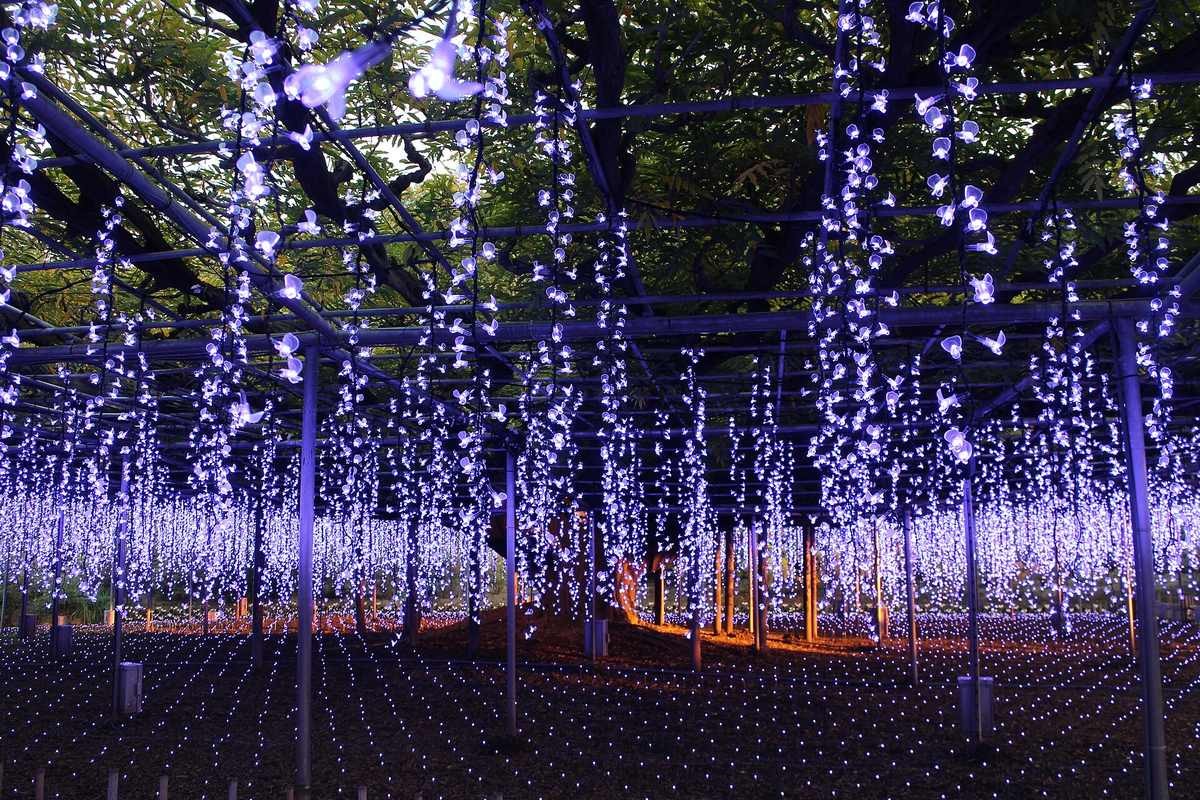
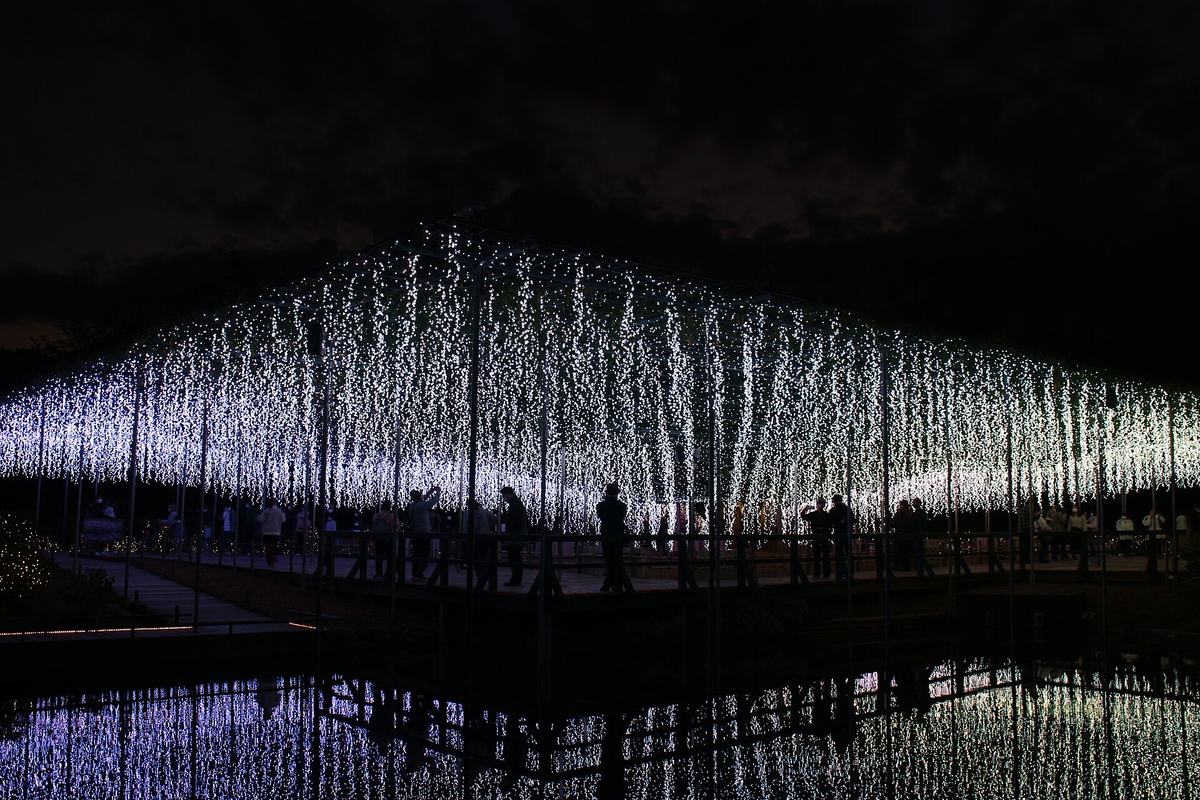
The "Garden of Illuminated Flowers" is the park's second act, and it differs from a shopping-district light-up in one important way: it illuminates an actual garden, with the entire design built around flowers and nature. The park's own highlights include the symbol tree — the "Miracle Great Wisteria" — rendered in wisteria-coloured lights that bloom outward as a narrative, white and yellow wisteria rebuilt in light, a "wall painting of light" on the hillside, and reflection effects on the pond surface.
The start date, where the park contradicts itself
This needs to be said plainly. The fee page gives the evening period as 17 October to 14 February, marked "planned". The park-history page describes the illumination as "held from late October", and the seasonal page's first theme block also reads "late October". Same website, two answers.
I will not pick one on the park's behalf. If pressed, 17 October is the more credible of the two: every row of that fee table is prefixed with the 2026 year, the 17 October row coexists with the 1 July–30 December row on the same annual table, 17 October 2026 falls on a Saturday (the conventional opening day for big Japanese illuminations), and Nabana no Sato — the other heavyweight paid illumination garden — also opens its 2026-27 season on 17 October. But those are circumstantial arguments and my inference, not an announcement. Check the official site's current notice before you travel, especially if your dates fall in that ambiguous mid-to-late October zone.
Three practical notes. The illumination runs in three themed blocks (late Oct–mid Nov, late Nov–late Dec, New Year's Day to the end), and the apparent gaps between blocks are theme changeovers, not closures. Hours are extended by 30 minutes from mid-November to early January, which is the most comfortable stretch of the season. And for reference, the previous season ended on 15 February 2026.
About the "one of Japan's three great illuminations" claim
You will see this claim in almost every English write-up. Here is where it comes from, and why we are not going to repeat it in our own voice.
The park's website does claim it, in two places. The park-history page says the illumination was selected as one of Japan's three great illuminations by the "Yakei Convention Bureau" and took first place nationally in a poll of night-view tourism specialists. The seasonal page says it was certified by "Japan Night View Heritage". Note the wrinkle: those two pages name different certifying bodies.
Treat the title as the park's own marketing line, not a ranking you can look up. No accessible official page names the other two illuminations in the trio, or the year the certification was granted. The title tells you the lights are the park's headline winter act — which they are — and nothing about how they compare with Nabana no Sato.
1997: moving a 130-year-old tree
The park's origin story is more interesting than its brochure, and it explains why the wisteria is what it is.
Its predecessor opened in 1968 as Hayakawa Nouen in Horigome-cho (now Asakura-cho), Ashikaga, where the centrepiece was known as the "250-tatami great wisteria". Urban development forced a move, and in 1997 the whole garden was relocated to its present site in Hazama-cho and reopened as Ashikaga Flower Park. (The official history page states 1997; the year 1996 appears nowhere on it.)
The hard part: how do you move a wisteria that was already 130 years old? The job went to Konami Tsukamoto, Japan's first female arborist. In the park's words, transplanting the great wisteria had no precedent, the project drew national attention for defying conventional wisdom, and it became the first successful case of its kind in Japan.
Two more numbers are worth knowing. The new site was originally wetland, so the park spread more than 250 tonnes of charcoal through the grounds to purify the soil and improve vitality. And the trellis that measured 72 square metres at the time of the move now spreads over 1,000 square metres, within grounds that have grown to 100,000 square metres. When you stand under those 600-tatami trellises, you are looking at a tree that was moved house, is now 160 years old, and has grown more than tenfold in its new home.
One last correction to a common error: this is a privately operated park, not a municipal one. The FAQ answers the question directly — is the park run by the city? No, it is privately managed. Which also quietly explains the floating pricing: a private operator has pricing freedom that a public facility does not.
Is the annual pass worth it?
The pass is called the Hanaoi Club: ¥6,800 new, ¥5,800 on renewal, valid one year from issue, applied for at the ticket window and issued on the spot. The benefits are not thin:
- Free entry for the holder for one year
- 10% off souvenirs and plants (some items excluded)
- ¥200 off for up to five companions (not combinable with other discounts)
- 10% off dining at the Wisteria restaurant (groups excluded)
- A potted plant when you visit in your birthday month
- 5% off group banquet bookings
And yet the arithmetic is unambiguous. Against the ¥2,300 ceiling on a peak wisteria day, you need three peak visits to break even. The most extravagant realistic tourist pattern — one wisteria visit, one illumination visit, one summer visit — comes to roughly ¥2,300 + ¥1,500 + ¥400 = ¥4,200, still short of ¥6,800, and that already assumes three separate trips to Japan with a Tochigi detour each time.
So the verdict is blunt: this pass is built for locals in Tochigi and Gunma, and overseas visitors should not buy it. If you want to save money, watch for the off-season coupons the park sends its email members and LINE followers, or in spring check whether Tobu is running the flower-tour ticket that locks the admission price in.
Eating, shopping and the rules people break
Start with a rule that shapes your whole day: outside food and drink may not be brought in, and eating outside the designated food areas is not permitted — the park asks visitors to refrain from eating anywhere but the food area, and specifically not in the shopping area. So the classic image of strolling under the wisteria with an ice cream in hand is not on. Buy it, eat it where you bought it, then walk on. That is not just etiquette here; it is park policy.
Eating
The thing to order is the Fuji Soft (wisteria soft-serve), ¥500 — the park's original soft-serve, described officially as letting you enjoy the fragrance of wisteria. It is at the Soup & Food Corner, immediately on your right as you come through the main gate. The same counter's popularity ranking is instructive: number one is Sano ramen at ¥850 (Sano is the next town over, so this is a legitimate regional dish rather than filler), number two is yakisoba with potato at ¥600, and the wisteria soft-serve is number three. A sensible order of operations: ramen for lunch, soft-serve on the way out.
For a proper sit-down meal there is Wisteria, a 200-seat restaurant serving Japanese and Western dishes with draft beer and garden views. Mains land roughly in the ¥1,500–2,400 range, but treat that as a summer 2026 menu reference only — the menu rotates by season and both the dishes and the prices will differ when you visit. Two further outlets, Ajisai and Maronie, are listed by the park but their menu pages are currently empty, so I will name them and say nothing more.
Shopping
The park's own FAQ names its signature souvenirs: Fuji Manju and Fuji no Hana Monogatari steamed buns, both made and sold on site as a live demonstration, at 8 pieces for ¥850 or 12 for ¥1,250; the latter comes in four fillings (red bean, chestnut, cherry and white). Other officially priced items:
| Item | Price (tax incl.) | Note |
|---|---|---|
| Fuji Manju | 8 pcs ¥850 / 12 pcs ¥1,250 | Made on site |
| Fuji no Hana Monogatari buns | 8 pcs ¥850 / 12 pcs ¥1,250 | Four fillings |
| Fujihime Earl Grey tea | ¥1,400 | Blended for the park by AZ Teas |
| Wisteria perfume | ¥3,800 | Inspired by the park's great wisteria |
| Lululun wisteria face masks | ¥1,650 | With the park's wisteria extract, 5 packs |
| Solid wisteria perfume | ¥1,300 | |
| Wisteria hand cream | ¥550 | Made with wisteria honey |
| Wisteria incense 40g | ¥600 | Low-smoke type |
| Fuji-kuma & Fuji-usagi plush | ¥450 each | Park original characters |
| Wisteria folding umbrella | ¥1,700 | Rain or shine |
| Bukkake ginger daikon | ¥600 | |
| Photo book "Fuji no Hana Monogatari" | ¥1,100 |
Two more the park's FAQ recommends without publishing prices: Ashikaga's Koin Monaka wafer sweets, and wine and grape juice from Coco Farm & Winery — a local operation where Kokoromi Gakuen grows grapes on a hillside, and which the park notes holds a harvest festival each November. Dates are not given, so check the winery's own page before you build a November visit around it. There is also an official online shop if you want to restock later.
Reminder: the shopping area is normally free to enter without admission — but during wisteria season it sits inside the paid zone, so you cannot pop in just for the manju.
Rules that catch people out
- Cosplay and wedding dresses are not permitted for entry. Bridal photography is refused entirely from April to mid-June and during the illumination evening sessions; other periods require a phone enquiry.
- No pets (guide, service and hearing dogs excepted), and the park states that the paid temporary pet-holding facility it used to offer no longer exists.
- No stroller rental, and cart-type strollers may not be brought in. Wheelchairs are lent free for use inside the park, but numbers are limited and it is first come, first served.
- Tripods are allowed provided they do not block paths and are folded when moving; the park may ask you to refrain when crowded. Live streaming is prohibited, as are lighting equipment, reflectors and step ladders.
- Also prohibited: bicycles, tricycles, drones, cart-type luggage trolleys, ball games, jogging, playing instruments, entering flower beds, and touching or taking plants.
- There is a nursing room, but it has no hot water supply — bring a flask.
Planning: pairing it with Hitachi Seaside Park
The planning problem with Ashikaga Flower Park is simple: it is a half-day. The grounds sound large at 100,000 square metres, but two to three unhurried hours covers it, which makes a full day out of Tokyo feel thin. The real question is what to pair it with.
Option A — two gardens. Pair it with Hitachi Seaside Park. This is not a pairing we invented: the park itself has sold a joint ticket and markets the two as Japan's "two great scenic spots", explicitly saying you can do both in a day, or split them across two days. They are genuinely complementary rather than competitive: Hitachi sells a single flower species painted across an entire hillside (nemophila blue, kochia red), while Ashikaga sells one tree carrying the whole scene. The experiences feel nothing alike. Practical caveat: they sit in different prefectures and the lateral journey is not short, so without a car I would split them across two days rather than force one.
Option B — half-day park, half-day Ashikaga town. The park's own suggested pairings are the Ashikaga School (Japan's oldest school), the Kurita Museum, and Sano Premium Outlets. The Ashikaga School is the most natural fit — in town, on the same Ryomo Line. Check admission and hours on each of the three sites before you go. If the outlet appeals, Japanese outlet tax-free and coupon mechanics are broadly the same everywhere; our Gotemba Premium Outlets guide explains the system.
Option C — an illumination day trip. If lights are the point, leave Tokyo later, arrive around 15:30, catch the switch-on (roughly 16:30–17:00) and stay into the evening. The critical part is the journey home: the station jams at closing, so top up the IC card and check the last services in advance. To see how this fits the wider Kanto light-up calendar, compare with our Tokyo winter illumination guide — those five venues are all central Tokyo and mostly free, whereas Ashikaga is a 90-to-120-minute train ride to a paid garden that sells day and night separately. Completely different propositions. For a like-for-like comparison with the other heavyweight paid illumination garden, our Nabana no Sato guide is the closest match: admission there runs ¥2,500–3,200 for the 2026-27 season against Ashikaga's flat ¥1,500, and both open their season on 17 October.
If you can only come once, here is the call I would make. Late April to early May is the reason this park exists — great wisteria, double-flowered wisteria and azaleas overlapping, an image with no substitute — at the cost of the year's highest band (¥900–2,300, with the festival ticket starting at ¥1,200) and the year's worst crowds. For value, take mid-to-late October: the tail of the amethyst sage plus the opening of the illumination, on the lowest daytime band of the year and with far more breathing room. I would not make a special trip in July or August — admission is at its cheapest then, but tropical water lilies and crape myrtle do not justify a two-hour haul from Tokyo.
Frequently Asked Questions
- Q1:How much does Ashikaga Flower Park actually cost?
- There is no single answer, and that is the park deliberately. The official fee page carries a headline in large type: "Admission is decided early on the morning of the day", with a second line saying the fee varies with how well the flowers are blooming. What the park publishes are bands, not prices: ¥500–900 for adults in January–March, ¥900–2,300 in the April–May wisteria window, ¥800–1,300 in June, and ¥400–800 for daytime entry from July to December. The English page says it outright: "Please contact us for details of the event period and admission fees as they may vary depending on how the flower blooms." So any guide quoting "admission is ¥X" is quoting one specific day, not a rate.
- Q2:Then how do I find out what I will pay on my date?
- Check the "today's admission and opening hours" block on the park's own homepage and fee page. The park posts the actual figure for the day each morning, along with that day's opening and closing times. A concrete data point: on 7 August 2026 the site showed the following day (Saturday 8 August) at ¥600 for adults and ¥300 for children, with 10:00–17:00 hours — squarely in the middle of the ¥400–800 summer/autumn band. So the band genuinely moves; the park is not quietly charging the ceiling every day. Two rules never float: the last tickets are sold 30 minutes before closing, and re-entry is not permitted.
- Q3:I am taking the Tobu limited express to Ashikagashi Station. Can I walk to the park?
- The names are similar but these are two companies and two systems. The park's own station is Ashikaga Flower Park Station on the JR Ryomo Line, opened in April 2018, about a 3-minute walk from the gate. Tobu Isesaki Line's Ashikagashi Station has no shuttle to the park — the park states plainly that no shuttle bus operates from it. But no shuttle does not mean no route. There are three: transfer at Kuki to the JR Tohoku Main Line and again at Oyama to the Ryomo Line; transfer at Tatebayashi to the Tobu Sano Line and again at Sano to the Ryomo Line; or — per Tobu's own website — walk about 15 minutes from Ashikagashi Station to JR Ashikaga Station and take the Ryomo Line from there.
- Q4:Does the Furatto Ryomo Tobu Free Pass cover the park?
- No, and this is the single most expensive mistake available here. The pass name contains "Ryomo", its free-travel zone blankets the Ashikaga area, and it looks purpose-built for this trip — but Tobu states explicitly that the JR Ryomo Line and Ashikaga Flower Park Station are not included. It cannot deliver you to the park gate. The pass is ¥2,440 for adults from Asakusa, valid three days, limited-express surcharges extra, and it makes sense if you are touring Tatebayashi, Sano, Ashikaga, Ota, Kiryu and Isesaki on Tobu lines — not for a single-target run at the flower park. One more trap: the park's electronic advance tickets are not sold at convenience stores, even though the konbini ticket machine covers most Japanese attractions.
- Q5:Is the annual pass worth buying?
- For an overseas visitor, no. The "Hanaoi Club" pass is ¥6,800 new and ¥5,800 on renewal, valid one year from issue, and the perks are real: free entry for the holder, 10% off souvenirs and plants, ¥200 off for up to five companions, 10% off at the Wisteria restaurant, and a potted plant in your birthday month. The maths kills it. Against the ¥2,300 ceiling on a peak wisteria day you need three peak-season visits to break even. A realistic tourist combination — one wisteria visit, one illumination visit, one summer visit — comes to roughly ¥4,200 and still does not clear ¥6,800. This is a pass designed for residents of Tochigi and Gunma who come five or six times a year.
- Q6:What is on in October and November, and when does the illumination start?
- Mid-to-late October is the park's most underrated window. The seventh of its eight flower "chapters" is 300,000 amethyst sage plants, blooming early October to mid-November, and the winter illumination picks up in late October — so the two overlap and you can see a purple flower field by day and the lights by night on one ticket cycle. On the start date the park contradicts itself: the fee page lists 17 October (marked "planned"), while the park-history page and the season page both say "late October". We are not going to pick one for you — check the official site for the current announcement before you travel. Note also that the park plans to extend hours by 30 minutes from mid-November to early January, which is the most relaxed stretch of the illumination season.
- Q7:Can a daytime ticket be used for the evening illumination?
- The park does not say, so we will not guess. What is verifiable: daytime and evening are separate lines on the fee table at different prices; the park states that re-entry is not permitted; and the daytime session (to 17:00) and the evening session (from 15:30) overlap by 90 minutes. Those three facts together suggest some form of continuation exists, but the park is silent on it in Japanese, English and Chinese alike. If your plan depends on seeing flowers by day and lights by night, call the park on 0284-91-4939 beforehand or ask at the ticket window on arrival — do not bet on a guide's inference.
Read next:
Hitachi Seaside Park 2026: Nemophila, Kochia & Ibaraki
5.3 million nemophila blanket Miharashi Hill in spring, then kochia turns crimson in October. Bloom timing, tickets, access from Tokyo, plus Ibaraki day trips.
Nabana no Sato Illumination: Light Tunnel & Access
One of Japan's longest winter illuminations near Nagoya — the 200m light tunnel, admission, timing, and how to get there from the city.
Tokyo Winter Illuminations: 5 Venues, Free vs Paid
Marunouchi, Roppongi, Midtown and Omotesando are free; only Yomiuriland charges. Dates, vibe, and a one-night route compared.