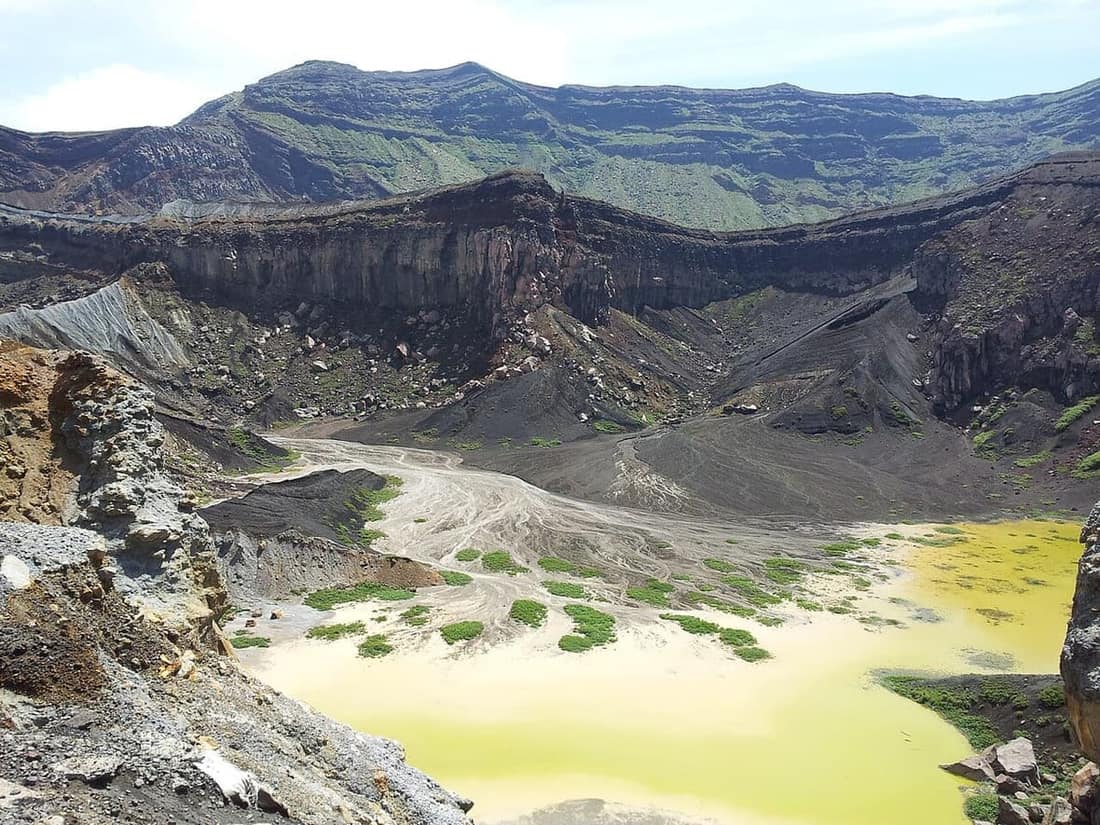
The short answer first, because it is the answer you searched for: no. Mt. Aso's volcanic alert dropped from level 3 back to level 2 on September 1, 2026, and the summit plaza has been reachable again since September 2 — but entry within roughly 1 km of the Nakadake crater is still banned, and no date has been announced for crater viewing to resume. The closure is three layers, and the order matters: crater viewing was first restricted in late January 2026, after a sightseeing helicopter crashed inside the crater on January 20; on June 21 the Japan Meteorological Agency raised the volcanic alert to level 2, banning entry within roughly 1 km of the crater; on August 14 it went to level 3, mountain-entry regulation, with a roughly 2 km no-entry zone; and on September 1 it came back down to level 2. Between those, the magnitude 7.1 Kumamoto earthquake of July 28, 2026 left rail and bus services in a day-by-day state — and as of September 14, the crater shuttle is still suspended and the park road up to the rim is still closed, while the Aso Station bus's route page shows it running to the summit terminal again. And yet the second half of this story matters just as much: a closed crater does not make Aso a wasted trip. Kusasenri's grasslands, the Aso Volcano Museum (confirmed open after the quake), Daikanbo's caldera panorama and the Komezuka cone all operate as usual, and the bus still reaches them. This guide lays out the full closure timeline, the three-layer regulation system, every transport option with prices, and what is genuinely worth doing right now, against official sources.
📍 This guide goes deep on the crater regulation, mountain transport and the summit area only. For what has reopened at Kumamoto Castle since the earthquake, with tickets and hours, see Is Kumamoto Castle open?; for the overnight that pairs best with Aso, see the Kurokawa Onsen guide.
- The crater is still closed: viewing restricted since the January 20, 2026 helicopter accident, alert level 2 (1 km entry ban) from June 21, level 3 mountain-entry regulation from August 14; back to level 2 on September 1, summit plaza reachable from September 2, but the 1 km crater ban stands — park road closed, shuttle suspended, no date for crater viewing to resume
- The mountain bus: the Aso Tozan line's route page currently shows it running to the Aso Sanjo Terminal (nine departures a day from Aso Station) with no shortening notice; the Asochiho bus's level 3 detour notice is gone, though there is a temporary detour on Sept 13 and a timetable change on Oct 1
- Check before you go: aso-volcano.jp shows the day's crater status on its front page; after the July 28 earthquake, rail and bus status must be checked daily too (for the trans-Kyushu bus from September, check the operator directly)
- Aso is not a wasted trip: Kusasenri is free and still bus-accessible, the Aso Volcano Museum is ¥1,300 (confirmed open July 29), and Daikanbo and Komezuka are unaffected
- Normal-times cost structure: crater viewing itself is free — you pay for the road (¥1,000 per car) or the shuttle (¥800 one way), both currently suspended; the Aso Station bus up the mountain is ¥1,000
- Standing health rule: asthma, bronchial or heart conditions, pacemakers — permanently barred from the crater area; the official wording is "risk of death"
📖 Table of contents
- Is Mt. Aso open, and can you visit the crater now?
- The three-layer regulation system
- Transport and costs: road, shuttle, bus, rail
- What Aso still offers while the crater is shut
- From ropeway to shuttle: 68 years of looking into the crater
- Eating and shopping: the summit, Kusasenri and Aso Station
- Is Aso worth the trip right now? A straight answer
- FAQ
Is Mt. Aso open, and can you visit the crater now?
The crater is not open. The volcanic alert is at level 2 (since 16:00 on September 1) with entry banned within roughly 1 km of the crater; since 9:00 on September 2 you can reach the summit plaza, but the park road from the plaza to the crater is closed, the crater shuttle is suspended, crater viewing and Sunasenri-ga-hama are both off-limits, and there is no reopening date. That is the status against the official pages on September 14, 2026, with no new official notice since September 1; for the status on your travel day, check the top of the aso-volcano.jp front page. Nakadake is one of very few active volcanoes where, in normal times, you can drive to the rim and look straight down into a steaming crater, and the 2026 closure is not one event but several stacked on each other, so read it as a sequence:
| Date | Event | What it means for visitors |
|---|---|---|
| Jan 20, 2026 | A sightseeing helicopter crashed inside the Nakadake first crater | Crater viewing restricted from late January; the Aso-san Park Road closed and the crater shuttle suspended (operator notice January 21) |
| Jun 21, 2026 | JMA raised the volcanic alert from 1 to 2 (crater-area regulation) | Entry banned within roughly 1 km of the crater — even if the accident restriction lifted, this ban stands on its own |
| Jul 28, 2026 | The 2026 Kumamoto earthquake (16:27, M7.1, depth 16 km, maximum intensity 7) | JR Hohi line suspended Kumamoto–Miyaji; multiple Sanko bus routes suspended — transport now changes daily |
| Aug 14, 2026 | JMA raised the alert from 2 to 3 (mountain-entry regulation), no entry within roughly 2 km | At the time: crater shuttle suspended, the Aso Tozan bus stopping at Kusasenri, Asochiho bus detouring past both summit stops |
| Sep 1, 2026 | 16:00 — JMA lowered the alert from 3 to 2 (crater-area regulation) | Reason given: a lower chance of an eruption reaching beyond 1 km, out to about 2 km; the crater-area warning remains in force |
| Sep 2, 2026 | From 9:00, the restriction eased to a roughly 1 km no-entry zone around the crater | The summit plaza is reachable again; crater viewing is still off and the crater shuttle is still suspended |
These events are independent of each other — the September 1 downgrade removed only the level 3 layer, while the 1 km crater ban and the post-accident viewing restriction both remain. The JMA's June decision was observational: volcanic tremor amplitude rose above 1.5 μm/s for over an hour at the western flank seismometer, and sulfur dioxide output measured around 1,700 tonnes per day — on the high side. Aso City's page about the park road says only this: the road is closed and crater viewing is not possible "for the time being." That phrase is the entirety of the official schedule information available. Nothing in this article, or anywhere else, can tell you a reopening month.
On the January 20 accident, this article states only what has been made public: a sightseeing helicopter (a Robinson R44 operated by Takumi Aviation, departing from the Cuddly Dominion animal park in Aso) crashed inside the Nakadake first crater; the three people aboard died, two of them travelers from Taiwan. The steep ash slopes and ongoing volcanic activity have made recovery operations extremely difficult, with reports as late as June 2026 describing plans to use heavy unmanned machinery. The cause remains under investigation and this article does not speculate. Aso City has stated that, out of consideration for the bereaved families, the viewing restriction continues for the time being.
⚠️ Three official pages to check before you travel (the crater regulation here was verified on September 14, 2026, bus and rail status on September 11, shop hours and part of the earthquake picture on August 1, and each is labelled):
① Crater regulation: Aso Volcano Disaster Prevention Council — today's status sits at the top of the front page;
② Alert level: JMA volcano warning map;
③ Crater shuttle status: Kyushu Sanko Aso-sanjo information page.
The three-layer regulation system
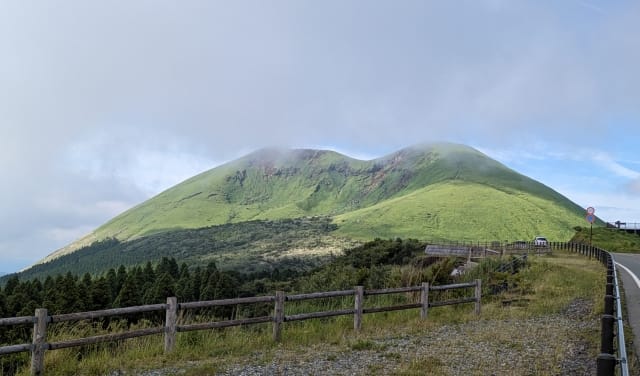
Even on the day the crater eventually reopens, you will still need to understand this system, because at Aso "open" is never a switch — it is three conditions holding true at once. Two of the layers will be familiar if you have read about other regulated volcano sites; the third is something few places have: a hard health-based entry ban.
Layer one, by period: the volcanic alert level
| Level | Name | Restriction | Crater viewing |
|---|---|---|---|
| 1 | Be aware it is an active volcano | — | Possible (still subject to the day's gas and weather controls) |
| 2 (current, from Sep 1, 2026) (previously Jun 21 – Aug 13, 2026) | Crater-area regulation | No entry within roughly 1 km of the crater (the summit plaza is reachable) | Not possible |
| 3 (Aug 14 – Sep 1, 2026) | Mountain-entry regulation | Set by the warning issued at the time; roughly 2 km both in August 2026 and in the October 2021 eruption | Not possible |
Level 3 is not hypothetical — this mountain reaches it. On October 20, 2021 at 11:43, the Nakadake first crater erupted with a plume 3,500 meters above the rim and a pyroclastic flow that ran more than a kilometer; the alert went from 2 to 3 the same day. It happened again on August 14, 2026, and lasted 18 days before the level came back down to 2 on September 1. The level genuinely moves in both directions without notice, which is why no forecast of "it should drop to level 1 and the crater reopen by month X" deserves your trust.
Layer two, by day: volcanic gas — closures happen even at level 1
Past the alert level, every single day has a gas gate. The authorities manage the viewing area in zones based on sulfur dioxide concentration and wind direction, and when readings spike, sections close on the spot — which is why "we drove all the way up and couldn't see the crater" stories predate the current closure by decades. The system is formal enough that the shuttle has a named operating mode for it: during gas-control periods it runs "E-zone operation," selling round trips only at ¥1,600 for adults, because you may get minutes at the top before being pulled back. The 1,700-tonnes-per-day reading from June 21 is a live example of how dynamic that indicator is.
🚫 The standing health ban — a rule, not advice, and unrelated to the current closure: the Aso Volcano Disaster Prevention Council permanently prohibits entry to the crater area for people with asthma, bronchial conditions, heart conditions, or anyone feeling unwell, stating plainly that volcanic gas carries a risk of death for them. The shuttle operator adds pacemaker wearers to the prohibited list. If any of this applies to you, design your Aso day around Kusasenri, the museum and Daikanbo from the start — all outside the gas-control area.
Layer three, by hour: weather and operating windows
Innermost is the physical day: the official hours page notes that operating times can change according to gas conditions and weather, and that different zones may close at different times. Fog, wind and road conditions can turn "open this morning" into "closed right now." Stack the three layers and the practical conclusion writes itself: the Aso crater should never be the must-happen centerpiece of an itinerary — in any year. It is the bonus you collect when every condition lines up.
Transport and costs: road, shuttle, bus, rail
The big principle first: crater viewing is free. There is no ticket — everything you pay for is a road or a seat. Here is the complete normal-times system, with each piece's actual status (park road and crater shuttle checked September 14, 2026; buses September 11).
Aso-san Park Road (the drive-up option — currently closed)
Aso City's toll road is how drivers normally reach the crater rim:
| Vehicle | Toll |
|---|---|
| Bicycle | Free |
| Motorcycle | ¥400 |
| Regular car | ¥1,000 |
| Microbus (up to 29 seats) | ¥2,800 |
| Medium bus (over 8t gross) | ¥3,300 |
| Disability discount (regular car) | ¥500 |
| Full-size bus | Not permitted (passengers transfer to the shuttle) |
Hours run in three seasonal bands: summer (Mar 20–Oct 31) 8:30–18:00 with the gate shut at 17:30; November 8:30–17:30; winter (Dec 1–Mar 19) 9:00–17:00. Walkers must start up at least an hour before gate closure. The viewing area sits on the crater's west side, around the old ropeway's Kakonishi station; the road between the summit-plaza car park and the Sensuikyo side on the east is permanently off-limits. All of the above is currently on pause: the road is closed with no reopening date. What reopened on September 2 is the summit plaza; the park road from the plaza up to the crater is still shut.
The crater shuttle (Sanjo Terminal to the rim — currently suspended)
The bus that took over when the ropeway was abolished in 2019 (that story below). Normal-times facts: ¥800 one way for adults, ¥400 for children, about five minutes each way, 32 seats. Eleven runs a day — one reservable 9:05 departure (booked by phone, one month to three days ahead) plus ten walk-up runs from 9:45 to 15:35. Payment is cash, the local Kumamon IC card or contactless credit — national transit IC cards like Suica do not work, an unusual trap worth remembering. During gas-control periods it switches to round-trip-only E-zone operation. Right now, with the road gated, the shuttle is fully suspended: as of September 14, Sanko's Aso-sanjo information page still says it is not running because the park road is closed. The drop back to level 2 did not bring it back, and no restart date has been given.
The Tozan line bus (Aso Station ⇔ Kusasenri ⇔ Sanjo Terminal)
This is the route that matters most right now — even with the crater shut, it is how car-free visitors reach Kusasenri and the volcano museum. During the level 3 period (August 14 to September 1) it terminated at the Kusasenri Aso Volcano Museum stop; since the summit plaza became reachable again on September 2, Sanko's route page (checked September 11) lists the line as Aso Station ⇔ Kusasenri / Aso Sanjo Terminal, with no shortening notice. Fares since the October 2025 revision:
| Section | One way |
|---|---|
| Aso Station ⇔ Aso Sanjo Terminal | ¥1,000 |
| Aso Station ⇔ Kusasenri / Aso Volcano Museum | ¥1,000 |
| Kusasenri ⇔ Aso Sanjo Terminal | ¥330 |
Sanko's route page currently lists nine departures a day from Aso Station and ten down from the terminal (same on weekdays and weekends), about 35 minutes from Aso Station to the terminal. For the individual departure times, go straight to the timetable on the Tozan line route page rather than older lists. The operator's own caveats deserve quoting: full buses may leave you at the stop, and connections to other services are not guaranteed. Treat it as a nine-runs-a-day mountain route with standing-room risk, not a metro, and re-check the service status page on the day you ride. One more thing to note: the level 3 detour notice for the Asochiho bus between Aso and Takachiho is no longer on its route page, but a road closure for the Aso-san Hill Climb cycling race puts some runs on a temporary detour on the morning of September 13, and a timetable revision with a new stop takes effect October 1 — if you plan to hop off at Kusasenri, confirm the stop on the route page's timetable first.
Getting there from Kumamoto: rail and highway bus (changing daily since the quake)
⚠️ The items below mix two verification dates, August 1 and September 11, 2026 (each is labelled), with services being restored in stages after the M7.1 earthquake. Check before departure: JR Kyushu earthquake service information / Kyushu Sanko service status.
- JR Hohi line (checked Aug 1): in normal times, Kumamoto to Aso takes about 1.5 hours by local train with a change at Higo-Ozu, around ¥1,300 (a third-party fare-database figure — confirm against JR Kyushu). Since the quake, the Kumamoto–Miyaji section was suspended as of July 29; the Aso Boy limited express was reported to resume August 1, but that could not be confirmed officially at publication. Riding it on a JR Kyushu rail pass? Here is the part that is easy to get backwards: reserving a seat at a station ticket office once you are in Japan is free (unlimited on the All Kyushu pass, up to six times on the Northern and Southern passes). The only charged option is booking ahead from home through the official online system, where a Design & Story sightseeing train like the Aso Boy costs ¥1,500 per reservation — see our Kyushu 3-day rail itinerary.
- Sanko express bus (Kumamoto ⇔ Aso Sanjo Terminal via Kusasenri) (checked Sep 11): suspended August 1–3 after the quake; its route page now shows normal operation, one round trip a day, with reservations required for the Kumamoto Station to terminal section.
- Kyushu Odan (trans-Kyushu) bus (checked Sep 11): a quake-reduced timetable was announced through August 31; whether full service returned in September was not obtained for this update. If you are chaining Aso to Kurokawa or Yufuin, check the times on Sanko's service status page before you go rather than relying on an older timetable.
- Asochiho bus (Aso ⇔ Takachiho) (checked Sep 11): three round trips a day on the route page, and the level 3 detour notice is gone; a cycling-race road closure causes a temporary detour on the morning of September 13, and a new stop and timetable revision take effect October 1. The volcano-plus-mythology pairing of Aso and Takachiho still works — see our Takachiho Gorge guide. The Takamori line (Kumamoto ⇔ Takamori) and the Hinokuni bus (Fukuoka ⇔ Kumamoto) were running normally as of the August 1 check.
- Minamiaso Railway: fully restored in July 2023 after the 2016 earthquake; its status after the 2026 quake was not verifiable for this article — check the operator directly.
What Aso still offers while the crater is shut
This is the section this article actually exists for. "Aso = the crater" is a false equation: Aso is one of the world's great calderas — an inhabited volcanic basin ringed by a hundred-kilometer rim — and the crater is one star in it. Everything below is unaffected by the crater regulation and sits outside the 1 km crater zone; Kusasenri and the museum were still operating when re-checked on September 11, 2026:
Kusasenri-ga-hama: the free centerpiece
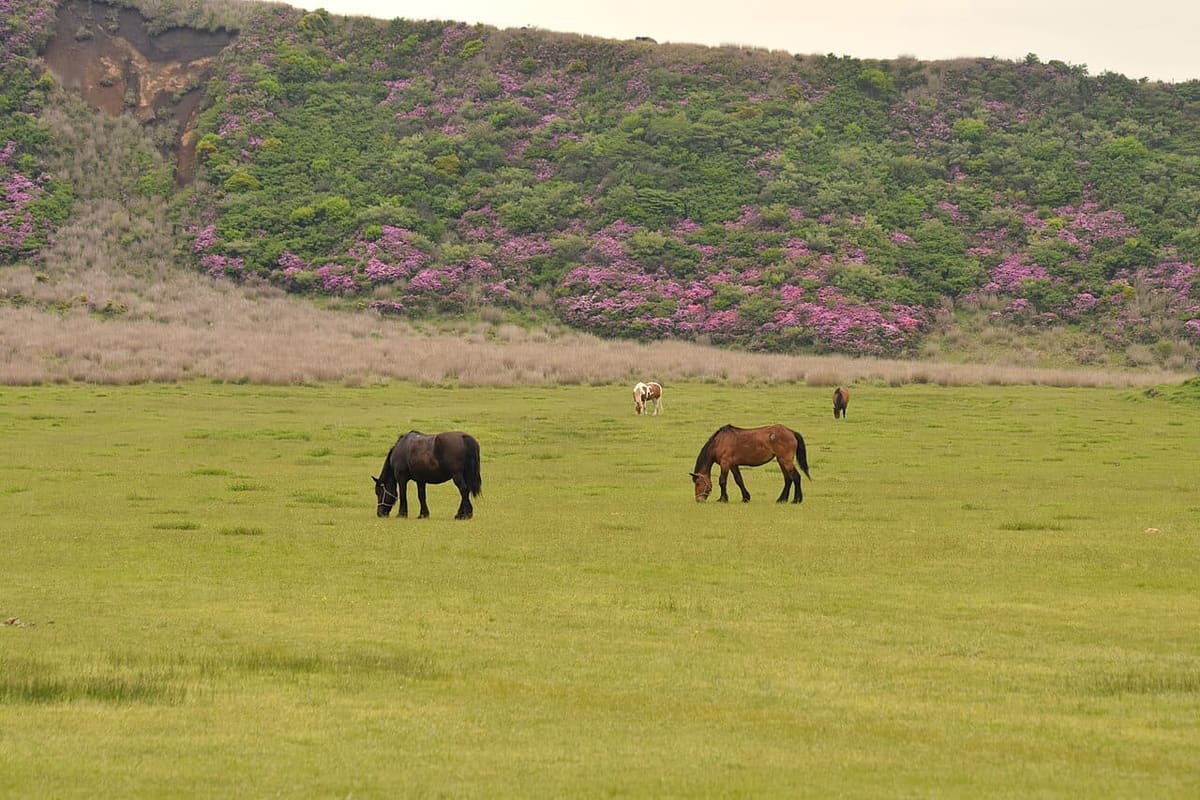
A sweeping grassland in an old crater basin below Eboshidake, with a rain-fed lake and grazing horses. Entry is free; the car park uses plate-reading pay-on-exit machines at roughly ¥500 per day for cars and ¥200 for motorcycles (confirm the posted rate on site). Horse-riding is offered — prices at the counter. And from here you can watch Nakadake's plume rise across the grass: with the rim closed, this is the realistic distance from which to "see the volcano."
Aso Volcano Museum: currently the only way to look into the crater
Right beside Kusasenri: adults ¥1,300, elementary children ¥650, seniors 65+ ¥1,100, open 9:00–17:00 (last entry 16:30), 40–50 minutes to do properly. Two things give it extra weight right now. First, the museum has cameras mounted on the crater wall, so its live feed is the one legitimate way to look inside Nakadake at all while the rim is closed. Second, after the July 28 earthquake the museum confirmed on the morning of July 29 that it was open as usual — the first summit-area facility to say so publicly. A summer VR program was also announced for 2026. One warning: the ¥880 admission price floating around third-party sites is outdated.
Daikanbo: the caldera in one frame
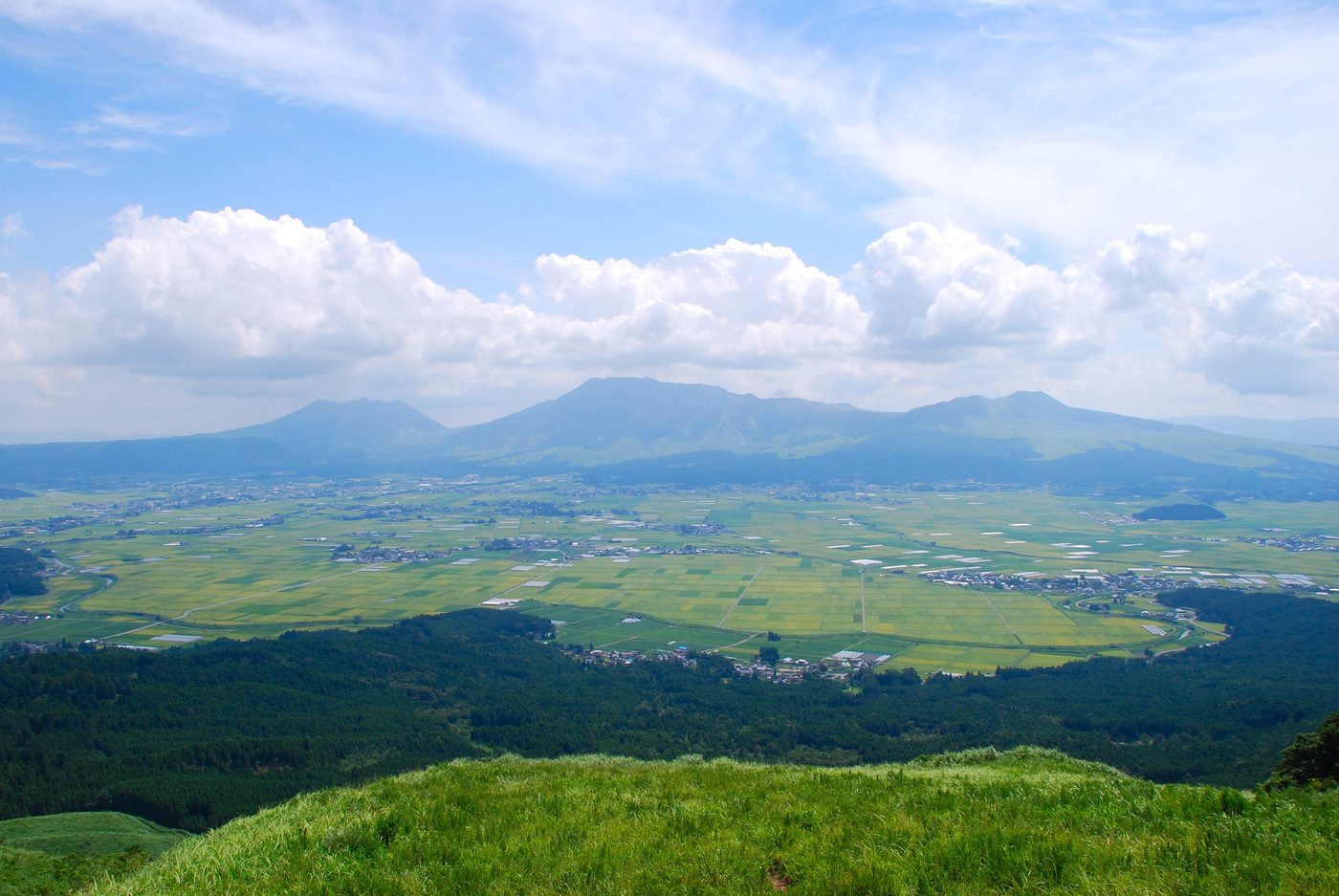
The highest lookout on the northern caldera rim, taking in the entire basin — the five peaks, the farmland, the towns — in a single panorama, with a chance of a sea of clouds on crisp autumn mornings. Free, easiest by car, and located far outside the crater zone.
Komezuka: look, don't climb
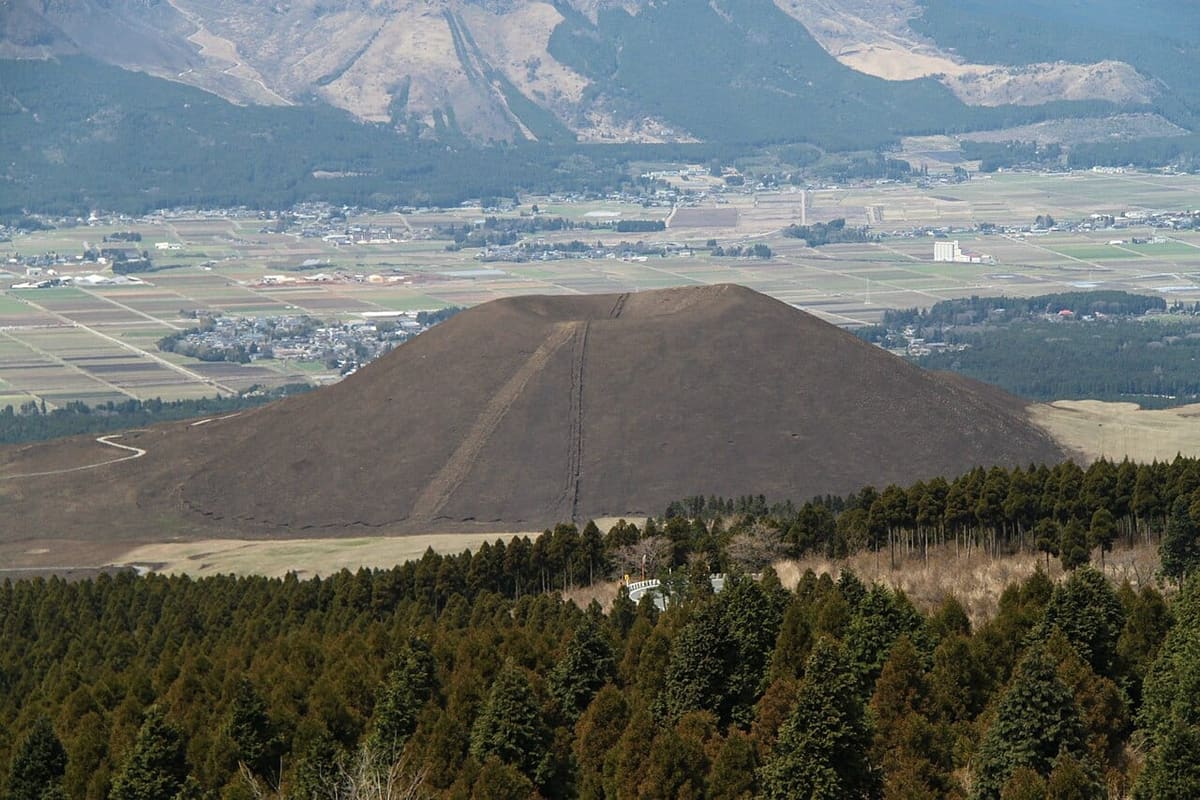
The perfectly proportioned miniature cone on Aso's postcard shots. One thing to be clear about: climbing Komezuka is prohibited. It used to be allowed, foot traffic stripped the slopes bare, and it is now fenced for vegetation recovery. The roadside view along the prefectural road is the intended experience — and it photographs better from there anyway.
No car: a day tour from Fukuoka
If you have no car and want Kusasenri and Kurokawa Onsen in the same day, a day tour from Fukuoka is the other way to do it. This GetYourGuide tour meets outside Hakata Station and runs Kamishikimi Kumanoimasu Shrine, then Kusasenri, then Kurokawa Onsen, so there is no crater stop in its itinerary to lose; its page also mentions the traffic controls since the helicopter accident. Guiding is in English and Chinese. Check the tour page's latest notice before you book.
Sunasenri and the hiking routes: Sunasenri still closed
Sunasenri-ga-hama, the ash plain south of the crater, has been closed since June 15 for emergency works, and Aso City's hiking page currently says that under alert level 2 both crater viewing and Sunasenri-ga-hama remain off-limits. Hikers heading for Nakadake and Takadake do have a way through: the same page says that at level 2 you can use the Sarayama detour or the Suzume-iwa detour, which route around the 1 km crater circle. The level 3 period from August 14 to September 1 was literally called mountain-entry regulation and effectively closed those detours too; with the drop back to level 2 they are the sanctioned way up again. Check the regulation map on aso-volcano.jp before planning any summit route, stick to the two detours Aso City lists, and do not treat an older guide's route as a workaround.
From ropeway to shuttle: 68 years of looking into the crater
Getting ordinary visitors to an active crater rim has nearly seventy years of history at Aso, across three generations of hardware — and knowing it explains why today's system looks the way it does.
Generation one: the ropeway (1958–2019). The Aso-san Ropeway opened in April 1958, running 858 meters from Asosan-Nishi station up to Kakonishi by the crater — a pioneering piece of infrastructure that turned an active crater into a mass-tourism destination. Its end came not from one disaster but from attrition: the 2014 escalation in Nakadake's activity started a long suspension; the 2016 Kumamoto earthquake cracked the station building and all four support pylons; in October 2018 operator Kyushu Sanko announced it would not rebuild; and in December 2019 the ropeway was formally abolished, closing a 61-year run.
Generation two: the shuttle (2020–). On November 1, 2020, the crater shuttle bus took over the last leg from the Sanjo Terminal. Within a year it met the October 20, 2021 eruption — plume 3,500 meters, pyroclastic flow past the kilometer mark, alert level to 3. This system was designed from day one around the assumption that it would regularly have to stop.
Then came 2026's four-punch year: the January accident put crater viewing under open-ended restriction, June's level 2 closed the whole 1 km circle, July's M7.1 quake hit the transport that feeds the mountain, and August 14's level 3 shut mountain entry outright — after the September 1 drop back to level 2 the summit plaza is reachable again, but the crater itself stays closed. Read across the 68 years and you get the one insight that actually helps you plan: crater tourism at Aso has always been time borrowed from an active volcano. Getting it is luck; not getting it is part of the deal. Plan with that mindset and a closed rim cannot sink your Kyushu trip.
Eating and shopping: the summit, Kusasenri and Aso Station
Worth saying explicitly, because many assume "crater closed = mountain closed": the Kusasenri businesses are operating normally. Each entry links to Google Maps; details verified August 1, 2026:
- Aso Sanjo Terminal (map): in normal times the Tozan bus terminus, with a cafe and shop open 9:00–16:30 and the gray volcanic-ash soft serve that is the color joke of the mountain, plus Kumamon goods. ⚠️ During the level 3 period (August 14 to September 1) neither the Tozan line nor the Asochiho bus came here; since September 2 the summit plaza is reachable again and the Tozan line's route page shows it running to the terminal, but no official notice on whether the cafe and shop are open was found in this re-check — before going up just for the ash soft serve, check Sanko's Aso-sanjo information page.
- New Kusasenri (map): ground-floor produce hall, the Kusasenri coffee roastery and an ASOMILK ice-cream counter; upstairs, the Kusasenri Shokudo serves akaushi beef bowls and horse-meat dishes with the grassland out the window.
- Kusasenri Rest House (map): a second-floor viewing restaurant, again built around akaushi bowls and steaks, with souvenirs and a cafe below.
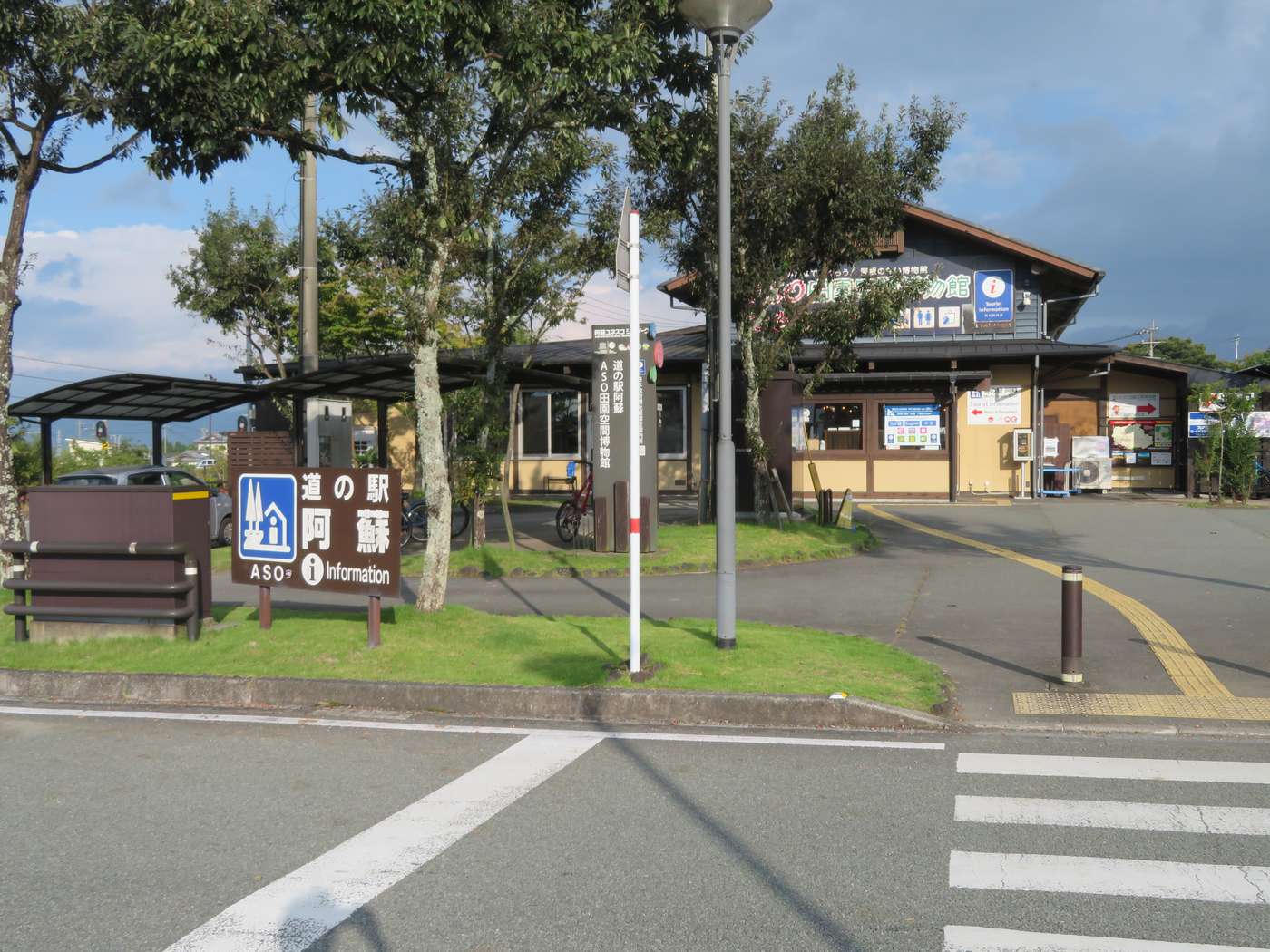
- Michi-no-Eki Aso (next to Aso Station, map): 9:00–18:00 (seasonal), open year-round — local vegetables, meat, ASOMILK dairy and handmade bento. The natural buffer stop between train and bus.
- Imakin Shokudo (Uchinomaki 290, in the Uchinomaki onsen quarter, map): a century-old canteen and the origin landmark of the akaushi-don. Open 11:00–15:00, closed Wednesdays, with queues even on weekdays. Uchinomaki needs a bus or car from Aso Station — budget the wait.
A word on the akaushi bowl itself: akaushi is Kumamoto's Japanese Brown breed — lean, red, with real chew and flavor — usually crowned with a soft-set onsen egg. Budget around ¥2,000 as an order of magnitude; menus vary by shop. My take is simple: if your route passes Uchinomaki, make the Imakin pilgrimage; if it doesn't, eat it at Kusasenri and lose nothing — a detour plus an hour's queue for one bowl is a poor trade for most itineraries, and the Kusasenri versions come with a grassland view.
Is Aso worth the trip right now? A straight answer
Two sentences: for the crater — no. For Aso itself — yes, and more confidently than you might expect.
The "no" is arithmetic. The viewing area is closed with no timetable — the alert dropped from level 3 back to 2 on September 1, but the 1 km crater ban stands and the shuttle is still suspended; travel there for the crater and the closest you get is the summit plaza, watching the plume from behind the cordon and reading a sign. Betting a day of your trip on "maybe it reopens by the time I go" is a wager with no posted odds — the officials have not even given you the information needed to estimate them.
The "yes" is the rest of the hand. Kusasenri's scale, Daikanbo's full-caldera panorama, the museum's live crater feed, Komezuka's geometry — that is a complete day that never depended on the rim. Add an overnight at Kurokawa Onsen (the ¥1,500 wooden pass and its three open-air baths are covered in our Kurokawa Onsen guide), or continue east to Takachiho on the Asochiho bus, still running — check its route page for temporary detours before you go (Takachiho Gorge guide), and the itinerary loses almost nothing to the closure. For a base, look at Uchinomaki onsen, Minamiaso or Kurokawa, and plan around a car. Each booking site's area list is below; pick whichever you already use:
| Area | Booking.com | Agoda | Rakuten Travel |
|---|---|---|---|
| Uchinomaki Onsen / Aso Station (Aso City) | Uchinomaki | Aso (Aso City and Minamiaso share one list) | Aso City |
| Minamiaso (Minamiaso Village) | Minamiaso | Minamiaso Village | |
| Kurokawa Onsen (Minamioguni Town) | Minamioguni | Minamioguni | Minamioguni Town |
These lists open on today's date by default, so change the dates to your actual nights before comparing anything.
And one honest addendum: if the entire point of your Kyushu trip is standing at an active crater's edge, and your dates fall inside Aso's closure, Sakurajima in Kagoshima is the realistic substitute — a 15-minute ferry, the Yunohira observatory and lava-field walks, with a volcanic presence every bit as strong; for the ferry and the volcano's current alert level, see our Sakurajima ferry guide. The Unzen hells offer the same volcanic geology from the Shimabara side — see the Unzen & Shimabara guide.
The last word is the most useful one: the crater regulation here was verified on September 14, 2026, bus and rail status on September 11, the shop hours and part of the earthquake picture on August 1. Crater regulation at aso-volcano.jp, rail at JR Kyushu's service page, buses at Sanko's status page — after this earthquake, check the night before and again the morning of. That is the single most valuable habit this guide can leave you with.
Frequently Asked Questions
- Q1:Is the Mt. Aso crater open right now?
- No, not as of September 14, 2026. The volcanic alert dropped from level 3 back to level 2 on September 1, and from 9:00 on September 2 the restriction eased to a roughly one-kilometer no-entry zone around the crater, so the summit plaza can be reached again. Crater viewing itself is still off: the Aso-san Park Road, the toll road from the summit plaza up to the crater rim, is shut, and the crater shuttle bus that replaced the old ropeway is still suspended. The closure has three separate layers, and the order matters: crater viewing was first restricted in late January 2026 after a sightseeing helicopter crashed inside the Nakadake first crater on January 20; on June 21 the Japan Meteorological Agency raised the volcanic alert level from 1 to 2, banning entry within roughly one kilometer of the crater; on August 14 it raised the level again to 3, mountain-entry regulation, with entry banned within roughly two kilometers; and on September 1 it came back down to 2. Even if the alert eventually drops to level 1, whether the accident-related restriction lifts is a separate question. Check the official crater regulation site, aso-volcano.jp, whose front page shows the current status each day.
- Q2:When will the Aso crater reopen?
- Nobody has published a date, and any article that names a month is guessing. The alert level — level 2 from June 21, level 3 from August 14, back to level 2 from September 1, 2026, with the one-kilometer crater ban still in force — depends on the volcano itself: the JMA raised it in June based on increased volcanic tremor and sulfur dioxide output of around 1,700 tonnes per day, and there is no way to forecast when those readings will settle. The accident-related restriction is separate: Aso City has said the viewing restriction will continue for the time being out of consideration for the bereaved families, with recovery of the wreckage from inside the crater still proving difficult as of mid-2026 reporting. The only practical approach is to check two official sources shortly before your trip: aso-volcano.jp for the crater regulation status and the JMA volcano warning map for the alert level, and to plan Aso so that the crater is a bonus rather than the centerpiece.
- Q3:Can people with asthma or heart conditions visit the crater when it is open?
- No, and this is a standing official rule rather than advice — it applies whenever the crater is open, independent of the current closure. The Aso Volcano Disaster Prevention Council states that toxic volcanic gas flows around the crater and that people with asthma, bronchial conditions, heart conditions, or anyone feeling unwell are permanently barred from entering, using the phrase "shi ni itaru osore" — risk of death. Kyushu Sanko, the shuttle operator, adds pacemaker wearers to the prohibited list on the grounds that the gas is life-threatening for them. If any of these apply to you, build your Aso day around Kusasenri, the volcano museum and Daikanbo instead; those sit outside the gas-control zone and are unaffected.
- Q4:Is Mt. Aso still worth visiting while the crater is closed?
- Yes, provided you aim your expectations correctly. The crater is one highlight of an enormous volcanic caldera, not the whole show. Kusasenri-ga-hama, the grassland basin with its rain-fed crater lake, is free and open as always; the Aso Volcano Museum next to it charges 1,300 yen for adults, confirmed open on July 29, 2026 after the earthquake, and its live camera feed from the crater wall is currently the only legitimate way to look inside the crater at all; Daikanbo on the northern caldera rim gives you the full panorama of the basin and can produce a sea of clouds on autumn mornings; and Komezuka, the perfectly shaped miniature cone, is a roadside photo classic, though climbing it is prohibited for vegetation protection. Add an overnight at Kurokawa Onsen and the itinerary loses very little from the crater being shut. What is not worth doing is flying to Kyushu specifically to stand on the crater rim — that is currently impossible and has no announced return date.
- Q5:How much does crater viewing cost when it operates?
- Viewing itself is free — there is no admission ticket. What you pay for is the road. Driving up the Aso-san Park Road costs 1,000 yen for a regular car and 400 yen for a motorcycle, while walking and cycling are free; large buses cannot use the road at all and transfer to the shuttle instead. Without a car, the crater shuttle from the Aso Sanjo Terminal costs 800 yen one way for adults and takes about five minutes, and during gas-control periods it switches to a round-trip-only mode at 1,600 yen. All of this is the normal-times system and all of it is currently suspended: the road is closed and the shuttle is not running, and the September 1 drop back to alert level 2 has not changed that. The local Tozan line bus from Aso Station still operates: during the level 3 period (August 14 to September 1) it ran only as far as Kusasenri, and since the summit plaza became reachable again on September 2, Sanko's route page shows it running to the Aso Sanjo Terminal; the fare is 1,000 yen to either the Kusasenri Aso Volcano Museum stop or the terminal.
- Q6:How has the July 2026 Kumamoto earthquake affected getting to Aso?
- Significantly, and the situation changes day by day, so this answer carries two verification dates. As of August 1, 2026: the JR Hohi line between Kumamoto and Miyaji was suspended as of the July 29 JR Kyushu notice, and there were reports of the Aso Boy limited express resuming from August 1, but that could not be confirmed against an official page at publication. As of September 11, 2026, three updates: Sanko's Kumamoto to Aso Sanjo Terminal bus shows normal operation on its route page, one round trip a day; the Kyushu Odan (trans-Kyushu) bus had a quake-reduced timetable announced through August 31, and its status from September was not obtained for this update, so check the operator directly; and the Asochiho bus route page no longer shows the level 3 detour notice, though a cycling race causes a temporary detour on the morning of September 13 and a timetable revision with a new stop takes effect October 1. Before traveling, check the JR Kyushu earthquake service page and the Kyushu Sanko service status page — this article deliberately makes no predictions about restoration timelines.
- Q7:How do I get up the mountain without a car?
- Take the JR Hohi line to Aso Station — in normal times about 1.5 hours from Kumamoto by local train with a change at Higo-Ozu, around 1,300 yen per third-party fare databases, to be confirmed against JR Kyushu — then the Kyushu Sanko Tozan line bus from the station forecourt. It costs 1,000 yen to the Kusasenri Aso Volcano Museum stop, and the full run to the Aso Sanjo Terminal takes about 35 minutes. During the level 3 period (August 14 to September 1, 2026) the line stopped at Kusasenri; since September 2 the summit plaza is reachable again and Sanko's route page shows the line running to the terminal, with nine departures a day from Aso Station and ten back down. Check the route page for the individual departure times. Two caveats straight from the operator: you may not get on when buses are full, and connections to other transport are not guaranteed.
Read next
Is Kumamoto Castle Open? 2026 Quake Status, Tickets & Hours
Kumamoto Castle reopened on 13 August 2026, but Wakuwakuza is closed, combo tickets are off sale and one car park is shut — tickets, hours and Shiro Akari.
Kurokawa Onsen Guide 2026: The Bath-Hopping Pass, Yuakari & Access
A townscape-protected cure town — a ¥1,500 pass for three open-air baths, the winter Yuakari lanterns, and reaching a village with no railway.
Takachiho Gorge Guide 2026: Rental Boats, Night Kagura & Access
The home of the "descent of the heavenly grandson" myth — rowing up to Manai Falls, nightly kagura at Takachiho Shrine, and reaching a town with no railway.
📊 See the 2026 Price Index (JR Pass, DPA, eSIM, Airport Transport) →