Twelve of the 19 components carry the word "ruins" in their official names. And for 30 days, from 19 September to 18 October 2026, three National Treasure mural panels go on show simultaneously for the only time this year — while the shuttle bus the government laid on for exactly that window states, in writing, that it will not accept the Asuka Loop Bus day pass you are probably holding. This article answers one question: where is the stuff. The palace is in a free AR app. The Yamadadera cloister is in a museum three kilometres away in a different municipality. The murals of two burial mounds were peeled out and locked into two other buildings — and the most important of those closed in April 2026, with the government saying it will not reopen until around 2030.
- The problem is not "there is nothing here" — it is that everything was moved. The authorities built a free exhibition room, made a free AR app, and put the excavated cloister in a museum. Arrive without knowing that and the day feels wasted.
- Only one of the two painted tombs shows real murals. Kitora has three announced FY2026 sessions, free, advance booking required. Takamatsuzuka has zero FY2026 sessions; the hall on site displays reproductions.
- The 19 Sep–18 Oct shuttle does not accept the loop bus day pass. The official notice says so verbatim. In the same window Takamatsuzuka's car park shuts and Ishibutai's becomes motorcycle-only.
- The Fujiwara Palace Site is on a different bus network. Kashihara's community bus, flat ¥220, runs 7 services on weekdays and only 5 at weekends — and only reaches Kashiharajingu-mae at weekends.
- 9–18 October is the strongest window of the year. Three-panel mural viewing, the inscription-anniversary special exhibition, and the weekend shuttle all overlap.
📖 Contents (tap to expand)
- What exactly got inscribed?
- Twelve components are "ruins" — so what is there to look at?
- Fujiwara Palace Site: download the app first
- Can you see the murals?
- Is Asukadera Temple the same place as Asukadera Temple Site?
- How do you get around?
- Visit between 2026 and 2030 and the visitor centre is shut
- When is the best time to go in 2026?
- Can you do it in a day?
- Appendix: original Japanese sources
What exactly got inscribed?
An entire ancient capital region, not a building. "Asuka-Fujiwara no Miyako" was approved on 26 July 2026 at the 48th session of the World Heritage Committee in Busan. The official UNESCO English name is Ancient Capitals of Asuka and Fujiwara.
Get the counting right, because it is routinely garbled. The Agency for Cultural Affairs states that Japan holds 22 cultural properties and 5 natural properties, 27 in total. So the accurate phrasing is Japan's 27th World Heritage Site, and its 22nd cultural one — not "the 27th cultural site".
The property spans three municipalities. Asuka Village holds most of it; Kashihara City has four components, which the city itself lists as the Fujiwara Palace Site, Shobuike Kofun, Moto-Yakushiji Temple Site and Daikandaiji Temple Site; and Sakurai City has exactly one, the Yamadadera Temple Site. Sakurai is one of the four bodies in the promotion council, yet it holds a single component — and the finds that made that component famous were moved to Asuka Village. More on that in a moment.
| Group | No. and official name | Municipality |
|---|---|---|
| Palaces and government offices | 01 Asuka Palace Site | Asuka Village |
| 02 Asuka Capital Site Garden Ponds | Asuka Village | |
| 03 Asuka Mizuochi Site | Asuka Village | |
| 04 Sakafuneishi Site | Asuka Village | |
| 13 Fujiwara Palace Site | Kashihara City | |
| Buddhist temple sites | 05 Asukadera Temple Site | Asuka Village |
| 06 Tachibanadera Temple Site | Asuka Village | |
| 07 Yamadadera Temple Site | Sakurai City | |
| 08 Kawaradera Temple Site | Asuka Village | |
| 09 Hinokuma-dera Temple Site | Asuka Village | |
| 14 Daikandaiji Temple Site | Asuka Village + Kashihara City | |
| 15 Moto-Yakushiji Temple Site | Kashihara City | |
| Burial mounds | 10 Ishibutai Kofun | Asuka Village |
| 11 Shobuike Kofun | Kashihara City | |
| 12 Kengoshizuka Kofun | Asuka Village | |
| 16 Tomb of Emperor Tenmu and Empress Jito | Asuka Village | |
| 17 Nakaoyama Kofun | Asuka Village | |
| 18 Kitora Kofun | Asuka Village | |
| 19 Takamatsuzuka Kofun | Asuka Village |
Count them and the shape of the trip appears. Twelve names contain the word "ato" or "iseki" — ruins or archaeological site — of which 11 end on it (the Asuka Capital Site Garden Ponds carries it in the middle). The remaining seven are all burial mounds.
One more thing the authorities have not caught up on: as of late August 2026, the official component-introduction page is still headed "introducing the candidate components". A month after inscription the wording has not been updated. If you hit the word "candidate" while researching, that is why.
Twelve components are "ruins" — so what is there to look at?
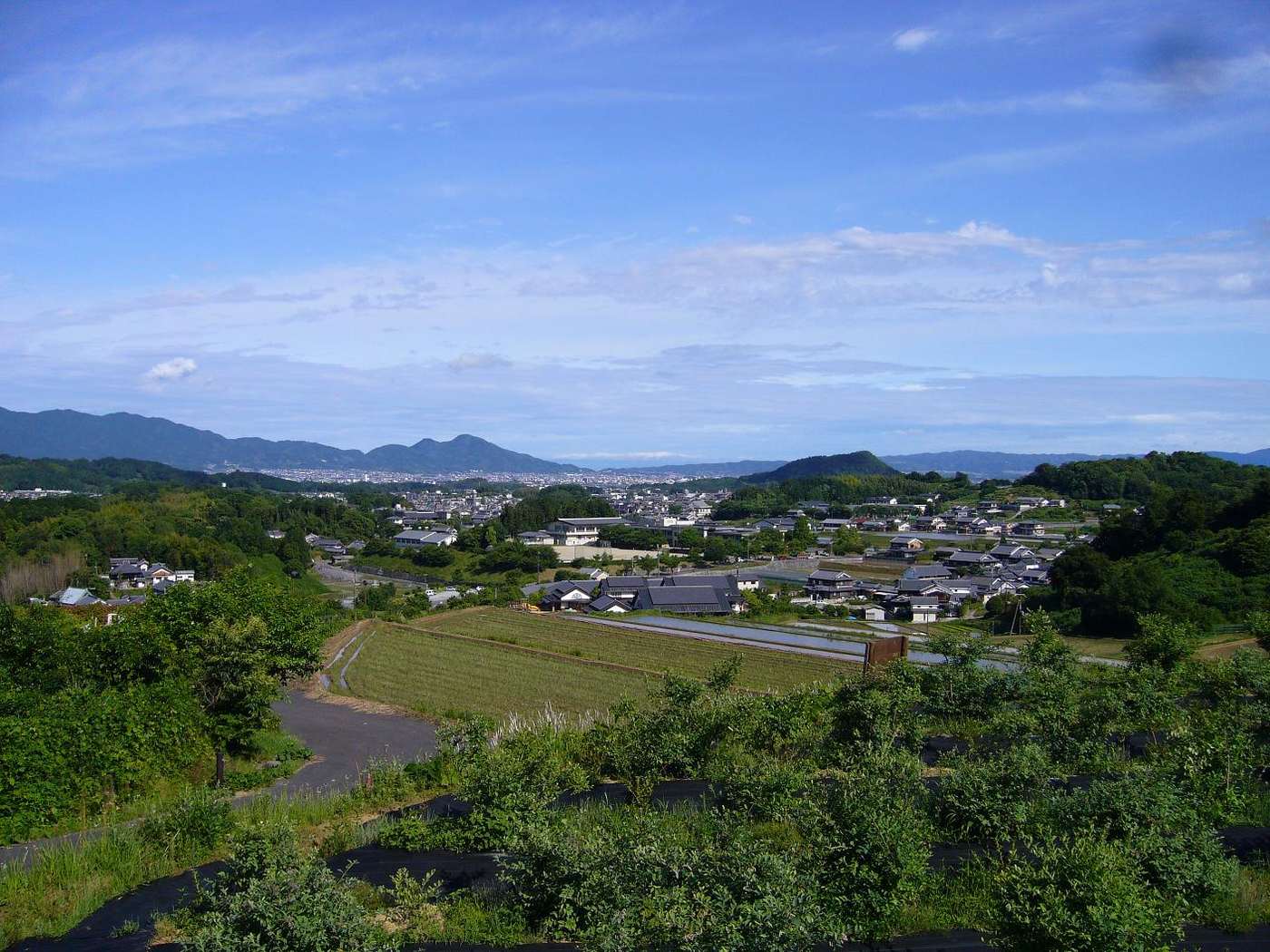
Look at the three places the authorities moved everything to. Asuka's buildings did not slowly crumble; they were dismantled and carted off. The official description of the Fujiwara Palace Site says it plainly: when the capital moved to Heijo-kyo in 710, the main buildings were taken apart and relocated, and the Great Audience Hall at Heijo Palace is said to have been transplanted from Fujiwara.
So the ground really is empty. The authorities know it is empty, and have done three things about it.
- A free AR app that puts the reconstructed palace back on the site — the next section is entirely about it.
- A free exhibition room, Kashihara City's Fujiwara-kyo Exhibition Room, holding a 1:1000 reconstruction model roughly seven metres by six.
- The excavated originals, moved into a museum. Yamadadera's east cloister was unearthed in the collapsed position it fell in, preserving a building style older than Horyuji. The official page states directly that these timbers are on permanent display at the Nara National Research Institute's Asuka Historical Museum.
That last one deserves a pause. The inscribed component "Yamadadera Temple Site" is in Sakurai City, where you will find ground-level markers. The timbers that made it famous are in Asuka Village, inside the ¥350 museum. The two are about three kilometres apart, in different municipalities. Travellers who do not know this stand in Sakurai looking at grass and go home saying Asuka has nothing.
There is a counterexample, and it is a good one. Kengoshizuka Kofun opened to the public on 6 March 2022 after a full reconstruction. Viewing is free, the path through is open all day, and the octagonal form has been rebuilt so you can actually read the shape — a form reserved in the Asuka period for emperors alone, with Empress Saimei the leading candidate for its occupant. If you want one thing on this trip that has a shape, is free, and cannot be closed on you, this is it.
Fujiwara Palace Site: download the app first
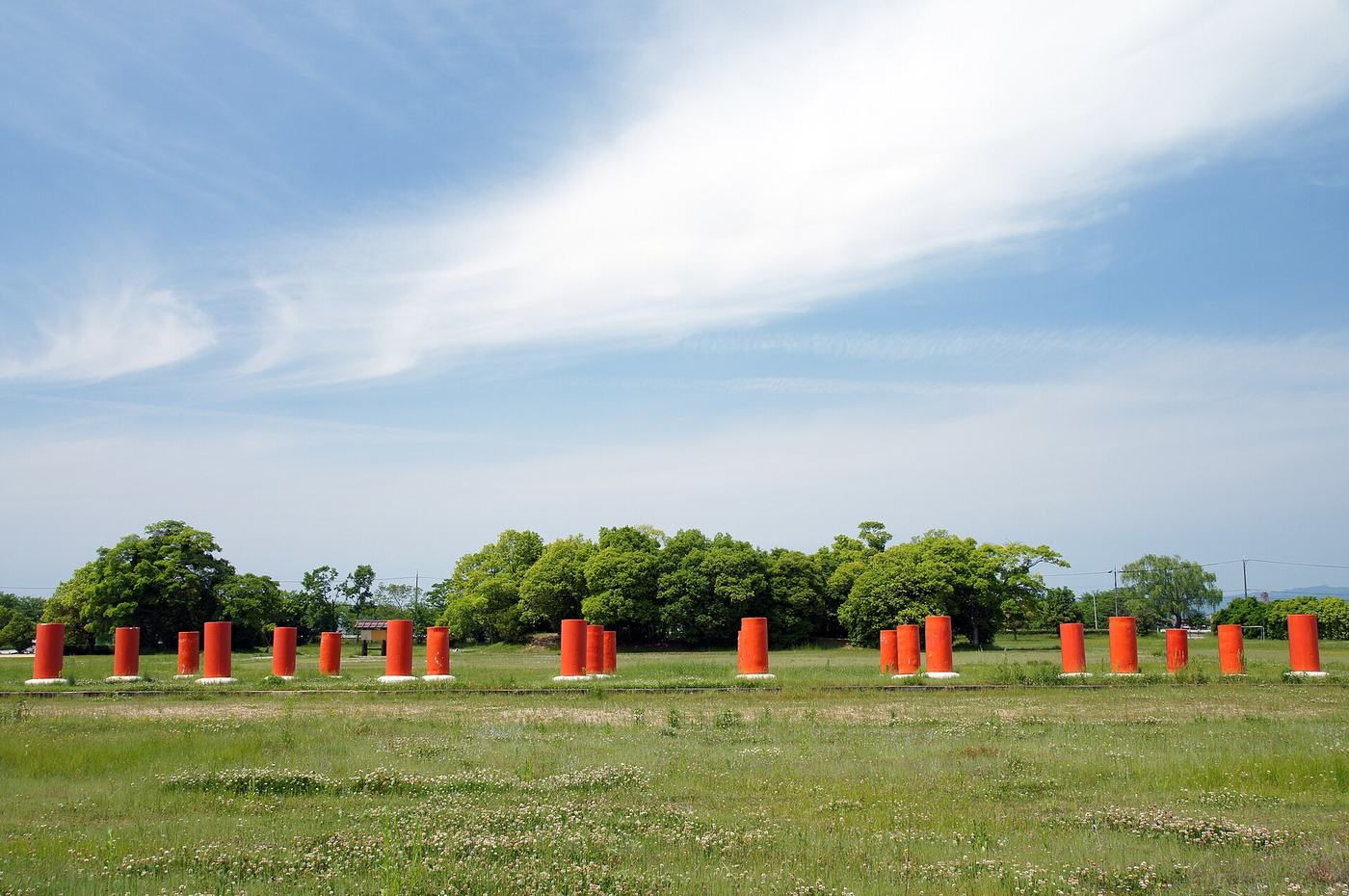
Download it on hotel Wi-Fi before you leave — that is the city's own instruction, not ours. Kashihara City publishes a free app called "XR Fujiwara-kyu", described officially as: hold up your phone and the palace appears. The usable area is around 100,000 square metres, AR and VR modes can be switched, and five designated points let you look around a high-resolution reconstruction through a full 360 degrees.
Two practical lines sit on that page. The first recommends downloading in advance over Wi-Fi, and offers the free Wi-Fi at the Fujiwara-kyo Exhibition Room as a fallback if you forget. The second matters more: after installation, using the app generates no further data traffic. It runs with no signal on site. The network is only needed once.
One limitation up front. The city notes that on Android only AR-capable handsets will work, and that some models may not display AR correctly. No such note appears for iPhone. Android users, open it once at home to check.
Once you have it, walk into the Fujiwara-kyo Exhibition Room, which is free to enter. Inside are that seven-by-six-metre 1:1000 model, excavated artefacts, CG reconstructions, and a 1995 animation produced by Capcom. Parking is free, with space for 30 cars. They also hand out a free manhole card.
Then the three lines from Kashihara City's own World Heritage page that should shape your day.
| Level | Official warning | What to do |
|---|---|---|
| 🔴 | Little shade; the site is vast, sun cover is scarce, heatstroke risk is high in summer | Carry plenty to drink, avoid midday |
| 🟡 | There are no rubbish bins inside the Kashihara components | Carry your rubbish out |
| 🟡 | Toilets are scarce around the site — use the exhibition room's | Go before you walk in |
The city's FAQ answers one more question outright: no component inside Kashihara City charges admission. All four are free. It also asks visitors to stay off private land and farmland, because the ring around that open ground is still being farmed.
The flowers run in three seasonal zones — rapeseed in spring, lotus in summer, cosmos in autumn — planted since FY2006 with a volunteer residents' committee. One correction to make: the summer kibana cosmos on the west side of Daigo Pond was discontinued after 2024, per a note added to the official page. Peak bloom dates and plant counts are not published as fixed numbers; the city runs a live bloom-status page instead, and that is the one to check.
Can you see the murals?
At Kitora yes, at Takamatsuzuka no. The paintings in both tombs have been peeled out entirely, but what happened next diverged.
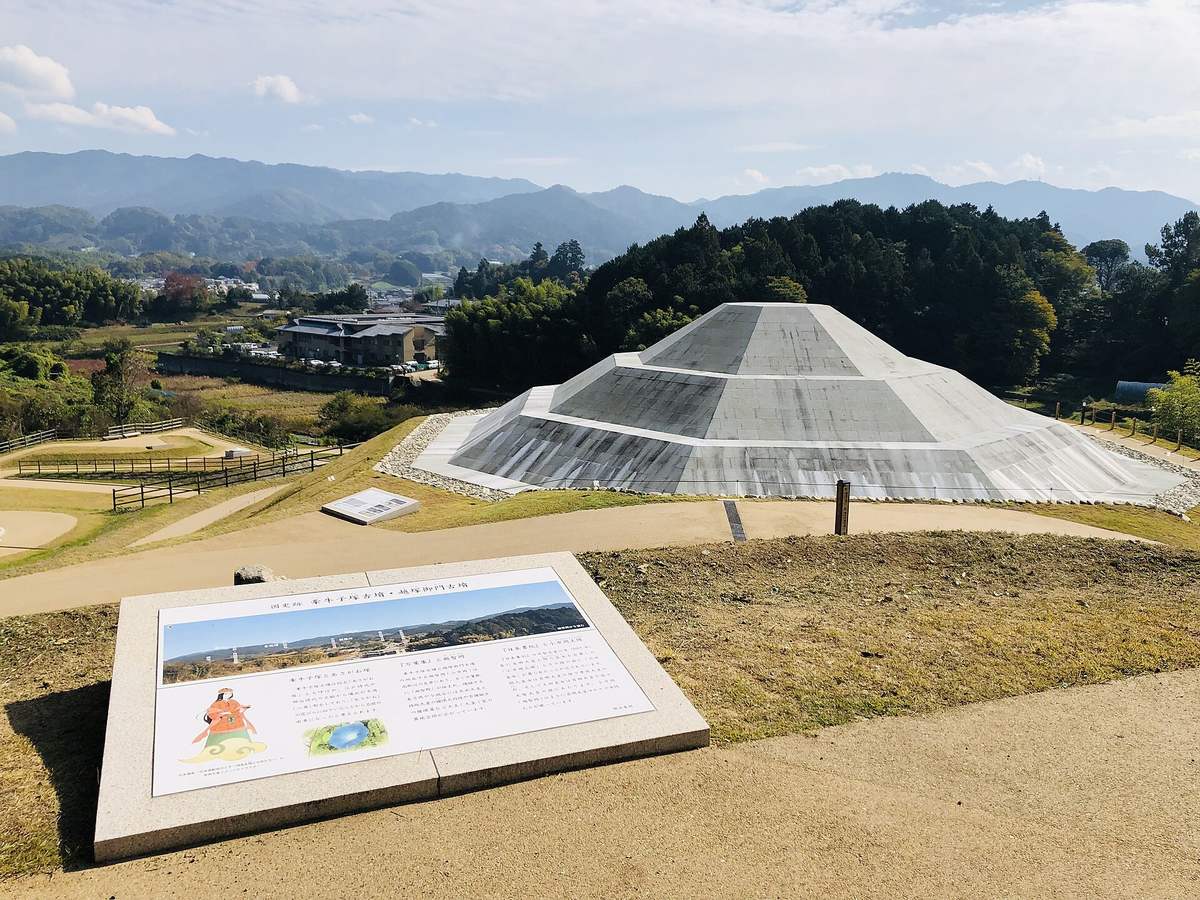
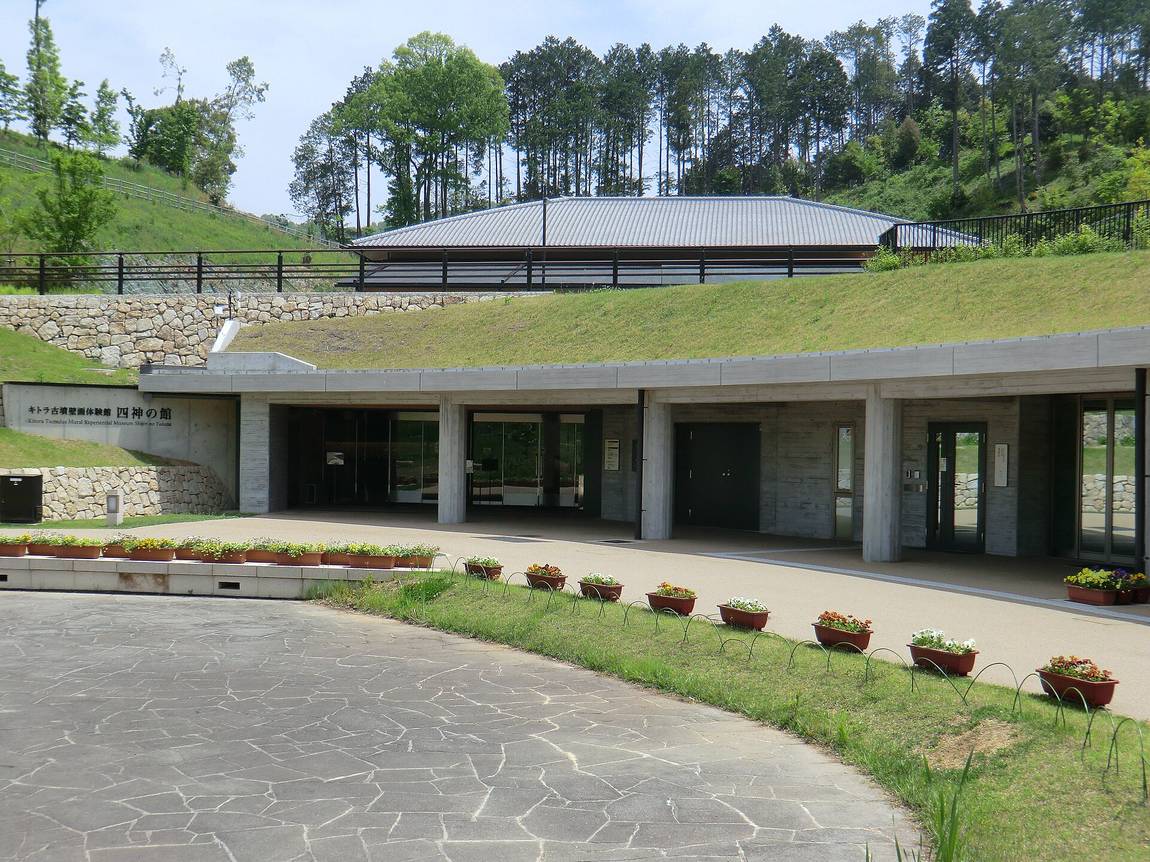
At Kitora, the official line is that the murals were temporarily removed for conservation and are being kept under strict storage; after removal they were reassembled panel by panel and are now conserved, and periodically shown, in the mural conservation facility inside the Kitora Tumulus Mural Experience Hall "Shijin no Yakata", which opened in FY2016. So there are sessions, they need booking, and what you see is real.
At Takamatsuzuka the reasoning is more tangled. The Agency's policy document says that returning the murals and stone chamber to the mound would be desirable, but that current scientific and technical standards make it difficult, so after repair they will not be returned for the time being and conservation and public display will continue instead. The mound the chamber was removed from was rebuilt in October 2009 to the shape inferred from excavation. What stands at Takamatsuzuka today is a 2009 shell, and it is empty. The chamber was dismantled between April and August 2007; mural repair finished in March 2020.
| Session | Dates | Closed | Panel shown |
|---|---|---|---|
| 39th | 23 May – 21 Jun 2026 (finished) | 3 Jun, 17 Jun | Star chart |
| 40th | 1 – 30 Aug 2026 | 12 Aug, 26 Aug | White Tiger |
| 41st | 19 Sep – 18 Oct 2026 | 30 Sep, 14 Oct | Vermilion Bird, Black Tortoise and Azure Dragon (three panels at once) |
The shared terms: ground floor of Shijin no Yakata, 09:30 to 16:30 with last entry at 16:15, free but advance booking is required, roughly 340 people per day, about 20 minutes in total of which the mural room itself is about 10 minutes. The organisers are the Agency for Cultural Affairs and the Nara National Research Institute for Cultural Properties. The secretariat flags the 41st session twice over: three panels simultaneously, and the hall's 10th anniversary.
Now the booking reality. For the 41st session the announced first application round ran from 10:00 on 18 August 2026 to 23:59 on 23 August, online or by return postcard — which had already closed by 29 August 2026. Under the 40th session's rules, a second round opened after the first, and a second round plus same-day entry existed only where the quota had not been filled. The equivalent terms for the 41st have not been published word for word, so check the viewing secretariat's page directly rather than assuming you can turn up and queue.
One more scheduling trap. The Agency's conservation policy document says public viewings are held four times a year, and Asuka Village's tourism site repeats the figure — but only three sessions were actually announced for FY2026, and the winter slot, customarily January or February, had no announcement as of 29 August 2026. Anyone planning a winter trip should verify before building the day around it. It may simply be unannounced.
For the genuine Takamatsuzuka paintings, see the FAQ above: the Agency's index stops at the 48th session, the secretariat's site says FY2025's 52nd session has finished, and neither official entry point lists an FY2026 date. What you can enter is the ¥300 Takamatsuzuka Mural Hall, described officially as displaying reproductions.
There is a difference between the two tombs that is set out in the viewing secretariat's own notes. It states that because grave robbers destroyed the Vermilion Bird on Takamatsuzuka's south wall, Kitora holds the only complete set of the Four Deities in Japan. Kitora is a small round mound, 13.8 metres across at the lower tier and 9.4 at the upper, with a chamber built from 18 blocks of cut tuff. Its star chart is described officially as the oldest surviving example of a formal Chinese-style star map anywhere. Of the twelve zodiac figures, nine are currently confirmed as present: rat, ox, tiger, dragon, snake, monkey, horse, dog and boar. It was designated an Important Cultural Property in 2018 and a National Treasure in 2019. Takamatsuzuka was discovered on 21 March 1972, and its murals designated a National Treasure on 17 April 1974.
Is Asukadera Temple the same place as Asukadera Temple Site?
No. The building you buy a ticket for, and where you meet the Great Buddha of Asuka, is Angoin — a working temple. The World Heritage component called "Asukadera Temple Site" is the archaeology, and most of it is underground.
The official description says as much: it is the site of Japan's first temple with a full-scale monastic layout, completed in 596, comprising both the well-preserved buried remains and artefacts and the exposed central hall platform at ground level. The thing that got inscribed is largely beneath your feet.
The same logic applies to the Tachibanadera, Yamadadera and Kawaradera components. Each of those names ends in "site", meaning the archaeology, not the temple you can buy a ticket for today. The ¥500 at Angoin is well worth paying for the Great Buddha, and so is ¥500 at Tachibanadera — just be clear that you are paying a temple admission, not a World Heritage entry fee. The inscribed component is free, and it is not behind the ticket desk.
A note on Tachibanadera's price: the adult fee changed from ¥400 to ¥500 on 1 April 2026. That date has passed, but the official tourism page still lists both figures side by side. ¥500 is current.
And the temple most often wrongly added to the list: Okadera is not one of the 19 components. It is a fine temple — ¥500 for adults and university students, free for primary school children and under — it simply is not on the list. Note too that the main hall interior is closed to visitors from January to March for the annual misfortune-averting rites. Decide whether you are going to Okadera to worship or to tick off World Heritage; both are valid, just do not confuse them.
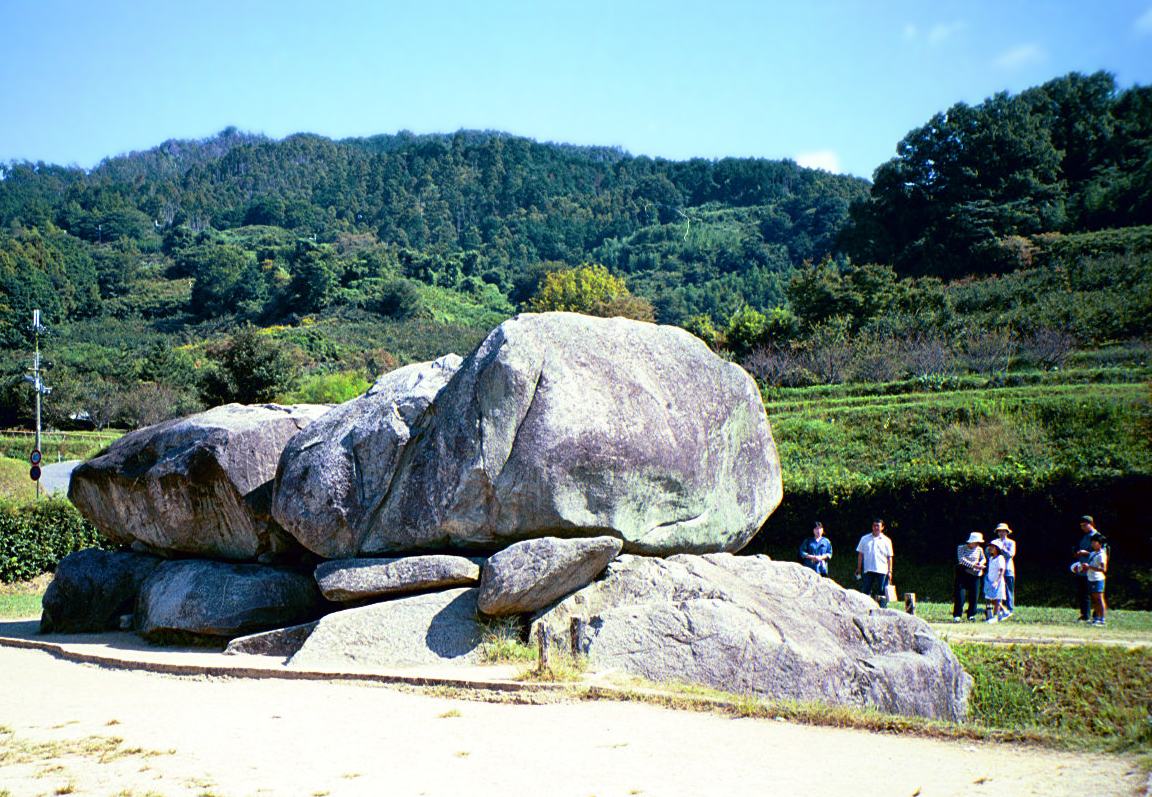
For something with mass, megaliths, and a photograph in it, go to ¥500 Ishibutai Kofun, open 09:00 to 17:00 with last entry at 16:45, year-round. To add the turtle-shaped stone carving at the Sakafuneishi Site, buy the ¥650 combination ticket — sold only at those two ticket desks, with no online channel.
How do you get around?
The Fujiwara Palace Site and Asuka Village run on two entirely separate bus networks. This is the single thing most likely to break your itinerary. Treat them as one area and you will find your pass does not go there.
Asuka Village is served by the Asuka Loop Bus "Akakame", operated by Nara Kotsu, running a circuit between the East Exit of Kintetsu Kashiharajingu-mae Station and Kintetsu Asuka Station. Its pass is ¥750. It does not reach the Fujiwara Palace Site.
| Section | One way |
|---|---|
| Kashiharajingu-mae East Exit → Asuka Okuyama / Asuka Historical Museum West | ¥320 |
| Kashiharajingu-mae East Exit → Manyo Culture Museum West | ¥310 |
| Kashiharajingu-mae East Exit → Ishibutai | ¥440 |
| Kashiharajingu-mae East Exit → Takamatsuzuka | ¥490 |
| Kashiharajingu-mae East Exit → Asuka Station | ¥530 |
| Ishibutai → Asuka Station | ¥320 |
The one-day adult pass is ¥750 and the two-day ¥1,100. Asuka Village prints its own comparison on the page: Kashiharajingu-mae East Exit to Ishibutai and back is ¥880 for an adult, so a single return trip pays for the pass and leaves you ¥130 up. Service runs roughly hourly, tightening to about every 30 minutes in peak season. Coverage extends beyond the two Akakame circuits to the Sakurai-Asuka line and the Asuka Station to Kashiharajingu-mae East Exit stretch of the Yagi-Shimoichi line. Buy at the Kintetsu Kashiharajingu-mae central gate, the Asukabito no Yakata by Asuka Station, the Ishibutai car park kiosk, Shijin no Yakata and elsewhere; a mobile version is sold through the Jorudan transit app.
The Fujiwara Palace Site is served instead by ¥220 the Kashihara City community bus, departing Yamato-Yagi Station. The city describes the route as linking Yamato-Yagi Station with the Kashihara Insectarium, and additionally Kashiharajingu-mae Station on weekends and public holidays only.
| Weekdays | Weekends and holidays | |
|---|---|---|
| Services per day | 7 | 5 |
| Reaches Kashiharajingu-mae | ❌ No | ✅ Yes (central exit) |
| Departures from "Kashihara Fujiwara-kyo Exhibition Room" | 7:39 / 9:09 / 10:49 / 12:39 / 14:09 / 16:09 / 17:39 | 7:39 / 9:09 / 11:19 / 14:09 / 16:24 |
| Fare | Flat ¥220 adult / ¥110 child, paid on exit, IC cards accepted | |
Read that table carefully. The days most visitors travel have two fewer services than a working Tuesday. But weekends are also the only days the route reaches Kashiharajingu-mae, which means weekends are the only days you can connect to Asuka's Akakame network. If you want the Fujiwara Palace Site and Asuka Village on the same day, make it a Saturday or Sunday. The weekend timetable also applies on 13–15 August and 30 December – 3 January.
A naming trap sits on that same route. There are two stops with almost identical names: "Kashihara Fujiwara-kyo Exhibition Room" and "Nara National Research Institute Fujiwara Palace Site Exhibition Room". They are two different institutions in two different places. The free room described in this article is the first one, run by the city. The research institute's room was not verified this round, so do not assume its hours from the name.
On foot, Kashihara City gives the same figure for all three nearest stations to the Fujiwara Palace Site — JR Unebi, Kintetsu Mimimimi-nashi and Kintetsu Unebigoryo-mae are each about 30 minutes' walk.
Kitora Kofun is the awkward one. Asuka Village's tourism site states outright that the Asuka-Kitora bus line has been discontinued and directs visitors to the Asuka demand-responsive service or a taxi; on foot it is 15 minutes from Kintetsu Tsubosakayama Station or 30 minutes from Asuka Station. The ¥500 demand-responsive service charges visitors per person per ride in cash only, running daily from 09:00 to 17:00 — with two hard constraints. Visitors can only book online; the official leaflet states telephone booking is not accepted (you register first, then show the driver your booking list). And two vehicles run Monday to Friday, but only one at weekends and on holidays. Relying on it to reach Kitora on a Saturday is a real risk. You cannot board or alight anywhere other than a designated stop, and you may be sharing with other passengers.
Then the clean trap. On 14 August 2026 the Asuka Historical National Government Park announced that on weekends and holidays between 19 September and 18 October 2026, Nara Kotsu would run a temporary bus linking Asuka Station, Kitora Kofun and Takamatsuzuka, 09:00 to 17:30, twice hourly, at ¥220. One line sits under the announcement: the Asuka Loop Bus one-day and two-day passes cannot be used. You bought the pass, and the only bus that will carry you to the National Treasure murals will not take it. If you are combining murals with Ishibutai on the same day, budget the two fares separately.
Other useful figures: paid parking is ¥500 for a standard car (¥2,000 medium, ¥3,000 large; Ishibutai charges ¥1,000 for standard cars from 2 to 6 May). Luggage storage at Asukabito no Yakata is ¥500 per item, and there are coin lockers by Asuka Station. The ¥120 Asuka Kingdom Passport bundles discount vouchers for major facilities and is not sold by post — but the discounts themselves are not published, so there is no way to calculate the saving in advance.
Visit between 2026 and 2030 and the visitor centre is shut
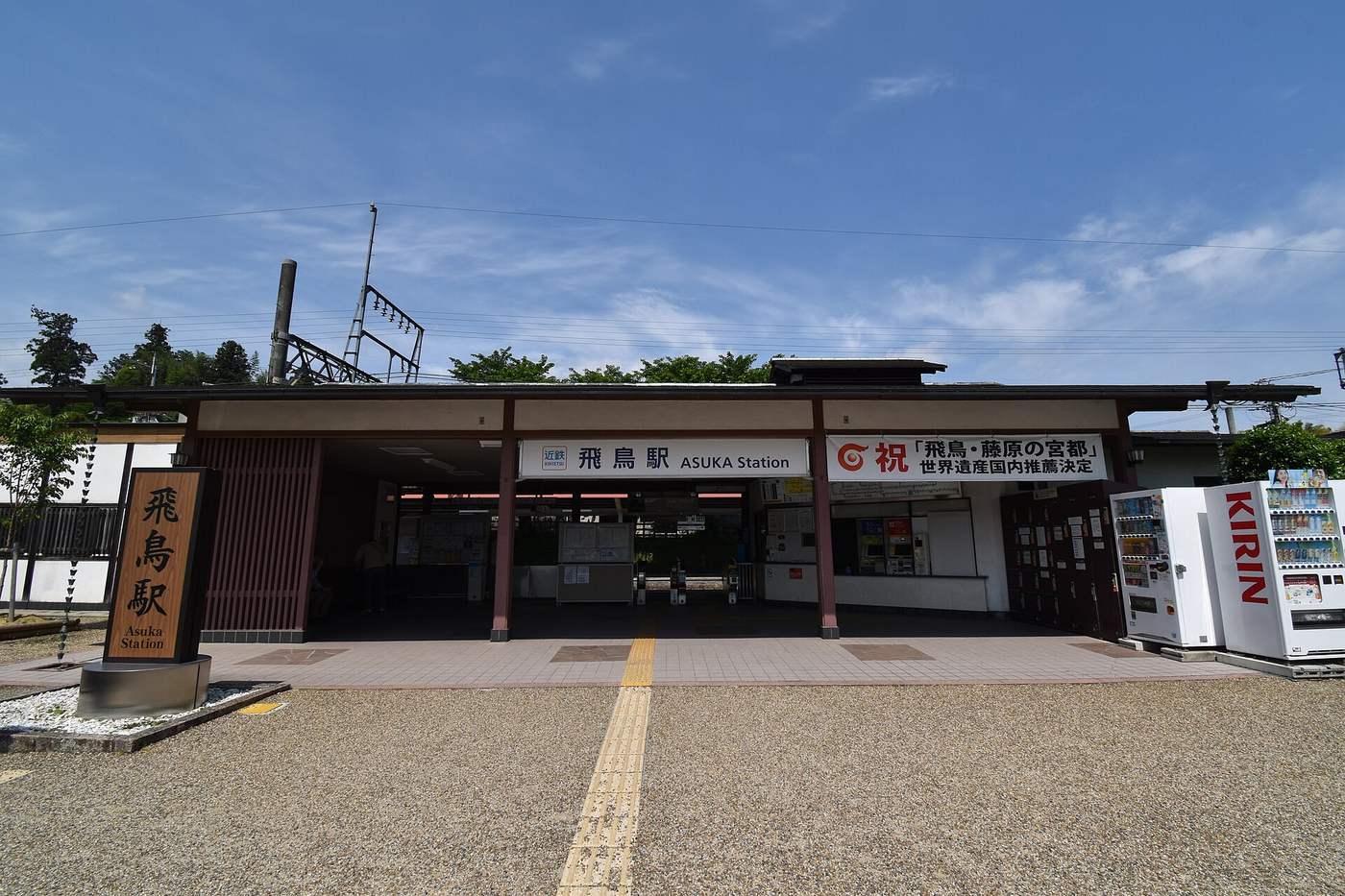
The Asuka Historical National Government Park Hall closed to visitors on 1 April 2026. The building opened in 1985 alongside the Takamatsuzuka area of the park and served as the hub for exploring Asuka for around 40 years; it is now shut for renewal works, and the authorities say use of the surrounding area is expected to resume around 2030.
The knock-on changes cluster in September 2026.
| Level | Facility | Change |
|---|---|---|
| 🔴 | Asuka Historical National Government Park Hall | Closed from 1 Apr 2026; reopening around 2030 |
| 🔴 | Takamatsuzuka area car park | Closed from 1 Sep 2026 (rest area and toilets remain until around end of Nov 2026) |
| 🟡 | Kitora area car park No. 1 | From 1 Sep 2026, buses by advance booking and paid |
| 🟡 | Ishibutai area car park | 19 Sep – 15 Nov 2026, two-wheelers only (motorcycles and bicycles) |
| 🟡 | Nara Prefectural Manyo Culture Museum car park | Charges from 1 Aug 2026 |
Treat that table as a hard constraint if you are driving. Between 19 September and 15 November 2026 you cannot park a car at Ishibutai, and the Takamatsuzuka car park is already closed — which is exactly the stretch where the three-panel mural viewing overlaps with autumn colour season. Come by public transport, or park elsewhere.
What the closed building is becoming is set out in the Agency for Cultural Affairs' March 2026 exhibition policy. The new facility, provisionally the Takamatsuzuka Kofun Mural Conservation, Public Display and Utilisation Facility, is to conserve the National Treasure murals whose ten-year repair is now complete while making them broadly available, and to serve as the gateway facility for the Asuka region, developed jointly with the Ministry of Land, Infrastructure, Transport and Tourism's national park. Two further lines matter to travellers: the new facility will present a systematic exhibition including display of the actual murals, and admission to the permanent exhibition room and the mural and stone-material conservation room is being considered on the basis of setting an admission charge. A separate September 2025 policy adds the location: the new facility will be built close to the existing temporary repair facility to minimise the risk of moving the murals and stone materials, and the provisionally reconstructed mound will continue to be managed and shown.
The two documents agree with each other: the place that is closed right now is becoming a building that will eventually display the real Takamatsuzuka murals permanently, and will start charging for it. But no official document states a year in which the new facility opens. "Around 2030" refers to the resumption of use around the park hall, not to an opening date. Anywhere you see "the new museum opens in 2030", someone has inferred that.
When is the best time to go in 2026?
9 to 18 October. Three things run simultaneously in those ten days, and all three dates are official.
| Event | Dates |
|---|---|
| Kitora mural 41st viewing (three panels at once, hall's 10th anniversary) | 19 Sep – 18 Oct 2026 (closed 30 Sep, 14 Oct) |
| Asuka Station – Kitora – Takamatsuzuka shuttle (weekends and holidays) | 19 Sep – 18 Oct 2026 |
| Asuka Historical Museum autumn special exhibition on the new inscription | 9 Oct – 13 Dec 2026 (closed Mondays) |
The exhibition opens on 9 October and the mural viewing ends on 18 October, so those ten days are the only intersection. To tighten it further, pick 10, 11, 17 or 18 October — the shuttle only runs at weekends and on public holidays, and those four weekend days have all three running.
Avoid 30 September and 14 October, when the mural room is closed. Steer around Mondays too: the museum and both exhibition rooms close then — though all three follow the rule that a Monday public holiday pushes the closure to the next working day, so check whether the date is a holiday rather than just reading the weekday.
After 18 October, the special exhibition continues to 13 December and the autumn cosmos zone at the Fujiwara Palace Site is still planted — but the shuttle stops, so Kitora goes back to being a walk or a booked ride. The winter mural session has not been announced, so do not plan a January or February trip around seeing the paintings.
Can you do it in a day?
Yes, but you must choose: a mural day or a ruins day. Force both into one and the bus timetables will beat you.
Start from the time boundaries, because they decide how the day folds.
- Ishibutai Kofun last entry 16:45, open year-round.
- Shijin no Yakata 09:30–17:00 (16:30 close December to February), and the ground-floor conservation facility closes every Wednesday.
- Kitora mural viewing last reception 16:15, about 20 minutes inside.
- Asuka Historical Museum closed Mondays, entry until 16:00.
- Kashihara Fujiwara-kyo Exhibition Room closed Mondays, last entry 16:30.
- Takamatsuzuka Mural Hall entry until 16:30.
For a mural day (only possible on weekends between 19 Sep and 18 Oct), start at Kintetsu Asuka Station, take the shuttle to Kitora, see the paintings, continue to Takamatsuzuka, return to Asuka Station. The day sits in the southern half of the village — do not bolt Ishibutai onto it. Since the shuttle refuses the loop pass, skip the day pass on this day unless you are certain you will ride several Akakame sections as well.
For a ruins day, buy the pass at Kashiharajingu-mae East Exit, ride the Akakame, and string together Ishibutai, the turtle stone at the Sakafuneishi Site, Asukadera (Angoin) and Tachibanadera, finishing at Kengoshizuka Kofun. Kengoshizuka is free with the path open all day, so it can sit at the end without any closing-time risk.
Give the Fujiwara Palace Site its own half-day, and make it a weekend. Take the community bus from Yamato-Yagi to the exhibition room stop, see the model, top up the app download on their Wi-Fi, use the toilet, then walk out and hold your phone up. On a weekend the same bus can drop you at Kashiharajingu-mae to pick up the Akakame; on a weekday it only returns to Yamato-Yagi.
With two days, the cleanest split is Asuka Village on one and Kashihara plus the murals on the other, in either order. If you are combining with Nara city, note that Nara city and Asuka Village are about 30 kilometres apart on different rail networks — that is two days, not one. For the Nara city day see our Nara travel guide, and for the deer and the Great Buddha specifically, Nara Park and Todaiji. Staying longer in the same corner of the prefecture? Tanzan Shrine in Sakurai City enshrines Fujiwara no Kamatari, a figure straight out of the Asuka period, while Hasedera covers the temple further east.
One last pairing worth knowing. Japan's Tentative List is now down to three entries, and one of them is Hikone Castle — a place whose official timeline and its widely circulated dates do not match, unpicked in our piece on the Hikone Castle inscription years. And if you want the opposite kind of World Heritage Site, one where the buildings are still standing where they were built, Hiraizumi and its Golden Hall are the clearest counterexample in Japan.
Appendix: original Japanese sources (tap to expand)
The Japanese text quoted above is collected here so you can check it yourself. Sources are the Agency for Cultural Affairs (bunka.go.jp), the Asuka-Fujiwara World Heritage promotion council (asuka-fujiwara.jp), Kashihara City (city.kashihara.nara.jp), the Asuka Village tourism site (asukamura.com), Asuka Village (asukamura.jp), the Asuka Historical National Government Park (asuka-park.jp) and Nara Kotsu (narakotsu.co.jp).
1. Japan's World Heritage count (Agency for Cultural Affairs)
2026年8月現在、世界遺産は文化遺産991件、自然遺産240件、複合遺産42件を含む1,273件に上り、そのうち日本からは文化遺産22件、自然遺産5件の計27件の世界遺産が登録されています。
2. What the components actually are (council: Asukadera / Yamadadera / Fujiwara Palace)
飛鳥寺跡は、日本で最初の本格的伽藍を持つ仏教寺院(596年完成)の遺跡です。…地下に良好な状態で埋蔵されている寺院跡の遺跡(遺構・遺物)と、地上に表出している中金堂基壇…
東側の回廊が倒壊した当時の状態で出土しており、法隆寺よりも古い建築様式を伝えています。この建築部材は奈良文化財研究所飛鳥資料館で常設展示されています。
藤原京は710年に平城京へ遷都し、主要な建物も解体されて遷されました。平城宮大極殿も藤原宮から移築したものといわれています。
3. The XR Fujiwara-kyu app (Kashihara City, updated 27 Mar 2026)
かざすだけで、藤原宮が現れるアプリ「XR藤原宮」
移動しながらリアルタイムに変化する藤原宮復元CGが楽しめる! 楽しめる範囲はなんと約10万平方メートル。AR(拡張現実)、VR(仮想現実)を切り替え可能。
5か所の体験ポイントで「高精細」な藤原宮復元CGを360度見渡すことができる!
藤原宮跡へ行く前に、Wi-Fi環境下での事前のダウンロードをオススメします。なお、事前ダウンロードをお忘れの場合、橿原市藤原京資料室のフリーWi-Fiをご利用ください。
インストール後、アプリの使用中に新たなデータ通信は発生しません。
AndroidはAR対応端末のみ。お使いの機種によっては、ARが正しく表示されない場合があります。
4. Site conditions and free admission (Kashihara City)
「飛鳥・藤原の宮都」の構成資産は、日陰が少なく、夏季は大変暑くなります。特に藤原宮跡は広大な史跡のため、見学中に日差しを遮る場所が少なく、夏季は熱中症の危険が高まります。十分な飲み物をご持参のうえ…
橿原市内の構成資産内には、ごみ箱はありません。
私有地、農地へ立ち入らないようお願いいたします。
Q.入場料は必要ですか? A.橿原市内の構成資産に入場料がかかるところはありません。
(注意)藤原宮跡周辺にはトイレが少ないです。当室のトイレをぜひ利用ください。
5. The flowers (Kashihara City, updated 26 Jul 2026)
橿原市では…平成18年度より地元住民の有志で組織された藤原宮跡整備協力委員会のご協力を得て、春から秋にかけての季節の花々を植栽しております。
(注)醍醐池西側での夏季のキバナコスモスの植栽は令和6年をもって中止しています。
6. The murals were removed from the tombs (council / Agency for Cultural Affairs)
天文図のほかにも四神や十二支、日月が描かれた壁画は、保存修理のために一時的に取り外され厳重に保管されています。
取り外し後に壁面ごとに再構成を行った壁画は、当分の間はキトラ古墳壁画体験館『四神の館』内のキトラ古墳壁画保存管理施設(平成28年度に開館)で保存管理しながら、定期的に公開する。
壁画・石室は、墳丘に戻すことが望ましいが、現在の科学的・技術的水準の下では…困難であり…修理終了後、当分の間は墳丘に戻さず、引き続き保存と公開を行う
石室が取り出された墳丘は…平成21年10月、発掘調査結果等から推定される古墳の姿に復元整備された。
7. Kitora viewing terms (Asuka Village tourism site / viewing secretariat)
場所:国営飛鳥歴史公園キトラ古墳周辺地区内「キトラ古墳壁画体験館 四神の館」1階
時間:9時30分~16時30分 ※最終受付:16時15分
料金:無料・要事前予約
定員:各日340名程度/見学所要時間:約20分(壁画展示室の見学は約10分)
主催:文化庁・独立行政法人国立文化財機構奈良文化財研究所
第一次応募:6/30(火)10時~7/5(日)23時59分まで/第二次応募:7/14(金)~8/29(土) ※定員に達していない場合に限り、第二次応募・当日受付あり
高松塚古墳では、盗掘により南壁の朱雀が失われていたため、我が国で四神の図像が全て揃うのはキトラ古墳壁画のみです。
この天文図は…本格的な中国式星図としては、現存する世界最古の例といえます。
現在、図像の存在確認ができているものは、子、丑、寅、辰、巳、申、午、戌、亥の9体です。
8. No FY2026 Takamatsuzuka viewing (viewing secretariat / mural hall)
「令和7年度 国宝高松塚古墳壁画修理作業室の公開」(第52回)は終了しました。
応募者多数の場合、抽選にて当選・落選を決定します。
古墳から発見された壁画、出土した金具や海獣葡萄鏡などのレプリカを展示。
9. Park hall closure and car parks (Asuka Historical National Government Park, 6 Aug 2026 / asukamura.com)
国営飛鳥歴史公園館は昭和60年(1985年)の高松塚周辺地区開園に合わせて開館し、約40年の間…飛鳥巡りの拠点として愛されてまいりましたが、この度リニューアル工事に伴い、令和8年4月1日(水)よりご利用を休止させていただきます。
同工事に伴い、高松塚周辺地区駐車場は令和8年9月1日(火)より利用を休止させていただきます。なお、休憩所・トイレは当面の間(令和8年11月末頃までを予定)引き続きご利用いただけます。
国営飛鳥歴史公園館周辺の利用再開は、令和12年頃を予定しております。
飛鳥歴史公園 キトラ周辺地区第1駐車場 ※R8.9.1~バス事前予約制導入(有料)
飛鳥歴史公園石舞台地区駐車場 ※R8.9.19~11.15は「二輪車(バイク・自転車)専用駐輪場」となります
奈良県立万葉文化館駐車場 料金 無料 ※R8.8/1~有料
10. The new facility (Agency for Cultural Affairs, Mar 2026 and Sep 2025)
高松塚古墳壁画保存管理公開活用施設(仮称、以下「新施設」)は、10年におよぶ修理が完了した国宝高松塚古墳壁画を保存管理しながら、広く公開活用を行い、また、飛鳥地方のゲートウェイ施設として、国土交通省(以下、国営飛鳥歴史公園)と一体的整備を行うものである。
新施設では、高松塚古墳と古墳壁画をメインテーマとし、壁画の実物展示を含む体系的な展示を行う。
常設展示室及び古墳壁画・石室石材保存管理室への入場については、観覧料を設定する方向で検討する。
新施設は、壁画・石室石材の移動によるリスクを最小限にするために現仮設修理施設に近接する場所に整備する。仮整備した墳丘については、引き続き管理しながら公開していく。
11. Transport (Kashihara City / Nara Kotsu / Asuka Village / national park)
コミュニティバスは、大和八木駅と橿原市昆虫館をむすぶルート、土日祝日はさらに橿原神宮前駅をむすぶルートで毎日運行しています。
参考:橿原神宮前駅東口~石舞台の往復 880円(大人)
明日香周遊バス「赤かめ」循環系統・菖蒲町経由/明日香周遊バス「赤かめ」/桜井飛鳥線/八木下市線(飛鳥駅~橿原神宮前駅東口のみ)
バス:「飛鳥キトラ線」廃止につき「あすかデマンド乗合交通」、タクシー等をご利用ください。
電車:近鉄壺阪山駅から徒歩15分、飛鳥駅から徒歩30分
…下記期間の土日祝日において奈良交通(株)により 飛鳥駅⇔キトラ古墳⇔高松塚を結ぶ臨時バスが運行されます。
運行期間:令和8年9月19日(土)~令和8年10月18日(日)の土日祝日/運行時間:9:00~17:30(1時間に2本運行)/利用料金:片道大人220円/子ども110円
※「明日香周遊バス(1日・2日)フリー乗車券」はご利用いただけません。
どなたでもご利用できます/来訪者:WEB予約のみ(2週間前から)※電話予約はできません/1人500円/1回(現金のみ、小学生未満無料)/月~金2台、土日祝1台で運行/停留所以外では乗降できません
12. Kengoshizuka Kofun (Asuka Village cultural properties division / tourism site)
平成29年度からおこなってきた牽牛子塚古墳等整備事業が完了し、令和4年3月6日(日)から、一般へ公開しております。見学は無料で、沿路の通り抜けは終日可能です。牽牛子塚古墳・越塚御門古墳の石槨は、柵・扉の外からの見学となり…石室特別公開は有料(¥500)で事前予約制です。
八角形は、飛鳥時代の天皇にのみ許された形
13. Tachibanadera fee revision (old price still listed alongside)
令和8年4月1日~料金改定(大人のみ)大人《個人》500円
Frequently Asked Questions
- Q1:Do you need tickets for the Asuka-Fujiwara World Heritage components?
- Mostly no. Kashihara City's official FAQ answers this directly: none of the four components inside Kashihara City charges admission — that covers the Fujiwara Palace Site, Shobuike Kofun, Moto-Yakushiji Temple Site and Daikandaiji Temple Site. Over in Asuka Village, Kengoshizuka Kofun is free with the path open all day, the Kitora mural hall "Shijin no Yakata" is free, and the Kitora mural viewings themselves are free (advance booking required). What actually costs money: Ishibutai Kofun at ¥500, the Takamatsuzuka Mural Hall at ¥300, and the admission fees at working temples such as Asukadera and Tachibanadera, ¥500 each. A full day of sightseeing here runs under ¥2,000 in tickets. Your real budget goes on transport and time.
- Q2:Can you see the real Takamatsuzuka murals?
- Not in FY2026. The genuine Takamatsuzuka paintings are only visible during the Agency for Cultural Affairs' periodic "conservation studio viewings", and both official entry points have gone quiet: the index page stops at the 48th session (January 2025), and the viewing secretariat's site states that the FY2025 run, the 52nd session, has finished. Neither lists a single FY2026 session, and the customary first slot of the year falls in May — May 2026 came and went without one. What you can enter on site is the Takamatsuzuka Mural Hall, whose own official description says it displays reproductions of the murals, metal fittings and the sea-beast-and-grape mirror. The mound itself is a 2009 reconstruction built to the shape inferred from excavation; the stone chamber was removed in 2007. For genuine Four Deities murals, go to Kitora.
- Q3:Is the Asuka Loop Bus day pass worth buying?
- Yes — one round trip pays for it. The one-day adult pass is ¥750 and the two-day is ¥1,100, and Asuka Village's own page prints the comparison for you: Kashiharajingu-mae Station East Exit to Ishibutai and back costs ¥880 for an adult. Ride that once and you are ¥130 ahead; everything after is free. Two catches, though. The pass does not reach the Fujiwara Palace Site — that is on a completely separate Kashihara City bus network. And the shuttle that runs to Kitora Kofun between 19 September and 18 October 2026 explicitly refuses this pass, in writing, on the official notice.
- Q4:What happens if you visit on a Monday?
- You lose both indoor collections at once. The Nara National Research Institute's Asuka Historical Museum closes Mondays, and Kashihara City's Fujiwara-kyo Exhibition Room closes Mondays. Those two rooms are precisely where the missing pieces have been moved to: the excavated Yamadadera cloister timbers are in the museum, and the 1:1000 model of the Fujiwara capital is in the exhibition room. Visit on a Monday and the components that most need an indoor display to make sense will all be shut. There is a less obvious one too: the mural conservation facility on the ground floor of Shijin no Yakata closes every Wednesday, leaving only the upper floor. Ishibutai Kofun, by contrast, is open year-round.
- Q5:What should you bring to the Fujiwara Palace Site in summer?
- Water, an empty bladder, and a bag for your rubbish. None of that is our advice — it is Kashihara City's, verbatim, on its own World Heritage page. The components have little shade, and the Fujiwara Palace Site in particular is such a vast archaeological area that there is almost nothing to block the sun, raising heatstroke risk in summer. The same page states there are no rubbish bins inside the Kashihara components, and asks visitors not to enter private land or farmland. The toilet warning is tucked away on the exhibition room's page, where the city asks you to use its facilities because toilets are scarce around the Fujiwara Palace Site. This is a square kilometre of open ground, not a shaded park.
- Q6:Are the yellow cosmos flowers still planted at Fujiwara Palace Site?
- No. Kashihara City added a note to its flower page: the summer planting of kibana cosmos on the west side of Daigo Pond was discontinued after 2024, so anyone planning around it will arrive to nothing. What the city does maintain is three seasonal zones — rapeseed blossom in spring, lotus in summer, cosmos in autumn — planted since FY2006 with help from a volunteer committee of local residents. Peak-bloom dates and plant counts are not published as fixed figures; the city runs a live bloom-status page instead, so check that before you travel.
Read next
Hikone Castle World Heritage: It's 2028, Not 2027
Japan's current official schedule puts the ICOMOS mission in 2027 and the vote in 2028, yet two Shiga pages still say 2027 and neither is flagged. The three conflicting timelines, what ICOMOS really said, and what a 2027 visit actually gets you.
Todaiji & Nara Park: tickets, hours, deer rules & goshuin
Four halls at ¥800 each, one combo ticket, cash only — and Hokkedo shuts at 16:00. Plus the official 1,687-deer count and fixed 2026 event dates.
Tanzan Shrine: pagoda, goshuin & is it worth the trip?
Where the Taika coup was plotted, with the world's only wooden 13-story pagoda — fees, the one-bus-an-hour access, and the 17:52 trap.
📊 See the 2026 Price Index (JR Pass, DPA, eSIM, Airport Transport) →