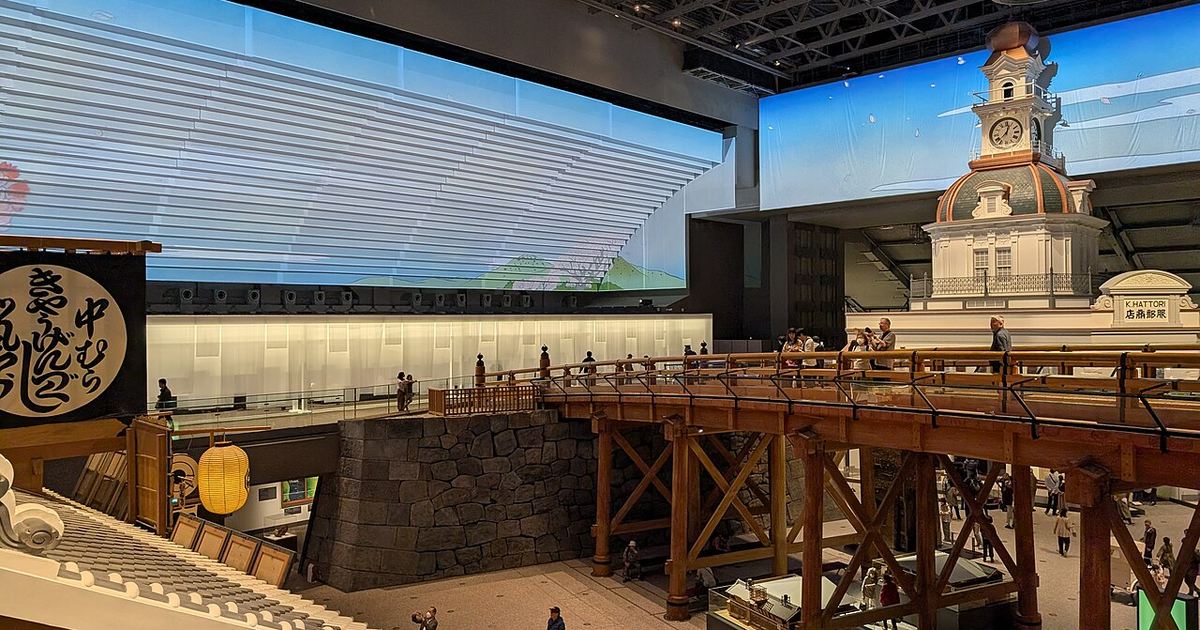
The Edo-Tokyo Museum shut for nearly four years, reopened on March 31, 2026, and raised admission from ¥600 to ¥800 on the same day. That is not the interesting part. The headline result of a four-year renovation is a projection thrown across 4,000 square metres of ceiling and columns on the third floor — and it starts at 18:40, while the ¥800 ticket you bought stops working at 17:30, with last admission a further half hour earlier. You can walk the entire museum, leave satisfied, and never know it exists. This guide stacks the three timetables that do not line up, then handles five things buried in the museum's own published notices: who the price rise actually hit, how many exhibitions that ¥800 quietly includes, why a high-school student pays for the cheap ticket and not the expensive one, why the first-floor gallery is empty for roughly a third of the year, and which entire floor costs nothing.
- Permanent exhibition closes at 17:30; the third-floor projection starts at 18:40. Seventy minutes apart, so seeing both means leaving and coming back.
- The projection is not nightly. Fourteen nights in the whole of August 2026, schedules published monthly, cancelled for strong wind or rain.
- Adult admission ¥800, raised from ¥600 on reopening day. Student rates did not move at all, widening the adult-student gap from ¥120 to ¥320.
- That ¥800 also covers the rotating feature exhibitions — currently including a nationally designated Important Cultural Property.
- The seventh-floor library is free to enter, video archive included. It is the one floor that needs no ticket.
📖 Contents (tap to expand)
- Has the Edo-Tokyo Museum actually reopened?
- The 4,000-square-metre ceiling projection
- What admission costs
- What ¥800 buys changes every month
- What changed inside the permanent exhibition?
- Is "Toyotomi Brothers!" a separate ticket?
- For high-school students the pricing runs backwards
- Which day should you go?
- The part you can walk into without a ticket
- Getting there from Ryogoku Station
- Is the Open Air Architectural Museum the same place?
- Can you follow it in English?
- Appendix: original Japanese wording
Has the Edo-Tokyo Museum actually reopened?
Yes. Tuesday, March 31, 2026.
It closed on April 1, 2022, so the shutdown ran just under four years. Four official documents agree on the reopening date: the museum's institutional chronology, two Tokyo Metropolitan Government press releases from January 30 and March 6, 2026, and the official site of the NHK special exhibition now running there. Three of the four call March 31 the reopening day in so many words.
One official inconsistency is worth clearing up before it confuses you. The chronology lists the closure period as ending on March 31 too, which read literally means the museum was shut on the day it opened. Treat March 31 as the reopening date and describe the closure as "from April 2022, roughly four years".
The museum gives its own reason for the work: about thirty years had passed since completion in 1992, and the building needed its basic functions restored and its age-related deterioration addressed, alongside improvements to visitor safety and the quality of the exhibition environment. Architect Shohei Shigematsu of OMA handled the interior and exterior spatial design; the 1993 original was by Kiyonori Kikutake Architects.
What that improved exhibition environment actually produced is where this gets useful.
The 4,000-square-metre ceiling projection
It starts at 18:40. Your ticket stopped working at 17:30.
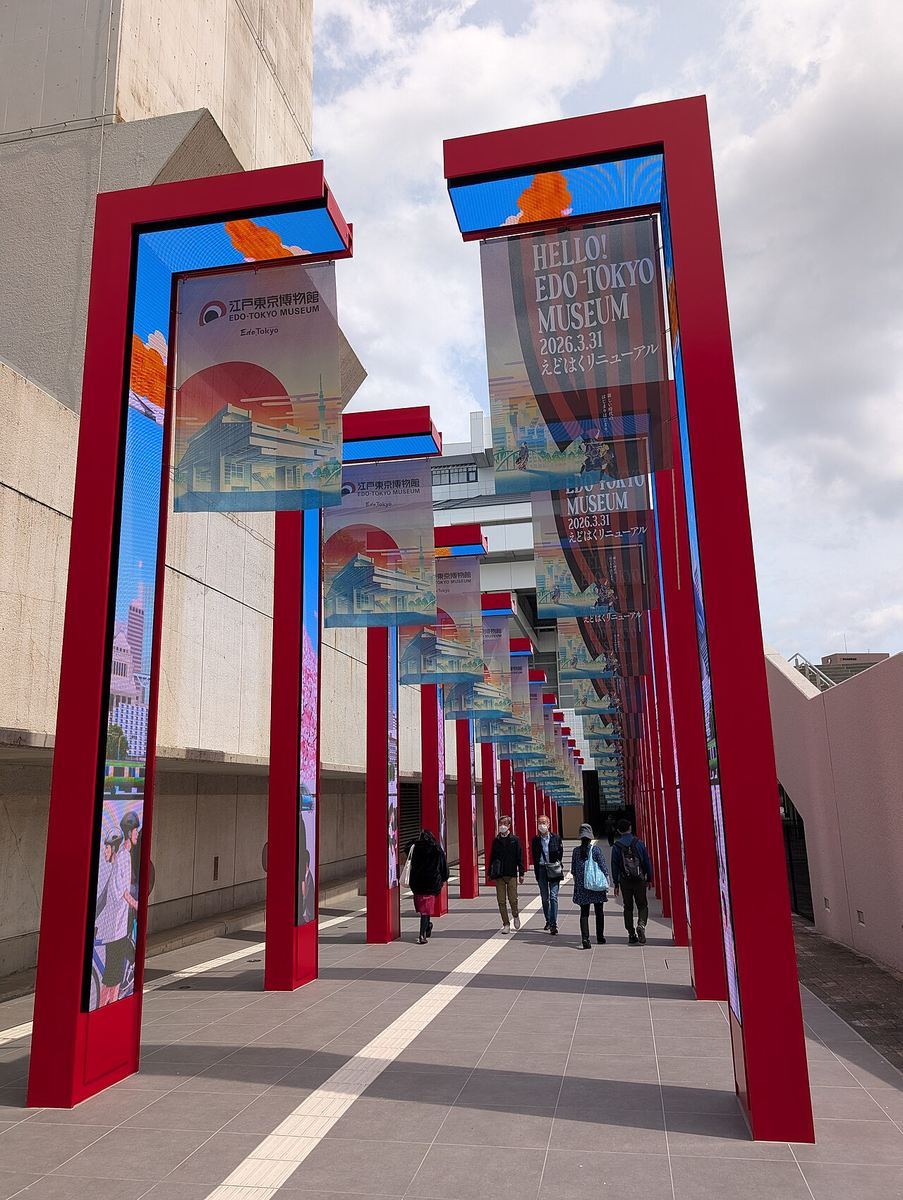
There are now three projections in the building: one on the flank of the torii-shaped structure at the western approach, one across the third-floor Edo-Tokyo Hiroba, and one inside the sixth-floor permanent exhibition. The first two sit outside the ticketed zone; the third is inside it.
The third-floor one is the spectacle. The museum describes it as imagery themed on the collection projected dynamically across roughly 4,000 square metres of ceiling and column surfaces, each run lasting about 20 minutes including a break, plus an interactive version whose imagery shifts with the wind blowing through the open third floor.
The problem is the clock. Set it against the ticket you bought:
| Permanent exhibition (your ¥800) | Third-floor Hiroba projection | |
|---|---|---|
| Hours | 9:30–17:30 (Sat to 19:30), last admission 17:00 | 18:40–20:00 (August 2026) |
| Sessions | — | 20 minutes each; four in August, at 18:40 / 19:00 / 19:20 / 19:40 |
| Days | Every day bar closures | 14 nights in all of August 2026 |
| Cancellable | No | Yes — strong wind, rain, or equipment maintenance |
On a weekday the galleries shut at 17:30 and the projection begins at 18:40: a 70-minute gap you have to spend outside the building. Saturday looks like it solves the problem, because closing moves to 19:30 — but the first August session was still 18:40, so you would be inside the galleries missing the first two runs.
Three further variables decide whether you see it at all.
It is not nightly, and the schedule comes out monthly
August 2026 ran on 14 nights: August 1, August 7 through 15, then August 21, 22, 28 and 29. The museum publishes one schedule page per month, and as of August 29, 2026 the September page had not appeared.
Check the museum's event listing for the current month before you travel, and do not trust any guide that hard-codes the time — this one included. The 18:40 above is the August 2026 value.
The start time follows sunset
The earliest published schedule, covering reopening through Golden Week, started at 17:20 and ran eight sessions a night. By August it was 18:40 with four. That is 80 minutes later and half the sessions. Winter will presumably pull it earlier again, but the museum has never published a rule — it just posts each month.
Weather cancels it outright
The stated policy is that projection may be halted at short notice to ensure safety in strong wind or rain, or for maintenance of the projection equipment, with sudden cancellations announced via X. This is effectively an outdoor show. Do not build an evening around it as the only objective.
So does it need a ticket? The museum has never said
No conclusion here. The admission page, opening-hours page, projection explainer, the August and reopening-period schedules, both metropolitan press releases and the government newsroom page — six official sources, zero mentions of a fee for this projection.
What can be said is structural. The floor plan shows the third floor holding only the Edo-Tokyo Hiroba and toilets; the ticket desk is on the first floor and the permanent exhibition entrance on the sixth; and the metropolitan press release lists the two time blocks on separate lines, permanent exhibition 9:30–17:30 and third-floor projection 17:20–20:00. That is circumstantial, not an answer.
There is also a counter-example that kills the obvious inference. There was a projection on Monday August 10 — but the museum was specially open that day, so you cannot argue "it runs on closed days, therefore it is outside the ticket".
Nothing official has been written, so nothing is being decided here on the museum's behalf. If it matters to your plan, call 03-3626-9974 and ask.
What the projection actually shows
Six named works. Traditional GRID uses the coffered grid of the ceiling, surfacing ukiyo-e and drawings in sequence from a collection of roughly 350,000 items. Another Sky works through the seasons with blossom, new greenery, rain and snow, and fireworks, letting an ukiyo-e-styled sky emerge. Traditional Colors moves traditional Japanese colours and patterns with the season and the wind. Memories of Edo is the signal piece that opens and closes a run. There is also Moving Picture and the interactive version driven by wind direction and strength.
What admission costs
¥800 for a general adult ticket, raised from ¥600 on the day it reopened.
| Category | Individual | Group (20+) | Before |
|---|---|---|---|
| General | ¥800 | ¥640 | ¥600 |
| 65 and over | ¥400 | ¥320 | ¥300 |
| University / vocational student | ¥480 | ¥380 | unchanged |
| High-school student | ¥300 | ¥240 | unchanged |
| Junior high and under | Free | — | Free |
The metropolitan press release of January 30, 2026 sets the change out line by line: general ¥600 to ¥800, seniors ¥300 to ¥400, with "no change" written against both student tiers.
So the increase landed on adults and seniors and left students alone, widening the adult-to-university-student gap from ¥120 to ¥320. If you are travelling with a student, get the card out — it is worth nearly three times what it used to be.
¥600 was the pre-April-2022 price and stopped applying the day the museum reopened.
Is there a weekday rate?
No. The official fee table has no weekday/weekend column at all. What it has instead are three date-based discounts, two of which a visitor from abroad cannot use:
- Silver Day — the third Wednesday of each month, free permanent-exhibition entry for over-65s with proof of age.
- Family Day — the third Saturday and the Sunday after it, half the general rate for up to two guardians accompanying a child under 18, but the museum requires proof that the guardian lives in Tokyo. Not available to tourists.
- Ticket-stub and membership discounts — a Sumida Hokusai Museum stub, a JR Otona no Kyujitsu Club card, a JAF card, a Chikatoku day pass and others qualify, but the museum only says to ask at the ticket desk. The discount rate is not published, so no figure is quoted here.
On payment: the Webket online store takes VISA, Mastercard, JCB, AMEX and PayPay; the first-floor ticket desk takes cash, transit IC cards, credit cards, e-money and QR payments. Decide before you buy — the museum states that tickets cannot be refunded or rescheduled after purchase.
What ¥800 buys changes every month
The rotating planned exhibitions and feature displays are inside that ticket, and they turn over constantly.
The museum says so twice, in its own definitions: planned exhibitions run in the gallery inside the fifth-floor permanent exhibition, feature displays run in corners of the fifth and sixth floors, and both carry the note that they are viewable on the permanent-exhibition admission fee.
Three were running as of late August 2026, all covered by the ¥800:
| Exhibition | Dates | Where |
|---|---|---|
| Planned exhibition: "An Invitation to the Floating World — Edohaku x the Idemitsu Collection" | Aug 25 – Sep 27 | 5F gallery |
| Feature display: "The Beauty of Cool — the Edohaku glasswork collection" | Aug 4 – Nov 8 | 6F |
| Feature display: "Ukiyo-e Beauties — Harunobu, Kiyonaga and Utamaro to Kunisada" | Aug 15 – Sep 27 | 5F |
The first of those includes a nationally designated Important Cultural Property, the folding screen "Famous Places of Edo" from the Idemitsu Museum of Arts. An ¥800 general ticket that includes an Important Cultural Property is not something the museum shouts about.
The flip side is that the same ticket buys different content in different months. Glance at the exhibitions page before you go.
What changed inside the permanent exhibition?
It did not come back the way it left. If you visited before 2022, seven things will not match your memory.
| What | What it became |
|---|---|
| The large "Choya Shimbun" building model | Rebuilt on historical evidence as the Hattori Clock Shop; its front entrance is now the doorway into the Tokyo zone |
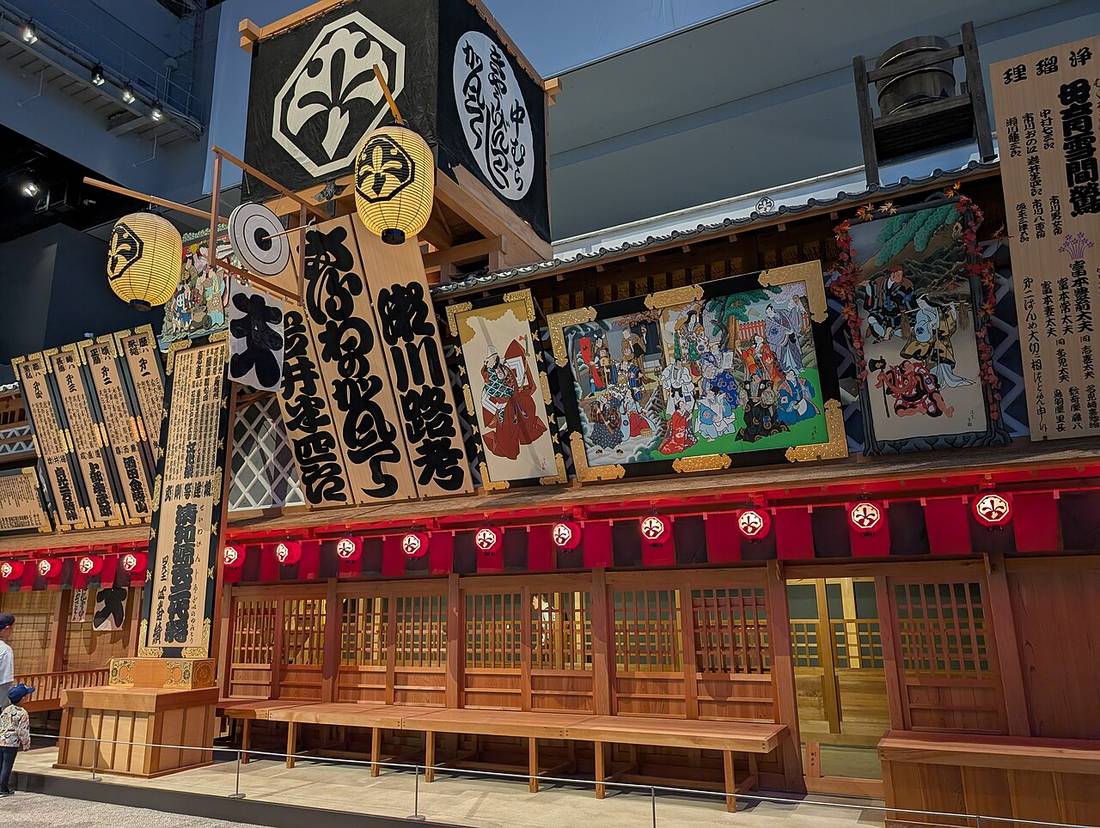
| The Nakamura-za theatre model | Answering visitor requests, it changed from exterior-only viewing to a model you can walk inside |
| The Entaro bus | New. The first motor vehicle in Japan designated an Important Cultural Property, transferred from the Bureau of Transportation; the museum calls it the oldest surviving and the only extant Entaro bus |
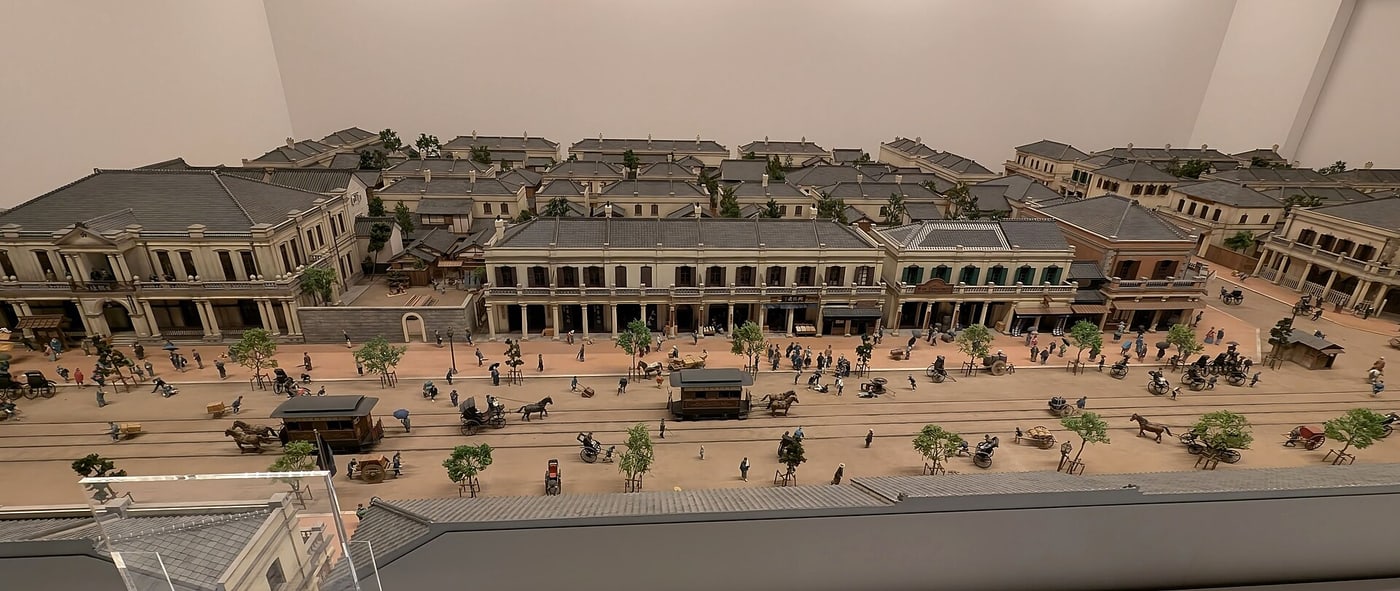
| The Edo streetscape | Tenement rows and food stalls, with a morning-glory seller's stall and a tempura stall newly added |
| The noren curtain | A light installation placed beyond Nihonbashi as the threshold where the modern and Edo viewpoints switch, supervised by the art and design studio Tangent |
| The sky inside the gallery | Sky imagery projected inside the sixth-floor gallery, moving from morning to night over 30 minutes, with patterns that change by season |
| Two new large models | The Asakusa Hanayashiki gate, reconstructed so you can walk through it, and the Dojunkai Daikanyama Apartments, rebuilt down to the furniture and household objects |
Make time for the Entaro bus. It is the only motor vehicle in Japan with Important Cultural Property status, and it was not in this building before — it came across from the Tokyo Bureau of Transportation for the reopening.
Two caveats. The staged display of eleven suits of armour and the complete showing of Hiroshige's "One Hundred Famous Views of Edo" were both flagged in the official footnote as limited-run. Whether either was still up by late August 2026 is not stated anywhere official, so treat them as reopening-period features and confirm on site.
Building and circulation
A red torii-motif gateway object now stands at the first-floor western entrance, with projection along the western approach. The wall beside the small hall was plastered by Tokyo master craftsman Naoki Kusumi, and the ticket-desk wall and counter use timber from the Tama region.
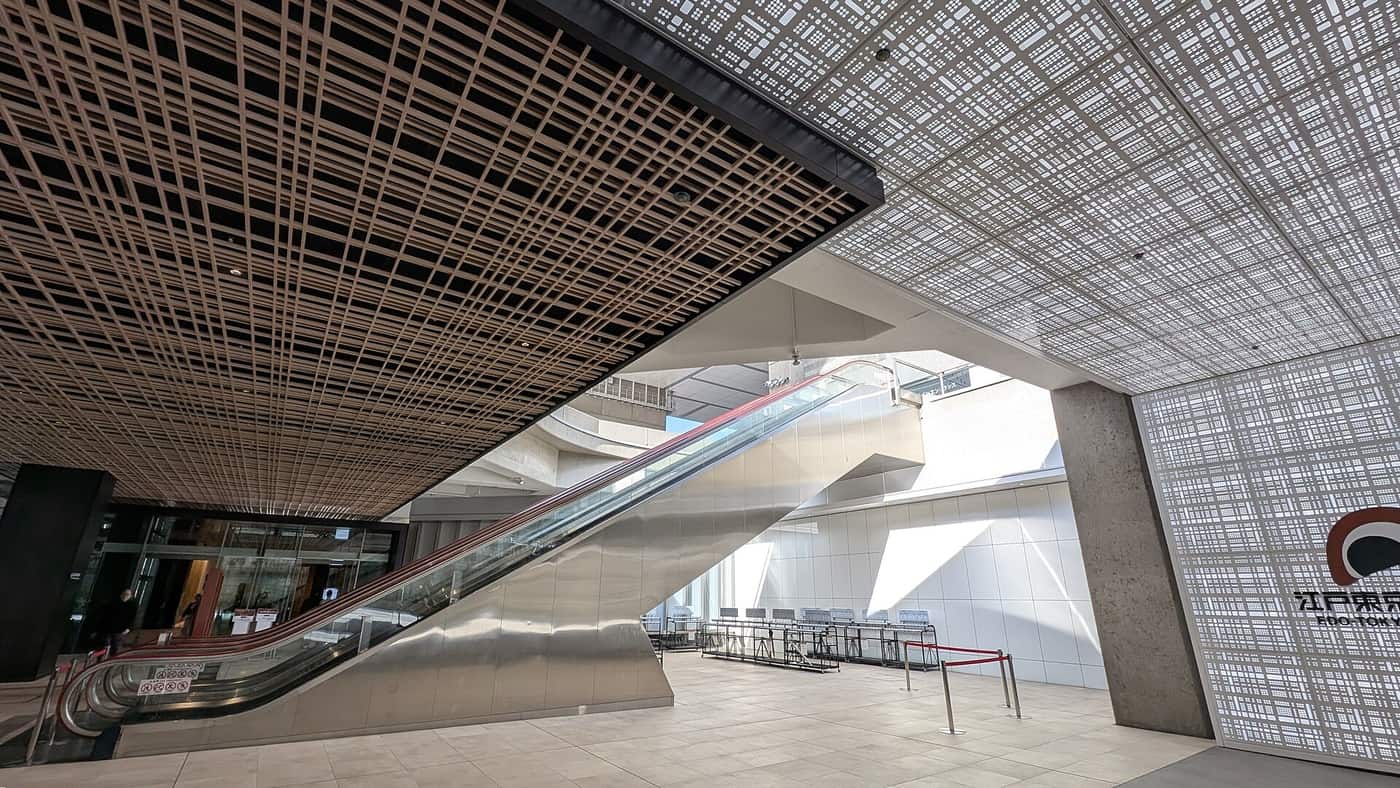
The genuinely useful detail is for wet days: the museum added a covered walkway from the Kiyosumi-dori side — that is, the Toei Oedo Line Ryogoku Station side — to the north entrance, and its accessibility handbook puts it flatly: the roof runs continuously from the station to the north entrance, so you can get in without getting wet. On the JR side, a light ceiling runs along the route from the west exit to the main entrance.
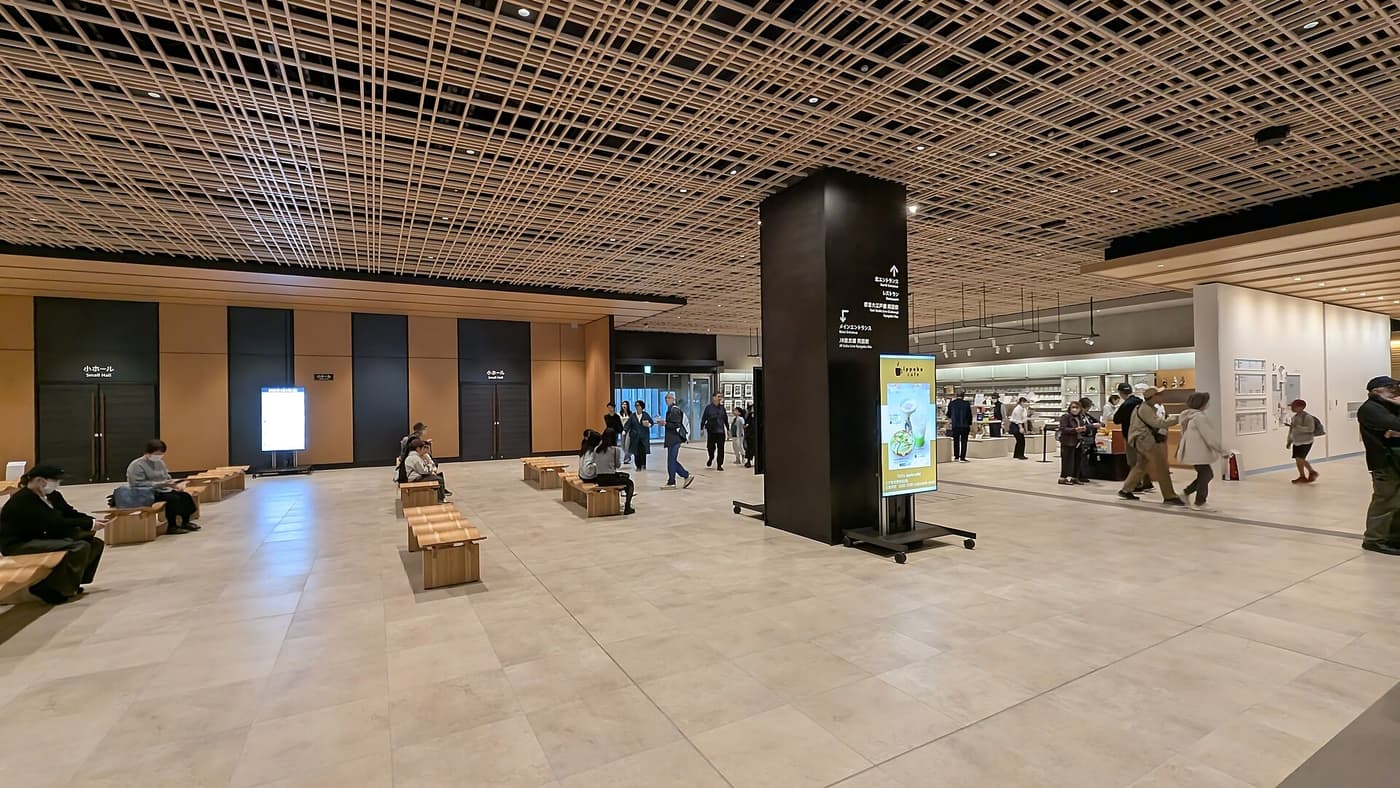
Everything front-of-house is new: the D!G TOKYO museum shop, the Japanese dining room Koyomi (soba, tempura and sushi alongside Western dishes) and the ippuku cafe. On accessibility, two accessible toilets were added beside the first-floor ticket desk and all accessible toilets in the building have ostomate facilities; the first-floor information desk is staffed by someone who signs; the permanent exhibition has tactile guide panels and touchable models; signage uses a universal-design typeface. The car park has ten EV charging points, two rapid and eight standard.
Can you take photos?
In the permanent exhibition on floors five and six, photography is permitted in principle. In the first-floor special exhibition gallery it depends on the exhibition. Monopods, tripods, selfie sticks, gimbals and drones are all banned, and flash is prohibited in principle.
Is "Toyotomi Brothers!" a separate ticket?
Yes — ¥2,100 general, and it does not include the permanent exhibition.
The show runs September 15 to November 8, 2026 in the first-floor special exhibition gallery. It is a touring exhibition that started at the Tokugawa Art Museum and Hosa Library in Nagoya, moved to the Osaka Museum of History (July 8 – August 31), and ends in Tokyo.
| Category | Special exhibition only | Combined with permanent |
|---|---|---|
| General | ¥2,100 | ¥2,740 |
| 65 and over | ¥1,600 | ¥1,920 |
| University / vocational student | ¥1,300 | ¥1,680 |
| High-school student | Free | No combined ticket |
| Junior high and under | Free | No combined ticket |
No advance booking is needed. The official wording states that plainly, adding that you may have to queue when it is busy.
The combined ticket has exactly two sales channels
This is the trap. The museum states that the combined ticket is sold only at the Edo-Tokyo Museum itself and on the museum's own Webket online store. Which means a ticket bought from a convenience-store terminal or any general ticketing agency is special-exhibition only, and will not get you into the permanent exhibition. If you want both, buy at the ticket desk or on Webket.
Four more things that will catch you out
- Advance pricing closed on September 14. The museum states that from September 15 everything sells at the on-the-day rate, so the ¥1,900 figure circulating online is now history.
- Exhibits swap halfway, with a clean break. First half September 15 – October 12, second half October 14 – November 8, with October 13 closed. Check which half your target object is in.
- Closure days differ from the museum's normal pattern. Mondays, except September 21, October 12 and November 2 which are open; plus Thursday September 24, Tuesday October 13 and Wednesday November 4. Friday November 6 stays open until 20:00.
- Silver Day does not apply to this exhibition. The museum states it will not offer free special-exhibition entry on Silver Day, so on that same day a visitor over 65 gets the permanent exhibition free and still pays ¥1,600 for the special one.
And one that matters for non-Japanese speakers: the audio guide for this exhibition is Japanese only, stated on the official page.
For high-school students the pricing runs backwards
The ¥2,100 exhibition is free; the ¥800 one costs ¥300.
| A high-school student pays | |
|---|---|
| Special exhibition "Toyotomi Brothers!" (general ¥2,100) | ¥0 |
| Permanent exhibition (general ¥800) | ¥300 |
Same day, same building, same teenager. Both figures come straight off the two official fee tables. If you are travelling with one, collect the free special-exhibition ticket first.
Which day should you go?
Check that it is open, then check whether the first-floor gallery is empty.
Monday closures are not reliable
The rule says closed Mondays, rolling to the next day when the Monday is a holiday. The published calendar says this:
| Month | Closed | Note |
|---|---|---|
| August 2026 | 3, 17, 24, 31 | Monday August 10 was open — special Obon opening |
| September 2026 | 7, 14, 24, 28 | Monday September 21 (holiday) open, closure moved to Thursday the 24th |
| October 2026 | 5, 13, 19, 26 | Monday October 12 open, closure moved to Tuesday the 13th |
| November 2026 onwards | Calendar not yet published | — |
Read the calendar page for your dates rather than trusting the Monday rule. For the New Year period the museum writes only "year-end and New Year" with no dates at all, so nothing is being estimated here.
Saturday is the only late night
Weekdays 9:30–17:30, Saturday 9:30–19:30, last admission 30 minutes before closing in both cases. If you want a long visit, take the Saturday.
Every Friday in August 2026 ran until 21:00, but that was the Tokyo Metropolitan Government's Summer Night Museum programme, not a standing arrangement — there is no official statement covering September onwards. Any guide saying "open until 9pm on Fridays" copied the August page.
The first-floor gallery is empty for roughly a third of the year
Lay out the run of shows since reopening:
| Exhibition | Dates |
|---|---|
| (empty, 25 days) | Mar 31 – Apr 24 |
| Reopening exhibition: "In Praise of Great Edo" | Apr 25 – May 24 |
| (empty, 29 days) | May 25 – Jun 22 |
| Reopening exhibition: "Western-Style Buildings — Meiji Dreams and Challenges" | Jun 23 – Aug 23 (ended) |
| (empty, 22 days — current) | Aug 24 – Sep 14 |
| Reopening / NHK taiga drama exhibition: "Toyotomi Brothers!" | Sep 15 – Nov 8 |
Visit between August 24 and September 14, 2026 and the first floor is bare: your ¥800 buys the permanent exhibition plus the planned and feature displays, nothing more. If the special exhibition is your reason for coming, move the date past September 15.
Free gallery talks on Friday afternoons
The Museum Talk runs 16:00 to 16:30, no booking needed, meeting under the Nihonbashi bridge on the fifth floor inside the permanent exhibition. You need a permanent-exhibition ticket to join, but the talk itself costs nothing. September 2026 has it every Friday — the 4th, 11th, 18th and 25th.
The part you can walk into without a ticket
The seventh-floor library charges nothing to enter.
The official wording is simply "admission fee: free", open 9:30 to 17:30, closed on the same days as the museum. The holdings run to roughly 140,000 books and catalogues, 150,000 periodicals and 10,000 microfilms.
The video library on the same floor is also free, and since the reopening it carries footage of the Tokyo air raids and recorded wartime testimony, viewable at any time. The seventh floor also has the Hon-no-Hiroba reading space, described officially as somewhere to rest while enjoying the view.
Treat this floor as a destination in its own right. If the weather turns, or the day falls apart, or you simply want somewhere to sit, this is a place in central Tokyo where you can stay a long time for nothing. For more of the same, see what to do in Tokyo when it rains.
Getting there from Ryogoku Station
If it is raining, use the Oedo Line side — that route is covered the whole way.
| Line | Exit | Walk |
|---|---|---|
| JR Sobu Line, Ryogoku | West exit (labelled "Kokugikan side" officially) | 3 min |
| JR Sobu Line, Ryogoku | East exit | 7 min |
| Toei Oedo Line, Ryogoku (Edo-Tokyo Museum) | A3 / A4 | 1 min |
Buses: Toei routes Kin 27, Ryo 28 and Mon 33, plus the Sumida ward circulator on its southern route. The stop is "Toei Ryogoku-eki-mae (Edo-Tokyo Museum)", three minutes on foot, and the museum specifically notes that this is a different stop from the one called "Ryogoku-eki".
The address is 1-4-1 Yokoami, Sumida-ku, Tokyo; the phone number is 03-3626-9974.
If you drive, parking is ¥1,000 for the first hour and ¥500 per 30 minutes after that, motorcycles ¥100 per hour, large coaches by prior reservation. The museum states that the car park may only be used during opening hours — which means you cannot leave the car there for the 18:40 projection. Holders of the various disability certificates park free. Given the station is a one-to-three-minute walk, skip the car and spend the money on the exhibition.
Ryogoku Kokugikan is right there
The museum's own press release labels the JR west exit the "Kokugikan side", and the main entrance route runs from that same exit. So one exit, two directions: the sumo hall one way, the museum the other, easily combined in a day.
It is a completely different proposition though, with its own ticketing, tournament calendar and etiquette — that is covered in how to watch a sumo tournament in Japan.
Is the Open Air Architectural Museum the same place?
No. It is in Koganei, it needs its own ticket, and general admission is ¥400.
The names are similar, both sit under the Tokyo Metropolitan Foundation for History and Culture, they share the Silver Day and Family Day schemes, and the museum's site links across — so it is easy to assume they are two wings of one institution. The prices, the location and the hours are all different, and the tickets are not interchangeable.
| Edo-Tokyo Museum | Edo-Tokyo Open Air Architectural Museum | |
|---|---|---|
| Location | 1-4-1 Yokoami, Sumida-ku (Ryogoku) | 3-7-1 Sakura-cho, Koganei, inside Koganei Park |
| Website | edo-tokyo-museum.or.jp | tatemonoen.jp (separate domain) |
| General | ¥800 | ¥400 |
| 65 and over | ¥400 | ¥200 |
| University student | ¥480 | ¥320 |
| High-school student | ¥300 | ¥200 |
| Hours | 9:30–17:30 (Sat to 19:30) | Apr–Sep 9:30–17:30 / Oct–Mar 9:30–16:30 |
If Koganei is on your list, confirm the opening status by phone or from its own front page before you go. One page on that site still carries a pandemic-era closure notice that contradicts the site's own homepage, so no opening status is quoted here from either.
Can you follow it in English?
The audio guide is free, and it runs on your own phone via a QR code.
The accessibility handbook says it directly: scan the QR code with a smartphone and listen to the audio guide free of charge. No rental unit, no deposit, no queue. Tablets in front of each display booth carry commentary in multiple languages as well.
Be careful about exactly what is claimed on languages. Under its "listening and viewing support" section the museum lists 13 supported languages: Japanese, English, simplified Chinese, traditional Chinese, Korean, French, Spanish, German, Italian, Russian, Thai, Portuguese and Malay. But that "supported languages" field sits inside a block that also covers the multilingual tablets and a speech-to-text service, and the museum never states that those 13 are the audio guide's languages. So no claim is made here that the audio guide is available in your language — you find out when you scan.
Separately, Bloomberg Connects went live on August 20, 2026: a free digital guide app whose content the museum says is auto-translated into more than 40 languages, including interview audio with Shohei Shigematsu and a conversation with director Terunobu Fujimori. Bring your own earphones — the museum explicitly asks visitors to carry them for audio guides and video inside the building. Put a pair in the bag before you leave.
The website has an English edition, and a traditional Chinese one, though translation is partial: on the Chinese pages the special-exhibition fee table is still in Japanese.
One thing that is neither confirmed nor denied: free Wi-Fi is never mentioned officially. The admission, hours, access, visitor-rules, floor-plan pages and the eight-page accessibility handbook were all searched, with zero hits. Plan as though there is none.
For deaf and hard-of-hearing visitors the museum does better than most: remote sign-language interpretation via QR code, and a signing member of staff on the first-floor information desk.
The three timetables, one more time
This building now runs on three clocks that do not line up:
- Permanent exhibition — 9:30–17:30 (Sat to 19:30), last admission 17:00. This is what your ticket opens.
- First-floor special exhibition gallery — follows its own run of shows, with three gaps since reopening, the longest 29 days.
- Third-floor Hiroba projection — from 18:40 in August 2026, a dozen or so nights a month, cancelled in bad weather, scheduled month by month.
Stack all three before you pick a date, a start time, and whether you are willing to kill 70 minutes outside. A very similar problem wrecks mornings across the river, where three disagreeing timetables leave a dead window — see the Toyosu Fish Market timing guide. To slot Ryogoku into a wider route, start from the five-day Tokyo itinerary.
Appendix: original Japanese wording (tap to expand)
The Japanese sources quoted above, collected here so you can check them yourself. Unless noted otherwise, all come from the official Tokyo Metropolitan Edo-Tokyo Museum site (edo-tokyo-museum.or.jp), including the Tokyo Metropolitan Government press-release PDFs and the official special site edohaku-special.net.
1. Reopening date and closure period
2026年(令和8)3月31日 東京都江戸東京博物館 リニューアルオープン
2022年(令和4)4月1日~2026年(令和8)3月31日 大規模改修工事のため休館
東京都江戸東京博物館(愛称:えどはく)は、2026 (令和8)年3月31日にリニューアルオープンいたします。
2. The admission increase (press release, January 30, 2026)
■常設展観覧料の改定 館内サービスの向上等に寄与するため、下記のとおり常設展観覧料を改定します。
・一般:600円→800円
・65歳以上:300円→400円
・大学生・専門学校生:480円(変更なし)
・高校生:300円(変更なし)
・中学生以下:無料
ご購入後のチケットの払戻や日時変更はできません。
3. Hours and closure days
9:30~17:30 (土曜日は9:30~19:30)/入館は閉館の30分前まで
※8月7日(金)・14日(金)・21日(金)・28日(金)は21:00まで開館時間を延長します。
休館日:毎週月曜日(月曜が祝日または振替休日の場合はその翌日)、年末年始
8月28日(金)はサマ―ナイトミュージアムのため21:00まで
4. The projections
約4,000㎡の天井面と柱面に収蔵資料等をテーマにした映像をダイナミックに投影します。1回の映像投影時間は、休憩時間も含めて20分ほどです。
3階江戸東京ひろばを吹き抜ける風に合わせて、映像が変化する「インタラクション映像」
強風や雨天などの天候の影響による安全の確保や、投影機材の整備等により、急遽、映像投影を中止することがあります…急な中止については、Xなどでお知らせいたします
常設展示室内に空の映像を投影…浮世絵風の江戸の空と、現代の空が交錯しながら出現/30分をかけて朝から夜へと変化する空の様子
5. Planned and feature exhibitions covered by the permanent-exhibition fee
企画展 常設展示に関係するテーマを中心に、5階常設展内の企画展示室で開催しています。※常設展観覧料でご覧いただけます。
特集展示 館蔵品を中心に特定のテーマを取り上げた展示です。5・6階常設展内の展示コーナーの一部で適宜開催します。※常設展観覧料でご覧いただけます。
6. The seven changes in the permanent exhibition
常設展示室で存在感を放っていた大型模型「朝野新聞社」を、史実に基づき「服部時計店」へと改修しました。服部時計店の正面玄関を東京ゾーンの入口として、訪れる人を迎えます。
来館者から寄せられた「芝居小屋の中に入ってみたい」という声に応え、模型仕様を一新しました。従来は外観のみの鑑賞でしたが、今回の改修で内部に足を踏み入れられる体験型展示へ。
自動車初の重要文化財となった本車輌が、東京都交通局から移され、常設展示室内で公開されます。現存する最古の車輌であり、唯一の円太郎バス伝存車輌
江戸時代の町人文化を象徴する「のれん」を日本橋の先に設置。“現代”と“江戸”の視点が切り替わる境界として、来館者を江戸の世界へといざなう光の演出
「浅草花屋敷の門」を展示室内に復元、実際に通り抜けることができる/「同潤会代官山アパートメント」は家具や生活用品等、当時の様子をリアルに再現
なお、甲冑及び名所江戸百景の展示については期間限定です。
7. Circulation and the covered walkway
清澄通り側(都営地下鉄大江戸線両国駅側)から北エントランスへの雨天時の配慮として、歩廊を増設しました
駅から北エントランスまでは屋根が続いており、雨の日でも濡れずにご入館いただけます。
JR両国駅西口側(国技館側)からメインエントランスまでの動線上には光天井を採用
8. The four conditions on "Toyotomi Brothers!"
※本展は事前予約不要です。混雑時は入場をお待ちいただく可能性があります。
※江戸東京博物館・江戸東京博物館オンラインWebket のみで販売
前売券販売期間は2026年7月15日(水)〜9月14日(月)。9月15日(火)からは当日料金で販売します。
前期 9月15日(火)~10月12日(月・祝)/後期 10月14日(水)~11月8日(日)
特別展「豊臣兄弟!」では…シルバーデー(毎月第3水曜日)当日の特別展の無料入場を実施いたしません。*常設展はシルバーデーの入場無料(65歳以上の方対象)を実施いたします。
※音声ガイドは日本語版のみのご提供となります。
9. The free parts
入室料 無料
映像資料を無料で視聴・閲覧できます
開催時間 16:00~16:30/参加には常設展の入場チケットが必要です/当日、常設展示室内5階の日本橋下にお集まりください。予約は不要です。
10. Language support
QRコードをお持ちのスマートフォン等で読み取り、音声ガイドを無料で聴くことができます。
各展示ブースの前にはタブレットを設置しております。複数の言語に対応した解説をご覧いただけます。
日本語・英語・中国語(簡体字)・中国語(繁体字)・韓国語・フランス語・スペイン語・ドイツ語・イタリア語・ロシア語・タイ語・ポルトガル語・マレー語
※館内で音声ガイドや動画をご利用になる場合は、イヤホンをご持参ください。
11. Access and parking
※「両国駅」とは別の停留所です。
駐車場のご利用は、当館開館時間内のみとなります
12. Why the building was renovated
平成4年のしゅん功後、約30年が経過。来館者の安心・安全確保及び展示環境の魅力を更に向上させ、基本機能の回復、経年劣化更新等を行う必要があることから、全面改修工事を実施しました。
Frequently Asked Questions
- Q1:Is the Edo-Tokyo Museum still closed for renovation?
- No. It reopened on Tuesday, March 31, 2026, after closing on April 1, 2022 — just under four years. Four separate official documents carry the same date: the museum's own institutional chronology, two press releases from the Tokyo Metropolitan Government dated January 30 and March 6, 2026, and the official site of the NHK-organised "Toyotomi Brothers!" special exhibition. One wrinkle worth flagging: the chronology page lists the end of the closure period as March 31 as well, so read literally it says the museum was shut on the day it opened. Three of the four sources explicitly call March 31 the reopening day, so that is the date to work from.
- Q2:How much is admission, and has the price changed?
- ¥800 for a general adult ticket, up from ¥600 on the day it reopened. Seniors 65 and over went from ¥300 to ¥400. The official notice spells out the change line by line — and it also spells out what did not move: university and vocational-school students stay at ¥480 and high-school students stay at ¥300, both marked "no change" in the original. Junior high and younger are free. The practical effect is that the gap between an adult and a student ticket widened from ¥120 to ¥320, so bring the student ID. There is no weekday/weekend split — the official fee table has no such column. ¥600 was the pre-closure price and stopped applying on the day the museum reopened.
- Q3:Do you need a ticket for the 4,000 sqm ceiling projection?
- The museum has never said. The admission page, the opening-hours page, the projection explainer, both monthly schedules, both Tokyo Metropolitan Government press releases and the metropolitan newsroom page were all checked, and none of them mentions a fee for it. Circumstantially it sits outside the paid zone — the third floor holds only the Edo-Tokyo Hiroba and toilets, the ticket desk is on the first floor and the permanent exhibition entrance is on the sixth, and the government press release lists the two time slots on separate lines. But circumstantial is all that is, and there is a counter-example: there was a projection on Monday August 10, a day the museum was open anyway, so "it runs on closed days, therefore it is free" does not hold. Call the museum on 03-3626-9974 if you need certainty before you plan around it.
- Q4:Is the museum always closed on Mondays?
- Not always. The stated rule is closed Mondays, rolling to Tuesday when the Monday is a public holiday or substitute holiday — but the published calendar has exceptions the rule does not predict. Monday August 10, 2026 was open, a special Obon opening. Monday September 21 (Respect for the Aged Day) and Monday October 12 are both open, with the closure pushed to Thursday September 24 and Tuesday October 13 instead. Check the official calendar page for your dates rather than reasoning from the rule. As of late August 2026 the calendar only ran through October; November onwards had not been published.
- Q5:Will the projection definitely be running when I visit?
- No, and there are three reasons why not. It does not run daily — August 2026 had just 14 projection nights in the whole month. The schedule is published one month at a time, and as of August 29, 2026 the September page was not yet online. And the museum states plainly that projection may be cancelled at short notice for safety in strong wind or rain, or for equipment maintenance, with cancellations announced on its X account. One more moving part: the start time tracks sunset. From reopening through Golden Week it began at 17:20 with eight sessions a night; by August it had shifted to 18:40 with four. Any guide that hard-codes a time is already out of date.
- Q6:Is the "Toyotomi Brothers!" exhibition included in the ¥800 ticket?
- No — it is a separate ¥2,100 ticket. There is a combined ticket at ¥2,740, and this is where people get caught: the museum states that the combined ticket is sold only at the museum itself and on its own Webket online store. A ticket bought from a convenience-store machine or a general ticketing agency is special-exhibition only and will not get you into the permanent exhibition. Three more things: no advance booking is required (official wording is explicit), advance-price sales closed on September 14, 2026, and the show swaps exhibits between a first and second half with October 13 closed in between, cleanly splitting the two. The audio guide for this exhibition is Japanese only.
- Q7:How long is the museum closed over New Year?
- No dates have been published. The opening-hours page says only "year-end and New Year" with no start or end date, and the calendar page ran no further than October when checked in late August 2026. If you see a specific window like December 28 to January 1 quoted online, that is not coming from the museum. Check the official calendar again once it extends into December.
Read next
Toyosu Fish Market 2026–27: Skip the Tuna Auction Lottery
Both viewing decks are free — the official site says so twice. What actually wrecks your morning is three timetables that disagree, leaving a dead window between 6:30 and 10:00.
Watching Sumo in Japan 2026: Official Tickets from ¥2,000
Official chair seats start at 2,500 yen in Tokyo and 2,000 in Fukuoka. Resale is banned, and the association enforced it 138 times last year.
Tokyo in the Rain: 10 Indoor Spots 2026
Ten indoor picks for a wet day: teamLab, Skytree, LaQua onsen, Pokémon Center — the plays that save a trip.
📊 See the 2026 Price Index (JR Pass, DPA, eSIM, Airport Transport) →