If you only want one photo that screams "this is Japan," the answer is usually here: cherry blossoms + Mt. Fuji + a five-story pagoda (or a lake reflection). Thanks to the altitude, the Kawaguchiko area blooms about two weeks after Tokyo — typically mid-April — which slots right after Tokyo's bloom, so you can chain "Tokyo first, then top up at Mt. Fuji." This guide covers the Chureito Pagoda and Lake Kawaguchi shots, the best hours, how to get there, day-trip vs overnight, and the thing people most often confuse — "shibazakura is not cherry blossom." It's the Mt. Fuji deep-dive companion to our Japan cherry blossom guide; altitude makes timing here more weather-dependent, so check the sakura bloom forecast again before you go.
- Kawaguchiko peaks around mid-April (two weeks after Tokyo, at altitude) — chain it after Tokyo's bloom
- The iconic trifecta is at Arakurayama Sengen Park: pagoda + cherries + Mt. Fuji, ~400 steps up
- Whether you see Fuji depends on weather more than the bloom date — it shows in the morning, hides by afternoon
- The "Fuji Shibazakura Festival" is moss phlox (a ground carpet), not tree cherries — don't confuse them
- A windless dawn gives the upside-down Fuji + cherry reflection — worth an overnight for that shot
📖 Table of contents
Kawaguchiko's timing: two weeks after Tokyo
Lake Kawaguchi sits at about 830m, much higher and cooler than central Tokyo, so its cherries reach full bloom roughly two weeks later — typically mid-April (around April 10-20). The Chureito Pagoda cherries run about the same. That gap is a gift: it follows Tokyo's late-March bloom, letting you plan a continuous "Tokyo cherries first, then a second wave at Mt. Fuji" trip.
But Fuji cherry-viewing has a variable other spots don't: whether you actually capture Mt. Fuji itself depends more on the weather than on the bloom date. Fuji frequently shows in the morning and hides behind cloud by afternoon, so even at full bloom a cloudy day can mean no mountain at all. The fix is to go at dawn and keep a flexible backup day. The nationwide timing is in the pillar's Japan cherry blossom guide.
Four Mt. Fuji cherry blossom spots
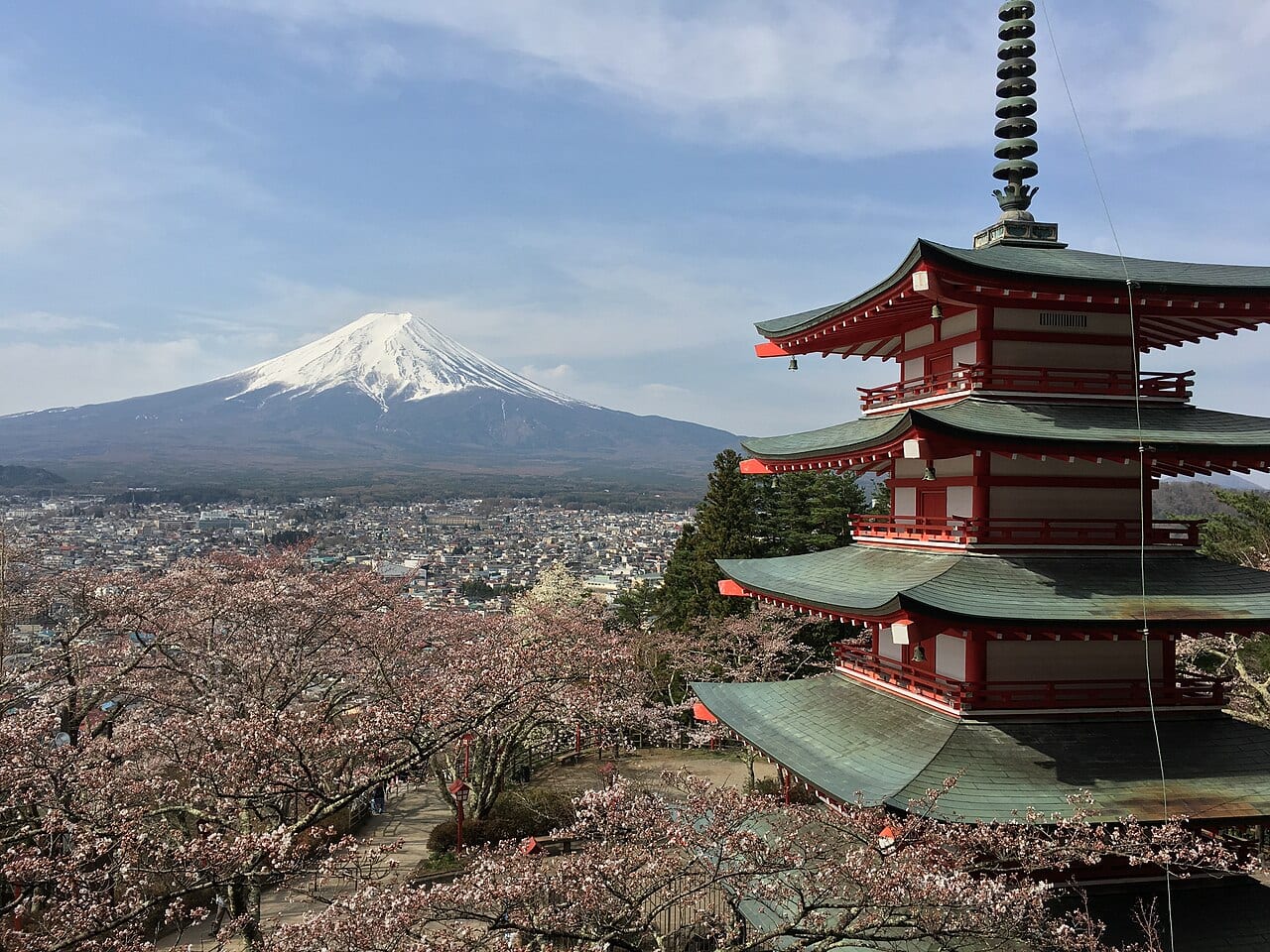
1. Arakurayama Sengen Park — the iconic trifecta
In Fujiyoshida, Arakurayama Sengen Park is where that cover photo of "pagoda + cherries + Mt. Fuji" is shot, and one of Japan's most recognizable sakura scenes. You climb 398 steps (the "Sakuya-hime" staircase) to the viewpoint — per the shrine's official information there is no step-free alternative route, so budget the fitness for it. During full-bloom week the dawn crowd is already heavy and prime spots fill fast, so go with the first wave at opening — also catching Fuji while it shows in the morning. It's ~10 min on foot from Shimo-Yoshida Station. For the full stair logistics, the 2026 festival cancellation, and the goshuin situation, see our dedicated Chureito Pagoda guide.
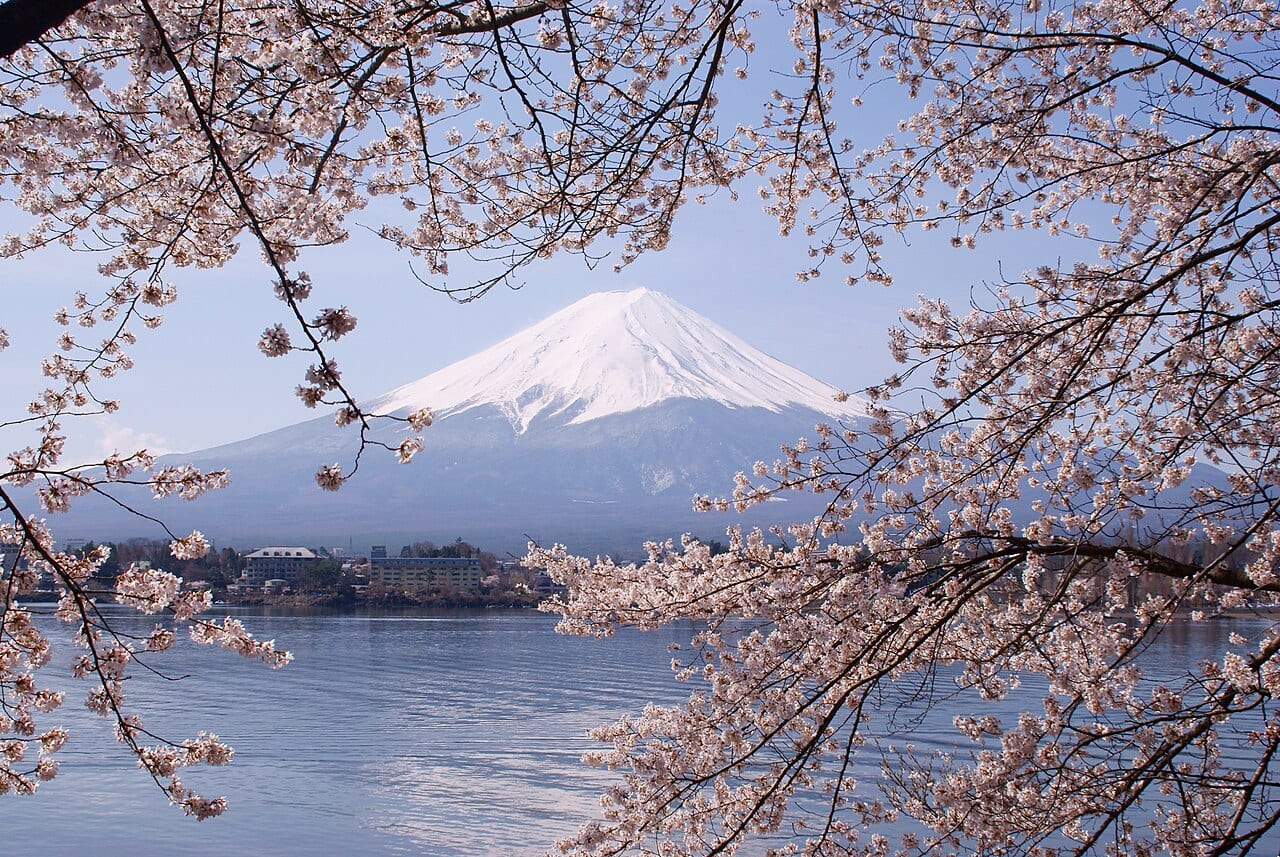
2. North shore of Lake Kawaguchi — the inverted Fuji + cherries
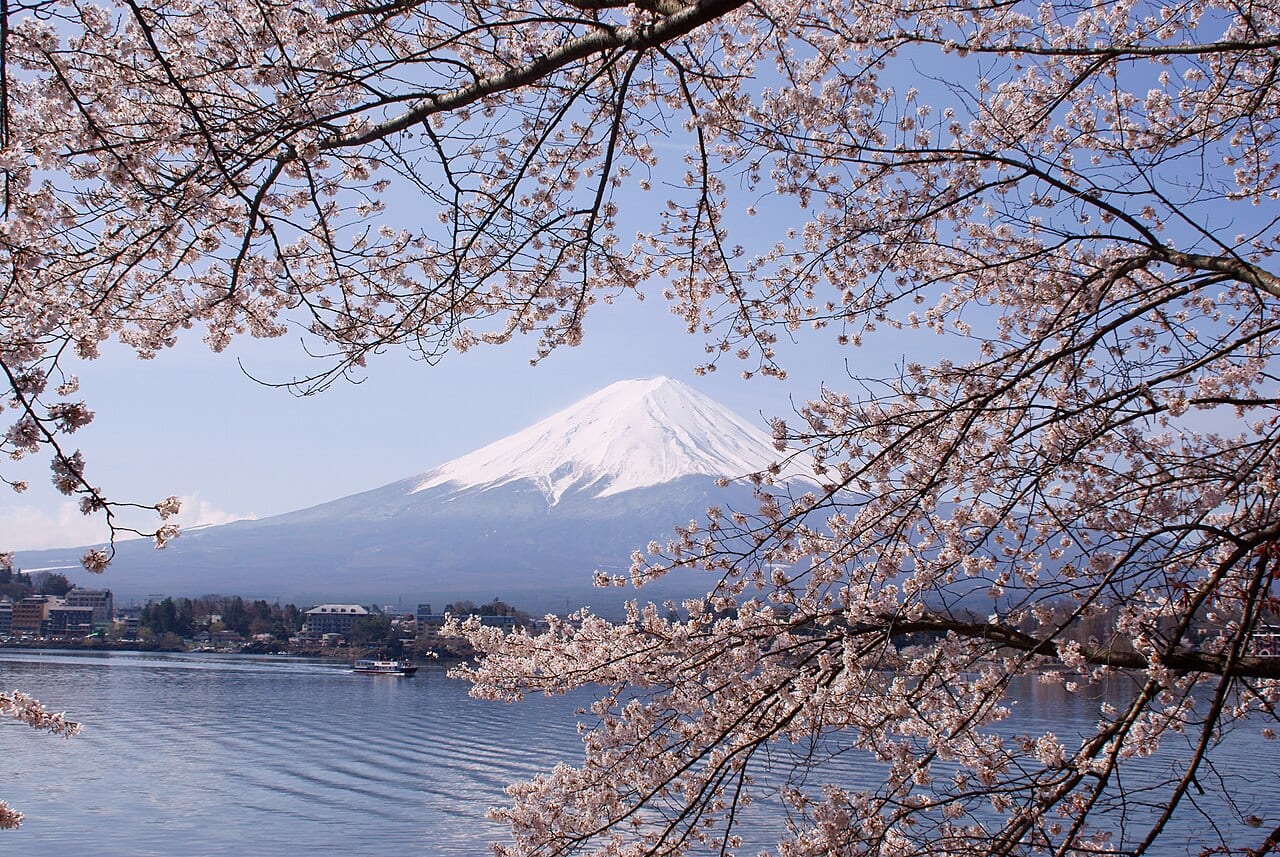
The north shore (around Ubuyagasaki and Nagasaki Park) has a cherry-tree avenue along the water, and its draw is the "upside-down Fuji" the lake mirrors on a windless dawn, paired with the shoreline cherries. That reflection is exactly why the overnight is worth it — the lake is calmest and Fuji shows most reliably at dawn and dusk. The shoreline path and cycle route are easy and made for slow shooting.
3. Oshino Hakkai — spring-fed village with Fuji
Oshino Hakkai is a cluster of crystal-clear spring ponds fed by Mt. Fuji's underground water; the see-through pools with thatched-roof houses and Mt. Fuji, plus scattered cherry blossoms in spring, give a rural mood completely unlike the lakeshore. It's about 20 minutes by car from Kawaguchiko and often paired with it.
4. Lake Motosu & Lake Shoji — the quieter photographer's pick
If the crowds at Arakurayama and Kawaguchiko put you off, the more westerly Fuji Five Lakes — Motosu and Shoji — are far quieter, with the same Mt. Fuji over water and scattered cherries. The trade-off is weaker public transport, so a car is best.
Note: the shibazakura festival isn't sakura
This is the most common Mt. Fuji travel mix-up, so to be clear: the Fuji Shibazakura Festival features shibazakura (moss phlox), not tree cherry blossoms. Shibazakura is a ground-hugging flower that carpets the slopes in vast sheets of pink, held at the Fuji Motosuko Resort near Lake Motosu, usually mid-April to late May — later and far longer than Kawaguchiko's tree cherries.
So if the photo you saw is "Mt. Fuji + a vast ground-level pink carpet," that's shibazakura, not cherry blossom; "Mt. Fuji + cherries on trees" is the sakura this guide covers. Both are beautiful and their seasons partly overlap (mid-April), but don't plan the wrong one — for tree cherries target Arakurayama and Kawaguchiko, and only go to the festival if you specifically want the flower carpet.
Access, and day-trip vs overnight
Three ways from Tokyo to Kawaguchiko: a Shinjuku highway bus direct (~1.5-2 hours, cheapest), the JR Fujikaiyu limited express direct from Shinjuku (no transfer but few departures), or a bus tour from Tokyo. Transit and lodging are tight in sakura season, so book ahead. The full comparison is in our Tokyo to Mt. Fuji day trip guide.
The easiest way to do Kawaguchiko and Mt. Fuji in a day is a bus tour from Ginza: KKday Mt. Fuji day tour (from Ginza), skipping luggage transfers and timetable hunting. For the inverted-Fuji-and-cherry shot, stay over — but lakeside inns are pricey and scarce in full-bloom week, so book as early as you can; if the shoreline is full, look around Kawaguchiko Station or Fujiyoshida for alternatives. Set up a KKday Japan eSIM online first. Kawaguchiko is high and its April dawns are still cold — packing is in our Japan packing & weather guide. For the Tokyo end, see our Tokyo cherry blossom guide.
When and how to actually catch Mt. Fuji
Cherry spots are everywhere, but "cherries with a clear Mt. Fuji" is a matter of luck — here's how to raise your odds:
- Go at dawn: Fuji usually shows in the morning and disappears behind afternoon cloud as humidity rises, so dawn is both the crowd-free slot and your best shot at the mountain — the biggest difference between Fuji sakura and other cherry spots.
- The inverted Fuji needs no wind: the lake only mirrors a reflection when it's near-still, calmest around dawn and dusk; any daytime breeze kills it, so don't arrive lakeside at noon.
- Read humidity and wind: dry, cold, north-wind days give the best visibility, and the morning after rain clears is often spectacular. Check the Fuji Five Lakes live cameras before you set out, then choose your spot.
- Keep a backup day: the worst plan is a single morning. If you can, stay over and hold the next dawn in reserve — it dramatically raises your odds of "cherries + a clear Mt. Fuji."
Frequently Asked Questions
- Q1:When do cherry blossoms peak at Mt. Fuji and Lake Kawaguchi?
- Because of the altitude (~830m), the Kawaguchiko area blooms about two weeks after Tokyo — typically mid-April (around April 10-20), and the Chureito Pagoda cherries run roughly the same. That slots neatly after Tokyo's late-March bloom, so you can chain "Tokyo first, then Mt. Fuji." Fine-tune two weeks out with the Fujikawaguchiko tourism association and Weathernews; mountain timing swings more with the weather.
- Q2:Where is that iconic "cherry blossoms + Mt. Fuji + pagoda" photo taken?
- At Arakurayama Sengen Park in Fujiyoshida, where the five-story Chureito Pagoda lines up with cherry blossoms and Mt. Fuji — the trifecta on every Japan poster. You climb the 398-step Sakuya-hime staircase to the viewpoint; per the shrine's official information there is no step-free alternative route. During full-bloom week the dawn crowd is heavy and the prime spots fill early, so go with the first wave at opening.
- Q3:Is the Fuji Shibazakura Festival the same as cherry blossoms?
- No — and people mix this up constantly. The Fuji Shibazakura Festival (near Lake Motosu) features shibazakura (moss phlox), a ground-hugging flower that carpets the slopes in pink — completely different from the Somei-Yoshino cherry trees. The shibazakura festival usually runs mid-April to late May, later and longer than Kawaguchiko's tree cherries. If you want "Mt. Fuji + a pink flower carpet," that's the festival, but it isn't cherry-blossom viewing.
- Q4:What's the easiest way to get to Kawaguchiko for cherry blossoms?
- Three ways: (1) a highway bus from Shinjuku direct to Kawaguchiko Station, ~1.5-2 hours, the cheapest; (2) the JR Fujikaiyu limited express direct from Shinjuku, no transfer but few departures; (3) a bus tour from Tokyo that skips luggage transfers. Transit and lodging are tight in sakura season, so book ahead. The full comparison is in our Tokyo to Mt. Fuji day trip guide.
- Q5:Should I day-trip or stay overnight for Mt. Fuji cherry blossoms?
- If you want the windless-dawn reflection of Mt. Fuji with cherries, an overnight is worth it — Fuji often shows in the morning and hides behind cloud by afternoon, and the lake is calmest at dawn and dusk. But Kawaguchiko full-bloom-week lodging is pricey and scarce; on a tighter budget, a day trip (bus tour or self-drive) still covers Arakurayama and the north-shore spots. Whether you actually see Fuji depends more on weather than on the bloom date.