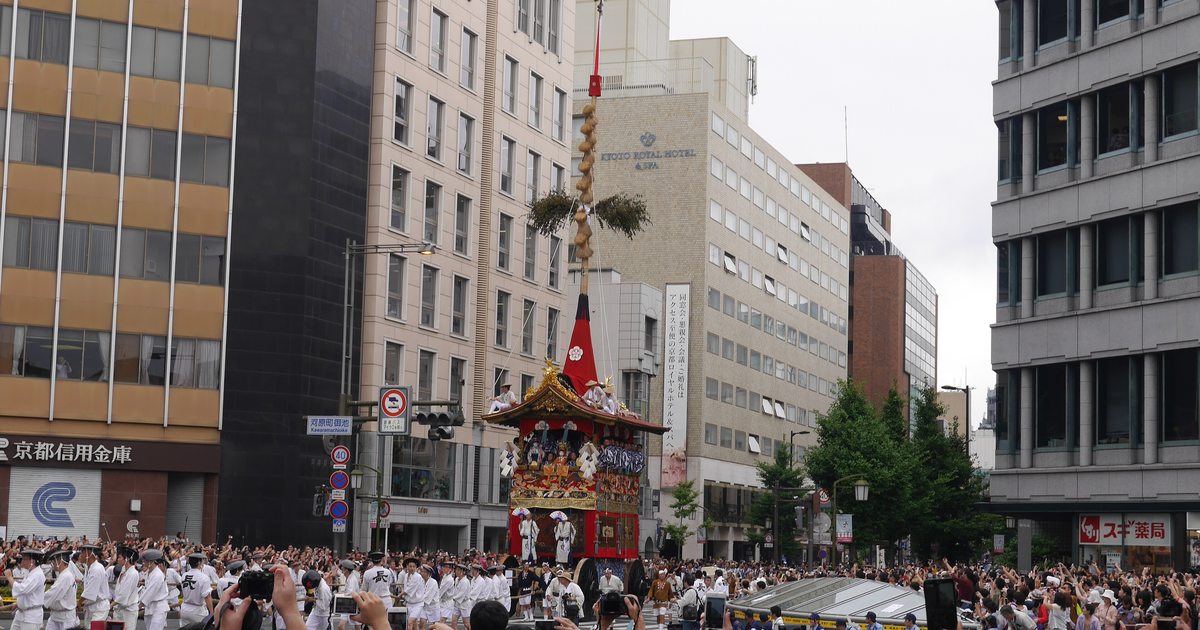
Stand outside Yasaka Shrine on 20 July and Gion Matsuri will look like it is not happening. It isn't — the gods have moved out. Yasaka Shrine says so in plain Japanese on its own site: three portable shrines leave the grounds on the evening of 17 July, install themselves in the Otabisho resting hall at Shijo-Teramachi, and stay there until 24 July. That fact unlocks a bigger inversion. The famous float parade is not the main event. Yasaka Shrine and the Kyoto City Tourism Association independently describe the floats as a procession that purified the avenues in advance of the portable shrines — an escort, clearing the road. Once you see that, everything else falls into place: why there are two parades, where to be between 18 and 23 July, and why two grandstand tickets at identical prices buy completely different things. This guide lays out the three official timetables that contradict each other — floats 9:00 to 11:20, food stalls on two nights only from 18:00 to 23:00, portable shrines not moving until 16:00 — and tells you where to stand in July 2027.
- The floats escort the portable shrines — both the shrine and the city tourism body say so, and it explains why there are two parades rather than one
- Food stalls and pedestrian-only streets exist on 15 and 16 July only (roughly 18:00-23:00). Not on the 14th, and not once during the second-half Yoiyama on 21-23 July
- From 18 to 23 July the deities are not at Yasaka Shrine — they are at the Otabisho on Shijo, free to visit, in the middle of the main shopping district, seven days a year
- The two grandstands cost the same and are not the same: the first-half seats mean 1.5-2.5 hours in the sun, the second-half seats are done in twenty minutes
- Rain or shine, no refunds, and umbrellas are banned — in the wettest month of Kyoto's year (223.6 mm)
📖 Contents
- 1. The week the gods are not at the shrine
- 2. Why there are two parades: the 48-year gap
- 3. Three timetables, two dead zones, one forced choice
- 4. Yoiyama is not three identical nights
- 5. Grandstand seats: same price, different product
- 6. How to watch without a ticket
- 7. The chimaki is not a dumpling
- 8. Kyoto in July: heat, rain, and two fineable rules
- 9. Beds, trains and the hidden tax
- 10. Getting the UNESCO line right
- 11. Planning calendar for 2027
- 12. FAQ
The week the gods are not at the shrine
Two official passages set up everything that follows.
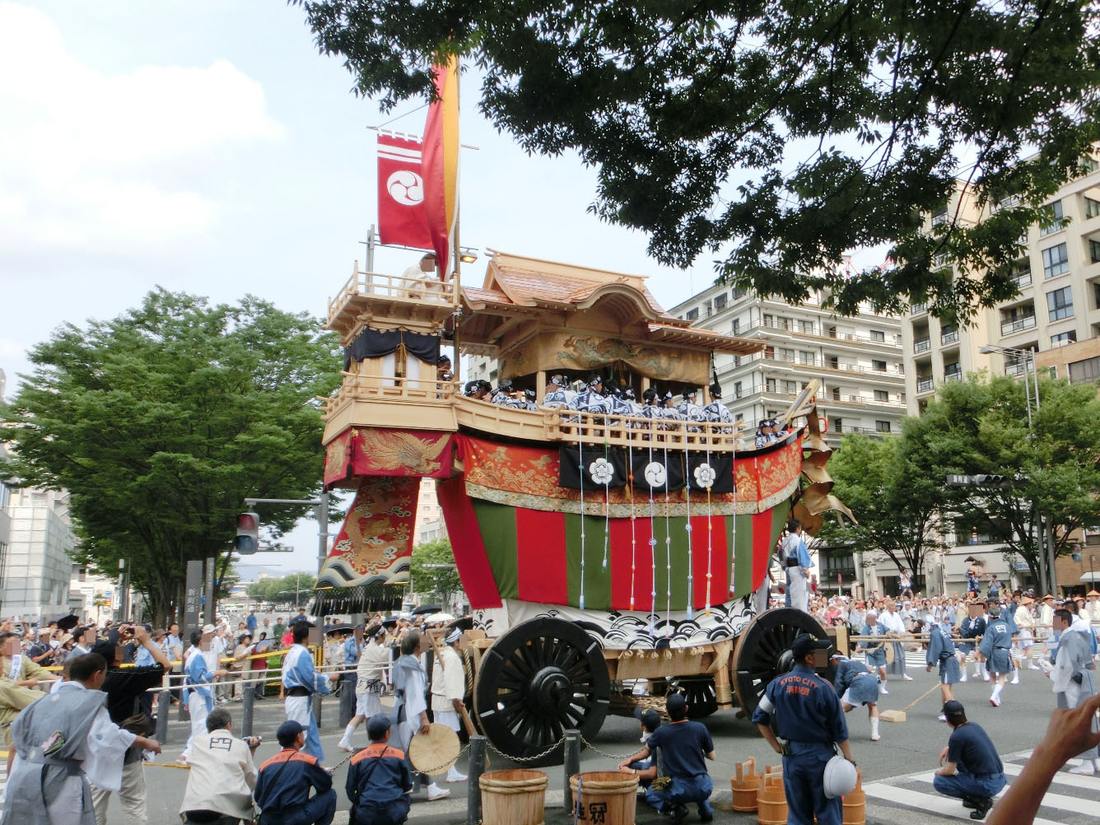
Yasaka Shrine, on its own Gion Matsuri page, writes that the floats were originally built as vessels to pacify the plague deities that brought disaster, and that they are thought to have purified the great avenues of the capital ahead of the portable-shrine procession. The Kyoto City Tourism Association puts it in different words with the same meaning: the mikoshi going from the shrine to the resting hall is the Shinko-sai, the return is the Kanko-sai, and the float processions have been carried out as something preceding those rites.
In plain English: the floats are the escort walking in front, sweeping the road clean. The organising shrine frames it that way and so does the tourism authority. The floats are so conspicuous, though, that it is easy to leave knowing all thirty-four of them and no idea where the portable shrines went.
The seven-day itinerary of a deity
Stitch the official timings together and the main storyline is remarkably clear.
- 10 July, 20:00-20:30 and 28 July, 20:00 — Mikoshi-arai. One of the three portable shrines is carried out with pine torches lighting the column front and back, and purified on the Shijo Bridge. Once before the festival, once after.
- 15 July, 20:00 — Yoimiya-sai. Official wording: the lights inside the shrine precinct are extinguished and, in the pure darkness, the divine spirits are transferred into the portable shrines waiting on the dance hall. It is the only rite of the entire month performed in total darkness, and it happens directly above the first of the two street-stall nights.
- 17 July, 16:00 — Shinko-sai. A rite in the main hall preceding the procession.
- 17 July, 18:00 — departure. The shrines leave from the foot of the stone steps at Yasaka, travel mainly east of the Kamo River and through the Kawaramachi district, and reach the Shijo Otabisho around 21:00.
- 18-23 July — in residence. The official phrasing is that they are enshrined there until the 24th. For six days the deities are at Shijo-Teramachi, not at Yasaka.
- 24 July, 17:00 — Kanko-sai. The three shrines leave the resting hall in order, work the area west of Teramachi, hold a rite at the Sanjo Matatabisha, take on lanterns, and return to Yasaka around 22:00 — after which each is carried clockwise three times around the dance hall before the spirits are transferred back.
⚠️ One official contradiction to flag before you build a plan on it: the events list headlines the Kanko-sai as "24 July, around 23:00" while the body text of the same entry describes a 17:00 departure and a 22:00 return. This guide uses the body text, because it carries the full route description — but check the current-year notice before you commit an evening to it.
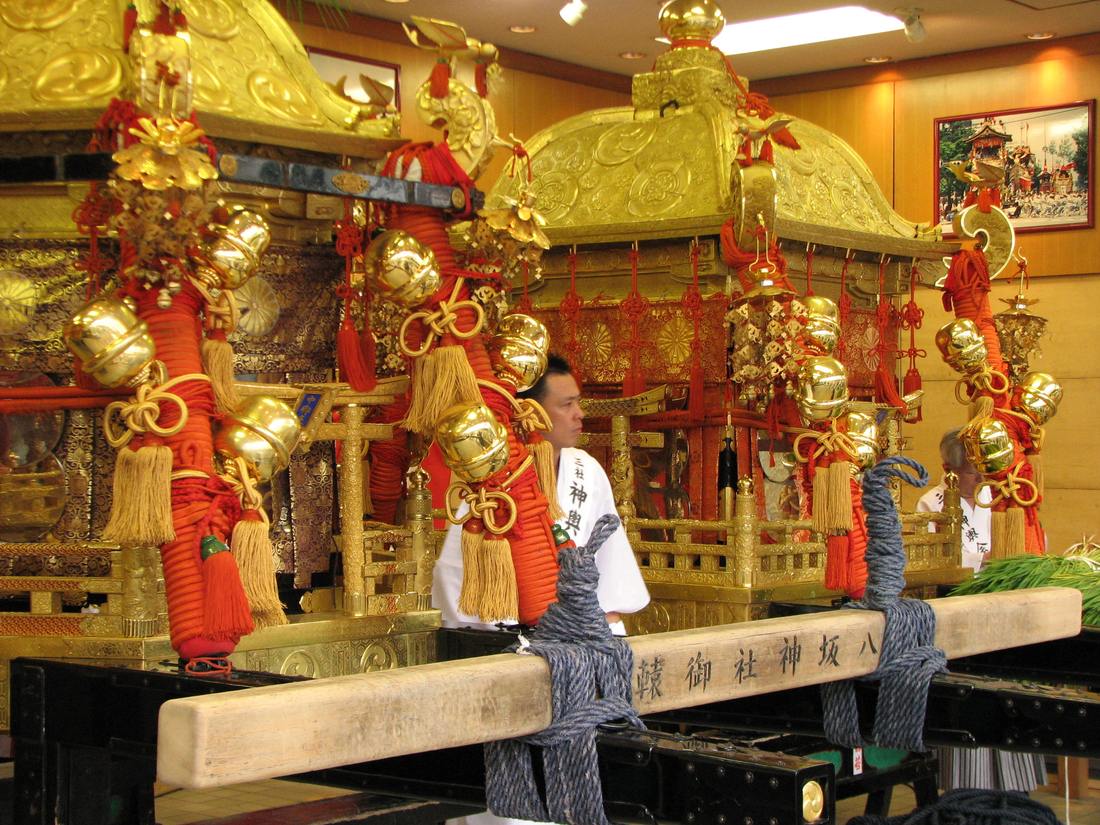
The three shrines are physically distinguishable, which is useful on the night. Officially they are hexagonal, square and octagonal, named Naka-goza, Higashi-goza and Nishi-goza, carrying Susanoo-no-Mikoto, Kushinadahime-no-Mikoto and the Yahashira-no-Mikogami respectively. The one bearing the principal deity is the hexagonal one, with a phoenix on the roof. Spot the phoenix and you have found Naka-goza.
The child without whom the festival cannot begin
If one passage deserves to be better known outside Japan, it is this one.
At the head of the Shinko-sai procession rides the Kuze Komagata Chigo, a child with a carved wooden horse's head held at the chest. The Kyoto City Tourism Association explains that this carving is the sacred body of Ayato Kunaka Shrine in the south of the city, and that only when it is joined with the gentle spirit of Susanoo enshrined at Yasaka can the festival begin at all.
Then the part that stops you: this child is regarded as a deity in person, and is therefore permitted to enter the Yasaka precinct still mounted and to ascend to the main hall. In the ordinary grammar of Japanese shrines that is close to unthinkable.
By comparison the famous Naginata-boko chigo is a supporting role. Officially, every float except the Fune-boko once carried a living child; today only the Naginata-boko still does, and the rest use effigies.
So where should you be from 18 to 23 July?
The default advice in that week is to go to Yasaka Shrine and soak up the atmosphere. On the shrine's own account, the thing you came for is not there during those six days.
Go instead to the Otabisho at Shijo-Teramachi. It sits inside the Shijo-Kawaramachi shopping district, costs nothing, needs no ticket, and is generally free of tourists — because nobody tells them there is anything to see. And it exists for seven days a year. For the other 358 it is an unremarkable shrine frontage on a busy street.
Why there are two parades: the 48-year gap
Once the floats are understood as an escort, the second parade stops being a puzzle. The Shinko-sai sends the deities out on 17 July and the Kanko-sai brings them home on 24 July. Two movements, two road-clearings. Guides that start from the floats can only offer "there are too many floats for one day", which does not survive contact with the numbers.
In between sits a 48-year interruption. The Kyoto City Tourism Association records that from 1966 to 2013 the two halves paraded together on 17 July, the merge being tied to route changes made during the high-growth years to relieve traffic congestion. In 2014 the second parade was revived, and the stated reason is worth quoting in substance: to transmit correctly to later generations a custom of two processions more than a thousand years old.
That gap left two fossils you can still see:
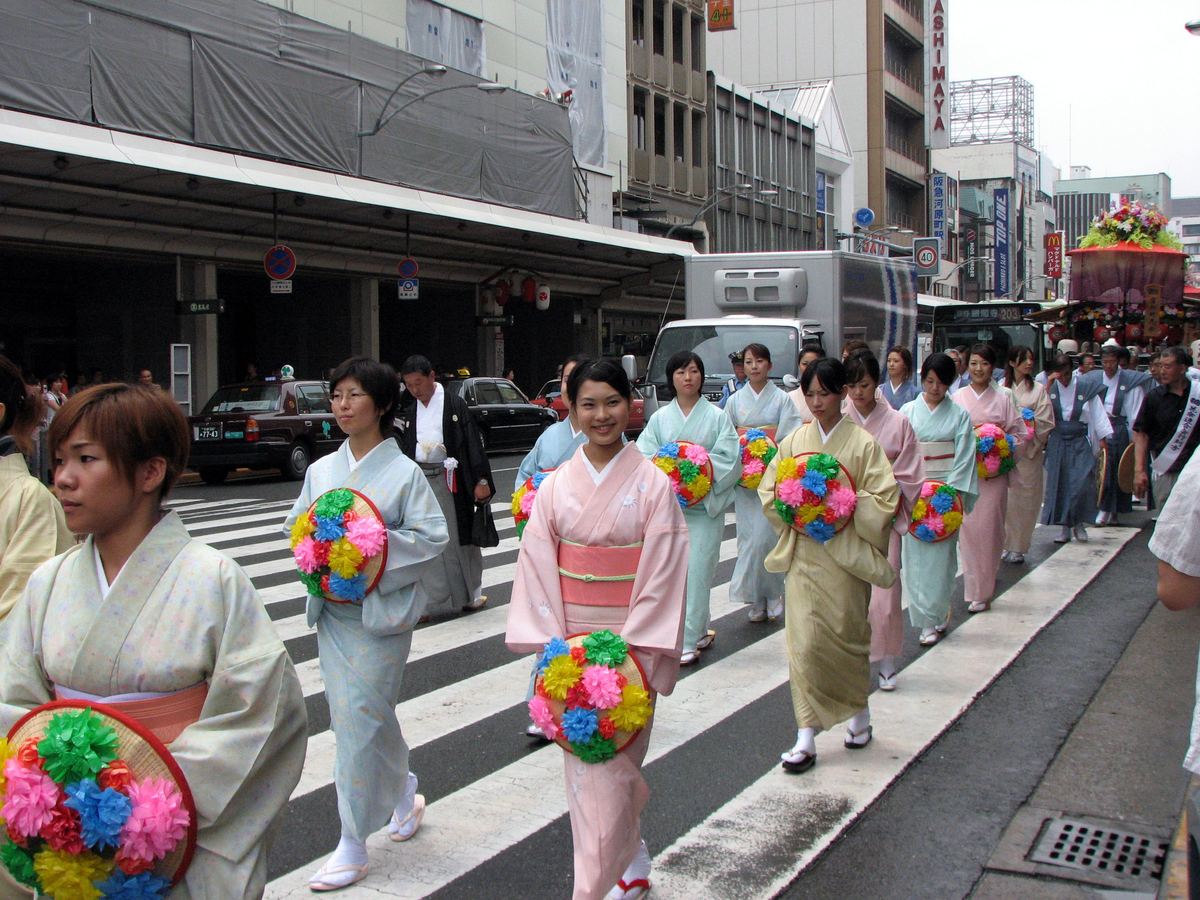
- The flower-parasol parade. Yasaka Shrine states that it was created because the second-half events were lost in the 1966 merge. It re-enacts the primitive form of the festival from before floats existed — but the event itself dates from the Showa era. Since the 2014 revival, both run on the morning of 24 July. Anyone describing Hanagasa Junko as a thousand-year tradition has confused what it depicts with what it is.
- The two returnees. The Ofune-hoko was revived in 2014 after roughly 150 years away since the end of the Edo period. The Taka-yama dropped out after its hangings were ruined by heavy rain during the 1826 procession — and came back in 2022, after about two centuries.
How the thirty-four split
| Item | Saki-matsuri (17 July) | Ato-matsuri (24 July) |
|---|---|---|
| Floats | 23 (9 hoko, 14 yama) | 11 (1 hoko, 10 yama) |
| Before the 1966 merge | 20 floats | 9 floats |
| Kuji-torazu (fixed order, no lottery) | Naginata-boko, Kanko-boko, Hoka-boko, Iwato-yama, Fune-boko | Hashibenkei-yama, Kita-Kannon-yama, Minami-Kannon-yama, Taka-yama, Ofune-hoko |
| Where the order is verified | Shijo-Sakaimachi | In front of Kyoto City Hall |
Thirty-four in total, of which 29 are designated Important Tangible Folk Cultural Properties. The order is drawn on 2 July at 10:00 at City Hall, with representatives of each float neighbourhood drawing lots witnessed by the mayor; on parade day the mayor, acting as magistrate, inspects each lot at the kuji-aratame and opens a fan to signal that the float may pass.
⚠️ The order is drawn fresh every year, so the 2027 running order does not exist yet. Any article listing it is recycling last year's.
Not one nail
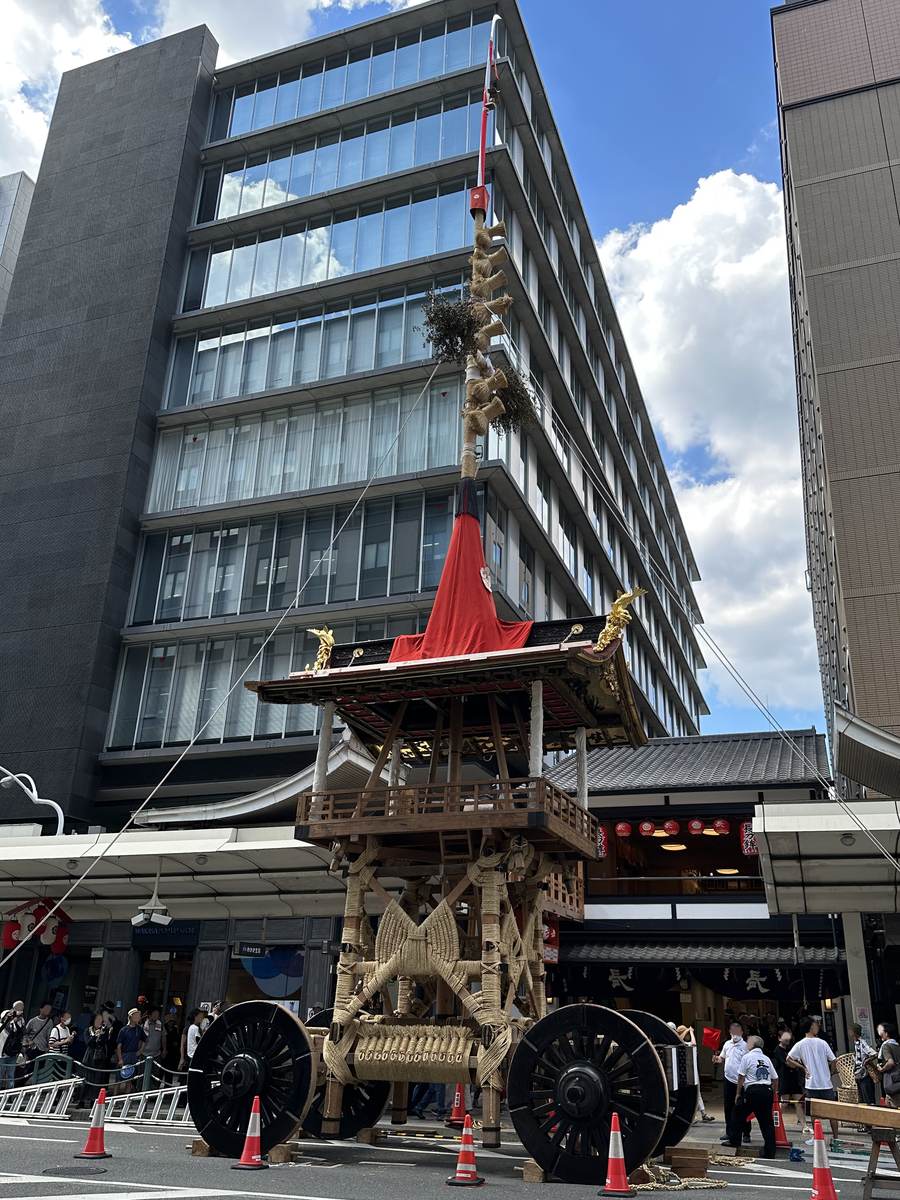
The assembly method deserves its own line. Officially the floats are lashed together with rough rope in a technique called nawagarami, and not a single nail is used — and the stated reason is not heritage romance. The rope joints absorb the distortion caused by the shaking during the procession. A ten-tonne wooden structure walks the streets because its joints are allowed to move.
On weight, the official sources disagree with each other. The Kyoto City Tourism Association page gives about 12 tonnes for a hoko and about 1.2 to 1.6 tonnes for a carried yama; the 2026 official Yoiyama guide gives 7 to 9 tonnes for a hoko (about 8.5 to 12 tonnes during the procession) and 0.5 to 1 tonne for a yama. Both are official, so treat the weight as a range. The rest is consistent: about 25 m from the ground to the tip of the pole and about 8 m to the roof, wheels roughly 1.9 to 2 m across, 40 to 50 pullers, two rhythm-callers (four when turning), four roof-hands whose job is clearing overhead cables, and around 180 person-days across assembly, procession and dismantling.
Three timetables, two dead zones, one forced choice
This is the most useful table in the article. The hard part of Gion Matsuri is not finding things to see, it is that three official timetables run in parallel and barely intersect: one for the floats, one for the portable shrines, one for the stalls and pedestrian zones.
| 17 July (Saki-matsuri) | 24 July (Ato-matsuri) | |
|---|---|---|
| Float procession | Departs Shijo-Karasuma 9:00, ends around 11:20 (Kawaramachi-Shijo 9:35 / Kawaramachi-Oike 10:20 / Shinmachi-Oike 11:20) | Departs Karasuma-Oike 9:30, ends around 11:20 (Kawaramachi-Oike 10:00 / Shijo-Kawaramachi 10:40 / Shijo-Karasuma 11:20) |
| Flower-parasol parade | None | 🔴 Departs 9:30, at the same time (Shimogyo school hall to Shijo Otabisho to Yasaka Shrine, arriving around 11:00) |
| Dead zone | 🔴 11:20 to 16:00 — about 4.5 hours of nothing | 🔴 11:20 to 17:00 — about 5.5 hours of nothing |
| Portable shrines | 16:00 rite, 18:00 departure, at the Otabisho around 21:00 | 17:00 departure from the Otabisho, back at Yasaka around 22:00 |
| Stalls / pedestrian zone | None (15 and 16 July only) | None |
Three conclusions come straight off that grid.
One: there are no food stalls on parade day. A lot of visitors arrive on the evening of 17 July expecting a street fair. There isn't one. The stalls belong to the previous week.
Two: midday to dusk is empty. Four and a half hours on the 17th, five and a half on the 24th, both parked in the hottest part of the day. Spend them indoors and come back for the shrines at the foot of the Yasaka steps (17th) or at the Otabisho (24th). Waiting it out on the street buys you nothing.
Three: the morning of 24 July is a forced choice. Floats leave Karasuma-Oike at 9:30 and the flower-parasol parade leaves the Shimogyo school hall at 9:30, on different routes, each with its own kuji-aratame — floats in front of City Hall, parasols at the Shijo Otabisho. No vantage point covers both. English coverage of this is essentially nil, and it decides which street you stand on that morning.
Two official numbers to discount slightly
⚠️ The first-half finish time differs by twenty minutes between official sources: the 2026 official Yoiyama guide map prints 11:00 at Shinmachi-Oike, while the tourism association website and the grandstand page both say around 11:20. This guide uses 11:20 because that is the figure the ticket-selling page relies on — but if you are chasing the tail of the procession, treat it as "around eleven".
⚠️ The flower-parasol entry does something similar, giving an 11:00 arrival at the shrine and then "around 12:00" for the dance offerings. Those are two different things: 11:00 is the column arriving, noon is the performance.
Tsuji-mawashi: the three corners worth standing at
The floats cannot steer — the wheels are fixed. The official description of the turn is almost agricultural: split lengths of bamboo are pulled out from under the float and laid on the road in the direction of travel, water is poured over them, and the pullers heave in one movement to swing the body through 90 degrees. A ten-tonne wooden tower pivoting on wet bamboo is the most dramatic thing the procession does.
For the first half, the official list of turning points is three: Kawaramachi-Shijo, Kawaramachi-Oike and Oike-Shinmachi. ⚠️ For the second half the organisers do not enumerate them, and a mirrored route does not guarantee mirrored corners.
Yoiyama is not three identical nights
This is the section most likely to change your booking, because it overturns the single most consistent error in foreign-language coverage.
In the "notice from Kyoto City" box of the 2026 official Yoiyama guide, the city writes that pedestrian road controls will be applied to sections of Shijo-dori and Karasuma-dori on 15 and 16 July only, roughly 18:00 to 23:00 — and then adds, verbatim, that on 14 July and during the second-half Yoiyama of 21 to 23 July there are neither pedestrian road controls nor street stalls.
| Date | Official name | Pedestrian zone | Food stalls |
|---|---|---|---|
| 14 Jul | Saki-matsuri Yoiyama, night 1 | ❌ No | ❌ No |
| 15 Jul | Saki-matsuri Yoiyama, night 2 | ✅ 18:00-23:00 | ✅ Yes |
| 16 Jul | Saki-matsuri Yoiyama, night 3 | ✅ 18:00-23:00 | ✅ Yes |
| 21-23 Jul | Ato-matsuri Yoiyama, three nights | ❌ None at all | ❌ None at all |
So the crowd peak of the entire month is two evenings, neither of which is a parade day. During the pedestrian window the city also asks people to keep to the left on Shijo-dori — a one-way walking flow that matters far more than it sounds once the street is packed. Going against it is how you end up stuck.
"Yoiyoiyama" and "Yoiyoiyoiyama" are not official terms. Neither word appears on the Kyoto City Tourism Association pages or the Yasaka Shrine festival page; the official term is simply Yoiyama, covering all three nights of 14-16 July (and 21-23 July for the second half). The stacked forms are media and colloquial usage. You will hear them; just do not treat them as an official grading of how big each night is.
What the stall-free nights actually contain
Strip the stalls away and Yoiyama looks a lot more like the thing it originally was.
- Gofu amulets. Each float has its own protective tablet with its own meaning, sold around the float only during its own three Yoiyama nights.
- Byobu Matsuri. Old houses and long-established shops in the float neighbourhoods put out screens, hanging scrolls and other treasures; the fuller official version describes families removing the lattice from the front of the house and opening the reception room to the street, in the Shinmachi, Muromachi and Rokkaku area. ⚠️ The organisers publish no list, no fee and no opening hours — it is not a ticketed exhibition, it is households opening their own doors.
- Boarding a float. The official wording is that some floats let you climb aboard if you buy a chimaki or other charm. Not all of them, and not without a purchase.
- Hiyori-kagura. Around 22:00 on 16 and 23 July, the musicians of the float neighbourhoods walk to the Shijo Otabisho to pray for fine weather for the next day's procession; the Naginata-boko group carries on along Shijo and offers its music at Yasaka Shrine around 23:00. It is the last free item of the night and far less crowded than anything earlier.
Several practical free facilities are printed only in the legend of the official Yoiyama map: water refill points for personal bottles (15-16 July only), a children's station offering nursing, nappy changing and toilet access (14-16 July, 18:00 to 20:00), recycling stations for waste separation and reusable tableware return (15-16 July), and AEDs installed in every float neighbourhood. Note that the children's station covers one more night than the water points — it includes 14 July.
For real-time crowding the city runs its own tool: the Kyoto Smart Navi digital tourism map streams live congestion information for the festival from 10 to 24 July, and there are official GPS-linked digital maps for each half. Considerably better than guessing at an intersection.
When the floats go up
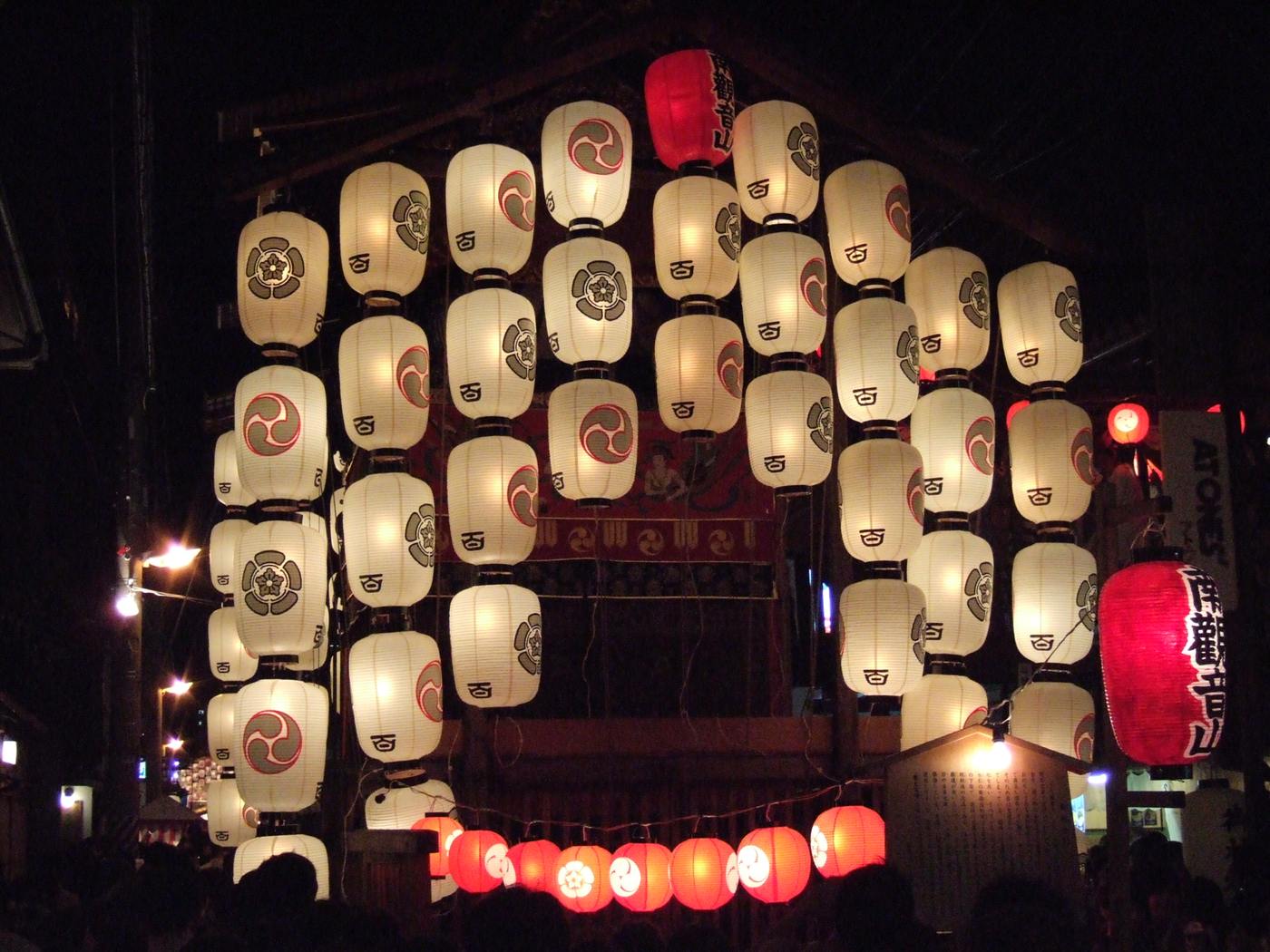
If watching the assembly appeals, it happens earlier than Yoiyama. Per the official events list — the most granular of the official sources — the first half builds its hoko from 9 to 13 July and its yama from 12 to 14 July, with the trial pulls on 12-13 July (hoko) and 13-14 July (yama); the second half builds from 18 to 21 July with trial pulls on 20-21 July.
⚠️ Three official pages give three slightly different build windows for the first half. This guide follows the events list because it is the only version that separates hoko from yama. Confirm against the current-year notice if you are timing a visit around it.
Frankly, if crowds are the thing you dislike most, 12-13 July is the most comfortable window of the whole festival: the floats are standing, the streets are not yet closed, the crowds are a fraction of Yoiyama, and the trial pulls are typically open for ordinary passers-by to take the rope. That is not an official recommendation — it is a conclusion drawn from the official schedule.
Grandstand seats: same price, different product
The headline first: a paid seat at Gion Matsuri does not buy a better view, it buys a guaranteed one — and the two halves sell the same price for very different contents.
Everything below is the 2026 reality, from the Kyoto City Tourism Association's press release of 20 April 2026 and the official sales page. 2027 prices, seat counts and sale dates are all unpublished. Read the numbers as the shape of the thing, not as this year's promise.
| Saki-matsuri, 17 July | Ato-matsuri, 24 July | |
|---|---|---|
| Location | Oike-dori, Kawaramachi to Shinmachi | Oike-dori: City Hall block (Kawaramachi-Teramachi) and Karasuma-Oike block (Karasuma-Takakura) |
| Seats | About 10,000 | About 4,000 (two fifths) |
| Lead float passes | About 10:30 (Kawaramachi-Oike) to 11:20 (Shinmachi-Oike) | About 9:30 (Karasuma-Oike) to 9:50 (Teramachi-Oike) |
| Wait after the 9:00 / 9:30 start | 🔴 About 1.5 to 2.5 hours | About 0 to 20 minutes |
| Can you see the kuji-aratame? | No — it happens at Shijo-Sakaimachi, outside the seating | ✅ Yes, beside the City Hall block |
| Standard seat price (2026) | Front row ¥8,000 / second row back ¥6,000 — identical on both days | |
The row that earns its keep is the waiting time. The first-half parade starts at Shijo-Karasuma at 9:00, but all the paid seating sits on Oike-dori, late in the route. Take your seat just after nine and the lead float will not reach you until 10:30 at the earliest and 11:20 at the far end. That is one and a half to two and a half hours sitting in a Kyoto July street with no parasol allowed.
The second half inverts it. The seating is at the start, the lead float passes between 9:30 and 9:50, and it is over in twenty minutes. Short — but you see the procession while it is still intact, and the kuji-aratame, the one genuinely ceremonial moment of the morning, happens beside you.
Seat types and 2026 prices
| Seat type | Price (2026) | 1st half | 2nd half |
|---|---|---|---|
| Standard, front row | ¥8,000 | ✅ | ✅ |
| Standard, second row back | ¥6,000 | ✅ | ✅ |
| Manabi seat, Japanese commentary (front / behind) | ¥11,500 / ¥9,500 | ✅ only | ❌ |
| Special Manabi seat, Japanese and English (front / behind) | ¥14,500 / ¥12,500 | ✅ | ✅ |
| Premium seat (front / rows 2-3) | ¥125,000 / ¥155,000 | ✅ only | ❌ |
| Group of 10 or more, standard | ¥6,500 | ✅ | ✅ |
For a foreign visitor the line that matters is the Special Manabi seat with Japanese and English commentary. It did not exist in 2025, it was introduced in 2026, and it is the only commentary seat sold for both halves — the ordinary Manabi seat is Japanese-only and first-half-only. ⚠️ Commentary is delivered by an external guide company and you must bring your own phone or tablet plus earphones; the organisers supply no hardware.
The premium seat, at six figures in yen, is not simply an expensive chair. It sits at the southwest corner of the Kawaramachi-Oike intersection — one of the three turning points. Rows two and three are tiered, cushioned and fitted with sun parasols, which is quietly funny given that the twelve front-row seats are not. The price includes soft drinks, guiding in Japanese and English, and a buffet at the Hotel Okura Kyoto from 12:00 to 14:00. ⚠️ It is first half only.
⚠️ Two stale figures to watch for online: 120,000 and 150,000 yen are the 2025 premium prices, superseded in 2026 by 125,000 and 155,000. A "Royal Seat" at 20,500 yen also circulates — Gion Matsuri has no such seat category; that figure belongs to a different Kyoto festival entirely.
How to buy, and the real obstacle for overseas readers
The 2026 process ran in three stages: group applications (10 or more) by ballot from 30 January to 12 February, an advance ballot from 27 April to 6 May drawn on 13 May with ticket issue from 1 June, then general first-come sales from 10:00 on 1 June. That advance ballot was new in 2026 — a reasonable signal that demand has tightened.
There are exactly two channels, and no official mention of buying on the day:
- Ticket Pia online, reached from the official tourism site. Requires a Pia membership registration plus phone-number verification. Premium seats go through this channel only, by credit card, as electronic tickets. Maximum nine tickets per transaction.
- Seven-Eleven stores in Japan, using the P-code (in 2026: 660-714 for the first half, 660-720 for the second). Only useful once you are in the country.
🚨 Whether Pia's phone verification accepts a non-Japanese number is not stated anywhere official. The accepted card brands are listed (VISA, Mastercard, JCB, Diners, NICOS, AEON, AMEX) with no mention of issuing country. The Pia interface does offer other languages, which helps. But if you are booking from abroad and must have a seat, keep a fallback — a friend in Japan, or one of the free vantage points below.
The small print that ruins days
- 🚨 Rain or shine, no refunds. Officially: the procession proceeds in rain, and unless the procession itself does not take place there are no refunds at all. Refunds are processed only at the point of purchase, and issuing and delivery fees are excluded.
- 🚨 Parasols, umbrellas and tripods are banned because they obstruct the view. Bring a raincoat, as the organisers themselves suggest.
- ⚠️ Toilet provision is inadequate — their words, not a reviewer's. Deal with it before you sit down.
- ⚠️ No alcohol brought in or consumed, no pets, no smoking. The organisers also ask for quiet viewing and modest clothing.
- ⚠️ Wheelchair seating exists in block 1 east (first half) and block 5 east (second half), near the lifts and accessible toilets at Zest Oike, at standard prices; non-wheelchair users may not buy it, and a companion ticket can be bought alongside.
Put together, my recommendation is this: if it is your first time, you can only do one day, and you want to sit, buy the second half. Same money, an hour less waiting, and a ceremony thrown in. The first half buys you twelve extra floats and a genuinely bigger spectacle, at the cost of two hours of sun — and in that case the second row is the smarter buy, since it saves 2,000 yen for a marginal difference in sightline.
How to watch without a ticket
Unlike many large Japanese festivals, most of Gion Matsuri is free by default; the paid seats only guarantee a place to sit. Here are the no-cost options, in the order I would rank them.
- The mikoshi departure, foot of the Yasaka steps, 18:00 on 17 July. This is the main storyline itself, and it is not ticketed at all. If I could only watch one thing, it would be this rather than the parade.
- The Yoimiya-sai at 20:00 on 15 July. Every light in the precinct is extinguished and the spirits are transferred in total darkness. Free, no ticket, at Yasaka Shrine — and directly above the first stall night, so the contrast between the noise on Shijo and the blackness inside the grounds is the point.
- The flower-parasol parade on 24 July. Never ticketed, including its own kuji-aratame at the Shijo Otabisho. Remember it is a straight either-or against the float parade.
- The turn at Shijo-Kawaramachi. ⚠️ This one is my own pick rather than an official recommendation. The organisers list the first half's three turning points as Kawaramachi-Shijo, Kawaramachi-Oike and Oike-Shinmachi, and the paid seating covers only Oike-dori from Kawaramachi to Shinmachi. Kawaramachi-Shijo therefore falls outside every paid block, and the official lead-float time there is 9:35 — nearly an hour before the earliest paid seat, with the sun still low. The costs, stated equally plainly: you stand, there are no facilities laid on, you must arrive early, and police manage the flow. No capacity or standing rules are published for that corner, so no arrival time guarantees a spot.
- The Otabisho, 18 to 23 July. As above: seven days a year, and the deities are genuinely there.
A few official requests worth honouring: come by public transport, do not drive, and do not push a bicycle into the crowd (their stated reason is accident prevention). The organisers also ask people with children or elderly companions to guard against getting separated, and add one very Japanese line — school trip groups should be back at their lodgings by 20:00. Read in reverse, that tells you when the composition of the Yoiyama crowd changes.
The chimaki is not a dumpling
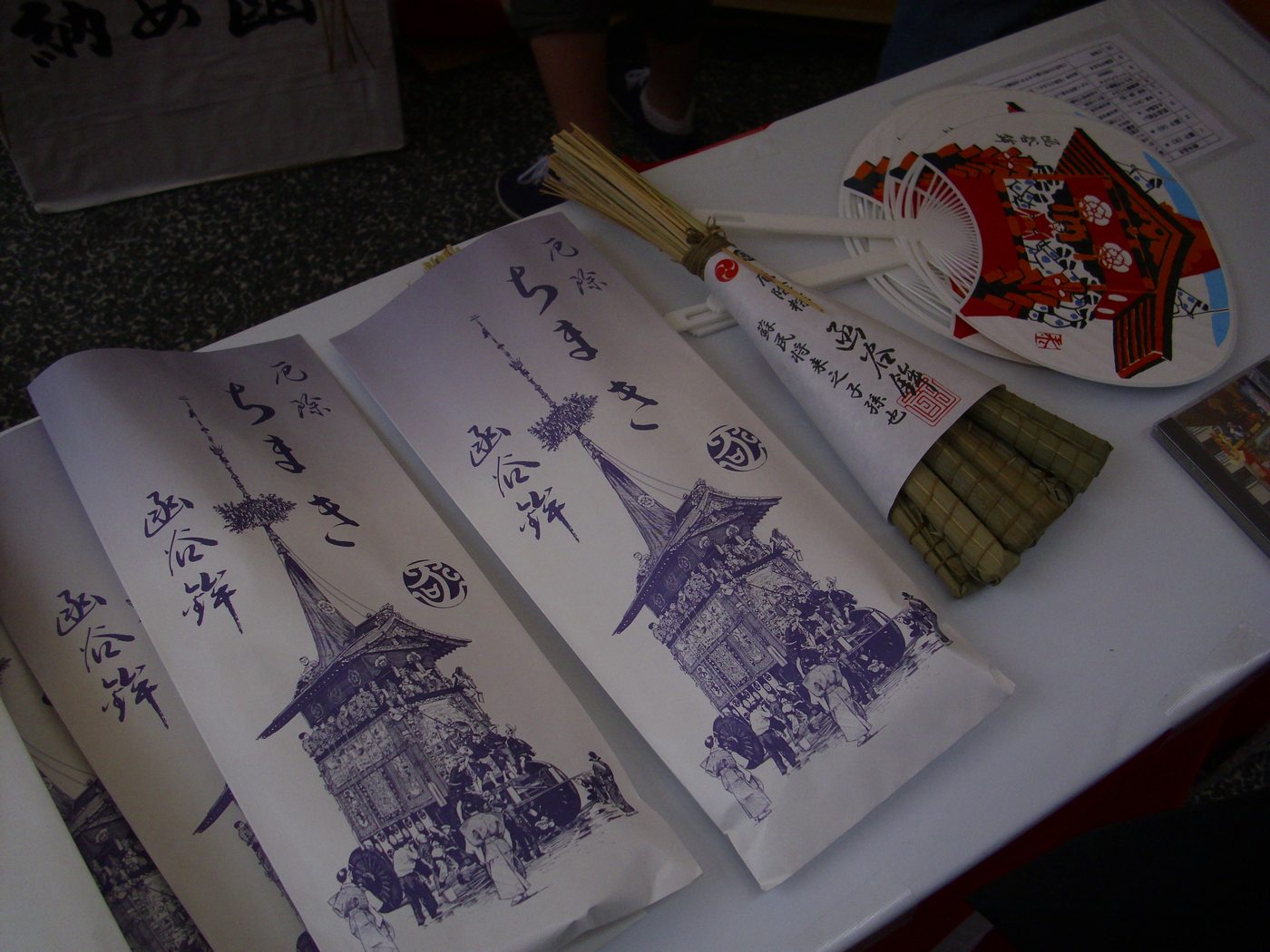
This is the single most common misunderstanding among overseas visitors, and the official wording could not be blunter: the Gion Matsuri chimaki is not something you eat. It is displayed somewhere conspicuous such as a doorway, and left there as a charm against plague and misfortune until it is replaced with a new one at the following year's festival.
Yasaka Shrine fills in the rest: it is an amulet prepared from bamboo leaves, issued only during the July festival period, carrying on its face a talisman reading "descendant of Somin Shorai", and hung under the eaves. Take one home and that is what you do with it — hang it by the door and swap it in a year. There is no rice inside.
🚨 No official source publishes a price. Yasaka Shrine, the Kyoto City Tourism Association and the official Yoiyama guide give no figure between them, and Yasaka Shrine directs enquiries about the chimaki issued by individual float neighbourhoods to the Gion Matsuri Yamahoko Federation, whose website has an expired certificate, so the per-neighbourhood schedules and amulet prices are not published anywhere reachable. Figures circulating online have no official backing. Read the notice at each float and bring cash.
Who was Somin Shorai?
The phrase on the talisman has a source. Yasaka Shrine cites a lost fragment of the Bingo no Kuni Fudoki in which Susanoo promises that, should plague spread in a later age, those who declare themselves descendants of Somin Shorai and wear a ring of reeds at the waist will be spared.
The last day of the festival is where that promise is collected: the Ekijinsha Nagoshi-sai on 31 July, at 10:00, sets a great reed ring at the torii for worshippers to pass through, purifying themselves and receiving the "descendant of Somin Shorai" talisman. The month that opens with the Kippu-iri rites on 1 July closes here — which means, strictly speaking, the last day of Gion Matsuri is 31 July, not 24 July.
One last detail: Gion Matsuri is nicknamed the "hamo festival" because the pike conger is in season exactly when the rainy season breaks; and because a cucumber's cut face resembles the crest of Yasaka Shrine, those involved in the rites are said to avoid eating cucumber during the festival. The official text uses "it is said". It is a tradition, not a rule, and eating cucumber in Kyoto in July will not offend anyone.
Kyoto in July: heat, rain, and two fineable rules
Start with primary data. Japan Meteorological Agency normals for the Kyoto observatory, 1991-2020, for July:
| Measure | July normal |
|---|---|
| Mean temperature | 27.3 C |
| Daily maximum | 32.0 C |
| Daily minimum | 23.6 C |
| Rainfall | 223.6 mm — the wettest month of the year |
| Relative humidity | 69 % |
| Days with thunder | 4.9 |
Look at the fourth row. July is Kyoto's wettest month — wetter than August (153.8 mm), June (199.7 mm) or September (178.5 mm). That runs against most people's mental model, which files Kyoto summer under "hot" and forgets "wet". Combine it with the rain-or-shine, no-refund, no-umbrella rule above and the conclusion writes itself: a packable raincoat is the last item you should leave at home.
The organisers' own heat warnings are heavier than the usual boilerplate: Yoiyama and the processions fall right at the end of the rainy season, they say, and the heat is severe; drink, wear a hat, rest. The grandstand page adds that extreme heat is expected. Kyoto's basin sits in its own trapped air, so it feels worse than 32 degrees suggests. For heatstroke response and the wider emergency picture see our guide to earthquakes, typhoons and extreme heat in Japan; for what to pack, our month-by-month Japan weather and clothing breakdown.
Two rules that carry a penalty or a public request
One: do not eat while walking. The tourism association's list of viewing requests contains a verbatim line asking visitors to refrain from eating while walking. It is not a blogger's etiquette opinion; it is the organiser's stated request. Buy, eat where you bought it, then move on — during those two packed nights it is a crowd-safety matter as much as a manners one.
Two: smoking on the street costs 1,000 yen. The legend of the official Yoiyama map marks a reinforced street-smoking control zone in which street smokers are liable to a 1,000 yen administrative fine, alongside temporary smoking areas provided on 15 and 16 July. So there is somewhere to smoke on those two nights, and lighting up on the street is a fine. Japan's street-smoking rules vary sharply by ward and city — sometimes across a single intersection — and our breakdown of Japanese smoking rules and where fines are actually issued covers the pattern.
Beds, trains and the hidden tax
A cost most visitors do not budget for
Since 1 March 2026, Kyoto City's accommodation tax has run on five brackets, with no exemption threshold and no age exemption — if a room charge exists, the tax applies, assessed by check-in date. Gion Matsuri week pricing pushes travellers up the ladder fast.
| Room charge per person per night | Tax |
|---|---|
| Under 6,000 yen | ¥200 |
| 6,000 to under 20,000 yen | ¥400 |
| 20,000 to under 50,000 yen | ¥1,000 |
| 50,000 to under 100,000 yen | ¥4,000 |
| 100,000 yen and above | ¥10,000 |
A family of four, three nights, in the 20,000-50,000 bracket pays 12,000 yen in tax alone — usually not included in the price your booking site displays, and usually collected at the property. Rules differ sharply between Japanese cities; our nationwide accommodation tax comparison lays them out side by side.
⚠️ No official source publishes how much hotel rates rise during the festival.
Getting around
The official position is unambiguous — come by public transport, and please do not come by private car. On the two pedestrian-zone nights, coin car parks inside the controlled area cannot be entered or exited between 18:00 and 23:00, and the city asks drivers to move vehicles out early.
The stations that matter, by purpose:
- Karasuma Line, Shijo Station — the first-half start at Shijo-Karasuma
- Karasuma Line, Karasuma-Oike Station — the second-half start and one of the second-half seating blocks
- Tozai Line, Kyoto Shiyakusho-mae Station — the second-half kuji-aratame and the main seating block
- Hankyu Karasuma / Kyoto-Kawaramachi and Keihan Gion-Shijo — for Yasaka Shrine and the Otabisho
If you will make four or more journeys, the ¥1,100 subway-and-bus day pass pays for itself; but during festival week there is a practical wrinkle — the buses are the mode most disrupted by street closures, while the subway keeps running normally. Which ticket wins in which scenario is worked through in our Kyoto transport pass comparison.
🚨 Parade-day road closures are only published shortly before the festival. The official grandstand page defers to the Kyoto Prefectural Police site for traffic restrictions on procession days, and the police put them up days beforehand and take them down afterwards — so check that site in early July 2027. The two pedestrian-zone nights (15 and 16 July, 18:00 to 23:00, sections of Shijo and Karasuma) are officially announced and can be planned around.
Getting the UNESCO line right
Three distinctions matter here.
First, what is inscribed is not "Gion Matsuri" but the "Yamahoko float ceremonies of the Kyoto Gion Festival". Those ceremonies were designated an Important Intangible Folk Cultural Property nationally in 1979. On the UNESCO layer, Kyoto City's announcement is exact: inscription was decided on 30 September 2009 at the fourth session of the Intergovernmental Committee, held in Abu Dhabi, with the Yamahoko Federation as safeguarding body.
Second, the 2016 list of 33 elements is an expansion, not Gion's inscription year. The Agency for Cultural Affairs database records the 2016 registration of "Yama, Hoko, Yatai float festivals" while noting in the same line that the entry was listed in 2009 as the Yamahoko ceremonies of the Kyoto Gion Festival. The 2016 nomination was built on that entry, together with the Hitachi Furyumono. Gion is not one of thirty-three equals — it is one of the two originals the list was expanded from.
Third, the list grew again on 8 December 2025. UNESCO's 20th intergovernmental committee adopted decision 20.COM 7.b.52, whose text states that the new inscription "incorporates and replaces" the 2016 entry for Yama, Hoko, Yatai float festivals (No. 01059), and that the Japanese inventory "comprises the thirty-three float festivals included in the original nomination, along with four additional festivals included between 2016 and 2021." So 33 is the 2016 figure, not the current one; the decision names neither the four additions nor a new total. For Gion the point only sharpens: it was already inscribed in 2009, and the list has now been expanded around it twice.
That distinction matters when you read about the other float festivals: the Takayama Festival float ceremonies, the Chichibu Night Festival floats and kagura and the 4:59am Hakata Gion Yamakasa in Fukuoka are all on the 2016 list, but none of them is its origin point. Gion is. (Hakata carries the same Gion name and the same Gion-faith roots, but it is an entirely separate festival — not a branch of the Kyoto one.)
And note the boundary of the inscription once more: it covers the float ceremonies. The mikoshi procession is outside it — the religious core did not get listed, the escort did.
Who decides the "three great festivals"?
You can use the phrase, but use it with the same grammar the organisers do. The Kyoto City Tourism Association writes that Gion Matsuri "is said to be" one of Japan's three great festivals and that it "is counted among" them; the press release says "one of Japan's three great festivals". In Japanese that is the register of a conventional grouping, not an official designation — no Japanese institution certifies a list of three great festivals.
More telling: Yasaka Shrine's own Gion Matsuri pages never use the phrase at all. The shrine that runs it does not claim the title; the tourism bodies do.
Planning calendar for 2027
Two hard facts first: Saturday 17 July 2027 for the first float procession, Saturday 24 July for the second. Every official page gives the date only, never a weekday rule, and there is no postponement clause; in 2026 the official listing read "17 July (Fri)" — date first, weekday second. The full festival period runs 1 July (Kippu-iri) to 31 July (Ekijinsha Nagoshi-sai).
Overlay the 2027 calendar and you get a mixed signal, not a simple "busiest year ever":
| 2027 date | Day | What happens | What it means for you |
|---|---|---|---|
| 15 Jul | Thu | 🔴 Yoiyama with stalls and pedestrian zone (18:00-23:00) | Needs leave to catch |
| 16 Jul | Fri | 🔴 Yoiyama with stalls and pedestrian zone; hiyori-kagura around 22:00 | One day of leave bridges to the weekend |
| 17 Jul | Sat | First float procession (9:00-11:20) and mikoshi departure (18:00-21:00) | ✅ Day one of a three-day weekend |
| 18 Jul | Sun | Deities at the Otabisho; second-half float building starts | Three-day weekend, day two |
| 19 Jul | Mon | Marine Day, a national holiday | Day three — domestic travellers are moving too |
| 21-23 Jul | Wed-Fri | Second-half Yoiyama (no stalls, no pedestrian zone) | The quiet version |
| 24 Jul | Sat | Second float procession and flower-parasol parade (9:30, either-or) plus Kanko-sai (17:00-22:00) | ✅ Saturday, but no stalls |
The genuinely good news: the two stall nights land on Thursday and Friday, the parade lands on Saturday, and 17-19 July is a three-day weekend thanks to Marine Day on the 19th. Take one day of leave on Friday 16 July and you collect a full stall night, the first procession and the mikoshi departure, with two days left over for the rest of Kansai. As configurations go, that is about as convenient as this festival gets.
The counterintuitive part: most people assume the parade Saturday evening is the big night. It is not. There are no stalls and no pedestrian zone on the evening of 17 July, which makes it the quietest Gion Matsuri night of that week — the mikoshi are out, but that is a moving column, not a street fair. For crowds and night-market atmosphere you have to move earlier, to the 15th and 16th.
⚠️ A three-day weekend containing a parade day will push accommodation and transport tighter than usual. The organisers publish no crowd or price projections, so that is a reading of the calendar rather than a forecast.
⚠️ Do not transplant the first-half conclusion onto the second. 24 July is also a Saturday, but it has no stalls, no pedestrian zone, two fifths of the seating, and a competing parade splitting the morning crowd. "Both parades on a Saturday, so both will be heaving" does not hold for the second half.
For calibration: in 2026 both processions fell on a Friday; in 2028 both fall on a Monday, and because Marine Day 2028 lands on 17 July, 15-17 July forms another three-day weekend — except that year the long weekend captures the two stall nights and puts the procession on its final day.
What 2027 has not published yet
- ❌ Grandstand prices, seat counts and seat types. In 2026 it was 8,000 yen front row and 6,000 yen behind, after a rise from 6,600 and 4,600 in 2025. A past rise is not a forecast — do not extrapolate a 2027 figure from it.
- ❌ Ballot and sale dates. Projected from the 2026 rhythm: group applications late January, press release mid-to-late April, advance ballot late April to early May, general sales 1 June. Projection, not announcement.
- ❌ The running order — decided at the lottery on 2 July.
- ❌ Parade-day traffic restrictions — posted by the prefectural police only shortly beforehand.
- ❌ Per-neighbourhood schedules and chimaki or amulet prices — the responsible federation's site is currently unreachable.
Fitting it into a Kansai trip
Gion Matsuri rewards being treated as one or two evenings inside a wider Kansai itinerary rather than as a destination in itself, precisely because its content clusters into short windows with long gaps between them — gaps that Osaka, Nara and Kobe fill nicely. Our five-day Osaka and Kyoto itinerary drops straight onto it: reserve the evening of 15 or 16 July and the morning of the 17th, and the rest stands as written.
Two other timing questions are worth thinking through together. Mid-July to mid-August is peak domestic travel season, and the transport and lodging squeeze around Obon affects whether you push the trip later; and if you are weighing a completely different season, Kyoto's New Year and hatsumode logistics describe the city's other annual crowd peak, which behaves nothing like this one.
The verdict in three sentences
One: the headline act is the support act. Yasaka Shrine and the Kyoto City Tourism Association both describe the float procession as clearing the road ahead of the portable shrines. Accept that and the two-parade structure explains itself — one road-clearing for the outbound rite, one for the return — and it produces a conclusion that changes an itinerary: from 18 to 23 July the deities are at the Otabisho on Shijo, not at Yasaka Shrine.
Two: the crowd is not on parade day. Officially, the pedestrian zones and the food stalls exist only on the evenings of 15 and 16 July, 18:00 to 23:00. In 2027 the nights to plan defensively around are the Thursday and Friday before the parade — while the parade Saturday evening is the emptiest night of that week.
Three: do not rush the tickets. The two halves charge the same for a standard seat, but the first half means one and a half to two and a half hours in unshaded sun and the second is finished in twenty minutes with the kuji-aratame beside you; seat counts run 10,000 against 4,000. And 2027 pricing and sale dates are entirely unpublished — the 2026 figures of 8,000 and 6,000 yen are reference only, and although prices did rise between 2025 and 2026, a past rise cannot be used to predict the next one.
⚠️ Every price, seat count and sales date here is 2026 actual. The 2027 figures are due around mid-to-late April 2027, and the prefectural police publish parade-day traffic restrictions only shortly before the festival.
Frequently Asked Questions
- Q1:How long does Gion Matsuri actually last?
- A full month, not a day. Yasaka Shrine and the Kyoto City Tourism Association both state that the festival opens with the Kippu-iri rites on 1 July and closes with the Ekijinsha Nagoshi-sai on 31 July. What most visitors picture as "Gion Matsuri" is really two mornings of float processions, on 17 and 24 July. And if you can only pick one evening, the official record says the answer is not a parade day: the pedestrian-only zones and the food stalls exist on the nights of 15 and 16 July only, roughly 18:00 to 23:00. Not on 14 July, and not at any point during the second-half Yoiyama on 21-23 July. That is a verbatim notice from Kyoto City printed in the official Yoiyama guide.
- Q2:Is the float parade really the main event?
- Not according to the people who run it. Yasaka Shrine, the shrine that owns the festival, describes the floats as vessels built to pacify plague deities and adds that they are thought to have purified the great avenues in advance of the portable-shrine procession. The Kyoto City Tourism Association says the same thing in its own words: the mikoshi travel from the shrine to the resting hall on 17 July (Shinko-sai) and back again on 24 July (Kanko-sai), and "the float processions have been carried out as something that precedes those rites". That single fact explains the structure of the entire festival, including the question that decides your whole week: why there are two parades rather than one long one. There is one parade per shrine movement, because each movement needs its road cleared.
- Q3:What is there to do between the parade and the evening?
- Nothing, and the gap is enormous. On 17 July the floats leave Shijo-Karasuma at 9:00 and finish around 11:20, while the next official item is the 16:00 rite inside Yasaka Shrine: roughly four and a half empty hours. On 24 July it is worse. The floats finish around 11:20 and the mikoshi do not leave the resting hall until 17:00, leaving about five and a half hours. Both gaps land in the hottest part of a Kyoto July day, where the 1991-2020 normal daily maximum is 32.0C. Plan them as indoor time — lunch, a department store, a nap — and come back at dusk. Trying to bridge the gap on the street is how people burn half a day and see nothing.
- Q4:Are the paid grandstand seats worth it, and which parade should I book?
- Same price, very different product. In 2026 both halves charged 8,000 yen for a front-row seat and 6,000 yen from the second row back; 2027 prices have not been announced. The difference is where the seating sits along the route. The first-half seats are near the end of the run: the official lead-float timings are about 10:30 at Kawaramachi-Oike and about 11:20 at Shinmachi-Oike, so after a 9:00 start you sit in full sun for roughly one and a half to two and a half hours. The second-half seats are at the start: about 9:30 at Karasuma-Oike, about 9:50 at Teramachi-Oike, so it is over in twenty minutes — and the kuji-aratame lottery-verification ceremony happens right beside the Kyoto City Hall block. Supply runs the other way: about 10,000 seats in the first half, about 4,000 in the second. My call: book the second half if you want the ceremony and the shade, book the first half only if you specifically want the bigger procession and are willing to bake for it.
- Q5:Can I use a parasol in the grandstand? What happens if it rains?
- No umbrella of any kind, no postponement, and no refund — all three come from the same block of official terms. The organisers state plainly that the float procession goes ahead in rain, and that unless the procession itself does not take place, nothing is refunded; refunds are handled only at the point of purchase and ticketing and delivery fees are excluded regardless. Parasols, rain umbrellas and tripods are all banned because they block the view behind you, and the official advice is to bring a raincoat instead. That matters more than it sounds: Japan Meteorological Agency normals for Kyoto put July at 223.6 mm of rainfall, the wettest month of the year, against a daily maximum of 32.0C. You are buying a seat that may be soaked or scorched, and you may not shade yourself in either case. The organisers also warn in writing that toilet provision is inadequate, and ban alcohol, smoking and pets.
- Q6:Can I eat the chimaki they sell during Yoiyama?
- No. It is not food. The official Yoiyama guide states verbatim that the Gion Matsuri chimaki is not something you eat: it is hung by the doorway and left there as a charm against plague and misfortune until it is swapped for a new one at the following year's festival. Yasaka Shrine adds that it is a bamboo-leaf amulet issued only during the July festival period, carrying a talisman reading "descendant of Somin Shorai", and hung under the eaves. It has no rice inside and is unrelated to the Chinese dumpling of the same name. No official source publishes a price. Yasaka Shrine, the Kyoto City Tourism Association and the official Yoiyama guide all give no figure, and Yasaka Shrine redirects questions about individual neighbourhoods' chimaki to the Yamahoko Federation, whose website has an expired certificate. Prices circulating online have no official source. Check the notice at each float's own stall, and bring cash.
- Q7:On 24 July, can I see the float parade and the flower-parasol parade?
- No — they start at the same minute and go different ways. The official events list puts the second-half float procession leaving Karasuma-Oike at 9:30, and the Hanagasa Junko flower-parasol parade leaving the Shimogyo school hall at 9:30 as well, running via Takatsuji, Karasuma and Shijo to the Shijo resting hall and reaching Yasaka Shrine around 11:00. Each has its own kuji-aratame, in two different places. No single vantage point covers both. The flower-parasol parade is not an ancient tradition. Yasaka Shrine states that it was created after 1966, when the second-half events disappeared into the merged 17 July parade, as a way to re-enact the earliest form of the festival before floats existed. What it depicts is old; the event itself is a Showa-era invention that has coexisted with the revived second-half parade only since 2014.
- Q8:Was Gion Matsuri inscribed by UNESCO in 2016 alongside Takayama and Chichibu?
- That framing is incomplete for Gion specifically. Kyoto City's own announcement is precise: the "Yamahoko float ceremonies of the Kyoto Gion Festival" were inscribed on the UNESCO Representative List on 30 September 2009, at the fourth session of the Intergovernmental Committee held in Abu Dhabi, with the Yamahoko Federation named as the safeguarding body. The Agency for Cultural Affairs database then records that the 2016 inscription of the 33-element "Yama, Hoko, Yatai float festivals" was registered on the basis of the 2009 entry. Gion is not one of thirty-three equals; it is one of the two originals the 2016 list was expanded from. (⚠️ And the list kept growing: UNESCO decision 20.COM 7.b.52 of 8 December 2025 states that a further inscription "incorporates and replaces" the 2016 entry, No. 01059, and that the Japanese inventory comprises the original thirty-three plus four festivals added between 2016 and 2021 — so 33 is the 2016 figure, not the current one.) Note also what was inscribed: the float ceremonies. The mikoshi procession, the religious core, is not in the inscription — the escort got the listing, the thing being escorted did not.
- Q9:When exactly is Gion Matsuri 2027 and when do tickets go on sale?
- The parade dates are already fixed: Saturday 17 July 2027 for the first half, Saturday 24 July for the second. Every official page gives only the calendar date, never a weekday rule, and there is no clause moving the parade for weekends or holidays. Add Japan's Marine Day on Monday 19 July 2027 and the first parade lands on day one of a three-day weekend. But the food-stall nights fall on Thursday 15 and Friday 16 July, which makes the Saturday parade evening the quietest night of that week rather than the busiest. As for tickets: 2027 prices, seat counts, ballot dates and sale dates are all unpublished. Based on the 2026 rhythm you can expect group applications around late January, the seating press release in mid-to-late April, an advance ballot around late April to early May, and general first-come sales from 1 June. That is a projection from last year, not an announcement — check the official pages from April 2027.