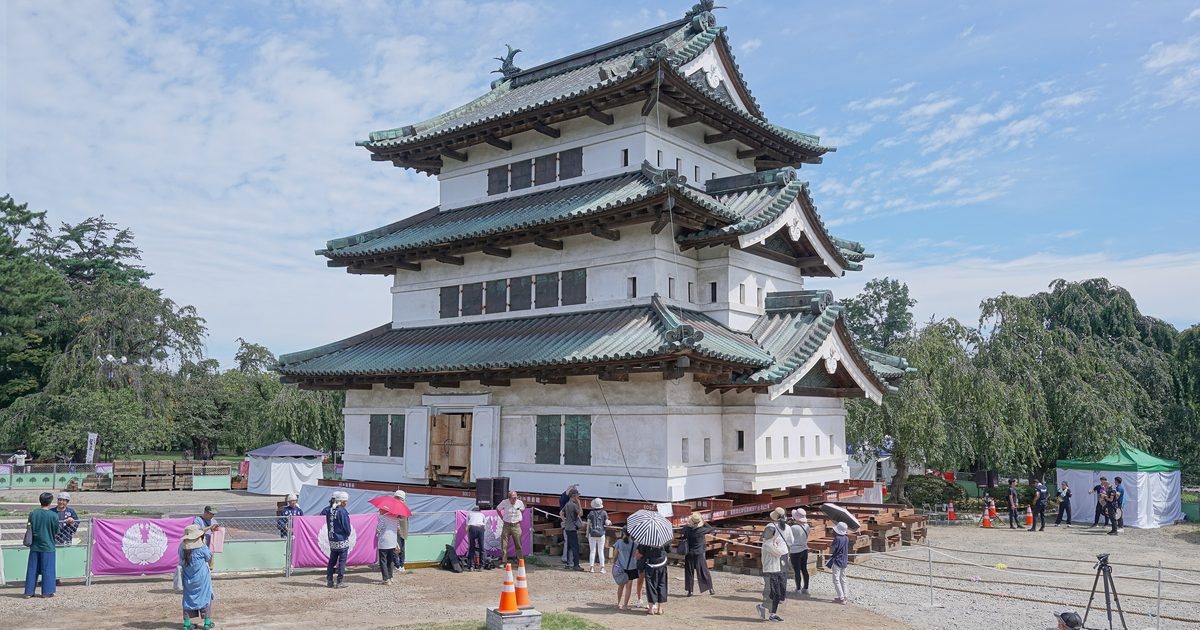
Japan has twelve surviving castle keeps. Exactly one of them is in Tohoku, and for the past eleven years it has been sitting in the wrong place — hauled 78 metres across a lawn and parked on a temporary base. In November 2026 Hirosaki City plans to put it back, and here is the part that catches people out: it does not land on the stone wall. The city's own rendering of the moment shows the keep sitting on a steel work platform that hides the masonry completely, with dry ground and construction plant where the water should be. That platform stays until FY2032. So the two cherry blossom seasons this article is about — 2027 and 2028, the only two in the next seven years when the keep's exterior is visible at all — give you a keep with no stone wall and no water beneath it. Below, the next decade split into four blocks rather than the usual two, plus one detail that will cost you more than any of it: the festival dates have been pulled forward three years running, seven days in 2026, announced less than three weeks before opening.
📍 This guide is about the keep itself and which year to come. For the blossom trip — how the festival works, the petal raft, night viewing, and stringing Hirosaki together with Hakodate and Sapporo — see Hirosaki and Hokkaido: Japan's last cherry blossom front.
- 2027 and 2028 are the only two seasons in the next seven years with a visible keep. Official wording covers the exterior through to the final day of the 2028 festival, after which a shelter roof goes up.
- But no stone wall and no water. The steel work platform around the base is removed only when the conservation work ends (FY2032), and the inner moat is restored at the same time.
- The interior is shut until FY2032, reopening April 2033. Not because of the move — the reinforcement was stripped out and seismic resistance is not secured.
- Re-check the festival dates before you book. 2024, 2025 and 2026 were all announced and then brought forward; 2026 moved a full seven days, under three weeks out.
- Entering the Honmaru before 9:00 is free. Festival paid hours shifted from 7:00 to 9:00 in 2025, and the area may be entered outside paid hours.
📖 Contents
- What you actually see from Gejo Bridge in 2027
- Which year gets you which photograph
- The view that disappears in November 2026
- Before you book: the dates moved forward three years running
- Why the dates move — and why the ticket rules changed too
- Is the ¥320 ticket worth it in 2027 and 2028?
- What else is still fenced off in 2027
- 1897 vs 2015: how long a keep stays off its wall
- Appendix: official Japanese wording
What you actually see from Gejo Bridge in 2027
You see the keep. You do not see the stone wall, and you do not see water.
Two words before anything else, because the rest of this article leans on them. The tenshu is the keep — the tall, multi-storey tower most people mean when they say "castle". The ishigaki is the stone rampart it stands on: a dry-laid mound of fitted stone that is a structure in its own right, and at Hirosaki it is the thing being repaired. The keep is the patient's hat; the rampart is the patient.
On the front page of its stone-wall repair project, Hirosaki City publishes an image titled, in its own words, "photo-image immediately after the keep is moved back". It is taken from Gejo Bridge — the short bridge in front of the Honmaru, the inner bailey, and the single most photographed vantage point in the park, identifiable by its vermilion-painted balustrade.
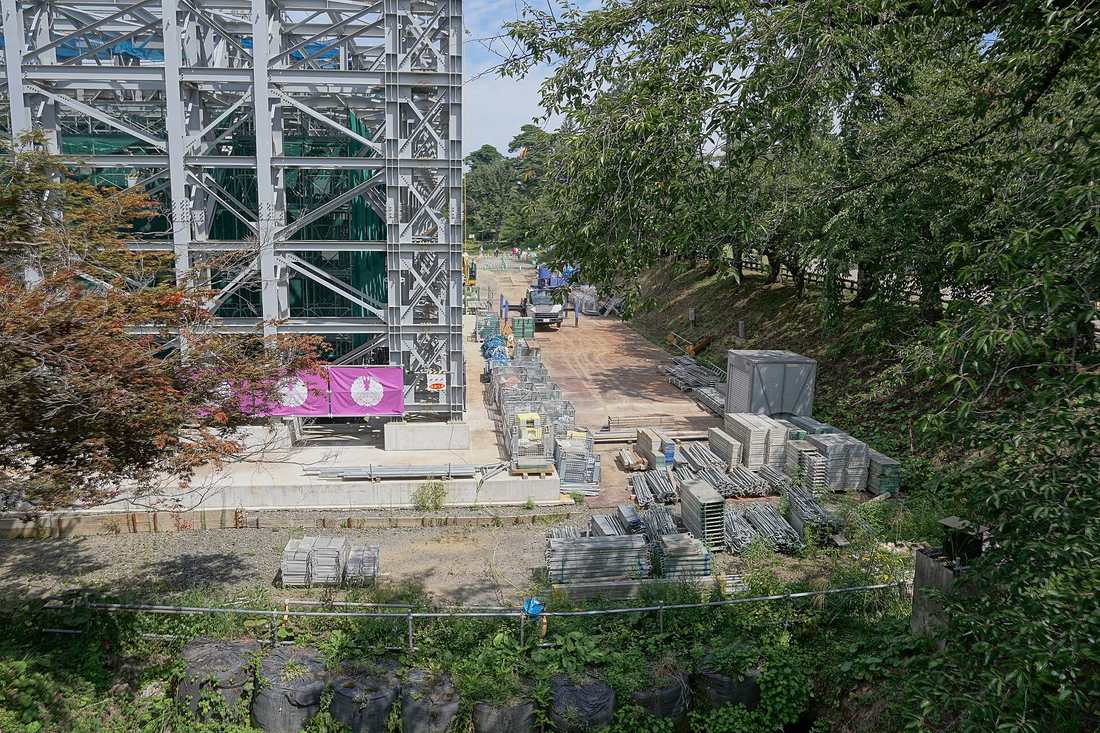
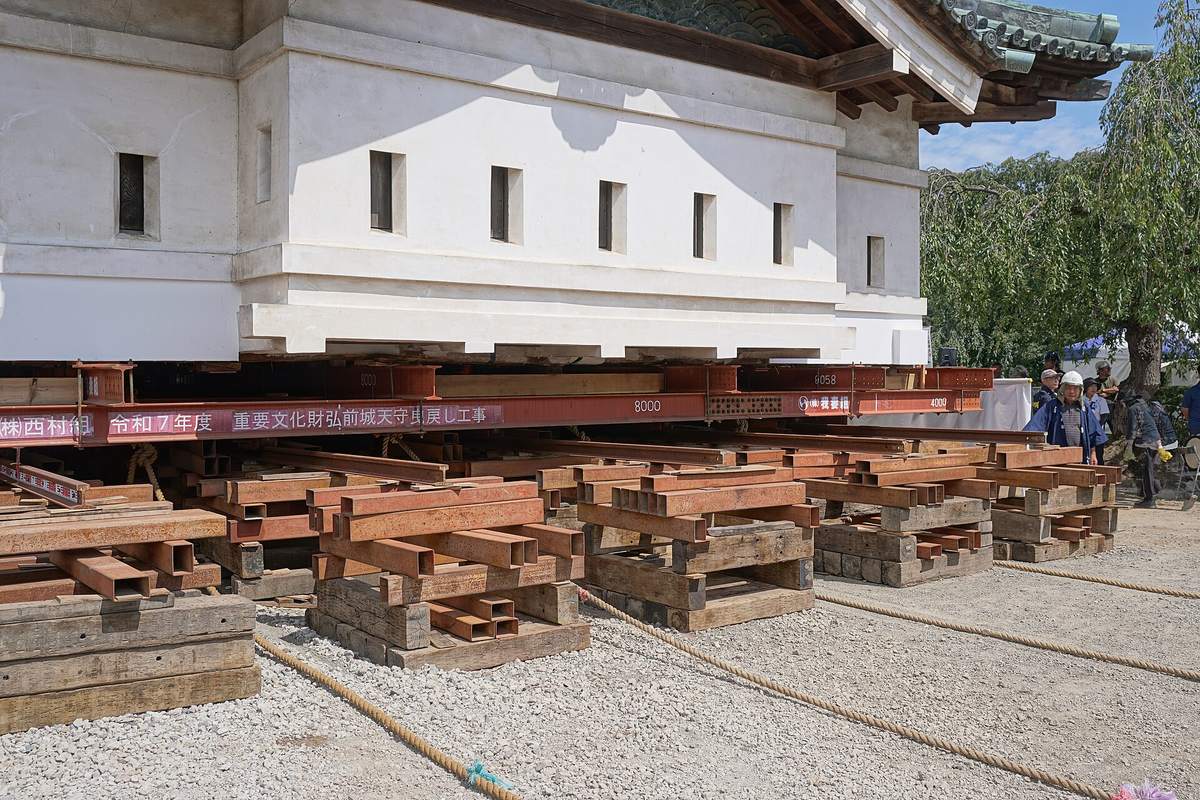
Three things are true in that image at once. The keep is genuinely back up at height. Its entire base is swallowed by a steel work platform rising from the floor of the moat, a lattice of columns, beams and diagonal bracing wrapped completely around the rampart, so that not one stone is visible. And in the bottom right there is bare dry ground and orange construction plant — not water.
The city's text matches its own picture. The concrete foundation and work platform covering the base exist so that machinery and materials can stand there while foundation piles are driven and a bearing slab installed. Then the sentence that decides everything: the work platform will also be used for the keep conservation work planned from FY2027 onward, and will be removed as soon as that conservation work finishes, at which point the inner moat will be restored.
Read that again slowly, because it welds two things together. The steel and the water are on the same clock. Both wait for the conservation work to end — FY2032. Across the 2027 and 2028 cherry blossom seasons, the keep stands on scaffolding, with no rampart and no reflection below it.
The moat has been dry for twelve years, not since last year
A common assumption is that the moat was drained for this year's move back. It was not. Hirosaki City's stone-wall schedule files it under FY2014: filling began on December 1, 2014.
The keep followed a year later. The official pamphlet gives the hikiya — the Japanese technique of jacking up a whole building and rolling it intact to a new site — as running from August 16 to October 24, 2015. Put the two dates side by side and you get a clean, slightly melancholy conclusion: the last cherry blossom season with Gejo Bridge, the keep, the inner moat and the blossom all present at once was spring 2014.
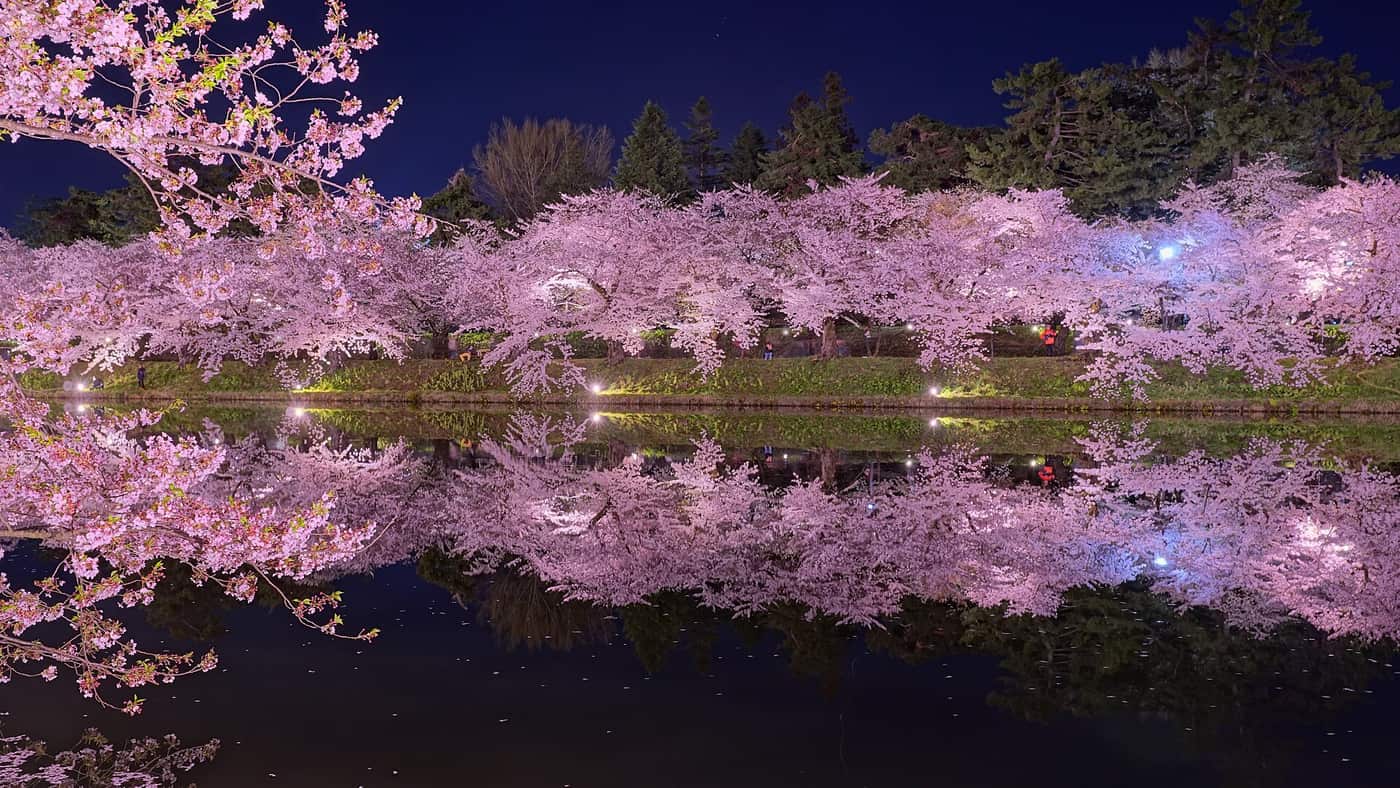
Do not over-correct, though. Hirosaki Park has four moats — outer, middle, west and inner — and only the inner one was filled. The other three are untouched, and they carry the park's other signature images. The petal raft that carpets an entire water surface is on the outer moat. The most celebrated night reflection is on the west moat, where the mirrored trees have a name of their own: sakasa-zakura, "upside-down cherries". Illumination covers the whole park, from sunset to 22:00. If you came for a reflection, set up on the west moat and stop trying to get one under the keep.
The site ranking first in your search results is not the official one
This one is worth stating plainly for anyone researching in English. hirosakipark.jp is not an official site. It is operated by a private company, Consis Co., Ltd., and says so on its own company page, adding in as many words that it has no connection whatsoever with Hirosaki City or any other public body. It is comprehensive and it ranks first, which makes it easy to take for the city's own.
The genuinely official trio are: Hirosaki City at city.hirosaki.aomori.jp, the works client and site manager; the Hirosaki Convention and Visitors Bureau at hirosaki-kanko.or.jp, one of the four festival co-organisers; and the Hirosaki Midori no Kyokai, which manages the chargeable zones, at hirosakipark.or.jp — one letter away from the lookalike. The two facts quoted above about illumination hours and sakasa-zakura come from the private site; they do not appear on any city page. Everything else in this article is city, bureau or ordinance text.
One more trap on the official domain itself: old paragraphs do not take themselves down. Pages exist that still carry superseded schedules from 2020 saying the keep returns in FY2021 and the work ends in FY2023. Check what date a paragraph stamps itself with before you trust its numbers.
Which year gets you which photograph
Four blocks, not two. "The keep was moved away" and "the keep is coming back" are only the first two. The city's stone-wall repair schedule has two more behind them, and they are the ones that decide whether your trip works.
| Period | The keep you see | Status |
|---|---|---|
| Spring 2016 – summer 2026 | On flat ground, Mount Iwaki behind it, walk right up to it | 🔴 Over |
| 2027 and 2028 seasons | Back up at height, visible from Gejo Bridge — but on a steel platform, no stone wall, dry moat | 🟢 Exterior visible |
| 2029 – 2032 | Enclosed by a shelter roof, exterior not visible | ⚪ Nothing official on 2029 |
| April 2033 onward | Repaired stone wall, water in the inner moat, interior open | 🟢 Officially planned |
How solid is that two-year window? It has been stated twice
The Reiwa 7 (2025) official Q&A is the more explicit of the two. Because work enclosing the entire keep begins around summer 2028, it says, the exterior can be seen as before right up to the final day of the 2028 cherry blossom festival. That is the only official sentence anywhere that names the cherry blossom season as the boundary, which is why it is the one to cite.
The version updated on June 4, 2026 shifts the same milestone a season later and approaches it from the other side: because the move back is being carried out without a suyane — the temporary shelter roof, effectively a building-sized shed erected over a structure so it can be worked on in any weather — the exterior remains visible, from after the move back until around autumn 2028, after which the shelter goes up and the exterior is hidden for several years.
The two do not contradict each other, and both enclose the 2027 and 2028 seasons. Quote either, but carry the date stamp with it, because Hirosaki City is running both versions simultaneously across its pages.
What about 2029? Officially, nothing
Inferring "spring 2029 is already covered" from "work starts around autumn 2028" is reasonable. It is still an inference. The city has published nothing about the four seasons from 2029 to 2032. For anything from 2029 onward, plan as though the keep is invisible and treat it as a bonus if it is not.
And the inside? Shut until April 2033
The interior closed on November 24, 2025. The Reiwa 7 version of the notice gives the end date as March 31, 2033; the Reiwa 8 version rewrites it as "through FY2032"; and the July 2026 issue of the city bulletin supplies the most concrete line of the three — public access to the interior is scheduled to resume in April 2033.
The reason for a seven-year closure is not "because it is being moved". The official Q&A explains that the move required the total weight to be reduced, so all the reinforcing members were removed; even back on its original base, the structure remains in a state where seismic resistance is not secured, and the interior must stay shut until countermeasures exist. The city adds its own escape clause: what needs repairing will only be determined once the FY2027 survey and design work is done, so the completion date may move.
Even "back on the base during November" carries a caveat the city wrote itself: subject to change depending on the progress of the work. And the work is already running slightly behind. The plan published in December 2025 had the second move happening in August; on the weekly work schedule updated in late August 2026, the second move was still listed as being prepared. Treat November as a direction, not a date.
The view that disappears in November 2026
The keep with Mount Iwaki behind it. And that was never how Hirosaki Castle looked.
Line up three facts, all of them from Hirosaki City, and the conclusion arrives on its own. The keep originally stood at the southeast corner of the Honmaru. Mount Iwaki, the volcano that dominates every wide shot of the Tsugaru plain, lies to the west of the park, which is why the city's own description of the western side of the grounds talks about the lotus pond and the west moat, once a channel of the Iwaki River. And in 2015 the keep was moved to the centre of the Honmaru.
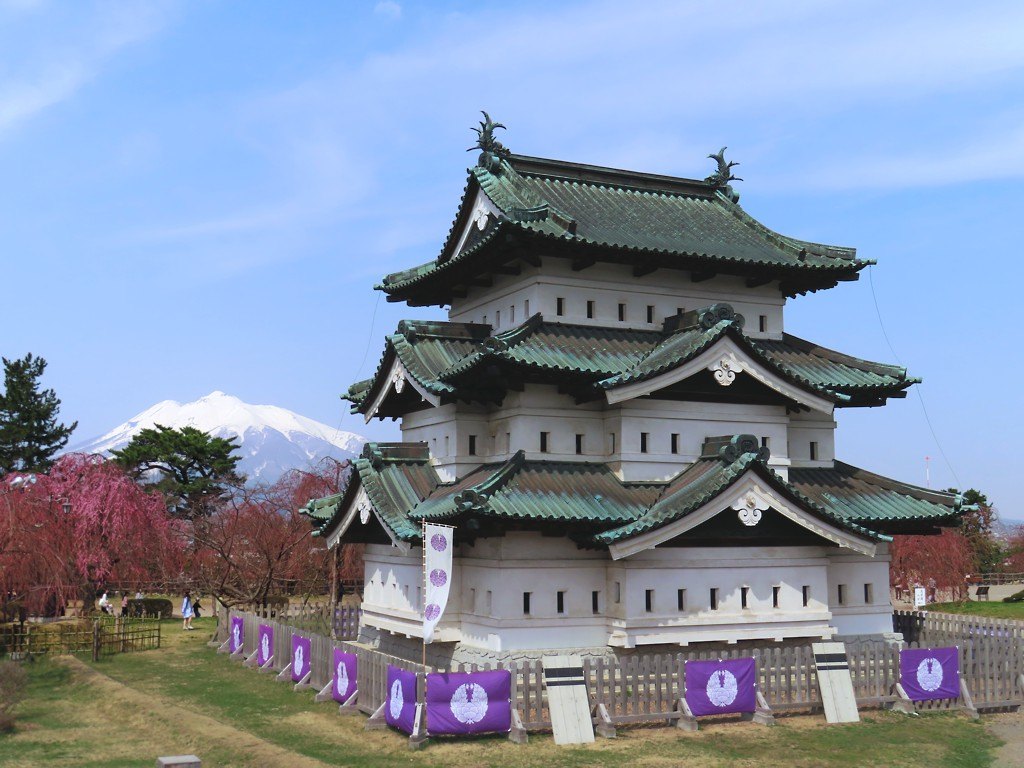
Work the geometry. While the keep sat in the southeast corner, photographing it meant standing to its west and shooting east, which put Mount Iwaki squarely behind your own back. Only once it had been hauled to the centre of the bailey was there room to stand on the east side, shoot west, and catch the mountain in the frame. That composition is eleven years old, and it ends in November 2026.
The distances are officially recorded, with one wrinkle. For 2015, the city's project page gives "hauled about 77.62 m toward the centre of the Honmaru", while the official pamphlet and the visitors bureau both round it to about 70 m. For the return leg, the city writes that the keep retraces the 2015 route in reverse, about 78 m, over roughly six months.
Where the keep actually got to during summer 2026
Hirosaki City has been publishing progress in instalments, each with a dated caption: June 12, jacking-up begins; June 22, jacking-up complete; June 30, travel rails laid; July 1, moved six metres; July 3, first move complete; July 17, lowered by a total of 80 centimetres; July 28, first rotation done.
It is a deliberately public job. The bulletin states that the work site can be viewed from the observation deck on the south side of the Honmaru until around late November 2026. Do not assume that deck survives into 2027 — the city has written nothing about what happens to it afterwards.
There was also an event, from August 21 to 28, 2026, at which members of the public took hold of ropes and physically hauled the keep, with a 300-drone show over the park on the opening night. That has already finished; applications closed on July 6. Its use here is purely evidentiary: the keep is genuinely in motion right now, not still on a drawing board.
Before you book: the dates moved forward three years running
Booking flights and hotels off the announced opening date carries real risk, and for three years the risk has pointed the same way: you arrive too late.
Lay out the archived snapshots of the Hirosaki Convention and Visitors Bureau's official festival page — the bureau being one of the four co-organisers — and a very tidy pattern falls out.
| Year | Dates first announced | Dates actually run | Brought forward |
|---|---|---|---|
| 2022 | Apr 23 – May 5 | Apr 23 – May 5 | — |
| 2023 | — | Apr 21 – May 5 | — |
| 2024 | Apr 19 – May 5 (17 days) | Apr 12 – May 5 (24 days) | 7 days |
| 2025 | Apr 18 – May 5 (18 days) | Apr 16 – May 5 (20 days) | 2 days |
| 2026 | Apr 17 – May 5 (19 days) | Apr 10 – May 5 (26 days) | 7 days |
The organisers gave their reasons in writing each time. In 2024: the period was brought forward in response to the early blooming of the cherry trees. In 2026, more explicitly: in response to the early blooming, it was decided to bring the festival's start date forward by seven days. A standing caveat sits below both: depending on the state of the blossom, the organisers may alter the period after consultation.
The 2026 case is the one to memorise. On March 24, 2026, the official page still showed April 17. The festival opened on April 10. The change landed less than three weeks before the start, by which point most visitors' flights and rooms were long since booked.
Correcting a claim you will still find everywhere
The Hirosaki Cherry Blossom Festival is not fixed to April 23 – May 5. 2022 was the last year those dates actually happened; it has moved every year since.
Who sets the dates? Hirosaki City's urban parks ordinance defines the festival period as one "determined annually through consultation among the relevant bodies, including the city", and a separate city notice states directly that the period is decided each year by an organising committee made up of the festival's constituent bodies. The four co-organisers are Hirosaki City, the Hirosaki Chamber of Commerce and Industry, the Hirosaki Convention and Visitors Bureau, and the Hirosaki Products Association.
So how do you book 2027?
The 2027 dates are not out; not a single 2027 date appears on any of the relevant official domains. The only guide is the announcement rhythm: the 2025 edition was live on October 12, 2024, and the 2026 edition on October 14, 2025 — both in the October of the preceding year. Be clear about the status of that, though: the organisers have never stated when they announce. Those two points come from comparing archived snapshots, and they are an observation, not a rule.
Three moves, in order:
- Check the official site in mid-October 2026 and write down the announced opening date.
- Shift your itinerary a week earlier. The last three years moved by 7, 2 and 7 days; booking a week ahead of the announced opening is the cheapest insurance available.
- Check again two weeks before departure. That is precisely the window in which the 2026 change happened. Take free-cancellation rooms and changeable fares where you can.
If you are still working out when the blossom itself arrives, the forecast mechanics are in how to read Japan's cherry blossom forecasts.
Why the dates move — and why the ticket rules changed too
Because Somei-Yoshino keeps blooming earlier — and when Hirosaki City rewrote its admission rules, it put that reason in the notice.
The official wording is that, given the recent tendency of Somei-Yoshino to bloom early, the existing handling provisions no longer fit, and are therefore being changed. Effective date: April 1, 2025. Two things changed.
The first change does not affect visitors
The "exemption-suspension period" — the window during which people otherwise entitled to free admission still pay, meaning, under the ordinance, Hirosaki residents aged 65 and over and similar categories — was switched from a fixed April 23 to May 5 to whatever the festival period turns out to be. The people this hits are local seniors, not tourists. Note also that the ordinance clause was not repealed but re-bound: the fixed dates were replaced with a period the mayor notifies annually.
The second one does affect you, and it makes things cheaper
The festival paid hours moved from the old "7:00 to 21:00 between April 23 and May 5" to "9:00 to 21:00 during the Hirosaki Cherry Blossom Festival". The start time slid two hours later.
Now pair that with a separate official rule: the Honmaru and Kita-no-Kuruwa area may be entered outside the paid hours. Put the two together and the result is that during the festival, entering the Honmaru before 9:00 costs nothing, where the old regime started charging at 7:00. A rule change that makes something cheaper is rare enough to be worth exploiting — and dawn in the Honmaru is a better hour to be there than mid-morning anyway.
The extension is not guaranteed, though. The city notes that if Somei-Yoshino blooms early, paid hours may revert to the normal 9:00 to 17:00 even during the festival. Read that carefully: it means the charging window shrinks, not that the illumination is cancelled. Lighting is a separate matter — park-wide, sunset to 22:00, and in 2026 extended to 23:00 for the five nights of April 15 to 19. In an early-blooming year you may find the ticket booths shut at 17:00 while the trees are lit as usual.
One climate trend, two institutional consequences: it forced the city to rewrite a fee provision, and it makes the organisers pull the opening date forward year after year. For the on-the-ground etiquette everywhere else in Japan — tarp rules, food, drones — see the rules and prohibitions of hanami.
Is the ¥320 ticket worth it in 2027 and 2028?
If you are buying it to see the keep, no.
Prices first. Hirosaki Park itself is free; only two places charge — Hirosaki Castle (Honmaru and Kita-no-Kuruwa) and the Hirosaki Castle Botanical Garden.
| Ticket | Adult (high school and above) | Child (elementary and junior high) |
|---|---|---|
| Honmaru & Kita-no-Kuruwa, single | ¥320 | ¥100 |
| Botanical Garden, single | ¥320 | ¥100 |
| Three-facility combination (adds Fujita Memorial Garden) | ¥520 | ¥160 |
| Hirosaki Castle annual pass | ¥1,040 | ¥310 |
Groups of ten or more pay ¥250 for adults and ¥80 for children. Carry cash — the city warns that some ticket windows inside the park take cash only.
How to read the paid hours
Ordinarily 9:00 to 17:00, from April 1 to November 23. During the 2026 festival it ran in three blocks: 9:00 to 17:00 from April 10 to 16, extended to 21:00 from April 17 to 30, then back to 17:00 from May 1 to 5.
There is also a piece of winter good news: from November 24 to March 31 the chargeable zones are free, though the keep is closed. Walking into the Honmaru in deep snow costs nothing at all, and Hirosaki in February is one of the better arguments for visiting Tohoku out of season.
Where to put your money in these two years
What follows is a judgement rather than an official statement, so treat it as such.
Across 2027 and 2028, the keep inside the Honmaru is a building wrapped in steel. The ticket buys proximity, not the photograph you had in mind. In these two seasons the better use of both money and daylight is the blossom circuit and the botanical garden; if all you want is confirmation that the keep is home plus a record shot, its upper half is visible without going through the gate at all.
Turn it around, though, and there is a case for coming precisely now. These are the only two years in which you can photograph a three-storey Edo-period timber keep standing on an industrial steel platform. After 2033 that image is gone permanently. Anyone who came for "a castle" will be disappointed; anyone interested in how a castle gets repaired has a two-year window and no second chance.
What else is still fenced off in 2027
At least three things, two of them scheduled to clear just before the 2027 blossom season.
The south side of the Honmaru
Part of the Honmaru's south side is closed off for the works, scheduled by the city to run until around March 31, 2027, with a temporary staircase provided as a detour during the closure. The city adds that this may shift either way depending on progress. In theory the 2027 blossom season is just clear of it — but that is a scheduled date, worth re-checking before you fly.
Two gates: you can walk through them, you cannot photograph them
The Ninomaru East Gate and the Kita-no-Kuruwa North Gate — both Important Cultural Properties in their own right — have been under seismic strengthening and conservation work since September 2025, wrapped whole in scaffolding and sheeting. From April 2026 the city replaced the mesh sheets with full-size photographic prints of the gates themselves, on the south face of the East Gate and the west face of the North Gate. Two official pages give two completion dates, March 5 and around March 31, 2027; both fall before the 2027 festival, so the conclusion holds either way — by the 2027 blossom season the scaffolding should be down. Visitors in 2026 should expect the opposite: the gates are passable, but a photograph with a gate in it is not available this year.
One point that is easy to garble: the full-size photographic sheet belongs to the two gates, not to the keep. Whether the keep's shelter roof will carry anything printed at all has never been stated officially, so nobody should be claiming it will.
The observation deck, stamps and castle seals
The observation deck on the Honmaru's south side is documented by the city only "until around late November 2026". Whether it survives into 2027 is unaddressed. Do not build it into a 2027 itinerary.
While the keep is closed, the goshuin-style castle seal is sold at the Hirosaki Castle Information Building, and the Japan Top 100 Castles stamp lives at the Information Building and the Green Consultation Centre. That is the 2026 arrangement; the city has published nothing for 2027. The wider logic of collecting these — and how wildly the rules vary between sites — is in the guide to collecting gojoin castle seals.
Worth noting as an alternative reason to be in Hirosaki: the summer Hirosaki Neputa festival runs August 1 to 7 on fixed calendar dates that do not float with the weekday, covered in the Hirosaki Neputa guide. If you are building a wider Aomori route around either season, the Aomori travel guide handles the movements between towns.
1897 vs 2015: how long a keep stays off its wall
Eighteen years. This happened once before, and it took exactly as long.
About two centuries after the Genroku-era stonework was laid, the rampart on the north side of the keep's base collapsed twice — in 1894 and again in 1896. After the second collapse, leaving the keep in place risked bringing it down, so the following year, 1897, a master carpenter born in Hirosaki, Horie Sakichi, hauled the keep into the interior of the Honmaru.
The rampart was repaired in 1915. A full eighteen years after that move.
Now this round. The keep was moved to the centre of the Honmaru in 2015 and returns to its base in 2026, which the city describes as coming home "for the first time in eleven years". But if what you want is the Hirosaki Castle that stands on a repaired rampart, with water in the inner moat, that you can walk inside — that arrives in 2033. Counting from 2015, also eighteen years. The technology changed completely; the timescale did not move at all.
Why the repair was unavoidable
Bulging had been observed in the rampart's east face for a long time, with the risk of collapse repeatedly flagged. The starting point is earlier than most people assume: after the 1983 Nihonkai-Chubu earthquake, fixed-point observation of the east face began the following year. A repair committee was formed in 2008, the decision to dismantle and rebuild was taken in FY2011, and work actually began in FY2014.
The scope runs from directly beneath the keep along part of the Honmaru's east face — about 100 metres — plus roughly 17 metres of the south face. (That 17 is Hirosaki City's own figure; a widely circulated version says 10 metres, and that version does not come from the city.) In total 2,185 stones were dismantled, the largest about two metres long and around six tonnes. The final stone went back on December 19, 2024, ending the rebuilding phase.
So why does the project still run to 2032, if the wall is already rebuilt? Because of what happens underground. Four foundation piles, two metres in diameter and about 35 metres long, plus a bearing slab, are being installed in the base so that the keep's weight no longer bears directly on the stone rampart. The steel platform wrapping the base exists to give that machinery somewhere to stand — and then to serve the keep's own conservation work afterwards. That is the entire reason you cannot see the stone wall.
What kind of keep this actually is
The present keep dates from 1810, rebuilt by the ninth lord, Tsugaru Yasuchika, nominally as a yagura or corner turret rather than as a keep, and it stood at the southeast corner of the Honmaru. The castle proper was completed in 1611, measuring roughly 500 metres east to west and 1,000 metres north to south, about 50 hectares in all.
It is one of Japan's twelve surviving keeps, designated an Important Cultural Property together with five gates and three corner turrets of the Ninomaru, and it is the only keep built during the Edo period that still stands anywhere in Tohoku. That is why Hirosaki was willing to spend eleven years lifting it, rolling it away and rolling it back.
A final piece of expectation-setting. The keep you see in 2027 will be wrapped in steel and there is no way around that. But the works touch only the base: the park's cherry trees flower exactly as before, the petal raft still carpets the outer moat, and the west moat reflections are still lit at night. For 2027 and 2028, treat Hirosaki as a blossom destination where you also glimpse a keep under repair — and not the other way round.
Appendix: official Japanese wording (click to expand)
The original Japanese behind the quotations above, collected here so you can check it yourself. Everything except the last item comes from Hirosaki City (city.hirosaki.aomori.jp, including the Koho Hirosaki bulletin and official pamphlets) and the Hirosaki Convention and Visitors Bureau (hirosaki-kanko.or.jp). The last item is from the privately operated "Hirosaki Park Sogo Joho" (hirosakipark.jp), which is not official — and note that the Hirosaki Midori no Kyokai, which manages the chargeable zones, uses hirosakipark.or.jp, one letter apart.
1. The work platform, and when the inner moat comes back
天守台を覆うコンクリート基礎と作業構台は、この工事における基礎杭打設箇所の掘削や基礎杭・耐圧盤設置のための機械・機材が載るためのものです。作業構台は令和9(2027)年度以降に予定している天守保存修理工事にも利用され、保存修理工事が終了し次第撤去し、内濠を復旧します。
2. How long the exterior stays visible (Reiwa 7 and Reiwa 8 versions)
Q 内部公開休止に伴い、外観も見れなくなるのか
A 令和10年夏頃より天守全体を覆っての工事となることから、令和10年のさくらまつり最終日までは、これまで通り外観を見ることができます。
天守曳戻し工事では素屋根等の覆屋を設けずに曳戻しを行うため、天守の外観を見ることが可能です。……曳戻し後から令和10(2028)年秋頃までは天守の外観を見ることが可能ですが、その後は保存修理工事で素屋根(覆屋)を設置するため、工事終了までの数年間は外観も見ることは出来なくなります。
3. Closure and reopening of the interior
令和7年11月24日より当面の間、天守内部の公開を休止します
現在の計画では、令和9(2027)年に天守修理の調査・設計を行い、令和 10(2028)年秋頃から工事に着手、完成後の天守内部の公開は令和 15(2033)年4月から再開する予定です。
天守曳戻し工事では、全体重量を抑える必要があり、補強材を全て取り外すことになります。元の天守台に戻った後も天守本体には耐震性が確保されていない状態となることから、対策を講じるまで天守内部の公開を休止する必要があるのです
4. The move-back plan, and the city's own caveat
今後の計画では、令和8年の弘前さくらまつり終了後に、曳戻し準備作業に入り、7月から1次移動、8月には2次移動、10月には3次移動して11月中に本来の天守台に戻る予定となっています。※天守曳戻しは作業の進捗次第で変更する場合があります。
今回の天守曳戻しは、平成27(2015)年度に実施した曳家のルートを逆に進むもので、約 78 mの距離を約6カ月かけて移動します
工事は公開型となっておりますので、11 月下旬頃まで本丸南側の展望デッキからご覧いただけます
5. When the inner moat was filled and the keep left (official pamphlet schedule)
【平成26年度】◆内濠の埋め立て工事
天守を約70m本丸中央側に曳家/8月16日から10月24日までの期間で
6. The festival dates being brought forward (Hirosaki Convention and Visitors Bureau)
※桜の早咲きに対応して会期が前倒しとなりました。(2024)
※さくらの早咲きに対応し、まつりの開始日を7日前倒しすることとなりました。(2026)
※さくらの開花状況により、主催者で協議の上、会期の変更等を行う場合があります
7. The admission rule change of April 1, 2025, and its stated reason
弘前さくらまつり期間における弘前城の入園料無料除外期間及び有料時間について、近年のソメイヨシノの早咲き傾向に伴い、現状の取り扱い規定が合わなくなっていることから、変更となります。
2.有料時間 まつり期間中の有料時間は、これまで「4月23日から5月5日までの間は午前7時から午後9時まで」としていましたが、「弘前さくらまつり期間は午前9時から午後9時まで」に変更となります。
※有料時間について、ソメイヨシノが早咲きの場合には、弘前さくらまつり期間であっても通常時間(午前9時から午後5時まで)に戻ることがあります。
「弘前さくらまつり期間」は、まつり関係団体で構成される主催者会議で毎年決められます
8. Chargeable zones, and entry outside paid hours
このため、4月1日から11月23日までの期間、弘前公園の一部区域を有料化しています。有料区域は弘前城(本丸・北の郭)、弘前城植物園です。
弘前城本丸・北の郭エリアは、有料時間以外でも入場可能です
11月24日から翌年3月31日まで有料区域が無料になり、天守が閉館となります。
9. The temporary detour on the south side of the Honmaru
現在、弘前公園本丸では工事を行っているため、南側の一部が通行止めとなっております。【通行止め期間】令和9年3月31日(水曜日)頃まで ※工事の進捗により、前後する可能性があります
10. The full-size photographic sheets — on the two gates, not the keep
令和7年度(2025)より耐震補強及び保存修理工事を進めている重要文化財・弘前城二の丸東門及び北の郭北門では、仮設足場を設置して仮設メッシュシートで城門全体を覆っています。このたび、令和8年4月7日に二の丸東門、4月9日に北の郭北門において、仮設メッシュシートを実寸大の城門写真シートに張り替え……
11. Scope, reason and history of the stone-wall repair
弘前城本丸東面の石垣には、以前から膨らみが確認されており、崩落する危険性が指摘されてきました
解体修理範囲(本丸石垣東面、約100m)/解体修理範囲(本丸石垣南面、約17m)
令和6(2024)年12月19日(木曜日)に最終石を積直し、終了しました(計2,185石)
天守台部分に、直径2m・長さ約35mの基礎杭4本と天守が載る耐圧盤を設置します。これにより、天守の荷重が石垣に直接かからないようにします
元禄の普請から約200年が経過した明治27年(1894)と明治29年(1896)、天守台北側の石垣が崩落します。明治29年の崩落後は、そのまま放置すると天守まで倒壊する危険性があったため、翌年に弘前市出身の大工棟梁・堀江佐吉が天守を本丸内部に曳家しています。石垣が修復されたのは、曳家から18年後の大正4年(1915)のことでした。
12. The keep and the castle
現在の天守は文化7年(1810)、9代藩主寧親が櫓造営の名目で再建したもので、本丸南東隅に位置
日本に現存する12の天守のひとつに数えられており、5棟の城門・3棟の二の丸隅櫓とともに重要文化財に指定
弘前城は…2代藩主信枚の時代、慶長16年(1611)に完成
13. Illumination (from the private "Hirosaki Park Sogo Joho", not official)
日没~22:00/場所:弘前公園内全域
西濠の「逆さ桜」や名物桜のライトアップ
Frequently Asked Questions
- Q1:Will the Hirosaki Castle keep be visible during the 2027 cherry blossom season?
- Yes, but only the exterior. In the version of its stone-wall project page updated on June 4, 2026, Hirosaki City states that the relocation work is being carried out without a temporary shelter roof, so the keep's exterior can be seen, and that this holds "from after the move back until around autumn of Reiwa 10 (2028)". An earlier official Q&A, current as of Reiwa 7 (2025), puts it even more precisely: the exterior can be seen as before right through to the final day of the 2028 cherry blossom festival. Both versions place the 2027 and 2028 seasons safely inside the window. Now the expectation management: the keep returns to its original base, but that base is wrapped in a steel work platform, so not one stone of the rampart is visible, and the inner moat beneath it is still dry earth. What you get is a keep standing on scaffolding, not the postcard.
- Q2:What are the 2027 Hirosaki Cherry Blossom Festival dates?
- Not announced. As of late August 2026, no 2027 date appears anywhere on Hirosaki City's site, the Hirosaki Convention and Visitors Bureau's site, or the other official domains, so any 2027 dates circulating online are not official. What can be observed is the announcement rhythm: the 2025 edition was already online on October 12, 2024, and the 2026 edition on October 14, 2025 — both roughly six months ahead, in the October of the preceding year. Two caveats matter. First, the organisers have never published a policy on when they announce; those two points come from comparing archived snapshots, not from a rule. Second, the announced dates are not final: the festival has been brought forward three years running, by a full seven days in 2026. Check the official site in mid-October 2026, then check again two weeks before you fly.
- Q3:When can you go inside the Hirosaki Castle keep again?
- April 2033. The interior closed on November 24, 2025. Hirosaki City's 2026-vintage page gives the closure as running "from November 24, 2025 to FY2032", and the July 2026 issue of the city bulletin Koho Hirosaki is more specific: public access to the interior is scheduled to resume in April 2033 once the work is complete. That is a closure of more than seven years. The city attaches a condition to it: exactly which parts need repair will only be settled once the FY2027 survey and design work is finished, so the completion date may change. In other words April 2033 is a plan, not a promise. If you want to climb a surviving Edo-period keep in the next few years, Hirosaki is not one of your options.
- Q4:Why does the keep have to stay shut for seven years — can it not just be moved back?
- Because the reinforcement was stripped out to make the move possible. Hirosaki City's own Q&A is blunt about it: the relocation required the total weight to be reduced, so all the reinforcing members were removed, and even after the keep is back on its original base the structure itself remains in a state where seismic resistance is not secured, so the interior must stay closed until countermeasures are in place. The other half of the answer is underground. The project is installing four foundation piles two metres in diameter and about 35 metres long, plus a bearing slab, so that the keep's load no longer presses directly on the stone rampart. That work needs machinery standing over the base — which is exactly what the steel work platform is for, and it stays in place for the conservation work that follows.
- Q5:Do you need a ticket for Hirosaki Park?
- Not for most of it. Hirosaki City states that the park is fundamentally free to enter and that only two zones are chargeable: Hirosaki Castle (Honmaru and Kita-no-Kuruwa) and the Hirosaki Castle Botanical Garden. A single ticket is ¥320 for adults, ¥100 for children; the three-facility combination ticket adding the Fujita Memorial Garden is ¥520 and ¥160. The rule worth knowing is a different one: the Honmaru and Kita-no-Kuruwa area can be entered outside the paid hours. This is a charge on time, not a fence. Paid hours are 9:00 to 17:00 from April 1 to November 23, extended during the festival — in 2026 to 21:00 from April 17 to 30 — and from November 24 to March 31 the chargeable zones are free, though the keep is shut. Bring cash: the city warns that some ticket windows in the park accept cash only.
- Q6:Where is the famous photo of the keep reflected in the moat taken?
- Nowhere, at the moment. The water under the keep is the inner moat, and it was filled in from December 1, 2014 for the stone-wall project; the keep itself was moved off its base in 2015. That combination has not existed for eleven cherry blossom seasons, and on Hirosaki City's schedule the inner moat is only restored after the keep's conservation work ends in FY2032. Do not over-correct, though: Hirosaki Park has four moats — outer, middle, west and inner — and only the inner one was filled. The petal raft that carpets the whole water surface is on the outer moat, and the celebrated night reflection shot is on the west moat, where the mirrored trees have their own name, sakasa-zakura or "upside-down cherries". Illumination covers the whole park from sunset to 22:00. Set up on the west moat, not under the keep.
- Q7:Will the keep be visible in spring 2029?
- Officially, nothing has been said about 2029 at all. The furthest any official statement goes is 2028: a temporary shelter roof goes up around autumn that year, after which the exterior is hidden for several years until the work finishes. Concluding from that sentence that spring 2029 is already covered is a reasonable inference, not an official announcement — the city has said nothing whatsoever about the four cherry blossom seasons from 2029 to 2032. If you are planning a trip for 2029 or later, the safe assumption is that the keep is not visible. The two seasons that are genuinely confirmed are 2027 and 2028. One more wrinkle: two versions of the schedule sit side by side on official pages, the Reiwa 7 version saying "around summer of 2028" and the Reiwa 8 version "around autumn of 2028". Both keep the 2028 festival inside the window.
Read next
Hirosaki & Hokkaido Cherry Blossoms 2027: Japan's Latest Bloom
They open when Kyoto is done — Hirosaki's petal raft, Goryokaku, Sapporo: Golden Week sakura, late April to early May.
Hirosaki Neputa 2027: Times, Seats & the Aug 7 Clash
Fixed August 1-7 every year, so 2027 runs Sun 1 to Sat 7 August. Hirosaki Neputa parades at 10:00 in the morning on the final day — not at night.
Japan Cherry Blossom Forecast 2027: Which Week to Fly
Peak sakura lasts about 7 days and shifts a week each year. Using historical-average bloom dates and how to read the annual forecast: which week is safest, the one week to bet, and where to chase a late bloom.
📊 See the 2026 Price Index (JR Pass, DPA, eSIM, Airport Transport) →