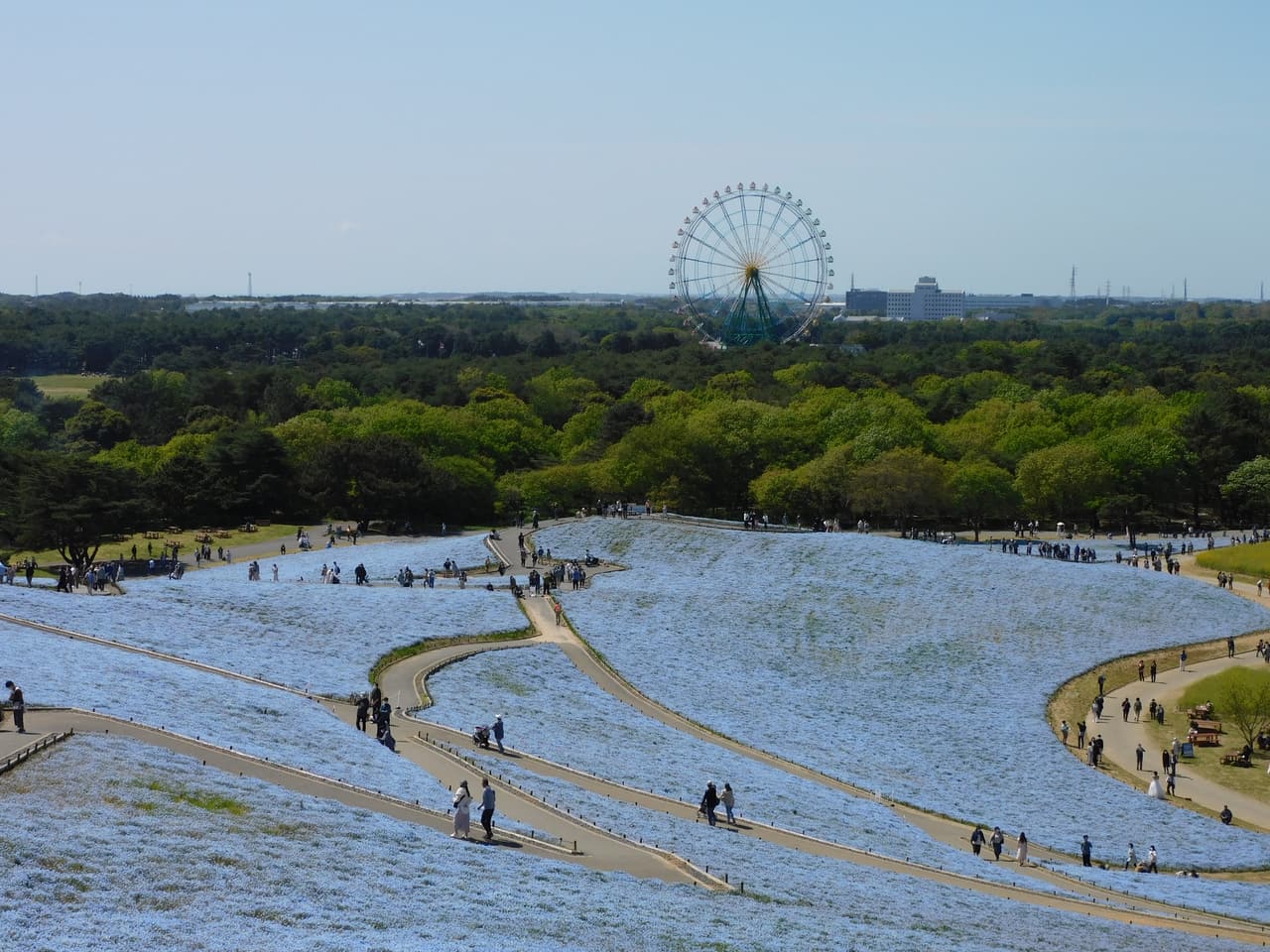
If you have seen that Instagram shot of an entire hillside blanketed in pale-blue flowers with a giant Ferris wheel behind it, that is Hitachi Seaside Park (Kokuei Hitachi Kaihin Koen) in Ibaraki. Every year from mid-April to early May, about 5.3 million nemophila (baby-blue-eyes) turn the park’s "Miharashi Hill" into a sea of blue that merges with the sky — one of Japan’s most iconic flower scenes, just 1.5 hours from Tokyo by limited express. But that blue sea has a short, weather-dependent window, so before you go you need to understand bloom timing, the seasonal ticket surcharge, and how the access connects, or you risk a wasted day. This guide covers the nemophila peak and the autumn red kochia, tickets, transport, and an Ibaraki day-trip loop taking in Kairakuen, Fukuroda Falls, Ushiku Daibutsu, and Oarai Isosaki Shrine. For framing the wider trip, pair it with our Tokyo 5-day itinerary.
- 5.3 million nemophila: peak mid-April to early May; 2026 estimated around Apr 16–25; weather-dependent, so check the official bloom status
- One hill, three faces: spring blue (nemophila), summer green, autumn red (kochia turns red in mid-October)
- Admission ¥450, but a peak-season surcharge (about +¥350) makes it roughly ¥800; free for junior-high and under
- 1.5 hours from Tokyo: Joban Line limited express to Katsuta, then a 15-minute bus
- Do not just see flowers: pair with Kairakuen (plums), Fukuroda Falls (ice fall), Ushiku Daibutsu, and Oarai’s sea torii
📖 Contents
Why visit Hitachi Seaside Park
Honestly, Hitachi Seaside Park is a "come for one thing" destination, and that thing is flowers. It is not a year-round city like Kyoto or Nara; its value is sharply concentrated. Show up at the right time — spring nemophila or autumn kochia — and you get one of the best flower spectacles in Japan; show up at the wrong time and it is a large, pleasant, but ordinary seaside park. So this trip lives or dies on timing, which is exactly why so much of this guide is about the bloom dates.
Its other strength is how close and easy it is. The Joban Line limited express puts it 1.5 hours from Tokyo, so a same-day round trip is no problem — among the best-value day trips in greater Kanto. The park covers about 200 hectares of gentle, easy-walking ground, and beyond the flowers there are amusement rides, lawns, and bike paths, so kids and older travelers can fill an afternoon. The common mistake, based on visitor reports, is planning the park alone: the flowers take just 3–4 hours, so a whole day for only flowers feels thin when Ibaraki has Kairakuen and Fukuroda Falls nearby. My advice is direct: pin down the bloom timing before you commit, and if you go, fold in the rest of Ibaraki rather than burning a day on a single flower field.
The nemophila blue sea: timing & photo tips
First, the timing that matters most. Nemophila (baby-blue-eyes) are small pale-blue flowers planted on the park’s highest point, Miharashi Hill ("the lookout hill") — about 5.3 million of them. Per official bloom data and past records, the peak runs mid-April to early May, with 2026 full bloom estimated around April 16–25. The key point: this is a living flower, the bloom shifts a few days each year with the weather, and the window is only two or three weeks — so check the official "bloom status" page a day or two before you go and only commit once it reads peak or full bloom. Do not hard-code last year’s dates.
For photos, a few things from visitor reports: (1) get up the hill at opening — Miharashi Hill is the highlight, the 11 a.m.–2 p.m. window is mobbed on peak days, and a clean blue frame is nearly impossible then. (2) Shoot from the crest toward the sea, where the blue flowers, sky, and ocean stack into the "endless blue" effect. (3) Use the Ferris wheel or a lone tree as a foreground or focal point for depth. (4) Overcast is fine — soft cloud light makes the blue richer, while harsh sun blows out highlights. The hill has almost no shade, so bring sun protection, a hat, and water.
Kochia and the four-season flower calendar
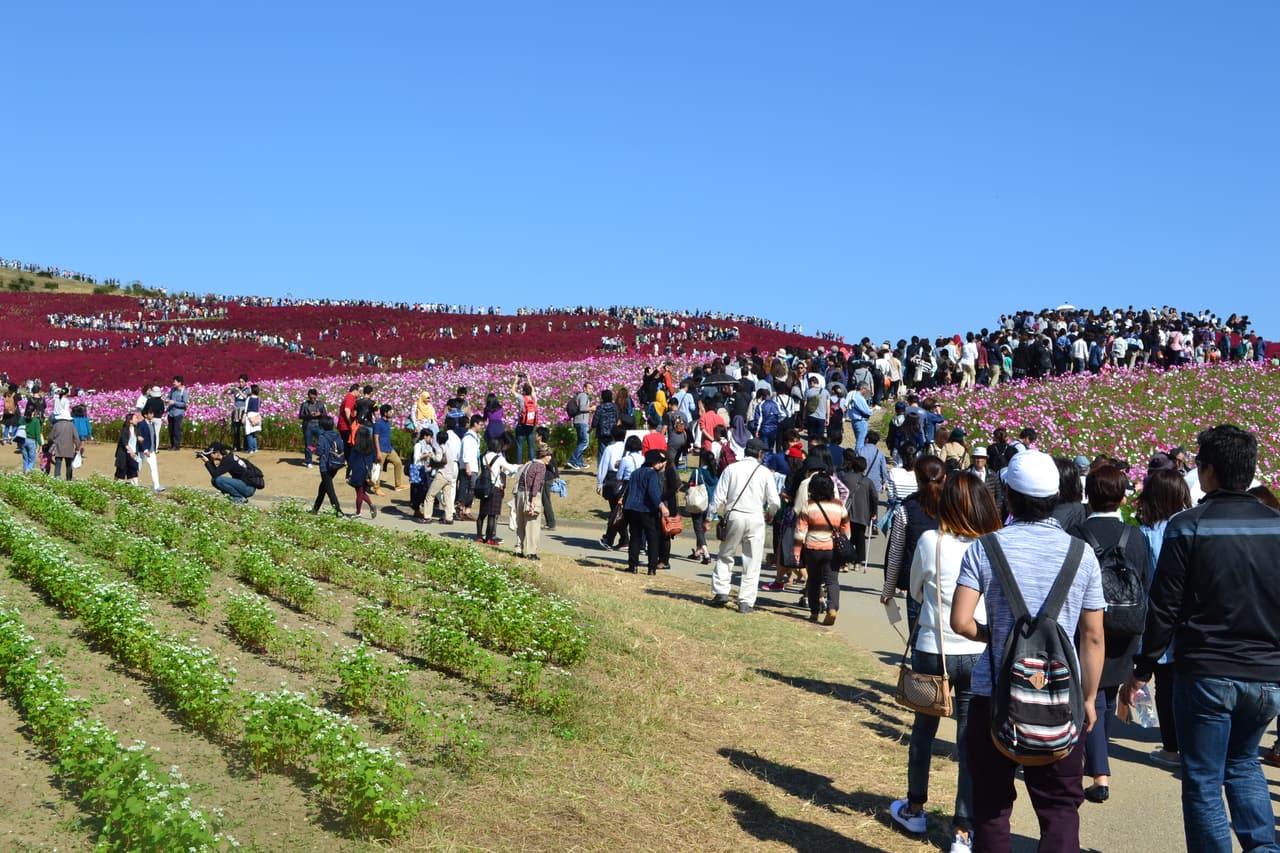
Many people do not realize that the same Miharashi Hill wears a completely different face in autumn. After the nemophila fade, the park plants kochia (burning bush) on the same hill — roughly 32,000–40,000 round, fuzzy bushes. In summer (July–August) they are bright green, photogenic just as rows of green pom-poms; by mid-October (about Oct 14–22) they turn fire-red, the whole hill blazing — the opposite of the spring blue, but every bit as striking. By late October they brown out.
So remember this flower calendar: spring (late April) brings tulips in the "Egg Forest" zone while Miharashi Hill is blue with nemophila; summer turns the hill green with kochia, alongside sunflowers; autumn (mid-October) brings red kochia with pink-purple cosmos at its feet; winter is comparatively quiet. In short, the two windows truly worth the trip are late April (blue) and mid-October (red) — other times the bloom is thin and the value drops a lot. Go for the one you want; do not plan from a vague impression.
Tickets, hours & getting around the park
Per the official site, admission works like this: ¥450 for adults (high-school age and up), ¥210 for seniors 65+, and free for junior-high and under. But one detail to know first — during the nemophila and kochia peaks the park adds a seasonal surcharge of about ¥350, so adults pay roughly ¥800 and seniors about ¥300 in high season. It exists for flower-season upkeep and crowd control and cannot be avoided; the good news is junior-high and under stay free year-round, so families are not hit hard.
Opening hours shift by season — typically around 9:30 a.m., with peak periods (Golden Week, summer holidays) opening earlier at 7:00–8:00 a.m. to spread crowds, and closing around 5:00 p.m. (earlier in winter). Always check the official current notice before you go. Parking is separate (about ¥520 for a car) and queues up on peak days. Note clearly: the Pleasure Garden amusement area — the giant Ferris wheel, coaster, and so on — is ticketed ride by ride (or via a ride pass) and is not included in admission. If you only want the flowers, admission alone is enough.
The park is big (about 200 hectares) but the terrain is gentle and the paths are easy, so no need to fear a death march. A paid loop sightseeing train, the Seaside Train, circles the main zones with hop-on/hop-off stops — ideal for older travelers, strollers, and tired legs — and you can rent a bike for the park’s dedicated cycle paths, the most comfortable way to cover a big site. Miharashi Hill, the Egg Forest, the dune garden, and the barbecue area are spread across zones, so grab a map at the gate and plan a route rather than wandering.
Worth separating clearly: the in-park cycle paths run on the park's own rules, while the Road Traffic Act starts at the gate. Inside, follow the signs and yield to walkers. On a bike rented near the station and ridden on public roads, the rules change entirely: bicycles ride on the left in Japan, and since April 1, 2026 bicycle offences carry blue-ticket fixed penalties for riders aged 16 and over. Police figures for the first month show 2,147 tickets against 135,855 verbal warnings — wrong-side riding usually draws a warning first, and only becomes ¥6,000 if you keep at it. A helmet is a duty of effort, not a fine. See the road rules that apply once you leave a park.
Access from Tokyo
Per the official access guide, the fastest way from Tokyo is train plus bus: take the JR Joban Line limited express "Hitachi" or "Tokiwa" from Shinagawa, Tokyo, or Ueno to Katsuta Station, about 75–90 minutes; leave Katsuta via the East Exit (Exit 2) and take an Ibaraki Kotsu bus, about 15 minutes, to the park’s West Gate or Seaside Gate. Budget around 1.5 hours total — an easy same-day return.
A few ways to save money and hassle: (1) flower-season passes — between Katsuta and the park, peak season often brings round-trip bus-plus-admission deals (the "Kaihin-koen free ticket") that beat paying each way, so ask at the station. (2) A JR Pass works here — the Joban limited express is JR East, so a nationwide or JR East pass can cover the express leg; whether it pays off is covered in our JR Pass guide. (3) Driving via the Joban Expressway’s Hitachi Seaside Park IC is flexible, but peak flower days bring serious traffic and parking queues, so if you would rather not stress over parking, train plus bus is usually smoother.
Ibaraki day trips: Kairakuen, Fukuroda, Ushiku, Oarai
Planning only Hitachi Seaside Park is a touch thin — the flowers take 3–4 hours, so a whole day out from Tokyo for flowers alone feels like a waste. Ibaraki hides several substantial sights; grouped by direction:
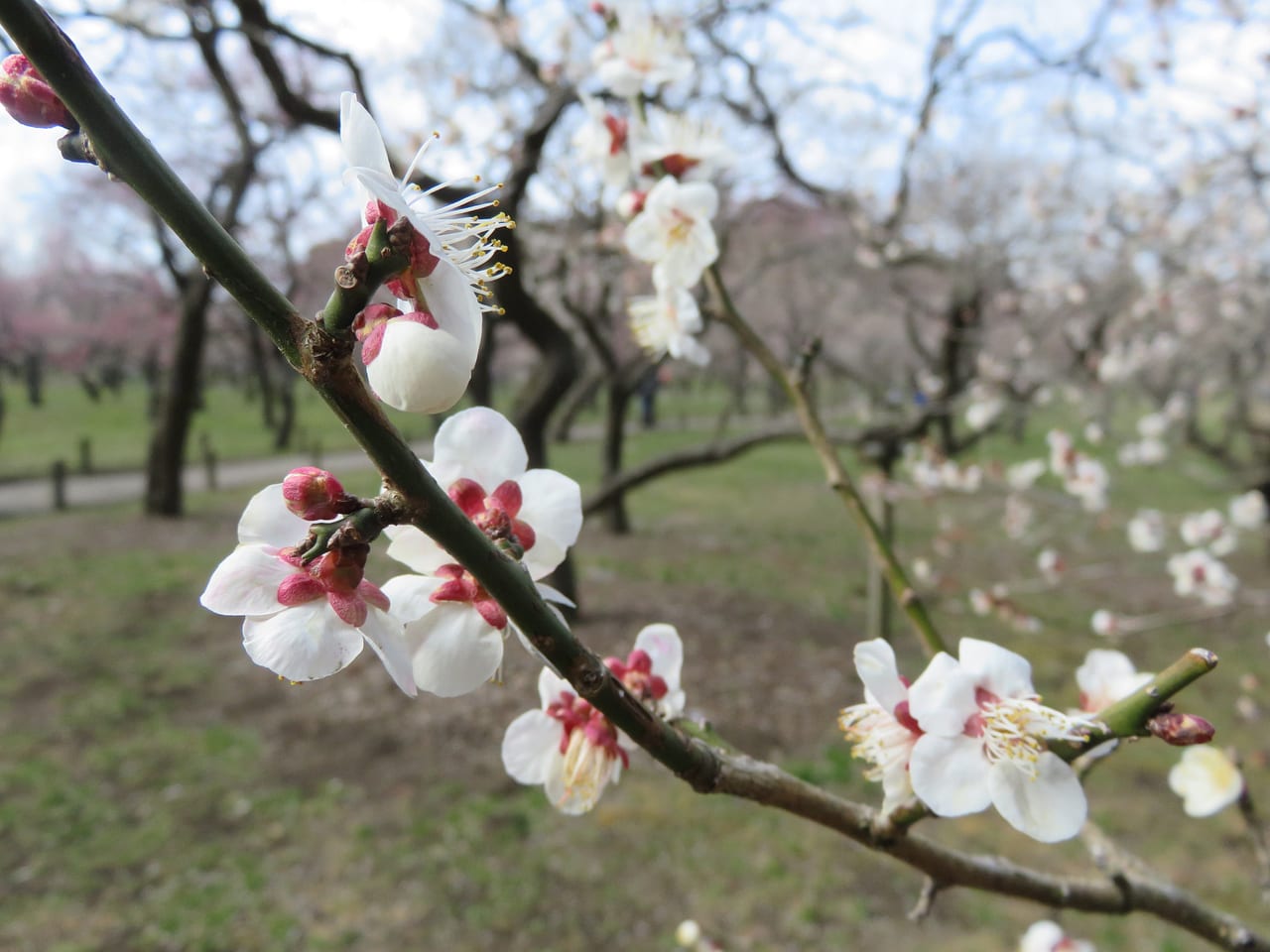
- Kairakuen, Mito: one of Japan’s three great gardens (with Kenrokuen in Kanazawa and Korakuen in Okayama), one stop past Katsuta at Mito. Its strongest season is the Feb–Mar plum festival — about 100 varieties and 3,000 plum trees blooming in early, mid, and late waves, with evening illuminations during the Mito Plum Festival. If you visit Ibaraki in Feb–Mar, the plums actually beat the not-yet-open nemophila. For admission, the Kobuntei villa, the second Kodokan venue and the catch about free early-morning entry, see the Japan plum blossom guide.
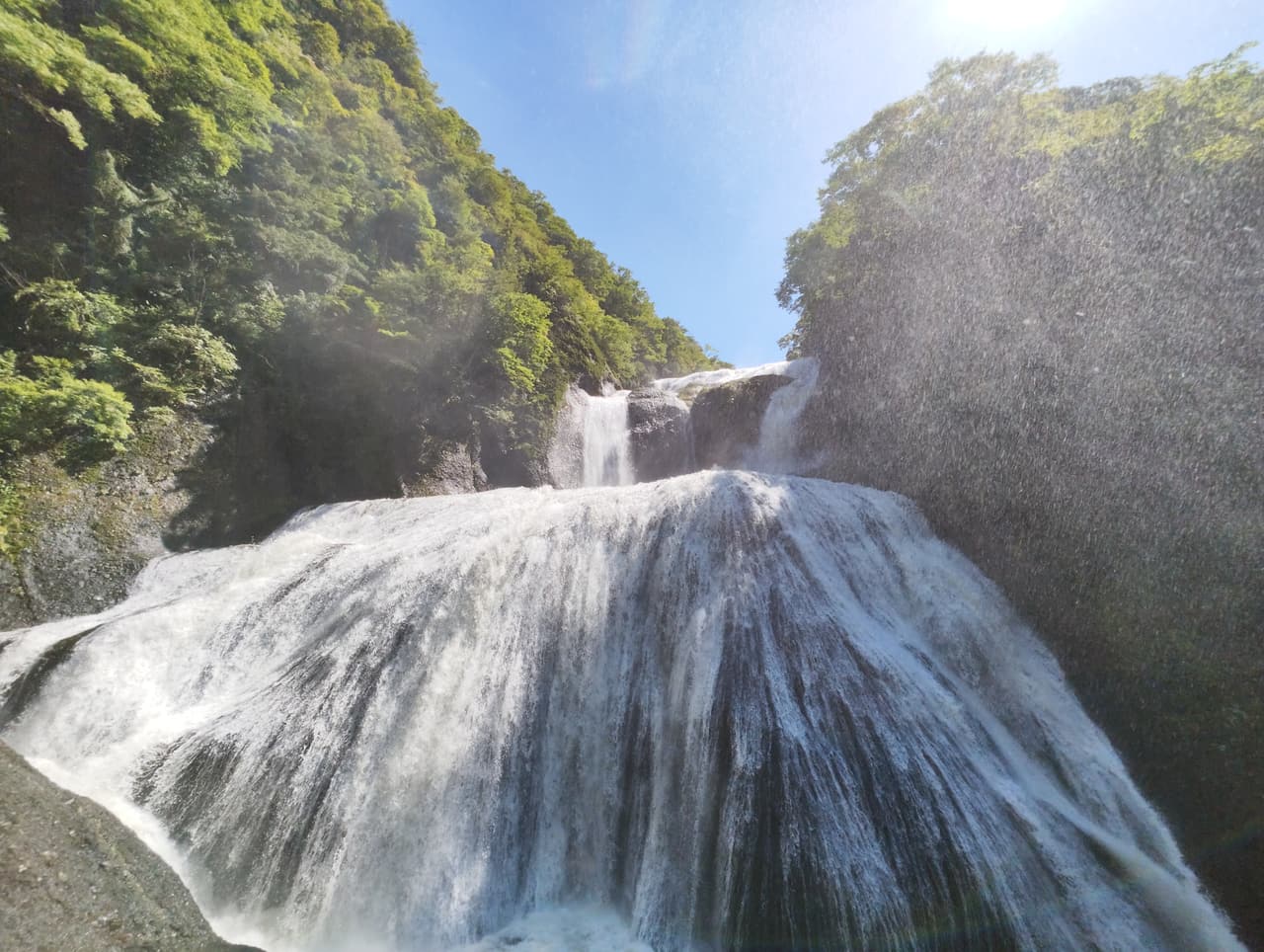
- Fukuroda Falls: one of Japan’s three great waterfalls, in Daigo in northern Ibaraki — 120m tall and 73m wide, cascading in four tiers (the "four-times falls"). The standout is that in winter it freezes into an "ice fall", though a full freeze is rare — late January to early February gives the best odds. You walk an "observation tunnel" to reach the viewing deck, which needs a separate ticket: ¥500 for adults, ¥300 for children. It is far north, so it suits drivers or a dedicated trip.
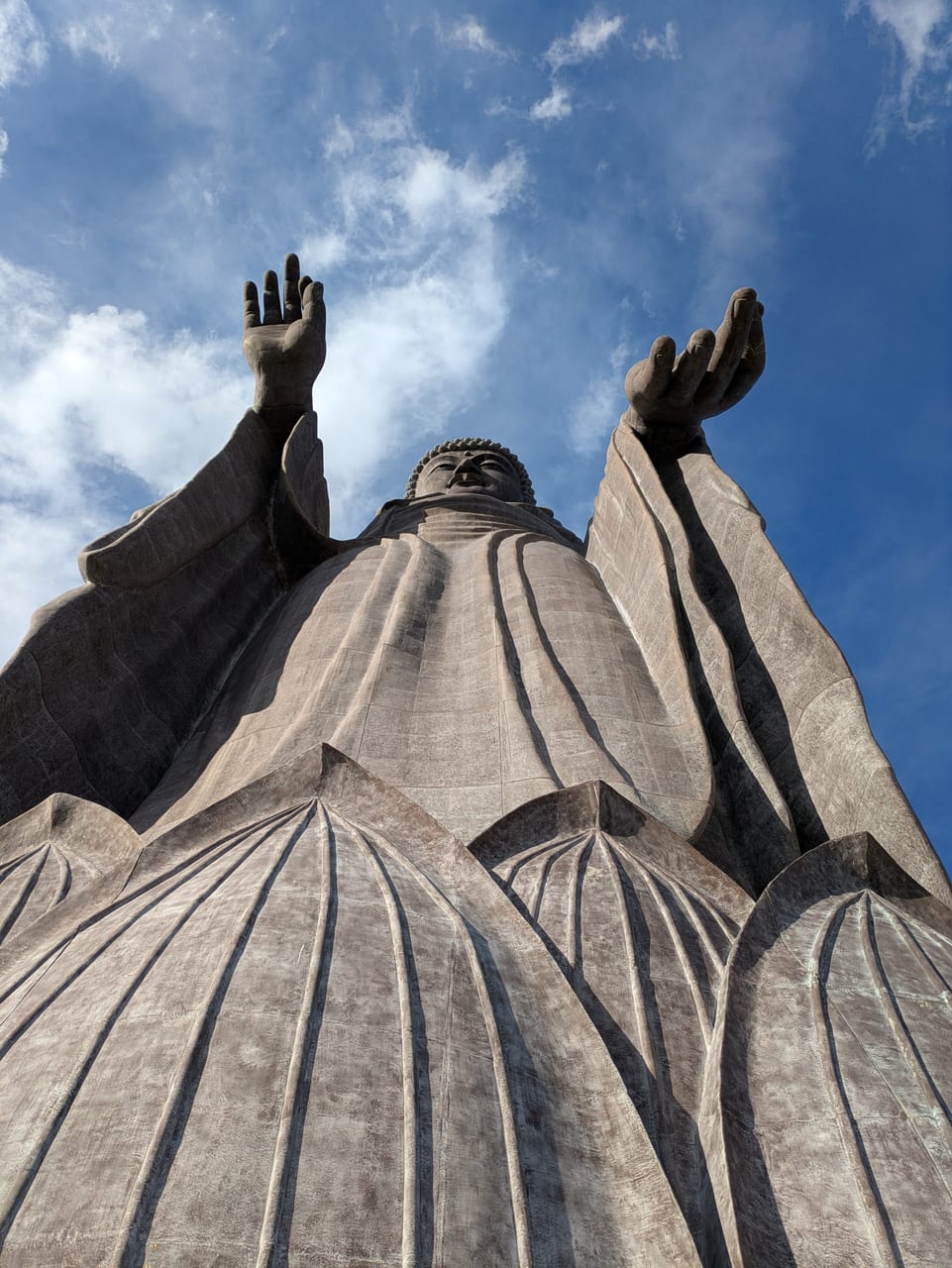
- Ushiku Daibutsu: a 120m bronze standing Buddha in Ushiku, southern Ibaraki — a Guinness-record tallest bronze Buddha, with an elevator inside up to a chest-height observation floor over the Kanto plain. Admission including the interior is about ¥900 for adults per the official site (garden-only is cheaper). It sits at the opposite end of the prefecture from the park, so it pairs better with a "south, closer to Tokyo" route.
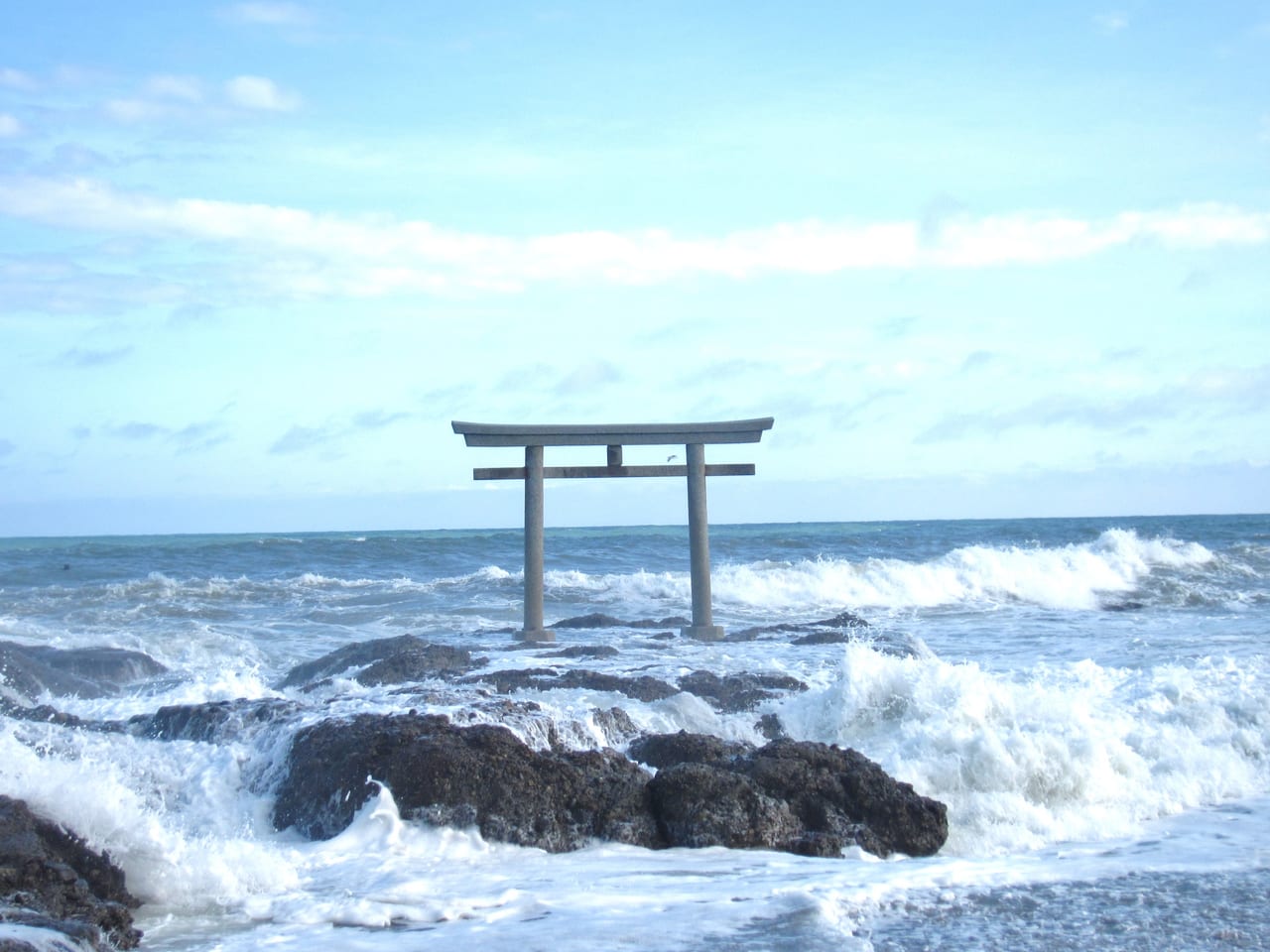
- Oarai Isosaki Shrine: on the coast in Oarai, famous for the Kamiiso sea torii standing on a rock in the Pacific — the torii framed with the sunrise is a stunner. It is also a pilgrimage site for the anime Girls und Panzer, with the whole town a fan stage. Oarai is not far from Hitachi Seaside Park (both on the central Ibaraki coast), a good add-on when you want sea views and an anime spot alongside the flowers. The wider pilgrimage scene is in our anime pilgrimage hub.
Practical reality: Ibaraki sights are spread out and transit is weak, so crossing the prefecture (Fukuroda up north, Ushiku down south) eats half a day by train and bus. To chain several in a day, renting a car is by far the most efficient; on trains alone, pick one axis — north (Kairakuen + Fukuroda) or central-south (Hitachi Seaside Park + Oarai, extending to Ushiku) — and do not try to grab everything.
Itineraries & lodging
Here are a few routes that walk well. The simplest "Tokyo day trip (flowers focus)": early limited express from Ueno to Katsuta → bus into Hitachi Seaside Park → up Miharashi Hill at opening for nemophila or kochia, plus the amusement zone and flower fields (3–4 hours) → back to Katsuta in the afternoon → optionally hop off at Mito for Kairakuen (plum season) or head straight back to Tokyo. Best for those who only want flowers without overdoing it.
A "north Ibaraki, two days" (nature + flowers): Day 1 flowers at Hitachi Seaside Park → overnight in Mito or Daigo; Day 2 morning Kairakuen (plum season) or the northern Fukuroda Falls (ice fall in winter) → back to Tokyo by evening. A "central-south Ibaraki": Hitachi Seaside Park → Oarai Isosaki Shrine for the sea torii and the Girls und Panzer trail → Ushiku Daibutsu if time allows.
On lodging: most people treat Hitachi Seaside Park as a same-day trip from Tokyo, where staying in Tokyo is most convenient and keeps the schedule flexible; to chain the north axis (Kairakuen + Fukuroda) or take Ibaraki slowly, base at Mito Station (a transit hub with plenty of dining) or a Daigo hot spring (a soak after Fukuroda). In flower season (the late-April holidays) lodging in Mito and along the line gets tight, so book early. For seasonal packing, see our Japan packing & weather guide; and since Ibaraki’s cherry blossoms run close to the nemophila window, pair this with our Japan cherry blossom guide if you are chasing sakura too.
FAQ
- Q1:When is the nemophila peak in 2026, and could I miss it?
- Based on official forecasts and visitor reports, the baby-blue-eyes (nemophila) at Hitachi Seaside Park peak from mid-April to early May, with 2026 full bloom estimated around April 16–25. But this is a living flower governed by the weather: the bloom shifts a few days year to year, the window is only two or three weeks, and the risk of arriving too early or too late is real. The safest move is to check the official "bloom status" (kaika joho) page a day or two before you go and only commit once it reads mihagoro (peak) or mankai (full bloom). Golden Week is mobbed but the flowers usually hold; to dodge crowds, go on a weekday right at opening. Keep this trip flexible.
- Q2:How much is admission, and do nemophila and kochia seasons cost more?
- Per the official site, regular admission is ¥450 for adults (high-school age and up), ¥210 for seniors 65+, and free for junior-high and under. The catch: during the nemophila and kochia peaks, the park adds a seasonal surcharge of about ¥350, so an adult pays roughly ¥800 in high season — there is no way around it. Parking is separate (about ¥520 for a car). The Pleasure Garden amusement area (the giant Ferris wheel, roller coaster, etc.) is ticketed separately and is not included in admission.
- Q3:When does the kochia turn red? Can I see it in summer?
- Kochia (burning bush) is the park’s autumn signature, planted on the same Miharashi Hill — roughly 32,000–40,000 bushes. In summer (July–August) they are bright green, fuzzy round domes that are already photogenic; the crimson peak hits mid-October (about Oct 14–22), when the whole hill turns fire-red — a completely different spectacle from the spring blue. By late October it fades to brown. So the same hill wears three faces: spring blue (nemophila), summer green, and autumn red (kochia). Go for the one you want; do not just turn up and hope.
- Q4:How do I get to Hitachi Seaside Park from Tokyo, and how long does it take?
- Per the official access guide, the fastest route is the JR Joban Line limited express "Hitachi" or "Tokiwa" from Shinagawa, Tokyo, or Ueno to Katsuta Station, about 75–90 minutes, then an Ibaraki Kotsu bus from Katsuta’s East Exit (Exit 2) of about 15 minutes to the park’s West Gate or Seaside Gate. Budget around 1.5 hours total — an easy day trip. In flower season there are round-trip bus passes (the "Kaihin-koen free ticket") that beat paying each way. By car, exit the Joban Expressway at Hitachi Seaside Park IC; expect heavy traffic and parking queues on peak flower days, so train plus bus is usually less stressful.
- Q5:Is the park enough on its own? What else is worth pairing in Ibaraki?
- On its own it is a little thin — the park takes 3–4 hours, so hauling out from Tokyo for a whole day of just flowers feels like a waste. Pair it by direction: garden lovers should add Kairakuen in Mito (one of Japan’s three great gardens, strongest in Feb–Mar with about 3,000 plum trees), one stop past Katsuta. For nature, the Fukuroda Falls up north (one of Japan’s three great waterfalls, which freezes into an "ice fall" in winter) is worth the detour. To the south sit the Ushiku Daibutsu (a 120m bronze Buddha, a Guinness record) and Oarai Isosaki Shrine, with its sea torii and Girls und Panzer anime fame. Sights are spread out with weak transit, so rent a car or pick one axis (north: Kairakuen + Fukuroda / south: Ushiku + Oarai).
- Q6:Is the park good for kids or older travelers? Is it easy to walk?
- Yes, and that is an underrated strength. The park covers about 200 hectares but the terrain is gentle and the paths are easy, and a paid loop "Seaside Train" shuttles you between zones (great for grandparents and strollers) so you need not march the whole thing. Beyond the flowers there is the Pleasure Garden (Ferris wheel, coaster), broad lawns, a barbecue area, and rental bikes — an easy afternoon for families. One note: on peak flower days it is very crowded and Miharashi Hill has a queue to reach the top, so arrive at opening, avoid 11 a.m.–2 p.m., and bring sun protection and water — the hill has almost no shade.
Related reading:
Tokyo 5-day itinerary 2026
A clear 5-day plan: Shinjuku base, two zones per day, honest budget.
Nikko Guide 2026: Toshogu, Kegon Falls & Lake Chuzenji
About 1h50 from Asakusa by Tobu express — the World Heritage Toshogu (Yomeimon, three monkeys, sleeping cat), Kegon Falls, Lake Chuzenji, and the Irohazaka autumn hairpins.
Where to See Cherry Blossoms in Japan 2027: 5 Spots Compared
Tokyo late March, Kyoto and Osaka early April, Kawaguchiko mid-April, Hirosaki and Hokkaido late April — best week and booking lead time for each.