The two most underrated corners of Kagoshima's Satsuma Peninsula are Ibusuki at the southern tip and Kirishima inland. Ibusuki has Japan's strangest soak — the sunamushi sand bath, where you are buried in roughly 50°C steam-heated black sand, and the city-run Saraku costs just ¥1,500 with a yukata. Kirishima hides Kirishima Jingu, designated a National Treasure only in 2022, the myth-laden peak of Takachiho-no-mine, and a whole volcanic onsen highland. Add the sobering but deeply worthwhile Chiran samurai gardens and Peace Museum, and you get Kagoshima at its most layered. Here is the one blunt thing up front: Ibusuki is south, Kirishima is north, Chiran is west — three different directions, sights spread out, service thin, so a rental car helps a lot. That is where most plans snag. For the Sakurajima ferry and the volcano's current status, see our Sakurajima ferry and volcano guide; this one focuses on Ibusuki, Kirishima, and Chiran.
- The Ibusuki sand bath is a must: Saraku is ¥1,500 with yukata (¥2,000 at peak), about 10 minutes buried in steam-heated black sand
- Mt. Kaimon "Satsuma Fuji" + Nishi-Oyama Station (JR's southernmost) + Lake Ikeda string into one driving day
- Kirishima Jingu became a National Treasure in 2022: vermilion halls, cedar approach; plus the Kirishima onsen district
- Takachiho-no-mine ≠ Takachiho Gorge: one is a peak in Kirishima, the other a ravine in Miyazaki — don't confuse them
- Chiran: samurai gardens ¥530, Peace Museum ¥500 — heavy but worth it
- Shinmoedake's alert level shifts — check JMA trail restrictions before any hike
📖 Contents
- 1. Why go to Ibusuki and Kirishima
- 2. The Ibusuki sand bath: buried in black sand
- 3. Mt. Kaimon, Nishi-Oyama Station & Lake Ikeda
- 4. Kirishima Jingu (a National Treasure) & Takachiho-no-mine
- 5. The Kirishima onsen district & Ebino Plateau
- 6. Chiran: samurai gardens & the Peace Museum
- 7. Transport & lodging (car vs. rail & bus)
- 8. A three-day plan
- 9. FAQ
Why go to Ibusuki and Kirishima
Plenty of travelers do Sakurajima and leave Kagoshima at that, which is a shame. Ibusuki and Kirishima are where Kagoshima gets its depth. Ibusuki gives you a beachside sand bath and a perfect cone volcano, the "Satsuma Fuji" — a soak you genuinely cannot have anywhere else in Japan. Kirishima gives you myth, a National Treasure shrine, and volcanic onsen, a completely different energy. My call is blunt: if you only have one day, choose Ibusuki — the sand bath is the rarest, most satisfying thing here, and the Mt. Kaimon sights cluster nicely. With two days or more, add Kirishima for the onsen and the National Treasure. Chiran is a heavyweight of a different kind — quiet, historical, sobering — and anyone willing to give it half a slow afternoon will not regret it. This is not a dense checklist trip; it is the way to do Kagoshima properly.
The Ibusuki sand bath: buried in black sand
Let me lead with the verdict: the sunamushi sand bath is the one thing not to miss in Ibusuki, full stop. Only Ibusuki and a handful of spots in Japan have it — geothermal steam under the beach heats the sand to around 50°C, you change into a yukata, lie down in a dug-out trench, and staff shovel hot sand over your whole body (only your head exposed). The weight presses, the heat seeps in, and in roughly 10 minutes you are sweating hard and your pulse is up — said to be excellent for circulation and shaking off fatigue.
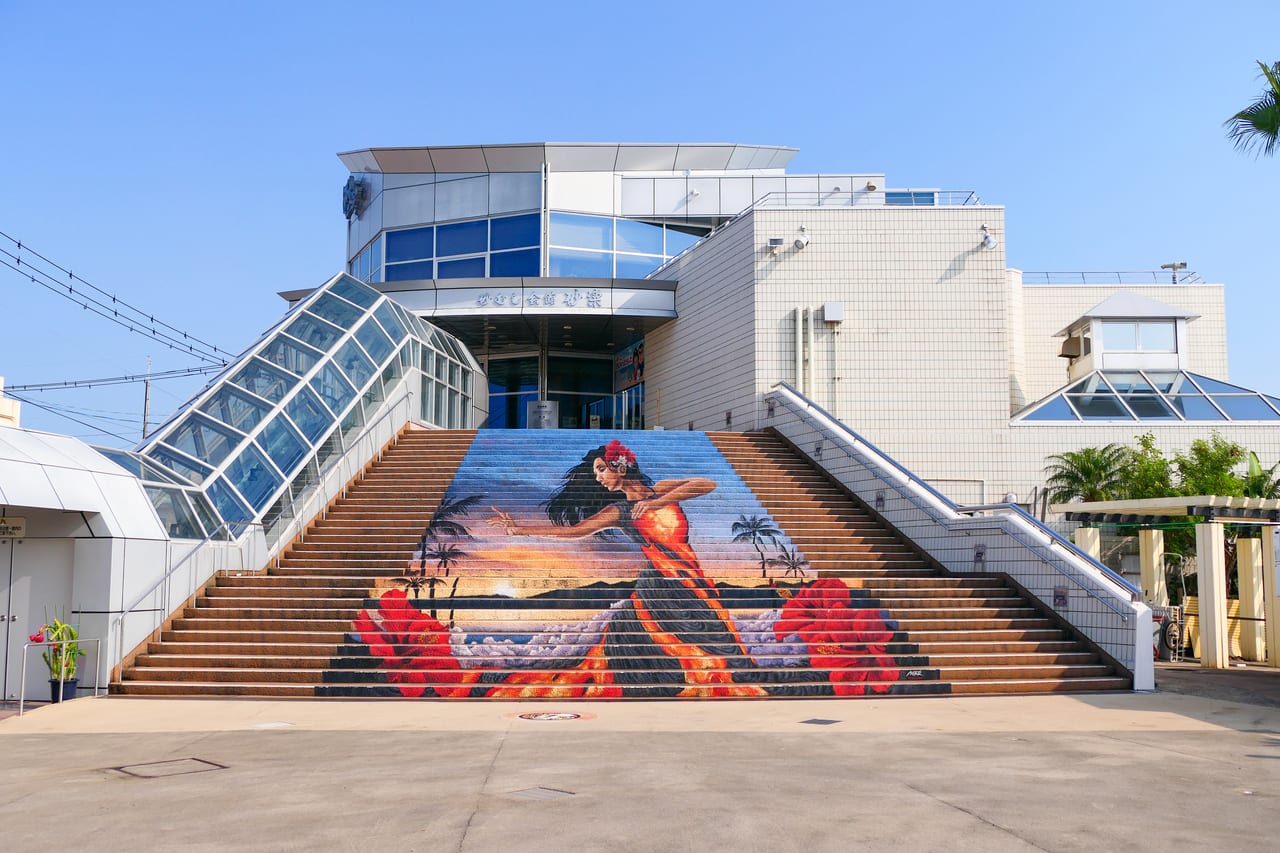
The flagship is the city-run "Sunamushi Kaikan Saraku," right on the shore, so you can watch the sea afterward. The practicals, per its 2026 rates: the sand bath (yukata included) is ¥1,500 for adults and ¥800 for children; peak periods like Golden Week and New Year shift to ¥2,000, and weekdays have a midday reception pause (around 12:00–13:00), so check the official site for current times. Towels are rented or sold on-site (about ¥300); the yukata is provided. The flow is simple: change into the yukata indoors, get buried at the sand field, rinse the sand off, then finish with a soak in the regular onsen pool.
A few honest warnings: the sweat comes on hard, so anyone with a heart condition, pregnant travelers, or those who don't do well with heat should take it easy — raise a hand and staff will dig you out anytime. In summer the queues build, so go early. Many Ibusuki hotels have their own sand-bath facilities too, so staying a night and doing it at your lodging is lovely. Beyond Saraku, the city also has options like "Yamagawa Sunayu-ri," same theme, different sea view.
Mt. Kaimon, Nishi-Oyama Station & Lake Ikeda
Once you've sweated it out, Ibusuki's sights (at the peninsula's southern tip) conveniently cluster around Mt. Kaimon, stringing into a smooth driving line. Start with the landmark:
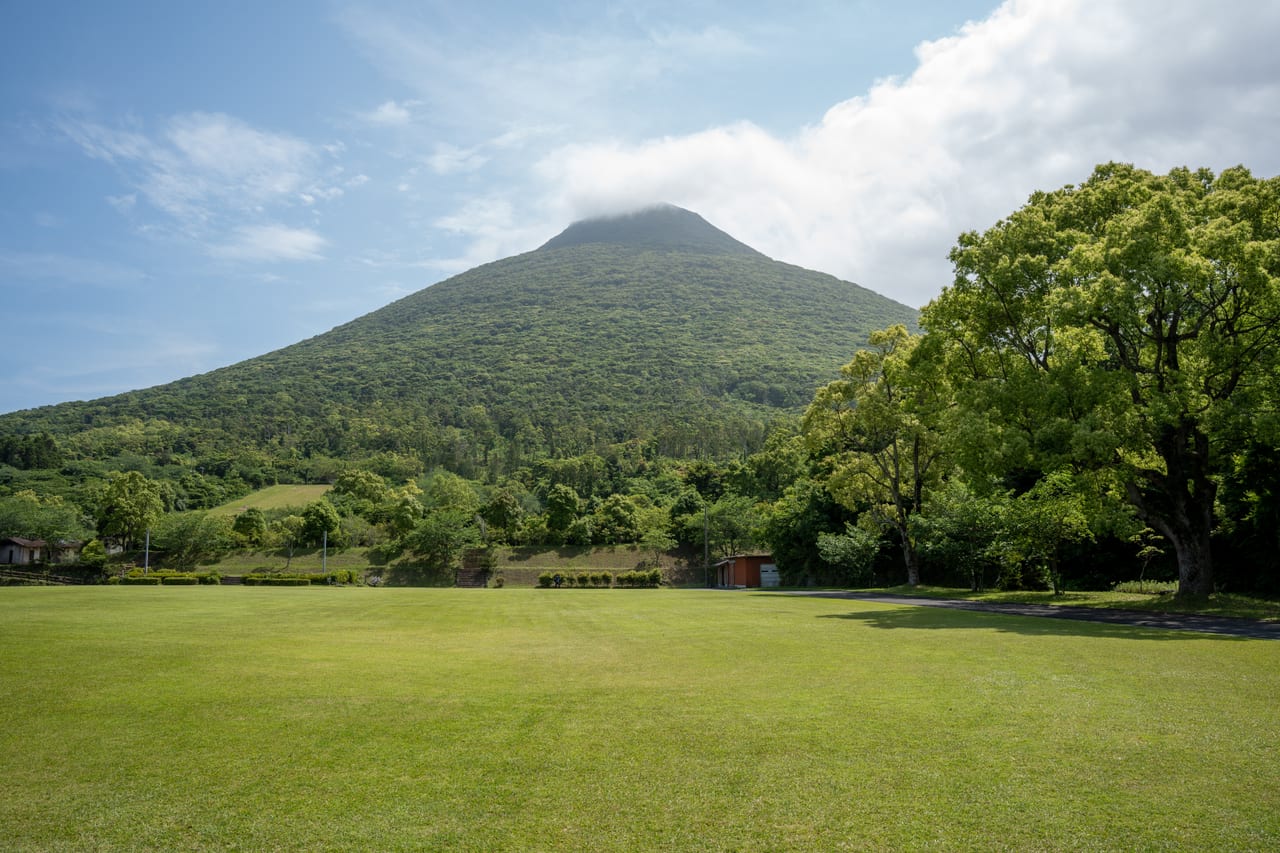
- Mt. Kaimon (Satsuma Fuji): a 924-meter, beautifully symmetrical cone volcano nicknamed the "Satsuma Fuji" for its resemblance to Fuji, the omnipresent backdrop of Ibusuki. The fit can climb it (a spiral trail, roughly 5 hours return); everyone else just enjoys it on the horizon and in every photo.
- Nishi-Oyama Station: a tiny stop on the JR Ibusuki-Makurazaki Line, and JR's southernmost regular station. The platform faces Mt. Kaimon and a yellow "happiness" postbox stands beside it — catnip for rail fans and couples. Service is sparse, so check the timetable if you want a train in the frame.
- Lake Ikeda: the largest caldera lake in Kyushu, home to an "Issie" monster legend and genuinely large eels; the lakeshore framed by Mt. Kaimon during the rapeseed-flower season (late winter into early spring) is especially pretty.
- Nagasaki-bana: the cape at the peninsula's southern point, with Mt. Kaimon rising across the water, a Ryugu shrine (the Urashima Taro legend), and a lighthouse over an open sea view.
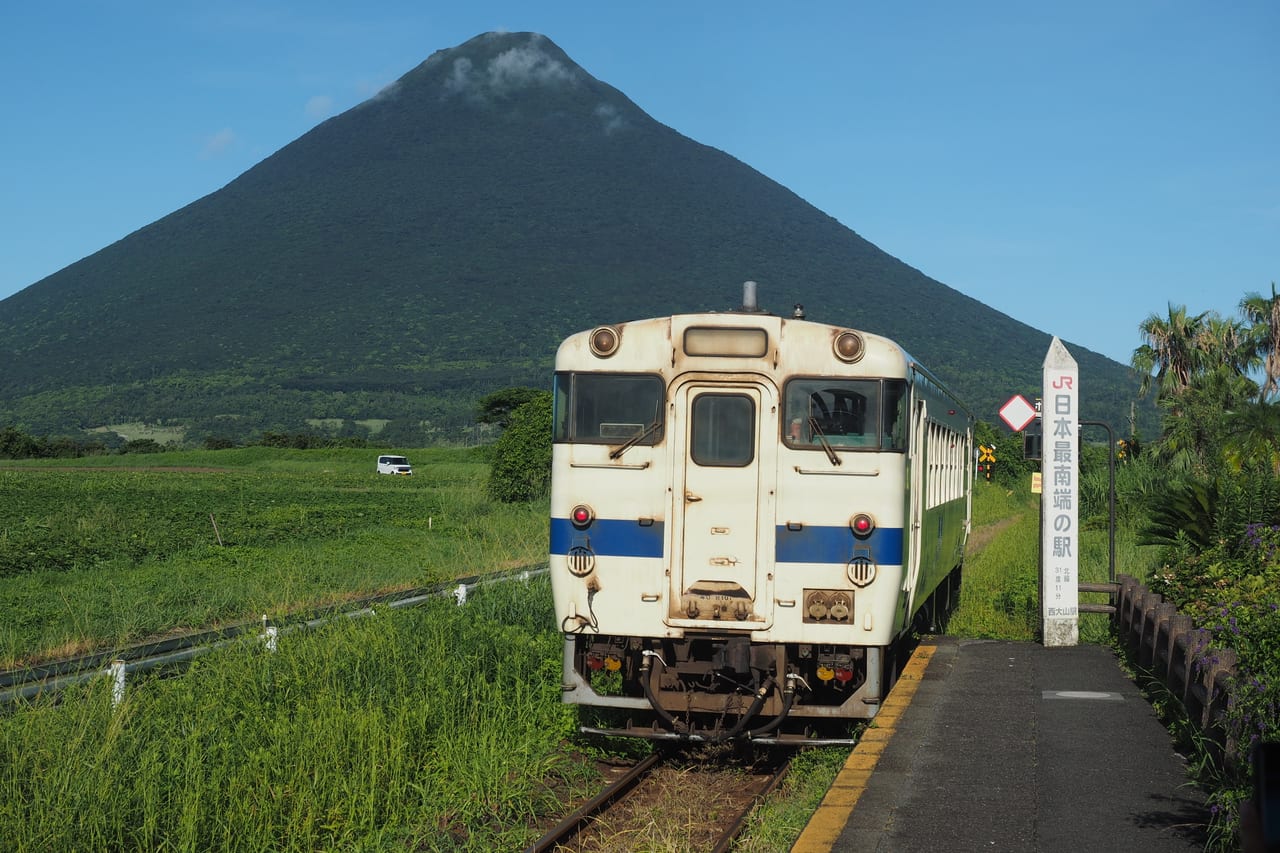
The most characterful way to reach Ibusuki is the sightseeing train "Ibusuki no Tamatebako": a striking black-and-white livery with views of Kinko Bay and Sakurajima, about 1 hour from Kagoshima-Chuo to Ibusuki, all reserved seats and booked ahead (three round trips a day). There's also the plain JR Ibusuki-Makurazaki Line local. But the Mt. Kaimon foothill spots (Nishi-Oyama aside) are awkward by public transport — a rental car, or an e-bike from Ibusuki Station, makes the day far easier.
Kirishima Jingu (a National Treasure) & Takachiho-no-mine
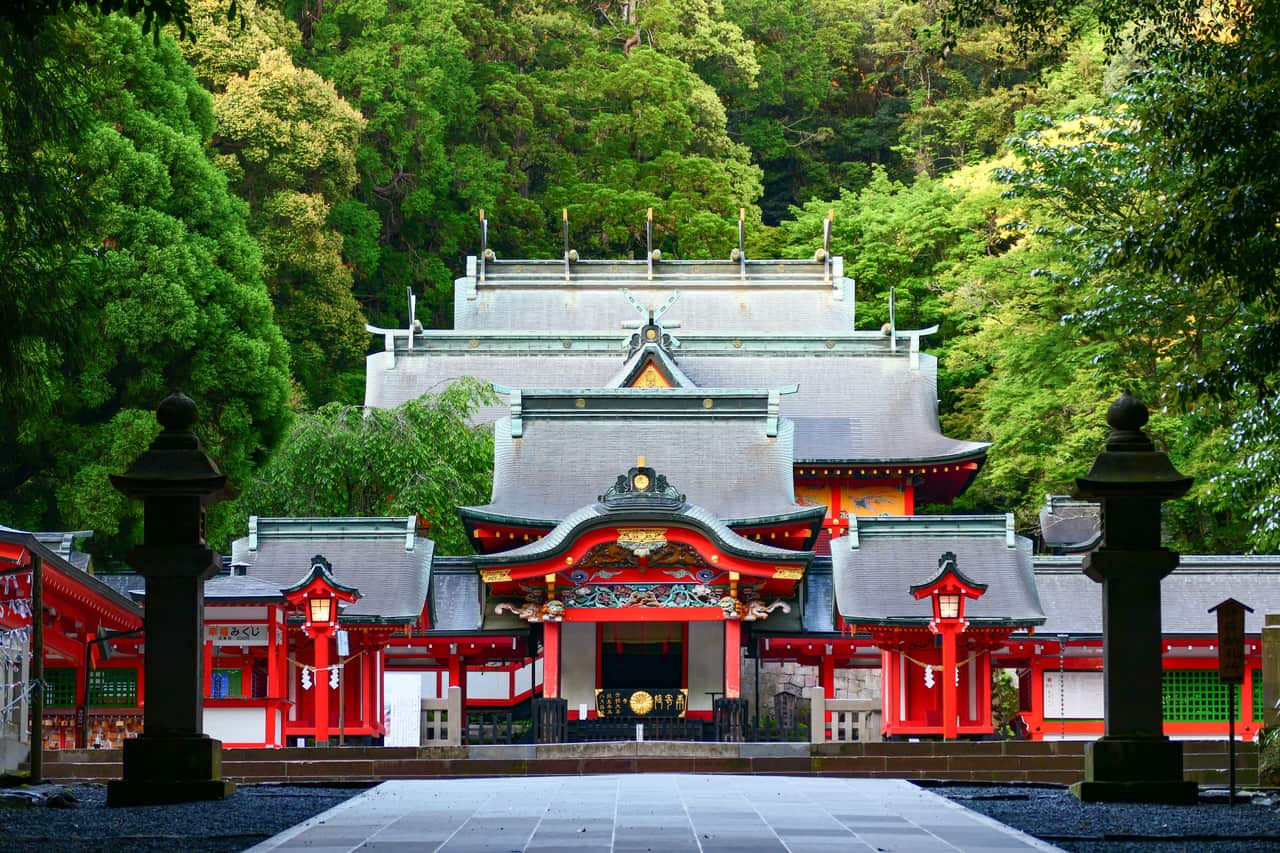
Inland at Kirishima, the centerpiece is Kirishima Jingu. Its enshrined deity is Ninigi-no-Mikoto, the heavenly grandson said to have descended to earth at Amaterasu's command and set the imperial myth in motion — and this area is one of the stages of that "heavenly descent" legend. The headline: Kirishima Jingu's main hall, offering hall, and worship hall were designated National Treasures in February 2022 (the first National Treasure structure in Kagoshima Prefecture). The current buildings, rebuilt in 1715 by Shimazu Yoshitaka, are vermilion-lacquered and dense with polychrome carving and dragon pillars — lavish and solemn at once, set at the end of a tall cedar approach. Worship is free.
Once myth comes up, clear the most common confusion: Takachiho-no-mine is not the Takachiho Gorge in Miyazaki. The one at Kirishima is Takachiho-no-mine, a roughly 1,574-meter volcanic peak in the Kirishima range on the Kagoshima/Miyazaki border, topped by the legendary "Ama-no-Sakahoko" halberd and counted as a stage of the heavenly-descent myth. Northern Miyazaki has a separate Takachiho Gorge — the famous ravine with columnar cliffs where you rent a little rowboat — and it is hours away by car. Same name, completely different place and experience. Do not assume you can do both in a day. At Kirishima you climb the peak; the rowboat gorge needs its own trip up to northern Miyazaki.
The Kirishima onsen district & Ebino Plateau
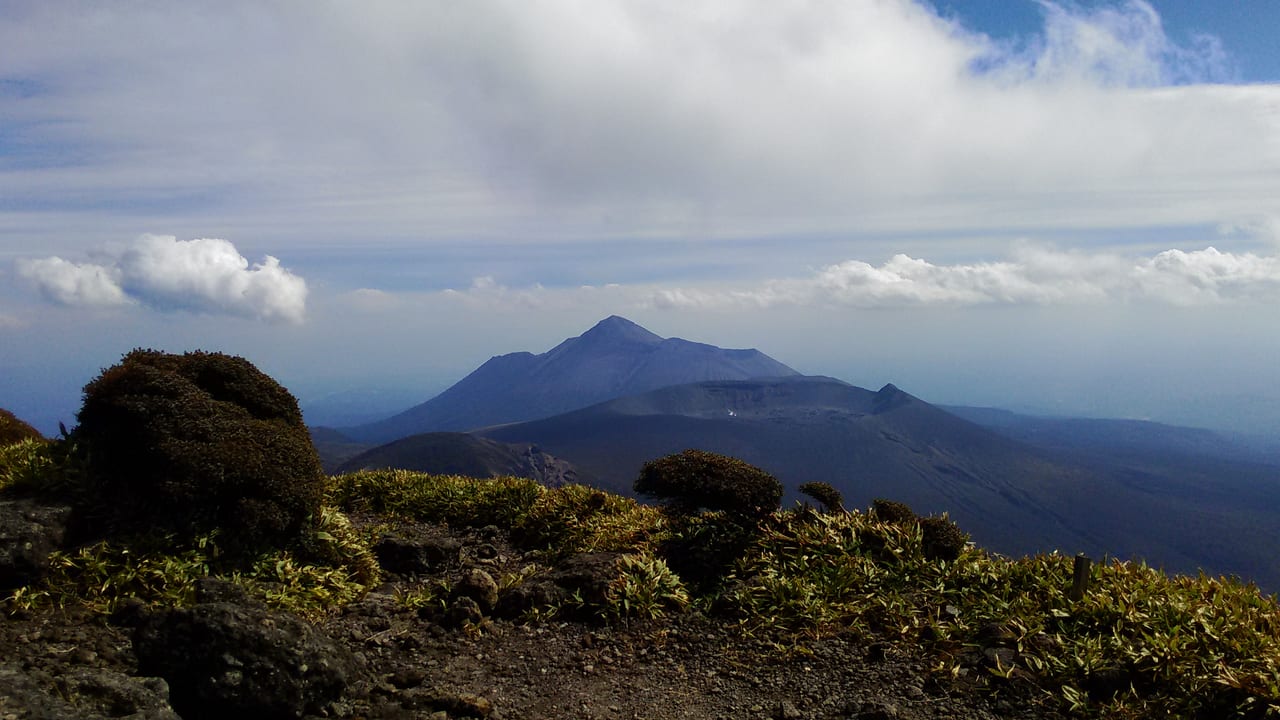
Kirishima is one big swath of volcanic terrain, so naturally it is also onsen country. The Kirishima onsen district is scattered across the slopes of the range, with varied water — sulfur, iron, carbonated springs — running from old healing baths to resort hotels, an excellent base for soaking plus nature. Higher up is the Ebino Plateau (around 1,200 meters), with volcanoes like Karakunidake and Shiratoriyama, autumn color, and winter rime ice — the gateway for hiking the Kirishima range.
But here is the serious caveat: Shinmoedake in the Kirishima range is an active volcano, and its alert level directly governs which trails are open. Per the Japan Meteorological Agency, in October 2025 Shinmoedake was lowered from eruption alert level 3 (no-entry) to level 2 (around-the-crater restriction), with a roughly 2 km warning zone around the crater. Some trails (around Shinmoedake and Shishikodake) remain closed and the Nakadake summit is still off-limits, while some Ebino Plateau routes (Karakunidake, Ohatayama) have reopened, and Kirishima Jingu and the onsen district carry on as normal. The level moves with volcanic activity — this is a genuine can-I-go-up-or-not safety matter, not an affiliate "out of stock" — so before planning any hike, check the JMA and Kirishima City sites for current trail restrictions and don't push past closures. If you're only soaking, visiting the shrine, or driving around, you're generally unaffected.
Chiran: samurai gardens & the Peace Museum
Southwest of Kagoshima, in the middle of the Satsuma Peninsula, Chiran is the trip's most different stop. It has two unmissable sights — one beautiful, one heavy.
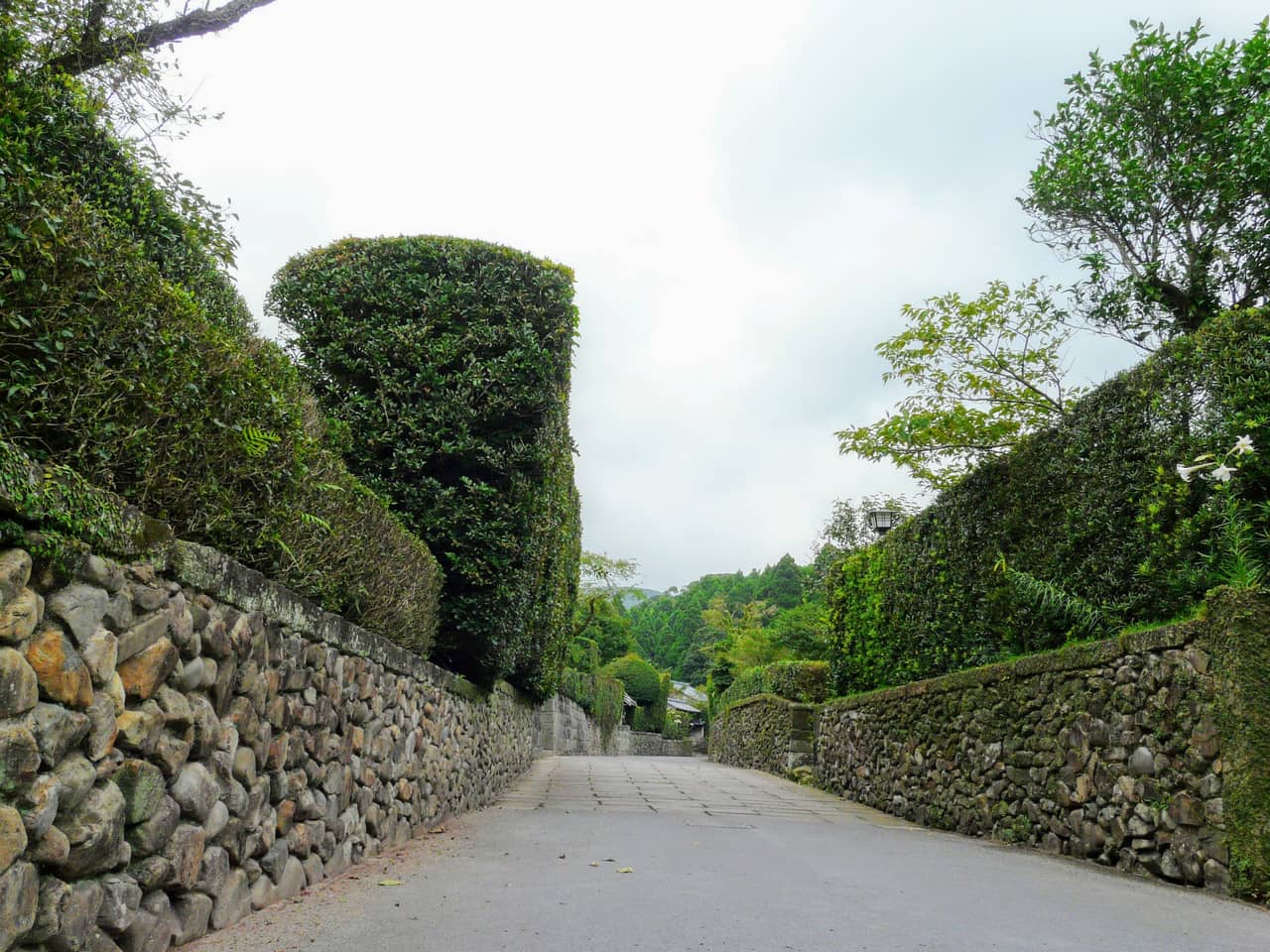
The beautiful one is the Chiran samurai gardens. An Edo-period outer-castle samurai settlement preserved intact — stone walls, clipped hedges, and a row of dry landscape gardens — earning it the nickname "Little Kyoto of Satsuma." Seven of the publicly open gardens are designated National Scenic Beauty, and you can stroll the atmospheric samurai-residence street and step into the gardens. Per 2026 rates, admission is ¥530 for adults, ¥320 for elementary and middle schoolers, free for younger children — great value, quiet, and very photogenic.
The heavy one is the Chiran Peace Museum. Chiran was one of the army's kamikaze (tokkotai) launch bases in the final stage of WWII, and the museum displays the last letters, personal effects, and photographs of the young pilots, framed entirely around a wish for peace and the cost of war. Per the new rates from October 2025, admission is ¥500 for adults, ¥300 for elementary and middle schoolers, free for younger children. Honestly: this is not a light stop — many of the letters were written by teenagers and twenty-somethings to their mothers, and you leave with complicated, heavy feelings — but that weight is exactly why it matters, and it is the most direct way to face this history. Pair it with the samurai gardens next door — museum first to sit with it, then the gardens to reset — and both the route and the mood flow better. Weigh the content before bringing very young children. Chiran also grows Chiran tea, one of Kagoshima's signature green teas, so picking some up on the way out is a nice close.
Transport & lodging (car vs. rail & bus)
The critical part of this trip is the transport, because the three zones point different ways. Lock in the skeleton: use Kagoshima city (Kagoshima-Chuo Station) as your hub — south to Ibusuki, north to Kirishima, west to Chiran, each as its own out-and-back.
- Ibusuki: about 1 hour from Kagoshima-Chuo on the sightseeing train "Ibusuki no Tamatebako" (all reserved, book ahead, three round trips a day) or the JR Ibusuki-Makurazaki local. In Ibusuki, the sand bath is easy to reach, but the Mt. Kaimon foothills, Lake Ikeda, and Nagasaki-bana have sparse service — rent a car or an e-bike.
- Kirishima: JR to Kirishima-Jingu Station then a bus up to the shrine and onsen, or about an hour by car from Kagoshima. The range, the Ebino Plateau, and the onsen ryokan are spread out, so a car gives the most flexibility.
- Chiran: no railway — about 1 hour 15 minutes by direct bus from Kagoshima-Chuo. Service is decent, so it is the one spot you can reach car-free.
So honestly: if you want the full Mt. Kaimon area, the Kirishima range, and Chiran, a car helps a lot; if you only want the highlights (Ibusuki sand bath + Chiran), the sightseeing train and buses get it done. If the wider Kyushu trip leans on JR, run the break-even in our JR Pass guide; to chain other Kyushu cities, see our Kyushu 3-day rail itinerary. For lodging, the smart move is to stay at an onsen — the Ibusuki hot-spring district (many hotels have their own sand baths or sea-view baths) or the Kirishima onsen district (volcanic springs ringed by nature). Evening soaks after the day-trippers leave are the best part, and you connect straight to the sights next morning. Pre-trip weather and packing are in our Japan packing & weather guide — southern Kagoshima runs warm, but the Kirishima highland swings cold between day and night, so bring a jacket.
A three-day plan
Here is the content shaped into a route that flows (written for a car with Kagoshima-city in/out; public-transport travelers should pad the transfers):
- Day 1 (Ibusuki): "Ibusuki no Tamatebako" or drive south → the Saraku sand bath → after lunch, drive the Mt. Kaimon loop: Nishi-Oyama Station for the southernmost shot with Kaimon → Lake Ikeda → Nagasaki-bana → check into the Ibusuki onsen district for a sea-view soak.
- Day 2 (Chiran + move to Kirishima): morning west to Chiran — the Peace Museum first to sit with it, then the samurai gardens → lunch with Chiran tea → afternoon transfer to Kirishima, check into the onsen district for a volcanic soak.
- Day 3 (Kirishima): morning at National Treasure Kirishima Jingu and its cedar approach → by weather and alert level: drive up the Ebino Plateau for the views or a hike (check trail restrictions first) → back to Kagoshima in the evening to continue or head home.
With only two days, do "one full Ibusuki day (sand bath + Mt. Kaimon area) plus either Kirishima or Chiran" — cramming all three is rushed. To add half a day on Sakurajima, fares, timetables and the island bus are in our Sakurajima ferry and bus guide; to extend to ancient cedars and rainforest, our Yakushima travel guide.
FAQ
- Q1:What is the Ibusuki sand bath, and how much does Saraku cost?
- The sand bath (sunamushi) is a one-of-a-kind soak where you are buried in naturally steam-heated black sand — you put on a yukata, lie down on the beach, and staff shovel roughly 50°C hot sand over your whole body until only your head shows, letting the weight and heat draw out a hard sweat. The flagship is the city-run "Sunamushi Kaikan Saraku." Per its 2026 rates, the sand bath (yukata included) is ¥1,500 for adults and ¥800 for children; during peak periods like Golden Week and New Year it rises to ¥2,000. Towels are rented or sold on-site (about ¥300). My take: the burial gets you sweating in about 10 minutes and your pulse climbs, so go easy if you have any heart condition, and finish by rinsing off in the regular indoor onsen next door. This is the thing in Ibusuki you should not skip.
- Q2:Is Takachiho-no-mine the same as the Takachiho Gorge in Miyazaki?
- No — and this is the most common mix-up. The one at Kirishima is Takachiho-no-mine, a roughly 1,574-meter volcanic peak in the Kirishima range on the Kagoshima/Miyazaki border, topped by the legendary "Ama-no-Sakahoko" halberd; it is one of the stages of the heavenly-descent myth. The other is the Takachiho Gorge in northern Miyazaki — a famous ravine with columnar basalt cliffs where you rent a rowboat — and it sits hours away by car. They only share a name; the places and the experiences are entirely different. At Kirishima you can climb the peak; the rowboat gorge needs a separate trip up to northern Miyazaki, so do not try to fit both into one day.
- Q3:Shinmoedake is active — can I still hike the Kirishima trails?
- It depends on which peak, and you must check the latest alert level before you go. Shinmoedake in the Kirishima range is an active volcano; per the Japan Meteorological Agency, in October 2025 it was lowered from eruption alert level 3 (no-entry) to level 2 (around-the-crater restriction), with a roughly 2 km warning zone around the crater. Some trails (around Shinmoedake and Shishikodake) remain closed, and the Nakadake summit is still off-limits, though some routes on the Ebino Plateau (Karakunidake, Ohatayama) have reopened. Kirishima Jingu, the Kirishima onsen district, and the Ebino Plateau scenery stay open as normal. The key point: the alert level shifts with volcanic activity — this is a real safety question, not an "out of stock" inconvenience — so check the JMA and Kirishima City sites for current trail restrictions, and do not push past closed sections.
- Q4:Is the Chiran Peace Museum worth it? Is it too heavy?
- Yes, and it is genuinely heavy. Chiran was one of the army's kamikaze (tokkotai) launch bases in the final stage of WWII, and the Chiran Peace Museum displays the last letters, personal effects, and photographs of the young pilots, framed entirely around a wish for peace. Per the new rates from October 2025, admission is ¥500 for adults, ¥300 for elementary and middle schoolers, free for younger children. Honestly, this is not a breezy stop — many of the letters were written by teenagers and twenty-somethings to their mothers, and you leave with complicated feelings — but that weight is exactly why it matters; it is the most direct way to face this history. Pair it with the Chiran samurai gardens next door so the route flows and you get an emotional reset. Consider the content before bringing very young kids.
- Q5:How do I plan Ibusuki and Kirishima — do I have to rent a car?
- The two sit in opposite directions — Ibusuki at the southern tip of the Satsuma Peninsula, Kirishima inland to the north — so use Kagoshima city as your hub and split the trip. Ibusuki is about 1 hour from Kagoshima-Chuo on the sightseeing train "Ibusuki no Tamatebako" (all reserved seats, book ahead, three round trips a day) or on the local JR Ibusuki-Makurazaki Line. Kirishima means JR to Kirishima-Jingu Station then a bus, or about an hour by car from Kagoshima. Chiran has no railway — it is about 1 hour 15 minutes by bus from Kagoshima-Chuo. Honestly: town-center spots are fine by public transport, but the Mt. Kaimon foothills, Lake Ikeda, Chiran, and the Kirishima range are spread out with thin service, so a car helps a lot. If the wider Kyushu trip leans on JR, run the math in our JR Pass guide first; to add Sakurajima, the ferry and island bus are covered in our Sakurajima ferry guide.
- Q6:Beyond the sand bath, what else is a must in Ibusuki?
- The southern tip of the Satsuma Peninsula packs its sights tightly. Mt. Kaimon is a 924-meter symmetrical cone volcano nicknamed the "Satsuma Fuji" — Ibusuki's signature backdrop. Nishi-Oyama Station is JR's southernmost regular station, its platform facing Mt. Kaimon with a yellow "happiness" postbox, a magnet for rail fans and photographers. Lake Ikeda is the largest caldera lake in Kyushu, home to a "Issie" monster legend and oversized eels. Nagasaki-bana is the cape at the peninsula's southern point with a wide sea view of Kaimon across the water. These cluster around Mt. Kaimon and string together easily by car, filling a day alongside the sand bath. For the ferry to Sakurajima or the boat to Yakushima, see how the Sakurajima ferry works and our Yakushima guide.
Related reading:
Sakurajima Ferry 2026: Times, Fares, Island Bus, Volcano Status
The Sakurajima ferry has run 4:00–23:30, not 24 hours, since October 2025 — pay at Sakurajima Port, the island bus, CUTE pass and volcano Level 3.
Yakushima Guide 2026: Jomon Sugi Trek, Moss Forest & Ferries
One of Japan's first Natural World Heritage sites — the 22 km Jomon Sugi trek, the Princess Mononoke moss forest, ferries from Kagoshima and the trailhead bus rules.
Kyushu 3-Day Rail Itinerary 2026
Yufuin no Mori + Aso Boy chain Hakata → Yufuin → Beppu → Kumamoto → Aso. JR Kyushu Pass saves ~¥2,500 post-hike.