One sentence is all most people know about Kamiarizuki: in lunar October, Japan's eight million gods leave their home shrines and gather at Izumo. True, but it misses what actually makes this season worth building a trip around — that the gathering is a 17-day sequence with a beginning, a middle and an end, and the end is not where you think. On the night of November 18, 2026, the gods come ashore at Inasa Beach, led by a sea snake, and walk one kilometre along a road called the Kamimukae-no-michi into Izumo Taisha, where they lodge in the nineteen-door dormitories flanking the main hall and spend a week in council deciding human bonds. At 4 p.m. on November 25 the farewell rite sends them off — but they do not go home. They move to Mankusen Shrine in Izumo City for a farewell banquet called the naorai, and only depart on December 4. That full arc is what this guide covers, verified against Izumo Taisha's official Reiwa 8 festival calendar, Shimane Prefecture's official tourism information, and the official sites of Sata and Mankusen shrines: the day-by-day 2026 schedule including two rites that sit in the same window, the three hard rules for watching the night ritual, the current state of Enmusubi Taisai applications, three shrines running on three different calendars, the Kamiarizuki-only goshuin, and why "you shouldn't visit during the festival" is only half right.
📍 This guide covers Kamiarizuki and the Kamiari Festival only. For how to worship at Izumo Taisha (two bows, four claps), the giant shimenawa, choosing omamori, San'in transport and the Matsue extension, see the Izumo Taisha guide — none of that is repeated here.
- 2026 dates: Nov 18 (Wed) 7 p.m. welcoming ritual at Inasa Beach → Kamiari-sai on Nov 19, 23, 25 → Nov 25 4 p.m. farewell rite → Dec 4 second farewell rite (official Reiwa 8 calendar). Never reuse last year's dates: it follows the lunar calendar — 2025 was Nov 29–Dec 8, and 2027 is now official: Nov 7 welcoming rite → Nov 14 farewell rite (second farewell Nov 23)
- The genuinely tight part is lodging on Nov 18: on the weekday timetable, the last train from Izumo-Taisha-mae that still connects to Matsue leaves at 9:41 p.m. — sleep on the Izumo side that night and save Matsue for Sata Shrine from Nov 20 (how to split the nights)
- Nov 23 is the worst day to come: a national holiday, plus the first Enmusubi Taisai, plus two more rites stacked on the same date
- Three shrines, three calendars: Izumo Taisha (lunar) / Sata Shrine (fixed Nov 20–25, the oldest attested) / Mankusen Shrine (lunar 17th–26th, the gods' final banquet)
- Stop looking for the Enmusubi Perfect Ticket — withdrawn in September 2023. The current equivalent is the Ichibata Railway 1-day pass at ¥1,800
📖 Contents
- Kamiarizuki explained: what actually happens
- The sea snake that leads the gods
- The full 2026 schedule
- Watching the Nov 18 welcoming ritual
- Enmusubi Taisai: how to apply
- Three shrines, three calendars
- "You shouldn't visit" — half right
- Goshuin during Kamiarizuki
- Zenzai: the festival food that spread nationwide
- Getting around during the festival
- Lodging: the honest version
- Planning 2027
- Is the Kamiari Festival worth visiting?
- FAQ
Kamiarizuki explained: what actually happens
Start with the vocabulary, because everything else rests on it. In lunar October, most of Japan calls the month Kannazuki — the month without gods. Izumo alone calls it Kamiarizuki, the month with gods. Shimane's official tourism site puts the reason plainly: the rest of the country says "without" because the deities have all travelled to Izumo.
And they come to hold a meeting. Izumo Taisha's own festival page describes the eight million gods conducting the kamuhakari — literally a council — on the matter of bonds. Shimane's official material is more specific: during the Kamiari-sai period, the 11th through 17th days of lunar October, all manner of matters including human "en" are decided by that council. The word "en" is worth pausing on, because it is broader than the "matchmaking" most of us picture: bonds between people, between a person and their work, between a person and an opportunity. Izumo is the shrine of connection in general.
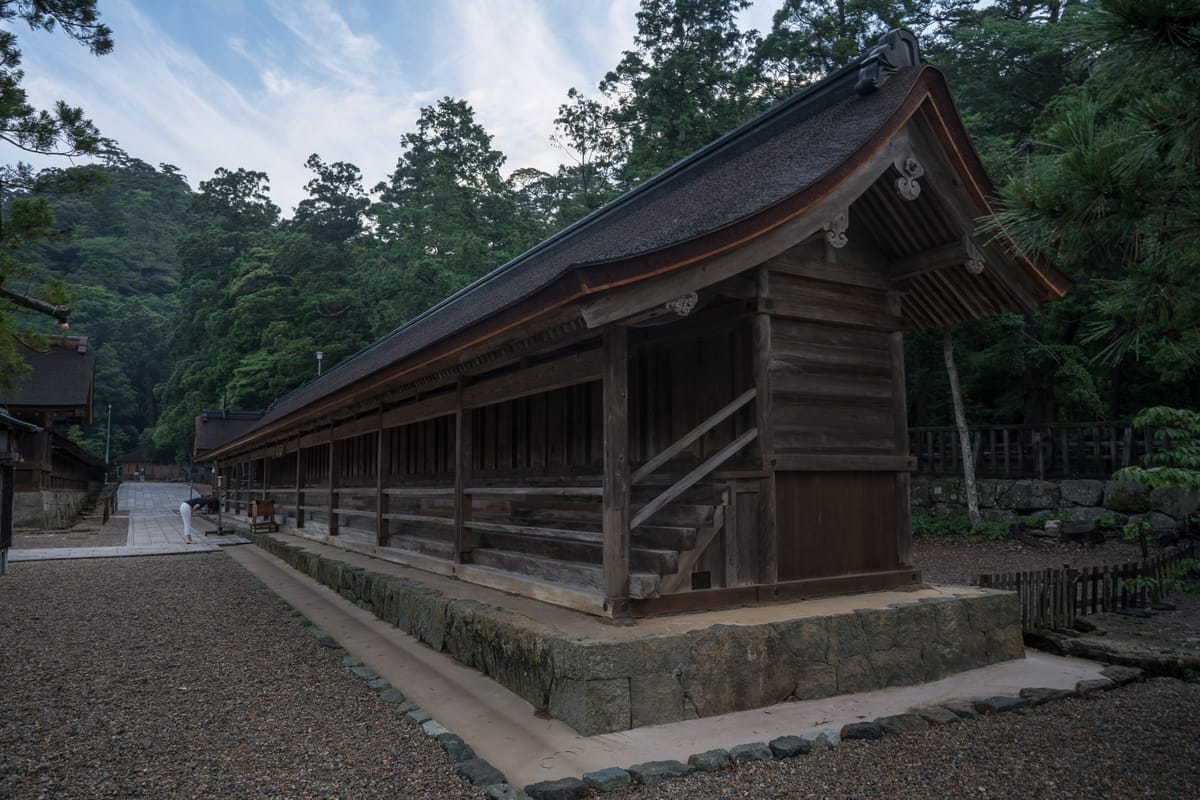
Where do eight million guests sleep? That question has a physical answer on the grounds, and it is the one detail worth walking over to see. Flanking Izumo Taisha's main hall to east and west are two long, low buildings called the Jukusha, literally "nineteen shrines," which serve as the visiting gods' lodgings. For most of the year those doors stay shut and worship is done at a distance. During the Kamiari-sai they are all opened — and they draw one of the longest worship queues on the grounds. A note on a claim you will see repeated online: the idea that "nineteen" encodes "infinity" has no primary source I could verify, so this guide does not repeat it. There are nineteen doors per row. That is all anyone can honestly say.
There is one more piece, and it changes how the whole month reads: the o-imi period. The Shimane Museum of Ancient Izumo describes the gods processing through the town, being received into the Jukusha, and then, from the 11th day, entering a period of o-imi in which song, dance and music are restrained. In other words, Kamiarizuki in Izumo is not a festival month in the celebratory sense. It is a month in which an entire district deliberately goes quiet. That single fact explains the atmosphere you will find, and it is also the root of the "should I even go" question addressed further down.
Finally, the fact that reshapes itineraries: Izumo Taisha does not have a monopoly on this. Per the Shimane Museum of Ancient Izumo, nine shrines in the Izumo region currently hold Kamiari rites, and Shimane's official tourism site names Sata Shrine, Mankusen Shrine and Hinomisaki Shrine among them. The three-shrine section below turns that into a plan.
The sea snake that leads the gods
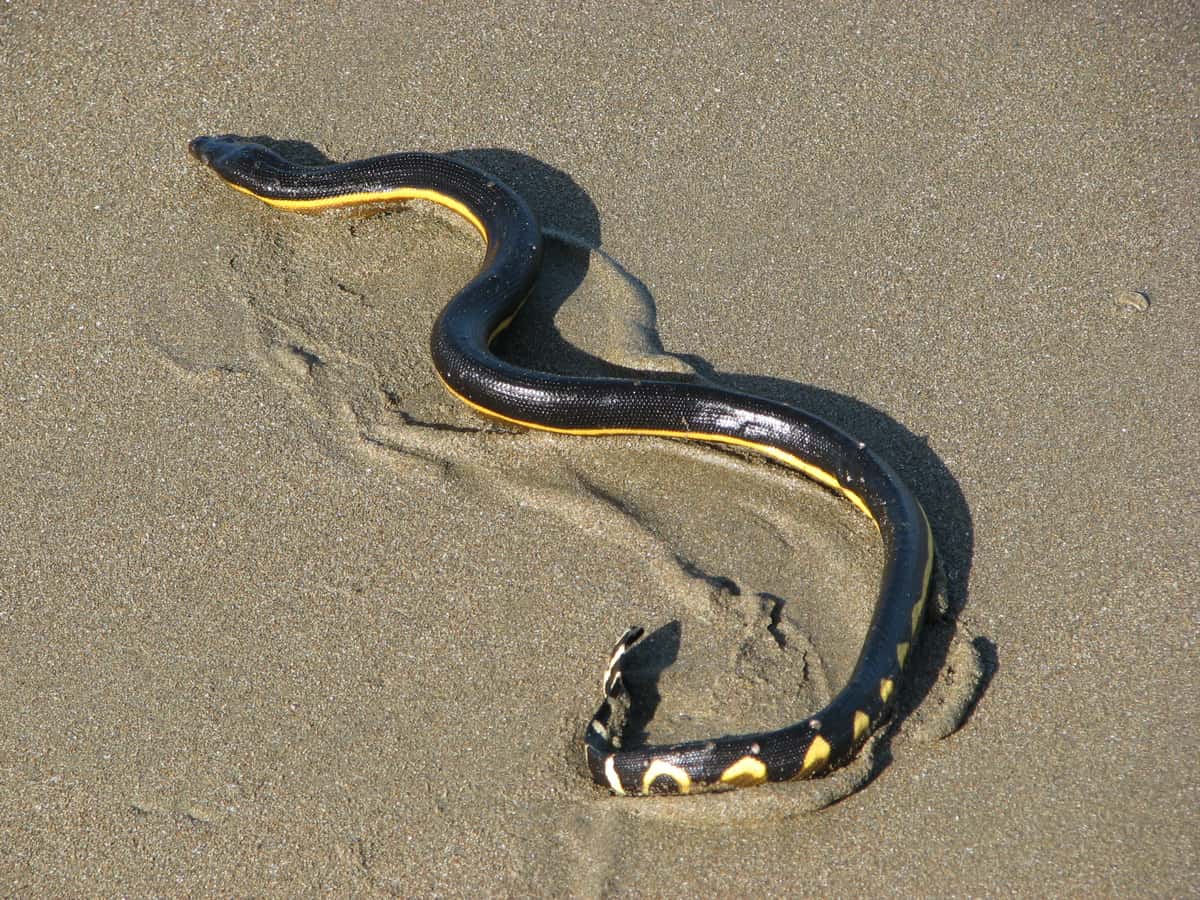
If you remember one image from Kamiarizuki, make it this one: at the head of the procession of eight million gods walks a sea snake.
Per the Shimane Museum of Ancient Izumo, the role of guide to the gods in the welcoming ritual is held by a sea snake from southern waters — specifically the yellow-bellied sea snake, known here as the ryuja, the dragon-serpent. Izumo has long treated sea snakes washing ashore as heralds of the divine, and because their form suggests a dragon they are honoured as Ryujasama. Shimane's official description of the procession is unambiguous: once the beach rite ends, the gods, veiled beneath a silk screen, proceed along the Kamimukae-no-michi to Izumo Taisha with the ryujashin leading the way.
As for what the dragon-serpent deity governs, Izumo Taisha's Saitama branch describes it as a deity of water, rain and abundant harvest. The longer lists of protections you will find on aggregator sites — against fire, against drowning and so on — could not be traced to a primary source in this round of checking, so this guide stops here.
The thread has a concrete slot in the official 2026 calendar: 11 a.m. on Thursday November 19, the Ryujashin-ko Taisai held by Izumo Oyashiro-kyo. It sits the morning after the welcoming rite and honours the dragon-serpent deity's virtues. If you want the deeper version of Kamiarizuki, this is a rewarding slot: you watch the ryujashin lead the gods ashore in the dark, and the next morning attend the festival dedicated to it. The same thread runs into the goshuin section — the Kamiarizuki-only stamp at Kitajima Kokuso-kan takes Ryujasama as its subject.
The full 2026 schedule
The table below follows Izumo Taisha's official Reiwa 8 festival calendar, with weekdays cross-checked against the actual 2026 calendar. It deliberately includes three rites that fall in the same window: the Ryujashin-ko Taisai on Nov 19, and the Kenkoku-sai and Koden Niiname-sai on Nov 23.
| Date | Rite | Time | Notes |
|---|---|---|---|
| Wed Nov 18 | Kamimukae ritual & Kamimukae-sai | 7:00 p.m. | Inasa Beach → Kaguraden; watchable from outside the cordon |
| Thu Nov 19 | Kamiari-sai | 9:00 a.m. | Main hall |
| Thu Nov 19 | Ryujashin-ko Taisai | 11:00 a.m. | Honours the dragon-serpent deity |
| Mon Nov 23 | Kenkoku-sai · Kamiari-sai · Enmusubi Taisai | 10:00 a.m. | Three rites, one day; the Enmusubi Taisai needs an application |
| Mon Nov 23 | Koden Niiname-sai | 7:00 p.m. | A fourth rite the same evening |
| Wed Nov 25 | Kamiari-sai · Enmusubi Taisai | 10:00 a.m. | Second Enmusubi Taisai |
| Wed Nov 25 | Karasade-sai (farewell) | 4:00 p.m. | The gods are seen off |
| Fri Dec 4 | Second Karasade-sai | 4:00 p.m. | The day the gods actually leave Izumo |
Three things to read out of that table
First, the dates move, so copying last year's is guaranteed to fail. Lunar October 2026 begins on November 9; the welcoming ritual falls on the 10th day of lunar October, which is November 18; the Kamiari-sai period covers the 11th to 17th days (November 19–25); and the second farewell rite falls on the 26th day, December 4. Every conversion lines up. The comparison makes the point better than the arithmetic does: Izumo Taisha's own page for 2025 listed the period as November 29 to December 8. Same festival, and 2026 lands nearly two weeks earlier. So when a page tells you the Izumo Kamiari Festival is "late November," check which year it is describing.
Second, November 23 is the most crowded day of the whole period, for three reasons rather than one. The holiday clash is only the first of them. Laid out from the official calendar, three things stack on that date: it is Labor Thanksgiving Day, a national holiday; the first Enmusubi Taisai is at 10 a.m.; and the Kenkoku-sai plus the 7 p.m. Koden Niiname-sai fall the same day. If your itinerary has any flexibility, skip November 23 and take November 19 or 25 instead. November 19 is the sweet spot — a weekday Thursday, and you can pick up the 11 a.m. Ryujashin-ko Taisai.
Third, the Kamiari-sai itself is not a spectacle. The rites in the main hall are not performed for an audience, and general visitors do not enter them (the Enmusubi Taisai is the exception, and it requires an application). What you can experience on the grounds is atmosphere, the opened Jukusha doors, and the crowds of worshippers. Set expectations there and you will not be disappointed. The one full ceremony ordinary visitors can genuinely watch from start to finish is the night rite on November 18.
Watching the Nov 18 welcoming ritual
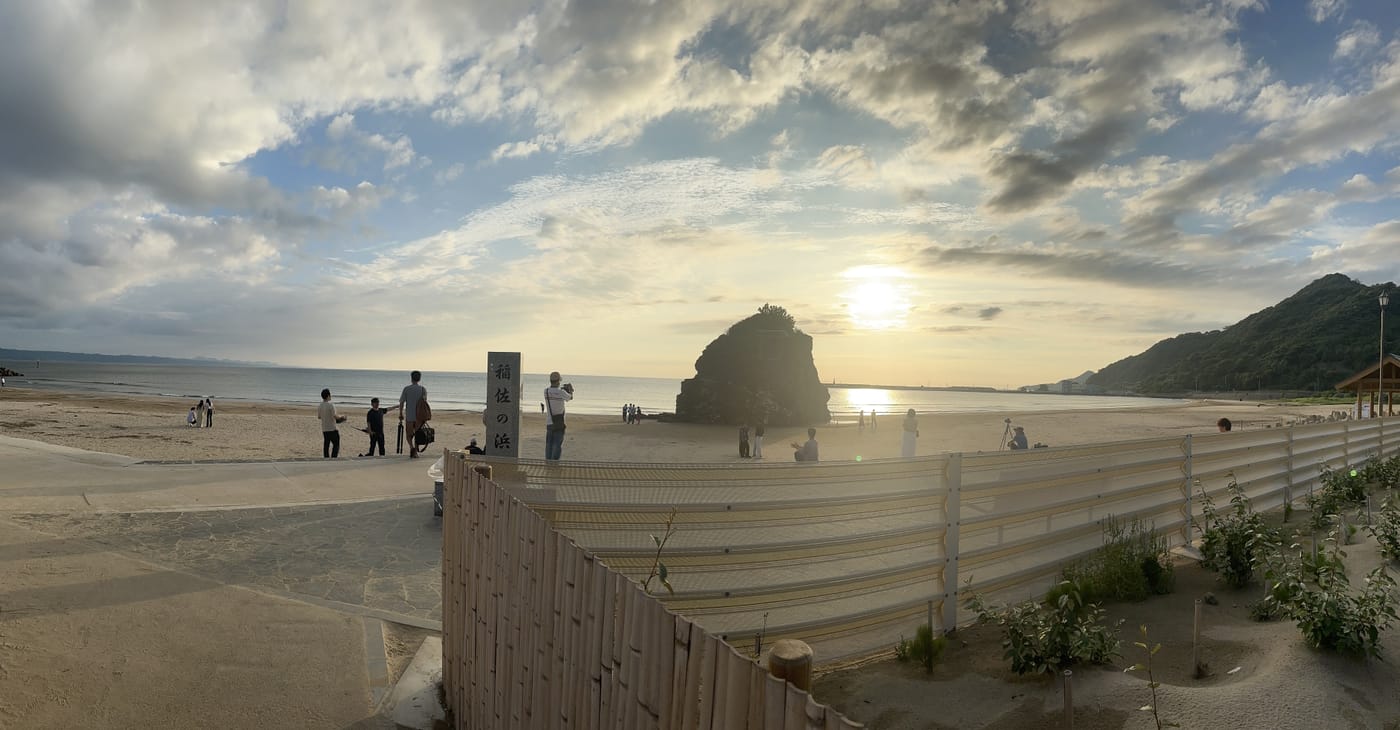
At 7 p.m. on November 18, a sacred fire is lit on Inasa Beach and a rope cordon marks off the ritual ground; priests set out the ryujashin facing the sea to receive the eight million gods arriving over the water. When the rite ends, the gods — veiled beneath a silk screen and led by the dragon-serpent — proceed along the Kamimukae-no-michi to Izumo Taisha, where the Kamimukae-sai continues at the Kaguraden. This is the only large rite of the entire month that the general public can watch in full.
Per Shimane Prefecture's official guidance, there are exactly three rules, and all three are hard lines:
- No flash photography. The official wording states that flash photography interferes with the rite and asks visitors to refrain. Plan your night shots without it; there is no negotiating this one.
- Do not walk on the straw mats. The official text is explicit: komo mats are laid on the sand, and you are asked not to walk on them. They are the gods' pathway. Go around.
- This is not a tourist event. The official page defines it that way and notes there is no spectator seating. No commentary, no announcements, no assigned places. Stand outside the cordon and follow the locals' rhythm.
Two practical notes. First, to stand anywhere near the cordon, be on the beach around 5 p.m. — the sand fills up once it gets dark. That is practical advice rather than an official figure, and I am not going to invent a precise "sold out by" time, because no source supports one. Second, a November night on the Sea of Japan coast is far colder than the forecast suggests: sea wind, damp air and standing still for an hour compound into something close to midwinter. A hat, gloves and a windproof layer will be the best-spent items in your bag that evening.
The Kamimukae-no-michi: one kilometre with the gods
The road the procession walks deserves attention in its own right. Per Shimane's official information, Inasa Beach lies about one kilometre west of Izumo Taisha, and "from here it is roughly a 20-minute walk to the shrine." That road is the Kamimukae-no-michi, lined with old townhouses; the official page names the Tezen Museum, a traditional kite shop and Izumo soba restaurants among the places along it.
My advice: do not let the night of the ritual be the only time you walk it. That evening the road is solid with people and procession, and you will see none of the streetscape. The better version is to walk the same route in daylight the next day — 20 minutes from the shrine down to the sea, browsing the museum and shops on the way, out to the beach, then back. Same kilometre, two completely different experiences, and the daytime one is free and needs no jostling for position. (Kamimukae-no-michi on Google Maps / Inasa Beach on Google Maps)
Enmusubi Taisai: how to apply
The Enmusubi Taisai is the one rite of Kamiarizuki that a visitor can take part in rather than observe — a prayer service attended from inside the main hall. The 2026 timings are official and settled: 10 a.m. on Monday November 23 and Wednesday November 25, twice in total.
Everything after that has to be reported as an open question. As of this guide's verification date, the shrine had not published the 2026 application method, application period, or offering amount; the previous year's information page has been removed from the site with no usable archive. What can be offered is the customary pattern:
- Announcement timing: in recent years, details go up on the official site roughly a month before the festival — for 2026 that means watching from mid-to-late October.
- How to apply: by return-reply postcard, with a lottery if oversubscribed. That implies a Japanese mailing address or someone to receive on your behalf, which is a real obstacle for overseas visitors — sort it out early.
- Cost: an offering is required, but this guide prints no figure. The number circulating online could not be checked against a live official page, and pointing you to the right source beats guessing.
What if you do not get a place? Less than you would think. Ordinary worship continues throughout the Kamiari-sai — the worship hall, the Yatsuashimon gate, the Jukusha, the Kaguraden and Inasa Beach are all open. The Enmusubi Taisai is a bonus, not the price of admission.
Three shrines, three calendars
This is the section that should change your itinerary. Nine shrines in the region hold Kamiari rites, and three of them differ enough in structure to be worth treating as separate trips:
| Shrine | Calendar | 2026 period | Character |
|---|---|---|---|
| Izumo Taisha (Izumo City) | Lunar | Nov 18–25 (plus Dec 4) | The main stage of the divine council; largest and busiest |
| Sata Shrine (Matsue City) | Fixed solar | Nov 20–25 | Oldest attested in records; the strictest taboo observance |
| Mankusen Shrine (Izumo City) | Lunar | Nov 25–Dec 4 | The gods' final stop and farewell banquet; grand rite Dec 4 |
Sata Shrine: the one with fixed dates
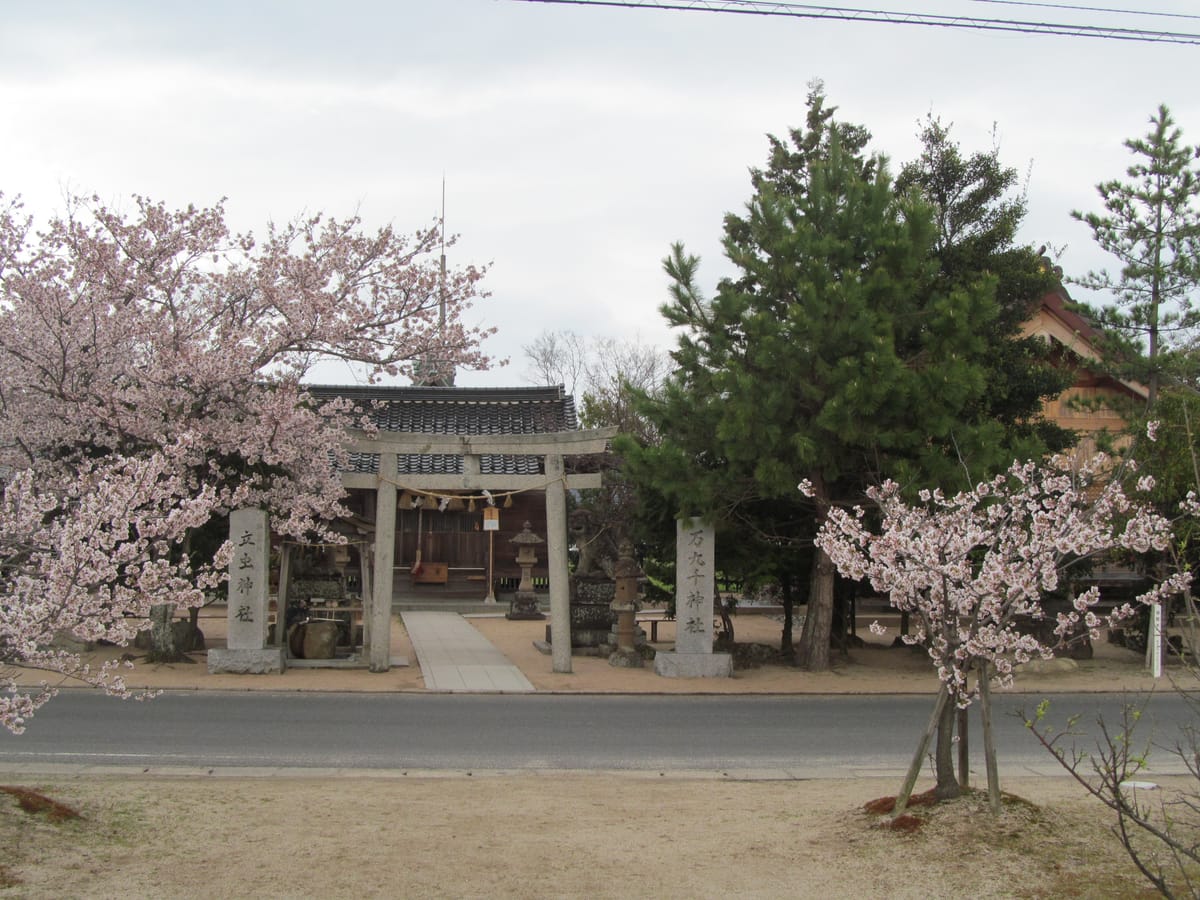
Sata Shrine's official site leaves no room for interpretation: the festival dates are November 20–25 on the solar calendar, not the lunar one. The welcoming rite is at 8 p.m. on November 20 and the farewell rite at 8 p.m. on November 25. Which means that in 2026 Izumo Taisha and Sata Shrine overlap completely across November 20–25 — one trip can take in two entirely different systems.
The shrine makes its own case for why it is worth the detour: its Kamiari-sai is the oldest attested in written records, and the sequence of the rite is performed in almost the same form as a record roughly 500 years old. It is also the most taboo-laden of the three. The official page states that during the festival period song, dance, noise and even construction work are restrained — this is the observance locally known as o-imi-san — and the restriction is split into two phases, the upper period November 20–26 and the lower period November 27 to December 4.
One deliberate caution: whether general visitors may watch the rites is not stated on Sata Shrine's official pages, so this guide will not tell you that spectators are welcome. The reasonable reading is that worship on the grounds is fine, with silence as the precondition. This is a festival that explicitly names noise as taboo; it is not a photo opportunity. (Sata Shrine on Google Maps)
Mankusen Shrine: the gods' last night
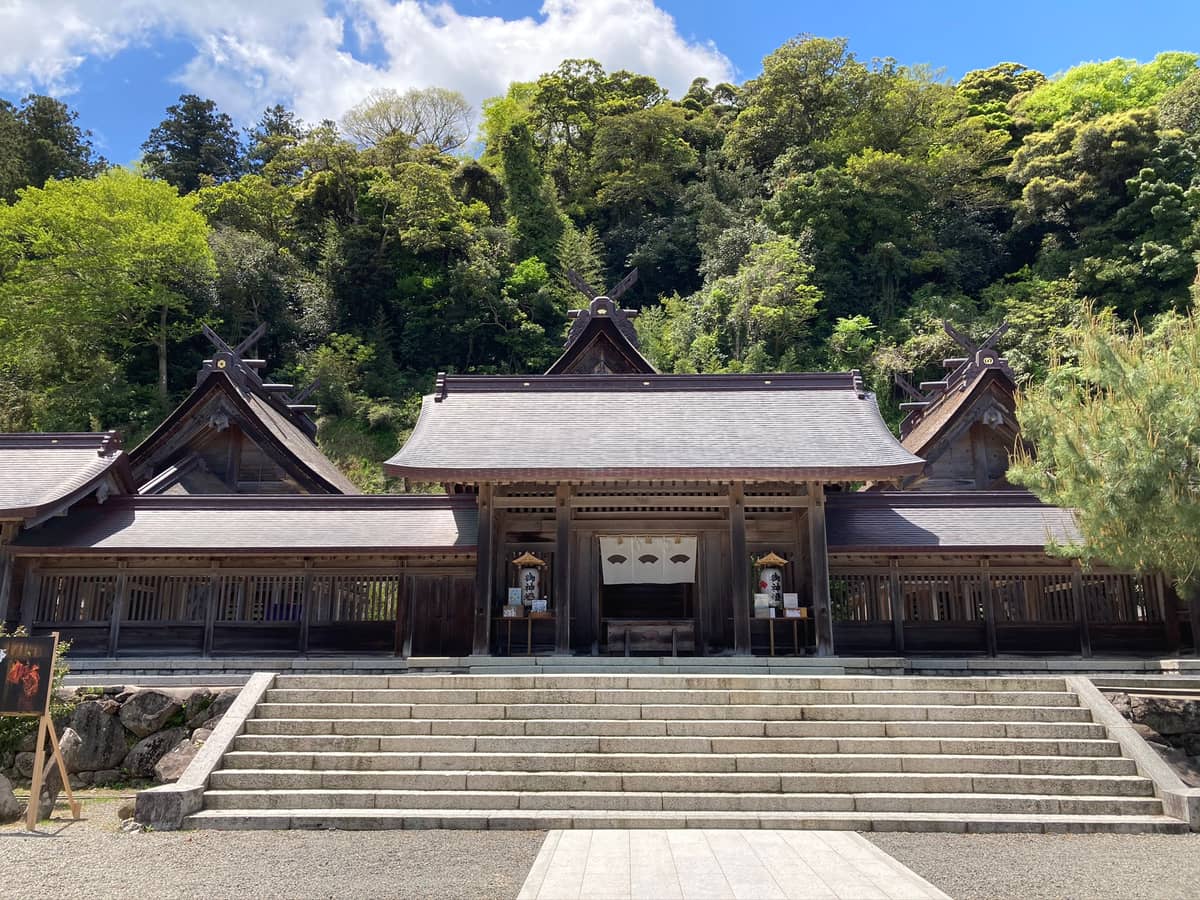
If Sata is the oldest, Mankusen is the last. The shrine's official site states that the 17th through 26th days of lunar October are known there as "kamiari" or "o-imi," the period during which it holds its Kamiari-sai — meaning that after the gods leave Izumo Taisha, this is where they stop. Converted for 2026, that is November 25 to December 4 (confirm the actual schedule against the shrine's own announcement closer to the time).
The grand rite on the 26th day is the climax, known locally by the affectionate names Mankusen-san and Karasade-san. The official description of that night: the gods hold a banquet called the naorai, pledge to meet again the following year, and only then set out. The same evening also brings the yutate rite, in which a cauldron is brought to the boil over sacred fire on the grounds, accompanied by kagura handed down in the chief priest's family.
In 2026 that day is December 4 — the same date as Izumo Taisha's second farewell rite, so the two lunar conversions confirm each other. The point worth pressing is narrative rather than logistical: most visitors treat the November 25 farewell at Izumo Taisha as the end of Kamiarizuki, but the real ending happens ten days later at a different shrine, over a drink. Following the gods all the way to their last stop is the most complete version of this trip, and almost nobody does it. (Mankusen Shrine on Google Maps)
"You shouldn't visit during the festival" — half right
A version of this warning circulates widely: the gods are in council, so ordinary people should stay away. It deserves to be split in two, because one half is wrong and the other half has a real basis.
The wrong half: Izumo Taisha does not close during the Kamiari-sai, and ordinary worship continues. The shrine's published worship hours apply year-round; the Enmusubi Taisai openly invites applications from the public; Shimane's official tourism site runs a promotional feature on the festival every year. A shrine that did not want visitors would not do all three of those things.
The right half: the instinct that one should not make noise is well founded — it just points at "come quietly" rather than "don't come." The Shimane Museum of Ancient Izumo states that the o-imi period begins on the 11th day of lunar October, with song, dance and music restrained; Sata Shrine's own description is stronger, naming song, dance, noise and construction among the taboos of the festival period. This is self-restraint by the people who live there, not a refusal of pilgrims.
So the accurate position is: you can come, it is worth coming, but come as someone attending a rite rather than watching a show. Concretely — no talking during the ritual, no pushing inside the cordon, no flash, no chasing the procession. That adjustment actually improves the experience: once you stop waiting for a performance to start, the dark water, the sacred fire and the silk screen land properly. For the baseline manners this builds on, see our shrine etiquette walkthrough.
"Attending rather than watching" sounds abstract; in practice it means knowing what you are standing in front of. If you want the layout of the grounds sorted out before the rite begins, GetYourGuide runs an Izumo Taisha guided grounds walk (about 1.5 hours) that covers exactly the sequence this article assumes: purification at the Harae-no-Yashiro, the pine approach, where the four claps come from, and finally the auxiliary shrines and the Soga-no-Yashiro where the gods lodge during Kamiarizuki. ⚠️ Three caveats before you book: it is guided in English only, it is new enough to carry zero reviews, and worship itself costs nothing — the fee buys context, not access. On a tight schedule, reading this page and walking in yourself covers the same ground.
Goshuin during Kamiarizuki
Kamiarizuki is the richest time of year for goshuin at Izumo, and also the longest queue. Start with what is available year-round: per Shimane's official tourism site, there are four goshuin in the Izumo Taisha precinct.
| Goshuin | Desk | Hours | Offering |
|---|---|---|---|
| Izumo Taisha main hall | Behind the worship hall | 7:00–18:00 | Free-will offering |
| Izumo Taisha Kaguraden | Left side of the Kaguraden | 7:00–18:00 | Free-will offering |
| Kitajima Kokuso-kan, Izumo-kyo main hall | Kitajima Kokuso-kan | 9:00–16:00 | ¥500 |
| Kitajima Kokuso-kan, Tenjinsha | Kitajima Kokuso-kan | 9:00–16:00 | ¥500 |
Two things are worth stating plainly here. Kitajima Kokuso-kan currently issues two goshuin designs at ¥500 each. And goshuin are not issued by post — Kitajima Kokuso-kan states directly that a goshuin is proof of having worshipped in person, so postal issuance is not offered. Official goshuin books come in two designs at ¥1,200 each.
The Kamiarizuki-only stamp is at Kitajima Kokuso-kan and takes Ryujasama as its subject, written on specially prepared paper for a ¥500 offering, with a matching limited goshuin book — accordion-fold, carrying the "ryujashin" characters within the double tortoiseshell and crossed flower-diamond crest — at ¥3,000 in limited numbers. Be precise about the year here: the Reiwa 7 issuing period was October 21 to December 9, which is official information; the 2026 (Reiwa 8) period, and whether it runs at all, has not been announced. Treat last year's window as a pattern and confirm with Kitajima Kokuso-kan.
Timing matters more here than usual. Per the shrine's official notice of May 2026: the grounds are open for worship 6:00–19:00; the main amulet office runs 8:30–16:30, with simplified windows early and late (6:30–8:30 and 16:30–19:00); after 19:00, worship is from in front of the bronze torii. The trap that catches people: the area behind the main hall closes at 16:30, so if you want to do the sand exchange at the Soga-no-Yashiro — bringing sand from Inasa Beach and taking home the shrine's protective sand — it cannot wait until dusk. During Kamiarizuki the amulet queues run long, and my advice is the same as always: arrive at opening and do worship, goshuin, amulets and the shimenawa photo in one sweep. For how goshuin work in general and how to choose a book, see our goshuin guide.
Zenzai: the festival food that spread nationwide
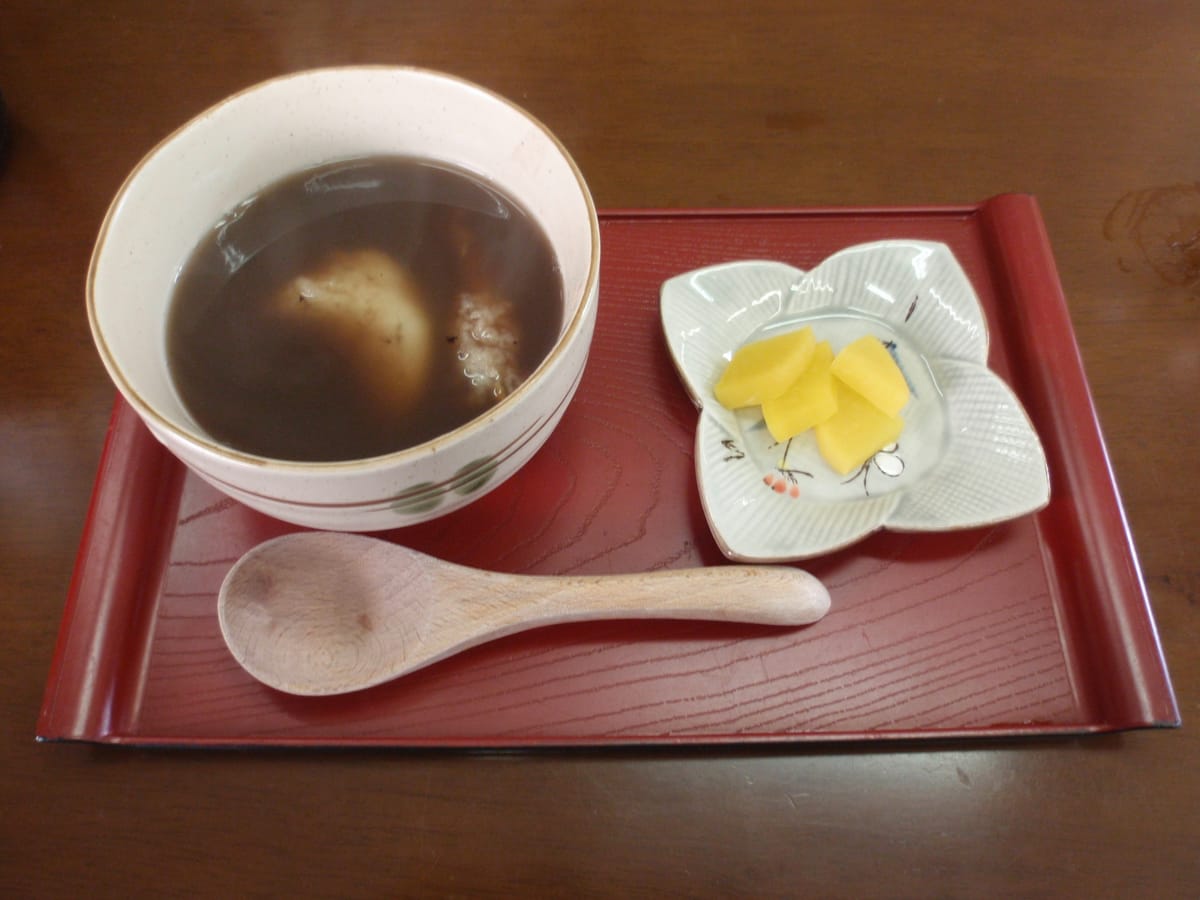
Writing about zenzai — sweet red bean soup with mochi — in a Kamiarizuki guide is not a food-section digression. It is origin story, because the word itself is said to come from this festival.
The account compiled by the Izumo Zenzai Association runs like this: the jinzai mochi served during the Kamiari-sai lent its name — "jinzai" shifted in the Izumo dialect to "zunzai" and then to "zenzai," and travelled to Kyoto in that form. The etymology has traces in early Edo-period texts including the Gion Monogatari, Hayashi Razan's Baison Saihitsu, and the Un'yo-shi. It also has a modern anchor: October 31 is "Izumo Zenzai Day," certified by the Japan Anniversary Association — a play on lunar October, the month of the gods, and the numerals 10 and 31.
So eating a bowl of zenzai in Izumo is eating this festival's food at its source. A few places worth noting along the Shinmon-dori approach and nearby:
- Arakiya — the oldest Izumo soba shop, describing itself as founded in the Tenmei era, roughly 220 years of Edo-period lineage. The signature is warigo soba, three tiers, ¥1,080, with a three-generation version at ¥1,450. The one that fits Kamiarizuki best is the en-musubi set at ¥1,240 (two-tier warigo plus soba-zenzai plus a fortune slip) — soba, zenzai and omikuji in one order. Soba-zenzai on its own is ¥550. Open 11:00–16:00 and closes when the soba runs out; closed Wednesdays (moving to the next day when a holiday falls). Worth flagging: in 2026 both November 18 and November 25 are Wednesdays, and those are exactly the welcoming and farewell rite days. (Google Maps)
- Sakaneya — an Izumo confectioner founded in 1872, known for its "Izumo zenzai mochi." No prices here: official figures were not obtained in this round, so check on site or on their own site. (Google Maps)
- Nihon Zenzai Gakkai Ichigo-ten — a zenzai specialist on the approach whose name ("Japan Zenzai Association, Shop No. 1") is itself a declaration of the etymology above. (Google Maps)
- Kaneya and Tanakaya — two more frequently recommended Izumo soba shops near the approach. No prices or hours listed here, because they were not individually verified this round and an unverified number would only send you on a wasted trip. (Kaneya / Tanakaya)
A practical warning about the approach street: most shops start winding down around 16:00, and soba shops close outright once the day's soba is gone. The welcoming rite is at 7 p.m., so plenty of people plan to eat first and then head for the beach — and find the shutters down at 5 p.m. The right order is to eat at lunchtime, spend the afternoon walking the Kamimukae-no-michi, then go to the sea. One more thing: these places all have seating, so sit down and finish your food before moving on. The approach is crowded and it is part of the shrine precinct, not a street for carrying food along.
Getting around during the festival
How to reach Izumo in the first place — the Yakumo limited express from Okayama, the Sunrise Izumo sleeper from Tokyo, or flying into Izumo Enmusubi Airport — and how to move around once there is covered in the Izumo Taisha guide and is not repeated here. This section is only about what changes during Kamiarizuki.
The important part first: do not drive on the night of the welcoming rite
That is not a preference, it is an official estimate. In its traffic guidance for the 2025 festival, Shimane Prefecture's official tourism site put the drive to Izumo Taisha on the evening of the welcoming rite at two to three hours, and noted that car parks around the shrine are effectively full from 10:00 to 15:00 across the festival period. The 2025 restrictions themselves: from 18:30 to 20:00, the stretch between the Inasa-no-Hama and Miyauchi intersections became a pedestrian-only road, with the sacred procession rerouted via National Route 431.
The official alternatives, which are also the resources you can reasonably assume will exist:
- Use trains and buses first (the official top recommendation)
- Free shuttle buses on the main festival days
- Free temporary parking around Unshu-Hirata Station — the answer for drivers is to park here and take the Ichibata Railway in (park and ride)
- Extra Ichibata Railway services laid on for the festival
⚠️ All of the above is 2025 practice. The 2026 restrictions and shuttle arrangements are normally announced one to two months before the festival — confirm against Shimane's tourism site and Izumo Taisha's own notices closer to the date.
The Ichibata Railway, and the ticket that no longer exists
First, a correction that saves wasted searching: the Enmusubi Perfect Ticket, a three-day pass at ¥4,000, was withdrawn from sale on September 30, 2023, and no longer appears on the Ichibata Railway's current discount ticket page. Stop looking for it.
The current equivalent is the Ichibata Railway 1-day free pass, valid for unlimited travel across the whole network on the day of use:
| Ticket | Adult | Notes |
|---|---|---|
| Dentetsu-Izumoshi ⇔ Izumo-Taisha-mae, one way | ¥550 | The main route in from Izumoshi Station |
| Matsue Shinjiko-Onsen ⇔ Izumo-Taisha-mae, one way | ¥900 | For staying in Matsue and day-tripping |
| 1-day free pass | ¥1,800 | Whole network, unlimited, same day only |
The break-even maths is simple. Staying in Matsue and going to Izumo Taisha and back costs ¥900 each way, ¥1,800 — exactly the price of the pass, so any additional stop (Unshu-Hirata, Ichibata-guchi) puts you ahead. Conversely, if you are based near Izumoshi Station and only shuttle to the shrine and back (¥550 × 2 = ¥1,100), the pass loses money. It is sold at Izumo-Taisha-mae, Dentetsu-Izumoshi, Kawato, Unshu-Hirata and Matsue Shinjiko-Onsen stations. Note also that a lot of older material still quotes ¥500 one way — that predates the fare revision of March 1, 2025.
The long-haul leg from Tokyo or Osaka
Izumo is in San'in and not on the Sanyo Shinkansen, so arriving from either Tokyo or Osaka is a genuine long-distance move. Three framings: change at Okayama for the Yakumo limited express (Okayama connects to the Sanyo Shinkansen); take the Sunrise Izumo, Japan's only remaining scheduled overnight sleeper, direct from Tokyo to Izumoshi; or fly into Izumo Enmusubi Airport (routes confirmed on the airport's own site serve Tokyo Haneda, Osaka Itami, Nagoya, Fukuoka and Oki).
Three honest blanks here. Sunrise Izumo fares, berth charges and timings are not printed in this guide — the JR official pages could not be retrieved in this round of checking, and I will not stand behind second-hand numbers; check JR directly. Likewise the detailed Yakumo fares and journey time are not re-derived here, and neither are the airlines, flight frequencies or airport bus fares at Izumo. That the Sunrise sells out around Kamiarizuki is a safe expectation; the exact release rules should come from JR.
If this trip is stitching Sanyo (Hiroshima, Miyajima) and San'in (Izumo, Matsue) into a full Chugoku loop, a nationwide pass is worth actually costing out — the break-even method is in our JR Pass guide. The Sanyo side of that loop connects to our Hiroshima guide and Miyajima and Itsukushima Shrine guide.
Lodging: the honest version
The night of the welcoming rite — November 18, 2026 — is one of the hardest nights of the year to find a room in Izumo. The objective basis for that is the two official figures above: a two-to-three-hour drive and full car parks. A place that gridlocks like that is not sitting on spare beds either.
What I will not tell you is that rooms "sell out a year ahead" — that quantified claim has no source I could verify. The workable line is: if you are committed to November 18, book two to three months out.
If nothing is left near the shrine, two directions:
- Around Izumoshi Station — more hotel stock than the shrine area, and the Ichibata Railway runs straight through to Izumo-Taisha-mae for ¥550.
- Matsue — a much bigger accommodation base, with a direct line from Matsue Shinjiko-Onsen to Izumo-Taisha-mae for ¥900. Buy the 1-day pass and the return trip breaks even, with Matsue Castle and the Lake Shinji sunset available on the same base. And Sata Shrine's own Kamiari-sai on November 20–25 is inside Matsue City — staying in Matsue to catch two different Kamiari festivals is arguably smarter than squeezing in beside the main shrine.
Just don't make Matsue your base for the night of November 18. On Ichibata Railway's current weekday timetable (revised April 1, 2025; November 18 is a Wednesday), the last departure from Izumo-Taisha-mae that still connects at Kawato for Matsue Shinjiko-Onsen is 9:41 p.m., arriving 10:42 p.m. The 10:24 and 10:53 p.m. departures only connect as far as Unshu-Hirata. The Dentetsu-Izumoshi direction is far more forgiving: the 10:53 p.m. still gets you there at 11:14 p.m. The rite only begins at 7 p.m. and the procession then walks a kilometre to the Kagura-den, so if you mean to follow it to the end, timing the 9:41 is on you — and missing it leaves no train to Matsue. In 2025 the railway added extra trains that night; the 2026 arrangements are not announced yet, but the room has to be booked before they are. My split: sleep on the Izumo side (near the shrine or around Izumoshi Station) on November 18, and save Matsue for November 20 onward, which lines up with Sata Shrine's own welcoming rite at 8 p.m. that evening.
All three major booking sites carry listings for both towns; use whichever you normally book with:
| Base | Which nights | Booking.com | Agoda | Rakuten Travel |
|---|---|---|---|---|
| Izumo City (near the shrine, Izumoshi Station) | Nov 18, the night of the welcoming rite | Izumo listings | Izumo listings | Izumo City listings |
| Matsue City | Nov 20–25, during Sata Shrine's Kamiari-sai | Matsue listings | Matsue listings | Matsue City listings |
No nightly rates are quoted here, because these are live inventory pages that move daily — the price shown for November 18 today and the price paid by someone who booked three months out are not the same number. Treat them as a booking-early entry point, not as evidence that rooms are still available: if the welcoming rite is the fixed point of your trip, book two to three months ahead. ⚠️ Rakuten Travel's Matsue City list also includes the Tamatsukuri Onsen inns, which sit on the JR line rather than the Ichibata Railway — if you want the direct Ichibata ride to the shrine, pick somewhere in central Matsue, between Matsue Station and Matsue Shinjiko-Onsen.
Planning 2027
The dates are set: in 2027 the welcoming rite is at 7 p.m. on Sunday November 7, and the farewell rite at 4 p.m. on Sunday November 14. Izumo Taisha's site now carries its Reiwa 9 festival calendar alongside the Reiwa 8 one (checked September 14, 2026), and a lunar conversion agrees: the 10th, 17th and 26th days of lunar October fall on November 7, 14 and 23.
| Date | Rite | Time | Notes |
|---|---|---|---|
| Sun Nov 7 | Kamimukae ritual & Kamimukae-sai | 7:00 p.m. | Start of Kamiarizuki |
| Mon Nov 8 | Kamiari-sai | 9:00 a.m. | Main hall |
| Mon Nov 8 | Ryujashin-ko Taisai | 11:00 a.m. | |
| Fri Nov 12 | Kamiari-sai · Enmusubi Taisai | 10:00 a.m. | First Enmusubi Taisai |
| Sun Nov 14 | Kamiari-sai · Enmusubi Taisai | 10:00 a.m. | Second Enmusubi Taisai |
| Sun Nov 14 | Karasade-sai (farewell) | 4:00 p.m. | The gods are seen off |
| Tue Nov 23 | Kenkoku-sai | 10:00 a.m. | |
| Tue Nov 23 | Second Karasade-sai | 4:00 p.m. | The day the gods actually leave Izumo |
| Tue Nov 23 | Koden Niiname-sai | 7:00 p.m. | Same evening |
- The dates move every year: the shrine listed 2025 as November 29 to December 8, 2026 is November 18–25, and 2027 is November 7–14 — anywhere from early November to early December across three years. Check that year's calendar; never book against last year's dates.
- The authoritative source: Izumo Taisha's Reiwa 9 festival calendar.
- Sata and Mankusen: Sata Shrine's Kamiari-sai stays on fixed solar dates, November 20–25, so in 2027 it does not overlap with Izumo Taisha (November 7–14) — there is a five-day gap, and the 2026-style "two festivals in one trip" does not work. Mankusen Shrine's lunar 17th–26th converts to November 14–23 (a conversion; confirm against the shrine's own announcement), which fills the gap, and its grand rite falls on the same day as Izumo Taisha's second farewell rite. Following the gods from the November 7 welcoming rite all the way to Sata's farewell on November 25 takes close to three weeks; if you cannot stretch that far, pick one side.
- Enmusubi Taisai: in 2027 it is held on Friday November 12 and Sunday November 14, neither of them a national holiday; the welcoming rite (November 7) and the farewell rite (November 14) both fall on a Sunday. Applications are customarily announced about a month before the festival, so "start watching the official site one month out" is the reusable rhythm regardless of year.
In practice I would hold flights and lodging around November 6–15: the welcoming rite is on Sunday evening, November 7, so arriving the day before is the relaxed version; if you also want the second farewell rite on November 23, push the return back. Lodging is the only genuinely tight link in this chain; flights are the easy part.
Is the Kamiari Festival worth visiting?
Start with who should skip it. If what you want is a lively Japanese festival, Kamiarizuki is the wrong pick. There are no floats, no fireworks, no roaring food-stall street. The opposite, in fact: this is a month whose defining custom is that song, dance and music are restrained. Arrive expecting a spectacle and the reaction is likely to be "is that it?" For that experience, the Aomori Nebuta Festival or a summer fireworks night offers vastly more density.
But if what you want is something that has run for centuries and is still performed the way it always was, Kamiarizuki has few substitutes in Japan. Sata Shrine performs a sequence almost identical to a 500-year-old record. Izumo Taisha still binds its dates to the lunar calendar, accepting a moving target every year rather than switching to a convenient fixed date. Mankusen Shrine still throws a farewell banquet for departing gods. None of that was designed for visitors — it is simply what happens, and you are allowed to stand nearby and watch.
My scheduling verdict: if you can only come once, for one day, take November 18 — the only large rite the public can watch in full, and the dark sea, the sacred fire and the silk screen do not translate into photographs. With three days, I would do November 18 for the welcoming rite, November 19 for morning worship plus the 11 a.m. Ryujashin-ko Taisai and an afternoon walk down the Kamimukae-no-michi, then move to Matsue on November 20 for Sata Shrine's welcoming rite — avoiding the triple-stacked November 23 entirely. If your trip can stretch into early December, add the December 4 grand rite at Mankusen Shrine and follow the gods to their final stop; almost no one does, and it is the only version of this trip that finishes the story.
One last honest note: the barrier here is not money. Worship at Izumo Taisha is free and watching the welcoming rite costs nothing. The real cost is the long haul out to San'in and a willingness to stand quietly in the cold for an hour on a November night. For anyone willing, it buys an evening that is very hard to replicate elsewhere in Japan.
FAQ
- Q1:Is it disrespectful to visit Izumo Taisha during the Kamiari Festival?
- No — and the shrine itself makes that clear in three ways. The grounds stay open for ordinary worship throughout the festival, the Enmusubi Taisai openly accepts applications from the public, and Shimane Prefecture's official tourism site actively promotes the festival with a dedicated feature every year. A shrine that did not want visitors would not do all three. That said, the instinct behind the question is not baseless. The Shimane Museum of Ancient Izumo explains that once the gods are welcomed into the Jukusha, the period from the 11th day of lunar October becomes the "o-imi" period, during which song, dance and music are restrained; Sata Shrine's official page goes further, listing song, dance, noise and construction work among the taboos of its festival period. But this is local self-restraint as a way of life, not a ban on pilgrims. The correct posture is to come as someone attending a rite rather than watching a show: stay quiet during the ritual, stay outside the cordon, do not chase the procession. Adjust your expectations that way and the experience gets better, not worse.
- Q2:When is Kamiarizuki in 2027?
- From the welcoming rite at 7 p.m. on Sunday November 7 to the farewell rite at 4 p.m. on Sunday November 14 — Izumo Taisha has already published its Reiwa 9 (2027) festival calendar. In between, the Kamiari-sai is held on November 8 (9 a.m.) and on November 12 and 14 (10 a.m.); the Enmusubi Taisai runs twice, at 10 a.m. on Friday November 12 and Sunday November 14; and the second farewell rite, when the gods actually leave Izumo, is at 4 p.m. on Tuesday November 23, a national holiday. The festival follows the lunar calendar — the welcoming ritual falls on the night of the 10th day of lunar October — so the Gregorian dates move every year: 2025 started November 29, 2026 starts November 18, and 2027 moves earlier again to November 7. Do not plan 2027 around the 2026 dates; the window to hold is early-to-mid November, and since the dates are now official you can price flights against it. The 2027 Enmusubi Taisai application details are not out yet; customarily they appear about a month before the festival. One change from 2026: Sata Shrine keeps its fixed solar dates, November 20–25, so in 2027 it does not overlap with Izumo Taisha — there is a five-day gap between the two.
- Q3:How do you apply for the Enmusubi Taisai, and what does it cost?
- The confirmed part first: in 2026 the Enmusubi Taisai is held twice, at 10 a.m. on Monday November 23 and Wednesday November 25, inside the main hall, per the shrine's official Reiwa 8 festival calendar. The unconfirmed part is everything else. As of this guide's verification date the shrine had not yet published the 2026 application method, application window, or prayer offering amount, and the previous year's information page has been taken down. The customary pattern in recent years: details are posted on the official website roughly a month before the festival, applications are made by return-reply postcard, and a lottery is drawn when the rite is oversubscribed. A return-reply postcard means you effectively need a Japanese mailing address or someone to receive on your behalf — a real barrier for overseas visitors, so plan it early. On cost, this guide deliberately prints no figure: an offering is required, but the amounts circulating online could not be verified against a live official page. Miss the draw and nothing is lost — ordinary worship, the Jukusha, the Kaguraden and Inasa Beach are all open throughout.
- Q4:Where do you get the Kamiarizuki-only goshuin?
- The limited "Ryujasama" (dragon-serpent) goshuin is issued at Kitajima Kokuso-kan, the Izumo-kyo compound beside the main shrine, not at Izumo Taisha's own goshuin desks. Per the Reiwa 7 information published by Shimane's official tourism site, it is written on specially prepared paper for an offering of 500 yen, and there is a matching limited goshuin book — an accordion-fold design carrying the "ryujashin" characters within the double tortoiseshell and crossed flower-diamond crest — at 3,000 yen in limited numbers. The Reiwa 7 issuing period ran October 21 to December 9. The 2026 (Reiwa 8) period has not been announced, so treat last year's dates as a pattern rather than a promise and check Kitajima Kokuso-kan's notices closer to the time. One firm rule: goshuin here are not issued by post — Kitajima Kokuso-kan states plainly that a goshuin is proof of having worshipped in person. Izumo Taisha itself has four goshuin in total: the main hall desk and the Kaguraden desk, both 7:00–18:00 with a free-will offering, and two at Kitajima Kokuso-kan at 500 yen each, 9:00–16:00.
- Q5:Can you drive to Inasa Beach on the night of the welcoming ritual?
- You can, but you should not, and that is not an opinion — it comes from the official numbers. Shimane Prefecture's official tourism site, publishing traffic guidance for the 2025 festival, estimated that driving to Izumo Taisha on the evening of the welcoming rite would take two to three hours, and noted that car parks around the shrine are effectively full between 10:00 and 15:00 throughout the festival period. In 2025 a pedestrian-only zone was in force between the Inasa-no-Hama and Miyauchi intersections from 18:30 to 20:00, with the sacred procession rerouted via National Route 431. The official alternatives were: use trains and buses first, free shuttle buses on the main festival days, free temporary parking around Unshu-Hirata Station for park-and-ride onto the Ichibata Railway, and extra Ichibata Railway services. All of that is 2025 practice — the 2026 version is usually announced one to two months before the festival, so confirm before you travel. The simplest solution remains: stay on the Ichibata line and do not touch a car that day.
- Q6:Is Izumo Taisha the only shrine holding a Kamiari Festival?
- No, and this is the single most useful thing to know when planning. According to the Shimane Museum of Ancient Izumo, nine shrines in the Izumo region currently hold Kamiari rites; the ones named by Shimane's official tourism site include Sata Shrine, Mankusen Shrine and Hinomisaki Shrine. What makes this practical rather than trivial is that the three main ones run on three different calendars. Izumo Taisha follows lunar October (November 18–25 in 2026). Sata Shrine uses fixed solar dates, November 20–25 every year, and its Kamiari-sai is described by the shrine as the oldest attested in written records, performed in a sequence almost identical to a record roughly 500 years old. Mankusen Shrine uses the 17th to 26th days of lunar October, which converts to November 25 to December 4 in 2026. So in 2026 Izumo Taisha and Sata Shrine overlap completely on November 20–25 — one trip, two different systems — and Mankusen carries the story to its actual end.
- Q7:Is the Shimane Museum of Ancient Izumo open?
- This one needs flagging. The museum's official site states that it has been closed since April 1, 2025 for seismic retrofitting and related work, with reopening scheduled for September 2026. So if you visit during Kamiarizuki in November 2026, it should be open again on that schedule — but the word the museum uses is "scheduled," not confirmed, and this guide will not promise on its behalf. The museum holds the enormous excavated pillar bases from Izumo Taisha's ancient main hall along with a major bronze collection, and it is genuinely the best place to understand the archaeology behind the myths, so it is worth including — just verify the reopening on the museum's own site before you build a day around it. If it is still closed when you go, the better substitute is time: walk the Kamimukae-no-michi road to Inasa Beach in daylight, or head east to Sata Shrine.
Related reading:
Izumo Taisha 2026: Kamiari Festival Dates, Omamori & Rituals
Kamiari-sai 2026 dates are official — the gods land at Inasa Beach on Nov 18. Full schedule, night ritual etiquette, omamori picks and the four-clap ritual.
Goshuin Guide: Collecting Japan Shrine Stamps
How to start collecting goshuin: books, etiquette, fees, and a first-timer route.
Miyajima Guide 2026: Floating Torii Tides, Mt. Misen & Oysters
World Heritage Itsukushima Shrine — how to time the floating torii by tide, the Mt. Misen ropeway, ferries, the visitor tax and grilled oysters.