You can reserve a wheelchair space on the Tokaido Shinkansen from your phone, on the day of travel, with an IC card linked so you never handle a ticket. Yet on JR West's own comparison table of the five booking channels there is a row labelled "simultaneous application for boarding assistance", and that row is blank for every online system — it exists only for the phone line, the ticket counter and a paper form. You can book the space. You cannot book the person who lifts you into it. This guide separates the three things that Japanese rail treats separately — the ticket, the space, and the assistance — and gives you the numbers to call, the deadlines that exist, and the things the official documents simply do not say.
What is deliberately absent below. Not a word about Toei Subway rules — its entire site returned a firewall interception page this round. Nothing about JR Hokkaido either; the official link is dead, and it is dead on JR Central's own page. Whether JR-EAST Train Reservation handles wheelchair seats gets no answer here in either direction, because its service guide pages were blocked. Uber, S.RIDE and Nishinihon JR Bus say nothing about wheelchairs on their public pages — which is not the same as saying no, and the difference is spelled out below. Who to ask about each gap is in the second-to-last section.
- Ticket, space and assistance are three separate transactions. Online systems handle the first two only.
- Westbound you can self-serve; northbound you cannot. Smart EX books Tokaido/Sanyo/Kyushu wheelchair spaces up to departure day. JR East's online route closes two days out and ends at a ticket counter inside Japan.
- Some wheelchair spaces only go on sale the morning of travel, because the rolling stock for those runs is decided that morning. Booking a month ahead is useless for exactly the passengers who need those seats most.
- "Will my chair fit" has four different answers. JR says 120 × 70 cm. One Osaka escalator takes 650 mm. A JAL regional turboprop's cargo door is 60 cm wide.
- A 200-room hotel's legal minimum is two accessible rooms. Under 50 rooms, it is zero. Size predicts nothing — phone each property.
📖 Contents
- Do you have to phone ahead?
- The ticket, the space and the person
- How do you book a shinkansen wheelchair space?
- Why some spaces only go on sale that morning
- Will your chair fit?
- What is the extra 10 yen on the fare?
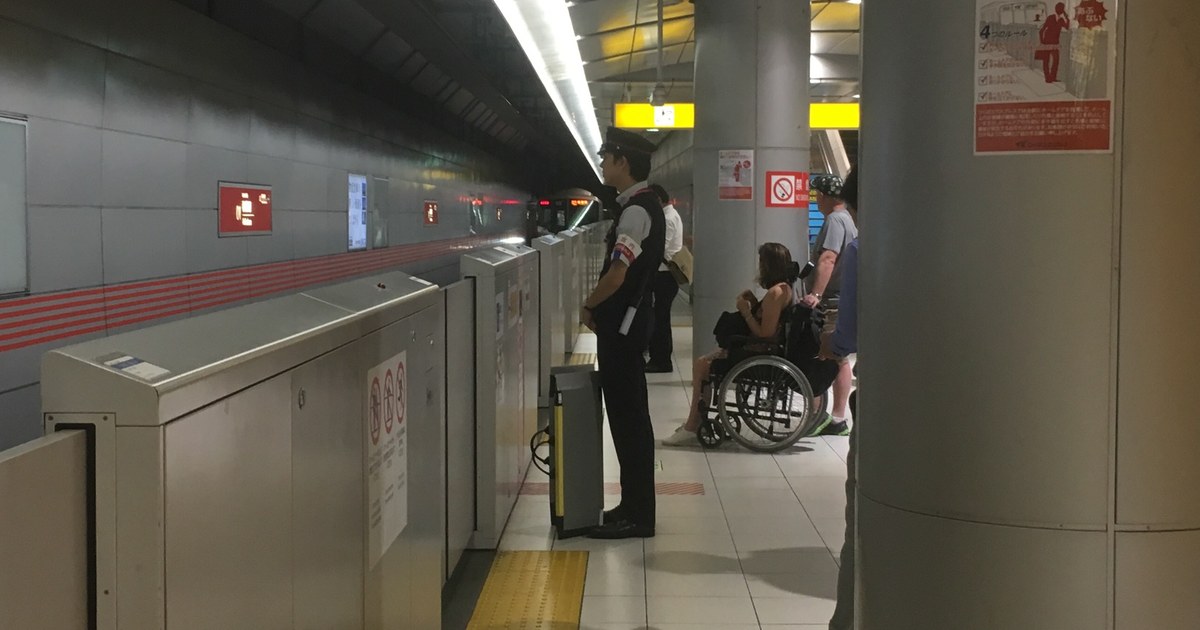
- Subways: tell the person at the gate
- How to check a station yourself
- A lift on the map, and a lift that is running
- Can a power wheelchair's battery fly?
- Getting around once you are off the train
- How do you confirm a hotel really has an accessible room?
- Japan's disability fare discount is closed to you
- Some places are simply out of reach, and that is worth knowing early
- What could not be verified, and who to ask
- What to do before you fly
- Appendix: official Japanese source text
Do you have to phone ahead?
Subways no, JR asks you to, and not one operator publishes a deadline in days. Split that sentence in half, because "no published deadline" and "no request to make contact" are two very different statements, and all three JR companies' pages say the first one.
JR East's wording is a request for your cooperation in contacting them in advance, and it gives the reason in the same sentence: getting you aboard sometimes needs coordination with other departments. It then adds the practical part — when the station is crowded, when operations are disrupted, or depending on the time of day, you may be asked to wait. The price of turning up unannounced is waiting, not refusal. JR Central pushes harder, asking you to make contact as soon as your travel is decided, and specifying that contact goes through the counter or phone line at your departure station. JR West nails down one thing in writing: email cannot be used to apply for assistance or to discuss ticket reservations. Email handles opinions and enquiries only.
| What you are boarding | Online option | Phone / counter | Published deadline | Same-day walk-up |
|---|---|---|---|---|
| Tokyo Metro, Osaka Metro and other subways | Not needed | Speak to staff at the gate | None | 🟢 Yes |
| JR local and rapid trains | — | Departure station counter or helpline | No day count | 🟢 Yes, expect a wait |
| JR East (to cut the wait) | Web application | 050-2016-1606 (09:00–18:00) | From 04:00 one month out to 12:00 two days before | 🟢 Yes, via the walk-up process |
| JR Central | 🔴 Phone or counter only | 050-3772-3910 (08:00–21:00, menu option 5) | None, but "as soon as travel is decided" | 🟢 Yes |
| JR West | 🔴 Email explicitly refused | 0570-00-8989 (08:00–20:00) | No day count | 🟢 Yes, arrive early |
| JR Kyushu | Web form (limited origin stations) | Phone, then they call you back | From 10:00 one month out to two days before | 🟢 Yes, apply at the departure station |
| Highway bus (WILLER) | Enquiry form | — | No day count | 🔴 No — arrange in advance |
The last row inverts everything above it. Rail and highway buses run on opposite logic: rail says "please tell us in advance, but we will handle you on the day", while the highway bus says arrange it first. WILLER adds a hard condition on top — a passenger who cannot manage their own personal needs must be accompanied, and the companion has to be capable of assisting at boarding and of guiding them in an emergency. JR Bus Kanto's statutory disclosure document says highway coach passengers reserve through its highway bus information centre in advance. Nishinihon JR Bus returns zero hits for the word "wheelchair" across its boarding guide pages — meaning it has not published a policy, not that it refuses one.
Which number you call depends on where you board
This is counter-intuitive, and JR West's table states it plainly: the operator you contact is determined by the company that owns your first boarding station, not by the line you are riding. The Hokuriku Shinkansen is the specimen — board at Itoigawa or west of it and you call JR West on 0570-00-8989; board at Joetsumyoko or east of it and you call JR East on 050-2016-1600. One line, two companies, and the handover falls between two adjacent stations.
So before dialling, answer one question: which station am I actually being helped onto the train at?
The ticket, the space and the person
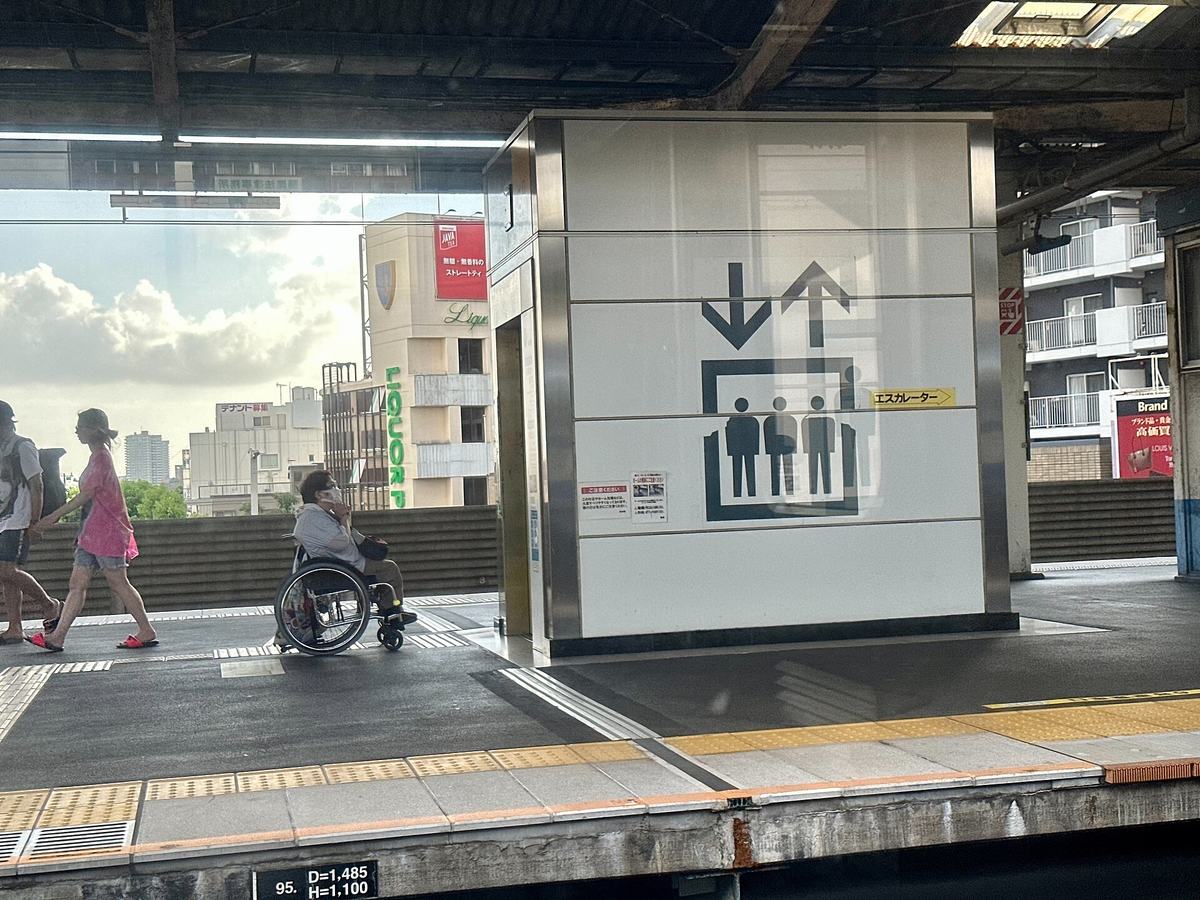
Three separate transactions, and online systems close only two of them. If one sentence from this article survives, make it that one.
The evidence comes from JR East's own terms of service for its assistance booking system, which states that the service does not guarantee a reserved-seat booking or secure a seat for you. What you have applied for is a person, not a place. Smart EX does the mirror image: it sells you a place and never notifies any station about you. Each side does half the job, and nothing joins them up.
JR West's five-channel comparison table makes the gap visible. Across the five columns, the row for booking assistance at the same time is populated for the application form, the ticket counter and the call centre only. Smart EX and e5489 are blank. So the correct sequence is: reserve the space on your phone, then separately phone to arrange the assistance.
JR Kyushu is the only one of the five that writes down what happens if that second step fails. It calls you back to confirm, and if it cannot reach you, the application auto-cancels at midnight three days after receipt (or on the eve of departure if you applied two to three days out). JR East is softer — the application simply "will not be completed" — but both note the same detail: the callback may come from a withheld number.
For a visitor with no Japanese phone number, that is the realistic failure mode. You fill in a form, leave a home-country number, the station cannot reach you, the clock runs out, and nothing tells you. If you use the web route, give a number you will genuinely answer while in Japan, including calls with no caller ID. If you cannot, phone or use the counter instead — both give you an answer on the spot.
How do you book a shinkansen wheelchair space?
It depends which way you are heading. Westbound you can self-serve up to the day of travel; northbound closes two days out and ends at a ticket counter inside Japan.
Three Japanese terms appear on the booking screens, and they are different products. Kuruma-isu taio zaseki is the umbrella term. Beneath it, a kuruma-isu space comes in two forms: with a transfer seat, meaning a seat you move across into, and without one, meaning you stay in your own chair. Separately there is the tamokuteki-shitsu, a multi-purpose room, which is a compartment rather than a seat.
That distinction decides whether you can book it yourself.
| Channel | Books until | Lines covered | What it can book | Ticket collection |
|---|---|---|---|---|
| Smart EX / Express Reservation | 🟢 Day of travel | Tokaido, Sanyo, Kyushu Shinkansen | Wheelchair seats only | 🟢 IC card, no ticket at all / machine / counter |
| e5489 (JR West) | 🟢 Day of travel | Plus Hokuriku Shinkansen | Wheelchair seats only | Machine / counter |
| Application form | 🟡 Two days before | Plus limited express trains | 🟢 Seats, multi-purpose room, and assistance | Counter |
| Ticket counter | 🟢 Day of travel | Everything | 🟢 As above | Counter |
| Call centre | 🟢 Day of travel | Everything | 🟢 As above | Counter |
The phrase "wheelchair seats only" in the first two rows is easy to skim past, and it is the whole point: the channels you can operate yourself are precisely the ones that exclude the person and the room.
Westbound: Smart EX is more open than expected
Smart EX names the seats down to the letter. On a 16-car Tokaido or Sanyo formation, car 11 offers the B seat (space with transfer seat), the E seat (space without transfer seat) and the A seat (companion seat), across Nozomi, Hikari, Kodama, Mizuho, Sakura and Tsubame, bookable regardless of fare product since 16 September 2023. Nothing on the page imposes a residency requirement — the Japanese words for "residence", "resident in" and "within Japan" all return zero hits. That matters, because Eki-net does carry an explicit exclusion of overseas residents — two systems, two different rules. The full comparison of who may use which Japanese booking system is in the online rail booking guide.
Three operational traps come with it:
- The search must be set to direct trains only. On web, tick the additional condition for direct trains; in the app, choose no transfers. A Tokyo–Sendai–Furukawa itinerary with a change cannot be booked online at all.
- One seat type per booking. A wheelchair space and a companion seat are two separate transactions.
- The multi-purpose room is never bookable online. Counter, phone or form only.
Northbound: JR East gives you an application, not a reservation
JR East runs a dedicated web form for wheelchair seats on its shinkansen, open from one month to two days before travel. It states outright that this is an application and that your preferred train is not guaranteed. The flow has three stages: submit the form, receive a call from the "purchase station" you nominated telling you the outcome, then go to that station and buy the ticket. The list of purchase stations runs from 38 in Tokyo to 11 in Aomori, and every one of them is inside Japan.
Six situations are excluded from the form entirely: journeys involving a transfer, parties with two or more passengers with reduced mobility, handle-type electric wheelchairs, the multi-purpose room, journeys where medical equipment and an accompanying doctor are involved, and passengers who already hold a ticket. All six go back to the counter or the phone.
A second web channel, JRE Odekake Support, covers assistance inside stations rather than seats. It accepts applications from 04:00 one month before travel until 12:00 two days before, excludes 11 named stations, and its terms state that a wheelchair outside JIS specification cannot be handled through the web route at all. For journeys between midnight and the last train, apply using the previous day as your travel date. The phone desk is 050-2016-1606.
Southbound: JR Kyushu has a live suspension notice
JR Kyushu's web application covers departures from Kyushu Shinkansen stations, Nishi-Kyushu Shinkansen stations, Hakata and Kokura; limited express journeys go through your nearest staffed station. One stretch is currently suspended from the web channel: following the 2026 Kumamoto earthquake, the Kyushu Shinkansen between Shin-Minamata and Kagoshima-Chuo is running to a modified timetable, web assistance applications for that section are suspended, and the operator asks you to apply at your boarding station on the day. That is a current notice, not archived text.
Why some spaces only go on sale that morning
Because the rolling stock for those runs is decided that morning. This is the least intuitive fact in the whole guide.
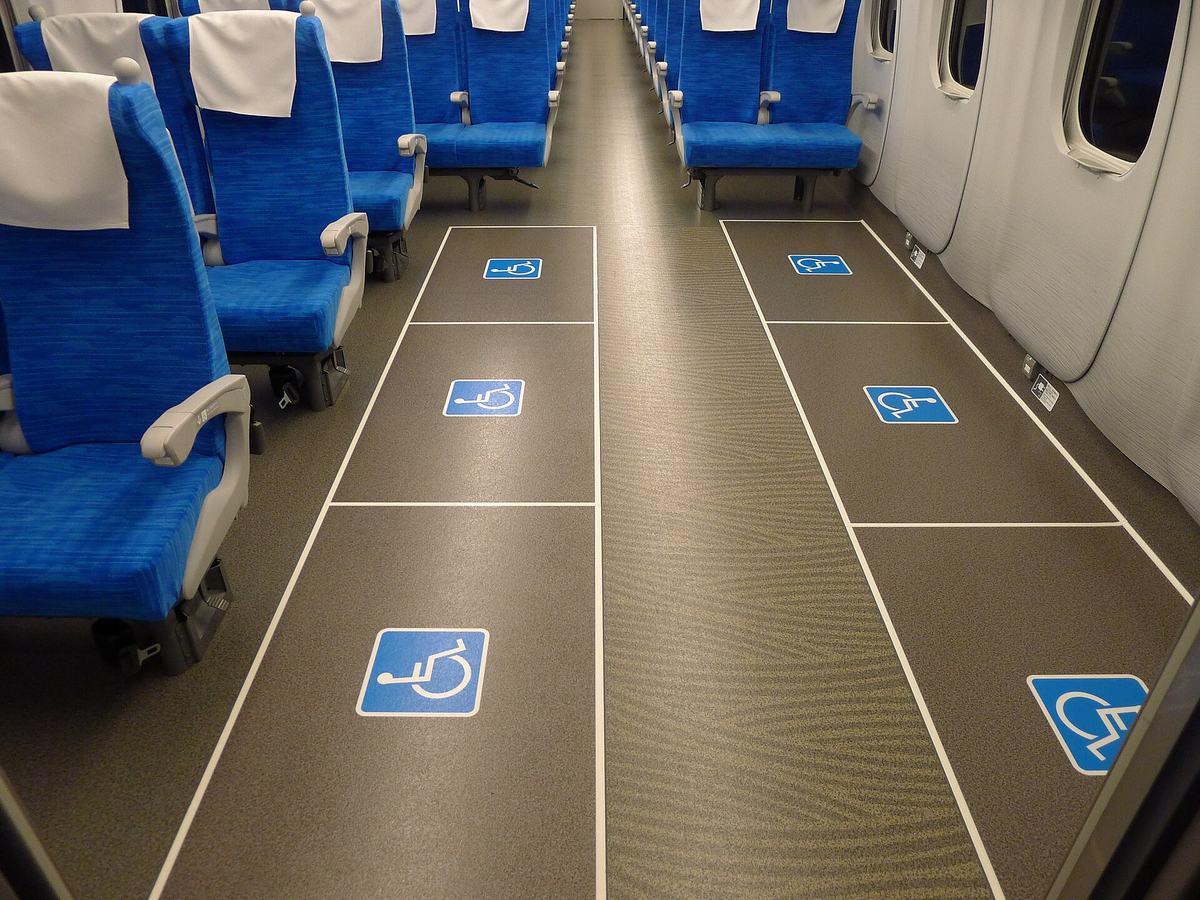
JR Central explains it directly. Some services run with N700S sets that carry six wheelchair spaces. Of those six, three are window-side spaces where you remain in your own chair, and three are aisle-side with a transfer seat. The complication is in the next sentence: services using those sets divide into runs fixed in advance and runs decided on the morning of travel.
The sales rule follows from that. For the pre-fixed runs, the no-transfer-seat spaces go on sale at 10:00 one month before travel. For the runs decided that morning, they go on sale that morning.
So the instinct that wheelchair spaces are scarce and must be grabbed a month out fails precisely for the passengers who need them most — someone who cannot transfer out of their own chair needs the no-transfer-seat type, and on some services that inventory simply does not exist a month ahead. JR West publishes the same structure for the Sanyo Shinkansen, listing which numbered services are bookable a month out and leaving the rest to same-morning release. Those service numbers change with each timetable revision, so none are reproduced here — check the operator's page before you book.
One related point in the same direction: these seats are excluded from the one-year-ahead reservation window, a detail already covered in the booking systems article. Another case where booking early does not help.
Where six seats and four seats come from
Two ministry records set the baseline: on 15 April 2021 the transport minister rode an N700S fitted with six wheelchair free spaces; on 23 June 2021, an E7 series fitted with four. The regulatory background is the 30 October 2020 revision of the mobility accessibility standards — and that revision covers shinkansen. Limited express trains got their own separate policy, published a year and a half later on 26 January 2022. Do not apply shinkansen rules to limited express trains, or vice versa.
Will your chair fit?
Four places give four different numbers, and the smallest is 60 cm — on an aircraft. Measure your own chair and compare it against this table; it tells you far more than "does the station have a lift".
| Choke point | Official figure | How it is worded |
|---|---|---|
| JR East (stations and trains) | Length and height 120 cm, width 70 cm | "Within" — a hard cap |
| JR West (stations and trains) | Length and height 120 cm, width 70 cm | "Approximately" — softer |
| Osaka Metro Morinomiya wheelchair escalator | Depth 1,040 × width 650 mm, max load 200 kg | Equipment spec — over it, you cannot ride |
| JAL 737-800 (cargo door) | H 81 / W 114 / D 127 cm | Cargo door aperture, varies by type |
| JAL 767-300 | H 142 / W 109 / D 139 cm | |
| JAL 777-300, A350-900/1000 | H 142 / W 147 / D 139 cm | |
| JAL DHC-8-400 | H 145 / W 84 / D 107 cm | |
| 🔴 JAL ATR42 / 72-600 | H 160 / W 60 / D 110 cm |
Read the first row against the last: a 70 cm chair that clears every rail rule in Japan will not pass through the cargo door of the ATR turboprop that serves the island routes. Rail gives you a ceiling of 70; that aircraft gives you an opening of 60. If your itinerary includes a regional island hop, measure this one first.
ANA publishes cargo hold dimensions by aircraft type on the same page and attaches an important qualifier: on its small aircraft (A321/320, 738/73P/73X, Q4A/DH4), a chair within the stated guideline dimensions may still be impossible to load because of hold height and other constraints. Clearing the numbers is not the same as being carried. On small aircraft, confirm in advance every time.
One blank has to be stated plainly: no operator publishes a weight limit. The words for kilograms and weight return zero hits across both JR pages, and ANA and JAL only ask you to contact them in advance for large or sports wheelchairs. So if a specific kilogram figure turns up while you are planning, it did not come from these documents. Both JR companies also leave the same door open — chairs over the stated dimensions are a "please consult us", not an outright ban.
Handle-type mobility scooters follow a different rulebook
The scooter-style chair with handlebars is classified in Japan as a handle-type electric wheelchair, and it is governed separately from manual and joystick-controlled chairs. Those two only need to meet the dimensions above. The handle type must additionally clear two performance thresholds:
- Right-angle cornering: turn a 0.9 m wide right-angle corner within five reversing manoeuvres, and turn a 1.0 m wide right-angle corner with no reversing at all.
- 180-degree turn: complete it within a width of less than 1.8 m.
Proof is a sticker on the frame: three stars in the rotation-performance field of the JIS star-rating label, three circles on the equivalent label for non-JIS-certified chairs, or the improved-type handle chair sticker.
Clearing that is only the start. The restrictions that actually shape your itinerary are these:
- Multi-purpose room only — no ordinary wheelchair seat.
- No web form, no Express Reservation, no e5489 — counter and phone are all that remain.
- Fixed list of eligible rolling stock: E5 and E6 (Tohoku, Akita, Hokkaido Shinkansen), E7 (Joetsu, Hokuriku), E8 (Yamagata), plus E259, E657, E353 and E261 limited express sets.
- 2 km/h speed cap inside stations, stated identically by both JR companies.
- JR East states that accidents caused by handle-type chair use are the passenger's own responsibility.
The blunt version: if anyone in your party uses a handle-type chair, do not build the trip around online booking. The whole route is counter and phone, the eligible trains are a short list, and calling early beats everything else.
What is the extra 10 yen on the fare?
It is ring-fenced money for accessibility works, collected by 13 operators. JR East is not among them — and that says nothing about how much equipment it has. More usefully: day passes and 24-hour tickets are exempt.
The scheme, created in December 2021, spreads the cost of station accessibility thinly across everyone who benefits, with the proceeds restricted to installing, upgrading, renewing and maintaining platform doors, lifts and similar equipment. At Tokyo Metro the surcharge on ordinary fares is ¥10: an IC fare of 168 yen becomes 178, a paper ticket of 170 becomes 180, and so on.
The exemptions are what matter to a visitor. Tokyo Metro's 24-hour tickets and other discount tickets, limited express tickets and reserved seat tickets are all excluded, as are student commuter passes. Buy a subway day pass and this scheme never touches your wallet.
As of 1 April 2026 the 13 operators applying it are Tokyo Metro, Hankyu, Hanshin, Odakyu, Kobe Electric Railway (Kobe Rapid line section only), Osaka Metro, Sanyo Electric Railway, JR West, Yokohama Minatomirai Railway, Tobu, Sotetsu, JR Central and Keisei.
🔴 The list is very easy to read backwards. It is a register of operators who chose to raise money by surcharging every passenger, not a ranking of accessibility. JR East, Toei Subway and Keio are absent, and that does not mean their equipment is thinner. The ministry sets out two paths on the same page: urban areas make use of the new fee mechanism, while rural areas get accessibility budget prioritised instead. The surcharge is one funding tool, not the funding.
A supporting figure: through fiscal 2024, the scheme collected 159.5 billion yen cumulatively while cumulative works came to 269.1 billion yen. More went out than came in. As for why JR East does not use the mechanism, no official explanation was obtained this round, so none is invented here.
One sourced progress number worth keeping: as of end-fiscal-2024, platform doors were installed at 1,190 stations across 2,830 platform tracks, including 195 stations and 621 tracks at locations averaging over 100,000 passengers a day.
Subways: tell the person at the gate
No booking, no form, no phone call — Osaka Metro states it in exactly those terms: if you need help, tell the station staff at the ticket gate directly.
Tokyo Metro needs a more careful sentence. Its accessibility page covers equipment and the surcharge, and says nothing about advance contact; its support page and FAQ, checked separately, likewise contain no advance-notice rule for wheelchair boarding assistance. So the accurate formulation is "the operator does not ask for advance contact on these pages", not "Tokyo Metro does not require advance contact". The evidential strength of those two sentences is very different.
That page does hand over one genuinely useful object: Tokyo Metro publishes a barrier-free handbook covering every station on both Tokyo Metro and Toei Subway, mapping lifts, wheelchair-accessible escalators and stairlifts. Toei's own site could not be reached this round, so a booklet produced by one operator that covers both neatly fills that hole.
How to check a station yourself
Use Rakuraku Odekake Net. It has an English interface, it plans barrier-free routes, and JR East's own page names it as the place to look. The address is ecomo-rakuraku.jp/en, run by the Foundation for Promoting Personal Mobility and Ecological Transportation.
What it does goes well beyond what any travel article can reproduce:
- Station-by-station accessibility search, and not only rail — airport terminals, bus terminals and passenger ship terminals are all covered.
- Route search with a barrier-free toggle, plus a choice between fastest and easiest.
- Station floor plans, listed per operating company. Ueno returns separate PDFs for Tokyo Metro and JR East — which matters enormously for interchanges, because one station name can mean two sets of equipment.
- Regional browsing across the whole country, prefecture by prefecture.
This is the single most useful thing in this guide. Booking a seat and phoning for assistance are one-off tasks; this site is something you will open every morning before leaving the hotel.
Two gaps on the official side, stated plainly
The first sits with JR East. Its wheelchair page is published under ten language URLs, and the measured result is this: the Japanese page, the traditional-Chinese page and the English page all carry <html lang="ja">, all contain the Japanese word for wheelchair 33 times, and the Chinese word for wheelchair returns zero hits on the Chinese page. The translated versions serve the Japanese original. The method is given here so you can check it yourself — view source, or search the page for a word in your own language. No motive is being ascribed; the practical consequence is simply that switching the language selector will not get you a translation, so budget time to work through Japanese text or bring someone who can.
The second sits with the national tourism organisation. Its two accessibility pages are narrative articles rather than a searchable resource, and on the question of how best to use taxis, one of them refers you to staff at a privately run website. The same page also carries a figure of roughly 95% of stations being fully accessible, but no original source for it was obtained this round, so it is not repeated here. For a sourced measure of progress, use the platform-door figure above.
A lift on the map, and a lift that is running
"This station has a lift" and "that lift is working today" are separate questions, and both operators publish the answer monthly.
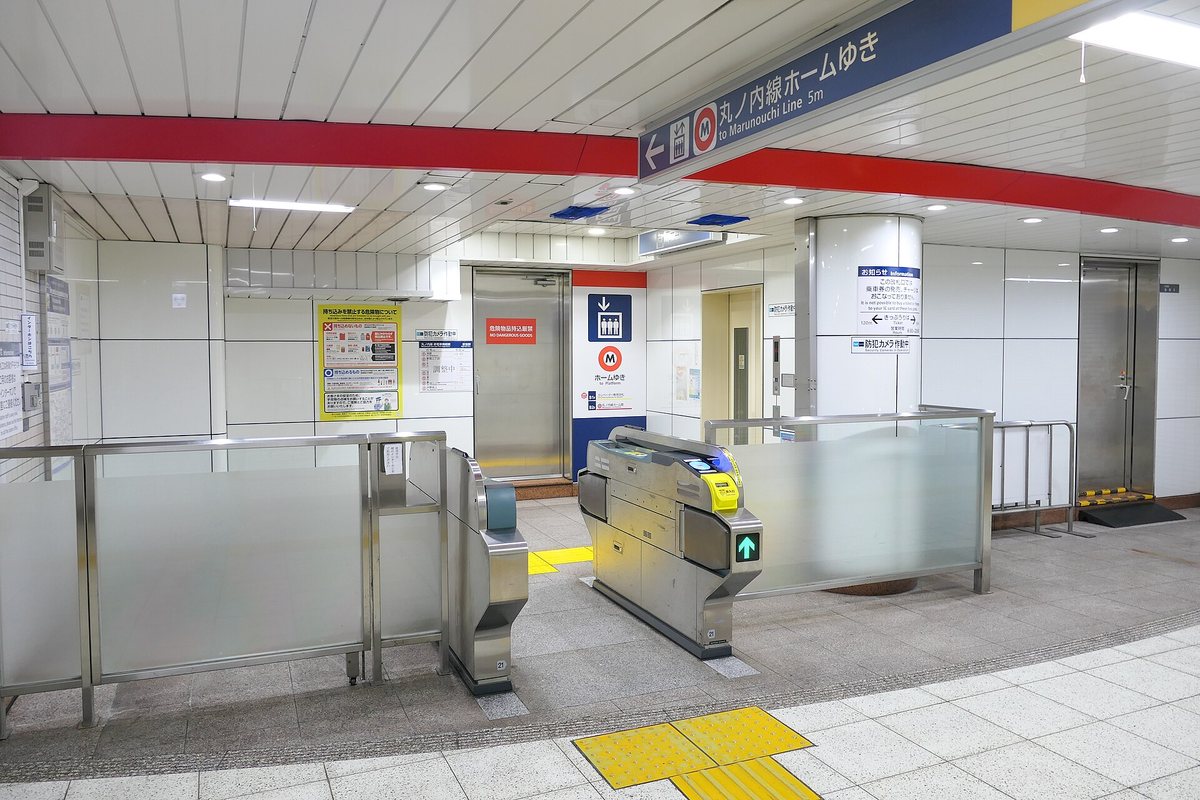
Tokyo Metro posts a same-day lift outage notice alongside a line-by-line schedule of planned outages for the month. Osaka Metro publishes inspection dates for lifts at each station. This is not a theoretical risk — Morinomiya station's August 2026 notice is the example: lift renewal works from 9 August to 16 September, with the concourse-to-platform lift out of service. Five weeks, at the very station whose wheelchair escalator only accepts 650 mm.
So daily route confirmation has two layers: check the equipment the night before on Rakuraku Odekake Net, then check the day's outage notice before you leave. Families with pushchairs use the identical method — for them it is an inconvenience, for a wheelchair user it decides whether the day happens at all. The pushchair side of the same problem is in the family travel guide.
Can a power wheelchair's battery fly?
Establish the type first. Spillable cells are refused outright; lithium goes by watt-hours. ANA and JAL use identical thresholds, so one table covers both.
| Battery type | Cabin | Hold | Limit |
|---|---|---|---|
| Lithium, removable (fitted to the chair, detachable) | 🟢 Yes | 🔴 No | Up to 300Wh |
| Lithium, non-removable | 🔴 No | 🟢 Yes | No stated limit |
| Spare lithium 300Wh and above | 🔴 No | 🔴 No | Banned entirely |
| Spare lithium 160–300Wh | 🟢 Yes | 🔴 No | 1 |
| Spare lithium up to 160Wh | 🟢 Yes | 🔴 No | 2 |
| Spare dry-cell type (Ni-MH, Ni-Cd) | 🔴 No | 🟢 Yes | 2 |
| Sealed non-spillable wet cell, spare | 🔴 No | 🟢 Yes | 1 |
| 🔴 Spillable (needs electrolyte topping up) | 🔴 No | 🔴 No | Refused both ways |
Note that the first two rows point in opposite directions: a removable battery must come off and travel in the cabin; a non-removable one must stay on and travel in the hold. JAL states that a battery detached from the chair does not count towards the spare battery allowance.
ANA cites a rule that makes a good closing line for this section: since 1 January 2021, the IATA dangerous goods regulations place the obligation on the power wheelchair user to know which battery type their own chair uses. That duty sits on the passenger, not the airline. Photograph the battery label before you fly and carry a printout.
These thresholds are not the ones that govern power banks — that separate table lives in the carry-on rules guide. Do not read across.
How far in advance? The two airlines differ
JAL's online request form states 48 hours before departure, and its English version carries the same number. Two qualifiers belong with it: that deadline appears on the form, while JAL's own support page carries no hour count at all and simply says to tell them when booking; and the form URL carries a region parameter, with the Japan-departure variant returning 404, so whether passengers departing Japan reach the same form could not be confirmed. The accurate sentence is "JAL's online request form says 48 hours", not "JAL requires 48 hours".
One nearby number is easy to misquote: JAL's special assistance registration service states that registration takes about three weeks. That is the time to set up a member profile, not a per-flight deadline.
ANA publishes no deadline at all. Its assistance, first-time-user, registration and FAQ pages were searched for day, hour and minute deadlines, and the only hits are check-in recommendations: 60 minutes before departure for domestic flights, 120 for international. Everything else says to tell them at the time of booking. So no "X days before" is invented for ANA here.
Where your chair comes back to you
The baggage carousel by default, not the aircraft door. ANA and JAL word it the same way: a checked wheelchair is returned at the baggage claim in the arrivals hall, and only a chair handed over near the boarding gate comes back at the aircraft door — ANA adds that you may request the carousel instead.
The exception is US routes, where under the Air Carrier Access Act ANA states that the chair is returned at the aircraft door immediately after disembarkation. A flight from Asia into Japan is not a US route, so the default applies: you disembark and have to get yourself to the carousel before you have your own chair back. That is the airport edition of this article's whole theme — and it is exactly why you should specify at booking where you want the chair returned.
Three airport details worth knowing
- "Free loan wheelchairs at every airport" and "a dedicated assistance counter" are different claims. JAL provides free loan chairs at all airports, but its dedicated special assistance counters are listed only at New Chitose, Haneda, Narita, Chubu, Itami, Fukuoka and Naha for domestic, plus Haneda and Narita for international — Kansai is not on the counter list.
- Haneda Terminal 2 has electric mobility scooters, but they cannot be reserved. ANA states that no advance booking is accepted; tell the counter staff on the day, available 06:00–19:00. No equivalent service appears for Narita or Kansai.
- Guide dogs, hearing dogs and service dogs travel free in the cabin on all routes, per both airlines. But note Japan's airport administration rules: assistance dogs other than those three may not accompany you inside the terminal and must travel in a carrier. Emotional support and alert dogs are accepted only on specific routes; otherwise they go in the hold.
One comparison is worth ending on. The airlines' English pages are genuine English pages. ANA's and JAL's English versions carry the battery table, the cargo hold dimensions, the 60/120 minute guidance, the US legal provision and the wheelchair return location, sentence for sentence, with no rules omitted. Set that against the rail page discussed earlier, whose translated versions are the Japanese text.
Getting around once you are off the train
The GO app lets you request a wheelchair-accessible vehicle, but you cannot pre-book it, and it seats two people including the wheelchair user. Those conditions matter more than the headline feature.
GO is the only ride-hailing app with a published policy: selecting a wheelchair-accessible vehicle summons a nationally certified Universal Design taxi. The same page lists three constraints — no advance reservation, a maximum of two occupants including the wheelchair user (the wheelchair user plus one companion), and disability discounts are not applied automatically.
The first constraint bites hardest. No advance booking means that at exactly the moments you most want certainty — clearing arrivals, leaving a venue after a show, missing the last train — you have no fallback. The second blocks a party of three outright; the third person books separately.
As for S.RIDE and Uber Japan: their public pages return zero hits for wheelchair, universal, welfare and barrier-free in Japanese. Uber's help centre does have an accessibility section, but its content is generic US state and federal anti-discrimination text with nothing Japan-specific. That is "not published", not "not available" — four zero-hit keywords only prove the marketing pages are silent. Ask their support directly if you need certainty.
The national UD taxi figure is misleading
As of the end of March 2025 there were 47,119 Universal Design taxis nationally, 28.1% of the 167,428-vehicle fleet, within a wider welfare taxi total of 59,918. That looks comfortably past the official target of about 25% by fiscal 2025.
Read the target's wording, though: it sets about 25% in each prefecture, while 28.1% is the national average. Broken down, Iwate sits at 4.3% and Akita at 8.3%. The goal is per-prefecture, so a national average clearing the bar tells you nothing about the prefecture you are actually visiting. In rural Tohoku, the number is single digits.
Two different legal categories of accessible taxi
Under Article 3 of the Road Transport Act, welfare taxis split two ways: ordinary taxi operators running welfare vehicles — which is what a UD taxi is, and anyone may hail one — and operators licensed specifically to carry disabled passengers, the type generally called a nursing-care taxi. The first you flag down; the second you arrange.
A small finding worth noting: searching the full text of the Road Transport Act returns zero hits for both "nursing-care taxi" and "welfare transport" in Japanese. Those are administrative and industry terms, not statutory ones.
City buses: one figure, two denominators
At the end of fiscal 2024 there were 32,237 low-floor buses in Japan. The same official document gives two percentages for that number:
- Of 44,735 "eligible vehicles" = 72.1%
- Of 54,523 total route buses = 59.1%
The gap is the roughly 10,000 vehicles legally exempted — highway coaches, airport buses and similar. For a visitor flagging down a city bus, 59.1% is the relevant probability, and it still does not subtract the chance that the service you want is one of the exempt categories. Both figures are official; quoting only the flattering one misleads.
How do you confirm a hotel really has an accessible room?
By phoning each property. The law only requires hotels of 50-plus rooms to provide one percent of total rooms — so a 200-room hotel's legal floor is two.
The provision is Article 16 of the Barrier-Free Act enforcement order: a hotel or ryokan with 50 or more guest rooms must provide wheelchair-accessible guest rooms numbering at least one percent of total rooms, rounded up. Article 9 sets the scope threshold at a total floor area of 2,000 square metres.
Run the numbers and three assumptions collapse:
- A property with 50 rooms or fewer needs none at all.
- A 200-room hotel's legal floor is two rooms. Not twenty. Two.
- Before 1 September 2019, a 500-room hotel complied with one. That was the old standard — "one or more".
And the requirement applies only to new construction, extensions and change of use; existing buildings are not caught retroactively. A great many Japanese hotels predate 2019. So "it's a big hotel, it will have one" has no legal basis whatsoever.
Worse, there is no searchable official database of accessible rooms. The closest thing is the tourism agency's accessibility certification scheme, but that publishes static regional PDFs and certifies a composite score covering accessibility and willingness to disclose information — which is not the same as having a wheelchair-accessible room. The official approach is a manual instructing hotels to publish their own accessibility information, not a central register.
There is no shortcut here: find the room type, then contact the hotel and ask about door width, whether the bathroom has a threshold, bed height, and whether that specific room is still available on your dates. A booking platform's accessibility filter does not carry any of that. The licensing categories and statutory floor areas behind Japanese accommodation are covered in the accommodation guide and are not repeated here.
Japan's disability fare discount is closed to you
You cannot use it. JR requires a physical disability certificate issued by a Japanese municipality.
JR Central states it directly: to buy the discounted ticket you present a certificate issued by a local authority, bearing a Class 1 or Class 2 entry in the JR passenger fare reduction field. A digital version through the disability certificate app is accepted only where it has been linked to Japan's My Number portal. A certificate issued by another country does not qualify anywhere on JR.
For completeness, the discount is 50% on ordinary tickets, coupon tickets, ordinary express tickets and commuter passes for a Class 1 holder travelling with one carer; travelling alone, it applies only when the journey exceeds 100 operating kilometres.
And one detail that closes the loop on this article's theme: even a Japanese holder cannot buy that ticket through Express Reservation, per JR Central's own note. In accessibility, the online systems have a lower ceiling than they do for anyone else — you can book the space, you cannot book the assistance, and you cannot buy the discount.
Some places are simply out of reach, and that is worth knowing early
Usually the obstacle is terrain, not equipment. Knowing in advance stops you spending a whole day travelling to somewhere you cannot enter.
The cleanest example is the Chureito Pagoda at Arakurayama Sengen Park — the classic pagoda-and-Fuji viewpoint. Reaching it means 398 steps, with no step-free alternative for ordinary visitors, and in peak season the vehicle access permit is not issued at all. The Chureito Pagoda guide says so plainly, and it makes a good template for trip planning: some attractions answer "no", and finding out a day early beats finding out at the bottom of the staircase.
On the rail side, the real black hole is unstaffed stations. The standard practice is for staff to travel out from the nearest staffed station to assist with boarding, which makes the wait unpredictable — it depends on how near that station is and what else that person is doing.
From 1 November 2025, JR West began trialling a fix on the Nanao Line: train crew assist with boarding and alighting directly, removing the wait for a station attendant. The trial covers five stations only — Unoke, Takamatsu, Hakui, Nanao and Wakura Onsen (the last for the Noto Kagaribi limited express only) — running from 1 November for the time being. The operator draws one clear line around it: the assistance covers boarding and alighting only; moving around inside the station remains the passenger's own responsibility.
The scope is tiny — one line, five stations — so do not read it as national policy. Its value is as confirmation that the problem exists and of the direction the industry considers a solution. JR Kyushu handles it differently: for unstaffed stations outside its smart-support-station lines and three named Kagoshima Main Line stations, it asks you to contact the line's designated number in advance, with coverage from the first train to the last.
What could not be verified, and who to ask
Six things could not be established this round. Saying so beats filling them in. Each row names where to take the question instead.
| Unresolved | Why | Where to ask |
|---|---|---|
| Any Toei Subway rule | The whole site returned a firewall interception page | For equipment locations use Tokyo Metro's barrier-free handbook, which covers every Toei station; for rules, ask staff at the gate |
| Whether JR-EAST Train Reservation books wheelchair seats | Its service guide pages returned Access Denied | Ask at a Midori-no-madoguchi counter, or use JR East's dedicated web form (closes two days out) |
| JR Hokkaido's rules | The official link is dead — and it is the link on JR Central's own page | Contact your departure station or JR Hokkaido directly |
| Uber and S.RIDE wheelchair policy | Four relevant keywords return zero hits on their public pages | Use GO, which does publish one, or hail a UD taxi; ask their support for certainty |
| Nishinihon JR Bus wheelchair rules | Zero hits for "wheelchair" across its boarding guides | Phone the operator before booking; highway coaches need advance arrangement anyway |
| Wheelchair weight limits | Neither JR nor either airline publishes a figure | For heavy, large or sports chairs, operators ask you to contact them in advance |
One further item is not "unverified" but "unstated": no official explanation exists for why JR East does not apply the accessibility surcharge. The ministry page goes as far as naming two funding routes, for urban and for rural areas, and no further.
What to do before you fly
Do these seven and the station side of the trip will hold together.
- Measure your chair — length, width, height — and write the numbers down. If a regional island flight is in the plan, check the width first: the narrowest cargo door is 60 cm.
- Photograph the battery label. Removable or not, and the watt-hours. IATA makes knowing this your obligation.
- Run every station on your route through Rakuraku Odekake Net, especially interchanges — one station name can hide two companies and two sets of equipment.
- Book the space and the assistance separately. Westbound, reserve on Smart EX yourself, then phone for assistance. Northbound, or if you need the multi-purpose room, go straight to the counter or the phone.
- If you use a web form, give a number you will answer in Japan. Stations may call from a withheld number, and JR Kyushu auto-cancels when it cannot reach you.
- Phone each hotel. The legal minimum is too low to infer anything from, and booking filters do not carry door widths.
- Check the day's lift outage notice before leaving. Tokyo Metro and Osaka Metro both publish daily and monthly.
If only one survives, make it number four. Treating "reserve the seat" and "arrange the person" as one task is the most expensive misunderstanding in this subject — nothing on the booking screen flags it, so you go on believing the trip is arranged until you are on the platform.
Two limits belong at the end. Everything above is drawn from the five JR companies, the Ministry of Land, Infrastructure, Transport and Tourism, Tokyo Metro, Osaka Metro, ANA, JAL and the e-Gov statute database, with no figure quoted that lacks an official source — which is why you will not find a wheelchair weight limit here, or that flattering 95% station accessibility rate. And the absence of a stated deadline should not be read as permission to skip the call: "no published day count" and "no request to make contact" are different things.
Appendix: official Japanese source text
The Japanese originals quoted above, collected here so you can verify them yourself.
1. Advance contact wording (JR East / JR Central / JR West / Osaka Metro)
駅をご利用の際には、駅係員がホームまでのご案内および列車の乗降のお手伝いをさせていただきます。スムーズにご利用いただくために関係箇所との調整が必要な場合がありますので、事前の連絡にご協力をお願い致します。(JR East)
混雑時や列車運行上支障がある場合、また時間帯などによってはお待ちいただく場合がございますので、あらかじめご了承ください。(JR East)
駅におけるご案内および列車乗降のお手伝いが必要な場合がございますので、あらかじめご連絡いただきますようお願いします。ご旅行がお決まり次第のご連絡をお待ちしています。/ご連絡やお問い合わせは、ご旅行を開始する駅において、窓口または電話にて承ります。(JR Central)
メールでのサポート内容:ご意見/お問い合わせ 介助のお申し込みやきっぷのご予約相談はできません。(JR West)
ご乗車当日はご案内に時間がかかる場合がありますので、ご利用にあたっては、十分に余裕をもって駅にお越しください。(JR West)
お手伝いが必要な場合は、各駅の改札の駅員に直接お伝えください。(Osaka Metro)
2. You apply for a person, not a seat (JRE Odekake Support terms)
第3条第6項 本サービスは列車の指定席予約及び座席確保を確約するものではありません。
第5条第2項 本申込の受付は、乗車日の1箇月前の4時から、乗車日の2日前の12時までとなります。
Article 3(1) excludes 11 stations: 綾瀬/羽沢横浜国大/厚木/鹿島サッカースタジアム/小諸/豊野/西若松/宮古/好摩/野辺地/八戸(在来線). Article 3(4)(2): non-JIS-specification wheelchairs cannot use the web route. Article 6(5): the station may call from a withheld number. Article 5(6): journeys after midnight up to the last train are applied for using the previous day. Desk: 050-2016-1606, 09:00–18:00.
3. Auto-cancellation when unreachable (JR Kyushu)
※お電話またはWEBでの車いす対応座席のご予約は出発日1ヶ月前の10時から2日前までにご連絡ください。/ご連絡がつかない場合は受付を行った3日後(出発日3~2日前の場合は出発日前日)の24時に自動キャンセルとなります。
Current suspension notice: 「【九州新幹線 新水俣駅~鹿児島中央駅間をご利用のお客さまへ】令和8年熊本地震の影響を受け、九州新幹線 新水俣駅~鹿児島中央駅間は通常とは異なるダイヤで運行しております。そのため、上記の区間でお手伝いのWeb申し込みを使用停止させていただいております。お手伝いをご希望のお客さまにつきましては、大変恐れ入りますが当日、ご乗車の駅でお申し込みください。」
4. The three terms, and the N700S six spaces (JR Central)
「車いす対応座席」には、車いすから移乗してご利用いただける「車いすスペース(移乗席あり)」、車いすのままご利用いただく「車いすスペース(移乗席なし)」と、多目的室がございます。
車いすスペースが6席あるN700S車両で運転する列車があります。6席のうち、3席は車いすのままご利用いただく窓側の「車いすスペース(移乗席なし)」、3席は移乗する座席のある通路側の「車いすスペース(移乗席あり)」です。
車いすスペースが6席あるN700S車両で運転する列車は、「あらかじめ決まっている列車」と「ご利用当日の朝に決まる列車」があります。/「車いすスペース(移乗席なし)」については、「あらかじめ決まっている列車」では、ご利用日の1か月前の10時より発売、「ご利用当日の朝に決まる列車」では、当日朝より発売します。
5. What Smart EX can book
対象列車:東海道・山陽・九州新幹線「のぞみ」「ひかり」「こだま」「みずほ」「さくら」「つばめ」/対象座席:11号車(東海道・山陽新幹線の16両編成の場合)車いすスペース(移乗席あり)(B席)、車いすスペース(移乗席なし)(E席)、車いす付添席(A席)の3種類/発売期間:乗車日の1ヵ月前(10:00)から/2023年9月16日以降、商品を問わずに予約できます。
車いす対応座席を予約される場合は、スマートフォン・パソコンをご利用の場合は追加条件(検索条件)に"直通列車のみ検索"を、アプリをご利用の場合は"乗継なし"を指定ください。
Smart EX top page: 「お持ちのクレジットカードと交通系ICカードがあれば今すぐチケットレスで乗車可能!」 Zero hits for 居住/在住/日本国内 across the page.
6. JR East's shinkansen web application
JR東日本の新幹線駅から出発する、お身体の不自由なお客さま向けの「車いす対応座席」および「車いすスペース」の指定席きっぷを、ご乗車の1カ月前から2日前までお申し込みいただけます。/「お申し込み受付」のため、必ずしもご希望の列車が予約できるとは限りません。
ご指定いただいた「ご購入駅」より…手配の結果についてご連絡いたします。駅からのご連絡は番号非通知での発信となる場合があります…ご連絡がとれない場合は、お申し込みが完了しませんのでご注意ください。
Six exclusions: journeys involving a transfer; two or more passengers with reduced mobility; handle-type electric wheelchairs; the multi-purpose room; medical equipment with an accompanying doctor; passengers already holding a ticket.
7. Wheelchair dimensions and handle-type performance requirements
①ご利用可能な車いす 長さ・高さが120センチメートル、幅が70センチメートル以内 ※上記の寸法を超える車いすをご利用になる場合はご相談ください。(JR East)
長さ及び高さ120センチ、幅70センチ程度の車いすであること。(JR West)
【直角路走行性能】幅0.9mの直角路を5回までの切り返しで曲れること。かつ、幅1.0mの直角路を切返しなしで曲れること。【180度回転性能】1.8m未満の幅で180度の回転ができること。
本体にJIS規格として…星数表示シールの「回転性能」欄が星印3つ(JIS認定取得のハンドル形電動車いす)、回転性能表示シールの「回転性能」欄の丸印3つ(JIS認定未取得)、または…「改良型ハンドル形電動車椅子用ステッカー」が貼付されている場合は、要件を満たしています。
ご利用可能なデッキ付きの車両は、東北・秋田・北海道新幹線(E5系・E6系)、上越・北陸新幹線(E7系)、山形新幹線(E8系)、総武線特急(E259系)、常磐線特急(E657系)、中央線特急(E353系)、東海道線特急(E261系)です。
鉄道施設等の利用中にハンドル形電動車いすの利用が原因で発生した事故…については、お客さまの責任においてご対応いただくこととし、弊社は一切責任を負いかねます。
In-station speed cap: 時速 2 キロメートル以下 (identical at JR East and JR West). Osaka Metro Morinomiya wheelchair escalator: 「【車いす使用上の制限】最大積載重量:200キログラム 最大有効寸法:奥行1,040×幅650ミリメートル」
8. The station accessibility surcharge (MLIT and Tokyo Metro)
令和3年12月に、鉄道駅のバリアフリー化により受益する全ての利用者に薄く広く負担を頂く制度(鉄道駅バリアフリー料金制度)を創設いたしました。本料金制度では、鉄道事業者が利用者から収受した料金を、ホームドアやエレベーターなどのバリアフリー設備の整備(設置、改良、更新、維持管理等)に充てられることとしております。
引き続き予算の確保に努めながら、都市部において新たな料金制度を活用いただくとともに、地方部において鉄道駅のバリアフリー予算を重点化することで、全国の鉄道駅バリアフリー化を加速してまいります。
●東京メトロ24時間券等のお得な乗車券や特別急行券・座席指定券には、鉄道駅バリアフリー料金を加算いたしません。/通学定期乗車券(大人・小児)には鉄道駅バリアフリー料金を加算いたしません。
The 13 operators (as of 1 April 2026, in order of notification): 東京地下鉄、阪急電鉄、阪神電気鉄道、小田急電鉄、神戸電鉄(※神戸高速線区間に設定)、大阪市高速電気軌道、山陽電気鉄道、JR西日本、横浜高速鉄道、東武鉄道、相模鉄道、JR東海、京成電鉄. Cumulative through FY2024: collected 159.5 billion yen, works 269.1 billion yen. Platform doors at end-FY2024: 1,190 stations / 2,830 platform tracks, of which 195 stations / 621 tracks at 100,000+ daily passengers.
9. Disability discount (JR Central)
割引のきっぷをお求めの際は、駅のきっぷうりば(係員の窓口またはサポートつき指定席券売機)で、各自治体で発行する身体障害者手帳(旅客鉄道株式会社旅客運賃減額欄に第1種又は第2種の記載のあるもの)をご提示ください。
※「エクスプレス予約」では「身体障害者割引」の乗車券は購入できません。
The Mirairo ID app is accepted only where linked to My Number portal. Discount: 50% on ordinary tickets, coupon tickets, ordinary express tickets and commuter passes for a Class 1 holder plus one carer; travelling alone, only where the journey exceeds 100 operating kilometres.
10. Train-crew assistance trial at unstaffed stations (JR West, 27 October 2025 release)
現在、車いすをご利用のお客様が、駅係員が不在となる駅をご利用の際には、最寄りの駅などから係員が駆けつけて乗降のお手伝いをさせていただいております。/このたび、係員の到着をお待ちいただくことなくスムーズにご乗車・ご降車いただけるよう、七尾線の一部の駅において、乗務員による乗降のお手伝いを試行的に実施いたします。/※本お手伝いは、列車の乗降時のみを対象としており、駅構内の移動はお客様ご自身でお願いします。
Stations: 宇野気駅、高松駅、羽咋駅、七尾駅、和倉温泉駅 (Wakura Onsen for the Noto Kagaribi limited express only). Period: from 1 November (Sat) for the time being.
11. Accessible room quota (Barrier-Free Act enforcement order)
第十六条 ホテル又は旅館には、客室の総数が五十以上の場合は、車椅子使用者が円滑に利用できる客室(以下「車椅子使用者用客室」という。)を客室の総数に百分の一を乗じて得た数(その数に一未満の端数があるときは、その端数を切り上げた数)以上設けなければならない。
第九条 法第十四条第一項の政令で定める規模は、床面積…の合計二千平方メートル…とする。
Before and after (Sendai City official PDF): previously 「客室の総数が50室以上の場合は、1以上の車椅子使用者用客室を設ける」, now 「客室の総数の1%以上」. In force from 1 September 2019. Note: the provision was Article 15 at the time of amendment and was renumbered to the current Article 16 without substantive change.
12. Power wheelchair batteries and cargo hold dimensions (ANA / JAL)
IATA(国際航空運送協会)発行の危険物規則書では、2021年1月1日以降、電動車いす使用者に対して、「電動車いす使用者は、ご使用になる電動車いすのバッテリー種別について自身で認識していること」と規定されています。(ANA)
リチウムイオン(Li-ion):機内持ち込みのみ可能です。~160Wh:2個 160Wh~300Wh:1個 本体から外したバッテリーは予備バッテリーの個数に含みません。/蓄電型乾電池(ドライバッテリー)ニッケル水素(Ni-MH)、ニッカド(Ni-CD):受託手荷物としてのみ…おひとり様当たり2個まで。/湿式電池…防漏型(Non-Spillable):受託手荷物としてのみ…1個まで。/非防漏型(Spillable)バッテリー液を補充するタイプ:お預かりできません。(機内持ち込みも不可)(JAL)
特に、小型機(A321/320,738/73P/73X,Q4A/DH4)の機材では、車いすサイズが目安内であっても、貨物室の高さ等の制限により搭載できない場合があります。(ANA)
お客様の車いすは、到着ロビー手荷物引取所にて返却いたします。出発時に搭乗口付近でお預かりした場合は、航空機出入り口付近でお返しいたしますが、ご希望により手荷物引取所でお返しすることも可能です。/(米国線)米国航空アクセス法に基づき、お預かりした車いすは到着後航空機のドア付近(降機してすぐの場所)でお返しいたします。(ANA)
JAL cargo door dimensions (H / W / D, cm): 737-800 = 81 / 114 / 127; 767-300 = 142 / 109 / 139; 777-300 and A350-900/1000 = 142 / 147 / 139; DHC-8-400 = 145 / 84 / 107; ATR42/72-600 = 160 / 60 / 110. JAL online form: 「ご出発の48時間前までにお申し込みください。」 English: "at least 48 hours before flight departure". ANA publishes no advance deadline, only check-in guidance of 60 minutes domestic / 120 minutes international. ANA phone: 0120-029-377 / 0570-029-377 / 03-6741-8900.
Assistance dogs (ANA): 「盲導犬・聴導犬・介助犬は全路線機内への同伴が認められおります。」「日本では空港管理規定により、補助犬(盲導犬、聴導犬、介助犬を除く)の空港ターミナル内での同伴は禁止されており、ケージでの移動が義務づけられています。」 Haneda Terminal 2 mobility scooters: 「事前予約は承っておりません。ご搭乗日当日にカウンター係員へ直接お知らせください。(ご利用可能時間は6:00~19:00)」
13. Taxis and buses (MLIT / GO)
「車いす対応車両」を指定して注文すると、国が認定している標準仕様ユニバーサルデザインタクシーを呼ぶことができます。/予約はご利用いただけません。/乗車可能人数は車いすの方を含めて2名までとなります。(車いすの方1名、同乗者の方1名)/障がい者割引は自動適用されません。(GO)
今次目標においては、「令和7年度までに、各都道府県における総車両数の約25%について、ユニバーサルデザインタクシーとする。」とされている。(MLIT)
福祉タクシーとは、道路運送法第3条に掲げる一般乗用旅客自動車運送事業を営む者であって、一般タクシー事業者が福祉自動車を使用して行う運送や、障害者等の運送に業務の範囲を限定した許可を受けたタクシー事業者が行う運送のことをいう。(MLIT)
お一人で身の回りのことをこなすことが難しいお客さまは、お付き添いの方が必ず必要です。お付き添いの方には、乗降の際の介護や援助、および緊急時の誘導、援助などができる方にお願いいたします。※車いすをご利用の方、お預けになる方は、事前に下記問い合わせフォームよりご相談ください。(WILLER)
End-FY2024: UD taxis 47,119 / 28.1% (of 167,428 taxis); welfare taxis 59,918 total. Lowest prefectures: Iwate 4.3%, Akita 8.3%. Low-floor buses 32,237 = 72.1% of 44,735 eligible vehicles, or 59.1% of 54,523 total route buses. The Road Transport Act full text returns zero hits for 介護タクシー and 福祉輸送.
14. Official portals and the multilingual test
連絡先や各駅のバリアフリー情報などについては、「らくらくおでかけネット」の中でご覧いただけます。(JR East)
エレベーター、車いす対応エスカレーター、階段昇降機の設置位置などについて、東京メトロと都営地下鉄のすべての駅の情報を掲載している冊子もご利用いただけます。→「バリアフリー便利帳」(Tokyo Metro)
JR East wheelchair page, measured 30 August 2026: the Japanese page, the /zh-CHT/ page and the /en/ page all carry <html lang="ja">, all contain 車いす 33 times, and the Chinese term for wheelchair returns 0 hits. Rakuraku Odekake Net operator: 「Presented by 公益財団法人交通エコロジー・モビリティ財団」.
Frequently Asked Questions
- Q1:Can I just turn up at the station without calling ahead?
- Yes. JR East, JR Central and JR West all ask you to contact them in advance, but not one of the three publishes a deadline in days, and none of them says an unannounced passenger will be refused. JR East does add a caveat: when the station is busy, when train operations are disrupted, or depending on the time of day, you may be asked to wait. So the cost of walking up on the day is waiting time, not refusal. Subways are simpler still — Osaka Metro tells you in writing to go to the ticket gate and speak to the staff member there. The one mode that genuinely requires advance arrangement is the highway bus: WILLER asks you to contact it through a form first, and states that a passenger who cannot manage on their own must be accompanied.
- Q2:Can I reserve a shinkansen wheelchair space from outside Japan?
- Westbound yes, northbound unresolved. For the Tokaido, Sanyo and Kyushu Shinkansen, Smart EX and Express Reservation let you book a wheelchair space yourself, including the window-side type where you stay in your own chair, right up to the day of travel, with an IC card linked so you never touch a paper ticket. Nothing on those pages imposes a residency condition. Northbound is JR East territory, where the online route closes two days before departure, is an application rather than a reservation, involves the station phoning you back, and ends with you collecting the ticket at a station inside Japan. Whether JR-EAST Train Reservation — the system overseas residents normally use — handles wheelchair seats could not be established this round: its service guide pages returned Access Denied throughout. So this article makes no claim either way. Ask at a Midori-no-madoguchi counter.
- Q3:My chair is a handle-type mobility scooter. Can it go on the shinkansen?
- Only if it clears two performance thresholds, and the booking route is completely different. Japan classifies it as a handle-type electric wheelchair. JR East requires it to turn a 0.9 m right-angle corner within five reversing manoeuvres, turn a 1.0 m right-angle corner with no reversing at all, and complete a 180-degree turn inside a width of less than 1.8 m. Three stars in the rotation-performance field of the JIS sticker, three circles on the non-JIS version, or the improved-type sticker all count as proof. On booking: it can only use the multi-purpose room, not an ordinary wheelchair-accessible seat; it cannot be booked through the web form, Express Reservation or e5489; and the eligible rolling stock is a fixed short list. Speed inside stations is capped at 2 km/h.
- Q4:Japan gives disabled passengers half-price rail fares. Can I use that?
- No. JR Central states that the discount ticket requires a physical disability certificate issued by a Japanese municipality, carrying a Class 1 or Class 2 entry in the JR fare-reduction field. A disability certificate from your own country does not qualify. The digital version works only if it has been linked to Japan's My Number portal. For reference, the discount itself is 50% on ordinary tickets, coupon tickets, express tickets and commuter passes for a Class 1 holder plus one carer; travelling alone, it applies only when the journey exceeds 100 operating kilometres. And note the detail that matches this article's theme: even a Japanese holder cannot buy that ticket through Express Reservation. The online ceiling is lower here than for any other passenger.
- Q5:Surely a big hotel will have an accessible room?
- That instinct fails, and the numbers say why. Article 16 of the Barrier-Free Act enforcement order requires a hotel with 50 or more guest rooms to provide wheelchair-accessible rooms equal to one percent of total rooms, rounded up. A 200-room hotel therefore has a legal floor of two. A hotel with 50 rooms or fewer needs none at all. That standard only took effect on 1 September 2019; before that the requirement was simply one or more, so a 500-room hotel built earlier was compliant with a single accessible room. The rules also apply only to new construction, extensions and change of use, so existing buildings are not retrofitted by law. Japan has no searchable national database of accessible hotel rooms either. Call each hotel and ask about door width, bathroom thresholds and bed height.
- Q6:How do the lithium batteries in a power wheelchair fly?
- First establish whether the battery is removable, then check the watt-hours. ANA and JAL use identical thresholds. A removable lithium battery mounted on the chair must be taken off and carried into the cabin, never checked, up to 300Wh. A non-removable battery is the reverse: it travels checked with the chair, with no stated upper limit. Spare batteries: two of up to 160Wh in the cabin, one of 160–300Wh in the cabin, and anything at or above 300Wh is banned outright. Spare nickel-metal-hydride and nickel-cadmium dry batteries go the other way — checked only, two per passenger. Sealed non-spillable wet cells are checked only, one per passenger; spillable cells that need topping up are refused in both cabin and hold. ANA cites the IATA rule making it the passenger's own duty to know which battery type their chair uses. This is not the same table as the one for power banks.
Read next
Japan Train Booking Online 2026: Eki-net Bars Overseas Use
JR East bars overseas residents from Eki-net outright. How Smart EX, Eki-net and e5489 really differ, and the card rules that quietly stop you collecting a ticket.
Japan Airport Security Rules 2026: Power Banks and Liquids
Customs wants your tax-free goods in hand; security wants your knife in the hold. Only five of Japan's seven power bank rules carry a penalty, and the 100 ml liquid limit has never been relaxed.
Japan Hotel Rooms Are Small by Law: Booking Guide 2026
Nine square metres is the legal minimum for a room with a bed. And Osaka, holding 94% of Japan's special zone minpaku, stopped taking new applications on 29 May 2026.
📊 See the 2026 Price Index (JR Pass, DPA, eSIM, Airport Transport) →