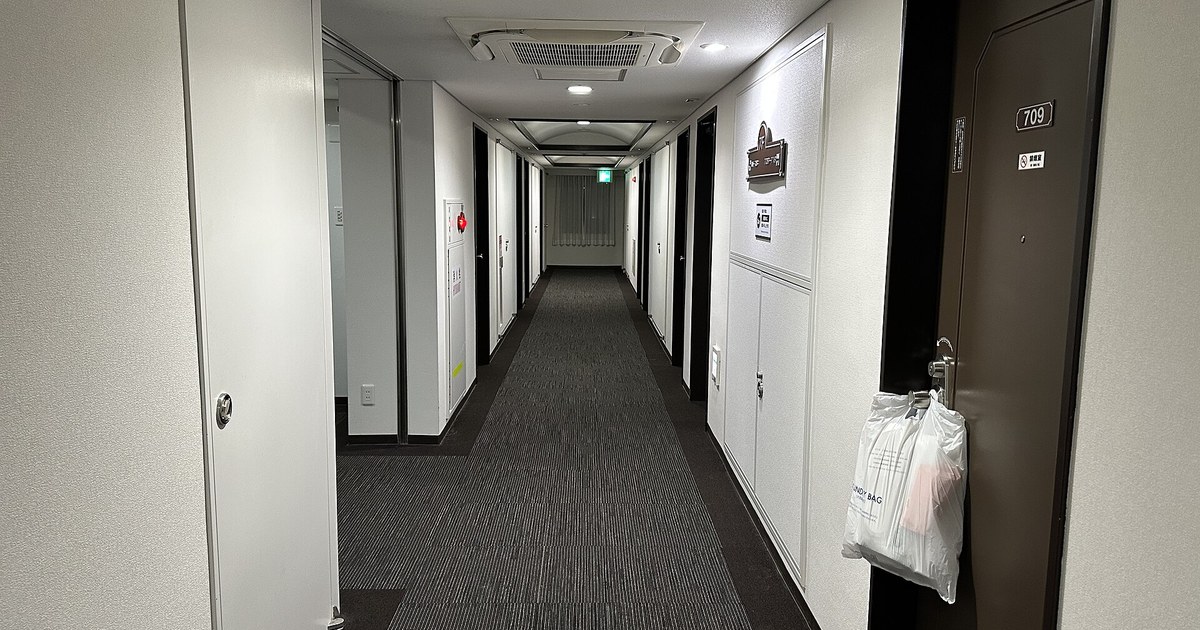
Here is the thing nobody tells you before your first trip to Japan: that “wow, this is tiny” business hotel room in Tokyo may be barely above the legal minimum — and the legal minimum for a room with a bed in it is 9 m², about 97 square feet (Enforcement Order of the Hotel Business Act, Article 1(1)(i); a room without a bed can legally be 7 m²). That is not bad luck. That is the regulation. This guide deliberately contains no room rates, because rates move daily and every price you read online is stale by the time you book. What does not move is the framework — what actually happens, legally, at the moment you hit “reserve”: which operating licence the property holds, what that licence guarantees about space, who is obliged to answer when something goes wrong at 2am, and whether the listing should even exist. And the single most important 2026 development goes up front: Osaka City, which accounts for roughly 94% of all special zone minpaku in Japan (8,887 facilities), stopped accepting new applications on 29 May 2026. Existing properties keep operating; nothing new comes in. Meanwhile, of 65,837 cumulative new-law minpaku notifications nationwide, 23,767 have already been withdrawn.
- Japan has exactly three lodging businesses in law: ryokan/hotel, simple lodging, and boarding house. “Business hotel” is a statistics label, not a legal category
- The floor areas are hard numbers: 9 m² for a hotel room with a bed, 3.3 m² per person for simple lodging, 25 m² per unit for special zone minpaku — unlike prices, these have not moved in years
- The front desk duty is now defined as functions: prompt emergency response, accurate guest register, key handover and non-guest entry control. That is why unmanned check-in is legal
- 🔴 Osaka stopped taking new special zone minpaku applications on 29 May 2026; certified properties continue “as before,” but under an intensive monitoring task force
- Verify minpaku in this order: platform first, entrance second. A missing number on the listing is not illegality — a missing sign at the door is
- Stop sorting platforms by nationality: Agoda and Trip.com both hold Japanese Class 1 travel registration; Jalan itself is Class 3
📖 Contents
- 1. Japan has three lodging businesses in law (comparison table)
- 2. Nine square metres: why Japanese hotel rooms are small
- 3. Why unmanned check-in is legal
- 4. Business, city, resort: three words with no legal force
- 5. Three legal routes to minpaku
- 6. The 2026 shift: Osaka closes the door, a third of the register exits
- 7. Two compliance checks you can actually perform
- 8. Platforms: ask about registration, not nationality
- 9. My call: what a mid-to-high budget traveller should book
- 10. FAQ
Japan has three lodging businesses in law
Start with the foundation. Article 2(1) of the Hotel Business Act is refreshingly short: the hotel business means ryokan/hotel operation, simple lodging operation, and boarding house operation. Three. That is the whole list. The same article, paragraph 5, then defines what counts as staying: using the facility with bedding. That sounds like filler until you realise it is the exact line that separates a lodging facility from an internet café or a 24-hour sauna where you can technically sleep — a distinction we unpack in the guide to what to do when you miss the last train.
⚠️ Before going further, intercept a claim that is still all over the English-language internet: the old split into “hotel operation,” “ryokan operation,” and “simple lodging” is obsolete. Supplementary Provision Article 3 of the Act deems holders of the old hotel-operation and ryokan-operation licences to be operators of the merged ryokan/hotel operation from 15 June 2018. The two separate categories no longer exist in the current statute. Awkwardly, one source of the confusion is official: the Japan Tourism Agency's own minpaku portal explainer still describes the pre-2018 split, flagged only by a note. So if you read that Japanese-style inns run under a different licence class from Western-style hotels, that is pre-2018 knowledge.
The reason to book by licence class is not legal curiosity. It is that one field settles three things you can check in advance and will only regret afterwards:
| Licence class | Statutory floor area / limit | Is anyone obliged to help you | Who is accountable for hygiene and emergencies |
|---|---|---|---|
| Ryokan / hotel operation (city hotels, business hotels, Japanese inns, resort hotels) | 7 m² per guest room; 9 m² if the room contains a bed (Enforcement Order Art. 1(1)(i)) | Highest statutory requirement. A front desk or equivalent equipment is mandatory, and it must satisfy the three functions in Enforcement Regulation Art. 4-3 (emergency response, accurate register, key handover and non-guest entry control) | Licensed and supervised by the prefectural governor via the public health centre; hygiene standards sit directly under the Act |
| Simple lodging operation (capsule hotels, hostels, guest houses, pensions, mountain huts) | Total guest room floor area 33 m²; where the declared capacity is under 10 people, 3.3 m² per person (Art. 1(2)(i); bunk tiers must be roughly 1 m apart vertically) | Same equipment framework applies, but practice varies enormously — from 24-hour staffing to a night-time contact point only | Also under public health centre supervision. The minimum floor area standard was relaxed in April 2016, making the licence easier to obtain than before |
| New-law minpaku (Housing Accommodation Business Act) — a separate regime, outside the Hotel Business Act | No floor area minimum (it is a dwelling, not a lodging facility); 180 nights per year maximum (Act Art. 2(3)) | Depends on the host-absent test. Host-absent properties must delegate management to a registered manager under Art. 11(1)(ii) — your contact is that management company, not the owner | Notification, not licensing. Managers register with the transport minister; brokers register with the Tourism Agency Commissioner |
| Special zone minpaku (National Strategic Special Zones Act Art. 13) | 25 m² per dwelling unit as a rule; minimum stay set by local ordinance, between 3 and 10 days | Per certification conditions; in practice usually remote | Specific certification by the prefectural governor; Osaka City stopped accepting new applications on 29 May 2026 |
| 🚫 No notification, no licence | — | Nobody | Nobody. Offering paid lodging without notification is, in principle, a Hotel Business Act violation |
The value of that table sits in the right-hand columns. You adjust to a small room within a day. What you never adjust to is discovering, at 2am with a flooded bathroom or a lost passport, that no one has a legal duty to pick up. That is why star ratings and review scores are a poor booking filter: a score describes how the last guests felt when everything went to plan. The licence class describes what you have when it does not.
Nine square metres: why Japanese hotel rooms are small
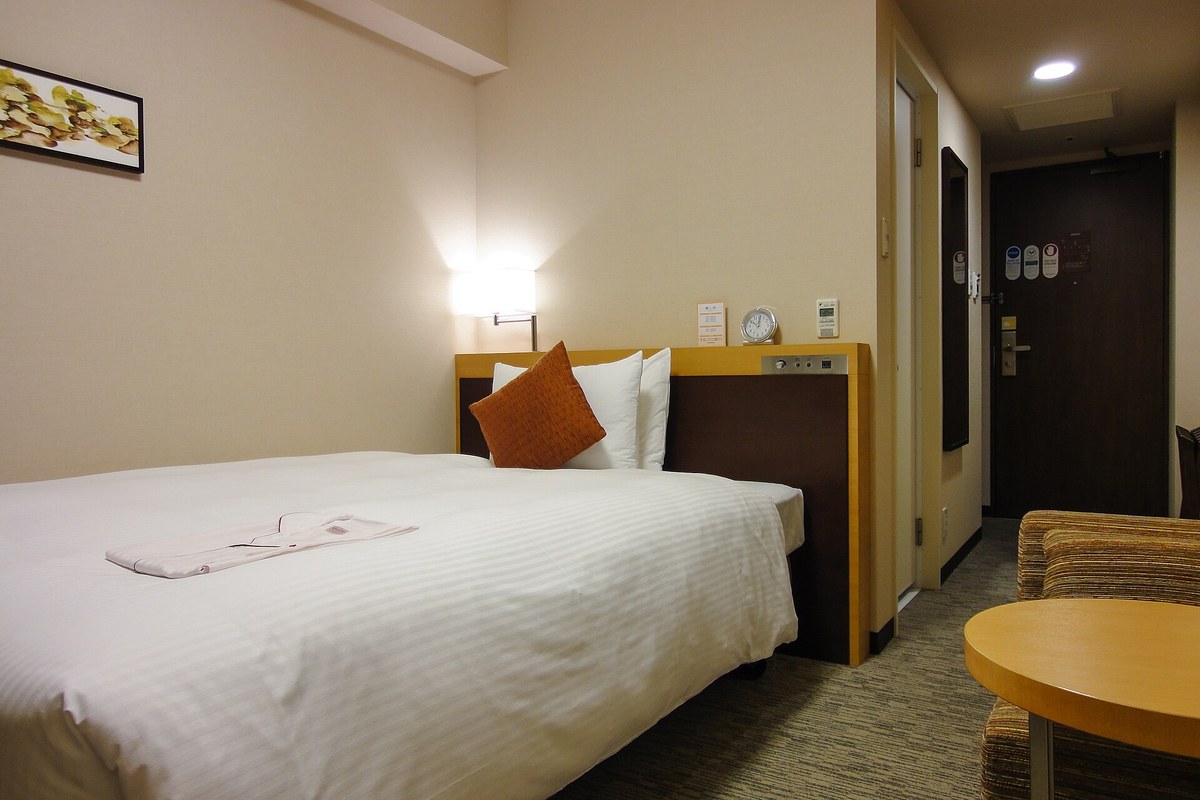
Almost every first-time visitor ends up photographing the moment their suitcase opens and the room stops working. There is a clean answer: Article 1(1)(i) of the Enforcement Order sets 7 m² per guest room, and 9 m² for a room containing a bed. Nine square metres is roughly 97 square feet, and because it is a legal minimum, rooms built right against that line exist and are entirely lawful.
Line the numbers up and the whole market starts to make sense:
- Hotel room with a bed: 9 m². The floor for single-occupancy business hotels.
- Simple lodging: 33 m² total guest room area, or 3.3 m² per person below 10 people. Note that it is a per-person standard, not a per-room one — that is the legal mechanism that lets a capsule hotel fit dozens of pods onto one floor. The same article also requires bunk tiers to sit roughly a metre apart, which is why a capsule is tall enough to turn over in but not to sit up straight.
- Special zone minpaku: 25 m² per dwelling unit. This is the counter-intuitive one. A special zone minpaku unit has a statutory minimum nearly three times that of a hotel room with a bed. So the instinct that “minpaku is cheaper, therefore worse” is wrong on this axis: on space, it carries the strictest requirement in the entire system.
- New-law minpaku: no floor area minimum at all, because in law it is a dwelling. You might get something generous or something cramped; the regime guarantees nothing about size, only about the night cap and the notification duty.
How do you use this when booking? Three ways. First, make the square metre figure a primary filter — it is the one field on a listing that marketing language cannot distort. Under 12 m² for two people with two suitcases and you will be climbing over luggage; around 15 m² is where a room becomes livable for a couple. Second, if a listing does not publish a size at all, treat that silence as information. Third, do not equate area with comfort: in Japanese business hotels the real dividing line is often whether the bathtub has been pulled out of the unit bath in favour of a separate shower, which changes how 12 m² feels far more than another square metre would.
One statistical footnote, because it affects any “how many hotels does Japan have” claim you might read: the Tourism Agency's accommodation survey changed its stratification variable from employee count to room count starting with the January 2026 survey (complete enumeration at 20+ rooms, sampling at 1–19). That means facility counts either side of that change are not directly comparable — so treat any story about Japanese lodging supply suddenly surging or collapsing with suspicion until you know which side of the line it sits on.
Why unmanned check-in is legal
Stay in Japan today and you will regularly meet a hotel with no humans in it: scan the passport, take the card the machine spits out, tap the card to make the lift move. The reasonable question is whether that can possibly be legal. It is, and the basis is explicit.
Article 1(1)(ii) of the Enforcement Order requires a front desk or other equipment enabling appropriate confirmation of the guest. The Ministry of Health ordinance (Enforcement Regulation Article 4-3) then breaks that into three functions:
- Equipment enabling a prompt response in the event of an accident or other emergency.
- Equipment enabling the guest register to be accurately recorded.
- Equipment enabling appropriate handover of room keys and confirmation of the entry and exit of non-guests.
In other words, the statute demands that three functions be satisfied, not that a person be stationed at a counter. That is the legal root of the camera-plus-intercom-plus-card-dispenser stack you keep meeting.
The right reading for a traveller is not that unmanned equals cheap. It is a trade-off, and you should know which side you bought:
- Unmanned suits: flexible schedules, late or pre-dawn arrivals, travellers who would rather not be greeted, and simple itineraries. It usually buys a better price band or a better address for the same money.
- Choose staffed when: you are with elderly relatives or pre-school children; you are travelling in snow or typhoon season, when a network suspension means somebody needs to make phone calls for you; it is your first independent trip; you need luggage held or forwarded; or the itinerary itself is fragile. The regulation says “prompt response” — remote counts, but remote promptness and three-steps-away promptness are not the same product.
One practical detail worth carrying: the third function includes confirming the entry and exit of non-guests. That is why so many Japanese hotels require a room card to select a floor in the lift, and why some will not let visitors upstairs. It is not fussiness — it is part of the equipment duty.
Business, city, resort: three words with no legal force
This section may change how you filter listings. “Business hotel” does not exist in Japanese law.
Its actual source is the Japan Tourism Agency's accommodation travel statistics survey, which divides hotels into three types:
- Resort hotel: built in a leisure or retreat area, mainly serving tourists.
- Business hotel: among hotels, those mainly targeting business travellers on work trips — a definition purely about clientele.
- City hotel: urban properties that are neither of the above.
Read the middle one again: no floor area, no price, no facilities, no service standard. It is a statistical facility type, not a licence, a grade, or a quality promise. Which is exactly why one self-described business hotel can be 9 m² with no window and another 18 m² with a large communal bath — nothing regulates the term.
The same applies to “guest house,” “pension,” and “hostel”: these are colloquial names, and the licence underneath them is usually simple lodging operation. One apparent contradiction is worth resolving, because you will hit it if you dig: the Tourism Agency's statistics place youth hostels under “company and organisation lodgings,” while its minpaku portal explainer lists pensions and youth hostels as examples of simple lodging operations. These do not conflict — the first is a statistical facility type, the second is a licence class. They are different axes. When two official documents appear to disagree, check first whether they are even measuring the same thing.
So how should you use the vocabulary? Treat “business hotel” as a hint about price band and location (usually near a station, simple room types, built for one or two people) and never as a quality judgement. The fields that actually carry information are licence class (who is accountable), square metres (whether you can live in it), and desk type (what happens when something goes wrong). All three are knowable before you book.
Three legal routes to minpaku
English-language coverage tends to treat minpaku as one thing. In Japan it is three distinct legal routes with materially different rights and duties.
Route 1: new-law minpaku (Housing Accommodation Business Act)
The most common route, in force since 15 June 2018. Key features:
- Notification, not licensing (Art. 3(1)). A lower barrier to entry — and correspondingly thinner guarantees for you.
- 180 nights per year (Art. 2(3)), where the year runs noon on 1 April to noon on 1 April, a day runs noon to noon, and the tally is kept per notified dwelling. Practical inference: the closer to March, the more likely a property has spent its allowance. This is the one scenario where I would tell a February or March traveller resting on a single minpaku booking to line up a backup.
- Host-absent properties must delegate to a registered management company (Art. 11(1)(ii)). Your escalation path is that company, not the owner. Being able to find the management company's name before booking is worth more than the host's profile photo.
- Exceeding 180 nights without a Hotel Business Act licence puts the excess in breach of Art. 3(1) of that Act, per the official guidance. The cap is genuinely hard.
Route 2: special zone minpaku (National Strategic Special Zones Act Art. 13)
Certified specifically by the prefectural governor, and only within designated zones. Three things matter:
- 🔴 It is not foreigners-only. The Cabinet Office publicly corrected this, noting the misunderstanding had spread and explaining that Article 13 requires the facility to be suitable for foreign guests, while imposing no provision at all on who the users are.
- There is a minimum stay, and it is not national. The statutory frame is “not less than a period set by ordinance, between 3 and 10 days,” so the “2 nights minimum” figure you may have read is one municipality's number, not the country's.
- 25 m² per unit as a rule. This is its real advantage: space, and suitability for families or anyone who needs to cook and do laundry. For a group of four or more staying four nights or longer, a special zone minpaku often beats two business hotel twins — provided you accept the supply risk in the next section.
Route 3: operating under a simple lodging licence
The Tourism Agency states it plainly: providing paid, repeated lodging is in principle a hotel business even when a dwelling is used, and operators who do not go the notification route generally obtain a simple lodging operation licence instead. From a listing, this route often looks identical to minpaku — but it sits under the Hotel Business Act, has no 180-night cap, and is supervised by the public health centre. In protection terms it is the strongest of the three.
The 2026 shift: Osaka closes the door, a third of the register exits
If you take one section from this guide, take this one. Minpaku is not stable supply, and 2026 is the first year the numbers make that measurable.
Osaka City stopped accepting new special zone applications on 29 May 2026
Scale first. Per the Cabinet Office's special zone minpaku performance data (figures as of 31 May 2026), the national total is 9,426 facilities and 26,167 dwelling units — of which Osaka City alone accounts for 8,887 facilities, roughly 94%. Second place, Ota Ward in Tokyo, has 472. After that it drops to Niigata 3, Kitakyushu 3, Chiba 2, Kibichuo 1. Talking about special zone minpaku is, in practice, talking about Osaka.
And Osaka City's own page is unambiguous: new applications for special zone minpaku ended on Friday 29 May 2026. Applications to add dwelling units or increase floor area stopped the same day, and the public health centre concluded its certification work on 30 June 2026. Osaka Prefecture (excluding Kaizuka, Izumisano, Kawachinagano and Habikino) closed on the same date; Yao City had already closed on 28 November 2025. The city's stated reason is the rise in disputes and complaints from neighbouring residents as facilities multiplied, with policy shifting toward bringing existing operations into line.
⚠️ Precision matters here, because the misreading has already started: what stopped is new applications, not existing properties. Osaka City states that facilities certified before 29 May 2026 can continue operating as before. Your booked special zone minpaku does not evaporate. At the same time, the city has set up a dedicated task force to monitor and instruct existing operators intensively.
What this actually means for your trip, in three points:
- Osaka's special zone supply can now only shrink. Nothing new enters, while visitor numbers are not falling — a structural supply shift, not a one-off news item. Anyone planning a 2027 Osaka trip should settle accommodation earlier than they used to.
- Compliance pressure on existing properties is up. Intensive monitoring raises the odds that problem properties get acted on. A listing that is visibly at odds with its neighbours is a worse bet than it was a year ago.
- ⚠️ No sunset date has been announced for existing facilities. The official text says only that they may continue operating as before. Any claim that Osaka minpaku will all be shut down by a specific date currently has no official basis.
Nationally: 65,837 notifications, 23,767 already withdrawn
The second dataset is just as blunt. Per the Tourism Agency, as of 15 July 2026: 65,837 cumulative notifications, 23,767 businesses withdrawn, leaving 42,070 active notified dwellings; 4,529 registered management companies and 66 registered brokers. Against 2,210 notifications on the day the regime started in June 2018, growth has been dramatic — but so has attrition, at more than a third of all notifications.
Locally it is starker: Osaka City shows 6,201 notifications against 3,945 withdrawals, about 64% exited; Hiroshima 691 against 380; Arakawa Ward 106 against 93. Active dwellings cluster where you would expect — Shinjuku 3,775, Sumida 2,314, Shibuya 1,845, Toshima 1,826, Taito 1,373 in Tokyo; Sapporo 3,041, Osaka City 2,256, Fukuoka Prefecture 1,844, Kyoto City 1,315, Okinawa Prefecture 1,196 (Naha 427).
Put the two datasets together and the conclusion is one sentence: a meaningful proportion of the minpaku you are looking at right now will be gone before long. That is not an argument against booking one. It is an argument for deciding, at booking time, what you would do if it vanished. Hotels and inns exit at nowhere near that rate — that gap is what the price difference is buying.
If your trip is anchored in central Osaka or Tokyo and you want to see how hotel supply compares against apartment-style listings for the same dates, a price comparison is the fastest way to sanity-check availability: check what is open in Osaka for your dates →, and the same for Tokyo accommodation →. One caveat: comparison tools answer “is there a room and what does it cost.” They will not tell you which licence the property holds — that is what the next section is for.
Two compliance checks you can actually perform
Enough framework. Here is execution — and note that the Tourism Agency's own advice to travellers has a clear order of priority, and it runs the opposite way to instinct.
First: look at which platform you are standing on
The official notice to guests about avoiding illegal minpaku says that it is important to search for minpaku on appropriate websites — meaning the sites of registered housing accommodation brokers or travel agents registered under the Travel Agency Act — because those operators are barred from handling illegal properties (Article 12; breach punishable by a fine of up to ¥500,000 under Article 75), and the agency publishes the full list.
As of 22 June 2026 there are 66 registered housing accommodation brokers, and essentially every name you would recognise is on it: Airbnb Global Services Limited (S0001), Ctrip (S0050), EXPEDIA, INC. (S0106), AGODA TRAVEL SERVICES PTE. LTD. (S0118), HomeAway.com, Inc. (S0131) and others. This is the first filter for legality, it is published by the regulator, and you can check it yourself.
There is also a shorter list of travel agents handling minpaku (10 companies, as of end-March 2025), but the agency annotates it clearly: travel agents not named on the list may still handle minpaku properties. Do not use it as a blacklist.
While we are here: a booking site's "property type" is not a licence type
That row of filters down the left of a booking site looks like it is classifying properties for you. It isn't. Trip.com, for instance, sorts Japanese stays into three buckets — hotels, B&Bs and apartments, hostels — and the middle one holds new-law minpaku, special-zone minpaku, apartments running on a simple lodging licence, and entirely conventional aparthotels all at once: four different legal statuses under one label. The hostel bucket mixes in ryokan and inns too. No bucket corresponds to "licensed, and licensed as what". That is not a failing on the platform's part — those categories exist to help you pick a room type, not to establish regulatory status.
Which is exactly why the order above matters: a platform can filter for "is this intermediary registered", never for "which licence does this listing hold". Only the door tells you that.
You can watch this happen in the data. Scraping Trip.com’s Taiwan site in August 2026 and reading the category code attached to each property: of the 1,573 Osaka stays under TWD 3,300 a night, 1,272 — 81% — are filed as “hotel”. Tokyo’s cheapest listing that day was called “Asakusa Keikyu Karin Hostel”; the word hostel is in the name and the platform still files it as a hotel. Better still: the single “hostel” checkbox expands into four sub-tags in Tokyo and three in Osaka — the platform’s own taxonomy is not even consistent between cities.
One more thing the search results show and the booking page doesn’t: weekends don’t get more expensive so much as the cheap tier disappears. Same two people, same one night, moving the date from Wednesday 11 November to Saturday 14 November: places bookable under TWD 1,800 a night fall from 101 to 39 in Tokyo, and from 196 to 48 in Osaka. What survives is also differently shaped — among Tokyo stays under TWD 3,300, the share priced per bed rather than per room jumps from 13% on the weekday to 37% at the weekend. It also explains why “cheap” means different things in the two cities: on the same night under TWD 3,300, 81% of Osaka’s cheap supply is a whole hotel room, while in Tokyo 21% is hostel or capsule and 13% is sold by the bed.
(Trip.com Taiwan site, 20 August 2026; one room, two adults, one night, TWD, including the platform’s own taxes and fees but not Japan’s accommodation tax. These are counts from a single snapshot, and the platform caps its result set — the weekday figure is understated, so the real contraction is larger than shown, not smaller. Counts rather than prices on purpose: re-running the same query the same day moved prices by up to 25%, so a price range here would be false precision.)
Second: on arrival, look at the door
Article 13 of the Housing Accommodation Business Act: the operator must display, at each notified dwelling, in a place visible to the public, a sign in the format prescribed by ministerial ordinance. There is no exemption. The implementation guidance (revised 24 December 2024) specifies the gate or entrance, at roughly 1.2 to 1.8 m above ground, in a position the public can readily notice; for apartment buildings it further recommends a simplified sign at the shared entrance or mailboxes. The sign must carry the notification number and the operator's contact details.
🔴 Now correct a widely repeated test: “no notification number on the listing means it is illegal” is wrong. The guidance describes website display as recommended, not required. The accurate formulation is:
Not seeing a number online does not make a property illegal. Arriving and finding no sign at the entrance does put it in breach of Article 13.
One more misreading to intercept: people sometimes cite the Tourism Agency's summary page, which mentions that display of the sign is excluded for host-absent properties, and conclude that host-absent minpaku need no sign. That passage lists duties that may not be delegated to a management company; it is not an exemption. The signage duty applies to every notified dwelling.
How to combine them in practice: use the first check before booking, the second on arrival. If there is no sign at the door, photograph it and contact the platform you booked through — if you booked on a registered broker's site, that operator has statutory obligations here. Which is exactly why the platform check comes first.
Platforms: ask about registration, not nationality
This section overturns something I assumed was true until I checked it: the idea that Japanese platforms and international platforms carry different inventory, and that international platforms have no legal standing in Japan, is simply out of date in 2026.
From the Japan Tourism Agency's list of Commissioner-registered Class 1 travel agents (as of 29 June 2026), checked entry by entry:
| Operator | Travel business registration | Notes |
|---|---|---|
| Ikyu Corporation | Commissioner registration No. 1973 | Class 1 |
| Rakuten Group (Rakuten Travel) | No. 1964 | Class 1; the same number is self-published on its corporate page, and it is a full member of JATA |
| Agoda International Japan K.K. | No. 2161 | Class 1, registered 12 July 2024 |
| Trip.com International Travel Japan | No. 2187 | Class 1, registered 19 September 2025 |
| Traveloka Japan | No. 2174 | Class 1 |
| ANA Jalan Pack | No. 1968 | Class 1 |
| Jalan net (Recruit Co., Ltd.) | Tokyo Governor registration No. 3-7538 | Class 3 — not on the Class 1 list |
| Booking.com B.V. / EXPEDIA, INC. | Not found on the Class 1 list | ⚠️ Both are Tourism Agency registered housing accommodation brokers; see caveats below |
Read that again: Agoda and Trip.com both hold Japanese Class 1 travel business registration, while Jalan itself is Class 3. Nationality is not the dividing line at all. Picking a platform on the theory that a Japanese brand is inherently safer will, in 2026, have you backing the wrong assumption.
⚠️ Two caveats that must travel with that table, or it will be over-read:
- The Class 1 list only covers Commissioner-level registration. Class 2 and Class 3 are prefectural governor registrations and the agency publishes no national roster of them — so absence from the Class 1 list is not evidence of no registration. Jalan is the living proof.
- Booking.com and Expedia are absent from the Class 1 list, but both are Tourism Agency registered housing accommodation brokers. So “those platforms are unregulated in Japan” is false. What this guide can verify is only that they are not on the Class 1 list — it will not claim they are unregistered.
So where is the line the regulator actually draws? On the Tourism Agency's page about verifying travel business registration (last updated 1 July 2025), which states that where a foreign travel company with no business office in Japan opens a Japanese-language website and takes bookings, a booking made on that website is not protected by Japan's Travel Agency Act or related laws.
In plain terms: the boundary is not Japanese company versus foreign company. It is whether your booking is formed with an entity that has a Japanese office and a Japanese registration. The same page sets out how registration classes are displayed, which makes it checkable: Class 1 reads “Commissioner of the Japan Tourism Agency registered travel business No. ___,” Class 2 “___ Governor registered travel business No. 2-___,” Class 3 “No. 3-___,” and agency businesses “travel agency business No. ___.” Finding that line in a platform's footer before you book beats reading ten platform reviews.
One last thing, on what this guide deliberately will not say: the popular claim that half-board (one night, two meals) ryokan packages only appear on Japanese platforms has no official or platform-published support that I could find, so it appears nowhere in this article. If you meet it elsewhere, treat it as unsourced anecdote. For half-board inns specifically, the booking-window research in our guide to five Japanese onsen ryokan worth the trip is far more useful than betting on platform differences.
My call: what a mid-to-high budget traveller should book
Collapsing all of that into advice. No hedging.
Default: a ryokan/hotel operation, staffed desk preferred
For a 5 to 14 day, mid-to-high budget, city-anchored trip, default to a licensed ryokan/hotel property. Not because it is fancier, but because its downside risk is lowest: health centre licensing and supervision, a statutory front desk duty, exit rates far below minpaku, and luggage holding and forwarding usually available as standard. The premium buys accountability when things break. In snow season, typhoon season, and anywhere transport is fragile, that premium has its highest return.
When minpaku is genuinely the better answer
I am not against minpaku. It has a clear zone of usefulness:
- Four or more people, four nights or longer, needing laundry and a basic kitchen. Here the 25 m² statutory minimum for special zone units is a concrete advantage — two 12 m² hotel twins split your group across a corridor; one unit keeps everyone in the same space.
- You have accepted that it is a dwelling, not a hotel. No lobby, no 24-hour desk, local rubbish sorting rules to follow, and genuine quiet expected at night (neighbour friction is the largest source of complaints, and a direct cause of Osaka closing its intake).
- You have a fallback. Given the withdrawal figures above, decide in advance what you would do if the property disappeared.
Listings I would close immediately
- Minpaku found anywhere other than a registered broker or travel agent site. This is the regulator's own first-priority advice, and the list is public.
- Any minpaku with no sign at the entrance on arrival. Article 13 has no exemption — that is not a grey area, it is a breach.
- Hotels that do not publish a room size. Not because the room must be small, but because the one objective field is the one they chose to withhold.
- Pages whose entire pitch is “business hotel” or “city hotel.” Those words carry no legal force in Japan, so a listing leaning on them has told you nothing.
- A February or March trip resting on a single new-law minpaku with no backup. The 180-night allowance only resets at noon on 1 April, making late winter the likeliest time to hit a wall.
Three things to do before you fly
- Add square metres to your filter set, and read every figure against 9 m² as the statutory baseline.
- Confirm the desk arrangement, especially for a late arrival or when travelling with children or older relatives.
- Budget the accommodation tax separately. It is not always inside what the booking site already charged you, and it can appear at checkout — rates, calculation and the 2027 changes in Tokyo and Okinawa are all in our Japan accommodation tax and bathing tax breakdown, which is why this guide quotes not a single rate. For whole-trip figures see how much a Japan trip actually costs, for cutting long-distance rail fares to the bone see whether the Seishun 18 Ticket is worth it, and if you are going alone the solo travel guide compares room types from that angle. Everything else pre-departure sits in our Japan trip essentials checklist.
To close: the information gap in Japanese accommodation is not about price. Prices you can compare in three minutes. Which licence a property holds, and who answers the phone when it goes wrong, is the thing no booking site will volunteer — and unlike a nightly rate, it does not change from one year to the next. Learn it once.
Frequently Asked Questions
- Q1:Why are Japanese business hotel rooms so small?
- Because the legal floor really is that low, and it has nothing to do with the hotel cutting corners. Article 1(1)(i) of the Enforcement Order of Japan's Hotel Business Act sets the minimum guest room size for a ryokan/hotel operation at 7 m² per room, or 9 m² if the room contains a bed. Nine square metres is roughly 97 square feet. Take out one single bed, one unit bath, and one narrow desk, and that is the room you paid for near Tokyo Station. The useful consequence: “the room was small” should be your expectation, not your review criterion. What actually varies between properties is how far above 9 m² they sit, and the listing figure — 12 m², 15 m², 18 m² — is the single most honest number on any booking page. It is not marketing copy, and no star rating substitutes for it. The same enforcement order also sets a floor for accessible rooms, and that one is low enough to surprise people — 1% rounded up for properties of 50 rooms or more, so a 200-room hotel is legally required to have two. See our accessible Japan guide.
- Q2:Is a business hotel a class of hotel in Japan?
- No. The term has no legal existence in Japan at all. The Hotel Business Act recognises exactly three businesses — ryokan/hotel operation, simple lodging (kan-i shukusho) operation, and boarding house operation. There is no business hotel category. The phrase comes from the Japan Tourism Agency's accommodation travel statistics survey, which splits hotels into three types, one of which is defined simply as “hotels mainly targeting business travellers on work trips.” That definition covers clientele only — no floor area, no price band, no facility requirement. This is exactly why two properties both calling themselves business hotels can be wildly different: nothing regulates the word. The same survey defines a resort hotel as one built in a leisure or retreat area mainly for tourists, and a city hotel as an urban property that is neither of the other two. All three are statistical labels, not licences and not guarantees.
- Q3:Are hotels with no staffed front desk and only a check-in kiosk legal in Japan?
- Yes, and they have been the norm since a 2018 reform. Article 1(1)(ii) of the Enforcement Order requires a front desk “or other equipment enabling appropriate identity confirmation,” and the Ministry of Health ordinance (Hotel Business Act Enforcement Regulation Article 4-3) defines that as three functions: equipment enabling a prompt response in an accident or other emergency; equipment enabling the guest register to be accurately recorded; and equipment enabling appropriate handover of room keys and confirmation of non-guest entry and exit. The law demands functions, not a human standing behind a counter — which is precisely why unmanned check-in machines spread so fast. Treat it as a trade-off rather than a downgrade. Unmanned properties usually buy you a better price band or a better location; what you give up is that the “prompt response” is remote. If you are travelling with elderly parents or small children, arriving after midnight, or going in snow or typhoon season, a staffed desk is worth the premium.
- Q4:Is minpaku legal in Japan, and how do I check the place I booked?
- Minpaku is legal, but there are three separate legal routes, and the official verification method has a specific order. The Japan Tourism Agency's first recommendation to travellers is not to hunt for a registration number — it is to search only on the websites of registered housing accommodation brokers or registered travel agents, because Article 12 of the Housing Accommodation Business Act bars those operators from listing illegal properties (breach carries a fine of up to ¥500,000 under Article 75), and the agency publishes the full list. The second check happens on arrival: Article 13 requires the operator to display, at every notified dwelling, a sign in a place visible to the public bearing the notification number and contact details, and the implementation guidance puts it on the gate or entrance at roughly 1.2 to 1.8 m above ground. ⚠️ Correct one widespread claim here: a listing that shows no notification number is not proof of illegality — online display is only “recommended” in the guidance. But a property with no sign at the entrance is in breach of Article 13, and that is a check you can perform yourself.
- Q5:How is the 180-day minpaku cap calculated, and does it affect my booking?
- It does, and its year does not start in January. Article 2(3) of the Housing Accommodation Business Act caps new-law minpaku at 180 nights of guest accommodation per year, and the Japan Tourism Agency defines the terms precisely: one year runs from noon on 1 April to noon on 1 April the following year, one day runs from noon to noon, and the count is kept per notified dwelling. The practical inference for travellers is that minpaku availability runs on a fiscal-year quota — the closer you get to March, the higher the chance a given property has burned through its allowance. So a February or March trip that rests entirely on one new-law minpaku with no fallback carries more risk than the same trip in October. Also worth knowing: exceeding 180 days without a Hotel Business Act licence puts the excess in breach of Article 3(1) of that Act, so the cap is hard and operators have no discretion to stretch it.
- Q6:Is special zone minpaku (tokku minpaku) restricted to foreign guests?
- No — and the Cabinet Office issued a public correction about this exact misunderstanding. The official wording notes that “a misunderstanding has spread as if users were restricted to foreigners,” and explains that Article 13 of the National Strategic Special Zones Act requires the facility to be suitable for foreign guests staying, while imposing no provision whatsoever on who the users are. Two features matter far more to your booking. First, the legal minimum room size is 25 m² per dwelling unit — nearly three times the 9 m² floor for a hotel room with a bed, which is why this category suits families and longer stays. Second, there is a minimum stay length, and it is not uniform nationwide: the statutory framework is “not less than a period set by ordinance, between 3 and 10 days.” Each municipality sets its own, so check how many nights the property requires before you commit.
- Q7:What changed in the Japanese minpaku market in 2026?
- Two things, and both point to the same conclusion: minpaku is not stable supply. First, Osaka City — which alone accounts for about 94% of all special zone minpaku in Japan (8,887 facilities) — stopped accepting new applications on 29 May 2026. Applications to add rooms or increase floor area stopped the same day, and the public health centre wound up its certification work on 30 June 2026. ⚠️ Be precise about what stopped: new applications, not existing properties. Osaka City's own page states that facilities certified before that date “can continue operating as before,” while the city has set up a task force to intensively monitor and guide existing operators. Second, turnover in the new-law minpaku register is startling: as of 15 July 2026 there were 65,837 cumulative notifications, of which 23,767 had already been withdrawn, leaving 42,070 active dwellings. In other words, a meaningful share of what you see listed today will not be there for long — book early, and keep a fallback.
- Q8:Do Japanese booking sites and international booking sites really carry different inventory?
- Sorting platforms by nationality is out of date in 2026, and it will make you back the wrong horse. Per the Japan Tourism Agency's list of Commissioner-registered Class 1 travel agents (as of 29 June 2026): Agoda International Japan is No. 2161 (registered July 2024) and Trip.com International Travel Japan is No. 2187 (registered September 2025) — both hold Japanese Class 1 travel business registration. Meanwhile Jalan net itself displays Tokyo Governor registration No. 3-7538, which is Class 3. Nationality is not the dividing line. The line the regulator actually draws appears on its own page about verifying travel business registration: a booking made on the website of a foreign travel company with no business office in Japan is not protected by Japan's Travel Agency Act or related laws. So the question worth asking is not whether the brand is Japanese, but whether it holds a Japanese registration and which legal entity your booking is with. ⚠️ One honest caveat: the Class 1 list only covers Commissioner-level registration — Class 2 and Class 3 are prefectural governor registrations and do not appear on it, so absence from that list is not proof of no registration.