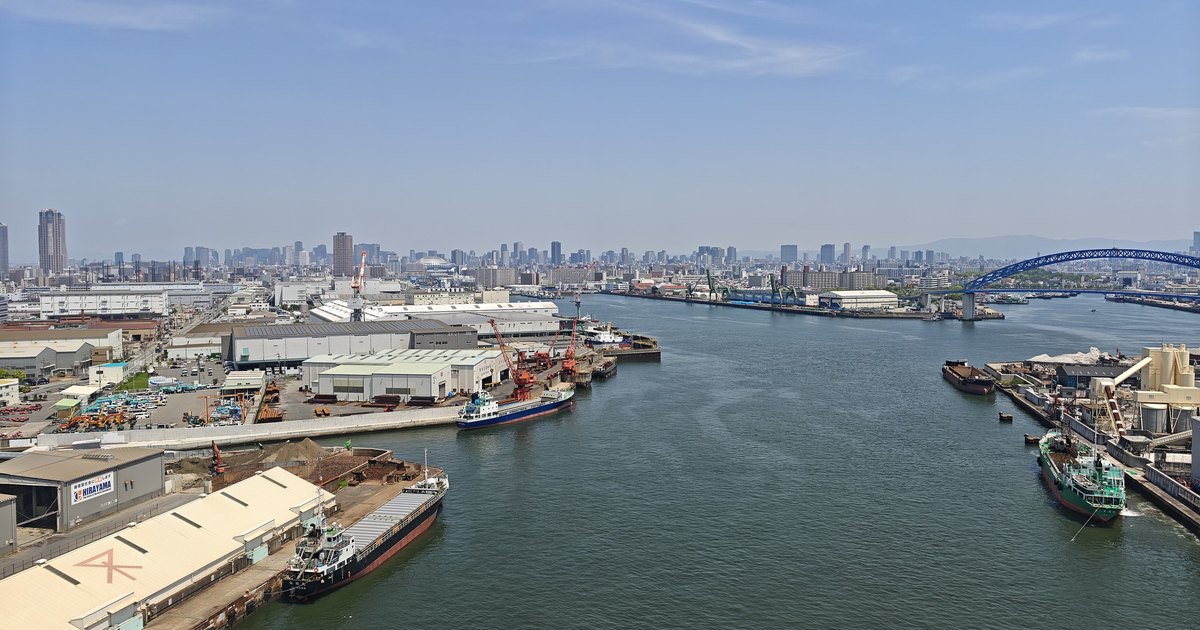
The thing most visitors brace for blows in from the mainland. The only thing Japan still issues alerts for is made inside Japan, by its own traffic and factories, under an August sun. Three numbers set the frame: national PM2.5 averages 8.4 micrograms per cubic metre against a standard of 15, Japan issued zero PM2.5 advisories in fiscal 2025, and Asian dust is observed somewhere in the country on about 9 days a year with July, August and September normals of 0.0. The system that does fire went off across 16 prefectures on a cumulative 47 days in 2025, 19 of them in August. This article separates the three pollutants, shows how differently the government treats each one, tells you which official page to check today, and names the official URLs that no longer work.
This is about what the Japanese government has published and what it has not, and where you can look things up on the ground. It contains no medical advice. If you have a respiratory or cardiovascular condition, follow your own doctor.
- By the government's own scorecard, Japan's air is clean. Fiscal 2024 PM2.5 attainment 99.5%, national mean 8.4, and zero advisories nationwide in fiscal 2025.
- Asian dust runs about 9 days a year, and summer is zero. March to May holds 86% of it; July, August and September normals are 0.0 days. The ministry says that in Japan it mostly amounts to a warning about dirty cars and laundry.
- The pollutant that fires every year is photochemical oxidant. 47 days across 16 prefectures in 2025, 19 days in August, zero in April and October, generated by Japanese traffic and industry under sunlight.
- The advisory is statutory; the warning is not. Advisory 0.12 ppm under the Air Pollution Control Act; warning 0.24 ppm set by each prefecture's own internal rules, and the ministry notes some prefectures use a different number.
- Some of the places the government tells you to look no longer exist. All three URLs printed in the ministry dust booklet were unreachable at verification, one of them returning 200 while redirecting. The living, English-language option is the meteorological agency.
Contents (click to expand)
- How clean is Japan's air, really?
- How many days a year does Asian dust arrive?
- Is Asian dust the same thing as PM2.5?
- Where do you check today's conditions?
- What does Japan actually issue alerts for?
- Advisory versus warning: what is the difference?
- Do you need a mask, and which one?
- Who should pay closer attention?
- Why will Japan's dust numbers never be updated again?
- So does this trip need any preparation?
- Appendix: official Japanese source text
How clean is Japan's air, really?
Clean enough that the alert system fires roughly once every two years.
Start with the most checkable line. In the fiscal 2024 air quality results the Ministry of the Environment released on 26 May 2026, PM2.5 met the environmental standard at 99.5% of general ambient monitoring stations and 100% of roadside stations, with a national annual mean of 8.4 micrograms per cubic metre. The standard itself sits under Article 16, paragraph 1 of the Basic Environment Act, set in September 2009, at an annual mean of 15 or below and a daily mean of 35 or below. The national average is a little over half the limit. (The official page gives only the September 2009 date and no notification number, so none is invented here.)
| Pollutant | Fiscal 2024 attainment (general stations) | Alerts actually issued |
|---|---|---|
| PM2.5 | 99.5% | Zero in fiscal 2025 |
| SPM (the band Asian dust pushes up) | 100% | No such scheme |
| Nitrogen dioxide | 100% | — |
| Carbon monoxide | 100% | — |
| Sulphur dioxide | 99.6% (non-attaining stations attributed officially to volcanic eruption) | — |
| Photochemical oxidant | 0% | 47 days across 16 prefectures in 2025 |
That table is the skeleton of this article. The first five rows are the good news. The last row is the subject, and it has nothing to do with the mainland.
The PM2.5 alert fired once in two years
Alongside the environmental standard, Japan has run an advisory scheme since February 2013. It triggers when the day-average is forecast to exceed 70 micrograms per cubic metre, and prefectural governors issue it. The 2026 environment white paper records zero advisories nationwide for fiscal 2025. The previous edition records one for fiscal 2023. That is not a travel site being generous about Japan; it is the government printing the count year by year.
The expert panel report that set the 70 threshold puts two sentences side by side, and dropping either one distorts it. Exceeding 70 does not mean every person will necessarily experience health effects. And highly sensitive individuals may show short-term effects even below 70. Read 70 as an administrative trigger for issuing a notice, not as a safety line for the human body.
How many days a year does Asian dust arrive?
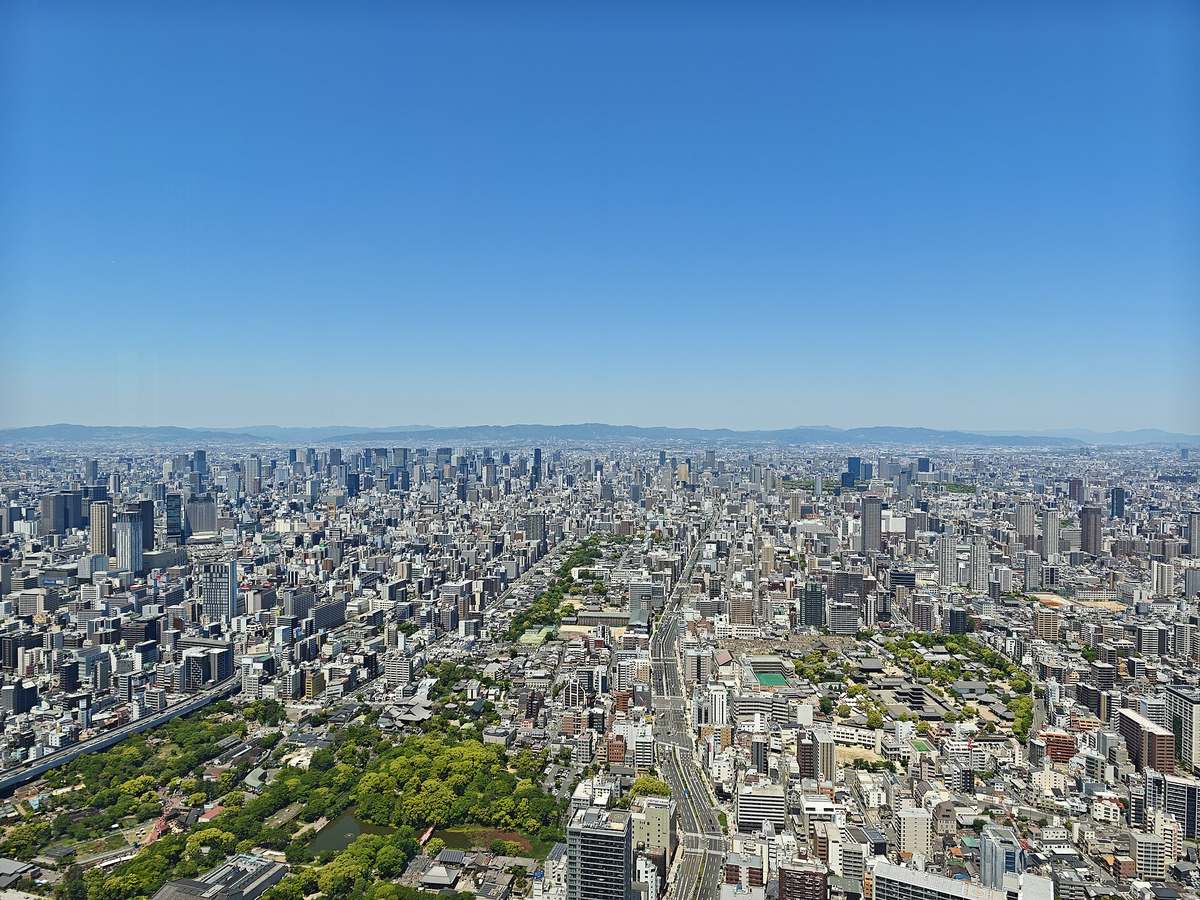
About nine, counted across the entire country, and the July to September normals are 0.0.
The Japan Meteorological Agency dust observation record averages 8.9 days per year over 2014 to 2023, peaking at 16 days in 2021 and bottoming at 3 in 2017. The historical highs are further back: 38 days in 2001 and 36 in 2002. Monthly normals for 1991 to 2020 look like this:
| Month | 1 | 2 | 3 | 4 | 5 | 6 | 7 | 8 | 9 | 10 | 11 | 12 |
|---|---|---|---|---|---|---|---|---|---|---|---|---|
| Normal (days) | 0.2 | 1.2 | 4.4 | 6.2 | 2.7 | 0.2 | 0.0 | 0.0 | 0.0 | 0.2 | 0.4 | 0.2 |
March, April and May total 13.3 days, about 86% of the year. Read the table against its definition: the agency counts days on which any weather station in Japan observed dust, so five stations seeing it on the same day still counts as one. It is not a count of what your city will get. Scaling it down, the 2023 station-day total of 40 divided across the 11 observation points then in service works out at roughly 3.6 days per location per year.
No percentage is offered here. The government has never calculated one, and dividing 9 by 365 produces our arithmetic rather than an official figure, which is exactly the kind of number that gets quoted back as fact once it appears as a percentage.
Do not treat dust as a season
The meteorological agency states in its own FAQ that it does not compile first and last dates for dust, because dust can be observed in any season even though it is more common in spring. The environment ministry runs parallel: dust reaches the Japanese archipelago year-round apart from summer, starts increasing around February, and peaks March to May.
So the accurate framing is that dust concentrates in spring without having an officially recognised start and end. That is a real contrast with pollen, where the dispersal start date has a precise official definition. Here the government declines to compile the statistic at all.
The reason spring dominates is in the official text too, and it does not require hand-waving about westerlies. From summer into autumn plants cover the ground, and in winter frozen soil and snow cover hold it down. In early spring the vegetation has not grown in yet and there is neither frost nor snow, so dust is far more likely to be raised.
Geography: the government gives a direction, not numbers
The ministry health booklet offers one line on geography: as a general tendency, the further a region is from the continent, the smaller the effect. Kyushu and the San'in coast get more than Kanto. But no regional day-counts have been published, so this article gives the direction and does not rank prefectures.
How the government itself describes the severity
This is the single most worthwhile line in the whole file. The ministry writes, in two places, that on very rare occasions dust does reach Japan while still concentrated and causes significant transport disruption such as cancelled flights. But in most cases the concentration has fallen by the time it reaches Japan, and in Japan it mostly amounts to advisories about dirt on cars and laundry.
The corroboration is almost funnier than the statement. The National Institute for Environmental Studies dust information Q&A has four questions, and one of them is whether it is safe to hang out the laundry tomorrow, answered by pointing readers at the meteorological agency dust forecast. The entire official dust apparatus has, by its own account, laundry as a principal use case.
Is Asian dust the same thing as PM2.5?
Not the same thing, but PM2.5 readings do rise when dust arrives.
The ministry wording is precise: the fraction of dust with smaller particle sizes is included in PM2.5, so PM2.5 concentrations rise when dust arrives. Note what it says, and does not: the fraction with smaller particle sizes, not all of it.
One number then separates the two. Official material puts the mass density distribution of dust reaching Japan at a peak near 4 micrometres in diameter, while PM2.5 is defined at 2.5 micrometres and below. Most of the mass of Asian dust sits outside PM2.5, in the SPM band at 10 micrometres and below.
The institutional evidence is blunter. The dust information website run jointly by the environment ministry and the meteorological agency carries a glossary explaining SPM and PM-10 and nothing for PM2.5, and the ministry health booklet uses an SPM reading of 0.2 milligrams per cubic metre as its corroborating indicator for high dust concentrations. When the government looks at dust, it reaches for a different ruler entirely.
How the instruments tell them apart: by shape
Spherical means pollution; non-spherical means dust. Particulate air pollutants generated from exhaust are generally spherical, while dust particles are not. Lidar fires a polarised laser and reads how far the polarisation state of the return has been disturbed, which resolves shape, which separates two classes of particle the eye cannot. It also explains why methods disagree: the operators note that lidar results do not necessarily match the meteorological agency visual observations, and that locally raised sand, dust or drizzle can also register as a high value.
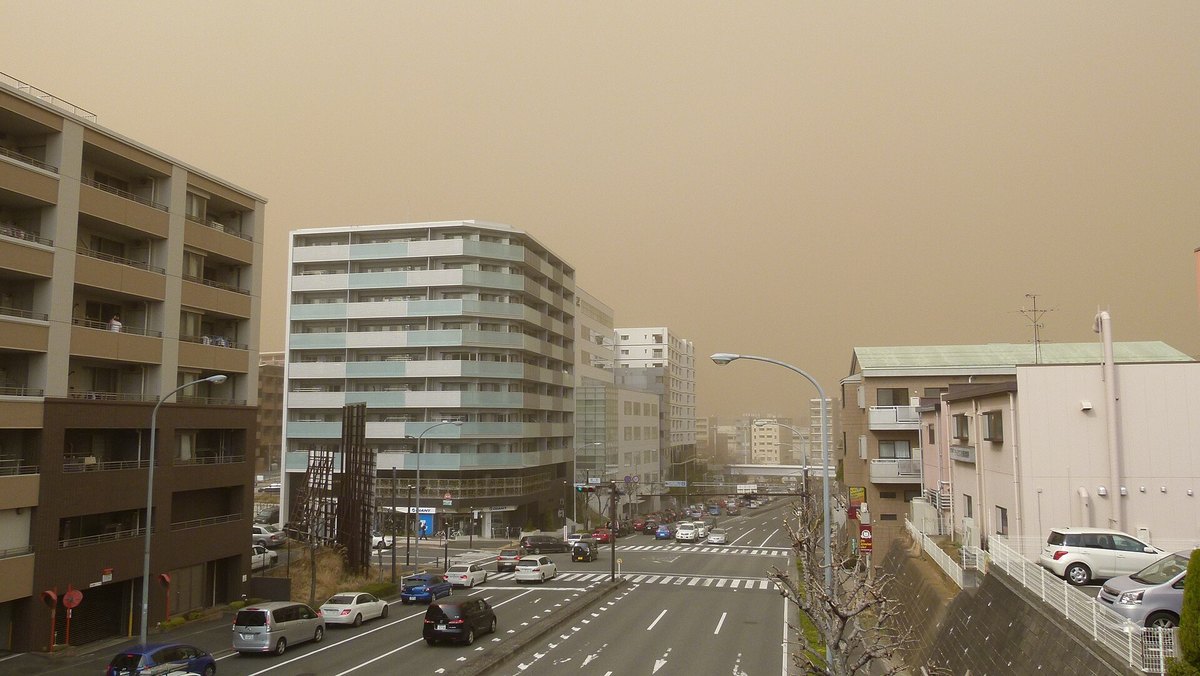
If the sky looks hazy, is it dust?
Not necessarily, and the government supplies a third candidate. The National Institute for Environmental Studies states plainly that a hazy sky is not necessarily dust, since particulate matter of pollution origin can produce the same appearance. The meteorological agency adds another: even with no dust arriving, on days under a high-pressure system with weak winds, fine dust and grit suspended in the air stagnate instead of blowing away, and the sky goes milky. Weather stations record that as a distinct phenomenon, enmu, usually translated as haze.
So a whitish sky in Japan has three official candidates: Asian dust, air pollution, and haze. The third has nothing to do with the mainland and has its own observational term.
Does dust carry pollution along with it?
The official phrasing is careful, so this is written at the same strength. The ministry notes that ion analysis of dust particles detects ammonium, sulphate and nitrate ions that are not thought to be of soil origin, and that this suggests the possibility that particles take up anthropogenic pollutants and are altered during transport. The health booklet says that depending on the trajectory, dust particles and anthropogenic pollutants such as sulphate PM2.5 may arrive at the same time.
Suggests the possibility. May arrive. Do not upgrade that into a claim that Asian dust hauls mainland pollution into Japan, which converts an official hedge into a causal statement.
Where do you check today's conditions?
One address covers it, called Soramame-kun, and it is Japanese-only. For dust, use the meteorological agency instead, which has an English version.
Soramame-kun is the environment ministry wide-area air pollutant monitoring system. What makes it usable is the top of the front page: two lines that answer the only live question a traveller has. One lists prefectures currently under a photochemical oxidant advisory or warning. The other lists prefectures currently under a PM2.5 advisory. When nothing is active, both lines say so, which is what they said during verification for this article.
The 2026 environment white paper confirms its status: advisories issued by prefectural authorities are collected in real time by the ministry through this system and provided online. It also exposes a public API, free for personal use.
Two limits. First, the operators state that the figures shown are preliminary values, not confirmed values. Second, the site is Japanese-only — every interactive control was clicked through during verification and there is no language switch anywhere. That matters in practice: the single most useful live air page in Japan needs your browser's translation feature.
Dust, oddly, is the one with an English portal
The meteorological agency publishes an English entry point titled Aeolian Dust (Kosa), carrying forecast charts, observation charts, and Himawari satellite dust monitoring imagery. The specification:
| Item | Official value |
|---|---|
| Dust analysis and forecast chart update | Once daily, around 06:00 |
| Himawari dust monitoring imagery | Around 20 minutes past each hour (previous 72 hours retained) |
| Forecast span | Every 3 hours to 1 day ahead, every 6 hours from 2 to 3 days ahead (96 hours maximum) |
| Model resolution | About 40 km horizontal, 40 vertical layers, particle sizes 0.2 to 20 micrometres in 10 bins |
| Charted threshold | Near-surface (to 1 km) dust concentration of 90 micrograms per cubic metre or above, equivalent to visibility under 10 km |
There is no Traditional Chinese version. The agency's own multilingual coverage table defines its language coverage as weather (conditions, heavy rain, high temperature and so on), earthquakes, tsunami and volcanoes, and dust is not on that list. (Honest boundary: that multilingual page is a single-page application, and this article did not expand every sub-page to confirm the Chinese site carries no dust section. The judgement rests on the official coverage description.)
Some of the places the government tells you to look are gone
Treat this section as part of the instructions, not as trivia.
The environment ministry dust arrival information system — the real-time lidar network — has been suspended for system refurbishment since 1 July 2025, and the notice is still posted on the Soramame-kun front page. The same notice adds that the overseas PM2.5 monitoring data system was also taken offline. The successor page, hosted by the National Institute for Environmental Studies on a mapping service, was opened during verification and checked again after waiting: the shell, explanatory text, legend and zoom controls all load, but the base map is blank, there are zero observation points, the date selector is empty, and both side charts are empty. No restoration date has been announced, so this describes the state at the time of verification rather than a permanent one. Open it yourself before relying on it.
One apparent contradiction is worth defusing. The 2025 environment white paper still says the ministry dust arrival information provides observation data in real time. That edition covers fiscal 2023 and went to press before the July 2025 suspension. It is a lag, not a falsehood — the sentence has simply been overtaken.
More useful are three dead links, printed on pages 13 and 14 of the ministry 2019 dust health booklet and tested one by one:
| URL printed in the booklet | Result at verification |
|---|---|
| The dust page on soramame.taiki.go.jp | TLS connection failure; plain http also unreachable |
| The dust page on www2.env.go.jp | Host name could not be resolved. Local DNS lookups timed out, so this can only be stated as unreachable from here, not as a withdrawn domain |
| The old dust forecast page on jma.go.jp | Returns HTTP 200, and that is the trap — the body is a five-second redirect to the agency disaster information portal, not a dust forecast |
The same failure is not confined to the PDF. The meteorological agency's own dust observation page carries a related-links entry pointing at an old dust URL that redirects to the disaster portal in exactly the same way. Detecting this is cheap: open the source and look for a meta refresh, or try two more paths and compare byte counts — identical sizes mean you are being sent to the same place.
The practical version: for dust, go to the meteorological agency dust information, which has an English portal. For whether anything is currently in force, go to Soramame-kun, which is Japanese-only. Do not use the three URLs in the booklet.
What does Japan actually issue alerts for?
Photochemical oxidants, in August, from Japan's own traffic and factories.
This is where the article turns. The government barely issues alerts for the first two pollutants and issues them every year for this one. The ministry summary of photochemical air pollution for 2025 prints the season cell by cell:
| Metric | 2025 | 2024 |
|---|---|---|
| Prefectures issuing | 16 | 14 |
| Cumulative days issued | 47 | 77 |
| Warnings issued | None | — |
| Busiest month | August, 19 days (July 14, June 8) | — |
| Months with none | April and October | — |
| Busiest prefecture | Chiba, 10 days; Tokyo, 8 | — |
| Highest hourly value during an advisory | 0.189 ppm, western central Tokyo, 6 August | — |
| Reported cases | 1 person, 1 prefecture | 7 people |
Lay that table over the dust normals earlier and something useful falls out: July, August and September, when dust is zero, are exactly when oxidant advisories cluster; April, dust's busiest month, had zero oxidant advisories. On a calendar the two are close to complementary.
The cause is the reason it has nothing to do with the mainland. Officially, photochemical oxidant is a secondary pollutant formed when airborne pollutants consisting mainly of nitrogen oxides and volatile organic compounds emitted by factories and vehicles undergo photochemical reaction under sunlight. Concentrations rise on days with strong sunshine, high temperature and weak wind — which is the default midsummer weather in Tokyo, Nagoya and Osaka. For how hot each month actually gets, see the month-by-month Japan weather and packing guide.
The symptoms, in the government's own list
Officially, reported symptoms are dominated by eye irritation (pain, itching, a gritty feeling, redness, watering) and throat symptoms (soreness, scratchiness, coughing), with breathing difficulty also listed.
Read it next to the count or this section turns into scaremongering. Reported cases nationwide in 2025 numbered one person in one prefecture, against seven in 2024, and the ministry notes those are voluntary self-reports of subjective symptoms rather than medical statistics.
One official table that inverts the whole impression
| Year | Cumulative days advisories issued | Reported cases (voluntary self-report) |
|---|---|---|
| 1971 | 98 | 48,118 |
| 1973 | 328 | 31,936 |
| 2024 | 77 | 7 |
| 2025 | 47 | 1 |
These are four rows of one official table. Both ends carry the same qualifier: voluntary self-reporting of symptoms, not clinical records. Even so, going from 48,118 to 1 across fifty-five years leaves no room for ambiguity about direction.
Advisory versus warning: what is the difference?
The advisory has statutory backing, the warning does not, and the warning threshold can differ by prefecture.
| Basis | Threshold (hourly value) | Issued by | |
|---|---|---|---|
| Advisory | Air Pollution Control Act | 0.12 ppm or above, with conditions indicating it will persist | Prefectural governors |
| Warning | Each prefecture's own internal regulations | Generally 0.24 ppm or above; some prefectures set a different figure | Prefectural governors |
| Environmental standard | Basic Environment Act | 0.06 ppm or below (fiscal 2024 attainment at general stations: 0%) | — |
What that means on the ground: cross a prefectural boundary and the same word can sit on a different number. Street smoking rules in Japan have the identical shape — the same prohibition, different penalties one ward over, and some wards with no penalty at all (see the guide to Japan's street smoking rules and fines). A great deal of Japanese regulation works this way: the centre supplies a frame, prefectures fill it in.
An honest boundary first: no article number is cited here. The official PDF says only that the advisory is issued under the Air Pollution Control Act, and no article number was obtained from a primary source, so none is borrowed from secondary ones.
One more thing is easy to misread. Attainment of 0% and advisories on only 47 days a year look contradictory, but they answer different questions. The environmental standard is a long-term health-protection level (0.06 ppm hourly, judged strictly), while the advisory is a short-term administrative trigger at double that. Zero attainment does not mean Japan spends every day at alert-level concentrations; it means almost no monitoring station holds under that very low line for an entire year.
Do you need a mask, and which one?
If you bring one, bring a plain non-woven mask. That is what the government asks for, and the reason is that medical-grade masks cannot be worn long enough.
The ministry dust health booklet is direct: during dust events, wearing a general-use mask of the non-woven type can be expected to prevent inhalation to some degree. Medical and industrial masks use high-efficiency filter media and can substantially reduce inhalation of fine particles including dust and PM2.5 — and then, in the same paragraph, it adds that those masks feel slightly difficult to breathe through and are not suited to long periods of wear.
The only quantified condition in the booklet is not a specification but a fitting instruction: choose a shape and size matched to your own face and wear it so air does not leak in, or the effect will not materialise.
So drop the idea of dust-specific gear. It does not exist. No official document specifies N95, KN95, a standard number, or a filtration percentage for dust.
One contrast is worth noting: the same ministry gives different mask advice depending on where you are. Inside Japan during dust events it says general-use non-woven. For Japanese residents in China during high-pollution episodes, it says wear a PM2.5-rated mask when going out. One ministry, two locations, two answers.
Japanese mask labelling itself — the standard classifications, and the two near-identical phrases on the box with opposite legal meanings — is covered end to end in the hay fever guide to Japan, so it is not repeated here. If you are choosing a box off a shelf, read that one.
Pollen and dust: the difference is legal
Cedar pollen and Asian dust share a season, and the ministry says so directly, noting that cedar pollen dispersal and dust arrival overlap in timing so hay fever sufferers should take care. Yet the two occupy completely different positions in the official system:
| Pollen | Asian dust | |
|---|---|---|
| Official forecast | Does not exist. The meteorological agency states pollen is not an atmospheric phenomenon and is therefore outside forecasting licensing; all forecasts are private | Exists. The agency's own numerical model, out to 96 hours, with an English version |
| Official real-time observation | The ministry automated network was abolished in 2021 | Agency visual observation cut to 2 sites in 2024; ministry lidar suspended since July 2025 |
| Official mask advice | Look for the label wording that certifies a pollen filtration test | General-use mask, non-woven type |
Same country, same season, two things floating in the same air — and one gets an official forecast while the other does not, because of whether the law counts it as weather.
Who should pay closer attention?
The government names people with respiratory or cardiovascular conditions, children and older adults. For everyone else, it says the effect in Japan mostly amounts to dirty cars and laundry.
The booklet's action list is short and cheap to follow:
- During dust events, cut non-essential trips outside to reduce how much you inhale.
- During high-concentration events, avoid prolonged strenuous outdoor exercise that loads the respiratory system for a long stretch — the example given is a marathon.
- People with respiratory or cardiovascular conditions, children and older adults should act more cautiously according to their condition.
- Ventilation matters, but during high-concentration events keep window opening and ventilation to the necessary minimum.
- Air purifier removal performance for dust and PM2.5 varies by model and by whether a filter is fitted; check the product labelling.
On health effects the government writes everything in the register of "has been reported," so that is the strength used here. On allergy, associations have been reported between dust arrival and eye, nasal and skin allergy symptoms including itchy eyes, conjunctivitis, runny nose and sneezing. On the respiratory system, increases in paediatric consultations and in adult emergency transports have been reported, and asthma admissions are considered to weigh most heavily on children and older adults. On the cardiovascular system, associations have been reported with emergency transports, cerebral infarction admissions, and myocardial infarction admissions and onset.
The same document then applies the brakes twice. In the myocardial infarction passage it states outright that how dust exposure participates in the onset process is not currently understood. And the chapter closes by saying that parts of the health effects of dust remain unexplained and that evidence collection continues.
Read that section as associations the government has observed, not as causation. And read it alongside the other line: on another page, the same ministry says that in Japan dust mostly amounts to advisories about dirt on cars and laundry. Drop either sentence and the picture distorts.
Does any of this need packing for? If you already have a relevant condition, bringing your own medication matters far more than researching mask specifications. How Japan pushes emergency information, and whether a foreign SIM or eSIM will actually receive it, is covered separately in the guide to earthquakes, typhoons and extreme heat in Japan.
Why will Japan's dust numbers never be updated again?
Because eleven visual observation sites became two, and the statistic stopped in March 2024.
The meteorological agency dust observation table page carries two statements: compilation of dust observation day-counts ended as of 26 March 2024, and the dataset covers January 1967 to March 2024. The reason sits on the trend page next to it: of the eleven domestic sites (Sapporo, Sendai, Tokyo, Niigata, Nagoya, Osaka, Hiroshima, Takamatsu, Fukuoka, Kagoshima, Naha), observation everywhere except Tokyo and Osaka ended at the end of March 2024. The environment ministry confirms the same: since 26 March 2024, visual observation is carried out at the Tokyo and Osaka observatories only.
The reader consequence is concrete. There cannot be an official national dust day-count for any year after 2024. Anything stating how many dust days Japan had in 2025 has no official source, because the statistic is no longer produced.
One trend conclusion should be copied rather than improvised. The agency states that over the 1967 to 2023 record, both the observation day-count and the station-day total vary greatly year to year, and no significant trend is evident (90% confidence level). The 2026 environment white paper agrees, saying dust varies greatly by year with no clear long-term tendency. So do not write that dust is increasing, or decreasing. The government has not taken either side.
So does this trip need any preparation?
Almost none. But here are four situations with actual answers rather than "it depends on your needs."
Travelling March to May and you already have hay fever: pack a box of general-use non-woven masks and stop there. Dust and pollen overlap in that window, and the government asks for the same mask type for both. The side worth researching is pollen, because its regional variation is large enough to change which city you pick. Dust has no official regional day-counts at all.
Travelling July to September with full outdoor days planned: the thing to watch is photochemical oxidant, not dust. Dust normals for those three months are 0.0, and 19 of the 2025 advisory days landed in August. You do not need to learn a new skill to judge it — remember the government's three conditions: strong sun, high temperature, weak wind. In a Kanto or Kansai midsummer that is the default, and it is also the highest heatstroke risk. So the real adjustment is moving the midday block indoors, which the heat already required of you.
You have a respiratory or cardiovascular condition: bookmark Soramame-kun before you fly and read those two lines each morning. It is Japanese-only, but all you need is whether your prefecture appears on either line. Add the official advice: on high-concentration days, push long strenuous outdoor activity back.
Everyone else: no preparation needed. Fiscal 2024 PM2.5 at 8.4 against a standard of 15, zero advisories in fiscal 2025, dust on about nine days a year that the government itself describes as mostly a laundry warning. Spend the planning effort somewhere it buys you more.
Leave the last word to the counter-intuitive part. The one air pollutant in Japan with 0% attainment of its environmental standard, and the one that genuinely triggers advisories every single year, does not blow in from across the sea. It is made by Japanese traffic and Japanese factories, cooked by the August sun. In 1971 it drew 48,118 self-reported cases. In 2025 it drew one. What happened in between is written across that official table.
Appendix: official Japanese source text (click to expand)
The Japanese originals quoted above are collected here so you can check them yourself.
1. Ministry of the Environment: what dust actually amounts to in Japan
日本でも、ごくまれに高い濃度のまま黄砂が飛来し、航空機の欠航等の大きな交通被害をもたらす場合があります。しかし、多くの場合、日本に飛来するまでに黄砂の濃度は低くなり、日本では自動車や洗濯物の汚れに対する注意喚起にとどまることがほとんどです。
2. Ministry of the Environment: dust and PM2.5, particle size, timing, observation network
黄砂のうち粒径の小さなものは微小粒子状物質(PM2.5)に含まれるため、黄砂が飛来するとPM2.5濃度も上昇します。
日本に到達する黄砂の粒径の質量密度分布は、直径 4 μm 付近にピークを持っており
黄砂は夏季を除き通年で日本列島に飛来しますが、2月頃から増加し始め、3月〜5月にピークを迎えます。
黄砂の影響の地理的な特徴として、一般的に、大陸から離れた地域ほど影響が小さいと考えられています。
日本では2024年3月26日以降、東京と大阪の2地点の気象台にて、目視による観測が行われています。
3. Ministry of the Environment dust health booklet (March 2019): masks and actions
黄砂が飛来している時は、一般用マスク(不織布マスク等)を着用することで、黄砂に対するある程度の吸入予防効果が期待できます。
医療用や産業用のマスクは、着用すると少し息苦しい感じがあるので、長時間の使用には向いていません。
マスクを着用する場合には顔の大きさに合ったものを選び、空気が漏れないように着用しなければ十分な効果が期待できません。
黄砂が飛来している時は、不要不急の外出を控えることで吸入量を減らすことが期待できます。
高濃度の黄砂が飛来しているときには、マラソン大会のような呼吸器系への負担が長時間続くような屋外での長時間の激しい運動を避ける
特に、呼吸器や循環器に疾患のある方、小児、高齢者の方などは、体調に応じて、より慎重に行動することが望まれます。
高濃度の黄砂が飛来しているときには、窓の開閉や換気を必要最小限に
空気清浄機の除去効果は、フィルターの有無や性能など機種によって異なる
また、スギ花粉の飛散と黄砂の飛来の時期が重なるため、スギ花粉症の方は注意が必要です。
心筋梗塞を発症する過程において、黄砂へのばく露がどのように関与するのかは今のところ分かっていません。
黄砂の健康影響については未解明な部分もあり、引き続き知見の収集を進めていきます。
4. Japan Meteorological Agency FAQ: no first or last dates, and haze
黄砂は一般的に春に多く観測されますが、どの季節にも観測されるため初終日の統計は実施していません。
夏から秋は植物が地面を覆っており、冬は土壌の凍結や積雪により、黄砂の発生が抑えられます。これに対し、春先は植物が充分に育っておらず、土壌の凍結や積雪もないため、黄砂の発生する可能性が高くなります。
大気中に浮遊する細かなちりやほこりが風に飛ばされることなく滞留し、その結果空がかすむことがあります。気象台ではこの現象を「煙霧」として観測しています。
5. Japan Meteorological Agency: end of the dust statistic and the long-term trend
黄砂観測日数の統計は2024年3月26日時点をもって終了しました。
国内11地点(札幌・仙台・東京・新潟・名古屋・大阪・広島・高松・福岡・鹿児島・那覇)のうち、東京・大阪以外の観測は2024年3月末に終了。
1967年〜2023年の統計期間では、黄砂観測日数及び黄砂観測のべ日数とも年々の変動が大きく、有意な変化傾向は見られません(信頼水準90%)。
6. National Institute for Environmental Studies: spherical versus non-spherical
一般的に排ガスなどから生成される粒子状の大気汚染物質は球形ですが、黄砂粒子は球形ではありません。この形状の違いをライダーは判別できるため、肉眼では区別できない黄砂と黄砂以外の大気汚染物質等の粒子状物質を判別して観測することが可能となります。
気象庁が発表する黄砂(目視観測)とは観測方法が異なるため、気象庁の観測結果とは必ずしも一致しません。また局地的に舞い上がった砂や塵、霧雨を計測して高い値を示すこともあります。
空が霞んでいても、黄砂とは限りません。大気汚染由来の粒子状物質によって空が霞んでいる場合があるからです。
7. Soramame-kun front page notice: dust system suspended
2025年7月1日より「黄砂飛来情報システム」は、システム改修のため休止致しました。
2025年7月1日より「海外PM2.5モニタリングデータ公開システム」は、公開停止致しました。
そらまめくんに掲載されているデータは、速報値であり、確定値ではありません。
8. Ministry of the Environment: PM2.5 standard and the caveats on the advisory threshold
1年平均値 15μg/m³ 以下 かつ 1日平均値 35μg/m³ 以下(平成21年9月設定)
ただし、日平均値70µg/m³を超えるPM2.5への曝露によって、すべての人に必ず健康影響が生じるというものではないことに留意が必要である。
なお、前述したとおり、高感受性者は、日平均値70µg/m³以下の場合であっても短期的な影響がみられる可能性がある。
2025年度の注意喚起実施件数は0件でした。
9. Ministry of the Environment: 2025 photochemical air pollution summary
発令都道府県数が16都府県、発令延日数が47日であり、令和6年(14都府県、77日)と比べて減少しました。また、警報の発令はありませんでした。
都府県別の発令延日数を見ると千葉県の10日が最も多く、次いで東京都の8日となっています。
月別に見ると8月が19日と最も多く、以下多い順に7月が14日、6月が8日で、4月と10月は発令がありませんでした。
令和7年の注意報発令中の光化学オキシダント濃度の1時間値の最高値は、8月6日の東京都区西部の0.189ppmでした。
令和7年の光化学大気汚染によると思われる被害の届出人数は1人(1県)で、令和6年(7人)と比較して減少しました。
光化学オキシダントは、工場や自動車から排出される窒素酸化物(NOx)、揮発性有機化合物(VOC)を主体とする大気中の汚染物質が、太陽光線の照射を受けて光化学反応を起こすことにより発生する二次的な汚染物質です。
光化学オキシダントは日差しが強く、気温が高く、風が弱い日等に高濃度になりやすいことが知られています。
10. Ministry of the Environment: advisory and warning rest on different bases
光化学オキシダント注意報は、大気汚染防止法に基づき光化学オキシダント濃度の1時間値が 0.12ppm 以上になり、気象条件からみてその状態が継続すると認められる場合に都道府県知事等が発令します。
光化学オキシダント警報は、各都道府県知事等が独自に要綱等で定めているもので、一般的には…0.24ppm 以上で…発令します(一部の県では、別の数値を設定しています)。
Frequently Asked Questions
- Q1:Do I need to worry about air pollution on a trip to Japan?
- Almost never, and the government publishes numbers blunter than anything a travel site would dare write. In the fiscal 2024 nationwide air quality results released by the Ministry of the Environment in May 2026, PM2.5 met the environmental standard at 99.5% of general monitoring stations and 100% of roadside stations, with a national annual mean of 8.4 micrograms per cubic metre against a standard of 15. The stronger evidence is the alert system itself. Japan runs a PM2.5 advisory scheme that fires when the day-average is forecast to exceed 70 micrograms per cubic metre, and the 2026 environment white paper records zero advisories nationwide for fiscal 2025. The previous edition recorded one for fiscal 2023. Two years, at most one activation. In the same dataset, nitrogen dioxide, carbon monoxide and SPM, the coarse-particle band that Asian dust pushes up, all sit at 100%. Exactly one pollutant fails: photochemical oxidants, at 0% attainment among general stations, and it is generated inside Japan by sunlight.
- Q2:How many days a year does Asian dust reach Japan?
- About nine, counted across the whole country, and the normals for July, August and September are 0.0. The Japan Meteorological Agency records an average of 8.9 observed days per year over 2014 to 2023, with a high of 16 in 2021 and a low of 3 in 2017. The 1991 to 2020 monthly normals run 4.4 days in March, 6.2 in April and 2.7 in May, so those three months hold 13.3 days, roughly 86% of the year. Read the definition carefully: this counts days on which any weather station in Japan observed dust, so five stations seeing it on one day still counts as one day. Scaled to a single city it drops further, and the 2023 station-day total of 40 divided across the then 11 observation points works out at about 3.6 days per location per year. This article does not convert that into a percentage chance, because the government has never published one. The agency also states it does not compile first and last dates for dust, on the grounds that it can be observed in any season, so the accurate phrasing is that dust concentrates in spring rather than that there is a dust season running March to May.
- Q3:Is Asian dust the same thing as PM2.5?
- They are not the same thing, but they move together. The Ministry of the Environment states that the finer fraction of Asian dust falls within PM2.5, so PM2.5 readings rise when dust arrives. The bulk of it does not, though. Official material puts the mass density distribution of dust reaching Japan at a peak near 4 micrometres in diameter, and PM2.5 is defined as 2.5 micrometres and below. Most of the mass therefore lands in SPM, the band at 10 micrometres and below, not in PM2.5. There is a neat institutional tell: the dust information site jointly run by the environment ministry and the meteorological agency has a glossary explaining SPM and PM-10 and no PM2.5 entry at all, and the ministry health booklet uses an SPM reading of 0.2 milligrams per cubic metre as its corroborating indicator for high dust, not a PM2.5 figure. The two are separated in practice by shape: particles generated from exhaust are spherical, dust particles are not, and lidar reads the depolarisation of its own laser return to tell them apart.
- Q4:Where do I check air conditions in Japan today?
- One address covers it, called Soramame-kun, and it is Japanese-only. It is the environment ministry wide-area monitoring system, and the top of its front page is two lines that answer the only question a traveller has: which prefectures currently have a photochemical oxidant advisory or warning in force, and which currently have a PM2.5 advisory in force. When nothing is active, both lines say so. The 2026 environment white paper confirms this is the official real-time collection point for advisories issued by prefectural governors. Two limits apply. The site states that its data are preliminary rather than confirmed values, and every interactive control on the page was clicked through during verification for this article without finding any language switch. For Asian dust, use the meteorological agency instead, which does publish an English portal under the name Aeolian Dust (Kosa). One warning: the three URLs printed in the ministry 2019 dust health booklet were all unreachable when this article was verified, and one of them returns HTTP 200 while actually being a five-second redirect to the agency disaster portal rather than a dust forecast.
- Q5:Which pollutant does Japan actually issue alerts for?
- Photochemical oxidants, and the peak month is August. The environment ministry summary of photochemical air pollution for 2025 records advisories in 16 prefectures over a cumulative 47 days, down from 14 prefectures and 77 days in 2024, with no warnings issued at all that year. By month, August led with 19 days, followed by July with 14 and June with 8, while April and October saw none. By prefecture, Chiba led with 10 days and Tokyo followed with 8. The highest hourly concentration recorded during an active advisory was 0.189 ppm in western central Tokyo on 6 August. None of this comes from the mainland. Officially it is a secondary pollutant: nitrogen oxides and volatile organic compounds emitted by factories and vehicles, undergoing photochemical reaction under sunlight, and concentrations rise on days with strong sun, high temperature and weak wind. Reported symptoms are mostly eye irritation and throat irritation, with breathing difficulty also listed. One figure keeps this in proportion: reported cases nationwide in 2025 numbered one person in one prefecture, and that count is voluntary self-reporting of symptoms, not a medical statistic.
- Q6:What is the difference between a photochemical advisory and a warning?
- The advisory has statutory backing and the warning does not, and warning thresholds can differ by prefecture. The environment ministry states that a photochemical oxidant advisory is issued under the Air Pollution Control Act when the hourly concentration reaches 0.12 ppm or above and meteorological conditions indicate the state will persist, with prefectural governors as the issuing authority. The warning is described as something each prefectural governor sets independently by internal regulation, generally at 0.24 ppm or above, and the same passage adds that some prefectures set a different figure. So the same word can sit on a different number once you cross a prefectural boundary, which is the same shape as street smoking rules in Japan. This article deliberately does not cite an article number for the advisory: the official PDF says only that it is issued under the Air Pollution Control Act, and no article number was obtained from a primary source. Separately, the environmental standard is 0.06 ppm hourly, and fiscal 2024 attainment among general stations was 0%, which is a different question from how often advisories fire.
- Q7:Should I bring a special mask for Asian dust?
- No, and the official recommendation is a plain non-woven mask, for a reason that runs the opposite way to intuition. The environment ministry dust health booklet says that wearing a general-use mask of the non-woven type during dust events can be expected to prevent inhalation to some degree. It then acknowledges that medical and industrial masks use high-efficiency filter media and can substantially cut inhalation of fine particles including dust and PM2.5, before adding in the same paragraph that those masks feel slightly difficult to breathe through and are not suited to long periods of wear. The only quantified condition the booklet gives is not a specification but a fit instruction: choose a shape and size that matches your face and wear it so air does not leak around the edges, or the expected effect does not materialise. So there is no such thing as dust-specific equipment, and no official document specifies N95, KN95, a standard number or a filtration percentage for dust. The same ministry gives a different answer for a different location, telling Japanese residents in China to wear a PM2.5-rated mask when pollution is high.
Read next
Hay Fever in Japan: Cherry Blossom Season Is Pollen Season
Official 2026 counts: Tohoku beats Tokyo fourfold, Kyoto’s April is 92% cypress, Hokkaido is birch.
What to Wear in Japan 2026: 4 Regions × 4 Seasons Packing Guide
A 4,500-word pillar: climate physics, region-by-region clothing strategy, four-season packing lists.
Japan Disaster Alerts 2026: New Names, and Your Phone
Japan renamed every weather warning on 29 May 2026. The new Level 3-5 names, what JMA says to do in the first minute, and whether a roaming phone alerts at all.
📊 See the 2026 Price Index (JR Pass, DPA, eSIM, Airport Transport) →