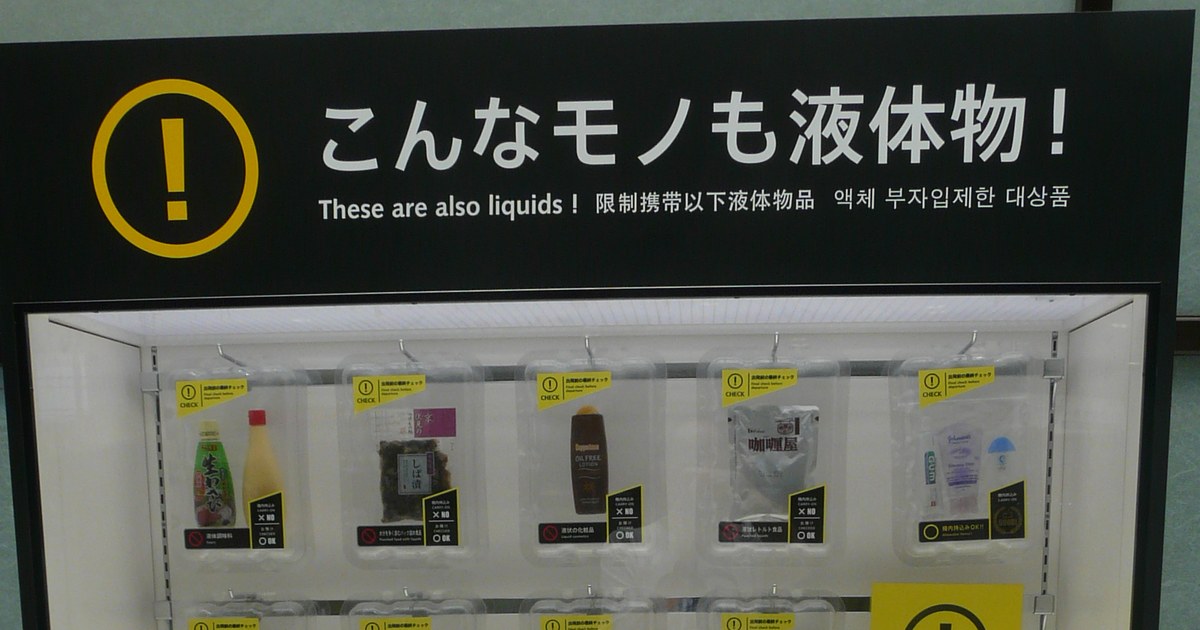
One suitcase, two Japanese government agencies asking for opposite things. Customs wants your tax-free purchases in your hands, because if the terminal flags your transaction you have to produce the goods on the spot. Security wants the same kitchen knife, the same aerosol can and the same 150 ml bottle of lotion taken off you, because the law says they cannot enter the cabin. Neither side is wrong; the fix is sequencing. This guide uses the Ministry of Land, Infrastructure, Transport and Tourism's own documents to settle what happens at a Japanese departure checkpoint: which items are merely binned on the spot, which ones expose you to up to two years' imprisonment or a fine of one million yen, why only five of the seven power bank rules are actually written into aviation law, and why the 100 ml limit Japan has never once relaxed is a piece of legislation rather than an airport policy.
Scope: this is about security screening when you fly out of Japan — what gets confiscated and what gets you charged. What you may legally carry into your home country is an entirely different regime, run by a different agency in a different country. Note also that official documents repeat, over and over, that airlines may impose rules stricter than the national ones. Everything below is the ministry layer only, so check your carrier's page once you have booked.
- "Prohibited" and "penalised" are two different things. Only five of the seven power bank rules carry a penalty. Charging your phone from a power bank does not. Charging the power bank from the aircraft socket does.
- The heaviest penalty is two years' imprisonment or a one million yen fine for bringing dangerous goods into the cabin. Walking past screening into the restricted area is scored separately: one year, or five hundred thousand yen.
- 100 ml is legislation, not guidance. Container 100 ml, bag 1 litre, one bag per passenger — all three written into the enforcement ordinance. The official liquids list still carries its 2015 version date.
- Japanese domestic flights have no 100 ml rule at all, which matters if you connect onward after a long-haul arrival. Liquid detection still runs; volume is simply not restricted.
- Once you surrender something, it is gone. The three items named by the government as most commonly abandoned: lighters, hair straighteners, power banks.
📖 Contents
- Tax-free goods must stay with me — so what about the knife?
- Can you actually be fined for this in Japan?
- Can I use a power bank on a plane in Japan?
- How many power banks, and at what watt-hours?
- Has Japan relaxed the 100 ml rule?
- Do domestic flights need the liquids bag?
- Scissors, nail clippers, Swiss Army knife: which are allowed?
- Which sprays and spirits cannot even be checked in?
- Earbuds, hair straighteners, lighters: which side do they go?
- What happens when security stops you?
- How should I pack before leaving Japan?
- Appendix: official Japanese source texts
Tax-free goods must stay with me — so what about the knife?
Complete the tax-free formality first, then check in whatever cannot fly in the cabin. The two demands do not actually collide, because they happen at different moments.
The tax-free terminals at Japanese airports sit before security, on the landside, and the official instruction is to visit them before you check your bags. Which means that at the moment you stand in front of the terminal, the goods are still in your hands by default. If the machine flags your record, you take the goods to the customs inspection desk, show them, and that step ends. Only then do you walk to the check-in counter and put the knife, the aerosol can, the over-100 ml liquids and the spirits above 24% alcohol into the hold. You reach security empty-handed.
As one line: terminal → show customs if flagged → check in → clear security. The mechanics of the tax-free step itself — the terminals, the passport scan, the flag, the seven airports where an online procedure substitutes — are covered in our guide to Japan's tax-free system and the airport refund procedure, and are not repeated here.
Arrival customs and departure security are not the same checkpoint
English-language advice tends to blur these two together, but even their consequences differ. Customs asks whether an item may enter a country; the penalty for getting it wrong is a fine, seizure or worse, and it happens at your destination. Security screening asks whether an item may board this aircraft; in the overwhelming majority of cases the consequence is that the item is binned, and it happens at your departure airport.
When you buy knives, spirits or medicines in Japan, run both layers in your head. Whether it can go home is one regime; whether it can fly is this one. Japanese souvenirs skew heavily towards blades and liquids — the Sakai knives, the kitchen cleavers and the sake bottles in our Japanese souvenir shopping list can only ever travel in the hold.
Can you actually be fined for this in Japan?
Yes, and at the top end it is two years' imprisonment or a fine of one million yen. But that band applies to a subset of items only. Most things pulled out of a bag at a Japanese checkpoint are simply binned, with no penalty attached at all.
Start with this three-tier table. Every section that follows unpacks one of its rows.
| What you did | Consequence | Legal basis |
|---|---|---|
| Carried a blade, an aerosol can, or a power bank above 160 Wh into the cabin | Up to 2 years' imprisonment or a fine of ¥1,000,000 | Aviation Act Art. 86(2), Art. 149-3 |
| Entered the restricted area or boarded without clearing screening | Up to 1 year's imprisonment or a fine of ¥500,000 | Aviation Act Art. 157-5 |
| Carried 150 ml of lotion, stowed a power bank in the overhead bin, charged your phone from a power bank | Item surrendered on the spot. No penalty | Enforcement ordinance liquid limits; leaflet items requesting cooperation |
Where does the penalty come from? Article 86 of the Aviation Act forbids anyone from bringing dangerous articles into an aircraft cabin, and Article 149-3 supplies the punishment. Article 194 of the enforcement ordinance lists ten categories of prohibited article, the tenth of which is headed "offensive weapons" and defined as firearms, bladed weapons and other articles capable of killing or wounding a person. Lithium batteries and power banks are prohibited articles too — they are carved out of the ban only when they meet the technical standards set in the ministerial notification.
That chain explains something very practical. A condition written into the notification is a condition whose breach means you carried a prohibited article, which is a criminal matter. A condition that is not in the notification has no route to a penalty at all. The line drawn through the seven power bank rules in the next section is drawn on exactly that basis.
Both penalty figures have a second, independent official source. The Government of Japan's public relations page, in its April 24, 2026 update, states that proceeding past the checkpoint without being screened constitutes a violation of the Aviation Act punishable by up to one year's imprisonment or a fine of five hundred thousand yen, and that bringing dangerous goods into the cabin is punishable by up to two years or one million yen. If bad weather has scrambled your flight and you are weighing whether to clear security now and sort it out later, that second figure quietly answers the question — and the wider handling of disrupted flights is covered in our guide to winter cancellations and delays in Japan.
Can I use a power bank on a plane in Japan?
Charging your phone from a power bank carries no penalty. Using the aircraft's socket to charge the power bank is the one that engages aviation law. That is the opposite of the intuitive reading.
The ministry's current passenger leaflet lists seven rules, and its footnote names only five of them as penalty-bearing. Laid out side by side:
| Item | What the ministry asks | Penalty |
|---|---|---|
| 1 | Never put it in checked baggage | 🔴 Yes |
| 2 | Watt-hour rating of 160 Wh or less | 🔴 Yes |
| 3 | Protect each one individually against short circuit | 🔴 Yes |
| 4 | Do not stow it in the overhead bin (keep it to hand, e.g. seat pocket) | ⚪ None |
| 5 | Two units maximum | 🔴 Yes |
| 6 | Do not charge the power bank in the cabin (charging it from aircraft power is prohibited) | 🔴 Yes |
| 7 | Do not use it in the cabin to charge devices (use the socket at your seat instead) | ⚪ None |
Items 4 and 7 are absent from that footnote, and the full text of the dangerous goods notification contains no matching provision either: across its nine pages, the Japanese terms for "overhead bin" and "charging an electronic device" both return zero hits, and the only appearance of "other electronic devices" is inside the definition of a power bank rather than in any prohibition. The English-language edition of the leaflet, issued the same day, carries the identical footnote naming items 1 to 3 plus 5 and 6.
The 2025 edition of the same leaflet said it more bluntly. Back then there were only five rules, and the footnote stated directly that items 1 to 3 were obligations under Article 86 of the Aviation Act while items 4 and 5 were requests for cooperation. The current version's softer phrasing about penalties "possibly" being imposed has, if anything, buried that distinction.
So can I ignore items 4 and 7?
Comply anyway. Keeping the power bank within reach instead of overhead, and charging your phone from the seat socket, cost you nothing.
Knowing which rules carry penalties is useful somewhere else. Two claims circulate widely — that stowing a power bank overhead gets you fined, and that from April 2026 power banks may not be used in flight at all — and neither has a basis. Meanwhile item 6, the one genuinely written into the notification and genuinely backed by aviation law, is barely mentioned anywhere. Remember the direction, because it is the easiest thing in this article to get backwards: using it to charge your phone is fine; using the aircraft's electricity to charge it is not.
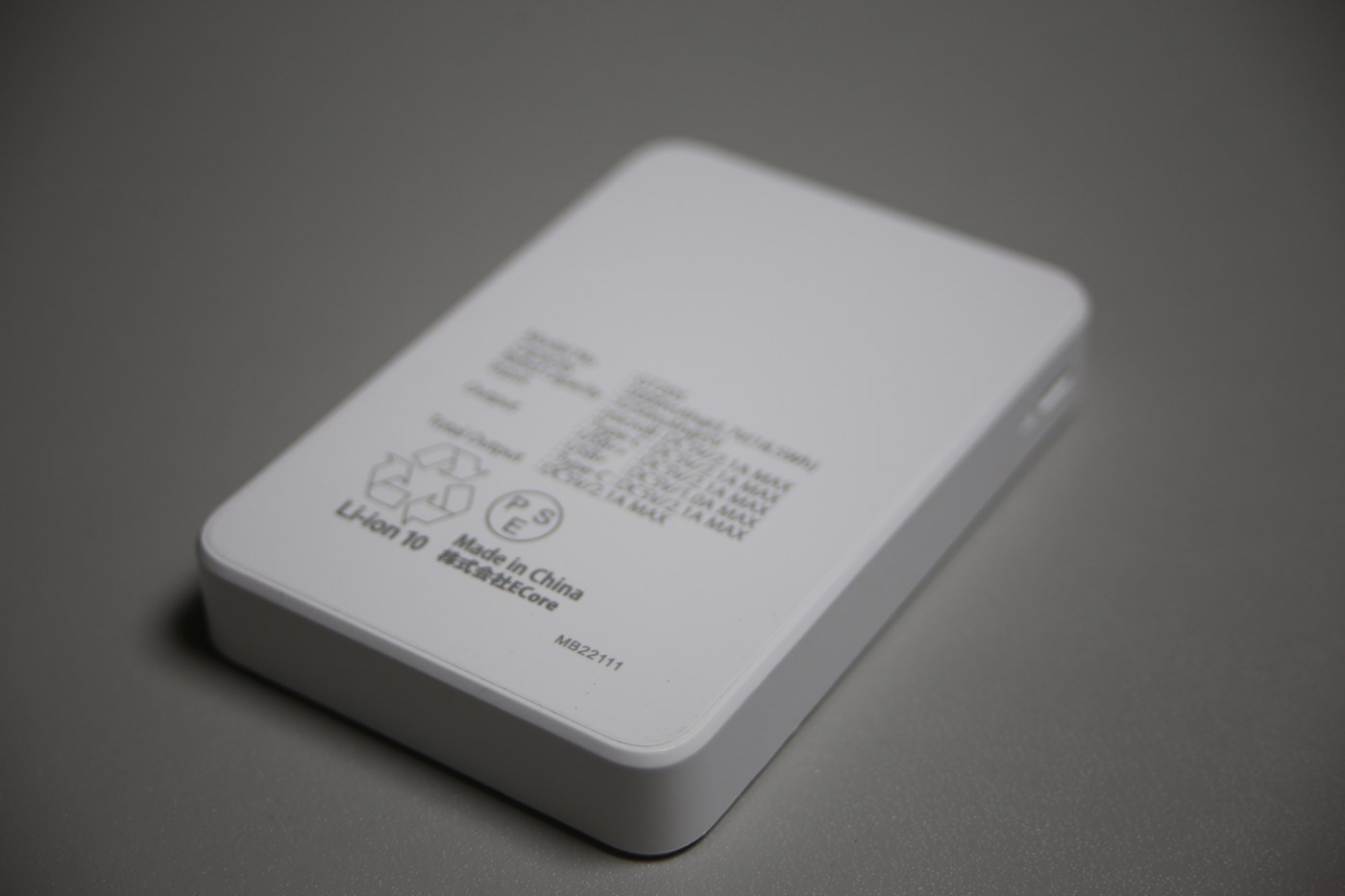
How many power banks, and at what watt-hours?
Two units, each 160 Wh or less, and never in the hold. All three of those carry penalties.
Powered wheelchair batteries run on a separate set of rules entirely — the two-unit and 160 Wh limits here do not apply. They have to be declared when you book, and each airline sets its own requirements for battery type and whether it must be removed. That is covered in our guide to travelling in Japan with a wheelchair.
Watt-hours are not printed on every device, so the ministry supplies the conversion. Take the rated capacity and rated voltage from the casing or the box:
Watt-hour rating (Wh) = rated capacity (mAh) × rated voltage (V) ÷ 1,000
Spare batteries are counted in a way the leaflet's diagram oversimplifies. The notification text applicable from April 24, 2026 is more precise, and it is easier read as a grid:
| Power banks you are carrying | Spare batteries at 100 Wh or less | Spare batteries from 100 to 160 Wh |
|---|---|---|
| 100 Wh or less × 2 | No limit on quantity | Up to 2 |
| 100 to 160 Wh × 2 | No limit on quantity | Not permitted |
| 100 Wh or less × 1 plus above 100 Wh × 1 | No limit on quantity | Up to 1 |
One detail in that grid is easy to miss: spare batteries at 100 Wh or under do not consume the allowance of two. What gets counted together is spare batteries in the 100 to 160 Wh band and power banks that are themselves above 100 Wh. Camera spares and wireless mouse cells almost always sit in the unlimited column.
Liquid rules frozen for eleven years; battery rules changed twice in ten months
Power bank rules are currently the fastest-moving thing at any Japanese airport, and the timeline is dense:
| Date | What happened |
|---|---|
| 2025-07-01 | Ministry publishes the first version of the rules (five items at the time) |
| 2025-07-08 | First version takes effect — seven days after publication |
| 2026-02-27 | Ministry opens public consultation |
| 2026-03-27 | ICAO Council approves an emergency amendment to the international standard, applicable the same day |
| 2026-04-14 | Ministry publishes the amendment (notification plus Article 194 of the enforcement ordinance) |
| 2026-04-24 | Current version takes effect; seven items |
Note that the consultation opened a month before the international amendment landed — Japan was already moving before the global standard was finalised. The same bureau revised this twice in ten months, while the liquid rule in the next section still carries a version date from eleven years ago. Two very different clock speeds inside one agency. Re-read the official leaflet before you fly, because the half-life of this particular section is measured in months.
Has Japan relaxed the 100 ml rule?
No, and this is not an airport guideline — it sits at the level of a ministerial ordinance.
Article 235-4-8, paragraph 3 of the Ordinance for Enforcement of the Aviation Act fixes three conditions word for word: liquids must be sealed in a container of 100 ml or less; those containers must be sealed inside a resealable transparent plastic bag of 1 litre or less; and each passenger may have only one such bag. The provision itself limits its scope to departing international flights, which means it governs the leg that takes you home.
A second correction is due on the claim most often offered as evidence that Japan has relaxed. CT scanners and smart lanes remove the requirement to take things out of your bag — they do not raise the volume limit. The April 24, 2026 update of the government's public relations page words it this way: where hand baggage contains a laptop, a tablet or liquids such as drinks, these must in principle be taken out of the bag, and passengers should follow the screening officer's instructions. The same page still carries the 100 ml, 1 litre and 20 cm figures in full.
On the subject of page versions: the official list of what counts as a liquid carries its own printed version date of October 1, 2015, and has not been reissued since.
One honest caveat is worth keeping. The opening clause of the same article contains a carve-out: items confirmed by the screening officer, by a method prescribed by the Minister, to raise no security concern fall outside the restriction. No instance of that power being exercised for liquid volume turned up in this round of verification. So pack to 100 ml — but do not repeat the line that Japanese law admits no exceptions, because the text itself does not say that.
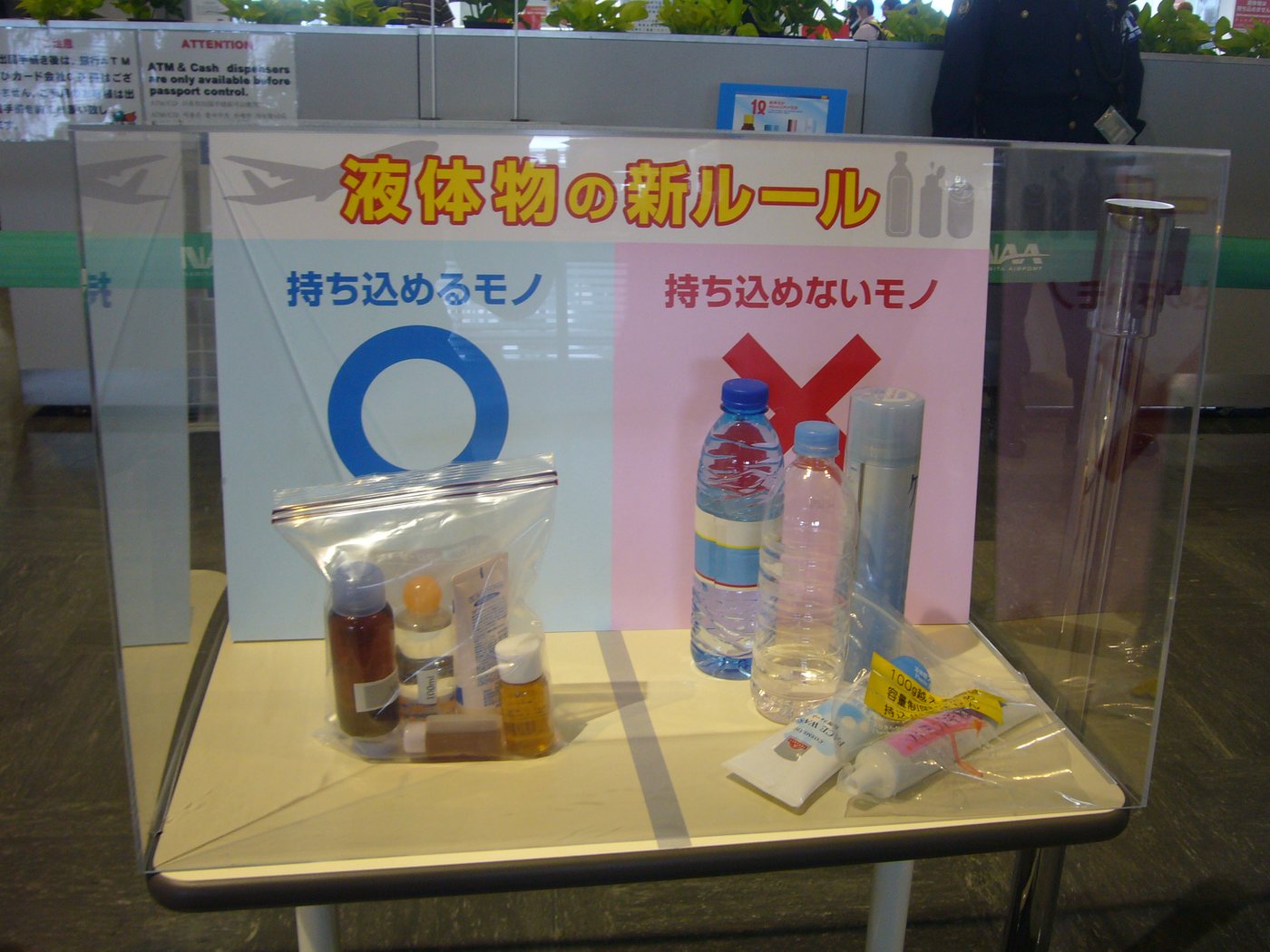
The details that get people stopped every year
The official Q&A settles the recurring arguments one by one. Straight to the table:
| The question | The official answer |
|---|---|
| My 120 ml bottle is only half full | Not allowed. The container's marked capacity is what counts, no matter how little is inside |
| Ten 100 ml bottles make exactly 1 litre | Not allowed. What is limited is the bag's capacity. If the zip will not close, some of it must be surrendered |
| Is something labelled 90 g a liquid? | It counts as 90 ml. Officially 1 g is read as 1 ml |
| How big may the bag be? | Height plus width within 40 cm; the government page states it as 20 cm by 20 cm or under |
| How transparent must it be? | Colourless and transparent; a zip-lock type is fine. The individual containers inside need not be transparent |
| Medicines, baby formula and food, special dietary items | Exempt, limited to what is needed in flight, and you must declare them to the officer. A prescription copy, pharmacy bag or medical certificate may be requested |
| Liquid medicines of 100 ml or less | Put them in the 1-litre bag and no declaration is needed — they are handled as ordinary liquids |
| Contact lens solution and cleaning fluid | Treated as medicine. No bag required, but declare it to the officer |
| Ice packs | Ordinary ones go in the bag. Packed together with refrigerated medication such as insulin, they may be declared as medicine |
| Dry ice | Not a liquid. The ceiling in an unsealed container is 2.5 kg |
If you travel with medication, read that declaration line twice — it is the easiest one to skip. Note that our guide to bringing medication into Japan deals with the arrival end; departure screening is a separate matter and both need attention. The same applies to anyone who has bought eyewear in Japan: the bottle of contact lens solution in your bag does not need to be squeezed into the zip-lock, but you do have to speak up about it (our guide to buying glasses in Japan covers turnaround times and warranties).
Alcohol bought after security travels; transfers are another matter
Liquids bought after security, inside the restricted area, may be carried on board. That is stated outright in official material, so if you want a bottle of sake and do not want it in the hold, buy it after the checkpoint.
The moment your itinerary includes a transfer, though, that assurance lapses. Official wording says that where you connect onto an international flight, the rules of that country apply and the item may be confiscated. The other direction is stricter still: when transferring at a Japanese airport, duty-free goods purchased in Europe or North America and sealed in a tamper-evident bag mostly cannot be moved into checked baggage, and passengers are asked to surrender them. That passage comes verbatim from the oldest of the four official liquid documents — the one with no date printed on it at all — so use it to choose a direction, not as a guarantee of degree.
Do domestic flights need the liquids bag?
No. Question 10 of the official Q&A asks exactly this, and the answer is that the liquid restriction is not applied on domestic flights, though normal screening including liquid detection equipment still runs. A second official document is even plainer: on domestic routes, subject to continued strict aviation security measures, liquids continue to be permitted in the cabin as before.
This is directly usable when you plan. An itinerary that flies into Tokyo and out of Fukuoka, or hops from Osaka to Sapporo, lets you carry a full bottle of water or lotion on those internal legs. Only the final leg out of Japan needs decanting.
What changes when you connect from a long-haul flight onto a Japanese domestic one
This is where visitors arriving from Europe, North America or Australia get caught out, because the rulebook swaps mid-journey and it swaps in two directions at once.
Start with the leg into Japan, which surprises people: it is governed by the rules of the country you departed from, not by Japan's. The official wording is that each contracting state is responsible for flights departing its own airports, so a flight leaving a foreign airport and arriving in Japan is regulated by the departure country. London to Tokyo runs on British rules the whole way; only Tokyo to London runs on the Japanese ones set out above.
Then, once you are inside Japan and take a domestic flight onward, two layers behave in opposite ways:
- The liquid layer disappears. No 100 ml container limit, no 1-litre bag, no one-bag rule. That bottle of water bought after arrival can board the flight to Sapporo.
- The dangerous goods layer travels with you unchanged. Aerosol classifications, the alcohol strength bands, the knife and blade-length rules, the lighter rules, the power bank rules and the per-container ceiling in the next section all apply identically on domestic flights. Nothing you carried in from abroad becomes acceptable because the leg is now domestic — and nothing you buy in Japan becomes acceptable because it is "only a short hop".
So the correct statement about a bottle of lotion is layered: on a Japanese domestic flight the ceiling is 500 ml per container under the dangerous goods rules; on an international departure the international rule squeezes it further to 100 ml. Two limits, not one, and only the tighter of them ever goes away.
One consequence for anyone who bought duty-free on the way in: the transfer passage quoted in the previous section says such goods mostly cannot be moved into checked baggage when transferring at a Japanese airport. Given that its source is the weakest document in the set, the low-risk approach is simply not to buy large liquids at your departure airport if you have a connection waiting in Japan. Buy them in Japan instead, where you can put them in the hold in a controlled way.
Scissors, nail clippers, Swiss Army knife: which are allowed?
Nail clippers can go straight through; a Swiss Army knife cannot, even with every blade removed. The dividing line is not "is it a knife" but blade length and tip shape, plus one extra test: does it look like a weapon.
| Item | Cabin | Hold | Official proviso |
|---|---|---|---|
| Scissors | × | ○ | Blunt tip and blade body 6 cm or less may be carried on. Eyebrow scissors, nose-hair scissors and travel sewing-kit scissors qualify |
| Box cutter | × | ○ | Same test: blunt tip and blade body 6 cm or less may be carried on |
| Razor | × | ○ | T-shaped razors, small cosmetic razors and electric shavers may be carried on |
| Multi-tool knife | × | ○ | Barred even when no component part is itself restricted, because its shape is threatening at a glance |
| Nail clippers | ○ | ○ | The kind with a cuticle knife attached is not permitted |
| Pizza cutter, apple cutter, can opener | × | ○ | Permitted in the cabin if body and blade do not separate |
| Letter opener | × | ○ | Permitted if blunt like a butter knife and judged incapable of being a weapon |
| Scalpel | × | ○ | Medical ones are equally not permitted |
| Tweezers | × | ○ | Permitted if the tip is rounded and the metal is not rigid |
| Keyrings and USB sticks shaped like shuriken or folding knives | × | ○ | Threatening shape means no cabin entry; the lighter-shaped versions cannot go in the hold either |
Five length thresholds on a separate list
Japan sets separate length ceilings for long, rigid objects, published apart from the liquid rules:
- 6 cm: blade body of scissors and box cutters; knitting needles
- 15 cm: screwdrivers, spanners, wrenches, mallets, rod files, darts (15 cm overall with a 6 cm shaft or less)
- 60 cm: tripods, monopods, fishing rods, trekking poles, ski poles, baseball bats, golf clubs and umbrella-shaped items
- 65 cm: the rod length of hanging scrolls and tapestries
- 70 cm: carry tubes for posters and scrolls
The short list of things that go straight into the cabin also includes ordinary umbrellas, vernier calipers, drawing compasses and dividers, safety pins, sewing needles, knitting needles under 6 cm and tennis rackets.
Leave some room for on-the-spot judgement. The ministry reserves final discretion over what counts as an offensive weapon, stating that items judged by the airline or the screening officer to be capable of becoming a weapon by virtue of material, rigidity or shape may be refused. The table above is where the reasoning starts, not a guarantee of the outcome.
Which sprays and spirits cannot even be checked in?
Bear spray, tear gas spray, paint spray and chlorine-based detergents are barred from the cabin and the hold alike. The instinct to "just check it" fails badly in this box.
First, a quantity ceiling that is entirely independent of the liquid rules and published separately from them. Cosmetics, medicines and aerosol cans, counted together, are capped at 0.5 litres or 0.5 kg per container and 2 litres or 2 kg per passenger, with the nozzle protected by a cap or another method that prevents accidental discharge. These are dangerous goods rules, so they apply to domestic and international flights alike. Put precisely: on a domestic flight the ceiling on a bottle of lotion is 500 ml; on an international departure the cabin limit squeezes it to 100 ml.
Aerosols themselves split three ways, and the test is what the can's label says about flammability:
| Category | Cabin | Hold | Examples |
|---|---|---|---|
| Cosmetics and quasi-drugs (applied directly to the body) | ○ | ○ | Antiperspirant spray, hairspray, sunscreen, antiseptic |
| Sports and household aerosols (non-toxic, non-corrosive, no flammability warning on the label) | × | ○ | Waterproofing spray, anti-static spray, spray adhesive |
| Everything else | × | × | Paint spray, model spray, tyre puncture spray, tear gas spray, oxygen spray, compressed air duster |
Two further groups are listed explicitly as banned from both: bear spray, pepper spray and tear gas spray, and bleach, mould remover and any detergent labelled chlorine-based or carrying the Japanese warning against mixing. Hikers should note the first group carefully. Bear spray is sold in mountain-town shops across Japan, but it cannot board an aircraft and it cannot enter the hold. Buy it, and it stays in Japan.
Alcohol splits by strength into three bands:
| Alcohol by volume | Cabin | Hold | Limit |
|---|---|---|---|
| 24% or less | ○ | ○ | Not a dangerous good; no volume limit |
| Above 24% up to 70% | ○ | ○ | 5 litres, and it must be in retail packaging (decanted into a hip flask is not accepted) |
| Above 70% | × | × | Prohibited outright |
The cabin column still sits underneath the international 100 ml rule, so in practice the conclusion is simple: put the bottles you are taking home into the hold, or buy them after security in the restricted area.
Earbuds, hair straighteners, lighters: which side do they go?
A lighter may travel only in the cabin, one per person, and may not be checked in. Wireless earbuds may not be checked in. A cordless hair straightener with a non-removable battery is banned from both. Almost every rule in this section runs against intuition.
| Item | Cabin | Hold | Condition |
|---|---|---|---|
| Power banks and spare lithium batteries | ○ | × | See the two sections above |
| Phone, laptop, camera (built-in lithium battery) | ○ | ○ | When checked, must be fully powered off — not asleep — and protected with clothing or a hard case |
| Wireless earbuds | ○ | × | Checking is limited to 0.3 g of lithium metal or 2.7 Wh of lithium ion. Treat ordinary true-wireless earbuds as un-checkable |
| E-cigarettes | ○ | × | Charging in the cabin is prohibited |
| Cordless curling irons and hair straighteners (battery not removable) | × | × | Only models with a removable battery, or a flight mode that cuts the heating circuit, are permitted |
| Mains-powered hair straighteners | ○ | ○ | Not a dangerous good |
| Gas-powered hair straighteners | ○ | ○ | One only, with a safety cap. Refill gas cartridges are banned from both |
| Smart luggage with a built-in battery | ○ | △ | Above 2.7 Wh it must be carried on; with the battery removed, the case itself may be checked |
| Self-heating bento (quicklime heater) | × | × |
Read the hair straightener row carefully. Officials stress that merely switching the unit off is not enough — a device in that state qualifies for neither the cabin nor the hold. If you intend to bring one, confirm the battery comes out, or that it has a flight mode that isolates the heating circuit.
Lighters and matches get their own table:
| Item | Cabin | Hold | Limit |
|---|---|---|---|
| Disposable and refillable gas lighters | ○ | × | One per person, carried on your person |
| Fuel lighters (wadding-absorbed type) | ○ | × | Same: one per person |
| Fuel lighters (tank type, no absorbent material) | × | × | |
| Electronic, filament and plasma lighters | × | × | |
| Small safety matches | ○ | × | |
| Strike-anywhere matches | × | × | |
| Lighter refill fluid and refill gas | × | × |
Smokers: keep the lighter in your pocket and out of the suitcase. Where you may actually light it in Japan is a separate body of municipal rules that changes as you cross a street — see our guide to Japan's smoking rules and street-smoking bans.
What happens when security stops you?
With time to spare, check it in or leave it in a locker. Without time, you surrender it, and it does not come back.
The government's public relations page sets out the sequence clearly: when a restricted item is found at the checkpoint and departure is still some way off, you may take it to the airline's check-in counter for the hold, or leave it in an airport locker. When there is not enough time, or the item is one that cannot go in the hold either, it is surrendered at the checkpoint. The same page names the three items most frequently given up — lighters, hair straighteners and power banks — and states that many such cases arise from passengers not knowing the restriction existed.
No official statistics on the number of surrendered items have been published, and none turned up in this round of verification. Figures circulating online have no traceable source and should be ignored.
Whether an item can be rescued comes down to time. Build the handling of a surprise into the buffer you allow at the airport: an extra thirty minutes is what turns that wagashi knife from "surrendered" into "checked". For the wider set of options on moving bags around, see our guide to luggage forwarding and coin lockers in Japan.
How should I pack before leaving Japan?
Do these seven things and the checkpoint stops being an event.
- Take the power bank out of the suitcase first. It can never be checked. Two units, each 160 Wh or less, and keep it within reach — a seat pocket rather than the overhead bin.
- Blades, scissors, aerosols and anything over 100 ml go into the hold. If you bought a kitchen knife, the bag it is in cannot be your cabin bag.
- Keep one lighter in your pocket. It cannot be checked, so putting it in the suitcase is the actual violation.
- Wireless earbuds stay with you. Do not leave them in the bag you are checking.
- Separate out medicines, contact lens solution and baby formula, and declare them at screening. They are exempt from the liquid rules, but the exemption requires you to speak up, and a prescription copy or pharmacy bag may be requested.
- Buy alcohol after security, in the restricted area. If you then transfer through another country, that stop applies its own rules and may confiscate it.
- If you have a tax-free formality to complete, do the terminal first, then check in. Reversing that order means walking the terminal twice.
If only one of those survives the flight home, make it the first. The power bank rule is the only one that is simultaneously penalty-bearing and extremely easy to get wrong while packing. The other six still have a remedy available at the airport; that one is discovered after you have already handed the bag over.
Two limits, stated plainly. Everything above is drawn from the Ministry of Land, Infrastructure, Transport and Tourism and the Government of Japan's public relations material, and airlines are entitled to impose stricter rules than the national ones — the official documents repeat that sentence themselves, so check your carrier's page once you have booked. And which airports have installed which generation of scanner, and what the queueing layout looks like on the day, could not be confirmed from airport operators' own pages in this round, so no claim is made here about CT scanners at any named airport.
Appendix: official Japanese source texts (click to expand)
The Japanese originals behind the statements above are collected here so you can check them yourself.
1. Footnote to the power bank leaflet (current edition, April 24, 2026)
※ 1-3、5・6に違反した場合、航空法により罰則が科される可能性があります。
English edition, same date, verbatim: Violations of items 1-3, 5 and 6 may be subject to penalties under aviation law.
2. Previous edition (Reiwa 7, July 8, 2025): obligations vs requests for cooperation
※:1~3は航空法第86条に基づく義務事項、4・5は協力要請事項
3. The seven current rules in full
1 預入(受託)手荷物に入れないで!
2 ワット時定格量160Whまで!
3 ショートしないように個々に保護!
4 収納棚に収納しないで!(座席ポケットなどお手元に保管)
5 モバイルバッテリーは2個まで!
6 機内で充電しないで!(機内電源などからモバイルバッテリーへの充電は禁止)
7 機内で使用(電子機器への充電)しないで!(電子機器の充電は、機内備え付けの電源からお願いします)
Watt-hour formula, official wording: ワット時定格量 (Wh)=定格容量 (mAh)×定格電圧 (V)÷1,000
4. Dangerous goods notification (applicable from April 24, 2026), Appended Table 18
パワーバンク … 預入 × 持込み ○ 2個
ワット時定格量が160Wh以下のものであること
6)予備のリチウム電池及びパワーバンクは、ショートしないように個々に保護されていること。
7)パワーバンクを航空機内において充電しないこと。
Negative evidence: across the full nine pages of that notification, 収納棚 (overhead bin) and 電子機器へ充電 (charging an electronic device) both return zero hits — which is why leaflet items 4 and 7 have no penalty-bearing provision behind them.
5. Timeline of the 2026 amendment (press release, April 14, 2026)
ICAOが定める国際基準の緊急改訂案がICAO理事会にて審議され、3月27日(現地時間)に承認、即日適用されました。
本年2月27日より意見公募を行っていたところですが…一部改正を行い
適用開始:令和8年4月24日(金)
6. Aviation Act: prohibition and penalties
第86条 爆発性又は易燃性を有する物件その他人に危害を与え、又は他の物件を損傷するおそれのある物件で国土交通省令で定めるものは、航空機で輸送してはならない。2 何人も、前項の物件を航空機内に持ち込んではならない。
第149条の3 第八十六条第二項の規定に違反して、航空機内に同条第一項の物件を持ち込んだときは、その違反行為をした者は、二年以下の拘禁刑又は百万円以下の罰金に処する。
第157条の5 …一年以下の拘禁刑又は五十万円以下の罰金に処する。二 …保安検査を受けずに航空機に搭乗したとき。
Article 194 of the enforcement ordinance lists ten categories of prohibited article; the tenth is 凶器 鉄砲、刀剣その他人を殺傷するに足るべき物件 (offensive weapons: firearms, bladed weapons and other articles capable of killing or wounding a person).
7. The three liquid conditions (Enforcement Ordinance, Art. 235-4-8, para. 3)
三 次に掲げる方法以外の方法により持ち込まれる液体(国際航空運送事業の用に供する危険物等所持制限区域内に持ち込まれるもの又は本邦内から出発して本邦外に到達する航行を行う航空機内に持ち込まれるものに限る。)
イ 液体を容量百ミリリットル以下の容器に封入すること。
ロ イの容器を再封入が可能な容量一リットル以下の透明なプラスチック製の袋に封入すること。
ハ ロの透明なプラスチック製の袋の数は、旅客一人につき一つとすること。
Carve-out in the opening clause of the same article: 次に掲げるもの(保安検査を行う者が国土交通大臣が定める方法により、保安上支障がないと確認したものを除く。)とする。
The version date printed on the official list of liquid items is 平成27年10月1日現在 (as of October 1, 2015).
8. Domestic flights and inbound flights (liquids FAQ)
Q10 国内線でも液体物の制限がありますか?
A10 国内線では、今回の液体物の制限は行われません。なお、液体物検査装置による検査など、通常の保安検査は実施されますのでご協力いただきますようお願いいたします。
(separate FAQ document)国内線については、引き続き、厳格な航空保安対策を実施したうえ、今までどおり液体物の機内持込を認めていくこととしております
海外の空港を出発して日本の空港に到着する航空便については、出発した国の責任の下、その国の規制をうけることとなります。
9. CT scanners and removing items (Government PR Online, updated April 24, 2026)
手荷物の中にPC・タブレット端末や飲み物などの液体物がある場合は、原則として鞄などから取り出す必要があるので、保安検査場の検査員の指示に従う。
保安検査を受けずに保安検査場より先に進んだ場合、航空法違反となり、1年以下の拘禁刑又は50万円以下の罰金が科せられる場合があります。
危険物を機内に持ち込んだ場合は航空法違反により、2年以下の拘禁刑又は100万円以下の罰金が科せられる場合があります。
10. After you are stopped (Government PR Online)
保安検査場で制限品が発見されたとき、出発まで時間がある場合は、預け入れ手荷物として航空会社のチェックインカウンターに預けたり、空港のロッカーに預けたりすることが可能です。しかし、出発まで時間がない場合や預け入れ手荷物にも入れてはいけない場合は保安検査場で放棄することとなり、その後、手元に戻ることはありません。
機内への持込みが制限されていることを知らず、ライター、ヘアアイロン、モバイルバッテリーなどの所持品が保安検査でやむを得ず放棄される事例が多く発生しています。
11. Blades and aerosols (representative items list, updated April 24, 2026)
先端が尖っていないもので刃体(刃先から支点までの長さ)6cm以下であれば持込可能
(ツールナイフ)構成品に機内持込制限品に該当するものが含まれていない場合であっても、一見して脅威を抱かせる形状をしているため持込不可
(爪切り)甘皮切りの小型ナイフが装着されているものは、持込不可
※上記1人あたりの数量は、①化粧品類、②医薬品類および③スプレー缶の合計数量であること。
材質、強度、形状等により凶器となり得ると航空会社又は保安検査員が判断したものは持込みできない場合があります
Hair straighteners, verbatim (Government PR Online): 単に「本体の電源を切る」…だけでは、機内持込み手荷物にも、預け手荷物にもすることはできません。
12. Duty-free purchases and transfers (liquids overview and FAQ)
保安検査後の免税店等で購入した酒類等は機内持込が可能です
国際線に乗り継ぐ場合は…その国のルールに従い没収される可能性があります
欧米で購入し特別な袋に封入された免税品等であっても、日本の空港において乗り継ぎする際には…ほとんどの場合は、受託手荷物として預け入れすることができず、放棄していただくことになります
That last passage comes from the only one of the four liquid documents carrying no date at all; its language still describes the rules as newly introduced, which is why the body text above gives the direction without the degree.
13. Airlines may be stricter
航空会社によって、より厳しいルールを設けている場合があります
Frequently Asked Questions
- Q1:Can I use a power bank on a plane in Japan in 2026?
- Yes, and there is no penalty for doing it — but Japan asks you not to, and the reverse action does carry one. The current Ministry of Land, Infrastructure, Transport and Tourism leaflet for passengers lists seven power bank rules. Its footnote names five of them: item 1 (never in checked baggage), item 2 (160 Wh or less), item 3 (individually protected against short circuit), item 5 (two units maximum) and item 6 (do not charge a power bank in the cabin). Those five, it says, may attract penalties under the Aviation Act. Item 4 (do not stow it in the overhead bin) and item 7 (do not use it to charge your devices) are not on that list, and no matching provision exists in the full text of the dangerous goods notification either. So the rule runs the opposite way to the intuitive one:the action you would instinctively take — charging your phone from your power bank — carries no penalty, while the action fewer people think of — plugging the power bank into the aircraft's own socket to top it up — is the one written into the notification and backed by the Aviation Act. No penalty does not mean ignore it. Follow the request. But stop believing that stowing a power bank in the overhead bin gets you fined.
- Q2:Has Japan relaxed the 100 ml liquid rule like some European airports?
- No, and the two things people conflate here are separate. In Japan the 100 ml limit is not an airport guideline — it is written into Article 235-4-8 of the Ordinance for Enforcement of the Aviation Act: liquids in containers of 100 ml or less, sealed inside a resealable transparent plastic bag of 1 litre or less, one bag per passenger. All three conditions are in the text word for word, and the same provision limits their scope to departing international flights. As for CT scanners, what they change is whether you take things out of your bag, not whether you may exceed 100 ml. The Government of Japan's public relations page, updated April 24, 2026, still carries the 100 ml, 1 litre and 20 cm figures in full. Worth knowing as well: the official list of what counts as a liquid has not been reissued — the version date printed on it is October 1, 2015.
- Q3:Do Japanese domestic flights require the 1-litre liquids bag?
- No. The official Q&A puts it plainly: the liquid restriction is not applied on domestic flights, though normal security screening including liquid detection equipment still runs. So on an itinerary like Tokyo in, Fukuoka out, or a hop from Osaka to Sapporo, those domestic legs let you carry a full-size bottle of water or lotion into the cabin. What domestic flights do not escape is the separate dangerous goods layer: the quantity ceiling on cosmetics, medicines and aerosols combined — 0.5 litres or 0.5 kg per container and 2 litres or 2 kg per passenger — applies to domestic and international flights alike, as does the ban on anything above 70% alcohol by volume. The international 100 ml rule is a second layer stacked on top of that, not a replacement for it.
- Q4:Can I bring a Swiss Army knife on a plane in Japan if I remove the blade?
- No. The ministry's representative-items list says so explicitly: a multi-tool knife is barred from the cabin even when none of its component parts is itself a restricted item, because its shape is threatening at a glance. The same reasoning bars keyrings, USB sticks and lighters shaped like shuriken or folding knives — and the lighter-shaped ones cannot go in checked baggage either. Going the other way: nail clippers are allowed in the cabin, but not the kind with a small cuticle knife attached. For scissors and box cutters the dividing line is the tip and the blade length: a blunt tip with a blade body (tip to pivot) of 6 cm or less may be carried on, which covers eyebrow scissors, nose-hair scissors and the small scissors in a travel sewing kit.
- Q5:Can I put bear spray in checked baggage in Japan?
- No — neither cabin nor hold. Bear spray, pepper spray and tear gas spray are marked with a cross in both columns on the official representative-items list. The same box holds paint spray, model spray, tyre puncture spray, oxygen spray and compressed air dusters, plus bleach, mould remover and any detergent labelled chlorine-based or with the Japanese warning against mixing. The test is what is printed on the can: aerosols applied directly to the body, meaning cosmetics and quasi-drugs, are allowed both ways; household aerosols with no flammability warning on the label — waterproofing spray, anti-static spray, spray adhesive — are barred from the cabin but allowed in the hold; everything else is barred from both. If you buy bear spray for a hiking trip in Japan, it stays in Japan.
- Q6:Can I take a lighter on a plane in Japan, or should I pack it in my suitcase?
- The opposite of what most people assume. A lighter may only travel in the cabin, one per person, carried on your person — and it may not go into checked baggage. Disposable lighters, refillable gas lighters, and fuel lighters of the type where wadding absorbs the liquid are all permitted. Tank-type fuel lighters without absorbent material, along with electronic, filament and plasma lighters, are barred from both cabin and hold. Matches follow the same shape: one small box of safety matches may travel in the cabin but not the hold, while strike-anywhere matches are banned from both. Lighter refill fluid and refill gas are banned from both as well.
- Q7:If security takes something off me at a Japanese airport, can I get it back later?
- No. The Government of Japan's public relations page describes the process: if there is still time before departure, you may take the item to your airline's check-in counter and put it in the hold, or leave it in an airport locker. If there is not enough time, or the item is one that cannot go in the hold either, you surrender it at the security checkpoint, and it does not come back to you afterwards. The same page names the three items most often given up this way: lighters, hair straighteners and power banks, noting that many cases arise from passengers simply not knowing the restriction existed. No official count of surrendered items has been published, and figures circulating online have no traceable source.
- Q8:I bought duty-free alcohol in Europe. Can I keep it while transferring in Japan?
- Probably not, and this is one of the weaker official answers, so treat it as direction rather than a guarantee. The clear part first: liquids bought after security, inside the restricted area of a Japanese airport, may be carried on board — that is stated plainly in current official material. The messy part is transferring. Official wording says that when transferring at a Japanese airport, duty-free goods purchased in Europe or North America and sealed in a special tamper-evident bag mostly cannot be moved into checked baggage and will have to be surrendered. That passage comes from the oldest of the four official liquid documents — the one carrying no date at all, whose language still describes the rules as newly introduced. The reverse case is the same in shape: liquids bought when leaving Japan will be handled under the rules of any country you transfer through, and may be confiscated there.