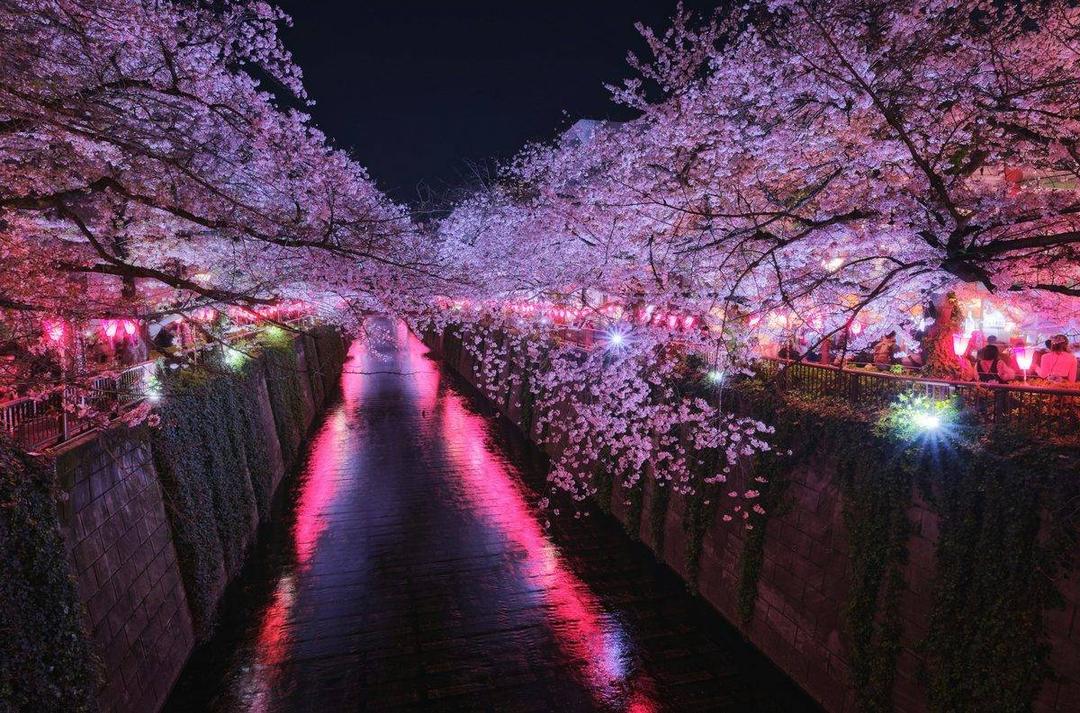
Autumn foliage gives you a month. Cherry blossoms don't. From full bloom to the first falling petals, a Somei-Yoshino tree looks its best for only about seven days — and that window shifts nearly a week each year with the winter. The next season is spring 2027, and the first bloom forecast may not wait for January — for the 2026 season Nihon Kishou released its first on December 18, 2025. So pencil in that week now from JMA average dates, lock hotels and flights, and start watching the forecasts from mid-December. That is why one traveler flies in to find bare buds and another hits it perfectly. This guide drops the romance and does the math: using JMA average dates and when the 2027 bloom forecast lands and how to read it, it turns "betting a single day" into "betting a high-odds window" — which city in which week, how to book before rates double, and how to choose between dawn light and night illuminations, from Kyushu all the way to Hokkaido.
- The bloom front climbs north over 6 weeks: Tokyo & Fukuoka ~March 31 → Kyoto & Osaka April 4 → Sendai April 13 → Hirosaki April 26 → Sapporo May 6 (all JMA 1991-2020 average full bloom)
- Tokyo usually opens 3-5 days before Kyoto (heat-island effect), so "Tokyo first, then Kansai" rides the timing
- Don't bet a single day — bet days 5-10 after first bloom, then fine-tune two weeks out with the 2027 Japan cherry blossom forecast (first release could be mid-December 2026)
- Sakura is a top peak season: Kyoto/Tokyo full-bloom rooms double; book 10-12 weeks out, even earlier for Hokkaido's Golden Week bloom
- 6:30am is the most underrated slot — Meguro River, Philosopher's Path, and Chidorigafuchi are still empty before 8
Tokyo first, then Kansai? Compare the JR Pass price before you lock trains →
📖 Table of contents
- 1. Why sakura is harder to time than foliage
- 2. National bloom-front timing table
- 3. Tokyo (late March): earliest, most photogenic, easiest
- 4. Kyoto & Osaka (early April): the classic core
- 5. Mt. Fuji & Kawaguchiko (mid-April): the postcard shot
- 6. Hirosaki & Hokkaido (late April-early May): the late, less-crowded front
- 7. Hotels and flights: the sakura-season timeline
- 8. Night cherries vs dawn: two ways to shoot one spot
- 9. Five rookie sakura mistakes
- 10. FAQ
Why sakura is harder to time than foliage
The star of Japanese cherry blossom season is Somei-Yoshino, the clone variety planted at roughly 80% of famous sakura spots. Its bloom runs in three roughly week-long phases: first bloom (the benchmark tree opens 5-6 flowers) → about a week later, full bloom (80%+ open) → a few days after that, the petal fall. The genuinely "best" window is full-bloom day plus the next 3-5 days. You are aiming at a week, not a season.
Worse, that week drifts. Cherry trees need a cold winter to break dormancy, then a warm run to accumulate heat toward blooming. A mild winter pulls bloom earlier, but a February-March cold snap pushes it back. Last season is the cleanest example: in 2026, a mild winter put Tokyo's first bloom on March 21, Ueno March 22, Kyoto March 25, Osaka March 24 — about a week ahead of average (per Weathernews 2026 forecast). That offers no guarantee for 2027, so treat every date below as a baseline and pair it with the year-specific forecast.
If you're still torn between spring sakura, autumn foliage and the other seasons, settle whether cherry-blossom season is the right fit before committing to this seven-day gamble — our best time to visit Japan guide lays out the trade-offs.
Four reliable forecasts to follow together:
- Weathernews: launched its 2026 season on January 8, updates weekly, down to spot level
- Nihon Kishou: the earliest out — its first 2026-season release came on December 18, 2025
- tenki.jp (JMA / Japan Weather Association): bloom/full-bloom forecast plus live conditions
- Weathermap (Sakura forecast): updates Mondays and Thursdays from March — best for the final pre-trip check
National bloom-front timing table
Sorted south to north, with each city's average full-bloom date (JMA 1991-2020) and the latest actual season (2026) for reference — that column is last season's real dates, not a 2027 prediction, so you can see how far the bloom can swing. Use it as a timeline: from the full-bloom date, count 1-2 days back and 3-5 days forward for that city's golden window.
| Region | Signature spot | Avg full bloom (JMA) | Latest actual (2026) / notes |
|---|---|---|---|
| Shikoku | Kochi Park | Mar 30 | First bloom Mar 22 — among the earliest nationwide |
| Kyushu | Fukuoka, Maizuru Park | Mar 31 | First bloom Mar 22 |
| Kanto | Tokyo: Chidorigafuchi, Meguro River, Shinjuku Gyoen | Mar 31 | First bloom Mar 21 (earliest); full bloom ~Mar 31 |
| Tokai | Nagoya Castle | Apr 2 | First bloom Mar 23 |
| Chugoku | Hiroshima Peace Park | Apr 3 | — |
| Kansai | Kyoto: Arashiyama, Philosopher's Path, Daigo-ji | Apr 4 | First bloom Mar 25; full bloom Apr 1 |
| Kansai | Osaka Castle & Mint Bureau passage | Apr 4 | First bloom Mar 24; full bloom Mar 31 (Mint passage ~mid-April) |
| Hokuriku | Kanazawa, Kenrokuen | Apr 8 | — |
| Mt. Fuji | Kawaguchiko & Arakurayama | Mid-April | Later at altitude; cherries + Mt. Fuji shot |
| Tohoku | Sendai, Tsutsujigaoka Park | Apr 13 | — |
| Tohoku | Hirosaki Castle (Aomori) | Apr 26 | Golden Week timing; moat "petal raft" |
| Hokkaido | Hakodate, Goryokaku | Late April | First bloom Apr 24 |
| Hokkaido | Sapporo, Maruyama Park | May 6 | Latest in Japan; full bloom over Golden Week |
To chase two bloom waves in one trip (Tokyo then Hokkaido, or Kansai then north to Hirosaki), the the nationwide JR Pass pays off across multiple shinkansen legs; a single-region trip is better served by a regional pass. Which one wins, with four routes calculated, is in our JR Pass guide.
Tokyo (late March): earliest, most photogenic, easiest
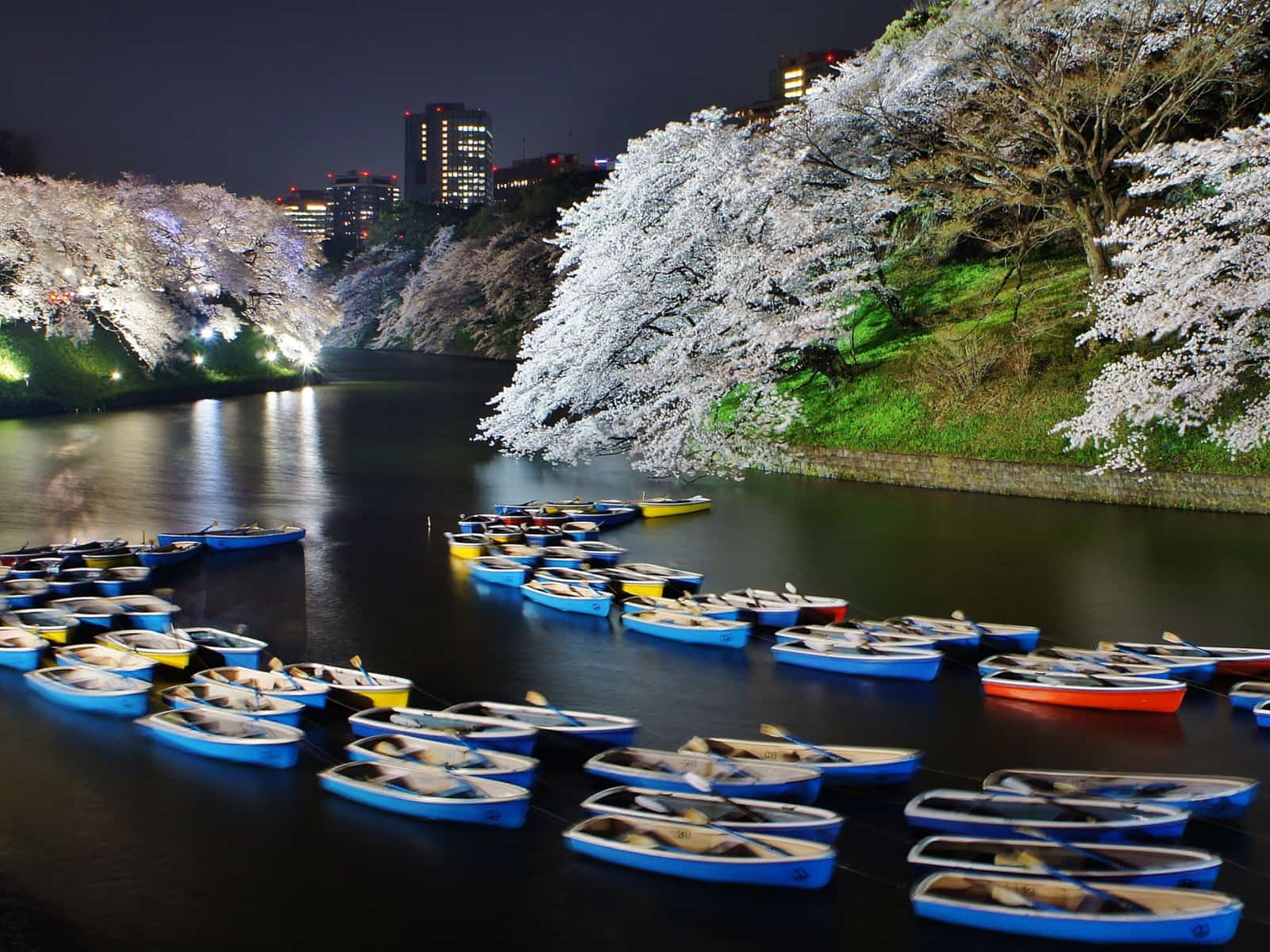
Most people assume sakura means Kyoto. Honestly, Tokyo is the safer bet to actually hit full bloom: it peaks around March 31, the same week as Fukuoka and earlier than Kansai, and its spots are dense and easy to reach, so your tolerance for a misjudged week is higher. For a first sakura trip where you want certainty, I'd put Tokyo ahead of Kyoto.
Tokyo's four big spots, and how to use them
- Meguro River: ~800 trees arch over a 3.8 km canal, with evening illumination reflecting off the water — Tokyo's best night cherries. It is also the most crowded; go at dawn or after 8pm. Right outside Naka-Meguro Station.
- Chidorigafuchi: the Imperial Palace moat, branches dipping to the water, with rowboats you can paddle under the blossoms — 30 minutes in blossom season is ¥1,500 since the 1 March 2026 revision (the ¥800 you will see quoted is now the residents' rate). ⚠️ The boathouse opens at 9:00 in blossom season, 10:00 otherwise, and closes Mondays — an early-morning visit means the promenade, not the water. 5 min from Kudanshita.
- Shinjuku Gyoen: large, with many cherry varieties (early to late, so a longer, more forgiving window) and lawns made for a picnic. ¥500 entry, no alcohol allowed — which keeps it calm. 10 min from Shinjuku Station.
- Ueno Park: the liveliest hanami scene — food stalls, picnic tarps, full-on crowd energy. Come here for the atmosphere of a Japanese cherry-blossom party. Right at Ueno Station.
Tokyo sakura usually folds into a general Tokyo trip; for getting around, the 72-hour ¥2,000 subway ticket (Tokyo Metro + Toei) is the best value. The spot-by-spot best hours for Meguro River, Chidorigafuchi, Shinjuku Gyoen and Ueno, the night cherries, and a crowd-free day route are in our Tokyo cherry blossom guide; where to stay and how to plan the days are in the Tokyo 5-day itinerary.
Kyoto & Osaka (early April): the classic core
If what you want is cherries framed by temples and shrines, it has to be Kyoto — just go in knowing that Kyoto's full-bloom week is the year's twin peak of crowds and room rates, and that it runs 3-5 days later than Tokyo. Don't apply Tokyo's timing to Kyoto.
Kyoto's top spots
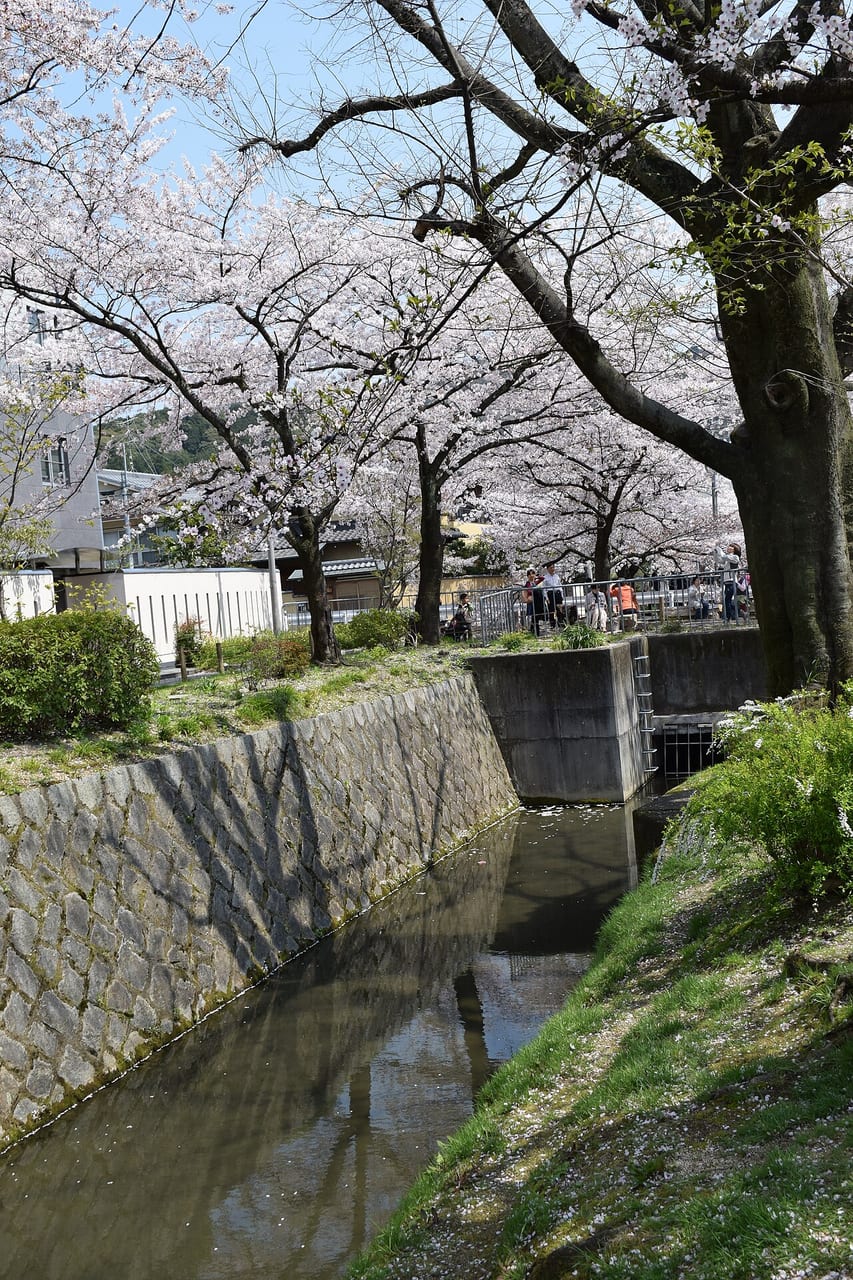
- Philosopher's Path: a 2 km cherry walk along the canal; the days when fallen petals carpet the water are the best. Nearly empty before 7am.
- Daigo-ji: the stage of Toyotomi Hideyoshi's legendary 1598 cherry-viewing party; its weeping cherries are among Kyoto's most dramatic. Spring special admission ~¥1,500.
- Gion Shirakawa & Maruyama Park: Gion's stone-paved lanes with cherry blossoms are Kyoto's signature night scene; Maruyama Park's illuminated weeping cherry is a classic.
- Arashiyama: Togetsukyo Bridge with mountain cherries across the river, plus the Sagano scenic railway. Dawn is the soul slot here too — same as in foliage season; the route logic is in our Arashiyama day-trip guide.
Wearing a kimono along the Philosopher's Path, Gion Shirakawa, or Kiyomizu is a classic sakura-season thing to do, and rental shops book up at peak. Kimono/yukata rental around Gion and Kiyomizu-dera (hairstyling included) starts at about US$21 — but that is the cheapest option, and the "30 minutes – 1 day" duration on the product page spans every option. If you want to wear it all day, check the specific option's hours before you book rather than assuming the US$21 one lasts until evening. The listing does not state which languages staff handle, so ask first if that matters: see the Gion & Kiyomizu-dera kimono rental options.
Osaka add-on: the Mint Bureau passage
Osaka Castle's Somei-Yoshino peaks with Kyoto (~Apr 4), but Osaka's famous one is the Mint Bureau "Sakura no Toorinuke" — a passage open for only about a week at peak, planted mostly with late-blooming double cherries, so it runs later (typically mid-April) and effectively extends the season. Dates and entry rules are announced by the Mint Bureau each year. The full Osaka Castle, Mint passage and Okawa water-bus night-cherry plan, with a one-day route, is in our Osaka cherry blossom guide.
For Kansai lodging and airport access: book Kyoto full-bloom-week hotels 12 weeks out — compare Kyoto hotels on Trip.com; on a budget, stay in Osaka and day-trip to Kyoto. The spot-by-spot timing for the Keage Incline, Philosopher's Path, Daigo-ji and Maruyama night cherries, plus a Higashiyama day route, is in our Kyoto cherry blossom guide; HARUKA versus Nankai from KIX is in our Kansai Airport route comparison.
Mt. Fuji & Kawaguchiko (mid-April): the postcard shot
If you only want one photo that screams "this is Japan," the answer is usually here: cherry blossoms + Mt. Fuji + water (or a five-story pagoda). Thanks to the altitude, Kawaguchiko blooms about two weeks after Tokyo — typically mid-April — which slots neatly after Tokyo's bloom, so you can chain "Tokyo first, then top up at Fuji."
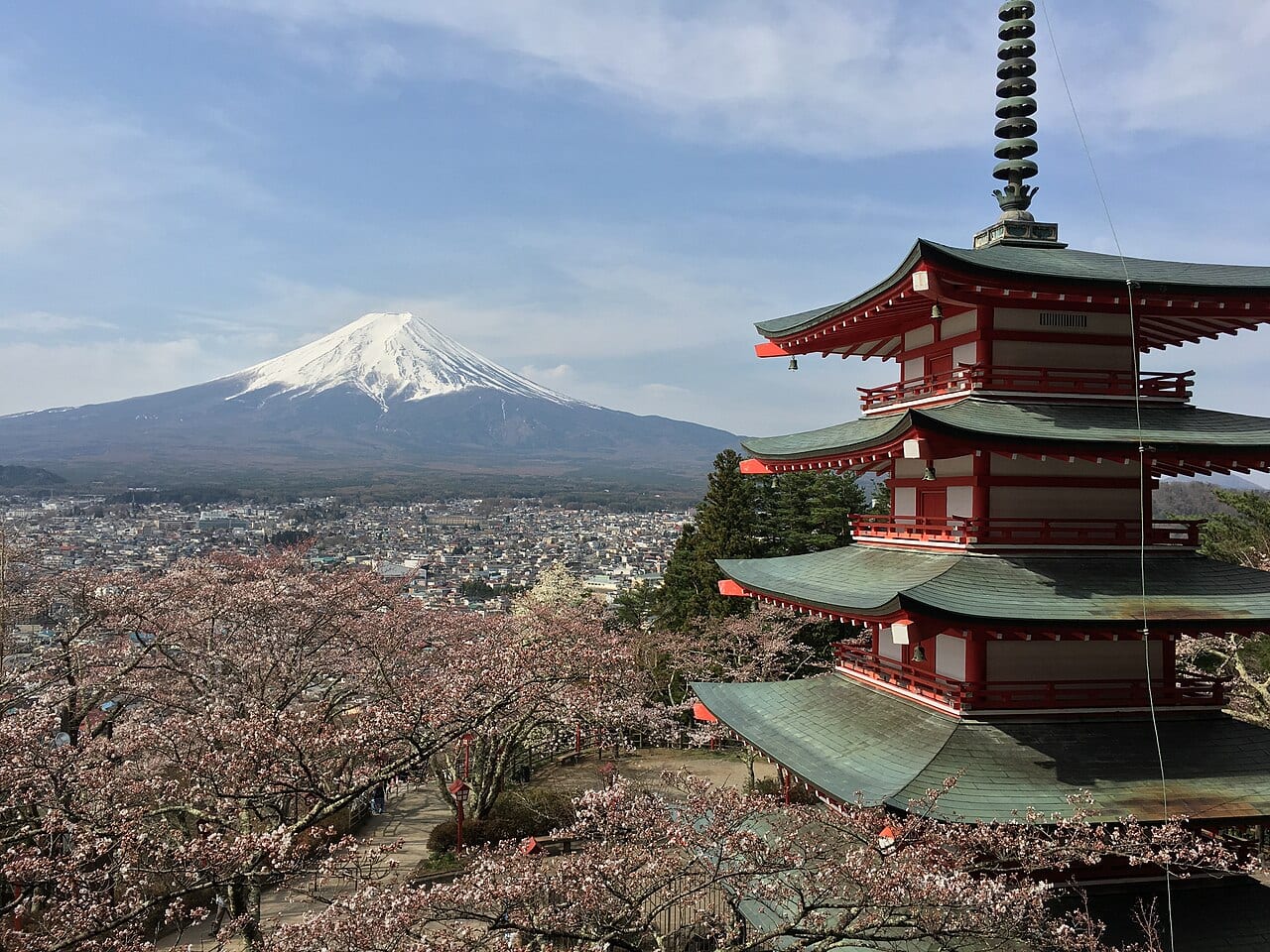
- Arakurayama Sengen Park: the five-story Chureito Pagoda + cherries + Mt. Fuji, the trifecta you've seen on every Japan poster. About 400 steps up.
- North shore of Lake Kawaguchi: Mt. Fuji mirrored on the lake with cherry trees along the shore; on a windless dawn you can shoot the reflection with blossoms.
The easiest way to do Kawaguchiko and Mt. Fuji in a day is a bus tour from Ginza: KKday Mt. Fuji day tour (from Ginza), which skips luggage transfers and timetable hunting. The best hours for the Chureito Pagoda and the north-shore inverted-Fuji shot, plus why "shibazakura isn't sakura," are in our Mt. Fuji cherry blossom guide; the full DIY transit comparison is in our Tokyo to Mt. Fuji day trip guide.
Hirosaki & Hokkaido (late April-early May): the late, less-crowded front
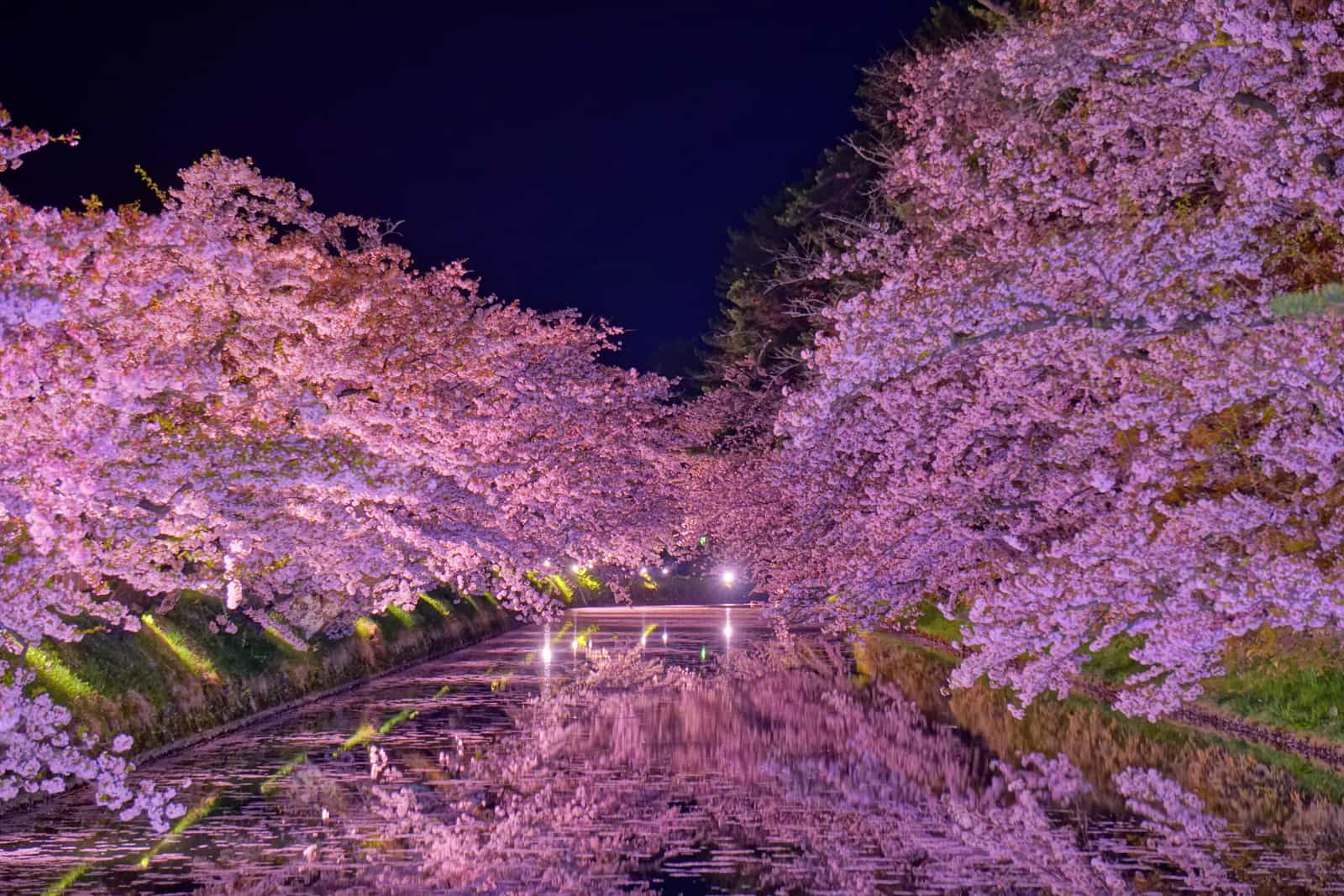
If the Tokyo/Kyoto crush puts you off, or you can only travel in early May, move your target north. Hirosaki Castle and Hokkaido are Japan's latest bloom front, falling late April to early May — right in (or just dodging) Golden Week.
- Hirosaki Castle (Aomori): one of Japan's great cherry-blossom castles, ~2,600 trees, famous for the moat carpeted in fallen petals (hanaikada). Average full bloom ~Apr 26, often overlapping early Golden Week. Reachable via Tohoku Shinkansen to Shin-Aomori, then a transfer.
- Hakodate Goryokaku: ~1,600 trees trace the star-shaped fort; the view from Goryokaku Tower is the payoff. Blooms around late April.
- Kakunodate (Akita): the "little Kyoto of Tohoku," a samurai-district old town where weeping cherries drape over black fences (162 designated national natural monuments) alongside the 2 km Hinokinai riverbank cherry tunnel; peak around late April, one of Tohoku's most atmospheric cherry spots. See our Kakunodate guide.
- Sapporo, Maruyama Park & Hokkaido Shrine: Japan's latest front, full bloom ~early May, usually over Golden Week — and Hokkaido often has cherries and plums blooming together, a combination you won't see on Honshu.
Hokkaido sakura collides with Golden Week, so book lodging and transit even earlier. Hirosaki Castle's petal raft and night cherries, Hakodate's Goryokaku, Matsumae and Sapporo timing, plus a Golden Week booking plan, are in our Hirosaki & Hokkaido cherry blossom guide; regional pass and route logic is in our Hokkaido JR Pass guide.
Hotels and flights: the sakura-season timeline
Sakura booking is harder than a normal peak because it stacks three demand layers: Japan's domestic graduation/entrance-and-hanami season, spring breaks across Asia, and (for Taiwan) the Qingming long weekend. Kyoto and Tokyo full-bloom-week 4-star rates often run 2-2.5x and sell out the closest to the date. The rule is the same: book the hot cities first, fill flexible ones later.
| Lead time | Action | Why |
|---|---|---|
| 10-12 weeks | Book Kyoto, Tokyo, Hirosaki full-bloom-week hotels | One of the year's highest-demand windows; later = pricier or gone |
| 8-10 weeks | Buy flights (early bird saves US$70-130) | Sakura is not an airline off-season; Hokkaido (GW) earliest |
| 4 weeks | Reserve night-viewing, kimono rental, sakura cruises | Limited capacity, often full |
| 2 weeks | Cross-check Weathernews / tenki.jp / Weathermap forecasts | A mild winter or cold snap shifts the bloom; adjust order |
| 1 week | Buy eSIM, light jacket, power bank | eSIMs sell out at airport counters during full-bloom week |
The expensive row is the first one. Kyoto is covered above; Tokyo needs booking in the same pass — compare Tokyo hotels on Trip.com, and lock the peak-bloom nights 10–12 weeks out. Booking rooms early does not lock your itinerary. What you adjust in the final fortnight, as the forecasts firm up, is which spot you visit on which day — not which night you sleep where. That asymmetry is the whole reason rooms go early and plans go late.
Taipei has direct flights to Tokyo, Osaka and Fukuoka; compare TPE→Tokyo fares on Trip.com is the fastest check. Don't wait to buy a SIM on arrival — sakura-season counters are jammed; set up a KKday Japan eSIM online and connect on landing. Which of the five brands to pick is in our Japan eSIM guide.
Night cherries vs dawn: two ways to shoot one spot
Like foliage, the same spot a few hours apart photographs like two different places. But sakura adds a dimension foliage doesn't have: night illumination is a centerpiece of Japanese spring, and many spots only light up during full-bloom week.
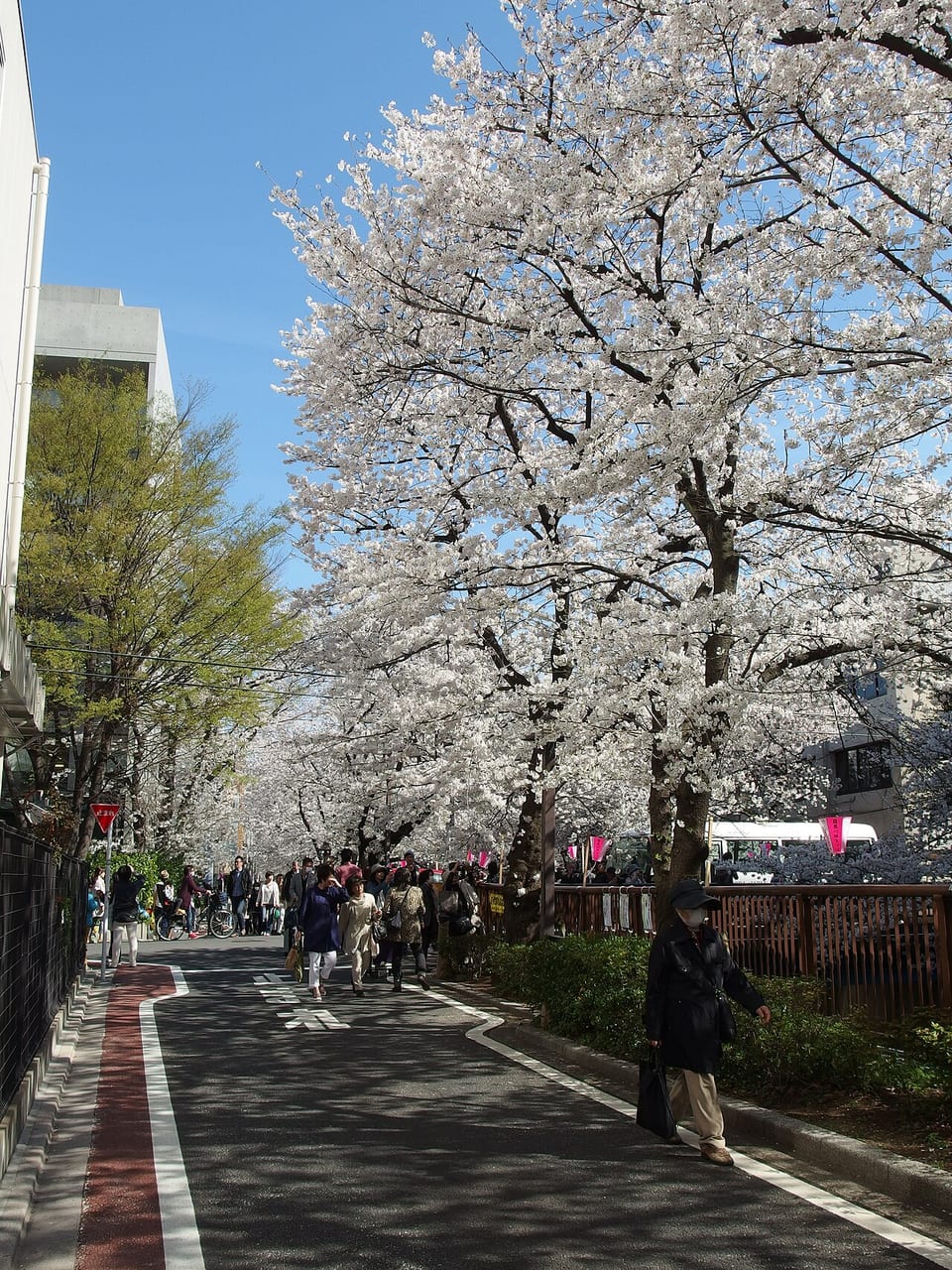
Dawn 6:30-8:30: empty frames
Meguro River, Philosopher's Path, Chidorigafuchi, Hirosaki Castle — the places mobbed by day are almost empty before 8am, with soft light and translucent petals. For a "clean" cherry-blossom shot, dawn is the only answer, and the payoff for getting up early is even higher than in foliage season.
Night 18:00-21:00: limited illuminations
Meguro River (water reflections), Kyoto's Gion Shirakawa and Maruyama Park weeping cherry, Osaka's Mint Bureau, and Hirosaki Castle (moat illumination) are the marquee night scenes. Note: night lighting usually runs only the week around full bloom, and the last 30 minutes before closing clear out fastest.
"Sakura blizzard" and "hanaikada": a one-to-two-day bonus
People assume "once they start falling, I'm late" — but the sakura blizzard of swirling petals and the hanaikada raft of petals on water (most famous at Hirosaki's moat, Meguro River, and Philosopher's Path) only happen for a day or two. Treat it as a limited bonus, not a regret.
Five rookie sakura mistakes
- Treating "April = cherry month." Tokyo peaks in late March; Hokkaido waits until early May. Skip the city-specific timing and you'll hit buds or bare branches.
- Booking rigid flights while the bloom drifts. Sakura moves nearly a week year to year. If your dates are fixed, raise your odds by choosing a forgiving spot (variety-rich Shinjuku Gyoen, or the late northern front) rather than betting one Tokyo park.
- Scheduling top spots for the afternoon or weekend. Meguro River, Philosopher's Path, Ueno are people-seas by day and on weekends. Go at dawn, or the tail end of a night illumination.
- Booking lodging only a month out. Sakura is a top peak season — Kyoto and Tokyo full-bloom weeks need 10-12 weeks' lead, or it's sold out or doubled.
- Writing off the petal fall. The blizzard and petal raft are limited showpieces, not lateness. What to actually avoid is the strong wind-and-rain night after full bloom, which strips the trees.
Frequently Asked Questions
- Q1:Which week should I actually book for cherry blossoms in Japan?
- There is no single nationwide week. The bloom front moves from Tokyo and Fukuoka (around March 31) up to Hokkaido (early May) — a six-week spread. Pick a city first: by JMA 1991-2020 averages, full bloom is ~March 31 in Tokyo and Fukuoka, ~April 4 in Kyoto and Osaka, April 13 in Sendai, April 26 in Hirosaki, and May 6 in Sapporo. Because "full bloom" only looks good for about 7 days, target the window of roughly days 5-10 after first bloom rather than a single date, and fine-tune two weeks out using the year-specific forecast.
- Q2:Why does Tokyo bloom before Kyoto when Kyoto is further south?
- This is the most counter-intuitive thing about sakura planning. The front generally moves south to north, but at similar latitudes Tokyo (avg full bloom March 31) usually opens 3-5 days earlier than Kyoto and Osaka (April 4) — Tokyo has a strong urban heat-island effect and faces the warm Pacific. So a "Tokyo first, then Kansai" order actually rides the bloom timing better than the order most people assume.
- Q3:Was 2026 early or late, and will 2027 be the same?
- Early. Per Weathernews, Tokyo first-bloomed March 21, Ueno March 22, Kyoto March 25, Osaka March 24 — about a week ahead of average, driven by a mild winter. But "mild winter equals early bloom" is not a rule: a late-February or March cold snap pushes it back, so 2026 being early says nothing certain about 2027. The first 2027 forecast need not wait for January: for the 2026 season Weathernews launched on January 8, but Nihon Kishou issued its first release on December 18, 2025. There is no 2027 forecast yet, so plan with the average dates, start tracking from mid-December, and make a final check two weeks before you fly.
- Q4:When does the 2027 sakura forecast come out?
- Not necessarily January. The forecasters do not launch together: for the 2026 season Weathernews went live on January 8, but Nihon Kishou issued its first release on December 18, 2025 — about three weeks ahead of its own pattern across the eight seasons from 2018 to 2025, every one of which fell between January 9 and 19. So the first 2027 forecast may well appear in mid-December 2026; do not wait until January to start checking. There is no exact 2027 bloom date to look up yet; the right move is to pencil in your target city's viewing week from the JMA 1991-2020 averages, book flights and hotels, then track Weathernews, tenki.jp, Nihon Kishou and Weathermap from mid-December, fine-tune the order, and do a final check two weeks before departure.
- Q5:If I can only pick one place, where should I go for sakura?
- It depends what you want. (1) First trip, classic temple-and-shrine aesthetic — Kyoto (Philosopher's Path, Daigo-ji, Gion night cherries, early April). (2) Urban convenience plus great photos — Tokyo (Meguro River, Chidorigafuchi, Shinjuku Gyoen, late March). (3) The postcard shot of cherries with a landmark — Kawaguchiko / Arakurayama with Mt. Fuji (mid-April). (4) Avoid crowds and catch Golden Week — Hirosaki Castle or Hokkaido (late April to early May, the latest front in Japan). With only 4-5 days, choose Tokyo or Kansai — do not try to do both.
- Q6:How early do I book hotels and flights, and is it pricier than autumn?
- Sakura is one of the most extreme peak windows of the year, stacking Japan's graduation/entrance season with spring breaks across Asia. In Kyoto and Tokyo, 4-star room rates often double during full-bloom week and sell out fast. Book city hotels 10-12 weeks out and flights 8-10 weeks out (early-bird fares save US$70-130). Hokkaido is the trap: its bloom lands during Golden Week, Japan's busiest domestic travel period, so book even earlier.
- Q7:If it rains or gets windy after the blossoms open, is the trip ruined?
- Not necessarily. Light rain at full bloom is fine — petals hold, and wet stone paths under pink blossoms photograph beautifully. The real killer is a strong wind-and-rain night after full bloom, which can strip the trees overnight. The move: if heavy wind/rain is forecast, schedule your most-wanted spot for the morning before it hits. And the petal-fall itself — the "sakura blizzard" and the "hanaikada" raft of petals on water (famous at Meguro River, Philosopher's Path, Hirosaki Castle's moat) — only happens for a day or two. That is a bonus scene, not a ruined trip.
🌡️ March-April has big day-night temperature swings and big regional gaps (Okinawa is already warm, Hokkaido still cold). Check your target city's monthly temperatures and packing in our Japan packing & weather guide so dawn cherry-viewing doesn't freeze you. One more thing: plum comes before cherry — in the same city ume opens roughly two months earlier and its festivals run four to eight weeks, so February and March travellers should read when plum blossoms bloom in Japan.