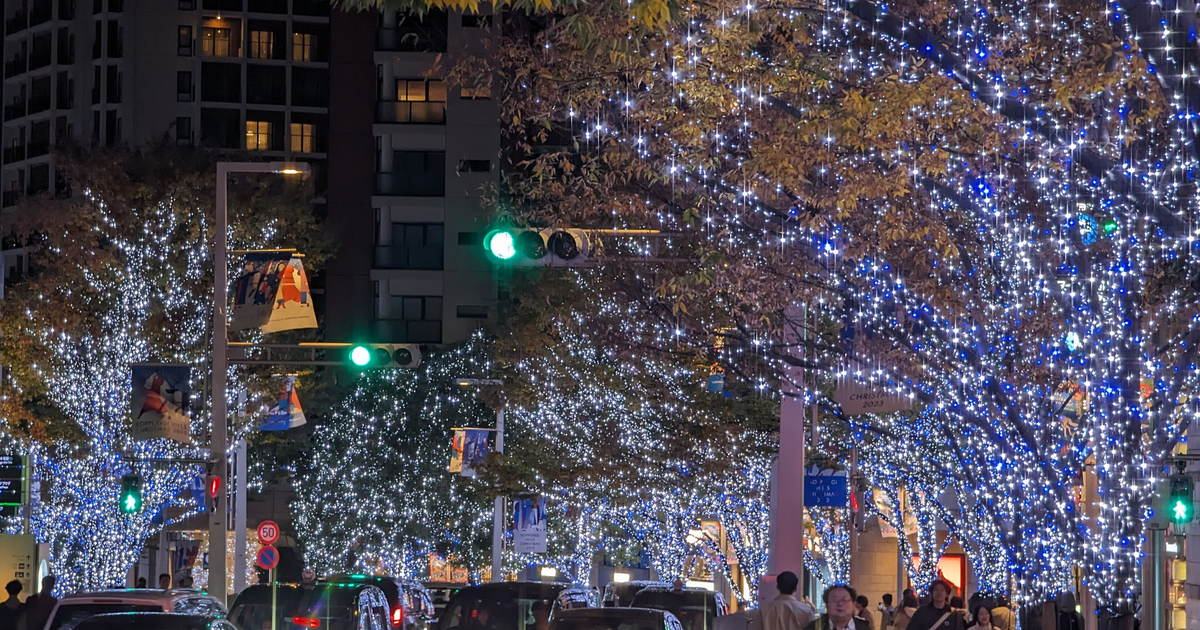
Japan has 16 national holidays, and not one of them falls in December. After Labour Thanksgiving Day on 23 November, the next statutory day off is New Year's Day — 38 consecutive days with no public holiday, the longest gap in the Japanese year. And it is not only the 25th: 23 December stopped being a holiday in 2019, ending three decades of a genuine pre-Christmas day off. In 2026, 24 December is a Thursday and 25 December a Friday; both are ordinary working days with ordinary rush hours. What this guide covers is the stretch from early December to the 25th — why the Japanese December is institutionally empty, which illuminations switch off on Christmas Day and which run until May, why Nabana no Sato costs nearly double on Christmas Eve, and why JR Central chose 25 December as day one of its New Year travel period. Everything from 26 December onward — what opens, what shuts, when the banks close, when the New Year sales start — belongs to the year-end and New Year opening guide. The two articles hand over to each other on exactly that date.
- 25 December has never been a Japanese national holiday. The Cabinet Office's current list of 16 has nothing in December; November 23 jumps straight to January 1
- 23 December was last a holiday in 2018. The current Holidays Act reads "Emperor's Birthday, February 23", and "December 23" has been struck from the law. 2019 is the only year with no Emperor's Birthday at all
- Illuminations split in two. Disney Christmas is officially 11 Nov–25 Dec 2026 and stops dead; Nabana no Sato officially runs to 31 May 2027. Checking only the venues that end on the 25th is how people write off a perfectly good post-Christmas trip
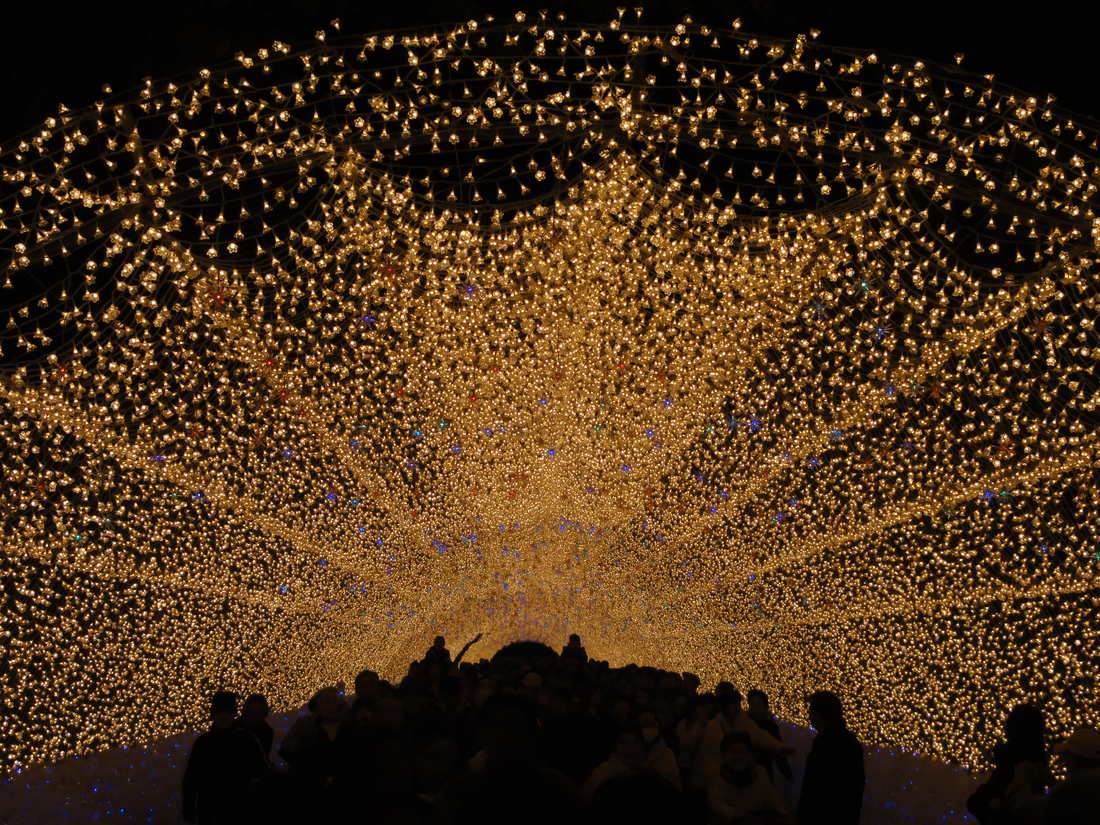
- Nabana no Sato runs a separate rulebook on 23–25 Dec: 15:00 opening, date-specified advance ticket compulsory, and a higher price than the ¥3,000 charged either side
- All Nozomi services are fully reserved 25 Dec 2026 – 5 Jan 2027. Christmas Day is day one of the New Year rush. Non-reserved ticket holders cannot take a seat — switch to Hikari or Kodama
📖 Contents (tap to expand)
- 1. Is Christmas a holiday in Japan?
- 2. The 23 December story, and the year with no Emperor's Birthday
- 3. The 25 December cliff: what stops, what runs on
- 4. Nabana no Sato on 23–25 December
- 5. Trains: why 25 December is day one of the rush
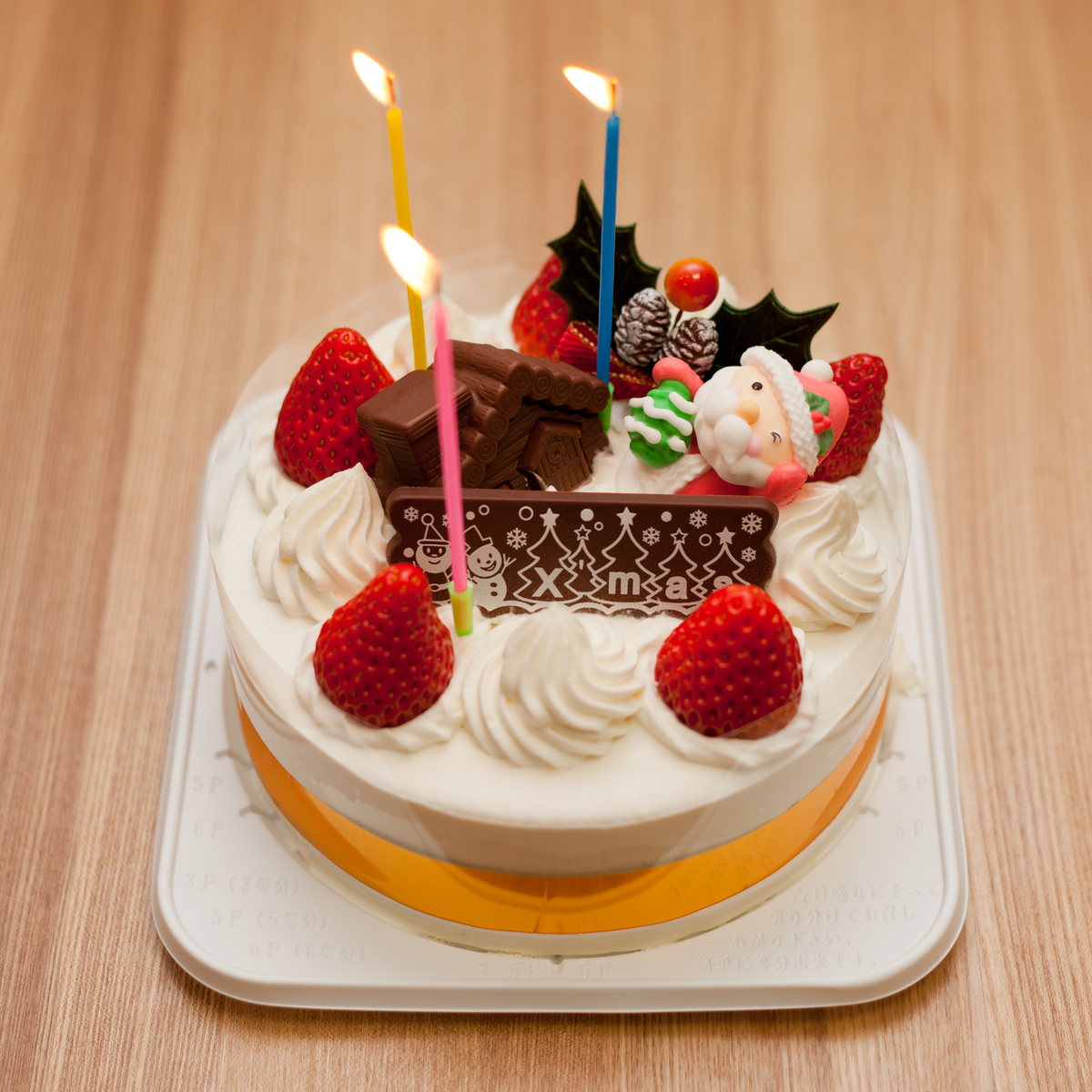
- 6. Christmas cake: a product the government regulates
- 7. KFC and Christmas fried chicken
- 8. Is Christmas a religious occasion in Japan?
- 9. What actually happens on 26 December
- 10. Planning late December
- FAQ
1. Is Christmas a holiday in Japan?
No: 25 December is not one of Japan's national holidays, and in 2026 it falls on a Friday, so offices and schools run as normal. It has never been on the list — not abolished, not moved — and Japan's December has no public holidays at all.
Here is the current list of 16, per the Cabinet Office:
| Holiday | Date | Holiday | Date |
|---|---|---|---|
| New Year's Day | 1 Jan | Children's Day | 5 May |
| Coming of Age Day | 2nd Mon of Jan | Marine Day | 3rd Mon of Jul |
| National Foundation Day | 11 Feb | Mountain Day | 11 Aug |
| Emperor's Birthday | 23 Feb | Respect for the Aged Day | 3rd Mon of Sep |
| Vernal Equinox Day | equinox | Autumnal Equinox Day | equinox |
| Showa Day | 29 Apr | Sports Day | 2nd Mon of Oct |
| Constitution Memorial Day | 3 May | Culture Day | 3 Nov |
| Greenery Day | 4 May | Labour Thanksgiving Day | 23 Nov |
Read down the column and the hole is obvious: December is empty. From Labour Thanksgiving Day on 23 November, the next statutory holiday is 1 January — 38 days without one.
For a visitor this matters more than it sounds. In 2026, 24 December is a Thursday and 25 December a Friday, and both are working days. Which means three things people assume do not survive contact with the calendar:
- ❌ "Trains are quieter on the 24th and 25th because everyone is home with family." Those are normal weekdays with normal rush hours. The Yamanote Line at 8am does not thin out for Christmas.
- ❌ "Shops close for Christmas." With no statutory holiday there is no institutional reason to close. The period when Japan genuinely shuts down is the year-end and New Year window, not Christmas.
- ❌ "There's a long weekend before Christmas." True until 2018, false since. See the next section.
The flip side is genuinely good news, and it is worth planning around: 24 and 25 December in Japan give you full Christmas atmosphere without holiday crowds. Illumination sites fill up with locals after work and with couples, so the crush is concentrated between roughly 6pm and 9pm. Arrive at 4:30pm when the lights first come on and a weekday visit is markedly easier than a weekend one. The period to actually avoid is after 26 December, when the New Year movement begins.
2. The 23 December story, and the year with no Emperor's Birthday
This is the section I most wanted to write, because the English-language internet almost universally gets the ending wrong.
The background: the Emperor Emeritus was born on 23 December, so from 1989 to 2018 that date was the Emperor's Birthday and a public holiday. For three decades Japan really did have a day off two days before Christmas, and if the date fell on a Sunday there was a substitute holiday on top. That is where the "pre-Christmas long weekend in Japan" idea comes from. It was true once.
Then it stopped. Comparing the Cabinet Office's published holiday records year by year gives this timeline:
| Year | 23 December | 23 February | Note |
|---|---|---|---|
| 1989–2017 | Emperor's Birthday | ordinary day | Birthday of the Emperor Emeritus |
| 2018 | Emperor's Birthday (final time) | ordinary day | Fell on a Sunday, so 24 December was a substitute holiday — Japan's last Christmas Eve day off |
| 2019 | ❌ not a holiday | ❌ not a holiday | 🌟 No Emperor's Birthday all year. Instead: 1 May "Day of Accession", 22 October "Day of the Enthronement Ceremony" |
| 2020 | ❌ not a holiday | Emperor's Birthday (first time) | Fell on a Sunday; 24 February was a substitute holiday |
| 2021–present | ❌ not a holiday | Emperor's Birthday | Current law |
How the 2019 gap happened
Look up 2019 in the Cabinet Office's holiday records and there is no "Emperor's Birthday" entry for the entire year. That is not a data omission; the holiday genuinely did not exist that year.
The cause is a plain timing gap. The current Emperor acceded on 1 May 2019, and his birthday — 23 February — had already passed. Meanwhile 23 December was no longer the Emperor's Birthday, because the Emperor Emeritus had abdicated. Neither candidate date qualified inside that calendar year.
What makes it stranger is what 2019 got instead: two one-off holidays, 1 May for the accession and 22 October for the enthronement ceremony. Because the Holidays Act converts a weekday trapped between two holidays into a holiday itself, 30 April and 2 May also became days off, producing the celebrated ten-day Golden Week of 2019.
So in 2019 Japan took ten consecutive days off in May and zero days off in December. As illustrations of how empty the Japanese December is, that one is hard to beat.
Where the law sits
The parent statute is the Act on National Holidays (Act No. 178 of 1948). The change from 23 December to 23 February came via the supplementary provisions of the Special Measures Act on the Abdication of the Emperor (Act No. 63 of 16 June 2017). The operative line in the current Holidays Act reads:
Emperor's Birthday — 23 February — celebrating the Emperor's birthday.
And the phrase "23 December" no longer appears anywhere in the current text. It was not reassigned to another December date; the provision was removed.
3. The 25 December cliff: what stops, what runs on
If one table from this guide survives, it should be this one, because it settles a practical question: will there be anything to see if you are in Japan after 26 December?
Most illumination round-ups quote a single generic window — "early November to 25 December" — and readers who arrive on the 26th conclude they have missed everything. They have not. Japanese winter illuminations split cleanly into two groups: those tied to the Christmas theme, which vanish once the theme does, and those tied to winter as a season, which run to February, or in one case to the end of May.
| Venue | Stops on 25 Dec, or continues | Year and source level |
|---|---|---|
| Tokyo Disney Resort — "Disney Christmas" | Stops 25 Dec (11 Nov – 25 Dec 2026, both parks) | ✅ Officially published for 2026 (Oriental Land 2026 programme schedule) |
| Sapporo White Illumination — Odori site | Stops 25 Dec | ✅ Officially published for 2026: Odori (blocks Nishi 3–5) 20 Nov – 25 Dec 2026; lighting hours post before opening |
| Roppongi Hills Keyakizaka | Stops 25 Dec | ✅ Officially published for 2026: 5 Nov – 25 Dec 2026, 17:00–22:00 (Mori Building release, 30 Sep 2026) |
| Nabana no Sato | Continues, through 31 May 2027 (price band changes on 26 Dec) | ✅ Officially published for 2026-27: 17 Oct 2026 – 31 May 2027, closed 6–7 Jan |
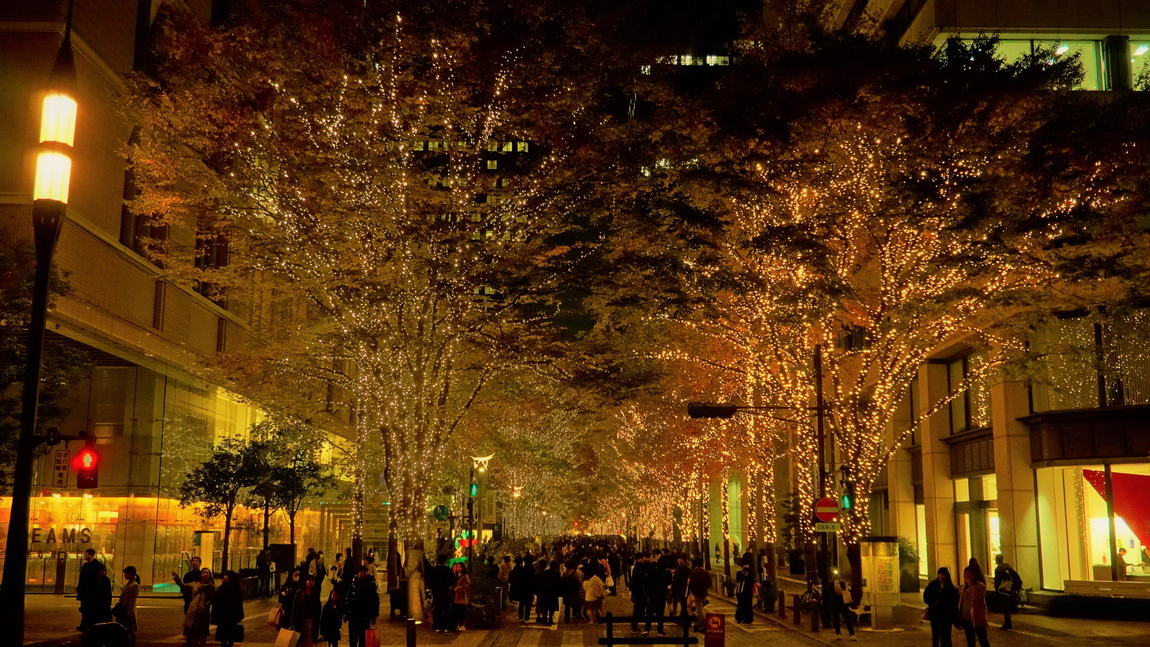
| Marunouchi Illumination | Continues, to 14 Feb 2027 | ✅ Officially published for 2026-27: 12 Nov 2026 – 14 Feb 2027; lighting hours post in late October |
| Sapporo — Ekimae-dori, Minami 1-jo | Continues, to 11 Feb 2027 and 14 Mar 2027 | ✅ Officially published for 2026-27: from 20 Nov 2026; Ekimae-dori to 11 Feb 2027, Minami 1-jo to 14 Mar 2027 |
| Universal Studios Japan — "Universal Holiday Wonders ~Discover U!!!~" (last year's "Universal Christmas Joy") | Continues, to 17 Jan 2027 | ✅ Officially published for 2026: 13 Nov 2026 – 17 Jan 2027; night show "Light Up the Night ~Christmas Celebration~" 25 Nov – 11 Jan |
| OSAKA Hikari no Renaissance (Nakanoshima, Osaka) | Stops 25 Dec — and it only runs 15 days total (11–25 Dec) | ✅ Officially published for 2026 (Osaka City / Prefecture release, 26 May 2026) |
| Midosuji Illumination (Osaka) | Continues, through 31 Dec (hours around 17:00–25:00, so it crosses midnight) | ✅ Officially published for 2026: 3 Nov – 31 Dec 2026 (59 days) |
How to use this table. All nine rows are marked ✅ — officially published and safe to build an itinerary on.
The two Osaka rows deserve a second look, because they demonstrate both camps at once — under the same organiser and the same umbrella name. OSAKA Hikari no Renaissance on Nakanoshima is the extreme case of the "stops on the 25th" camp: it runs for 15 days a year, 11 to 25 December, and it is the source of the headline Osaka winter illumination photograph. The Midosuji Illumination, filed under the same umbrella, is squarely in the "runs on" camp — through 31 December, and because the official hours are "around 17:00 to 25:00", the 31 December session stays lit past midnight into 01:00 on 1 January. From 1 January, though, Osaka's core programmes are all finished, and Kansai's next street-scale display is Kobe Luminarie on 29 January. For what is lit on which dates, see our Osaka winter illumination guide.
One Sapporo detail deserves its own line: this season the Munich Christmas Market in Sapporo (20 Nov – 25 Dec 2026, free to enter) sits in Odori blocks Nishi 1–2, next to the illumination site in blocks Nishi 3–5 rather than inside it. Lighting hours for the 46th edition are published before opening; last season Odori lit from 16:30 to 22:00, extended to midnight on 23–25 December, and the market ran 11:00–21:00.
How the Tokyo venues sit relative to each other, and how to string them into one evening, is covered in the Tokyo winter illumination guide. That article uses the same "which end on the 25th, which run to February" framework and will be updated with exact dates once officials publish them.
4. Nabana no Sato on 23–25 December
This is the single most useful item in the guide, and the one most likely to catch people out at the gate.
Nabana no Sato, in Kuwana, Mie Prefecture, is one of Japan's largest paid illumination venues, and its 2026-27 season is officially confirmed as 17 October 2026 to 31 May 2027 (closed 6–7 January) — seven and a half months, among the longest runs in the country. The usual understanding is that you simply turn up and buy a ticket, no lottery required. That is true on the overwhelming majority of days. It is not true on 23, 24 and 25 December.
Those three days operate under a separate rulebook:
| Item | 23, 24, 25 Dec (special operation) | Other periods (e.g. 26 Dec – 28 Feb) |
|---|---|---|
| Opening | 15:00 only — no daytime session Closes 22:00 on 23 Dec, 23:00 on 24 and 25 Dec | Standard opening hours |
| Ticketing | Date-specified advance ticket required, capped quantity | Available at the gate |
| Adult admission | Higher than other periods, with a ¥2,000 in-park voucher included — see the official fee page for the amount | ¥3,000 (¥3,200 at the gate) |
| Under primary school age | Free | Free |
| Disability discount | Not applicable | Standard rules apply |
Side by side: the same illumination costs more on Christmas Eve than on 26 December, and you must have bought a dated ticket beforehand and cannot get in before 3pm.
My recommendation is unambiguous: unless you happen to be in the Nagoya area on those exact nights and specifically want Christmas Eve, move this to 26 December or later. Three reasons — identical lights, the ordinary price, no scramble for a capped dated ticket. In fairness to the venue: a 15:00 opening with evening-only operation is a genuinely different operating model, so the premium is not arbitrary. It just does not buy a visitor anything extra.
Everything else about the venue — the tunnel of lights versus the water illumination, when to arrive to avoid the crush, how to get there from Nagoya, and how to combine it with Nagashima Spa Land and the outlet mall — is in the full Nabana no Sato guide. This section only covers what changes over those three nights.
5. Trains: why 25 December is day one of the rush
This is where this guide and the New Year one physically join, and it is the detail most often missed when planning late-December travel.
JR Central has published the following: from Friday 25 December 2026 through Tuesday 5 January 2027, every Nozomi service operating between Tokyo and Hakata runs as all-reserved.
Note what that start date implies. Christmas Day is not the tail of ordinary December; on the railway's calendar it is the first day of the New Year travel peak.
The official conditions, in plain terms:
- Holders of non-reserved limited express tickets cannot take a seat — there are no non-reserved cars on Nozomi in this window.
- Boarding is permitted only on the basis of using the vestibule area of an ordinary car, i.e. standing between carriages.
- And officials state explicitly that, given crowding, you are not guaranteed to board the train you want. Even standing is not promised.
The alternative is on the same official page: Hikari and Kodama keep their non-reserved cars as normal throughout the period. This is the line worth remembering, because it is the realistic fallback. Tokyo to Kyoto or Osaka on a Hikari takes longer, but you will get on, and you will sit down.
So for long-distance travel on 25 December my order of preference is: (1) reserve a Nozomi seat the day bookings open — one month before travel, on the day, early; (2) if that fails, switch to Hikari or Kodama; (3) only then consider moving the travel day to the 24th or earlier. Japan Rail Pass holders are in the same boat: the pass lets you reserve for free, it does not reserve for you.
⚠️ Conventional-line limited expresses are announced separately. JR Central, JR East and JR West jointly announced on 18 September 2025 that the Hida, Shinano and Nanki services would run all-reserved from 26 December 2025 to 4 January 2026, noting it matched the Nozomi window. That was the 2025-26 announcement, not 2026-27. The equivalent for 2026-27 had not been published as of August 2026; it typically appears in late September. If your itinerary uses limited expresses toward Takayama, Matsumoto or the Kii Peninsula, check the official release in October.
Everything about transport and opening hours from 26 December onward — whether the metro runs all night on New Year's Eve, when the New Year sales start, which days banks are closed by law, whether your card works in the ATMs — is in the year-end and New Year opening guide. For how Japan's three big travel peaks compare and which one to avoid outright, see Golden Week, Obon and New Year compared.
6. Christmas cake: a product the government regulates
First, a widespread expectation that needs adjusting: the idea of picking up half-price Christmas cake in a supermarket late on 25 December is running against the trend, not with it.
Discounts do happen — seasonal goods get marked down everywhere. But do not build an evening around it, because the Japanese government is systematically reducing the leftovers. The Consumer Affairs Agency's FY2020 White Paper on Consumer Affairs puts it like this:
Overheated seasonal sales campaigns for products such as Christmas cake and ehomaki result in large volumes of unsold goods being discarded, and this has become a social problem.
The government's actions, as recorded in that White Paper: an administrative notice in January 2019 urging food retailers to sell in line with demand, and a further notice to the same effect issued through food retail associations in December 2019. Twice in a single year — the frequency alone tells you how seriously this is being treated.
There are official outcome figures too. In post-season surveys, around 90 percent of businesses reported improved waste rates against the previous year, achieved by shifting to reservation-based sales, same-day production, and adjustments to product sizes and ranges. The White Paper names FamilyMart as a specific case: osechi, large Christmas cakes, eel for the midsummer ox day and ehomaki all moved to a fully reservation-based model under a declared "zero waste loss" policy. The agency's dedicated food-loss portal puts it to consumers directly, noting that leftover cake, osechi and ehomaki are discarded every year and advising people to purchase by planned reservation.
What that means for a visitor: Japanese Christmas cake is turning into a pre-ordered product. Walk into a department store food hall at 6pm on 24 December and what you will mostly find is a queue of people collecting reservations, not a mountain of stock waiting to be discounted. If you want one, reserve it a few days ahead at a department store or a patisserie.
Ehomaki appears alongside Christmas cake in that same Consumer Affairs Agency passage: Japan applies one regulatory logic to both seasonal foods, and the agriculture ministry's roster of waste-reduction participants grew from 26 companies to 100 — see the Setsubun guide's ehomaki section.
Fujiya started in 1910, not 1922
The commercial origin of Christmas cake in Japan is traced to the confectioner Fujiya. The 1922 date attached to it belongs to a different product, twelve years later.
Per Fujiya's official corporate history: in November 1910, Fujii Rinemon — then 25 — opened a Western confectionery shop at 2-chome 86, Motomachi, Yokohama; and in December 1910, the history records the launch of Christmas cake. What appears against 1922 is the launch of the shortcake, the strawberry-and-cream cake, at 8 sen apiece. The two events are twelve years apart.
One further restraint: the official history makes no claim to being Japan's first. So the accurate phrasing is that Fujiya's own corporate history records it selling Christmas cake as early as December 1910 — without adding a "first in Japan" crown that the company itself never claimed.
7. KFC and Christmas fried chicken
Pack contents, tax-inclusive prices, the reservation opening date and the collection-slot system are only published inside the campaign window. KFC Japan's Christmas microsite goes offline out of season, and no official figure exists for it in August. Details go live in early November — check japan.kfc.co.jp then.
Note the domain: KFC Japan is japan.kfc.co.jp, not kfc.co.jp. The latter does not resolve.
The corporate history is officially documented:
- March 1970: an experimental US KFC outlet appeared at the Osaka Expo — the brand's first mass exposure to a Japanese audience was at a world's fair.
- July 1970: KFC Japan was established as a 50-50 joint venture between KFC of the United States and Mitsubishi Corporation. It has been a Japanese-American joint venture from day one.
- November 1970: the first Japanese store, "Meisei", opened in Nishi Ward, Nagoya — not Tokyo.
- December 1974: the official history records "first Christmas campaign implemented".
So "KFC Japan's Christmas marketing dates from 1974" is an official-grade fact and safe to repeat. But watch for one embellishment: the official history contains only that phrase about a first Christmas campaign, and does not include the famous "Kentucky for Christmas" slogan.
As for what proportion of Japanese people eat fried chicken at Christmas, no official statistic sits behind any of the percentages in circulation. What you actually need to know is simpler: KFC branches are extremely busy on 24 and 25 December, so if you want a barrel, order as soon as the campaign is published in early November.
8. Is Christmas a religious occasion in Japan?
No — and the official religious statistics show the scale, as long as you use them correctly.
From the Agency for Cultural Affairs' Religious Yearbook, Reiwa 7 edition (published December 2025, with a statistical base date of 31 December 2024):
| Group | Adherents |
|---|---|
| Shinto-affiliated | 86,359,612 |
| Buddhist-affiliated | 80,463,918 |
| Christian-affiliated | 1,872,320 |
| Other | 6,358,197 |
| Total | 175,054,047 |
The Christian-affiliated figures also include 4,791 single religious corporations, 73 umbrella corporations and 35,511 clergy.
Look at the total: 175 million — far in excess of Japan's actual population of roughly 123 million.
Why? Because the agency says so itself, in a caveat printed in the same document:
The term "adherent" is used differently by each religious body; the definition and qualifications of an adherent are set by each organisation individually, and each uses its own method of counting.
In plain terms: this is self-reported data with inconsistent definitions and substantial double-counting. A single person being counted by both a shrine and a temple is entirely ordinary.
So the correct use is narrow: 1.87 million tells you Christianity occupies a very small share of Japan's religious statistics. It cannot be divided by the population to produce a percentage. The figures quoted as "only 1 percent of Japanese are Christian" are exactly that division — of a dataset whose own publisher states the counting basis is inconsistent.
The conclusion holds without a percentage: in a dataset that puts Shinto and Buddhist affiliation in the 80-million range each, Christian affiliation is 1.87 million. That is enough to establish that Christmas in Japan did not grow out of religious practice — it is a commercial and social occasion. Which is precisely why it can end as abruptly as it does on 26 December.
9. What actually happens on 26 December
Does Christmas in Japan vanish overnight into New Year goods? Not everywhere, and not on one schedule. Three separately sourced timetables, side by side:
| Evidence | Detail | Source level |
|---|---|---|
| Tokyo Disney Resort's programme calendar | "Disney Christmas" ends 25 December 2026; the next programme, New Year, starts 1 January 2027 — leaving 26 to 31 December blank on the official schedule | ✅ Official 2026 programme |
| Nabana no Sato's price bands | Admission changes band on 26 December: a higher special-operation price on 23–25 Dec, then ¥3,000 from 26 Dec to 28 Feb | ✅ Official 2026-27 pricing page |
| JR Central's calendar | All-reserved Nozomi operation begins 25 December — on the railway's schedule, Christmas Day is already day one of the New Year transport period | ✅ JR Central official |
| Sapporo White Illumination, Odori site | Switches off 25 December, and the neighbouring Munich Christmas Market ends the same day | ✅ Official 46th-edition outline (2026-27) |
You do not need a folklore explanation. Read the schedules: Japan's largest theme park runs its Christmas programme to 25 December and does not open the next one until 1 January, leaving six blank days; Japan's largest paid illumination changes its price band on 26 December; and JR Central sets the start of the New Year transport period at 25 December. Three independent institutions, three separate official calendars, one shared pivot point.
Two practical consequences. First, you will not be short of things to see after 26 December — Nabana no Sato, USJ (to 17 January 2027), Marunouchi (to 14 February 2027) and Sapporo's Ekimae-dori (to 11 February 2027) all belong to the continuing camp. Second, the whole country changes rhythm, from "see the lights after work" to travelling home, cleaning the house and preparing New Year food. The rules for that period — what opens, what closes, when the sales begin, which days banks are shut by law, whether the metro runs overnight — are a separate subject entirely, and they live in the year-end and New Year opening guide. The handover point between the two articles is 25 December: this one runs up to it, that one starts from it.
10. Planning late December
Collapsing all of the above into practical advice.
- Do not travel to Japan specifically for Christmas. Honestly, if what you want is a country pausing to celebrate, Japan will not deliver it — 24 and 25 December are working days and institutionally nothing stops. What is worth travelling for is the illuminations, and those run far longer than Christmas does.
- For maximum atmosphere, 23–25 December is the window. Know the cost first: Nabana no Sato charges more than usual and requires a dated ticket on those nights, and Sapporo's Odori site extended to midnight on those dates in the previous season (this season's hours are published before opening). Atmosphere and price move together.
- If you are cost-conscious, I would simply pick 26–29 December. The lights are still on (Nabana no Sato officially through 31 May, USJ through 17 January; Marunouchi through 14 February 2027), Nabana drops back to ¥3,000, and the New Year exodus has not peaked. That is the best-value stretch of late December in my view.
- Avoid long-distance travel on 25 December if you can. All-reserved Nozomi operation starts that day; without a reservation you are standing in a vestibule, with no guarantee of boarding. If you must move, take a Hikari or Kodama with non-reserved cars.
- Reserve a Christmas cake rather than hunting for a markdown. Government policy is actively reducing leftovers and the industry is moving to full pre-order. Same logic for KFC — the year's campaign is published in early November.
- Do not underdress. Late December means single-digit daytime highs across much of Kanto and sub-zero conditions in Hokkaido and Tohoku, and illumination viewing means standing outdoors all evening. Month-by-month temperatures and what to pack are in the month-by-month weather and clothing guide; when the first snow typically falls and which cities see accumulation in December is in the first snow guide.
- Eat the season while you are there. Late December is peak crab and hotpot territory — unrelated to Christmas, but very much related to your itinerary. See what to eat in Japan in winter.
Finally, the limits of this guide, which are more useful than pretending to omniscience. Officially published and safe to plan around: the holiday system, the all-reserved Nozomi period, Nabana no Sato's season dates and its ordinary price bands (the 23–25 December price is the one to recheck), Tokyo Disney Resort's and USJ's 2026 programmes, the two Osaka displays, Roppongi Keyakizaka and Marunouchi. Sapporo's 46th-edition dates are official as well; only its lighting hours are still to come. KFC's annual campaign lands in early November. Check the official pages before you travel. What this guide gives you is the system, the rules and a framework for judging what you read — not a timetable for December 2026.
Frequently Asked Questions
- Q1:Is Christmas a public holiday in Japan?
- No. December 25 has never appeared on Japan's list of national holidays. Not "removed at some point" — never on it. The Cabinet Office lists 16 national holidays in force: New Year's Day, Coming of Age Day, National Foundation Day, the Emperor's Birthday, the Vernal Equinox, Showa Day, Constitution Memorial Day, Greenery Day, Children's Day, Marine Day, Mountain Day, Respect for the Aged Day, the Autumnal Equinox, Sports Day, Culture Day and Labour Thanksgiving Day. Not one of them falls in December. The practical consequence is a gap most visitors do not expect: after Labour Thanksgiving Day on November 23, the next statutory holiday is New Year's Day on January 1, leaving 38 consecutive days with no public holiday at all — the longest such stretch in the Japanese year. In 2026, December 24 is a Thursday and December 25 a Friday. Both are ordinary working days, rush hour included. So the common claim that trains are quieter at Christmas because everyone is home with family runs directly against the institutional facts.
- Q2:Wasn't December 23 a holiday in Japan? What happened to it?
- It was, and 2018 was the last time. The Emperor Emeritus was born on December 23, so from 1989 through 2018 that date was the Emperor's Birthday and a red day on the calendar — which is where the idea of a pre-Christmas long weekend in Japan comes from. It was real, and it is now gone. In 2018 the date fell on a Sunday, so December 24 became a substitute holiday: Japan's final Christmas Eve day off. The current text of the Holidays Act reads "Emperor's Birthday, February 23", and the phrase "December 23" no longer appears anywhere in the law — it was not moved to a different December date, it was removed entirely. The change came through the supplementary provisions of the Special Measures Act on the Abdication of the Emperor (Act No. 63 of June 16, 2017), amending the Act on National Holidays (Act No. 178 of 1948). Any guide still promising a holiday around December 23 is working from pre-2019 material.
- Q3:Which day was the Emperor's Birthday in 2019?
- There wasn't one. 2019 is the only year in modern Japan with no Emperor's Birthday at all, and it is the detail almost every guide — Japanese ones included — gets wrong. The reason is a simple timing gap. The current Emperor acceded on May 1, 2019, but his birthday, February 23, had already passed by then; and December 23 was no longer the Emperor's Birthday because the Emperor Emeritus had abdicated. Neither date qualified within that calendar year. Open the Cabinet Office's official holiday records for 2019 and there is simply no "Emperor's Birthday" row. What appears instead are two one-off holidays: May 1, "the Day of Accession", and October 22, "the Day of the Ceremony of the Enthronement". Because the Holidays Act turns a weekday sandwiched between two holidays into a holiday itself, April 30 and May 2 also became days off — producing the famous ten-day Golden Week of 2019. And yet that same year had zero holidays in December. February 23 returned as a holiday from 2020 (it fell on a Sunday that year, making February 24 a substitute holiday).
- Q4:Do Japan's Christmas illuminations all end on December 25?
- Some do, some run for months — and knowing which is which decides whether your post-Christmas trip has anything to look at. The ones that stop: Tokyo Disney Resort's "Disney Christmas" runs November 11 to December 25, 2026 across both parks, and that is confirmed in Oriental Land's published 2026 programme schedule. Sapporo White Illumination's Odori site also stops on December 25 — its 46th edition is officially November 20 to December 25, 2026 — and Roppongi Hills' Keyakizaka runs November 5 to December 25, 2026. The ones that keep going: Nabana no Sato has officially confirmed 2026-27 as October 17, 2026 to May 31, 2027 (closed January 6-7), entirely unaffected by December 25. Marunouchi ran to mid-February in 2025-26; Universal Studios Japan's 2026 winter event, "Universal Holiday Wonders ~Discover U!!!~", officially runs November 13, 2026 to January 17, 2027; and Sapporo's Ekimae-dori and Minami 1-jo sites officially run to February 11 and March 14, 2027. So "there is nothing to see after December 26" is wrong — it just means you only checked the venues that stop.
- Q5:Is Nabana no Sato different on Christmas Eve?
- Completely different, and more expensive. December 23, 24 and 25, 2026 are designated "Christmas special operation" days with their own rules. First, there is no daytime session at all — gates open at 15:00 (closing 22:00 on the 23rd, 23:00 on the 24th and 25th). Second, entry requires a date-specified advance ticket, and the number sold is capped. Third, the price: the special-operation ticket costs more than the 3,000 yen (3,200 yen at the gate) charged in the surrounding periods including December 26 to February 28 — go by the amount on the official fee page when you book. Officials also state that the disability discount does not apply on special operation days; children under primary school age are free throughout. My advice is blunt: unless you specifically need to be there on the night of the 24th, move it to December 26 or later. Same lights, the ordinary price, no scramble for a dated ticket.
- Q6:What should I know about taking the shinkansen on December 25?
- Christmas Day is day one of the New Year travel period, as far as the railway is concerned. JR Central has announced that from Friday December 25, 2026 through Tuesday January 5, 2027, every Nozomi service between Tokyo and Hakata runs as all-reserved. The official wording matters: holders of non-reserved limited express tickets cannot take a seat, may board only on the basis of using the vestibule area of an ordinary car, and — explicitly — are not guaranteed to board the train they want when services are crowded. So during this window, no reservation on a Nozomi means no seat, and standing is not guaranteed either. The escape route is stated on the same official page: Hikari and Kodama services keep their non-reserved cars as usual throughout the period. They are slower, but you can actually get on. Practical order of preference: reserve a Nozomi seat the day tickets open (one month before travel), fall back to Hikari or Kodama, and only then consider shifting your travel day earlier. Japan Rail Pass holders must still make a seat reservation — the pass is not a seat. One more caveat: JR Central, East and West jointly announced all-reserved operation for the Hida, Shinano and Nanki limited expresses for December 26, 2025 to January 4, 2026, but the equivalent 2026-27 announcement had not been published as of August 2026; it typically comes in late September.
- Q7:Can I pick up a discounted Christmas cake late on December 25?
- The trend is moving in the opposite direction, and it is being pushed there by government policy. Japan's Consumer Affairs Agency addressed this directly in a column in its FY2020 White Paper on Consumer Affairs, stating that overheated seasonal sales campaigns for Christmas cake and ehomaki lead to large volumes of unsold product being discarded, and that this has become a social problem. The same document records that the government issued an administrative notice in January 2019 urging food retailers to "sell in line with demand", then issued a further notice through food retail associations in December 2019 — twice in one year. Post-season surveys found that around 90 percent of businesses reported improved waste rates versus the previous year, achieved through reservation-based sales, same-day production, and changes to sizes and product ranges. The White Paper names FamilyMart as an example: osechi, large Christmas cakes, eel for the midsummer ox day and ehomaki all moved to a fully reservation-based model under a stated "zero waste loss" policy. The agency's food loss portal likewise tells consumers to "purchase by planned reservation". Translation for visitors: Japanese Christmas cake is becoming a pre-ordered product. If you want one, reserve it a few days ahead at a department store or patisserie rather than waiting for a markdown.
- Q8:Do Japanese people really eat KFC at Christmas, and can I just walk in?
- Fried chicken at Christmas is genuinely widespread in Japan. From KFC Japan's official corporate history: the Japanese company was established in July 1970 as a 50-50 joint venture between KFC of the United States and Mitsubishi Corporation; an experimental US KFC outlet had already appeared at the Osaka Expo in March 1970; Japan's first store, "Meisei", opened in Nishi Ward, Nagoya in November 1970 — not Tokyo, which is a common error; and the official history records "first Christmas campaign implemented" in December 1974. So "KFC Japan's Christmas marketing began in 1974" is an official-grade fact. The barrel contents, tax-inclusive prices, reservation opening date and collection-slot system are only published inside the campaign window — the Christmas microsite goes offline out of season. Details typically appear in early November; check japan.kfc.co.jp then, and note the domain, because kfc.co.jp is not it. The official history records only that a first Christmas campaign was run; the famous "Kentucky for Christmas" slogan does not appear in it.
Read next
What's Open in Japan Over New Year? 2026-27 Guide
Department stores now shut on Jan 1–2, Tokyo’s subways stopped running all night years ago, and every Nozomi is reserved-only over the holidays.
Tokyo Winter Illuminations: 5 Venues, Free vs Paid
Marunouchi, Roppongi, Midtown and Omotesando are free; only Yomiuriland charges. Dates, vibe, and a one-night route compared.
Nabana no Sato Illumination 2026-27: Opens Oct 17
Runs Oct 17, 2026 to May 31, 2027 near Nagoya — ticket tiers, lighting times, the 200m light tunnel, both routes from the city and the last buses back.
📊 See the 2026 Price Index (JR Pass, DPA, eSIM, Airport Transport) →