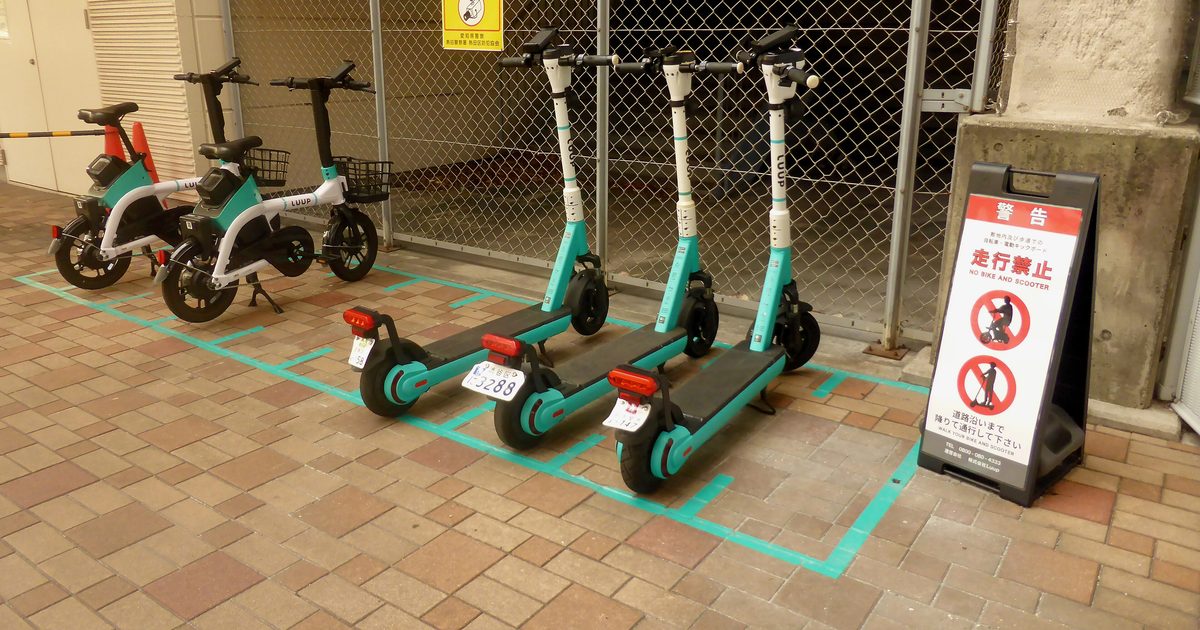
Japanese police issued 37,185 e-scooter citations in 2025 against 386 accidents — you are roughly 96 times more likely to be ticketed than to crash — and 59% of those citations were for the same thing: riding where the machine is not allowed to be. What makes this vehicle genuinely strange is that it requires no licence at all. Most people hear that and assume enforcement must therefore be worse, since there is nothing to take away. The law does the opposite: the drafters inserted a parenthesis into Article 125, paragraph 2, item 1 of the Road Traffic Act that singles out this vehicle class, so that a rider with no licence can still receive the ¥6,000 fixed-penalty ticket, pay it, and be done. That bracket is the spine of this guide, because it also tells you where the danger actually sits. The bracket appears in item 1 only. Items 2, 3 and 4 have no such carve-out, and what they describe is alcohol in your system, injuring somebody, and being under 16 — a list that reads uncomfortably like a visitor’s itinerary. Below: the statutes, the amounts, and the three things that really block foreign riders. None of those three are in the Road Traffic Act.
- No licence, minimum age 16. Your home licence and IDP are irrelevant here; a passport is accepted as proof of age
- Being unlicensed does not make things worse — the bracket in Article 125(2)(i) exists to ensure you get the same blue ticket a local would
- Three switches turn that ticket into a criminal case: alcohol in your system, causing injury, being under 16. The first one is the realistic risk in a country built around izakaya
- The most-enforced offence by far is riding in the wrong place (¥6,000, 59% of all citations). Footways need signage and 6 km/h mode with the lamp flashing — riding slowly does not qualify
- What actually blocks visitors is not legal: whether your card registers, whether you can read a test you must answer perfectly, and a parking mistake that sends you to a police station in person
📖 Contents
- 1. Do you need a licence
- 2. The bracket written for you
- 3. Three switches that turn a ticket into a criminal case
- 4. What each offence costs
- 5. Where you are allowed to ride
- 6. What 6 km/h mode actually is
- 7. The age rule, and why it catches parents
- 8. Do you need a helmet
- 9. How many riders get stopped
- 10. Can visitors rent one
- 11. Parking it in the wrong place
- 12. Identical machines, different rules
- 13. If sign-up defeats you
- 14. Three closing points
- 15. Frequently asked questions
Do you need a licence
No, and no licence from any country changes anything.
The mechanism is worth following, because it explains every counter-intuitive result later in this guide. Article 84, paragraph 1 of the Road Traffic Act imposes the licence obligation on two categories: automobiles, and general motorised bicycles. Article 18, paragraph 1 defines that second category precisely — it means the machines falling under Article 2, paragraph 1, item 10 (a). A compliant e-scooter falls under item 10 (b) of the same provision instead, and it acquires its formal name somewhere else entirely: Article 17, paragraph 3, where it is called a specified small motorised bicycle.
The consequence is that this vehicle class simply never enters the scope of Article 84, paragraph 1. The National Police Agency puts the conclusion in a single sentence on its explainer page: no driving licence is required. Leave your International Driving Permit in the hotel safe — for this machine it does nothing. Age is the only eligibility bar, and a passport settles it.
Follow the definition one step further and a rarely-mentioned side effect appears. Because the statutory term "automobiles etc." excludes this class, Article 103, which governs licence revocation and suspension, hangs its trigger on offences committed while driving an "automobile etc." — and the full text of Article 103 contains no reference to specified small motorised bicycles at all. The drafters compensated with Article 108-3-5, a mandatory rider training scheme built on the same pattern as the one for cyclists, backed by a fine of up to ¥50,000 for ignoring an order to attend.
The bracket written for you
The law reaches into a general rule and lifts this one vehicle class out of it.
Article 125, paragraph 2 defines who counts as a "violator" for the purposes of the fixed-penalty system, and it does so backwards: anyone falling into one of the four listed items is not a violator, gets no blue ticket, and has the case handled as a criminal matter. Item 1 catches people who hold no licence for the vehicle involved. In the world of cars and motorcycles that is entirely sensible — unlicensed driving is not something you settle by post.
Applied to a vehicle nobody can be licensed for, it produces an absurd result. Not one rider in Japan would ever receive a fixed-penalty notice; every rolled stop sign would land on a prosecutor’s desk. So item 1 carries a parenthesis excluding specified small motorised bicycles from its own scope.
For a visitor the practical translation is short. Your lack of a Japanese licence has no effect on how a violation is processed. You are handed the same ticket a Japanese rider is handed, you pay the same amount, and the case closes without a criminal record. That runs against the usual instinct, where being undocumented in a foreign system means more friction rather than less.
Three switches that turn a ticket into a criminal case
The bracket appears in item 1 only. Items 2, 3 and 4 do not have one.
This is the section to take away. The remaining three items of Article 125, paragraph 2 apply across all vehicles with no carve-out for this class:
| Item | Trigger | Outcome |
|---|---|---|
| Item 1 | No licence — but this vehicle class is excluded by the bracket | 🔵 Blue ticket as normal |
| Item 2 | Alcohol in your system, down to the 0.15 mg/L band | 🔴 Criminal procedure |
| Item 3 | The violation caused a traffic accident | 🔴 Criminal procedure |
| Item 4 | Under 16 years old | 🔴 Criminal procedure |
Read item 2 carefully, because its reach is wider than it first looks. It does not merely say that drink-riding is a criminal offence — a separate provision already does that. It says that any violation committed while you have alcohol in your system ceases to be a fixed-penalty offence. An ordinary red light that would have cost ¥6,000 becomes a criminal case because of one drink with dinner.
Drop that into the real geography of a Japanese evening and the risk becomes obvious. Share scooters are parked outside the izakaya, and the machine needs no licence and no key — you scan and go. There is no friction at all between "I did not drive tonight, so this is fine" and a criminal file. Police recorded 415 drink-riding citations in 2025, comfortably more than one per day.
Item 3 is equally unyielding: cause injury through a violation and the fixed-penalty route disappears. That much is identical to the position for cyclists, since both classes sit under the same article of the same act.
The two alcohol bands themselves:
| State | Threshold | Penalty |
|---|---|---|
| Riding with alcohol present | 0.15 mg per litre of breath (Enforcement Order Art. 44-3) | Up to 3 years’ confinement or ¥500,000 |
| Riding while intoxicated | 0.5 mg per litre of breath, or impairment preventing proper control | Up to 5 years’ confinement or ¥1,000,000 |
⚠️ A boundary on those figures: they are the values in the current statutory text. Our guide to driving in Japan and the International Driving Permit describes the 0.5 mg threshold as a July 2026 addition; that legislative history was not checked here, so this guide states the current value only and leaves the history to that article.
What each offence costs
Between ¥3,000 and ¥12,000, with a phone in your hand at the top.
The amounts live in Appended Table 6 of the Road Traffic Act Enforcement Order, which is organised in columns by vehicle type. Note 4 of that table defines the "moped etc." column as covering small special vehicles, motorised bicycles and light vehicles — and since a specified small motorised bicycle is a motorised bicycle, that is the column that applies to you. Worth flagging because bicycles take a different route through the same table, and the two sets of numbers are not interchangeable.
| Fixed penalty | Offence | Table 6 item |
|---|---|---|
| ¥12,000 | Holding a phone to talk or watch the screen | Item 6 |
| ¥6,000 | Lane-position violation (footway riding, riding on the right) / running a red light / breach of the safe-riding duty / failing to yield at a crossing | Item 16 |
| ¥5,000 | Failing to stop where required / ignoring a flashing signal / entering a prohibited road / failing to slow where required | Item 17 |
| ¥3,000 | Failing to proceed slowly on a footway / incorrect use of a roadside strip / incorrect turning at junctions | Item 19 |
That table is the administrative layer. On the criminal side the police publish a separate and much steeper set: carrying a passenger, up to ¥500,000; riding on the wrong side or ignoring the carriageway rule, up to three months’ confinement or ¥500,000; breaching the footway rules, up to ¥200,000 or a petty fine; riding a machine that fails the safety standard, up to three months or ¥500,000; using a phone, up to one year’s confinement or ¥300,000; and failing to take the required measures after an accident — a hit and run — up to ten years’ confinement or ¥1,000,000.
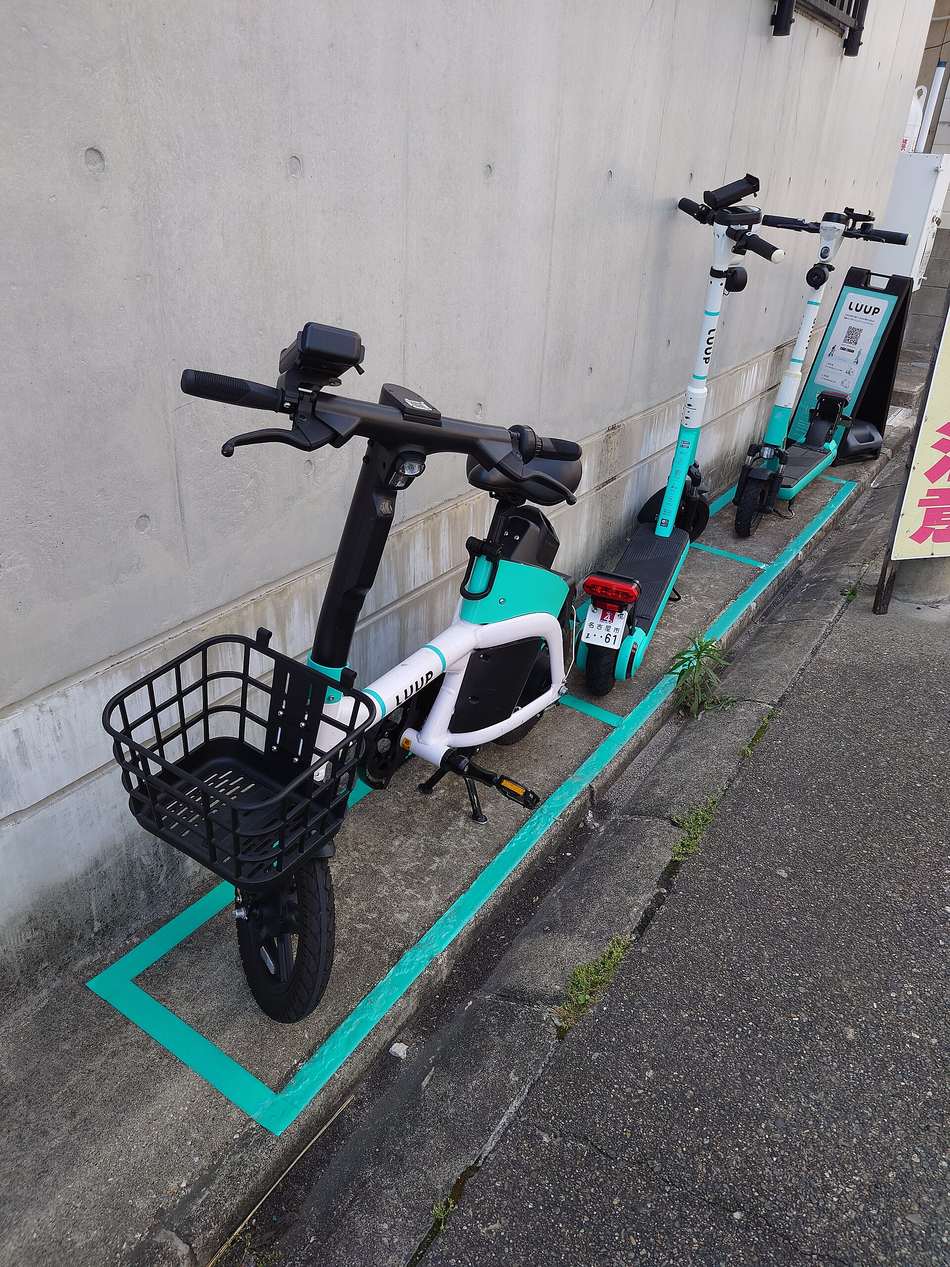
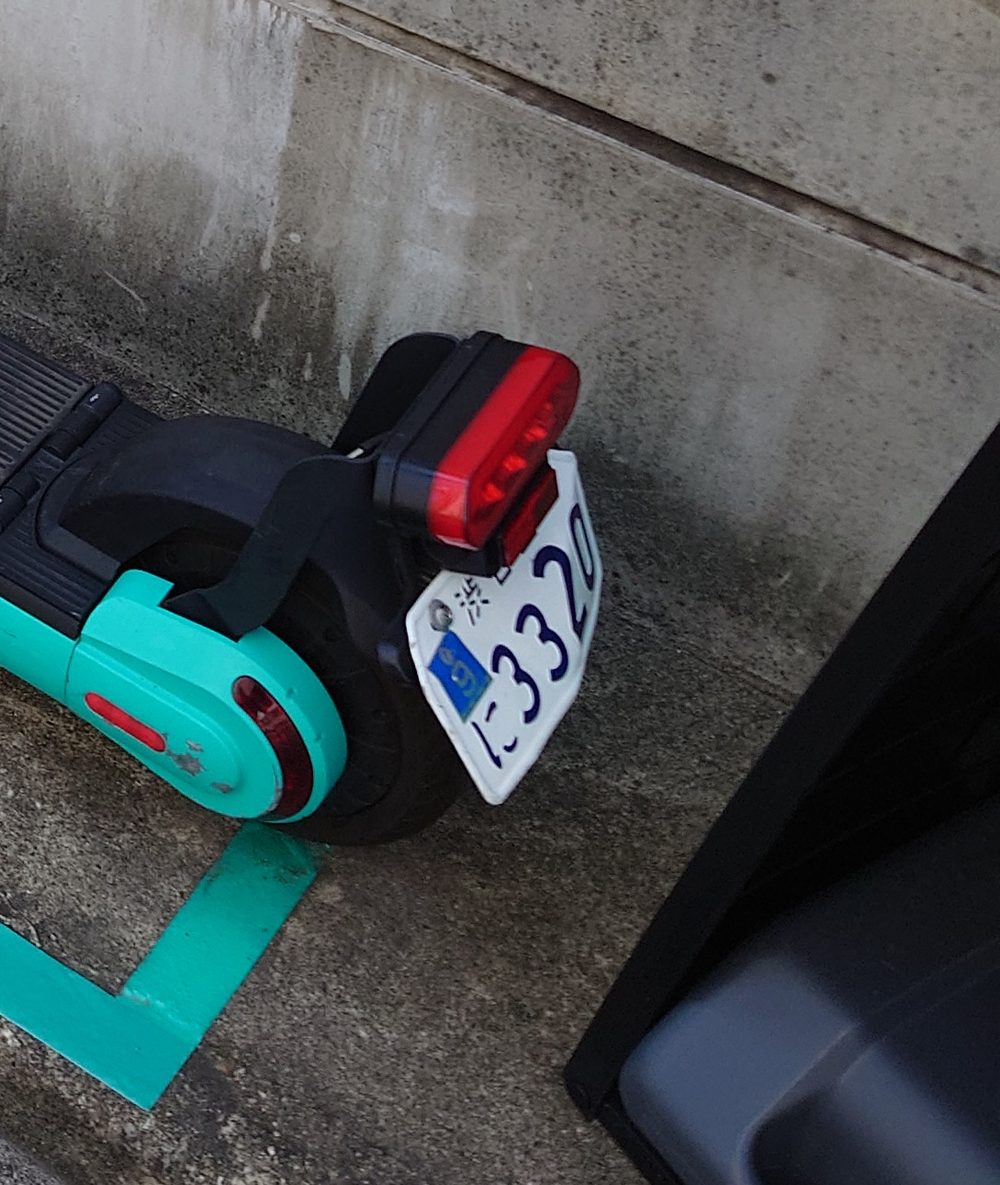
⚠️ Two further duties belong to the owner of the machine, not the rider: compulsory liability insurance, and fitting the municipal number plate. Rent and the operator handles both. Buy a scooter in Japan and they become your problem.
Where you are allowed to ride
The default is the left-hand side of the carriageway, and the footway is an exception to an exception.
Start with the default, because it is the one visitors get wrong on reflex. This class is legally a motorised bicycle: it belongs on the road, on the left. Anyone arriving from Taiwan, Korea, mainland China, North America or most of Europe has the opposite side wired into muscle memory, and muscle memory reasserts itself at junctions. The single most-cited offence in the statistics, lane-position violation, covers exactly this together with riding onto a footway you may not use — 22,368 citations in 2025 alone.
The share operator then layers its own limits on top, and they are tighter than the statute. Its help pages state three things: riding outside the service area is prohibited; zones outlined in red on the map must be walked through, with riding across them explicitly forbidden as well; and — the one most easily missed — a shared pedestrian and cycle path counts as footway and is generally off limits.
For a short trip that reduces to one habit: check on the map before you unlock that the direction you are heading is clear, rather than discovering a red zone mid-ride.
What 6 km/h mode actually is
It is a mode, not a speed — riding slowly by hand does not count.
Two conditions must hold together before a footway is legally available to you.
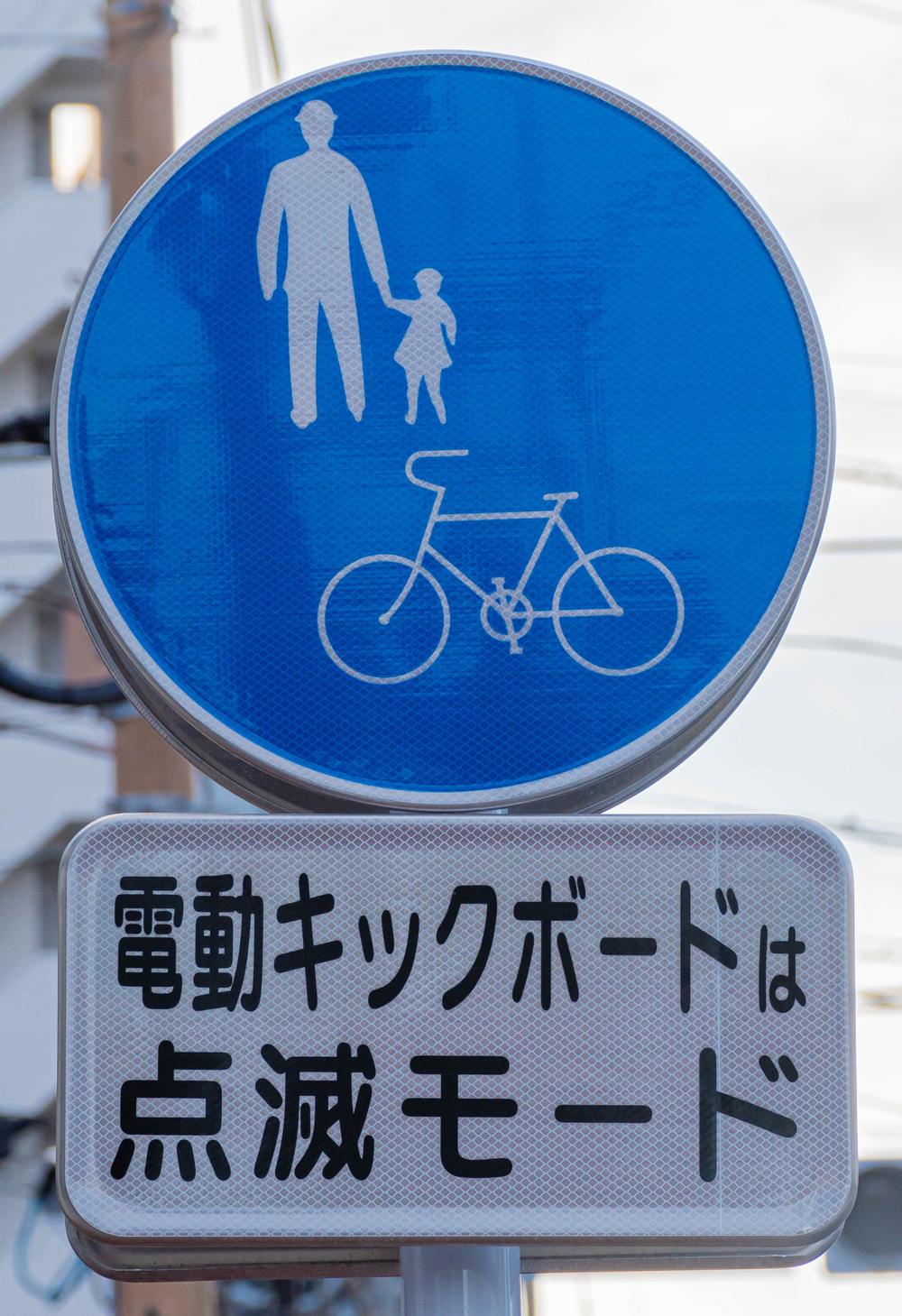
The first concerns the machine. Article 17-2, paragraph 1 creates a sub-category for machines meeting three requirements at once; Article 5-6-2 of the enforcement regulations fills in the detail. The speed ceiling is six kilometres per hour, and the machine must display that state by flashing its maximum-speed indicator lamp. The regulation also requires no sidecar, brakes operable while moving, and no sharp protrusions.
The second concerns the footway itself. Article 17-2, paragraph 1 applies only where road signs indicate that this class may use that footway. Without the sign, 6 km/h mode is irrelevant — you still may not ride there.
The police then close off the workaround in the same breath: holding your speed below 6 km/h by throttle control does not satisfy the requirement, so the machine does not qualify for the exception. What the rule wants is a flashing lamp, not a careful rider. The operator states the identical rule in its own English help page, giving two independent sources, and adds that footways without the specific signage remain prohibited even in 6 km/h mode.
Once you are legitimately on one, paragraph 2 of the same article still governs your behaviour: keep to the carriageway side of the footway (or to the marked cycle portion where one exists), proceed slowly, and stop entirely rather than obstruct anyone on foot.
The age rule, and why it catches parents
Sixteen — and handing the machine to someone younger is itself an offence.
Article 64-2, paragraph 1 is one line long: a person under 16 may not ride a specified small motorised bicycle. The provision that deserves more attention is paragraph 2, which says no person may provide such a machine to someone likely to ride it in breach of paragraph 1. The penalty sits in Article 118, paragraph 1, item 2: up to six months’ confinement or a ¥100,000 fine, and the police page carries the same figures.
For families travelling with teenagers this is a hard edge. A 15-year-old cannot ride, and a parent who lets them ride is committing an offence in their own right. The two guided tours running in Tokyo both list under-16s as unsuitable, which is not operator caution — it is the statute copied across.
Read it alongside item 4 of Article 125, paragraph 2 from earlier: an under-16 is not a "violator", so violations at that age were never on the fixed-penalty path to begin with.
Do you need a helmet
Not wearing one is not an offence.
Article 71-4 handles the two vehicle types in consecutive paragraphs and with deliberately different force. Paragraph 2 tells general motorised bicycle riders they must not ride without a helmet. Paragraph 3 tells specified small motorised bicycle riders they must endeavour to wear one. The penalty line at the end of the article reaches only paragraphs 4 through 7, so paragraph 3 carries no penalty, and the police page describes it as a duty of effort.
The useful reading is that a helmet will not cost you money — not that you need to plan around it. Both the share service and the guided tours hand one to you; the Tokyo tours list safety helmets and warm gloves among the inclusions. The conclusion matches the position on bicycles set out in Japan’s cycling ticket system: the one rule that will not fine you and might save your life.
How many riders get stopped
37,185 citations in 2025, against 386 accidents.
These come from the National Police Agency, dated as of February 6, 2026. ⚠️ The form they take needs stating: the statistics are published only as JPG images — no PDF, no CSV, no HTML table — so the figures below were read off those images. Anyone re-checking them later has to open the images again; there is no diffable text version.
| Measure | 2023 (Jul–Dec) | 2024 | 2025 |
|---|---|---|---|
| Accidents | 85 | 338 | 386 |
| Deaths | 0 | 1 | 1 |
| Injuries | 86 | 350 | 399 |
The enforcement breakdown is what should actually change your behaviour. Cumulative citations from July 2023 through 2025 total 85,561:
| Offence type | Cumulative | Share | 2025 alone |
|---|---|---|---|
| Lane position | 50,436 | 59% | 22,368 |
| Running a signal | 19,052 | 22% | 6,529 |
| Failing to stop | 7,392 | 9% | 4,286 |
| Obstructing pedestrians | 1,750 | 2% | 650 |
| Other | 6,931 | 8% | 3,352 |
| (of which, riding with alcohol present) | 830 | — | 415 |
Three conclusions fall straight out. First, being ticketed is far likelier than crashing — 37,185 against 386, a ratio near 96 to 1. Preparation should therefore go into knowing where you may ride, not into first aid. Second, 59% of everything is one mistake: being in the wrong place. That is the default foreign error, because both the side of the road and the footway rules differ from home. Third, this is a Tokyo story rather than a Japan story. The 386 accidents in 2025 occurred in just 13 prefectures, with Tokyo accounting for 278 of them (72.0%) and Osaka 55 (14.2%).
Scale, for context: active machines grew from 7,946 to 32,941, and cumulative app downloads from 2.44 million (March 2024) to 5.85 million (December 2025). The fleet is still expanding quickly, and the legal framework is barely three years old.
Can visitors rent one
Yes, and the legal hurdles are behind you before you start.
LUUP is the operator that matters in practice. Working through its official pages and terms of service produces a friendlier picture than the reputation suggests:
| Hurdle | Verdict | Difficulty |
|---|---|---|
| Legal eligibility (licence) | 🟢 No licence of any kind required | — |
| Legal eligibility (age) | 🟢 16 and over | — |
| Age verification document | 🟢 Passport is on the official list (licence, passport, residence card, My Number card) | Low |
| App language | 🟢 App Store lists English, Japanese, Korean and Chinese | Low |
| SMS verification | 🟡 Never stated either way officially | Unknown |
| Credit card | 🟡 Overseas cards depend on the issuer; not a blanket refusal | Medium |
| Traffic rules test | 🟡 Must be answered correctly throughout; language versions not obtained | Unknown |
| Documentation | 🔴 The sign-up and age-verification articles exist in Japanese only | Medium |
The documented sequence: enter a phone number, receive a verification code, supply name, date of birth and email, then register a credit card. Riding this vehicle class adds three more steps — submit an age verification document in the app, take the traffic rules test, and answer every question correctly in sequence to pass. Article 5, paragraph 2 of the terms of service reinforces it by listing failure to complete the operator’s rules-awareness process as a bar to using the service.
Three items deserve separating out, because their certainty differs sharply.
The card. The Japanese help page says an overseas-issued card may not work with the payment system depending on the issuer. The English version of the same article states flatly that overseas-issued credit cards cannot be registered. The two language versions disagree in strength, and the Japanese wording is the one to trust — which makes carrying two cards from different issuers a more sensible plan than assuming failure.
The phone number. Officially unaddressed. The operator states that verification uses international SMS, then devotes the entire troubleshooting article to three Japanese carriers and closes by telling anyone else to ask their own provider. Whether a foreign number receives the code has never been stated in either direction, and this guide will not fill the gap with a guess.
The test language. Not obtained. Verifying it would require registering an account and entering the app, which is outside what this guide checked. All that is known is the app’s declared language support. ⚠️ Do not infer from that list that the test itself is translated; whether the test follows the app language has not been stated.
The ten free days are not for you
The app store listing and the help centre both push a headline offer: ten days of unlimited free rides for new account registrations. It is the most visible thing about the service.
The first line of the eligibility conditions restricts it to people residing in Japan, judged by the operator’s own criteria — and the notes repeat the restriction a second time on the same page.
The contrast is what makes this worth a section. The service itself carries no residence requirement; the full terms of service contain none of the Japanese words for residing, resident, nationality or within-Japan. But the thing that makes the service look free is restricted to residents, and the page saying so exists only in Japanese. The help centre carries 75 articles in Japanese against 58 in English, and the ones missing from the English set include the free-trial page, the sign-up walkthrough, and the age-verification walkthrough. More pointedly, the English article on preparing to ride links to "how to submit age verification documents" — and that link points straight at the Japanese page. A reader working in English is sent by an official English page into a page of Japanese.
On insurance: cover is included in the fare. The accident policy pays ¥5,000,000 for death or permanent disability, ¥3,000 per day of hospitalisation and ¥1,500 per outpatient day; third-party liability for e-scooters and seated models is uncapped. Read the exclusion alongside it: injuries caused by the user’s intent or gross negligence are not covered — which is where riding after a drink lands.
Parking it in the wrong place
The worst bracket is ¥50,000, and the money is the smaller problem.
Article 16 of the terms sets four tiers:
| Situation | Penalty |
|---|---|
| Returning the machine outside a designated return location (no-parking zones handled separately) | ¥30,000 |
| Failing to report theft or an accident immediately, or to supply what the insurer requires | ¥30,000 |
| Parking in a no-parking zone / being tagged with an abandoned-vehicle sticker / being judged to have abandoned it | ¥50,000 |
| Damage or theft caused intentionally or negligently, as assessed by the operator | ¥200,000 |
The line that follows matters more than any of those numbers. If an abandoned-vehicle confirmation sticker is applied to a machine while you have it out, you are required to present yourself at a police station immediately and have the violation processed. On a five-day trip that is not a fee — it is half a day gone, spent handling a traffic offence through a language barrier.
Which reduces parking to one instruction: return only to a port shown on the app map. If the clock is against you, end the ride a stop early and walk the rest.
Identical machines, different rules
"Electric scooter" is not a legal category in Japan.
This section is the one that matters if you are thinking of buying a machine to use during the trip. Everything above — no licence, footway access under conditions — depends on the machine meeting the standard in Article 1-2-2 of the enforcement regulations:
| Attribute | Standard |
|---|---|
| Length | Not more than 190 cm |
| Width | Not more than 60 cm |
| Motor | Electric motor rated at 0.60 kW or less |
| Top speed | Incapable of exceeding 20 km/h |
| Speed settings | Where multiple maxima can be set, the setting must not be changeable while moving |
| Transmission | Automatic, or otherwise requiring no clutch operation |
| Lighting | Fitted with the maximum-speed indicator lamp defined by safety standard Article 66-17 |
The police state the consequence of falling outside that standard without hedging: since July 1, 2023, even something marketed as an e-scooter must be ridden with a licence if it does not meet the standard, may not be ridden on footways, and violations carry penalties.
In practice: you cannot tell which category a machine belongs to by looking at it. What identifies a compliant machine is the conformity sticker, the maximum-speed indicator lamp and the small municipal number plate. A rental machine is compliant because that is the operator’s responsibility; a machine you buy may not be, and at that point the insurance and plate obligations become yours as well.
You will meet this vehicle class elsewhere on the site, always as a one-line prohibition: the expressway rules in our Hakone Ekiden spectating guide name this class explicitly among vehicles barred from motorway sections; the private-vehicle restrictions in the Oirase Gorge guide lump mopeds and e-scooters together as restricted; and the Ine boathouse guide covers a non-shared rental where the tourism association states in writing that it neither runs nor takes responsibility for the activity. When you hit a bare prohibition like those, come back here to work out which class of machine it is talking about.
If sign-up defeats you
A guided tour is a different route entirely — and a different product from self-service rental.
If your card will not register, the code never arrives, or you would simply rather not adjudicate footway signage in a foreign language, Tokyo has two two-hour guided e-scooter tours that bypass the sign-up process completely: one circling the Imperial Palace grounds, and an evening ride that includes a Tokyo Tower main deck ticket. Both include safety helmets and warm gloves, and both set the minimum age at 16, matching the statute.
One line appears in the small print of both tours and deserves quoting for what it reveals: an alcohol test is carried out before the tour, anyone testing positive is not allowed to ride, and no refund is given. That is Article 125, paragraph 2, item 2 expressed as a commercial policy — the operator does not want a customer riding with alcohol present, because at that moment the whole thing stops being a world of fines. Both tours also warn that practice time is provided but there is no refund if you turn out to be unable to ride.
⚠️ Three qualifications before booking. First, these are guided tours, not rentals — booking one does not make you eligible to unlock a scooter on your own afterwards. Second, Tokyo only, English only. No comparable products were found in Osaka or Kyoto, and with 72% of accidents occurring in Tokyo, the distribution of supply follows the distribution of use. Third, the Imperial Palace tour carries only two reviews, too few to say anything about quality; the Tokyo Tower one has twenty. Note also that the Tokyo Tower tour lists people over 70 as unsuitable, and the Imperial Palace tour excludes pregnant travellers and people with heart conditions.
Imperial Palace area, 2 hours · Tokyo Tower night ride, observatory ticket included
Three closing points
One: the legal hurdle is already behind you. No licence, minimum age 16, passport accepted as proof — and the bracket in Article 125, paragraph 2, item 1 exists specifically so that an unlicensed rider still receives a blue ticket and closes the matter by paying it. This is the most visitor-friendly corner of the entire framework, and almost nobody writes it down.
Two: guard against three switches and one direction. The switches are alcohol, injury and being under 16 — trip any one of them and the fixed-penalty route vanishes. The direction is left: 59% of all citations are lane-position violations, and footway access needs both signage and 6 km/h mode with the lamp flashing, because riding slowly does not qualify. Those two sentences are the whole of the practical advice here.
Three: what actually blocks you is not in the Road Traffic Act. Whether your card registers, whether you can read a test you must answer perfectly, and the fact that a parking mistake requires you to appear at a police station in person. And the ten free days that make the service look cheap are restricted in writing to residents of Japan, on a page published only in Japanese. ⚠️ One more, for readers of traditional Chinese: the police publish their multilingual e-scooter leaflet in English, simplified Chinese and Korean — there is no traditional Chinese version, which is a large part of why this guide exists. For trip preparation generally see what to prepare for a first trip to Japan; the other two halves of the same act are covered in the cycling ticket system and driving with an International Driving Permit.
On currency: this guide was verified on September 7, 2026, with every statutory citation taken from the e-Gov full text of the acts and orders. The accident and enforcement statistics are dated February 6, 2026 and published as images only; the next annual release, expected around February 2027, will require re-reading those images. Share-service fares and terms move, and the operator itself attaches two caveats — prices vary by area, and you should check the rate inside the app before riding — so no fare table appears here. Open the app and look; that is the only current price.
Appendix: official Japanese source text (click to expand)
The Japanese originals quoted above are collected here for checking. Sources: e-Gov statute database (Road Traffic Act, its Enforcement Order and Enforcement Regulations), the National Police Agency traffic bureau, and LUUP’s official pages and terms of service.
1. Scope of the licence requirement (Art. 84(1))
自動車及び一般原動機付自転車(以下「自動車等」という。)を運転しようとする者は、公安委員会の運転免許(以下「免許」という。)を受けなければならない。
Definition of a general motorised bicycle (Art. 18(1)):
一般原動機付自転車(原動機付自転車のうち第二条第一項第十号イに該当するものをいう。以下同じ。)
Definition of the specified small class (Art. 17(3)):
特定小型原動機付自転車(原動機付自転車のうち第二条第一項第十号ロに該当するものをいう。以下同じ。)
National Police Agency:
特定小型原動機付自転車を運転するのに運転免許は必要ありませんが、16歳未満の者が特定小型原動機付自転車を運転することは禁止されています。
2. The bracket (Art. 125(2))
この章において「反則者」とは、反則行為をした者であつて、次の各号のいずれかに該当する者以外のものをいう。
一 当該反則行為に係る車両等(特定小型原動機付自転車等を除く。)に関し法令の規定による運転の免許を受けていない者…
二 当該反則行為をした場合において、酒に酔つた状態若しくは第百十七条の二第一項第三号に規定する状態で車両等を運転していた者又は身体に第百十七条の二の二第一項第三号の政令で定める程度以上にアルコールを保有する状態で車両等(自転車以外の軽車両を除く。)を運転していた者
三 当該反則行為をし、よつて交通事故を起こした者
四 十六歳未満の者
3. Age limit and the provision offence (Art. 64-2)
十六歳未満の者は、特定小型原動機付自転車を運転してはならない。
何人も、前項の規定に違反して…運転することとなるおそれがある者に対し、特定小型原動機付自転車を提供してはならない。
Penalty, per the National Police Agency:
【罰則】6月以下の拘禁刑又は10万円以下の罰金
4. Helmets (Art. 71-4(2) and (3))
(第二項・一般原動機付自転車)乗車用ヘルメットをかぶらないで一般原動機付自転車を運転してはならない。
(第三項・特定小型原動機付自転車)乗車用ヘルメットをかぶるよう努めなければならない。
(罰則 第四項から第七項までについては第百十九条の三第一項第五号)
5. 6 km/h mode (Enforcement Regulations Art. 5-6-2)
(第一項)…最高速度表示灯を点滅させることにより表示する方法とする。
(第二項)法第十七条の二第一項第二号の内閣府令で定める速度は、六キロメートル毎時とする。
The police, on riding slowly without switching mode:
※ アクセルの操作により…6キロメートル毎時を超えない速度で走行させている場合は、この要件を満たすものではないため、特例特定小型原動機付自転車には該当しません。
6. Vehicle standard (Enforcement Regulations Art. 1-2-2)
一 車体の大きさは、次に掲げる長さ及び幅を超えないこと。イ 長さ 百九十センチメートル / ロ 幅 六十センチメートル
二 車体の構造は、次に掲げるものであること。
イ 原動機として、定格出力が〇・六〇キロワット以下の電動機を用いること。
ロ 二十キロメートル毎時を超える速度を出すことができないこと。
ハ 構造上出すことができる最高の速度を複数設定することができるものにあつては、走行中に当該最高の速度の設定を変更することができないこと。
ニ オートマチック・トランスミッションその他のクラッチの操作を要しない機構がとられていること。
ホ 道路運送車両の保安基準第六十六条の十七に規定する最高速度表示灯が備えられていること。
7. Machines outside the standard (National Police Agency)
令和5年7月1日以降、いわゆる電動キックボード等であっても、基準に該当しないものを運転する場合には、運転免許を受けていなければならず、歩道を走行することはできません。違反は罰則の対象となります。
8. The two alcohol bands
(第百十七条の二第一項第一号)…酒に酔つた状態(身体に血液一ミリリットルにつき一・〇ミリグラム以上又は呼気一リットルにつき〇・五ミリグラム以上のアルコールを保有する状態その他アルコールの影響により正常な運転ができないおそれがある状態…)
(施行令第四十四条の三)血液一ミリリットルにつき〇・三ミリグラム又は呼気一リットルにつき〇・一五ミリグラム
9. Which column of the penalty table applies (Enforcement Order, Appended Table 6, note 4)
「原付等」とは、小型特殊自動車、原動機付自転車及び軽車両(重被牽引車を除く。)をいう。
10. LUUP sign-up and age verification
【特定小型原動機付自転車(電動キックボード・電動シートボード)をご利用の場合の追加手順】
特定小型原動機付自転車のご利用は「16歳以上」の方に限られます。
1.年齢確認書類の提出: アプリ内で 運転免許証、パスポート、在留カード、マイナンバーカード のいずれかを提出します。
2.交通ルールテストの受講…「はい」「いいえ」選択形式のテストを受講します。
3.全問連続で正解し、「合格」の画面が表示されれば…完了です。
Terms of service Art. 5(2) (the text is served through an iframe from the official page):
利用時点で満16歳以上であることを確認できる当社所定の公的な本人確認書類又は身分証(登録ユーザー自身のものに限ります。)を…提出し、当社所定の交通ルールの周知のためのプロセスを完了していない場合
11. Overseas-issued cards (Japanese help page)
海外発行カード:発行元により、弊社の決済システムに対応していない場合があります。
12. Eligibility for the ten free days
受け取り対象となる条件 以下のすべてを満たす方が対象です。
日本国内に居住されている方(当社所定の基準で判断します)…
ご注意事項 無料特典の対象となるのは日本国内に居住する方に限ります。日本国内に居住しているか否かは当社所定の基準にて判断いたします。
13. Parking and contractual penalties (Terms of service Art. 16)
ライド中のモビリティに対し放置車両確認標章が取り付けられた場合、登録ユーザーは、法令等に従い、直ちに警察に出頭し、違反の処理を受けるものとします。
Frequently Asked Questions
- Q1:Do I need a driving licence to ride an e-scooter in Japan?
- No — and no licence from anywhere else helps either. Article 84, paragraph 1 of the Road Traffic Act imposes the licence requirement on "automobiles and general motorised bicycles" only. A general motorised bicycle is defined in Article 18, paragraph 1 as the sub-type listed at Article 2, paragraph 1, item 10 (a). A compliant e-scooter falls under item 10 (b) instead, and picks up its formal name — tokutei kogata gendōki tsuki jitensha, a specified small motorised bicycle — over in Article 17, paragraph 3. It therefore sits outside the Article 84 obligation entirely, and the National Police Agency states the conclusion in one flat sentence: no driving licence is required. So your home licence, your International Driving Permit and a Japanese licence are all equally useless here. The only eligibility bar is age 16, and a passport proves that. ⚠️ One distinction matters: the licence exemption belongs to machines that meet the technical standard. A scooter that does more than 20 km/h or carries a motor above 0.60 kW is legally a different vehicle class, which puts you back in the world of licences, no footway riding, and penalties for getting it wrong.
- Q2:Without a Japanese licence, does a violation get handled more harshly?
- No, and the law contains a bracket written specifically to guarantee that. Article 125, paragraph 2 defines who is not a "violator" for fixed-penalty purposes — and anyone in that list skips the blue ticket and goes straight to criminal procedure. Item 1 would normally catch you: it excludes people who hold no licence for the vehicle concerned. But there is a parenthesis dropped into the middle of item 1 that carves out specified small motorised bicycles. The reason is practical rather than generous: there is no licence to hold for this vehicle class, so without that carve-out literally nobody riding one could ever receive a fixed-penalty notice. Every red-light offence in the country would have gone to a prosecutor. Translated for a visitor: not having a Japanese licence changes nothing about how your case is handled. You get the same ticket a Japanese rider gets, pay the same amount, and the matter ends there with no criminal record. ⚠️ Items 2, 3 and 4 of the same paragraph have no such bracket, and those three are where the real risk sits.
- Q3:Is a helmet mandatory on an e-scooter in Japan?
- No. It is a duty of effort with no penalty attached. Article 71-4 treats the two vehicle types differently in consecutive paragraphs: paragraph 2 tells riders of general motorised bicycles that they must not ride without a helmet, while paragraph 3 tells specified small motorised bicycle riders that they must endeavour to wear one. The penalty line at the foot of that article covers only paragraphs 4 through 7 — paragraph 3 is not in it — and the police use the phrase "duty of effort" on their own explainer page. So a bare head will not cost you money, but that is not a reason to skip the question. In practice you will be handed one anyway: the two guided e-scooter tours running in Tokyo both list safety helmets and warm gloves among the inclusions, and share services supply them too. This mirrors the position on bicycles exactly — see Japan cycling rules, where the same conclusion applies: it is the one rule that will not fine you and might save your life.
- Q4:Can I ride an e-scooter on the pavement in Japan?
- Only in a narrow exception, and slowing down yourself does not count. Two conditions have to hold at once. First, the machine must be switched into 6 km/h mode: Article 17-2, paragraph 1 combined with Article 5-6-2 of the enforcement regulations sets the ceiling at six kilometres per hour and requires the machine to display that state by flashing its maximum-speed indicator lamp. Second, that particular stretch of footway must be signed as open to this vehicle class — without the sign, 6 km/h mode changes nothing. The police close off the obvious workaround explicitly: holding your speed under 6 km/h using the throttle does not satisfy the requirement, so the machine does not qualify. The share operator says the same thing independently in its English help pages, and adds that riding on a footway without the specific signage remains prohibited even in 6 km/h mode. ⚠️ Once you are legitimately on a footway, Article 17-2, paragraph 2 still applies: keep to the carriageway side, proceed slowly, and come to a stop if you would obstruct anyone walking. This is why the most-enforced offence of all is lane-position violation — ¥6,000(反則金|道路交通法施行令 別表第六 第16項「原付等」欄).
- Q5:What happens if I drink and then ride an e-scooter?
- The penalties are heavy, but the thing to understand is that alcohol is the switch that moves your entire case out of the fixed-penalty system. The penalties first. Article 117-2, paragraph 1, item 1 covers riding while intoxicated — 1.0 mg per millilitre of blood, 0.5 mg per litre of breath, or otherwise impaired to the point of being unable to ride properly — at up to five years of confinement or a ¥1,000,000 fine. Article 117-2-2, paragraph 1, item 3 covers the lower band, defined by Enforcement Order Article 44-3 as 0.15 mg per litre of breath, at up to three years or ¥500,000. Both provisions apply to "vehicles etc.", which includes this class. Now the part almost nobody writes: under Article 125, paragraph 2, item 2, any violation you commit with alcohol in your system stops being a fixed-penalty offence at all. A red light that would ordinarily cost ¥6,000(反則金|道路交通法施行令 別表第六 第16項「原付等」欄) becomes a criminal matter because of one drink at dinner. Police figures record 415 drink-riding citations in 2025 alone, more than one a day. Japanese izakaya districts have share scooters parked outside them, which is precisely why this paragraph exists.
- Q6:Can foreign visitors actually rent an e-scooter in Japan?
- Yes, and the legal hurdles are already behind you. For age verification the operator lists four acceptable documents — driving licence, passport, residence card, My Number card — so a passport works. The terms of service contain no residence or nationality requirement at all; searching the full text for the Japanese words for "residing", "resident", "nationality" and "within Japan" returns nothing. The app declares support for English, Japanese, Korean and Chinese on the App Store. On payment, the Japanese-language help page says an overseas-issued card may not be supported depending on the issuer — which means try it, not give up. ⚠️ Worth knowing: the English version of that same page hardens this into a statement that overseas-issued credit cards cannot be registered. The two language versions do not agree in strength; the Japanese wording is the one to go by. The genuinely unanswered item is the phone number. The operator says only that it uses international SMS for verification, and its entire troubleshooting page addresses the three Japanese carriers. Whether a foreign number receives the code has never been stated either way, and this guide will not guess. There is also an in-app traffic rules test that you must answer correctly all the way through; whether it exists in English or Chinese was not obtained for this guide.
- Q7:What happens if I park an e-scooter in the wrong place?
- The worst bracket is ¥50,000, and the money is not the painful part. Article 16 of the operator’s terms sets four penalty tiers: ¥30,000 for returning the machine anywhere other than a designated return location; ¥30,000 for failing to report a theft or accident immediately, or failing to supply what the insurer asks for; ¥50,000 for parking in a no-parking zone, being tagged with an abandoned-vehicle confirmation sticker, or being judged to have abandoned the machine; and ¥200,000 for damage or theft caused intentionally or negligently. The same article then adds a line that is far worse for anyone on a five-day trip: if an abandoned-vehicle sticker is applied to a machine during your ride, you are required to present yourself at a police station immediately and have the violation processed. That is not a fee — it is half a day of your itinerary spent handling a traffic offence in a language you may not read. ⚠️ So the parking rule reduces to one instruction: return only to a port shown on the app map, and if time is tight, end the ride a stop early and walk. The operator also draws its own riding area more tightly than the law does — red-outlined push zones on the map must be walked through, and it states explicitly that riding across them is prohibited too.