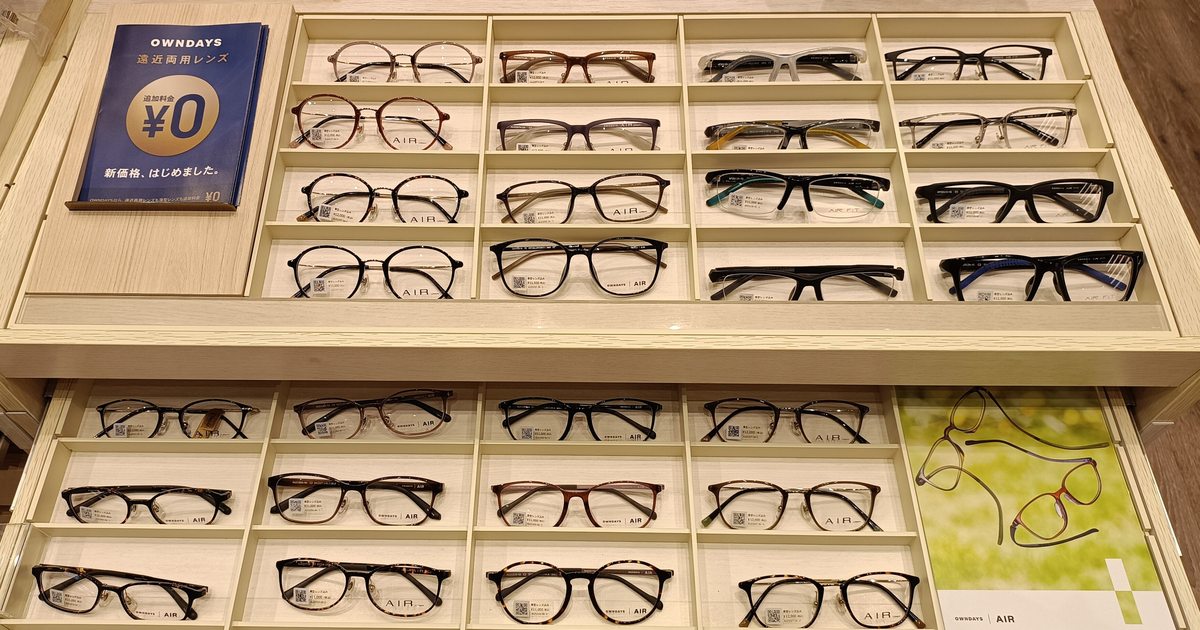
Japanese eyewear chains are genuinely fast: OWNDAYS advertises glasses in as little as 20 minutes, JINS says 30 minutes minimum, Zoff says about 30 minutes after payment. All three of those numbers arrive with an official qualifier attached — and when the qualifier fails, the wait does not stretch by an hour. It jumps to 7 to 14 days. Zoff quotes up to about 14 days outside its stocked range; JINS quotes 10 days to 2 weeks for progressives; OWNDAYS publishes a lens-by-lens table where everything except the standard and blue-light options is 7–10 days. So the real question when buying glasses in Japan is not “are they cheap” — it is “will I physically have them before I fly home”. And the cost of getting that wrong is unusually high, because JINS states on a single page, four separate times, that glasses are classified as medical devices and therefore cannot be shipped internationally. You cannot even collect at a different branch. This guide covers the real lead times, why the three “free” lenses are not the same product, which chain honours a warranty once you are home, and one legal fact about contact lenses that runs opposite to intuition.
- Same-day works in exactly one combination: stocked prescription range plus standard lens only. Any upgrade means 7–14 days
- 🚨 They cannot be shipped to you: JINS classifies glasses as medical devices, and you cannot switch collection branches either
- The three ¥0 lenses are not equivalent: Zoff’s is not aspherical and is UV380; matching the others costs ¥5,500 more
- Warranty geography is the real decision point: JINS is Japan-only, OWNDAYS states worldwide handling, Zoff says nothing at all
- Contact lenses do not legally require a prescription — but the shop must record your name and address by law
📖 Contents
- 1. Same-day collection: the two conditions, stated officially
- 2. Why the three “free” lenses are not the same lens
- 3. JINS vs Zoff vs OWNDAYS, side by side
- 4. 🚨 They cannot be shipped, and cannot be collected elsewhere
- 5. Warranty geography: the column that actually matters
- 6. Eye tests, prescriptions and bringing your old pair
- 7. Tax-free at these three chains specifically
- 8. Contact lenses: the prescription myth, and what is true
- 9. Verdict: who should buy where, and when not to bother
- 10. FAQ
Same-day collection: the two conditions, stated officially
Same-day collection is not the default. It is an outcome that requires two conditions to hold at once.
Read the three chains’ own wording side by side and the same two variables surface every time.
- Your prescription has to sit inside the branch’s stocked lens range. Zoff: glasses can be handed over roughly 30 minutes after payment “if it is within the range of stocked lenses”. JINS: you can collect the same day “if the store you visited has the lens in stock”. Zoff adds an unusually candid rider — even stocked lenses can be out of stock at a given branch, in which case you wait.
- You have to order the standard lens and nothing else. OWNDAYS quantifies this better than the other two.
Note what is not on that list. Frames are not on it. None of the three chains lists frame material, shape or rimless-versus-full-rim as a variable anywhere in its official material. The variables are your prescription and your lens options. That is it.
The OWNDAYS lens-by-lens lead time table
OWNDAYS publishes an in-store turnaround figure against every lens type it sells. No other chain does, and it converts a vague worry into an arithmetic problem: each upgrade you tick has a published price in days.
| Lens type | Official in-store lead time | Same day still possible? |
|---|---|---|
| Standard (thin aspherical) | Same day – 10 days | ✅ Yes |
| Blue-light cut | Same day – 10 days | ✅ Yes |
| Photochromic | 3–10 days | ❌ |
| Progressive (every grade) | 7–10 days | ❌ |
| Polarised | 7–10 days | ❌ |
| Tinted | 7–10 days | ❌ |
| Anti-fog / scratch-resistant / heavy-duty coating | 7–10 days | ❌ |
| Ultra-thin 1.76 | 7–10 days | ❌ |
One sentence summarises it: only the standard lens and the blue-light option are ever listed as same day. Everything else starts at seven days — which is longer than a great many Japan itineraries.
The other two chains publish less granular figures pointing the same direction. JINS quotes about 10 days when a branch lacks your prescription in stock or when the lens is a special order, and 10 days to 2 weeks for progressives. Zoff quotes up to about 14 days outside its stocked range, and about five business days for online orders of stocked lenses.
The practical consequence is blunt. If you were planning to pick up a pair of progressives while in Japan — the single most common version of this plan — drop it. The surcharge at JINS is ¥5,500+ (⚠️ the official site quotes two slightly different figures; see the note below), but the money is not the obstacle. Ten days to two weeks is.
Why the three “free” lenses are not the same lens
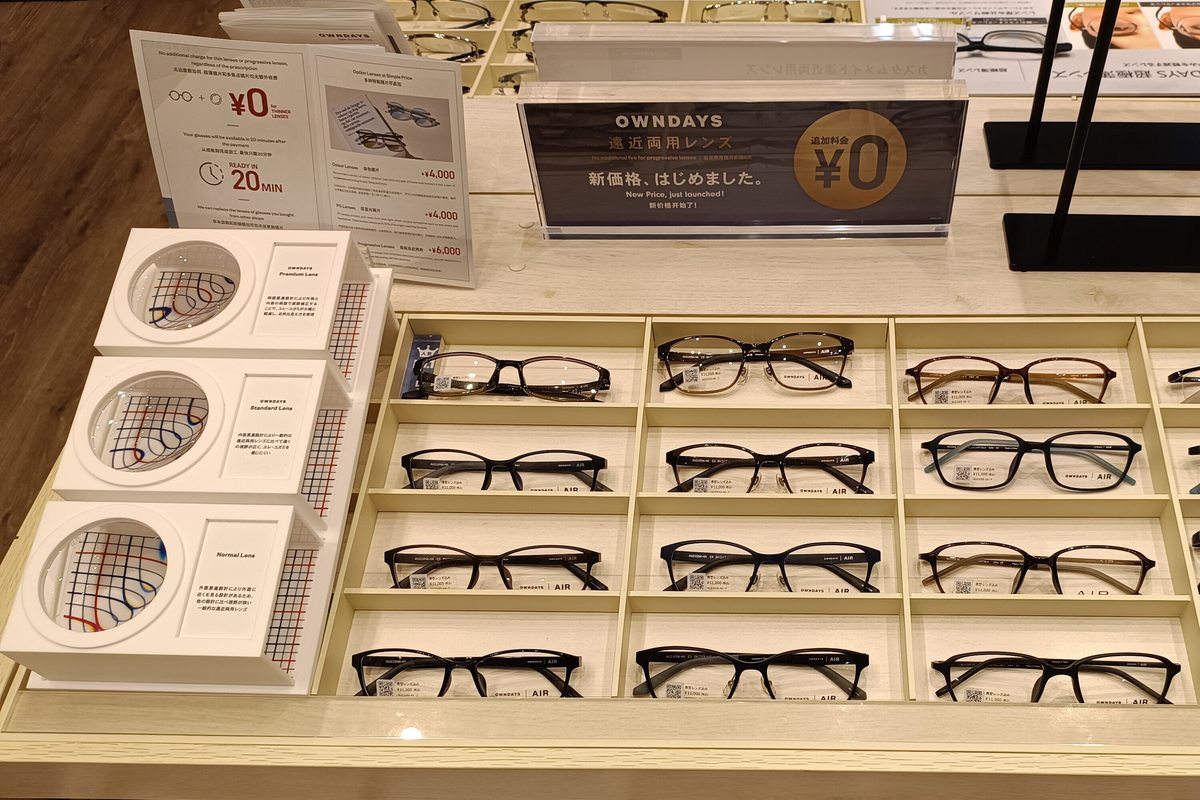
All three chains market a headline of “lenses included at ¥0”. That claim is true at all three. The thing included is not the same at all three, and the difference lands hardest on exactly the people most likely to buy glasses abroad — those with a strong prescription.
- JINS — standard clear lens at ¥0, spec 1.60 single-vision aspherical. Official wording: no surcharge regardless of prescription strength or astigmatism, with the caveat that the makeable range has limits.
- OWNDAYS — standard lens at ¥0, spec thin aspherical, and the wording is the most generous of the three: no surcharge on thin aspherical lenses at any prescription. Lenses come from Seiko, Asahi and Nikon-Essilor.
- Zoff — the ¥0 “set lens” is specified as water-repellent, hard and multi coating plus UV380 (about 94% UV cut). ⚠️ The official description never uses the word aspherical.
Getting Zoff up to the same specification as the other two is a paid upgrade:
| Zoff thin aspherical upgrade | Surcharge | Note |
|---|---|---|
| 1.60 | ¥5,500 | The minimum spend to match the JINS / OWNDAYS free lens (UV400, about 99%) |
| 1.67 | ¥7,700 | — |
| 1.74 | ¥9,900 | — |
| 1.76 | ¥13,200 | 🚨 Officially marked suspended by the manufacturer — not currently orderable |
| 1.76 double aspherical | ¥16,500 | 🚨 Same — order intake suspended |
None of this makes Zoff the expensive option. Its frames run in five bands from under ¥5,500 up to ¥13,301 and above, and for a mild prescription the set lens is perfectly good — you keep the whole surcharge. The point is structural: Zoff prices lenses separately, so you must add two numbers before comparing. JINS and OWNDAYS mostly do not, so the frame price is the price.
Ultra-thin 1.76: down to one supplier in 2026
If your prescription is strong enough to want a 1.76 index lens, here is the position as verified on August 18, 2026.
- JINS — ultra-thin 1.76 at ¥11,000 is officially marked temporarily suspended from sale (notice updated May 13). Its 1.74 carries a separate extended lead time notice (updated June 30).
- Zoff — both 1.76 options are marked order intake suspended by the manufacturer.
- OWNDAYS — ultra-thin 1.76 by Tokai Optical is still listed and priced at ¥12,000, and remains orderable.
So one of the three chains can still make you a 1.76 lens. ⚠️ We are deliberately not explaining why. None of the three publishes a reason, none states that they share a supplier, and stitching three independent notices into a single causal story would be storytelling rather than reporting. What is recorded here is the verified status and the date it was verified — re-check before you travel.
And note the sting in the tail: the OWNDAYS ultra-thin lead time is 7–10 days. The route “strong prescription, therefore OWNDAYS” exists, but it is not a same-day route.
JINS vs Zoff vs OWNDAYS, side by side
Here is the comparison I would actually use. The two rows that matter most are near the bottom, not the top — the chains separate on warranty and service, not on price.
| Criterion | JINS | Zoff | OWNDAYS |
|---|---|---|---|
| What the ¥0 lens actually is | 1.60 single-vision aspherical; makeable range limited | Water-repellent / hard / multi coat + UV380 (~94%); not described as aspherical | Thin aspherical, free at any prescription (Seiko / Asahi / Nikon-Essilor) |
| Cost to reach equivalent spec | ¥0 | +¥5,500 for 1.60 aspherical, UV400 | ¥0 |
| Fastest advertised turnaround | 30 min minimum (if the lens is in stock) | About 30 min (if within the stocked range) | 20 min at fastest (same-day handover) |
| Turnaround once the condition fails | Special order about 10 days; progressives 10 days – 2 weeks | Outside stocked range up to about 14 days; online about 5 business days | Published per lens: standard and blue-light same day, everything else 7–10 days |
| Warranty geography | 🔴 “The warranty is operated within Japan” — nothing once you are home | ⚪ No official statement either way; zero overseas stores listed | 🟢 Taiwan site: OWNDAYS stores worldwide can handle the warranty |
| Warranty inside Japan | 6 months, up to 2 claims across frame and lenses; free lens swap if the power is wrong | 6 months, 2 claims; free power exchange; 1 year for under-18s | 2 exchanges / 1-year vision guarantee / breakage and theft cover; physical stores only |
| Service for overseas visitors | Free eye test, foreign prescriptions accepted, old pair can be copied, non-Japanese speakers explicitly welcomed — the fullest inbound FAQ of the three | Five-language inbound page with a five-step purchase flow — but zero mentions of tax-free on it | Free unlimited eye tests; free cleaning and adjustment worldwide; eye-doctor prescription advised for under-16s and first-time wearers |
| Frame pricing | From ¥5,900 (simulator: frame ¥5,900 + lens ¥0) | Five bands: to ¥5,500 / ¥8,800 / ¥11,100 / ¥13,300 / above ¥13,301 | From ¥7,000 including tax |
| Lens replacement in your own frame | ¥6,600+ own frame / ¥7,700+ other brands | Fitting fee +¥3,300 own frame / +¥8,800 other brands | ¥7,700+, including frames bought elsewhere |
⚠️ Frames are given as starting points and bands on purpose. Eyewear chains price frames in bands rather than as fixed items, and discount campaigns run constantly — JINS had sale pricing on its own homepage on the day of verification. Pinning a single frame number to the page would look precise and be wrong within weeks. Lens surcharges are the stable, centrally maintained figures, which is why they live in our Japan price reference and update site-wide in one edit.
🚨 They cannot be shipped, and cannot be collected elsewhere
If you remember one section, make it this one, because it removes the fallback plan most people assume they have.
JINS answers four different questions in its inbound FAQ — shipping a purchase abroad, shipping a warranty replacement abroad, shipping an order you failed to collect, and whether it partners with any forwarding agent — with the same sentence, four times over:
Because glasses are classified as medical devices, regulatory restrictions mean they cannot be sent by international courier.
Two further rules on the same page are just as firm.
- No branch switching. Official wording: you cannot collect at any store other than the one where you purchased. Order in Shinjuku, collect in Shinjuku — which quietly rules out the very common “Tokyo in, Osaka out” itinerary.
- No pre-ordering lenses. You cannot order lenses alone in advance to be ready when you arrive. The plan of emailing ahead so your unusual prescription is waiting for you does not exist.
What JINS will do is ship within Japan — to an address or to your hotel, at your expense, provided the hotel agrees to accept the parcel. That is a genuine solution if your itinerary loops back through the same city later. It is no help at all if you fly out tomorrow.
OWNDAYS appears to offer a way around this: it operates an overseas forwarding service. Look closely at what that is. It is a third-party forwarder arrangement — you buy, the goods go to a domestic forwarding warehouse, and the forwarder ships them on. Costs stack up as domestic shipping (free over ¥3,300), international shipping, a forwarding handling fee, and customs duty and import tax. OWNDAYS also notes that only some stores support it. That is not in conflict with the JINS statement — one is a company shipping policy, the other is a third-party service — but OWNDAYS does not state whether prescription eyewear qualifies, nor how forwarding interacts with a tax-free purchase. So do not assume glasses made in Japan can be shipped home. Ask the branch.
Put those rules together and the right response is not “schedule it for day one”. Day one does not rescue a 14-day lead time. The right response is to settle your prescription before you leave home: bring the pair you currently wear, or bring the numbers from your last eye test. Then the shop can tell you on the spot whether you fall inside the stocked range — rather than you discovering on day five that the answer is two weeks.
Warranty geography: the column that actually matters
A few hundred yen of price difference is invisible a month later. A frame that has gone crooked, a loose screw, or a prescription that turns out to be slightly off after three days of wear — those you notice. This is the dimension on which the three official warranty pages diverge most: one states Japan-only coverage, one states worldwide coverage, and the third does not use the word "overseas" anywhere.
- JINS — explicitly domestic. Its warranty page states that the warranty is operated within Japan. The terms are otherwise good: six months from collection, two claims across frame and lenses, and a free lens replacement if the power feels too weak or too strong, objects look distorted, you feel unwell, or the lenses flicker. Adjustments are free any time, as are nose pad and hinge screws (repairs are chargeable). All of which requires returning to the purchasing branch with the glasses and the warranty card — which is not reissued if lost.
- OWNDAYS — the only cross-border wording. Its Taiwan warranty page states that OWNDAYS stores worldwide can handle the peace-of-mind warranty, and separately that cleaning and adjustment are free at OWNDAYS stores worldwide. The Japanese site says the warranty can be claimed at any OWNDAYS store, with frame replacement restricted to the purchasing branch.
- Zoff — nothing published. Domestic terms are comparable to JINS (six months, two claims, free power exchange, extended to one year for under-18s), but there is no cross-border language anywhere on the official site and no overseas stores in the directory. Absence of a statement is not a denial — but it is not a promise either, so it is recorded here as unknown rather than guessed at.
⚠️ Discount the OWNDAYS advantage slightly. The Japanese and Taiwanese warranty packages are not the same set of terms — Japan runs two exchanges plus a one-year vision guarantee, Taiwan runs a one-year power guarantee with one free claim, a one-month exchange window and accident cover at member-tier discounts. Neither side publishes which set governs a Japan purchase serviced overseas. The accurate expectation is therefore: cross-border handling is documented, the applicable terms are not. Bring the warranty card and the receipt, and ask before you assume.
Eye tests, prescriptions and bringing your old pair
Here is the reassuring part: the barrier to buying glasses in Japan as a visitor is far lower than most people assume. JINS addresses the four standard worries head-on in its inbound FAQ.
| The worry | The official answer |
|---|---|
| Can I order without a prescription? | Yes. Glasses can be made without one; the store performs the vision test, and the test is free |
| Can I use a prescription from home? | Yes, provided the power falls within the lens range the company works with. Tell staff at reception that this is what you want |
| Can they just copy my current glasses? | Yes — with the caveat that scratched or specialty lenses may not read accurately |
| What if I do not speak Japanese? | Explicitly fine. The FAQ suggests having a translation app installed to make it smoother |
OWNDAYS takes a similar line but draws two boundaries that deserve respect rather than irritation: it recommends using an ophthalmologist’s prescription for under-16s and for anyone wearing glasses for the first time, and its stores cannot measure prism or depth perception. If your eyes are not in a stable condition, it will ask you to see a doctor first. Testing and consultation are otherwise available any time with no limit on visits, as are cleaning and fitting.
Zoff directs customers to “an eye clinic or your nearest Zoff store”, and its inbound page lists the eye exam as step three of five in the purchase flow. ⚠️ Unlike the other two, Zoff does not state whether in-store testing is free. We are not going to fill that gap with an assumption on its behalf.
The practical advice: rather than agonising over paperwork, just bring the glasses you currently wear. It is the lowest-friction option and gives staff something to check against. And if you have genuinely complex needs — an unusual astigmatism axis, a prism requirement, or you have never worn glasses before — do not do this on holiday. The value of these chains is speed and price, not complex optometry.
Tax-free at these three chains specifically
The system itself has its own guide, so this section covers only how the three eyewear chains handle it. Four things matter.
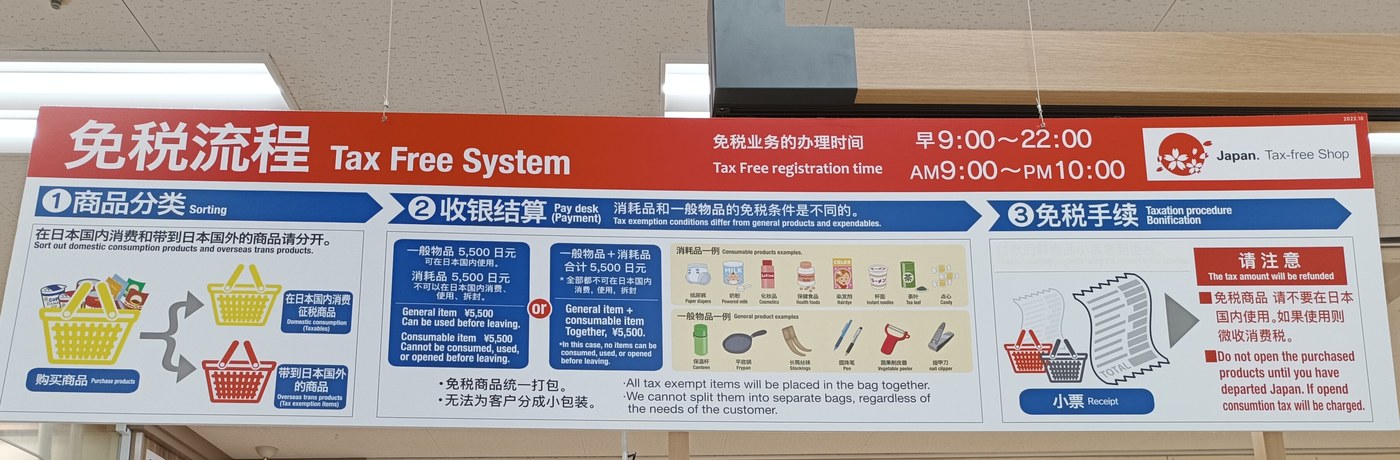
- The threshold is the standard one: ¥5,000 before tax, same store, same day. JINS states the tax-inclusive equivalent as ¥5,500 and up, which lines up exactly, and reminds customers to bring the passport itself.
- All three run tax-free at selected branches only. JINS maintains a dedicated tax-free store filter; OWNDAYS states in its help centre that tax-free is branch-limited, requires a passport, and is not available in its online store. Check the specific branch before making a trip of it.
- Glasses are non-consumable, so wearing them out of the shop is fine. ⚠️ Worth correcting a piece of obsolete vocabulary here: the “general goods” category is abolished from November 1, 2026, along with the whole general-goods versus consumables split. The framing that helps you is that glasses are non-consumable, which is exactly why you can wear them for the rest of the trip and still clear the export check on the way out. Keep the box and the model labelling until the airport.
- Do not put them on the same receipt as things you will consume. Under the new system customs verifies a receipt as a single unit — one missing item and the whole receipt fails. So ring the glasses up separately from anything you will eat, drink or use up in Japan. The full explanation is in how the receipt-level export check works, and the airport sequence — before security, before you check any bags — is in the airport refund walkthrough.
Zoff’s visitor page never mentions tax-free once
Zoff runs a genuinely well-made page for overseas visitors in five languages — English, Simplified and Traditional Chinese, Korean and Thai — with the purchase flow broken into five steps (choose a frame, go to reception, eye exam, payment, collection) and three service icons covering eye exam, fee and time.
Search that page for “tax free” and you get zero hits.
Search Zoff’s Japanese store directory for the same term and you get 342. Zoff clearly does operate tax-free stores; the page it built specifically for foreign visitors just does not say so, and to find out whether a given branch can process it you have to go back to the store directory.
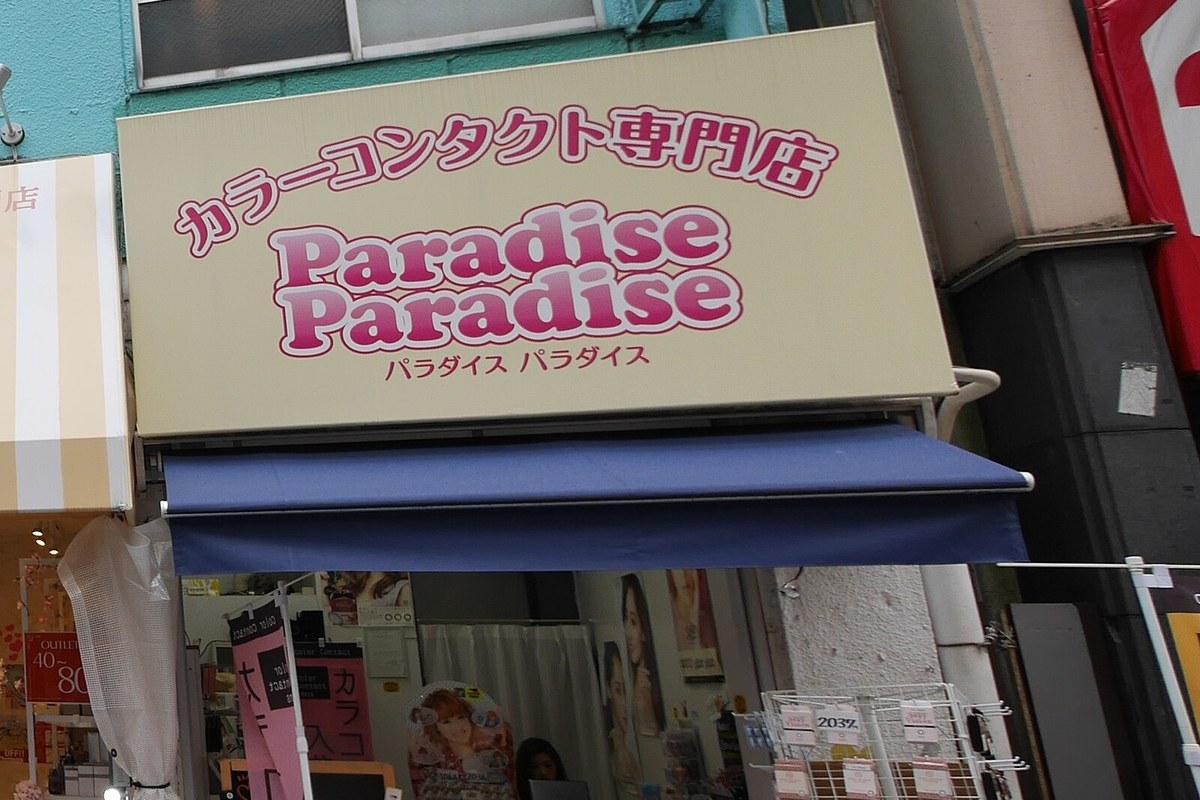
The same gap turns up elsewhere: Yodobashi publishes nothing about tax-free online while its shopfronts advertise it, and the MUJI page often taken for an inbound welcome coupon is a pure tax-free explainer. What a large Japanese chain publishes and what it does in store are not the same thing. For which chains genuinely issue visitor coupons rather than relying on tax-free alone, see our Japan coupon chain-by-chain table — the answer for eyewear is that none of the three has a visitor coupon; tax-free is the only mechanism.
⚠️ For JINS, ask at the branch. Its store search is the only place that carries tax-free status branch by branch, and that site is not reachable from outside Japan — so there is no reliable count to plan around. The same trap turns up with Loft's visitor coupons.
Contact lenses: the prescription myth, and what is true
The legal fact: buying contact lenses in Japan does not require a prescription. The National Consumer Affairs Center of Japan states it plainly:
Because [contact lenses] are not pharmaceuticals, a prescription is not necessarily required in order to purchase them. As far as purchase alone is concerned, it is possible at any retailer holding a licence to sell highly controlled medical devices.
The structure of the law backs this up. Contact lenses are indeed highly controlled medical devices under article 2(5) of the Pharmaceuticals and Medical Devices Act, and non-corrective coloured lenses were brought under the same regime on November 4, 2009. But every article of that Act mentioning prescriptions — 9-3, 9-4, 49, 50 and 83 — governs pharmaceuticals and pharmacies. Not one governs medical devices.
So where did the myth come from? Both sources are traceable.
- A 2017 Ministry of Health notice states that sales conduct which misleads consumers into thinking a medical consultation is unnecessary — advertising “no prescription needed” or “no examination needed” — is inappropriate. The regulation targets shops promoting the absence of a prescription, out of concern that it discourages eye exams. The visible result is that no retailer displays such wording, and shoppers reason backwards to the conclusion that a prescription must be mandatory. For customers who have not seen a doctor, the same notice asks retailers only to advise them again. It has never required refusing the sale.
- The industry’s voluntary sales standard — whose own published Q&A concedes the case. It states that while a pharmaceutical prescription has a legal basis, a “contact lens instruction sheet” has no legal basis, with no prescribed format, usage rules or regulation, and that the voluntary standard itself has no binding force.
None of which makes this a green light. Three things belong in the same breath.
- 🚨 The retailer is legally required to record your name and address. Article 173(2) of the enforcement regulations requires the product name, quantity, date of sale and the name and address of the purchaser, retained for three years. Being handed a form at the till is normal and lawful — expect it rather than being alarmed by it.
- Shop policy is not law. An individual retailer is entirely free to require an eye test, demand an instruction sheet, or decline first-time buyers outright. That is that shop’s rule, it varies between chains, and one shop’s behaviour predicts nothing about the next.
- The professional advice still stands. The Japan Ophthalmologists Association’s position is that anyone being fitted for contact lenses for the first time must see an ophthalmologist, and the Consumer Affairs Agency logged 242 contact-lens incidents over roughly five and a half years, 75 of them involving cosmetic lenses and six requiring more than a month of treatment.
Our position: separate law, shop policy and clinical advice — but do not read this as encouragement to experiment. Restocking dailies in the brand, power and base curve you already wear is reasonable. Trying contact lenses for the first time, or switching to an unfamiliar base curve, while travelling is gambling with your eyes for no good reason.
One directional point to close on: bringing lenses into Japan and carrying them home are two different rulebooks. If you are heading back to Taiwan there are hard per-power and per-brand quantity caps, set out in our guide to Taiwan customs limits on medicines and contact lenses; the rules for carrying medication into Japan are covered separately in our bringing medicine into Japan guide. Check the limit before you buy in bulk, not at the customs desk.
Verdict: who should buy where, and when not to bother
Compressed into decisions you can act on. These are choices, not a shrug.
| Your situation | What I would do |
|---|---|
| Ordinary prescription, want a cheap spare pair, three to five days in Japan | Any of the three — take whichever you walk past. At Zoff, ask whether the set lens covers your power; for a mild prescription it does, and you keep the ¥5,500 upgrade |
| Strong prescription, lens thickness matters to you | OWNDAYS or JINS. Both include thin aspherical at ¥0 where Zoff charges for it. If you specifically need 1.76, OWNDAYS is the only remaining supplier in 2026 — at a 7–10 day wait |
| You want adjustments and warranty cover after you get home | OWNDAYS. It is the only one with cross-border wording. Keep the warranty card and receipt, and confirm in person which terms apply |
| You want progressives, polarised, tinted, anti-fog or ultra-thin | 🔴 Not on this trip. Official lead times run 7 to 14 days, longer than most itineraries. Buy them at home, or accept you will not be collecting them |
| Unusual astigmatism axis, prism requirement, or a first-ever pair | 🔴 Do not do this while travelling. OWNDAYS says outright that its stores cannot measure prism or depth perception and advises a doctor’s prescription for first-time wearers |
| Flying into Tokyo and out of Osaka, hoping to order early and collect late | 🔴 JINS explicitly forbids it (no branch switching). Do not assume the other two allow it either — confirm before you pay |
Three closing points.
One: same-day is the exception, not the rule. It requires a stocked prescription and a standard lens. Meet both and the 20-to-30-minute promise is real; miss either and you are looking at a week or more.
Two: uncollected means lost. Glasses are medical devices in Japan, JINS states they cannot be shipped internationally, and no chain lets you swap collection branches on a whim. The preparation that actually helps is not scheduling this for day one — it is settling your prescription before you leave home, by bringing your current pair or your last test results.
Three: choose on warranty geography, not on a few hundred yen. The price gap between the three is small; the difference between “somebody will service these when I am home” and “nobody will” is binary. If you are weighing up whether buying in Japan is worth it at all, our three-question worth-it framework applies here as well as it does to cosmetics and snacks.
Frequently Asked Questions
- Q1:Can you really get glasses the same day in Japan?
- Only in one specific combination: your prescription sits inside the store’s stocked lens range, and you order nothing but the standard lens. The headline numbers are real — OWNDAYS advertises delivery in as little as 20 minutes, JINS says 30 minutes minimum, Zoff says roughly 30 minutes after payment. But every one of those sentences carries an official qualifier: Zoff writes “if it is within the range of stocked lenses”, JINS writes “if the store has the lens in stock”. Break the qualifier and the timeline does not slip by an hour, it changes category: Zoff quotes up to about 14 days for prescriptions outside the stocked range, JINS quotes about 10 days for special-order lenses and 10 days to 2 weeks for progressives, and OWNDAYS quotes 7–10 days for everything except standard and blue-light lenses.
- Q2:If I cannot collect them before I fly out, can they be shipped to me?
- JINS closes that door explicitly, and repeats itself four times to make sure you noticed. Its inbound FAQ answers four separate questions — shipping a purchase overseas, sending a warranty replacement overseas, shipping an uncollected order overseas, and whether it works with any forwarding agent — with the identical line: glasses are classified as medical devices in Japan and regulatory restrictions mean they cannot be sent by international courier. The same page adds that you cannot collect at a different branch from the one you ordered at, so an “order in Tokyo, collect in Osaka” plan is dead on arrival. JINS will ship within Japan — to a residence or to your hotel, at your cost, if the hotel agrees to receive it. OWNDAYS does list an overseas forwarding service, but that is a third-party forwarder model (domestic shipping to a forwarding warehouse, then international shipping plus handling fees plus import duty), and OWNDAYS does not state whether prescription eyewear qualifies. Plan as though uncollected equals lost.
- Q3:Is the free lens the same at all three chains?
- No, and the gap is big enough to change which chain is actually cheapest for you. JINS includes a 1.60 single-vision aspherical lens at ¥0, stating that no surcharge applies “regardless of how strong the prescription is or whether there is astigmatism” — though it also notes the makeable range has limits. OWNDAYS includes a thin aspherical lens at ¥0 and puts it even more plainly: no surcharge on thin aspherical lenses at any prescription (lenses by Seiko, Asahi and Nikon-Essilor). Zoff’s ¥0 “set lens” is a different product: the official spec lists water-repellent, hard and multi coating plus UV380, about 94% UV cut — and the word aspherical never appears. Matching the other two means paying the thin-aspherical surcharge, which starts at ¥5,500(1.60 薄型非球面(UV400 約 99%)) for 1.60 with UV400 (about 99%), then ¥7,700 for 1.67 and ¥9,900 for 1.74. Practical translation: if your prescription is strong, the frame price you see at Zoff is not your final price; at JINS and OWNDAYS it essentially is.
- Q4:Will the warranty still work when I get home?
- This is where the three chains differ most, and it is the line I would actually choose on. JINS states it in writing on its official warranty page: the warranty is operated within Japan. The terms themselves are good — six months from collection, up to two claims across frame and lenses, free lens replacement if the power feels wrong or things look distorted, free adjustments and screw replacement any time — but you must bring the glasses and the warranty card back to the branch that sold them, and the card is not reissued. OWNDAYS is the only one of the three with cross-border wording: its Taiwan site states that OWNDAYS stores worldwide can handle the peace-of-mind warranty and that cleaning and adjustment are free at stores worldwide, while its Japanese site says the warranty is honoured at all OWNDAYS stores with frame replacement limited to the original branch. Zoff has nothing official on the subject — no cross-border language anywhere, and no overseas stores in its Japanese store directory. ⚠️ One catch with OWNDAYS: the Japanese and Taiwanese warranty packages are not the same set of terms, and neither side publishes which set applies to a Japan purchase serviced abroad. Carry the warranty card and the receipt, and ask in person.
- Q5:Do you need a prescription to buy contact lenses in Japan?
- No, whatever you may have been told before your trip. The National Consumer Affairs Center of Japan states it directly: because contact lenses are not pharmaceuticals, a prescription is not necessarily required in order to purchase them; any retailer holding the licence to sell highly controlled medical devices may sell them. The statutory structure agrees — every article of the Pharmaceuticals and Medical Devices Act that mentions prescriptions (articles 9-3, 9-4, 49, 50 and 83) governs pharmaceuticals and pharmacies, not medical devices. The myth is traceable: a 2017 Ministry of Health notice bans retailers from advertising “no prescription needed” or “no examination needed”, because that wording discourages eye exams — so no shop displays it, and shoppers infer the opposite. The industry’s own voluntary standard, meanwhile, concedes in its published Q&A that a “contact lens instruction sheet” has no legal basis and that the voluntary standard itself carries no binding force. Three things still apply: retailers are legally required to record your name and address and keep it three years; individual shops may impose stricter rules of their own; and both the Japan Ophthalmologists Association and the Consumer Affairs Agency recommend seeing an eye doctor first.
- Q6:Are cosmetic coloured contacts less regulated than corrective ones?
- No. They were brought under exactly the same regime in 2009. The Ministry of Health’s official page states that since November 4, 2009, coloured contact lenses not intended for vision correction are regulated as highly controlled medical devices under the same law as corrective lenses. In practice that means the same two things: you will not be asked for a prescription, but the shop must hold a sales licence (selling without one carries up to three years’ imprisonment or a ¥3,000,000 fine under articles 39 and 84), and your name and address get recorded either way. There is one asymmetry worth knowing before you buy a novelty pair: in the Consumer Affairs Agency tally covering roughly five and a half years, 75 of the 242 recorded contact-lens incidents involved cosmetic lenses, six of them requiring more than a month of treatment.
- Q7:Can I claim tax-free on glasses, and does wearing them out of the store break it?
- Yes to the first, no to the second — glasses are one of the easiest tax-free purchases there is. The threshold is the standard one: ¥5,000(同店同日最低消費(稅拔)) before tax, same store, same day, with your physical passport. JINS states the same figure tax-inclusive as ¥5,500 and up, which matches. One wording correction worth making: “general goods” is obsolete terminology — the split between general goods and consumables is abolished from November 1, 2026. The useful framing is that glasses are non-consumable, which is why you can walk out wearing them, use them for the rest of the trip, and still clear the export check on departure. Keep the box and the model labelling until the airport rather than binning it at the hotel. All three chains run tax-free at selected branches only, so check the specific store before you go, and see our Japan tax-free guide for the full airport procedure.
- Q8:Can I use a prescription written in my home country?
- Yes — JINS answers this question directly in its official FAQ. Its wording: glasses can be made from a prescription issued in your own country provided the power falls inside the lens range the company works with, and you should tell staff at reception that you want to order from a prescription. The lower-effort option is to bring the glasses you currently wear: the same FAQ confirms a copy can be made from an existing pair, with the caveat that scratched or specialty lenses may not read accurately. In-store eye testing at JINS is free (stated explicitly), and the FAQ also confirms that not speaking Japanese is no barrier — it suggests installing a translation app. OWNDAYS offers unlimited free testing and consultation but draws two lines worth respecting: it recommends an ophthalmologist’s prescription for under-16s and first-time wearers, and its stores cannot measure prism or depth perception. Zoff directs you to “an eye clinic or your nearest Zoff store” but, unlike the other two, does not state whether in-store testing is free.