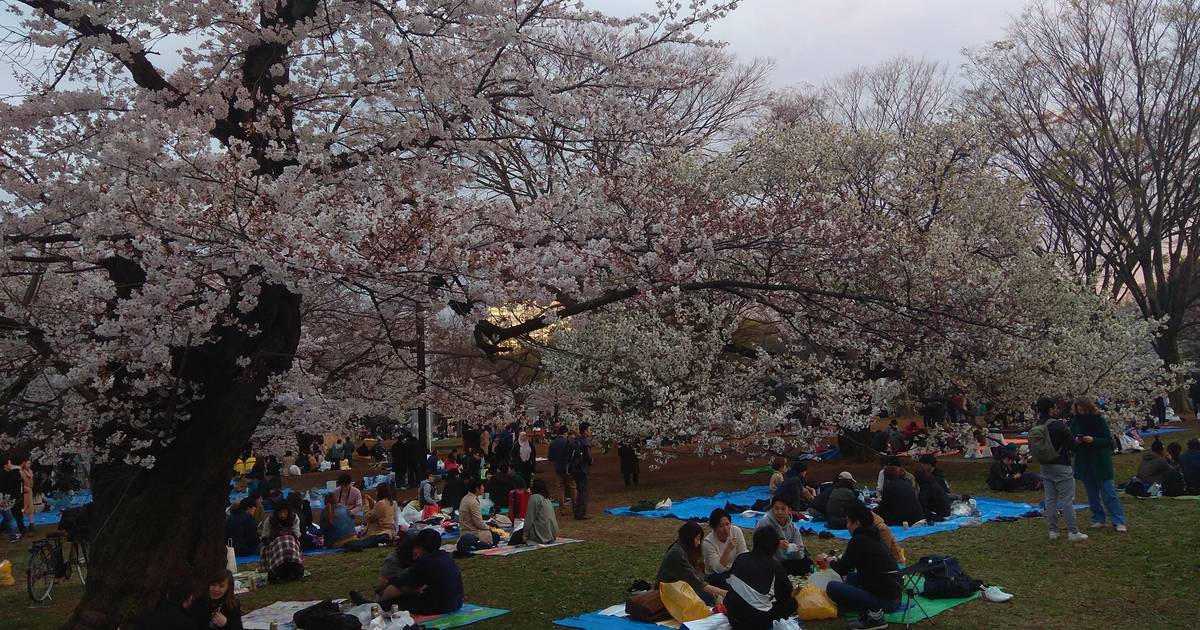
Carry the same picnic mat and the same can of beer into three famous Tokyo cherry blossom sites and you will get three different answers about whether you are allowed to be there — and one ward alone, Chiyoda, runs three separate rulebooks within ten minutes' walk of each other. The line that actually decides what you can do is not which park, it is who administers the land: a national garden run by the Ministry of the Environment, a metropolitan park run by Tokyo, a ward park and a ward-run festival, a city park run by Kyoto, or an independent administrative institution that is not a park at all. Five administrators, five different answers to the same four questions. Learn to read the administrator and you never have to look up a park again.
- The dividing line is the administrator, not the park: ask who owns the ground first, then look up the rules — the answer is predictable once you know the tier
- Leaving a tarp to hold a spot is against the rules: Tokyo bans unattended spot-saving, Chiyoda bans saving a spot with a sheet alone, Yoyogi bans leaving belongings — three unrelated authorities, one behaviour
- Tokyo and Kyoto point in opposite directions: Tokyo permits spot-saving within designated places and times; Kyoto bans it outright at Maruyama Park and even publishes its own definition of the term
- Prohibited is not the same as punishable: no monetary penalty for hanami behaviour turned up anywhere I checked — the strongest tool is being asked to leave
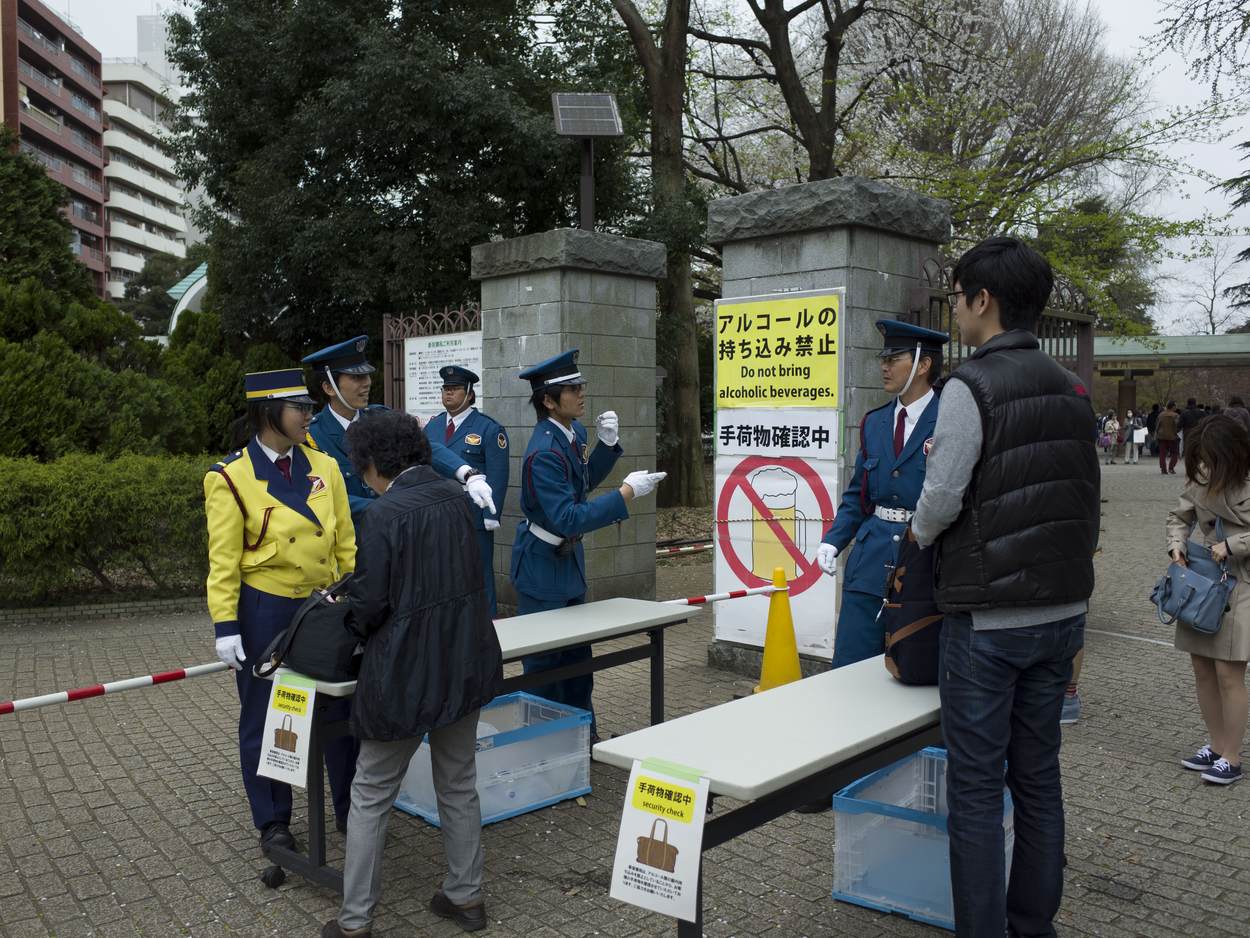
- One of Japan's most famous blossom walks bans picnics: the Osaka Mint Bureau asks visitors to refrain from eating and drinking, and inspects bags at the gate
📖 Contents
- Read the administrator: five tiers, one table
- Can you drink? Depends on the ground you are standing on
- The blue tarp, and why walking away from it breaks the rules
- Tokyo: three famous sites, three rulebooks
- Kyoto: free but strict, or paid and paid twice
- The Mint Bureau: not a park, so not park rules
- Barbecues: almost universally banned, plus 19 exceptions
- The rules run on a calendar, the flowers do not
- Four checks before you leave the hotel
Read the administrator: five tiers, one table
Hanami rules are usually laid out as a list: this park allows picnics, that park bans alcohol, one line per location. The problem is not that the entries are wrong. The problem is that the format does not generalise — change the park and you have to start over from scratch.
Sort Japan's blossom sites by who administers them and the structure becomes obvious. Here is how the same four actions — laying a mat, drinking, saving a spot, lighting a flame — resolve across the five tiers:
| Administrator tier | Example site | Alcohol | Sheet picnic | Spot-saving | Open flame |
|---|---|---|---|---|---|
| National garden (Ministry of the Environment) | Shinjuku Gyoen (paid entry) | 🔴 Banned in writing | 🟡 Mat yes, tents and parasols no | 🔴 No prolonged occupation of one spot | 🔴 No bonfires or gas stoves |
| Metropolitan park (Tokyo Bureau of Construction) | Ueno, Yoyogi, Inokashira | ⚪ Zero clauses in ordinance or Q&A | 🟢 Yes | 🟡 Within set places and times; unattended and proxy saving banned | 🔴 Yoyogi bans barbecues explicitly |
| Ward park and ward festival (Chiyoda City) | Chidorigafuchi Greenway, Chidorigafuchi Park, Sotobori Park | ⚪ No street-drinking ordinance in the ward | 🟡 Only the two designated parks; banquets banned on the greenway | 🔴 No saving a spot with a sheet alone | 🔴 Fire equipment including generators banned |
| City park (Kyoto City) | Maruyama Park | ⚪ No alcohol clause in the city's eight rules | 🟢 Yes | 🔴 Banned outright, stated separately | 🔴 Bonfires and aerial fireworks banned |
| Independent administrative institution (Mint Bureau) | Sakura no Toorinuke, Osaka | 🔴 Eating and drinking itself discouraged | 🔴 Impossible — it is a one-way walkway | 🔴 Does not exist — timed entry slots | 🔴 Wholly non-smoking, bag inspection |
How to use the table in practice: before you go, look at whose website the place lives on. A domain under env.go.jp means a national garden run by the Ministry of the Environment, and those carry the strictest rules. metro.tokyo.lg.jp means a Tokyo metropolitan park. A city or ward domain means local-government rules that may exist only in a single annual announcement. And a go.jp address attached to something that is not a park usually signals an entry system of its own design.
The next six sections go tier by tier, quoting what officials actually wrote and explaining how that wording bites on the ground. If your question is which week to fly rather than what to do once you land, that belongs to a different article — our guide to timing the bloom front handles it.
Can you drink? Depends on the ground you are standing on
This is the most-searched hanami question in English and the one most likely to be answered badly, because it has two layers — park rules and municipal ordinances — and the two layers frequently disagree about the very same square metre of ground.
Layer one: the park's own rules
Tokyo's metropolitan park ordinance (Ordinance No. 107 of 1956) has an Article 16 headed restriction of acts, not prohibition, and reading all ten of its clauses gives you: altering the original state of the park, collecting or damaging plants, capturing wildlife, advertising, driving vehicles in, entering restricted zones, commercial activity, damaging land or objects, dumping rubbish, and a catch-all tenth clause covering anything else that obstructs park management. A machine search of the full ordinance returns zero hits for alcohol, for the word sake, and for eating and drinking. The official metropolitan park Q&A returns zero for alcohol too.
Kyoto City is the same. Its public guidance on using city parks runs to eight items: restrictions on ball games, take your rubbish home, keep dogs leashed and clean up after them, no bicycles or motorbikes, no bonfires or aerial fireworks, clean and level the ground when you leave, no skateboarding or similar nuisance, and a general clause about not bothering other users. Zero hits for alcohol. Zero hits for spot-saving.
Then there is Shinjuku Gyoen, run by the Ministry of the Environment, where alcohol heads the list of items you may not bring in. The English version of the same page reads, word for word, The following items are prohibited in the garden — Alcoholic beverages. That ban also comes up in the comparison of Tokyo's big six blossom sites, so the point here is not that it is obscure. The point is that it proves the dividing line exists: walk out of the Gyoen gate and into a metropolitan park a few minutes away, and the identical can of beer goes from banned to entirely unregulated.
Layer two: ward street-drinking ordinances
🔴 If you have ever searched for whether Japan bans public drinking, this layer will surprise you: very few municipalities have such an ordinance, and the two that do attach no penalty to it.
| Municipality | Street-drinking ordinance | When it applies | Penalty |
|---|---|---|---|
| Shibuya City | 🔴 Yes, and it names parks | Year-round, 18:00–05:00 | ⚪ None — guidance only |
| Shinjuku City | 🟡 Yes | Only 31 Oct and 1 Nov | ⚪ None — guidance only |
| Chiyoda City (home of Chidorigafuchi) | ⚪ None found | — | Charges cover smoking and litter only |
| Minato, Chuo, Taito, Osaka City, Kyoto City, Fukuoka City | ⚪ None found on official sources | — | — |
Shibuya's ordinance is easy to mis-cite. The correct title translates as the Ordinance on Securing a Safe and Secure Environment in the Area Around Shibuya Station; the phrase about restricting drinking in public places is merely the heading of Article 6. The current text, in force since 1 October 2024, reads:
Article 6. No person shall drink alcohol, during the hours prescribed by ward regulation, in a public place (meaning a road, park, plaza or other place of a public nature) within the area prescribed by ward regulation, in the vicinity of Shibuya Station.
Three things changed in that revision, and they have to be read together: it moved from specific periods (Halloween and New Year) to year-round, the subject changed from visitors to the district to any person — so it is no longer aimed at tourists specifically — and the covered area expanded to include Maruyamacho. The 18:00 to 05:00 window lives in Article 3 of the implementing regulation, and paragraph 3 of that same article contains a proviso: the mayor may designate dates on which those hours are changed, subject to public notice.
And the penalty is nothing. All nine articles of the ordinance, read through, return zero hits for administrative charge, penalty, fine and detention. The strongest measure is Article 8, under which the mayor may instruct a person believed to be acting in violation to stop.
🔴 Set that against tobacco and the whole framework clicks into place. Same ward, same street: smoking on the pavement carries a 2,000 yen charge, drinking on the pavement carries nothing at all. The guide to which wards actually fine you for smoking works through seven municipalities on exactly this distinction between prohibited and punishable. Hanami is the second clean case of the same test — running in the opposite direction. With tobacco, several wards prohibit but do not fine. With alcohol, most wards do not even prohibit.
⚠️ No national ban on public drinking is an absence of evidence, not official confirmation of legality — no government publishes a notice saying it has not banned something. What does exist in current law is the 1961 Act on Prevention of Intoxicated Behaviour Causing Trouble to Others (Act No. 103 of 1961). Article 4 provides that an intoxicated person who behaves in a markedly crude or violent manner causing trouble to the public in a public place or on public transport is liable to detention or a petty fine, and Article 5 adds a fine of up to 10,000 yen for someone who ignores a police officer's restraint and offends again. It regulates conduct after drinking, not the drinking itself; on drinking, Article 2 imposes nothing more than a duty to exercise moderation.
⚠️ A second boundary, flagged as our inference rather than official wording: the addresses that make up Yoyogi Park do not appear in the appended table of prohibited areas in Shibuya's implementing regulation, so the park appears to sit outside the drinking-restriction zone — but no official document says so in those words. Note too that Shibuya runs a separate, purely voluntary pledge campaign against nuisance street drinking which officials state covers the entire ward, not just the station area. The ordinance zone and the pledge area are two different things and should not be conflated.
The blue tarp, and why walking away from it breaks the rules
If you have seen photographs of hanami, you have seen the blue tarp. It is a cheap polyethylene builder's sheet, sold in every home centre in Japan for a few hundred yen, and in early April it is the standard flooring of the entire ritual. In company culture the job of going out at dawn to unroll one and claim ground for the evening party traditionally falls to the most junior employee, who then sits there for hours while everyone else works.
Here is the uncomfortable part: the familiar version of that scene is not compliant. As it is usually described, the junior employee spreads the sheet and leaves, with the group arriving after work. Tokyo's metropolitan parks prohibit exactly that. The Bureau of Construction's park Q&A says:
Q. I would like to save a spot for hanami.
A. Saving a spot for hanami is possible within the places and times set by each park. However, unattended spot-saving is prohibited. We also do not permit proxy spot-saving, so please refrain from it. Do not respond even if you are approached with an offer.
The same three sentences appear, with minor differences of phrasing, on the notices page for Inokashira Park (updated 25 March 2026) — which confirms this is a rule common to all metropolitan parks rather than one park's quirk.
Chiyoda City writes the same rule independently, in its own cherry blossom festival FAQ, as item 3 of the rules for sheet-friendly locations: no saving a spot with a sheet alone. Yoyogi Park uses a third formulation in its official prohibitions: leaving belongings in the park is banned. Three unrelated administrators, three vocabularies, one behaviour.
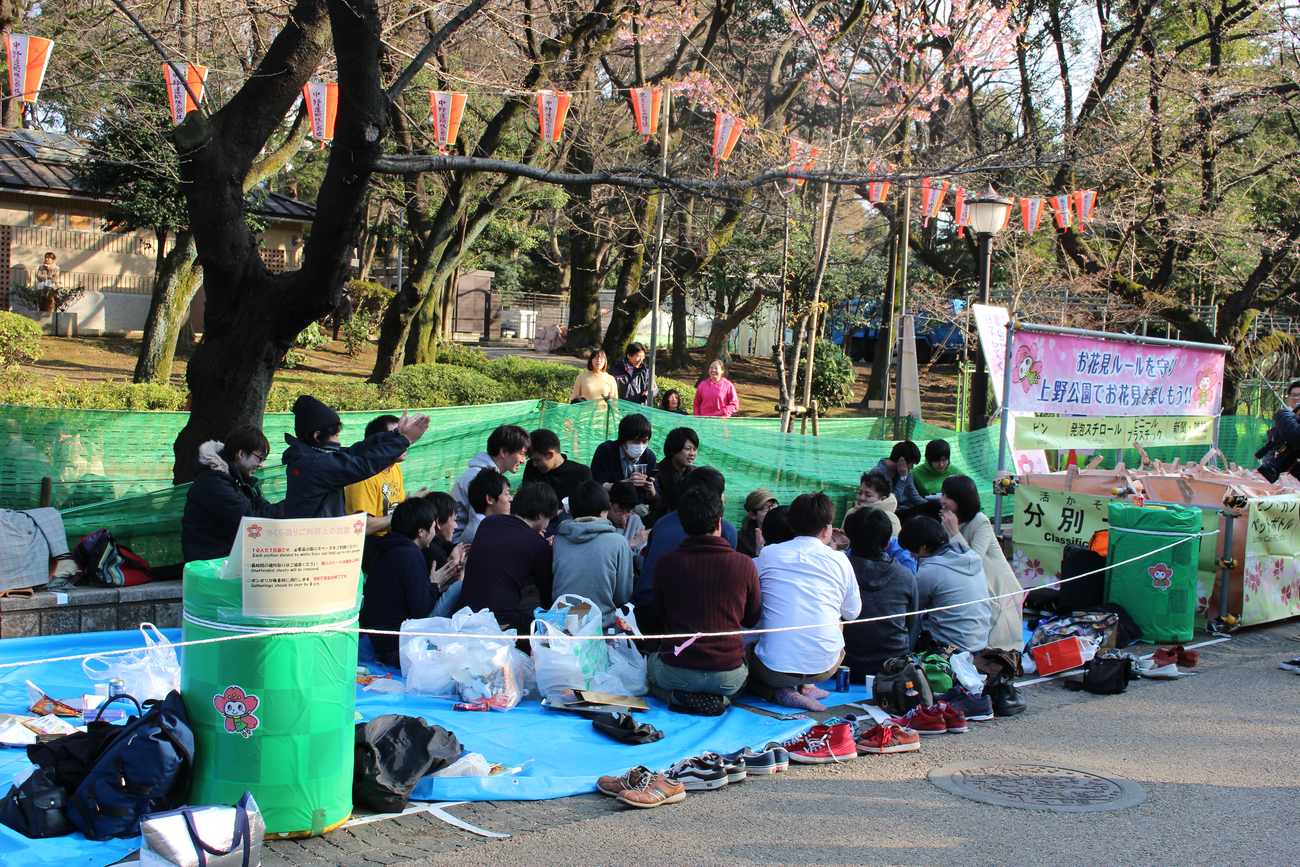
🔴 No official source says it is forbidden to claim a spot the night before. Tokyo's park Q&A, the Ueno and Inokashira notice pages and Chiyoda's festival FAQ contain no clause about the night before at all. What officials use instead are three substitute mechanisms, and their combined effect is harder than a single ban would be:
- Closing the park. Ueno Park is open from 5 am to 11 pm, with entry prohibited outside those hours (Tokyo Bureau of Construction, page updated 28 March 2024). Overnight spot-holding at Ueno is not banned; it is physically impossible
- Banning the unattended sheet. The Tokyo and Chiyoda clauses above. If nobody is there, it stops being spot-saving and becomes abandoned property
- Banning it outright. Kyoto City at Maruyama Park, covered below
Two more practical details are worth memorising. Chiyoda explicitly bans the pins used to peg a sheet down, because they damage roots and turf. Shinjuku Gyoen lists prolonged occupation of a single spot on a bench or lawn among its prohibited acts — it does not stop you laying a mat and sitting down, it stops you camping on one patch all day. That distinction reappears in the next section.
So what exactly are the places and times each park has set? Officials have not published them. The websites for Ueno and Inokashira, Tokyo's own hanami page, and the Q&A itself all say only that each park sets its own, and not one page states what those are. There is a single way to find out: telephone the park office (Ueno Onshi Park office, 03-3828-5644). No official document names which avenues or plazas at Ueno permit banquets, so treat any online list of them as unconfirmed.
Tokyo: three famous sites, three rulebooks
Shinjuku Gyoen: paid, dry, tent-free, and reserved on certain weekends
Admission is ¥500 for adults, ¥250 for visitors aged 65 and over and for students from high school age, and free for junior high school age and younger. Transport IC cards work at the entrance gate. Opening hours from 15 March to 30 September are 09:00 to 18:00, with last entry at 17:30. The garden closes on Mondays — except that officials state it stays open on Mondays from 25 March to 24 April during the cherry blossom period, which covers essentially the whole season.
Three rules matter here:
- No bringing alcohol in, top of the prohibited-items list
- No tents or parasols. There is one exception and it is useless for hanami — kids' tents under 150 cm are allowed in the children's plaza only, and only from 7 May to 31 October, because the exception exists for heatstroke prevention. March and April are outside it entirely
- No prolonged occupation of a single spot. Laying a mat and sitting down is fine; holding one patch all day is not
Two more blossom-season clauses rarely appear in English: during the cherry blossom period, photography with equipment brought in for the purpose of shooting a specific person as the subject is prohibited — so portrait shoots under the blossoms are out here — and running in the garden is not allowed during the blossom period, including the special 25 March to 24 April opening. The entire garden is non-smoking, including e-cigarettes, the walking paths and the car park.
🔴 The advance reservation system on certain blossom-season weekends is the thing most likely to wreck a day here. A Ministry of the Environment press release dated 2 March 2026 announced advance online reservation for entry between 10:00 and 16:00 on 28 and 29 March and 4 and 5 April 2026, applications accepted online only (via the asoview platform), with no entry for anyone lacking an electronic ticket or group reservation voucher. But the real lesson came later.
A line was added at the top of that release:
※ Advance reservation for Saturday 4 April is no longer required. (Updated 3 April 2026)
Tokyo's blossoms opened on 19 March 2026 and reached full bloom on 28 March, so by 4 April the trees were a week past peak and officials dropped the requirement the day before. Reservation dates are set by the calendar — the weekend — not by the state of the flowers. Lock an itinerary to the table published in early March and you can end up building a whole day around a reservation that gets cancelled out from under you.
Useful exits to note: entry between 09:00 and 10:00, or after 16:00, needs no reservation; neither do annual passport holders, visitors entitled to free entry, or guardians accompanying children of junior high school age or younger and pregnant visitors. Be aware that annual passports cannot be sold or renewed on reservation days, and that fax and reply-paid postcard applications were discontinued from 2026. Nothing has been announced for 2027; the pattern is a policy statement in late February and dates in early March.
Ueno Park: banquets yes, but the official word is "some areas"
Ueno is the most party-friendly of Tokyo's famous blossom sites, with roughly 1,200 cherry trees. The 2026 Ueno Sakura Matsuri was the 77th edition, running 14 March to 5 April across 23 days, with paper lanterns lit from 17:00 to 22:00. The fountain plaza hosted a food event gathering stalls from all 47 prefectures, plus food trucks and a ramen alley — which is the single biggest practical difference between Ueno and Chidorigafuchi, as the next section explains.
There is a further layer in Tokyo's own annual report. Hanami banquets at Ueno were suspended for four years from 2020 to 2022 and resumed in 2023, and the wording Tokyo's Eastern Parks and Green Spaces Office used in its Business Overview, Reiwa 5 edition is:
With the lifting of restrictions associated with COVID-19, we permitted hanami banquets in some areas of the park for the first time in four years. To ease congestion we also made Sakura-dori one-way and conducted joint night patrols with the local police, fire service and tourism association to ensure hanami rules were followed.
🔴 "Some areas" is not "the whole park." Which areas has never been published, in the document or on the web. That lines up exactly with the Q&A phrase about places set by each park — Tokyo pushes the answer down to individual park offices, and the park offices have not put it online. ⚠️ Note also that the most recent edition of that overview available online is the Reiwa 5 (2023) one; the Reiwa 6, 7 and 8 editions are not findable on the bureau's site, so the passage above describes the position in 2023 and should not be read as current policy.
Ueno's own rules page (updated 6 March 2023) lists 14 items covering fireworks, playing catch, golf, drones, skateboards, pets, feeding animals, musical instruments, stalls, petitions and fundraising, surveys, photography, smoking and the AED. Banquets, spot-saving and alcohol return zero hits. Its smoking clause only asks visitors to refrain in places where passive smoking may occur — advisory, a full tier softer than Shinjuku Gyoen's outright ban.
Chidorigafuchi: one name, three places, three rulebooks
This is the most immediately useful section in the guide, because Chidorigafuchi is not one place in official documents. Chiyoda City splits it three ways:
| Location | What you can do | Official wording |
|---|---|---|
| Chidorigafuchi Greenway (the famous 700 m) | 🔴 Walk through, nothing else | "Banquets and smoking are prohibited on the Chidorigafuchi Greenway" |
| Chidorigafuchi Park | 🟢 Sheet picnic allowed | "Markers are set in the centre of the park; please use the road side of the line joining them" |
| Sotobori Park | 🟢 Sheet picnic allowed | "Please use the green strip between the footpath and the roadway" |
| Kitanomaru Park, Imperial Palace East Gardens, Imperial Palace Outer Garden, National Diet Front Garden | 🟡 Benches only, simple food | "Simple eating and drinking (brought in) is possible using benches and similar" |
The two sheet-friendly parks carry seven prohibitions, three of which deserve separate memory: fire equipment including portable generators, and noise such as karaoke; no saving a spot with a sheet alone; and no pins to peg a sheet down. Rubbish goes home with you in all cases.
⚠️ The bench line for those last four locations is Chiyoda City's wording, but Kitanomaru Park, the East Gardens, the Outer Garden and the Diet Front Garden are national gardens run by the Ministry of the Environment, and the ministry's own rules page for them returns a 403. Read that row as what Chiyoda City says, not as a ministry ruling.
Three more things that send people home disappointed:
- There are no food stalls on the greenway. The official FAQ answers the question — are there stalls on the Chidorigafuchi Greenway? — with a flat there are none. Compare Ueno's 47-prefecture food event plus food trucks plus ramen alley, and you get a genuinely useful decision rule: choosing whether your Tokyo hanami includes street food is the same decision as choosing the park
- Weekend pedestrian flow during the illumination period is one-way, running from Yasukuni-dori towards the entrance at the Chidorigafuchi National Cemetery, with officials adding that you cannot enter from the Hanzomon side. Walk over from Hanzomon station and you will be turned away at the entrance
- Tripods and step stools are banned on the greenway, including Kudanzaka Park. The roadway alongside is closed to traffic from 09:00 to 21:00 during the illumination, but officials state explicitly that it is not a pedestrian precinct — walkers stay on the footpath
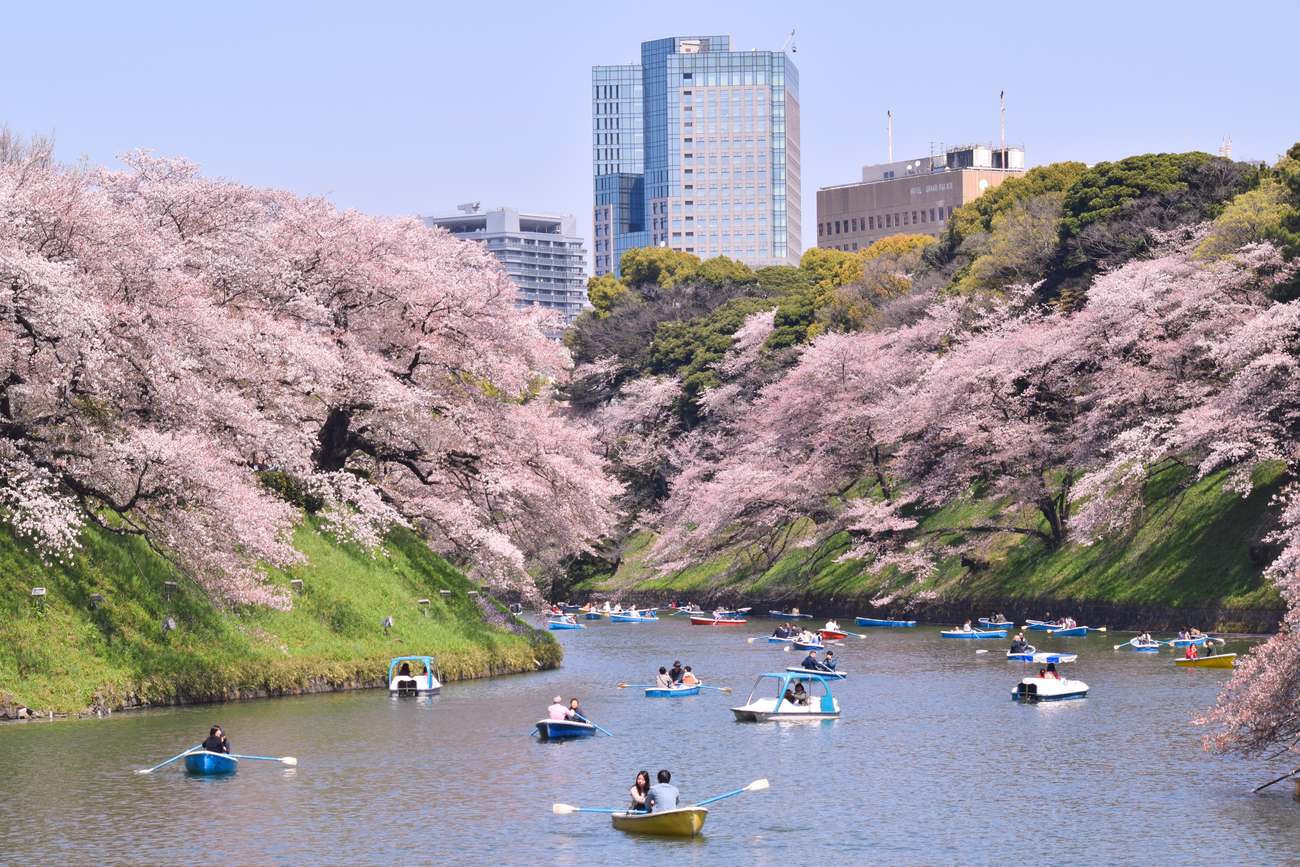
The boats: the price doubled in 2026, and the figure you remember is now the residents' rate
🚨 On 1 March 2026 Chiyoda City revised the fares at the ward-run Chidorigafuchi boathouse, and the revision was a straight doubling. Blossom-season 30 minutes went from ¥800 to ¥1,500, blossom-season 60 minutes from ¥1,600 to ¥3,000, and the standard 30-minute rate from ¥500 to ¥1,000.
⚠️ The roughly ¥800 per 30 minutes quoted all over the internet is now the residents' rate — the city introduced one at the same time, and the condition is stated as applying when even one person aboard a boat lives in the ward, on production of an original official document. Visitors will never use it, but you need to know it exists, or that ¥800 will fool you into thinking nothing changed.
Other practicalities: standard opening is 10:00 to 17:00, closed Mondays, and closed entirely from December to February. Hours extend during the blossom season — in 2026 the earliest slot was 09:00 and the last was 18:30. Rowboats take a maximum of three people, and anyone of junior high school age or younger must be accompanied by an adult. Drinking and eating on board are prohibited, with officials asking that nothing be brought aboard at all, and someone who has already been drinking may be refused. No photography whatsoever on the pier, and no tripods anywhere in the boathouse grounds.
⚠️ If you have seen the tip about rowing at 6:30 am to beat the crowds, it is physically impossible, because the first boat goes out at 09:00 in blossom season or 10:00 the rest of the year. Being on the greenway at 6:30 for empty-path photographs is excellent advice; it is just a separate activity that needs a separate slot in the day.
During the season there is also a pre-purchased smart ticket at ¥12,000 for one hour and one boat, up to three people, rowboats only, with a purchase page available in traditional Chinese as well as English. What it buys is skipping the queue and a fixed time slot; the unit rate is plainly much higher. The cancellation terms are severe: a ¥2,000 handling fee up to two days before, no refund at all the day before or on the day, and arriving 20 minutes late counts as a cancellation. Only a rained-off closure gets you a full refund.
🔴 Be honest with yourself about the odds: of the 12 days in the 2026 blossom-viewing period, five (26 and 31 March, 1, 2 and 4 April) were cancelled for rain or strong wind. If the boats are the centrepiece of your trip, build a second plan. Do not make them load-bearing.
Kyoto: free but strict, or paid and paid twice
Maruyama Park: no admission fee, and spot-saving banned outright
🔴 Kyoto City's answer on spot-saving is the exact reverse of Tokyo's. A Kyoto City press release dated 18 March 2026 states:
So that as many people as possible can enjoy the cherry blossoms, spot-saving (spreading out a blue tarp or similar in advance to secure a place) is prohibited. We ask for your cooperation in enjoying hanami with restraint.
Two things stand out. First, Kyoto supplies its own definition of spot-saving — spreading a blue tarp or similar in advance to secure a place. Second, this is a flat prohibition with none of Tokyo's proviso about designated places and times. Same act; conditionally permitted in one city, banned in the other.
⚠️ Mats are not banned across Kyoto — that ban is Maruyama Park-specific. The city's general park rules contain no such clause; spot-saving returns zero hits across those eight items. It also currently appears only inside the annual illumination press release rather than on a standing rules page, which makes it formally a single-year notice, reissued each year. Whether it carries into 2027 depends on that year's announcement.
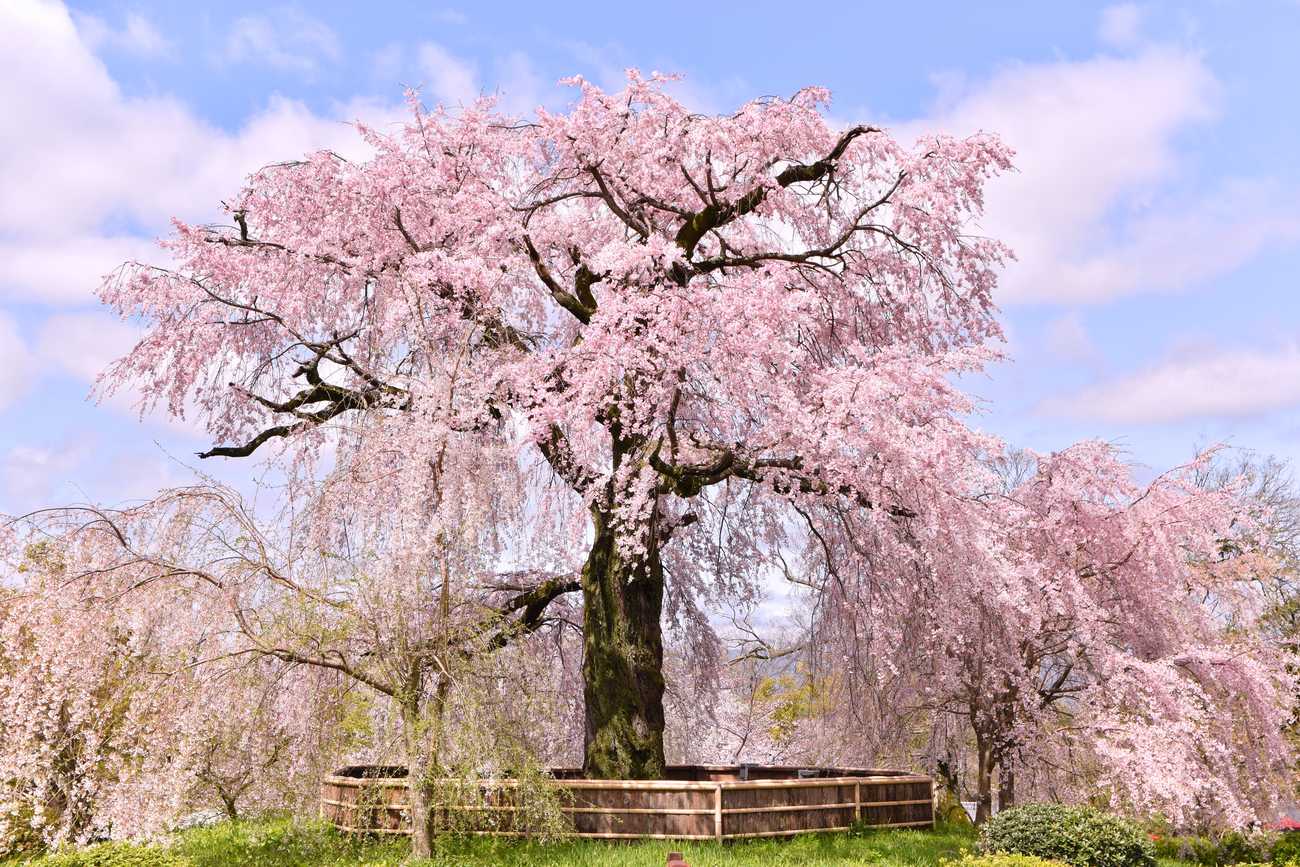
Maruyama Park is Kyoto's oldest park, opened on 25 December 1886, covering 86,641 square metres, and simultaneously designated a place of scenic beauty, a scenic district, a special ancient-capital preservation district and a wide-area evacuation site. Entry is free. Its famous weeping cherry, the "Gion night cherry", is formally a single-petalled white higan weeping cherry — and the tree standing there now is the second generation. The original was designated a natural monument in 1938 and died in 1947; the current tree was planted in 1949 and stands 12 m tall with a trunk circumference of 2.8 m and a crown spread of 10 m.
🔴 If you want to see the bonfires, weight your trip towards the first half of the season. The 2026 illumination ran from 24 March to 8 April, 18:00 to 22:00, but the kagaribi braziers only ran to 1 April — a full week short of the lighting. Officials also state that if a dryness advisory or strong-wind advisory is in force as of 4 pm on the day, the braziers are cancelled for safety. The call is therefore made at four in the afternoon, and cancellation notices go up on the Kyoto City Urban Greenery Association's pages rather than the city's own.
Bloom status is posted on the Maruyama Park management office's Instagram and streamed by the Kyoto City Tourism Association on YouTube (in 2026 the stream ran 24 March to 8 April). The management office is on 075-561-1778, 09:00 to 17:00, closed Wednesdays. For how Kyoto's other blossom sites stack up, see our comparison of the Philosopher's Path against Daigo-ji.
Nijo Castle: day and night are separate admissions
If Maruyama represents free but strict, Nijo Castle is the other extreme: paid, and paid twice.
The 2026 Nijo Castle cherry blossom festival ran 19 March to 19 April, 32 days. Daytime viewing runs 08:45 to 17:00 with last entry at 16:00, and admission including the Ninomaru Palace is ¥1,300 for adults. The evening illumination runs 18:00 to 22:00, last entry 21:00.
🔴 Officials state it directly: day and night are separate sessions and each requires its own ticket. They also note that the illumination viewing area differs from the daytime one, so the parts of the site you can walk at night are not the parts you walked in the afternoon.
Evening pricing floats along three axes at once, which is unusual for a Japanese attraction: early-bird versus standard × Monday–Thursday, Friday–Sunday and holidays, or designated peak dates × junior high school age and above, or primary school age. For admission plus the Ninomaru Palace at junior high age and above, the early-bird Monday-to-Thursday rate is ¥2,400, while the standard rate on a designated peak date is ¥3,200 — an ¥800 spread for identical content. Combination tickets bundling the castle's theatrical programme exist as two further options.
Two dates to hold on to: early-bird tickets sold through ticket agencies and convenience stores (FamilyMart, Lawson) until 18 March, after which only the standard rate remains; and the designated peak dates — 4, 5 and 11 April in 2026 — require a date-specified ticket. ⚠️ Everything above is the 2026 record. Nothing has been announced for 2027, dates and prices are reset annually, so re-check before you book.
The Mint Bureau: not a park, so not park rules
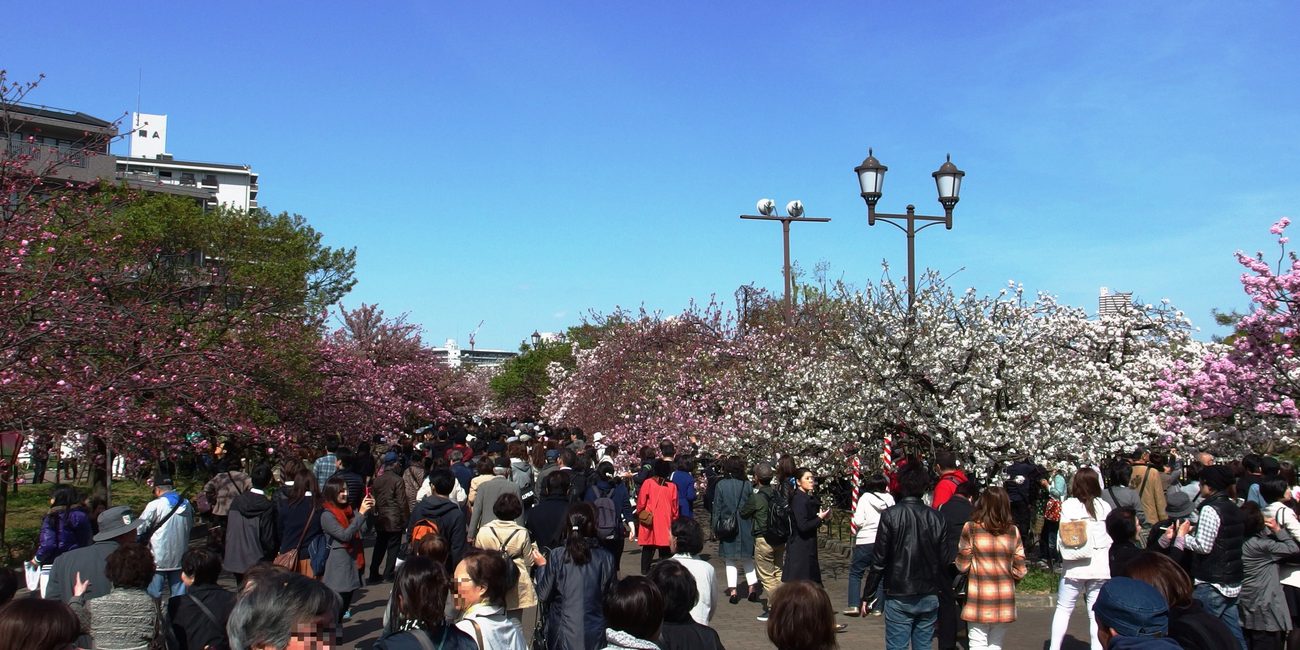
The Osaka Mint Bureau's Sakura no Toorinuke is among the most famous cherry blossom events in Japan, and it is the only site on this list where even eating is discouraged. One sentence explains everything else about it: it is not a park, it is the grounds of a government mint, and the event is a toorinuke — a walk-through, not a place to stay.
First, a common misconception. It does run on advance application, but the mechanism is first-come-first-served, not a lottery. The Mint Bureau's notice of 14 January 2026 uses the phrase advance application system via the internet (first-come-first-served) verbatim.
The 2026 record: seven days, 9 to 15 April, opening at 10:00 on weekdays and 09:00 at weekends, with entry closing at 19:15 and everyone out by 19:45. Applications opened at 09:00 on 18 March and ran until the event ended, with one throttle built in — until 07:00 on 1 April, applications were capped at roughly three-quarters of the total entry allocation, with the remainder released from 09:00 that day. That year the walk had 140 varieties across 331 trees; the flower of the year was Gyoiko, and a variety called Fukuzakura made its debut.
The application rules repay a careful read before you travel:
- Entry slots run in 30-minute blocks, each capped at 2,350 people (except the first hour of each day — weekdays 10:00 to 11:00, weekends 09:00 to 10:00 — which is capped at 1,200 per 30 minutes)
- One applicant may book only one time slot per day; slots on different days can be booked separately
- One application covers a maximum of five people (infants not counted), and on the day everyone must check in together — split entry is not accepted
- Individual applications only; corporate names are not accepted
- Check-in is by QR code, displayed on a phone or printed out
- Entry outside your allocated slot is refused in principle, though minor discrepancies caused by transport delays are tolerated, other than at each day's opening and closing times
- No dedicated car park and no coach drop-off point
Then the three rules that define the place: eating and drinking inside the venue is discouraged, the venue is entirely non-smoking, and bags are inspected on entry. Officials also ask visitors to refrain from using parasols, selfie sticks and tripods, and pets are not admitted (guide dogs and similar excepted). The Mint Museum closes temporarily for the duration.
For access, officials list three stations, each about 15 minutes on foot: Osaka Metro Tanimachi Line Temmabashi (north ticket gate, exit 2), Keihan Main Line Temmabashi (east ticket gate, exit 14), and JR Tozai Line Osakajokitazume (exit 3). A dedicated phone line, 06-7713-0476, operates 09:00 to 19:00 for people not using the internet. A separate special blossom viewing session for visitors with disabilities and older visitors is held on the day before the main walk opens.
⚠️ Nothing has been announced for 2027 — a full-site search of the Mint Bureau's pages for the Japanese era year corresponding to 2027 returns zero hits. The established pattern is an intention-to-hold notice in mid-January and dates plus application details in mid-March. So the planning action is: start watching the Mint Bureau site in mid-January, and distrust anything that offers you 2027 dates today. For the rest of the city, see our take on Osaka Castle and the Okawa riverside.
Barbecues: almost universally banned, plus 19 exceptions
This section can be short, because the answers agree with each other: you cannot light a fire at a major hanami site.
- Yoyogi Park: prohibition number one covers use of fire, listing bonfires, cooking, barbecues, fireworks and generators. The same list also bans tents, tarps and sun shades and leaving belongings
- Shinjuku Gyoen: bonfires and portable gas stoves banned
- Kyoto City parks: rule 5 prohibits dangerous acts using fire, such as bonfires and aerial fireworks
- Chiyoda's two sheet-friendly parks: fire equipment including portable generators banned
🔴 Yoyogi Park has no barbecue area. Tokyo's Bureau of Construction publishes a list of metropolitan parks where barbecues are permitted (updated 30 March 2026) naming 19 parks — Akatsuka, Akiruodai, Oshima-Komatsugawa, Koyamadaira, Shioiri, Nogawa, Hikarigaoka, Fuchunomori, Musashino, Musashino-Chuo, Yumenoshima, Wadabori, Kasai Rinkai, Kiba, Koganei, Shiokaze, Toneri and Mizumoto among them. Neither Yoyogi nor Ueno appears on it. Use requires a booking by phone or online, and officials add that methods letting flame touch the ground directly are prohibited.
The conclusion is blunt: do not try to combine a barbecue with hanami. They happen in two different sets of parks, and forcing them together produces a bad version of both.
The rules run on a calendar, the flowers do not
Every hanami system you can look up online was designed around a calendar, and the blossoms do not consult it. Two cities, at two different levels of government, have now conceded the point in writing.
The first is Shinjuku Gyoen. Four reservation dates for 2026 were fixed as weekends in late February and early March; Tokyo then bloomed on 19 March, reached full bloom on 28 March and by 4 April was a week past peak, so on 3 April officials announced that 4 April no longer needed a reservation. The system could not keep up with the season, so it was dismantled mid-flight.
The second goes further — Hirosaki City changed the rule itself. A municipal notice on the revision of the paid-entry exclusion period and paid hours at Hirosaki Castle states:
In line with the recent tendency of Somei-Yoshino to bloom early, the current handling provisions no longer fit, and so they are being changed. … The period during which those otherwise entitled to free entry must pay was previously stated as "from 23 April to 5 May"; it is changed to "the period of the Hirosaki Cherry Blossom Festival." … Note regarding paid hours: if the Somei-Yoshino bloom early, hours may revert to the standard 09:00 to 17:00 even during the festival period.
A municipal government stating in plain language that its fixed-date rule can no longer keep up with the flowers, converting the rule to float with the festival — and then still adding a clause saying it may snap back if the bloom is early. That is more persuasive than any abstract statement that sakura drifts a week each year, because it is officials rebuilding their own machinery to chase the season.
Hirosaki charges on a completely different model from Shinjuku Gyoen: the park itself is free, and only the Honmaru and Kita-no-Kuruwa area and the botanical garden are paid zones, at ¥320 for adults, or ¥520 for a three-facility combination ticket. Officials also state that the Honmaru and Kita-no-Kuruwa area can be entered outside paid hours as well — which makes this a charge on time, not a fence around ground. In 2026 the paid hours for that area were 09:00 to 17:00 from 10 to 16 April, 09:00 to 21:00 from 17 to 30 April, and 09:00 to 17:00 from 1 to 5 May. 🚨 Some ticket counters are cash only, and officials specifically ask visitors to bring cash. For how the northern bloom front works, see the guide to Japan's last cherry blossoms of the year.
One more piece of background gets garbled constantly and is worth fixing: the Japan Meteorological Agency stopped forecasting, not observing. A press release dated 25 December 2009 explained that because private weather companies were by then providing equivalent nationwide information, the agency would cease publishing its cherry blossom forecast from the following spring — 2009 was the last. But the closing sentence of that same release reads: the observation of cherry blossom flowering, for the purpose of understanding climate effects on living things, will continue. And when the agency cut its phenological observations in 2020 from 34 plant and 23 animal categories down to 6 categories covering 9 phenomena, cherry flowering and full bloom were explicitly among the survivors. Every organisation publishing a bloom forecast today is a private company, not the government. The official criteria remain 5 to 6 open flowers for flowering and roughly 80 per cent for full bloom, measured mainly on Somei-Yoshino, with Ezoyamazakura substituted in parts of Hokkaido and Hikanzakura in the southwestern islands.
Four checks before you leave the hotel
The whole guide, compressed into four actions:
- Ask who administers the ground. Look at the domain of the official site: the Ministry of the Environment (
env.go.jp) means the strictest rules and possibly an alcohol ban; Tokyo (metro.tokyo.lg.jp) means no alcohol clause but real rules about holding space; a city or ward means checking that place's own announcement; and an independent administrative institution may not be a park at all - Assume nobody may leave the mat. This holds under Tokyo, under Chiyoda, and at Yoyogi, and no administrator anywhere says the opposite. If you want a spot, leave a person in it, not a sheet
- If you want to drink, first confirm you are not in a national garden. Shinjuku Gyoen bans it and the Mint Bureau discourages consumption entirely; metropolitan parks and Kyoto city parks have no clause on it. On the street it comes down to the municipality — Shibuya prohibits it year-round from 18:00 to 05:00, parks included, with no penalty attached
- Re-check anything paid or reservation-based the day before you go. A Shinjuku Gyoen reservation date was scrapped the previous day; Maruyama's braziers are decided at 4 pm on the day; the Chidorigafuchi boats missed five days out of twelve. None of that is knowable a week ahead
Every rule above is a usage rule written by an administrator, not criminal law. The consequences of breaking them are guidance, a request to stop, and a request to leave; no official document attaches a monetary penalty to hanami behaviour. That is not an invitation to ignore them — being asked to leave costs you the day just as thoroughly as a fine would, and these rules mostly exist because something went wrong in the past. Maruyama cancels its braziers on a dryness advisory; Ueno reinstated banquets alongside joint night patrols. Both of those tell you what the rule is really for. For nationwide timing and a site-by-site overview, start from our complete Japan cherry blossom guide.
Frequently Asked Questions
- Q1:Can you drink alcohol at hanami in Japan?
- There is no single national answer, because the answer depends on who administers the ground you are standing on. Tokyo Metropolitan Government's park ordinance and its official park Q&A contain no alcohol clause at all — a full-text search of both returns zero hits for the word 'sake'. So at Ueno Park, Yoyogi Park and Inokashira Park, drinking is simply not regulated at the ordinance level. Walk into Shinjuku Gyoen, which the Ministry of the Environment runs, and it flips: alcoholic beverages sit at the very top of the garden's prohibited-items list, and the English version of that page reads 'The following items are prohibited in the garden — Alcoholic beverages'. Osaka's Mint Bureau cherry blossom walk goes further still and asks visitors to refrain from eating or drinking anything inside the venue. As for the street, there is no nationwide law banning public drinking. What does exist is a 1961 statute on intoxicated behaviour, and it regulates the loud or violent conduct of a drunk person, not the act of drinking; on drinking itself it imposes only a duty to exercise moderation. A small number of individual wards have their own street-drinking ordinances, and there are fewer of them than most visitors assume.
- Q2:Do you need a permit to reserve a hanami spot, and can you leave a tarp there?
- You cannot leave it unattended, and two completely unrelated authorities each say so in their own words. The Tokyo Metropolitan Government Bureau of Construction's official park Q&A states that spot-saving for hanami is possible within the places and times each park has set, but that unattended spot-saving is prohibited, and that hiring someone to hold a spot for you is not permitted either. Chiyoda City, which runs the Chidorigafuchi cherry blossom festival, lists 'no spot-saving with a sheet alone' as item 3 of its rules. Yoyogi Park expresses the same idea a third way, by banning the act of leaving belongings in the park. So the familiar picture — go early, spread a blue tarp, walk away, come back after work — is against the rules as written. The only compliant version is that a person stays on the mat. Two practical details follow: Chiyoda also bans the pins people use to peg a sheet down, and Ueno Park is open from 5 am to 11 pm with entry prohibited outside those hours, which makes overnight spot-saving physically impossible there rather than merely forbidden.
- Q3:What happens if you break these hanami rules? Are there fines?
- No official document attaches a monetary penalty to hanami behaviour. The tools available to park managers are verbal guidance, a request to stop, and a request to leave. Shinjuku Gyoen puts it most firmly: the garden states it may ask visitors to leave in cases of misconduct, violence, nuisance to other visitors, or refusal to follow staff guidance. Shibuya City's street-drinking ordinance makes the same point even more sharply. Article 6 prohibits drinking in public places including parks within a designated area during designated hours, yet reading all nine articles of that ordinance turns up zero instances of the words for administrative fine, penalty, criminal fine or detention. The strongest measure is 'guidance' under Article 8. Same ward, same street: smoking on the pavement carries a 2,000 yen charge, drinking on the pavement carries nothing. Prohibited and punishable are two different things in Japan. That should not be read as permission, though — being asked to leave ruins the day just as effectively as a fine would.
- Q4:Do you need a reservation for Shinjuku Gyoen during cherry blossom season?
- On certain weekend dates, yes — and those dates are fixed by the calendar rather than by the blossoms. A Ministry of the Environment press release dated 2 March 2026 announced advance online reservations for entry between 10:00 and 16:00 on 28 March, 29 March, 4 April and 5 April 2026, with applications accepted online only. Then a line appeared at the top of that same release: advance reservation for Saturday 4 April is no longer required, updated 3 April 2026. Tokyo's blossoms opened on 19 March that year and reached full bloom on 28 March, so by 4 April the trees were a week past peak and officials scrapped the requirement the day before. There are several useful exits from the system: entry between 9:00 and 10:00, or after 16:00, needs no reservation, and neither do annual passport holders, visitors entitled to free entry, guardians accompanying children of junior high school age or younger, and pregnant visitors. Note that annual passports cannot be bought or renewed on reservation days. For 2027 nothing has been announced; the usual pattern is a policy statement in late February and specific dates in early March.
- Q5:Can you have a picnic at Chidorigafuchi?
- It depends which Chidorigafuchi you mean, because Chiyoda City treats the name as three separate places. First, the famous 700-metre Chidorigafuchi Greenway: the official notice states plainly that banquets and smoking are prohibited on the greenway. Second, the official FAQ names exactly two places where you may lay a sheet and eat — Chidorigafuchi Park, where markers in the centre of the park define a line and you should use the road side of it, and Sotobori Park, where the strip of green between the footpath and the roadway is the designated area. Third, at Kitanomaru Park, the East Gardens of the Imperial Palace, the Imperial Palace Outer Garden and the National Diet Front Garden, the wording is that simple eating and drinking using benches is possible — benches only, no ground sheets. All three categories sit within about ten minutes' walk of each other and run on three different rulebooks. Two more things that waste people's evenings: the greenway has no food stalls, and the official FAQ answers that question with a flat 'there are none'. And on illumination-period weekends, pedestrian flow is one-way from Yasukuni-dori towards the entrance at the Chidorigafuchi National Cemetery, with officials noting that you cannot enter from the Hanzomon side.
- Q6:Is the Osaka Mint Bureau cherry blossom walk still reservation-only, and is it a lottery?
- Advance application is required, but the mechanism is first-come-first-served, not a lottery. The Mint Bureau's notice of 14 January 2026 uses the exact phrase 'advance application system via the internet (first-come-first-served)'. The 2026 event ran for seven days, from 9 April to 15 April, opening at 10:00 on weekdays and 9:00 at weekends, closing to entry at 19:15 with everyone out by 19:45; applications opened at 9:00 on 18 March. Several rules are worth knowing before you apply: entry slots run in 30-minute blocks capped at 2,350 people each, except for the first hour of each day, which is capped at 1,200 per 30 minutes; one application covers a maximum of five people who must all check in together, with no split entry; and only individual applications are accepted, not corporate ones. The three most counter-intuitive rules are that eating and drinking inside the venue is discouraged, the venue is entirely non-smoking, and bags are inspected at entry. The reason is that this is not a park at all — it is the grounds of a government mint, and the event is a walk-through rather than a place to sit. Nothing has been published for 2027; the usual pattern is an intention-to-hold notice in mid-January and dates plus application details in mid-March.
- Q7:Can you barbecue under the cherry blossoms?
- At almost every major hanami site, no, and it is explicitly prohibited rather than merely discouraged. The first line of Yoyogi Park's official prohibitions covers the use of fire, listing bonfires, cooking, barbecues, fireworks and generators. Shinjuku Gyoen bans bonfires and portable gas stoves. Rule 5 of Kyoto City's park rules prohibits dangerous acts using fire such as bonfires and aerial fireworks. Chiyoda City's two sheet-friendly parks prohibit fire equipment including portable generators. Tokyo does publish a list of metropolitan parks where barbecues are allowed — the version updated on 30 March 2026 names 19 of them, including Akatsuka, Akiruodai, Oshima-Komatsugawa, Koyamadaira, Shioiri, Nogawa, Hikarigaoka, Fuchunomori, Musashino, Musashino-Chuo, Yumenoshima, Wadabori, Kasai Rinkai, Kiba, Koganei, Shiokaze, Toneri and Mizumoto. Use requires a phone or online booking, and letting flame touch the ground directly is prohibited. Note which two parks are missing from that list: Yoyogi and Ueno. Treat barbecuing and cherry blossom viewing as two separate outings, because they happen in two different sets of parks.
Read next
Tokyo Cherry Blossoms 2027: Best Spots & Crowd-Free Tips
Tokyo peaks late March and is the easiest to time — best hours for Meguro River, Chidorigafuchi, Shinjuku Gyoen, Ueno, plus a one-day route.
Japan Cherry Blossom Forecast 2027: Which Week to Fly
Peak sakura lasts about 7 days and shifts a week each year. Using historical-average bloom dates and how to read the annual forecast: which week is safest, the one week to bet, and where to chase a late bloom.
Osaka Cherry Blossoms 2027: Castle, Mint Passage & Okawa
Osaka Castle + the Mint passage extra round (late cherries mid-April) + Okawa night cherries from a water bus.
📊 See the 2026 Price Index (JR Pass, DPA, eSIM, Airport Transport) →