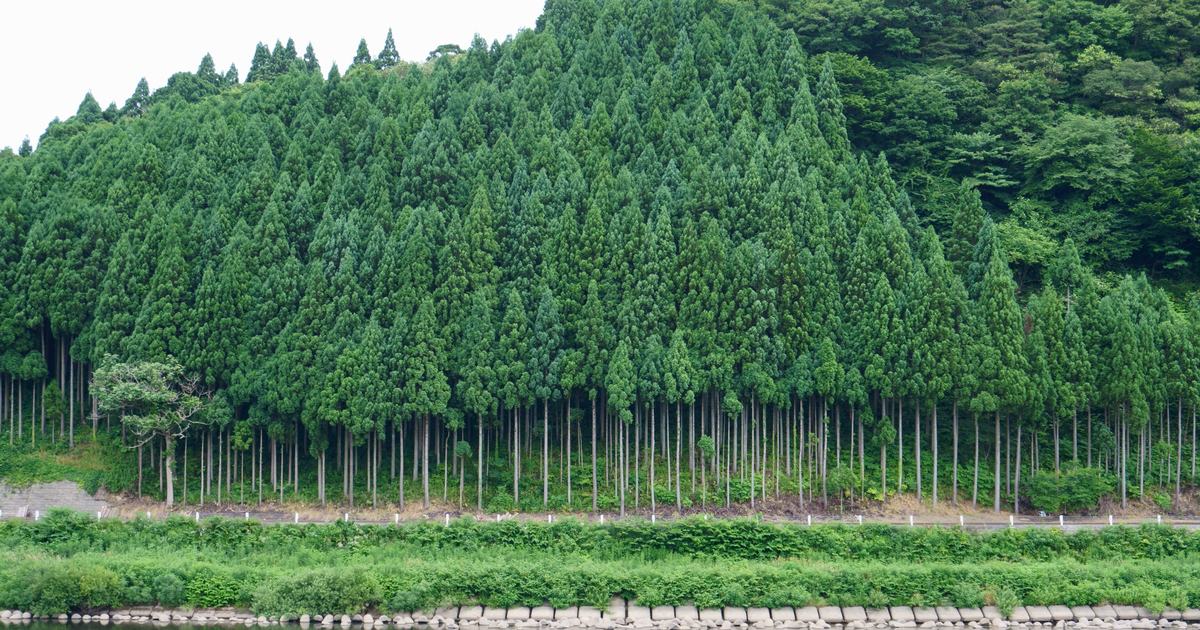
In 2026 the Ministry of the Environment measured 21,530.5 grains of cedar pollen per square centimetre at Ofunato in Iwate Prefecture and 20,058 at Hirosaki in Aomori — against just 3,510.9 in central Tokyo. The worst place in Japan for hay fever is not Kanto. It is Tohoku, by a factor of more than six. And within Tokyo itself the spread is 4.33 times, from 5,291 in Chiyoda to 22,937 in Ome. This guide works entirely from official counts — Ministry of the Environment, Tokyo Metropolitan Government, the Hokkaido Institute of Public Health and the Forestry Agency — to answer a question the blossom calendar never answers: if you follow the blossom front north, what exactly are you following pollen-wise? Kanto is the tail of cedar plus the start of cypress. Kansai in April is cypress almost outright. Tohoku is the heaviest cedar in the country. Hokkaido swaps in birch. And the one place genuinely outside the season costs you the blossoms entirely.
📍 This guide covers geography, timing and the systems you will meet in Japan — monitoring, forecasting, mask labelling rules and pharmacy purchase rules. It does not give medical or medication advice and recommends no specific product. Talk to a doctor or a pharmacist about treatment.
- The official window is February to April, not March to April: Shizuoka released 51.3% of its season in February, Yamaguchi 58.0% — and Tokyo's season end dates run to mid-May, so Golden Week is still inside it
- Tohoku, not Kanto, is the worst: Ofunato 21,530.5 and Hirosaki 20,058 grains per square centimetre against Chiyoda's 3,510.9 (cedar, 2026 measured)
- Kyoto in April is cypress, not cedar: cypress made up 92.0% of Kyoto's full-season total in April alone, while cedar was down to 3.6%
- Hokkaido is not a refuge unless your allergy is specifically cedar: Sapporo birch starts on a ten-year mean of 21 April; blossom opens on a normal of 1 May. The pollen beats the flowers by ten days
- Wool attracts 9.8 times more pollen than cotton: the official adhesion table puts wool at 980 against cotton at 100 — and February to April is coat season
📖 Contents
- Two fronts, one line
- Region by pollen type by month
- Tohoku is the worst, and it peaks a month later
- Kansai in April is 92% cypress
- A 4.33x spread inside one city
- Hokkaido: birch beats the blossoms by ten days
- Okinawa has never been measured
- Why Japan has no official pollen forecast
- What actually works, by official numbers
- Pharmacy categories and the May 2026 rule change
- So where should you go: the trade-offs
Two fronts, one line
Every cherry blossom itinerary is built on the same idea: the blossom front moves north from Kyushu, and if you pick your week you can catch peak bloom more than once in a single trip. That is entirely correct. It just leaves something out.
The cedar and cypress dispersal season is the same line moving north. Outside Okinawa, planted cedar runs from Kyushu to southern Hokkaido across roughly 4.5 million hectares, and the Ministry of the Environment's official handbook describes cedar as planted from southern Hokkaido through to Kyushu, with the heaviest concentrations "particularly in the Tohoku region and Kyushu." What triggers cedar to flower is temperature — the handbook states that early-winter temperatures in November and December determine when dormancy breaks, and temperatures during the subsequent preparation period determine when dispersal begins. The same thermal logic that drives the blossom front drives the cedar.
So chasing blossoms means chasing pollen, and no amount of shifting your trip a week either way solves that. What you can actually control is three variables: which region, which month, and what you wear. And with every step north, the species you are dealing with changes.
One timing correction first. The official window is February to April, not March to April. The Ministry of the Environment and the Ministry of Health, Labour and Welfare state jointly that cedar pollen disperses in roughly February to April. That extra month matters enormously in western Japan: in 2026, Ube in Yamaguchi Prefecture released 58.0% of its entire season in February, and Shizuoka City 51.3%. Arriving in February feels safe. It is not.
Region by pollen type by month
This table is the backbone of the whole guide. Every figure comes from the Ministry of the Environment's measured pollen survey, June 2026 edition, covering the confirmed full 2026 season from 1 February to 25 May, in grains per square centimetre. Each prefecture has exactly one monitoring site, so read every row as "that glass slide in that city," never as a prefectural average.
| Region (site) | Feb–Mar lead | April lead | Cedar, season | Cypress, season | What it means for blossom travel |
|---|---|---|---|---|---|
| Hokkaido (Sapporo) | Almost nothing | Birch (from mid-April) | 51.0 | 0.0 | Cedar and cypress near zero, but birch beats the blossoms by ten days |
| Aomori (Hirosaki) | Cedar (from late March) | Cedar (9,158) | 20,058 | 0.0 | Second-highest in Japan; Hirosaki Park blossom normal is 22 April |
| Iwate (Ofunato) | Cedar (18,653 in March) | Cedar tailing off | 21,530.5 | 253.8 | Highest in Japan, concentrated in March |
| Yamagata (Yamagata City) | Cedar | Cedar + cypress | 12,100.5 | 698.0 | Same pattern inland, a tier below Aomori and Iwate |
| Tokyo (Chiyoda) | Cedar (71.6% in March) | Cypress (809.6) | 3,510.9 | 1,776.2 | Cedar tail hands over to cypress; central Tokyo is surprisingly low |
| Yamanashi (Kofu) | Cedar + cypress | Cypress (3,786.5) | 3,217.7 | 8,180.1 | Lake Kawaguchi blossom viewing sits here, under cypress the whole time |
| Shizuoka (Shizuoka City) | Cedar (51.3% in Feb) | Cypress (3,586.4) | 8,057.9 | 8,220.3 | 16,278 combined — the most underrated hot spot in Japan |
| Kyoto (Kyoto City) | Cedar (79.1% in March) | Cypress (4,365 = 92.0% of season) | 2,245.0 | 4,746.0 | What hits you during blossom season is cypress, not cedar |
| Shiga (Otsu) | Cedar | Cypress (7,392.2) | 1,916.8 | 9,294.2 | Higher April cypress than Kyoto |
| Osaka (Izumisano) | Cedar | Cypress (1,364.6) | 1,105.0 | 1,752.3 | Low absolute cedar by Kansai standards |
| Tottori (Yonago) | Cedar | Cypress (5,132.6 = 84.2%) | 1,901.1 | 6,097.7 | Chugoku cypress plantations grew 185% in 47 years |
| Kagawa (Miki) | Cedar (light) | Almost nothing (cedar 0.6) | 672.8 | 533.9 | Lowest of all 27 sites, 23% of central Tokyo |
| Fukuoka (Fukuoka City) | Cedar + cypress (March) | Almost nothing (cedar 2.2) | 2,656.1 | 2,573.8 | Cleanest option for late blossoms in April |
| Kumamoto (Yatsushiro) | Cedar + cypress | Almost nothing (cedar 0.6) | 2,214.5 | 1,231.0 | As above |
| Okinawa | No data — not measured as zero, simply never measured | Blossom is Taiwan cherry, in Jan–Feb | |||
⚠️ Three limits before you use that table. First, 2026 was a heavy year — Tokyo's twelve-station average came in at 1.5 times the past ten-year average — so do not read these as typical values. Second, comparing different sites within the same year is safe (same period, same method, same standard), but comparing across years is not: the Ministry of the Environment notes that a single location can vary five- to tenfold between its heaviest and lightest years. Third, the "dispersal start date" is not the day pollen starts flying. The official definition is the first of two consecutive days with at least one grain per square centimetre, and the handbook itself adds that small amounts do fly before that date.
Tohoku is the worst, and it peaks a month later
Hay fever in Japan is usually pictured as a Tokyo problem. The measurements say otherwise: in 2026, cedar came in at 21,530.5 at Ofunato and 20,058 at Hirosaki, against 3,510.9 in Chiyoda. On cedar alone that is 6.1 times. Counting cedar and cypress together, Ofunato is 21,784 against Chiyoda's 5,287, still 4.1 times. Whichever measure you use, Tohoku is far ahead of Tokyo.
This is not a one-year fluke. Forestry Agency plantation data puts Akita Prefecture at 367,469 hectares of planted cedar, the largest in Japan, followed by Iwate at 202,871 and Aomori at 201,036, and the Ministry of the Environment handbook independently describes concentrations as heaviest "particularly in Tohoku and Kyushu." Three separate official sources, same direction.
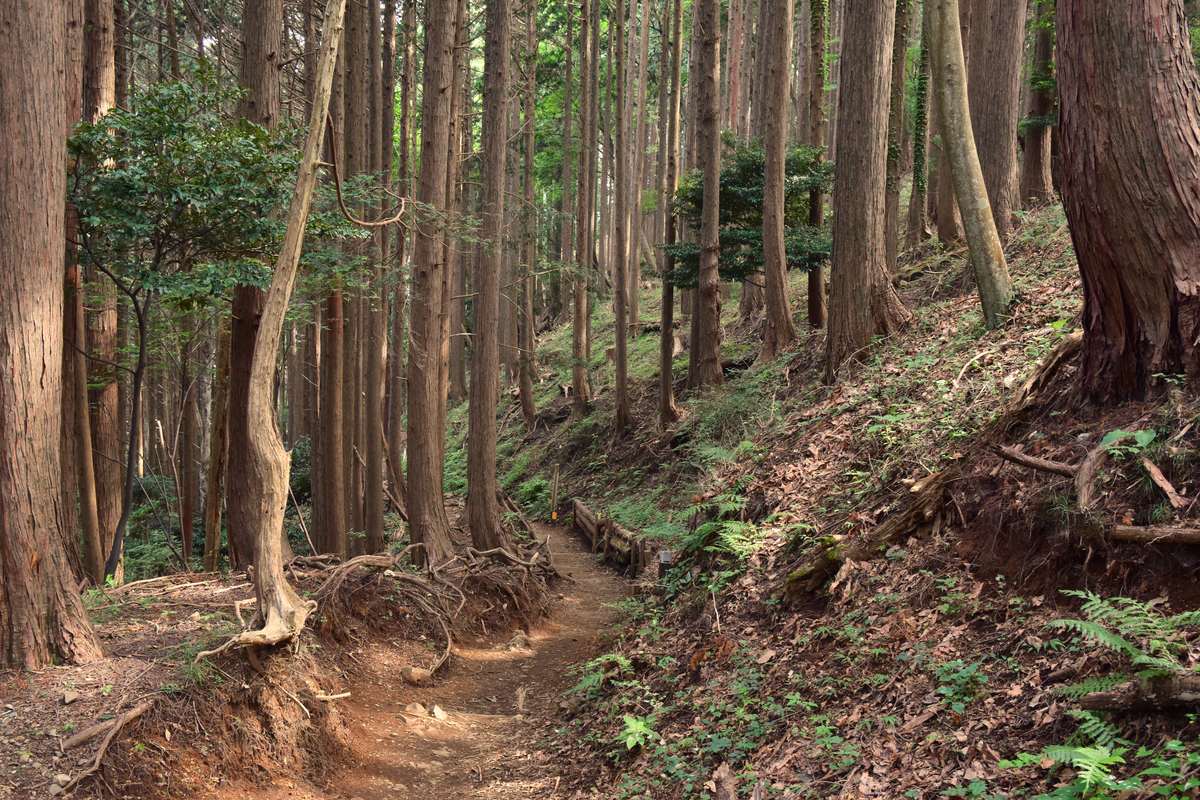
The part that matters for itinerary building is the lag. Tohoku's cedar peak sits in late March to early April — Hirosaki recorded 10,883 in March and another 9,158 in April, so the first third of April is still at full strength. Over the same April, Tokyo's cedar had dropped to 96.8. Tohoku's peak is everybody else's tail.
For blossom travellers, that lag has a specific and rather useful landing point. The normal opening date for Hirosaki Park is 22 April. Hirosaki measured 3,059 grains on 3 April; by 22 April it was down to 3.0. The most famous blossom site in Japan's heaviest cedar country opens right after the pollen finishes. If you want to understand how those opening dates are projected in the first place, we cover that separately in our guide to reading the blossom forecast and picking your week.
There is a mirror-image fact here too: Tohoku has essentially no cypress. Hirosaki and Sapporo both recorded a flat 0.0 for the season, and Ofunato only 253.8. The official handbook says cypress is planted everywhere except Hokkaido and Okinawa but is comparatively scarce from Tohoku through Hokuriku and concentrated from Tokai westward — and the measurements match the sentence exactly. If cypress is your specific trigger, Tohoku is the safe zone.
Kansai in April is 92% cypress
This is the collective blind spot. Practically all hay fever content about Japan is written about cedar — but in Kyoto in April, cedar is essentially finished and what is flying is cypress.
Kyoto City's 2026 cypress season totalled 4,746.0 grains per square centimetre, and April alone accounted for 92.0% of it (4,365). Cedar over the same April was 81.0, just 3.6% of its own season. Otsu in Shiga is more extreme still, at 9,294.2 for the season with 7,392.2 in April, and Yonago in Tottori put 84.2% of its cypress into April.
Map that onto a trip and it becomes obvious: Kyoto's Somei-Yoshino normal opening date is 26 March, with full bloom around the start of April — the entire blossom window sits on top of the cypress peak. Whatever is making your eyes stream in Kyoto, statistically it is not cedar.
It also explains the common experience of being fine in Tokyo and falling apart in Kyoto. That is not imagination; the two species have genuinely different geographies. The official handbook states that in regions from Kanto westward, cypress pollen can in some years exceed cedar.
And cypress is heading the wrong way. Forestry Agency figures show national cypress plantation area still rising between 2012 and 2017 (2.559 million to 2.595 million hectares), with the Chugoku region climbing from 157,000 hectares in 1970 to 447,000 in 2017 — a 185% increase, still rising in the most recent interval. That lines up precisely with Yonago's 84.2%. By contrast, cedar's national area fell just 2.0% between 2000 and 2017, from 4.528 to 4.438 million hectares.
The government is working on the source. The Ministry of Agriculture, Forestry and Fisheries maintains a plan to reduce pollen-producing cedar plantations (adopted 30 May 2023, amended 16 February 2026) targeting roughly a 20% reduction in both plantation area and pollen output by fiscal 2033, and roughly half by around fiscal 2053. Convert those to something a traveller can use and the answer is blunt: fiscal 2033 is seven years away and only delivers "about 20%," and the halving lands around 2053, twenty-seven years out. For anyone booking a flight now, source-reduction policy is background explaining why Japan has this much pollen — not advice.
A 4.33x spread inside one city
Tokyo runs its own monitoring network, separate from the national one: twelve stations, and it starts counting in early January, a month earlier than the Ministry of the Environment. The results published on 26 May 2026 are the single most useful table in this guide if your trip is Tokyo-based (8 of the 12 stations plus the city-wide average are excerpted below).
| Station | 2026 (cedar + cypress) | Past 10-yr average | Ratio to 10-yr avg | Cedar season end |
|---|---|---|---|---|
| Chiyoda | 5,291 | 5,363 | 1.0 | 9 May |
| Katsushika | 5,450 | 5,392 | 1.0 | 11 May |
| Suginami | 6,765 | 6,690 | 1.0 | 3 May |
| Kita | 5,583 | 5,432 | 1.0 | 27 April |
| Ota | 5,751 | 5,453 | 1.1 | 12 May |
| Hachioji (Mt. Takao) | 7,964 | 6,998 | 1.1 | 10 May |
| Tachikawa | 12,603 | 5,971 | 2.1 | 29 April |
| Ome | 22,937 | 11,645 | 2.0 | 6 May |
| City-wide average | 8,451 | 5,790 | 1.5 | — |
Two conclusions, both of which contradict what gets repeated.
First, Ome divided by Chiyoda is 4.33. Same city, same year, same method. Translated into travel terms: staying central does not protect you on the day you go to Mt. Takao, Okutama or Mitake. Hachioji, where Takao is, runs 1.5 times Chiyoda; Ome runs 4.33 times. If your itinerary includes a day hiking in Tokyo's western hills, that day is not remotely comparable to the day you spent shopping in Ginza.
Second, "Tokyo pollen surged 1.8x in 2026" is not true of central Tokyo. Chiyoda, Katsushika, Suginami and Kita all came in at a ratio of 1.0 against their own ten-year averages. The 1.8 figure is pulled up entirely by the western suburbs — Ome at 2.9 times the previous year, Machida 2.6, Kodaira 2.5, Tachikawa 2.1. The headline describes an arithmetic mean, not what anyone downtown experienced.
One more thing sitting in the same table: what actually surged in 2026 was cypress, not cedar. The city-wide cypress average was 3.6 times the previous year (659 to 2,366); cedar was only 1.5 times.
Hokkaido: birch beats the blossoms by ten days
If you have been told to go to Hokkaido because of your hay fever, half of that is right.
The right half: the Hokkaido Institute of Public Health states that unlike Honshu, cedar distribution in Hokkaido is limited to part of the southern island, and cedar pollinosis is not the problem there that it is on Honshu. Sapporo measured 51.0 grains of cedar in 2026 — one sixty-ninth of central Tokyo — and 0.0 cypress. If your allergy is specifically cedar or cypress, Hokkaido is the cleanest place in the country.
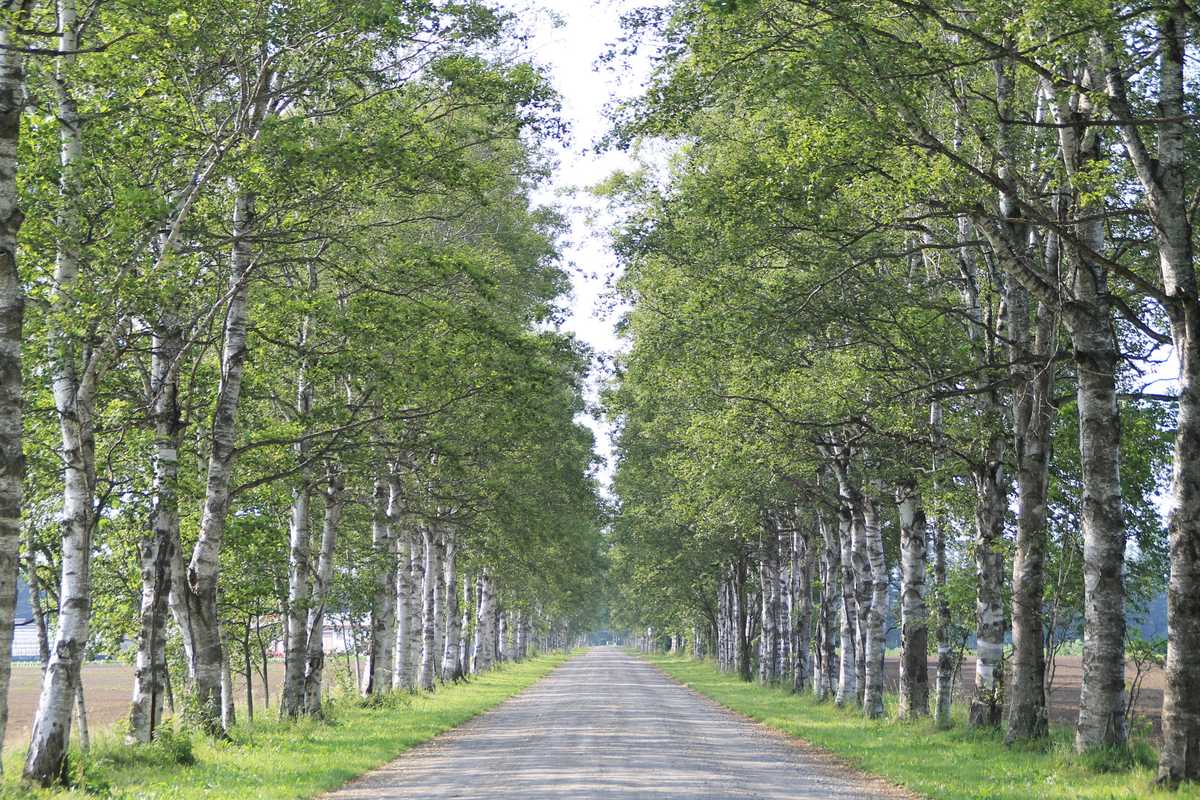
The half that inverts: Hokkaido runs on birch. The same institute states that grass pollinosis used to dominate but birch pollinosis is now the common one. And birch timing lands directly on blossom season.
| City | 2026 birch start date | 10-year mean (2016–2025) |
|---|---|---|
| Hakodate | 13 April | 24 April |
| Sapporo | 16 April | 21 April |
| Iwamizawa | 20 April | 27 April |
| Asahikawa | 20 April | 30 April |
| Obihiro | 17 April | 30 April |
| Kitami | 24 April | 2 May |
| Wakkanai | 13 April | 3 May |
Put the Sapporo row next to the Meteorological Agency's cherry blossom normal (1991–2020): Sapporo birch starts on a ten-year mean of 21 April; Sapporo blossom opens on a normal of 1 May. The pollen arrives ten days before the flowers. In 2026 birch actually started on 16 April, five days earlier than the mean. By the time blossom travellers land, birch has been flying for the better part of a fortnight.
⚠️ The "ten days earlier" conclusion applies to Sapporo only — do not extend it to the other cities in that table.
Two more Hokkaido-specific points that matter in practice.
Alder starts in March. The institute states that in Hokkaido alder disperses from March while snow is still on the ground, and that alder shares the birch family and cross-reactive antigens with birch — so people with birch pollinosis may react to it. The tree pollen season in Hokkaido effectively opens in March, not mid-April.
Birch pollinosis comes with a fruit problem. Both official sources flag oral allergy syndrome: people with birch pollinosis frequently react to rose-family fruit, with the handbook naming apples and peaches and the institute adding cherries. Those are Hokkaido's signature products. The handbook notes the same pattern elsewhere — tomatoes with cedar pollinosis, watermelon with ragweed.
Okinawa has never been measured
If you have heard that Okinawa has no cedar, strictly that is wrong.
Forestry Agency prefectural data (as of 31 March 2012, the most recent edition the agency has published) records 248 hectares of planted cedar in Okinawa and zero cypress. The Okinawa Prefectural Forest Resources Research Center describes the distribution itself: cedar wants fertile, well-aerated soil, such soils cover only a small area in Okinawa, and cultivation is therefore limited to valleys in the northern part of the main island.
More to the point, Okinawa was added to the Ministry of the Environment's cedar male-flower bud survey from fiscal 2025: the site is Yona in Kunigami Village, the estimate is 668 male flowers per square metre, and the remarks column reads "new." That is the lowest number in the country — Tokushima recorded 21,205 in the same survey, Osaka 16,925, Wakayama 16,575. Okinawa is around 4% of Osaka.
So what is the accurate version? Okinawa has never been included in the pollen dispersal monitoring network. The old national system described its own coverage as "nationwide (excluding Okinawa Prefecture)," and the current 27-site roster reaches no further south than Miyazaki and Yatsushiro in Kumamoto. Okinawa's dispersal figure is not low; it does not exist.
🔴 Going to Okinawa means giving up cherry blossoms. Okinawan blossom is Taiwan cherry (kanhizakura), flowering in January and February, not the Somei-Yoshino of late March and April. If blossoms are the reason you are coming to Japan, trading them away to avoid pollen is a real cost, not a footnote. If you want to make that trade, make Okinawa its own trip and plan the blossoms separately — our nationwide cherry blossom timing guide is the place to line those dates up.
Why Japan has no official pollen forecast
If you have tried to check Japanese pollen forecasts, you have probably noticed that every provider gives a different number and there is no official version to check them against. That is not a search failure. It is how the system is built, and there is a legal reason for it.
The Japan Meteorological Agency states in its own forecasting-licence FAQ that pollen dispersal and plant flowering are not atmospheric phenomena and are therefore outside the scope of forecasting business licensing.
In plain terms: issuing a weather forecast in Japan requires a licence from the agency under the Meteorological Service Act. Issuing a pollen forecast does not, because pollen is not legally weather. Every Japanese pollen forecast is therefore produced privately, with government supplying only inputs — the Ministry of the Environment provides bud surveys and measured counts, the Forestry Agency provides forest data, the Meteorological Agency provides meteorological data, and private operators do the forecasting. The agency's own published list of major pollen forecast providers includes tenki.jp and Weathernews. (We recommend tenki.jp in our Japan travel app rundown, and it is indeed on that official list.)
There is a wider pattern here. The agency's phenological observation programme has been cut back to six species and nine phenomena — hydrangea flowering, ginkgo colouring and leaf fall, plum flowering, maple colouring and leaf fall, cherry opening and full bloom, and pampas grass flowering — and pollen is not among them. We have documented the same structural gap twice before: plum has an opening date but no full-bloom observation, and maple has a colouring date but no peak-viewing observation. Pollen goes one step further — it is not classified as weather at all. The other thing floating in the same spring air runs the opposite way: Asian dust gets the agency's own numerical forecast, in English, as covered in the guide to air quality in Japan.
Something else worth knowing: the official pollen monitoring system was shut down five years ago. On 24 December 2021 the Ministry of the Environment announced the termination of its pollen monitoring system and the end of automated pollen counting. The system had run since fiscal 2002 with automatic counters at 120 sites nationwide, publishing dispersal conditions in real time. The stated reasons were two: private weather operators now run more monitoring points than the ministry did, and the ministry was pursuing an internal programme of "selection and concentration" in its own operations.
What replaced it? The ministry's current dispersal survey runs at 27 sites, where practising ENT physicians and university laboratories count pollen on glass slides under a microscope every day through the season (the Durham method). The published list of cooperating institutions includes an ENT allergy clinic in Sapporo, the Hirosaki University graduate school of medicine, and the Kyoto Prefectural University of Medicine. One hundred and twenty automated stations became twenty-seven manual microscope counts. For a country the world treats as the reference case for pollen allergy, that is the entire central-government observation programme. The old system's domain no longer even resolves in DNS.
Finally, the December headlines. On 23 December 2025 the Ministry of the Environment published its fiscal 2025 bud survey: Aomori at 44% and Iwate at 49%, the two lowest in the country; Hokkaido at 328%, the highest. Six months later the same ministry's measurements put Iwate first nationally, Aomori second, and Hokkaido last.
Three reasons, all officially documented. One: the denominator is each prefecture's own ten-year average, not a national one — the ministry states explicitly that 100% means equal to the past ten-year average, and Aomori's baseline is high enough that half of it is still enormous. Two: the Hokkaido 328% is calculated against a single year — the remarks column in the results table reads "one-year average," and of the nine prefectures above 200%, only Hokkaido carries that note. Three: the survey counts bud density in tree crowns, not total prefectural output; Hokkaido has 32,571 hectares of planted cedar, all of it in the far south, so density cannot become volume.
⚠️ These two datasets were never designed to be compared. The bud survey is an input private forecasters use, not a forecast. The two numbers answer different questions, and the one that helps you is the absolute count.
Which is why 2027 pollen levels cannot be predicted yet. The bud survey will not publish until November or December 2026, private forecasts follow in January 2027, and the ministry states plainly that pollen volume varies greatly year to year — the same location can differ five- to tenfold (Tokyo's own record: 13,260 in 2018 against 2,495 in 2020, a factor of 5.3). Trips get booked a year out; pollen volume is not knowable until January or February of that year. Plan on the geography and the timing instead — those do not move.
What actually works, by official numbers
Only measures with official figures behind them. Start with what you wear.
🔴 Wool attracts 9.8 times more pollen than cotton. The joint Ministry of the Environment and Ministry of Health briefing includes an adhesion-rate table for clothing fabrics, indexed to cotton at 100:
| Fabric | Pollen adhesion rate (cotton = 100) |
|---|---|
| Wool | 980 |
| Synthetic fibre | 180 |
| Silk | 150 |
| Cotton | 100 |
The official recommendation is to avoid wearing wool garments. The awkward part is that February to April in Japan is precisely wool coat season, so this advice runs against every packing instinct for the trip. The practical fix is small: make your outer layer synthetic or a shell jacket and keep wool as an inner insulating layer. Going from 980 to 180 is the single highest-return action in this guide, and it costs one garment swap. (For how to layer by month and latitude in the first place, see our month-by-month Japan packing guide.) The same briefing also advises minimising exposed skin.
Masks and glasses, official figures. Compared with wearing nothing, the handbook reports that an ordinary mask reduces pollen by about 70% and a pollen-specific mask by about 84%; ordinary glasses cut pollen reaching the eyes by about 40% and pollen-specific glasses with side shields by about 65%. The absolute counts from the same experiment: with no mask and no glasses, 1,848 grains in the nasal cavity and 791 on the conjunctiva; with an ordinary mask and ordinary glasses, 537 and 460.
An easily missed one: officials consider that wearing contact lenses during pollen season may worsen symptoms, with the handbook stating that lens irritation can aggravate pollen-induced allergic conjunctivitis and that switching to glasses is preferable.
Timing. Officials state that pollen counts peak around midday and again in the late afternoon, and that three weather patterns push counts higher: sunny warm days, dry windy days, and the day after rain. That last one is the most actionable for itinerary building — do not schedule your outdoor centrepiece for the day after rain. Other official advice includes opening windows only narrowly with net curtains drawn, and not drying laundry or futons outdoors.
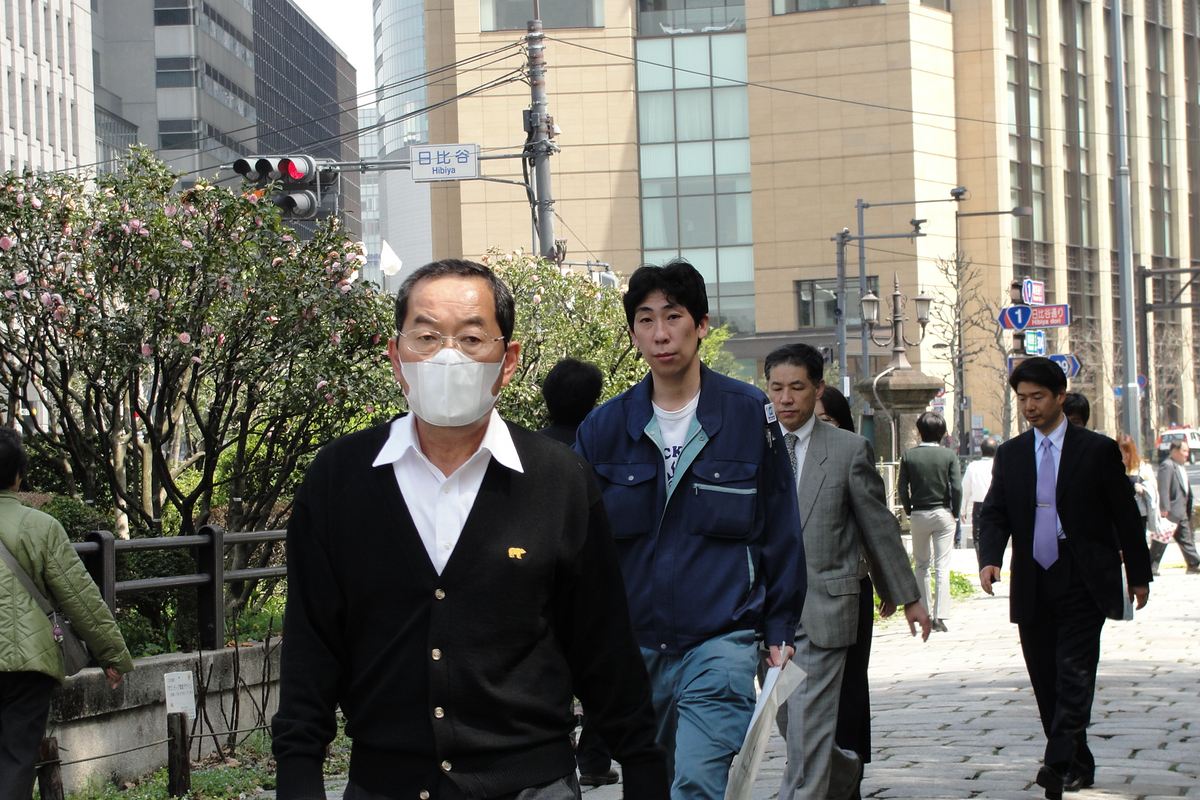
🔴 The most counter-intuitive thing about buying masks in Japan: the box marked "medical" or "surgical" is barred from claiming pollen performance.
Japan does have a national standard. JIS T 9001 (performance requirements and test methods for medical and general-use masks, enacted 16 June 2021, never revised) defines exactly two categories: medical masks and general-use masks. Per the official commentary from the standard's drafting body, the Japan Hygiene Products Industry Association, one of the four performance items available to general-use masks is a pollen filtration efficiency test with a threshold of 95%, and any function not satisfied may not be advertised. The medical mask requirements list VFE, BFE, PFE and various safety items — with no pollen line at all.
The association's conformity-assessment Q&A, July 2026 edition, answers it directly: pollen is not within the scope of medical masks so it cannot be labelled, and a manufacturer wanting to state it must obtain the general-use mask JIS. Which means reaching for the "medical" or "surgical" box because it sounds more serious lands you on the one category legally prohibited from making the claim you are shopping for.
So what should you read? Under the association's labelling and advertising guideline, the only permitted phrasing for a passed pollen filtration test is "effective against pollen", with numbers confined to a specified format box and decimals truncated to whole numbers. A separate voluntary standard enacted on 14 February 2026 covers masks that make no filtration claim: they may print "for the pollen season" or "in pollen season" as a use scene, but may not claim an effect. Two near-identical phrases, opposite legal meaning.
The same guideline explicitly bans a list of phrasings including "prevents hay fever," "pollen-cut mask," "completely blocks" and "100% guard," and requires the disclaimer that masks do not completely prevent infection or entry. This is not theoretical: on 4 July 2019 the Consumer Affairs Agency issued action orders against four companies selling photocatalytic masks (DR.C Ikuyaku, Iris Ohyama, Taisho Pharmaceutical and Tamagawa Eizai) under the Act against Unjustifiable Premiums and Misleading Representations, for misleading superiority claims. One package read "the mask that turns pollen into water," and the agency found none of the substantiating material submitted amounted to reasonable grounds. ⚠️ That said, this was a single 2019 event — a review of six fiscal years of the agency's releases from 2021 to 2026 found no further mask-related orders, so do not read it as a pattern of frequent enforcement.
⚠️ One final and important boundary: JIS conformity assessment and the various industry marks are voluntary private schemes, not government certification. The association states plainly that this is not a JIS mark display scheme, that the scheme is one it operates voluntarily, and that products can be sold without assessment. When the Ministry of Health circulated the labelling guideline, its own covering note described it as information provided for reference — reference, not regulation. The other mark often used as a selling point, JAPOC certification (covering air purifiers, masks, glasses, window screens, clothing and ventilation fans), is likewise an industry body scheme. There is no such thing as a Japanese government-certified pollen mask. (We were also unable to obtain the JIS text itself — the association states that JIS rules prevent it publishing the contents, so the performance requirements above come from the drafting body's official commentary rather than the standard.)
Pharmacy categories and the May 2026 rule change
⚠️ What this section is: an explanation of how Japan's sales system works and what you will encounter in a shop. It contains no medical or medication advice and recommends nothing. Ask a doctor or a pharmacist about treatment.
Start with the good news: Japanese law imposes no nationality or identity requirement on foreign visitors buying over-the-counter medicine. A full-text search of the current Pharmaceuticals and Medical Devices Act returns zero hits for "nationality" and zero for "foreigner," and the same for "visiting Japan" in the enforcement regulations. The legally required pre-sale checks for Class 1 products cover age, other medications in use, sex, symptoms, consultation history, pregnancy and breastfeeding — not name, address, identity document or nationality.
Japanese OTC medicines sit in categories that determine who may sell them and whether the shop owes you an explanation:
| Category | Who may sell | Duty to explain |
|---|---|---|
| Guidance-required medicines | Pharmacist | Legal duty (plus instruction) |
| Class 1 | Pharmacist | Legal duty (must be in writing) |
| Class 2 | Pharmacist or registered seller | Duty to endeavour |
| Class 3 | Pharmacist or registered seller | None proactively (must answer if asked) |
⚠️ Two details that get misreported. First, the written information duty for Class 1 is a legal obligation, but the law does not require it to happen face to face — the face-to-face requirement belongs to guidance-required medicines, a different category. Second, Class 1 has a lawful waiver: Article 36-10(6) provides that the duty does not apply where the purchaser states that no explanation is needed, limited to cases where appropriate use can be assumed. Guidance-required medicines have no equivalent.
Where do hay fever products sit? Verification for this guide confirmed that the six commonly cited Japanese OTC hay fever products — Allegra FX, Alesion 20, Claritin EX, New Contac Bien Z, Stonarini Z Gel and Allerubi — are all currently Class 2. Which means the widespread idea that you need a pharmacist to buy hay fever medicine in Japan does not hold: a registered seller can sell them, and the explanation is only a duty to endeavour. This category is not stable, though. Claritin EX moved twice in six years — up from guidance-required to Class 1 in 2020, then down to Class 2 on 16 January 2021, with the manufacturer noting at the time that the change made it purchasable at shops and hours with no pharmacist present.
🚨 And one of the six is about to disappear. Taisho Pharmaceutical announced on 30 June 2026 that it will end sales of Claritin EX at the end of September 2026, with future plans under consideration by the brand owner, Bayer Yakuhin. This guide is written for people travelling in spring 2027, so it should be said clearly: that product may well not be on the shelf by then.
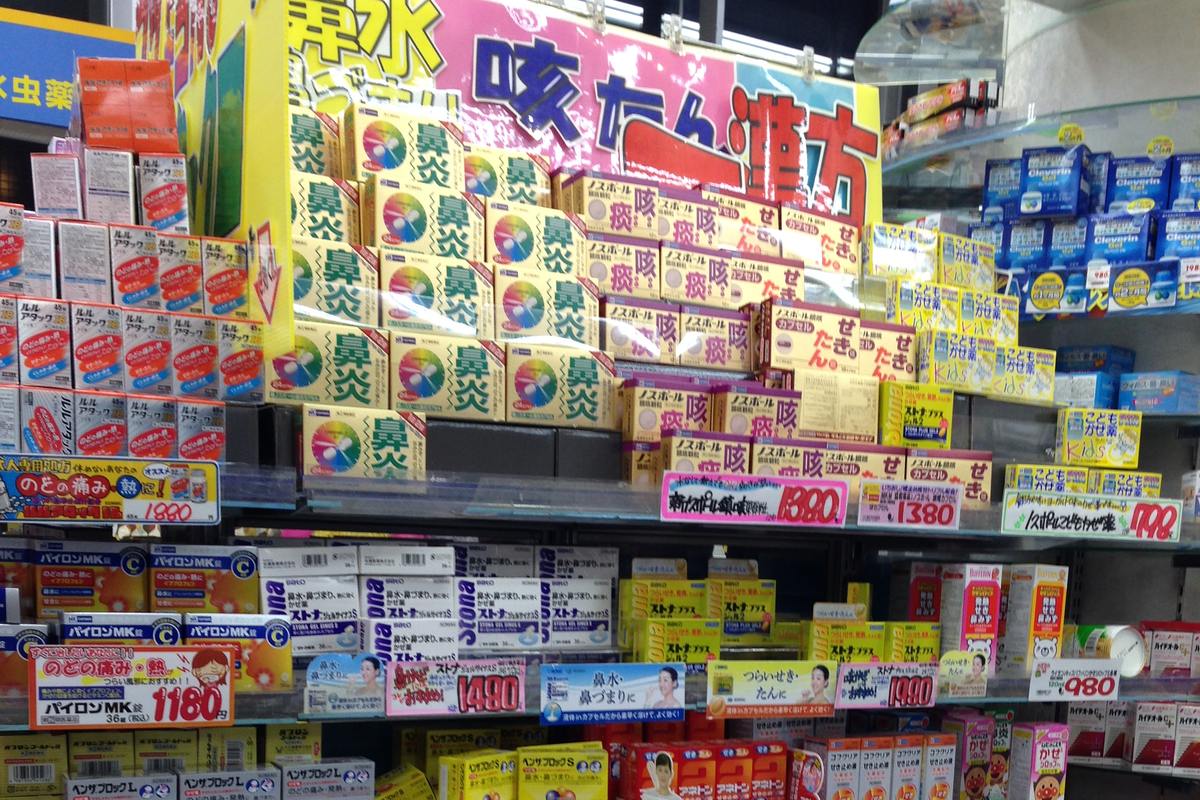
🔴 From 1 May 2026, stocking up on nasal medicines in Japan triggers questions. A new Article 36-11 of the Pharmaceuticals and Medical Devices Act raised the former ministerial-ordinance category of medicines with abuse potential into statute as "designated abuse-prevention medicines" and added ingredients. The one that matters here is pseudoephedrine: ministry materials count 75 oral nasal-medicine products containing it inside the restriction (plus 20 containing methylephedrine). External preparations are explicitly excluded.
The mechanics: ordinance and notification define a small package as up to five days' supply, or seven days for cold remedies, analgesics and oral nasal medicines; anything larger counts as a large package. When someone buys a large package or multiple units, the shop is legally required to verify age (set at 18 in the ordinance) and to confirm two things: whether you have bought comparable products at other shops, and your reason for buying above the quantity threshold. Multiple or large packages may not be sold to under-18s.
In traveller terms: buying a whole trip's worth of strong nasal medicine in one go now means the assistant is legally obliged to ask you those questions. It is not the shop being difficult, and it is not aimed at foreigners — it applies to everyone.
The same ingredient is regulated from the opposite direction, which closes a neat loop: our guide to bringing your own medication into Japan covers the quantity limits that apply when you bring your own. What Japanese law restricts is a preparation containing more than 10% ephedrine-type ingredients, which over-the-counter allergy medicine does not reach — the rule that will actually stop you is the purchase limit in Japanese stores.
For readers flying home to Taiwan, the return leg has its own limits: the current customs regulation (amended 30 January 2026, effective 1 February 2026) allows up to 12 bottles/boxes of any single non-prescription medicine and 36 in total, with prescription medicines capped at two months' supply without a prescription document and six months with one. One note in that schedule matters specifically for hay fever products: a medicine classed as prescription-only in Taiwan but sold over the counter abroad is subject to the non-prescription limits, not the prescription ones. The full schedule and what happens if you exceed it are in our Taiwan customs and quarantine guide; we do not repeat the table here.
One last official yardstick. The handbook notes that pollen season overlaps with cold season, but that hay fever usually involves itchy eyes and, unlike a cold, does not produce a high fever. That is a rule of thumb published by the government, not a diagnosis — if you are unsure, see a doctor.
So where should you go: the trade-offs
Compressed into decisions. No "it depends on your needs" — here is the position.
If your allergy is specifically cedar or cypress and you know that: Hokkaido is the cleanest place in Japan (Sapporo cedar 51.0, cypress 0.0), and Sapporo's blossom season around 1 May falls after Honshu's pollen season has ended. This is the one combination where seeing blossoms and avoiding pollen genuinely coexist. The condition is that you actually know your trigger — if you do not, birch cuts straight through this plan.
If you do not know your trigger and blossoms are non-negotiable: take Kyushu in April. Fukuoka recorded 2.2 grains of cedar across the entire month, Yatsushiro 0.6, Miyazaki 6.2, with cypress in the low hundreds — the cleanest region in Japan for that month, and the late blossoms and major sites are all still there. That is far more effective than going to Kyoto with a good mask. Kyoto's April cypress was 4,365.
If your trip is already fixed on Kanto: weight it toward central Tokyo rather than the western hills. Ome is 4.33 times Chiyoda; Hachioji, where Mt. Takao is, is 1.5 times. If you had a Takao or Okutama day planned, moving it to museums and indoor sights downtown buys you a bigger difference than any equipment will.
If your trip is already fixed on Kansai: understand that you are dealing with cypress, not cedar, and keep your outdoor centrepiece off sunny windy days and off the day after rain. Kyoto's cedar is down to 3.6% of its season by April, so "wait until cedar season is over and then do Kyoto" is a plan that delivers you into the cypress peak instead.
If you want Hirosaki's blossoms: that is actually one of the few pollen-friendly windows in the region. Hirosaki Park's normal opening date is 22 April, and Hirosaki's cedar reading on 22 April was 3.0 — in the heart of Japan's heaviest cedar country, the blossoms open right after the pollen finishes.
If you are willing to skip blossoms: Okinawa is the one place never included in the monitoring network. But price the trade honestly — Okinawan blossom is Taiwan cherry in January and February, and you will miss Honshu's season entirely. If you want it, make it a separate trip.
Wherever you go, do these three things: swap the outer layer out of wool (adhesion 980 versus 180 for synthetics), avoid outdoor commitments around midday and late afternoon, and keep the day after rain indoors. All three are free, and all three have official numbers behind them.
Whether 2027 is a heavy pollen year is not knowable now, including by the Japanese government. The bud survey publishes in November or December 2026 and private forecasts in January 2027 — and even then, what you get is a multiplier against each prefecture's own ten-year average, which helps your planning far less than the geography and timing above. As for source reduction, the official targets are roughly 20% by fiscal 2033 and roughly half by around fiscal 2053. That is not an answer for anyone booking a flight this year.
Frequently Asked Questions
- Q1:When exactly is hay fever season in Japan? Is it March and April?
- The official line is February to April, not March to April, and that one-month gap catches a lot of people out. The Ministry of the Environment and the Ministry of Health, Labour and Welfare state in their joint pollen briefing that cedar pollen disperses in roughly February to April. The 2026 measured data backs this up hardest in western Japan: Ube in Yamaguchi Prefecture released 58.0% of its entire season in February alone, Shizuoka City 51.3%, and even Chiyoda Ward in central Tokyo was already at 25.5% by the end of February. So arriving in mid-February on the assumption that the blossoms have not opened yet and therefore the pollen has not started is exactly wrong along the Tokai and Sanyo coasts. The other end is just as misunderstood. Tokyo Metropolitan Government recorded 2026 cedar season end dates between 22 April and 12 May across its twelve stations, and cypress end dates between 6 and 12 May. That means Golden Week still falls inside pollen season in Tokyo. The genuinely clear month is not April; it is late May onward.
- Q2:Which part of Japan has the least pollen?
- By absolute measured count, the lowest of the 27 national monitoring sites in 2026 was Miki Town in Kagawa Prefecture, on the Seto Inland Sea side of Shikoku: 672.8 for cedar plus 533.9 for cypress, a combined 1,206.7 grains per square centimetre, or 23% of central Tokyo. Forestry Agency plantation data points the same way — Kagawa has just 1,909 hectares of planted cedar, the smallest of any prefecture outside Okinawa. But the more useful answer depends on your month. If you are travelling in April, Kyushu is cleaner by an order of magnitude: Fukuoka City recorded 2.2 grains of cedar for the whole of April, Yatsushiro in Kumamoto 0.6, Miyazaki 6.2, with cypress also in the low hundreds. Kyoto in the same April recorded 4,365 for cypress. So if what you want is late blossoms in April without a wrecked face, the answer is Kyushu, not Kansai. Each prefecture has exactly one monitoring site, so "Kagawa 1,206.7" means one glass slide in Miki Town, not a prefectural average.
- Q3:Is Hokkaido a safe haven for hay fever sufferers?
- Half true, and the half that is not true is the half that hits cherry blossom travellers. The true half: Hokkaido has almost no cedar or cypress. Sapporo measured 51.0 grains of cedar per square centimetre in 2026, one sixty-ninth of central Tokyo, with cypress at a flat 0.0. The false half is timing. Hokkaido runs on birch, and the Hokkaido Institute of Public Health publishes a ten-year mean (2016 to 2025) first-dispersal date for Sapporo birch of 21 April. The Japan Meteorological Agency normal for Sapporo cherry blossom opening is 1 May. Birch pollen has been flying for about ten days by the time blossom travellers arrive, and in 2026 it actually started on 16 April, five days earlier still. So the correct framing is conditional: if you know your allergy is specifically cedar or cypress, Hokkaido is the cleanest place in Japan. If you do not know what you react to, treating it as a refuge is a gamble. One more thing the institute flags: birch pollen allergy frequently comes with oral allergy syndrome to rose-family fruit, specifically apples, peaches and cherries. Those happen to be exactly what Hokkaido is famous for.
- Q4:Does Okinawa have no cedar pollen at all?
- Okinawa having no cedar is one of the most repeated claims about Japanese hay fever, and strictly speaking it is wrong. Forestry Agency prefectural data records 248 hectares of planted cedar in Okinawa, all in the valleys of the northern main island, and the Okinawa Prefectural Forest Resources Research Center says the same thing in its own words: the soils cedar likes cover only a small area there, so cultivation is limited to the valleys of the northern region. From fiscal year 2025 the Ministry of the Environment has also added Okinawa to its cedar male-flower bud survey, at Yona in Kunigami Village, with an estimated 668 male flowers per square metre and a note reading "new." That is the lowest figure in the country, roughly 4% of Osaka. The claim that actually holds, and is more useful, is a different one: Okinawa has never been part of the pollen dispersal monitoring network at all. The old Ministry of the Environment system stated its coverage as "nationwide (excluding Okinawa Prefecture)," and the current 27-site list stops at Miyazaki and Yatsushiro. Okinawa is not measured as low; it is simply not measured. And one thing has to be said plainly before anyone books it: going to Okinawa means giving up cherry blossoms. Okinawan blossom is Taiwan cherry, it flowers in January and February, and it is not the Somei-Yoshino that the entire cherry blossom season is built around.
- Q5:Why does every Japanese pollen forecast give a different number? Is there an official one?
- There is no official one, and there is a legal reason for that. The Japan Meteorological Agency states in its own licensing FAQ that pollen dispersal and plant flowering are not atmospheric phenomena, and are therefore outside the scope of forecasting business licensing. Issuing a weather forecast in Japan requires a licence from the agency under the Meteorological Service Act. Issuing a pollen forecast does not, because pollen is not legally weather. Every pollen forecast in Japan is therefore produced by a private operator, with government supplying only the raw inputs: the Ministry of the Environment provides male-flower bud surveys and measured dispersal counts, the Forestry Agency provides forest resource data, and the Meteorological Agency provides meteorological data. Disagreement between providers is structural, not a sign that you found a bad source. The same gap shows up in the phenological observation programme, which have been cut back to six species and nine phenomena and contain no pollen entry at all. It is the third instance of a pattern this site has documented: plum has an opening date but no full-bloom observation, maple has a colouring date but no peak-viewing observation, and pollen is not even classified as weather.
- Q6:Every December there are headlines saying next spring will have X times more pollen. Can I plan around that?
- Almost never, and the evidence that demolishes it comes from the government itself. On 23 December 2025 the Ministry of the Environment published its fiscal 2025 cedar male-flower bud survey: Aomori at 44% and Iwate at 49% of their own ten-year averages, the two lowest in the country, and Hokkaido at 328%, the highest. Six months later the same ministry measured the actual 2026 season: Iwate first in the country, Aomori second, Hokkaido dead last. The order almost inverted. Three reasons, all documented officially. First, the denominator is that prefecture’s own ten-year average, not a national one — the ministry states explicitly that 100% means the same as the past ten-year average. Aomori’s baseline is high, so half of it is still a lot. Second, the Hokkaido figure of 328% is calculated against a single year: the survey table carries a note reading "one-year average" in the Hokkaido row, and of the nine prefectures above 200%, only Hokkaido has that note. Third, the survey counts flower bud density in tree crowns, not how much pollen a prefecture will release. Hokkaido has only 32,571 hectares of planted cedar and all of it sits in the far south of the island, so density cannot translate into volume. It is worth being fair here: the two datasets were never designed to be compared. The bud survey is an input that private forecasters use, not a forecast. The practical rule is simply to read absolute counts in grains per square centimetre and ignore the multipliers.
- Q7:On Japanese masks, does "for the pollen season" printed on the box mean it filters pollen?
- No, and by the industry rules that phrase is specifically not allowed to mean anything. The Japan Hygiene Products Industry Association standard enacted on 14 February 2026 permits masks that do not claim filtration performance to print "for the pollen season" or "in pollen season" as a use-scene description, while stating in the same clause that they cannot claim an effect. The wording that does mean something is different: "effective against pollen." Under JIS T 9001, one of the four performance items available to general-use masks is a pollen particle filtration efficiency test with a threshold of 95%, and any item not passed may not be advertised. Two phrases that look nearly identical, opposite legal meaning. There is a more counter-intuitive trap here too. Reaching for the box marked "medical" or "surgical" on the assumption that it must be the more serious product lands you on exactly the category that is barred from making pollen claims. The association’s conformity-assessment Q&A, July 2026 edition, answers this directly: pollen is not within the scope of medical masks so it cannot be labelled, and anyone wanting to state it must obtain the general-use mask JIS. Last and most important: the JIS conformity assessment and the various industry marks are voluntary private schemes, not government certification. The association itself states that this is not a JIS mark display scheme and that products can be sold without assessment. There is no such thing as a Japanese government-certified pollen mask.
Read next
Japan Cherry Blossom Forecast 2027: Which Week to Fly
Peak sakura lasts about 7 days and shifts a week each year. Using historical-average bloom dates and how to read the annual forecast: which week is safest, the one week to bet, and where to chase a late bloom.
What to Wear in Japan 2026: 4 Regions × 4 Seasons Packing Guide
A 4,500-word pillar: climate physics, region-by-region clothing strategy, four-season packing lists.
Japan to Taiwan Customs 2026: What You Can Bring Back
Japan is African swine fever free — and it will not save your pork jerky. Taiwan bans cloven-hoofed meat from swine fever zones too. A decision table covering the NT$35,000 allowance, the 6 kg cap, the fresh-fruit ban, and the fine everyone quotes wrong.
📊 See the 2026 Price Index (JR Pass, DPA, eSIM, Airport Transport) →