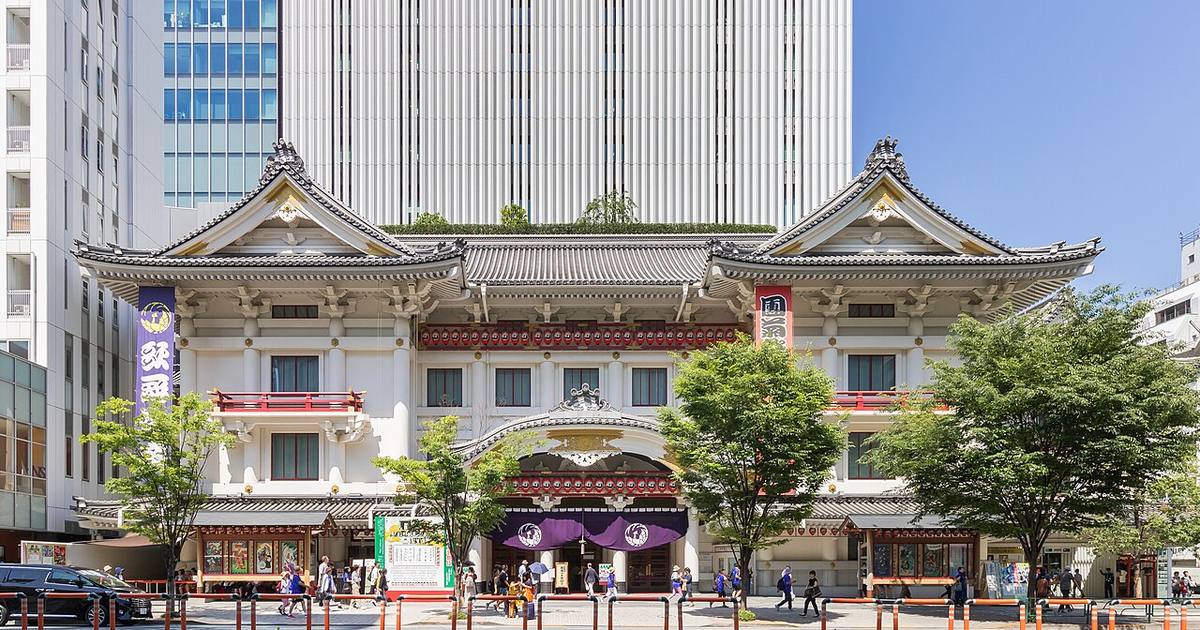
The single-act seats on the fourth floor of the Kabukiza come in two versions, and their rules contradict each other at almost every point. One goes on sale at noon the day before, online, by credit card, four tickets per person. The other goes on sale at 10am on the day, at a basement window, in cash, one ticket per person. Confuse them and the consequence is not paying a bit more — it is standing outside. This guide lays both systems out side by side, then covers three things that decide how you buy and where you sit: that anyone aged 30 or under can buy any seat grade at half price on the day with a passport as ID, that the second-floor dining room is no longer a restaurant but a room for eating food you brought yourself, and that Osaka Shochikuza closed permanently enough in May 2026 that Shochiku now describes itself as running three theatres. Every price below is tagged with the exact month it applies to, because the Kabukiza does not have a standing price list at all.
- Two single-act systems. Reserved: noon the day before, online, card, up to 4 tickets. Unreserved: 10am on the day, box office, cash, one ticket only
- Prices are per act and reset monthly. August 2026 ran ¥2,000–3,500 across six acts, plus a ¥110 system fee on reserved seats
- Under 30? Skip the cheap seat. Same-day half price on every grade, passport accepted as ID; September 2026's ¥18,000 first-grade seat becomes ¥9,000
- The fourth floor has no shop and no restaurant, and you cannot go down to floors one to three. Buy food before you go up
- Captions are cash-only and cannot be pre-booked; the earphone guide is Japanese commentary, not an English one
📖 Contents
- Two single-act systems that contradict each other
- Buying from abroad: the English page and the 3D Secure trap
- What a single act actually costs
- What the cheap seat costs you
- Under 30: your passport is worth half the ticket
- Which ticket should you buy
- Regular seats: there is no standard price
- When tickets go on sale (it is not the 12th)
- Intervals and food: the room that stopped being a restaurant
- Following the play: guides and captions
- Dress, phones, and the calls from the back
- What you can see without a ticket
- Where kabuki is playing right now
- Fitting the Kabukiza into a Tokyo itinerary
- Frequently Asked Questions
Two single-act systems that contradict each other
The hitomakumi or single-act seat is kabuki's genuinely low-barrier entry point: instead of committing to a full programme of three to four and a half hours, you buy one act, watch it, and leave. It is not one ticket type but two, sold under two entirely separate systems.
| 4F reserved (shitei-seki) | 4F unreserved (jiyu-seki) | |
|---|---|---|
| On sale from | 12:00 noon, the day before | 10:00 on the day itself |
| Where | Online only, credit card, via e-tix.jp/shochiku_makumi | Box office only, cash — basement level 2 of the theatre |
| Maximum per person | 4 tickets | 1 ticket |
| Queueing | None | Required — the official text asks you to line up before sales open |
| Seats available | About 70 | About 20 |
| Fees | ¥110 system fee per ticket | None; cash at face value |
| Admission | QR code emailed after purchase (phone screen or A4 printout) | Paper ticket |
| Cards accepted | VISA / MASTER / JCB / AMEX, 3D Secure mandatory | — |
| Usable with a Ticket Web Shochiku account | No — the official page states these cannot be bought by phone, through Ticket Web Shochiku, or at the box office | — |
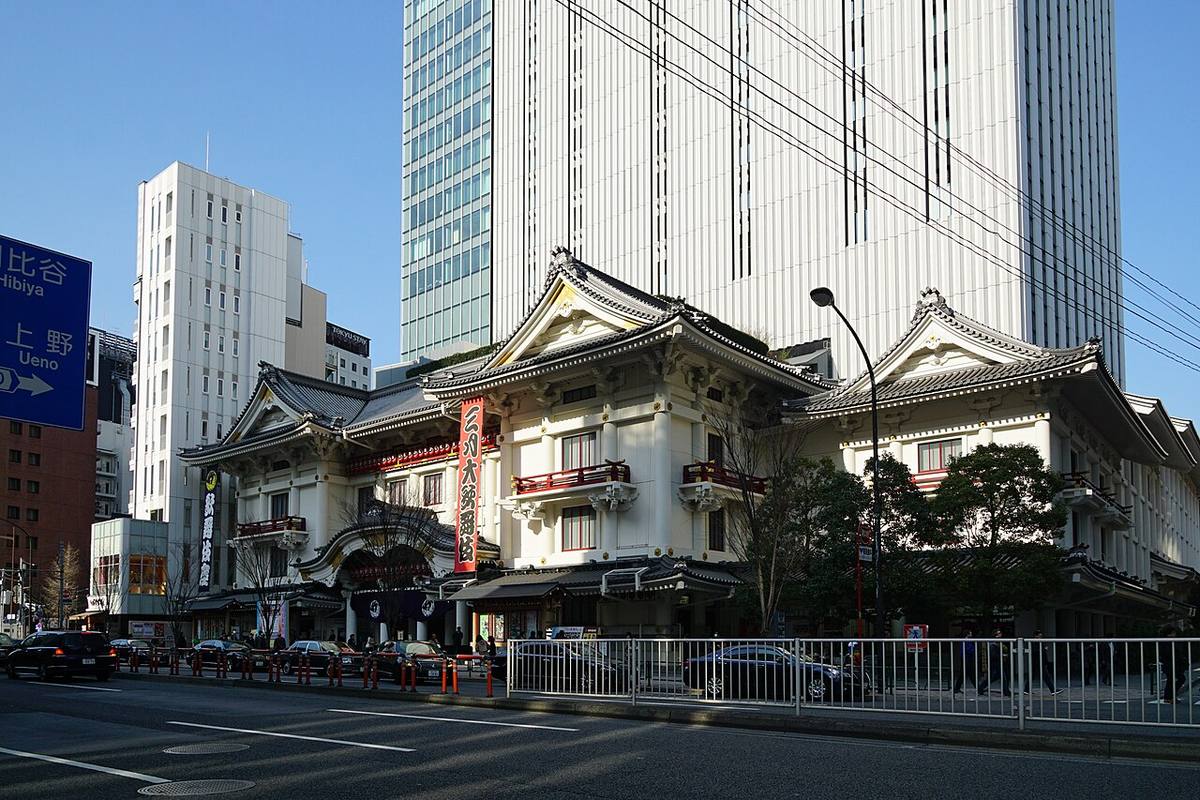
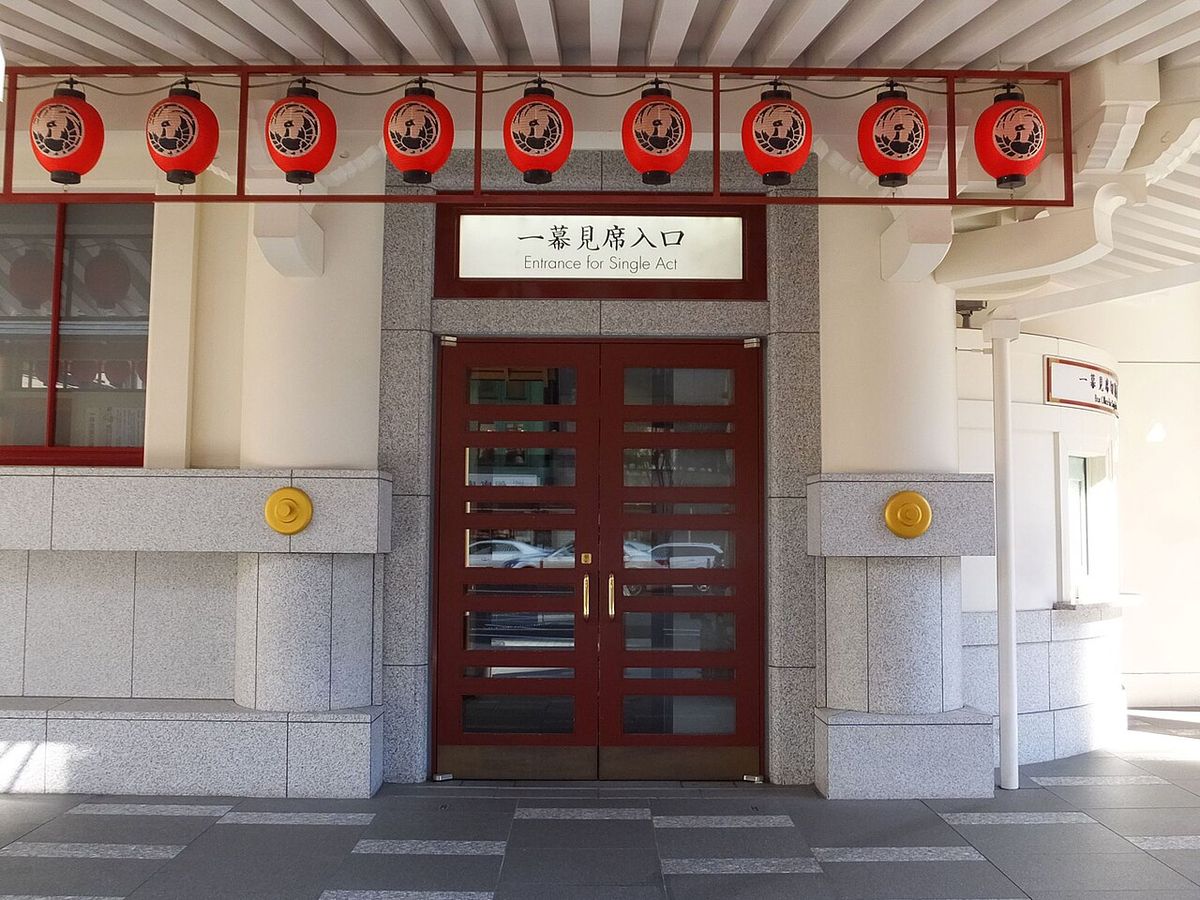
Both share a set of conditions that are easy to skim past and expensive to discover on the day. Sales stop when the allocated number of tickets is gone. Changes and refunds are not possible after purchase. Each act is completely cleared, so buying two consecutive acts still means leaving your seat and re-entering. You watch from the fourth floor and cannot enter floors one to three. A ticket is required from age four. The dedicated entrance is on the left side of the front facade, not the main doors. And Shochiku warns in its own words that the fourth floor is the highest and most distant level of the theatre, so part of the stage and the hanamichi may not be visible, with seat spacing narrower than on the first and second floors.
Two quirks worth knowing. First, the August 2026 e-tix page carried a notice that in that month there were time slots when audiences could not be shown to their seats for staging reasons — so "every act is available" is the principle, not a guarantee, and it varies by month. Second, Kabukiza has buy-out days every month when regular tickets are not sold to the public, but single-act seats usually still are. In August 2026 that was the 21st for the first part; in September the 25th for the matinee and the 5th and 21st for the evening. It is a counter-intuitive gap that works in a walk-up visitor's favour.
Buying from abroad: the English page and the 3D Secure trap
Here is the practical good news for visitors: the reserved single-act system has a fully functional English-language official sales page, it takes foreign-issued VISA, Mastercard, JCB and AMEX, and it does not require a Japanese account. For most overseas visitors this is by some distance the easiest legitimate way to see kabuki at the Kabukiza.
And here is the trap that will cost you the ticket. The official English page states that enrolment in 3D Secure 2 is mandatory, and that payment will not be allowed with a card that is not registered for it. If your bank has not enabled online transaction verification — the SMS one-time code or in-app approval step — the transaction simply fails, at noon, while roughly seventy seats disappear. Call your card issuer before you fly. It takes five minutes and there is no workaround at the payment screen.
Regular seats are a different story. Ticket Web Shochiku is a Japanese-language site requiring registration, and this article did not test whether an overseas card and overseas address can complete that registration, so it makes no promise either way. What is certain is that the box office and the U30 scheme need no online account at all — if you are already in Tokyo, walking to Higashi-Ginza is the reliable path.
There is a third route for regular seats, and it closes exactly the gap the paragraph above leaves open: GetYourGuide lists a Kabukiza regular-seat ticket whose named supplier is Shochiku itself (the activity provider field reads Shochiku Co., Ltd. Kabukiza Theatre Japan, and the listing is flagged as an official ticket). English interface, overseas cards accepted, and the captioning tablet is bundled into the price — which, as the next section explains, is otherwise cash-only and cannot be reserved in advance. See the Kabukiza regular seat plus captioning option on GetYourGuide.
Three things to know before you book, because this is where people buy the wrong thing. First, these are not single-act seats. You are buying a full part of the programme, in one of three grades — First Class 1st floor, First Class 2nd floor, or Second Class A 1st floor — so the cheap route the first half of this article describes is not on that page. Second, you cannot choose your seat. The listing states plainly that seats cannot be specified for GetYourGuide reservations and are allocated first-come, first-served at the moment your booking completes, on the same queue as domestic sales. Third, compare the price on the page against the official table in the section above — this article quotes no figure, because the programme changes monthly, the price table changes with it, and exchange rates drift. Two more rules: children under four are not admitted, and cancellation closes two days before the performance.
Also worth flagging: Shochiku's own traditional-Chinese pages carry outdated prices (they still list an English audio guide at 1,000 yen and 800 yen per act, which does not match the current published figures). If you land on a Shochiku page in a language other than Japanese, treat the prices as historical and cross-check the operator pages linked in this guide.
What a single act actually costs
The figure you probably have in mind — somewhere around 1,000 to 1,500 yen — is no longer accurate. Here is the official act-by-act table for the August 2026 programme, straight from the e-tix sales page:
| Act | Curtain | Running time | Single-act price (incl. tax) |
|---|---|---|---|
| Kaidan Botan Doro, Act 1 | 11:00 | approx. 76 min | ¥3,000 |
| Kaidan Botan Doro, Act 2 | approx. 12:51 | approx. 77 min | ¥2,500 |
| Rakuda | 15:10 | approx. 50 min | ¥2,000 |
| Kijin no Omatsu | approx. 16:25 | approx. 90 min | ¥3,500 |
| Maizuru Setsugetsuka | 19:00 | approx. 32 min | ¥2,500 |
| Yuki / Zangetsu | approx. 20:02 | approx. 28 min | ¥3,000 |
Two things fall straight out of that table. Price is not proportional to length — the 32-minute dance piece costs 500 yen more than the 50-minute comedy — because pricing reflects the weight and draw of the piece, not the clock. And the entire table is replaced next month, when a new programme with different acts arrives. Any article that gives you a single fixed figure for a Kabukiza single-act ticket is describing one month of one year.
For budgeting purposes, remember the band rather than the number: roughly ¥2,000–3,500 per act, plus ¥110 if you buy the reserved version. Then open the e-tix page for your own month a few weeks before you travel.
What the cheap seat costs you
Cheap is real. Comfortable is not part of the deal, and the trade-offs deserve to be listed in full rather than buried.
- Nothing to eat or drink up there. The official line is that there is no shop and no restaurant on the fourth floor, and that you cannot enter floors one to three. Every bento counter, tea room and drink corner is out of reach. Buy in the basement before you go up.
- Complete turnover between acts. Even with two consecutive acts booked, you leave the auditorium in between.
- Sightlines are officially disclaimed. Shochiku states that part of the stage and the hanamichi may not be visible from the fourth floor. Since the hanamichi — the raised walkway through the audience, 18.18 metres of it — is one of kabuki's signature devices, that matters more on a first visit than it sounds.
- Narrower seat spacing than the first and second floors, in the theatre's own words.
- Late arrivals may wait. The English official text says that if you arrive after the performance begins, staff may not be able to show you to your seat for a while for staging reasons.
- No refunds, no changes, and the theatre's one-hour parking discount explicitly does not apply to single-act ticket holders.
- Sort your luggage downstairs. Lockers are ¥100 for the small size and ¥200 for the large; basement level 1 has 28 large and 136 small, and there are 24 more small ones on the third floor which single-act holders cannot reach. Oversized items are held at a floor reception desk for ¥500 per item, and losing a locker key costs ¥4,000.
Add all of that together and the honest positioning is this: the single-act seat is the lowest-barrier way in, not the best-value way to watch. It suits people testing whether they like kabuki at all, people with ninety minutes carved out of a packed day, and people who mainly want to get inside the building.
Under 30: your passport is worth half the ticket
This is the highest-value paragraph in the guide, and the scheme behind it was extended as recently as July 2026.
Shochiku runs a same-day half-price ticket at the Kabukiza only. The official wording: on the day of the performance (excluding buy-out days), and only where seats remain, same-day tickets in every grade may be purchased at half the list price — single-act seats excluded. Eligibility is anyone aged 30 or under buying on the day.
The crucial detail for foreign visitors is the ID list. The official examples are a driving licence, a passport, a My Number card, a disability certificate or Mirairo ID, or a student card with a photo. A passport is explicitly named, so this is not a residents-only benefit. The requirement is a photo ID that shows your age, presented as the original document — copies are not accepted.
The savings are substantial. In the September 2026 programme, a first-grade seat listed at ¥18,000 costs ¥9,000, and the cheapest third-floor B seat listed at ¥5,000 costs ¥2,500 — less than the most expensive single-act ticket in the same building, for a full programme, in a proper seat, with the run of the theatre's facilities.
The constraints have to be read alongside the discount, or you will waste a morning:
- Same day only, remaining seats only. The official text is explicit that no seats are set aside for the scheme and that if nothing is left unsold, nothing is sold at half price. It discounts leftovers; it does not reserve an allocation.
- No advance purchase of any kind — no internet, no telephone, no pre-sale.
- One ticket per person, per part of the day, and you cannot buy for a companion. The official phrasing covers this directly: even where a companion is present, only the eligible person's own ticket is sold.
- Not available on buy-out days, and not applicable to single-act seats.
- Sold at the basement level 2 box office from 10am, using a dedicated application form, paying cash or credit card only.
- No ID means full price. No cancellations, no changes, and resale is prohibited.
- Shochiku reserves the right to change or end the scheme without notice, so re-check before you travel.
The trick that removes most of the risk: Ticket Web Shochiku's seat availability search — reached via the purchase menu, then Kabukiza, then availability — works without logging in or registering. Check it the night before or first thing in the morning and you will know whether the trip to Higashi-Ginza is worth making.
One more addition from July 2026: since that month's programme, U30 half-price buyers also receive a half-price voucher for the earphone guide, collected at the same basement box office, bringing one unit to ¥400. It covers one unit per voucher, is valid only on the day of purchase, cannot be reissued, cannot be combined with other discounts, and does not cover the captioning tablet.
Which ticket should you buy
Everything above, compressed into a decision. The figures are official; the judgement is ours.
| If you are… | Buy | Because |
|---|---|---|
| 30 or under | Not a single-act ticket. Be at the basement box office at 10am with your passport | Half price on a third-floor B seat came to ¥2,500 in September 2026 — cheaper than most single acts, for a whole programme. Check availability online first |
| Over 30, first kabuki | A single act — and pick the shortest one | The shortest act in August 2026 ran 32 minutes. The real question is whether the form holds your attention, and a short act answers it cheaply. Upgrade next time |
| Two or more people, with a flexible schedule | Regular seats, or the reserved single-act tickets at noon the day before | Unreserved seats are one per person, so a couple has to queue separately and may not both get in. Reserved is the only single-act route that seats a group together |
A few finer calls. Is the hanamichi worth paying for? If seeing actors make entrances through the audience matters to you, do not buy a single-act seat — Shochiku itself says you may not see it from the fourth floor. Are the tatami box seats worth it? In both August and September 2026 the ground-floor boxes were priced the same as the top grade (¥17,000 and ¥20,000 respectively), but the August programme carried an official note that tea service was not provided in the boxes that month — if the service is why you are paying, verify it for your month. When to arrive? Shochiku's general guidance is that most theatres open about 30 minutes before curtain; for unreserved single-act tickets you need to be there considerably earlier, because the official instruction is to be in the queue before sales open.
If you are also considering sumo on the same trip, the two are worth reading together precisely because their economics differ. Sumo rewards timing — the cheapest ticket plus a 2pm arrival gets you every bout that matters. Kabuki rewards knowing the schemes — the single act and the U30 rule. Our grand sumo ticket guide lays out that ticket ladder and the official ring schedule in the same format used here.
Regular seats: there is no standard price
This deserves stating flatly because it breaks most people's mental model: the Kabukiza does not publish a standing price list. Grade names are stable — top grade, first grade, second grade A/B/C, third floor A/B, ground-floor box — but the amounts are set separately for each production, which in practice means every month.
Two consecutive months make the point better than any explanation:
| Grade | Aug 2026 Hachigatsu Noryo Kabuki (three parts) | Sep 2026 Shuzan-sai Kugatsu Ohkabuki (two parts) | Change |
|---|---|---|---|
| Top grade | ¥17,000 | ¥20,000 | +17.6% |
| First grade | ¥16,000 | ¥18,000 | +12.5% |
| Second grade A | ¥13,000 | ¥15,000 | +15.4% |
| Second grade B | ¥12,000 | ¥14,000 | +16.7% |
| Second grade C | ¥8,000 | ¥9,000 | +12.5% |
| Third floor A | ¥6,000 | ¥6,500 | +8.3% |
| Third floor B (cheapest) | ¥4,500 | ¥5,000 | +11.1% |
| Ground-floor box | ¥17,000 | ¥20,000 | +17.6% |
Same theatre, one month apart, and the first-grade seat moves from ¥16,000 to ¥18,000. This is not a price rise — it is two different products. Different casts, different weight of repertoire, different structure of the day. "How much is a Kabukiza ticket" has no answer; "how much is the run I want to see" does.
The practical recommendation that follows: if you simply want a proper seat and are not chasing a particular actor, the third-floor B seat is the best value in the house — ¥4,500 and ¥5,000 in those two months, less than double a single act, with the whole programme, more legroom than the fourth floor, and full access to the facilities. The genuinely debatable spend is the jump to first and top grade, which buys proximity and a better angle on the hanamichi.
Some structural facts to plan around. The number of parts per day changes monthly: August 2026 ran three parts (11:00 / 15:10 / 19:00), September ran a matinee and evening (from 11:00 and 16:00), and October's Kinshu Jugatsu Ohkabuki (2–20 October) returned to three parts (11:00 / 14:30 / 18:00). Every month has dark days — the 10th and 18th in August, the 9th and 18th in September, the 9th in October. And for productions from November 2026 onward, neither curtain times nor prices have been published (the November face-showing run is dated 1–25 November, December 2–25, and the New Year run 2–26 January 2027, dates only). This guide does not guess at them.
When tickets go on sale (it is not the 12th)
One common claim says Kabukiza tickets go on sale on the 12th of the preceding month. There is no official source for that, and it does not match reality. Shochiku's own ticket calendar opens by stating that sales methods differ by production. In the single month of August 2026, the calendar listed five different on-sale dates: the 7th for Heisei Nakamura-za, the 9th for Minamiza, the 14th for Kabukiza, the 18th for Misonoza, and the 26th for the Tachikawa Tachihi special.
What can be said as a pattern: Kabukiza has recently sold on the 14th of the preceding month online and by phone, with box-office sales opening on the 16th (14 July for the August run, 14 August for September, 14 September for October). Kyoto's Minamiza runs on the 9th. That is an observed rhythm across recent months, not a guarantee, so check the production page for your month.
| Channel | What to know |
|---|---|
| Ticket Web Shochiku | Open 24 hours, but the first day of sales starts at 10:00. Registration required. Seat availability search needs no login. Enquiries 03-3545-2200 (10:00–17:00) |
| Ticket Phone Shochiku | 10:00–17:00, open year-round except the New Year break. 0570-000-489 (navi-dial, call charges apply) / Tokyo 03-6745-0888 / Osaka 06-6530-0333. Same-day tickets cannot be reserved by phone |
| Theatre box office | Basement level 2. ⚠️ Window sales and ticket collection start two days after the online/phone on-sale date, at 10:00, and no allocation is held back for the window |
| Other agencies | Ticket Pia (P-code 543-857 for the August 2026 run), e+, Lawson Ticket (L-code 33325), Seven Ticket (code 116-748). Shochiku also operates an official resale site and a ticket insurance option |
| Groups | Kabukiza from 30 people, 03-3545-6855 / Shinbashi Enbujo from 15, 03-3541-2111 / Minamiza from 10, 075-561-1155 |
Intervals and food: the room that stopped being a restaurant
Kabuki's rhythm is not a Western theatre's. Long breaks sit between acts — makuai — and Shochiku describes them as roughly 10 to 30 minutes. They are not filler; they are when people eat. Shochiku makes the connection itself: the makunouchi bento, one of Japan's standard lunchbox formats, takes its name from being eaten between the acts of a kabuki play.
How long, concretely? From the official running times for August 2026:
- Part 1: 11:00–12:16, 35-minute interval, 12:51–14:08 — about 3 hours 8 minutes total
- Part 2: 15:10–16:00, 25-minute interval, 16:25–17:55 — about 2 hours 45 minutes
- Part 3: 19:00–19:32, 30-minute interval, 20:02–20:16, 20-minute interval, 20:36–20:50 — about 1 hour 50 minutes
Two-part months are longer still: September 2026's matinee ran 11:00 to approximately 15:05 (about 4 hours 5 minutes) and the evening 16:00 to 20:35 (about 4 hours 35 minutes). Budget a half day, not a film's length.
Where you may and may not eat
The boundaries here are precise, and getting them wrong is the difference between a pleasant interval and a wasted one.
- Food bought inside the building may be eaten at your seat. The official notice covers bento bought at the basement-level Yagura counter and bento pre-ordered through the theatre's online service: both may be eaten in the auditorium and lobby during intervals. Eating during the performance is not permitted at all.
- The third-floor restaurant Hanakago does not accept outside food — you may neither bring it in nor eat it there. It is a formal 192-seat room, reservation required (closing two days before at 17:00, online or on 03-3545-6820, 10:00–17:00), and it serves alcohol.
- 🔥 The second-floor room "Ohtori" is no longer a restaurant. Shochiku's facilities page states that it is currently not operating and has been opened as a space where customers may consume bento and drinks they have brought themselves during intervals. If you planned an interval meal there, you will find a room full of people eating food they carried in.
To be precise about what is not stated: Shochiku does not say that outside food may be taken into the auditorium. The safely supported combination is food bought inside → your seat or the lobby; food you brought → the second-floor Ohtori room. Do not extrapolate past that.
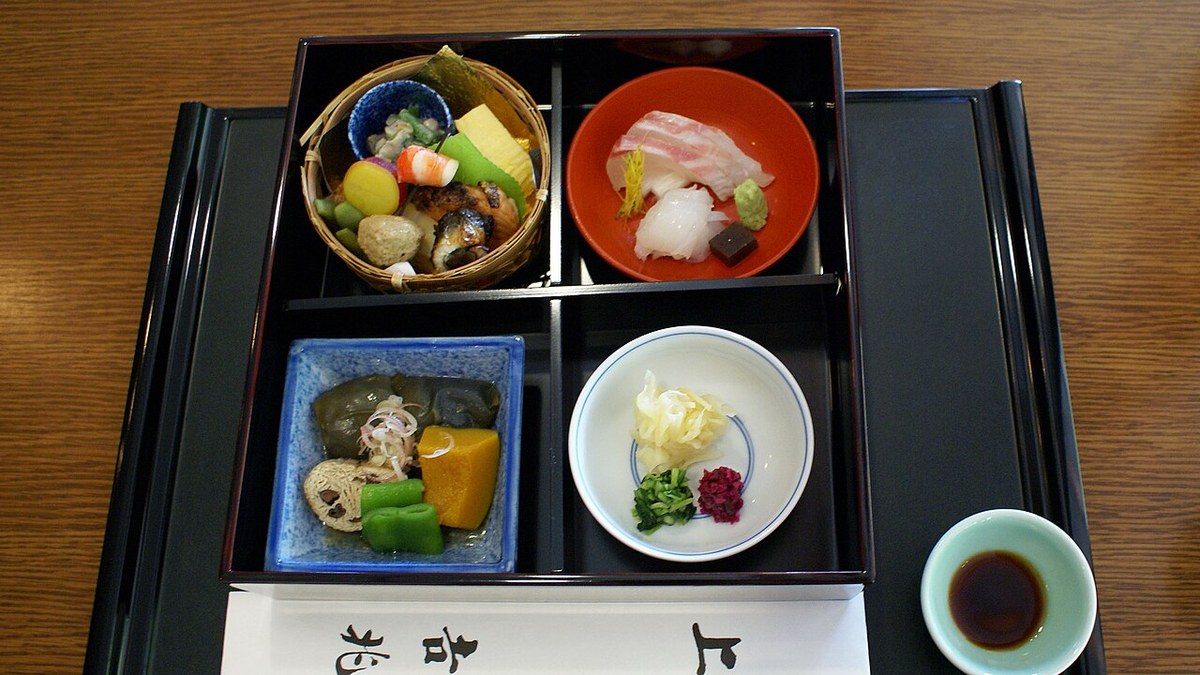
The rest of the building, briefly: the third-floor Kitcho serves the shokado bento during intervals (a format Shochiku attributes to Teiichi Yuki, inspired by a compartmented box belonging to the monk Shokado Shojo); the ground-floor Hinoki tea room is reserved for ticket holders during intervals, open 10:00–19:00 for non-attendees and 10:00–20:00 for attendees; drink corners on floors one to three sell draught and canned beer, sake, sparkling wine and light food, but close once the performance ends; ground-floor box seats can have a bento delivered to the seat if ordered by 15:00 the previous day, though the second part of a three-part day is excluded; and the basement Yagura counter runs 9:30–19:00 during performance periods, 9:30–16:00 on dark days, closing early once the bento sell out.
Worth repeating one last time: a single-act ticket gives you access to none of this.
Following the play: guides and captions
Kabuki dialogue is classical Japanese, so assistance is close to essential even for fluent speakers. Two distinct services exist and they are routinely confused:
| Earphone guide | Captioning tablet | |
|---|---|---|
| Language | Japanese commentary only | Japanese script, English, Simplified Chinese |
| Regular seats (floors 1–3) | ¥700 pre-booked (plus a 2% handling fee) / ¥800 on the day | ¥1,500 |
| Single-act seats (4F) | No pre-booking; ¥500 on the day, cash | ¥1,000 |
| Payment | Cash for the fourth-floor units | Same-day cash only, no advance booking |
| Where | Outdoor counter on the east side (right of the facade) and indoors on the first floor east side; fourth-floor units at the 4F information desk. Return boxes near each exit | First floor inside the theatre only, next to the earphone guide desk. The official text states there is no outdoor handling |
Three things English speakers should take from that table. First, the earphone guide will not help you unless your Japanese is strong — it is commentary in Japanese, not translation. Second, the captioning tablet is the tool you actually want, and it is cash only and cannot be reserved; the English official page says CASH ONLY in capitals. The classic failure is a card-bought QR ticket in one hand and no yen in the other. Third, the Chinese caption option is Simplified, which matters if you were expecting Traditional characters.
There is one way around the cash-only problem, and it only works if you are buying a regular seat: the Shochiku-supplied regular-seat listing on GetYourGuide bundles the English or Simplified Chinese captioning into the ticket price, so you pay online before you fly and do not need yen in your pocket on the day. Single-act buyers cannot use this — that listing sells regular seats, and the fourth-floor tablet still has to be paid for in cash at the first-floor counter.
Exceptions that only appear on the operator's page: for the third part of the August 2026 programme the earphone guide was 500 yen both pre-booked and on the day, and no earphone guides were lent at all for the pieces Yuki and Zangetsu in that part. The English e-tix page adds that captioning may not be provided for very short performances. Discounts exist too: 100 yen off the earphone guide with a disability certificate (covering up to two people including a companion) and 50 yen off with a Shochiku Kabuki-kai card (up to ten people); since 1 February 2026 one captioning tablet is lent free on presentation of a disability certificate.
If you plan to lean on your phone — reading a synopsis before the curtain, checking which act starts when, or running the seat availability search on the morning you hope to buy a U30 ticket — you will want reliable data. This is a genuinely connectivity-dependent plan in a way most sightseeing is not. Our Japan travel essentials guide compares the options; if you would rather just take unlimited data and stop thinking about it, KKday's unlimited Japan eSIM is the straightforward choice.
Dress, phones, and the calls from the back
Start by discarding the most persistent myth: there is no dress code at the Kabukiza. Shochiku's own introduction says ordinary clothes are fine — what you would wear to another play or out shopping — and adds that anyone who wants to dress up is warmly welcome. Jeans and trainers are entirely acceptable; whatever you wore around Ginza that afternoon will do.
The one concrete instruction in the official guidance has nothing to do with formality: keep your hair low so you do not block the view behind you. It is a far more useful piece of advice than anything about jackets, and it appears in almost no foreign-language coverage.
The official etiquette page has exactly four rules: switch phones off during the performance, stay quiet, no photography or audio recording of the stage, and take a child who cries or calls out to the lobby. The newcomer page expands two of these usefully. On phones, silent mode is not enough because alarms still sound and, in the official phrasing, a screen's light is startlingly conspicuous in a dark auditorium — and smart watches should be switched off too. On noise, even the sound of a sweet wrapper or a plastic bag carries, so take out anything you will need before the curtain. Two more: save your reactions for the interval, and keep your back against the seat back, because even a slight forward lean obstructs the row behind. Seats are assigned, and you may not move to an empty one nearby.
On omukou — the shouted house names from the rear seats — this guide takes a deliberately unsatisfying position, because the satisfying ones are unsourced. Shochiku's glossary gives only a neutral definition: voices from the rear seats calling an actor's house name, and the people who do it. No official rule states who may do it. Guides confidently assert both "anyone can" and "only a registered group may", and neither cites Shochiku. Our advice for a first visit is to listen rather than call: timing, intonation and choice of name are things regulars accumulate over many performances, and a mistimed shout interrupts the whole room. For the broader question of reading the room in Japan, our Japanese etiquette guide covers the same instinct applied elsewhere.
On children: a ticket is required from age four, across all Kabukiza performances including single-act seats. Whether under-fours may enter at all is not stated officially, so this guide does not speculate — call the theatre. Some productions bar preschool children entirely (Shinbashi Enbujo's September 2026 King Lear, for example), so check per production. Kabukiza also takes monthly applications for an event childcare service; fees and provider were not verified here.
What you can see without a ticket
A surprising amount of the Kabukiza is free and open, and it connects directly to the subway: Tokyo Metro Hibiya Line and Toei Asakusa Line at Higashi-Ginza, exit 3, links straight into basement level 2 of the building; Ginza station exit A7 is a five-minute walk. That makes it one of central Tokyo's better wet-weather hours — if the forecast turns, pair this section with our Tokyo rainy day guide.
Kobikicho Hiroba, basement level 2 (free)
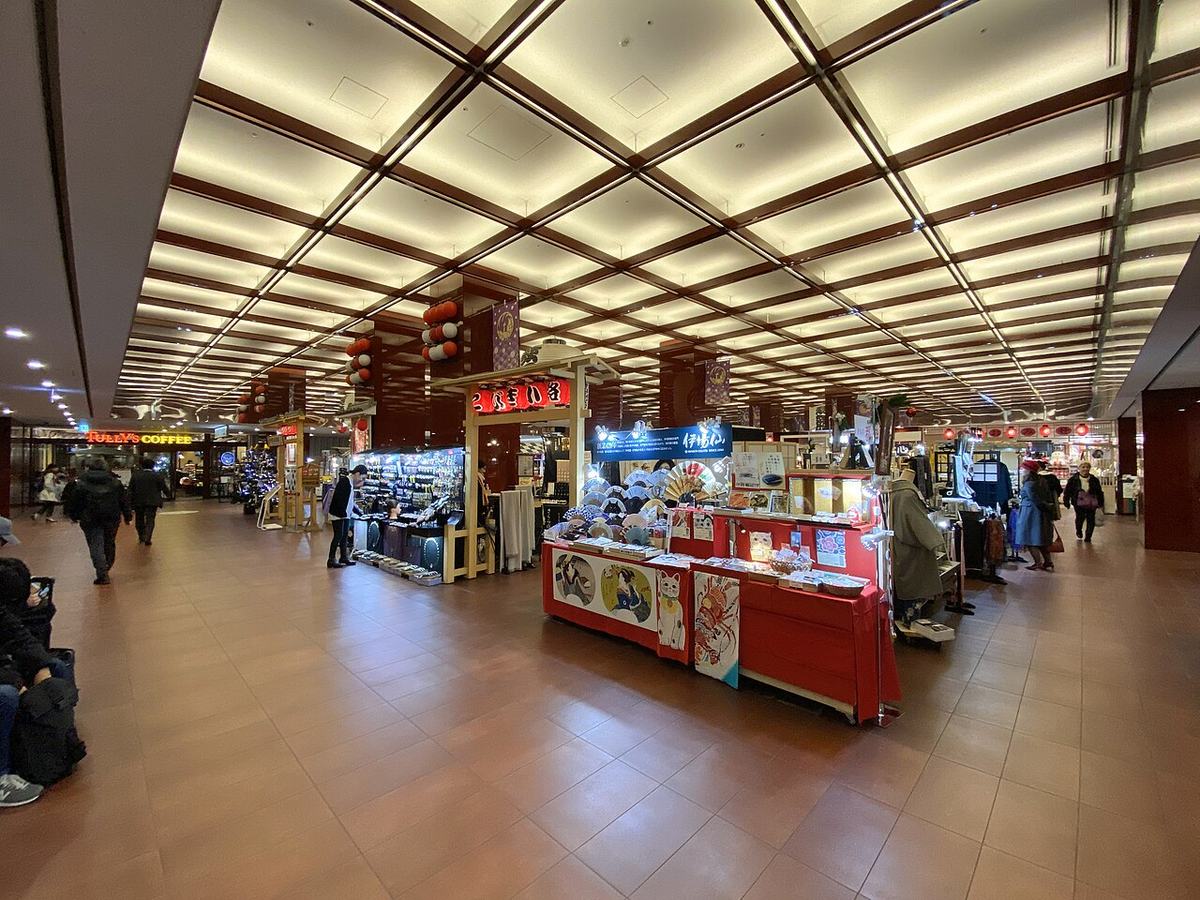
Open 9:30–19:00 during performance periods and 9:30–18:00 on dark and closed days. Inside are the box office, the Yagura bento counter, the Kaomise souvenir shop, a food souvenir shop, a tea house, plus a 7-Eleven and a Tully's Coffee. Cards, electronic money and QR payments are accepted at most (not all) shops.
Several of the tenants have real pedigree: Ibasen, a Nihonbashi fan maker founded in 1590, produces fans in kabuki kumadori face-paint and woodblock-print patterns; Suishin's mizuhiki artisans make family-crest work to order and deliver a spoken flourish with it; Hinemosu's "good fortune mallet" (listed at 1,650 yen in the August 2026 tenant list) is assembled in front of you with a recited patter; and bromides — stage photographs from the current run — go on sale from mid-month until the final day at 600 yen for a 2L print. Those prices come from the August 2026 official tenant list and shift with each run. One local note: this is an indoor mall that gets dense during intervals, so eat what you buy at the shop front rather than while walking.
Fifth-floor gallery and roof garden (free)
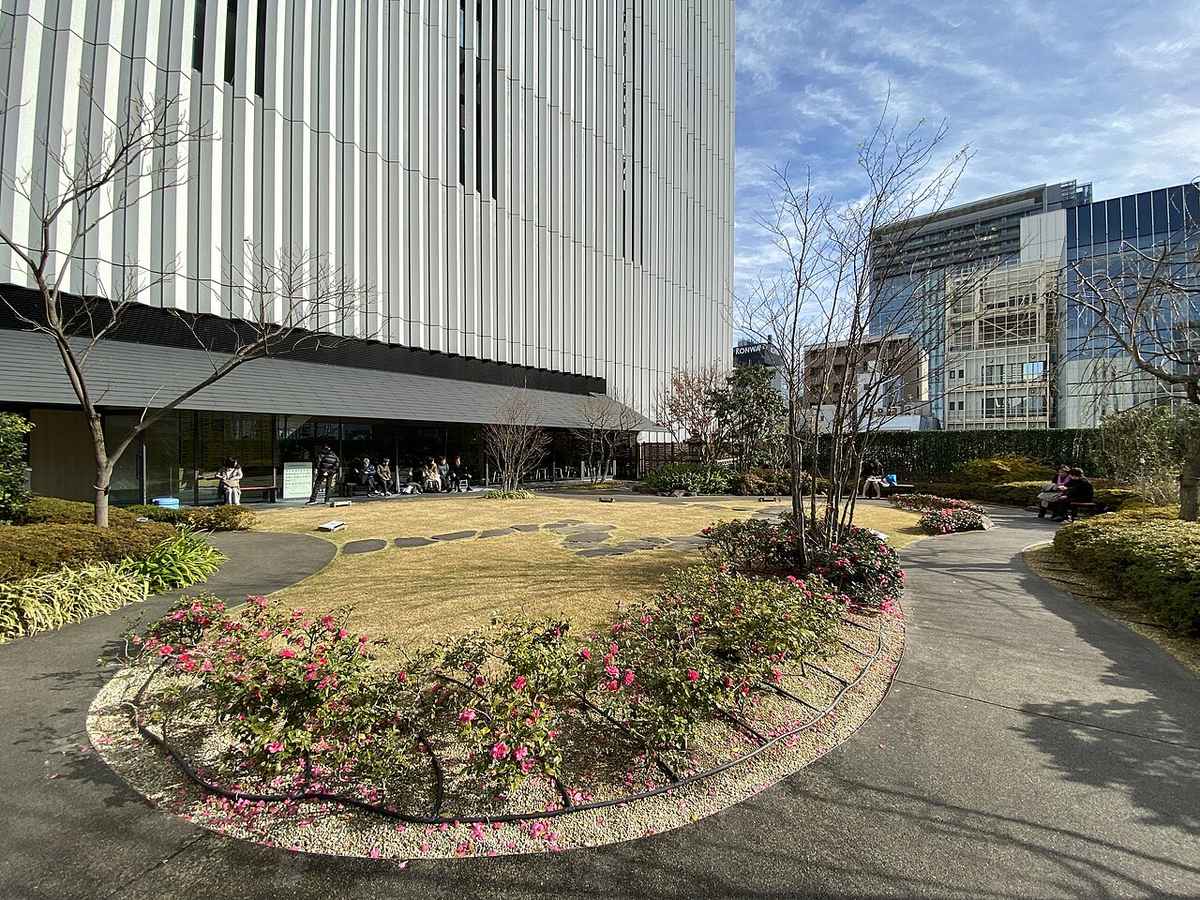
The Kabukiza Gallery sits on the fifth floor of the tower, open 10:30–18:00, free of charge, closed irregularly. It covers the theatre's history, the categories of kabuki, ukiyo-e, the current month's programme and a Q&A corner, and Shochiku specifically notes multilingual QR codes and recommends it to overseas visitors. Enquiries: 03-3545-6800.
On the same level are a roof garden built on the theatre's roof — a weeping cherry as its signature tree, plus a lantern and stone basin associated with the playwright Mokuami Kawatake — and a Japanese tea room and souvenir shop. Walking down the Goemon staircase from the garden brings you to a fourth-floor corridor displaying models of every previous Kabukiza.
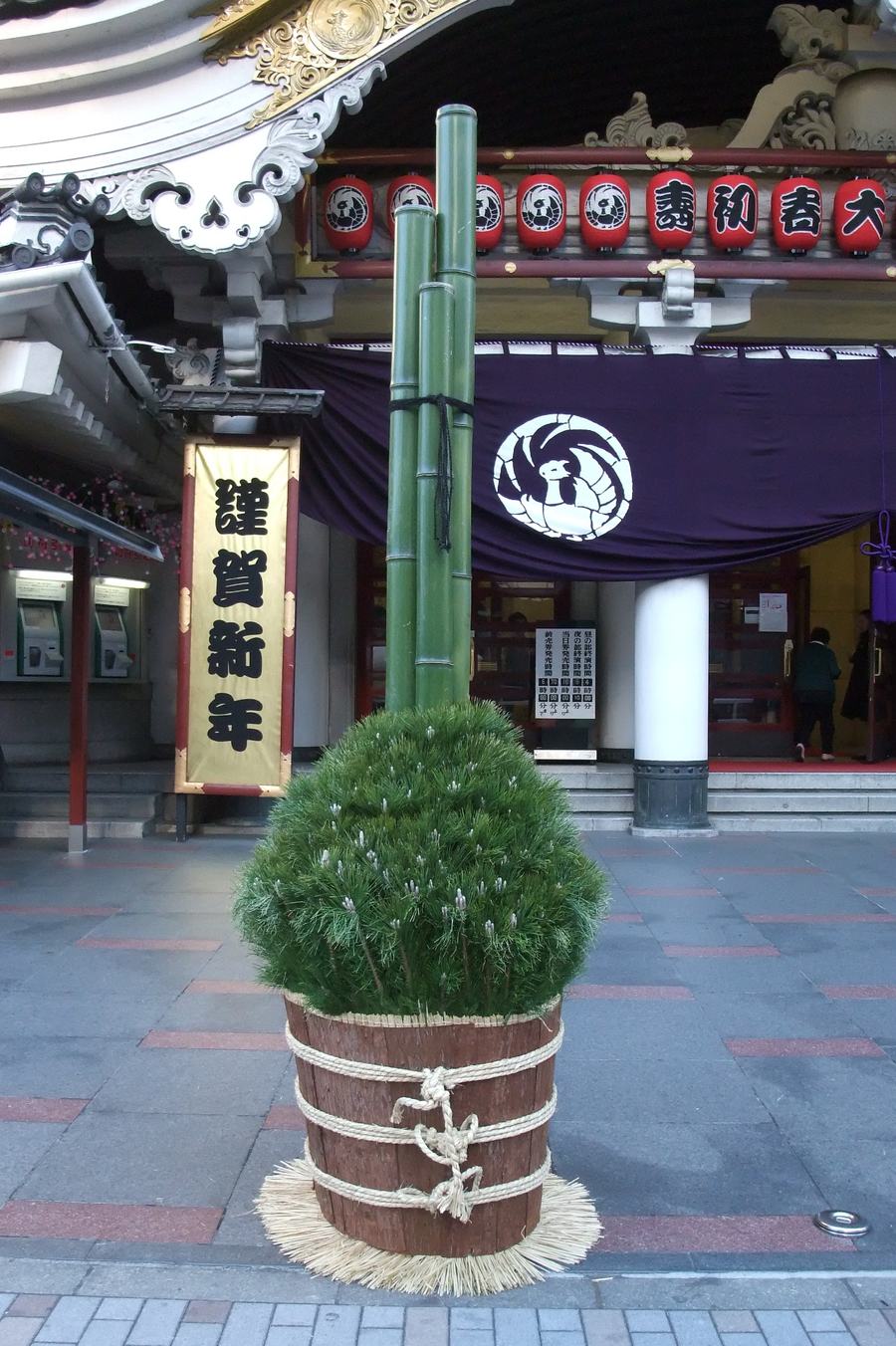
And a detail Shochiku publishes itself, which is worth going to find: descending that staircase you can see rows of roof tiles bearing the theatre's hoo-maru phoenix crest — and exactly one of them has the phoenix facing the wrong way. It is called the reversed phoenix, and the theatre says finding it brings happiness.
Kabuki Inari Shrine, and the building itself
The small Kabuki Inari shrine stands at the right of the front facade, facing Harumi-dori, and Shochiku states explicitly that people who are not attending a performance may pray there. It is dedicated to full houses and safe runs, the wellbeing of audiences and stage staff, peace for the neighbourhood, and protection from fire; there is a Hatsuuma festival on the day of the horse each February, dedication rites on the opening and closing days of each run, and a safety prayer in autumn.
⚠️ One distinction to get right: the Kabuki Inari goshuin is a product sold at the Kaomise souvenir shop in basement level 2, not a seal inscribed by shrine staff at a shrine office. The price is not published officially, so no figure appears here. If you are collecting seals in the conventional sense, this one is a different category from the ones covered in our goshuin guide.
The current building is the fifth Kabukiza: completed February 2013, opening ceremony in March, reopened to the public in April, and co-designed by Mitsubishi Jisho Sekkei and Kengo Kuma. It seats 1,808 (excluding the 96 single-act seats): 897 on the first floor, 441 on the second, 470 on the third. The revolving stage is 18.18 metres across and the hanamichi is also 18.18 metres, on a 6,790 square metre site. The facade deliberately continues the fourth building's tiled roof, curved gable and balustrades, while the tower behind takes a lattice motif.
The history is a compressed account of modern Tokyo. The first Kabukiza opened on 21 November 1889, Western outside and Japanese cypress within. The second, rebuilt in 1911 as a Japanese palace, burned down in 1921 after an electrical fault. The third was interrupted mid-construction by the 1923 Great Kanto Earthquake and eventually opened as a Nara-meets-Momoyama hall, before the May 1945 air raids left only its outer shell. The fourth, opened December 1950, reused the surviving foundations and side walls and was listed as a registered tangible cultural property in 2002 (delisted in 2010); it closed on 30 April 2010 for reconstruction. The fifth opened with a full year of inaugural performances.
Where kabuki is playing right now
If your reference material predates May 2026, this section is likely to be wrong in your copy.
Osaka Shochikuza: closed since May 2026
Shochiku's theatre navigation now labels it as closed. The history page closes with a statement that after 103 years of programming, the theatre closed in May 2026. Its performance listing is empty, no Shochikuza dates appear in the company-wide schedule, and Shochiku's introduction page now states that the company has three theatres: Kabukiza, Shinbashi Enbujo and Minamiza.
The official vocabulary is inconsistent — the navigation uses a word suggesting a temporary closure, the history page one suggesting a permanent one — and no reopening timetable has been published. So this guide records only the published facts: closed as of May 2026, currently listed as closed, no reopening announced. It does not say "permanently closed" and it does not say "will reopen".
The building deserves a footnote regardless. Built on Dotonbori in 1923 by Matsujiro Shirai, it was Japan's first reinforced-concrete cinema, billed as a purely European-style theatre and the foremost hall of popular art, and it gave rise to the troupe that became the OSK Nippon Revue Company. When it was rebuilt in the 1990s, the neo-Renaissance facade known as the triumphal arch of Dotonbori was preserved intact and carried into the 1997 replacement building. It marked its centenary in 2023.
The National Theatre: closed since 2023, no reopening date
Tokyo's National Theatre — including the National Engei Hall and the Traditional Performing Arts Information Centre — closed at the end of October 2023 for reconstruction, with only the information centre's library and viewing rooms still operating. The Japan Arts Council's published reasoning is unusually candid: intermittent malfunctions in the revolving stage and lifts that could cause accidents, cracks in the rails supporting the revolving stage, replacement parts that are no longer manufactured so a breakdown would be unrecoverable, and outstanding ceiling-collapse countermeasures dating back to the 2011 earthquake.
Procurement has been slow: a failed tender in November 2022, another in August 2023, an additional 20 billion yen and a revised plan in December 2024, a revised schedule in September 2025, and a tender notice published on 31 March 2026. No reopening date has been announced — the official language commits only to shortening the closure as far as possible — so no year appears in this article.
Its own kabuki programming continues elsewhere. The October 2026 run is at the New National Theatre Playhouse, 1–20 October, curtain at 1pm with a scheduled 4:15pm finish, dark on the 9th, and doors 45 minutes before curtain rather than Shochiku's usual 30. All seats are reserved: third grade ¥4,000 (students ¥2,800), second grade ¥9,000 (students ¥6,300), first grade ¥14,000 (students ¥9,800), top grade ¥16,000 (students ¥11,200), and hanamichi-front ¥20,000 (students ¥14,000). Advance sales open 13 September at 10:00, and notably student and disability discounts can be applied for online (holders and one carer get 20% off). Enquiries 0570-07-9900 or 03-3230-3000, 10:00–18:00; the programme booklet is bilingual at 1,000 yen.
🔴 One rule here is the exact opposite of the Kabukiza's: the official page states that food and drink are not permitted in the auditorium, and that lobby eating space is limited. At the Kabukiza you can eat a bento at your seat; here you cannot. Food rules follow the theatre, not the art form — do not carry the assumption across.
Shinbashi Enbujo and Kyoto Minamiza: operating normally
Shinbashi Enbujo is running as usual; 2026 dates include the Super Kabuki production of Princess Mononoke (3 July–23 August), a Kazuo Funaki concert series (27–31 August) and King Lear (6–22 September, no preschool children). Groups from 15 people on 03-3541-2111; wheelchair spaces available. No official ticket prices were obtained for this article, so none are quoted.
Kyoto's Minamiza is also operating: a summer backstage tour (2–23 August), Nagareru Shiranami Kirameku Hoshi (2–26 September, on sale 9 August at 10:00), an Ichikawa Danjuro special (3–25 October, on sale 9 September), and the comedy Sanbaba (3–25 November, on sale 9 October). Shochiku describes Minamiza as standing on the birthplace of kabuki, with 400 years of history behind it.
⚠️ But as of this article's verification date of 9 August 2026, Shochiku has published nothing at all about the December 2026 Kaomise run at Minamiza — no dates, no prices. If you are planning around Kyoto's year-end face-showing performances, check back in September or October. What can be explained now is the institution: in the Edo period actors contracted with a playhouse a year at a time, and the first run of each contract year introduced the company to the audience. Annual contracts are gone, but the name survives, and the flagship examples are the November run at the Kabukiza and the December run at Minamiza. Kabukiza's November 2026 dates are published as 1–25 November; times and prices are not.
Finally, the wider map. Shochiku's sales calendar also lists Heisei Nakamura-za, Nagoya's Misonoza, the Tachikawa Tachihi special performances and Asakusa Public Hall, alongside touring productions that visit halls nationwide (their on-sale dates are not listed centrally) and cinema screenings of filmed kabuki. And single-act seats are not unique to the Kabukiza — Shochiku notes that depending on the production, other theatres may offer them too, so check the individual production page.
Fitting the Kabukiza into a Tokyo itinerary
The Kabukiza sits directly above Higashi-Ginza station and a few minutes' walk from Ginza's main crossing, which makes its natural slot the afternoon or evening of a Ginza day. Our five-day Tokyo itinerary places Ginza on day five as a shopping block; dropping in a single act of ¥2,000 to ¥3,500 changes the texture of that day without displacing anything else.
- One hour available: buy the shortest act and walk out afterwards. Rather than reading a synopsis on your phone at the last minute, go up to the free fifth-floor gallery beforehand.
- Half a day: buy a regular seat and watch a full part — about two to three hours in a three-part month, four to four and a half in a two-part month — and eat during the intervals. This is the form as it was designed to be experienced.
- No ticket, or nothing left: Kobikicho Hiroba (9:30–19:00), the fifth-floor gallery (10:30–18:00), the roof garden and the Kabuki Inari shrine are all free, and hunting for the reversed phoenix will fill an hour.
If your interest is broader cultural experiences, our guide to Japan's higher-end cultural experiences covers options at a different budget. For a completely different angle, consider Kotohira in Shikoku, where the Kanamaru-za of 1835 is the oldest surviving kabuki playhouse in Japan and you can go beneath the stage to see the hand-powered machinery. The Kabukiza shows you the performance in a working theatre; Kanamaru-za shows you how the theatre itself works as a machine. They complement each other well.
Frequently Asked Questions
- Q1:Is a single-act ticket worth it, or should I book a full programme?
- It depends on your age. If you are 30 or under, the single-act seat is almost never the right choice: Shochiku runs a same-day half-price scheme at Kabukiza covering every seat grade, and the official document lists a passport among the accepted photo IDs. A first-grade seat in the September 2026 run is ¥18,000, so half price is ¥9,000 — a proper seat downstairs, the whole programme, and full access to every shop and restaurant in the building. If you are over 30 and this is your first kabuki, take the single act. The six acts in the August 2026 run were priced between ¥2,000–3,500, and the shortest ran 32 minutes. The barrier to kabuki has never really been the money; it is whether you can sit through four hours of a form you have not met yet.
- Q2:What is the difference between the reserved and unreserved single-act seats?
- Almost every rule is inverted, which is exactly why people get it wrong. Fourth-floor reserved seats go on sale at 12:00 noon the day before the performance, are sold online by credit card only through the dedicated site e-tix.jp/shochiku_makumi, allow up to four tickets per person, carry a ¥110 system fee per ticket, admit you with a QR code emailed after purchase, and number roughly 70 seats. Fourth-floor unreserved seats go on sale at 10:00 on the day itself, are sold at the box office in cash only in the second basement of the theatre, are limited to one ticket per person, come as a paper ticket, and number roughly 20 seats. So buying for a group is only possible on the reserved side. One honesty note: the cash-only and one-per-person rules for unreserved seats appear in Shochiku's official announcement of May 2023 (last amended June 2024 for the age rule) rather than on any permanent page, and this article was verified on 9 August 2026.
- Q3:How much does a single act actually cost? I have read it is about 1,500 yen.
- That figure is out of date. On the official e-tix sales page for the August 2026 programme, the six acts were priced at 3,000, 2,500, 2,000, 3,500, 2,500 and 3,000 yen — a band of ¥2,000–3,500, with the ¥110 system fee on top for reserved seats. Older figures are still in wide circulation: Tokyo's own tourism site was still quoting roughly 1,500 yen in a December 2024 revision. Two structural points matter more than the exact figures. Prices are set act by act, and the whole table is replaced every month when the programme changes. And price does not track running time: in the same month, a 32-minute dance piece cost ¥2,500 while a 50-minute comedy cost ¥2,000. Hunting for the longest act is not a strategy.
- Q4:Can I buy a bento during the interval if I have a single-act ticket?
- No, and this is the most underrated cost of the cheap seat. Shochiku states plainly that single-act ticket holders watch from the fourth floor and cannot enter floors one to three, and that there is no shop and no restaurant on the fourth floor. Everything — the bento counter, the tea room, the drink corners, the third-floor dining room — is on floors you are not allowed to reach. If you want to eat, buy it in the Kobikicho Hiroba on basement level two before you go up. Other conditions worth knowing before you commit: each act is fully cleared between acts, so consecutive tickets still mean leaving your seat; seat spacing is narrower than on the lower floors; the fourth floor is the highest and furthest level, and the official page warns that part of the stage and the hanamichi walkway may not be visible; latecomers may not be seated for some time; and the theatre's one-hour parking discount explicitly excludes single-act ticket holders.
- Q5:Are there English captions, and do I need to book them?
- Yes, and no — you cannot book them. Kabukiza offers a captioning tablet in Japanese, English and Simplified Chinese, priced at ¥1,500 for regular seats and ¥1,000 for the fourth-floor single-act seats. The official wording is unambiguous: no advance reservation, same-day payment, CASH ONLY, and the rental counter exists only inside the theatre on the first floor, next to the earphone guide desk — there is no outdoor counter. The predictable failure mode is arriving with a card-purchased QR ticket and no yen in your pocket. Keep 1,000 to 1,500 yen in cash aside. Note also that the earphone guide is a Japanese-language commentary, not an English one, so it is not the accessibility tool English speakers usually assume it is. One more caveat straight from the English official page: if a performance is very short, the captioning service may not be offered at all.
- Q6:Is there a dress code?
- There is not, and the official position is refreshingly blunt about it. Shochiku's introduction for newcomers says ordinary clothes are fine — the same thing you would wear to any other play or to go shopping — while adding that anyone who wants to dress up is very welcome. The only concrete requirement anywhere in the official guidance has nothing to do with formality: keep your hair low so you do not block the view of the row behind. The rules that actually get enforced are about noise and light. Phones go off, not silent, because alarms still sound and a screen is startlingly bright in a dark auditorium; the official text specifically extends this to smart watches. Unwrap sweets and take out anything you need before the curtain, because rustling plastic carries. Save your reactions for the interval. Sit back in your seat, since even leaning slightly forward blocks the person behind you. Photography and audio recording of the stage are prohibited outright.
- Q7:Can I shout the actors' names like the regulars do?
- The honest answer is that Shochiku has never published a rule either way. Its official glossary defines omukou only descriptively: voices from the rear seats, far from the stage, calling out an actor's house name, and the people who do it. That definition does not say anyone may do it, and it does not restrict it to a registered group. No official eligibility rule appears on Shochiku's site, and none was found in the Japan Arts Council's digital library either. Our recommendation for a first visit is simple: listen, do not call. The timing, the intonation and the choice of house name are things regulars build up over many performances, and getting it wrong interrupts everyone. The official etiquette page's second rule is, after all, to stay quiet during the performance.
- Q8:Which theatres are currently staging kabuki?
- Fewer than you would expect, because two of the usual names are closed. Osaka Shochikuza closed in May 2026: Shochiku's theatre navigation now labels it as closed, its history page states that after 103 years the theatre closed in May 2026, its performance listing is empty, and Shochiku's own introduction page now says the company has three theatres — Kabukiza, Shinbashi Enbujo and Kyoto Minamiza. The official wording alternates between temporary and permanent phrasing and no reopening timetable has been published, so this article states only what is published. Tokyo's National Theatre has been closed since the end of October 2023 for reconstruction; the Japan Arts Council's explanation cites cracks in the revolving stage rails, spare parts that are no longer manufactured, and unresolved ceiling safety work. Procurement failed twice, an extra 20 billion yen was added in December 2024, and the latest step was a tender notice on 31 March 2026. No reopening date has been announced. Its own kabuki programmes continue at other venues, with the October 2026 run at the New National Theatre Playhouse.
Read next
Watching Sumo in Japan 2026: Official Tickets from ¥2,000
Official chair seats start at 2,500 yen in Tokyo and 2,000 in Fukuoka. Resale is banned, and the association enforced it 138 times last year.
Tokyo in the Rain: 10 Indoor Spots 2026
Ten indoor picks for a wet day: teamLab, Skytree, LaQua onsen, Pokémon Center — the plays that save a trip.
Tokyo 5-day itinerary 2026
A clear 5-day plan: Shinjuku base, two zones per day, honest budget.
📊 See the 2026 Price Index (JR Pass, DPA, eSIM, Airport Transport) →