The thing that genuinely wears you out on a multi-city Japan trip isn't the walking — it's dragging a 28-inch suitcase up station stairs, onto packed trains and across town every time you change hotels. And Japan has the best fix anywhere: send that case from one hotel to the next by takkyubin (courier forwarding). Tokyo to Osaka, a big suitcase costs about 2,300 yen and usually arrives the next day. You ride the train with a daypack; the luggage is waiting at the next hotel. The Japanese call this te-bura kanko — "hands-free sightseeing." This guide covers it all: forwarding rates, the airport-to-hotel and hotel-to-airport deadlines, coin-locker sizes and prices, the ecbo cloak storage app, and the current shinkansen oversized-baggage reservation rule.
The mental model: Japan gives you three luggage tools for three situations. Takkyubin (forwarding) solves "changing cities, not in a rush." Coin lockers / ecbo cloak storage solve "explore light by day, collect by night." The shinkansen oversized-baggage rule is what you need when you genuinely must drag the bag with you. Get these three straight and a multi-city trip becomes dramatically less tiring.
- Forwarding rates — a big suitcase is usually 140-160 size; Tokyo to/from Osaka is about 2,310-2,630 yen, next-day. Max 200cm total, 30kg.
- Forward or not? — staying 2+ nights and not needing the bag that day, forward it; need it tonight, drag it or use a same-day locker.
- Airport delivery — Kuroneko counters in arrivals send to your hotel; on the way home, send 1-2 days before your flight.
- Lockers vs app — coin lockers small 300-400, medium 500-600, large 700-800 yen; when they're full, use ecbo cloak (400/700 yen).
- Shinkansen oversized bag — Tokaido/Sanyo/Kyushu lines: over 160cm needs a free reserved "oversized baggage area" seat; no reservation risks a 1,000 yen fee; over 250cm banned.
📖 Table of contents (tap to expand)
- Why use luggage forwarding in Japan at all?
- How takkyubin works: rates, sizes, the process
- Airport to hotel, hotel to airport: don't miss the deadline
- Forward vs drag it: how to choose
- The shinkansen 160cm oversized-baggage rule
- Coin lockers: sizes, prices, what if they're full
- ecbo cloak and storage apps: stop gambling on empty lockers
- Practical tips: forms, tracking, valuables
- Cheat sheet: which luggage tool to use
- FAQ
Why use luggage forwarding in Japan at all?
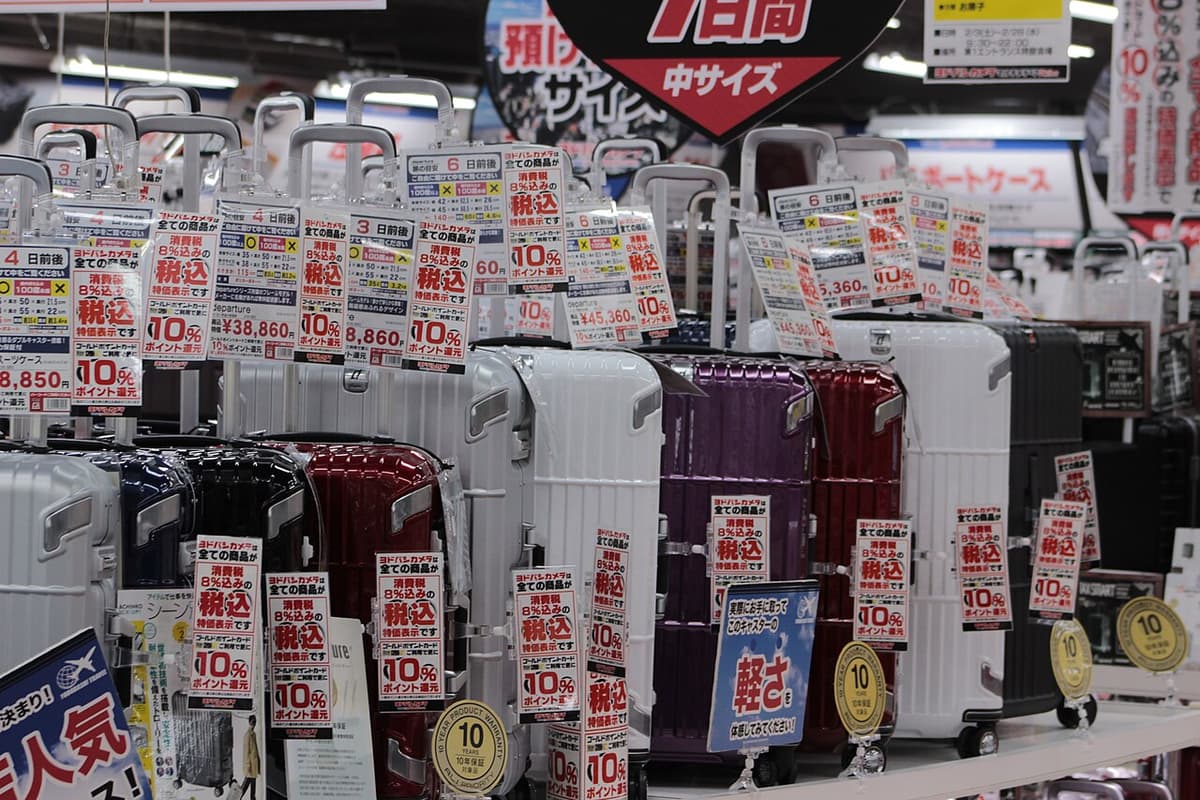
Japanese stations are not kind to travellers hauling big bags: many older stations have few lifts, you climb stairs between platforms, and at rush hour you can barely wedge a suitcase onto the train. If your trip hops "Tokyo 3 nights, then Kyoto 2 nights, then Osaka 2 nights," dragging everything you own through stations on every changeover day burns half your good mood before you've seen anything.
The fix is to outsource the "change cities" part to logistics. Japan's takkyubin network is among the most reliable and affordable point-to-point delivery on earth: the hotel front desk ships it, and it arrives at your next hotel the next day. You carry a light daypack with what you need tonight and move freely by train. This isn't a luxury splurge — it's standard practice for experienced Japan travellers. The moment that big case leaves, the comfort of the whole trip jumps a level.
Which itineraries benefit most? Longer trips, more cities, two-plus nights per stop — exactly the kind of cross-region plan in our two-week Japan itinerary or 10-day Japan itinerary that spans Kanto, Kansai and beyond. If instead you're parked in one city for days without changing hotels, you barely need forwarding — a coin locker for daytime storage is enough.
How takkyubin works: rates, sizes, the process
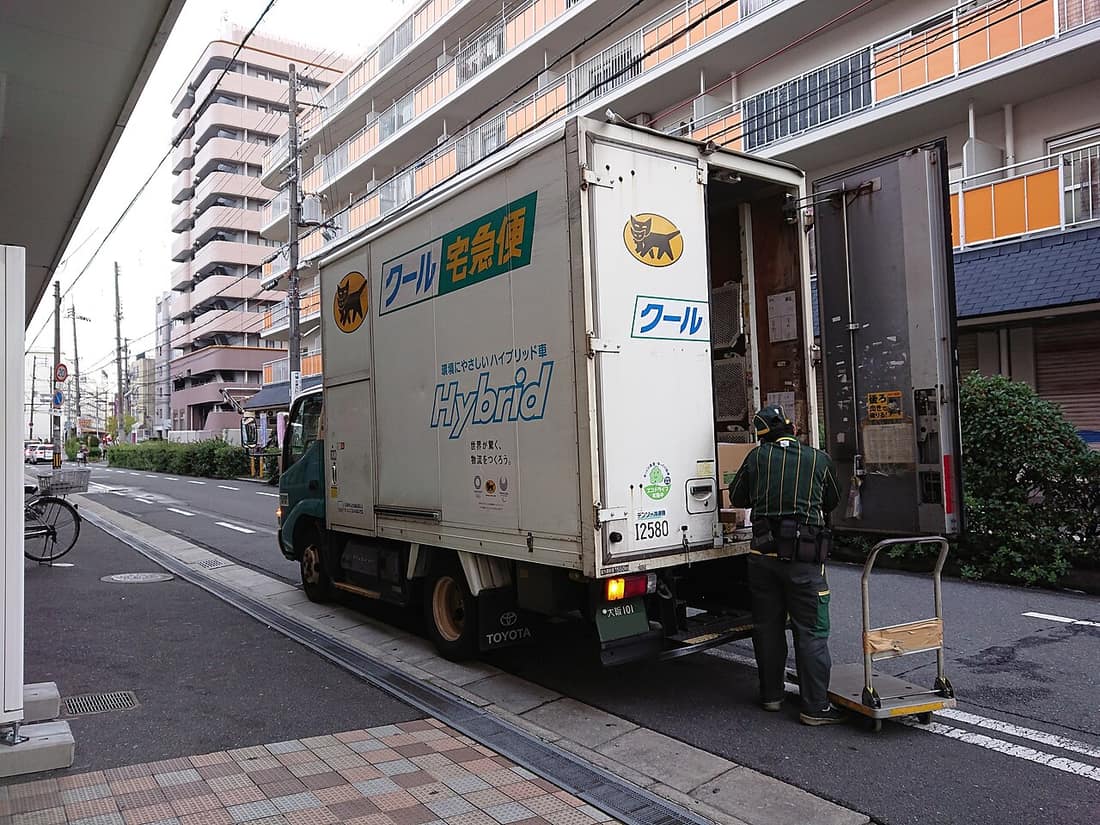
The two big carriers are Yamato (Kuroneko / TA-Q-BIN) and Sagawa; for travellers, Yamato is the most common with the densest network. Shipping is simple: hotel front desks, convenience stores and Yamato depots can all send a parcel. You fill in a form, pay, and get a tracking number. Done.
How size and rate are calculated
The fee is set by two variables: size and distance. Size is graded by "total dimensions" (length + width + height) into eight tiers, and the rate climbs with both the size band and the distance between sender and recipient:
| Size tier | Total dimensions | Typical bag | Tokyo↔Osaka guide price |
|---|---|---|---|
| 60-100 size | ≤ 100cm | Small backpack, small cabin bag | ~1,500-2,000 yen |
| 140 size | ≤ 140cm | Medium suitcase (~24 inch) | ~2,310 yen |
| 160 size | ≤ 160cm | Large suitcase (28-30 inch) | ~2,630 yen |
| 180-200 size | ≤ 200cm | Oversized / packed hard cases | Higher |
In practice, a typical 28-30 inch checked suitcase lands in the 140-160 band, so Tokyo to Osaka runs about 2,300-2,630 yen, next-day. Longer hauls cost more: Tokyo to Hokkaido or Okinawa adds on. The limit per item is 200cm total dimensions and 30kg; split into two parcels if you exceed it. (Rates per Yamato's official table; peak-season and fuel adjustments occur, so ask the desk or store clerk for a quote before shipping.)
The shipping process, step by step
- Confirm the next hotel's details: full name, address, your check-in name and date — get these right, errors cause delays
- Go to a hotel desk, convenience store or Yamato depot and fill in the waybill (okurijo) with the recipient hotel and your name
- Pay: cash, or card at some points; you're quoted by size and distance on the spot
- Take the tracking number (otoiawase bango) and keep it to follow the parcel online
- Collect at the next hotel the next day — most hotels hold parcels; tell them in advance to be safe
Airport to hotel, hotel to airport: don't miss the deadline
One of the best uses of forwarding is to outsource the airport legs too. Narita, Haneda, Kansai and Chubu all have Yamato (Kuroneko) or JAL ABC luggage counters in arrivals.
Arrival: airport to hotel
After you land and collect your bags, take the big case straight to the airport courier counter and send it to your hotel, then ride the airport rail link into the city with just a light pack instead of wrestling a suitcase onto the N'EX or limousine bus. Airport-to-city is usually next-day, which means —
Departure: hotel to airport
On the way home, reverse it: send the bag from your hotel to an airport pickup point, travel light to the airport, then collect and check in. The key is timing. Airport forwarding is also typically next-day, so send it at least 1-2 days before your flight to be certain it's waiting on departure day. Sending it the same day as your flight will not make it in time — this is the single most common mistake, so plan ahead. Airport forwarding costs slightly more than city rates (from around 1,600 yen, up to 3,600-3,700 yen for a big case), but a hands-free final day with no suitcase to haul to the airport is well worth it.
Forward vs drag it: how to choose
Not every leg should be forwarded. The decision is one question: "I check out today — do I need this bag tonight?"
- Staying two-plus nights, not in a rush for the bag that day → forward it. Ship the big case to the next hotel at check-out, sightsee light all day, and it's waiting for you tomorrow. Brilliant on full-day outings to Kyoto, Kamakura, Nikko or Fuji.
- Checking out and needing the bag the same day (one-night stop, or you're taking a night bus/train that evening) → forwarding doesn't fit (next-day arrival). Drag the bag, or stash it in a station coin locker, explore light, and collect it before you move on.
- You genuinely must take a big suitcase on the shinkansen → read the next section on the 160cm oversized-baggage rule first, so you don't get fined or find nowhere to put it.
On long multi-city trips like a cross-region two-week itinerary, my default setup is: move around within cities light using Suica/ICOCA, and forward the big bag ahead between cities, so only a daypack rides the shinkansen with me. That even sidesteps the oversized-baggage reservation entirely.
The shinkansen 160cm oversized-baggage rule
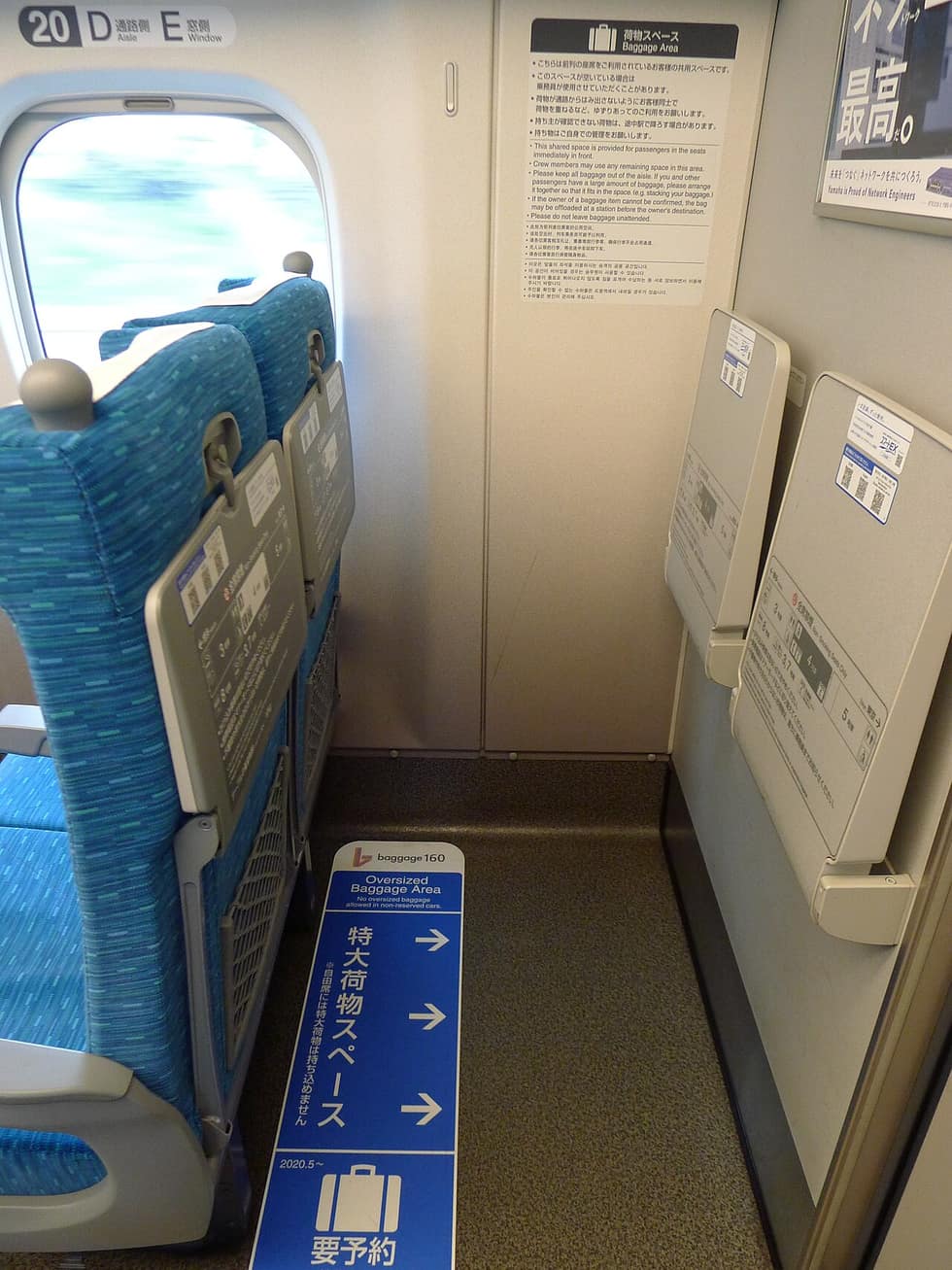
If you decide to take a big bag on the shinkansen, this rule matters — get it wrong and you can be fined.
On the Tokaido, Sanyo, Kyushu and Nishi-Kyushu shinkansen (the main Tokyo–Nagoya–Osaka–Hakata–Kagoshima spine), baggage with total dimensions (length + width + height, including wheels and handle) over 160cm and within 250cm counts as "oversized" and you must reserve an "oversized baggage area" seat — the seat directly in front of the dedicated storage space behind the rearmost row of each car.
- The reservation is free: when you book a reserved-seat ticket, just choose the oversized-baggage-area seat. No extra charge — it simply ties your seat to the row with the luggage space.
- No reservation, and you're checked → 1,000 yen (tax included) fee for bringing an over-160cm bag aboard without a reserved spot.
- Over 250cm total → not allowed on board at all; those must be forwarded.
- How to measure: add the three sides, including wheels and the extended handle. Plenty of 26-28 inch cases people assume are fine actually exceed 160cm once measured properly, so check.
Coin lockers: sizes, prices, what if they're full
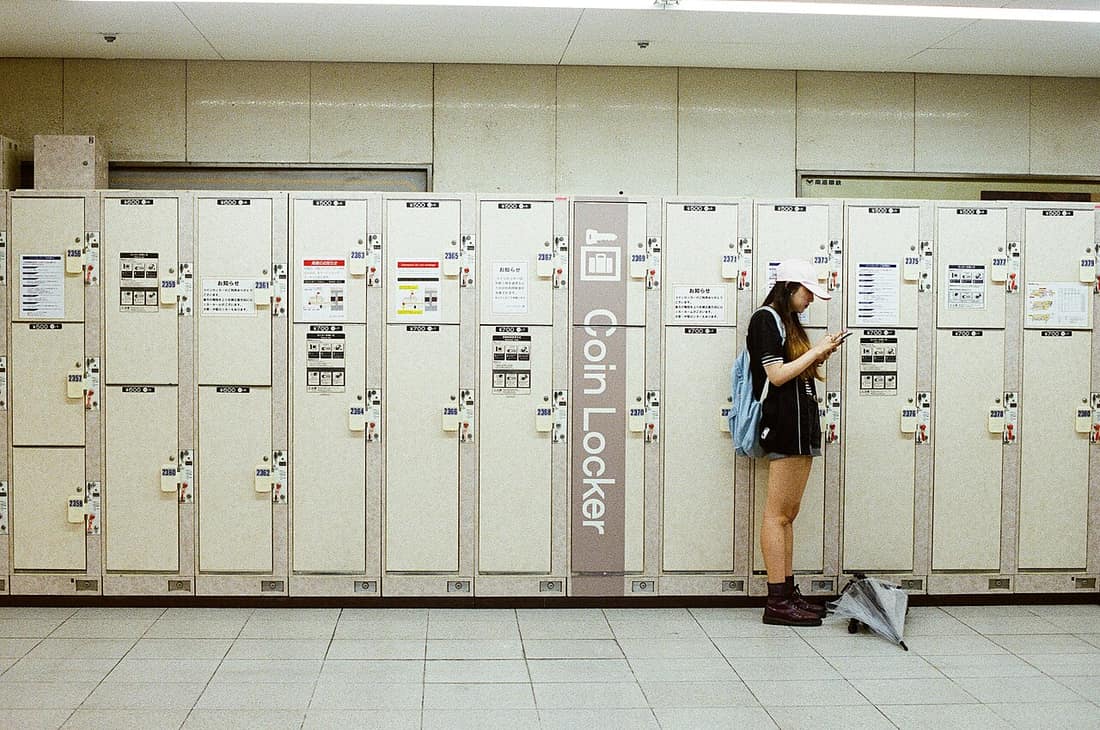
When you don't need to send a bag to another city and just want to explore light by day and collect it later (say you've checked out, stored the case for a day, and pick it up before an evening train), coin lockers (koin rokka) are the most direct option.
Sizes and prices
| Size | Fits | Per-day guide price |
|---|---|---|
| Small | Backpack, small bag | 300-400 yen |
| Medium | Cabin bag, large rucksack | 500-600 yen |
| Large | Large suitcase (28 inch) | 700-800 yen |
Most lockers bill by the day (usually resetting at last train or midnight); going over needs another coin or top-up. Increasingly they take IC card (Suica/ICOCA) tap payment — no fishing for coins, and you unlock with the same card. Far more convenient than the old coin-only units.
ecbo cloak and storage apps: stop gambling on empty lockers
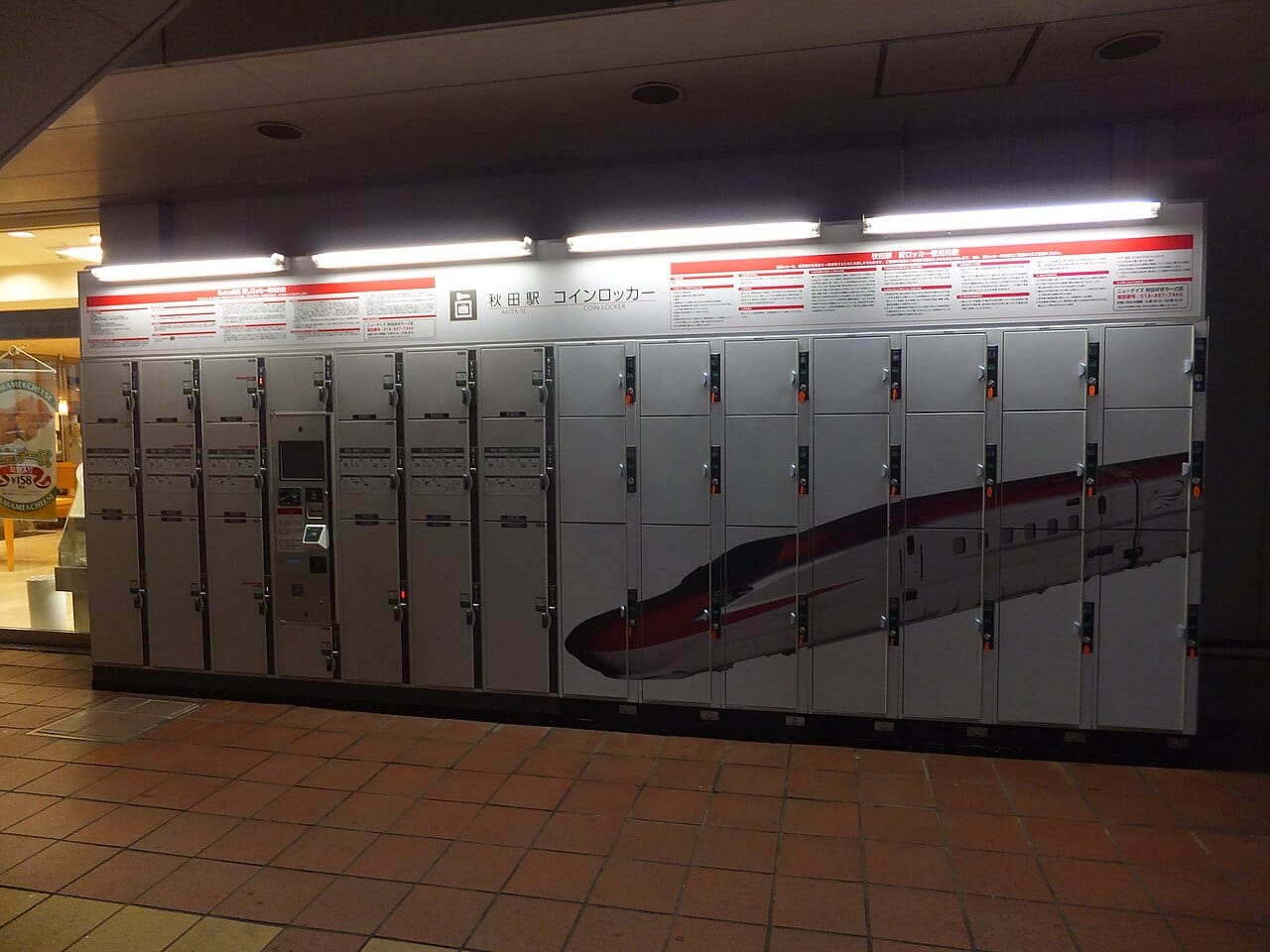
Coin lockers fill up; storage apps don't. The three most useful tools:
- ecbo cloak — an app that turns cafes, shops, post offices, station counters and inns into bookable storage points. Find a nearby spot, reserve and pay online, hand the bag to the staff, and show a QR code to collect — no gambling on an empty locker. Pricing is about 400 yen for a bag-size item (longest side under 45cm) and 700 yen for a suitcase (longest side 45cm or over) per item per day, with 1,000+ locations across Japan and insurance up to 100,000 yen for loss or damage. Especially handy near big stations when lockers are taken.
- Radical Storage — the same idea, turning shops into bookable storage points you reserve and pay for online. The difference that matters is the pricing model: one flat price per item per day regardless of size, so the bigger your suitcase the better it looks. But the rate is set per city, not nationally (checked 28 Aug 2026, headline "from" rates on their site: Tokyo 490 yen/day across 481 locations; Osaka 400 yen/day across 97; Kyoto 750 yen/day). Put plainly: for a full-size suitcase in Tokyo or Osaka it undercuts ecbo cloak; in Kyoto it costs more — so check the rate for the city you'll actually be in rather than assuming it's always cheaper.
- Coin Locker Navi — an app showing real-time vacancies at station coin lockers, telling you which station and which bank still has free lockers and what size, so you're not hunting station by station.
How to combine them: check Coin Locker Navi first for a cheap empty locker; if there's none, the answer depends on the city — a big suitcase in Tokyo or Osaka is usually cheapest with Radical Storage, while a small bag, or anything in Kyoto, is better served by ecbo cloak's 400-yen bag rate and its thousand-plus locations.
Both apps need live mobile data to check vacancies, reserve and pay, so your phone connection can't drop. If you haven't sorted Japanese data yet, see our Japan eSIM guide first so storage, tracking and navigation all run smoothly.
Practical tips: forms, tracking, valuables
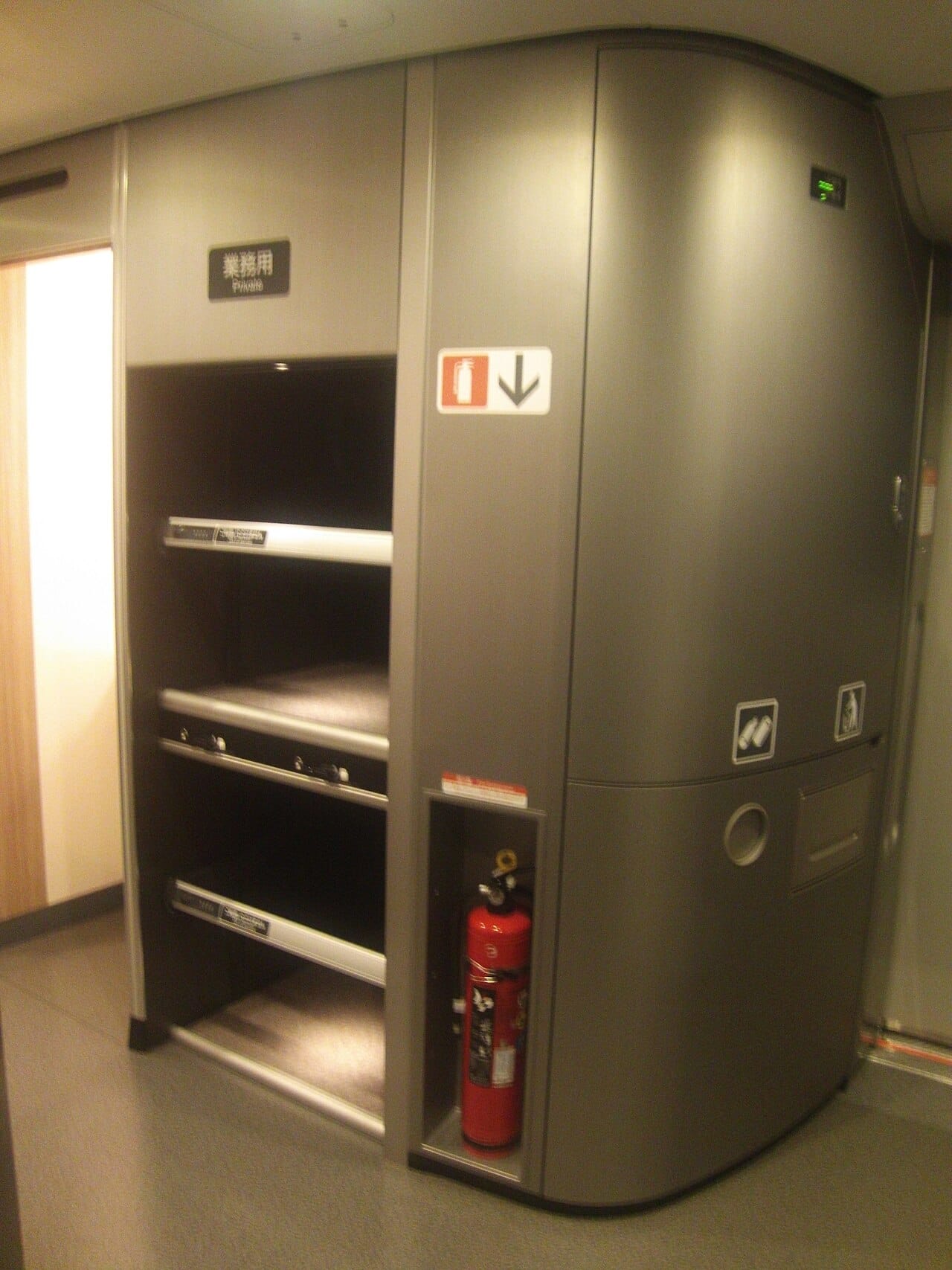
A few final points to make forwarding go smoothly:
- Get the recipient details right: full hotel name, correct address, your check-in name and date — all required. Wrong hotel or name is the usual cause of a stuck parcel; if you're unsure of the address, ask your current hotel desk to look up the next one.
- Tell the receiving hotel in advance: most hold parcels, but an email or call saying "a forwarded bag is coming" with your booking name and check-in date avoids a bag arriving that nobody can match to a guest.
- Keep valuables on you: cash, passport, electronics, camera, medication, contact lenses, fragile items and anything you need that day go in the carry-on, never the forwarded case.
- Save the tracking number: photograph the otoiawase bango on the waybill to follow the parcel and its arrival time online.
- Budget for the time lag: forwarding is usually next-day, so build that gap into your plan — especially on the way home, where you ship 1-2 days before the flight.
- Compensation has a ceiling: Yamato is typically up to 300,000 yen per item, which is exactly why high-value things shouldn't be forwarded — carry them.
Get these details right and forwarding almost never goes wrong — Japanese logistics reliability is world class, and the rare failures come from human steps like a mis-filled form or bad timing, not the network itself.
Cheat sheet: which luggage tool to use
| Situation | Use this | Cost / time | Watch out |
|---|---|---|---|
| Changing cities, 2+ nights per stop, not needed that day | Takkyubin hotel-to-hotel | ~2,300+ yen big case, next-day | Keep tonight's items on you; get the hotel address right |
| Just landed / departing, via the airport | Airport courier counter to hotel / to airport | ~1,600-3,700 yen, next-day | On the way home, send 1-2 days before the flight |
| Explore light by day, collect by night | Coin locker | Small 300-400 / large 700-800 yen, per day | Large lockers fill in peak season; IC card tap works |
| Lockers all full | ecbo cloak storage app | Bag 400 / suitcase 700 yen, per day | Book and pay online; needs data |
| Must take a big bag on the shinkansen | Reserve an "oversized baggage area" seat | Free (Tokaido/Sanyo/Kyushu lines) | Over 160cm must reserve, 1,000 yen if not; over 250cm banned |
In one line: forward big bags ahead between cities, store daytime carry-ons in lockers or ecbo cloak, and reserve a seat if you really must drag a big case on the shinkansen. Outsource the dreary "moving luggage" job to Japan's world-class logistics and you'll have the energy to actually enjoy the trip.
One last piece of advice
Lots of first-time visitors pack the schedule full and hop between cities, but forget to plan how the luggage moves — and then spend the whole trip wrestling a big case. Two small habits upgrade everything: forward the big bag ahead when you change cities, and stash your daytime carry-on in a locker or ecbo cloak when you're out light. Forwarding a big suitcase between cities costs barely 2,300 yen and buys you a whole day hands-free, with no stairs and no packed-train wrestling — one of the highest-value small spends in all of Japan travel. Build luggage logistics into your next multi-city plan and you'll never go back to dragging it.
FAQ
- Q1:How much does luggage forwarding (takkyubin) cost in Japan, and how long does it take?
- Sending one large suitcase between major cities (say Tokyo to Osaka) costs roughly 2,300-2,630 yen and usually arrives the next day. Price depends on two things: size and distance. Takkyubin grades parcels by "total dimensions" (length + width + height) into eight tiers — 60, 80, 100, 120, 140, 160, 180 and 200 size. A typical 28-30 inch suitcase falls in the 140-160 size band. On Yamato (Kuroneko / TA-Q-BIN) official rates, Tokyo to Osaka is about 2,310 yen at 140 size and 2,630 yen at 160 size; longer routes (Tokyo to Hokkaido or Okinawa) cost a bit more. The maximum is 200cm total dimensions and 30kg per item. City-to-city delivery is usually next-day; remote islands add a day. (Source: Yamato official rate table.)
- Q2:Forwarding vs dragging the bag onto the shinkansen — when should I forward?
- Ask one question: do you need that bag tonight, the same day you check out? Forwarding is usually next-day, so if you check out today and need the suitcase this evening, forwarding does not work — drag it, or use a coin locker and collect it the same day. But if you are staying two-plus nights at each stop and not in a rush to have the case that day, sending your big bag ahead to the next hotel and travelling light by train is far more comfortable, especially on heavy sightseeing days in Kyoto, Kamakura or around Fuji. Also note the shinkansen oversized-baggage rule: bags over 160cm in total dimensions need a (free) reserved "oversized baggage area" seat on the Tokaido, Sanyo, Kyushu and Nishi-Kyushu lines, or you risk a 1,000 yen fee. For many travellers, forwarding the case sidesteps the whole hassle.
- Q3:Can I send my luggage from the airport straight to my hotel? How far ahead?
- Yes. Narita, Haneda, Kansai and Chubu — all the major airports — have Yamato (Kuroneko) or JAL ABC luggage-delivery counters in arrivals. Land, hand over the big case to the counter, send it to your hotel, and ride into the city with just a daypack while the suitcase shows up at the hotel next day. Airport-to-hotel is typically next-day, so keep anything you need the first night (change of clothes, charger, medication) in your carry-on. Going home, reverse it: send the bag from the hotel to an airport pickup point, but send it at least 1-2 days before your flight so it is waiting at the airport on departure day. This is where people get caught — sending it the same day as the flight does not leave enough time. Airport forwarding costs a little more than city rates (around 1,600 yen for small bags, 3,600-3,700 yen for big cases), but the convenience is worth it. Sort your data first so you can track parcels — see our Japan eSIM guide.
- Q4:How much are coin lockers in Japan, what sizes exist, and what if they are full?
- Station coin lockers come in three sizes: small is roughly 300-400 yen, medium 500-600 yen, and large (fits a suitcase) 700-800 yen per day, most billed by the day with a top-up if you go over. Big stations (Tokyo, Shinjuku, Kyoto, Osaka) have plenty of lockers, but the large ones fill fast in peak season. If you cannot find one, two options: (1) the Coin Locker Navi app shows real-time vacancies at nearby stations; (2) switch to ecbo cloak, an app that turns cafes, shops, post offices and station counters into storage points you book and pay for online — no gambling on an empty locker. ecbo cloak charges about 400 yen for a bag-size item and 700 yen for a suitcase per day, with 1,000+ locations across Japan and insurance up to 100,000 yen. All of this needs live mobile data.
- Q5:Do I have to reserve a seat for oversized baggage on the shinkansen, and on which lines?
- It depends on the bag. On the Tokaido, Sanyo, Kyushu and Nishi-Kyushu shinkansen, baggage with total dimensions (length + width + height, including wheels and handle) over 160cm and up to 250cm counts as "oversized" and requires a reserved seat in the "oversized baggage area" — the row in front of the storage space behind the rearmost seats of each car. The reservation is free; you simply select that seat when booking a reserved-seat ticket. Bring an over-160cm bag aboard without reserving and, if checked, you pay a 1,000 yen (tax included) baggage fee. Bags over 250cm total are not allowed on board at all — forward those. Measure carefully: many 24-28 inch cases exceed 160cm once you add wheels and handle. Other lines (Tohoku, Joetsu, Hokuriku, etc.) do not currently run this reservation system but still follow general baggage rules. (Source: JR official guidance.)
- Q6:Could my forwarded luggage get lost? Can I send valuables?
- Takkyubin is one of the most reliable logistics networks in the world; lost luggage is extremely rare, and each item carries compensation cover (Yamato is typically up to 300,000 yen per item). Two rules apply. (1) Always keep valuables, cash, passport, electronics, medication, fragile items and anything you need that day in your carry-on — only forward the clothes and souvenirs you can wait a day for. (2) Fill in the destination hotel exactly: full hotel name, address, your check-in name and check-in date, and ideally tell the hotel a delivery is coming (most hold parcels, but confirming and giving your booking name avoids confusion). When you ship, staff give you a tracking number (otoiawase bango) — keep it to check the parcel online. Airport and convenience-store counters have sample forms you can copy if the language is a barrier.
Read next
JR Pass 2026: Is It Still Worth It?
Four real routes calculated, six alternatives that may beat the Pass.
Narita & Haneda to Tokyo: Complete Transit Guide 2026
Six options compared (N'EX, Skyliner, Limousine, Keikyu, Monorail) — pick by destination.
Japan trip prep checklist
eSIM, Visit Japan Web, tax-free, insurance — done in one read.