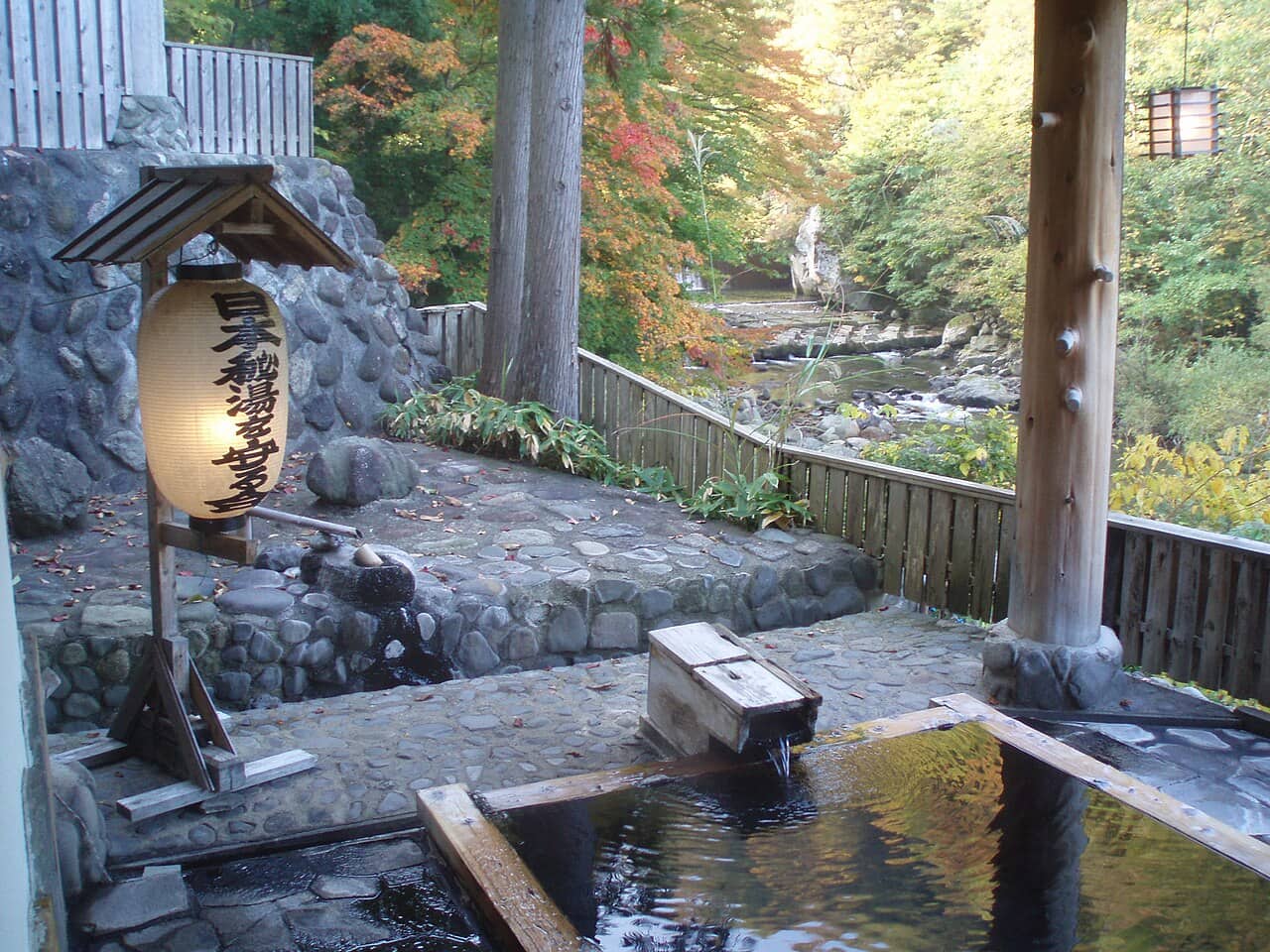
If you have tattoos and want to experience a Japanese onsen, you've probably seen two extreme answers online: "Japan bans tattoos in onsen, forget it," and "It's all relaxed now, don't worry." Both are wrong. The truth is simpler — you can do it, you just have to pick the right approach. A March 2016 Japan Tourism Agency circular already stated that refusing bathing solely on the ground of a tattoo is not appropriate, and the sign at the door was never law to begin with; even at traditional baths that still say "no tattoos," you have several clean workarounds: cover-up patches, private reservable baths, or an in-room bath. This guide skips the hand-wringing and gives you an actual, executable plan to soak with tattoos.
Here's the bottom line up front: if your tattoo isn't small, or you simply don't want to risk being asked to leave, the cleanest fix is one thing — book a ryokan with a "kashikiri-buro" (private reservable bath) or an in-room open-air bath. A private space with no strangers means your tattoo is a non-issue in almost every case. The other methods — cover patches, tattoo-friendly venues, small quiet baths — are backups for small tattoos, tighter budgets, or travellers who specifically want the big communal-bath atmosphere. Let's break each one down.
- Yes, with the right method — the "no tattoos" rule is a house rule, not law (the Public Bath Houses Act never mentions tattoos); the 2016 tourism agency circular calls blanket refusal inappropriate.
- The cleanest fix — book a ryokan with a kashikiri-buro or in-room open-air bath. Private space, zero awkwardness, tattoo is a non-issue.
- Cover small tattoos — "tattoo kakushi shiru" patches at Matsumoto Kiyoshi / Don Quijote, waterproof; three bathhouses cap it at two stickers of about 11 by 20 cm.
- Tattoo-friendly lists exist — JNTO and regions like Wakayama have lists; tattoo-friendly.jp too. Hokkaido and Beppu lean more relaxed.
- Policies change — never treat a named venue as guaranteed; email or call the property to confirm before you go.
Table of Contents
- Why Japanese Onsen Ban Tattoos
- Attitudes Are Relaxing: What Changed
- Four Routes: Your Full Tattoo Workaround
- Route 1: Pick Tattoo-Friendly Facilities
- Route 2: Cover Small Tattoos With a Patch
- Route 3: Private & In-Room Baths (Best)
- Route 4: Small, Quiet Establishments
- Checking Policy in Major Onsen Towns
- Quick Table: Which Route to Choose
- A Concrete Plan for Tattooed Travellers
- Frequently Asked Questions
Why Japanese Onsen Ban Tattoos
To beat the rule, first understand where it comes from. Japan's onsen tattoo ban is rooted in history, not aimed at foreign tourists: in Japanese society, tattoos have long been linked to organised crime — the yakuza. That association deepened when yakuza films boomed in the 1960s and 70s, putting heavily tattooed characters on screen and cementing a "tattoo = gang, danger" image in the public mind.
Go back further and you find that in 1872, during the Meiji era, the government banned decorative tattooing to project a "modern" image to the outside world, pushing tattoo culture underground. It was in that period that the yakuza adopted full-body tattoos as a symbol of commitment and identity, locking in the "tattoo = gangster" perception. Because onsen and sento are shared spaces where strangers bathe naked together in quiet, operators feared tattooed guests would unsettle other bathers — hence the "お断り" (refused) signs.
Attitudes Are Relaxing: What Changed
The good news: Japan's stance on tattoos has noticeably loosened in recent years, especially toward foreign visitors. A few drivers:
- The reality of the tourism boom — Western, Australian and NZ travellers treat tattoos as ordinary fashion with zero gang connotation. A blanket ban shuts out huge numbers of foreign guests, so tourism-oriented onsen towns began rethinking.
- The 2019 Rugby World Cup and Tokyo Olympics push — major international events made Japan aware that many foreign athletes and spectators are tattooed; tourism bodies encouraged facilities to take a more flexible approach to visitors' tattoos (offering cover patches, opening private baths, and so on).
- The administrative position — a Japan Tourism Agency circular dated 16 March 2016 states plainly that refusing bathing solely because a person has a tattoo is not appropriate, and asks recipients to note that a tattoo creates no hygiene problem; the Ministry of Health forwarded it on 18 March to prefectural, designated-city and special-ward public health divisions for onward notice to bathing facilities. ⚠️ In the interest of honesty: the widely repeated claim that around half of facilities have relaxed their policy has no traceable source that could be verified, so it is no longer cited here — the 2016 documents above are what can actually be checked.
- 🔴 But do not extrapolate that circular beyond the bath. The Tourism Agency version was addressed to exactly four bodies — the Japan Hotel Association, the All Japan City Hotel Federation, the Japan Ryokan Association and the Japan Spa Association — the Ministry of Health version went to the public health divisions that regulate bathhouses, and the famous sentence says bathing, not admission. No authority or trade body for pools, gyms, water parks, aquariums or beaches appears on either list, and those venues run a separate set of rules: see our pools, gyms and water parks guide.
So drop the outdated all-or-nothing line of "Japan bans tattoos, give up." The real answer today is "it depends on the venue and the method" — you absolutely can soak; you just need to know how to choose and how to prepare.
Four Routes: Your Full Tattoo Workaround
Here are all the workable approaches, ranked from "cleanest and least stressful" to "most challenging." Choose based on your tattoo size, budget and the atmosphere you want:
- Pick tattoo-friendly facilities — check lists and book baths or ryokan that clearly welcome tattoos.
- Cover a small tattoo with a patch — anything two cover stickers can hide, patched up before you enter the communal bath.
- Private / in-room baths (best) — a reservable or in-room private bath, no strangers, tattoo is a non-issue.
- Small, quiet establishments — small independent local baths at off-peak times tend to be more flexible.
For most tattooed travellers the winning combination is: build the trip around a ryokan with a private bath, and pack a box of cover patches for any small tattoo. Now let's go route by route.
Route 1: Pick Tattoo-Friendly Facilities
The most direct move is to start by choosing facilities that are explicitly tattoo-friendly, sidestepping all guesswork and awkwardness.
Where to find tattoo-friendly lists
- Official lists — JNTO and some regions (such as Wakayama) have published tattoo-friendly onsen lists; a good starting point.
- Dedicated directories — sites like tattoo-friendly.jp and tattoofriendlyonsen.com specialise in tattoo-friendly onsen and ryokan, filterable by region and facility type.
- Booking-site filters — some platforms let you filter by "kashikiri-buro" or "客室露天風呂" (in-room open-air bath), indirectly bypassing communal-bath tattoo rules.
Regions that lean more relaxed
- Hokkaido — higher overall acceptance of tattoos, linked historically to the Ainu people's traditional tattoo culture. Many onsen and super-sento there are more flexible.
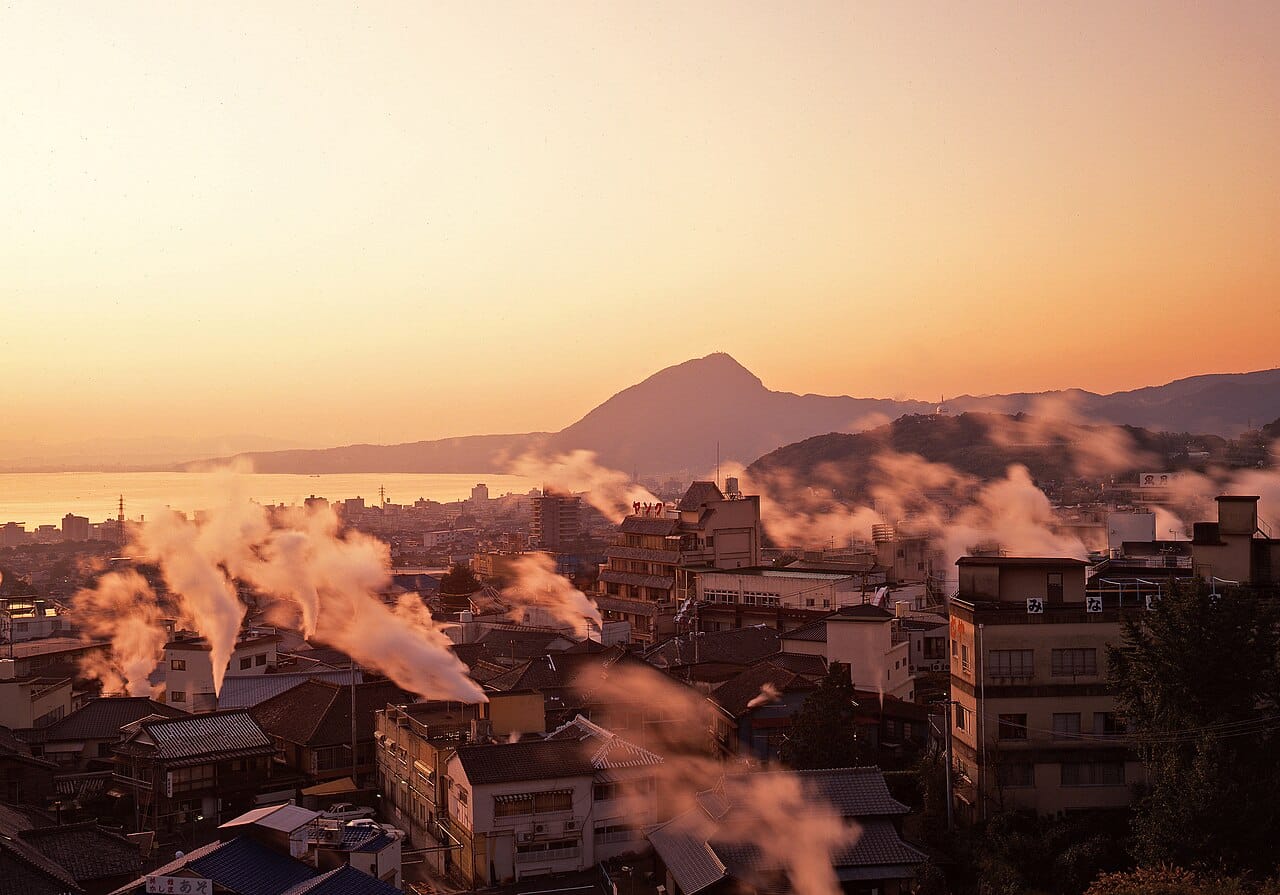
- Beppu (Oita) — known for welcoming tattooed visitors, with one of the largest concentrations of hot springs in Japan and plenty of choice. See our Beppu onsen guide.
- Big super-sento and newer ryokan — opening up more in recent years, but still confirm individually.
Route 2: Cover Small Tattoos With a Patch
If your tattoo is small, a cover-up patch is the least-hassle way into a communal bath.
Where to buy and what to get
- In Japan — drugstores and discount stores like Matsumoto Kiyoshi and Don Quijote (Donki) stock "tattoo kakushi shiru" (タトゥー隠しシール) and foundation tape — skin-tone, waterproof, heat-resistant cover patches.
- Pack from home — skin-tone waterproof bandages and elastic sports wrap are easy to buy before you fly; carry a few so you're not hunting for them on arrival.
How big a tattoo, and how to keep it on
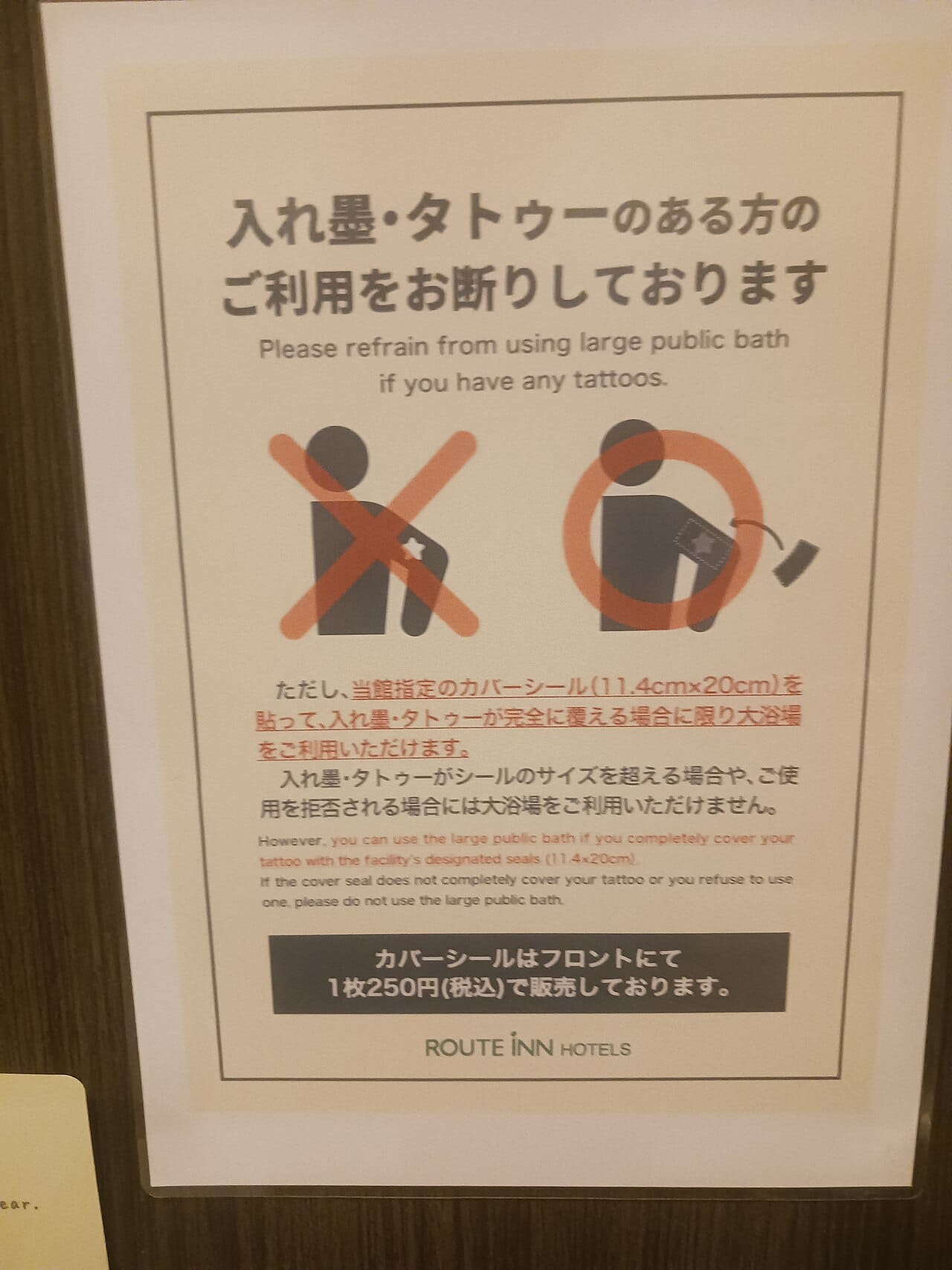
- Size limit — the government never gave a number, the venues did. The Tourism Agency circular only says "palm-sized", which is a comparison rather than a specification. Measurable figures come from three bathhouses: Dormy Inn lists 85×105 mm, 100×140 mm and 118×172 mm, two as a rule; Manyo Club in Toyosu caps it at 11 cm by 20 cm, two; Sayanoyudokoro in Itabashi the same, at 310 yen each. All three require their own stickers, so the ones you brought do not count; Manyo Club also wants it worn for your whole stay in the building, and Dormy Inn states it can run out. A small wrist, ankle, shoulder or nape piece is usually within range; full sleeves and back pieces are not — go straight to a private bath instead.
- 🔴 These are bathhouse specifications — don't carry them to other venues. Some pools and water parks state in writing that covering a tattoo with a T-shirt, rash guard, taping or a bandage still does not permit use, and eject you with no refund. The same sticker is a pass in one place and an aggravating factor in the other: see our guide to tattoo rules beyond the onsen.
- Application — apply to clean, dry skin; move gently in the water and avoid scrubbing so it doesn't peel; carry spares, since long soaks or repeated entries may need a fresh one.
Route 3: Private & In-Room Baths (Best)
This is the route I most recommend for tattooed travellers — no watching for reactions, no worrying about a patch peeling, no gambling on policy, just the soak itself. Two flavours:
Kashikiri-buro (private reservable bath)
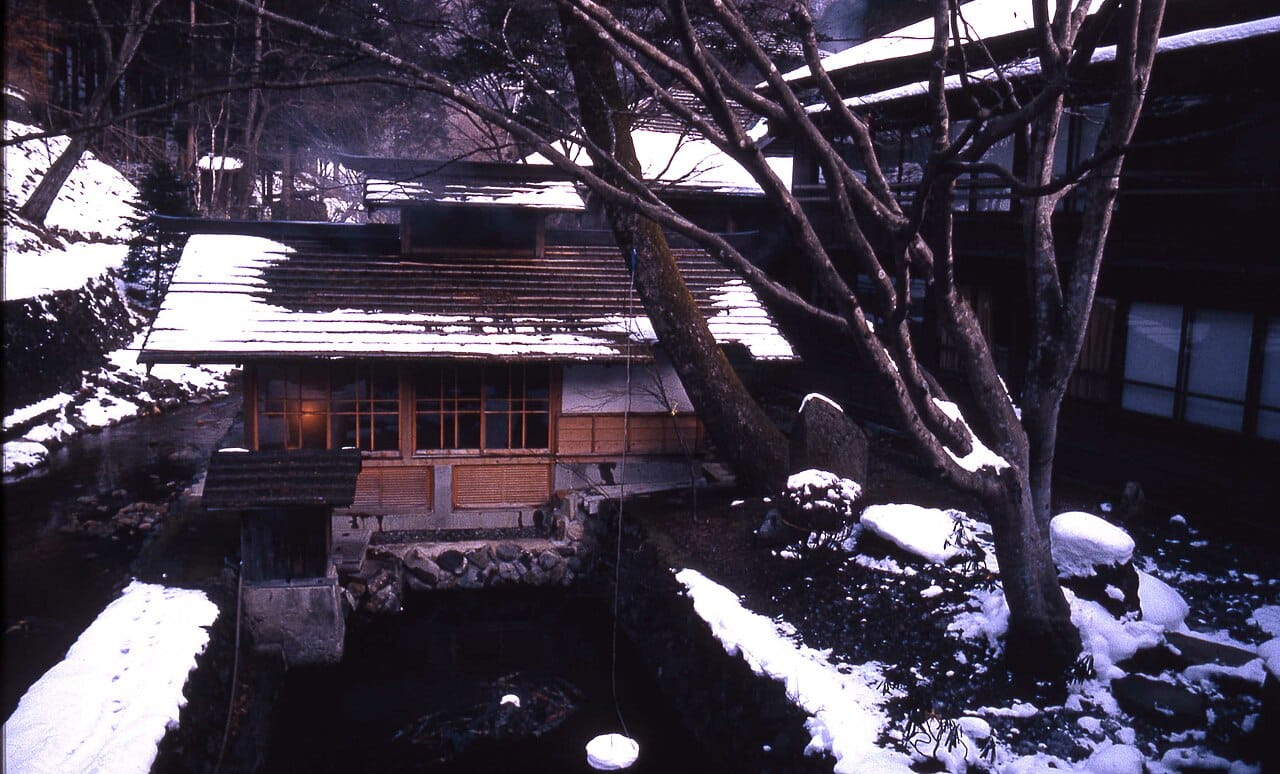
A "kashikiri-buro" (貸切風呂), also called a family bath, is a private bath room you reserve for about 45-60 minutes for just you (or your party). Because it's a private space with no strangers, tattoos are generally a non-issue. Cost varies by facility: some ryokan include it in the room rate, others charge a fee (commonly around 2,000-5,000 yen per session, depending on the property). You usually book your slot at the front desk on check-in, so reserve early at popular places.
In-room bath / in-room open-air bath
The ultimate, top-tier solution is a room with its own bath — a "kyakushitsu rotenburo" (in-room open-air bath). The guest room itself has a private tub or rotenburo, so you soak whenever you like without ever leaving the room or touching any communal space. For tattooed travellers this is the endgame: zero awkwardness, zero restriction, total privacy. It costs more than a standard room, but if soaking is the point of your trip and tattoos are a concern, it's money well spent. For how to choose a ryokan overall, see our best onsen ryokan picks.
Confirm a venue's rule on arrival: unlimited Japan eSIM (KKday) →Keywords to filter by when booking
- kashikiri-buro / family bath — private reservable bath
- 客室露天風呂 / in-room open-air bath — private bath in the room
- heyashoku (部屋食) — meals served in-room, which paired with an in-room bath means almost no communal areas at all
- When there's no clear label, just email the property and ask whether a private bath is available — fastest answer
Route 4: Small, Quiet Establishments
If your tattoo is small and you still want the communal big-bath atmosphere, this route is worth trying — but read the room.
- Choose small independent local baths over big chains — small, locally run baths are usually more flexible and check less strictly; large family-oriented super-sento tend to enforce the rule harder.
- Go at quiet times — weekday afternoons and early mornings are emptiest, so you're less likely to draw stares and the facility is less likely to object.
- Wash, cover, and drape a towel — scrub the tattoo clean, apply the patch on small pieces, and drape a small towel naturally over it as you enter the bath to lower its visibility.
- If the entrance clearly says "お断り", don't push it — respect the rule and switch to a private bath or another venue. Japanese society values "not causing trouble for others"; a low-key, polite stance is far better received than barging in.
Basic etiquette before soaking (wash thoroughly first, no towel in the water, keep quiet) applies to everyone, and a tattooed traveller who nails the etiquette does a lot to ease a facility's concerns. Full walkthrough in our Japan etiquette guide.
Checking Policy in Major Onsen Towns
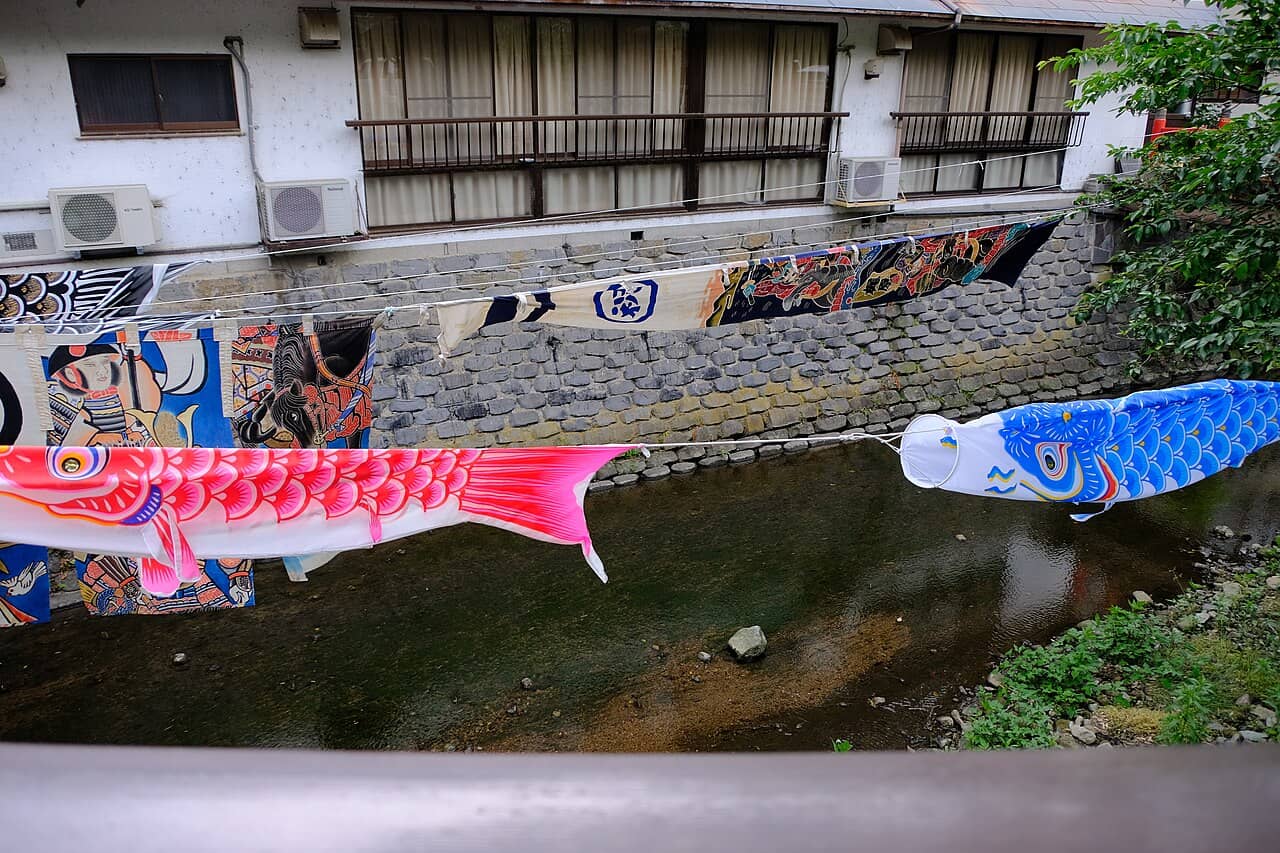
Every onsen town has a different character — some are "bathhouse-hop" towns built on public baths (where tattoo rules matter more), others are centred on in-ryokan baths (easy if you book a private bath). Here's how to vet each:
- Kinosaki Onsen (Hyogo) — famous for its "seven public bathhouse hop"; the soto-yu are communal baths, so confirm each one's rule ahead, or focus on staying at a ryokan with a private bath and using its in-house tub. See our Kinosaki onsen guide.
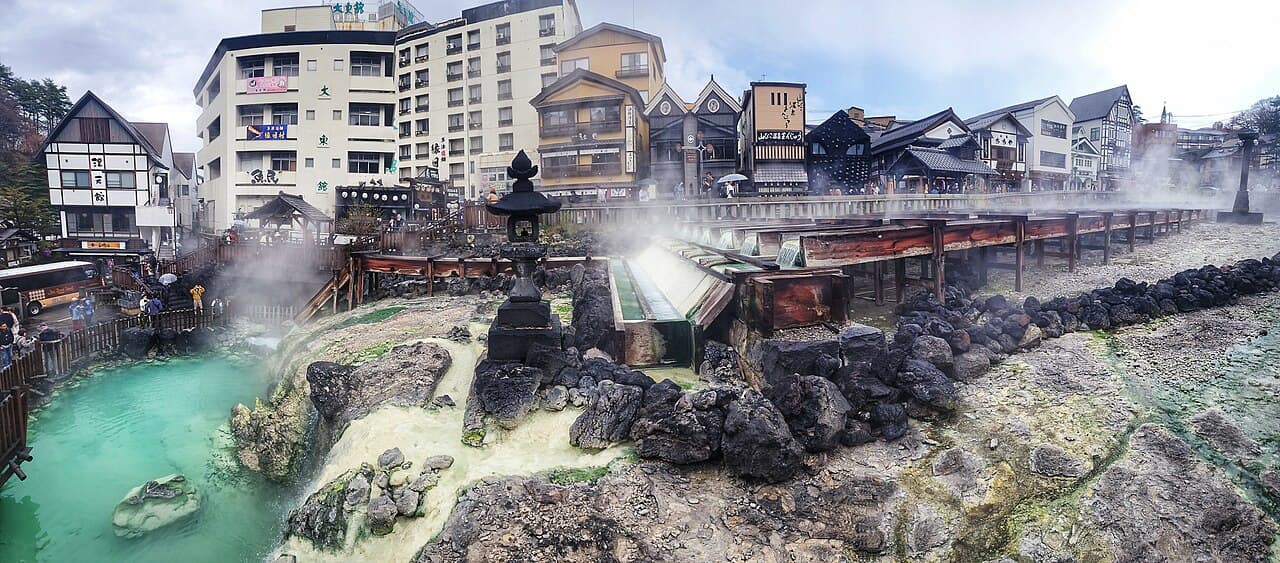
- Kusatsu Onsen (Gunma) — public baths around the Yubatake coexist with each ryokan's in-house baths; confirm with your target bath/ryokan ahead, and a ryokan with a kashikiri-buro is the safest bet. See our Kusatsu onsen guide.
- Beppu (Oita) — as noted, more tattoo-friendly overall, with huge volume and plenty of choice; a good fit for tattooed travellers.
- Hokkaido onsen — higher overall acceptance, but still confirm individually.
One rule sums it up: public bathhouses = confirm individually; private baths = safest. Design the trip around in-ryokan private baths as the backbone, with public bathhouses as a checked-ahead extra, and you minimise any tattoo roadblocks.
Quick Table: Which Route to Choose
| Route | Best for | Cost | Awkwardness risk |
|---|---|---|---|
| Tattoo-friendly facility | Want the communal bath, willing to check lists | Standard bath fee | Low (but confirm each policy) |
| Cover patch | Small tattoo (two 11×20 cm stickers cover it), saving money | A few hundred yen per patch | Medium (can peel; useless on big work) |
| Kashikiri-buro | Any tattoo size, want a private soak | ~2,000-5,000 yen/session (or in rate) | Very low |
| In-room open-air bath | Soaking is the priority, tattoo concern, budget OK | Higher room rate | None |
| Small quiet bath | Small tattoo, want the local bathhouse vibe | Standard bath fee | Medium-high (at the facility's discretion) |
In one line: big tattoo or zero-awkwardness needs → book a private bath; small tattoo and you want the communal bath → cover patch + tattoo-friendly facility. You can mix both.
A Concrete Plan for Tattooed Travellers
Here's the above turned into a copy-paste plan:
- Booking stage — for your key onsen nights, choose a ryokan with a kashikiri-buro or in-room open-air bath; filter by "kashikiri-buro" / "客室露天風呂". This locks in "I will definitely get to soak" up front.
- When you want a communal bath — if your tattoo is small, shortlist tattoo-friendly facilities from the JNTO / tattoo-friendly lists ahead of time and pack a box of cover patches; restock at Matsumoto Kiyoshi / Don Quijote on arrival.
- For bathhouse-hop towns (Kinosaki, Kusatsu, etc.) — lean on in-ryokan private baths and email/phone each public bathhouse ahead, rather than gambling on the spot.
- On site — nail the bathing etiquette (wash first, no towel in the water), keep a low profile; if a venue clearly says "お断り", respect it and switch to a private bath.
- Confirm ahead — check any named venue's tattoo policy before going. On arrival, a Japan eSIM makes it easy to check email and websites on the move.
One Last Reminder
Soaking in a Japanese onsen with tattoos isn't really about "can you" — it's about whether you'll spend ten minutes doing the homework. Book a ryokan with a private bath and you can sidestep nearly every tattoo restriction and soak in peace; for a small tattoo and a communal bath, pack a cover patch and pick the right venue and time, and it usually works too. The rest is nailing the bathing etiquette and respecting each facility's rule — Japanese society rewards the low-key, polite guest, not the one who pushes in. Put this plan in your luggage and your tattoos won't stand between you and a Japanese onsen.
Frequently Asked Questions
- Q1:Can you actually go to an onsen with tattoos in Japan?
- Yes — but you need the right venue or the right method; it is not a blanket nationwide ban. Many onsen and sento (public baths) post a sign reading "入れ墨・タトゥーお断り" (no tattoos), but that is a house rule set by each facility, not a law — the Public Bath Houses Act never mentions tattoos anywhere in its text, and the only clause compelling refusal is Article 4, covering a person judged to have a communicable disease (full legal breakdown in our Japan sento guide). Official attitude has shifted too: a March 2016 Japan Tourism Agency circular states that refusing bathing solely because someone has a tattoo is not appropriate, and the Ministry of Health forwarded it to prefectural health divisions two days later. That circular only reaches bathing, though — it was addressed to four hotel and onsen bodies, and its wording is about bathing rather than admission, so it does not cover pools, gyms, water parks or aquariums (see our guide to tattoo rules beyond the onsen). In practice you have four routes: (1) choose a tattoo-friendly facility; (2) cover a small tattoo with a patch; (3) book a ryokan with a private reservable bath (kashikiri-buro) or an in-room open-air bath; (4) pick small, quiet establishments. The cleanest, zero-awkwardness answer is route 3: book a room with its own private bath. Policies are at each venue's discretion and change, so confirm ahead.
- Q2:Why do Japanese onsen ban tattoos — is it anti-foreigner?
- It is mostly historical, not aimed at foreign tourists. In Japan tattoos have long been associated with organised crime (the yakuza) — an image reinforced by yakuza films in the 1960s-70s. Earlier still, decorative tattooing was banned in 1872 during the Meiji era as Japan projected a "modern" image, which pushed tattoo culture underground and entrenched the yakuza-tattoo link. Because onsen and sento are shared, quiet spaces where people bathe naked together, operators worried that visible tattoos would make other bathers uncomfortable, so the "no tattoos" sign became common. In other words, the sign targets other bathers' comfort, not your fashion tattoo specifically — which is exactly why covering up or bathing in a private space works in most cases.
- Q3:Where do I buy cover-up patches, and how big a tattoo can they hide?
- You can buy them at major Japanese drugstores and discount stores. Matsumoto Kiyoshi and Don Quijote (Donki) stock "tattoo kakushi shiru" (タトゥー隠しシール) and foundation tape — skin-tone, waterproof and heat-resistant cover patches. You can also pack waterproof skin-tone bandages from home as backup. But patches only work for small tattoos — and there are published measurements. The government never gave a figure (the Tourism Agency circular only says "palm-sized"); the venues did. Dormy Inn's FAQ lists 85 by 105 mm, 100 by 140 mm and 118 by 172 mm, two as a rule; Manyo Club in Toyosu and Sayanoyudokoro in Itabashi both cap it at 11 cm by 20 cm, two stickers (310 yen each at the latter). All three require their own stickers, so the ones you brought do not count there. Full sleeves and back pieces cannot be concealed — go straight to a private bath. Note that these are bathhouse-side specifications: some pools and water parks state in writing that covering a tattoo with a T-shirt, rash guard or bandage still does not permit use, and eject you without a refund — see our pools, gyms and water parks guide.
- Q4:What are kashikiri-buro and in-room baths, and how do they help with tattoos?
- This is the best and least stressful solution for tattooed travellers. A "kashikiri-buro" (貸切風呂, also called a family bath) is a private, reservable bath room you book for about 45-60 minutes for just yourself or your party. Because it is a private space with no strangers, tattoos are generally a non-issue. Some ryokan include it in the room rate; others charge a small fee (commonly around 2,000-5,000 yen per session, depending on the property). One step up is an "in-room bath" or in-room open-air bath (kyakushitsu rotenburo) — your guest room has its own private tub or rotenburo, so you can bathe any time without leaving the room. That is the ultimate fix: private, unrestricted, no awkwardness. Filter listings by "kashikiri-buro" or "客室露天風呂", or simply email the property to ask about a private bath.
- Q5:Are there tattoo-friendly onsen lists or official guides?
- Yes. JNTO (Japan National Tourism Organization) and some regions such as Wakayama have published tattoo-friendly onsen lists, and dedicated directories like tattoo-friendly.jp and tattoofriendlyonsen.com let you filter by area and facility type. Regionally, Hokkaido tends to be more relaxed about tattoos (linked to the Ainu people's traditional tattoo culture), and Beppu is known for welcoming tattooed visitors; many super-sento and newer ryokan have opened up too. That said — do not treat any named venue as guaranteed; policies change with ownership and complaints. The safe move is to shortlist from these lists or a booking site, then email or call the specific property to confirm its current rule before you go.
- Q6:I only have a small tattoo and want to try a public bath — any tips?
- You can try, but read the room. A small, discreet tattoo with a cover patch on is often fine at small, independent baths; large pieces in obvious spots (forearm, calf) are more likely to be turned away. To minimise friction: (1) choose quiet times (weekday afternoons, early mornings) and small local baths over big chains; (2) wash the tattoo thoroughly and apply the patch before entering; (3) drape a small towel naturally over it in the bath; (4) if the entrance clearly says "お断り", don't push it — respect the rule and switch to a private bath or another venue. Japan values "not causing trouble for others"; a low-key, polite approach is far better received than barging in. Basic bathing etiquette is in our Japan etiquette guide.
Read next
5 Best Japanese Onsen Ryokans 2026
From a 1925 Cultural Property to Michelin 3 Key — five definitive Japanese onsen inns.
Japan Etiquette 2026: Trains, Onsen & Dining Dos & Don'ts
Tipping can offend, never stand chopsticks in rice, wash before the onsen, stand left in Tokyo but right in Osaka. The mistakes tourists actually make — and which rules are overblown.
Beppu Onsen Guide 2027: The Hells, Sand Baths & Beppu Hatto
Japan's highest hot-spring output — the seven hells, a seaside sand bath, Kannawa steam cooking and the Beppu Hatto.