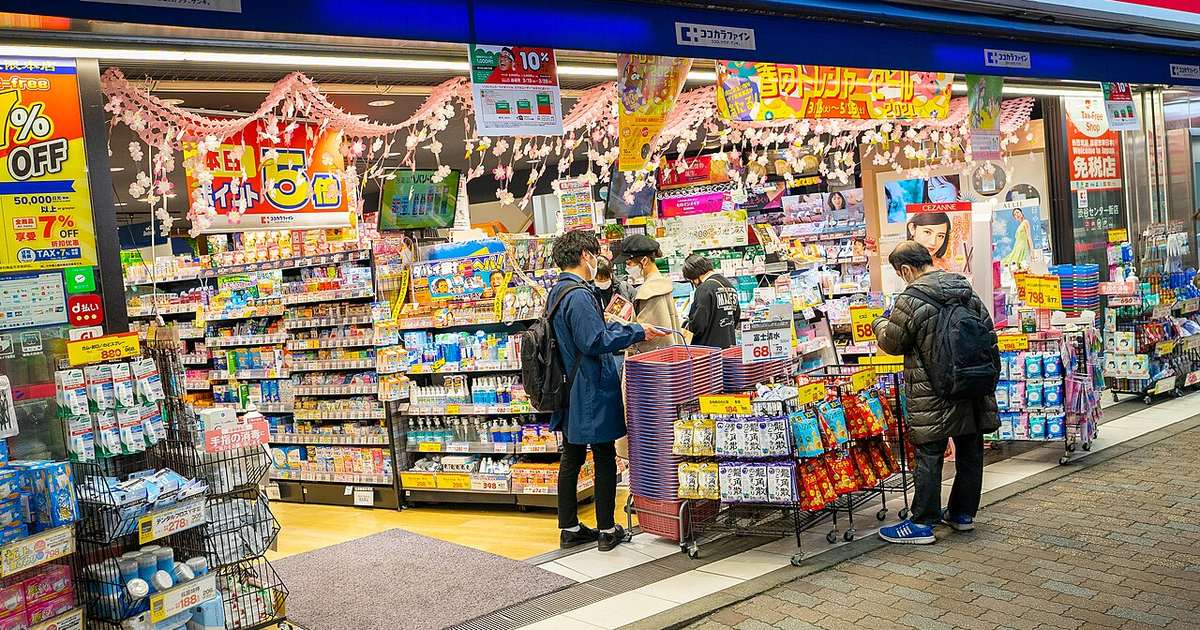
Take two identical boxes of cold medicine to a Japanese drugstore counter and one of them goes back on the shelf — and that has been true since 1 April 2023, not since 2026. Which means the widespread impression that last winter you could stock up and this winter you cannot is simply wrong: on the question of how many boxes you may buy, those two winters ran under the same rule. What actually changed on 1 May 2026 is three other things. That vague "one package" became a number you can work out yourself at the shelf — one package, not exceeding five days' worth of doses, or seven for cold remedies and a few related categories. The ingredient list went from six to eight, and the two additions land on the cough suppressant found in most Japanese cold remedies and on the active ingredient of the country's best-known sleep aid. And beside that stretch of shelf, the law now requires a qualified human being to be standing there.
Who this does not affect, stated up front: if you are buying one box of cold medicine, nothing happens — not even an extra sentence at the till. Two groups run into this system: people wanting two or more units at once, and people reaching for a large-volume pack. Scope note: this covers buying medicine over the counter in Japan. Bringing your own medication into Japan is a separate regime enforced by a different agency, and it is covered in the guide to medication and Japanese customs.
- One package per person dates from 2023, not 2026. What is new is that it now has a number attached: one package, not more than five days' worth, or seven days for cold remedies, oral rhinitis medicines and antipyretic analgesics.
- Switching brands does not work. Official guidance says one unit each of different products sharing the same designated ingredient still counts as a multiple sale.
- The age is 18, and that number sits in an ordinance rather than in the Act. Under-18s asking for more than the ceiling fit neither statutory carve-out, so there is no route to a sale.
- The box mark reads in one direction only. Printed means listed; absent means nothing, because old-style labelling stays valid until 30 April 2029.
- No passport needed. The official wording accepts self-declaration where the customer obviously looks over 18. None of the eight source documents mentions foreign customers at all.
📖 Contents
- Is the one-box limit actually new in 2026?
- How many is too many, and can I work it out myself?
- Does buying a second box of another brand count?
- Which medicines got pulled in?
- What does the 要確認 mark on the box mean?
- Is the age limit 18 or 20?
- Why are these medicines behind glass now?
- Do I need my passport to buy cold medicine?
- Is buying online inside Japan easier?
- So how should I actually buy it?
- Appendix: official Japanese source texts
Is the one-box limit actually new in 2026?
No. It has been written into a Ministry of Health, Labour and Welfare director-general notice since 1 April 2023. That notice defines the quantity considered necessary for proper use as, in principle, one package unit per person per pharmacological category — one box, one bottle, and so on. It even works the example: where the products serve different purposes, such as an antipyretic analgesic and a rhinitis medicine, the proper quantity is one package of each.
Getting this straight matters for how you plan a trip. The winter of 2025 and the winter of 2026 ran under the same rule on the question of how many boxes. If a shop assistant put a second box back last year, that was not a new law arriving early. That was the law.
There is a second, equally common misreading. The old list already held six ingredients, and the 2023 revision widened rather than narrowed it: it stripped the qualifier limiting codeine and dihydrocodeine to cough and expectorant preparations, and the one limiting methylephedrine to oral liquids. Combination cold remedies as a whole have been inside this system since then.
A note on source grade. That 2023 notice (Yakuseihatsu 0208 No. 1, 8 February 2023) was repealed when the new system took effect, and the replacement notice says so explicitly. The full text used here came from a PDF mirrored on a Japanese prefectural government site, not from the ministry's own domain. The content is the ministry's; the hosting is not.
So what did 1 May 2026 change
Side by side is the fastest way to see it. Every section below unpacks one row of this table.
| 1 Apr 2023 – 30 Apr 2026 | From 1 May 2026 | |
|---|---|---|
| Ingredients listed | 6 | 8 (adds diphenhydramine, dextromethorphan) |
| Legal level | Compliance item under ordinance | Statute (Act Art. 36-11), with an express prohibition |
| Definition of "one box" | "In principle one package per person" — no number | One package, not exceeding 5 days' doses (7 for cold remedies etc.), Notification No. 33 |
| Age | "Young persons" | 18, set by ordinance |
| Above the ceiling | Sold after confirming the reason | Prohibited by default; released only by in-person explanation. No release at all for under-18s |
| Display | Designated Class 2 within 7 m; no staffing requirement | Locked or out of reach, or within 7 m with staff continuously stationed |
| Box labelling | None | 要確認 (the 要 enclosed on large packs), on the barcode face |
| Store obligations | — | Must adopt a written sales procedure manual |
How many is too many, and can I work it out myself?
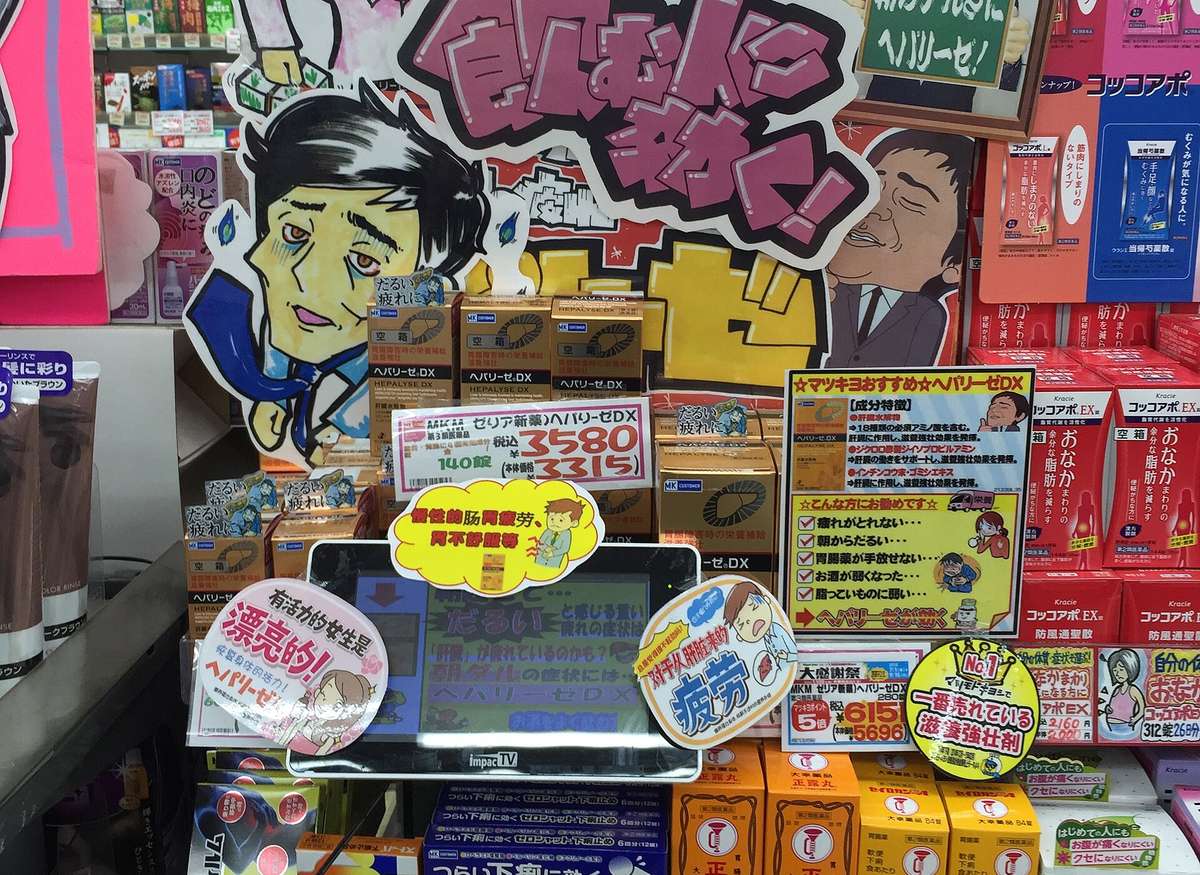
One package, and that package must not exceed five days' worth of doses; cold remedies, oral rhinitis medicines and antipyretic analgesics stretch to seven, depending on the ingredient. Ministry Notification No. 33 of 2026 is the first version of this rule written as something you can compute at the shelf rather than something you have to ask about.
The wording ties the quantity to the product's own label: one package which, judged against the stated dosage and administration, does not exceed the number of days in the right-hand column. By ingredient:
| Ingredient | Ceiling | Stretched to 7 days for |
|---|---|---|
| Ephedrine | 5 days | — |
| Codeine | 5 days | — |
| Dihydrocodeine | 5 days | Cold remedies |
| Diphenhydramine | 5 days | Cold remedies |
| Dextromethorphan | 5 days | Cold remedies |
| Pseudoephedrine | 5 days | Cold remedies, oral rhinitis medicines |
| Bromvalerylurea | 5 days | Antipyretic analgesics |
| Methylephedrine | 5 days | Cold remedies, oral rhinitis medicines |
Two conversion rules sit in the implementing notice, and they matter for children's formulations and single-dose products: where the dosage varies by age, convert using the age with the largest daily dose; for single-dose medicines, convert using the maximum daily amount.
Run the arithmetic on a real product
Here is what the calculation looks like with a product whose figures are published. Drewell's official dosage is two tablets once daily before bed, so two tablets a day. Its designated ingredient, diphenhydramine, carries the five-day ceiling — the seven-day stretch applies to cold remedies, and Drewell is a sleep aid, so it does not qualify. Five days at two tablets a day is ten tablets. The manufacturer lists two pack sizes, 6 tablets and 12 tablets. The 6-tablet pack sits inside the line; the 12-tablet pack works out at six days and is therefore over the ceiling as a single box.
Be clear about what that calculation is. The ministry has published no product-by-product determinations at all. The paragraph above takes the dosage the manufacturer publishes and substitutes it into the day counts in the notification. It is arithmetic from official figures, not an official ruling, and the counter has the final say.
Which reduces the pre-purchase action to one move: turn the box over to the dosage panel and divide the pack size by the daily dose. Anything above five days — or seven, for the categories listed above — is the line, and Japanese family-size packs frequently sit right on it. Those large packs are, of course, exactly the ones that look like the best value to a visitor comparing prices back home; that comparison is worked through in the piece on what is genuinely cheaper in Japan.
Does buying a second box of another brand count?
Yes, it counts. This is the least intuitive rule in the whole system, and the official wording leaves no room: selling one unit each of different products containing the same designated ingredient still constitutes a multiple sale.
What is regulated is the ingredient, not the brand. One box of A plus one box of B is two boxes as far as the law is concerned, provided they share a listed ingredient. The obvious workaround was closed before the notice was published.
The reverse direction is written down too, and it works in your favour: one unit each of products containing different designated ingredients does not exceed the ceiling. A box of cold medicine plus a box of rhinitis medicine with a different designated ingredient is a legitimate purchase. The same passage adds that a pharmacist or registered seller may still ask what you are using them for, on duplicate-medication and interaction grounds.
Translated into a trip decision: if the plan was to buy for the whole family in one stop, the plan needs changing. Three things work instead — buy across separate visits, buy the smaller pack, or accept that the second box is not happening. The third sounds defeatist; it is also the outcome the system is designed to produce.
Which medicines got pulled in?
Eight ingredients, and the two additions land on the two categories visitors buy most. Ministry Notification No. 32 of 2026, issued 13 February and applied from 1 May, lists them all with the same proviso attached to each — external preparations excluded.
| # | Ingredient | Where you meet it |
|---|---|---|
| 1 | Ephedrine | Cough and rhinitis preparations |
| 2 | Codeine | Cough suppressants |
| 3 | Dihydrocodeine | Cough suppressants, combination cold remedies |
| 4 | Diphenhydramine (new) | Antihistamine; also the active ingredient in the sleep aid Drewell |
| 5 | Dextromethorphan (new) | Cough suppressant, extremely common in Japanese cold remedies |
| 6 | Pseudoephedrine | Nasal congestion; Pabron Ace Pro-X contains it |
| 7 | Bromvalerylurea | Sedative and analgesic preparations |
| 8 | Methylephedrine | Cough suppressants, combination cold remedies |
The two additions deserve separating out. Dextromethorphan is a cough suppressant that turns up in a large share of Japanese combination cold remedies. Diphenhydramine drags the entire sleep-aid category into the system for the first time — the manufacturer's own ingredient table for Drewell lists 50 mg of diphenhydramine hydrochloride per two tablets, and before 1 May 2026 that product was not on any version of this list. If a sleep aid is on your shopping list, that is the line item to know about.
Three boundaries that are easy to miss
- Kampo preparations are outside it. The director-general notice states that preparations whose principal active ingredients are crude drugs are not included.
- External preparations are excluded, and the category is wider than it sounds. It follows the definition in the general rules for preparations in the Japanese Pharmacopoeia: troches, inhalations, eye drops, ear drops, nasal drops and sprays, suppositories, ointments and patches. So a nasal spray is outside this system while an oral rhinitis medicine with the same ingredient is inside it — worth knowing if you arrive in pollen season, which is covered in the hay fever guide.
- Derivative names count too. Dihydrocodeine sexanol and hydrocodone phosphate sexanol both fall inside the list.
Why there is no safe-product list here
Because the ministry has not published one, and its chosen mechanism is the mark on the box described in the next section. Two products were confirmed against manufacturer pages for this article. Two others in the same family could not be: their ingredient tables are rendered by JavaScript, and all eight ingredient names returned zero hits in the retrieved source. That zero is an artefact of how the page was fetched, not evidence the products are clean.
Hence the rule this guide follows, in one direction only: name a product that contains a designated ingredient, never name one that does not. To judge the box in your hand, read on.
What does the 要確認 mark on the box mean?
It is a mark manufacturers are required to print, and it reads in one direction only: printed means listed, absent means nothing.
The enforcement notice specifies two visual forms:
| Product type | What is printed |
|---|---|
| Contents at or below the ministry-set quantity | 要確認 inside a square black border |
| Everything else (large-volume products) | 要確認 with the character 要 enclosed in a circle or box |
The remaining specifications: 8 pt type or larger, black on black border — white on white permitted where the box colour makes it unreadable — and it must go on the face carrying the barcode. PTP blister foil does not count as the direct container, so do not go looking for it on the tablet sheet.
The transition period is three years, and it is the most important sentence in this section. Under Article 8 of the supplementary provisions of the amending Act, products bearing old-standard labelling are treated as compliant with the new labelling for three years from the date the rules took effect, provided they are manufactured or sold within one year of 1 May 2026 — which runs to 30 April 2029. Until then, marked and unmarked stock sit on the same shelf. Manufacturers may also add the mark by sticker.
Stated as something you can carry into a shop: if you see 要確認, you know it is on the list; if you do not see it, the only move left is to ask at the counter.
Is the age limit 18 or 20?
Eighteen — and that number sits in a ministerial ordinance, not in the Act. The distinction is not pedantry. Article 36-11(3) of the Act refers to an age specified by ministry ordinance; the figure is fixed at eighteen by Article 159-18-6(2) of the Enforcement Regulation. Ordinances are amended faster than statutes, so do not file this away as "the Act says 18".
The structure of the provision is harder than either "must confirm" or "may refuse". It is a default prohibition with two carve-outs. Laid out in four cells:
| Your situation | What the law says |
|---|---|
| 18 or over × within the quantity | 🟢 Buy it. Not even an extra sentence at the till |
| 18 or over × above the quantity | 🟡 Prohibited by default; released once a pharmacist or registered seller explains in person or by an equivalent method |
| Under 18 × within the quantity | 🟡 Same in-person requirement, plus your name is recorded |
| Under 18 × above the quantity | 🔴 Neither carve-out applies. No release condition exists; the sale does not happen |
The fourth cell is the hardest one in this article, and it falls straight out of the structure: one carve-out covers sales to professionals, the other covers customers at or above the specified age, and someone under 18 asking for more than the ceiling is in neither. Industry guidance renders it as counter procedure — such sales are prohibited, staff should explain that this is a statutory requirement and decline, and where appropriate offer a smaller pack.
A second prohibition that has nothing to do with quantity
Even at 18 or over, even buying a single box, the law requires the seller to refuse if they judge that proper use cannot be assured. Article 36-11(4) is a free-standing prohibition, and its verb is the flat Japanese negative imperative — a ban imposed on the store, not discretion granted to it. Industry guidance turns it into procedure: hold the sale until the doubt is resolved, and decline where selling is judged inappropriate.
"In person or equivalent" is not the same as face-to-face
The term is defined tightly. It includes video call systems but expressly excludes telephone, written correspondence and chat, on the stated ground that methods which cannot show the other party's image in real time do not qualify. Inside a physical shop it means one thing: a qualified person talks to you directly. A general cashier cannot complete that transaction.
So if you are over the ceiling or under 18, the till stops while someone is fetched. That is not the assistant being difficult; it is the statutory condition for releasing the prohibition.
Why are these medicines behind glass now?
Because the law offers stores two compliance routes, and both change how you get hold of the product. Article 218-5 of the Enforcement Regulation gives Class 2 and Class 3 designated abuse-prevention medicines a choice:
- Place them inside a designated display zone, or lock them away, or keep them in fixtures customers cannot reach directly; or
- Display them within seven metres of an information-provision counter which has a pharmacist or registered seller continuously stationed at it.
One point here is easy to get wrong, so state it directly: the seven-metre distance is not the new part. Designated Class 2 medicines were already required to sit within seven metres of an information-provision counter under Article 218-4(2). What the old rule lacked was any requirement for a person to be there, and it offered two exemptions — locking the stock away, or controlling access within 1.2 metres of the fixture. The new rule's substance is the continuously stationed person, and the 1.2-metre exemption is gone.
Which becomes two things you will see on the floor:
| What you see | How to buy it |
|---|---|
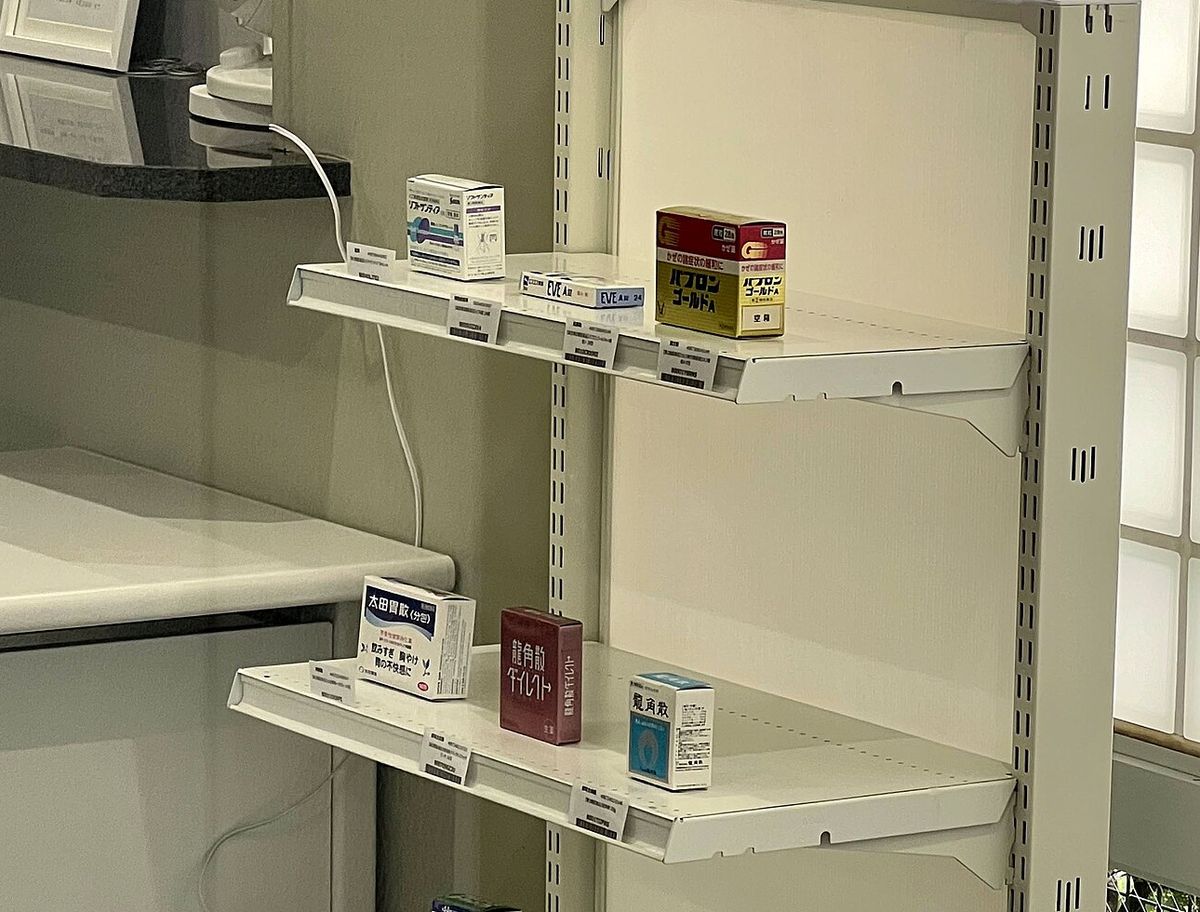
| An empty box or a product card on the shelf | Carry it to the counter and exchange it for the real thing. This is not a stock-out |
| A locked glass cabinet | Ask a member of staff to open it; the key is in principle held by a qualified person |
The official Q&A confirms that empty-box display is lawful, and that compliance is judged by where the actual stock is kept, not where the empty box sits. The same Q&A settles a small point that says a lot about how tightly this is drawn: the person required to be continuously stationed must have even brief absences — a drink, a bathroom break — written into the store's procedure manual in advance.
For anyone on a schedule the practical conclusion is short: budget the time it takes to find a member of staff. Over-the-counter medicine is no longer reliably a grab-and-go purchase, least of all in the big chains in tourist districts, where the checkout and tax-free mechanics are covered in the Matsumoto Kiyoshi guide.
Do I need my passport to buy cold medicine?
No. The official wording says that where the customer is obviously 18 or over from appearance, confirmation by self-declaration is acceptable. The director-general notice frames it as a case where the selling pharmacist can reliably establish age. Only where appearance does not clearly settle the question does the ministry say that presenting identification, or using registered membership information, becomes appropriate.
Industry guidance adds a line pointing the same way: where staff cannot establish that the customer is 18 or over, the recommended response is to suggest a small single pack, not to turn the customer away.
The rules make no distinction by nationality, and on language the ministry has written nothing
Across the eight official documents reviewed for this article, the Japanese terms for foreigner, inbound visitor, tourist, residence status, passport, Japanese language and English all return zero hits. Those eight are two notifications, three director-general and enforcement notices, one Q&A, and two sets of industry guidance. The last of them is the one that carries weight: the guidance the drugstore chain industry wrote for its own member stores, intended as counter procedure, does not mention foreign customers or language anywhere in it. The thresholds in this system are age and quantity.
One layer needs flagging as inference rather than official position. The regulation requires staff to provide information individually and to confirm that the customer has understood it and whether they have questions; Article 36-11(4), quoted above, then prohibits the sale where proper use cannot be assured. Stack those two and a customer who cannot follow the explanation is, in theory, more likely to get stuck in exactly the situations that require one. But the ministry has never written anything about language, and what actually happens when the explanation does not land is not addressed in any of these documents. Treat the paragraph above as reasoning, not as a rule.
The only place in the official material that touches on carrying medicine out of the country addresses Japanese residents travelling abroad, not inbound visitors. It cannot be turned around and cited as official permission for tourists to buy more. What you may bring home is a separate country's separate regime — for the Taiwan side of that, see the customs and quarantine guide for goods leaving Japan.
Is buying online inside Japan easier?
It is harder, and for a visitor considerably harder. For distance selling, the official Q&A requires age verification that is objective and not based on self-declaration.
Four worked examples are given: uploading identification, age authentication via a My Number card, using a mobile carrier's contract data, or restricting payment to credit card. The same passage undercuts the last one, noting that internationally branded prepaid cards — obtainable by under-18s — defeat it.
Of those four, a short-stay visitor typically holds none: no My Number card, no Japanese mobile contract, and identification and card acceptance vary by retailer. In-store, meanwhile, an adult who obviously looks over 18 clears the check by saying so. The conclusion is blunt: this is not a problem to solve online. Walk in and ask someone.
So how should I actually buy it?
Do these five things and the counter will not be a problem.
- Do the arithmetic first. Turn the box to the dosage panel and divide the pack size by the daily dose. Anything over five days — or seven, for cold remedies, oral rhinitis medicines and antipyretic analgesics — is the line, and it is where large family packs tend to land.
- Wanting two boxes means checking the ingredients first. If the designated ingredient is the same, switching brands achieves nothing.
- Look for 要確認 on the box. Printed means it is on the list. Absent proves nothing, and the only move then is to ask.
- An empty box or a locked cabinet means find staff. It is neither a stock-out nor a refusal.
- If the second box is not happening, accept it. Buying across separate visits or dropping to a smaller pack are the alternatives the industry's own guidance names.
If only one of those survives the flight, make it the second. Reaching for a different brand is the one move in this system that looks entirely reasonable and walks straight into the rule — the other four cost you five minutes, while that one is discovered at the till.
What this guide deliberately does not cover
The boundaries, stated rather than left implicit. These are the things I did not verify, or that the ministry does not address at all:
- No penalty figures. The provisions and amounts applying to stores that breach Article 36-11 were not verified here, nor was the question of whether the purchaser bears any liability. On the face of the text, the obligations fall on the seller.
- Nothing on how this interacts with tax-free shopping. The Japanese term for duty-free returns zero hits across all eight documents. The two regimes are independent, and welding them together would mean inventing a causal link.
- No estimate of how many products are affected. A product-level search of the pharmaceutical agency's OTC database returned no usable result, so no figure is offered.
- No official English-language material obtained. The ministry's English site returned 403 here. That is a failure to retrieve, not proof that nothing exists.
And one situation this guide cannot help with: when what you need is not an over-the-counter product at all. Where Japanese OTC medicine stops working, the next step is a clinic, and the cost structure and billing risks of that route are set out in the guide to what medical treatment costs in Japan.
Appendix: official Japanese source texts (click to expand)
The Japanese originals quoted above, collected here so you can check them yourself.
1. Where "one package per person" comes from (Yakuseihatsu 0208 No. 1, 8 Feb 2023, item 2(1))
適正な使用のために必要と認められる数量とは、原則として、薬効分類ごとに1人1包装単位(1箱、1瓶等)である。よって、例えば解熱鎮痛薬と鼻炎薬など、使用目的が異なる医薬品を販売等する場合には、それぞれの用途ごとに1人1包装ずつを適正数量とする。
This notice was repealed when the new system took effect. The full text used here came from a PDF mirrored on a prefectural government site, not from the ministry's own domain. The old list held six ingredients and applied from 1 April 2023.
2. The eight ingredients (Ministry Notification No. 32 of 2026, applied 1 May 2026)
一 エフェドリン ただし、外用剤を除く。
二 コデイン ただし、外用剤を除く。
三 ジヒドロコデイン ただし、外用剤を除く。
四 ジフェンヒドラミン ただし、外用剤を除く。
五 デキストロメトルファン ただし、外用剤を除く。
六 プソイドエフェドリン ただし、外用剤を除く。
七 ブロモバレリル尿素 ただし、外用剤を除く。
八 メチルエフェドリン ただし、外用剤を除く。
The accompanying director-general notice adds: preparations whose principal active ingredients are crude drugs are not included; the scope of "external preparations" follows the Japanese Pharmacopoeia general rules (troches, inhalations, eye drops, ear drops, nasal preparations, suppositories, ointments, patches); dihydrocodeine sexanol and hydrocodone phosphate sexanol are also covered.
3. The quantity ceiling (Ministry Notification No. 33 of 2026, implementing notice)
一包装であって、かつ、次の各欄に掲げる指定濫用防止医薬品ごとに、当該指定濫用防止医薬品の用法及び用量からみて表の右欄に掲げる日数分の数量を超えないものとする。
Conversion rules (item 2): where the dose differs by age, convert using the age with the largest daily dose; for single-dose medicines, convert using the maximum daily amount.
4. Switching brands still counts (director-general notice, 4-1(5))
同一指定成分を含有する異なる製品を一つずつ販売する場合にあっても、複数個の販売に該当するものであること。
異なる指定成分を含有する製品を一つずつ販売する場合にあっては、厚生労働省告示において定める数量を超えた指定濫用防止医薬品の販売に当たるものではない
5. Default prohibition and its two carve-outs (Act Art. 36-11(3))
薬局開設者、店舗販売業者又は配置販売業者は、指定濫用防止医薬品ごとに厚生労働省令で定める数量を超えて指定濫用防止医薬品を販売し、若しくは授与し、又は厚生労働省令で定める年齢に満たない者に指定濫用防止医薬品を販売し、若しくは授与してはならない。ただし、次の各号のいずれかに掲げるとき…は、この限りでない。
一 薬剤師等に販売し、又は授与するとき。
二 …購入し、又は譲り受けようとする者が厚生労働省令で定める年齢以上の者その他厚生労働省令で定める者である場合において、…薬剤師又は登録販売者に、対面等により、第一項本文の規定による情報の提供を行わせるとき。
6. The free-standing second prohibition (same article, paragraph 4)
第一項本文の規定による情報の提供ができない場合その他指定濫用防止医薬品を使用しようとする者の適正な使用を確保することができないと認められる場合には、指定濫用防止医薬品を販売し、又は授与してはならない。
Industry guidance renders this as procedure: hold the sale until the doubt is resolved; decline where selling is judged inappropriate.
7. Age 18 (Enforcement Regulation Art. 159-18-6(2))
法第三十六条の十一第三項本文及び第二号の厚生労働省令で定める年齢は、十八歳とする。
Director-general notice 4-1(4)(c): where the customer is under 18, the name must also be confirmed. Not required at 18 or over.
8. Under-18 requests above the ceiling (drugstore chain industry guidance)
18 歳未満の者への大容量製品又は複数個の販売は禁止されており、求めがあっても法令上の規定である旨を伝え謝絶し、必要に応じ小容量製品での代替の提案等を行う。
9. What "in person or equivalent" excludes (director-general notice)
相手の映像をリアルタイムで認識できない電話や書面を通じたやりとりのみによる方法、チャット等による方法は含まれない
10. When self-declaration suffices (director-general notice 4-1(4)①)
年齢の確認については、例えば対面での販売において外見等から、18 歳以上である旨が明らかな場合など、販売を行う薬剤師等が確実に年齢を確認できる場合には、自己申告等による確認で差し支えないこと。
11. The duty to confirm understanding (Enforcement Regulation Art. 159-18-2)
情報の提供を受けた者が当該情報の提供の内容を理解したこと及び質問の有無について薬剤師等に確認させること
12. Display (Enforcement Regulation Art. 218-5 and Art. 218-4(2))
New rule: Class 2 and Class 3 designated abuse-prevention medicines must be placed in a designated display zone, locked away, or kept in fixtures customers cannot directly reach; or displayed within seven metres of an information-provision counter at which a pharmacist or registered seller is continuously stationed. Old rule (Art. 218-4(2)): designated Class 2 medicines within seven metres of an information-provision counter, with exemptions for locked storage and for access control within 1.2 metres of the fixture, and no staffing requirement.
13. Labelling and the three-year transition (enforcement notice; amending Act supplementary provision 8)
Products at or below the ministry-set quantity carry 要確認 in a square black border; others carry it with 要 enclosed in a circle or box. Type 8 pt or larger, black on black border (white on white permitted where legibility requires), printed on the face bearing the barcode. PTP blister foil is not the "direct container". Transition: products labelled to the old standard and manufactured or sold within one year of the effective date are treated as compliant for three years from that date, to 30 April 2029. The mark may also be added by sticker.
14. Online age verification (Q&A administrative communication)
Distance selling requires objective verification not based on self-declaration. Examples given: uploaded identification, My Number card age authentication, mobile carrier contract data, or payment restricted to credit card — with the caveat that internationally branded prepaid cards, obtainable by under-18s, defeat the last method.
15. Empty-box display and continuous staffing (Q&A administrative communication)
Q4: empty-box display is lawful, and compliance is judged by where the actual stock is displayed, not the empty box. Q3: brief absences by the continuously stationed staff member (drinks, bathroom) must be set out in the store's procedure manual in advance.
16. What I could not obtain / what the ministry does not address
Penalty provisions and amounts for breaches of Article 36-11 were not verified. The interaction between tax-free shopping and these rules returns zero hits across all eight documents. A product-level search of the pharmaceutical agency's OTC database returned no usable result. The ministry's English-language site returned 403.
Frequently Asked Questions
- Q1:How many boxes of cold medicine can I buy at once in Japan?
- One package, and that package must not exceed five days' worth of doses — seven days for cold remedies, oral rhinitis medicines and antipyretic analgesics, depending on the ingredient. The one-package-per-person part is not new: it has been written into a Ministry of Health, Labour and Welfare director-general notice since 1 April 2023. What arrived on 1 May 2026 is the day count. Ministry Notification No. 33 of 2026 defines the ceiling as one package whose quantity, judged against the product's own stated dosage, does not exceed the listed number of days. That makes it the first version of this rule a shopper can verify without asking anyone: divide the pack size by the daily dose printed on the box. Note that the ceiling is counted per ingredient, not per product, so two different brands sharing one designated ingredient are added together.
- Q2:Can I just buy a second box of a different brand instead?
- No, and this is the single most counterintuitive rule in the system. The director-general notice states it flatly: selling one unit each of different products that contain the same designated ingredient still counts as a multiple sale. What is regulated is the ingredient, not the brand, so one box of brand A plus one box of brand B is two boxes in the eyes of the law when they share a listed ingredient. The reverse direction is also written down, and that half is good news: one unit each of products containing different designated ingredients does not constitute a sale above the quantity ceiling — a box of cold medicine plus a box of rhinitis medicine with a different designated ingredient is fine. The same passage adds that a pharmacist or registered seller may still ask you about it, on duplicate-medication and interaction grounds.
- Q3:Do foreign tourists need a passport to buy cold medicine in Japan?
- No, and the rules make no distinction by nationality at all. The director-general notice says plainly that where the seller can reliably establish age — its own example is face-to-face sales where the customer is obviously 18 or over from appearance — confirmation by self-declaration is acceptable. Only where appearance does not clearly settle the question does the ministry say that presenting identification, or drawing on registered membership information, becomes appropriate. Across the eight official documents reviewed for this article — two notifications, three director-general and enforcement notices, one Q&A, and two industry guidance documents — the Japanese terms for foreigner, inbound visitor, tourist, residence status and passport return zero hits. The most telling of the eight is the last: the guidance that the drugstore chain industry wrote for its own member stores, to be used as counter procedure, does not mention foreign customers or language anywhere. The thresholds in this system are age and quantity, not nationality.
- Q4:Is the age limit for buying these medicines 18 or 20 in Japan?
- Eighteen — and the number lives in a ministerial ordinance, not in the Act itself. Article 36-11(3) of the Pharmaceuticals and Medical Devices Act refers to an age specified by ordinance of the Ministry of Health, Labour and Welfare; the figure of eighteen is set by Article 159-18-6(2) of the Enforcement Regulation. The structure matters more than the number. The provision is a default prohibition with two carve-outs: selling to a pharmacist or equivalent professional, or selling to someone at or above the specified age where a pharmacist or registered seller provides the information in person or by an equivalent method. Someone under 18 asking for more than the ceiling fits neither carve-out, so there is no route to a sale at all. Industry guidance turns that into counter procedure: sales of large-volume products or multiple units to under-18s are prohibited, and staff are told to explain that this is a statutory requirement, decline, and where appropriate suggest a smaller pack instead.
- Q5:Does the "要確認" mark on the box tell me whether a product is restricted?
- Only in one direction: if it is printed, the product is on the list; if it is absent, you cannot conclude anything. The enforcement notice requires manufacturers to print 要確認 on the container of a designated abuse-prevention medicine. Products whose contents fall at or below the ministry-set quantity carry it inside a square black border; larger-volume products carry it with the first character 要 enclosed in a circle or a box. The type must be 8 pt or larger, and it goes on the face that carries the barcode. The catch is the transition period: under Article 8 of the supplementary provisions of the amending Act, products labelled to the old standard remain treated as compliant for three years from the date the new rules took effect, provided they are manufactured or sold within one year of 1 May 2026. That runs to 30 April 2029. Until then, shelves hold both marked and unmarked stock, and the unmarked stock proves nothing. Manufacturers are also permitted to add the mark by sticker.
- Q6:Why are some medicines behind glass or displayed as empty boxes now?
- Because the law hands the store two compliance options, and both change how you get the product. Article 218-5 of the Enforcement Regulation requires Class 2 and Class 3 designated abuse-prevention medicines to be either placed inside a designated display zone, locked away, or kept in fixtures customers cannot reach directly — or else displayed within seven metres of an information-provision counter that has a pharmacist or registered seller continuously stationed at it. The seven-metre distance itself is not new; designated Class 2 medicines were already subject to it. What is new is the requirement for a person to be there, and the removal of the old exemption for access control within 1.2 metres of the fixture. The official Q&A confirms that empty-box display is lawful, and that compliance is judged by where the actual stock sits, not where the empty box sits. So an empty box or a product card on the shelf is not a stock-out.
- Q7:Would buying online inside Japan be easier than in a store?
- The opposite, especially for a visitor. For distance selling, the official Q&A requires age verification that is objective and not based on self-declaration. Its four worked examples are uploading identification, age authentication via a My Number card, drawing on a mobile carrier's contract data, or restricting payment to credit card — and the same passage warns that the last method is undermined by internationally branded prepaid cards, which under-18s can also obtain. A short-stay visitor typically holds none of these: no My Number card, no Japanese mobile contract. In-store, by contrast, an adult who obviously looks over 18 clears the age check by saying so. Walking in and asking someone is the faster route.
- Q8:Which specific products are affected, and which are safe to buy?
- No safe-product list exists, because the ministry has not published one — its chosen mechanism is the mark on the box. Only two products were confirmed against manufacturer pages for this article: Drewell, whose official ingredient table lists 50 mg of diphenhydramine hydrochloride per two tablets, and Pabron Ace Pro-X, which the maker's own page says contains pseudoephedrine hydrochloride. Two other products in the same family could not be checked, because their ingredient tables are rendered by JavaScript and the eight ingredient names returned zero hits in the retrieved source — an artefact of how the page was fetched, not evidence that those products are clean. That is why this guide names products that do contain a designated ingredient and never names one that does not. To judge the box in your hand, look for the 要確認 mark, or ask the pharmacist or registered seller at the counter.