There are zero giant pandas in Japan. Ueno Zoo's last two stopped being visible to the public on 25 January 2026 and rolled out of the gate at 13:24 on 27 January — and that was the third of three departures spread across 22 months, not a single news event. This guide is not a eulogy. It answers the practical question underneath: what exactly the three zoos say on their own websites, why every animal went back, what officials have and have not said about a return, and what to do with the half-day you had blocked out for Ueno.
📍 This piece covers the panda question and how to replan around it. For a full Tokyo itinerary with small children, see our Tokyo with kids guide. For wet-weather substitutes, see rainy-day Tokyo. If what you actually wanted was a signature animal experience, Asahiyama Zoo's winter penguin walk in Hokkaido is a different proposition entirely.
- Zero giant pandas in Japan. Not a rumour — Ueno, Kobe's Oji Zoo and Wakayama's Adventure World each state the current situation on their own official pages.
- It took 22 months and three separate events. Kobe (death, March 2024), Wakayama (four returned, June 2025), Ueno (two returned, January 2026). Ueno was the last piece, not the whole story.
- The reason is an expired lease, not a failing zoo. Ownership always sat with China; Ueno's pair arrived in 2011 on loan under a 2010 agreement, and every animal went back when the term ended.
- No new plan, but nobody is pretending otherwise. Ueno's director said he is waiting for conditions that allow a new project; Adventure World says it strongly hopes to continue and is still in discussions. Why there is no agreement yet, no official source has ever written down.
- Ueno is still worth it — but 16:00 last entry is the wrong deadline to plan around. Several enclosures shut at 15:00, and the monkey mountain has been closed for nearly two years.
📖 Contents (tap to expand)
- Are there any pandas left in Japan?
- When exactly did Ueno's two leave?
- Why did every animal go back?
- Will pandas come back?
- The "Panda Forest" is still there — what is in it now?
- Is Ueno Zoo still worth a visit?
- Read this timetable before you go in
- Admission and closing days
- Did attendance fall after the pandas left?
- So what goes in that slot instead?
- Appendix: official Japanese sources
Are there any pandas left in Japan?
No. Not one, anywhere in the country.
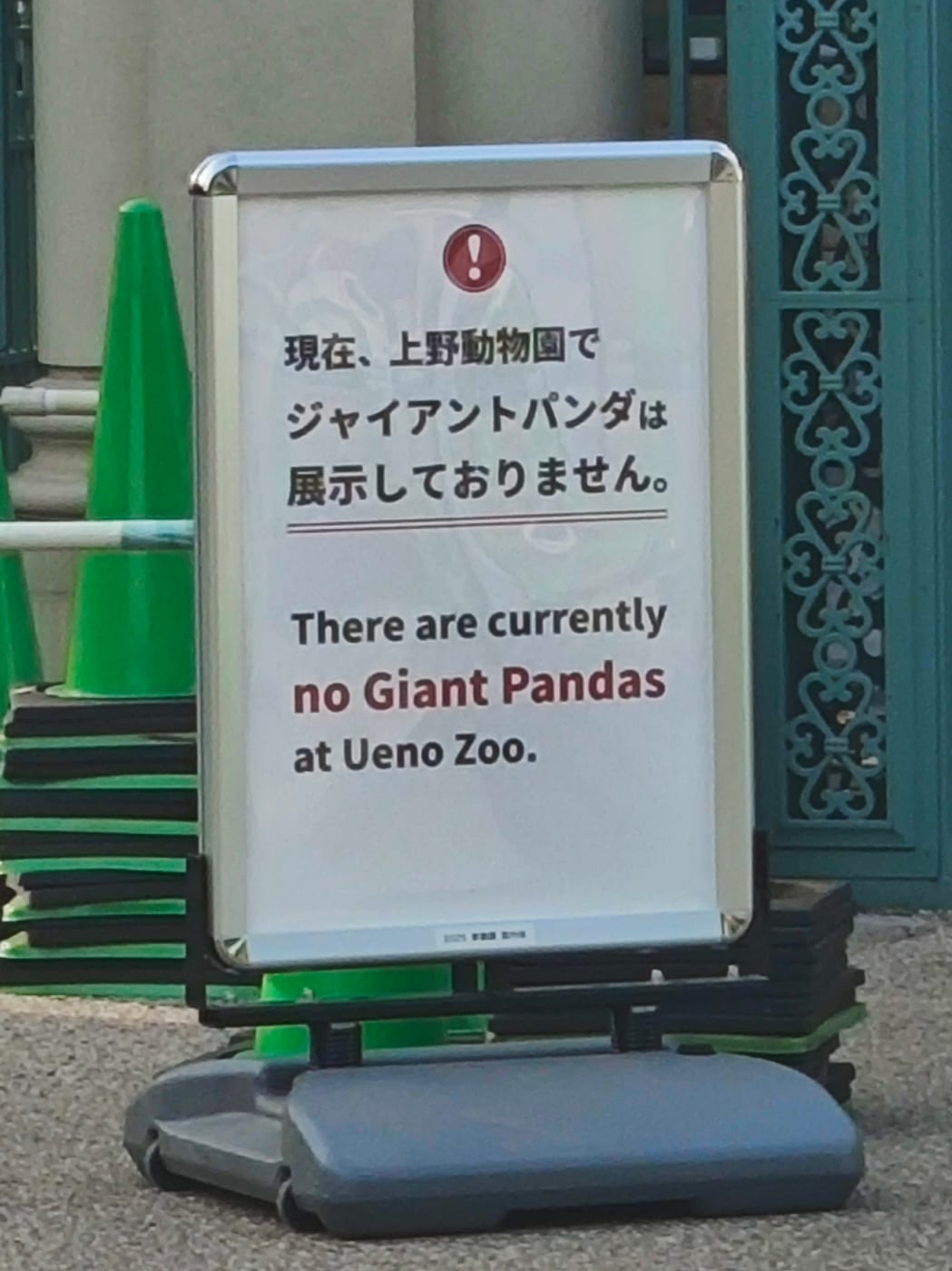
That is not inferred from news coverage. Only three facilities have kept giant pandas in Japan in recent decades, and each of them states the current position on its own website, in its own words.
| Facility | How the official site puts it | When it reached zero |
|---|---|---|
| Ueno Zoological Gardens (Tokyo) | A standing note at the top of the panda pages: the zoo does not currently keep giant pandas | Two returned, 27–28 January 2026 |
| Kobe Oji Zoo (Hyogo) | The giant panda entry in the animal encyclopedia carries a parenthetical note that the zoo no longer keeps the species | Death, 31 March 2024 |
| Adventure World (Wakayama, Nanki-Shirahama) | The panda URL redirects away; in the animal index source code the whole block sits inside an HTML comment | Four returned, 28 June 2025 |
Line those three dates up and the shape of the story changes. Japan did not lose its pandas on one day in January 2026. It went to zero in three steps over 22 months, and Ueno was simply the last one. First, late on 31 March 2024, Oji Zoo's female Tan Tan died at the age of 28 after resuscitation failed; her preserved specimen was later returned as well, leaving Japan on 25 June 2025 and arriving in China the next day. Then on the evening of 28 June 2025 the four pandas at Adventure World — Rauhin, Yuihin, Saihin and Fuhin — landed at Chengdu Shuangliu International Airport on a charter flight. Ueno came last.
Adventure World deserves a separate line because it is the most thoroughly erased of the three. The dedicated panda URL now redirects to the general animal index, and in that index page's source the giant panda block and its navigation entry are both commented out — invisible on the rendered page, still sitting in the HTML. What the page advertises now is bottlenose dolphins, emperor penguins, African elephants and cheetahs, described officially as roughly 120 species and 1,600 animals.
When exactly did Ueno's two leave?
Last public viewing 25 January 2026; the pair left the zoo on 27 January; the return was completed across 27 and 28 January.
You will find several different dates online, and the awkward part is that they are all official. Ueno Zoo published notices at different moments with different precision, and the earliest one is still live and still unedited.
| Official notice | Published | Date it gives |
|---|---|---|
| Dedicated return page | Before the transfer | Late January 2026 |
| Return announcement | 25 Jan, updated 27 Jan 2026 | Returned 27 Jan; viewing ended 25 Jan |
| Departure-day notice | 27 January 2026 | Left for Narita around 13:30 on 27 Jan |
| Zoo grounds notice | 6 February 2026 | Returned 28 January |
| Retrospective blog post | 5 March 2026 | Across 27–28 Jan; left the zoo 13:24, flight departed 20:14 |
| Arrival notice | 31 January 2026 | Arrived at the Ya'an base, 31 January |
Which one should you use? The 5 March retrospective. It is the only complete official account, it is precise to the minute, and it explains why the date straddles two days: the cargo flight did not lift off from Narita until 20:14 on 27 January, so the handover naturally fell on the 28th. The "late January" wording on the dedicated page is a preview written before the event, not a record of it, and the zoo never went back to revise it.
For anyone holding an old itinerary, though, the date that actually matters is different: 25 January was the last day the pandas could be seen. They were still on the grounds for two more days but no longer on public display. Any guide telling you the animals were visible right up to 27 January is wrong.
Why did every animal go back?
Because they were always on loan, and the term written into the agreement ran out.
The paperwork starts in 2010, when the Tokyo Metropolitan Government and the China Wildlife Conservation Association signed a cooperation agreement to jointly run a giant panda breeding research project. Under that agreement, in 2011, the China Conservation and Research Center for the Giant Panda loaned two giant pandas to Ueno Zoo. Ownership never transferred.
Over the following years Ueno and its Chinese partners raised three cubs to adulthood, and each of those cubs was returned to China in turn. The zoo's own history page ends the sequence in one sentence: by January 2026, exactly as the agreement stipulated, every giant panda had been returned. The original 2011 pair, Ri Ri and Shin Shin, had already gone back in September 2024 after 13 years in Japan.
Wakayama used the same institutional framing. Adventure World's stated reason for the 2025 return is that the contract period of the ongoing Japan–China joint panda conservation project expired that August.
Keep the category straight, because it changes what you should expect on the ground. This is a lease expiring — not a zoo closing, not a facility failing, not an animal welfare incident. Ueno Zoo trades entirely normally. Nothing was fenced off, the admission price did not move, and every other species is where it was.
One footnote for anyone quoting the source: Ueno's history page contains a typo, giving 1885 where it means 1985, and a paragraph further down the same page gets it right (1985, Japan's first successful breeding by artificial insemination). Use 1985.
Will pandas come back?
No new loan has been announced — but the silence people assume is there does not exist.
Two separate layers, and merging them is how misinformation gets made.
The first layer is plans. Nothing concrete appears anywhere on Ueno's official site: no target year, no number of animals, no named individuals. Any article promising an imminent new arrival is not sourcing that from the Japanese side.
The second layer is statements, and here there are two, from two organisations. Ueno Zoo director Yutaka Fukuda said in his farewell message on departure day that with these two leaving the zoo would have no giant pandas, that exchanges with counterparts would continue, and that he wanted to wait for the conditions that allow a new project to be carried out. Ueno's panda section separately states the zoo will keep cooperating with the China Conservation and Research Center for the Giant Panda on conservation work. Adventure World's announcement says the park strongly hopes the joint project continues and will keep discussing it with the Chinese side.
So the accurate summary is: no plan, but both sides say out loud that they are waiting. As for why no agreement has materialised, no official source has ever written a reason down, and this guide will not supply one.
One phrasing to avoid: do not describe Wakayama as permanently panda-free. Adventure World never said it would stop keeping the species. It said the contract expired and it hopes to renew — a materially different claim.
A related trap sits on the Oji Zoo site, where a page titled "the panda room" is still live with content frozen in 2010. It says a male named Kou Kou died in September 2010 and that the zoo was preparing to welcome a new male. That page is not a description of the present and it will mislead anyone who lands on it. The only usable current statement from Oji Zoo is the parenthetical note in its animal encyclopedia.
The "Panda Forest" is still there — what is in it now?
The enclosure was not closed and was not renamed. Walk in and you get red pandas and pheasants.
People often assume the area would be sealed off. It was not. Ueno's Panda Forest is still on the zoo map and still signposted on site; the zoo simply added a line to the enclosure page saying it does not currently keep giant pandas, and flagged the same on its exhibit list.
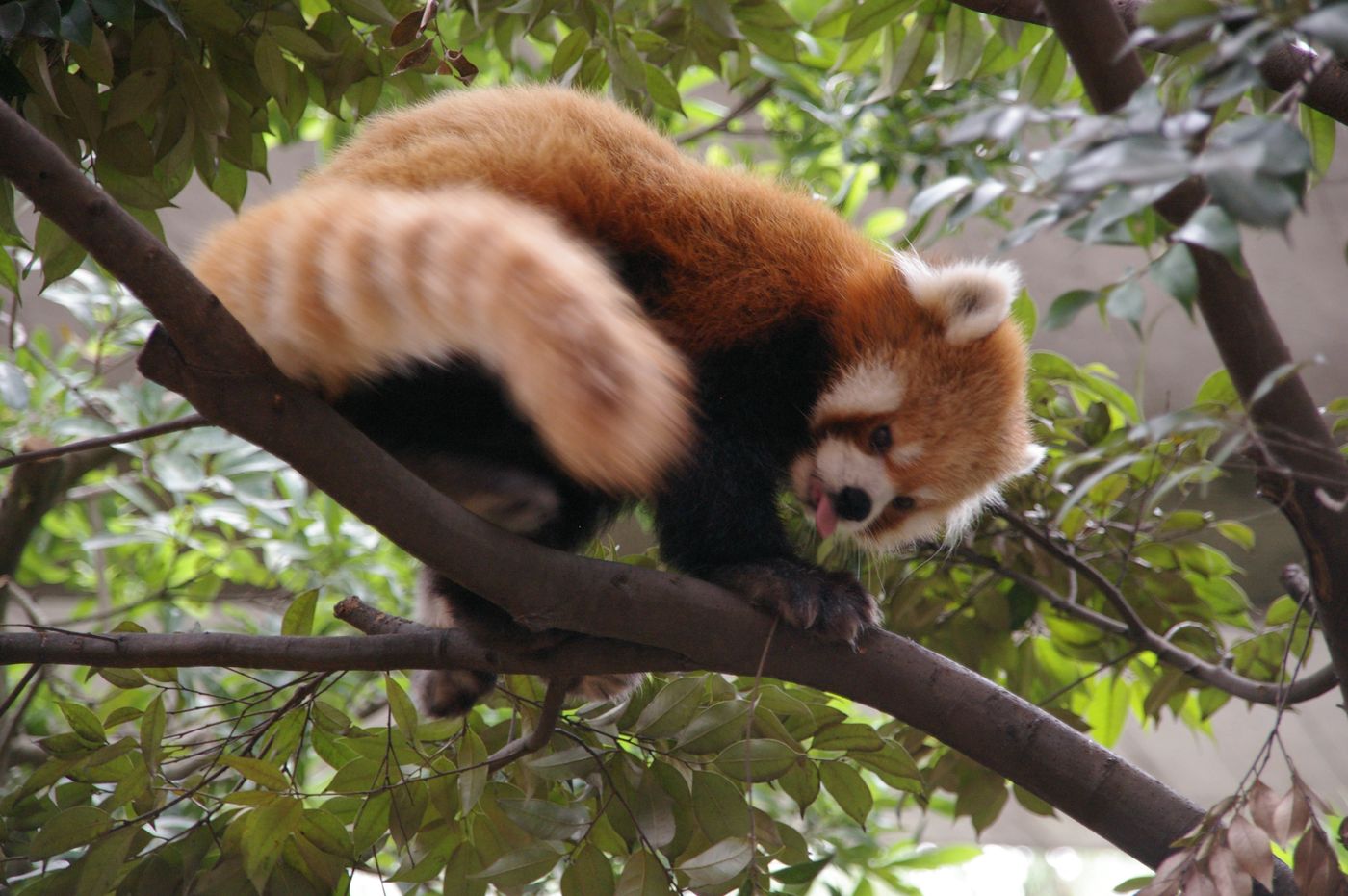
The current residents are Sichuan red pandas plus pheasant species — golden pheasant, silver pheasant and Temminck's tragopan.
Which raises a distinction worth making explicitly, because it causes real confusion in every language: a red panda is not a small or young giant panda. It is a separate animal — russet-coloured, roughly cat-sized, with a ringed tail. Many Japanese zoos have red pandas. The number with giant pandas is zero. If a guide tells you some zoo in Japan "has pandas", check which species it means before you build a day around it.
Is Ueno Zoo still worth a visit?
Yes — but decide which garden you are there for before you decide what time to arrive.
Ueno splits into an East Garden and a West Garden, and the common failure mode is doing half of each. Here is how the zoo itself divides the headline exhibits:
- East Garden: the elephant forest; gorillas and tigers; the bear hill; polar bears and seals; the nocturnal house and tapirs; Japanese native species; and the historic old Kaneiji five-storey pagoda.
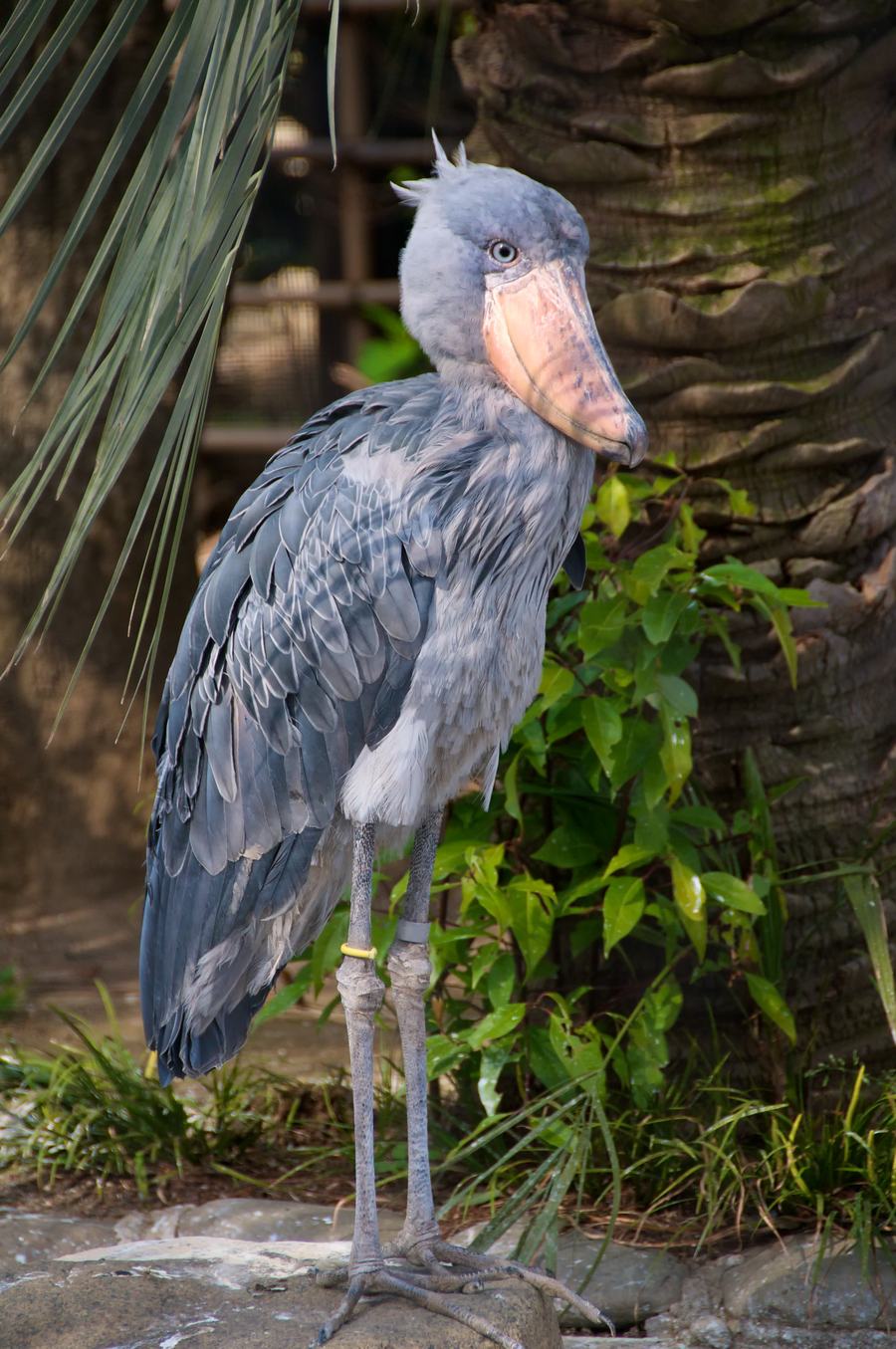
- West Garden: the shoebill; giraffes, hippos and rhinos; the aye-aye forest; the small mammal house; the amphibian and reptile house; the children's zoo; Shinobazu Pond; and the Panda Forest.
With pre-schoolers, go West and stay West. The argument is density: the small mammal house, the reptile house and the children's zoo sit close together and are indoors or partly indoors, which is your recovery plan for rain, heat and meltdowns. The East Garden cannot offer that. With adults, the East Garden's elephants and polar bears hold attention for longer.
Two things are genuinely new in 2026
The first is a pygmy hippo calf called Iroha. She was born on 25 December 2025; the zoo announced the winning name on 7 April 2026 after a public vote — 3,142 of 9,119 ballots — and put her on display from 2 June. The same announcement published the census: as of 7 April 2026 Ueno kept five pygmy hippos (two male, three female), and the national total was 16 animals across seven facilities. Pygmy hippos are scarce, and that number makes the case on its own.
The second is the walking route around the old Kaneiji five-storey pagoda, opened to the general public on 17 March 2026. There is a detail here that catches people out: the route is accessible only from outside the zoo, via the Ueno Toshogu approach, open 09:30 to 17:00. You do not need a zoo ticket to walk it — but you also cannot reach it from inside the zoo. Officials have flagged further construction work in autumn 2026.
The zoo also published extra opening days and extended hours for the 2026 fiscal year: additional opening days in May, August, October, November and March 2027; one extra hour on 25, 26 and 29 April and 2–5 May over Golden Week; and three extra hours from 9 to 12 October. A separate notice about early-summer evening opening is in preparation. If you want a late-afternoon visit, those four October days are the best conditions on the calendar.
Read this timetable before you go in
Last entry is 16:00, but plenty of animals are put away from 15:00.
This is the most useful section here, because it kills a very common plan: "we will swing by Ueno Zoo around three or four." The zoo publishes per-exhibit closing times, and they diverge sharply from the closing time of the zoo itself.
| Exhibit closes | Animals |
|---|---|
| 15:00 | Sulphur-crested cockatoo, lar gibbon, collared peccary |
| 15:30 | Rock ptarmigan |
| 15:45 | Western lowland gorilla |
| 16:00 | Amphibian and reptile house, alpacas, goats (same moment as last entry) |
| 16:15 | Hippo, pygmy hippo, giraffe, black rhinoceros |
| 16:20 | Sumatran tiger |
| 16:30 | Small mammal house, children's zoo, aye-aye forest, polar bear |
| 16:45 | Asian elephant |
| 16:50 | Red panda, monkeys of the world |
| 17:00 | Zoo closes |
Read that backwards and the planning rule falls out. Arrive at 15:30 and you have 15 minutes of gorilla, 30 minutes of reptile house, and no cockatoo or gibbon at all. To see the zoo properly, 14:00 is the latest sensible entry; make it 13:00 with small children or anyone slow on their feet.
The same notice carries several closures you need to know so you do not send yourself to a locked exhibit:
- The monkey mountain (Japanese macaques) has been closed to the public since 19 November 2024, and the area around it has been closed to through traffic since 13 May 2025. That is nearly two years with no reopening date given.
- Japanese serow is off display from 7 July to 30 September 2026, with access restrictions around the pagoda over the same period — note this is separate from the pagoda walking route above, which runs outside the zoo grounds.
- Bewick's swan (from 1 August) and black-necked crane (from 5 August) are off display.
- Events are cancelled when a heatstroke alert is issued or on extreme-heat days.
Officials update that page, so check the closure list again in the week before you travel.
Admission and closing days
¥600 for adults, free for elementary school children and younger, closed Mondays.
| Ticket | Individual | Group (20+) | Annual pass |
|---|---|---|---|
| General | ¥600 | 480 yen | 2,400 yen |
| Age 65+ | ¥300 | 240 yen | 1,200 yen |
| Junior high student | ¥200 | 160 yen | —— |
| Junior high students living or studying in Tokyo | Free | —— | —— |
| Grade 6 and below | Free | —— | —— |
The rest of the operating detail:
- Open 09:30–17:00, with entry and ticket sales closing one hour before, at 16:00.
- Closed Mondays; when Monday is a public holiday or a substitute holiday, the closure moves to the following day. Also closed 29 December to 1 January.
- Free admission days: 20 March (zoo anniversary), 4 May (Greenery Day), 1 October (Tokyo Citizens' Day). Free, and also the three busiest days of the year — avoid them with a stroller.
- Respect for the Aged Week, 15–21 September: free for visitors aged 60 and over plus one companion.
- Payment options are broad: credit cards (Visa, Mastercard, JCB, AMEX, Diners), transit IC cards, PayPay, d Payment, au PAY, Rakuten Pay, plus Alipay and WeChat Pay. Online tickets are available too.
Put 600 yen next to Tokyo prices for a moment: it is barely more than a coffee, and children through elementary school get in free. Even a two-hour visit covering only the West Garden is hard to regret at that price. Which is why "skip it, there are no pandas" does not survive the arithmetic — you save 600 yen and give up half a day of walkable central Tokyo.
Did attendance fall after the pandas left?
The full year was up 0.8%. The two months right after the departure were down 14.7% and 19.1%.
The Tokyo Zoological Park Society publishes a monthly attendance report covering its four facilities. For fiscal 2025 — April 2025 through March 2026 — Ueno's figures ran like this:
| Month | FY2025 | FY2024 | Change |
|---|---|---|---|
| November 2025 | 429,819 | 340,495 | +26.2% |
| December 2025 | 281,261 | 219,506 | +28.1% |
| January 2026 | 286,525 | 256,611 | +11.7% |
| February 2026 | 214,097 | 251,071 | −14.7% |
| March 2026 | 286,243 | 353,751 | −19.1% |
| Full year | 3,387,959 | 3,362,664 | +0.8% |
Start with the line people misread. The annual total went up — 3,387,959 visitors, 0.8% ahead of the previous year. Whatever else is true, "Ueno collapsed without its pandas" is contradicted by the zoo group's own statistics.
Break it into months and something else appears. February at minus 14.7% and March at minus 19.1% are the only double-digit declines in the year, and they are precisely the first two full months after the departure. At the other end, December was up 28.1% and January up 11.7% — timing consistent with a farewell rush.
Three boundaries have to be stated or this turns into invention:
- The report contains numbers and not one word of interpretation. The timing lines up. Causation is not something officials have claimed, and it is not claimed here.
- November 2025's +26.2% predates the return announcement, so it cannot be part of a farewell rush. The cause is not stated anywhere and is not guessed at here.
- The fiscal 2026 report, covering April 2026 onward, has not been published. How busy the zoo is right now is therefore unanswerable until officials release it.
One thing does follow safely for planning purposes: the lottery and timed-entry machinery built around panda viewing no longer exists. That system existed for one species. With the animals gone, so is the queue. You buy a ticket and walk in.
So what goes in that slot instead?
Do not schedule Ueno Zoo for the pandas — and do not delete Ueno Zoo because of them either.
If your itinerary says "Ueno Zoo (pandas)", find yourself below:
- It had to be a giant panda: that is not available in Japan on this trip. Change the destination or change the expectation. Red pandas are here; they are a different animal.
- Pre-schoolers, and you wanted see-it-touch-it: keep Ueno, go West Garden, arrive between 13:00 and 14:00. Small mammal house, reptile house and children's zoo are adjacent and weatherproof.
- You wanted the big signature animals: keep Ueno, go East Garden for elephants and polar bears — and note the Asian elephants shut at 16:45.
- You wanted something you cannot see elsewhere: the shoebill in the West Garden, plus Iroha the pygmy hippo calf — 16 pygmy hippos exist across all of Japan.
- Only the afternoon is free: switch to Ueno Park itself. The Tokyo National Museum, Ueno Toshogu and the pagoda walking route opened in March 2026 are all within a short walk, and the pagoda route needs no zoo ticket.
- You wanted a real animal spectacle: it is not in Tokyo. Move that expectation to Hokkaido and the winter penguin walk at Asahiyama Zoo.
Two last cautions. Check the date on anything you read: before trusting anything that lists pandas as Ueno's must-see, check whether it acknowledges the January 2026 return. If it does not, it is out of date however fresh it looks. And if your trip is in 2027 or later, check the official pages again before you go — both sides say they are waiting, which means this can change, even though no official timetable exists to plan around today.
Put together, the conclusion is less mournful than it sounds. Ueno Zoo opened in 1882, is the oldest zoo in Japan, and charges 600 yen with under-12s free. What it lost was a world-famous headline act. What remains is a walkable, half-day, high-hit-rate stop in central Tokyo. Replace the expectation, not the slot.
Appendix: official Japanese sources (tap to expand)
The Japanese wording behind the claims above, collected here so you can check it yourself.
1. Ueno Zoo, panda pages — current status note
※現在、上野動物園ではジャイアントパンダは飼育しておりません。
2. Ueno Zoo, "Panda Forest" enclosure page
現在ジャアントパンダは飼育していません。
ジャイアントパンダ:現在は飼育していません
("ジャアント" is the zoo's own typo, reproduced as published.)
3. Ueno Zoo, grounds notice, 6 February 2026
2026年1月28日に2頭のジャイアントパンダを中国に返還し、現在はジャイアントパンダを飼育しておりませんが、エリア内をゆっくり散策しながらさまざまな工夫をご覧ください。
4. Ueno Zoo, return announcement, 25 / 27 January 2026
ジャイアントパンダ「シャオシャオ」と「レイレイ」を1月27日に中国に返還することとなりました
1月25日(日)をもちまして、ジャイアントパンダ2頭の観覧が終了しました
5. Ueno Zoo, retrospective blog post, 5 March 2026
2026年1月27日から28日にかけて、…中国ジャイアントパンダ保護研究センター雅安基地へ無事返還しました
13時24分、上野動物園を出発しました
貨物機へ搭載され、20時14分に離陸
6. Farewell message from Ueno Zoo director Yutaka Fukuda, 27 January 2026
今回の2頭の搬出で上野動物園にはジャイアントパンダがいなくなりますが、今後も関係者同士で交流を続けながら、新たなプロジェクトが実施できる環境が整うのを待ちたいと思います。
7. Ueno Zoo, agreement history and "looking ahead"
2010年、東京都と中国野生動物保護協会は、…「ジャイアントパンダ繁殖研究プロジェクト」を共同で進める協力協定書の調印をおこないました。それにもとづき、2011年に2頭のジャイアントパンダが中国ジャイアントパンダ保護研究センターから上野動物園に貸与されました。
上野動物園は中国と共同でこのプロジェクトに取り組み、3頭の子の成育に成功。2026年1月までに、協定書で定められたとおりジャイアントパンダ全頭を中国に返還しました。
2024年9月の2頭の返還までの13年間に、自然交配による3回の出産と、3頭の子の成育に成功しました。成育した子ども3頭は、それぞれ中国に返還されました。
上野動物園は、1972年以降培った飼育繁殖技術を発展させるべく、2011年より協力連携を強固にしてきた中国ジャイアントパンダ保護研究センターとは引き続き連携をはかり、これからもジャイアントパンダにおける保全活動を継続させていきます。
8. Kobe Oji Zoo, animal encyclopedia, giant panda entry
(現在当園では飼育しておりません)
9. Oji Zoo, death of Tan Tan, 1 April 2024
当園のジャイアントパンダ「タンタン」(メス・28歳)が、2024(令和6)年3月31日(日曜)午後11時56分に死亡しましたので、ここに謹んでお知らせいたします。
10. Oji Zoo, return of the preserved specimen, 26 June 2025
2024年(令和6年)3月31日に死亡したメスのジャイアントパンダ「タンタン」の剥製等を中国へ無事返還しましたのでお知らせします。
剥製等は2025年(令和7年)6月25日に日本を出発し、6月26日に中国に無事到着しました。
11. Adventure World, reason for the return and the park's position
本年8月、日中双方で現在進行中のジャイアントパンダ保護共同プロジェクトの契約期間が満了となり
共同プロジェクトの継続を強く願っており…中国側と協議を続けて参ります
12. Adventure World, four pandas arrive in Chengdu, 28 June 2025
6月28日(土)現地時間午後6時51分(日本時間 午後7時51分)、…「良浜(らうひん)」「結浜(ゆいひん)」「彩浜(さいひん)」「楓浜(ふうひん)」が、チャーター機で無事に成都双流国際空港へ到着しました。
(The body text of these two Adventure World notices is JavaScript-rendered; the wording was retrieved via WebFetch.)
13. Ueno Zoo, pagoda walking route, 12 March 2026
3月17日より園外からも楽しめるよう一般開放します
周遊ルートは園外(上野東照宮の参道側)からのみアクセス可能
14. Ueno Zoo, naming of pygmy hippo calf Iroha, 7 April 2026
上野動物園での飼育状況(2026年4月7日現在)5頭(オス2、メス3)
国内の飼育状況 7園館 16頭
Frequently Asked Questions
- Q1:Can you still see a giant panda in Japan in 2026?
- No. There are zero giant pandas anywhere in Japan, and all three facilities that used to keep them say so on their own websites rather than leaving it to the press. Ueno Zoo carries a line at the top of its panda pages stating that the zoo does not currently keep giant pandas. Kobe's Oji Zoo left the giant panda entry in its animal encyclopedia but added a parenthetical note that the zoo no longer keeps the species. Adventure World in Wakayama went furthest: its dedicated panda URL now redirects away, and in the source code of its animal index the entire giant panda block, along with its navigation entry, is wrapped in an HTML comment. So do not put Ueno Zoo, Oji Zoo or Adventure World on an itinerary for the pandas. That specific goal is no longer achievable in Japan.
- Q2:What date did Ueno’s last two pandas actually leave? Why do sources disagree?
- Because Ueno Zoo itself published three different dates, and all of them are official. The earliest was a dedicated announcement page that said only "late January 2026" — a preview page written before the transfer, and one the zoo never went back and updated. A 6 February 2026 notice says the pandas were returned on 28 January. The most precise account is a retrospective blog post published on 5 March 2026: the return was completed across 27 and 28 January, the pair left Ueno Zoo at 13:24 on 27 January, and the cargo flight lifted off from Narita at 20:14 that night. There is also a date that matters more to visitors than any of those: public viewing ended on Sunday 25 January 2026. So the accurate phrasing is "last viewing 25 January, departed the zoo 27 January, return completed across 27–28 January, arrived at the Ya'an base in China on 31 January" — not any single day.
- Q3:Why were they all sent back?
- Because they were on loan and the agreement expired. In 2010 the Tokyo Metropolitan Government and the China Wildlife Conservation Association signed a cooperation agreement to jointly run a giant panda breeding research project. Under it, two giant pandas were loaned to Ueno Zoo by the China Conservation and Research Center for the Giant Panda in 2011 — the word the zoo uses is "loan", and ownership stayed with China throughout. Ueno's own history page closes the story plainly: working jointly with China the zoo successfully raised three cubs, and by January 2026 it had returned every giant panda to China exactly as the agreement stipulated. Wakayama's wording is the same kind of institutional language: Adventure World says the contract period of the ongoing joint conservation project expired that August. This is a lease ending, not a zoo failing.
- Q4:Will pandas ever come back to Japan?
- No new loan has been announced — no timetable, no numbers, no named animals. But it would be wrong to say officials have gone silent, because they have not. On the day the pair left, Ueno Zoo director Yutaka Fukuda said in his farewell message that the zoo would keep up its exchanges with counterparts and wait for conditions that allow a new project to be carried out. Ueno's panda pages separately state that the zoo will continue to work with the China Conservation and Research Center for the Giant Panda on conservation. Adventure World's return announcement says the park strongly hopes the joint project will continue and that it will keep discussing this with the Chinese side. So the honest summary is: no plan, but both sides explicitly say they are waiting. As for why there is still no new agreement, no official source has ever put a reason in writing, and this guide will not invent one. Note also that Adventure World has never said it will stop keeping pandas permanently — it said the contract ended and it hopes to renew.
- Q5:Is the "Panda Forest" enclosure at Ueno closed now?
- No, and it has not been renamed either. The Panda Forest is still on the zoo map and still signposted on site; the zoo simply added a line to the enclosure's page saying it does not currently keep giant pandas, and marked the same on its exhibit list. What lives there now are Sichuan red pandas and pheasant species including golden and silver pheasants. Worth flagging because it trips people up in several languages: a red panda is not a young or small giant panda, it is a different animal entirely — russet, cat-sized, ringed tail. Plenty of Japanese zoos have red pandas. The number that have giant pandas is zero.
- Q6:Without pandas, is Ueno Zoo still worth a visit?
- Yes, but plan it differently and watch the clock. Admission is 600 yen for adults and free for elementary school children and younger, which makes it close to the cheapest major attraction in Tokyo; the price is unrelated to the pandas and did not change. The headline animals the zoo now promotes are elephants, gorillas, tigers and polar bears in the East Garden, and the shoebill, giraffes and hippos in the West Garden. Two things are genuinely new in 2026: a pygmy hippo calf named Iroha, born 25 December 2025 and on public display since 2 June 2026, and a walking route around the old Kaneiji five-storey pagoda opened to the public on 17 March 2026 — though that route is reachable only from outside the zoo, via the Ueno Toshogu approach. The real trap is closing times. Last entry is one hour before the 17:00 close, but many enclosures shut between 15:00 and 16:15, and the monkey mountain has been closed to the public since 19 November 2024 with no reopening date announced.
- Q7:Did visitor numbers at Ueno Zoo fall after the pandas left?
- It depends which window you look at. The Tokyo Zoological Park Society's monthly report for fiscal 2025 (April 2025 to March 2026) puts Ueno's full-year total at 3,387,959 visitors, up 0.8% on the previous year — so the idea that the zoo collapsed without pandas is not supported by the official statistics. Split by month, though, the first two full months after the departure were February 2026 at minus 14.7% and March 2026 at minus 19.1%, the only two double-digit declines in the whole year. December 2025 was up 28.1% and January 2026 up 11.7%, which lines up in time with a farewell rush. Two limits are worth stating plainly: the report publishes numbers and no interpretation whatsoever, so the timing lines up but causation is not something officials have claimed; and the fiscal 2026 report covering April 2026 onward has not been published yet, so how busy the zoo is this summer is a question this guide cannot answer.
Read next
Tokyo with kids: the honest family guide
Stroller routes, kid-friendly restaurants, and the attractions worth the tantrum risk.
Tokyo in the Rain: 10 Indoor Spots 2026
Ten indoor picks for a wet day: teamLab, Skytree, LaQua onsen, Pokémon Center — the plays that save a trip.
Asahiyama Zoo Guide 2026: Penguin Walk & Behavioural Exhibits
Japan's northernmost zoo, famous for behavioural exhibits — the winter penguin walk, the seal column tank and diving polar bears — plus Asahikawa ramen and a Biei combo, 1h25 from Sapporo.
📊 See the 2026 Price Index (JR Pass, DPA, eSIM, Airport Transport) →