Start with the sentence that settles it: Eki-net, the booking system most readers arrive intending to sign up for, is one that many of them are not permitted to use. JR East FAQ entry 4131, updated on 10 March 2026, states that people living overseas cannot use Eki-net, because it is a service for residents of Japan — and directs overseas residents to a separate system called JR-EAST Train Reservation. That system, in turn, carries a notice dated 22 December 2022 and still live in August 2026, admitting that passports from some countries cannot complete a purchase. This guide covers three things: which of the three online systems you are actually eligible for, what happens when a booking crosses operator boundaries (it is not blocked — it is downgraded), and the invisible barrier that stops people at the ticket machine after everything else has gone right: the card in your wallet.
- 🔴 Eki-net is for Japan residents only — overseas visitors are directed to JR-EAST Train Reservation, whose passport notice has been up for nearly four years
- Crossing operators is not blocked, it is downgraded: Eki-net books Tokaido trains as paper-only, discount-free, no advance request
- Smart EX cannot leave the Tokaido, Sanyo and Kyushu Shinkansen; e5489 also covers Sanyo and Kyushu, so it is not the sole gateway west
- 🚨 Booking a year ahead does not remove the scramble: EX Hayatoku early-bird fares are explicitly excluded from it, and so is the Supreme Class cabin
- 🚨 The real gate is your card: all three require 3D Secure, and e5489 states virtual and chipless cards cannot collect tickets
- The decision is not geography — it is whether this trip requires a physical paper ticket
📖 Contents
- 1. Eligibility first: you may not be allowed to use Eki-net
- 2. The three systems side by side
- 3. Crossing operators: downgraded, not blocked
- 4. Smart EX: the right answer for the Tokaido, with two traps
- 5. Is booking a year ahead worth it? Partly
- 6. North of Tokyo: what I could and could not verify
- 7. e5489: no account needed, but you must collect the ticket
- 8. The invisible barrier nobody mentions: your card
- 9. Where each ticket can actually be collected
- 10. Which one should you use — and when to skip online entirely
- 11. FAQ
Eligibility first: you may not be allowed to use Eki-net
The most important fact goes first. Eki-net is not a system that foreigners can technically use if they persevere through a Japanese interface. It is a system that officially excludes overseas residents.
JR East FAQ entry 4131 says that people living overseas cannot use Eki-net, and that Eki-net is a service aimed at customers residing in Japan. The same entry then names the alternative for overseas residents: JR-EAST Train Reservation. These are two different systems, not one system with a language toggle.
The entry carries an official update date of 10 March 2026. This is not a fossilised rule nobody has looked at since 2018; JR East revised it this year. Registering for Eki-net and fighting for Toku-da-ne discount inventory the moment sales open is a real procedure — the official text simply limits it to residents of Japan. The instructions are real; the audience is wrong.
Full disclosure before going further: we published the same mistake. Our guide to the final season of the Furano-Biei Norokko listed Eki-net as a recommended official booking channel and claimed it had a Chinese interface. That was wrong, and it was corrected in the same round that published this article — that Hokkaido sightseeing-train guide now states the residency restriction properly.
The three systems side by side
Laid out together, the differences are not about usability. They are about eligibility, the physical form of the ticket, and what your card has to be.
| Criterion | Smart EX | Eki-net | e5489 |
|---|---|---|---|
| Who may use it | Anyone. No annual fee, no booking fee (⚠️ Taiwan uses a separate app) | 🔴 Residents of Japan only; overseas residents are directed to JR-EAST Train Reservation | Anyone — and you can book without registering an account |
| Coverage | Tokaido, Sanyo and Kyushu Shinkansen only (Tokyo to Kagoshima-Chuo). Other sections: buy at a window | JR East is home turf; also books Tokaido, Sanyo, Kyushu and Nishi-Kyushu Shinkansen (downgraded, see below) | Sanyo, Kyushu, Nishi-Kyushu and Hokuriku Shinkansen plus major limited expresses; also sells Tokaido |
| Booking opens | One year ahead, 05:30 on the same calendar date, until 4 minutes before departure | Early booking 3 months ahead at 14:00 / advance request 1 month + 1 week ahead at 14:00 / general sale 1 month ahead at 10:00 | 1 month ahead at 10:00; advance application opens a week earlier at 05:30 on the same weekday |
| How you board | IC card, QR code or paper — registering an IC card is optional | JR East sections tap in on the Shinkansen eTicket; Tokaido and similar are paper only | 🚨 You must collect a paper ticket (ticketless products excepted) |
| Collection requirements | Reservation code (QR or 16 digits) plus login password; machines only from 7 days before travel, earlier means a window | Payment card, QR code or customer number; customer-number collection is window-only | Green ticket machines, collection machines or windows; boarding uncollected means buying again at full fare |
| Card requirements | 3D Secure required; mini and virtual cards cannot collect tickets | 3D Secure required, and the card must be in the member's own name | Security code plus 3D Secure where applicable; cards with no physical form or no IC chip cannot collect |
| Discounts | EX Hayatoku early-bird family (⚠️ excluded from one-year booking, as is the Supreme Class cabin) | Toku-da-ne and similar (🔴 zero discounts once you cross to the Tokaido) | JR West's Toku-Toku Kippu range — its genuine exclusive |
| Cross-operator reach | 🔴 Cannot leave Tokaido / Sanyo / Kyushu at all | Can cross, but downgraded to paper, no discount, no advance request | Sells Tokaido, but those tickets cannot be collected on JR East |
The row that matters most is how you board. What genuinely constrains your trip is not which company owns the track, but whether at some point you have to stand in front of a machine and turn a reservation into a piece of card stock. That single question determines how much slack your arrival day needs.
Crossing operators: downgraded, not blocked
The second widespread misconception is that the three JR systems are sealed off from each other and crossing regions forces you to a ticket window. That is wrong, and the direction of the error is interesting: you are not blocked, you are downgraded.
Take Eki-net first. FAQ entry 4836 confirms it can book the Tokaido, Sanyo, Kyushu and Nishi-Kyushu Shinkansen. But leaving JR East territory triggers four simultaneous restrictions:
- Paper tickets only. Those lines sit outside the Shinkansen eTicket scheme (FAQ entry 4542), and without an eTicket there is no tapping through the gate with an IC card.
- No discounts whatsoever. The price equals the station window price; none of Eki-net's discount products apply.
- No advance request. You can only book trains already on sale within the one-month window.
- Web only. The ticketless smartphone app cannot handle these sections, because there is no electronic ticket for it to issue.
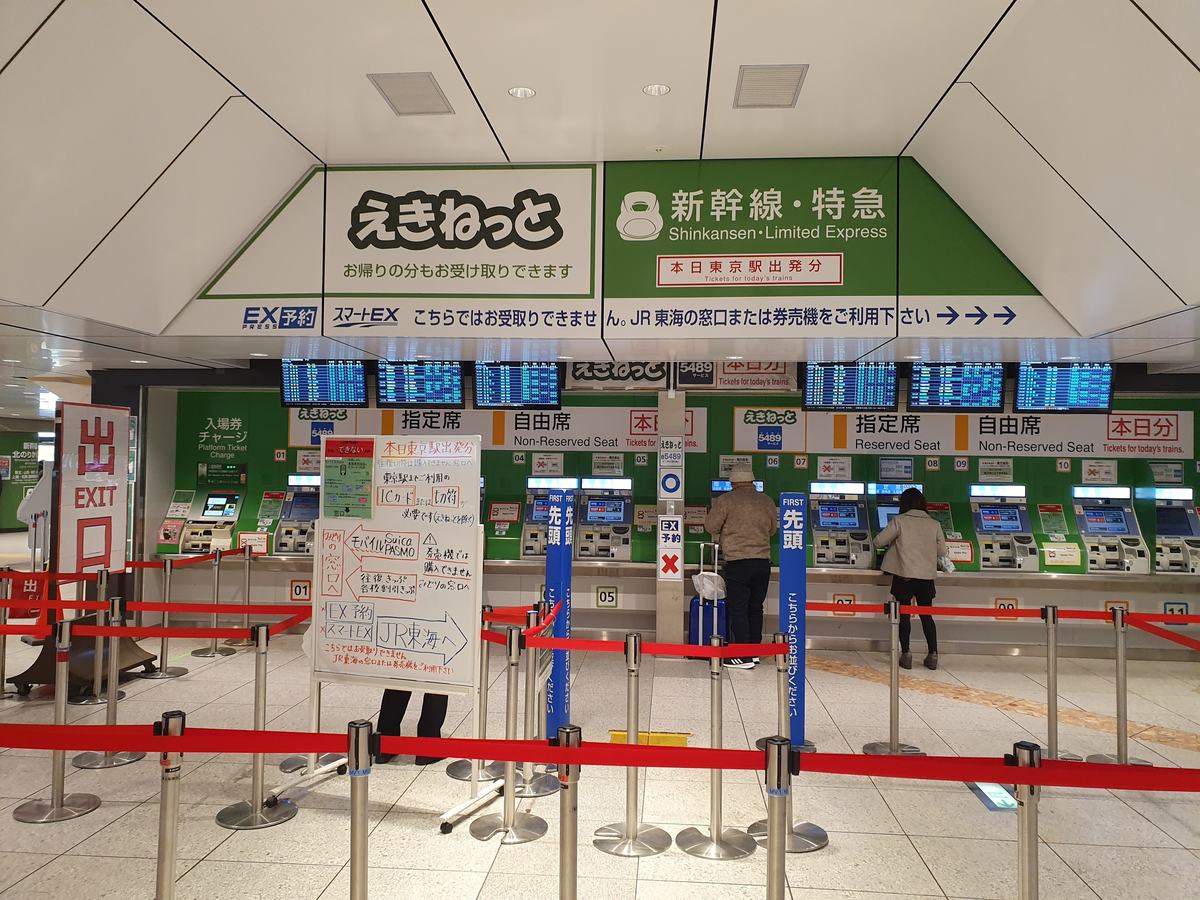
Smart EX draws a much harder line. FAQ entry 461 restricts the service to the Tokaido, Sanyo and Kyushu Shinkansen between Tokyo and Kagoshima-Chuo, and tells you to buy other sections at a station window. There is no downgraded version. It simply stops.
e5489 is a third shape again. It does sell Tokaido Shinkansen tickets, but JR West's own booking page carries the note that collection on JR East excludes certain tickets, such as the Tokaido Shinkansen between Tokyo and Shin-Osaka. The restriction has moved from booking to collection, which is easy to miss until you are standing at the wrong machine.
While correcting the record, one more claim needs retiring: e5489 is not the only gateway to western Japan. Smart EX covers the Sanyo and Kyushu Shinkansen as well, and Eki-net sells them too (as undiscounted paper). What e5489 genuinely monopolises is not geography but JR West's own Toku-Toku Kippu range and its conventional-line limited expresses — plus one thing no other system offers: booking without registering an account.
Smart EX: the right answer for the Tokaido, with two traps
Conclusion first: if your trip runs along Tokyo, Nagoya, Kyoto, Osaka, Hiroshima and Hakata, Smart EX is the answer and there is not much to deliberate. Three reasons:
- No annual fee and no booking fee, officially stated. A separate fee-paying EX service exists, but ordinary visitors have no reason to need it.
- It can be entirely paperless. Register a transit IC card and tap straight through the gate, or display a QR code. Crucially, registering an IC card is optional — skip it and collect a paper ticket with a reservation code plus password. Ten IC card types are listed as compatible. ⚠️ One product removes that fallback: the Shinkansen Supreme Class cabin arriving 1 October 2026 cannot be collected as paper at all, so without a registered IC card you cannot board.
- Changes happen on your phone rather than in a queue.
Two traps almost nobody writes about.
Trap one: the app is region-split
The official Smart EX app download page lists availability for the United States, Canada, Australia, Singapore, Hong Kong, Malaysia and Thailand. Taiwan is not on that list because Taiwan uses a separate app behind a different download link. On Android inside Japan the app appears under the name “smart EX App”.
The practical damage: follow an American blogger's guide, search the store by name, and you may install the wrong app — or fail to find anything and conclude the service is unavailable to you. Go through the official download page rather than searching the store by name.
Trap two: a Welcome Suica may not open the gate
FAQ entry 484 confirms that Welcome Suica and PASMO PASSPORT can be registered to Smart EX. It then attaches two conditions, the second of which is the one that causes trouble:
- These visitor cards carry an expiry date and stop working past it.
- 🚨 A card bought overseas that has not yet been used at a station gate within the Suica or PASMO area cannot be used for Shinkansen travel until it has been tapped once inside that area.
In other words, landing and going directly to a Shinkansen gate on a brand-new overseas-purchased card can fail at the barrier. The fix is trivial — take one ordinary subway or JR ride first — or avoid the issue entirely by not registering an IC card and collecting paper instead.
One more rule that saves real money: Smart EX cannot be combined with other tickets including the JR Pass, and a seat booked through it cannot be converted into a JR Pass reserved seat after arrival (FAQ entry 462). Booking a placeholder seat now and swapping it onto a Pass later does not work; it means paying twice. Whether a Pass suits your itinerary at all is worked through in our full JR Pass break-even analysis.
Is booking a year ahead worth it? Partly
Here is the third misconception, and I had it wrong in two earlier articles before correcting it.
The factual half is right: Smart EX opens reservations at 05:30 on the same calendar date one year before travel, and closes four minutes before departure. The error is the inference drawn from it — that you therefore never need to join the 10:00 release-morning scramble. Three conditions on the official page dismantle that inference:
| Restriction | What the official page says | What it means for you |
|---|---|---|
| 🔴 Excluded fare types | EX Hayatoku early-bird fares, S Work seats, wheelchair spaces and oversized-baggage seats are excluded from one-year-ahead booking; Supreme Class joins them from 1 October 2026 | The cheap fares still make you wait. A year out you are buying at standard price |
| Nothing is confirmed | Between one year and one month out, neither the train nor the seat is confirmed | You have secured the travel date, not a specific service or seat |
| Confirmation timing | Confirmation lands at 14:00 one month before travel; changing a confirmed booking waits until after 10:00 one month before | The one-month milestone is still in your calendar — just with far less pressure |
The accurate framing: booking a year ahead solves availability anxiety, not price. If the early-bird fare is what you are after, the piece to read is our breakdown of EX Hayatoku fares and how to actually land one — that guide covers the fare type and the arithmetic, this one covers the systems and eligibility. They do not overlap.
One timing note worth carrying: during all-reserved periods, the non-reserved fallback does not exist. There are eight such periods in the 2026 fiscal year, including Obon and the November Labour Thanksgiving long weekend — covered in our guides to travelling during Obon and the November calendar and its long weekend. On those dates, booking early is not a comfort measure; it is the only method.
North of Tokyo: what I could and could not verify
If Eki-net is closed to overseas residents, how do you book the Tohoku, Joetsu, Hokuriku, Yamagata and Akita Shinkansen? The officially designated answer is JR-EAST Train Reservation.
What this guide can state responsibly:
- It exists, and it has a full Traditional Chinese version alongside English.
- Its homepage carries a notice dated 22 December 2022 and still live in August 2026: an error means passports from some countries cannot complete a purchase; the issue is under investigation and may take time; if you have difficulty, please try again after arriving in Japan. No countries are named.
- A second notice dated 18 October 2022: to prevent card fraud, some transactions may be restricted by the issuing bank; try another card, or buy at a station, a JR EAST Travel Service Center, or a reserved-seat ticket machine.
- A further notice dated 28 January 2026 announces new rail passes for inbound visitors.
Practical advice: try booking before you fly, but do not build the itinerary on the assumption that it will work. The reasoning is that four-year-old notice — when the operator's own workaround is “try again after you arrive in Japan”, the online path is not guaranteed. The fallback is spelled out by JR East itself: stations, a JR EAST Travel Service Center, or reserved-seat ticket machines. Handling it on arrival beats retrying an error message ten times from home.
Another fallback is a booking platform's JR search page. Klook's Japan rail booking page and KKday's shinkansen booking page both sell East Japan trains — the Tohoku, Joetsu, Hokuriku, Yamagata and Akita shinkansen. Both are search pages: you pick the stations, date and train yourself. Three things to check before paying: how you collect the ticket depends on the route — Klook says most routes let you scan a QR code at the gate with a few exceptions that need a paper ticket, while KKday says JR Central uses QR codes and JR West needs a trip to an e5489 machine with an 11-digit booking code, so go by what the checkout page says; changes are stricter than at a station window — on Klook only shinkansen, Narita Express and Fuji Excursion bookings can be changed in the app, and nothing can be changed or refunded within an hour of departure or after the QR code is scanned, while KKday offers no changes at all and QR e-tickets cannot be altered; and neither is JR-EAST Train Reservation itself, so treat the fees and fares shown at checkout as the real ones.
e5489: no account needed, but you must collect the ticket
JR West's e5489 has one advantage the other two lack outright: you can book without registering as a member. For a single trip, with no desire to create yet another account, that alone can decide it.
The specifications that matter:
- Coverage: Sanyo, Kyushu, Nishi-Kyushu and Hokuriku Shinkansen plus major limited expresses, and Tokaido Shinkansen tickets too. Its real exclusive is JR West's own Toku-Toku Kippu range and conventional-line limited expresses.
- Booking window: from 10:00 one month before travel until 6 minutes before departure (4 minutes for Hokuriku Shinkansen e-tickets, 2 for conventional-line ticketless). Maximum six people per booking.
- Advance application: opens at 05:30 on the same weekday one week before the sale date, closing at 07:59 on the sale date itself. The actual reservation is still processed at 10:00 one month out — it queues for you, it does not guarantee a seat. It requires membership registration, and cancellation is free until 07:59 but impossible from 08:00.
- Service hours: 05:30–23:50 and 00:05–01:50, with card payment only after 23:30. Worth knowing if you are booking from a timezone where Japanese late night is your afternoon.
- Payment: credit card, at a station, or at convenience stores and financial institutions. Card payments need the security code (J-WEST cards excepted) and a 3D Secure password where applicable. When the card is the thing failing, the convenience-store route deserves a proper look — it is cash-only and the seller decides which chain you may use, as set out in how convenience-store payment actually works.
And then the rule that costs people money:
There is also a longer-than-expected list of itineraries e5489 simply will not accept: journeys with five or more connections, very short limited-express hops such as Osaka to Shin-Osaka, itineraries crossing 04:00, out-and-back sections, limited express to local to limited express combinations, and journeys starting or ending at Hakatanami or Meinohama, among others. The system does not explain why; it just returns nothing. If a search comes up empty, it may not be your mistake — it may be an exclusion rule.
The invisible barrier nobody mentions: your card
If you remember one section, make it this one. The first gate on all three systems is not language and not interface. It is the card in your wallet.
Layer one: 3D Secure
All three require it, and the wording is getting firmer:
- Smart EX states that it uses 3D Secure cardholder authentication, and warns plainly that if your card is not enrolled in or does not support 3D Secure, registration — including re-registration — may be impossible.
- Eki-net accepts JCB, VISA, Mastercard, AMEX, Diners and View cards, but the card must be enrolled in 3D Secure and must be in the member's own name — even a family member's card is refused.
- e5489 requires the security code (except J-WEST cards) and a 3D Secure password where applicable.
Depending on your bank, 3D Secure appears under names like Verified by Visa, Mastercard Identity Check, or simply an online-transaction SMS verification. Confirming it is switched on takes five minutes before you fly and saves an inexplicable registration failure later.
Layer two: the physical form of the card
This layer gets even less coverage, and it hurts more, because it does not stop you at booking — it stops you at collection:
- e5489 states outright that single-use debit cards, V-Preca, virtual cards and other cards with no physical form, plus mini cards, cannot collect tickets, and that cards without an IC chip cannot be used at ticket machines — window only.
- Smart EX excludes mini and virtual cards from some services, ticket collection included. Debit and prepaid cards may also be rejected by the issuer at registration (with a noted exception since 21 May 2022 for JCB debit and prepaid cards issued within Japan).
- Eki-net notes that virtual, prepaid and debit cards carry partial restrictions and may fail at ticket collection or refund.
The blunt recommendation: carry one physical, chipped credit card, in your own name, with 3D Secure enabled. Plenty of travellers now run entirely on virtual cards and phone wallets, which is fine in most of Japan — but in rail booking it fails at the worst possible moment, when you are already at the station with ten minutes to departure.
And if the card is refused? Go to a window or a ticket machine and pay another way — do not cycle through the other two systems hoping one accepts it. The card requirements come from the same underlying rules; a card that fails one will usually fail the others.

Where each ticket can actually be collected
Even with a successful booking and a card that works, one gate remains: your ticket may not be collectable at the station you assumed. Each system carries its own geographic exclusions. The table below exists to help you decide which station, on which day, you handle collection.
| System | Where you can collect | Explicitly excluded |
|---|---|---|
| Smart EX | Ticket machines and dedicated collection machines at major Tokaido, Sanyo and Kyushu Shinkansen stations; windows at major JR Central, JR West and JR Kyushu stations | On JR East, only ticket machines within the Tokyo metropolitan area, Yokohama city, Kawasaki, Odawara and Atami; windows of any JR company other than Central, West and Kyushu cannot collect at all |
| Eki-net | JR East (reserved-seat machines and Midori-no-madoguchi) / JR Hokkaido (some tickets excepted) / JR Central reserved-seat machines only / JR West only at some Hokuriku-area stations | Bookings including a JR Central section cannot be collected on JR Hokkaido or in JR West's Hokuriku area — they must be collected at a JR East station |
| e5489 | JR West and JR Shikoku green ticket machines, collection machines and windows; JR Kyushu reserved-seat machines (outside the gates) and windows; on JR East only Hokuriku Shinkansen stations, major stations in the Tokyo metropolitan area, plus the machines at Narita Airport and Airport Terminal 2 stations | Officially: collection on JR East excludes certain tickets, such as the Tokaido Shinkansen between Tokyo and Shin-Osaka. JR Central collection applies only to bookings that include a JR Central section |
Two operational details deserve pulling out:
- Smart EX machine collection only opens 7 days before the travel date. Earlier than that means a staffed window. If your plan was to collect every ticket for the trip on day one, check that each travel date falls inside that seven-day window first.
- Eki-net's staffed-assist ticket machines — the ones with an operator call button — can collect tickets, but only via the payment card or a collection QR code. Collecting with a customer number is window-only. Those machines are genuinely useful if you do not speak Japanese, provided you arrive holding the right credential.
One refund right belongs here too: where an Eki-net booking is affected by a cancelled service, and you did not travel on the preceding or following train, the base fare, limited express charge and facility charge are all refunded in full (FAQ entries 6151 and 3727); limited expresses follow the same principle. Free-pass products are excluded from cancellation refunds. Note that the official wording is that procedures vary by product — do not read this as an automatic refund. The full delay and cancellation rulebook is in our guide to what you can claim back when a Japanese train is cancelled.
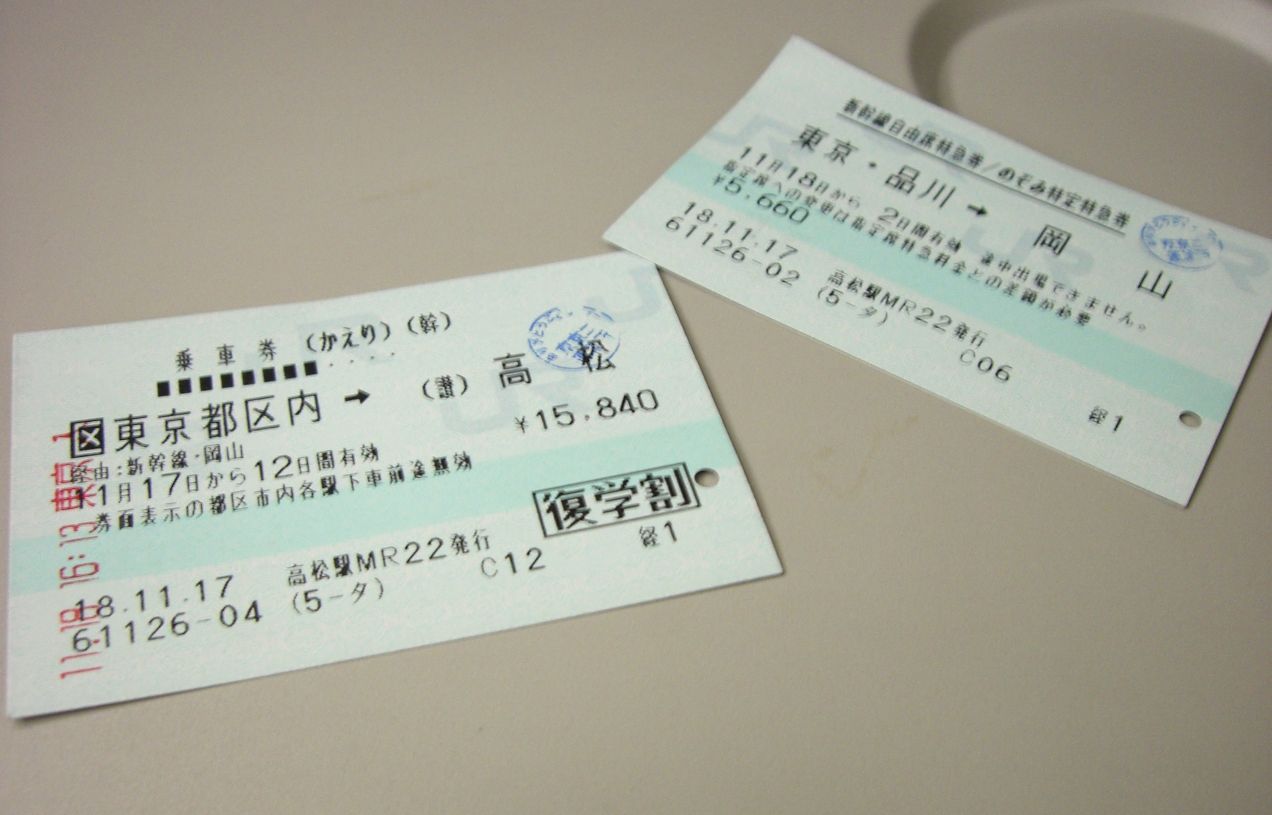
Which one should you use
Everything above, collapsed into a decision you can act on. Ask about eligibility first, geography second, and your card last.
- Do you live in Japan? If not, cross Eki-net off entirely. It is not an option, whatever other guides say.
- Is the trip mostly Tokyo to Nagoya, Kyoto, Osaka, Hiroshima and Hakata? Then use Smart EX: no annual fee, potentially paperless, changes handled on your phone. Just make sure you install the app version for your own country.
- Are you heading north of Tokyo on the Tohoku, Joetsu, Hokuriku, Yamagata or Akita Shinkansen? The designated entry point is JR-EAST Train Reservation. Try it before departure, and if it fails, plan to use a station, a JR EAST Travel Service Center or a reserved-seat machine after you land — that passport notice has been live for nearly four years.
- Do you want JR West limited expresses or its Toku-Toku Kippu range? Use e5489, which also happens to be the only system you can use without an account. Just build ticket collection into the schedule.
- Card refused? Do not try another system; the requirements are the same everywhere. Go to a window or machine and use one of the alternative payment channels the operators list.
When to skip online booking entirely
An opinion is only useful if it is specific, so here are four cases where I would go straight to a station instead:
- Your itinerary hits e5489's exclusion list (five or more connections, crossing 04:00, out-and-back sections). These will never appear online, and a counter resolves them faster.
- You only carry virtual or chipless cards. A booking you cannot collect is not a booking.
- You want a regional pass or special-plan ticket outside JR West. Those have their own distribution channels and are not necessarily in any of these three systems.
- Departure is imminent. Smart EX closes 4 minutes before departure and e5489 six, which sounds generous — but that is the deadline for completing payment, not for reaching the platform. In the final minutes, the machine in the concourse beats the phone in your hand.
One boundary to close on: this guide is about buying point-to-point tickets, for travellers who are not buying a Pass. If your itinerary is long-distance, multi-leg and crosses regions, the question you should be asking is a different one — and our nationwide versus regional Pass comparison runs the break-even numbers. Read both and you have the whole picture.
Conclusion: three sentences
One: check eligibility before you study any interface. JR East states that overseas residents cannot use Eki-net (FAQ entry 4131, updated 10 March 2026); the system you are meant to use is JR-EAST Train Reservation — whose homepage has carried a “some passports cannot complete a purchase” notice since December 2022.
Two: crossing operators is not blocked, it is downgraded. Eki-net books Tokaido trains as undiscounted paper with no advance request, while Smart EX cannot leave the Tokaido, Sanyo and Kyushu lines at all. The real decision axis is not geography — it is whether this trip requires a physical ticket.
Three: the card is the hidden gate. All three systems require 3D Secure, Eki-net additionally requires the member's own name, and e5489 states in writing that virtual and chipless cards cannot collect tickets. Pack a chipped physical card and switch 3D Secure on before you fly — five minutes of preparation against fifteen lost at a ticket machine.
Frequently Asked Questions
- Q1:Can foreign visitors register for Eki-net?
- Officially, no. JR East FAQ entry 4131, last updated on 10 March 2026, states it without any room for interpretation: people living overseas cannot use Eki-net, because Eki-net is a service intended for residents of Japan. The same entry redirects overseas residents to a different system, JR-EAST Train Reservation. That is the opposite of the advice you will have absorbed if you followed instructions written for Japanese residents — the booking flow they describe is real, it just is not open to you.I had this wrong too, and it is corrected as of this guide.
- Q2:Smart EX opens a year ahead — does that mean I never have to compete for tickets?
- Half true, and false for anyone trying to save money. Smart EX does open reservations at 05:30 on the same calendar date one year before travel. But the official reservation-hours page attaches three conditions. First, the EX Hayatoku early-bird fares, S Work seats, wheelchair spaces and oversized-baggage seats are all excluded from one-year-ahead booking — and the early-bird fares are precisely the cheap ones. Shinkansen Supreme Class, launching 1 October 2026, joins that exclusion list too. Second, bookings placed between one year and one month out have neither the train nor the seat confirmed. Third, confirmation happens at 14:00 one month before travel, and changing an already-confirmed booking has to wait until after 10:00 one month before. So the honest framing is: booking a year out secures the day, not the fare and not the seat.
- Q3:Are the three JR booking systems completely walled off from each other?
- No. The boundary is one-way permeable, not mutual. Eki-net can book the Tokaido, Sanyo, Kyushu and Nishi-Kyushu Shinkansen — but crossing that line downgrades the booking on four counts: paper ticket only (those lines are outside the Shinkansen eTicket scheme), no discount products at all, no advance-request window, and web only, because the ticketless app cannot issue what does not exist electronically. In the other direction, Smart EX cannot leave the Tokaido, Sanyo and Kyushu Shinkansen at all — the official FAQ tells you to buy other sections at a station window. e5489 also sells Tokaido Shinkansen tickets, but those specific tickets cannot be collected on JR East territory. So the popular claim that crossing regions forces you to a ticket window is wrong; what actually happens is that the booking goes through and quietly loses a tier.
- Q4:I live abroad. How do I book Shinkansen trains north of Tokyo?
- Use JR-EAST Train Reservation, or plan to sort it out at a station after you land. This is the section where honesty matters more than completeness. JR East returns HTTP 403 to automated requests across its whole site, and while the JR-EAST Train Reservation homepage does open (there is a full Traditional Chinese version as well as English), its user guide, FAQ, ticket-collection and membership sub-pages were all blocked by the site firewall during verification. That means booking-open times, which trains are covered, where and with what documents you collect tickets, and whether fees apply are questions this guide cannot answer. What we could confirm are two notices still sitting on that homepage. One, dated 22 December 2022, admits that passports from some countries cannot complete a purchase, says the issue is under investigation and may take time, and advises travellers to try again after arriving in Japan. The other, dated 18 October 2022, warns that card issuers may block some transactions, and points you to stations, a JR EAST Travel Service Center or a reserved-seat ticket machine instead. A notice that has been up for almost four years tells you what to plan for: try online, but do not stake the trip on it.
- Q5:Why does my credit card fail at registration, or at the ticket machine?
- Almost always one of two things: 3D Secure, or the physical form of the card. All three systems treat 3D Secure as mandatory. Smart EX states plainly that if your card is not enrolled in, or does not support, 3D Secure you may be unable to register (including re-registering). Eki-net requires a card that is enrolled in 3D Secure and issued in the member's own name — a family member's card is rejected. e5489 requires the security code (except for J-WEST cards) and a 3D Secure password where applicable. The second barrier is physical and it bites at collection rather than booking: e5489 states that single-use debit cards, V-Preca, virtual cards and other cards with no physical form, plus mini cards, cannot be used to collect tickets, and that cards without an IC chip cannot be used at ticket machines at all — window only. Smart EX likewise excludes mini and virtual cards from some services, ticket collection included. Two things to do before you fly: switch on 3D Secure with your issuer, and pack a physical chipped card in your own name.
- Q6:Can I book a seat on Smart EX and then swap it onto a JR Pass?
- No — the official FAQ rules it out explicitly. Smart EX cannot be combined with other tickets including the JR Pass, and a reserved seat booked through the service cannot be converted into a JR Pass reserved seat after you arrive in Japan. The practical consequence: if a Pass is in your plan, book reserved seats through the Pass's own channels. Holding a seat on Smart EX first and converting later does not work and simply means paying twice. Whether a Pass makes sense for your itinerary in the first place is a different question, worked through in our nationwide versus regional Pass comparison.
- Q7:Can a Welcome Suica tap straight through a Shinkansen gate?
- Not necessarily, and this one strands people at the barrier. Smart EX confirms that Welcome Suica and PASMO PASSPORT can be registered to the service. But the same FAQ entry attaches two conditions. These visitor cards carry an expiry date and stop working once past it; and more importantly, a card purchased overseas that has not yet been used at a station gate inside the Suica or PASMO area cannot be used for Shinkansen travel until it has been tapped once in that area. So the plan of landing and heading straight for a Shinkansen gate on a freshly bought overseas card can fail. The workaround is trivial — ride one ordinary subway or JR journey first — but it is worth knowing that registering an IC card is optional in the first place. Skip it and collect a paper ticket with your reservation code and 4-to-8-digit password.
- Q8:Can I board without collecting my e5489 ticket?
- No, and it is expensive. JR West states that if you board without collecting the ticket you must buy a new, undiscounted ticket on board (ticketless products excepted). This is the sharpest difference between the three systems. Smart EX can be entirely paperless via a registered IC card or a QR code; Eki-net's JR East sections tap through on the Shinkansen eTicket scheme; e5489 essentially requires the reservation to become a physical ticket before departure. Collection points are geographically restricted too: on JR East only Hokuriku Shinkansen stations, major stations within the Tokyo metropolitan area, and the reserved-seat machines at Narita Airport and Airport Terminal 2 stations — and the official note adds that collection on JR East excludes certain tickets, such as the Tokaido Shinkansen between Tokyo and Shin-Osaka. If an e5489 ticket is in your plan, collecting it is the first thing you do at the station.