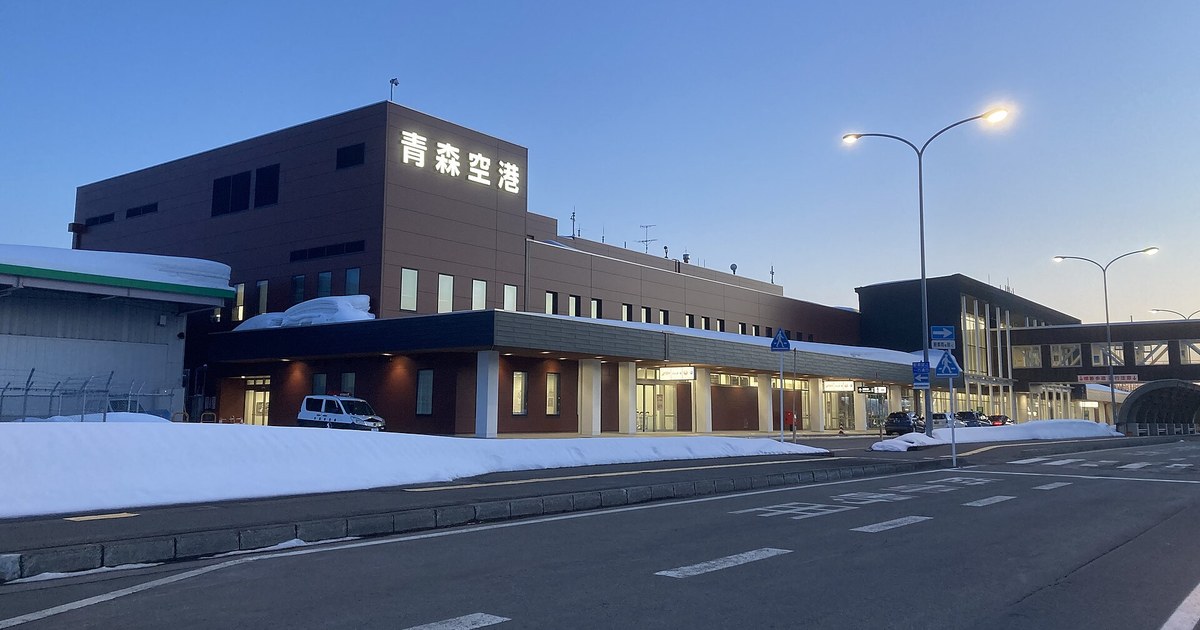
Most travellers arrive at a snowed-in Japanese airport carrying one unexamined assumption: that the airline will find a way to get them where they are going — another carrier, a rebooked routing, a train ticket, something. When the cause is weather, in Japan, it will not. ANA draws the line in a single sentence that leaves almost no room to argue: transfers to another airline, and transfers to ground transport, are accepted only where the delay or cancellation arises from a cause attributable to ANA. Weather is not attributable to ANA. The conditions of carriage line up exactly: Article 26, which covers company-attributable causes such as an aircraft fault, offers you three substitutes including another airline's aircraft and another mode of transport. Article 27, which covers causes attributable to neither party — weather — leaves you, before travel begins, with an ANA aircraft with available seats, a full refund, or an extension of validity. The other carrier and the train disappear from the list entirely. This guide works through what that line means in practice: when the fee-waiver marker actually appears, why ANA's 7 days and JAL's 30 days matter more than anything else on the comparison table, who ends up paying for the hotel, and a set of official numbers that will rearrange your instincts — the worst month for on-time performance in Japan is not December or January. It is February.
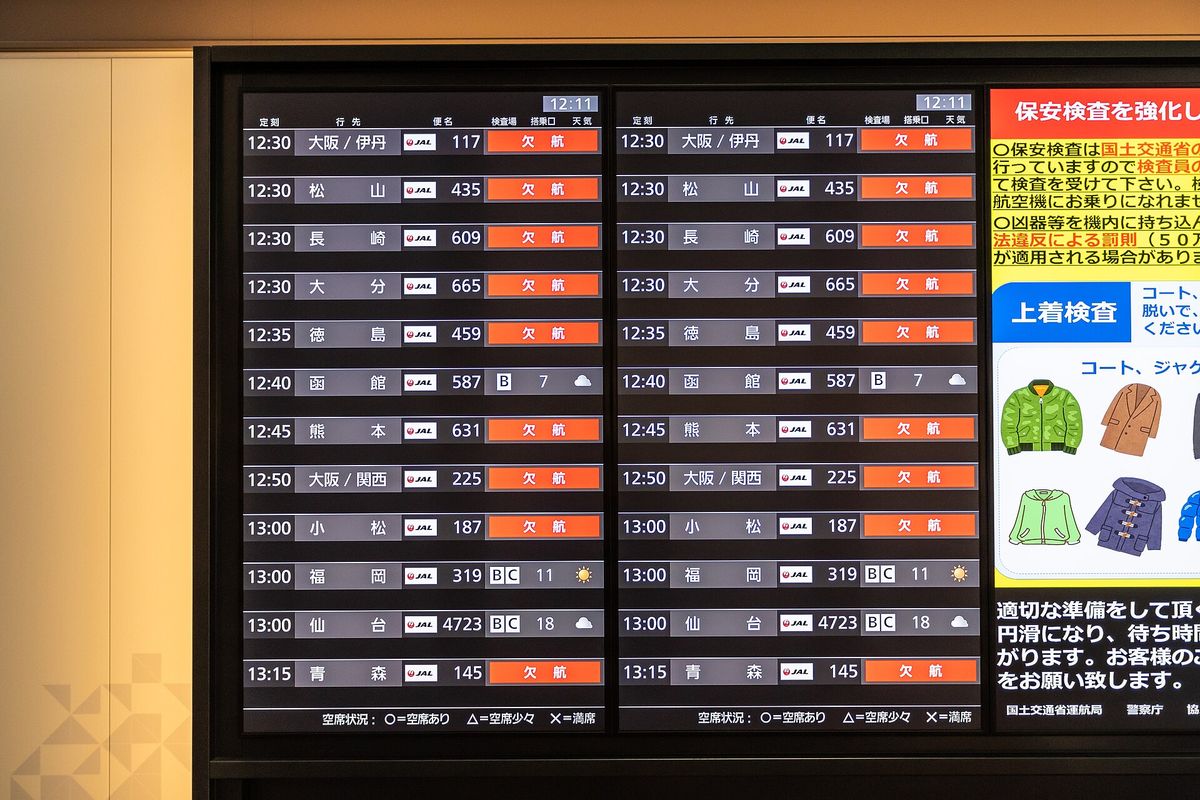
- A weather cancellation gives you three options: the airline's own next seat, a full refund, or extended validity. ANA states in writing that it will not move you to another carrier or to ground transport
- The gap with Europe is not the cash, it is the duty of care: EU261 waives compensation for weather too, but Article 9 meals and hotels still apply. Japan has no equivalent
- 🚨 Cancel before the “!” marker appears and you pay the cancellation charge — with no refund even if the flight is later cancelled. ANA designates affected airports only around 18:00 two days ahead
- Free-rebooking windows differ sharply: ANA ±7 days, one change; JAL 30 days from the boarding date
- Winter is less fearsome than you think, but watch February: 2024 fiscal-year on-time performance was 71.56% in February, worse than typhoon-season August
📖 Contents
- 1. What the airline actually owes you when weather wins
- 2. Against EU261: the gap is care, not compensation
- 3. The expensive mistake: cancelling before the marker
- 4. ANA vs JAL, side by side
- 5. Who pays for the hotel and the meals
- 6. The official numbers: February, not December
- 7. New Chitose 2016: when the trains stopped too
- 8. Aomori: the only snow-country airport publishing monthly data
- 9. Stranded: what to do, in order
- 10. FAQ
What the airline actually owes you when weather wins
Start with the legal frame. If you have heard that Japanese railways are covered by law while airlines are not, that is wrong, and it is wrong in a way that will mislead you.
The document everyone cites for rail — the Passenger Business Rules — is a set of conditions of carriage written by each JR company. It is not legislation. On the aviation side, Article 106 of the Civil Aeronautics Act requires Japanese air carriers to establish conditions of carriage and obtain the approval of the Minister of Land, Infrastructure, Transport and Tourism, with the approval criteria specifying that the document must at minimum set out fares, charges, and matters concerning the carrier's liability in respect of carriage.
So the accurate picture is this: rail and air both run on operator-written, ministry-approved conditions of carriage. The legal standing is the same. The difference is entirely in what those two documents say. The rail rulebook contains substitute transport — a mechanism that puts you on a competitor's line at no extra charge — and a schedule of refunds. The aviation conditions of carriage list weather as an exclusion. If you want the rail half of the picture, we cover it separately in our guide to substitute transport and JR refund rules when trains stop.
Article 26 and Article 27: one line, two different worlds
The ANA domestic conditions of carriage split disruptions by cause, and the two halves are not remotely equivalent.
| Situation | Article | What you can ask for |
|---|---|---|
| Attributable to the company (aircraft fault, knock-on aircraft rotation) | Article 26 | (a) an ANA aircraft; (b) another company's aircraft; (c) another mode of transport — all three are on the table |
| Attributable to neither company nor passenger (bad weather, force majeure) | Article 27 | Before travel begins: an ANA aircraft with available seats, a full refund, or extended validity. Other carriers and other transport modes are absent |
The plain-language pages are, if anything, blunter than the articles themselves. On the irregular-operations page, both the “change to another airline's flight” section and the “change to ground transport” section open with the same construction: accepted only where the delay or cancellation arose from a cause attributable to ANA, such as an aircraft fault on the day before or the day of the flight. That “only” is not stylistic. It is the condition.
One nuance, so you do not walk to the counter with misplaced hostility: not paying is not the same as not helping. In company-attributable cases ANA proactively contacts eligible passengers by email or SMS about reimbursement; in weather cases it does not cover costs but will still assist with arranging accommodation, at your expense. JAL, for its part, sends real-time notifications for cancellations, delays and weather assessments — the stage before a decision is made — by email, SMS and LINE, provided you have registered contact details in the booking. In Japan, the phrase “under weather assessment” usually means you still have a few hours to act. Being the first to know beats being early in the queue.
Against EU261: the gap is care, not compensation
“Japan has no EU261-style compensation” is a true sentence that misleads almost everyone who reads it, because it points at the wrong difference. Put the European text side by side and the real gap appears immediately.
- Article 5(3): a carrier is not obliged to pay Article 7 compensation if the cancellation was caused by extraordinary circumstances — which covers severe weather. Europe does not pay compensation for weather cancellations either.
- Article 9 (right to care): passengers shall be offered free of charge meals and refreshments, and hotel accommodation where a stay of one or more nights becomes necessary. Article 5(3) removes the Article 7 money. It does not remove Article 9.
Read together, the European position on a weather cancellation is: no compensation cheque, but you will still be fed and housed. Duty of care and compensation are two independent obligations, and only one of them is switched off by extraordinary circumstances.
Japan has neither. Article 106 requires the conditions of carriage to describe the carrier's liability and to be approved by the minister. It sets no compensation floor and no minimum standard of care. Everything below that is left to what each airline writes for itself — and what both airlines have written pushes weather-related accommodation and ground transport onto the passenger.
So the sentence to carry with you is this: the gap between Japan and Europe is not whether you get paid — under weather neither pays. It is whether anyone is responsible for where you sleep tonight. If your mental model was “surely they will at least put me in a hotel,” that expectation never had a basis.
The expensive mistake: cancelling before the marker
Both airlines waive change and refund fees the same way. The carrier designates the affected airports and flights in advance; designated flights then display a “!” marker beside the flight number in the arrivals and departures search. That marker is the switch. ANA calls the category “flights cancelled or affected by bad weather”; JAL uses the same marker and additionally publishes a list of affected airports from the day after tomorrow onward.
The problem is when the switch is thrown:
- ANA: affected airports are decided around 18:00 two days before the operating day.
- JAL: the official wording is that the timing is not fixed and may be decided close to departure.
Which produces the scenario that costs people real money. Three days out, the forecast has painted Hokkaido in warning colours. You look at it, conclude the flight is doomed, and cancel early to secure a seat on something else.
ANA has written down what that costs:
Where the flight does not fall within the designated flights, cancelling travel at the customer's own discretion incurs the normal cancellation charge. Furthermore, the cancellation charge cannot be refunded even if a cancellation of the flight is subsequently decided.
Two separate points sit in that quote. The first is that cancelling an undesignated flight costs the usual fee. The second is the one that stings: if the flight you cancelled goes on to be cancelled anyway, the fee you already paid stays paid. A related page adds that performing a change or refund while the “!” is not displayed may itself incur charges.
So the operating principle is short enough to remember at 2am: do not bet against the forecast, wait for the marker. However ugly the weather map looks, keep your hands off the button and watch for the “!” beside your flight number. When it appears, the door to a free change or a full refund opens. If you are worried about availability, research your alternatives in advance and keep the change page loaded — just do not commit.
A related detail that quietly frames the whole calculation: ANA states that in weather cases no cancellation fee is charged. For contrast, a passenger-initiated refund carries a refund handling fee of 440 yen per sector plus the cancellation charge itself, under Article 24 of the conditions of carriage. That 440 yen is a regulatory figure rather than a product price — you will never see it on a fare table — but it marks the smallest possible gap between “cancelled myself” and “waited to be designated.” In practice the gap is far larger, because the cancellation charge is the expensive half.
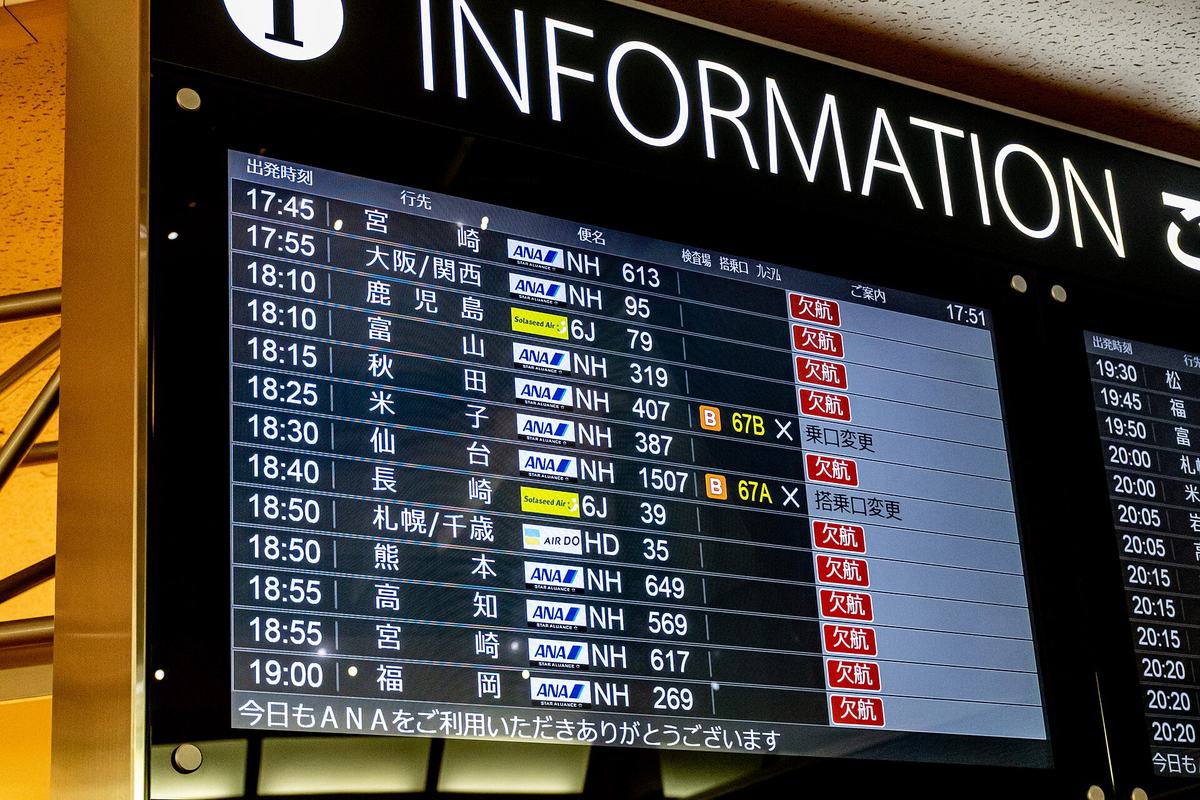
ANA vs JAL, side by side
Broadly the two carriers behave alike. One difference, though, is big enough to change which airline you book — and it has gone essentially unreported in English: how far into the future your free rebooking can reach.
| Item | ANA | JAL |
|---|---|---|
| How the fee waiver is identified | “!” beside the flight number in the arrivals/departures search — flights cancelled or affected by bad weather | “!” beside the flight number — fee-exempt flights; plus a published list of affected airports from the day after tomorrow |
| 🔴 When designation happens | Around 18:00 two days before the operating day | No fixed timing published; official wording says it may be decided close to departure |
| 🔴 Free rebooking window | Within 7 days either side of the original departure date, one change only (a further change is allowed if the new flight is also cancelled) | Within 30 days of the boarding date |
| Delay handling threshold | Departure delays of 30 minutes or more, in principle | Not published |
| Cut-off for action | Online changes until 20 minutes before departure; refunds until the departure time | Before the departure time of the booked flight |
| Refund filing deadline | Online: within 4 days of the final travel date; counter: within 1 year and 30 days of the travel start date | Where online is unavailable: within 30 days of the boarding date, via a dedicated form |
| Time to receive the refund | Credit card roughly 1–2 months; ⚠️ explicitly not guaranteed where many flights are cancelled by poor weather | Refund processing about 1 week |
| Refund fee in weather cases | No cancellation fee charged (contrast: passenger-initiated is 440 yen per sector handling fee plus cancellation charge, Article 24) | No fee |
| Notifications | Email / SMS to eligible passengers in company-attributable cases | Real-time alerts for cancellation, delay and weather assessment via email, SMS and LINE when contact details are registered |
| Other carriers / ground transport under weather | Not offered — restricted in writing to causes attributable to ANA | No citable wording found; not extrapolated |
The one cell to remember is 7 days versus 30 days. On ANA, a weather cancellation compresses your free options into a single week around the original date and a single use — so that one change has to be right. On JAL you have most of a month, enough to fly home on a different arrangement and settle the replacement later. If your dates were never fixed in the first place, that difference is a genuine reason to prefer one carrier over the other on winter Hokkaido and Tohoku routes.
Two operational details deserve to be pulled out of the table:
- Once your bag is checked in, online and telephone rebooking is closed to you. ANA states that passengers who have already checked baggage must be handled at an airport counter. On an unsettled day, checking a bag is the moment you commit yourself to a physical queue. Check the flight status before you check the bag.
- Change once, then cancel for your own reasons, and standard charges apply against the original fare. The free change exists to absorb the disruption, not to let you rebuild the itinerary.
Who pays for the hotel and the meals
This section can be short, because both carriers are unusually direct.
JAL states that ground transport costs and accommodation costs arising from delays and cancellations caused by bad weather or natural disasters are borne by the customer.
ANA presents it as two columns. ANA bears the cost where the cause is attributable to ANA, such as an aircraft fault. The customer bears the cost where the cause is not attributable to ANA — the listed examples being bad weather, natural disasters and airport congestion. Note that last one: congestion is on your side of the ledger.
Then there is a condition that even frequent Japanese travellers get wrong. On JAL international routes, a company-attributable disruption is only covered if it occurs on the day of travel. The official text limits the arrangement to delays and cancellations arising on the boarding day itself, and states that flights whose schedule change or cancellation had already been decided by the day before the scheduled boarding date are not eligible. The published table makes the categories explicit: same-day company-attributable disruption sits under JAL bears; company-attributable disruption decided the previous day or earlier sits under customer bears, alongside bad weather.
Read that carefully and an uncomfortable implication follows: telling you a day in advance that tomorrow's flight is cancelled is the cheaper option for the airline. That is not a conspiracy theory — it is how the official table classifies it. Two more mechanics to note: reimbursement is claimed after the fact and original receipts are mandatory, with copies not accepted; and for codeshare flights operated by another airline, the operating carrier's standards apply rather than JAL's.
So where does the money come from
The causal chain is short and it points in exactly one direction: the airline has written down that it will not cover weather-related accommodation, so trip-delay insurance is the only remaining source for that cost. Our guide to trip-delay policies and their trigger thresholds already covers how to compare policies, what the trigger hours mean, what credit-card bundles require of you, and which documents a claim needs. Read it with this section as the premise: you are not insuring against an unlikely event. You are insuring against a cost the airline has already told you, in its published terms, that it will not carry.
The official numbers: February, not December
Everything so far has been bad news, so it is time to calibrate the fear against data. Here is monthly on-time performance (arrival basis, fiscal 2024) from the Japanese transport ministry's aviation service disclosure:
| Month | On-time rate, all carriers | Note |
|---|---|---|
| February | 71.56% | 🔴 worst of the year |
| August | 73.72% | typhoon season |
| December | 75.78% | — |
| March | 77.40% | — |
| January | 81.11% | better than the annual average |
| Fiscal year | 80.89% | — |
Three conclusions fall straight out of that table.
- February is worse than typhoon-season August. If your working assumption was that summer typhoons are the main threat, the ministry disagrees.
- January is fine — 81.11%, above the annual average. The folk belief that a January Hokkaido trip means getting snowed in has no statistical support.
- The spread is not large enough to change your travel plans. Even in the worst month, more than seven flights in ten leave on time.
By carrier, February reads ANA 70.09% and JAL 68.98%, while Hokkaido-based AIRDO records 66.48%, the weakest of the major operators — a number worth knowing if you are deciding whether a winter Hokkaido itinerary needs a spare day.
The second dataset is cancellation rates. For January to March 2025 — the winter quarter — the national cancellation rate was 1.36%, against 3.72% in the same quarter a year earlier, while the delay rate was 18.66% (16.34% previously), where a delay means departing 15 or more minutes behind schedule. In plain terms: roughly a 1% chance of being cancelled, and close to a one-in-five chance of running late. What actually derails winter itineraries in Japan is usually a missed connection or a missed last train, not being unable to get home at all.
The ministry acknowledges the seasonality itself while warning against reading it too simply: summer is exposed to typhoons on Okinawa routes, winter is exposed to snowfall in the northern regions, and therefore simple month-to-month comparison is not appropriate. That caveat is worth quoting because it explains both why February is worst and why one number should not decide anything.
Why the early flight really is safer
“Take the first flight of the day” is standard travel advice that nobody supports with evidence. Here is the evidence. The Japanese transport ministry treats aircraft rotation (kizai-guri) as a separately counted cause of cancellation, defined as a case where the preceding flight was delayed or cancelled for some reason and the following flight is consequently cancelled.
One airframe flies several sectors a day. If snow catches the first one, every sector behind it is paying down that debt — and the effect is significant enough that the ministry gives it its own category in the national statistics. The later your flight sits in the day, the more accidents there have been in front of it. That is a published statistical field, not a feeling.
So the recommendation is unambiguous: on winter domestic sectors, book the first wave of the day, and do it above all for the leg that connects to an international departure. The cost is a painful alarm; what you buy is a flight with nothing in front of it to go wrong. Conversely, if an evening flight is your only option, do not schedule anything critical for that day — because when it goes, the next thing you can move to is quite likely tomorrow.
New Chitose 2016: when the trains stopped too
Percentages do not frighten anyone, so here is a documented case. Japan's Ministry of Internal Affairs and Communications, through its Hokkaido regional administrative evaluation bureau, investigated the passenger stranding incident of December 22–24, 2016 at New Chitose Airport, during which central Sapporo recorded its first 90cm-plus December snowpack in fifty years.
| Date | Cancellations | Stranded | Ground transport |
|---|---|---|---|
| Dec 22 | 224 flights (59%) | about 3,000 | runway closed about 5h 40m |
| Dec 23 | 284 flights (72%) | about 6,000 — the largest on record | 🔴 312 airport bus services (about 96%) and 52 train services (about 45%) suspended; runway closed about 4h |
| Dec 24 | 103 flights (25%) | about 2,600 | 79 train services (about 70%) suspended; total suspension from first train to about 13:00 |
| Three-day total | 611 flights | about 11,600 | — |
Three details are worth carrying away. First, the runway closures were about the type of snow, not the quantity: the official record cites wet, heavy snow where repeated clearing failed to improve the friction coefficient. Second, the airport's stock of 6,000 blankets — enough for roughly 3,000 people — ran out, and the Japan Self-Defense Forces supplied a further 4,000, with about 10,000 distributed in total; stock was later increased to 10,000. Third, and most consequential for travellers: “I will just take the train instead” did not work on the worst day. Buses were 96% down and rail 45% down on December 23.
The escape routes the government itself published
The most useful thing in that report is buried in an appendix: it sets out the routes that actually worked, which is not something official bodies normally do.
- Conventional line plus shinkansen: December 23, 09:00 from New Chitose Airport station, via Minami-Chitose, 13:35 Shin-Hakodate-Hokuto, 18:04 Tokyo Station — running at least 40 minutes late at the time.
- Ferry plus shinkansen: December 22, 17:20 bus from New Chitose Airport, 23:59 Tomakomai West Port, ferry, 07:30 Hachinohe on December 23, 12:04 Tokyo Station.
Neither is cheap or comfortable, but both are officially attested as passable on the day. If the rail option is the one you would take, our breakdown of what leaving Hokkaido by rail actually costs covers the ticket combinations — with one warning attached: rail passes offer no remedy at all once activated, including for weather suspensions, which the rail article explains in full.
The report also lists three failures the authorities identified in themselves, and each one translates into something you should do:
- Many passengers travelled to the airport without having checked operational information. The follow-up measure was to install an operational-information display board at Sapporo Station in December 2017.
- There was no information about alternative transport inside the airport — ferries were running normally, and nobody told the stranded passengers.
- Security screening was performed for flights whose operation had not yet been confirmed, leaving passengers waiting for long periods inside the restricted area and causing disputes. The ministry subsequently instructed carriers not to conduct security screening for flights other than those scheduled to operate.
That third point has a direct practical meaning for you: being sent through security while your flight status is undecided is not necessarily in your interest. Options narrow inside the restricted area, and getting out again — with your bag — is more complicated than getting in.
Aomori: the only snow-country airport publishing monthly data
If you want to know how often a snow-country airport actually stops, there is exactly one place in Japan publishing usable monthly official figures. Aomori Prefecture releases annual airport overviews containing scheduled-service cancellation data going back to fiscal 1987 — a 38-year series — plus snow-clearing statistics. The figures below come from Aomori Airport Overview 2025, issued in October 2025.
| Month (fiscal 2024) | Cancellation rate | Flights cancelled |
|---|---|---|
| August | 🔴 4.4% | 62 — highest of the year, typhoons |
| January | 3.3% | 45 — winter peak |
| March | 2.6% | 37 |
| February | 2.5% | 31 |
| December | 1.2% | 17 |
| Full year | 1.4% | 230 of 16,386 scheduled |
That table overturns an instinct. Aomori is among the snowiest places in Honshu: in the same fiscal year it recorded 106 days of snowfall, 1,366cm of cumulative snowfall — nearly 14 metres — a maximum snow depth of 235cm in January 2025, 92 days of snow-clearing operations and 225 clearing runs. Despite all of that, its worst month for cancellations was August, because of typhoons, not any winter month.
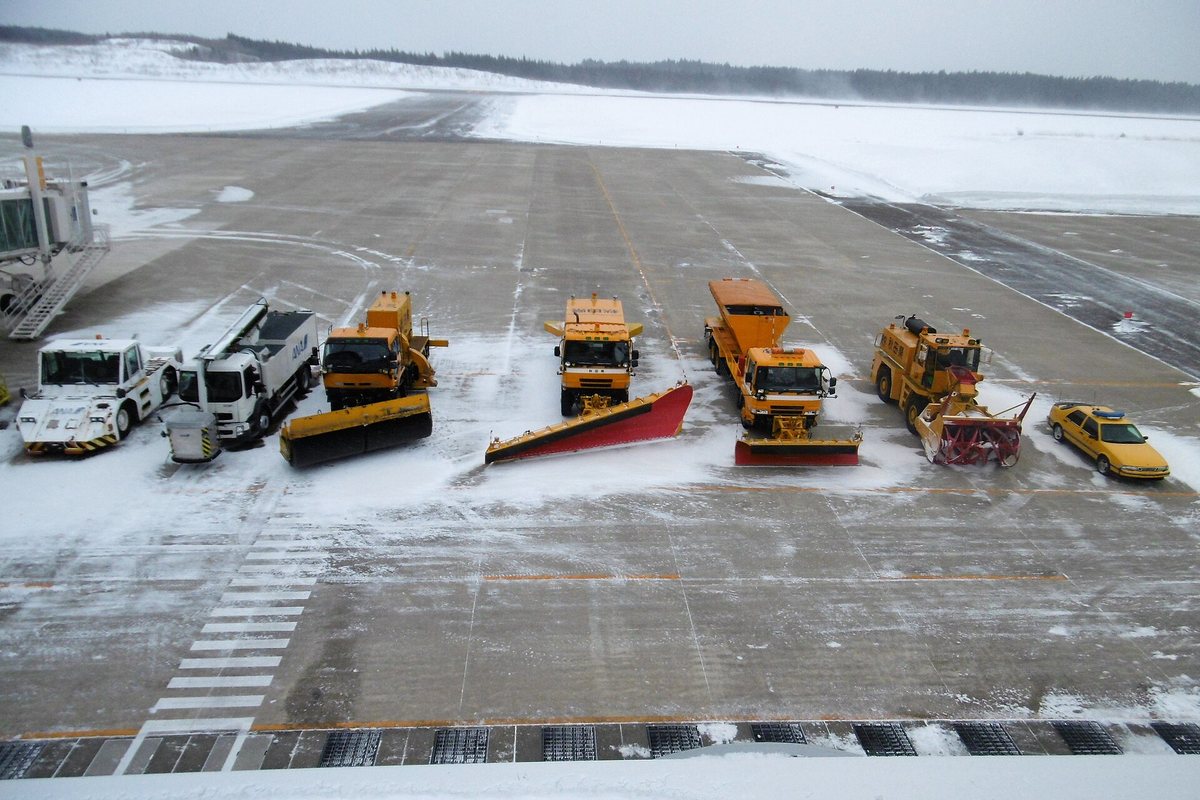
The clearing operation explains why. Aomori clears about 550,000 square metres — the prefecture likens it to roughly twelve Tokyo Domes — to a standard of about 40 minutes. The runway is worked in 30-metre passes on each side, with ten vehicles arranged in a diagonal line; a single deployment involves 34 vehicles of 6 types (37 devices); and the 500-plus airfield lights are cleared by hand. ⚠️ These operational figures come from a prefectural page whose last update is dated November 22, 2019, so the fleet composition may have changed since.
For contrast, New Chitose has also strengthened its own operation: from a former 10-vehicle echelon taking about 40 minutes to a 12-vehicle echelon clearing the full width in one direction in about 20 minutes across a 60m by 3,000m surface. Which is the point about 2016 — the paralysis was not fundamentally a clearing-speed problem. It was snow of a type that would not give the runway its friction back.
Stranded: what to do, in order
Everything above, compressed into a sequence you can follow.
Two to three days out: do one thing, and do not touch the button
- Turn notifications on. Register an email address or mobile number in your JAL booking and you get real-time alerts for cancellations, delays and weather assessments, including via LINE. ANA contacts eligible passengers by email or SMS in company-attributable cases. This step is free and has the highest return of anything in this list.
- Watch the marker, not the forecast. ANA designates affected airports around 18:00 two days ahead; JAL publishes no fixed time. Until the “!” appears, do not touch the change or refund controls — section 3 explains what that costs.
- Research alternatives, but do not book them. Once designation happens you want to move fast, and ANA gives you one free change — do not waste it on a date you have not thought through.
On the day: check the status before you check the bag
- Baggage is a one-way door. ANA states that passengers who have already checked baggage cannot change flights online or by phone. On an unsettled day, the order of those two actions decides whether you spend the afternoon on your phone or in a queue.
- Use the website while you still can. ANA accepts online changes until 20 minutes before departure and refunds until the departure time; JAL until the departure time. The counter is the last resort, not the first.
- Think before clearing security on an undecided flight. The 2016 review named this specifically, and the ministry now instructs carriers not to screen passengers for flights that are not scheduled to operate. Your options shrink airside.
Once it is confirmed cancelled: choose well among three
A weather cancellation leaves you with three options: the airline's own next flight, a full refund, or extended ticket validity. How to choose:
- Flexible dates and flying JAL → take the rebooking. A 30-day window lets you deal with tonight first and pick the replacement date later.
- Flying ANA and unsure when you can travel → think twice. The free change is ±7 days and one use. If you cannot say whether next week works, the refund may beat guessing at a date — and weather refunds carry no cancellation fee anyway.
- You have an international connection → this is the case that justifies picking up the phone immediately. Domestic and international sectors are frequently separate tickets, a free domestic change does nothing for an international flight that has already departed, and if the international leg is a codeshare, the operating carrier's standards govern.
Tonight's bed: secure the room first, argue about money later
Order matters here. Get a room, then work out who pays. The airline does not cover weather accommodation but will generally help arrange it at your cost; on a mass-cancellation day the hotels around the airport empty within an hour. The moment your flight enters “weather assessment,” book something with free cancellation. The money then goes back through trip-delay insurance — thresholds and documentation are covered in the insurance guide — and the one thing to do at the airport is ask the airline for written proof of the delay or cancellation, which is the document a claim turns on.
Escaping overland: confirm the ground is still moving
Switching to rail is the natural instinct, but the New Chitose numbers are a warning: on the worst day, 96% of buses and 45% of trains were down as well. So the order is “check the rail and bus operating information, then decide whether to leave the airport,” not “head for the station and figure it out there.” Our rail disruption guide lists official service-status URLs for twenty operators and explains who qualifies for substitute transport. If you are driving, that is an entirely separate risk assessment — see how to read winter road conditions. And for judging how serious the storm itself is, how Japan's alert levels work covers the warning system.
Three sentences to take away
One: under weather, a Japanese airline owes you its own next seat and nothing else. ANA states in writing that other carriers and ground transport apply only to causes attributable to ANA; Article 26 offers three substitute modes, Article 27 leaves only ANA's own aircraft. Delete the assumption that someone will find a way to get you there, and your decisions at the airport change completely.
Two: the gap with Europe is care, not cash. EU261 waives compensation for weather as well, but its Article 9 duty to provide meals and accommodation survives; Japan's Civil Aeronautics Act Article 106 requires only that liability be described in an approved document, with no floor of any kind. Which is why the hotel bill can only come back through trip-delay insurance — that is a causal chain, not a sales pitch.
Three: do not bet against the forecast, and take the early flight. Cancelling before the “!” appears costs you the fee, and you do not get it back even if the flight is later cancelled; meanwhile aircraft rotation is a separately counted cause of cancellation in the national statistics, so the later your flight sits in the day, the more can already have gone wrong ahead of it. And as for whether to avoid Japanese winters altogether — the ministry's monthly data says even the worst month, February, still runs 71.56% on time, and typhoon-season August is worse than every winter month except February. The answer is not to stay away. It is to leave one day spare.
Frequently Asked Questions
- Q1:If snow cancels my flight in Japan, will the airline rebook me on another airline or put me on a train?
- No, and ANA states this in writing. Its irregular-operations support page uses one sentence pattern twice — once for transfers to other airlines and once for transfers to ground transport: rebooking is accepted only where the delay or cancellation arises from a cause attributable to ANA, such as an aircraft fault occurring the day before or the day of the flight. The conditions of carriage match exactly. Article 26 (company-attributable causes) offers three substitutes: ANA aircraft, another company's aircraft, or another mode of transport. Article 27 (causes attributable to neither the company nor the passenger, which is where weather sits) leaves you, before travel begins, with an ANA aircraft with available seats — the other carrier and the other transport mode simply are not in the list. So a weather cancellation entitles you to ANA's own next seat, a full refund, or an extension of ticket validity: pick one. These article numbers are ANA's; read JAL's own conditions of carriage rather than assuming the same structure.
- Q2:Does Japan have anything like EU261 compensation for delays?
- No, and the half that matters is not the compensation. If you have heard that Japan has no EU261-style compensation, that is true and it misses the point. EU261 Article 5(3) already removes the obligation to pay Article 7 compensation where the cancellation is caused by extraordinary circumstances, and bad weather qualifies. Europe does not pay the compensation for weather either. What Article 5(3) does not remove is Article 9, the right to care: passengers must be offered, free of charge, meals and refreshments and hotel accommodation where a stay of one or more nights becomes necessary. Japan has no equivalent layer at all. Article 106 of the Civil Aeronautics Act requires Japanese carriers to file conditions of carriage and obtain approval from the Minister of Land, Infrastructure, Transport and Tourism, and the approval criteria require the document to set out the carrier's liability — but no minimum compensation and no minimum duty of care is imposed. The real gap is not the cash. It is who is responsible for feeding you and finding you a bed.
- Q3:The forecast looks terrible. Should I cancel my ticket early to be safe?
- Do not cancel it yourself. ANA states it without ambiguity: where your flight has not been designated as an affected flight, cancelling on your own judgement means the normal cancellation charge applies, and — this is the part that costs money — the cancellation charge is not refunded even if the flight is subsequently cancelled. A related page warns that carrying out a change or refund before the “!” marker appears may also incur fees. Meanwhile ANA decides its affected airports only around 18:00 two days before the operating day, and JAL says openly that the timing is not fixed and can be decided close to departure. The correct behaviour is therefore counter-intuitive but simple: do not bet against the forecast, wait for the marker. Have your alternative flights researched, keep the change page open — and keep your hands off the button until the “!” shows up.
- Q4:What is the difference between ANA and JAL when weather cancels a flight?
- The biggest difference is how long the free rebooking window stays open. ANA limits fee-free changes to within 7 days either side of the original departure date, and to one change only (if the new flight is also cancelled you may change again). JAL allows fee-free changes within 30 days of the boarding date. For anyone with flexible dates, that is the difference between deciding on the spot and deciding after you get home. Other differences: ANA states that delay handling applies in principle to departures delayed 30 minutes or more, accepts online changes until 20 minutes before departure and refunds until the departure time, and requires online refunds to be completed within 4 days of the final travel date; JAL's online refund route runs within 30 days of the boarding date via a dedicated form. On timing, only ANA publishes a fixed hour; JAL publishes none.
- Q5:Who pays for the hotel when weather strands me at a Japanese airport?
- You do, and both carriers say so explicitly. JAL states that ground transport costs and accommodation costs arising from delays or cancellations caused by bad weather or natural disasters are borne by the customer. ANA splits it into two columns — ANA pays where the cause is attributable to ANA, such as an aircraft fault; the customer pays where the cause is not attributable to ANA, listing bad weather, natural disasters and airport congestion. There is one further trap that even Japanese travellers miss: on JAL international routes, even a company-attributable disruption is only covered if it happens on the day of travel. The official wording limits cover to delays and cancellations occurring on the boarding day itself, and states that flights whose schedule change or cancellation was decided by the day before are not covered. Reimbursement is claimed after the fact, original receipts are required and copies are not accepted, and codeshare flights operated by another carrier follow the operating carrier's standards. Since the airline is not paying, trip-delay insurance is the only source for that money — see our guide to insurance trigger thresholds.
- Q6:Is winter really the worst time to fly within Japan?
- Not the way most people assume, and the official monthly figures say something surprising. In the Japanese transport ministry's published on-time performance data for fiscal 2024 (arrival basis), the worst month across all carriers is February at 71.56% — worse than August at 73.72%, the peak of typhoon season. December sits at 75.78%, March at 77.40%, and January is actually 81.11%, above the annual figure of 80.89%. By carrier, February reads ANA 70.09%, JAL 68.98%, and Hokkaido-based AIRDO 66.48%, the weakest of the major operators. Aomori Airport is stranger still: in the prefectural government's published monthly figures, the highest cancellation rate of the year was August at 4.4% — a typhoon month — against a winter peak of 3.3% in January. The takeaway is not “avoid winter.” It is build a buffer day around February and Hokkaido routes.
- Q7:If flights stop, can I just take a train or bus instead?
- On the worst days, no — and there is an official case file proving it. Japan's Ministry of Internal Affairs and Communications, through its Hokkaido regional bureau, investigated the passenger stranding incident of December 22–24, 2016 at New Chitose Airport. Across three days: 611 flight cancellations and roughly 11,600 stranded passengers. On December 23 alone, 284 flights (72%) were cancelled and about 6,000 people were stranded — while 312 airport bus services (about 96%) and 52 train services (about 45%) were also suspended. The next day rail suspensions reached 79 services (about 70%), with everything suspended from first train until around 13:00. So the reflex to “just take the train” fails exactly when you need it. The same report does, unusually, publish the escape routes that worked: on December 23, 09:00 from New Chitose Airport station, via Minami-Chitose, 13:35 Shin-Hakodate-Hokuto, 18:04 Tokyo Station, running about 40 minutes late at minimum. For what that route actually costs, see our breakdown of leaving Hokkaido by rail.
- Q8:How long does a weather-cancellation refund take?
- Longer than you would hope, and the airline itself declines to promise on the days it matters. ANA states that credit-card refunds take roughly one to two months, and adds the caveat that this does not apply where large numbers of flights are cancelled due to poor weather — the exact scenario that made you need the refund is the one with no timeline. JAL states that refund processing takes about one week. For expense reimbursement in company-attributable cases, ANA notifies eligible passengers by email or SMS, accepts self-submitted claims from those not contacted, sets a deadline of 30 days from the scheduled departure date, and takes about three weeks to assess, extending to about a month during mass cancellations. Two operational traps worth memorising: once your bag is checked in you can no longer change flights online or by phone, only at an airport counter; and if you change flights once and then cancel for your own reasons, the standard charges apply against the original fare.