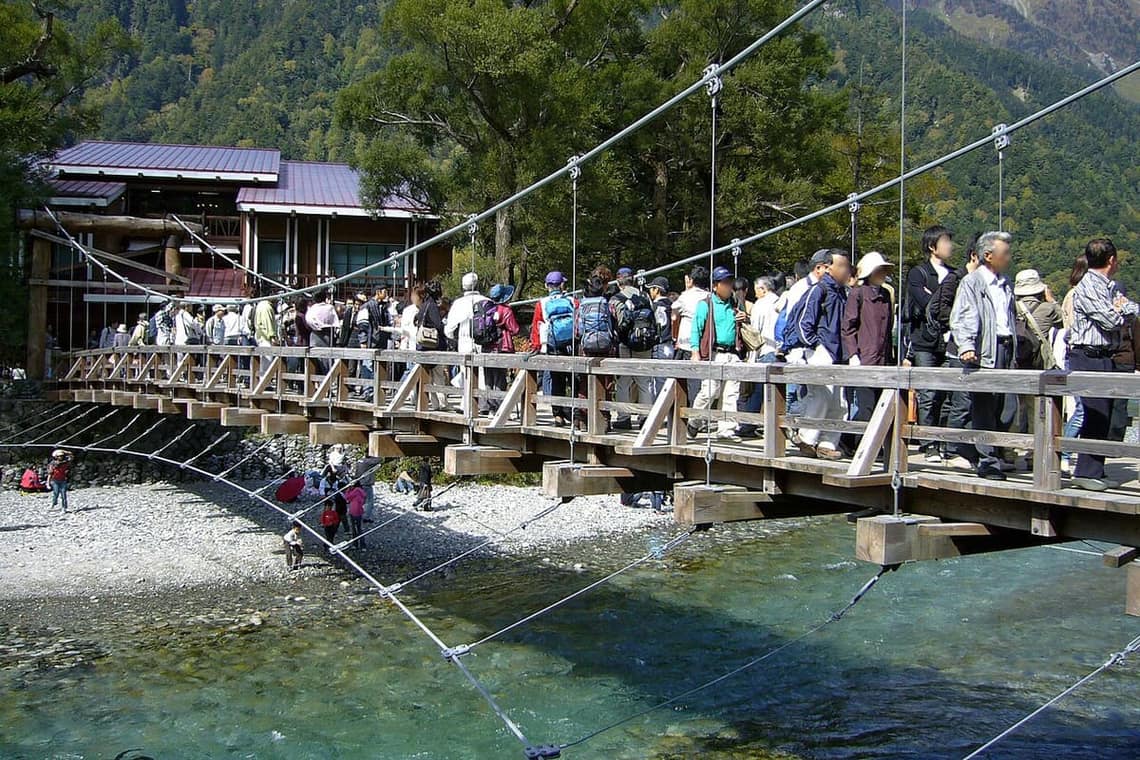
Ask when Kamikochi is open and you usually get a single date range back. That answer is incomplete, because Kamikochi's opening hours come in three layers. The outer layer is the season — in 2026, April 17, when the Kama Tunnel opens, to the closing ceremony on November 15. The middle layer is the year-round ban on private cars, which means you are not driving in on any date, ever; you park at Sawando or Akandana and transfer. The inner layer is the one that actually ruins itineraries: the last bus. The road barrier stays open until 19:00, but the last shuttle to Sawando leaves around 17:55 and the last one to Hirayu around 17:30, so the real cut-off is roughly half past five. On top of all that, Alpico Kotsu revised its Kamikochi fares on April 17, 2026: the Sawando shuttle went from ¥1,500 to ¥1,600 one way, and the Shin-Shimashima route bus is now ¥3,100 — so any fare printed before April 17, 2026 is now void. This article covers the three time layers, both approach sides, every current fare and the honest answer on winter, verified against official sources in August 2026.
📍 This piece is strictly about when you can go, how you get in and what it costs. What to actually do once you are there — Kappabashi, Taisho Pond, Myojin Pond, route planning, lodging and gear — is covered in our Kamikochi hiking guide. The two pieces are deliberately split and do not repeat each other.
- 2026 season: April 17 (Kama Tunnel opens) to the November 15 closing ceremony; the 56th opening festival on April 27 is a ceremony, and you can enter from April 17
- 2027 dates are not announced: the usual pattern is a mid-April opening, April 27 festival and November 15 close — confirm with the official site before booking
- Private cars and motorcycles are banned year-round, rentals included: park at Sawando (¥800/day) from Matsumoto or Akandana (¥600/24h) from Takayama
- Fares rose on April 17, 2026: Sawando shuttle ¥1,600 one way / ¥3,000 return, Shin-Shimashima to Kamikochi ¥3,100 — the old ¥1,500 and ¥2,800 fares are void
- Last-bus trap: around 17:55 to Sawando, 17:30 to Hirayu, 16:50 final direct bus to Shinjuku, 18:00 last taxi boarding — the 19:00 barrier time is not your deadline
- Winter closure is not a legal ban: entry is permitted but officially framed as self-responsibility winter mountaineering, with a mandatory climbing plan — not a sightseeing option
📖 Table of contents
- The three layers: season, daily hours, last bus
- The car ban and why your rental cannot enter
- The April 2026 fare revision: full price table
- Driving from Matsumoto: Sawando and the shuttle
- Driving from Takayama: Akandana and the Nohi shuttle
- Without a car (1): Matsumoto rail plus route bus
- Without a car (2): the Shinjuku direct bus
- Taxis: fixed rates and the 18:00 cut-off
- What costs money inside: free trails, tip toilets, one real admission
- Myojin Bridge and walking times: working backwards from the last bus
- Is Kamikochi open in winter? The honest answer
- How to plan it: the calls worth making
- FAQ
The three layers: season, daily hours, last bus
Start with the conceptual fix that makes everything else easier: Kamikochi does not have opening hours — the road does. Kamikochi is a river valley inside a national park. The trails are free and physically there all year. Whether the place is "open" depends entirely on the condition of the single road that reaches it: the prefectural Kamikochi Park Line and the Kama Tunnel at its mouth. That road carries three separate time restrictions, and missing any one of them can wreck a day.
Layer one: the calendar — April 17 opening is not the April 27 festival
Per the official Kamikochi site, the 2026 timeline runs like this:
| Date | Event | What it means |
|---|---|---|
| Fri Apr 17, 2026 | 6:30 safety prayer ceremony at the Kama Tunnel entrance; shuttle buses and taxis start entering from 7:00 | This is the day you can go — winter closure lifted |
| Mon Apr 27, 2026 | 56th Kamikochi Opening Festival, 10:50 by Kappabashi bridge | A ceremony, not an opening day |
| Nov 15, 2026 | Closing ceremony | Road enters winter closure until mid-April the following year |
There is a misunderstanding here that recurs every spring, so let us kill it early: you do not have to wait for the opening festival to visit Kamikochi. The road opens on April 17 and ordinary sightseeing works from that morning. The festival ten days later is a blessing ceremony held riverside at Kappabashi — worth seeing if your dates land on it, irrelevant if they do not. The only real difference in late April is that some hotels, shops and restaurants are still coming online, so dining choice is thinner.
As for 2027: nothing has been announced. The pattern across recent years is a mid-April road opening, the festival on April 27 and a November 15 close, and the official FAQ describes the season in exactly those terms — from the April 27 opening festival to the November 15 closing ceremony. That framework is safe for sketching a trip, but confirm the year's actual announcement before you commit to flights or non-refundable lodging.
Layer two: the Kama Tunnel's daily access hours
Even in season, the tunnel is not open around the clock. The long-standing access window is 5:00 to 19:00 daily, extended to 20:00 in July and August, with the barrier closed overnight. One honest caveat: at the time this article was verified in August 2026, the official restrictions page still carried the previous year's designation on those hours, so treat the window as the established pattern and check the official restrictions page for the current year's notice. The 5:00 to 19:00 frame has held for years, and planning around it will not mislead you.
Layer three: the last bus — the number that actually decides your day
The barrier is open until 19:00. That does not mean you can leave at 19:00. You did not drive in — the regulation would not let you — so your departure is dictated by a bus timetable:
| Route | Last departure from Kamikochi (indicative) |
|---|---|
| Kamikochi → Sawando (shuttle) | around 17:55 |
| Kamikochi → Hirayu / Akandana (shuttle) | around 17:30 |
| Kamikochi → Shin-Shimashima / Matsumoto | around 17:55 |
| Kamikochi → Shinjuku (Sawayaka Shinshu Go) | final 16:50 |
| Taxi | last boarding 18:00 |
⚠️ These times shift by date. Alpico and Nohi publish several timetable editions per season, so the table above is an order-of-magnitude guide, not a schedule — check the current edition on the day. The conclusion does not move, though: the practical departure line at Kamikochi is around 17:30, and in peak autumn the bus terminal queue builds for an hour before the last departures. Do not plan up to the wire.
The car ban and why your rental cannot enter
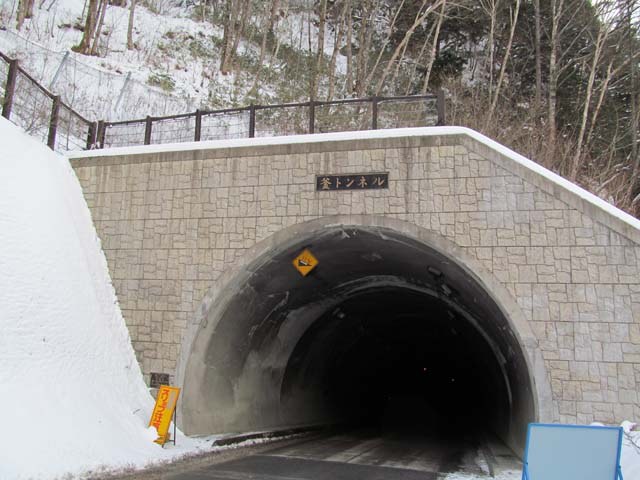
Kamikochi is the original Japanese case study in private-vehicle restriction, and the key detail people miss is that it is a year-round ban, not a peak-season measure. The official wording is blunt: private vehicles, motorcycles included, are prohibited from the Kama Tunnel onward, and visitors should transfer to a shuttle bus or taxi from the parking areas. A rental car is a private car — Japanese plates buy you no exemption. The restricted stretch is the prefectural Kamikochi Park Line, running from the Kama Tunnel to Kamikochi, branching off National Route 158.
Three categories may pass:
- Route and shuttle buses — how nearly everyone arrives
- Taxis — permitted, on a fixed-rate system; see the taxi section
- Chartered sightseeing coaches — within the operating season and daily access hours; recent years have not designated additional coach restriction days, but that is set annually rather than fixed
Which means the first planning decision is not whether to drive but which side to park on: Sawando on the Matsumoto side, or Hirayu and Akandana on the Takayama side. In practice your surrounding itinerary decides for you — pairing Kamikochi with Matsumoto Castle and Azumino points to Sawando, pairing it with Hida-Takayama and the Okuhida onsen points to Akandana.
The April 2026 fare revision: full price table
Here is the single biggest reason this article exists: on April 17, 2026, Alpico Kotsu revised fares across its Kamikochi network. The Sawando shuttle went from ¥1,500 to ¥1,600 one way and ¥2,800 to ¥3,000 return, and the Shin-Shimashima route bus rose as well. Budget from this table, verified against the official fare matrix in August 2026:
| Section | Current 2026 adult fare | Notes |
|---|---|---|
| Sawando ⇄ Kamikochi (shuttle) | One way ¥1,600 / return ¥3,000 | No reservations; children half fare |
| Hirayu / Akandana ⇄ Kamikochi (shuttle) | One way ¥1,500 / return ¥2,800 | Unreserved seating, booking not possible |
| Matsumoto ⇄ Shin-Shimashima (train) | ¥710 | IC cards not accepted (support planned spring 2027) |
| Shin-Shimashima ⇄ Kamikochi (bus) | ¥3,100 | Reservation-priority system |
| Matsumoto BT ⇄ Kamikochi direct | ¥4,600 | National Park Liner; the 5:30 departure is ¥5,000 with the early-morning surcharge |
| Taisho Pond ⇄ Kamikochi | ¥450 | For the "ride to Taisho Pond, walk back to Kappabashi" plan |
| Shinjuku ⇄ Kamikochi (Sawayaka Shinshu Go) | Daytime from ¥8,000 | Three-tier calendar pricing; see the Shinjuku section |
| Takayama ⇄ Kamikochi set ticket | ¥5,800 | Valid 7 days, transfer at Hirayu |
One more small figure that is easy to carry over from an older trip: Sawando parking is now ¥800 per day for a standard car. ¥700 is the superseded rate.
Driving from Matsumoto: Sawando and the shuttle
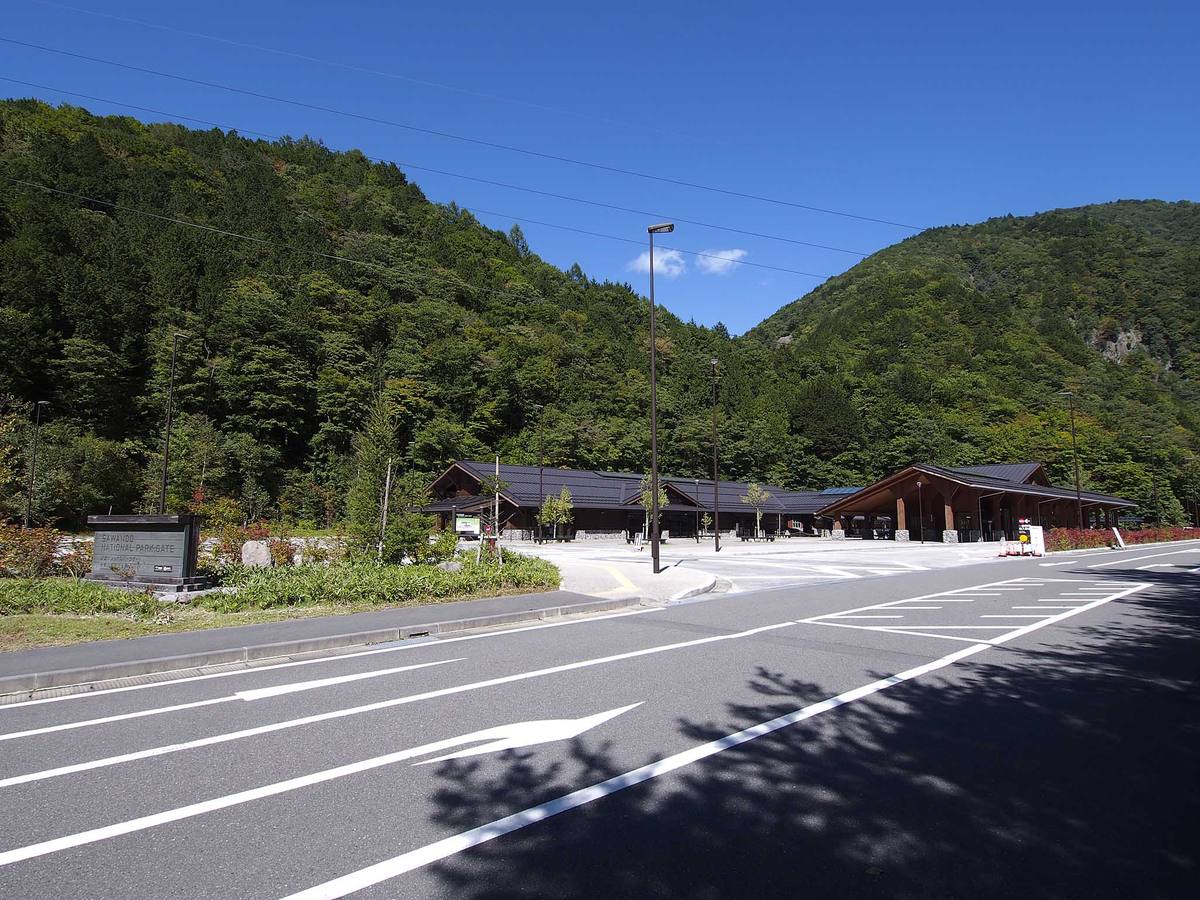
Anyone arriving by car from Matsumoto or the Nagano Expressway parks in the Sawando area. The municipal lots there hold roughly 2,000 vehicles at ¥800 per day for a standard car and ¥400 per day for a motorcycle, with automated 24-hour barriers, so arriving before dawn is not a problem.
- Shuttle fare: one way ¥1,600, return ¥3,000 (children half fare) — the return ticket saves ¥200 outright
- No reservations at all: buy a same-day ticket from the machines at Sawando Bus Terminal, Sawando Ohashi and the other stops, then board
- Roughly every 30 minutes, with a ride of about 30 minutes; first departures from Sawando are in the 5:00 hour, last departures from Kamikochi in the 17:55 range, both varying by date
Sawando's trump card is that first departure time. A bus in the 5:00 hour means you can be standing on Kappabashi before 6:00 — and the morning mist on Taisho Pond, the windless mirror reflections, the empty bridge are all products of that hour. If you want the dawn but do not want to pay valley-hotel rates, the cheapest workable play is a night in Sawando or Matsumoto and the first shuttle up. Staying in Matsumoto the night before with time for the castle? Tickets and hours are in our Matsumoto Castle ticket and hours guide.
Driving from Takayama: Akandana and the Nohi shuttle
Coming from Takayama or the Okuhida onsen villages, you park at Akandana, where the rate is ¥600 per 24 hours. Note the different billing unit: Akandana charges by the 24-hour block rather than by calendar day, which makes it the cheaper option if you intend to stay overnight in the valley.
- Shuttle fare: one way ¥1,500, return ¥2,800 (children's return ¥1,400)
- Unreserved seating, no booking possible, roughly every 30 minutes, operating April 17 to November 15
- The last departure from Kamikochi toward Hirayu is in the 17:30 range — about half an hour earlier than the Sawando side, so the Takayama approach needs a tighter finish
- Bear bells are fine. Bear spray, however, cannot fly at all — neither in the cabin nor in checked baggage: the Ministry of Land, Infrastructure, Transport and Tourism's dangerous-goods reference list (April 24, 2026 edition) marks bear spray and pepper spray as prohibited both as carry-on and as checked luggage. Buy it in Japan, use it or dispose of it in Japan, and do not plan to bring a canister in or take one home
Without a car and based in Takayama, buy the Nohi Bus Takayama ⇄ Kamikochi return set ticket at ¥5,800 (children ¥2,900), departing Takayama Nohi Bus Center with a transfer at Hirayu. It is valid for seven days, which is the genuinely useful part: base yourself in Takayama for a few nights, watch the forecast and go up on the clear day. Our Hida-Takayama guide covers the town and the Okuhida side.
Without a car (1): Matsumoto rail plus route bus
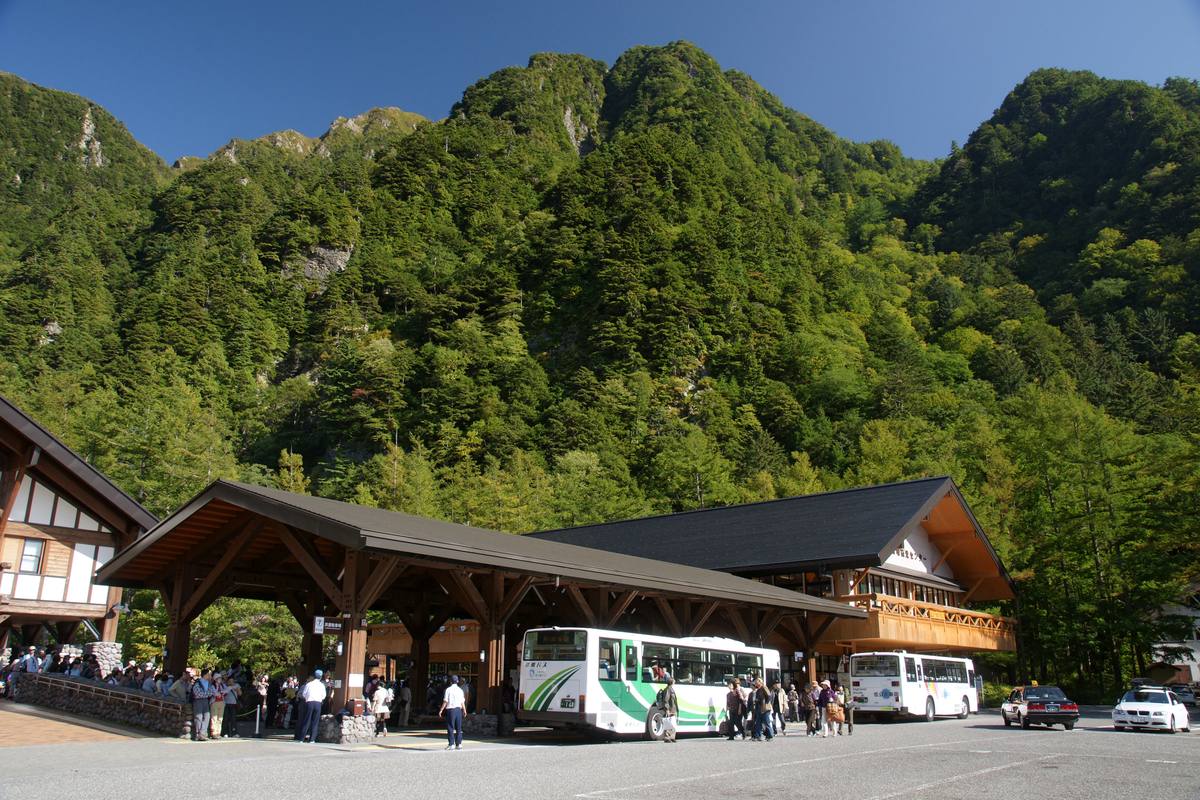
Pure public transport from Matsumoto is a two-stage trip: the Alpico Kotsu Kamikochi Line train from Matsumoto Station to Shin-Shimashima (¥710, about 30 minutes), then the bus on to Kamikochi (¥3,100, about 65 minutes). Two practical details:
- IC cards do not work on the Kamikochi Line train — Suica and PASMO are not accepted, with support only planned for spring 2027, so buy a paper ticket at Matsumoto Station
- The Shin-Shimashima to Kamikochi bus is reservation-priority: a booking guarantees a seat, and without one you may still board if space remains. Reserve on Highway Bus dot com for peak-season weekends; weekdays are relaxed
If changing trains is unappealing, there is a through option: the National Park Liner between Matsumoto Bus Terminal and Kamikochi at ¥4,600 one way, with the 5:30 departure carrying a ¥400 early-morning surcharge for a total of ¥5,000. That surcharge is a good trade if you are chasing the dawn; other departures include a mid-morning 10:15. Returning, the last bus from Kamikochi toward Matsumoto is in the 17:55 range.
If Kamikochi is one stop on a wider Chubu trip that also takes in the Tateyama-Kurobe Alpine Route, run the numbers on the JR Alpine-Takayama-Matsumoto Area Pass before you buy anything. It covers two JR corridors — Nagoya–Matsumoto–Shinano-Omachi and Nagoya–Takayama–Toyama, non-reserved ordinary-car seats — plus the whole Alpine Route. The Kamikochi Line train, every bus into and out of Kamikochi, and the Nohi bus between Hirayu and Takayama are not covered, and neither is Kanazawa. Whether it pays off therefore comes down to the Alpine Route leg; bought for Kamikochi or Matsumoto alone, it almost never breaks even. It is sold through the official Tourist Pass site, Klook (a paper exchange order posted free worldwide, to be swapped for the pass in Japan within 90 days of purchase) and Trip.com (a physical ticket by SF Express or Akihabara pickup, non-cancellable). The 2026 validity window ends on November 10, five days before Kamikochi closes. For a comparable seasonal alpine route with the same open-and-close logic, our Tateyama-Kurobe Alpine Route guide is the natural companion piece.
Without a car (2): the Shinjuku direct bus
From Tokyo, the simplest option is Alpico Kotsu's Sawayaka Shinshu Go, running direct from Busta Shinjuku to Kamikochi, calling at Sawando Bus Terminal, Nakanoyu, Taisho Pond and the Imperial Hotel before the Kamikochi terminus. It is fully reservation-only, with seats released one month before the travel date at 8:00 on Highway Bus dot com.
The fare needs explaining, because it uses calendar pricing — three tiers by date, with the busiest days costing the most:
| Seat | Daytime (C / B / A) | Overnight (C / B / A) |
|---|---|---|
| 4-across standard | ¥8,000 / ¥10,000 / ¥12,000 | ¥10,000 / ¥12,000 / ¥14,000 |
| 3-across green | ¥10,000 / ¥12,000 / ¥14,000 | ¥12,000 / ¥14,000 / ¥16,000 |
So the range runs from ¥8,000 at the bottom to ¥16,000 at the top, with children at half fare throughout; alighting in the Shin-Shimashima area is ¥1,400 cheaper. When another site tells you Shinjuku to Kamikochi costs ¥8,000, read that as "C-rank weekday starting fare" — on an autumn weekend you are likely looking at A-rank.
The timetable is more interesting than the pricing:
- Daytime: Shinjuku 7:15 → Kamikochi 10:57, three hours 42 minutes — a late enough arrival that adding both Taisho Pond and Myojin on the same day gets rushed
- Overnight: Shinjuku 22:25 → Kamikochi 4:15 the next morning, which is the classic way to collect the dawn mist. You arrive before first light and get the mist, the alpenglow and an empty Kappabashi in a single morning. The price is a night in a coach seat, and whether that trade works is a question about your relationship with sleep
- Last return 16:50: departures at 14:30, 15:50 and 16:50, meaning a Shinjuku round trip leaves you noticeably less valley time than a car-based approach
For completeness: the official route list also shows services from Osaka and Kyoto, Tokyo Station and Nagano, but their fares were not individually verified for this article — check the Alpico site directly if you need them.
If you would rather not fight for Sawayaka Shinshu seats or change buses, there is one more way in: a Kamikochi day bus tour from Tokyo. Chartered sightseeing coaches are one of the three exceptions to the vehicle ban, so they drive straight into the valley. Taking the tour that stops at the Lake Suwa service area as an example, it leaves at 7:00 and gets back to Tokyo around 19:00, with about four hours in Kamikochi — by the walking times further down, Taisho Pond to Kappabashi (80 minutes) plus the Myojin round trip (two hours) already uses more than three of them. The trade-offs match the daytime bus: no dawn mist, and no night in the valley. The same operator (Japan Holiday) lists this route on two platforms, which differ in meeting arrangements and cancellation terms:
| Platform | Listing | Meeting | Cancellation |
|---|---|---|---|
| Klook | Tokyo Kamikochi & Lake Suwa Full-Day Tour with Bus | 7:00, several Tokyo departure points, chosen at checkout | Full refund up to 48 hours before |
| GetYourGuide | From Tokyo: Kamikochi Hiking Day Trip with Lake Suwa Stop | Tokyo Mode Gakuen (Cocoon Tower), Shinjuku | Full refund up to 24 hours before |
Taxis: fixed rates and the 18:00 cut-off
Taxis from both Sawando and Hirayu may legally enter Kamikochi — one of the three exceptions to the vehicle ban — and they run on a zoned fixed-rate system. Depending on your pickup zone (upper or lower Sawando, or Hirayu and Akandana), the fare to Kamikochi Bus Terminal falls in a band of roughly ¥4,200 to ¥6,000, with lower fixed rates to Taisho Pond; confirm your exact zone rate on the official taxi page. Last boarding is 18:00, which makes the taxi the latest possible exit of any transport option.
Two things to factor in. Pickups on the Hirayu side add the Abo Tunnel toll — ¥790 each way plus ¥790 for the return leg, so ¥1,580 on top of the fare. And a standard vehicle seats up to six. That sets the sweet spot clearly: with four to six people the per-head difference against the shuttle narrows to a few hundred yen, and you buy no queueing, door-to-door delivery at your hotel and the ability to have the driver drop you at Taisho Pond on the way in. With two people or fewer, take the bus and spend the difference on lunch.
What costs money inside: free trails, tip toilets, one real admission
Headline first: Kamikochi has no entrance fee and every trail is free. Inside the valley your wallet meets exactly three small charges, and they differ in nature in ways worth understanding:
| Item | Amount | Nature |
|---|---|---|
| Public toilets | About ¥100 customary (no official price) | Tip system — the official FAQ states almost all public toilets work this way; carry coins |
| Trail maintenance donation | From ¥500 per contribution | Entirely voluntary — Nagano's North Alps Trail Program, by card online or cash boxes at mountain huts |
| Myojin Pond admission | Adults ¥500 / elementary children ¥200 | A fixed price — admission to the Hotaka Shrine inner sanctuary precincts (open 6:00–17:00), not a donation |
Myojin Pond deserves the callout because it is not the same kind of money as the two items above it: it is a shrine admission with a published price, not a voluntary contribution. Meanwhile the Kamikochi Visitor Center is free to enter, open 8:00 to 17:00 daily through the season; ten minutes inside before you set off is a genuinely good use of time for the valley geography and the current bear notices.
Myojin Bridge and walking times: working backwards from the last bus
Walking times belong in an access article because they determine whether you make the last bus. Per the official trail data — and note the official caveat that these times exclude stops for photos, wildlife watching and rests:
- Taisho Pond → Kappabashi (Nature Research Path): about 4 km, about 80 minutes — the official figure is 80 minutes, so "about an hour" is optimistic
- Kappabashi ⇄ Myojin: about 3 km, about 60 minutes one way on the right bank (the left bank routes past Dakesawa Marsh) — budget two hours for the round trip
- Myojin → Tokusawa: around two hours one way, flat but long — the upper limit of a stroll and the lower limit of a hike
Myojin Bridge earns a note of its own: a suspension bridge roughly 50 m across the Azusa, about an hour upstream from Kappabashi along the left bank, linking Myojinkan on one side with Myojin Pond on the other. The approach is the standard composition for photographing the south peak of Myojin-dake, and troops of wild monkeys frequently cross at dawn — do not feed or crowd them; they live there. Route-wise, cross the bridge and loop back along the far bank rather than retracing, which folds Dakesawa Marsh into the same circuit.
Now the part that matters: working backwards from the last bus. Say you are on the Sawando line with a last departure around 17:55. Allow 20 minutes of queueing, so you want to be at the terminal by 17:35; Kappabashi to the terminal is about five minutes; so your hard turnaround at Kappabashi is 17:30. Want to add the Myojin round trip — two hours? Then you must leave Kappabashi by 15:30. Taking the 16:50 Shinjuku bus? Move everything an hour earlier. The Kamikochi disaster story is never "the trail was too hard"; it is realising at 15:45, by Myojin Pond, that the return leg exists. Route planning and pacing are covered in our Kamikochi hiking routes and times.
Sort out connectivity before you go up: signal around Kappabashi is workable, but it thins out toward Myojin and Tokusawa, so check timetables and weather radar while you still have bars.
Is Kamikochi open in winter? The honest answer
Every year after the November 15 closing ceremony, search volume for this question climbs. The honest answer has two halves.
Legally: yes. The official FAQ's position is that entry is possible, but that visitors should understand it as winter mountaineering conducted on the principle of self-responsibility. The winter closure of the Kamikochi Park Line closes the road, not the mountain; nothing prohibits you from entering the valley in winter.
In practice: this is not sightseeing. Winter Kamikochi looks like this:
- No transport of any kind operates beyond the Kama Tunnel — you walk in from the Nakanoyu area through roughly 1.3 km of unlit tunnel, then out onto snow
- Every facility is shut: hotels, shops and the visitor centre are closed for the season and most public toilets are locked, so there is no resupply and no refuge
- Filing a climbing plan is mandatory, per official notice
- You need winter kit — snowshoes or skis, a full layering system — plus avalanche terrain judgement and the ability to self-extract
Which leads to a blunt recommendation: if you needed this article to learn what Kamikochi is like in winter, winter is not when you should go. Snow-season Kappabashi genuinely does look like another planet, but it is terrain for equipped winter walkers, not a trip you join by adding a down jacket. If you are set on it, go with a guided group that has winter experience in the valley, carry insurance that actually covers mountain rescue costs (our guide to Japan travel insurance and mountain rescue cover explains what to look for), and file the climbing plan. Everyone else: keep Kamikochi between mid-April and November 15. Nagano in winter has plenty of other answers, and our Japan weather and packing guide covers what each month actually demands.
How to plan it: the calls worth making
Compressing all of the above into decisions you can act on:
- With a car, the side you park on is an itinerary decision, not a price one — but Sawando owns the mornings and Akandana owns the overnights. Chasing the dawn mist means Sawando, where the first shuttle runs in the 5:00 hour; staying over means Akandana, where ¥600 per 24 hours beats ¥800 per day. Plenty of people enter from Matsumoto and exit at Hirayu to link Shinshu with Hida, which works fine — just remember the return ticket is off the table if you do
- Without a car and coming from Tokyo, the overnight Sawayaka Shinshu Go maximises the experience: a 4:15 arrival hands you the dawn outright. If you cannot sleep on a coach, take the shinkansen to Matsumoto and continue by train and bus for far more schedule freedom
- In a group of four to six, take the taxi seriously: the per-head gap shrinks, you skip the queue, and the 18:00 last boarding is the latest exit available anywhere in the valley
- On season, fresh green in May and foliage in early-to-mid October are the two peaks; autumn weekends produce the worst last-bus queues, so build in an extra 30 minutes of slack. Nationwide colour timing is in our Japan autumn foliage forecast
- A night inside the valley is a different trip altogether — but that is a question about what to do rather than how to get in; lodging tiers and route planning are in the Kamikochi hiking guide
One last compression of the whole article: the barrier to Kamikochi has never been fitness, it is time management. The calendar (April 17 to November 15), the daily window (historically 5:00 to 19:00) and the last bus (call it 17:30) each bite independently, and since April 2026 the fares have changed too. Put those three layers in your itinerary, budget from the current prices above, and what remains is the loveliest stretch of level walking in the Northern Alps.
Frequently Asked Questions
- Q1:When is Kamikochi open in 2026, and what about 2027?
- The 2026 season has three dates, not one. April 17 is when the road opens: a safety prayer ceremony is held at the Kama Tunnel entrance at 6:30 that morning, and shuttle buses and taxis start running into the valley from 7:00 — that is the day you can actually go. April 27 is the 56th Kamikochi Opening Festival, held at 10:50 by Kappabashi bridge, which is a ceremony rather than an opening day. November 15 is the closing ceremony, after which the road shuts for winter. A lot of visitors assume they have to wait until the April 27 festival before entering; they do not. Normal sightseeing works from April 17, with hotels, shops and restaurants opening progressively over the following weeks. For 2027, no dates have been announced. The long-standing pattern is a mid-April road opening, the festival on April 27 and the closing ceremony on November 15, and the official site states the season as running from the opening festival on April 27 to the November 15 closing ceremony — but treat 2027 as a forecast until the official announcement lands.
- Q2:Is Kamikochi open in winter, and can you still get in?
- Legally, yes; practically, this is not sightseeing. The official FAQ position is that you may enter, but that it must be understood as winter mountaineering undertaken at your own responsibility. What that means on the ground: no transport of any kind operates beyond the Kama Tunnel, so you walk in on foot through an unlit tunnel roughly 1.3 km long and then across snow; every facility in the valley is shut, including hotels, shops and the visitor centre, with most public toilets closed, so there is no resupply and no shelter; and filing a climbing plan is required, not optional. In other words, the winter closure closes the road and the facilities, not the mountain itself — but snow-season Kamikochi is terrain for equipped winter walkers with avalanche judgement and the ability to turn back unaided, not for visitors in a thick coat and boots. If you are reading this article to find out what Kamikochi is like in winter, that is itself a good sign you should visit between mid-April and November 15 instead.
- Q3:Can you drive into Kamikochi? What about a rental car?
- No, and this is not a seasonal restriction — Kamikochi has a year-round private vehicle ban. Private cars and motorcycles are prohibited on the Kamikochi Park Line beyond the Kama Tunnel every day of the year, and a rental car counts as a private car with no exemption. You park below and transfer: on the Matsumoto side at the municipal Sawando lots (around 2,000 spaces, 800 yen per day for a standard car), and on the Takayama side at the Akandana lot (600 yen per 24 hours). Three categories may pass the barrier: route and shuttle buses, taxis on the fixed-rate system, and chartered sightseeing coaches within the operating season and daily access hours. Recent years have not designated additional coach restriction days, but that is set by annual notice rather than fixed permanently, so coach groups should confirm for their year.
- Q4:How much is the Sawando shuttle bus, and do you need to book?
- After the Alpico Kotsu fare revision of April 17, 2026, the Sawando shuttle costs 1,600 yen one way and 3,000 yen return for an adult, with children at half fare — up from the old 1,500 and 2,800 yen. Budget from the revised figures, not from anything printed before that date. No reservation is possible or needed: you buy a same-day ticket from the machines at Sawando Bus Terminal, Sawando Ohashi or Kamikochi Bus Terminal and board, with departures roughly every 30 minutes and a ride of about 30 minutes. The Hirayu and Akandana shuttle on the Takayama side works the same way — unreserved, non-bookable, 1,500 yen one way and 2,800 yen return. The services that do take reservations are different animals: the Sawayaka Shinshu Go from Shinjuku is fully reservation-only, and the Shin-Shimashima to Kamikochi route bus is reservation-priority, meaning you can still board without one if seats remain. Three services, three booking systems — do not mix them up.
- Q5:What time is the last bus out of Kamikochi?
- This is the layer that catches people out. The Kama Tunnel barrier has historically operated from 5:00 to 19:00, extended to 20:00 in July and August, but those are road access hours, not your departure window — since you did not drive in, your exit is governed by the bus timetable. Departures from Kamikochi Bus Terminal run to roughly 17:55 for Sawando, roughly 17:30 for Hirayu and Akandana, and roughly 17:55 for Shin-Shimashima and Matsumoto; the Shinjuku direct bus leaves far earlier, with a final departure at 16:50, and the last taxi boarding time is 18:00. The practical cut-off, in other words, is around 17:30, not 19:00. Times shift by date across several timetable editions per season, so check the current one before you travel. If you plan the Kappabashi to Myojin return walk, add two hours and work backwards from the last bus rather than forwards from your arrival.
- Q6:Does Kamikochi have an entrance fee, and what else costs money inside?
- There is no admission fee and the trails are free; your spending is transport, food and lodging. Three small in-valley charges are worth understanding because they are different in kind. First, public toilets are almost all on a tip system, stated in the official FAQ; no amount is officially set, and about 100 yen is the customary guide, so carry coins. Second, Nagano Prefecture runs a voluntary trail-maintenance donation under the North Alps Trail Program, from 500 yen per contribution, payable by card online or in cash boxes at mountain huts — genuinely optional. Third, Myojin Pond sits inside the precincts of the Hotaka Shrine inner sanctuary and charges a fixed admission of 500 yen for adults and 200 yen for elementary-school children, open 6:00 to 17:00 during the season. That third one is a set price, not a donation. The Kamikochi Visitor Center is free to enter, 8:00 to 17:00, open daily through the season.
- Q7:How do you get from Shinjuku to Kamikochi, and what does it cost?
- Alpico Kotsu runs the Sawayaka Shinshu Go direct from Busta Shinjuku into the valley, with stops at Sawando Bus Terminal, Nakanoyu, Taisho Pond and the Imperial Hotel before Kamikochi Bus Terminal. The daytime service leaves Shinjuku at 7:15 and arrives at 10:57, about three hours 42 minutes; the overnight service leaves at 22:25 and arrives at 4:15 the next morning, which is the classic way to be standing at Taisho Pond before the mist burns off. Fares use a three-tier calendar system by date: a four-across standard seat is 8,000, 10,000 or 12,000 yen for the day service and 10,000, 12,000 or 14,000 yen overnight, with three-across green seats 2,000 yen more in each case, topping out at 16,000 yen, children half fare. Booking is compulsory and opens one month before the travel date at 8:00 on Highway Bus dot com, and popular autumn dates fill fast. Returning, the Kamikochi departures for Shinjuku are 14:30, 15:50 and 16:50 — that final 16:50 is an hour earlier than the local shuttles, so a Shinjuku round trip gives you the tightest day in the valley.
Read next
Kamikochi Hiking Guide 2027: Kappabashi, Taisho Pond, Season & Access
An alpine valley in the Northern Alps, one of Japan's loveliest mountain landscapes — Kappabashi, Taisho Pond, hiking routes, car-free and mid-April to mid-November only.
Matsumoto Castle Tickets & Access 2026: E-Tickets, Queues, Getting There
Timed e-tickets that can't be changed vs on-site paper tickets, the ended Nagano bus, opening hours, keep queues and how to reach the castle.
Hida-Takayama Guide 2027: Old Town, Jinya, Hida Beef & Festival
The little Kyoto of Hida — the Sanmachi old streets, Japan's only surviving jinya, the morning market, Hida beef and the Takayama Festival.
📊 See the 2026 Price Index (JR Pass, DPA, eSIM, Airport Transport) →