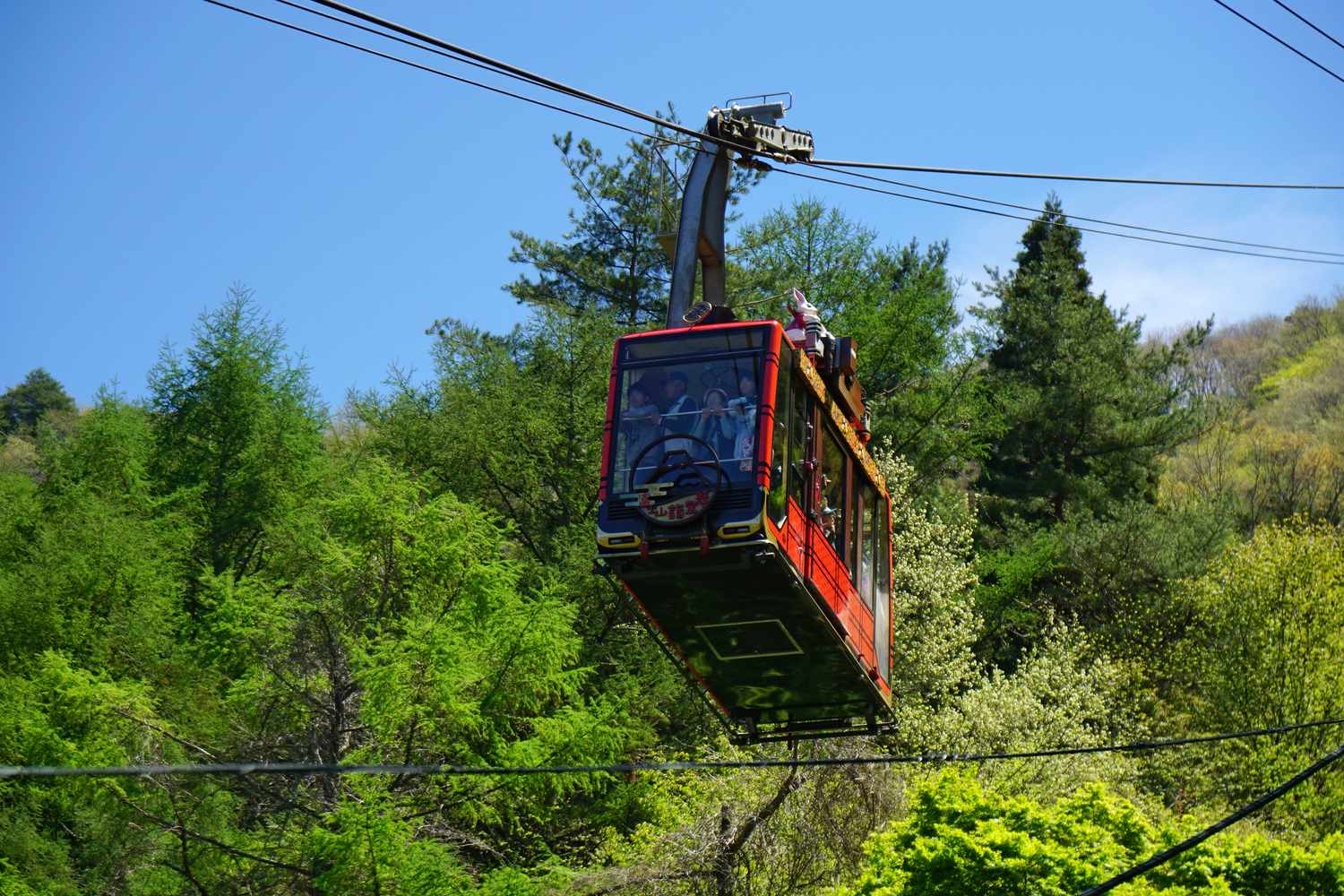
Board the cable car on the shore of Lake Kawaguchiko and about 3 minutes later you are on the Mt. Tenjo summit deck, where the lake and Mount Fuji line up in a single frame. This is the Mt. Fuji Panoramic Ropeway — nicknamed the "Kachi Kachi Yama ropeway" after the Japanese folktale set on this very mountain. An adult round-trip ticket is ¥1,000; up top you also get a 500-yen scenic swing, the rabbit-themed Usagi Shrine where you rub a stone hare for strong legs, and a genuine literary footnote — the author Dazai Osamu once stayed here. This guide lays out fares and the four official passes, the last-descent trap, whether each summit attraction is worth your time, the Kachi Kachi Yama legend, how to get there, whether you can hike down, wheelchair reality, and the honest "only worth it on a clear day" verdict. All prices and times are official, verified July 2026.
📍 The ropeway is on the Kawaguchiko shore. If you are coming for autumn, the lakeside foliage timing and how it divides from the summit is in the Kawaguchiko autumn guide; the five-story-pagoda-and-Fuji shot across the water is in the Chureito Pagoda guide; and how to reach Kawaguchiko from Tokyo is in the Tokyo to Mt. Fuji access guide.
- Worth it depends on weather: a clear day stacks lake + Fuji beautifully; a clouded day guts the payoff
- Fare: individual round trip adult ¥1,000 / child ¥500; the quoted "900 yen" is a group rate, not an old fare
- Last-descent trap: standard 8:30–17:00, but the last car down is 17:20 (18:20 in summer) — don't linger past it
- Summit draws: 500-yen scenic swing (height 110cm+, weight under 100kg), Usagi Shrine's two stone hares, kawarake throwing, Tanuki teahouse dango
- You can hike down: the official Gokoku Shrine route is ~40 min, passing a Dazai Osamu memorial and a hydrangea grove
📖 Table of Contents (click to expand)
- Fares, the half-price disability rate, and four official passes
- Hours and the last-descent trap
- Summit attractions: swing, shrine, teahouse — worth it?
- The Kachi Kachi Yama legend and Dazai Osamu
- Access: getting to the ropeway
- Hiking down: the official three-leg, 40-minute route
- Accessibility: the honest word on steps and wheelchairs
- Is it worth a dedicated trip?
- Eat and browse: Kawaguchiko Station and the summit teahouse
- FAQ
Fares, the half-price disability rate, and four official passes
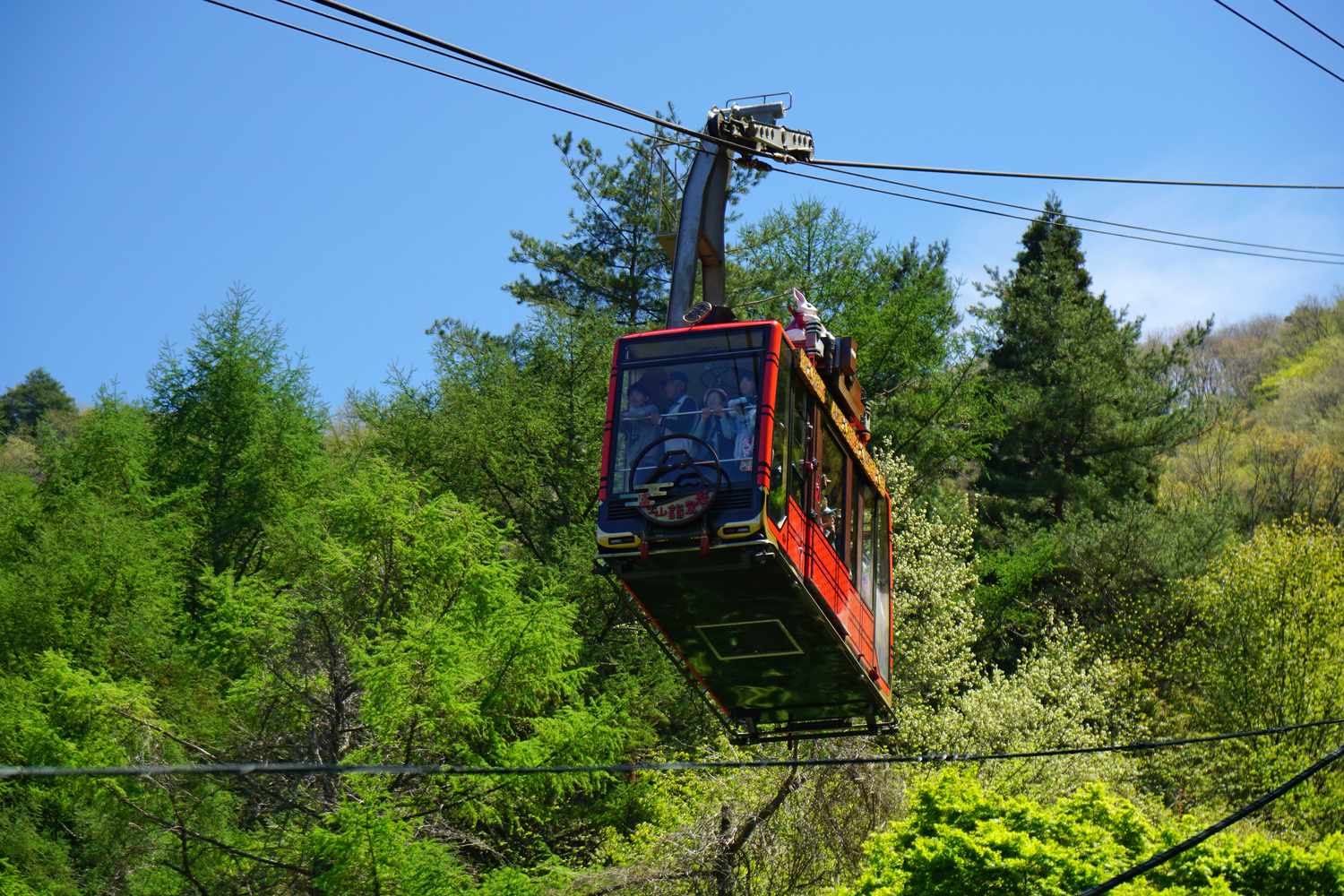
Fares first. Per the official fare page (2026), individual tickets are as below; people with disabilities pay half of the listed price (for example, an adult round trip of ¥500).
| Ticket | Adult | Child |
|---|---|---|
| Round trip | ¥1,000 | ¥500 |
| One way | ¥600 | ¥300 |
One common online mix-up to clear up first: several third-party aggregator sites list "round trip 900 yen," which makes it look as if the price has gone up. In fact ¥900 is the group rate for parties of 15 or more, not an old individual fare — the official fare page keeps "individual" and "group" as two separate tables, and an individual has always paid ¥1,000. Don't let the ¥900 figure convince you a price hike happened.
To save a little, the operator sells four passes (all valid 2 days, non-refundable once you start using them), summarized from the July 2026 official check:
| Pass | Adult | Child | Includes | Sold at |
|---|---|---|---|---|
| Ropeway & Cruise set | ¥1,700 | ¥850 | Ropeway round trip + sightseeing boat ("Ten-sei" or the Oishi Park line) | On-site / Kawaguchiko Stn |
| Kawaguchiko round pass | ¥3,300 | ¥1,650 | Ropeway + boat + 2-day unlimited sightseeing bus | On-site / Kawaguchiko Stn |
| Ropeway & Oishi Park shuttle set | ¥2,500 | ¥1,500 | Ropeway + Oishi Park line round-trip boat | Online only |
| Fujikyu Rail & Rope Coupon | ¥2,700 | ¥1,350 | Ropeway round trip + 2-day unlimited Fujikyuko Line | Online only |
My call is simple: if you were going to take a sightseeing cruise anyway, the first "Ropeway & Cruise" set is the best value — ¥1,000 ropeway plus ¥1,000 boat is ¥2,000 bought separately, so the ¥1,700 set saves ¥300 with almost no reason not to take it. If you will ride the sightseeing bus to several points around the lake that day, then consider the Kawaguchiko round pass; but if you just want to ride up for the view without a boat or a bus loop, a plain round-trip ticket is enough — don't cram in bundled content you won't use just because a pass "sounds" cheaper. Ticket machines and the Kawaguchiko Station counter both sell tickets, so no advance booking is needed. In peak season, if you would rather skip the line or pay by card in advance, Trip.com sells an e-ticket round trip you can show at the gate: Trip.com Mt. Tenjo ropeway round trip →
Hours and the last-descent trap
The ropeway hides a trap a lot of people fall into: the "closing time" and the "last car down" are not the same thing. Per the official page, standard hours are 8:30 to 17:00, but the figure that actually decides whether you get down is the last descent at 17:20. In summer (July 20 to August 31) hours extend to 8:30–18:00 with a last descent at 18:20.
| Period | Hours | Last descent |
|---|---|---|
| Standard | 8:30–17:00 | 17:20 |
| Summer extension (Jul 20 – Aug 31) | 8:30–18:00 | 18:20 |
In other words, if you want to linger up top for sunset, the swing, or the teahouse, work out the last-descent time and don't wait until 17:00 to think about coming down — there is a last car both up and down, and the summit attractions close even earlier than the ropeway itself (the scenic swing, for instance, stops accepting riders at 15:30). The ropeway runs essentially year-round, including New Year, and winter actually has a higher chance of a clear Fuji thanks to low rainfall — that's the operator's own point. Strong wind, lightning, and similar bad weather can suspend service, but there is no published wind-speed threshold (ignore third-party "suspends above X m/s" claims), so check the official site for the day's status before you set out, which is also what the operator's page advises.
Summit attractions: swing, shrine, teahouse — worth it?
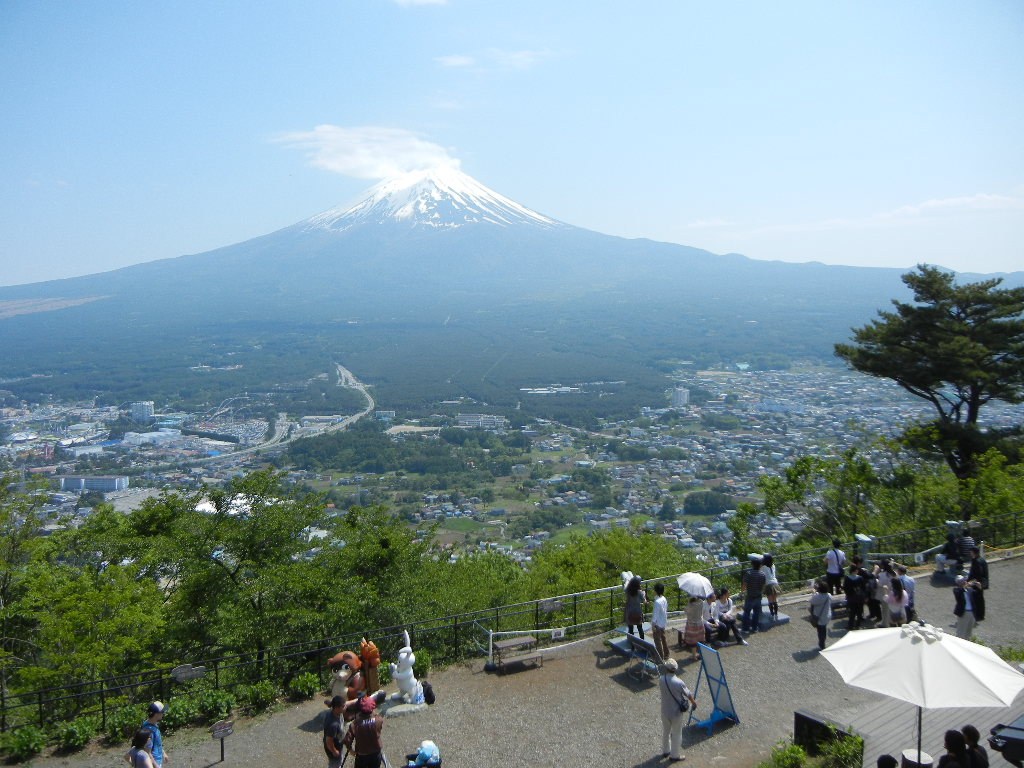
A lot of people assume Mt. Tenjo is just "go up, see a view." In fact the summit clusters several small attractions together, so here is my item-by-item take:
The scenic swing (Zekkei Buranko) — a must for the photo, but with hard limits. The shot of swinging out toward Fuji is taken here. It costs ¥500 per person (official, verified July 2026), open weekdays and weekends 9:45 to 16:00 with last acceptance at 15:30. Note the limits: you need to be at least 110cm tall and under 100kg, so families with small children should watch the height bar. It costs ¥500 more than just taking in the view, but if you came for that Fuji-facing photo, the money is well spent; if you don't care about the shot, skipping it costs you nothing.
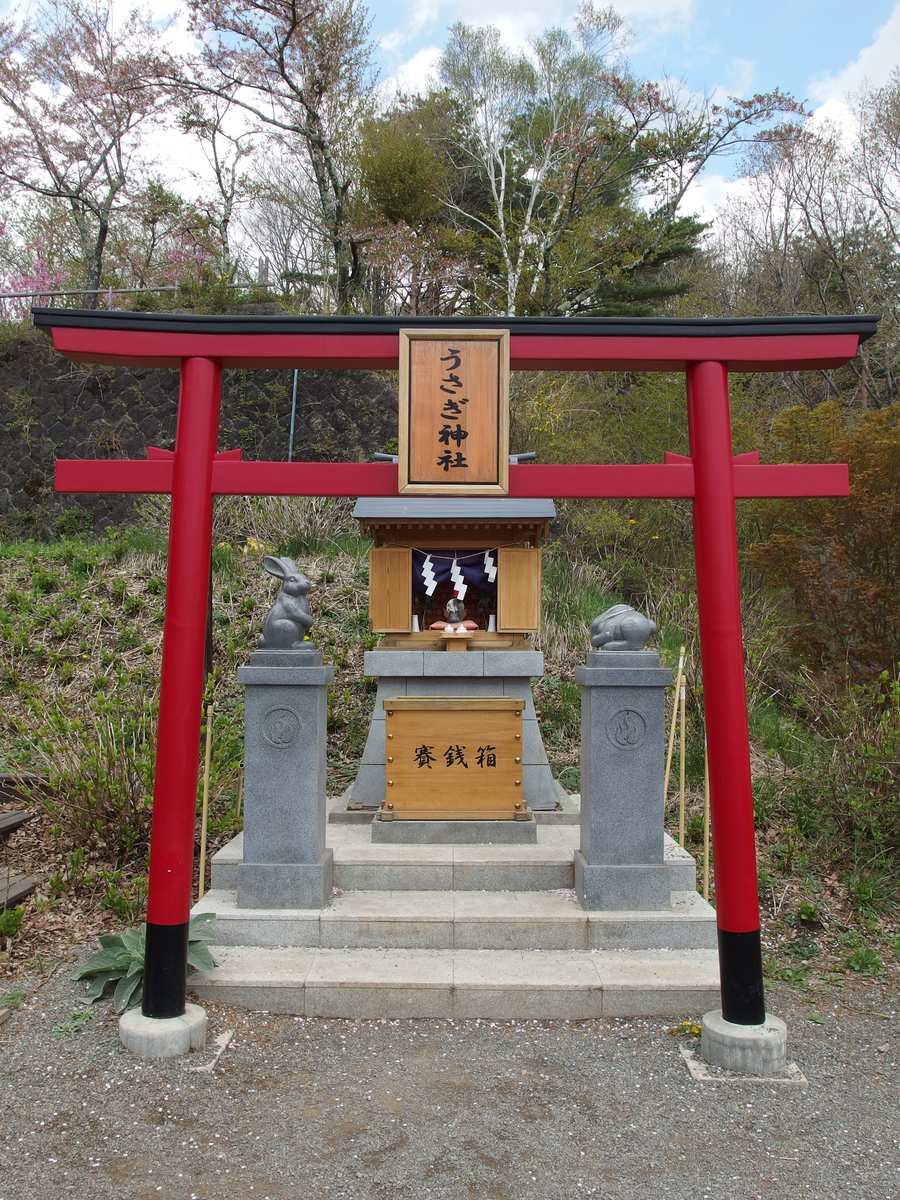
Usagi Shrine — worth a passing bow and a wish. This shrine was set up to pray for the "safety and strong legs" of hikers of the nearby Mitsutoge and of visitors, and its sacred body is a hare. Inside stand two "koma-usagi" hares: the crouching "dreaming hare," whose head you rub for wisdom, and the upright "Fuji-gazing hare," whose feet you rub for strong legs. You don't need to schedule time for it — it sits right on the deck route, so make a wish, take a photo, move on.
Kawarake throwing — hurl a clay disc at a target to make a wish. Mt. Tenjo enshrines the match-making deities Iwanaga-hime and Konohanasakuya-hime, and visitors throw unglazed clay cups at a target wishing for "all wishes granted." The fee is not listed on the official page; I won't invent a number, so confirm at the on-site ticket counter. The activity itself feels a bit like a festival ring toss, and couples or families tend to enjoy it.
The Bell of Heaven and the Zekkei Yagura — free photo spots. The Fuji-facing "Bell of Heaven" can be rung for a photo (the official page doesn't state a fee, so presumably free, though it never says "free" in so many words — confirm on site). The "Zekkei Yagura," completed in 2019 at 1,110m, is described by the operator as extending out toward the cliff edge like a single-plank bridge; the draw is that suspended-in-air angle, so photo lovers should not miss it.
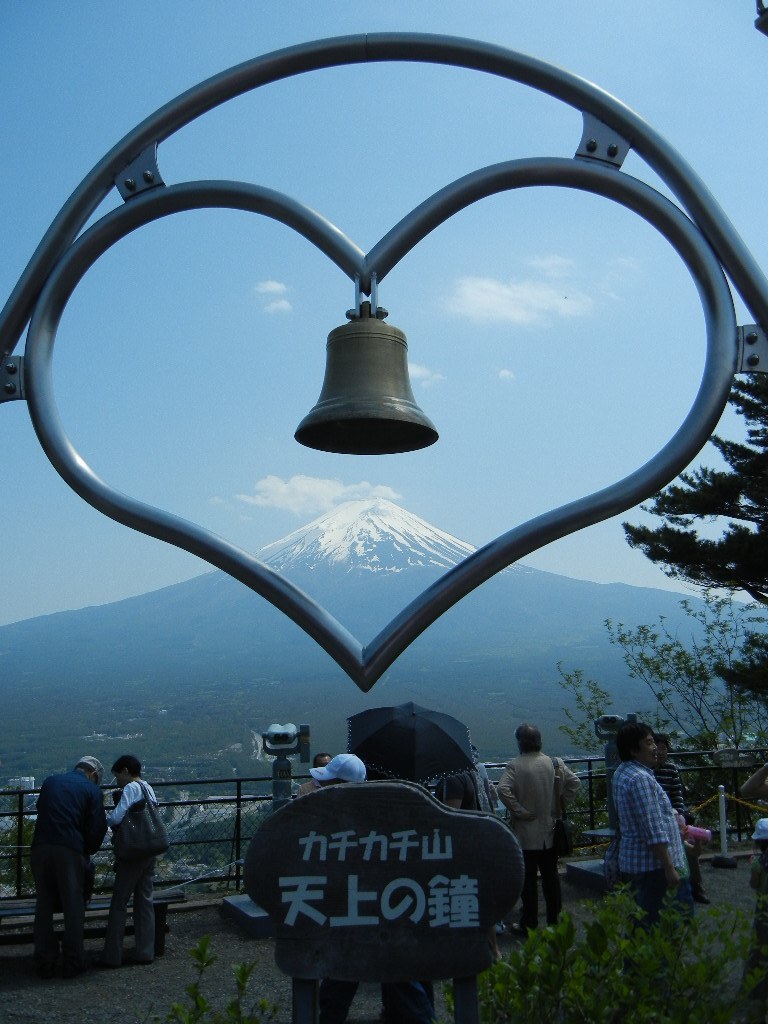
Tanuki teahouse (the summit teahouse) — the summit's only food stop. Menu, verified against the official page July 2026:
| Item | Price |
|---|---|
| Tanuki dango (mitarashi) | ¥600 |
| Usagi dango (black-sugar kinako) | ¥600 |
| Chewy curry bread | ¥600 |
| Meat-rice stick | ¥800 |
| Soft-serve ice cream | ¥600–700 (flavor by season) |
There are souvenirs too: a mini-Fuji senbei ¥700, Usagi Shrine charms (7 kinds) ¥700 each, ema ¥500 each, limited medals ¥200 each, and a hare omikuji ¥100. One caveat: the teahouse's own hours are not stated on the official page, so plan conservatively against the ropeway hours and don't leave your dango run to the last minute.
The Kachi Kachi Yama legend and Dazai Osamu
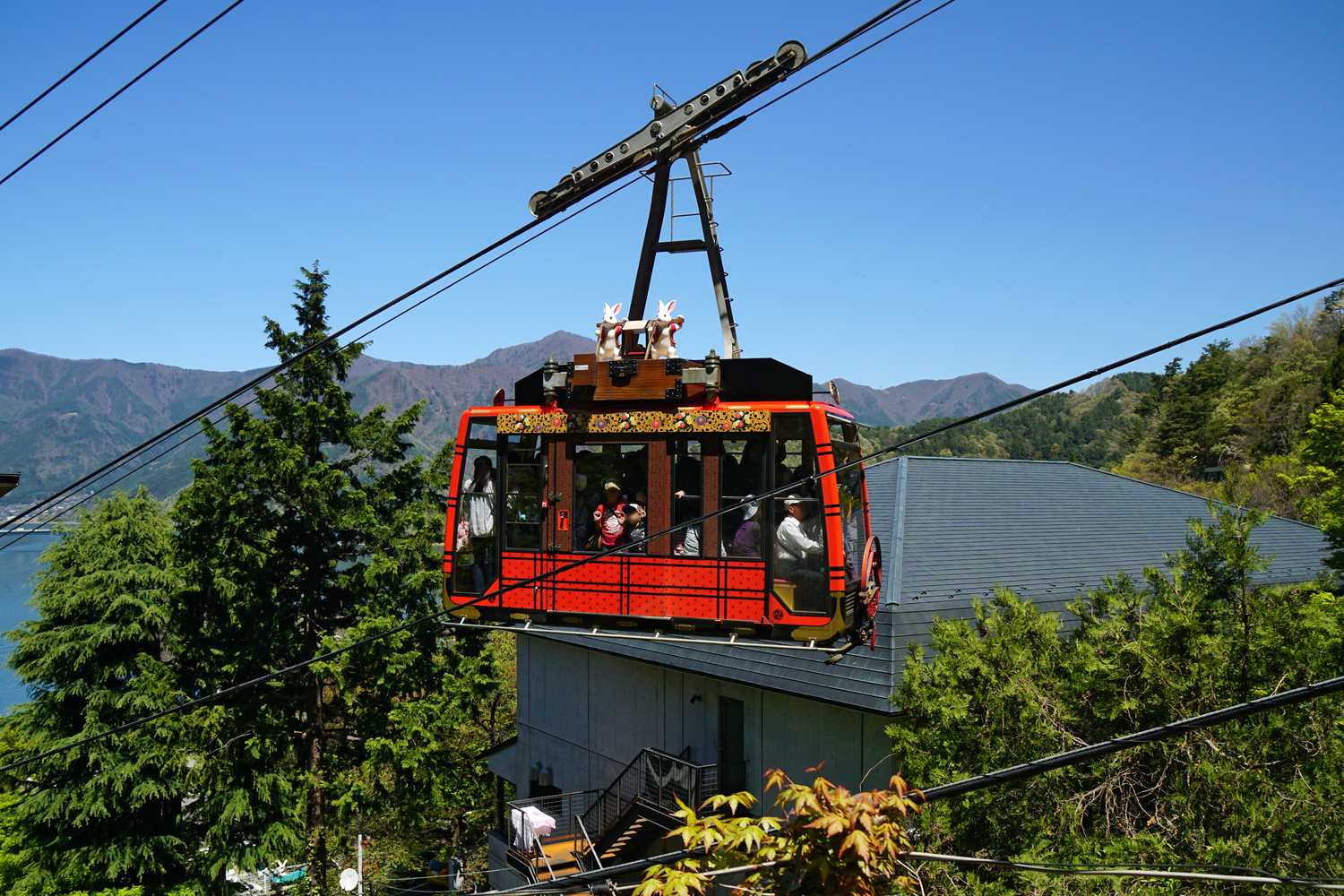
The "Kachi Kachi Yama" nickname isn't arbitrary. Per the official introduction, this Mt. Tenjo is the stage of the Japanese folktale "Kachi Kachi Yama" — the story of a raccoon dog (tanuki) who wrongs an old woman and a rabbit who takes revenge, the most famous scene being the rabbit setting fire to the firewood on the tanuki's back, which crackles "kachi kachi." That is where the rabbit and tanuki motifs on the ropeway and at the summit come from (the operator doesn't get into the folkloric origins of the tanuki and rabbit characters, so I'll leave the legend at the story the official page retells, without over-reaching into scholarship).
The literary link is more interesting: in 1938, at age 29, the author Dazai Osamu stayed here to recover from physical and mental exhaustion, and drew on that time to write "One Hundred Views of Mount Fuji" and the short story "Kachi Kachi Yama" (collected in "Otogi-zoshi"). In other words, this ropeway you're riding and the Mt. Tenjo beneath your feet are the real-world stage of Dazai's work. If you take the hiking trail down, a Dazai Osamu memorial stone stands along the way at Nakaba-daira (see the hiking section below), so literature fans can plan a "ride up, walk past the memorial down" route that ties the sightseeing to the literary backdrop.
Access: getting to the ropeway
The ropeway station is at 1163-1 Asakawa, Fujikawaguchiko, Minamitsuru District, Yamanashi, right on the Kawaguchiko shore. Ways to reach it:
- By sightseeing bus: on the Kawaguchiko Sightseeing Bus (Red Line), get off at stop 9 "Yuransen / Ropeway Iriguchi," then walk about 3 minutes to the station. The loop bus runs every 15 minutes, 9:00 to 17:45; a one-day pass is ¥1,500 adult / ¥750 child (best value if you'll hit several points around the lake; for one short hop you can simply walk).
- From Kawaguchiko Station: the official page says "on foot or by loop bus, about 15 minutes," giving only a total and not splitting walking versus bus minutes. If you're a decent walker, strolling over with lake views along the way is pleasant.
- By car: the prefectural free lakeside car park (about 300 spaces, buses too) — free is its biggest plus; the operator doesn't fully spell out the route from station to car park, so just follow the "Yuransen / Ropeway Iriguchi" signs.
The Red Line buses were designed by Eiji Mitooka (the same designer as the Mt. Fuji View Express train), so the ride itself is a small pleasure. Note that the single-trip cash fare is not clearly posted on the official page, so for a short hop just walk or use a day pass rather than fussing over some third-party single fare. For the full Tokyo-to-Kawaguchiko comparison (Limited Express Fuji Excursion, highway bus, JR to Fujikyuko Line), see the Tokyo to Mt. Fuji access guide.
Hiking down: the official three-leg, 40-minute route
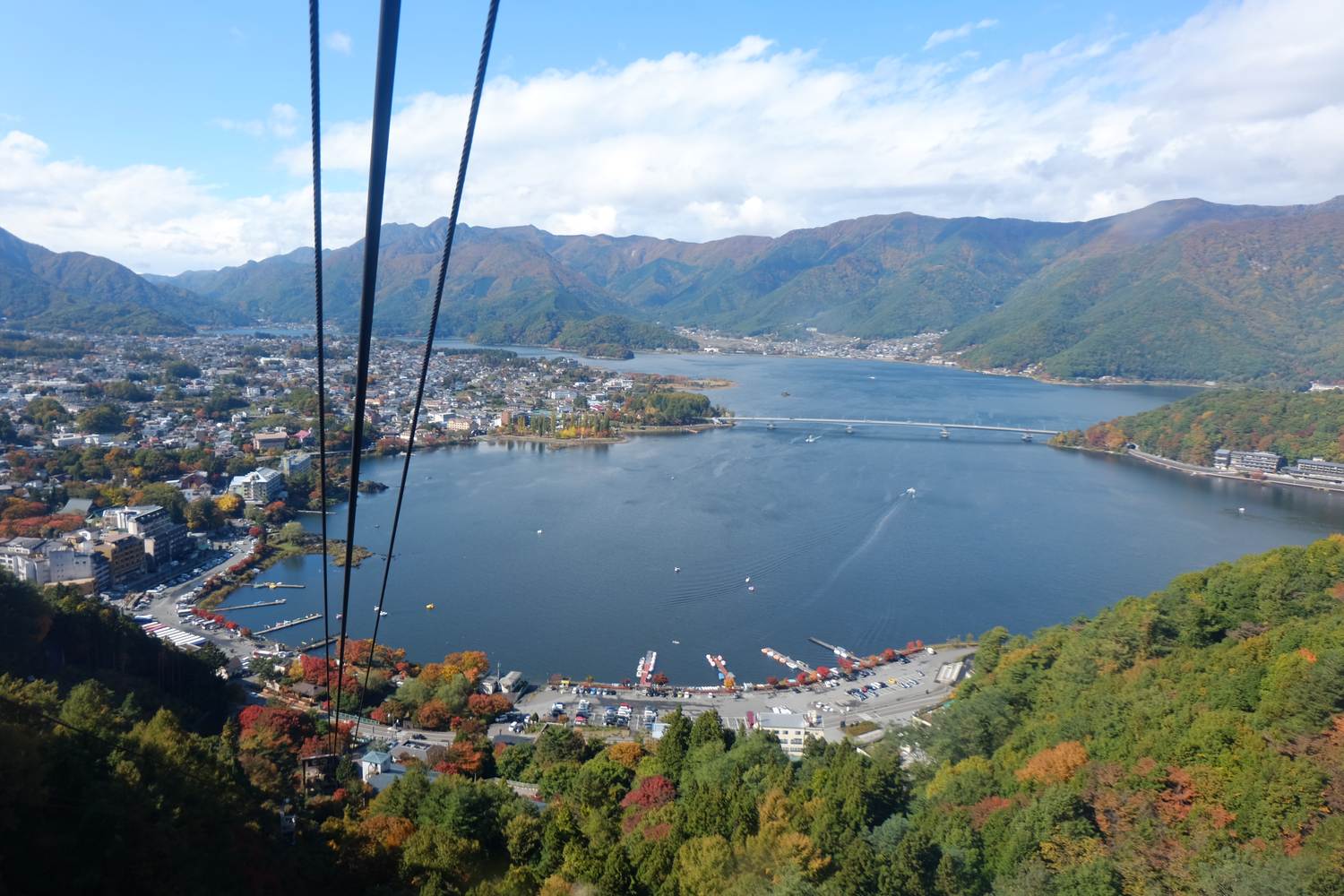
If your legs are up to it and you'd rather save a one-way fare, the operator itself recommends riding up and hiking down. Per the official hiking page, the Gokoku Shrine route has three legs:
- Fujimidai Station → Nakaba-daira (Dazai Osamu memorial): about 15 min (downhill trail)
- Nakaba-daira → via the hydrangea grove → Gokoku Shrine: about 10 min
- Gokoku Shrine → the Kawaguchiko lakeshore: about 15 min
The three legs come to an official total of about a 40-minute hiking course. Highlights along the way are the Dazai Osamu memorial at Nakaba-daira and a hydrangea grove — come in summer and you catch the bloom. The operator also candidly notes "on a clear day, the superb view of Mount Fuji and Lake Kawaguchiko" — in other words you need good weather to see the payoff, and that's the operator's own line, not my embellishment. The surface is a mountain trail, so wear proper hiking shoes (the operator gives no gear list; this is a general suggestion) and use your judgment with young children or bad knees. As of July 2026 the official news page showed no trail closure or maintenance notice, but mountain conditions shift with weather and season, so check the latest notice before you go. An adult one-way up is ¥600, so riding up and walking down comes out a bit cheaper than a round-trip ticket.
Those 40 minutes are Mt. Tenjo, not Mt. Fuji. Climbing Fuji itself means an official season, a restricted entry window, and ¥4,000 of paperwork per person — the four trails and the two prefectures' differing rules are laid out in our Mt. Fuji climbing rules guide.
Accessibility: the honest word on steps and wheelchairs
Let me be plain here, to spare anyone with mobility needs a wasted trip. The operator states clearly: the lakeside station has 64 steps and Fujimidai Station has 112 steps, and wheelchair movement is difficult. The summit does have a gentle, step-free "panorama corridor" that deliberately avoids steep stairs, suitable for strollers or those with reduced mobility within the summit area — but that is a layout up at the summit and does not mean the two stations are step-free; the two boarding stations are themselves stair barriers.
So if someone in your group uses a wheelchair, the ride itself is a high hurdle — think it through in advance. With a stroller, the realistic approach is carrying the child plus a folding buggy. If you genuinely want to bring a less-mobile older relative to see Fuji, I'd steer you to a flat lakeside spot like Oishi Park instead — far easier, and it captures the lake-and-Fuji view just as well. As for pets, they are allowed: small ¥300, medium ¥500, in a hard-sided carrier, large dogs not permitted.
Is it worth a dedicated trip?
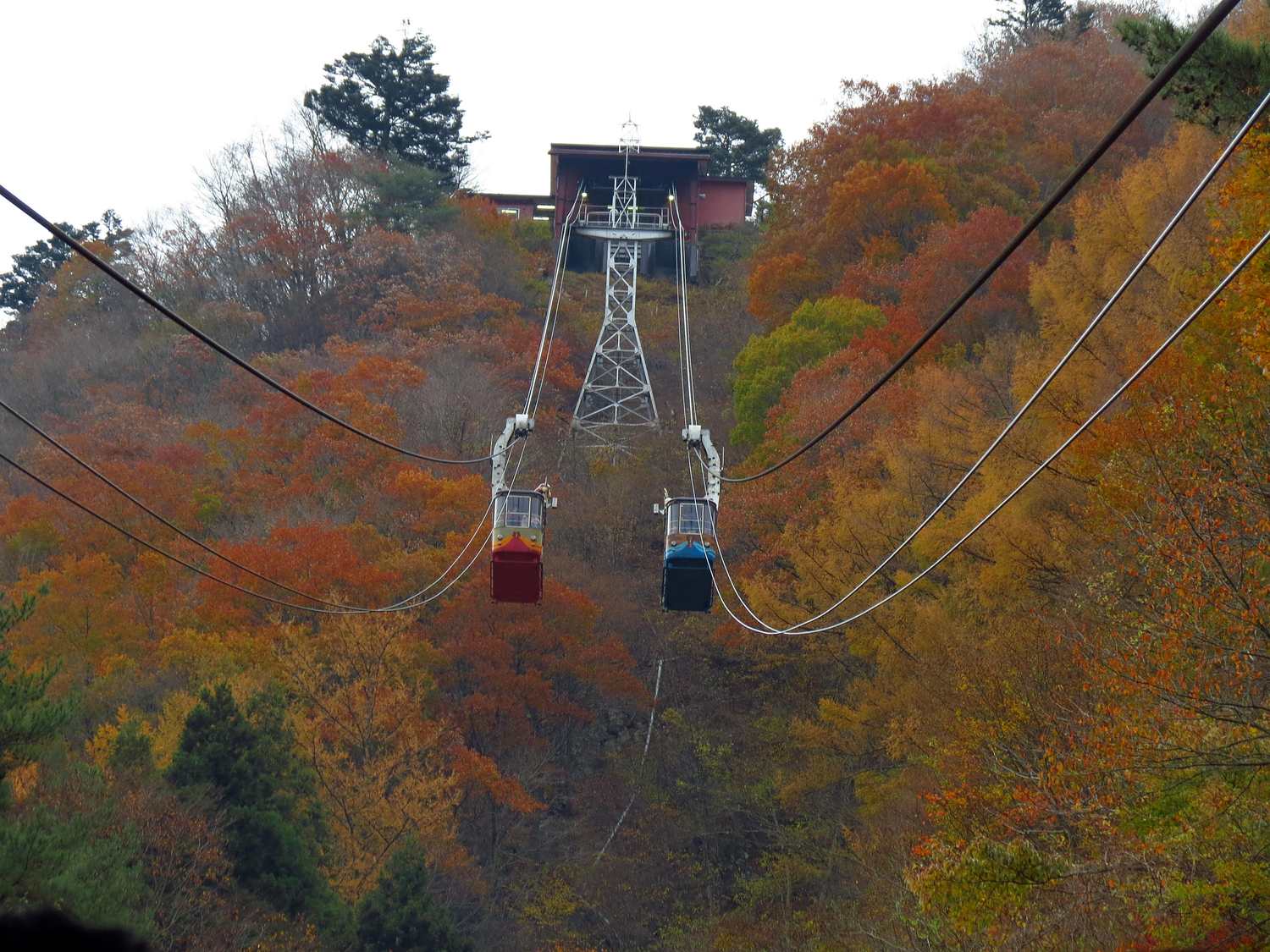
Straight to the verdict: worth it on a clear day, skip it on a grey one. This ropeway's value rides almost entirely on whether the summit can put the lake and Fuji in one frame — on a clear day that angle is hard to beat, and the ride up is only 3 minutes, so it earns its place. But the ride is short and the fare isn't cheap, so if the day is heavily clouded and Fuji is fully hidden, all you'll see from the deck is a grey wall and the value collapses. On days like that I'd give the time to the lakeshore instead and ride up another day when the weather turns.
So how does it divide from the free lakeside spots? If you're here for autumn foliage, there's a timing advantage worth knowing: per Yamanashi's official tourism site, the Mt. Tenjo deck's foliage peaks from early November into early December, later than the lakeside Momiji Corridor (early-to-mid November). Meaning that when the lakeshore starts fading in late November, the summit can still deliver a fresh round of foliage plus a Fuji view — that's its unique role in autumn. For how to schedule between the lakeside spots and the ropeway in foliage season, see the peak-timing table in the Kawaguchiko autumn guide, which handles the seasonal decision while this guide handles playing the site itself in full.
If you'd rather not work out transfers and timetables and just want a day that strings Kawaguchiko, the ropeway, and the surrounding sights together, KKday runs a Fuji day tour that includes the Mt. Tenjo ropeway (from Tokyo, door-to-door): Kawaguchiko & Mt. Tenjo ropeway day tour. It suits people who don't want to juggle transport, or who are traveling with older relatives or kids; if you were going to travel independently and want a flexible lakeside route anyway, riding the loop bus yourself is cheaper and freer.
Eat and browse: Kawaguchiko Station and the summit teahouse
Food at the summit runs through the Tanuki teahouse covered above (dango ¥600, curry bread ¥600, soft-serve ¥600–700); eating a skewer of dango up top while looking out at Fuji is a fine way to close the visit. Once you're back down and want to eat or browse around Kawaguchiko Station, these two are worth knowing (both addresses are searchable on Google Maps):
- Hoto Fudo, Kawaguchiko Station-front branch: 3631-2 Funatsu, Fujikawaguchiko, Minamitsuru District (Marubun Building 1F, directly across from Kawaguchiko Station), open 11:00 to 19:00, 110 seats, tel 0555-72-5560, no parking of its own. A specialist in Yamanashi's signature "hoto" — flat wheat noodles in a miso-based hotpot — doing that single dish and doing it well; hearty and warming on a cold day. The shop notes that on weekdays after 16:00 it's best to phone ahead to confirm closing time.
- Bakery&Cafe ESOLA: 3093 Koritsu, Fujikawaguchiko, Minamitsuru District, tel 0555-73-9080, closed Sundays and Mondays, open 8:00 to 16:00 (until the bread sells out). It bakes bread in a Fuji lava stone oven with around 80 varieties, and its picture windows look out to Mount Fuji — good for grabbing bread for the next morning or the road. Note the Sunday and Monday closures, which catch a lot of weekend visitors out; check the official calendar for any temporary closures before you plan around it.
Frequently Asked Questions
- Q1:Is the Kachi Kachi ropeway worth riding?
- It depends on the weather. The whole value of this ropeway is that the Mt. Tenjo summit deck stacks Lake Kawaguchiko and Mount Fuji into one frame — on a clear day the view is excellent and the ride up takes only 3 minutes, so it earns a spot in your plan. But the ride is short and the fare is not cheap, so if the day is heavily clouded and Fuji is fully hidden, the payoff collapses. My honest call: check the Fuji-area forecast first — worth it on a clear day, skip it for the lakeshore on a grey one. If you are here for autumn foliage, the summit peaks later than the lakeshore (into early December), which gives it a distinct timing advantage.
- Q2:How much are the Kachi Kachi ropeway tickets, and are there cheaper passes?
- Per the official 2026 fare page, an individual round-trip ticket is 1,000 yen for adults and 500 yen for children; one-way is 600 yen for adults and 300 yen for children, and people with disabilities pay half. Groups of 15 or more get a group rate (adult round trip 900 yen) — the widely quoted 900 yen is that group price, not an old fare, so an individual still pays 1,000 yen. To save a little, the official ropeway + sightseeing-boat combo is 1,700 yen for adults, which beats buying them separately (1,000 + 1,000 = 2,000) by 300 yen and is the most useful bundle; there are also a bus-inclusive Kawaguchiko pass and a rail-inclusive coupon for people who will actually use that transport.
- Q3:What time is the last Kachi Kachi ropeway car? Could I get stranded at the top?
- This is the easiest trap. Standard hours are 8:30 to 17:00, but what actually decides whether you can get down is the last descent at 17:20 — plan your ascent well before then and don't linger at the summit until 17:00 and only then think about heading down. In summer (July 20 to August 31) hours extend to 8:30 to 18:00 with a last descent at 18:20. The ropeway runs essentially year-round including New Year, but strong wind, lightning, and similar bad weather can suspend service; there is no published wind-speed threshold, so check the official site for the day's operating status before you go.
- Q4:Can I walk down instead of taking the ropeway?
- Yes — the operator itself recommends riding up and hiking down. The official Gokoku Shrine route has three legs: Fujimidai Station to Nakaba-daira (with a Dazai Osamu memorial stone) about 15 minutes, on via a hydrangea grove to Gokoku Shrine about 10 minutes, then Gokoku Shrine back down to the lakeshore about 15 minutes — roughly a 40-minute hiking course in total. The surface is a mountain trail, so wear proper shoes and use your judgment if you have young children or bad knees. As of July 2026 the official site showed no trail closure or maintenance notice, but mountain conditions change, so check the latest notice before you go.
- Q5:Can wheelchair users or strollers take the ropeway?
- Be prepared — the operator states it bluntly: the lakeside station has 64 steps and Fujimidai Station has 112 steps, and wheelchair movement is difficult. The summit does have a gentle, step-free "panorama corridor" that avoids steep stairs, but that is the layout up at the summit — it does not mean the two stations are step-free; both stations are stair barriers in themselves. So if someone in your group uses a wheelchair, the ride itself is a high hurdle; with a stroller, carrying the child plus a folding buggy is more realistic. For a step-free Fuji view, a flat lakeside spot like Oishi Park is far easier. Pets are allowed in a hard-sided carrier: small 300 yen, medium 500 yen, large dogs not permitted.
Read next
Kawaguchiko Autumn 2026: Momiji Corridor & Ropeway Guide
A spot-by-spot peak-timing table, Fujikaiyu vs highway bus math, and how to dodge the leaf-season crowds.
Chureito Pagoda: is the 398-step climb worth it?
The pagoda-and-Fuji postcard after 398 steps — 2026 festival cancellation, timing, and access.
Tokyo to Mt. Fuji day trip guide
Kawaguchiko, Oshino Hakkai, Arakurayama — bus times, prices, must-knows.
📊 See the 2026 Price Index (JR Pass, DPA, eSIM, Airport Transport) →