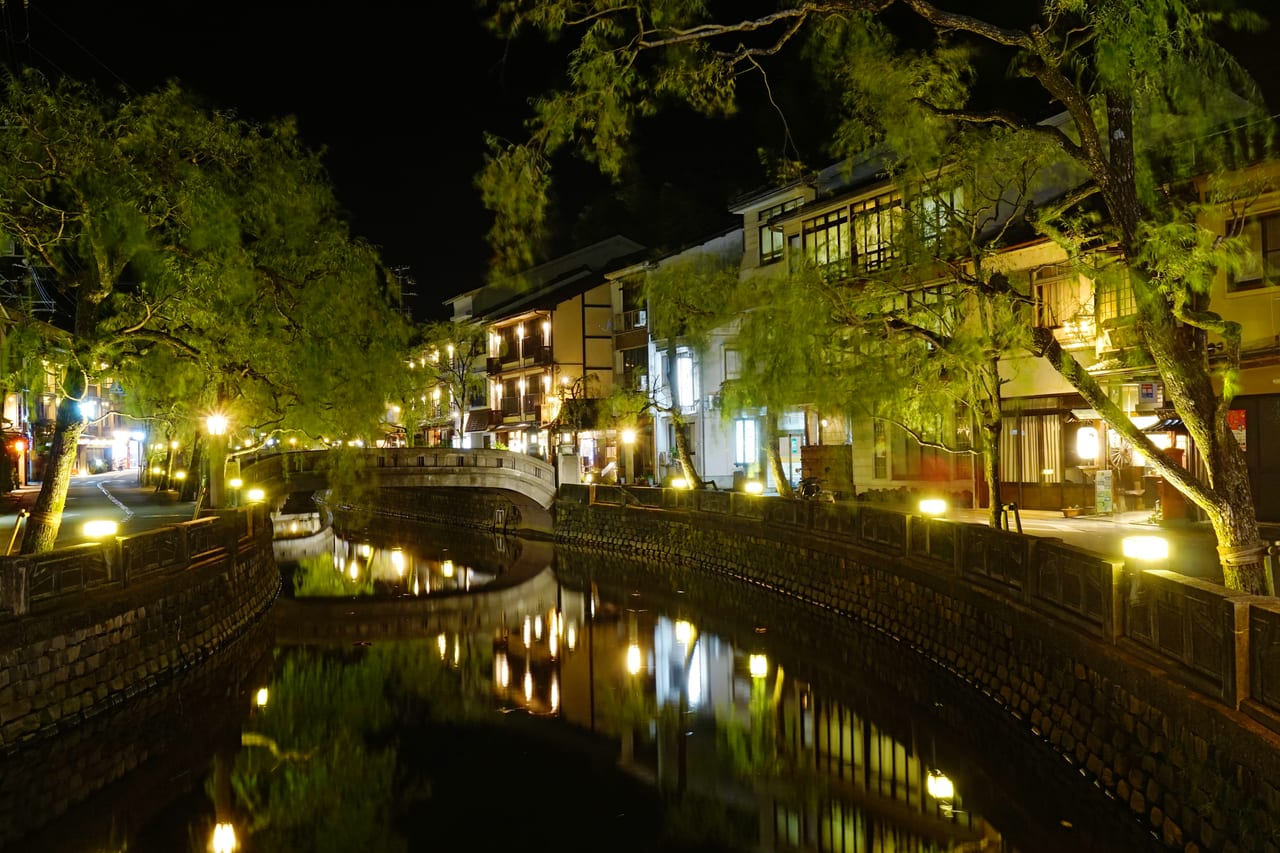
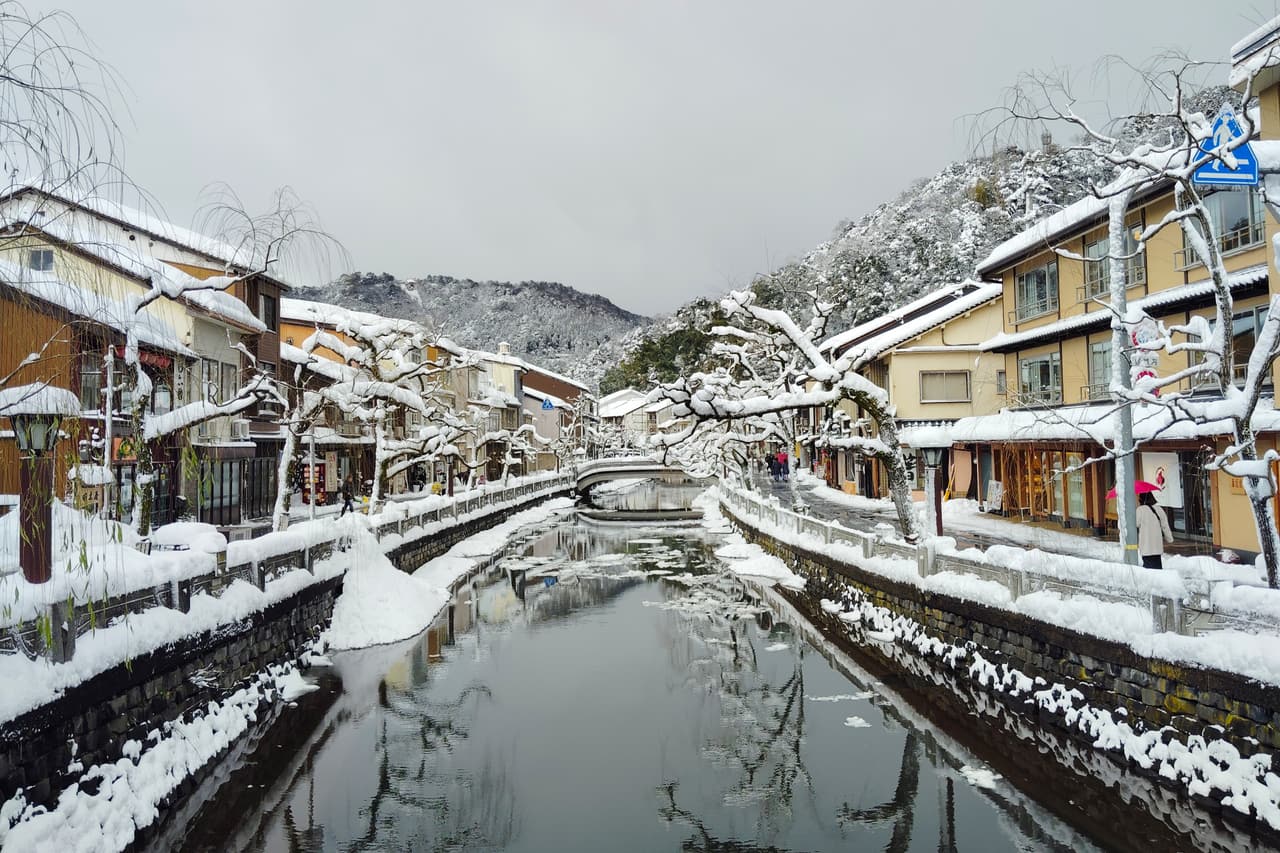
Kinosaki Onsen is the Kansai hot-spring town that turns a whole village into your bathhouse. The Otani River runs through the center, willows lean over both banks, stone bridges connect the lanes, and by evening almost everyone is out in a ryokan yukata, clacking along in wooden geta from one public bath to the next. It has a 1,300-year history and seven soto-yu, each with its own legend, and the tradition here is not to hide in your room but to wear the town like a bath. Winter adds its trump card: matsuba snow crab, which opens November 6 and runs to late March, plus Tajima beef year-round. A direct limited express puts it 2 hours 21 minutes from Kyoto and 2 hours 35 minutes from Osaka. This guide covers the Yumepa day pass (¥1,500), how to pick among the seven baths, the yukata culture, the ropeway and Onsen-ji temple, snow-crab season, Genbudo, and access and lodging. To work it into a wider Kansai trip, see our Osaka & Kyoto 5-day itinerary.
- Yumepa day pass ¥1,500 (¥750 children) pays off at two baths; most ryokan guests bathe free
- Seven soto-yu: Ichino-yu, Gosho-no-yu, Sato-no-yu, Jizo-yu, Yanagi-yu, Mandara-yu, Kono-yu — three or four is plenty
- The yukata-and-geta stroll is the whole point: ryokan provide yukata free; the canal is full of them by dusk
- Winter trump card is snow crab: opens Nov 6, runs to late March; Tajima beef year-round
- 2 hr 21 min from Kyoto, 2 hr 35 min from Osaka direct to Kinosaki Onsen Station, town walkable from the exit
📖 Contents
Why visit Kinosaki Onsen
Honestly, Kinosaki is not a place stuffed with sights. What it sells is a ritual the whole town shares. Most onsen towns work one way — check into a ryokan, soak in its private bath, never go out. Kinosaki is the opposite: the tradition is to treat your room as a changing room and the entire hot-spring street as your bathhouse, walking from one public bath to the next in your ryokan yukata and geta, a little towel basket in hand. The willows along the Otani River, the arched stone bridges, the lanterns that come on at dusk — it is all staged for exactly this. The town is small and easy: the street runs less than a kilometer from the station, and you can stroll the highlights in half a day.
My take is blunt: eighty percent of Kinosaki is in the overnight stay. A day visitor can still buy a Yumepa and hop the baths, but you miss the quiet, lantern-lit Kinosaki that only appears after the day-trippers leave — that is half the town. And the two perks reserved for guests — free bath-hopping and a whole-crab or Tajima-beef kaiseki at night — happen to be Kinosaki's two most signature experiences. So if you are wavering on whether one onsen town is worth a dedicated night, Kinosaki is one of the few where I would just say yes.
The seven baths & the Yumepa pass
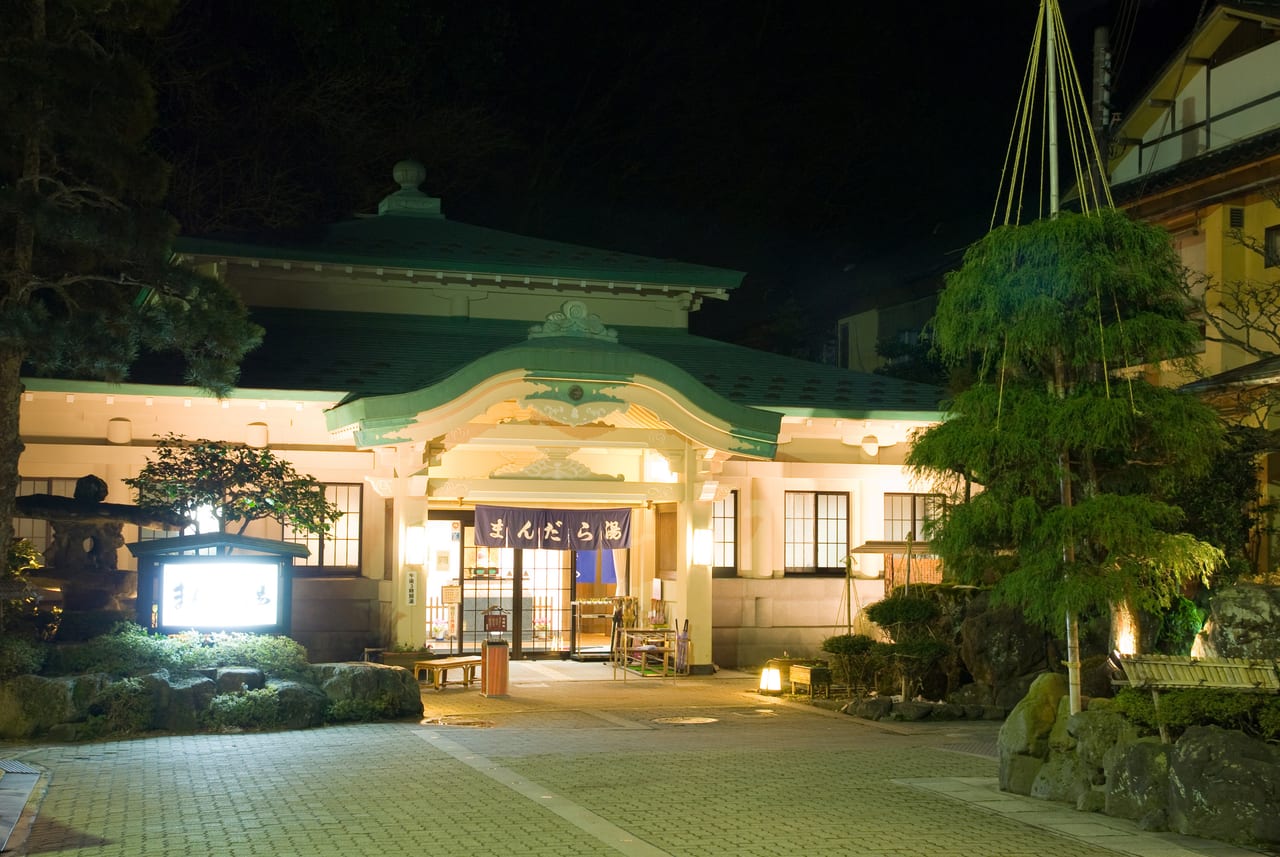
The core of Kinosaki is the soto-yu meguri — hopping the seven public bathhouses scattered along the street. Per the Kinosaki Onsen Tourism Association, each has a different legend and feel:
- Kono-yu: the oldest of the seven, said to mark a spring discovered when a stork (kounotori) healed its wounds here. It sits at the far end of the street, the quietest, with an open-air bath.
- Gosho-no-yu: the most ornate, Kyoto-style building with the grandest facade and an open-air bath — one of the most popular of the seven.
- Sato-no-yu: right by Kinosaki Onsen Station, the newest and largest, with a sauna and several pools — handy to soak as you arrive or before you leave.
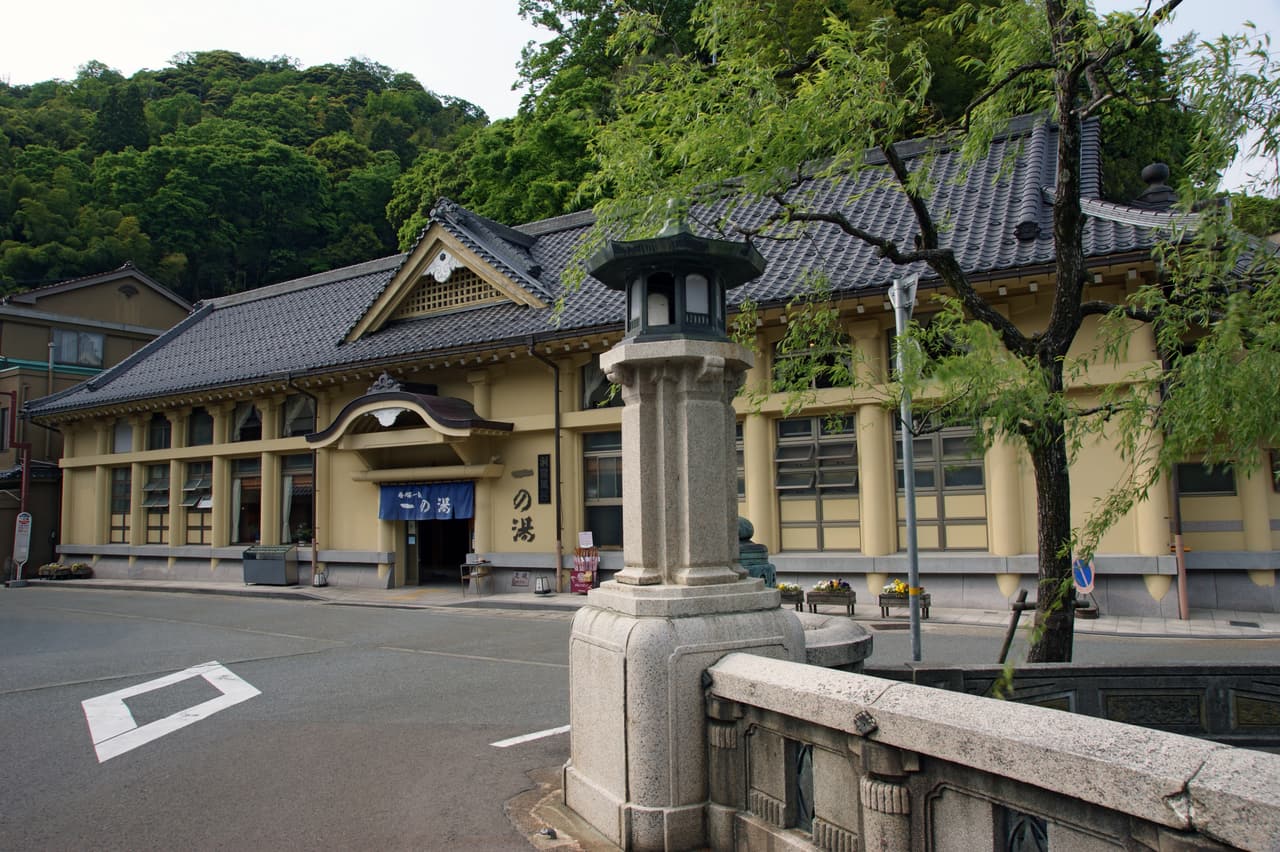
- Ichino-yu: the central landmark, best known for a cave bath carved into the rock face, with the most photogenic frontage too.
- Jizo-yu, Yanagi-yu, Mandara-yu: smaller town baths, each with its own flavor — Yanagi-yu is famous for a fertility legend, and Mandara-yu is tied to the founding monk Dochi Shonin.
How do the prices work? A single bath is ¥800 for adults, ¥400 for children; the Yumepa one-day pass is ¥1,500 for adults, ¥750 for children, with unlimited entry to all seven that day (set April 2023, still current for 2026). In other words, if you plan to soak in two or more, the Yumepa already pays off. But here is the key: most ryokan guests can hop the baths for free on their stay voucher, with no Yumepa needed — which is exactly why an overnight stay is the best value. Day-trippers just buy the Yumepa at any bathhouse reception.
A few practical notes: do not fixate on doing all seven. Per official info and traveler reports, pick three or four and follow the river in order — soak too many and you just get tired. Each bath has its own weekly closing day (usually one fixed day, rotated across the seven), so check the association's schedule so you do not arrive at a locked door. Hours vary too; the Sato-no-yu end stays open later if you want a night soak. One more thing if you have ink: Kinosaki's seven soto-yu are public baths and most do not allow visible tattoos, so see our onsen with tattoos guide for cover patches and workarounds.
Yukata and geta: the whole point
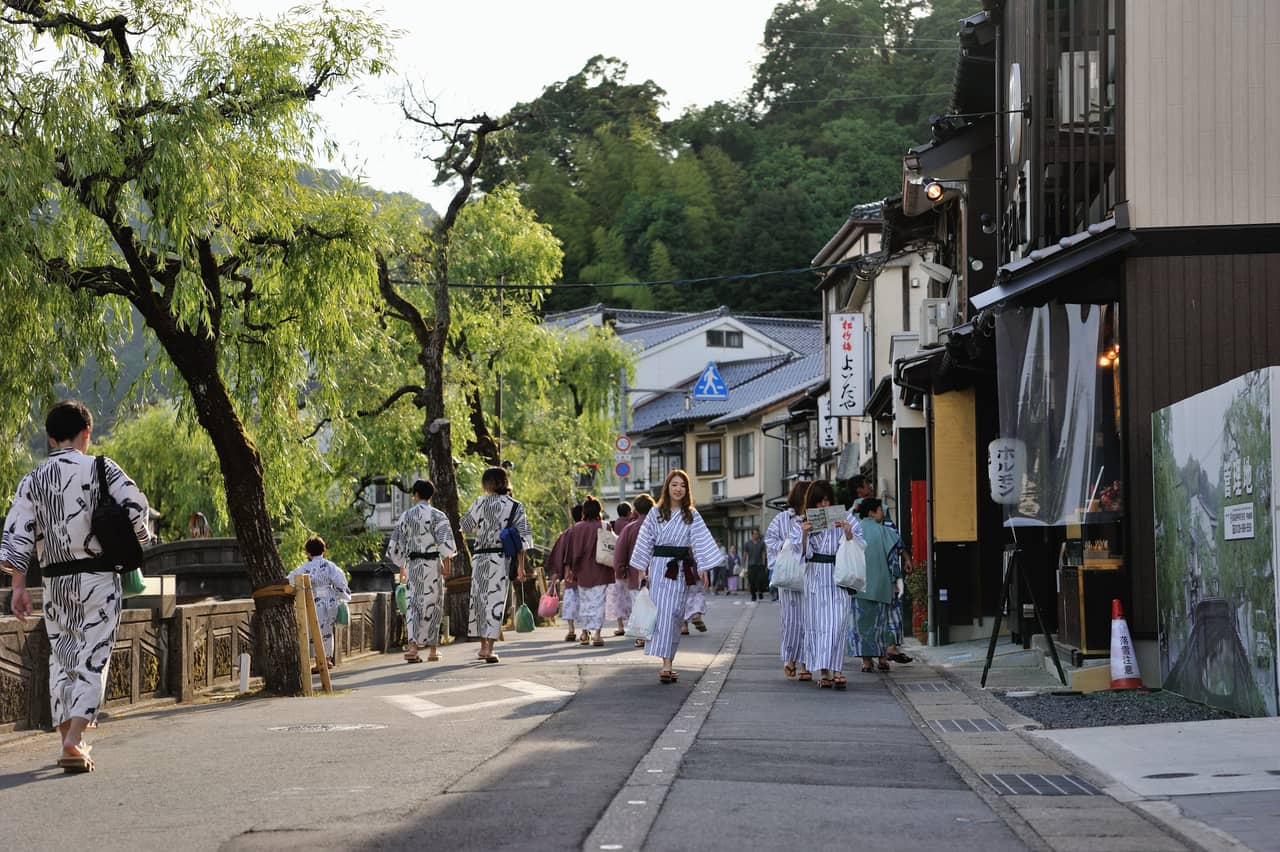
If you remember one thing about Kinosaki, make it bath-hopping in yukata. It is not a rule and no one forces it, but without it the town is just "seven decent public pools," and the magic drains away. What sets Kinosaki apart from every other onsen town is that the whole village runs the "yukata street" as shared scenery. Walk the Otani River at dusk and nearly everyone is in yukata and geta; the clack of wooden soles and the figures carrying towel baskets between baths are the prettiest sight here.
Where does the yukata come from? Your ryokan provides a yukata and geta for free, and many let you choose from several patterns, with different cuts for men and women — one of the perks of staying. Day-trippers, or anyone who wants to dress up and swap patterns, can rent from shops in town. My advice is to not just chase photos — the real point is the slowed-down pace: you cannot rush in geta, so you are forced to walk slowly, watch the river, the willows, the lanterns of other inns. That "the setting makes you slow down" feeling is what most separates Kinosaki from city travel. Just remember the basics of Japanese public bathing — rinse off before getting in, keep your towel out of the water — covered in the bathing section of our Japan etiquette guide if it is your first soak.
The Mt. Daishi ropeway & Onsen-ji
Beyond bath-hopping, the second thing worth your time in Kinosaki is the ropeway up Mt. Daishi. It departs near Kono-yu at the far end of the street, runs about 676 meters over roughly seven minutes, and — unusually — has a mid-station, "Onsen-ji Station." This is the site of Matsudaisan Onsen-ji, a temple with more than 1,300 years of history, said to be founded by the monk Dochi Shonin; its main hall is an important old temple in the area and the spiritual source of the hot-spring town.
The ropeway continues to the Mt. Daishi summit station, where an observation deck and cafe let you look down over the whole hot-spring street, the Maruyama River, and out to the Sea of Japan — the best angle to take in, all at once, the willow-lined street you just walked. Per the tourism association's published fares, a round trip runs about ¥1,200 for adults and ¥600 for children (subject to the operator's adjustments, so confirm on site). It runs roughly from mid-morning to late afternoon and has a fixed monthly maintenance closure, so check the official site before you plan. I would slot it into the second morning, after checkout — a high view to cap things off before you head down to catch your train.
Snow crab & Tajima beef
Kinosaki is an onsen town whose peak season is decided by food. The winter trump card is matsuba snow crab (the male zuwai crab, called "matsuba-gani" along the San'in coast). By the fishing-season convention, snow crab opens on November 6 and runs to late March (the 2025–2026 season starts Nov 6, 2025). Through this window Kinosaki runs its "Crab Kingdom," and nearly every ryokan serves a whole-crab kaiseki — sashimi, grilled crab, crab hot pot, miso in the shell — and an all-you-can-eat crab plan is the single reason many travelers make a winter trip here. For crab, target mid-November to February and book lodging early; crab plans on peak weekends fill fast.
The other card, playable all year, is Tajima beef. Tajima is the black wagyu of the Tajima district of Hyogo, and crucially the bloodline behind famous brands like Kobe and Matsusaka beef — fine marbling, deep flavor. Restaurants and ryokan kaiseki around Kinosaki commonly serve Tajima beef as teppanyaki, sukiyaki, or steak, so if you miss crab season, Tajima beef is your main course. The street also has Tajima-beef croquettes and skewers as snacks to nibble between baths — standard kit for a yukata stroll. Other onsen-town bites include onsen-tamago (hot-spring eggs) and seafood crackers; the vibe is relaxed.
Genbudo & nearby side trips
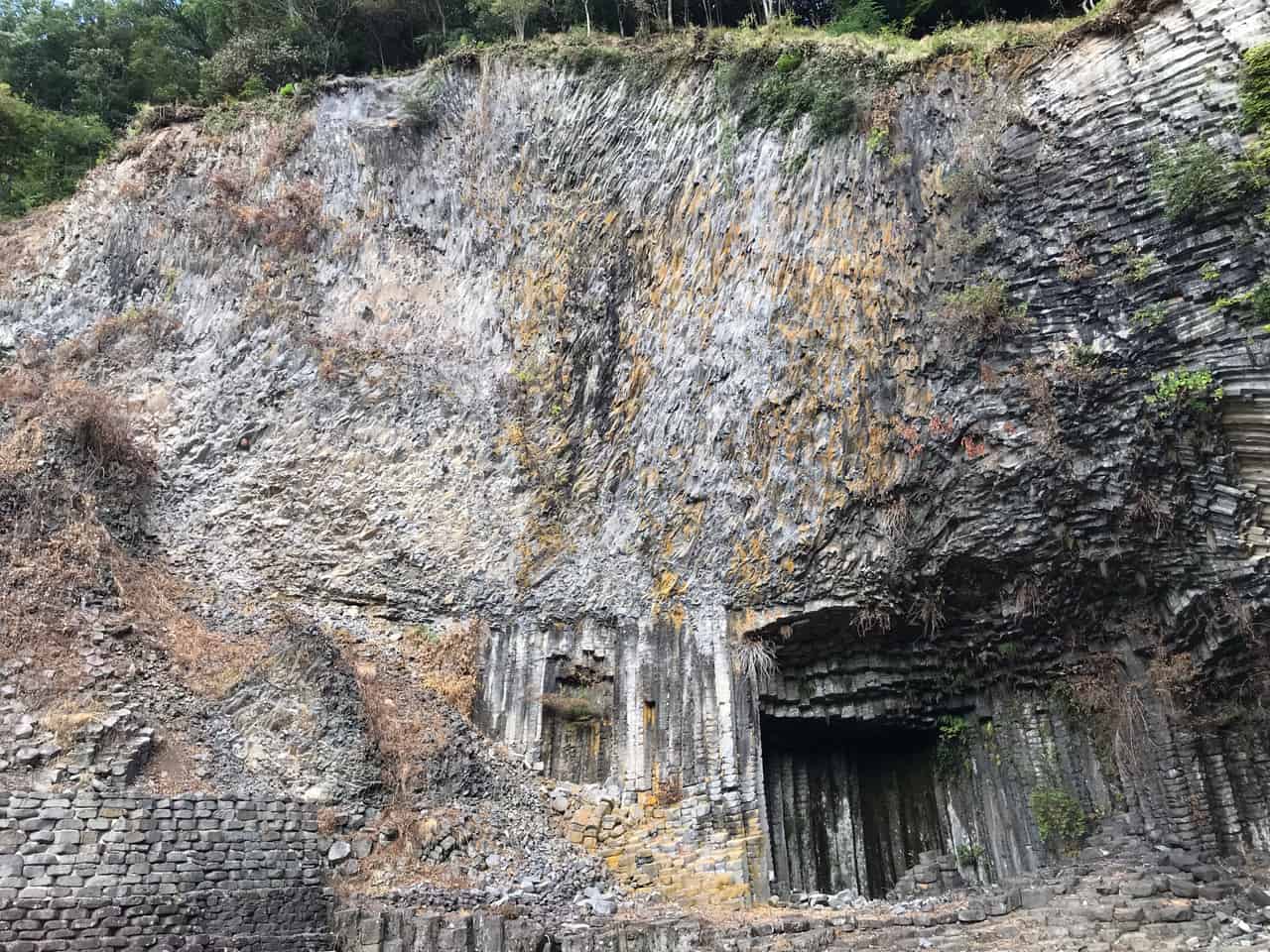
If you stay a night and want to add half a day, the closest and most striking side trip is Genbudo. About ten minutes from Kinosaki by car (across the Maruyama River), Genbudo is a cliff of columnar-jointed basalt formed when volcanic lava cooled and contracted around 1.6 million years ago — the whole face splits into hexagonal stone columns, a genuine spectacle, and it is the namesake site for the Japanese geological term for basalt, so it carries academic weight. The park has several caves (Genbudo, Seiryudo, and others) and walking paths; admission is cheap and the outdoor photos are excellent, so geology and landscape fans should not miss it.
Farther afield, the Tajima / San'in Coast where Kinosaki sits is part of a UNESCO Global Geopark, and you can string the coast — Kasumi, the Amarube viaduct, the Sea of Japan shoreline — into a longer route. Kinosaki itself is known for the reintroduction of the oriental stork (kounotori), and the nearby Hyogo Park of the Oriental White Stork lets you see the released, rewilded birds. When fitting Kinosaki into a wider Kansai trip, it often pairs with Amanohashidate and the Ine boathouses as a "northern Kyoto / San'in coast" line. Pre-trip weather and packing for the whole route are in our Japan packing & weather guide.
Transport & lodging
Getting in is easiest by direct JR limited express, no transfer: from Kyoto the "Kinosaki" express reaches Kinosaki Onsen Station in about 2 hours 21 minutes; from Shin-Osaka the "Kounotori" takes about 2 hours 35 minutes. Both run straight to Kinosaki Onsen Station, and the hot-spring street is walkable from the exit, with Sato-no-yu right by the station. Departures are not frequent (roughly hourly), so check times and reserve a seat — crab-season weekends get tight. If your Kansai trip uses a lot of JR, Kinosaki falls within the JR West "Kansai Wide Area Pass" coverage, so run your route through the break-even math in our JR Pass guide first.
Around town you barely need transport: Kinosaki is small, and even from the station to the far end (Kono-yu and the ropeway base) is about a 15-minute walk, so the whole way to get around is on foot in your yukata. Leave luggage at your ryokan or a station locker and travel light between baths. For places like Genbudo or the stork park, use a local bus or taxi.
Lodging is the main event here — the ryokan itself is part of the experience. Choose a traditional inn along the hot-spring street (both banks of the Otani River): step out to the willow canal, hop the baths easily, and come back to a crab or Tajima-beef kaiseki at night. Kinosaki's inns range from long-established luxury ryokan to budget minshuku, and crab season (mid-November to February) and autumn-foliage weekends are the tightest, so book a month or two ahead. For how this "yukata + soto-yu + ryokan kaiseki" style compares with other Kansai onsen towns, read it alongside our best onsen ryokan guide to pick the one that suits you.
FAQ
- Q1:How much is the Kinosaki Onsen day pass (Yumepa)? Is it free for ryokan guests?
- Per the Kinosaki Onsen Tourism Association, the Yumepa one-day bathhouse pass is ¥1,500 for adults and ¥750 for children (junior-high and under), with unlimited entry to all seven soto-yu that day (the price set in April 2023, still current for 2026). A single bath costs ¥800 for adults, ¥400 for children, so the pass pays off the moment you visit two baths. The key point: most ryokan guests can hop the public baths for free on their stay voucher — no Yumepa needed. Day-trippers simply buy the Yumepa at any bathhouse reception desk.
- Q2:How many public baths are there, and do I need to do all seven?
- There are seven soto-yu: Ichino-yu, Gosho-no-yu, Sato-no-yu, Jizo-yu, Yanagi-yu, Mandara-yu, and Kono-yu. Each has its own legend and atmosphere — Kono-yu (the oldest, said to be discovered when a stork healed its wounds here), Gosho-no-yu (an ornate Kyoto-style building with an open-air bath), Sato-no-yu (next to the station, the newest and largest, with a sauna), and Ichino-yu (famous for its cave bath carved into rock). You do not need to soak in all seven; per official info and traveler reports, three or four is plenty. The real point is the ritual of strolling in yukata and geta along the willow canal between baths. Each bath has its own weekly closing day, so check the association schedule before you go.
- Q3:Do I have to wear a yukata? Where do I get one?
- It is not a rule, but strolling the baths in yukata and geta is the whole point of Kinosaki — skip it and you lose half the charm. Your ryokan provides a yukata and wooden geta for free, and many let you choose from several patterns; this is what sets Kinosaki apart from other onsen towns, where the whole street treats the "yukata stroll" as shared scenery. By evening almost everyone along the canal is in yukata. Day-trippers and anyone who wants more pattern choices can also rent from shops in town. It is not just for photos: clacking along the stone streets in geta with a little towel basket forces you to slow down — that pace is what Kinosaki is selling.
- Q4:When is the best time to visit, and when is snow-crab season?
- Kinosaki works year-round, but winter is its trump card. Matsuba (snow) crab opens on November 6 and runs to late March — through this window the town runs its "Crab Kingdom," and nearly every ryokan serves a whole-crab kaiseki, drawing visitors who come specifically to eat crab (the 2025–2026 season starts Nov 6, 2025). The other signature is Tajima beef — the bloodline behind Kobe and Matsusaka beef — available all year. Summer brings hot-spring-street fireworks and fireflies, autumn turns Mt. Daishi red, and spring softens the canal with willow buds and cherry blossoms. For crab, target mid-November to February and book lodging early.
- Q5:How do I get to Kinosaki Onsen from Kyoto or Osaka? Do I have to change trains?
- The easiest way is a direct JR limited express, no transfer: from Kyoto the "Kinosaki" express reaches Kinosaki Onsen Station in about 2 hours 21 minutes; from Shin-Osaka the "Kounotori" express takes about 2 hours 35 minutes. Both run straight to Kinosaki Onsen Station, and the hot-spring street is walkable from the station exit — no further transport needed. Departures are not frequent (roughly hourly), so check times and reserve a seat. If your Kansai trip uses a lot of JR, Kinosaki falls within the JR West "Kansai Wide Area Pass" — price it against your route using our JR Pass guide.
- Q6:How many days do you need? Can I do it as a day trip?
- You can day-trip, but staying a night is strongly recommended. Eighty percent of Kinosaki happens at night — after the day visitors leave, lanterns light the willow canal and everyone is in yukata between baths, a scene you cannot get on a same-day return. Only overnight guests bathe free and sit down to a whole-crab or Tajima-beef kaiseki, and those are the two most signature things here. Suggested flow: arrive early afternoon day one, drop bags and change into yukata, hop three or four baths by evening, dinner of crab or beef; day two, take the ropeway up Mt. Daishi for the temple and town view, or add Genbudo, then leave after lunch. To slot Kinosaki into a wider Kansai trip, see our Osaka & Kyoto 5-day itinerary.
Related reading:
Kobe Travel Guide 2026: Beef, Kitano & Night Views
30 minutes from Osaka: certified Kobe beef teppanyaki, the Kitano foreign houses, free Nankinmachi Chinatown, the reopened Port Tower, the Rokko and Maya night views, and Arima Onsen.
Osaka & Kyoto 5-day itinerary
Dotonbori, Kiyomizu, Arashiyama — full tested route.
JR Pass 2026: Is It Still Worth It?
Four real routes calculated, six alternatives that may beat the Pass.