If you asked me which place in Kansai is worth peeling a day and a half away from the big cities for, Koyasan (Mount Koya) would be my first answer. Founded more than 1,200 years ago by Kobo Daishi (Kukai), it is the head temple of Shingon Buddhism and the core of the UNESCO World Heritage "Sacred Sites and Pilgrimage Routes in the Kii Mountain Range." Scattered across this mountaintop basin are over a hundred temples, a roughly two-kilometer cedar-lined approach path, Japan’s largest cemetery, and a vermilion pagoda that blazes out of the green forest. What makes it special is not any single sight — it is that you can stay inside a working temple, eat a shojin vegetarian dinner, and join morning prayers at dawn. Few places in Japan let you sleep inside a living sacred site like this. This guide covers the three great sites — Okunoin, the Danjo Garan, and Kongobuji — plus temple lodging, admission prices, and how to get up from Osaka. If you want to keep walking the pilgrim route afterward, read our Kumano Kodo guide.
- Founded by Kobo Daishi 1,200 years ago — the head temple of Shingon Buddhism, a World Heritage Site at about 800 m elevation
- Okunoin is free: Japan’s largest cemetery, a 2 km cedar path, Kobo Daishi’s mausoleum, and the Lantern Hall — see this first
- Building interiors charge: Konpon Daito ¥500, Kongobuji ¥1,000; a combined ticket runs about ¥2,500
- A temple stay is the soul of Koyasan: shojin cuisine plus morning prayers, from roughly ¥12,000 per person, cash only at most temples
- About two hours up from Osaka Namba via the Nankai Koya Line, cable car, and bus — the World Heritage Ticket is the best deal
📖 Contents
Why visit Koyasan
Honestly, Koyasan is not a place dense with photo stops; its value lies in atmosphere and a slower sense of time. The whole mountain is a basin ringed by eight peaks — old texts compare it to the eight petals of a lotus — with the town in the middle and the main sacred sites at opposite ends: Okunoin to the east, the Garan and Kongobuji to the west, with a single main street tying them together by bus or on foot. It feels nothing like Kyoto’s ornate temple tourism, because here the temples are not museums — they are functioning training halls where monks chant daily and host overnight travelers. When you stay, you become part of that system rather than a spectator of it.
My advice is blunt: if you can do only one thing, walk Okunoin; if you can stay one night, stay in a shukubo. The first costs nothing yet hits hardest, and the second is the one experience Koyasan offers that nowhere else can match. The buildings — the Konpon Daito, Kongobuji — are well worth seeing, but they are the bonus round; trim them if time is tight. Plan Koyasan as "step away from the Kansai cities and slow down for a day and a half," not as another box to tick, and you will actually love it.
Okunoin: the free site to prioritize
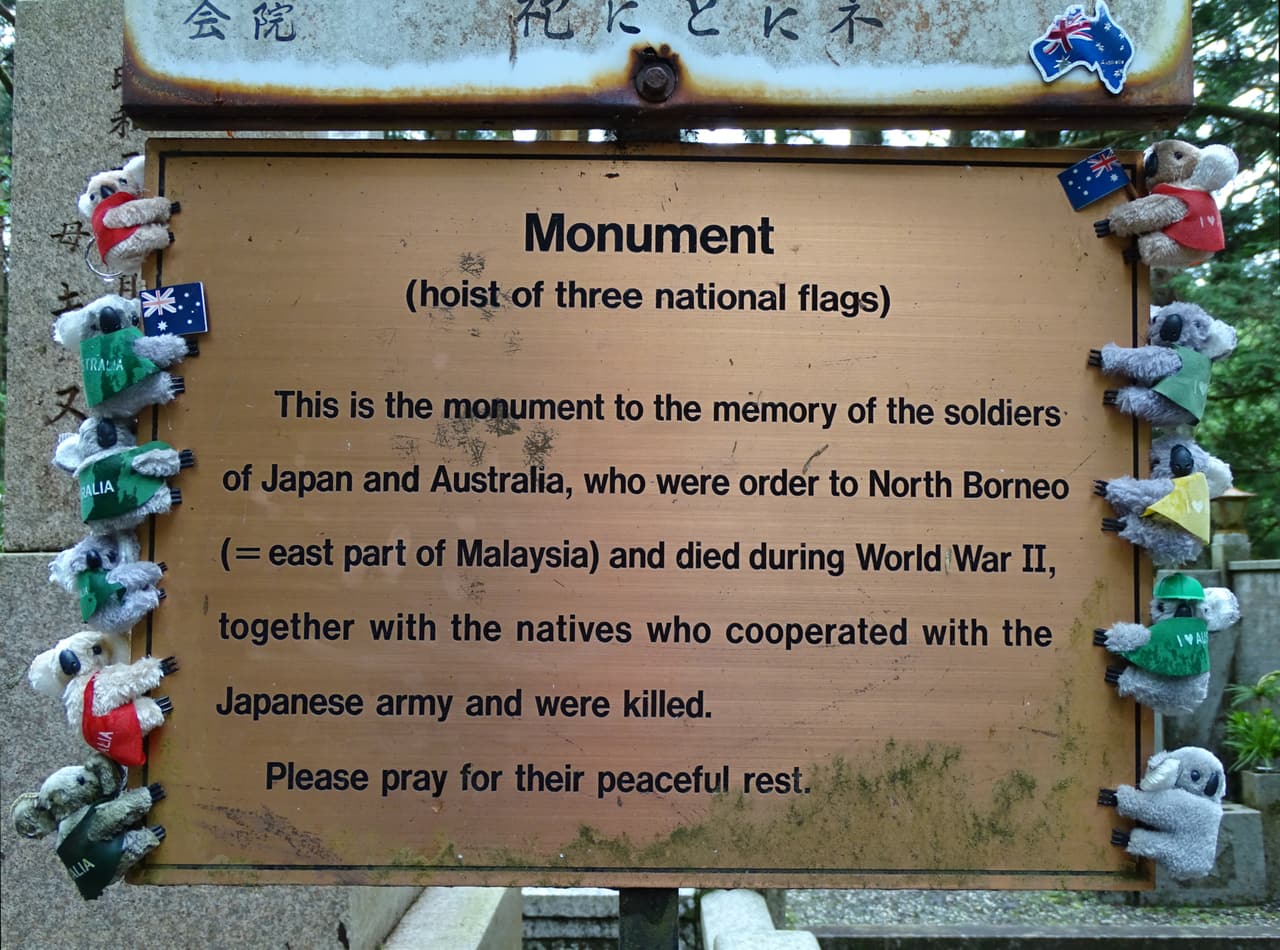
If Koyasan got just one sight, it would unquestionably be Okunoin. It holds the mausoleum of Kobo Daishi — in Shingon belief he did not die but entered eternal meditation here — and it is the spiritual core of the whole school. From the entrance at Ichi-no-hashi to the innermost mausoleum runs a roughly two-kilometer path flanked by centuries-old cedars, lined with more than 200,000 gravestones, memorial pagodas, and cenotaphs — from warlords of the Sengoku era (Oda Nobunaga, Takeda Shingen, and Uesugi Kenshin all have memorial towers here) to modern corporate memorials, crowded and moss-covered. It is, in the truest sense, Japan’s largest cemetery.
A few things you must know:
- Completely free and broadly open around the clock: the path has no walls or ticket gate, walkable at dawn and after dark. It is most atmospheric at dusk when the lanterns come on — another strong reason to stay overnight.
- Stay silent and stop photographing past the Gobyo Bridge: crossing the innermost bridge enters the most sacred space, where eating and photography are prohibited on the far side. Put the camera away and pay your respects quietly.
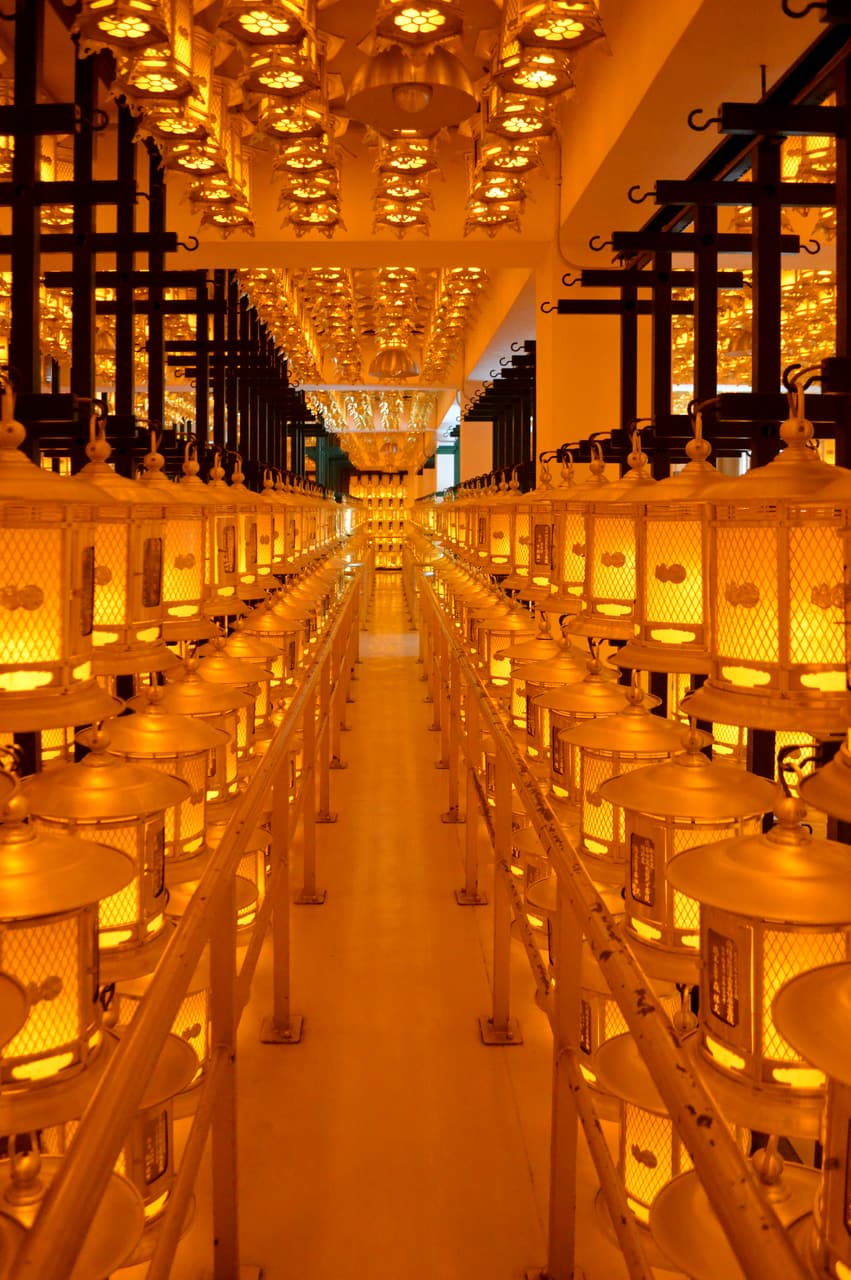
- The Lantern Hall (Torodo): the hall of worship before the mausoleum, hung with tens of thousands of lamps; two are said to have burned for nearly a thousand years without going out. A subterranean chamber lined with countless small Buddha statues can also be circled below.
On routing, most people enter from the Naka-no-hashi stop closer to town and walk to the mausoleum, which saves a little time over the full path from Ichi-no-hashi; but to feel the full layering of the avenue, walk the whole way from Ichi-no-hashi — about 40 unhurried minutes one way. Dusk and early morning have the fewest people and the best light.
The Danjo Garan & Konpon Daito
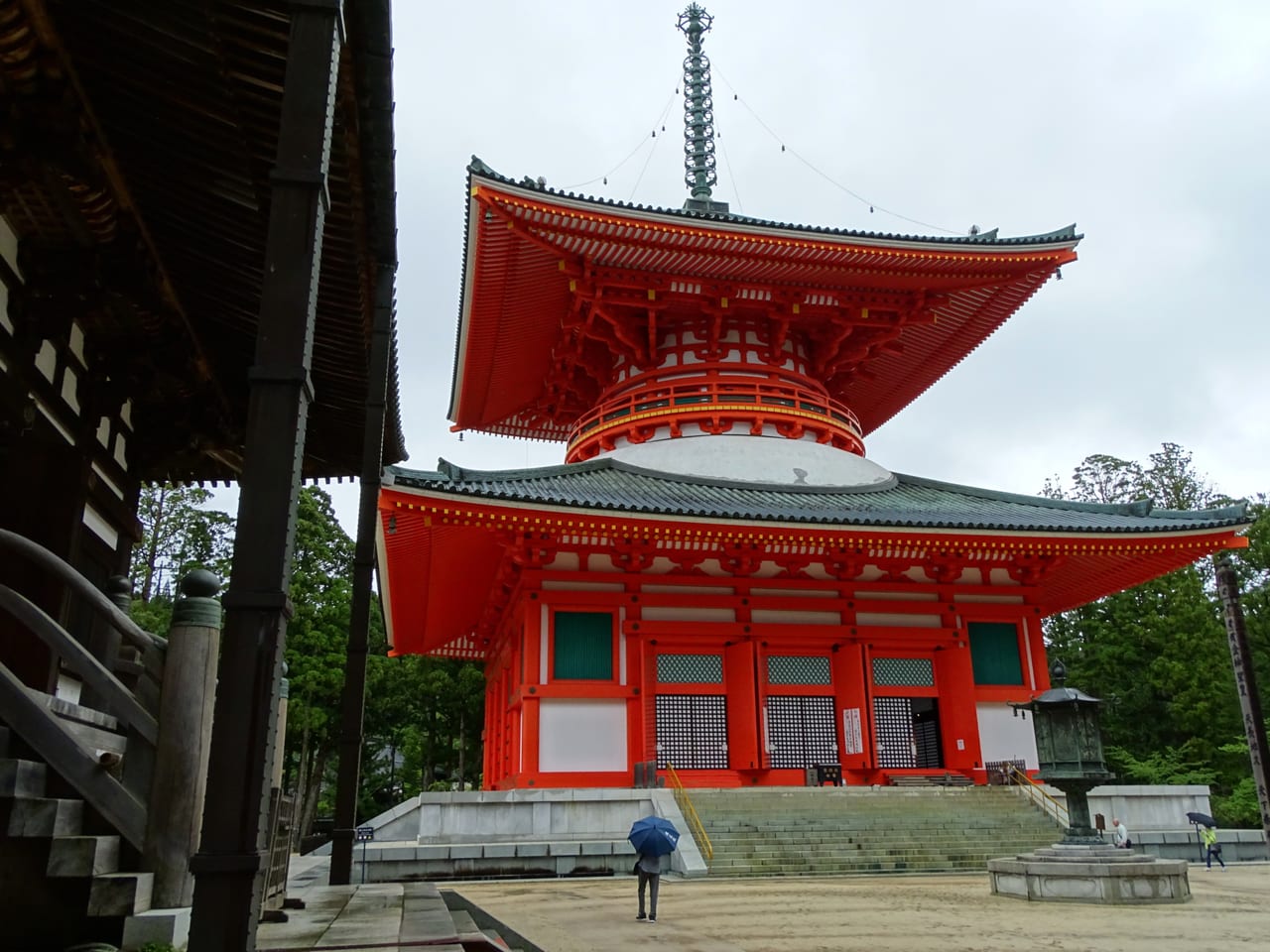
If Okunoin is Koyasan’s spiritual center, the Danjo Garan is its architectural one. This was the central training complex Kukai laid out when he first founded Koyasan, an open precinct gathering the Kondo, Miedo, Fudodo, and other halls — and the standout is the vermilion Konpon Daito, about 48 meters tall. It is one of Japan’s earliest "tahoto"-form pagodas (the present structure is a Showa-era rebuild), and its bright red body leaps out against the surrounding cedar green. It is the single most photogenic sight on Koyasan, and the cover of this guide.
On price, per official 2026 figures: entering the Konpon Daito interior is ¥500 for junior-high age and up, free for younger children. Inside, a three-dimensional mandala arranges sixteen great bodhisattvas around a central Dainichi Nyorai, unfolding the esoteric Buddhist worldview as physical statues in space — well worth stepping in for. The precinct itself — strolling the grounds and the plaza before the Kondo — is free, and a loop around the Garan to admire the Konpon Daito from outside is rewarding on its own. In autumn, the red pagoda against red maples is a classic.
Kongobuji & the Daimon gate
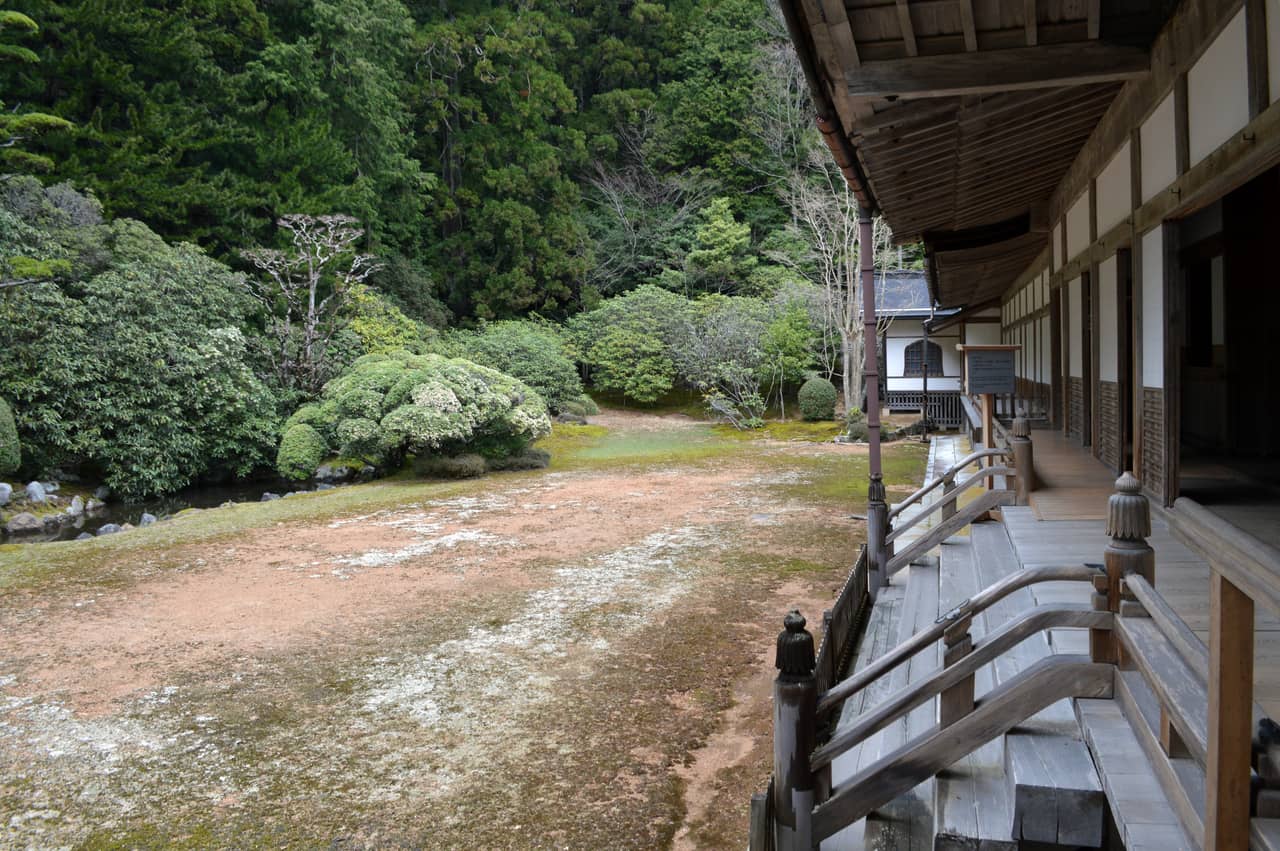
Kongobuji is the head temple of Koyasan Shingon Buddhism — the headquarters for roughly three thousand Shingon temples nationwide, effectively the school’s "head office." The building is a large shoin-style hall, and the interior is the draw: per official figures, admission is ¥1,000 for adults and ¥300 for elementary students (hours about 8:30–17:00, last entry 16:30). The ticket walks you through a series of tatami halls with painted sliding-door screens and historical displays, out to the Banryutei at the rear — one of Japan’s largest rock gardens, where white sand and blue stones form a pair of male-and-female dragons guarding the mausoleum. Sitting under the eaves to watch it for a while is genuinely restful. The temple usually serves a cup of tea and a sweet along the way (included in admission), a small Kongobuji tradition.
To save money while seeing several sites, the combined admission ticket sold at the Kongobuji office is about ¥2,500 (covering Kongobuji, the Kondo, the Konpon Daito, the Tokugawa mausoleum, and the precept ceremony), better value than paying one by one if you intend to walk every building. Separately, walk west from the town to Koyasan’s far western edge and you reach the imposing red Daimon gate — about 25 meters tall, the formal entrance for pilgrims who once arrived on foot along the Choishi-michi. It is free, viewable anytime, and dramatic when backlit at dusk.
A temple stay: shojin cuisine & morning prayers
To put it plainly, Koyasan without a temple stay is only half-seen. Of Koyasan’s hundred-plus temples, around fifty offer shukubo — temple lodging open to ordinary travelers. Staying gets you three things you cannot get elsewhere:
- Shojin ryori: the temple’s strict Buddhist vegetarian cuisine — no meat, fish, or egg, and no pungent roots like onion or garlic — built around koya-dofu (freeze-dried tofu), sesame tofu, seasonal vegetables, and yuba. Do not assume vegetarian means bland: the plating and layering often surprise people, and it is one of Koyasan’s signatures. A stay typically includes dinner and breakfast.
- Morning prayers: around 6:00–7:00, monks chant in the main hall, sometimes with a goma (fire) ritual. Guests can usually join freely — it is not compulsory — but this is the essence of a temple stay, so get up for it once. Some temples also offer sutra copying or seated meditation.
- Sleeping inside a living temple: tatami rooms, paper screens, and a temple garden at dawn — an atmosphere no ordinary hotel can give you.
On price and booking: per official sources and booking platforms, a shukubo with two meals runs roughly ¥12,000–¥30,000 per person per night, higher at famous temples (Ekoin, Ichijoin, Sojiin and the like) and in the autumn rush. Remember: most temples take cash only and require advance booking, and the November foliage season often sells out a month or two ahead, so book as early as you can. Curfew is early (often around 21:00), baths are frequently shared, and rooms may not be warmly heated — treat it as a spiritual experience, not a luxury hotel. Book through the official Koyasan Shukubo Association site or mainstream platforms. If you like this temple-and-ryokan style of lodging, see how it slots into the stays in our Osaka & Kyoto 5-day itinerary.
Getting up from Osaka & tickets
The main route up is the Nankai Koya Line, simple but with three transfers:
- ① Train: from Osaka (Namba), take the Nankai Koya Line — the limited express "Koya" or an ordinary express — to the terminus at Gokurakubashi, about 80–90 minutes by limited express.
- ② Cable car: at Gokurakubashi, transfer to the Koyasan Cable Car, which climbs the steep slope in about five minutes to Koyasan Station.
- ③ Bus: Koyasan Station itself is not in the town, so transfer to a Nankai Rinkan bus down into the center (stops such as Senjuinbashi), about ten-plus minutes. Note: walking from Koyasan Station to the town is generally not allowed (no sidewalk, pedestrians prohibited), so the bus is mandatory.
From Namba to the town is about two hours total. The ticket I recommend is Nankai’s Koyasan World Heritage Ticket — it bundles the round trip Namba⇌Koyasan (cable car included), two days of unlimited Nankai Rinkan buses on the mountain, and discounts on selected sites, valid two days, far better value than paying leg by leg. Per official 2026 figures, the paper version starts around ¥3,400 (round trip excluding the limited-express surcharge, plus the Kongobuji discount); the digital version is cheaper but lacks the Kongobuji discount, and the limited express "Koya" needs an additional express ticket. Paper tickets are sold at Nankai counters such as Namba, Shin-Imamiya, and Kansai Airport; digital tickets are bought online.
On the JR Pass: the Koya Line is run by Nankai (a private railway) and is not covered by the JR Pass, so even with a JR Pass you must buy a separate Nankai ticket up. If you are using a JR Pass for the rest of Kansai and only step off the JR network for this one day, the World Heritage Ticket is the cleanest solution. Whether the JR Pass pays off at all, and how to run the break-even math, is in our JR Pass guide.
A one-night, two-day plan
Here is the same content shaped into a route that walks well:
- Day 1 (afternoon ascent + Okunoin): morning train up from Osaka Namba on the Nankai Koya Line (about two hours) → arrive midday and drop bags at your shukubo → afternoon walk through Okunoin (the full path from Ichi-no-hashi to the mausoleum, best at dusk) → back to the temple for a shojin dinner → an optional second walk through the lit Okunoin or an early night.
- Day 2 (morning prayers + Garan + Kongobuji): join morning prayers at dawn (around 6:00) → temple breakfast → morning at the Danjo Garan for the Konpon Daito (¥500) → Kongobuji for the Banryutei (¥1,000) → walk to the Daimon gate at the western edge → after lunch, cable car and Nankai Koya Line back down to Osaka or Kyoto.
With more time and a taste for walking, Koyasan is one of the starting points of the traditional pilgrimage routes — from here you can continue on the "Kohechi" over the mountains to Kumano Hongu, the most classic stretch of the UNESCO "Sacred Sites and Pilgrimage Routes in the Kii Mountain Range"; see our Kumano Kodo guide. If Koyasan is only an interlude in a city trip, rejoin the urban plan once you are back in Osaka, mapped out in our Osaka & Kyoto 5-day itinerary.
FAQ
- Q1:Do you have to stay overnight on Koyasan, or is a day trip enough?
- A day trip is possible, but staying one night in a shukubo (temple lodging) is strongly recommended. Koyasan is about pace, not ticking boxes: the Okunoin cedar path after the day-trippers leave, the 6 a.m. morning prayers, the lit lanterns at dusk — none of that is visible on a day trip. Getting up from Osaka takes about two hours each way by train, cable car, and bus, which squeezes a same-day visit down to four or five rushed hours. Per official figures, around 50 of Koyasan’s 100-plus temples offer lodging; staying lets you eat shojin cuisine and join morning prayers, which is the whole point. If you must day-trip, focus on Okunoin and the Garan and skip Kongobuji’s interior.
- Q2:Do Okunoin, the Garan, and Kongobuji each charge admission? How much?
- They differ a lot. Okunoin — the approach path and the Lantern Hall (Torodo) — is completely free and broadly open around the clock: Japan’s largest cemetery, the two-kilometer cedar avenue, Kobo Daishi’s mausoleum, and the lantern hall are the one part you should not miss and that costs nothing. Admission applies to building interiors: the Konpon Daito in the Garan is ¥500 (junior-high age and up; free for younger children), and Kongobuji is ¥1,000 for adults, ¥300 for elementary students. If you plan to see several sites, the combined admission ticket sold at the Kongobuji office is about ¥2,500 (covering Kongobuji, Kondo, Konpon Daito, the Tokugawa mausoleum, and the precept ceremony), which beats paying one by one. Prices follow official 2026 figures; confirm on-site notices.
- Q3:How much does a Koyasan temple stay cost, and what should I know?
- Per official sources and booking platforms, a shukubo runs roughly ¥12,000–¥30,000 per person with two meals (shojin cuisine), higher at famous temples (Ekoin, Ichijoin, Sojiin and the like) and in peak autumn season. Three things to know: (1) most temples take cash only and require advance booking — they fill up early for the November foliage; (2) shojin ryori is strict Buddhist vegetarian food, no meat, fish, egg, or pungent roots, and it is more refined and filling than people expect; (3) the early-morning service (around 6:00–7:00) is usually optional, not compulsory, but it is the heart of a temple stay, so set an alarm. Bathrooms are often shared and curfew is early (around 21:00) — treat it as a spiritual experience, not a hotel.
- Q4:How do you get to Koyasan from Osaka, and what ticket should I buy?
- The main route is the Nankai Koya Line: ride from Osaka (Namba) to the terminus at Gokurakubashi, transfer to the Koyasan Cable Car up to Koyasan Station, then take a Nankai Rinkan bus into the town center (around Senjuinbashi) — about two hours total. The best-value ticket is Nankai’s Koyasan World Heritage Ticket: a round trip Namba⇌Koyasan (cable car included), unlimited buses on the mountain, and discounts on selected sites, valid two days. Per official 2026 figures, the paper version (with the Kongobuji discount) starts around ¥3,400; the digital version is cheaper but lacks the Kongobuji discount, and the limited express "Koya" needs an extra fee. Route details and JR Pass coverage are in our JR Pass guide.
- Q5:How many days should I give Koyasan, and how does it pair with Kumano Kodo or Osaka–Kyoto?
- Koyasan works best as a one-night, two-day trip: go up in the afternoon for Okunoin and a temple stay, then do the Garan, Kongobuji, and the Daimon gate after morning prayers before heading down. It pairs beautifully with the Kumano Kodo — both belong to the same UNESCO "Sacred Sites and Pilgrimage Routes in the Kii Mountain Range," and the traditional Koyasan-to-Kumano route (the Kohechi) is still walkable today; see our Kumano Kodo guide. With limited time, treat Koyasan as a quiet break inside a city trip — go straight up from Namba, then return to the urban legs of our Osaka & Kyoto 5-day itinerary.
- Q6:When is the best time to visit Koyasan? Is winter very cold?
- Koyasan sits in a basin around 800 meters up, noticeably cooler than Osaka below. Per official climate data, the best windows are the fresh green of June and the foliage from late October to mid-November, when cedar and maple weave together and Okunoin is at its most atmospheric. Winter (Dec–Feb) brings snow and sub-freezing nights — Okunoin under snow has a rare stillness, but temple rooms are not always warmly heated, so pack for cold. Summer is pleasantly cool, a genuine escape from the lowland heat. In every season the day-to-night swing is large and the dawn service is cold, so bring an extra layer beyond what you would wear at sea level.
Related reading:
Kumano Kodo Guide 2026: Three Shrines & Nachi Falls
A UNESCO pilgrimage route dual-listed with the Camino. The three Kumano shrines, 133m Nachi Falls, the beginner 7km Hosshinmon-to-Hongu walk, the Tsuboyu onsen, and honest transport advice.
Osaka & Kyoto 5-day itinerary
Dotonbori, Kiyomizu, Arashiyama — full tested route.
JR Pass 2026: Is It Still Worth It?
Four real routes calculated, six alternatives that may beat the Pass.