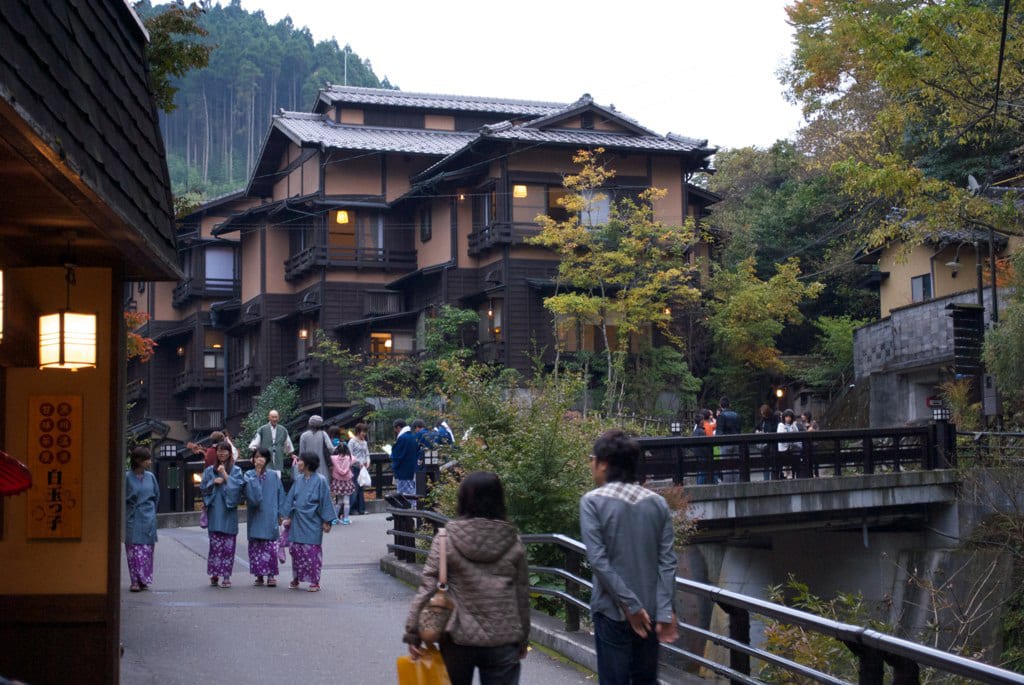
If you're tired of the neon and noise of big hot-spring resorts, Kurokawa Onsen is a relief. Tucked into a valley north of Aso, this small onsen village has preserved a rural "hot-spring-cure town" feel — no sign wars, just wooden inns and a river — through a strict townscape code. Its signature is the ¥1,500 "nyuto tegata," a pass that lets you bathe at three ryokan open-air baths as you stroll. This guide covers how the pass works, walking the onsen town, the winter "Yuakari" lantern lights, and how to reach a town with no railway. It's a deep extension of the Aso hot springs — for the crater rules and how to get up the mountain, see our Aso crater guide.
- Cure-town feel: a townscape code preserves wood and river, no neon — the whole village runs like one ryokan
- Nyuto tegata: ¥1,500 adults, 3 of about 25 ryokan open-air baths, 1 redeemable for food/souvenir, valid 6 months
- Onsen-town walk: Kawabata street, the Jizo hall, Marusuzu bridge — bathe and stroll
- Winter Yuakari: ~300 bamboo lanterns lit along the river, usually from around 20 Dec to 31 Mar, 17:00–21:30 nightly; 2026-27 dates not yet announced
- No railway: direct bus from Fukuoka 2h45, cross-Kyushu bus links Aso–Yufuin — drive or reserve ahead
📖 Contents
Why visit Kurokawa Onsen
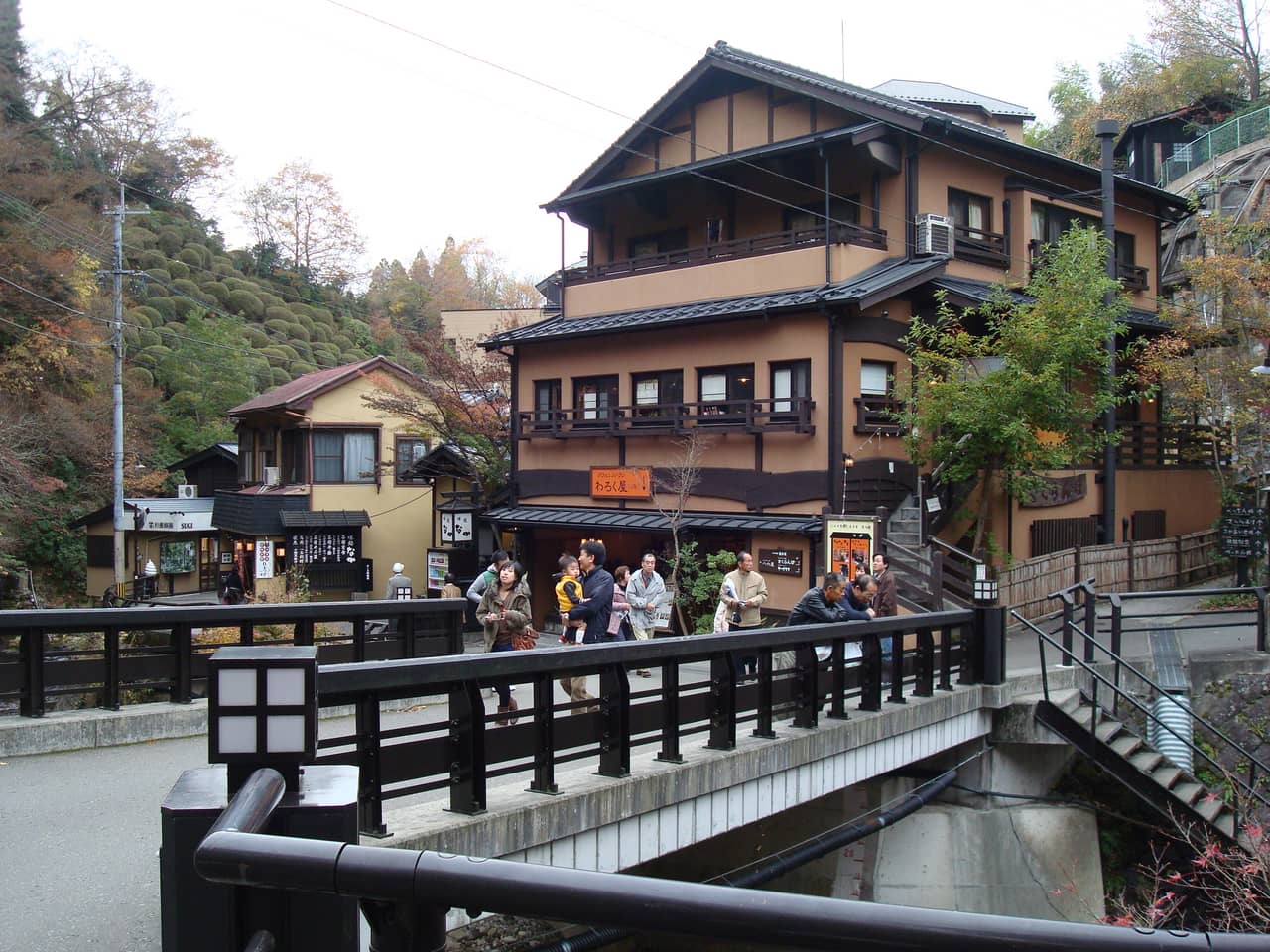
Kurokawa's appeal isn't in being big — it's in being consistent. It was once an obscure little spring in the Aso mountains; from the 1980s, the local innkeepers reached a consensus to rebuild the whole town around a townscape code: no large neon signs, building materials kept to wood and earthen walls, restrained advertising, and trees planted along both banks of the Kurokawa River. That "treat the whole street as one whole" approach turned a fading village into one of Japan's most popular hot-spring towns.
The result is the Kurokawa you see today — wooden inns staggered along the valley, stone-step lanes linking bathhouse to bathhouse, no glaring signs or touts, just the sound of the river and drifting steam. Against Beppu's mass tourism and Yufuin's rows of famous shops, Kurokawa feels more like a single ryokan spread across a village: you buy one pass, and the street becomes your bathhouse. Anyone wanting to dodge the crowds and simply bathe and walk will love it here.
The nyuto tegata: how bath-hopping works
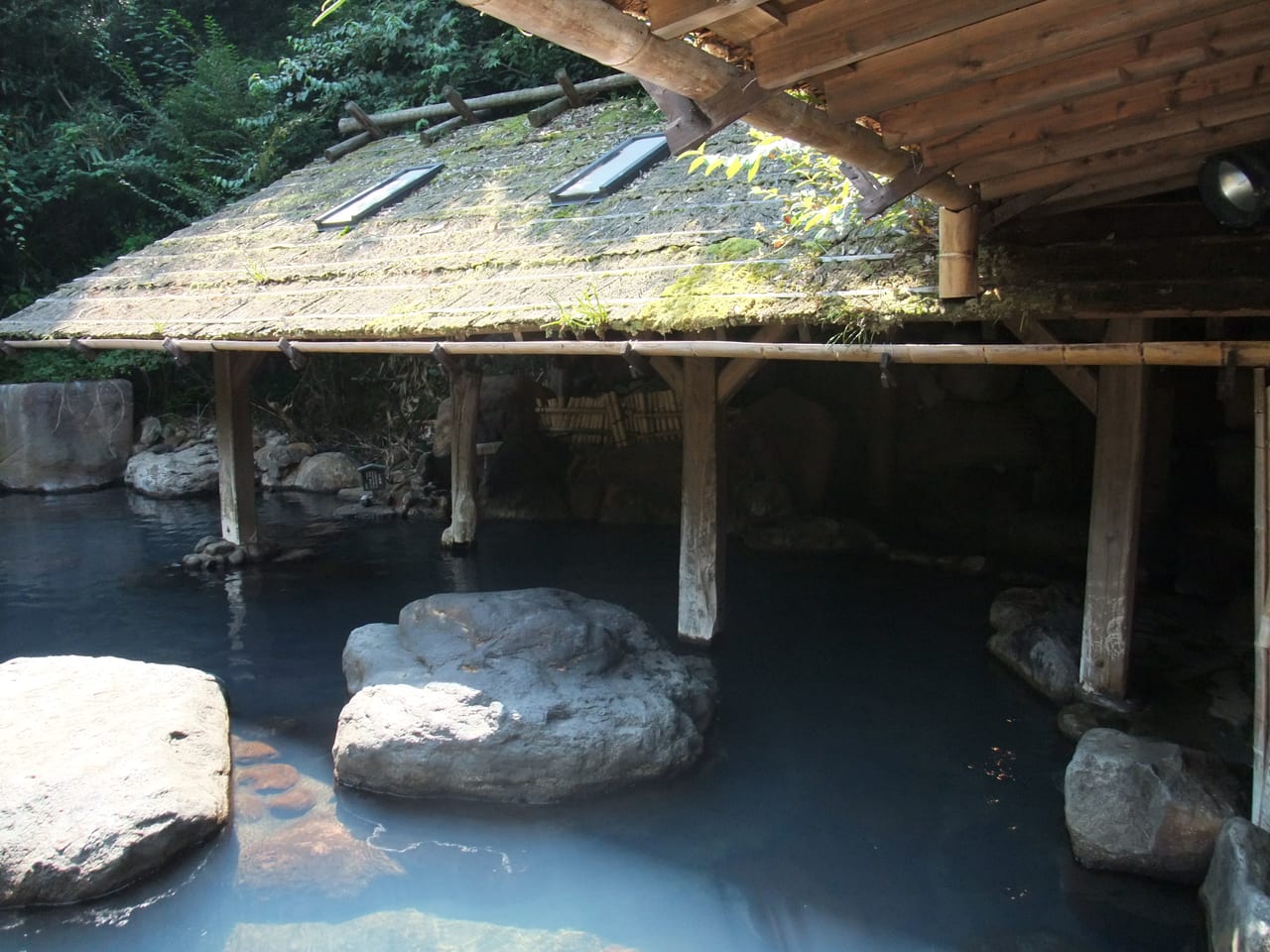
The thing to do in Kurokawa is the open-air bath-hop with the nyuto tegata. The wooden pass is ¥1,500 for adults and lets you bathe at any 3 of about 25 ryokan open-air baths in town — it carries 2 red stickers (for baths) and 1 green sticker (that one spot can instead be spent on food or a souvenir at a shop, rather than a bath). It's valid for 6 months, so if you don't finish all three in one visit you can use the rest on a return trip. Bathing hours are 8:30–21:00, with most open-air baths available from daytime into the evening.
A tip on doing it well: each ryokan's bath has different landscaping, water, and men's/women's/mixed arrangements, so stop first at the Kaze-no-ya tourist information center for a map and to ask which baths are open that day, then pick three on a sensible route by the style you want (riverside open-air, cave bath, cypress bath). Walking between the three pairs naturally with strolling the town. Bring a towel (some baths sell them). There's also a children's tegata at ¥700 (ages 3–grade 6: two baths plus a juice). For checking the day's openings and navigation, set up a Japan eSIM from KKday before you go.
A quick etiquette note, since you'll be hopping between baths: wash and rinse thoroughly at the shower stations before getting in, tie up long hair, and don't put your towel in the water. Baths are nude and almost always separated by sex (a few are mixed or have women-only times — the map marks which). On tattoos: policies vary by ryokan, and some baths do not admit visible tattoos — if you have one, ask at the tourist center which open-air baths allow them or where a cover-up sticker is acceptable, and choose your three accordingly. Asking first saves an awkward turn-away at the door.
Walking the onsen town
Kurokawa's town unfolds along the Kurokawa river valley and is compact enough to walk, perfect for the gaps between baths. A few landmarks: Kawabata street is the main lane, lined with ryokan, cafés, souvenir and snack shops; the riverside Jizo hall enshrines Kurokawa's guardian Jizo and is the town's spiritual center; and the Marusuzu bridge over the Kurokawa is a classic photo spot, with the best view of the wooden inns and the stream from the deck.
Snacking shop to shop is part of the fun — the town has onsen eggs, horse-meat croquettes, pudding, local sake and Oguni-cedar crafts, which is exactly where to spend that green sticker on the tegata for a snack or souvenir (just finish each bite by the storefront before wandering on, as the local custom goes). The scale is small and the pace slow — the kind of place where you bathe at one inn, rest a while, then wander to the next.
Kurokawa Yuakari 2026-27: when is it, and until what time are the lanterns lit?
The 2026-27 dates haven't been announced yet; in past seasons Yuakari started around 20 December and ran to 31 March, lit every evening 17:00–21:30. It's free and needs no booking. For the 2024-25 season the official announcement came just a week before opening (14 Dec), so check back in early December.
| Item | Details |
|---|---|
| 2026-27 dates | Not announced (2025-26: 20 Dec 2025 – 31 Mar 2026; 2024-25: 21 Dec 2024 – 31 Mar 2025) |
| Lighting hours | 2025-26: 17:00–21:30 nightly (2024-25: 17:30–21:30) |
| Closed days | The official notice gives one continuous period with no closed days listed |
| Where | Marusuzu Bridge to Kawabata-dori, near Yamabiko Ryokan, Becchinkan, the Kurokawa Onsen bus stop, Myojin-sama |
| Cost | Free — you see it just walking the onsen street and riverside |
| Saturday extra | "Yuakari Yokocho": every Saturday in 2025-26 (except 3 Jan), food trucks from 17:00 and complimentary bamboo-warmed sake (kappo-zake) from 18:30; perks for overnight guests |
| Official site | Kurokawa Onsen Yuakari (Japanese) |
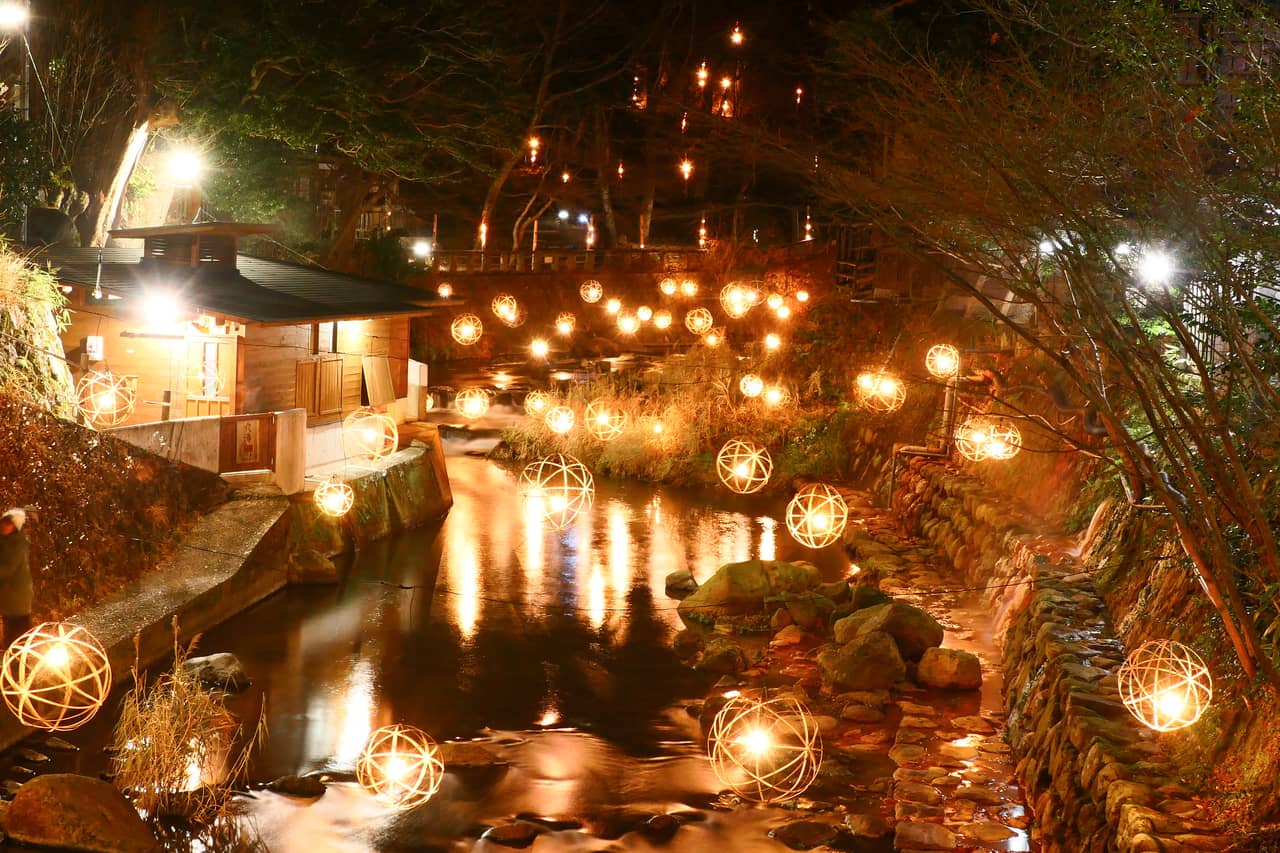
If you come in winter, don't miss "Yuakari." This lantern event, held since 2012, lights about 300 spherical "mari" lanterns and 2-meter cylinder lanterns made from local Oguni cedar bamboo along both banks of the Kurokawa River and across the riverbed. After dark the warm glow reflects on the water, and with the drifting steam it's the village's most iconic winter scene — one of the best reasons to stay overnight.
Bathing, then heading out in your coat to stroll among the lanterns, is the most enjoyable stretch of a winter trip here. If you want a livelier night, stay on a Saturday — the Yuakari Yokocho food trucks and kappo-zake only appear then.
When to go
Kurokawa is a year-round soak, but each season changes the mood. Winter is the headline — an open-air bath with snow on the rocks and steam rising in cold air is the classic Kurokawa image, and it overlaps with the Yuakari lanterns; bring warm layers for the walk between baths. Autumn (mid-to-late November) brings foliage to the valley, the busiest and most photogenic time, so reserve accommodation early. Spring is fresh and mild, summer cooler than the lowlands thanks to the elevation. Whatever the season, baths are quietest in the early morning and just before closing, away from the daytime tour-group window — another reason staying overnight beats a day trip, since you get the town at its calmest.
Access: getting to a town with no train
The key thing first: Kurokawa Onsen has no railway station. The nearest are Higo-Ozu or Aso on the JR Hohi Line, from which you transfer to a bus. Getting there is mainly by highway bus or car:
- Direct highway bus from Fukuoka: Fukuoka (Hakata) straight to Kurokawa Onsen in about 2 hours 45 minutes, no transfer — the easiest way from Fukuoka.
- Cross-Kyushu (Odan) bus: it links the onsen axis of Kumamoto–Aso–Kurokawa–Yufuin–Beppu. About 3 hours from Kumamoto Station, ~50 minutes from Aso, ~1 hour 37 minutes from Yufuin. It runs by reserved seating (book before your travel date) and suits anyone doing "Yufuin/Beppu + Kurokawa" together.
- Driving: most flexible, letting you fold in the Aso highlands and Daikanbo, with easier parking than at big resorts.
Once in Kurokawa, the onsen town and its ryokan are within walking distance, so you won't need transport between baths. For documents, insurance and customs prep, see our Japan pre-departure essentials.
Day trip vs overnight, and trip sequencing
For bathing and strolling alone, a day trip with the tegata works fine — three open-air baths and a loop of the town fill half a day to a day. But Kurokawa's nights and dawns hold their own scenery: the quiet town after dark, the winter Yuakari, the valley steam at first light — all of which need an overnight, and Kurokawa's ryokan mostly have their own open-air baths, so staying lets you soak at leisure. To get the full cure-town flavor, I'd stay a night.
A worthwhile nearby add-on is Nabegataki Falls, about a 20-minute drive away in Oguni Town — a wide, low curtain of water (roughly 10 m high, 20 m across) you can actually walk behind, which is why it's nicknamed the "back-view waterfall." Admission is ¥300 for adults (¥150 for students), parking ¥200. Note it runs on a reservation system: online booking is possible even same-day, but on big holidays it goes fully reservation-only with no walk-in entry, so check and book before you drive over. It pairs naturally with a Kurokawa stay if you have a car.
For sequencing, Kurokawa sits north of Aso on the Kumamoto–Oita border, most often forming an "Aso + Kurokawa" or "Yufuin/Beppu + Kurokawa" two-day plan: day one Aso for Kusasenri and the Daikanbo lookout, then drive to Kurokawa to bathe and stay; or day one Yufuin strolling, day two the cross-Kyushu bus to Kurokawa. For whether the crater is open and how to get up there, see our Aso crater access guide, and for the Kyushu rail-and-bus loop our Kyushu 3-day rail itinerary. For a completely different style of onsen town, southern Kyushu has Ibusuki's sand baths and Kirishima, while toward Nagasaki you'll find the Unzen Hells and Shimabara hot springs — both a contrast to Kurokawa. Mornings and evenings get cool in the Kyushu mountains — see our Japan weather and clothing guide.
Frequently Asked Questions
- Q1:What is Kurokawa's "nyuto tegata," and how does it work?
- The nyuto tegata is Kurokawa's signature draw — a small wooden pass, ¥1,500 for adults, that lets you bathe at any 3 of about 25 ryokan open-air baths in town (the pass carries 2 red stickers for baths and 1 green sticker — that one spot can instead be redeemed for food or a souvenir at a shop). It's valid for 6 months, so if you don't use all three on one visit you can finish on a return trip. Bathing hours are 8:30–21:00. There's also a "children's tegata" at ¥700 (ages 3 to grade 6: two baths plus a juice, with a reward for completing all three). Buy it at any ryokan or the Kaze-no-ya tourist information center.
- Q2:What makes Kurokawa special, and how is it different from Beppu or Yufuin?
- Kurokawa goes the "understated, keep-it-authentic" route. From the 1980s, local innkeepers agreed on a townscape code to unify the whole village — no large neon signs, building materials kept to wood and earthen walls, restrained advertising, and greenery planted along both banks of the Kurokawa River — deliberately cultivating the feel of a rural hot-spring-cure town. Compared with Beppu's "hells and mass tourism" or Yufuin's boutique-shop bustle, Kurokawa is quieter, run almost as if the whole village were a single ryokan — ideal if you want to skip the crowds and simply bathe and stroll. See our Beppu guide and Yufuin guide for the contrast.
- Q3:Can I enjoy Kurokawa without staying overnight?
- Yes. With the tegata you can do day-use bathing — three open-air baths plus a walk through the onsen town easily fills a day trip. But I'll say it plainly: part of Kurokawa's magic is at night and at dawn — the quiet town after dark, the lamplight on the river, and the winter Yuakari illumination, which only an overnight gives you. If your schedule allows, staying at a Kurokawa ryokan (most have their own open-air baths) is far more rewarding than a day trip. For how to choose an onsen ryokan, see our 5 best Japanese onsen ryokans.
- Q4:What is Kurokawa's "Yuakari," and when is it on?
- Yuakari is Kurokawa's winter lantern event, run since 2012 — about 300 spherical "mari" lanterns and 2-meter cylinder lanterns made from local Oguni cedar bamboo are lit along both banks of the Kurokawa River, the warm glow reflecting on the water and snow; it's the village's most iconic winter scene. The 2026-27 dates have not been announced yet; the 2025-26 season ran 20 Dec 2025 – 31 Mar 2026, lit nightly 17:00–21:30, and the season before ran 21 Dec 2024 – 31 Mar 2025. If you want to see it, plan an overnight — strolling the town after the lanterns come on in the evening is the highlight.
- Q5:Kurokawa has no train — what's the easiest way there?
- Correct — Kurokawa Onsen has no railway station; the nearest are Higo-Ozu or Aso on the JR Hohi Line, from which you transfer to a bus. Main options: (1) a direct highway bus from Fukuoka (Hakata), about 2 hours 45 minutes, no transfer — easiest from Fukuoka; (2) the Kyushu Odan (cross-Kyushu) bus — about 3 hours from Kumamoto Station, ~50 minutes from Aso, ~1 hour 37 minutes from Yufuin (it links Aso–Kurokawa–Yufuin–Beppu, runs by reserved seating, so book ahead); (3) driving, the most flexible, letting you add the Aso highlands. Once there, the onsen town is walkable, so you won't need transport between baths.
- Q6:How does Kurokawa fit into a wider Kyushu trip?
- Kurokawa sits north of Aso on the Kumamoto–Oita border, so it most often slots into an "Aso + Kurokawa" or "Yufuin/Beppu + Kurokawa" onsen route. The smoothest two-day plan: day one Aso for Kusasenri and the Daikanbo lookout, then drive to Kurokawa to bathe and stay; or day one Yufuin strolling and shopping, day two the cross-Kyushu bus to Kurokawa. Whether the Aso crater is open right now is in our Aso crater status guide, and for the wider Kyushu rail-and-bus loop our Kyushu 3-day rail itinerary.