Osaka & Kyoto 5-day itinerary
Dotonbori, Kiyomizu, Arashiyama in one five-day route.
How to sequence the day from dawn to dusk — and which afternoon to pick
Two out of every five overseas visitors to Kyoto end up in Arashiyama. Most are half-day visitors: in at 9:00, out by 11:30. Which means the bamboo grove between 7:30–9:00 and the Hozu riverbank between 13:00–15:00 are actually quiet — if you sequence the day correctly. What follows is what 90 minutes of waking early actually buys you, why the Romantic Train shouldn't be the first thing you plan around, and how to pick one of the four reasonable afternoon options.
Arashiyama's crowd curve is unusually steep. It climbs from 9:30, peaks at 11:00, dips between 14:00 and 15:00, climbs again at 16:00, and collapses after 17:00. The pattern is driven by the half-day visitor profile: tour buses and day-trippers eat hotel breakfast, leave around 9:00, hit Arashiyama by 11:00, eat lunch, and pivot to Kinkaku-ji or Gion by mid-afternoon.
The implication is concrete: arriving 90 minutes ahead of the buses gets you a genuinely empty bamboo grove. After 9:30 it's not a question of "is it busy" — it's "can I take a portrait without strangers in frame." During autumn peak (Nov 20–Dec 5), travelers commonly describe the bamboo path as "Shibuya Crossing with leaves."
One detail worth taking seriously:80% of Arashiyama's crown sights are within a 15-minute walk of each other. The bamboo grove, Nonomiya Shrine, Tenryuji, and Togetsukyo Bridge form a compact loop. Which means the 90-minute head start applies to all of them simultaneously. The cost-benefit math is unusually favorable.
Three rail lines reach Arashiyama. The choice depends on where you're starting, not on price — fares are nearly identical.
JR Sagano Line — fastest. Kyoto Station to Saga-Arashiyama, ¥240, 15 minutes, departures every 6–10 minutes during peak hours. If you're staying near Kyoto Station, Higashiyama, or Fushimi, this is the obvious pick. Saga-Arashiyama Station is a 12-minute walk to the bamboo entrance, passing through the wooden-fronted Sagano Yu shopping street — pleasant if you catch it just as shops open.
Hankyu Arashiyama Line — best arrival drama. Hankyu Kawaramachi → Katsura → Arashiyama, ¥240, about 25 minutes. The Hankyu Arashiyama Station sits south of Togetsukyo Bridge — when you exit, the mountain ridge is right in front of you. Arrival impact beats JR. Downside: you walk north into the day, which forces Togetsukyo as your first stop rather than your last, and most people find the resulting sequence awkward.
Randen (Keifuku) Arashiyama Line — most atmosphere. Shijo-Omiya → Arashiyama, flat fare ¥250, about 25 minutes. A street tram with two cars, sometimes painted in heritage liveries. Works for visitors based around Nishijin or Shijo-Omiya, or anyone who wants to ride the Kitano Line cherry tunnel in early April. The terminal itself is a soft surprise — 199 illuminated kimono-pattern lanterns line the platform.
None of the three justifies buying a multi-day pass. Round-trip is ¥480 total — just tap an IC card like ICOCA or Suica through the gates on all three rather than buying single tickets each time. If you're coming from Kansai International Airport, sort out HARUKA first — how to buy and use the discounted ticket is in our HARUKA e-ticket guide. For getting around the rest of Kyoto beyond Arashiyama, our Kyoto transport guide covers buses, subway, and which pass to buy. The verdict: JR from Kyoto Station, Hankyu from Kawaramachi, Randen from Shijo-Omiya or if you want the tram.

If you remember one section of this article, remember this one. The 3.5 hours between 7:30 and 11:00 are the highest-leverage time of the entire Arashiyama day. Use them well and you've already taken every photo you came for — the rest of the day becomes leisure, not chase.
From most central Kyoto hotels (around the station, Karasuma, Kawaramachi, or Higashiyama), leaving by 7:00 a.m. lines you up nicely: get to Kyoto Station, hop on the JR Sagano Line, 15 minutes to Saga-Arashiyama. Trains run every 6–10 minutes and the first departure is around 5:48 a.m., so you can go earlier without worrying about the schedule. Exit the station, turn left along Sagano Yu street toward the north — do not head straight for the bamboo grove. Hit Nonomiya Shrine first. It sits at the north end of the bamboo path, which means walking from there reverses the dominant crowd flow and lets you catch the bamboo with better light from the south.
If you want kimono photos: most kimono shops near Saga-Arashiyama Station open between 9:00 and 9:30 — you'll arrive about an hour earlier. The clean play is either to do the first half of the bamboo walk and Nonomiya in regular clothes, double back at 9:30 to change, then shoot Tenryuji and Togetsukyo in kimono; or rent the day before in central Kyoto. MOCOMOCO's Arashiyama branch takes online reservations to skip the queue and includes makeup and an optional outdoor shoot. Book MOCOMOCO kimono rental on KKday →
Nonomiya's gate is a kuroki torii — Japan's oldest torii form, made of unstripped cedar logs with the bark left on. The shrine grounds are small; ten minutes is enough. The real reward is the moss garden behind the main hall and the "turtle stone" (kameishi). The shrine is famous for love prayers, which means it's mobbed by 11:00, but at 8:00 you'll hear your own footsteps on the gravel.
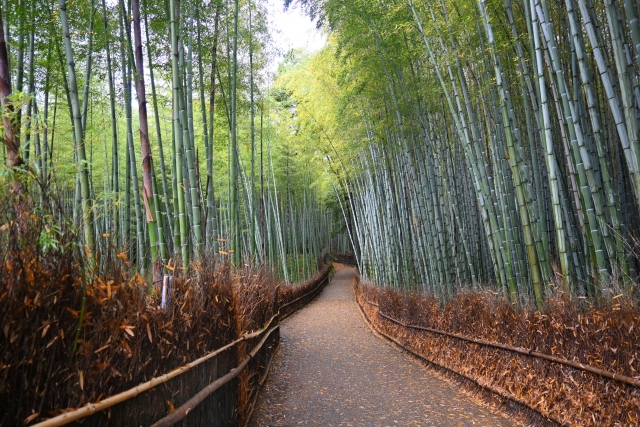
Most visitors enter the bamboo grove from the south end (closest to the station). That entrance is the most crowded. Walk in from the back path behind Nonomiya Shrine instead — the first five minutes are functionally empty, especially before 8:30. The grove runs about 400 meters; nominally a 10-minute walk, but you'll stop to look up, so budget 25 minutes.
The image everyone comes for — light shafts cutting through the canopy onto the path — happens between 8:00 and 8:30 in spring and autumn, slightly later in winter when the sun rises late. By midday summer sun is too direct and the contrast collapses.
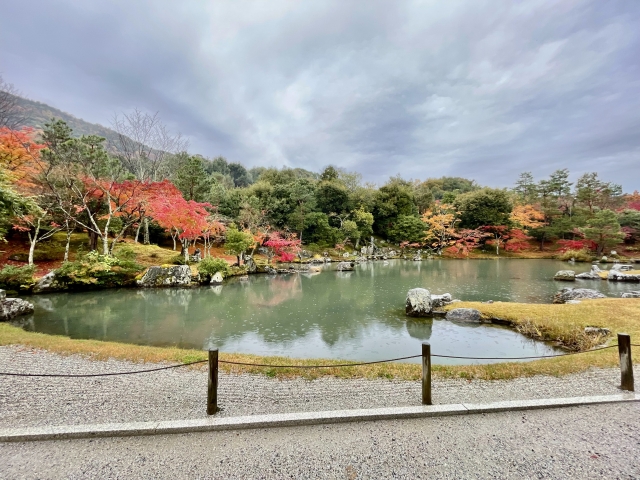
Exit the bamboo grove's south end, turn left, and Tenryuji's north gate is 3 minutes away. Doors open at 8:30 — you arrive five minutes after, which means the garden is yours.
The Sogen-chi pond garden was designated Japan's "Special Place of Scenic Beauty No. 1" — the first item on that national heritage register. Translation: when Japan decided to formally protect important gardens, this was the benchmark.
Admission has three tiers: garden only ¥500, garden plus temple buildings (Hojo, Shoin, Tahoden) ¥800. The famous Cloud Dragon ceiling painting in the Dharma Hall usually opens only on weekends and during the spring/summer/autumn special-access periods, with an additional ¥500 required. My recommendation: the garden is the essential part; pay for the buildings if Japanese architecture interests you; the dragon ceiling is genuinely impressive (9-meter diameter, "eight-way gaze" composition) but only if your visit aligns with an open day.
Exit through the north gate by the Hyakkaen flower garden — this puts you back at the south end of the bamboo grove and closes the morning loop cleanly.
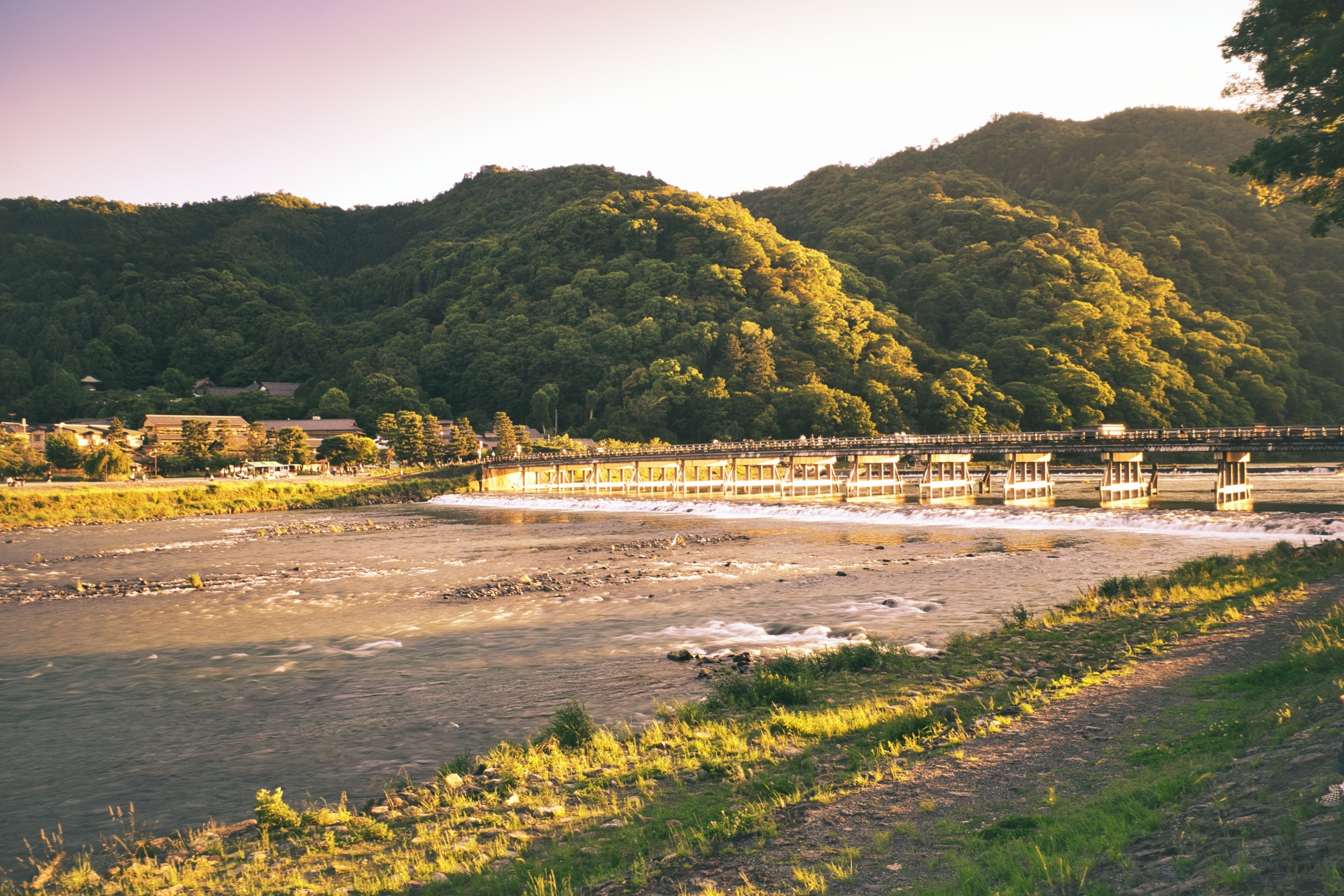
From Tenryuji's south gate, an 8-minute walk along the main road brings you to Togetsukyo. The bridge itself isn't the photo — the photo is the bridge in front of the mountain ridge behind. Best angle: stand on the south side levee path, shoot west-to-east across the bridge with the full mountain in frame.
Before 10:00 the riverbank is nearly empty; you can walk down to the water. After 10:30 tour groups start arriving, and by 11:00 the bridge itself is genuinely hard to cross on foot.
Ebisuya rickshaws are usually parked at the south end of Togetsukyo. Their shortest 12-minute option does a loop of the bridge with English/Mandarin/Japanese commentary on the local history. Not essential — but if your legs are already tired and you want one moving image of the day, this is the cleanest way to get it. Book Ebisuya rickshaw on KKday →
Lunch in Arashiyama splits into three tiers with very different price and mood.
Tier 1: yudofu (hot tofu) set meal. Arashiyama's traditional specialty, served at temple-affiliated restaurants. Around ¥3,000–5,500 per person. The established names are Nishiyan Sodo, Shorai-an, and Saga Tofu Ine — all worth eating once if you've come this far, but mentally prepare yourself: yudofu is yudofu, served with tempura, fu dengaku, and seasonal vegetables. If "I came to Japan to eat this" isn't on your list, it's reasonable to skip. Important: during peak seasons (cherry blossom, autumn foliage) and weekends, these places require advance reservations — often weeks or months out. Shorai-an and Nishiyan Sodo in autumn typically need 2–3 months' lead time; cherry-blossom season needs a month or more. Walk-ins succeed maybe 5% of the time in peak.
Tier 2: soba — especially nishin-soba (herring soba). ¥1,200–2,000 per person. Faster, lighter, cheaper than yudofu. "Arashiyama Yoshimura" (riverside, second floor with bridge views) and "Sagano Yu" (a converted public bath turned café) are the middle-ground picks favored by both locals and visitors. Yoshimura in particular needs reservations for weekend lunches in peak season — especially the second-floor window seats; weekdays you can usually walk in. Sagano Yu also takes bookings. Couldn't get either? Tier 3 below is the fallback.
Tier 3: matcha coffee + a bento. The fastest option — grab a convenience-store bento or pastry, get a coffee from Arabica Kyoto by the bridge, and eat on a riverside bench. ¥600–1,200 per person. If your afternoon is tight (Romantic Train at 14:00, or a Hozugawa boat at 13:00), this is the realistic move.
Arashiyama's afternoon is a fork point. You cannot do all four. Pick one based on energy, weather, and what you missed earlier.
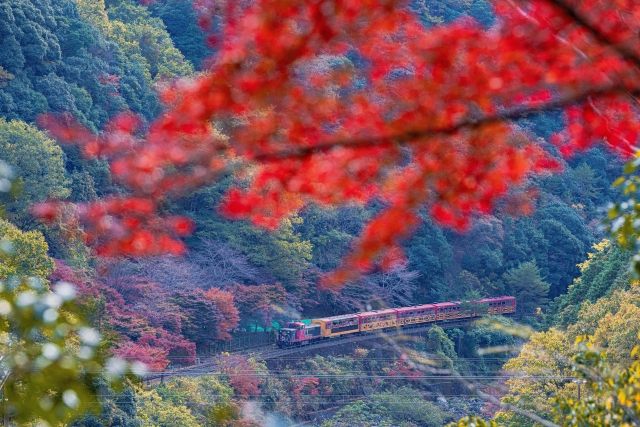
The scenic railway runs Saga to Kameoka, 7.3 km one-way, about 25 minutes. Adult ticket ¥880. The train traces the Hozu River gorge and is the famous picture-book attraction of every Japanese spring and autumn travel magazine.
I'll be direct: the Romantic Train should not be the anchor of your day. Three reasons —
1. Bookings are punishing. Advance tickets go on sale at 0:00 (midnight) Japan time, one month before the boarding date, on the railway's website only — station windows don't sell in advance. The cherry / maple peak weeks go fast, and Car 5 "The Rich" (the open-air carriage with no window glass) is the most sought-after. Even with preparation, getting your preferred date and car takes luck.
2. The actual experience is short. 25 minutes total. Subtract time finding your seat, taking photos, and the brief tunnel passages, and the genuine viewing window shrinks to maybe 15 minutes.
3. It's heavily season-dependent. Outside cherry blossoms and autumn foliage, the gorge is pretty but not extraordinary. The marketing photos you've seen are 100% peak-season shots — most days don't look like that.
One thing changes at the end of 2026: the current trainset makes its last run on Tuesday, December 29. The winter shutdown begins on December 30 and a new train enters service in spring 2027. The restart date, the new train's first day and its fares have not been announced. The new train's passenger cars are numbered 1–4, and the railway has not said whether any of them is windowless. If you're planning a spring 2027 cherry-blossom trip, don't lock the train in yet.
So my recommendation is unromantic: book it if you can, skip it without regret if you can't. To choose your car and seat (Car 5, or window seats A and D), book through the railway's official site: the booking pages are available in English, payment is by credit card with 3-D Secure enabled, and cancelling is free until 23:59 the day before. KKday sells the same one-way ticket (current trainset, through December 29), but its product page states that seats cannot be chosen in advance — they are assigned automatically at purchase, and your group is not guaranteed to sit together. Book Sagano Romantic Train on KKday →
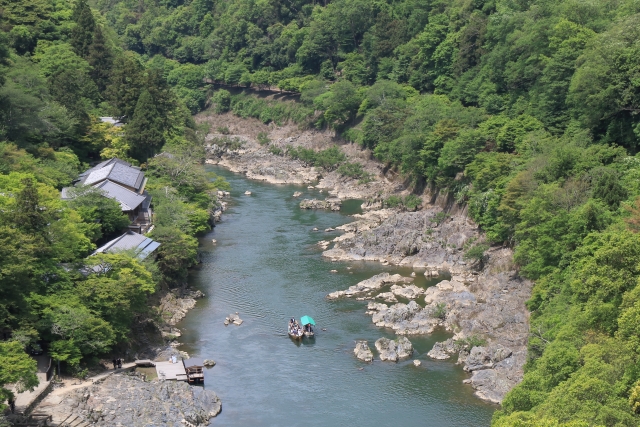
A wooden boat down the Hozu River, Kameoka to Arashiyama, 16 km, about 2 hours. Adult ¥6,000 (child ¥4,500). From March 10 through December 13 boats depart every hour from 9:00 to 15:00. From December 14 through March 9 they switch to the heated kotatsu-style winter boat with four daily departures at 10:00, 11:30, 13:00, and 14:30 — heated tables inside the cabin, snowy gorge outside the window.
The experience beats the Romantic Train in nearly every dimension that matters. The boatmen pole and oar in real time; rapids splash water into the boat (refreshing in summer, sealed in the winter version); the running commentary is in Japanese with occasional English. Restriction: passengers under 80 cm tall cannot board.
The clean sequence: morning Arashiyama → lunch → JR back one stop to Hozukyo or Umahori, taxi to the Kameoka boat pier, then float two hours back to Arashiyama. The whole arc delivers you back to Togetsukyo around dusk. Book Hozugawa river boat on KKday →
Arashiyama's most underrated sight. Admission ¥800 (child ¥400), 5-minute walk from the south end of Togetsukyo Bridge to the trailhead, then a 20-minute climb up to the summit observatory. Elevation 160 meters. The summit view covers the entire Kyoto basin — Kyoto Tower, the Higashiyama Thirty-Six Peaks, Mt. Hiei in the distance on clear days. Roughly 120 wild Japanese macaques live on the mountain. Feeding bags cost ¥100 each — you feed the monkeys through a wire mesh from inside a small enclosure (the monkeys are on the outside).
Summer hours (March 15 – October 31): 9:00–17:30. Winter hours (November 1 – March 14): 9:00–16:30. The ticket window takes cash only — no credit cards, no IC cards. Hit a 7-Eleven near Arashiyama Station first if you need yen. The 20-minute uphill walk is moderately strenuous, but for visitors who couldn't get a Romantic Train ticket and aren't sold on a 2-hour boat ride, this is the highest return on time investment: great view, real animals, and the descent ends at the bridge again.

The quiet Arashiyama. From Tenryuji, walk 25 minutes north along an old residential street. Adashino Nenbutsu-ji holds 8,000+ unnamed stone Buddha statues commemorating the medieval dead. Gio-ji is a small moss-garden temple with a Heike-era backstory. Nison-in is the third stop, famed for its "Fall in Love Lane" gate. This whole northern arc is essentially empty — almost everyone turns around at Tenryuji.
Best for: a second visit, when you've already done the bamboo grove and want something less Instagrammable. Plan three hours for the walk and the three temples; small teahouses along the way let you pause. During autumn peak this arc is the photographer's choice — still quieter than the southern crush by an order of magnitude.
16:00 onward is Arashiyama's second sweet spot. The tour buses are gone, restaurant lunch services are over, the train and the boat have closed for the day — but daylight isn't done. Golden hour over Togetsukyo Bridge between 16:30 and 17:30 is the most beautiful image Arashiyama produces in any single year. The whole mountain ridge goes from green to amber to rust, and the river surface mirrors it exactly.
Two ways to spend it: find a riverside café (Arabica Kyoto Arashiyama, % Arabica) and order something slow, or walk to "Arashiyama Onsen Fufu no Yu" by the station and dip your feet in the public footbath (around ¥200 for 20 minutes). Don't rush this part. You've been moving since 7:30. The final 90 minutes should be where the day decompresses.
After 17:30, almost everything in Arashiyama closes. It's an old tourist district with conservative hours. Unless you're staying overnight at an Arashiyama ryokan, catching a train back to central Kyoto between 17:30 and 18:30 for dinner there is the natural rhythm.
Arashiyama ryokan rates run ¥25,000–55,000 per person with kaiseki dinner and breakfast — meaningfully pricier than central Kyoto hotels. What you buy with the difference is the after-the-day-trippers-leave version of Arashiyama: by 19:00 Togetsukyo Bridge belongs to locals out for a walk, and most ryokan have rotenburo (open-air baths) facing the Hozu River or the mountain ridge — a view central Kyoto cannot deliver. For photographers or travelers actively trying to avoid the central Kyoto crowd, the extra night earns its keep. Arashiyama onsen ryokan on Trip.com →
Arashiyama's four seasons aren't just color changes — they're different sets of available activities.
Spring blossoms (March 25 – April 10): Nakanoshima Island just south of Togetsukyo gets a dense ring of Yoshino cherry trees. The Randen Kitano line stretch between Arashiyama → Narutaki → Utano runs through a "cherry tunnel" you can only see from the tram window. The Sagano railway switches to a new train in spring 2027, and its first day and cherry-season timetable have not been announced — don't build the day around it yet.
Summer green (mid-May to end-September): The bamboo is at its richest. The Hozugawa boat ride has the most spectacular splashing because of higher water levels. Downside: daytime highs of 35°C+, plenty of mosquitoes, and the Iwatayama monkey climb risks heatstroke. Summer Arashiyama should avoid the 11:00–15:00 window entirely — concentrate on early morning and the golden hour.
Autumn foliage (November 20 – December 5): Sogen-chi garden framed by maple, Hogon-in's evening illumination, and the Romantic Train at peak — the calendar peak of Arashiyama tourism. Also the most crowded two weeks of the year. The bamboo grove is full from dawn to dusk and restaurants without a reservation are effectively unreachable. Full peak-forecast timing and quieter alternatives in our Kyoto autumn foliage guide.
Winter snow (late January – mid-February): Lowest visitor numbers, lowest accommodation prices. The Sagano Scenic Railway closes for winter from December 30 (the 2027 restart date has not been announced; last season it reopened on March 1), and the Hozugawa river boat operates only the four-times-daily heated kotatsu version. But Tenryuji's Sogen-chi garden under snow is Arashiyama's single most beautiful image of the year — a window that appears only 3–5 days annually, dependent entirely on weather.
The day's cost broken open (transit into Kyoto and dinner not included):
Budget tier (¥3,000): JR round-trip ¥480 + Tenryuji garden ¥500 + convenience-store bento lunch ¥1,000 + golden-hour coffee ¥600 = ¥2,580. Afternoon: the free northern temple walk. A walking-intensive, low-cost day that still hits the essentials.
Standard tier (¥7,500): JR round-trip ¥480 + Tenryuji garden + buildings ¥800 + yudofu lunch ¥3,500 + Romantic Train one-way ¥880 +Iwatayama Monkey Park ¥800 + dusk coffee ¥800 = ¥7,260. The full day.
Premium tier (¥12,000+): Standard tier + Hozugawa river boat ¥6,000 (substitute for the Romantic Train) + Arashiyama ryokan dinner or overnight stay (extra). If you're visiting Arashiyama only once and want everything, this is the maximum-value combination.
Arashiyama commonly slots as Day 4 of a typical Osaka-Kyoto itinerary — for how it fits into a full five-day plan, see our Osaka & Kyoto 5-day itinerary. If you want to extend the morning into a Uji matcha pilgrimage in the afternoon, our Kyoto matcha journey 2026 covers the full Uji-side loop. For a different direction, Shiga is just about 50 minutes by JR from Kyoto — an offbeat day trip out to Hikone Castle and Lake Biwa.
If you'd rather not deal with the Sagano railway reservation site, the boat schedule, and the JR-then-taxi-then-boat handoff yourself, KKday has a half-day combo that bundles the Sagano Scenic Railway, the Hozugawa boat ride, and a Kyobasha horse-carriage tour into one booking — 1-person departures available, tickets handled for you. It compresses the entire afternoon into about 4 hours. Book the Arashiyama half-day combo on KKday →
The trick to Arashiyama isn't seeing every sight. It's sequencing — and giving yourself the slack to slow down once the buses leave. Most visitors treat this mountain as a three-hour stopover. The truth is that the most valuable hours come after noon, when the tour groups vanish and the place returns, briefly, to itself.
WaTabi · Researched & curated · 2026.05