The sign in Gion that everybody photographs, the one reading ¥10,000, does not govern photography, and that figure appears nowhere in the body text of either official document behind it. The six penalties that do have statutory backing are printed on the reverse of the same city leaflet, and they run from ¥50,000 to ¥500,000. What almost nobody notices is that Kyoto City and the Gion residents' association also wrote down, on that same sheet of paper, exactly where to go if you want to watch a maiko dance — and the answer is neither Hanamikoji nor any of the odori. This guide works through that document line by line, then attaches the spring and autumn odori calendar, four different age limits and the three places ticket buying actually breaks.
- The ¥10,000 has no statutory basis, and it is attached to entry, not photography. The Japanese text fines unauthorised entry; the English on the same sign says "Fine up to ¥10,000", a ceiling.
- Six penalties that do have statutes are printed by Kyoto City on the back of the same leaflet. Blocking the pavement to shoot: ¥50,000. Littering: ¥30,000. Trespass: ¥100,000 plus prison. Touching a maiko: ¥500,000.
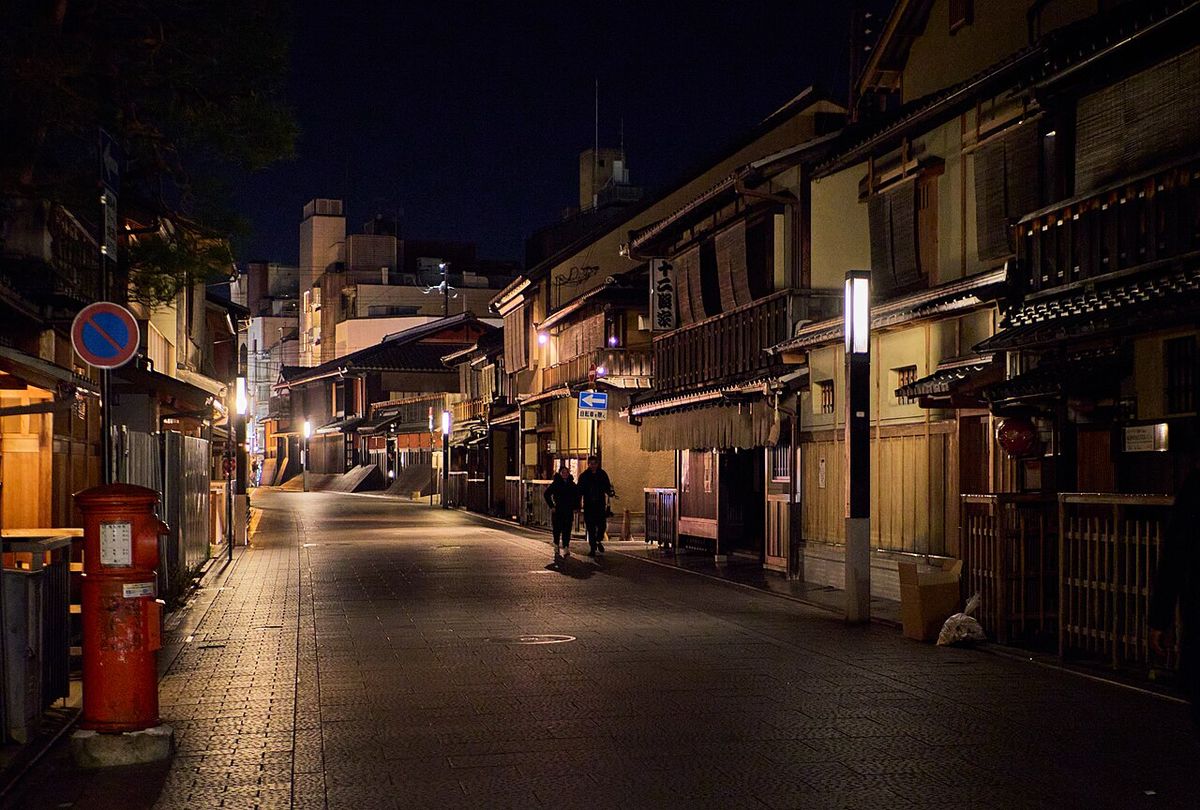
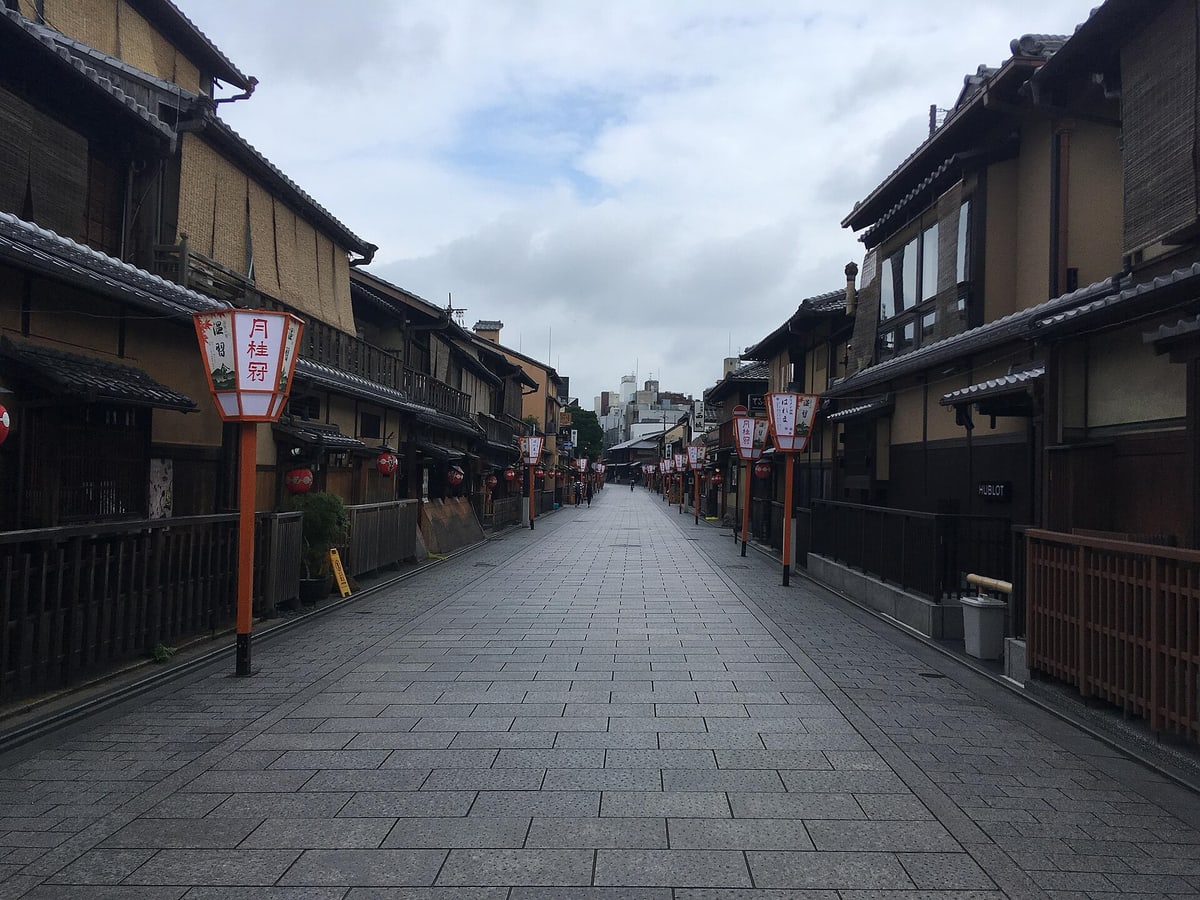
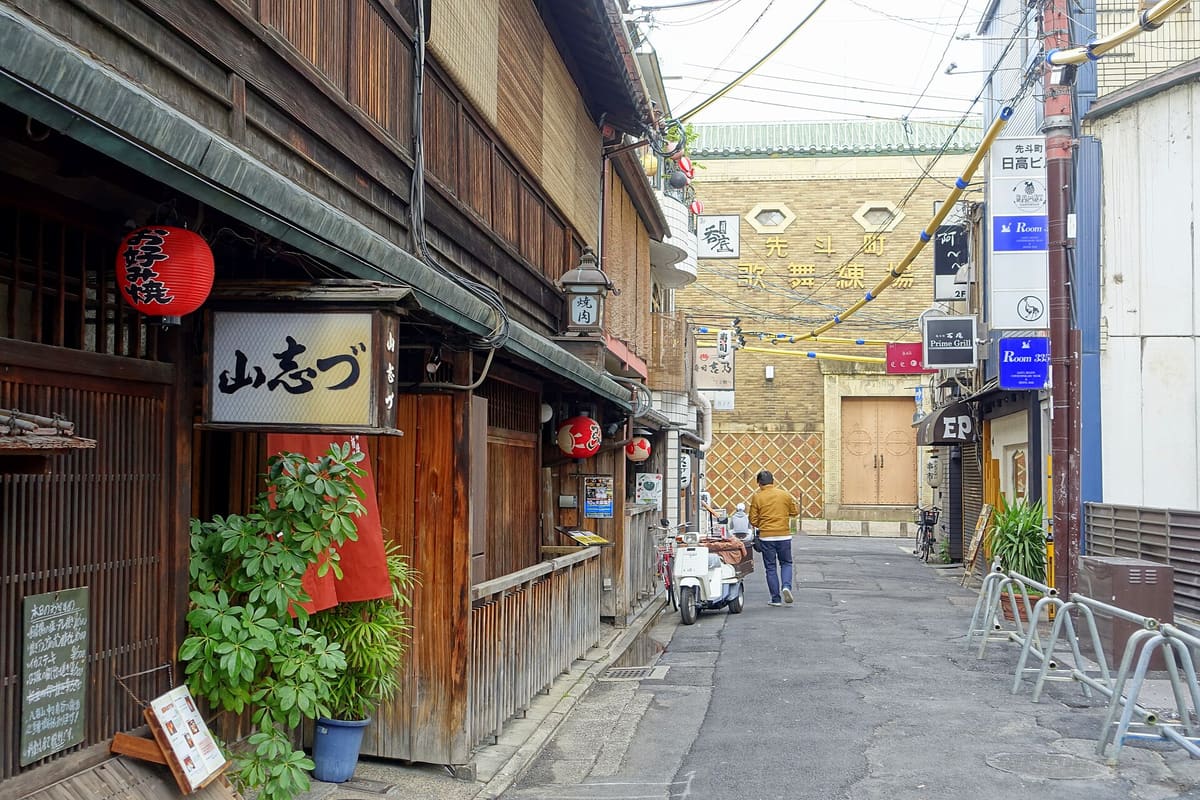
- Hanamikoji Street itself is a public road. The official map draws it white; the six lanes branching off it are the private roads where photography and entry are banned.
- The official document names its own alternative. Watch kyomai at Gion Corner, daily at 6pm or 7pm — and the only "Maiko spot" on the official map is marked there.
- Autumn's five performances do not overlap, and their sale dates are staggered too. Suimeikai opens 7 September, Mizue-kai 9 September, Kotobuki-kai 14 September. Spring is the crowded one.
📖 Contents
- Does the ¥10,000 sign mean anything?
- Which six penalties are real?
- Can you walk down Hanamikoji?
- Where does the leaflet tell you to go?
- Why do the four spring odori collide?
- Autumn is the real relay, and its sale dates are staggered
- Where does ticket buying break?
- The one show with all five districts
- When will 2027 dates appear?
- Four checks before you go
- Appendix: original Japanese
Does the ¥10,000 sign mean anything?
It is a private landowner's own notice, the amount has no statutory basis, and the money is attached to entering rather than to photographing.
Start with what the sign actually says, because a photograph of it is printed inside Kyoto City's own leaflet. The large text reads that this is a private road and that photography and entry by tourists and guided tours are prohibited, putting photography and entry side by side. The small line underneath attaches the money to one of those two things only: entering without permission carries a ¥10,000 fine. The English line on the same board reads "Private road / Do not enter / Fine up to ¥10,000", which is an upper limit rather than a set amount. Two languages on one sign, saying two different things.
Now the provenance of the figure. Two official documents were obtained for this guide — the Kyoto City leaflet "Rules of the Gion-Machi District", and the "Message from the Gion-Machi South District" hosted on the city's official tourism site — and neither contains the figure ¥10,000 anywhere in its body text. It exists only as a photograph of a sign inside official material. No council resolution, no rulebook, no city notice states it. The Gion-Machi South District Council has no website of its own, which means the resolution behind that sign has no publicly citable version at all.
There is also a legal detail worth knowing. Bakkin, the word on the sign, is the Japanese term for a criminal fine, which only a court can impose; a neighbourhood council has no such power, so the usage is loose. And a neat coincidence: the only place ¥10,000 appears in the relevant Japanese law is as the upper bound of karyō, the minor pecuniary penalty under the Minor Offences Act, phrased as one thousand yen or more but less than ten thousand yen. Legally that ¥10,000 is a ceiling that can never be reached, not a ticket price.
Do not jump from here to "so it is only a voluntary rule and does not matter". That direction is wrong too, and the next section is why.
Which six penalties are real?
All six cite a statute, they run from ¥50,000 to ¥500,000, and Kyoto City prints them on the reverse of the same leaflet.
Page two of the "Message from the Gion-Machi South District" carries a section headed, in translation, reference: penalty provisions. It is the single most useful thing in this guide, because it inverts the ranking everyone repeats: the ¥10,000 is the lightest item on that street.
| Behaviour | Statute cited | Penalty as stated |
|---|---|---|
| Stopping on the pavement to shoot, standing still, stepping into the roadway | Road Traffic Act Art. 76(4)(ii) → Art. 120 | Fine up to ¥50,000 |
| Littering | Kyoto City beautification ordinance Art. 7 & 29 (part of the district is a reinforced zone) | Fine up to ¥30,000 |
| Entering private land without permission | Penal Code Art. 130 / Minor Offences Act Art. 1(32) | Up to 3 years' imprisonment or ¥100,000 |
| Touching a geiko or maiko | Kyoto Prefecture nuisance ordinance Art. 3(1) → Art. 10 | Up to 6 months' imprisonment or ¥500,000 |
| Stopping or following a geiko or maiko | Minor Offences Act Art. 1(28) | Detention (1–30 days) or minor fine (¥1,000–under ¥10,000) |
| Damaging property | Penal Code Art. 261 | Up to 3 years' imprisonment or ¥300,000 |
The same page adds one line marked with a star: residents may report you, and police officers may come. That sentence is more useful than any of the figures, because it describes what actually happens. Nobody arrives to collect ¥10,000; somebody calls the police.
None of this is meant to frighten you, and the officials' own tone is not "you will be arrested" — it is "people live here". The signatories include the residents themselves, the teahouse association, the geiko association and Kenninji temple, and what they are asking for is that you do not block the street and do not chase anyone with a camera. Our guide to where street smoking is actually punished works through the other half of the same test: prohibited and punishable are different things. In Gion both are true at once, but they hang off different actions — the unenforceable ¥10,000 covers entry, while the ¥50,000 for standing in the road to take photographs is the one almost no English-language guide mentions.
Can you walk down Hanamikoji?
Yes. The main street is a public road; the photography and entry bans apply to the six lanes branching off it.
The Manners MAP on page two of the city leaflet colours streets two ways: white for public road, blue for private road. Hanamikoji Street itself is drawn white. Drawn blue are the lanes running off it at right angles: Yayoi-koji, Nanzono-koji, Hatsune-koji, Aoyagi-koji, Kosode-koji and Nishi-Hanamikoji.
That is worth pausing on, because it inverts the usual picture. Most visitors arrive believing Hanamikoji is a private lane where cameras are forbidden, and walk it nervously. In fact the street under your feet is public, and the six lanes where photography and entry are banned are the routes geiko and maiko take to and from work — which is exactly why people turn into them without realising.
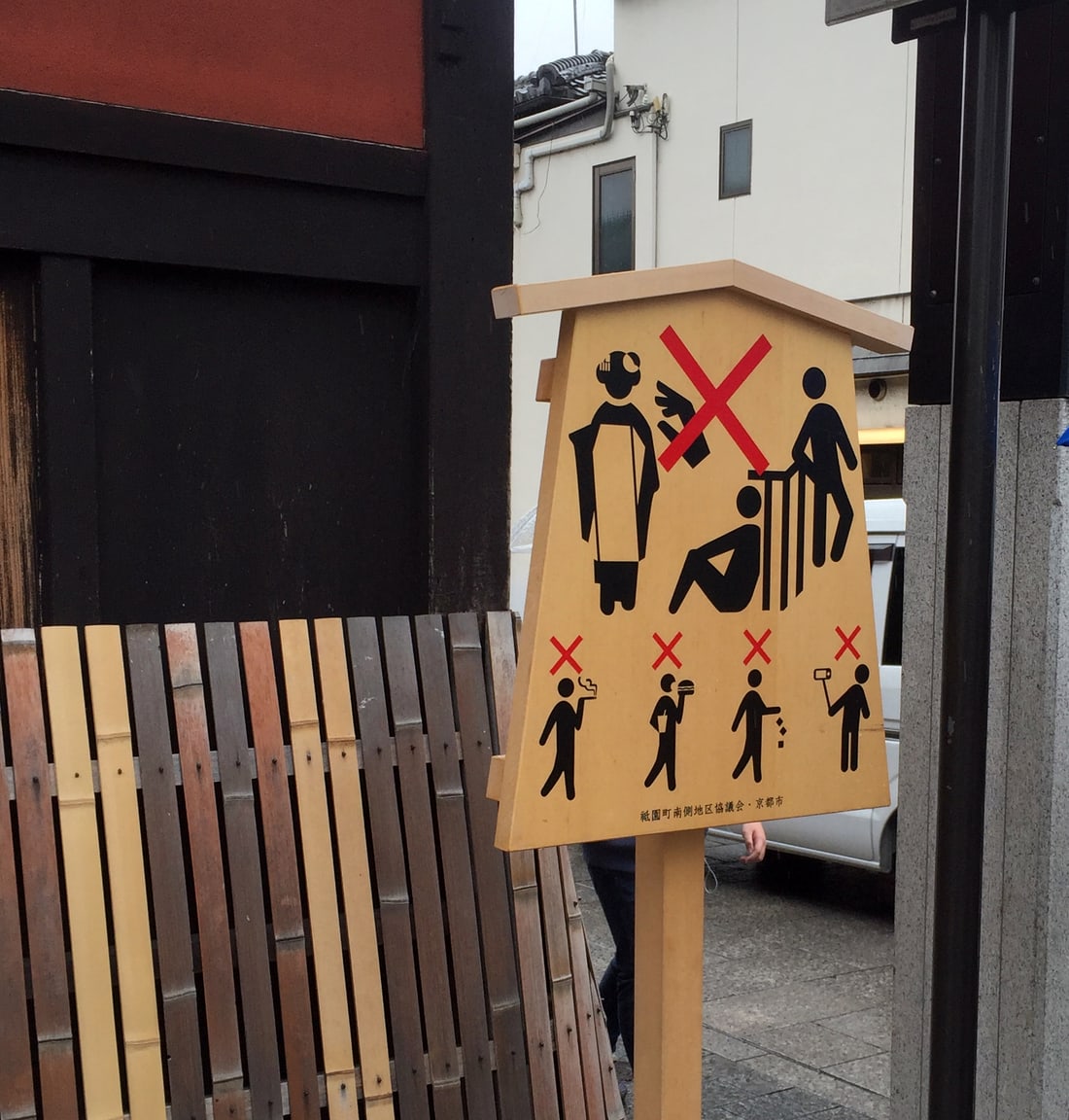
On photography there is a second layer, and the two official documents are not equally strict, so this guide leaves both on the table. The front of the lantern-shaped leaflet carries an unconditional line, "Do not take photos of maiko". The Message document instead uses the word unauthorised photography. Pick your own standard from those two; officials have not reconciled them.
Three more rules from the same map, each of which you will use on the ground:
- Hanamikoji has two white lines painted on it, and everything inside them is carriageway. The leaflet states that walking on the carriageway is prohibited. When the street is busy, people drift into the middle without thinking — and that is precisely the ¥50,000 Road Traffic Act provision from the previous section.
- The angled wooden lattices along the frontages are not props. They are called inuyarai or komayose, they exist to protect the buildings, and the leaflet prohibits touching them or sitting on them.
- The wooden plaque by a teahouse door is a boundary marker. Where it is displayed, the leaflet states, you may not enter the premises.
One caveat to record: the Manners MAP is a schematic, not a cadastral map, so the signs on site define the boundary. What the map gives you is a way of reading the street, not a set of coordinates.
Where does the leaflet tell you to go?
Gion Corner — and that is the document's own sentence, not our recommendation.
Directly beneath the clause on unauthorised photography, the "Message from the Gion-Machi South District" adds two lines:
Geiko and maiko are not mascot characters.
If you wish to watch kyomai, performances are held at Gion Corner every day at 6:00pm or 7:00pm.
The signatories are the residents of the Gion-Machi south district, the Gion Kobu teahouse association, the Gion geiko association, Kenninji temple and the district council, dated December 2023. And on the Manners MAP from the same campaign, the only point labelled "Maiko spot" is Gion Corner, annotated as a paid facility where maiko can be viewed. The people who live on that street put the problem and the answer on one sheet of paper.
Practically, it is the easiest option here because it is not tied to a season:
- Two performances daily, 6:00pm and 7:00pm. No ticket scramble, no need to pin your trip to a particular week.
- General admission, 23 and over, ¥5,500; ages 16 to under 22 ¥3,850; ages 7 to under 15 ¥3,300; preschool children free unless they need their own seat. A premium seat and a tea-ceremony seat are also sold, at ¥6,600 and ¥6,050.
- Photographs with a maiko are possible after the show — which, set against the two previous sections, makes this the one place in Kyoto where photographing a maiko is unambiguously invited.
Two things to check first. The winter programme, 1 December to 11 March, runs Tuesday to Friday only and closes on public holidays, and it drops bunraku and noh from the seven-item line-up. The venue also closes on 16 July, 16 August and 26 December to 4 January. If you are in Kyoto in winter, confirm your date has a show at all.
One thing that misleads people: booking platforms list a "Gion Corner Show Ticket", and it is not this ticket. As of September 2026 the only Gion Corner listing on GetYourGuide is a version with round-trip transport bundled in, at US$56 per person — close to half again the venue's own ¥5,500 — and the transport cannot be dropped. It carries two further traps: the listing states it is not suitable for children under 6, which is stricter than the venue itself (pre-schoolers get in free), and it warns that the QR code GetYourGuide issues is not the final admission ticket, so you must watch for a second one from the operator before a show that runs to a fixed, unchangeable schedule. It is rated 3.4/5 across 30 reviews, one of them a one-star from someone sent to the wrong address who arrived after the performance had finished. If you do not need the transport, buy from the venue or on the door.
The third route is an ozashiki, hiring geiko and maiko for a banquet inside a teahouse. That route's cost and how it is arranged are covered in our guide to what luxury travel in Japan is actually worth paying for, so it is not repeated here. The three routes reduce to one sentence: Hanamikoji is free but there is nothing you should be doing there, Gion Corner is ¥5,500 every single night, and an ozashiki costs an order of magnitude more but is the only one where anyone sits down with you.
Why do the four spring odori collide?
Because they were never a relay. In April the problem is not choosing one, it is fitting two into a single day.
The usual English summary says the districts hand off from late March to May, so the week you are in Kyoto decides which one you see. Checked against the official 2026 schedule, that is not true of spring.
| District | Performance | 2026 dates | Curtain | Price (incl. tax) |
|---|---|---|---|---|
| Gion Kobu | Miyako Odori (152nd) | 1–30 April | 12:30 / 14:30 / 16:30 | ¥7,000 / ¥6,000 / ¥4,000 / ¥2,000 |
| Miyagawacho | Kyo Odori (75th) | 4–19 April (13 April dark) | 13:00 / 16:00 | ¥7,000 / ¥6,000 |
| Pontocho | Kamogawa Odori (187th) | 5–22 May (18 days) | 12:30 / 14:20 / 16:10 | ¥7,000 / ¥6,000 / ¥4,000 |
| Kamishichiken | Kitano Odori | Official page offline; not obtained | — | — |
Three things follow, and you can plan straight off them.
First, Miyako Odori and Kyo Odori overlap completely from 4 to 19 April (minus 13 April). Through the first half of the month you can see both, and the practical pairing is the 12:30 Miyako Odori followed by the 16:00 Kyo Odori, with about ninety minutes in between and roughly a ten-minute walk between the two theatres. That is the opposite of a choice.
Second, there is a genuine gap, and it lands in the worst possible place: 1 to 4 May. Miyako Odori closes on 30 April and Kamogawa Odori does not open until 5 May. Those four days are the first half of Golden Week — the most expensive flights, the biggest crowds, the week the largest number of visitors put Kyoto in their itinerary — and there is no odori running. Whenever you read that Pontocho performs "in May", add the words "from the 5th" yourself, or you will arrive on 1 May to a closed theatre.
Third, Kitano Odori's 2026 dates could not be obtained. The Kamishichiken page for it currently returns a 404, the Wayback Machine holds no 2026 snapshot, and the nearest archived capture is a 404 from October 2025 — meaning the page is taken down entirely out of season. The only citable version is the March 2025 archive: 73rd edition, 20 March to 2 April 2025, 14:00 and 16:30, ¥7,000 with tea, ¥6,000 without, preschool children not admitted, sold online through Confetti. Those are 2025 figures, not a rule about "late March in a typical year", and they cannot be used to plan 2026 or 2027. The live annual-events page at Kamishichiken lists only "March–April, Kitano Odori" with no dates at all.
One thing with a time horizon: Kamishichiken's theatre is fundraising for major repairs
In September 2026 the Ookini Foundation opened a donation drive for the Kamishichiken Kaburenjo, citing deterioration of exterior walls, lighting and air conditioning, describing large-scale repair as an urgent issue, and putting the cost above ¥100 million. The campaign runs from 4 September 2026 to 31 October 2028.
Officials have not said the theatre will close, and have not said Kitano Odori will be cancelled or relocated — the tone of the appeal is about reassuring people who come for Kitano Odori, Kotobuki-kai and the summer beer garden. This guide draws no inference. But two precedents that have already happened show that the line-up breaks more often than people assume: Gion Kobu Kaburenjo closed for seismic retrofitting in 2016, sending Miyako Odori to Shunjuza in 2017 and 2018 and to Minamiza in 2019, then dark through the pandemic, with the building completed in November 2022 and the performance finally returning home in April 2023. And after Miyagawacho's theatre was rebuilt, officials described the 2026 Kyo Odori as being held "for the first time in five years". Five districts all performing at home is a snapshot of 2026, not a rule.
Autumn is the real relay, and its sale dates are staggered
From 1 October to 18 November, five performances with no overlap at all — in autumn the week you visit really does decide which one you see.
The sentence everyone applies to spring is actually true of autumn. And unlike spring, autumn puts its sale dates a week apart across September rather than bunching them.
| District | Performance | 2026 dates | Price (incl. tax) | On sale | Age limit |
|---|---|---|---|---|---|
| Gion Kobu | Onshukai | 1–6 Oct (16:00) | ¥10,000 / ¥6,000 | 🟢 since 10 Aug | not stated |
| Miyagawacho | Mizue-kai | 8–11 Oct | ¥10,000 / ¥8,000 | 🔴 from 9 Sept | under 10 not admitted |
| Pontocho | Suimeikai | 15–20 Oct (15:30) | reserved ¥10,000 / ¥8,000; unreserved ¥5,000 | 🔴 from 7 Sept, 10:00 | not stated |
| Gion Higashi | Gion Odori (67th) | 1–10 Nov (13:30 / 16:00) | ¥7,000 / ¥6,000 | 🟢 since 1 Aug (online to 28 Oct) | under 3 not admitted |
| Kamishichiken | Kotobuki-kai | 12–18 Nov (7 days) | ¥10,000 | 🔴 from 14 Sept, 10:00 | preschoolers not admitted |
The only blank days are 7 October, 12–14 October, 21–31 October and 11 November. Every other week catches exactly one performance — and exactly one.
Autumn is a different product, though, and it is worth saying so before anyone buys the wrong expectation. Onshukai, Mizue-kai, Suimeikai and Kotobuki-kai are kenzan recitals, where each district shows its technical work. Tickets start at ¥10,000, above the ¥6,000 to ¥7,000 of the spring tourist-facing odori, and the performances are shorter, smaller and come with far less visitor infrastructure. Book spring for spectacle and autumn for craft. The cheapest way in across all five is Suimeikai's unreserved seat at ¥5,000, and that one you can buy online. On the day sales opened, 7 September 2026, the official Suimeikai ticket page listed all three prices — both reserved tiers and the unreserved seat — inside the same web application flow, the opposite of what the same kaburenjo does in spring, so do not carry pitfall two below over to the autumn recital. ⚠️ The web route does not let you pick a seat: the official wording is that seats cannot be chosen and are assigned by the organiser, and that applies to the two tiers labelled reserved as well. You may end up on the first or second floor, in a chair seat or a box seat, and a group is not guaranteed to sit together. The phone route wants a bank transfer or cash by registered mail, which is not realistic from abroad, so an online card payment is effectively the only way in — and once it goes through the organiser accepts no cancellation.
Gion Higashi is the exception to all of it. It has no autumn recital, because Gion Odori is itself the autumn event — officials describe it as the only hanamachi dance performance of the five districts held in autumn. Which means Gion Higashi stages exactly one public performance in the entire year: no spring odori, no separate recital. Structurally it is the odd one out, and its tickets went on sale on 1 August 2026, with online sales running to 28 October.
Where does ticket buying break?
Three obstacles, one at each of three districts, and none of them is the price.
Obstacle one: Miyagawacho and your credit card
Miyagawacho's ticketing page states that credit cards not registered for the service cannot be used — 3D Secure 2.0 is mandatory. An overseas card that has never been enrolled with its issuing bank will be declined at the final step, and there is no fallback: the district explicitly does not take telephone bookings.
Two more from the same district. Confirmation emails cannot be resent, so you must be able to receive mail from e-get.jp. And wheelchair users are the mirror image of everyone else — they cannot book online at all and must call 075-561-1151, weekdays 10:00 to 16:00.
Obstacle two: Pontocho's cheapest seat is not sold online
Of Pontocho's three price bands, the ¥4,000 ordinary seat is not sold online at all; the wording is that ordinary seats are not on sale. The online shop carries only the ¥7,000 and ¥6,000 bands. To buy the cheap one you have to queue at the box office beside the theatre entrance from 10:00 on the day, and officials note it may sell out.
What arrives after an online purchase is also worth knowing: a PDF exchange voucher, which must be printed or displayed on your phone and swapped for an actual ticket. An order screenshot will not get you in.
Obstacle three: Kamishichiken's ten-day cut-off
Kamishichiken sells through Confetti, and online applications close ten days before the date you want to attend (officials illustrate this with a 20 March performance closing on 10 March). Deciding in Kyoto to add a performance simply does not work at this district. Seats are assigned and officials state plainly that you cannot request one. Wheelchair spaces require a phone call in advance.
The counterexample: Gion Higashi is the most visitor-friendly of the five
Gion Higashi's official shop runs in Japanese and English with a yen or dollar toggle, which no other district offers. One detail catches people out: what you receive after paying is an exchange number, not a ticket, and on the day you present the number issued by the Gion Higashi teahouse association — not the order ID from the shop platform.
Two rules all four share
Whichever district you buy from: seating is assigned but you cannot choose the seat number (Miyako Odori publishes a seating chart so you can at least see the blocks; the rest allocate for you), and tickets cannot be cancelled, changed or refunded, stated separately by each of the four. For getting between the theatres, our breakdown of which Kyoto transport pass is worth it covers the passes.
What the tea ticket actually buys
A tea service before the curtain. All five districts hold it beforehand, and none of them lets you drink afterwards.
This is the detail most people get wrong, because a tea ceremony sounds like something that happens after a show. The five descriptions differ in wording and agree in substance:
- Miyako Odori: seating from one hour before, arrive at least 40 minutes before curtain, and the tea room explicitly cannot be used after the performance. The tea ticket is the upgrade — the gap between ¥7,000 and ¥6,000.
- Kyo Odori: every seat includes tea and there is no option without it. Tea seating 11:30–12:50 for the first performance, 14:30–15:50 for the second, closing ten minutes before curtain; miss it and you take the sweet away. It uses the ryurei style, with chairs and tables.
- Kamogawa Odori: the Q&A explains that the ticket buys a geiko's tea preparation, and the dish the sweet is served on is yours to take home.
- Kitano Odori: one hour to ten minutes before curtain; afterwards it is substituted with a manju to take away.
- Gion Odori: from one hour before, finishing five minutes before curtain.
So read a tea ticket as an instruction to arrive an hour early, not as a freebie.
The one show with all five districts
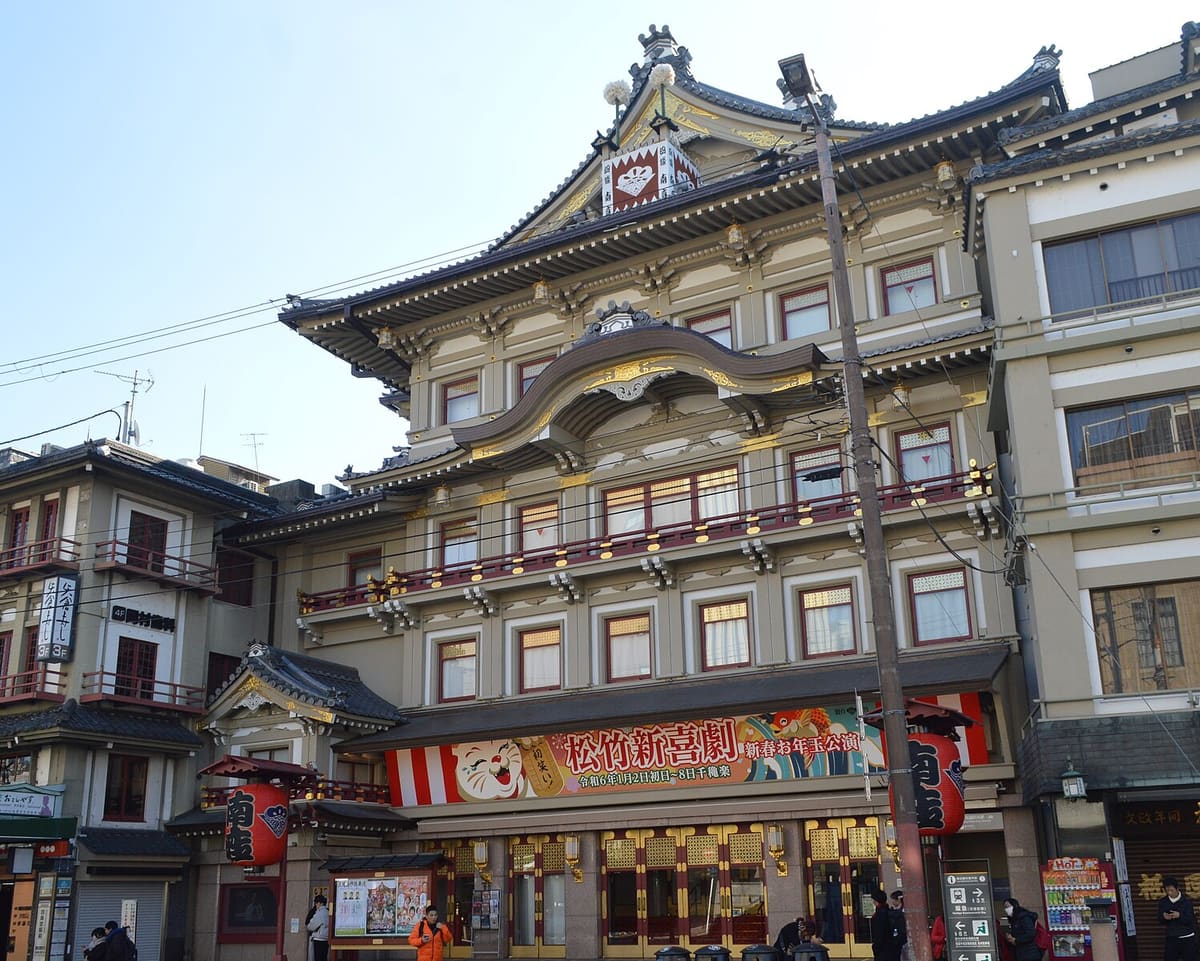
Every June at Minamiza, sold through the kabuki ticketing system, and officials state that it is the only occasion where all five appear together.
If what you want is not a particular district but "the five hanamachi", none of the ten performances above is the short route. The Ookini Foundation, the umbrella body for all five, stages Miyako no Nigiwai each June, putting geiko and maiko from Gion Kobu, Miyagawacho, Pontocho, Kamishichiken and Gion Higashi — around 70 performers in total — on one stage.
- The 33rd edition ran on 27 and 28 June 2026, morning programme 11:00 and afternoon 14:30.
- The venue is Minamiza, not any of the district theatres.
- Prices: ¥14,000 special seats, ¥13,000 first class, ¥6,500 second class (all of the third floor), plus a same-day student ticket at ¥3,250 when second-class seats remain.
- Tickets opened at 10:00 on 22 April 2026 through Shochiku's web and phone ticketing, Minamiza, Kabukiza and Shimbashi Enbujo — the same system as kabuki. If you have bought a kabuki ticket before, this will look familiar; if not, our walkthrough of single-act kabuki tickets covers how the system works.
The event began in 1994 for the 1,200th anniversary of the founding of Heian-kyo, and the editions run consecutively by year: 31st in 2024, 32nd in 2025, 33rd in 2026.
The foundation also runs something called Soshun Yume Butai, but it is not annual — the official page states in as many words that it was not held in 2025, and the last confirmed staging was 23 February 2024 at Minamiza. It is mentioned here so you know it exists; do not put it in an itinerary.
When will 2027 dates appear?
Nothing has been published, but Miyako Odori's announcement is due next month by its own precedent.
Across the 38 official pages checked for this guide, the Japanese era year Reiwa 9 and the year 2027 returned zero hits combined — the single match was a site component on the Kyoto tourism portal, not performance information. So this guide publishes no 2027 dates, prices or edition numbers, including the "usually around month X" kind of extrapolation.
The documents do, however, date themselves, and that gives a usable rhythm for planning a return trip. The 2026 Miyako Odori announcement is dated October 2025, with a footer noting that the information reflects the position as of October 2025. By that precedent, the 2027 Miyako Odori announcement should appear in October 2026 — next month. The on-sale dates recorded elsewhere give you the rest of the alarm clock:
| Performance | Announcement / on-sale, as observed |
|---|---|
| Miyako Odori | announced the previous October → tickets 6 January |
| Kyo Odori | tickets 25 February (2026) |
| Kitano Odori | applications open 14 January (2025) |
| Gion Odori | tickets 1 August (2026) |
| Miyako no Nigiwai | tickets 22 April (2026) |
These are observed dates, not commitments. No official page states a rule about when announcements are published.
Four checks before you go
- Decide which of the three things you actually want. A staged performance means working around the calendar (crowded in spring, single-file in autumn); watching maiko dance without pinning a date means booking Gion Corner; sitting down with them means an ozashiki, at an entirely different budget. Do not try to plan all three at once.
- Memorise two lines before you walk into Gion. Inside the painted white lines is carriageway, so stay out of it; the six blue side lanes are private roads, so do not turn into them and do not raise a camera at their mouths. Those two correspond to the ¥50,000 Road Traffic Act provision and the ¥100,000 trespass provision — both heavier than the sign's ¥10,000.
- Before buying, confirm three things: your card, the age limit, and your tea time. Kyo Odori demands 3D Secure 2.0; travelling with a preschooler in spring leaves Miyako Odori as the only option; and the tea service is always before the curtain, so move your arrival an hour earlier.
- Autumn tickets are selling this week. Suimeikai went on sale 7 September, Mizue-kai 9 September, Kotobuki-kai 14 September, and Gion Odori's online sales close 28 October. If you are in Kyoto in October or November, this is more urgent than your hotel — hotels have alternatives, and these five performances give you one per week.
A last word on what this guide is for. The six statutes above are real, but the point of the official document was never to frighten anyone. Its signatories are the people who live on that street, the first thing they wrote is that geiko and maiko are not mascot characters, and on the same sheet they tell you there is a performance every evening at six and at seven. Put down the unenforceable ¥10,000 and keep this instead: do not block the street, do not chase anyone with a camera, and if you want to watch, buy a ticket and go in. For Kyoto at other times of year, try New Year and hatsumode in Kyoto or what Gion is like during Gion Matsuri.
Appendix: original Japanese sources (click to expand)
Longer quotations are collected here so you can check them yourself. Short phrases stay inline in the body.
1. The sign itself (photographed inside the Kyoto City leaflet, page 2 Manners MAP)
私道につき 観光客、ガイドツアーの写真撮影や進入禁止
許可なく進入の場合、罰金1万円
Private road / Do not enter / Fine up to ¥10,000
This reading comes from magnifying a photograph embedded in the official PDF, not from inspecting the physical sign. Officials do not record when the sign was installed, so no date is given here.
2. The three rules on the front of the leaflet
①私道での写真撮影は禁止 / No Photography on private roads
②道路上での立ち止まり、車道歩行は禁止 / Do not stop on public roads, Do not walk on the roadway
③芸妓・舞妓の撮影禁止 / Do not take photos of maiko
Rule three is unconditional, while the Message document uses 無断撮影 (unauthorised photography). The two official documents differ in strictness; both are reproduced here rather than reconciled.
3. The alternative named in the Message (December 2023)
芸妓さんや舞妓さんはマスコットキャラクターではありません。
京舞を御覧になりたい場合は、ギオンコーナーにて、毎日午後6時又は午後7時に公演を行っています。
Signed by the residents of the Gion-Machi south district, the Gion Kobu teahouse association, the Gion geiko association, Kenninji and the district council.
4. Statutes quoted in the penalty section, page 2
道路交通法 第76条第4項第二号:道路において、交通の妨害となるような方法で寝そべり、すわり、しやがみ、又は立ちどまつていること
軽犯罪法 第1条32号:入ることを禁じた場所…に正当な理由がなくて入つた者
★ 住民の通報により警察官が駆け付ける場合があります。
5. Three on-the-ground rules from the Manners MAP
道路の両白線内側は車道です。車道での歩行は禁止です。
犬矢来・駒寄:建物を守るためのものです。「触ること」や「座ること」は禁止です。
お茶屋の店先に表示されています。敷地内に勝手に入ることはできません。
6. Gion Higashi's position among the five districts
五花街で唯一秋に開催される花街舞踊公演
7. Miyako no Nigiwai
祇園甲部、宮川町、先斗町、上七軒、祇園東の芸妓舞妓、総勢約70名の伎芸を一度にご覧いただけるのは「都の賑い」だけ
8. Soshun Yume Butai
令和7年の開催はございません。
9. Miyagawacho ticketing conditions
サービス未登録のクレジットカードはご利用いただけません
10歳未満の方はご入場いただけません(No one under 10 years old will be admitted)
10. Pontocho's ordinary seats
普通席の販売はございません
11. Kamishichiken Kaburenjo repair appeal (dated September 2026)
外壁や照明設備、空調設備など…経年劣化が進んでおります/大規模修繕が喫緊の課題/改修工事費用は1億円を超える予定
Campaign period 4 September 2026 to 31 October 2028. Officials say nothing about closure, cancellation or relocation, and this guide draws no inference.
12. Dating of the Miyako Odori announcement
令和七年十月吉日/掲載情報は令和7年10月時点での予定です
13. What could not be established
- Neither official document contains the figure ¥10,000 in its body text, and the Gion-Machi South District Council has no website, so no resolution can be cited.
- The installation date of the sign is not recorded by officials.
maiko3.com/kitanoodori/returns HTTP 404; the Wayback Machine holds no 2026 snapshot, and the nearest capture is a 404 from October 2025. Kitano Odori for 2026 and 2027 could not be obtained.- Age limits for Kamogawa Odori, Onshukai and Suimeikai are not stated on any official page — recorded here as "not stated", not as "no limit".
- A full-text check of 38 official pages returned zero combined hits for Reiwa 9 and 2027.
Frequently Asked Questions
- Q1:Is the ¥10,000 fine for photographing maiko in Gion real?
- The amount on that sign has no legal basis, and it is not attached to photography. The sign itself is reproduced inside an official leaflet co-signed by Kyoto City, the Gion-Machi South District Council and the Kyoto City Tourism Association. Its Japanese small print reads that entering without permission carries a 10,000 yen fine, so the money is tied to entry, not to taking pictures. The English line on the very same sign reads 'Fine up to ¥10,000', which is a ceiling rather than a fixed amount, so the two languages on one sign do not say the same thing. More to the point, neither of the two official documents obtained for this guide contains that figure anywhere in its body text. It appears only as a photograph of a sign inside official material, and the Gion-Machi South District Council has no website of its own, so there is no published resolution to cite. The word used on the sign, bakkin, is the Japanese legal term for a criminal fine, which only a court can impose; a neighbourhood council has no such power, so this is a private landowner measure using loose legal wording. One coincidence is worth knowing: the only place 10,000 yen appears in Japanese law here is as the upper bound of a minor fine under the Minor Offences Act, phrased as one thousand yen or more but less than ten thousand yen, which makes it a ceiling that can never actually be reached. None of that means you can ignore the sign, and the reason is in the next answer.
- Q2:What can you actually be fined for in Gion?
- Page two of the Message from the Gion-Machi South District, published December 2023 and hosted on Kyoto City's official tourism site, carries a section listing penalty provisions, and every one of them cites a statute. Stopping on the pavement to take photographs, standing still, or stepping out into the roadway falls under Article 76(4)(ii) of the Road Traffic Act, punishable under Article 120 by a fine of up to 50,000 yen. Littering falls under Articles 7 and 29 of Kyoto City's beautification ordinance, up to 30,000 yen, and the leaflet notes that part of the Gion-Machi south district is designated as a reinforced enforcement zone. Entering private land without permission falls under Article 130 of the Penal Code or Article 1(32) of the Minor Offences Act, up to three years' imprisonment or a 100,000 yen fine. Touching a geiko or maiko falls under Article 3(1) of the Kyoto Prefecture nuisance prevention ordinance, punishable under Article 10 by up to six months' imprisonment or a 500,000 yen fine; merely stopping one or following her falls under Article 1(28) of the Minor Offences Act. Damaging property falls under Article 261 of the Penal Code. The same page adds one starred line: residents may call the police, and officers may come. So the ranking is the opposite of the one that circulates online. The 10,000 yen everybody quotes is the lightest thing on that street, and the ones with statutory backing are printed by Kyoto City on the reverse of the same leaflet.
- Q3:Can you walk along Hanamikoji Street, and can you take photos there?
- You can walk it, because the main street itself is a public road. The Manners MAP on page two of the official Gion-Machi leaflet colours streets in two shades, white for public road and blue for private road, and Hanamikoji Street is drawn white. The blue private roads are the narrow lanes branching off it: Yayoi-koji, Nanzono-koji, Hatsune-koji, Aoyagi-koji, Kosode-koji and Nishi-Hanamikoji. Those lanes are where the no-photography, no-entry signs stand, and they are also the routes geiko and maiko use going to and from work, which is exactly why people wander into them by accident. On photography itself, the two official documents are not equally strict and this guide does not pick one for you: the front of the lantern-shaped leaflet states flatly 'Do not take photos of maiko', while the Message document uses the wording unauthorised photography. Two more rules from the same map matter on the ground. Hanamikoji has two white lines painted on its surface, and the leaflet states that everything inside them is the carriageway and walking there is prohibited. The angled wooden lattices along the building frontages, called inuyarai or komayose, exist to protect the buildings, and touching or sitting on them is prohibited. One caveat: the Manners MAP is a schematic, not a cadastral map, so on site the signs define the boundary.
- Q4:Where does Kyoto officially tell visitors to go to watch maiko dance?
- Gion Corner, and that is the official document's own answer rather than a recommendation of ours. Directly beneath the clause about unauthorised photography, the Message from the Gion-Machi South District states that geiko and maiko are not mascot characters, and then, in the very next line, that anyone wishing to watch kyomai should go to Gion Corner, where performances run every day at 6pm or 7pm. On the Manners MAP from the same campaign, the single point labelled 'Maiko spot' is Gion Corner, annotated as a paid facility where maiko can be viewed. In practical terms it is the easiest option in this guide because it does not depend on a season: two shows daily, no ticket scramble, 5,500 yen for general admission aged 23 and over, free for preschool children unless they need their own seat, and photographs with a maiko are possible after the show. Two things to check before you go. The winter programme from 1 December to 11 March runs only Tuesday to Friday, closes on public holidays, and drops bunraku and noh from the line-up. The venue also closes on 16 July, 16 August and from 26 December to 4 January.
- Q5:When can you see the five hanamachi odori dance performances?
- Spring bunches them together and autumn strings them out, which are two completely different planning problems. The 2026 official schedule ran as follows. Miyako Odori occupied the whole of April, 1 to 30. Kyo Odori ran 4 to 19 April with 13 April dark, so the two overlapped completely through the first half of the month: you could see both, often on the same day, rather than choosing between them. The real gap falls from 1 to 4 May, because Kamogawa Odori does not open until 5 May, and those four days are the first half of Golden Week, when Kyoto has no odori running at all. Autumn is the reverse. Onshukai ran 1 to 6 October, Mizue-kai 8 to 11 October, Suimeikai 15 to 20 October, Gion Odori 1 to 10 November and Kotobuki-kai 12 to 18 November, with no overlap anywhere. In autumn the week you happen to be in Kyoto really does decide which single performance you can see. Kitano Odori, staged by the Kamishichiken district, could not be confirmed for either 2026 or 2027: its official page currently returns a 404, so this guide can only report the archived 2025 dates. Nothing at all has been published for 2027 — a search across 38 official pages returned zero hits for the Japanese era year Reiwa 9 or for 2027.
- Q6:Are children allowed at the odori performances?
- Five districts give four different answers, and one of them says nothing at all. Miyagawacho states in writing that children under 10 cannot be admitted, both for Kyo Odori in spring and Mizue-kai in autumn, which is the highest bar of the five. Kamishichiken states that preschool children cannot be admitted, for both Kitano Odori and Kotobuki-kai. Gion Higashi states that children under 3 cannot be admitted, the lowest bar. Gion Kobu's Miyako Odori is the only one of the five with no lower age limit at all, but the trade-off is that preschool children still need a ticket: the official wording places elementary school pupils and younger accompanied by a guardian in the 2,000 yen second-class student category. Pontocho's Kamogawa Odori says nothing on the subject anywhere — not on the main page, not in the Q&A, not on the ticketing page — so this guide reports that officials have never written it down, which is not the same as saying there is no limit. The only venue explicitly welcoming small children is Gion Corner, where preschoolers are free unless they need their own seat. If you are travelling with a preschooler in spring, Miyako Odori is in practice the only odori you can get into.
- Q7:What is the hardest part of buying odori tickets from abroad?
- Three obstacles, one at each of three different districts, and none of them is the price. First, Miyagawacho: the official ticketing page states that credit cards not registered for the service cannot be used, meaning 3D Secure 2.0 is mandatory, so an overseas card never enrolled with its issuer will simply be declined. The same district cannot resend confirmation emails, so you must be able to receive mail from the e-get.jp domain, and it does not accept telephone bookings at all — except from wheelchair users, who conversely cannot book online and must call 075-561-1151 on weekdays between 10:00 and 16:00. Second, Pontocho: the cheapest 4,000 yen ordinary seat is not sold online at all, stated in as many words, so the only way to buy one is at the box office beside the theatre entrance from 10:00 on the day, and officials warn it may sell out. What you receive after buying online is a PDF exchange voucher that must be printed or shown on your phone and swapped for an actual ticket. Third, Kamishichiken: online applications close ten days before the date you want, so a spur-of-the-moment addition to a Kyoto itinerary is impossible there. By contrast Gion Higashi runs the most visitor-friendly shop of the five, with Japanese and English and a yen or dollar toggle, though what arrives after payment is an exchange number issued by the Gion Higashi teahouse association rather than a ticket, and it is not the order ID from the shop platform. All four districts share two rules: seats are assigned and you cannot pick the seat number, and tickets cannot be cancelled, changed or refunded.
- Q8:What does the tea ceremony ticket get you, and when does it happen?
- It happens before the curtain, at all five districts, and this is the detail most visitors get wrong. Miyako Odori starts seating for tea one hour before the performance and asks you to arrive at least 40 minutes before curtain, stating that the tea room cannot be used after the show ends. Kyo Odori goes further: every seat includes the tea ticket and there is no option without it, with tea seating from 11:30 to 12:50 for the first performance and 14:30 to 15:50 for the second, closing ten minutes before curtain; anyone who misses it takes the sweet home instead. Kyo Odori also uses the ryurei style with chairs and tables, with the geiko seated to prepare the tea. Kitano Odori runs from one hour to ten minutes before curtain and substitutes a manju to take away afterwards. Gion Odori starts one hour before and finishes five minutes before curtain. Kamogawa Odori's Q&A explains that the ticket buys a geiko's tea preparation, and that the dish the sweet is served on goes home with you as a souvenir. Treat a tea ticket as an instruction to arrive an hour early rather than as a bonus, because no district lets you drink after the performance.
Read next
Kabukiza Guide 2026: Two Single-Act Systems, Opposite Rules
Reserved single-act seats go online at noon the day before; same-day seats are cash-only at the window, one per person. Under-30s pay half.
Gion Matsuri 2027: The Parade Is Only the Escort
The floats exist to clear the road for the portable shrines, and the gods leave Yasaka Shrine for a week. Street stalls run two nights only, and both 2027 parades fall on a Saturday.
Kyoto New Year 2026-27: Joya no Kane & Okera Mairi
Chion-in’s bell is now a paid, pre-booked affair, city buses and subways do not run late on New Year’s Eve, and Keihan is your way home.
📊 See the 2026 Price Index (JR Pass, DPA, eSIM, Airport Transport) →