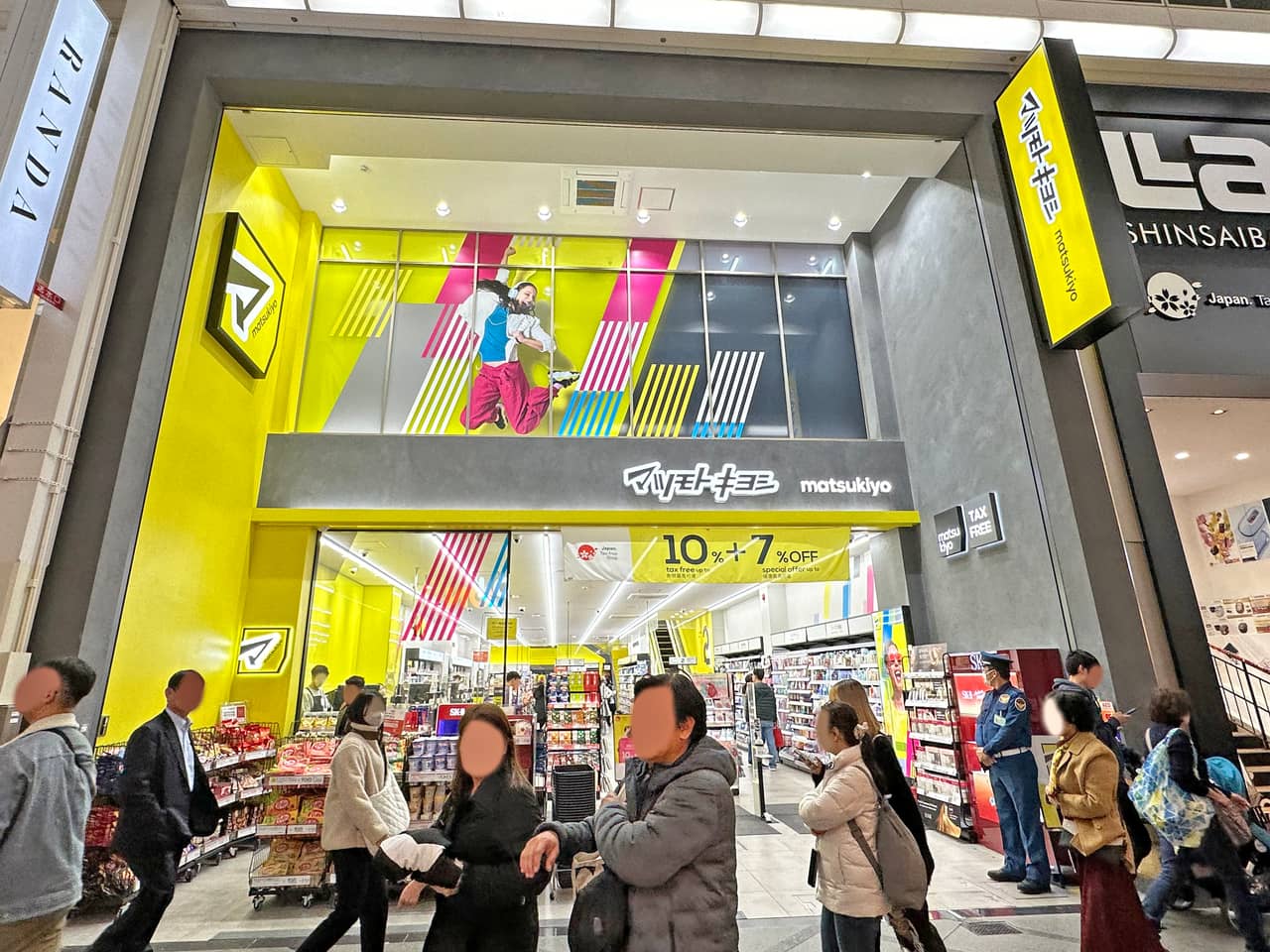
A drugstore sweep is something almost every visitor to Japan does, and Matsumoto Kiyoshi is the chain tourists know best — the one with the most branches in prime shopping areas. But start with the detail that decides how much you actually save: the visitor coupon is tiered — 3% over ¥10,000, 5% over ¥30,000, and only 7% over ¥50,000, with higher thresholds than Don Quijote. In other words, a typical drugstore basket only gets 3%, about 13% with tax-free — not the "up to 17%" the ads love to print. This guide covers how to claim the coupon, what you'll actually save, what to buy, what's excluded, and whether to pick Matsumoto Kiyoshi or another drugstore. For the all-store stacking logic, see our Japan discount coupons guide.
- Tiered coupon: 3% over ¥10,000 / 5% over ¥30,000 / 7% over ¥50,000 (plus 10% tax-free)
- Reality check: thresholds beat by Don Quijote — most baskets get 3%, ~13% total, not 17%
- How to claim: show the coupon at checkout (e.g. MATCHA's) — not a scan coupon; can't combine with other discounts
- Must-buys: open-shelf cosmetics, sheet masks, supplements — strong private labels (matsukiyo / argelan)
- Excluded: counter cosmetics, tobacco, magazines, diapers, baby food (still tax-free)
📖 Contents
What Matsumoto Kiyoshi is & the group
Matsumoto Kiyoshi is one of Japan's signature drugstore chains, instantly recognizable by its yellow-and-blue sign. It leans strong on beauty and skincare with a trend-led range, which makes it especially popular with younger shoppers and tourists, and its branches cluster around stations and prime shopping districts — very easy to find. As of March 2025 the group ran about 1,938 stores in Japan, of which roughly 1,200 offer tax-free, so in big-city hubs there's almost always one a few steps away.
It's also a large group: in 2021 Matsumoto Kiyoshi Holdings merged with Cocokara Fine to form "Matsukiyo Cocokara & Company," giving it deeper scale and private-label resources. What visitors feel most is the value of those private-label (PB) lines — matsukiyo cosmetics, the natural-leaning argelan — quality close to the big brands at friendlier prices, and a repeat-buy favorite for many. Beyond health and beauty, branches usually fold in snacks, drinks and sundries, so one stop covers most of your bag.
Practically, two things make it the default for visitors: location and hours. Because branches sit right by stations and on the main shopping streets, you rarely make a special trip — you pass one on the way back to your hotel. Most large stores stay open until 21:00–22:00, so a drugstore sweep is the easy thing to slot in after dinner, when the temples and museums have shut. The flagships run to two or three floors — typically cosmetics and skincare on the ground floor, supplements and daily goods above — and bigger tourist-area stores usually have English, Chinese or Korean signage plus tax-free staff who can help, so language is rarely a barrier.
How to claim the coupon & what you save
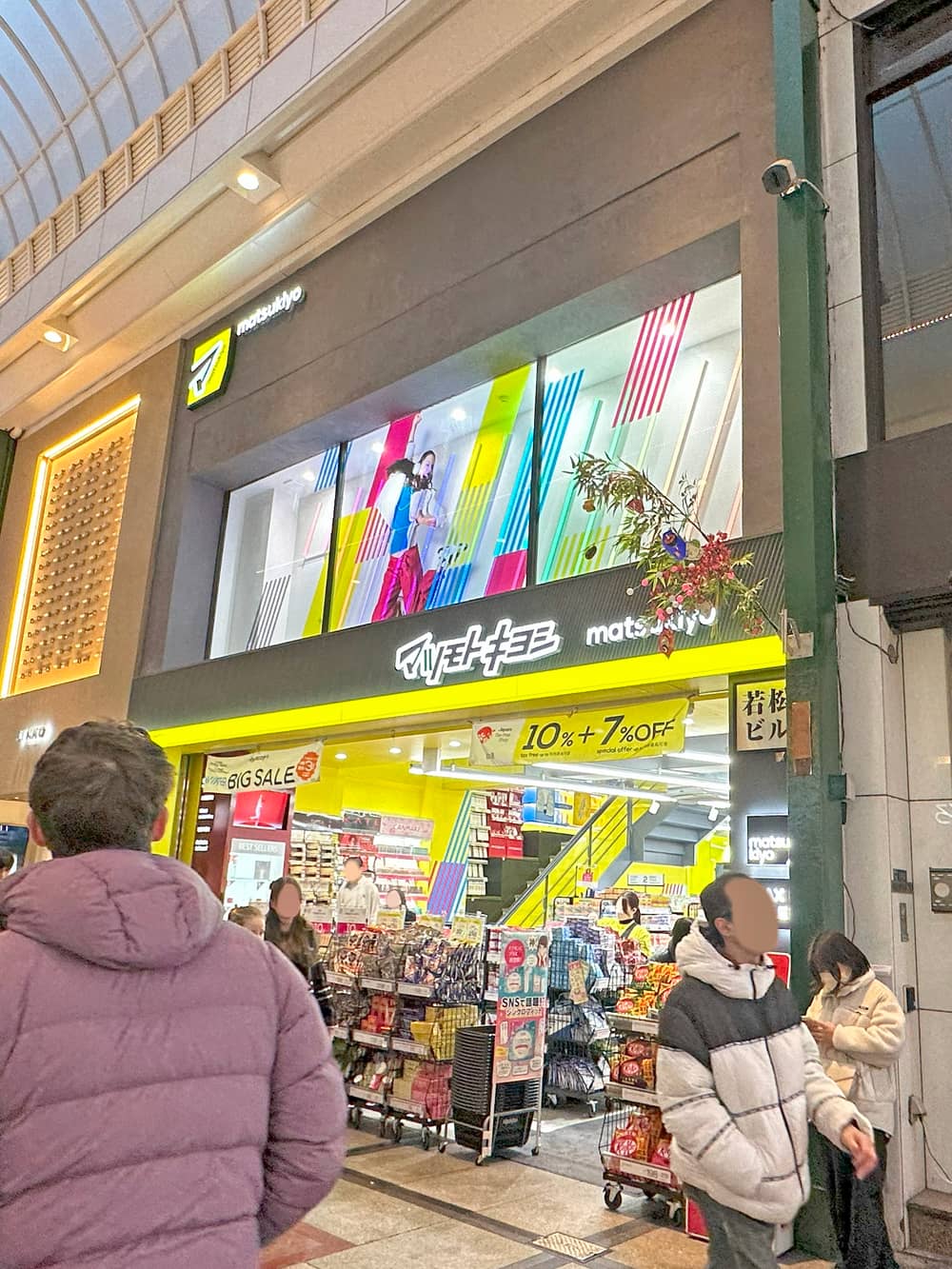
Saving at Matsumoto Kiyoshi works differently from Don Quijote's or Bic Camera's "scan coupon" — visitors get a coupon shown at checkout, and it's tiered:
- 3% over ¥10,000 (pre-tax)
- 5% over ¥30,000
- 7% over ¥50,000
All on top of 10% tax-free. The usual source is a travel-media page such as MATCHA's Matsumoto Kiyoshi coupon — show it to the cashier at checkout. The coupon can't be used with other discounts, and the validity rolls over (currently to March 31, 2027), so check before you go.
Here's the honest bit: that "up to 7%" has a high bar and means little for most shoppers. Compare: Don Quijote gives 5% from ¥10,000; Matsumoto Kiyoshi gives only 3% at ¥10,000, and 7% needs ¥50,000 in one purchase. Drugstore items are low-ticket and a basket usually lands at ¥10,000–20,000, so the vast majority of people actually get 3% — about 13% total with tax-free, not the "17%" in the ads. Don't buy things you won't use just to reach 7%; unless you're genuinely sweeping ¥50,000 of cosmetics, supplements and masks for the whole family, 3% is 3% — spend on what you actually want instead. That said, 3% still beats nothing: Muji, which plenty of visitors browse on the same trip, has no tourist coupon whatsoever. Its one 10% discount is the members-only Muji Week, and the official terms make it mutually exclusive with tax-free — that is the chain where stacking genuinely is not on the table.
There's also the in-house app (Matsukiyo Cocokara), with a "first-time 10% off" (food 5%) and daily roulette coupons — but it's not much use for short-term visitors: sign-up mostly expects a Japanese phone/account, and the app discount is often either-or with the checkout coupon. For a short trip, "checkout coupon + tax-free" is the reliable route. To pull up the coupon or the app in store, have a connection ready — set up a compare the five Japan eSIM options before you fly. For the tax-free system and the Nov 2026 reform, see our Japan tax-free guide.
How the tax-free counter works: large Matsumoto Kiyoshi stores have a dedicated tax-free counter — bring your passport, the receipt and the goods. For anything bought up to October 31, 2026, cosmetics and supplements count as "consumables," get sealed, and shouldn't be opened in Japan. From November 1 (judged on the purchase date) that category and the sealing rule are abolished: you pay tax-inclusive (registering your refund method at the till), then on departure day scan your passport at a self-service kiosk for the customs confirmation, after which the shop or its refund operator pays you — the airport itself hands over nothing, and you have 90 days from purchase to leave Japan. Two things then decide whether you actually get the money. Customs clears one receipt at a time — if one item on that receipt isn't with you, the entire receipt is refused — and the check sits in the departure hall before security, ahead of bag drop, because a checked bag cannot be pulled back. And cosmetics or supplements you open and use in Japan wipe out that whole receipt; if that happens, skip the terminal and declare it at the manned customs desk. Most stores have you pay at a normal register first, then visit the counter — follow the in-store "Tax-free" signs.
Must-buys & excluded items
Beauty and skincare are the strength here; these are the categories visitors sweep most (look up ingredients and rules first):
- Open-shelf cosmetics: base makeup, lip and eye products, and the matsukiyo private-label line — trendy and cheap, the chain's signature strength.
- Sheet masks & sunscreen: all kinds of sheet masks, toners, Japanese sunscreens — low-ticket, easy to gift, ideal for using the coupon on volume.
- Supplements: vitamins, kampo, enzymes, tablets — long shelf life, easy to carry, popular as souvenirs.
- Hair & oral care: shampoo and styling, toothbrush heads, toothpaste and other daily restocks.
- Natural-leaning sundries: argelan and other in-house natural lines for bath and fragrance — nice quality at friendly prices.
But several categories are excluded from the coupon (still tax-free), so go in knowing it: common exclusions are counter cosmetics that require consultation, tobacco, magazines, diapers and baby food, plus some prescription/designated medicines. So the coupon's sweet spot is open-shelf cosmetics, supplements and sundries; don't expect a coupon on counter makeup or baby items, and ask before paying. On medicines, designated categories (e.g. Class-2) have purchase rules — they may be limited or need a usage check, so don't over-sweep.
A word on price, since it surprises people: Japanese drugstores are not automatically cheaper than your home country on global brands, and for big-name imported cosmetics the gap can be small. Where the math genuinely works is Japan-domestic products — the private-label matsukiyo and argelan lines, J-beauty sheet masks and sunscreens, domestic supplements — which are cheaper here, hard to find abroad, and squarely in the coupon's sweet spot. So don't assume everything's a bargain: note a few home prices before you fly, then let the tax-free-plus-coupon stack tip a borderline buy. And remember the discount is on the pre-tax total at a single store on one day — splitting a big shop across two branches can drop you below the ¥10,000 tier and lose the coupon entirely.
Matsumoto Kiyoshi vs other drugstores
Japan's drugstores are a crowded field; for visitors the differences come down to "what each is strong at" and "how the discount works":
| Compare | Matsumoto Kiyoshi | Don Quijote | Sundrug / Tsuruha etc. |
|---|---|---|---|
| Strength | Beauty & skincare, private labels | Snacks & sundries, open late | Often cheaper on sundries/supplements |
| Discount type | Checkout coupon (3/5/7%) | Scan coupon (5% over ¥10k / 7% over ¥30k) | Mostly scan coupons |
| Discount at ¥10,000 | 3% | 5% | Varies by store |
| Branches | Many in prime areas, easy to find | ~600 nationwide, open late | Many, city and suburb |
The practical bottom line: sweep cosmetics and skincare at Matsumoto Kiyoshi (widest range, strong private labels, prime-area branches); snacks, sundries and general restocking at Don Quijote (one-stop, open late, the friendliest 5%-from-¥10,000 tier); for plain sundries and supplements, Sundrug / Tsuruha / Satudora scan coupons are often cheaper. Don't fixate on one chain — in prime areas three of them are often a short walk apart, so compare and go by what's on your way. For every drugstore's coupon side by side, see our Japan discount coupons guide and the coupons hub.
Best branches
The easiest stores for tourists:
- Osaka: the Shinsaibashi, Ebisubashi and Dotonbori area has the densest cluster — easy to sweep as you shop; Kansai is in our Osaka & Kyoto 5-day itinerary.
- Tokyo: big stores in Shinjuku, Shibuya, Ikebukuro and Ueno — the city is in our Tokyo 5-day itinerary.
- Elsewhere: Nagoya, Fukuoka, Sapporo and other major hubs all have them — just look for the yellow-and-blue sign. Most large stores run until 21:00–22:00, so an after-dinner sweep works.
A timing tip: do your drugstore sweep later in the trip so you're not carrying a bulging bag all week — and more so once the November 2026 system is in, since anything you open and use up in Japan voids the whole receipt it was bought on. Buying late keeps it simple. Leave a buffer before closing: the tax-free counter can queue up in the last ten minutes.
Things to watch out for
- Tax-free rules: ¥5,000 (pre-tax) threshold either way, bring your passport; from November 1, 2026 the refund comes after departure — decided by purchase date, not departure date (see our guide to the new refund system).
- Coupon: shown at checkout, can't be combined with other discounts, and the validity rolls over — check the page first.
- Real discount: most baskets only reach 3% — don't let "up to 7%" push you to force a ¥50,000 spend.
- Medicine rules: designated medicines may be limited or need a check; counter cosmetics, tobacco, diapers etc. are excluded from the coupon.
Get the "checkout coupon + tax-free" routine down and a beauty sweep saves a tidy sum. For snacks and sundries see our Don Quijote coupon guide, for electronics our Bic Camera coupon guide, and for every store's coupon, the Japan discount coupons guide and the coupons hub.
Frequently Asked Questions
- Q1:How do I get a Matsumoto Kiyoshi coupon, and how big is the discount?
- Matsumoto Kiyoshi gives visitors a coupon you show at checkout — not the LiveJapan-style scan coupon used by Don Quijote and Bic Camera. It's tiered: 3% over ¥10,000, 5% over ¥30,000, 7% over ¥50,000 (on the pre-tax amount), all on top of 10% tax-free. The usual source is a travel-media coupon page such as MATCHA's Matsumoto Kiyoshi coupon — show it to the cashier at checkout. Note it cannot be combined with other discounts, and the validity rolls over (currently to March 31, 2027), so check the page before you go.
- Q2:Why does the "up to 7%" matter little for most shoppers?
- Because the thresholds are much higher than Don Quijote's. Donki gives 5% from ¥10,000; Matsumoto Kiyoshi gives only 3% at ¥10,000, and you must spend ¥50,000 in one go to reach 7%. Drugstore items are low-ticket and a typical basket lands around ¥10,000–20,000, so most people actually get 3% — which with 10% tax-free is about 13% total, not the 17% the ads imply. To hit 7% you'd need to sweep ¥50,000 of cosmetics, supplements and masks in a single trip — don't buy things you won't use just to clear the bar.
- Q3:Can short-term visitors use the Matsumoto Kiyoshi app (Matsukiyo Cocokara) first-time 10% coupon?
- You can install it, but it's not much use for short-term visitors. The Matsukiyo Cocokara app's "first-time 10% off" (food 5%) and daily roulette coupons are built for members who shop in Japan regularly, and sign-up usually expects a Japanese phone number/account; the app discount is also often either-or with the checkout coupon. For a short trip, the reliable path stays "checkout coupon + tax-free." If you're staying longer and will buy again, then look into the app's roulette coupons.
- Q4:What should I buy, and which items are excluded from the coupon?
- Matsumoto Kiyoshi is especially strong on beauty and skincare, and its private-label lines (matsukiyo, argelan, etc.) are great value. Popular picks: (1) drugstore cosmetics, sheet masks, sunscreen; (2) supplements, vitamins, kampo; (3) hair and oral care; (4) snacks and sundries. But several categories are excluded from the coupon (still tax-free): common exclusions are counter cosmetics that require consultation, tobacco, magazines, diapers and baby food, plus some prescription/designated medicines. In short, the coupon's sweet spot is open-shelf cosmetics, supplements and sundries.
- Q5:Matsumoto Kiyoshi vs other drugstores (Sundrug, Tsuruha, Don Quijote) — which should I pick?
- It depends what you're buying: Matsumoto Kiyoshi has the widest beauty/skincare range, strong private labels and branches in prime areas — best for sweeping cosmetics; Sundrug / Tsuruha / Satudora use scan coupons and are often cheaper on sundries and supplements; Don Quijote is the one-stop for snacks and sundries, open late, with the friendliest 5%-from-¥10,000 tier. Practical rule: cosmetics and skincare at Matsumoto Kiyoshi, snacks and sundries at Don Quijote, and for general restocking go to whichever is on your way. Don't fixate on one chain — in prime areas three of them are often a short walk apart.
- Q6:Anything else to watch out for at Matsumoto Kiyoshi?
- A few things: (1) tax-free threshold is ¥5,000 (pre-tax), unchanged by the reform, and you need your passport; from November 1, 2026 the tax comes back after you leave, and which system applies goes by the purchase date, not your departure date (see our Japan tax-free guide) — the customs check happens in the departure hall before security and before you check bags in, and it clears one receipt at a time, so a single item missing voids that whole receipt; cosmetics and supplements used up in Japan kill that receipt too; (2) the coupon can't be combined with other discounts and the validity rolls over; (3) medicines have purchase rules — designated categories may be limited or need confirmation; (4) excluded items (counter cosmetics, tobacco, diapers, etc.) take no coupon — ask before paying.