If you want a single city where you can soak in one of Japan's oldest hot springs and climb one of its 12 surviving original castle keeps, Matsuyama is almost the only answer. The big news first: Dogo Onsen Honkan, after roughly five and a half years of preservation work, fully reopened on July 11, 2024, and from about ¥700 you can step into the wooden building often said to have inspired the bathhouse imagery in "Spirited Away." Matsuyama also has its hilltop castle (an original 1854 keep, reached by ropeway or chairlift), the replica Botchan train tied to novelist Natsume Soseki, and the lively Dogo shopping street. This guide covers the Honkan's reopening status, Asuka-no-Yu, the castle, the Botchan train, the shopping street, and access and lodging — including the rail route across the Seto Ohashi from Okayama. For the art islands on the other side of Shikoku, see our Takamatsu & Naoshima guide.
- Dogo Honkan fully reopened July 11, 2024: one of Japan's oldest hot springs and an Important Cultural Property; Kami-no-Yu bathing from ¥700
- Asuka-no-Yu is the newer annex (2017): more spacious, with resting rooms, bathing from ¥600 — easier with older travelers
- Matsuyama Castle is one of 12 original keeps: ropeway/chairlift up, keep plus round-trip ride about ¥1,040
- The Botchan train still runs: a Soseki literary link, a diesel replica of a Meiji steam locomotive
- Flying into Matsuyama Airport is fastest (90 min Tokyo, 50 min Osaka); by rail it is 2.5–3 hr from Okayama over the Seto Ohashi
📖 Contents
Why visit Matsuyama & Dogo
Honestly, Shikoku is the part of Japan a lot of independent travelers know is worth it but never quite fit in — and Matsuyama is the most logical first step. It has an airport, a small walkable center, and two genuinely rare cards in one place: one of Japan's oldest hot springs and a surviving original castle keep. That combination is hard to find on the mainland: Kyoto and Osaka have old temples but nothing quite like a century-old wooden public bathhouse; Himeji has an original keep but no bathing culture. Matsuyama ties hot springs, a castle, and literature (Natsume Soseki, Masaoka Shiki) into one small city, all connected by a single streetcar line.
The pace suits it, too. Dogo is an onsen town — strolling the shopping arcade in a yukata at dusk, hearing the Botchan clock chime on the hour, soaking and then having a drink — and that slowness is the point, a different kind of trip from sight-chasing Tokyo or Osaka. My advice is direct: if you have already done a few trips to Japan and want a quiet, story-rich city to settle into for a night or two, Matsuyama and Dogo are very much worth it; but if you have only one day and want to cram in sights, the density may leave you wanting more. Its value is in atmosphere, not in a long checklist.
Dogo Onsen Honkan (reopening status)
Get the current status straight first, so old articles do not mislead you into thinking it is still closed for a major rebuild: Dogo Onsen Honkan fully reopened on July 11, 2024. It underwent "preservation and restoration" work from January 2019 (the building stayed partly open throughout rather than closing completely), running about five and a half years, and this reopening brought the whole building — including the resting rooms — back into service. The Honkan is a wooden public bathhouse completed in 1894 (Meiji 27) and designated a National Important Cultural Property in 1994 (the first public bathhouse to be so designated). The tiered Shinrokaku tower with its white heron at the top is Matsuyama's most iconic image, and is often said to have inspired the bathhouse in the animated film.
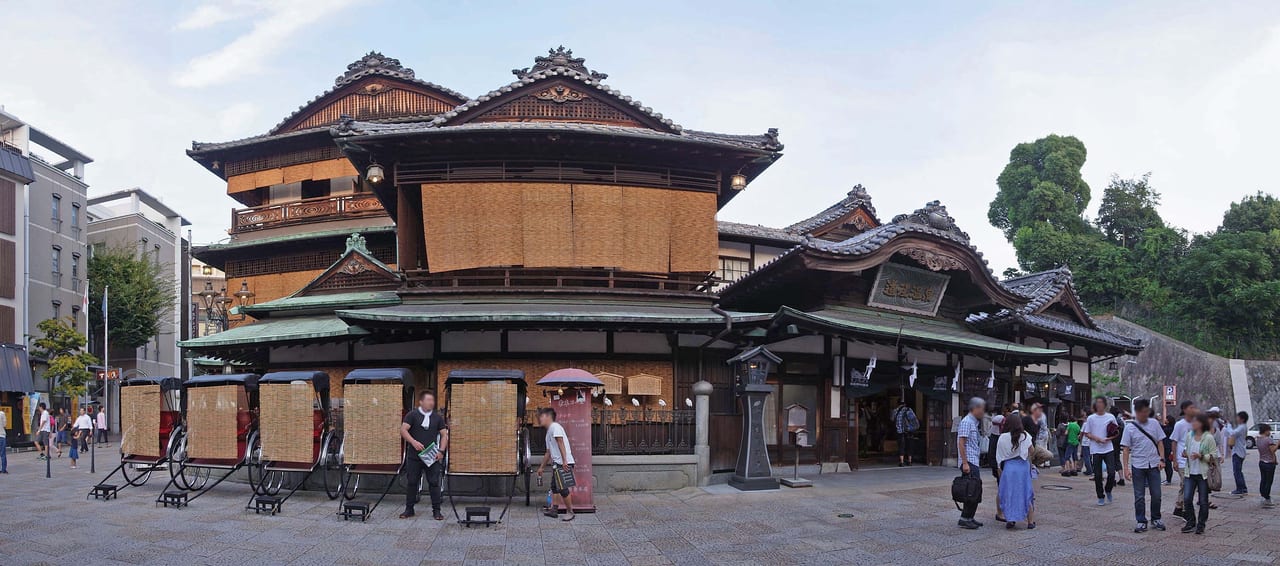
A few notes on tickets and how it works. The most basic option, the Kami-no-Yu ground floor, costs about ¥700 for adults and ¥350 for children (raised roughly 50% from the old price on reopening, which the operator attributes to inflation and preservation costs). Above that are course tickets that add a second-floor resting hall, a third-floor private room, tea and sweets, and a guided tour of the Yushinden (the bath formerly reserved for the imperial family), with prices stepping up accordingly. In practice, know that the Honkan is a working public bathhouse, not a museum: there are queues, the building is old, the facilities are simple, and the washing and locker areas are traditional — do not let the official photos set you up for a luxury spa. Per official information, hours are long (Kami-no-Yu ground floor runs from early morning to late at night), and the crowd peaks from evening into the night, so go early or near midday for a calmer soak.
One more thing: the Honkan is about atmosphere and history. If your priority is a comfortable, spacious soak, the Asuka-no-Yu in the next section is the better fit — many people end up photographing and experiencing the Honkan once for the history, then doing their main bathing at Asuka-no-Yu. There is no separate affiliate ticket product for the Honkan, and that is completely normal: you buy at the counter on arrival, no online reservation needed for ordinary bathing (some private-room and special-bath courses can be booked by phone or on the official site).
Asuka-no-Yu & the Dogo shopping street
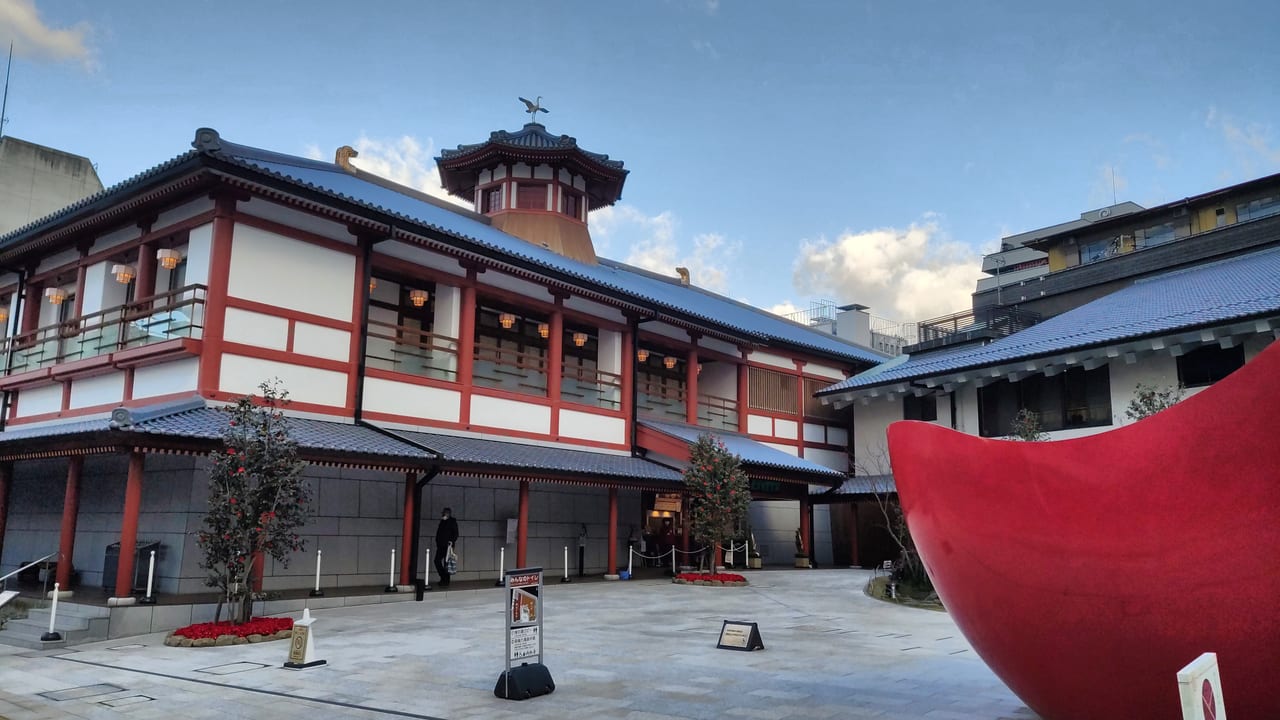
Asuka-no-Yu is the Dogo Onsen "annex," built new in 2017, a three-minute walk from the Honkan. Its theme is an Asuka-period garden combined with Ehime crafts, and the space is new, bright, and spacious — a completely different experience from the century-old main building. Per official information, the most basic bathing option starts at around ¥600, with stepped courses adding a second-floor hall, private rooms, tea and sweets, and Ehime-textile yukata; the second-floor special baths can be reserved in advance. My take on the trade-off: if it is your first visit and you want the classic Honkan exterior and a taste of the history, the Honkan is essential; but for a comfortable soak, for older travelers, or if you want a resting room to sit and have tea, Asuka-no-Yu is more rewarding. Doing both is entirely reasonable — they are a short walk apart.
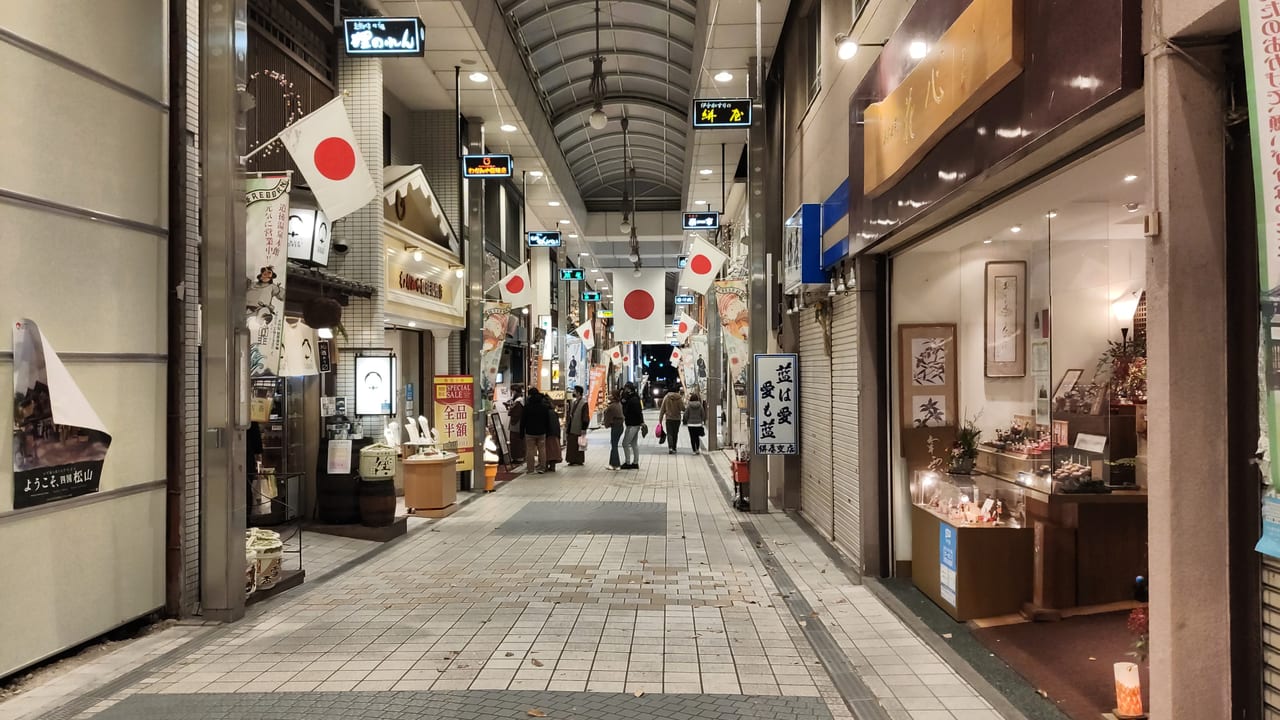
Beyond bathing, much of Dogo's charm is the Dogo shopping street (Dogo Haikara-dori) — the covered arcade running from Dogo Onsen Station to the Honkan, packed with souvenirs, Ehime citrus (mikan) products, taiyaki, soft-serve, and local snacks. A yukata stroll here at dusk is the essence of an onsen town. In front of the station, the Hojoen square holds the Botchan Karakuri Clock, built in 1994 for the Honkan's 100th anniversary; per official information it rises and plays music with characters from "Botchan" on the hour (every 30 minutes on busy weekends, in March–April, August, November, Golden Week, and year-end), and there is a free foot bath fed by hot-spring water right beside it for a rest. The area is small, so an evening stroll covers it nicely.
Matsuyama Castle: an original keep
Matsuyama Castle is the trip's other ace. It sits atop Mt. Katsuyama in the city center, and the key point is this: it is one of Japan's 12 surviving "original keeps" — meaning the keep has stood since the Edo era rather than being a postwar concrete reconstruction (the current keep was rebuilt in 1854). Construction began in 1602 under lord Kato Yoshiaki, and from its commanding hilltop the keep looks out over the city and the distant Seto Inland Sea, a genuinely wide view. For anyone who likes Japanese castles, an original keep carries far more weight than the concrete reconstructions you find everywhere, and that is exactly why Matsuyama Castle is worth a dedicated climb. Matsuyama also sells a gojoin castle stamp, but the official announcement page was unreachable at the time of our check — the sales point and price are not confirmed, so ask at the reception desk on the day. See where to buy gojoin castle stamps for how the other 11 original keeps handle theirs.
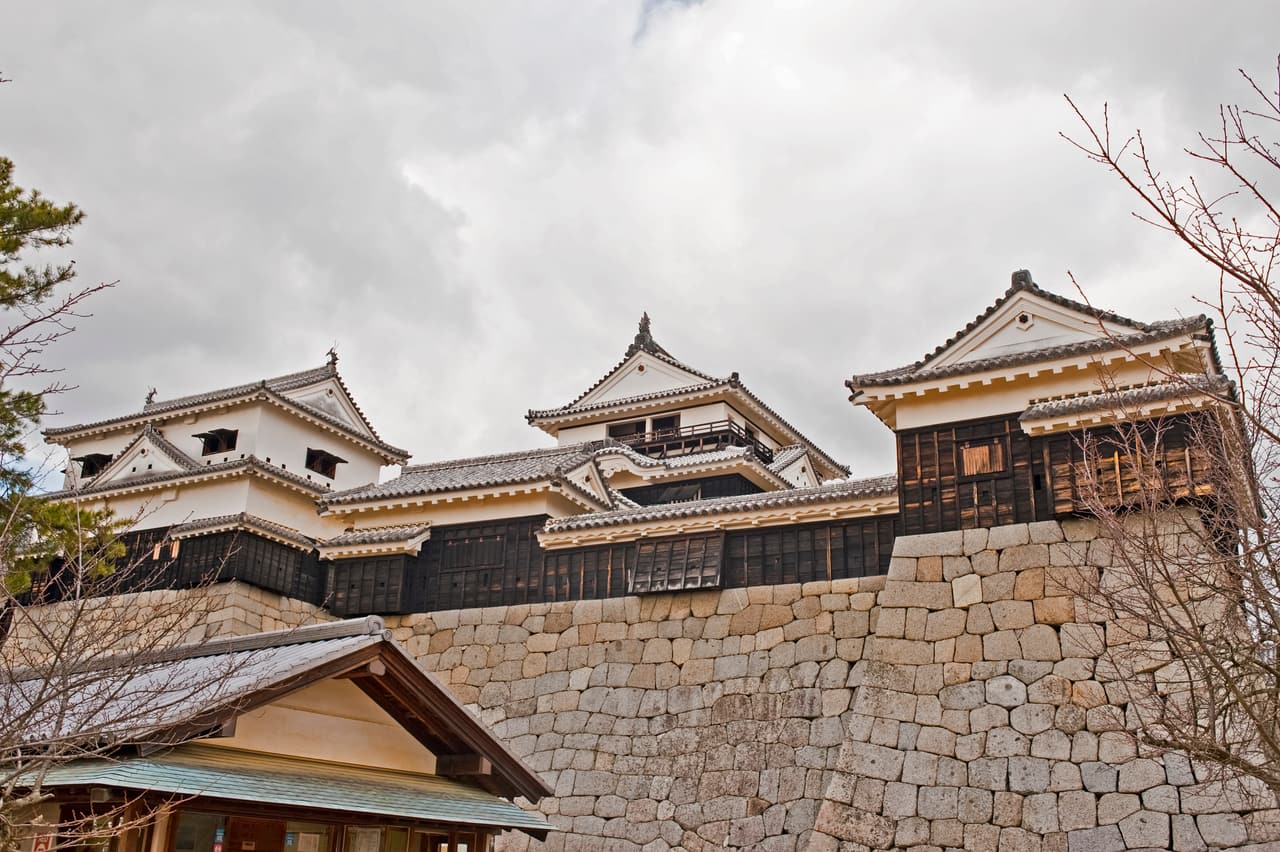
There are three ways up: the ropeway, the open-air chairlift, or the walking trail. The ropeway and chairlift share one line and the same fare, with the base station a 5-minute walk from the Iyotetsu "Okaido" tram stop; the ropeway takes about 3 minutes, the chairlift about 6. Per official information, keep admission is about ¥520 for adults and ¥160 for elementary schoolers, and the round-trip ropeway/chairlift is about ¥520 — so the keep plus a round-trip ride is roughly ¥1,040 per adult. My recommendation: take the ropeway if it is hot, you are with older travelers, or the weather is unstable (it is covered and quick); if you do not mind heights, the open chairlift is more fun and gives you the view on the way up. The castle grounds and the Honmaru complex (a cluster of turrets and gates) are good to wander, so budget 1.5 to 2 hours up top.
The Botchan train & Soseki
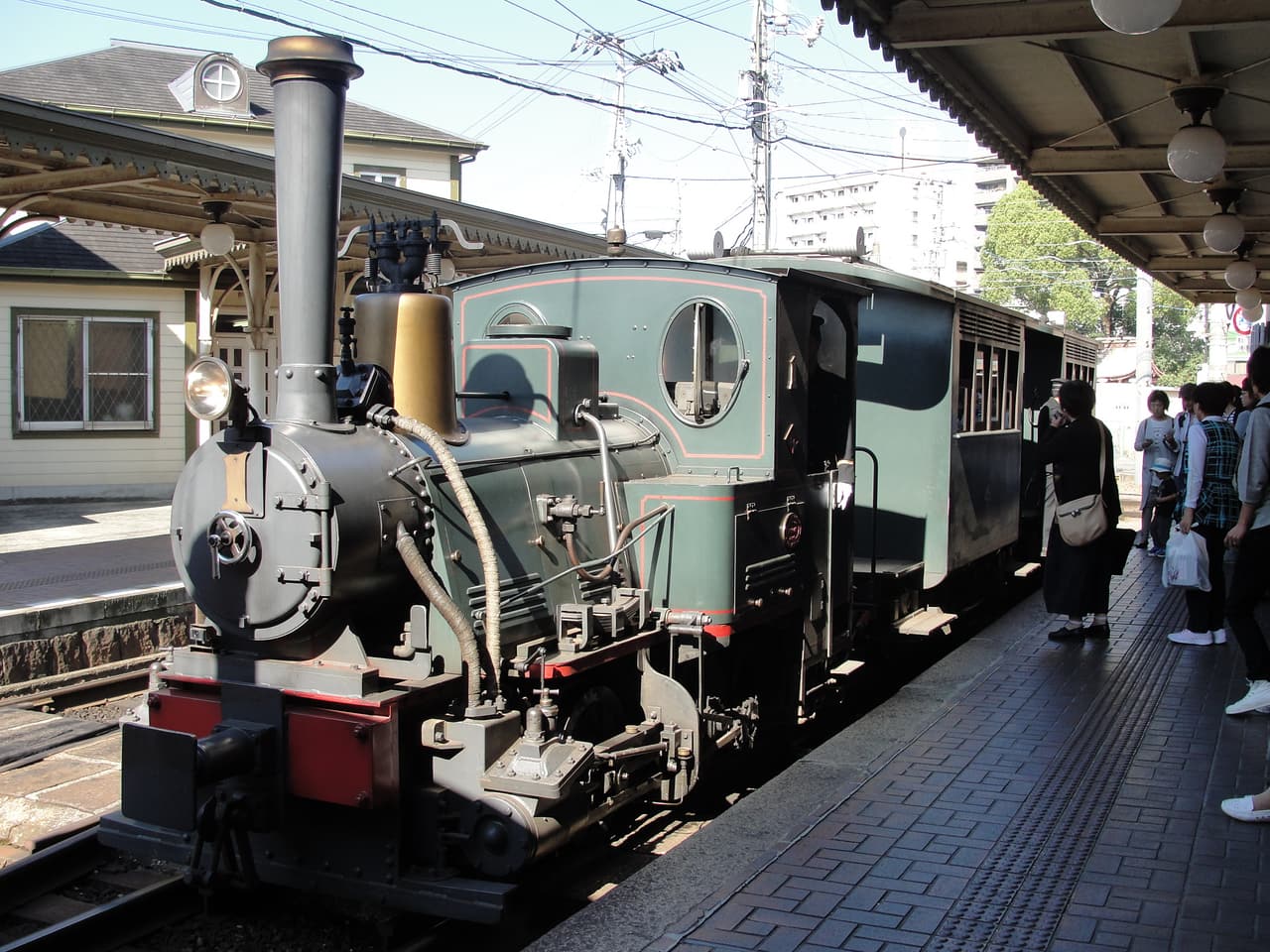
Matsuyama's literary signature is Natsume Soseki. Soseki taught at a Matsuyama school in 1895, and that experience became the backdrop for his 1906 novel "Botchan," in which a little clattering train became a city symbol. Today's Botchan train is Iyotetsu's replica of that Meiji-era steam locomotive — the running cars are actually diesel-powered, but fitted with an odorless smoke machine to recreate the original puffs, with the bodywork faithfully styled to the classic look.
Per official information, the Botchan train currently runs city routes such as Matsuyama-shi Station to Dogo Onsen Station with a separate fare (different from the flat streetcar fare); service is limited and adjusts with the season and vehicle maintenance, so the safest move is to check the timetable on the day or on the Iyotetsu site rather than trusting an old blog schedule. It is a "moving sight": ride a vintage car, then watch the staff turn it around by hand in front of Dogo Onsen Station, one of the more memorable scenes in the city. Beyond the train, the center has the Shiki Memorial Museum (devoted to haiku master Masaoka Shiki, a friend of Soseki) and literary traces around Dogo, so fans can add half a day.
Transport & lodging
Getting in is fastest by flying into Matsuyama Airport: about 90 minutes from Tokyo (Haneda) and 50–60 minutes from Osaka (Itami or Kansai), with an airport bus to JR Matsuyama Station in about 15 minutes. By rail you transfer via the mainland: Tokyo to Okayama by Shinkansen (about 3.5 hours), then the JR Shiokaze limited express along the Yosan Line across the Seto Ohashi into Shikoku, reaching Matsuyama in about 2.5–3 hours — roughly 6.5 hours and ¥22,000 in total; Osaka to Matsuyama by rail (via Okayama) is about 3 hours 50 minutes. The decision is simple: for a Matsuyama-only trip, just fly; if you are already doing Okayama, Kurashiki, Takamatsu, or Naoshima, slotting Matsuyama onto one end by rail works best — for entering Shikoku from Okayama, see our Okayama & Kurashiki guide. Whether a rail pass pays off depends on your actual route; run the break-even math in our JR Pass guide first.
Around town, the main mode is the Iyotetsu streetcar: JR Matsuyama Station, Matsuyama-shi Station, Okaido, and Dogo Onsen Station are all on the network, and the route most visitors use is "JR/Matsuyama-shi Station to Okaido (the Matsuyama Castle base) to Dogo Onsen." A flat fare per ride, IC cards tap straight on, and for just 2–3 hops a day a single fare each time is fine. The Botchan train is a separately priced special service (see the previous section).
For lodging, there are two approaches. For onsen-town atmosphere, stay around Dogo Onsen — strolling in a yukata at dusk, soaking whenever you like, with plenty of ryokan across a wide price range (from business-style to high-end), the trade-off being the distance from JR Matsuyama Station. If Matsuyama is just a stopover and you have trains to catch, hotels around JR Matsuyama Station or the Okaido shopping area are more convenient and easier for food. Per official information, Dogo and Matsuyama have a decent supply of lodging at gentler prices than Kyoto or Osaka, but the onsen ryokan tighten up on weekends and in peak seasons (autumn, Golden Week), so book ahead. To experience the quiet Dogo after the day visitors leave, stay overnight at a Dogo Onsen ryokan.
A two-day Matsuyama + Dogo plan
Here is the same content shaped into a route that walks well:
- Day 1 (castle + city): arrive at Matsuyama Airport or by JR and drop bags → streetcar to "Okaido" → ropeway or chairlift up Matsuyama Castle, explore the keep and grounds (1.5–2 hours) → lunch and shopping in the Okaido area → afternoon at the Shiki Memorial Museum or literary spots in the center → evening streetcar to Dogo, check into an onsen ryokan.
- Day 2 (Dogo all day): bathe at Dogo Onsen Honkan early while it is quiet (the history and the exterior) → brunch and Ehime citrus souvenirs along the Dogo shopping street → catch the Botchan Karakuri Clock on the hour and the free Hojoen foot bath → an afternoon soak at Asuka-no-Yu (the comfortable one this time) → ride the Botchan train as a finale → evening back to JR Matsuyama Station or the airport for the next leg.
If you only have one day, make Day 2's Dogo (Honkan plus the shopping street) the core and fit the castle in as time allows — but it is rushed, and you miss Asuka-no-Yu, which is exactly why I keep saying one night is worth it. East across Shikoku you can connect to Takamatsu and the Naoshima art islands (see our Takamatsu & Naoshima guide), or arrive from Okayama and Kurashiki. Still in Kagawa, you can add the 785-step climb to Konpira-san and Sanuki udon; deeper into Shikoku, the south holds Kochi Castle, Katsurahama, and the Shimanto River, while the east has the Naruto whirlpools and the Iya Valley vine bridges. Pre-trip weather and packing are in our Japan packing & weather guide.
FAQ
- Q1:Is Dogo Onsen Honkan still under renovation in 2026? Can I bathe there now?
- Yes, you can bathe, and now is a good time. After roughly five and a half years of preservation work (started January 2019, with the building staying partly open throughout), Dogo Onsen Honkan fully reopened on July 11, 2024. It is a designated National Important Cultural Property and one of the oldest hot springs in Japan. The most basic option, the Kami-no-Yu ground floor, costs about ¥700 for adults and ¥350 for children (raised roughly 50% on reopening to cover inflation and preservation costs), and there are stepped course tickets that add a resting room, tea and sweets, or a tour of the imperial Yushinden. Note this is a working public bathhouse, so expect queues and a traditional, no-frills setup.
- Q2:What is the difference between the Honkan and Asuka-no-Yu? Which should I bathe in?
- Both are public bathhouses in Dogo, but with different personalities. The Honkan is a century-old wooden Important Cultural Property; its value is in the architecture and historic atmosphere, with the trade-off of an aged, crowded, simple interior. Asuka-no-Yu (the annex, built in 2017) is themed around an Asuka-period garden and Ehime crafts, with a newer, more spacious feel, comfortable second-floor halls and private rooms, and bathing from around ¥600. Per visitor reports: choose the Honkan if it is your first time and you want the classic exterior and the history; choose Asuka-no-Yu for a more comfortable soak or if you are with older travelers. Doing both is easy, since they are a three-minute walk apart.
- Q3:How do you get up to Matsuyama Castle? Ropeway or chairlift, and how much is admission?
- The keep sits atop Mt. Katsuyama, and the usual way up is the ropeway or the open chairlift (same line, same fare): about 3 minutes by ropeway, about 6 minutes by chairlift, with the base station a 5-minute walk from the Iyotetsu "Okaido" tram stop. Per official information, keep admission is about ¥520 for adults and ¥160 for elementary schoolers, and the round-trip ropeway/chairlift is about ¥520 — roughly ¥1,040 total per adult. Take the ropeway if it is hot or you are with older travelers; take the chairlift for the open-air views. Matsuyama Castle is one of Japan’s 12 surviving original keeps (the current keep was rebuilt in 1854), not a concrete replica, which is exactly why it is worth the trip up.
- Q4:Is the Botchan train still running? How do I ride it?
- Yes, it runs. The Botchan train is Iyotetsu’s replica of a Meiji-era steam locomotive, now diesel-powered but fitted with an odorless smoke machine to recreate the original puffs. The name comes from Natsume Soseki’s 1906 novel "Botchan" — Soseki taught at a Matsuyama school, and that literary link is one of the city’s signatures. Per official information, it currently runs city routes such as Matsuyama-shi Station to Dogo Onsen Station with a separate fare (different from the flat streetcar fare); service is limited and shifts with the season and maintenance, so check the timetable on the day or on the Iyotetsu site. The train is a sight in itself: ride a vintage car, then watch it turned around by hand in front of Dogo Onsen Station.
- Q5:How do I get to Matsuyama from Tokyo, Osaka, or Okayama?
- The fastest option is to fly into Matsuyama Airport: about 90 minutes from Tokyo (Haneda) and about 50–60 minutes from Osaka (Itami or Kansai), with an airport bus to JR Matsuyama Station in about 15 minutes. By rail you come via the mainland: Tokyo to Okayama by Shinkansen (about 3.5 hours), then the JR Shiokaze limited express across the Seto Ohashi into Shikoku, reaching Matsuyama in about 2.5–3 hours — roughly 6.5 hours and ¥22,000 end to end. Osaka to Matsuyama by rail (via Okayama) is about 3 hours 50 minutes. If you are already doing Okayama, Kurashiki, Takamatsu, or Naoshima, slotting Matsuyama onto one end of a Shikoku trip by rail works best; for a Matsuyama-only trip, just fly.
- Q6:How many days do you need, and how do you get around the city?
- Per visitor reports, Matsuyama plus Dogo works best over 1.5 to 2 days: half a day for Matsuyama Castle and the Okaido shopping area, and half a day to a full day for Dogo (bathing, the shopping street, the Botchan clock, the shrines). The backbone of city transport is the Iyotetsu streetcar; JR Matsuyama Station, Matsuyama-shi Station, Okaido, and Dogo Onsen Station are all on the network, and the route most visitors use is "JR/Matsuyama-shi Station to Okaido to Dogo Onsen." A flat fare per ride, IC cards accepted. To connect Takamatsu, Naoshima, or Okayama, check whether a rail pass pays off with the math in our JR Pass guide.
Related reading:
Takamatsu & Naoshima Guide 2026: Ritsurin & Art Island
55 minutes from Okayama over the Seto Ohashi to Takamatsu, then a ferry to Naoshima for Ando's Chichu Art Museum and Kusama's pumpkins — Ritsurin, Sanuki udon, ferries and a two-day plan.
Okayama & Kurashiki Guide 2026: Korakuen, Bikan & Denim
Korakuen (one of Japan's three great gardens), the white-walled Kurashiki Bikan quarter and Kojima denim — the best stop on the Sanyo Line.
JR Pass 2026: Is It Still Worth It?
Four real routes calculated, six alternatives that may beat the Pass.