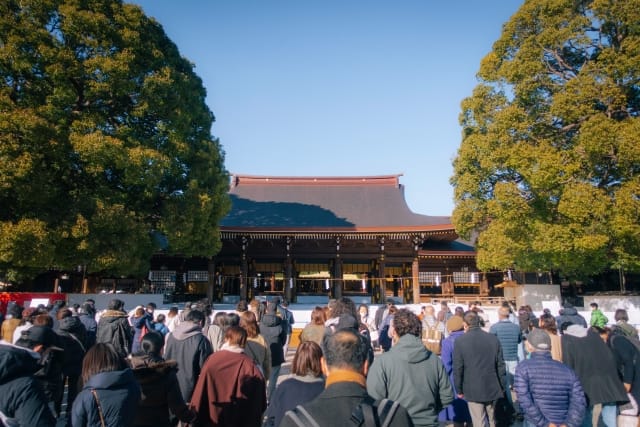
Meiji Shrine is free, its 700,000-square-metre forest was planted a century ago from roughly 100,000 donated trees, and whichever of the three gates you enter, the main hall is about a ten-minute walk away — all three figures straight from the shrine's own pages. The one thing to settle before you go is the schedule: the gates track the sunrise and sunset, so opening hours change every single month — 5:00 in midsummer, 6:40 in midwinter, with December closing as early as 16:00. This guide covers the full official 12-month hours table, the honest state of goshuin information (the shrine publishes no price — details below), whether the ¥500 Inner Garden and the ¥1,000 museum earn their fees, why Meiji Jingu and Meiji Jingu Gaien are two different places, and the festival calendar topped by the November 3 Reisai.
- Free admission; official visit estimate 1–2 hours; every entrance is about 10 minutes' walk from the main hall
- Hours change monthly with the sun: gates open 5:00 in summer, close 16:00 in December — full official table below; never make it a winter last stop
- Goshuin at the Nagadono, 9:00 until closing; the shrine publishes no offering amount — the posted price at the counter is the only real one
- Inner Garden ¥500: Kiyomasa's Well plus about 150 varieties / 1,500 iris plants (June); museum ¥1,000, closed Thursdays
- Inner vs Outer Precinct: the ginkgo avenue is at Gaien, a separate place; the November 3 Reisai is the highest-ranked rite of the year
📖 Contents
- The basics: free, ten minutes, one to two hours
- Opening hours: the official 12-month table
- Getting in: three gates, three stations
- Goshuin: what the shrine publishes and what it does not
- The Inner Garden: Kiyomasa's Well and the irises
- The museum and the 2026 Gaien centenary
- Free grounds vs garden vs museum
- Meiji Jingu vs Meiji Jingu Gaien: two different places
- The Eternal Forest: the no-cedar experiment
- Festival calendar: Reisai and New Year
- Eating nearby: forest café, crepes, Harakado
- Is Meiji Shrine worth it? Three ways to plan it
- FAQ
The basics: free, ten minutes, one to two hours
Start with the skeleton, all of it official. Admission to the grounds is free — the shrine's English Q&A says so outright, which already separates Meiji Shrine from nearly every other headline sight in Tokyo. The shrine sits at 1-1 Kamizono-cho, Yoyogi, Shibuya; it was consecrated on November 1, 1920, enshrining Emperor Meiji (the 122nd emperor) and Empress Shoken; the grounds cover roughly 700,000 square metres; and the shrine's own estimate for a visit is one to two hours.
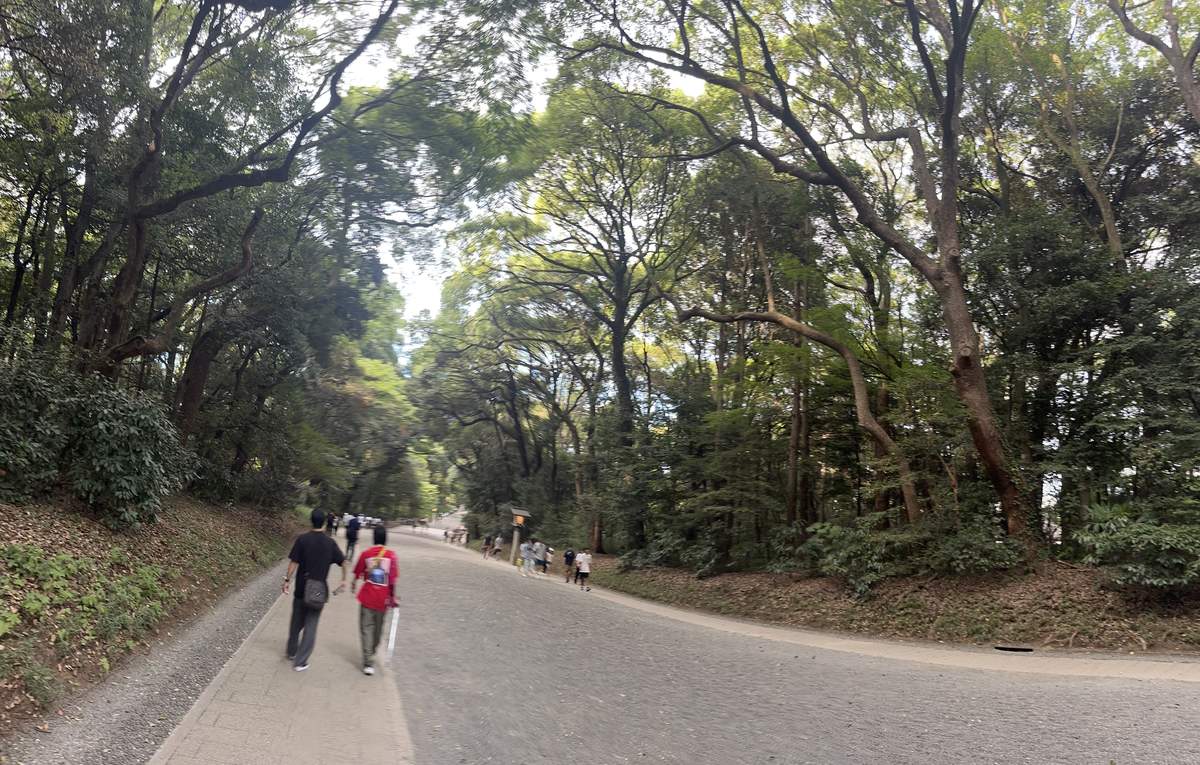
One more line worth quoting because it settles most routing questions: per the official access page, the walk from any entrance to the main hall takes about ten minutes. That walk goes through a canopy of tall evergreens and is the best part of the visit — treat it as the experience, not the overhead.
Only two things on site charge money, and both are optional: the Inner Garden (Gyoen, maintenance contribution ¥500) and the Meiji Jingu Museum (¥1,000). Neither is a must — the comparison section below sorts out who should pay for what.
Opening hours: the official 12-month table
Meiji Shrine has no fixed hours. The gates open with the sunrise and close with the sunset, on a schedule the shrine publishes month by month. This is the single most useful table in this guide (verified against the official sanpai page on 2026-08-01 — re-check the current month before you travel):
| Month | Open | Close | Month | Open | Close |
|---|---|---|---|---|---|
| January | 6:40 | 16:20 | July | 5:00 | 18:20 |
| February | 6:20 | 16:50 | August | 5:00 | 18:00 |
| March | 5:40 | 17:20 | September | 5:20 | 17:20 |
| April | 5:10 | 17:50 | October | 5:40 | 16:40 |
| May | 5:00 | 18:10 | November | 6:10 | 16:10 |
| June | 5:00 | 18:30 | December | 6:40 | 16:00 |
Two conclusions to build a day around. First, never make Meiji Shrine the last stop of a winter afternoon: 16:10 closing in November, 16:00 in December — more than an hour earlier than the "get there by five" instinct assumes, and the most common way people miss it entirely. Second, the crowd hack here is not a secret entrance, it is the clock: walk in right at opening. That is a recommendation reasoned from the table, not an official crowd statistic — but no tour group operates at 5:00, and the shrine opens earlier than any hotel breakfast in Tokyo. At first light you get an almost empty approach and birdsong at the main hall, which is unobtainable at any price after 10:00. The one catch: goshuin reception starts at 9:00 (next section), so early birds loop back.
Getting in: three gates, three stations
Three approach gates, each glued to a different station, which is why the shrine slots into almost any Tokyo route:
| Gate | Stations | Best for |
|---|---|---|
| South (Minami-sando) | JR Harajuku / Tokyo Metro Meiji-jingumae 'Harajuku' | Most visitors — chains straight into Harajuku and Omotesando; the forest café sits this side |
| North (Kita-sando) | JR Yoyogi / Tokyo Metro Kita-sando | Coming from Shinjuku; noticeably quieter than the south gate |
| West (Nishi-sando) | Odakyu line Sangubashi | Odakyu-line stays; the calmest of the three |
The shrine's own maps carry the station-to-gate detail as image files, so this guide will not invent walking minutes; the load-bearing number is the official one — any gate to the main hall, about ten minutes. One restriction applies to drivers only: cars cannot enter via the Harajuku or Sangubashi gates and must use the Yoyogi gate, and the shrine flatly recommends public transport. On foot, all three gates are open to you. If this is your first shrine in Japan, the bow at the torii, the water basin sequence and the two-bows-two-claps-one-bow rhythm are covered in our shrine etiquette walkthrough — Meiji Shrine's long approach is the ideal place to run the full routine once, properly.
Goshuin: what the shrine publishes and what it does not
Three facts for collectors. Where: the Nagadono, the reception building in front of the Kagura-den — with an official caveat that the location can shift on certain days, so follow the on-site signs. When: 9:00 until the gates close. How much: the shrine does not say.
That last point deserves the emphasis: Meiji Shrine's official site publishes no offering amount for the goshuin and no price for the goshuin book, anywhere. Any yen figure you have read for it therefore has no official backing — possibly stale, never authoritative. Our position matches our goshuin collecting guide: where a shrine declines to publish, the price posted at the counter on the day is the only real one. Bring small change and let the notice board settle it. What the official pages do confirm: a standard goshuin book exists for sale (price likewise unpublished), and there is a live tradition of seasonal limited seals — official news announced an iris-season seal from May 30 in 2026, timed to the Inner Garden's flowers.
And one thing you can only get here: the Omikokoro. It replaces the standard fortune slip — no luck ranking at all. You draw one of thirty poems chosen from Emperor Meiji's 93,032 waka and Empress Shoken's 27,825, with commentary, English edition available. As a keepsake pressed between goshuin pages, a poem beats a "moderate luck" verdict every time.
The Inner Garden: Kiyomasa's Well and the irises
The Gyoen is the one paid corner of the grounds: a maintenance contribution of ¥500, no adult/child distinction. Hours: 9:00–16:30 March–October, 9:00–16:00 November–February, open every day of the year — with a June exception that tells you exactly when the garden matters: weekdays 8:00–17:00, weekends 8:00–18:00, extended for iris season.
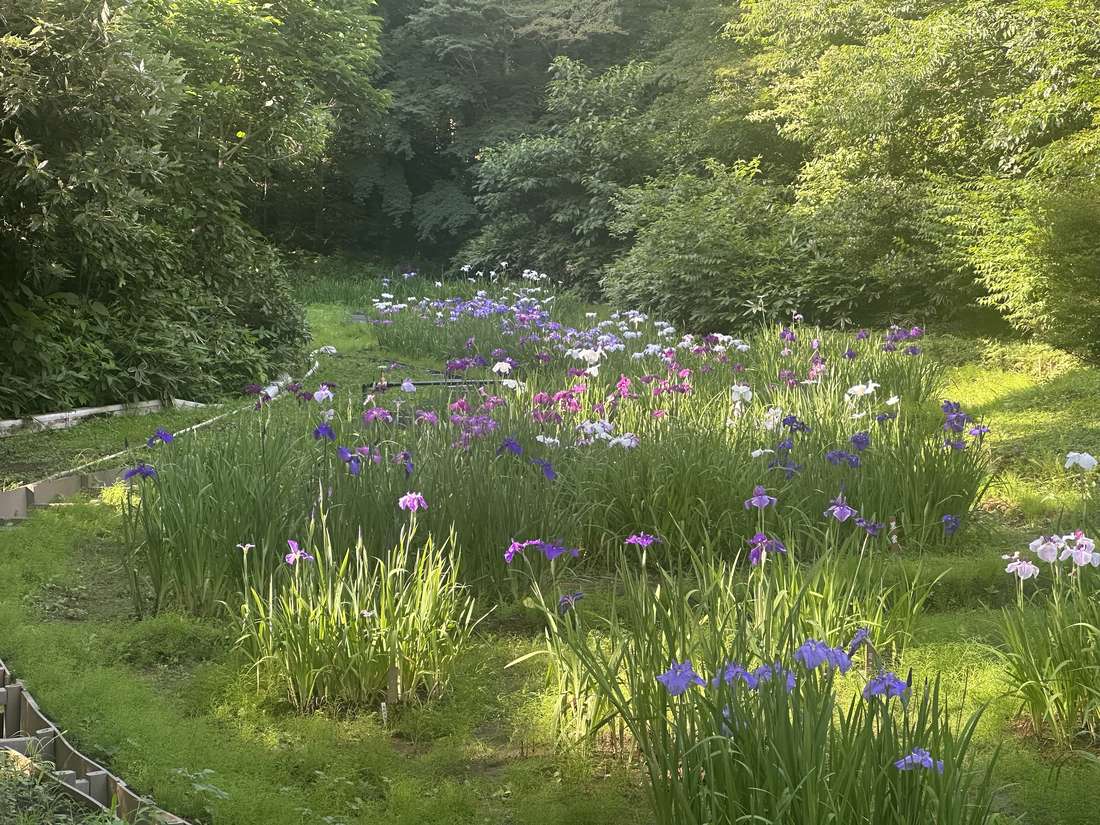
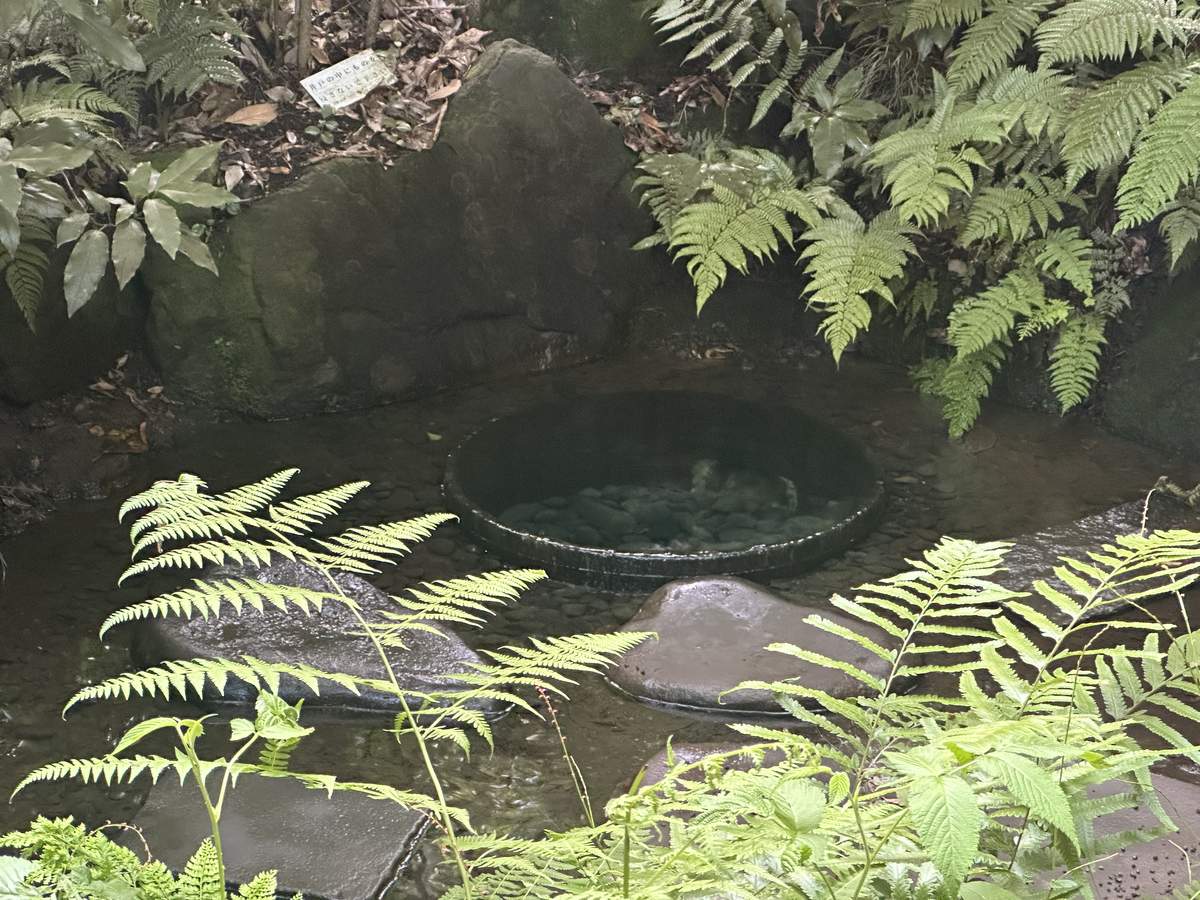
Two headliners inside. Kiyomasa's Well is a natural spring attributed by tradition to the warlord Kato Kiyomasa — the shrine itself writes "said to be", and this guide keeps that hedge rather than upgrading legend to fact. The measured facts are official and striking on their own: an average flow of 60 litres per minute, at about 15°C in every season — a constant-temperature spring in the middle of the Yamanote loop. The iris field is the other: about 150 varieties, 1,500 plants by official count, with "June, typically" as the honest peak framing — the shrine publishes no fixed bloom dates, so check its news page for the current state before a special trip.
So — is the ¥500 worth it? By month. In June: yes, without qualification. Early opening, irises at strength and a limited iris goshuin stack into the single best 500-yen ticket in this part of Tokyo. Any other month: pay if a quiet stroll garden is your idea of value; skip it if you are box-ticking, because outside iris season what you are buying is stillness, and stillness wasted on a rushed visitor is 500 yen spent on a corridor.
The museum and the 2026 Gaien centenary
The Meiji Jingu Museum sits along the southern approach: ¥1,000 general, ¥900 for high-school students and under, free below elementary age, ¥900 for groups of 20+, free with a disability certificate. Open 10:00–16:30 (last entry 30 minutes before closing), closed Thursdays (open when the Thursday is a holiday) and during exhibition changeovers — if your only window is a Thursday, cross it off now rather than at the door.
The building is by Kengo Kuma (stated on the official page), a low timber structure that dissolves into the forest edge — worth a slow walk-past even without a ticket. The 2026 angle: the Outer Precinct (Gaien) was established in October 1926 and turns one hundred in October 2026, and the shrine has announced a centenary special exhibition at the museum on the giant murals of the Meiji Memorial Picture Gallery. Dates and admission were not yet published at verification (2026-08-01); autumn visitors should check the official news page — catching it would be the best reason in years to buy this ticket.
Free grounds vs garden vs museum
Three tiers, ¥0 to ¥1,500 total. The decision table:
| Free grounds | Inner Garden | Museum | |
|---|---|---|---|
| Cost | Free | ¥500 | ¥1,000 (¥900 under 18) |
| Hours | Sunrise–sunset (monthly table) | 9:00–16:30/16:00; June from 8:00 | 10:00–16:30, closed Thu |
| What you get | Forest approach, main hall, great torii, goshuin | Kiyomasa's Well, iris field, stroll garden | Imperial artefacts, Kengo Kuma building |
| Who it's for | Everyone — this is the shrine | Anyone in June; garden people otherwise | History and architecture fans; rain plan |
| Verdict | Go at opening time | The one add-on worth defaulting to | Wait for the centenary exhibition |
Compressed: the free grounds are the destination, the garden is the best upgrade, the museum is a special-interest pick. One hour gets you the core; two hours adds the garden; the museum earns its slot on a rainy day or once the centenary show opens.
Meiji Jingu vs Meiji Jingu Gaien: two different places
This section exists because the mistake recurs every November. Meiji Jingu (the Inner Precinct) and Meiji Jingu Gaien (the Outer Precinct) are two separate places, a substantial distance apart. Everything in this guide — forest, main hall, goshuin, well — is the Inner Precinct by Harajuku and Yoyogi. The golden ginkgo avenue that owns Japanese social media from mid-November to early December is at Gaien, over by Aoyama and Shinanomachi: a modern district of stadiums and boulevards with none of the forest hush. Walk through the Harajuku torii hunting ginkgo and you will be scanning an evergreen forest for yellow trees that were never there.
Plan them as two stops or pick one. For the avenue — peak timing, camera angles, routing — see our dedicated Tokyo ginkgo guide. And if your November target is actually the Inner Precinct — the Reisai on November 3, Shichi-Go-San families in kimono — the Gaien crowds are irrelevant to you; the forest stays calm.
The Eternal Forest: the no-cedar experiment
Knowing what you are walking through changes the walk, and this may be the most successful piece of designed nature on the planet. After Emperor Meiji died in 1912 and Empress Shoken in 1914, a national movement petitioned for a shrine; it was consecrated in 1920. The forest around it is not old growth — it was planted from roughly 100,000 trees donated from across Japan, put in the ground by a cumulative 110,000 youth-corps volunteers.
The stroke of genius was a refusal. The obvious choice for a shrine approach was cedar — and the foresters deliberately rejected it, judging that sugi would not tolerate urban smoke, and chose smoke-resistant evergreen broadleaf species instead, engineering the species mix so the plantation would mature into a self-sustaining natural forest within a century. That is the "Eternal Forest" concept, and the official numbers say the bet landed: 365 species at planting, 234 today, about 36,000 trees standing — a plantation that has effectively become wild. If the approach feels like deep mountain forest rather than a city park, that is not your imagination; it is the design, one century on schedule.
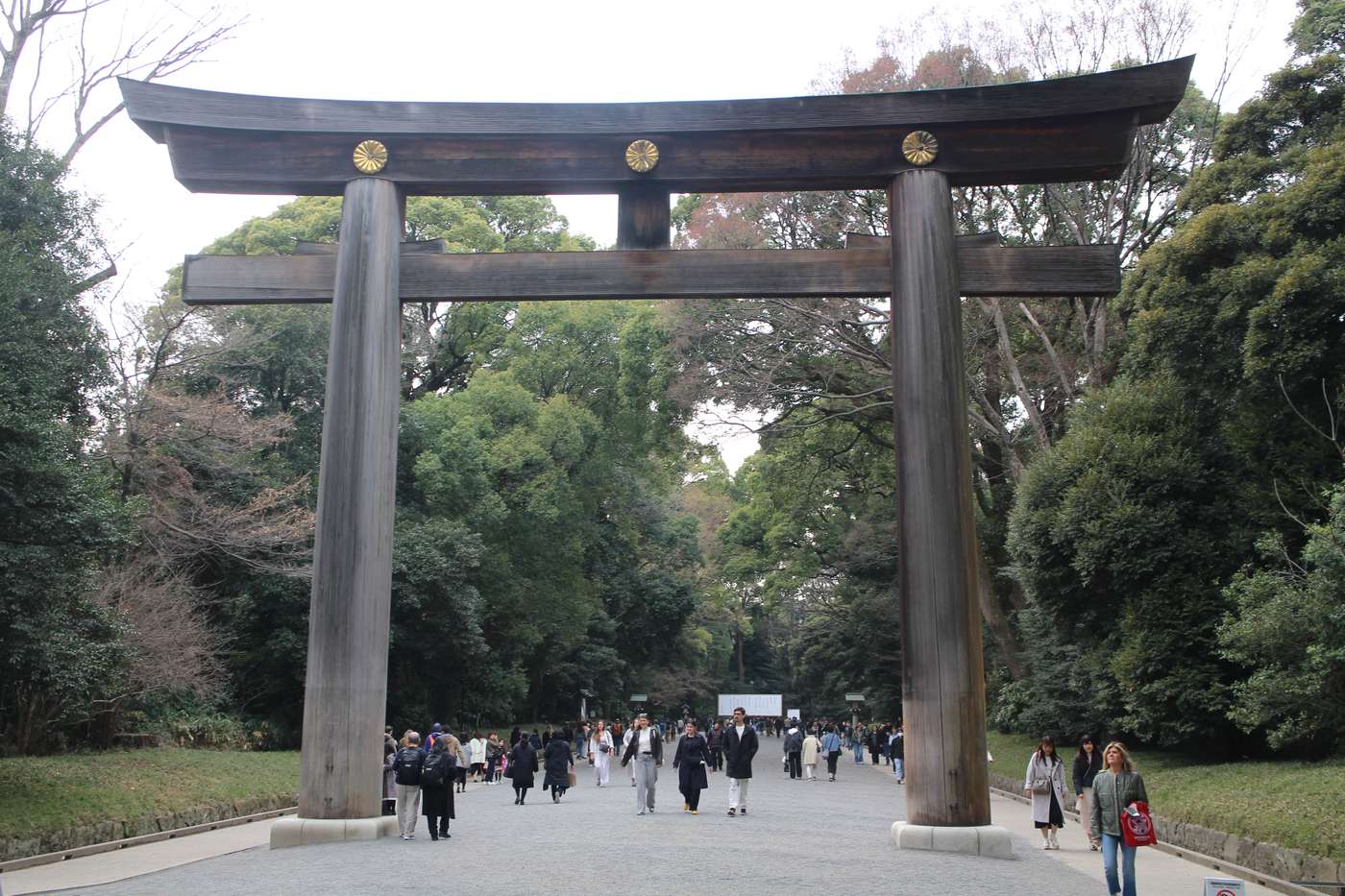
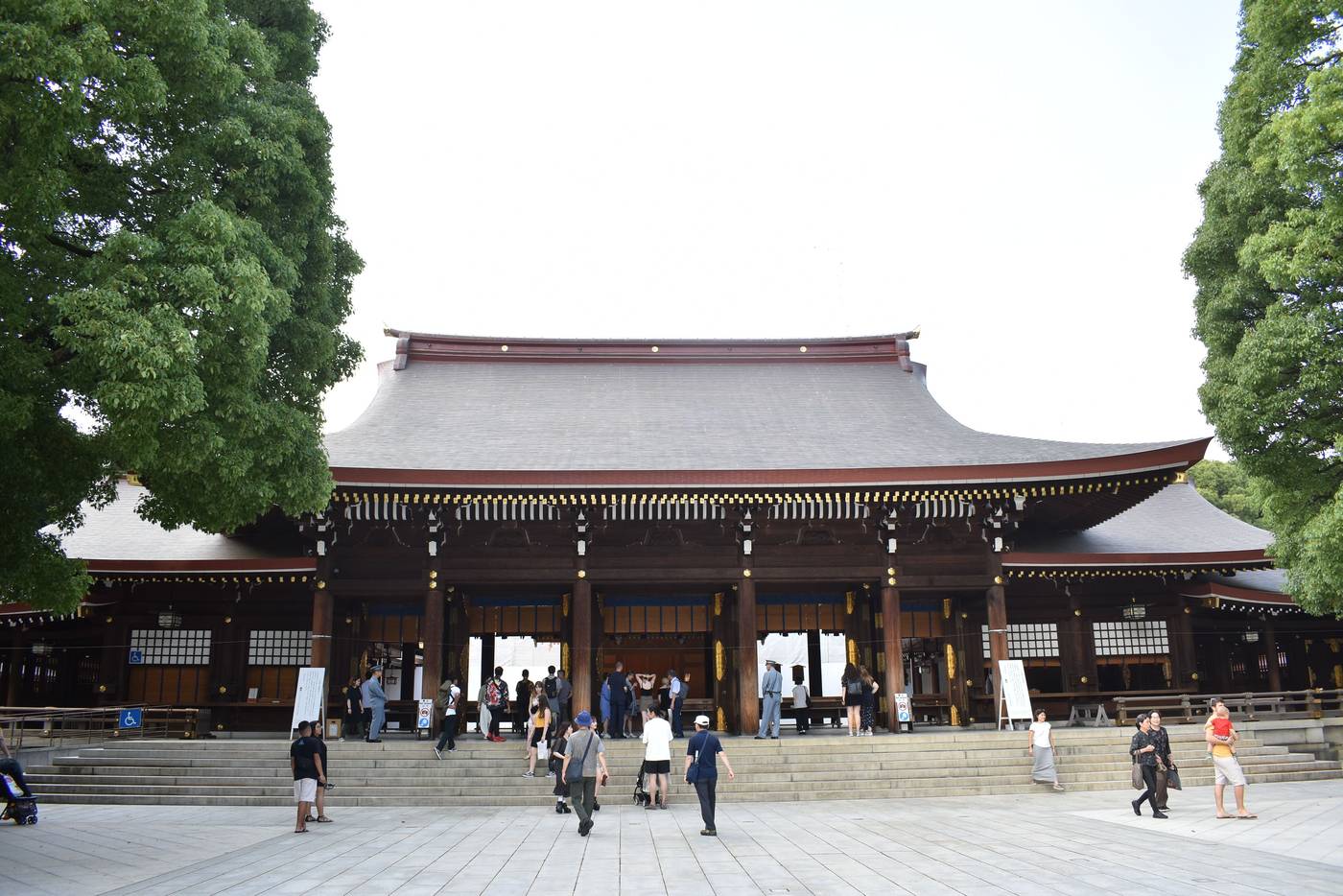
Two physical landmarks to look up at. The Great Torii (second torii): 12 m tall, 17.1 m wide, pillars 1.2 m across, 13 tonnes — Japan's largest wooden myojin-style torii, built of Taiwanese hinoki cypress from trees over 1,200 years old; the current gate is the second generation, completed December 23, 1975. The main sanctuary is itself a survivor's story: the original burned in 1945 under incendiary bombing (the sacred object was carried out safely), a restoration association formed in 1953, and the rebuilt sanctuary was consecrated in 1958, with the remaining facilities finished by 1960 — what you bow to today is a postwar nationwide rebuilding effort. The paired camphor trees near the main hall are treated by visitors as a matchmaking symbol by long custom; the shrine publishes no age for them, so enjoy the custom and skip the numbers.
Festival calendar: Reisai and New Year
The ritual year tracks the two enshrined lives, and most dates repeat annually:
| Rite | Date | Notes |
|---|---|---|
| Saitansai | Jan 1 | Annual |
| Kigensai | Feb 11 | Annual |
| Kinensai | Feb 17 | Annual |
| Spring Grand Festival | May 3 | Annual |
| Nagoshi purification | Jun 30 | Annual |
| Emperor Meiji Festival | Jul 30 | Anniversary of the emperor's death |
| Meiji Jingu tanka convention | Oct 18, 2026 | Officially announced; entries close Aug 28, attendance free |
| Enshrinement Festival (Autumn Grand Festival) | Nov 1 | Consecrated Nov 1, 1920; performing-arts offerings on the grounds |
| Reisai | Nov 3 | The highest-ranked rite of the year: Emperor Meiji's birthday (Culture Day), an imperial envoy attends; yabusame horseback archery among the offerings |
| Niinamesai | Nov 23 | Annual |
| Year-end purification | Dec 31 | Annual |
If you can only aim for one, aim for November 3. The Reisai falls on Emperor Meiji's birthday — now the Culture Day national holiday — and is the shrine's top-ranked rite, attended by an envoy dispatched from the imperial court, with yabusame mounted archery among the offerings. Stack it with the November 1 Enshrinement Festival's performing arts and the first three days of November are the best free spectacle on this side of Tokyo. Remember the 16:10 November gate closing and follow the on-day official schedule for viewing.
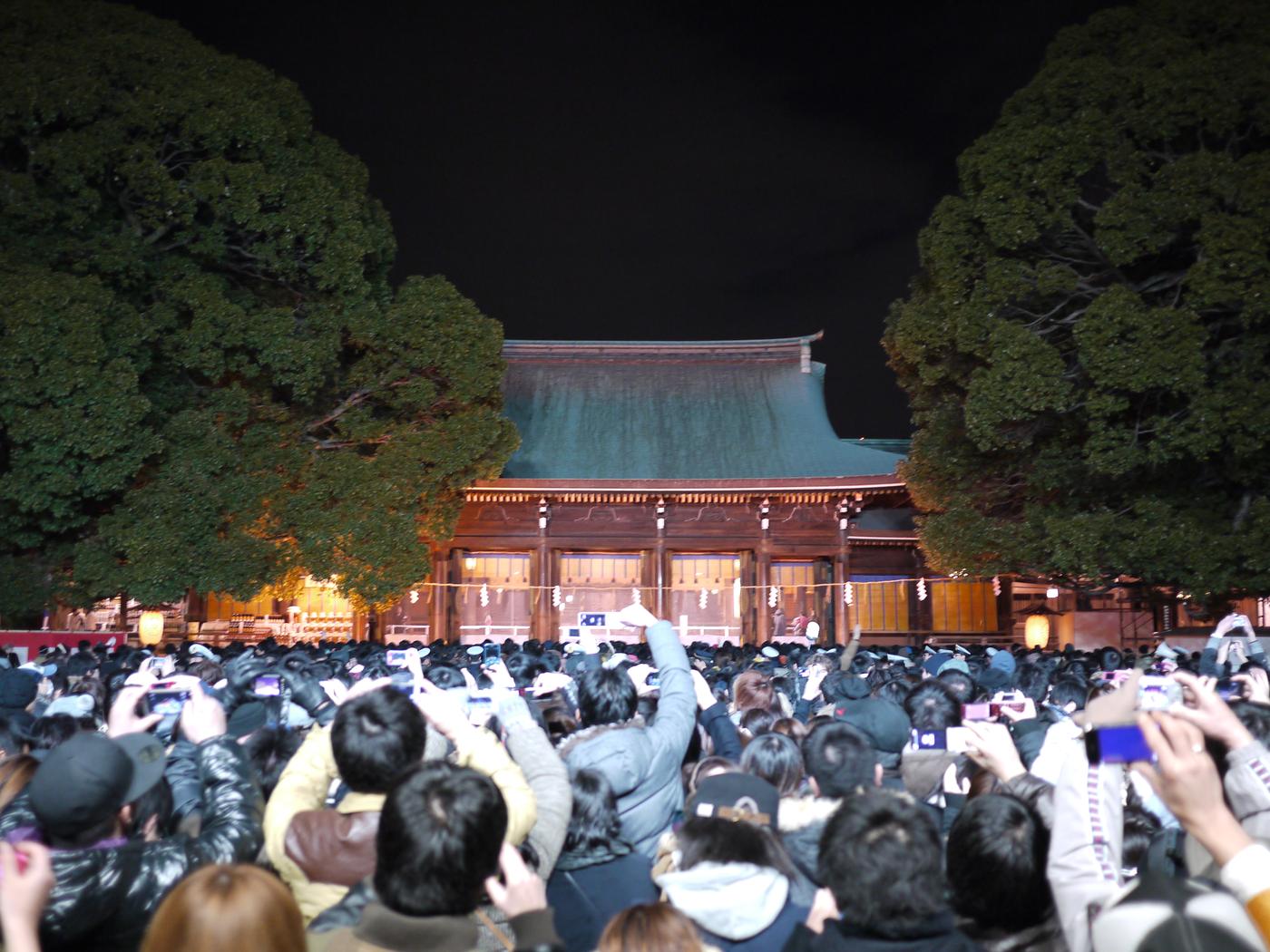
New Year (hatsumode) gets its own paragraph. Media estimates put the crowd around three million, routinely called Japan's largest — a media figure, note, since the shrine publishes no count and the police agency stopped issuing hatsumode statistics. What the shrine does publish is the congestion map in words: worst from 22:00 on Dec 31 to 3:00 on Jan 1, and after 10:00 on each of Jan 1–3, with an official plea to spread visits out. As a worked example, the Reiwa 8 official schedule ran: Dec 31 open 6:40 then through the night, Jan 1 to around 18:30, Jan 2–3 to around 18:00, Jan 4 to around 17:30, normal hours from Jan 5. The Reiwa 9 (2026–27) version follows in December on the official site — plan against that, not against a blog's memory of last year. My play: skip midnight, walk in at first light on January 1 before 9:00, and you get the full hatsumode atmosphere at a fraction of the crush.
Eating nearby: forest café, crepes, Harakado
The shrine borders Harajuku, so the food options are endless; these three are the ones actually tied to the route, with hours verified 2026-08-01:
- CAFÉ Mori no Terrace (on the grounds, by the south gate): open 9:00 until the shrine's closing time (last order 30 minutes before), so its hours ride the monthly table. Coffee ¥500 hot or iced, gelato from ¥400, no reservations. The interior uses reclaimed timber from the shrine's own forest thinnings — coffee brewed inside the forest, in a room built from it, which is as on-theme as a café gets. It is also the natural waiting room between an early-morning visit and the 9:00 goshuin opening. August 2026 notice: closed Aug 20–21 and 24–26, short hours 13:00–18:00 on Aug 22.
- Marion Crepes, Harajuku Takeshita-dori (1-6-15 Jingumae, Junes Bldg 1F): founded 1976, and by the company's own account Japan's first paper-wrapped crepe shop — Takeshita-dori's crepe culture starts with this brand. Hours are not published officially; go by the shopfront notice. One etiquette point worth holding to: finish it standing by the shop before walking on — a crepe carried through Takeshita-dori's crowd ends up on someone's coat.
- Tokyu Plaza "Harakado" (Jingumae crossing): retail B1F–4F 11:00–21:00, the 5F–7F food floors 11:00–23:00, and — the fun one — the Kosugiyu Harajuku sento bathhouse in the basement, 7:00–23:00, closed Thursdays. Closed Jan 1. A proper sit-down meal after the forest, or a 7:00 bath before a dawn shrine walk, both live here.
Is Meiji Shrine worth it? Three ways to plan it
The direct answer: yes, and it is not close — it costs nothing, anchors the Harajuku–Shibuya day perfectly, and delivers the one thing no other central-Tokyo sight has: silence at scale. The real question is which version of it you want:
- First-timers on the standard loop: put the shrine first on your Harajuku–Omotesando–Shibuya day — forest in the morning, streets in the afternoon, maximum contrast. That is exactly how Day 3 of our Tokyo 5-day itinerary runs it. Budget 90 minutes, exit the south gate, and Takeshita-dori is right there.
- Collectors and garden people: come in June. Garden at 8:00 for the irises, Nagadono at 9:00 for the limited seal and the standard goshuin, done before 10:00 — a sequence that only exists in June, since the garden opens at 9:00 the rest of the year. Budget 2.5 hours.
- The empty-shrine chasers: check the month's opening time (5:00 summer, 6:40 winter) and be at a gate when it swings. No goshuin, no coffee, no garden at that hour — what you get is an empty approach and birdsong at the main hall, which for the right person outranks everything money can buy here. Breakfast at the forest café until 9:00 and you still miss nothing.
Stated limitation: every hour and price above was verified against official pages on 2026-08-01; the gate schedule changes monthly and New Year runs on its own annually-published version, so confirm the current month before you fly.
Frequently Asked Questions
- Q1:Is Meiji Shrine free to enter, and how long does a visit take?
- Yes — admission to the shrine grounds is free, stated plainly on the shrine's official English Q&A page, which makes it one of the few genuinely free first-tier sights in Tokyo. The only two things that cost money are optional add-ons: the Inner Garden (Gyoen), which asks a 500 yen maintenance contribution and contains Kiyomasa's Well and the iris garden, and the Meiji Jingu Museum at 1,000 yen general admission. On time, the shrine's own estimate is one to two hours. In practice that splits cleanly: one hour covers the forest approach, a proper visit to the main hall and the walk back out; two hours means adding either the garden or the museum. One more official figure worth planning around: from any of the three entrances, the walk to the main hall takes about ten minutes, and that forest walk is the point of the place rather than a cost.
- Q2:What time does Meiji Shrine open and close?
- There is no fixed schedule — the gates track the sun, so opening and closing times change every month of the year. Per the official monthly table (verified August 2026), the earliest opening is 5:00 from May through August, the latest is 6:40 in January and December; closing runs from 18:30 in June down to 16:00 in December. The number that catches people out is the winter closing time: 16:10 in November, 16:00 in December. If you slot Meiji Shrine in as your last stop of a winter afternoon on the assumption that arriving by five is fine, you will find the gates shut. New Year operates on a special schedule — as an example, the officially published Reiwa 8 New Year arrangement kept the gates open all night from 6:40 on December 31 through New Year's Day evening. Check the official sanpai page for the current month before you go.
- Q3:How much is the goshuin at Meiji Shrine, and where do you get it?
- The honest answer: Meiji Shrine does not publish the offering amount for its goshuin — or the price of its goshuin book — anywhere on its official website. Any figure circulating online therefore has no official backing, and may be out of date. What the shrine does publish: the seal is received at the Nagadono, the reception building in front of the Kagura-den, from 9:00 until the gates close, with a note that the reception location can change on certain days. Treat the amount posted at the counter on the day as the only authoritative number and carry small change. There is also a confirmed tradition of seasonal limited-edition seals — official news announced an iris-season seal from May 30 in 2026. One timing trap: the gates can open as early as 5:00 in summer, but goshuin reception starts at 9:00, so early-morning visitors need to circle back.
- Q4:What is Kiyomasa's Well, and is the ¥500 Inner Garden worth it?
- Kiyomasa's Well is a natural spring inside the Inner Garden, traditionally attributed to the warlord Kato Kiyomasa — and note that the shrine itself uses the "said to be" framing rather than presenting it as settled history. The official figures are concrete, though: the spring produces an average of 60 litres per minute, and the water holds around 15 degrees Celsius year-round, which is remarkable for central Tokyo. It sits inside the paid Inner Garden, so the 500 yen maintenance fee is the price of seeing it; the free grounds do not reach it. Whether that is worth it depends on the month. In June, unconditionally yes: the iris garden — about 150 varieties and 1,500 plants by official count — peaks, the garden opens early at 8:00, and a limited iris goshuin has been offered from late May. In other months, go if a quiet Japanese garden appeals on its own terms; skip it if you are collecting sights on a stopwatch.
- Q5:Are Meiji Jingu and Meiji Jingu Gaien the same place?
- No, and confusing them ruins itineraries every autumn. Meiji Jingu — the forest, the main hall, the goshuin, Kiyomasa's Well, everything in this guide — is the Inner Precinct, on the Harajuku and Yoyogi side of the city. The famous golden ginkgo avenue that floods social media from mid-November is at Meiji Jingu Gaien, the Outer Precinct, a district of stadiums and boulevards over toward Aoyama and Shinanomachi (the JMA normal for the ginkgo turning there is 23 November, which in 2026 lands inside a three-day weekend — see what late November actually looks like) — a separate location a substantial distance away, with a completely different character. If you walk through the great torii at Harajuku looking for ginkgo trees, you will be searching an evergreen broadleaf forest for a yellow avenue that is not there. Treat them as two separate destinations. As a footnote for 2026: the Outer Precinct was established in October 1926, so it marks its centenary in October 2026, and the Meiji Jingu Museum has announced a related special exhibition.
- Q6:How crowded is Meiji Shrine at New Year, and when should you go?
- Media estimates put Meiji Shrine's hatsumode (first shrine visit of the year) at around three million people, often cited as the largest in Japan — and that framing matters, because the shrine publishes no visitor count and Japan's National Police Agency stopped releasing hatsumode crowd statistics years ago. What the shrine does publish is when it is worst: by its own notice, the crush peaks from 22:00 on New Year's Eve to 3:00 on New Year's Day, and after 10:00 each day from January 1 to 3, with an explicit request that visitors spread out. Read that in reverse and the plan writes itself: New Year's Day at dawn — the Reiwa 8 arrangement had the shrine open all night into January 1 evening — or a weekday morning from January 4 onward. The Reiwa 9 (2026-27) schedule follows in December on the official site; do not assume last season's hours carry over.
- Q7:Is the Meiji Jingu Museum worth the ¥1,000?
- It depends on what you are there for. The museum holds artefacts associated with Emperor Meiji and Empress Shoken, and the building itself — a low timber structure by Kengo Kuma, tucked along the forest edge of the southern approach — is a legitimate draw for architecture fans even from the outside. Practicalities: 1,000 yen general, 900 yen for high-school students and under, free for pre-elementary children, open 10:00–16:30 with last entry 30 minutes before closing, closed on Thursdays (open if the Thursday is a national holiday) and during exhibition changeovers. If you visit on a Thursday, strike it from the plan entirely. The 2026 wildcard: the Outer Precinct centenary special exhibition on the giant murals of the Meiji Memorial Picture Gallery has been announced but dates and pricing were unpublished at verification. Forced to choose between the museum and the Inner Garden on a first visit, take the garden — the well and the irises are experiences unique to this place.
- Q8:What is the Omikokoro, and how is it different from a normal omikuji?
- The Omikokoro is Meiji Shrine's version of the fortune slip, and it deliberately breaks the format: there is no fortune. No dai-kichi, no curse to tie onto a rack — instead you draw one of thirty poems selected from the 93,032 waka composed by Emperor Meiji and the 27,825 by Empress Shoken, printed with a commentary, and an English edition exists. The logic is tied to what the shrine is: it enshrines the Meiji Emperor and Empress, so what you receive is their words rather than a luck prediction. Whether you prefer this to a standard omikuji is taste. If you want the theatre of good-or-bad luck, it will feel flat. If you want something to actually keep, a poem slip from this particular shrine slots into a goshuin book far better than a generic fortune — it is one of the most distinctive small rituals in Tokyo.
Read next
Tokyo 5-day itinerary 2026
A clear 5-day plan: Shinjuku base, two zones per day, honest budget.
Goshuin Guide: Collecting Japan Shrine Stamps
How to start collecting goshuin: books, etiquette, fees, and a first-timer route.
Tokyo Ginkgo & Autumn 2026: Meiji Jingu Gaien, Rikugien, Showa Park
Tokyo’s latest and grandest fall: 8 must-visit spots + Mt. Takao day-trip + Tokyo Subway Pass math.
📊 See the 2026 Price Index (JR Pass, DPA, eSIM, Airport Transport) →