The Nichinan Coast of Miyazaki is the most underrated stretch of shoreline in southeast Kyushu — a little island ringed by the "Devil's Washboard" rock platform, a shrine whose vermilion hall is set inside a cliff-side sea cave, the only seven full-size Moai in the world rebuilt with Easter Island's official blessing, and roughly 100 wild horses grazing free at Cape Toi. It is easy to reach: Miyazaki Airport has frequent domestic flights, faster than looping around Kyushu by bullet train. But here is the blunt thing to know up front: Aoshima is fine by JR, but everything south of it — Udo Jingu, the Moai, Cape Toi — sits on a sparse rail line, and without a car it is genuinely hard to cover. That single fact trips up most Miyazaki plans. This guide covers Aoshima and the Devil's Washboard, the undama toss at Udo Jingu, the Sun Messe Moai, Cape Toi's Misaki horses, and the Obi castle town, with fares, transport, and chicken nanban. The mountain gorge at Takachiho has its own guide; this one is Miyazaki city and the coast.
- Aoshima + Devil's Washboard: 10-minute walk from JR Aoshima Station, the whole island a Special Natural Monument — no car needed for this part
- Udo Jingu: vermilion hall set in a sea cave, undama five for ¥200 — my number-one stop on the coast
- Sun Messe Nichinan Moai: the only officially sanctioned full-size replicas in the world, ¥1,000 adults, closed Wednesdays
- Cape Toi wild horses: ~100 free-ranging Misaki horses, ¥400 per car contribution — but ~2 hours from Miyazaki city
- Honestly: south of Aoshima is hard without a car; driving Route 220 is the heart of the coast
📖 Contents
- 1. Why visit Miyazaki & the Nichinan Coast
- 2. Aoshima & the Devil's Washboard
- 3. Udo Jingu: the cave shrine & undama
- 4. Sun Messe Nichinan Moai
- 5. Cape Toi's wild horses
- 6. Obi: the Little Kyoto of Kyushu
- 7. Miyazaki food: chicken nanban, jidori, mango
- 8. Transport & lodging (why you need a car)
- 9. A two-day plan
- 10. FAQ
Why visit Miyazaki & the Nichinan Coast
Honestly, Miyazaki tends to get skipped in the Kyushu pecking order — people fly into Fukuoka, do Aso in Kumamoto, soak in Beppu and Yufuin, and leave Miyazaki sitting in the bottom-right corner of the map. Which is exactly what makes it good: low visitor density, a beautiful coastline, and a thick layer of myth. Miyazaki is the stage of Japan's "Hyuga myths" — the tale of the brothers Yamasachi-hiko and Umisachi-hiko unfolds along this coast, and both Aoshima Shrine and Udo Jingu tie directly into it, so the shrines here are not "just another shrine" but threaded through with a real story. Add the palm-lined Nichinan coastal road (the Phoenix Road) running south from the city, and the drive itself lifts your mood. My framing: Miyazaki suits the "rent-a-car and travel slow" traveler. If you have already done Kyushu's headline spots and want somewhere quiet with a memorable hook, the Nichinan Coast delivers.
Aoshima & the Devil's Washboard
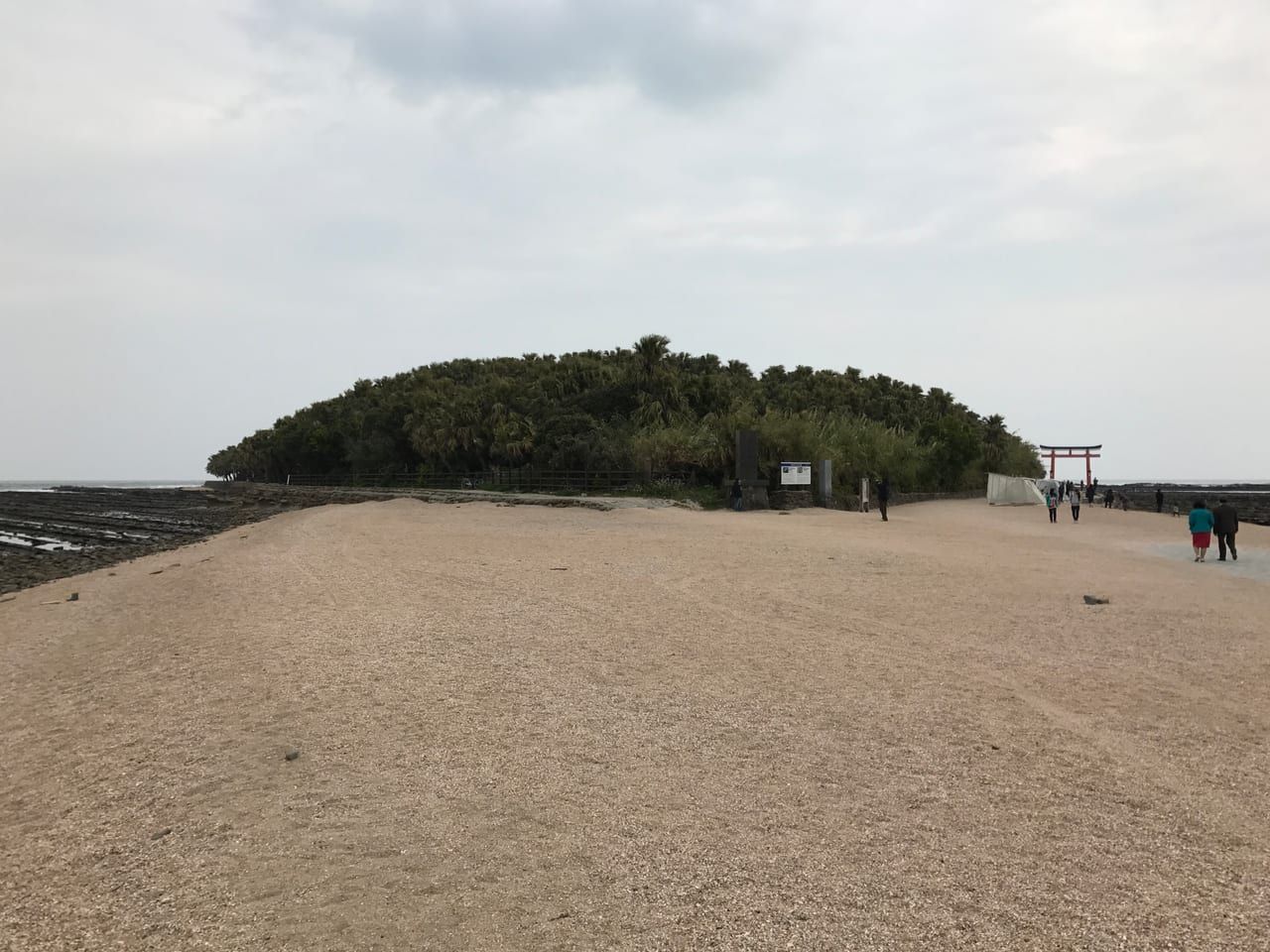
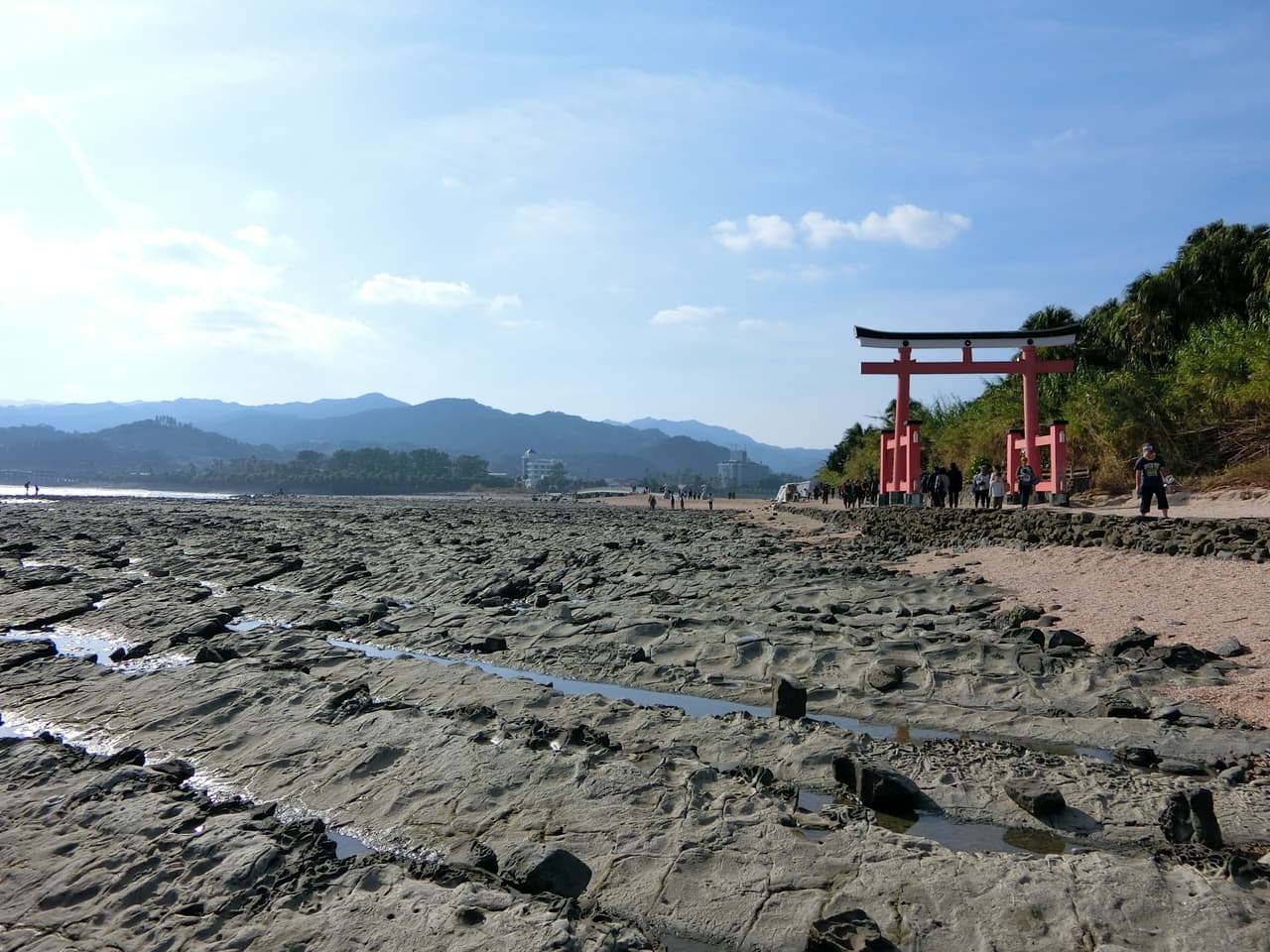
The closest sight to Miyazaki city, and the one that needs no car, is Aoshima — a small island about 1.5 km around, linked to the mainland by the Yayoi Bridge, where the entire island is a grove of tropical and subtropical plants designated a Special Natural Monument. Cross the bridge and at the island's heart sits Aoshima Shrine, dedicated to the married deities Yamasachi-hiko (Hikohohodemi) and Toyotama-hime, which is why it is known for matchmaking and safe childbirth; legend puts the shrine at over 1,200 years old.
But what makes Aoshima famous is the "Devil's Washboard" ringing it — a vast corrugated rock platform fanning out toward the sea like a giant scrubbing board. Its formal name translates as "the raised seabed and wave-cut formations of Aoshima," and per the records it is sandstone that formed underwater around 7 million years ago, then rose and was scoured by waves until the harder beds were exposed in board-like layers. At low tide the whole platform emerges and runs out to the horizon, and with the island's torii it photographs beautifully. Practical notes: you can enter from 6:00, charms and goshuin are issued from 8:00, and worship is free; to shoot the washboard, aim for low tide when the rock is most exposed — check the day's tide table before you go. Access is easy: a 10-minute walk from JR Aoshima Station, about 15 minutes by car from the Miyazaki interchange. This is one of the few Miyazaki sights you can enjoy without driving.
Udo Jingu: the cave shrine & undama
If I could choose only one stop on the whole Nichinan Coast, it would be Udo Jingu, no hesitation. What sets it apart: the vermilion main hall is not built on the ground but set inside a natural sea cave below a cliff. You walk down a clifftop path from the parking area, through the cave mouth, before the bright-red hall appears in the shadow of the rock, facing the open sea — a "cave shrine" that is genuinely rare in Japan. It enshrines Ugayafukiaezu (son of Yamasachi-hiko, father of Emperor Jimmu); legend has Toyotama-hime giving birth in this very cave, so it too is known for safe birth, child-rearing, and matchmaking, and inside there is the "Ochichi-iwa" rock said to have formed from breast milk.
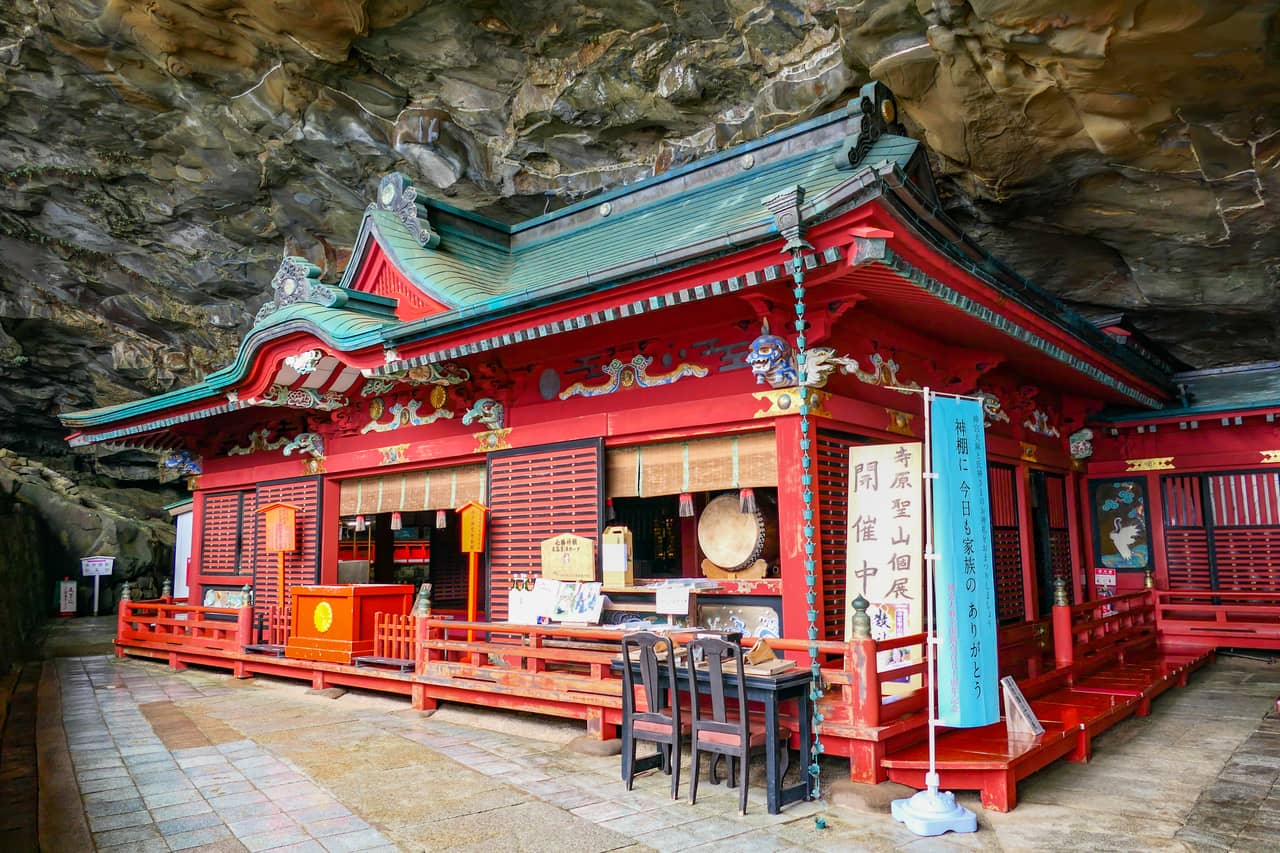
The signature interaction here is the undama toss: from the platform in front of the hall you look down at a turtle-shaped rock called Kameishi, with a rope-ringed hollow on its "shell." Buy a set of undama (five for ¥200), and — men throwing left-handed, women right-handed — try to land one in that hollow, said to grant your wish. The distance is real and the hollow small, so most people miss, but the act itself is great fun and a hit with adults and kids alike. Worship is free, with seasonal hours: 6:00–19:00 (Apr–Sep), 7:00–18:00 (Oct–Mar). It is about an hour by car from Miyazaki city, 40 minutes from Aoshima, and the coastal drive there is gorgeous — but there is no convenient rail at this point, so plan it around a car. Udo Shrine's stamp is a keeper — here is what goshuin are and how to receive them.
Sun Messe Nichinan Moai
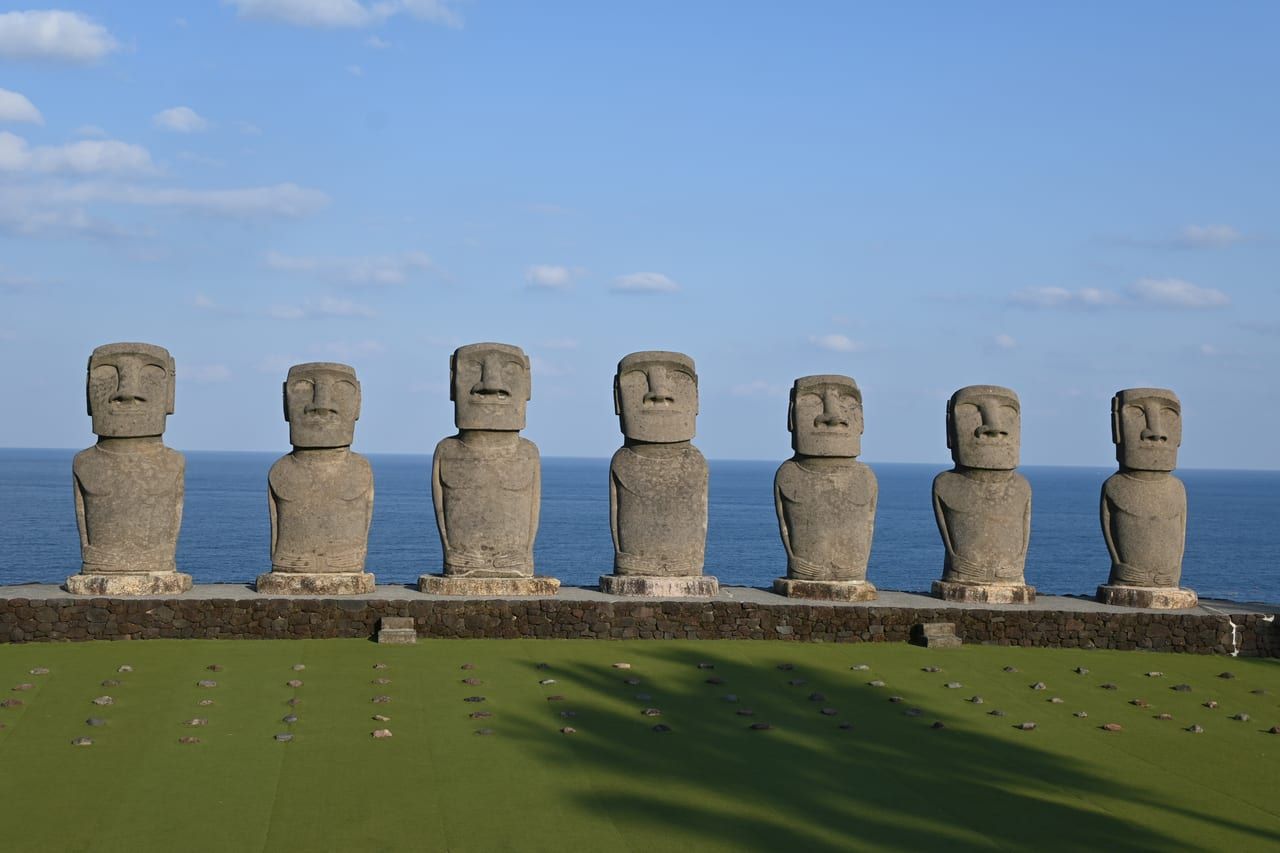
About 10 minutes by car from Udo Jingu, seven Moai suddenly appear on a hillside with their backs to the mountain and faces to the sea — this is Sun Messe Nichinan. First, the most-asked thing: these seven Moai (Ahu Akivi) are the only complete replicas in the world authorized by the council of elders on Easter Island, not the usual theme-park knock-offs. After disaster toppled Easter Island's Moai, a Japanese team helped restore them, and in return the island made a one-off exception authorizing this full replica at Nichinan — per official sources each stands about 5.5 meters, and the row of them against the blue of the Nichinan sea is genuinely a "whoa" moment.
Honestly, Sun Messe as a whole is a touch kitsch — beyond the Moai there is a rainbow-colored "Bell of the Earth" and assorted installations; it leans tourist-park, not solemn historic site. But because it is unpretentious and simply photogenic, it works perfectly with kids or anyone after a fun photo. Practicals: ¥1,000 adults, ¥700 middle/high schoolers, ¥500 ages 4+, open 9:30–17:00 (last entry 16:30), closed Wednesdays (open on Golden Week, Obon, New Year and the like). The grounds are large and on a slope; allow 1–1.5 hours. My framing: it is a fun add-on, not a must-see core — since you have already driven to Udo Jingu, the 10-minute hop to the Moai is well worth it.
Cape Toi's wild horses
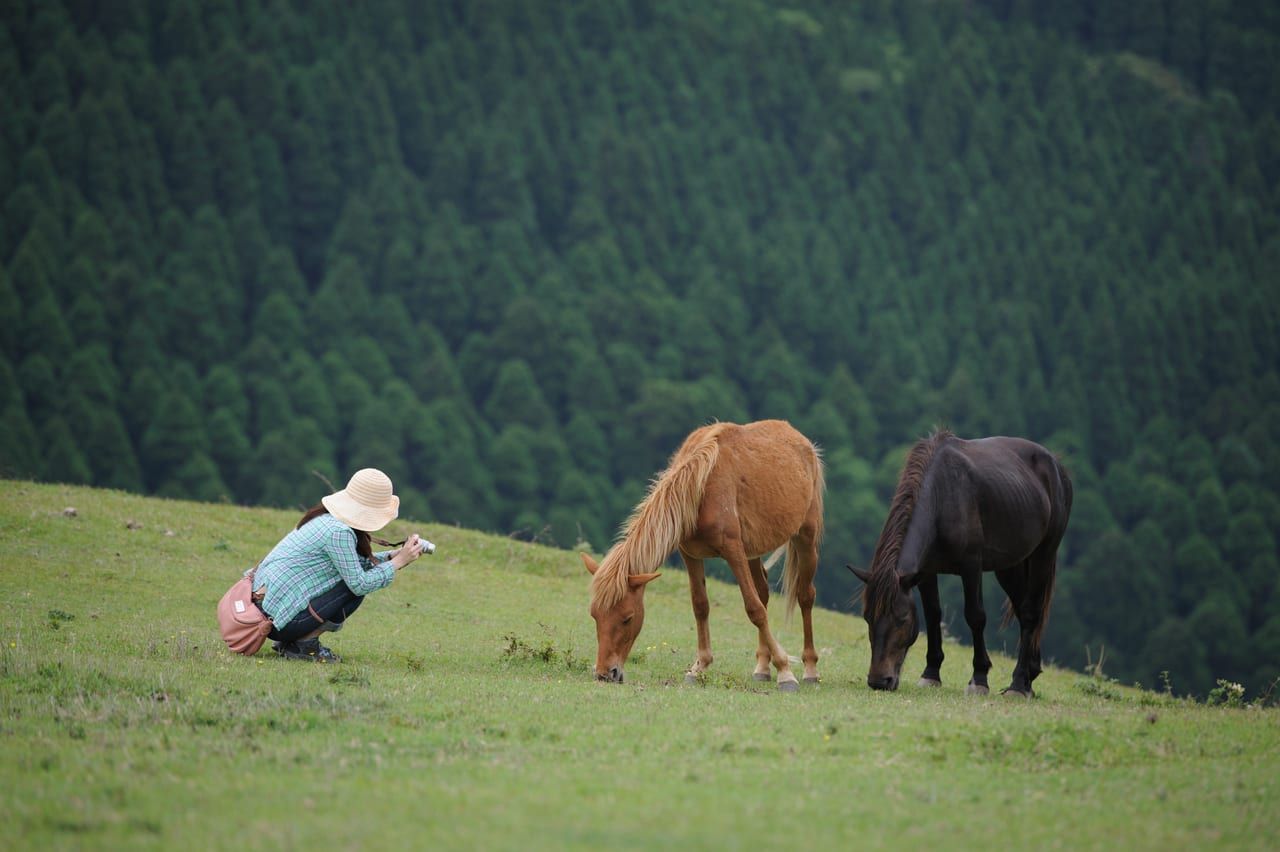
To see genuinely "free-ranging" animals, you have to push to the southern tip of the coast at Cape Toi. The draw is the Misaki horses (misaki-uma) — a native Japanese breed of wild horse; per official sources about 100 of them graze the cape's grassland completely unfenced, and you can watch them up close, mares with foals, in a scene of true free-ranging that is rare in mainland Japan (it is a national natural monument). The open grassland faces the Pacific, with the white Cape Toi lighthouse for a backdrop — a wide, airy view.
Practicals: Cape Toi has no admission, but entering the cape requires a "wild horse protection contribution" of ¥400 per car (¥100 per motorbike) toward conservation of the Misaki horses. The cape's visitor center, Uma-no-Yakata, is ¥310 adults, ¥200 for school children, open 9:00–17:00, and explains the horses' ecology. But let me be upfront: Cape Toi is in Kushima at the prefecture's southern tip, about a 2-hour drive from Miyazaki city and effectively unreachable without a car — the Nichinan Line to Kushima still leaves a long gap to the cape. So my call is blunt: it suits a self-drive day as the southernmost turnaround, collecting Aoshima on the way back north; if you have no car or only two days, drop Cape Toi without guilt and do Udo Jingu, the Moai, and Obi properly instead.
Obi: the Little Kyoto of Kyushu
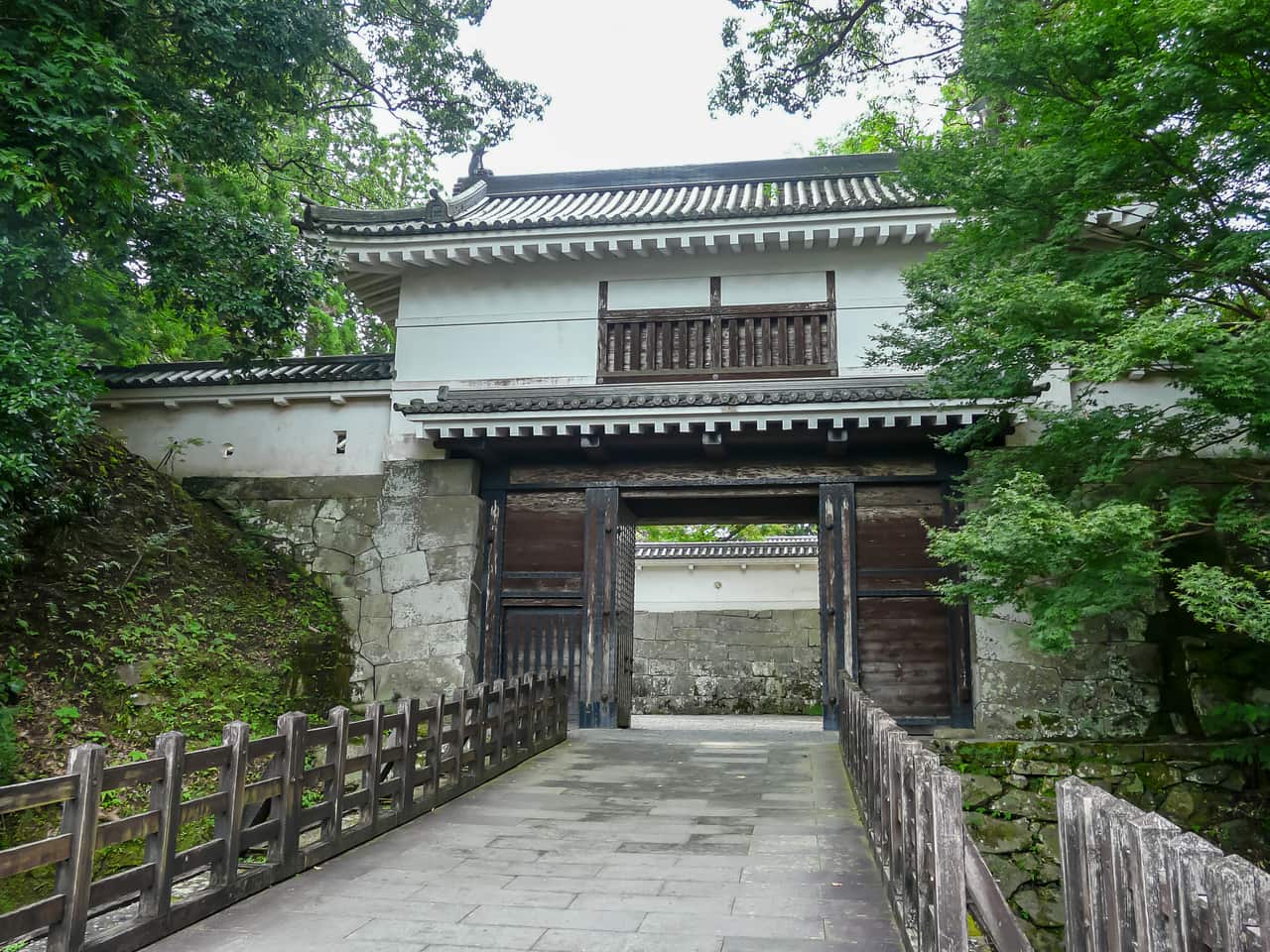
Turn a little inland from the coast and you reach Obi — a remarkably intact castle town nicknamed "the Little Kyoto of Kyushu." This was the seat of the Ito clan's 51,000-koku Edo-period domain, and Obi Castle's ruins preserve the grand Otemon gate and layered stone walls, with rows of samurai residences, stone-paved lanes, white walls, and old trees in the town below — it walks like a period drama, and with far fewer tourists than Kyoto you can take it slow.
The ticketing is generous: individual sites like the Obi Castle History Museum are ¥300 for adults; to see the historic facilities thoroughly, buy the combination ticket (¥800 adults, ¥600 high-school/university students, ¥350 for younger students), which usually covers several halls and, on some versions, includes snack swaps at designated shops — excellent value. Do not miss the local specialties — "obi-ten" (sweet fish-paste fritters made with tofu and brown sugar) and "atsuyaki-tamago" (a thick rolled omelet with a pudding-like texture) — both perfect as a storefront snack stop between sights. Obi is about 30 minutes from Udo Jingu and Sun Messe, so a "coast + Obi" day fits neatly. It is one of Miyazaki's underrated, memorable corners.
Miyazaki food: chicken nanban, jidori, mango
The eating is a quiet highlight of this trip. Three things to know:
- Chicken nanban (チキン南蛮): this nationwide favorite — fried chicken dressed in sweet vinegar sauce and topped with tartar — originated right here in Miyazaki (around Nobeoka). Eating the home version in Miyazaki, the balance of crisp and sweet-sour really lands; it is the one dish you would regret missing.
- Charcoal-grilled jidori (地鶏の炭火焼): Miyazaki free-range chicken seared hard over charcoal until the surface blackens with smoke, chewy and full of flavor, perfect with beer — the signature of a Miyazaki izakaya.
- Miyazaki mango (マンゴー): Miyazaki is a top-tier mango producer, and the highest grade, "Taiyo no Tamago" (Egg of the Sun), is on another level of sweetness and aroma (summer season, and not cheap). If you visit in summer, do not skip a seasonal mango dessert.
Miyazaki beef, hiyajiru (a cold miso-and-broth rice dish for summer), and kamaage udon are all worth a try too. Per traveler discussion, the city's back-lane izakaya run dense and friendly on price, so dinner in town and days out on the coast makes for an easy rhythm.
Transport & lodging (why you need a car)
This is the most important section for planning Miyazaki, so read it before you build the itinerary. Getting in is easiest via Miyazaki Airport — frequent domestic flights from Tokyo (Haneda) and Osaka (Itami) make it far simpler than looping the whole way around Kyushu by Shinkansen, and the airport to the city is about 10 minutes by JR. Getting around, though, is the real challenge:
- JR Nichinan Line: the single-track line running south from the city to Aoshima, Aburatsu, and Kushima. The Aoshima leg is fine by public transport (10-minute walk from Aoshima Station), but service is sparse — off-peak gaps of an hour or two are normal — and Udo Jingu, Sun Messe, and Cape Toi all sit some distance from their stations, needing a further bus or taxi. Relying on the Nichinan Line for the southern coast means a lot of time spent waiting.
- Rental car (strongly recommended): honestly, to cover Udo Jingu, the Moai, Cape Toi, and Obi south of Aoshima, self-driving is far more convenient. Pick up at the airport or in town and drive Route 220 (the Phoenix Road) south, palms on one side and sea on the other — that road alone is the heart of a Nichinan trip. Every sight has parking; Cape Toi takes the contribution at the entrance.
If the wider Kyushu trip leans on JR, run the break-even math in our JR Pass guide first — but for the Nichinan Coast specifically, a pass does not help much; the real question is whether you have a car. For the wider rail routing, see our Kyushu 3-day rail itinerary. For lodging, the smart move is to base in Miyazaki city: city hotels are plentiful and friendly on price, you can hit the izakaya at night and day-trip the coast, which beats staying out at the scattered coastal points. Pre-trip weather and packing (Miyazaki is hot in summer, sun protection by the sea) are in our Japan packing & weather guide.
A two-day plan
Here is the same content shaped into a route that flows (written for a rental car; train travelers should pad the transfers and consider dropping Cape Toi):
- Day 1 (city + Aoshima): pick up the car at Miyazaki Airport → morning at Miyazaki Jingu → lunch of home-style chicken nanban in the city → afternoon at Aoshima and the Devil's Washboard (check the tide table and aim for low tide to shoot the rock) → back to the city for an evening of charcoal-grilled jidori at an izakaya, overnight in town.
- Day 2 (Nichinan Coast): drive south on Route 220 → Udo Jingu (cave hall + undama) → 10 minutes to Sun Messe Nichinan for the Moai → lunch → inland to the Obi castle town for the samurai district and obi-ten (with time and energy to spare, push on to Cape Toi for the wild horses) → evening back to the airport or city.
With a third day, head south to Kagoshima for the ferry across to Sakurajima (see our Sakurajima ferry times and fares), or north into the mountains to row through Takachiho gorge (see our Takachiho gorge guide), for a southern-Kyushu run that takes in Miyazaki's coast, gorge, and the Kagoshima volcano. For the wider rail and routing logic, see our Kyushu 3-day rail itinerary.
FAQ
- Q1:Can you do Miyazaki and the Nichinan Coast without a car?
- Honestly, it is hard, though not impossible. Miyazaki city to Aoshima is fine — take the JR Nichinan Line to Aoshima Station and walk about 10 minutes. The problem is everything south of Aoshima: Udo Jingu, Sun Messe Nichinan, Cape Toi, and Obi sit on a sparse line (off-peak trains often run only every hour or two), and several of them are still a bus or taxi ride from the nearest station. If you only want Aoshima and the Devil's Washboard, the train is fine; the moment you want Udo Jingu, the Moai, or Cape Toi, I strongly recommend renting a car and driving the coast on Route 220 — that drive is half the pleasure of the trip. For the wider rail picture, see our Kyushu 3-day rail itinerary.
- Q2:Are the Moai at Sun Messe Nichinan real, and how much is entry?
- They are officially sanctioned full-size replicas, not knock-offs. The seven Moai (Ahu Akivi) at Sun Messe Nichinan are the only complete replicas in the world authorized by the council of elders on Easter Island — per official sources each stands about 5.5 meters, lined up with their backs to the hill and faces to the sea. Admission, per the official site, is ¥1,000 adults, ¥700 middle/high schoolers, ¥500 ages 4+, open 9:30–17:00 (last entry 16:30), closed Wednesdays (open on holidays like New Year, Golden Week, Obon). Honestly it is a bit theme-park kitsch — there is a rainbow "Bell of the Earth" and other installations — but the Moai row against the blue of the Nichinan sea makes a genuinely fun photo, well worth it with kids.
- Q3:What is the undama ritual at Udo Jingu, and how does it work?
- Udo Jingu's signature is the undama (lucky-stone) toss. The shrine's main hall sits inside a sea cave below a cliff; from the platform in front of it you look down to a turtle-shaped rock called Kameishi, with a small rope-ringed hollow on its "shell" — you throw your undama into that hollow. Per the shrine's custom, men throw left-handed, women right-handed; the stones are five for ¥200, and landing one is said to make a wish come true. Entry to the shrine is free, open 6:00–19:00 (Apr–Sep) and 7:00–18:00 (Oct–Mar). The vermilion main hall is set into a natural cave in the cliff face — a rare "cave shrine" — and with the undama toss on top, it is my number-one stop on the whole Nichinan Coast.
- Q4:Does Cape Toi cost anything, and how do you get there?
- Cape Toi itself has no admission, but entering the cape requires a "wild horse protection contribution" of ¥400 per car (¥100 per motorbike) toward conservation. The Misaki horses (misaki-uma) are a native Japanese breed of wild horse — per official sources about 100 of them roam the cape's grassland completely unfenced, grazing within easy view, which is a rare sight of genuine free-ranging horses in mainland Japan. The cape's visitor center (Uma-no-Yakata) is ¥310 adults, ¥200 for school children, open 9:00–17:00. But the catch: Cape Toi is in Kushima at the southern tip of the prefecture, about a 2-hour drive from Miyazaki city, and effectively unreachable without a car — slot it as the southernmost turnaround of a self-drive day, or skip it.
- Q5:Is Obi (Obi Castle) worth the detour?
- If you like old streets and samurai districts, yes. Obi is a well-preserved castle town inland from the coast, nicknamed "the Little Kyoto of Kyushu." Obi Castle was the seat of the Ito clan's 51,000-koku domain, and the ruins still hold the imposing Otemon gate, layered stone walls, and rows of samurai residences along stone-paved lanes. Individual sites like the Obi Castle History Museum are ¥300 for adults; to cover the historic facilities, buy the combination ticket (¥800 adults), which usually includes several halls and, on some versions, snack vouchers at participating shops — strong value. Try the local "obi-ten" (sweet fish-paste fritters) and thick rolled omelet as you walk. It is about 30 minutes from Udo Jingu and the Moai, so a "coast + Obi" day pairs perfectly.
- Q6:How many days for Miyazaki, and how does it chain with Kagoshima?
- For Miyazaki city plus the Nichinan Coast, two days is the sweet spot: day one in the city (Miyazaki Jingu, Aoshima, the Devil's Washboard) with chicken nanban and charcoal-grilled jidori, day two self-driving the southern coast (Udo Jingu, Sun Messe, Obi, and Cape Toi if you have the legs). Miyazaki connects via Miyazaki Airport, which has frequent domestic flights from Tokyo and Osaka — far simpler than looping around Kyushu by Shinkansen. To extend, head south to Kagoshima for the Sakurajima ferry (see how the ferry works) or north into the mountains to Takachiho gorge (see our Takachiho gorge guide). If the trip leans on JR, run the math with our JR Pass guide first.
Related reading:
Takachiho Gorge Guide 2026: Rental Boats, Night Kagura & Access
The home of the "descent of the heavenly grandson" myth — rowing up to Manai Falls, nightly kagura at Takachiho Shrine, and reaching a town with no railway.
Sakurajima Ferry 2026: Times, Fares, Island Bus, Volcano Status
The Sakurajima ferry has run 4:00–23:30, not 24 hours, since October 2025 — pay at Sakurajima Port, the island bus, CUTE pass and volcano Level 3.
Kyushu 3-Day Rail Itinerary 2026
Yufuin no Mori + Aso Boy chain Hakata → Yufuin → Beppu → Kumamoto → Aso. JR Kyushu Pass saves ~¥2,500 post-hike.