There is exactly one place on Earth where you can watch wild monkeys soak in a hot spring: Jigokudani Monkey Park in Nagano. The Hokuriku Shinkansen puts it just 80 minutes from Tokyo, and from Nagano Station a local railway carries you into the valley where the snow monkeys bathe — admission ¥1,000 for adults from December 1, 2026. But Nagano is not only the monkeys. At the foot of the mountains sits Zenkoji, a 1,400-year-old temple with a pitch-black corridor (Okaidan-meguri) hidden beneath its main hall; the cobblestone hot-spring town of Shibu Onsen with its nine public baths; and Obuse, where the artist Hokusai spent his final years and the streets run on chestnut sweets. This guide covers how to reach the monkeys (including that icy trail), Zenkoji, the onsen towns, Obuse, and transport and lodging — so you can string "monkeys + temple + hot spring" into a smooth two days.
- 80 minutes from Tokyo: Hokuriku Shinkansen to Nagano, then Nagano Dentetsu to Yudanaka and a bus into the monkey park
- Monkey park ¥1,000 adult from December (¥800 through November): the bathing shot needs the Dec–Mar snow season, but the park is open year-round
- A 1.6 km forest trail: 30 minutes each way, icy in winter — wear grippy shoes
- Zenkoji Okaidan-meguri: feel for the "lock of paradise" set directly beneath the principal image, in a pitch-black under-altar passage; inner-sanctuary ticket ¥800 since April 1, 2026
- Base in Yudanaka / Shibu Onsen: check in and you get the nine-bath key — soak in the evening, climb to the monkeys at dawn
📖 Contents
Why visit Nagano
Honestly, Nagano is off most first-timers’ lists — it is not on the golden route (Tokyo, Kyoto-Osaka, Hokkaido), so you have to go out of your way. That is precisely its value: it owns one image no other place can copy. Wild monkeys soaking in a snowy hot spring, faces flushed, eyes shut in bliss — this is not a zoo act but a genuine wild troop, and that authenticity is Nagano’s strongest card. On top of that, it compresses three of Japan’s most quintessential experiences — bathing in an onsen, visiting a thousand-year temple, and seeing snow — onto a single rail line you can do in one swing.
When to come? Per official information, the signature bathing scene clusters in the Dec–Mar snow season, which is also Nagano’s busiest and most rewarding window. The other months still have monkeys and an open park, but without snow and bathing the pull drops off. One thing that is often underrated: the forest trail into the park ices over and gets slippery in winter — this is not a stroll, more on that below. If you dislike cold or ice, or are traveling with kids or older relatives, autumn (October–November, with foliage around Obuse and Zenkoji) is a fair compromise: you still see monkeys and the path is kinder, you just gamble on the bathing shot. My call is simple: if you came specifically for snow-bathing monkeys, grit your teeth and choose deep winter; if Nagano is just a side trip, autumn is the most comfortable.
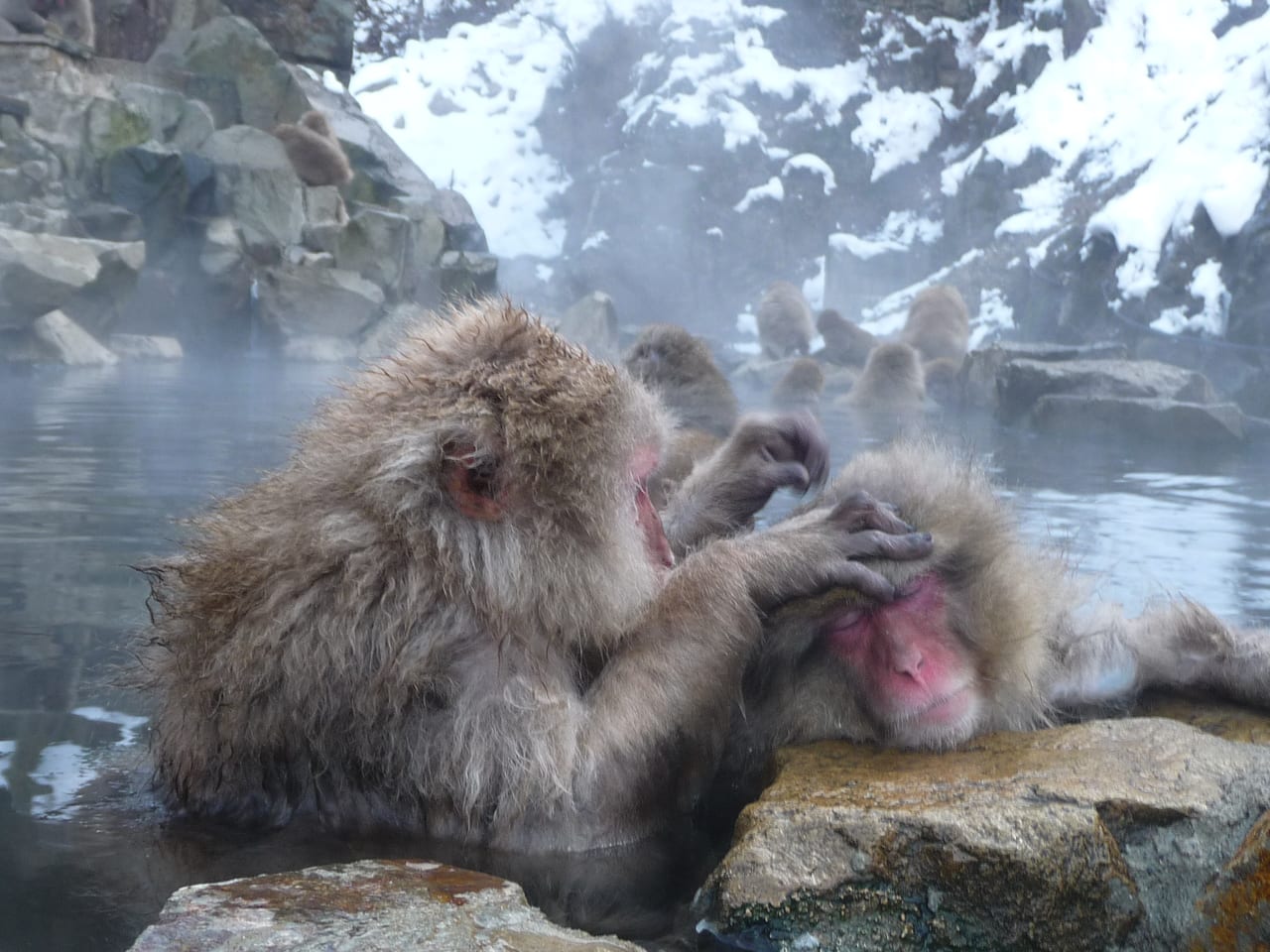
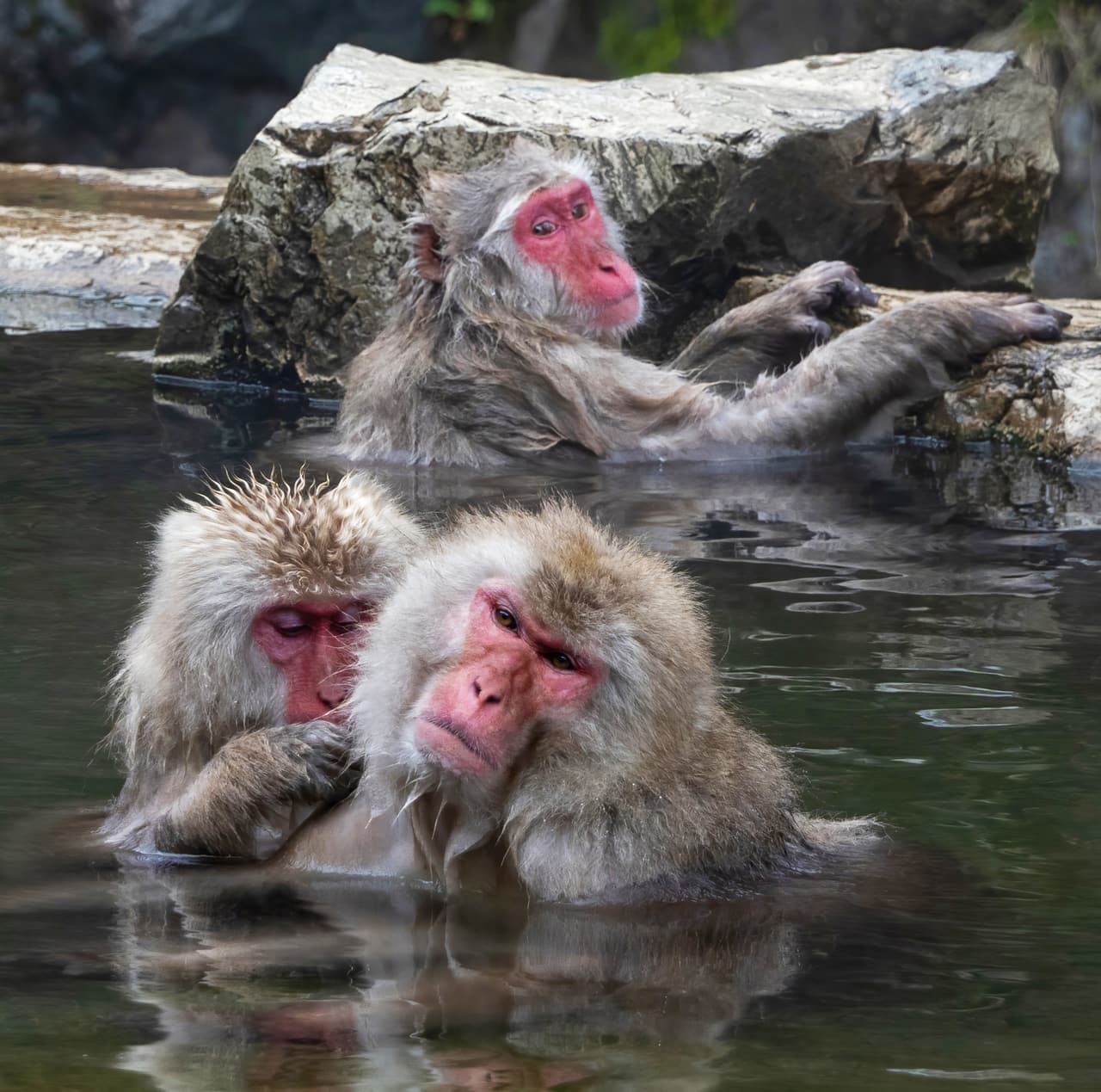
Jigokudani Monkey Park: wild snow monkeys bathing
This is the heart of a Nagano trip and the reason to make the journey. Jigokudani Monkey Park sits in a gorge along the upper Yokoyu River; the name "Jigokudani" (Hell Valley) comes from the steam and scalding ground where hot springs erupt all around. The park keeps one pool built for the monkeys, and each winter the Japanese macaques (the "snow monkeys") come down from the mountain and soak in it for warmth — the image that went global from the 1970s and onto magazine covers worldwide.
A few must-know practicalities:
- Tickets and hours: from December 1, 2026, ¥1,000 for adults and ¥500 for children (elementary through high school), under-6s free; web tickets ¥880 adult and ¥440 child. Through November it is ¥800/¥400. Buy on the spot, no reservation needed. Green season (Apr–Oct) 8:30–17:00, winter (Nov–Mar) 9:00–16:00, open year-round — though a blizzard or a no-show by the monkeys can close it for the day.
- A 1.6 km forest trail: from the parking and bus stop to the bathing pool you walk roughly 1.6 km, 25–30 minutes each way, a gentle uphill with no shuttle. In winter it ices over, so grippy waterproof shoes are essential, plus crampons if you are unsure.
- Bathing is a winter thing: the classic soaking scene only appears in the Dec–Mar snow season; in other months the monkeys are active on the grounds but rarely in the water. For the postcard shot, target deep winter and arrive early when it is quietest.
A word on monkey etiquette: you can get very close, but do not feed them, do not reach out to touch, and do not stare into their eyes (a threat in macaque body language), and keep your bag zipped so nothing gets snatched. They are habituated to people and generally mind their own business — leave them be and you get a quiet, close-up view. Budget 2–3 hours for the whole loop — in, the monkeys, and back out — and do not pin a tight connection or next stop right behind it.
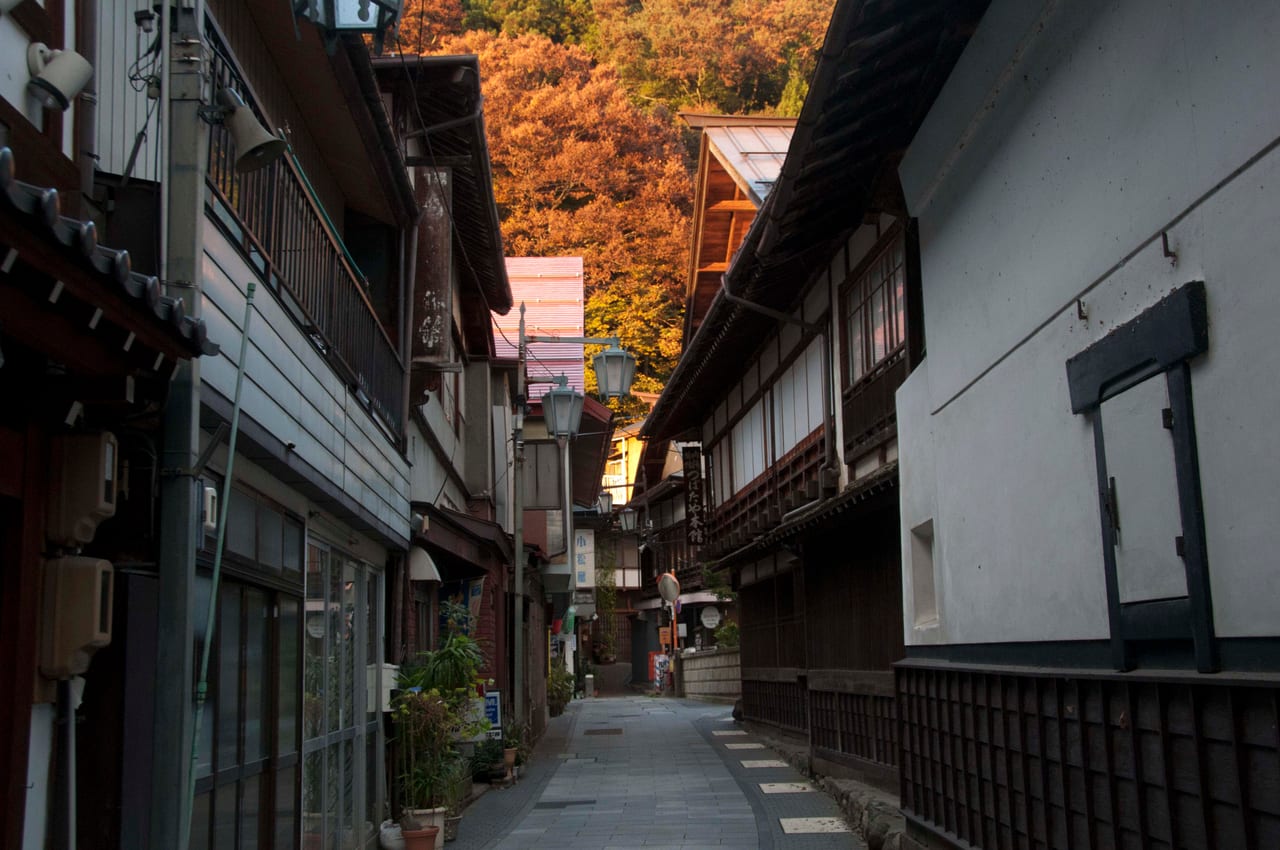
Shibu Onsen, Yudanaka & the nine-bath circuit
Most people who come for the monkeys do not day-trip; they stay at the Yudanaka / Shibu Onsen towns at the foot of the mountain, soak in the evening, and climb up at dawn before the crowds. Both onsen towns sit right below Jigokudani and make the smoothest base for the park.
Shibu Onsen is the more atmospheric of the two: wooden ryokan line a cobblestone street, and at night, with the lamps lit and the clack of geta on stone, it carries a distinctly old Taisho-Showa onsen-town feel (it is often linked, loosely, to certain anime scenes). Its signature is the nine public bathhouses (sotoyu) — check into any ryokan on the street and you receive a key that opens all nine, so you can wander them one by one. Traditionally, "completing the nine" carries a wish for warding off misfortune, a ritual unique to Shibu. Each bath differs slightly in mineral content and temperature, and some run hot, so test the water by hand before stepping in.
Next door, Yudanaka Onsen is the terminus of the Nagano Dentetsu, the most convenient to come and go from, with more lodging — good if you have heavy bags and want to walk less. The two are within walking distance and both are on the bus route. Accommodation is mostly traditional ryokan (often with dinner and breakfast included), and snow season and weekends fill fast, so book early. The booking-site listings for the area are laid out under Transport & lodging; wherever you book, prioritize "near the bus stop, breakfast included, luggage storage while you go up the mountain."
Zenkoji & the Okaidan-meguri
Back in Nagano City, Zenkoji is a stop you should not skip. Founded around the 7th century with 1,400 years of history, its most unusual trait is that it belongs to no single Buddhist sect (non-sectarian) — rare in a Japan of sharply divided schools — which is why pilgrims of every faith and gender have always been welcome, making it a great commoners’ pilgrimage hall. The grand main hall is a National Treasure, the massive Sanmon gate can be climbed for a view down the approach, and that stone-paved approach is lined with old shops and pilgrim lodgings — worth the walk in its own right.
The most famous thing here, and the one to actually do, is the Okaidan-meguri: from the inner sanctuary you descend into a pitch-black underground corridor directly beneath the principal image, where you can only feel your way along the right-hand wall in total darkness. The goal is to touch the gokuraku no jōmae in the black — the temple’s own word is jōmae, a lock or latch, not a "key", and it is fixed directly beneath the principal image rather than hung on a wall. Touch it, the legend goes, and you forge a bond with the hidden image enshrined directly above and secure passage to the Pure Land. Those few dozen seconds of pure darkness, with nothing but your fingertips and your heartbeat, are what many remember most about Zenkoji, far more than the architecture.
Practically: the grounds and outer main hall are free to visit; what you pay for is the inner sanctuary plus Okaidan-meguri ticket. Update your numbers: since April 1, 2026 it is ¥800 general, ¥300 for grades 7–12 and ¥100 for grades 1–6, pre-schoolers free; the old ¥600 / ¥200 / ¥50 line is dead. And the brackets moved, not just the amounts — junior-high students were lifted out of the ¥50 band into grades 7–12, going from ¥50 to ¥300. If you want the inner sanctuary, Sanmon gate, Kyozo and museum in one go, the combined ticket is ¥1,500 (¥600 grades 7–12, ¥200 grades 1–6). Opening time is the other thing everyone gets wrong: the temple states the inner sanctuary opens one hour before the O-asaji morning service, which drifts daily with sunrise — not 9:00. Closing is 16:30 April–October, 16:15 in March and November, 16:00 December–February. For the dawn O-asaji morning service — led daily by the head priest, who blesses the faithful along the approach (the o-juzu-choudai head-touching) — you have to rise earlier, but it is another of Zenkoji’s distinct draws. It is about a 20–30 minute walk from Nagano Station, or a few stops by bus.
A sense of scale before you go: the main hall is a National Treasure, and the pitch-black Okaidan-meguri corridor runs directly beneath its floor in this 1,400-year-old non-sectarian temple. The Sanmon gate can be climbed for a view down the approach — a stone-paved street lined with old shops and pilgrim lodgings.
There are deliberately no photographs of Zenkoji in this section. The temple states in writing that its precinct is private land and that the trademark on its halls’ likenesses belongs to it, so photography and photo use there require an application. Our policy is to describe the buildings in words rather than publish images of them — and this matters to you too, because the same rules govern the photographs you take on site.
If your trip falls between April and June 2027, read this section again. From 4 April to 19 June 2027 Zenkoji holds its Gokaicho, the once-in-seven-years opening, over 77 days. The 2022 edition drew 6.36 million visitors along this same approach — over 70,000 a day — and Nagano is not a big city, so its hotel stock fills first. During those weeks the temple is not what this section describes: the inner sanctuary has a queue and the approach is shoulder to shoulder. For the schedule, the ticket prices that have still not been announced, and why the 19 days in June are the easier half, see our guide to the 2027 Zenkoji Gokaicho.
Obuse: Hokusai and chestnut town
If you have a spare half-day, I would point you to Obuse — about 30 minutes from Nagano City on the Nagano Dentetsu, conveniently on the way to Yudanaka, so the side trip costs you nothing. Obuse plays two cards: Hokusai and chestnuts. The ukiyo-e master Katsushika Hokusai spent stretches of his final years painting in Obuse, and the town’s Hokusai-kan museum holds his works and the ceiling paintings he made for the local festival floats — the town’s weightiest cultural stop. Nearby, Gansho-in temple has a vast phoenix that Hokusai painted on the main hall ceiling in old age; looking up at it is genuinely stunning.
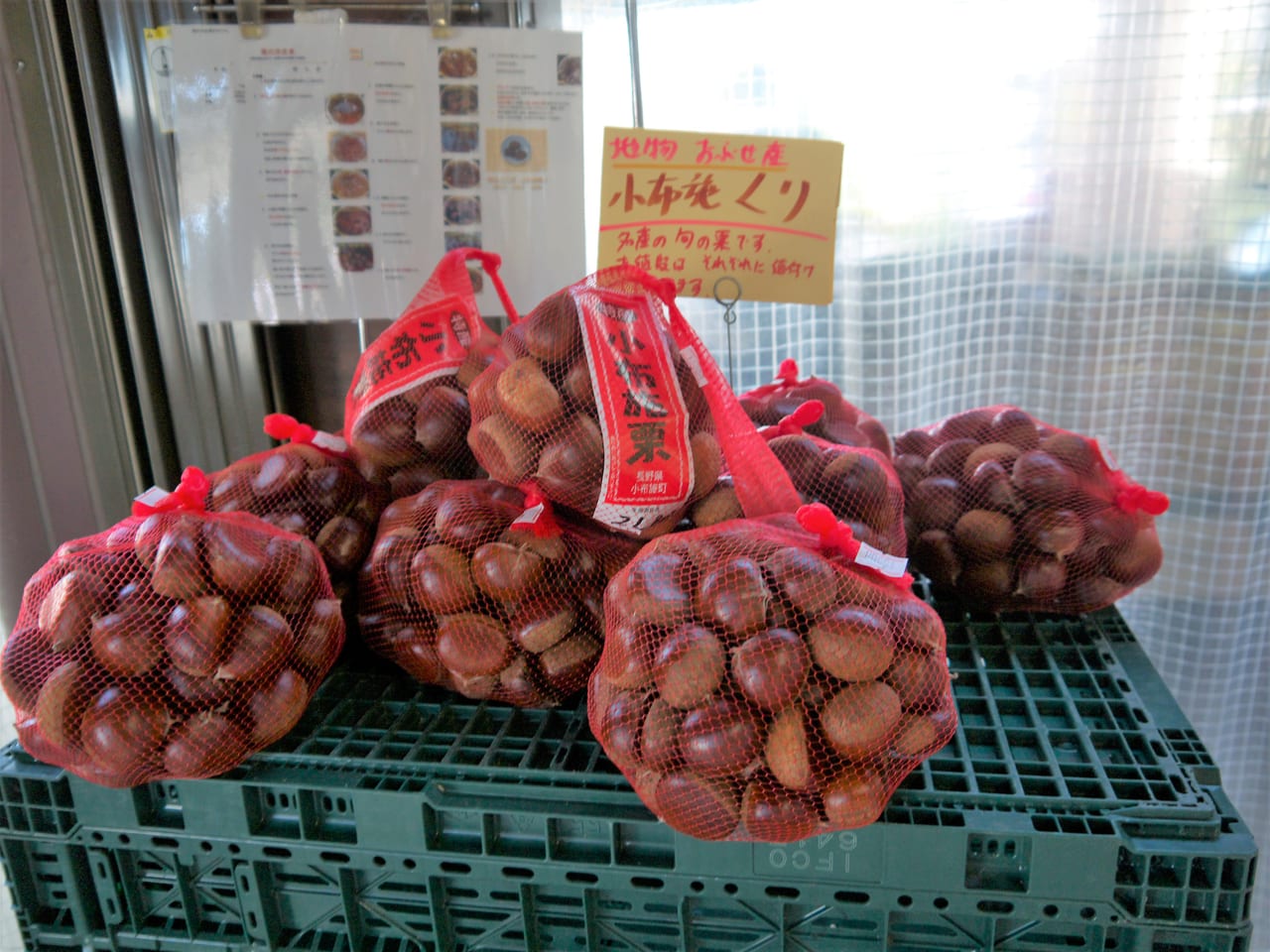
The other card is chestnuts. Obuse has been a chestnut producer since the Edo period, and the whole street runs on chestnut sweets — chestnut rice (kuri-okowa), kuri-kinton (chestnut paste), and chestnut Mont Blanc. The seasonal specialties at old confectioners (such as Obuse-do and Sakurai Kanseido) draw queues in autumn. The town itself is small, with pleasant cobblestone lanes, old walls, and gardens — the kind of place to wander slowly for half a day. Autumn foliage with chestnut sweets is the best pairing, but also the most crowded. Slot Obuse between Zenkoji and the monkeys, and the route flows perfectly.
Transport & lodging
Getting in runs on the Hokuriku Shinkansen: per official information, Tokyo → Nagano is about 80 minutes at fastest (Kagayaki), the easiest way in; the line also reaches up from Kanazawa and Toyama. From Nagano Station, every move toward the monkeys is on the Nagano Dentetsu — ride to the terminus at Yudanaka (about 45 min by limited express, an hour on the local), then transfer to a local bus to the "Snow Monkey Park" stop (about 10 min, ¥390), where the 1.6 km trail begins. Nagano Station also runs a direct monkey-park bus (hourly in winter, around ¥2,000), worth it with heavy bags.
Which ticket is best: the Nagano Dentetsu sells the "SNOW MONKEY PASS" (adult ¥4,800 for the version sold April 1 to September 30, 2026), which bundles unlimited Nagaden trains for the day (limited-express non-reserved seats included), one round trip on the Yudanaka⇄Snow Monkey Park bus, and the monkey park admission. Admission is already included, so you do not buy a ticket at the gate. The direct express bus from Nagano Station is not covered. It is sold only from ticket machines at Nagaden stations (not at counters) and is valid on the day of purchase. On a packed day (Nagano → Obuse → Yudanaka → monkeys) it usually beats paying leg by leg; lay your route out and compare. That version is no longer on sale, and the winter version’s dates and price have not been announced (park admission rises on December 1, so do not assume the same price), so check Nagaden’s site before a winter trip. As for the nationwide JR Pass, most people doing only a Tokyo round trip do not need it; pay per leg. Only if this trip also chains long Kansai or Tohoku legs is it worth running the break-even math in our JR Pass guide — do not buy a nationwide pass just for one Nagano round trip.
For lodging, there are two strategies. If the monkeys and bathing are the point, stay in Yudanaka / Shibu Onsen — soak the nine baths in the evening, climb to the monkeys at dawn before the day-trippers arrive, and the route is flawless; the catch is that traditional ryokan dominate and snow season books out early. If you would rather treat Nagano as a hub and load up on Zenkoji and Obuse, you can also stay near Nagano Station at a business hotel — gentler prices, easy Shinkansen access — and day-trip the monkeys. My advice: if time allows, spend a night in an onsen town — it is an experience a same-day return cannot buy. Each booking site’s listings for the two areas are below — pick whichever you like; many older ryokan also take bookings on their own sites. For pre-trip weather and snow-season packing, the Chubu climate notes around our Karuizawa guide help, and in snow season especially, pack grippy footwear.
| Where to stay | Booking.com | Agoda | Rakuten Travel |
|---|---|---|---|
| Yudanaka / Shibu Onsen (Yamanouchi, at the foot of the monkey park) | Yudanaka area | — (no page limited to this area) | Yamanouchi town |
| Around Nagano Station (Nagano City) | Nagano City | Nagano | Nagano City |
Check each property’s location before you pick. Rakuten’s Yamanouchi listing also includes ski hotels up at Shiga Kogen, close to an hour’s drive from Yudanaka Station, so look for Yudanaka, Shibu Onsen or Shiga Kogen in the address; the Nagano City listings likewise mix in hot-spring inns in Togakushi and Matsushiro, far from the station. These pages open on today’s date, so change it to your nights before comparing.
A two-day snow monkeys + Zenkoji plan
Here is the same content shaped into a route that walks well:
- Day 1 (Nagano City + Obuse → onsen town): early Hokuriku Shinkansen from Tokyo to Nagano (80 min) → visit Zenkoji, do the Okaidan-meguri, climb the Sanmon (about 2 hours) → Nagano Dentetsu to Obuse for a chestnut-rice lunch, the Hokusai-kan, and the old chestnut street → continue by train to Yudanaka / Shibu Onsen in the evening, check in, take the nine-bath key, and wander the baths in yukata → ryokan dinner and breakfast.
- Day 2 (Jigokudani snow monkeys): go early while it is quiet, bus to the "Snow Monkey Park" stop → walk the 1.6 km forest trail (grippy shoes in winter) → watch the monkeys bathe (about 2–3 hours) → back to Yudanaka / Nagano → after lunch, Shinkansen back to Tokyo or onward.
If you only have one day, leave Tokyo early and head straight to the monkeys, then squeeze in Zenkoji by Nagano Station on the way back as a same-day return — you will see the monkeys, but you miss the nine baths and a proper look at Obuse, which is exactly why I keep saying one night is worth it. South of Nagano you can chain Karuizawa (cool-summer resort, shopping, chapels — see our Karuizawa guide) or Takayama and Shirakawa-go (see our Takayama guide) into a Chubu loop; heading east back to Tokyo connects with our Tokyo 5-day itinerary.
Only one day: snow monkey bus tours from Tokyo
If you would rather not string together the Shinkansen, the Nagano Dentetsu and a local bus yourself, a bus day tour from Tokyo is the other way in. Be clear about what it sells: transport and a schedule, not a ticket — the monkey park sells admission at the gate with no reservation, so a tour is not about securing entry. These tours board in Shinjuku (some also at Tokyo Station) between about 7:30 and 8:00 and get back around 8 p.m., with roughly three and a half hours on the bus each way. What differs is where else they stop, how long they give you at Jigokudani, and whether lunch is included. Watch that Jigokudani time: the trail from the parking area to the pool is 25–30 minutes each way, so a tour that allots one hour leaves you about half an hour with the monkeys. I would pick one that gives two hours or more.
| Route | Site | Meets in Tokyo | At Jigokudani | Lunch | Know before you book |
|---|---|---|---|---|---|
| Monkeys + Zenkoji | KKday | 07:20 Tokyo Station Marunouchi South / 07:50 Nishi-Shinjuku | 2 hours | On your own (Zenkoji approach) | Winter departures only, earliest December 4, 2026; needs at least 7 people to run |
| GetYourGuide | Shinjuku i-Land Tower | 3 hours | Included | Start time only shows after you pick a date | |
| Trip.com | 07:30 Shinjuku i-Land | About 2.5 hours | Included | Almost no reviews yet | |
| Monkeys + beef sukiyaki + Iiyama snow huts | KKday | 07:45 LOVE sculpture, Nishi-Shinjuku | — | Included | The snow-hut stop still lists last season’s dates (January 23 – March 1, 2026); the 2027 snow-hut season runs January 22 – February 28 |
| GetYourGuide | LOVE sculpture, Nishi-Shinjuku | 2 hours | Included | ||
| Klook | 08:00 from Tokyo | — | Included | Includes snow-hut entry, which only exists in its limited season | |
| Monkeys + beef sukiyaki | KKday | LOVE sculpture, Nishi-Shinjuku (check-in 07:20) | — | Included | English guide; dates from September on, not just winter |
| GetYourGuide | 07:30 LOVE sculpture, Nishi-Shinjuku | 2 hours | Included | ||
| Trip.com | 07:45 from Tokyo | About 1 hour | Included | English guide; the shortest time at Jigokudani | |
| Monkeys + Shiga Kogen art museum | KKday | Before 8:00, Shinjuku Center Building | — | Buffet optional | Dates currently listed only through the end of 2026; needs at least 10 people to run |
A dash means the product page did not say how long you get. Prices change with the departure date, so I have not listed them — open the page and pick your date. One more thing: several of these tours sell dates outside the snow season, but the monkeys only bathe from December to March; an autumn booking gets you monkeys, not the soaking scene. My advice has not changed: if you have the time, stay a night — the day tours are for people who genuinely have only one day.
FAQ
- Q1:How much is Jigokudani Monkey Park, and do I have to come in winter to see them bathing?
- From December 1, 2026, admission is ¥1,000 for adults and ¥500 for children (elementary through high school) (¥800/¥400 through November; web ticket ¥880 for adults), bought on the spot with no reservation needed. Hours run by season: 8:30–17:00 in the green season (Apr–Oct) and 9:00–16:00 in winter (Nov–Mar), open year-round (though heavy snow, or the monkeys simply not coming down that day, can force a closure). The monkeys are there all year, but the postcard shot of them soaking in the hot spring really only happens in the Dec–Mar snow season — they only climb into the park’s single pool when it is cold enough to want the warmth. In summer they roam the grounds but rarely bathe. For the snow-bathing image, target deep winter and arrive early.
- Q2:How long is the walk from the parking lot to the monkeys, and is it doable in winter?
- From the entrance lot to the bathing pool you walk a roughly 1.6 km forest trail, about 25–30 minutes each way — a gentle uphill with no shuttle, so on foot is the only option. It is easy in summer; in winter the path ices over and gets slippery, and the common rookie mistake travelers report is the wrong footwear. Wear grippy, waterproof shoes or hiking boots, and pack crampons if you are worried (nearby shops sell them). Travel light with camera gear. With the 30-minute walk in, the monkeys, and the walk back, budget 2–3 hours and do not stack a tight connection right after.
- Q3:Does Zenkoji charge admission, and what is the "Okaidan-meguri"?
- The grounds and the outer main hall are free to visit. What you pay for is the ticket into the inner sanctuary plus the Okaidan-meguri, and the temple reset those rates on April 1, 2026: ¥800 general, ¥300 grades 7–12, ¥100 grades 1–6, pre-schoolers free. ⚠️ This was more than a price rise — the brackets were redrawn. The old "elementary and junior high" band at ¥50 was split, and junior-high students moved up into the new grades 7–12 band, so their ticket went from ¥50 to ¥300, a sixfold jump. The Okaidan-meguri is Zenkoji’s signature experience: you descend into a pitch-black corridor beneath the main hall and feel your way along the wall in total darkness for the gokuraku no jōmae — the temple’s own word is jōmae, a lock or latch rather than a "key", and it sitsdirectly beneath the principal image. Touch it and you forge a bond with that hidden image and secure passage to the Pure Land. Do not write 9:00 in your plan: the inner sanctuary opens one hour before the O-asaji morning service, which shifts daily with sunrise; closing is 16:30 April–October, 16:15 in March and November, and 16:00 December–February.
- Q4:Can you combine the snow monkeys and Zenkoji? How many days?
- Yes, and they pair beautifully. Both sit on the Nagano Dentetsu line: Zenkoji is in Nagano City (walkable or a short bus from JR/Shinkansen Nagano Station), and the monkeys are out at the Yudanaka end. The smoothest plan is two days: day one do Zenkoji and a side trip to Obuse, then ride the Nagano Dentetsu to Yudanaka or Shibu Onsen for a hot-spring night; day two hit Jigokudani first thing (fewest people) and head back at midday. One day is possible but rushed — leave Tokyo early, go straight to the monkeys, and squeeze in Zenkoji by Nagano Station on the way back. To bathe the nine baths and linger, stay a night. The Tokyo side connects via our Tokyo 5-day itinerary.
- Q5:How do I get from Tokyo to Nagano and the monkeys? Do I need a JR Pass?
- Per official information, the Hokuriku Shinkansen runs Tokyo → Nagano in about 80 minutes (the fastest Kagayaki), the easiest way in. From Nagano Station, transfer to the Nagano Dentetsu to its terminus at Yudanaka (about 45 min by limited express, an hour on the local), then a local bus to the "Snow Monkey Park" stop (about 10 min, ¥390 from Yudanaka; Nagano Station also has a direct bus, hourly in winter, around ¥2,000). Whether a JR Pass pays off depends on your whole route: a Tokyo round trip alone does not justify it. Only if this trip also chains Kansai or Tohoku legs should you run the break-even math in our JR Pass guide. The Nagano Dentetsu "SNOW MONKEY PASS" bundles a 1-day train pass, one round trip on the Yudanaka⇄park bus and the monkey park admission (so no separate ticket at the gate). It is sold only from ticket machines at Nagaden stations. The published sales period (April 1 to September 30, 2026) has ended, and the winter version’s dates and price have not been announced, so check Nagaden’s site before you count on it.
- Q6:Is Yudanaka–Shibu Onsen worth staying in, and how does the "nine-bath circuit" work?
- Worth it, especially if you want old-school onsen-town atmosphere. Shibu Onsen is a historic hot-spring street of cobblestones and centuries-old wooden ryokan, and its defining feature is nine public bathhouses (sotoyu). The mechanic is simple: stay at any ryokan on the street and you receive a key that opens all nine baths, so you can wander them in yukata and geta. Traditionally, "completing the nine" carries a wish for warding off misfortune. Next door, Yudanaka Onsen is the Nagano Dentetsu terminus and the most convenient to come and go from. Both sit at the foot of the monkey park, which is why most visitors base here overnight — soak in the evening, climb to the monkeys at dawn. Lodging is mostly traditional ryokan; book early.
Related reading:
Karuizawa Guide 2026: Kumoba Pond, Shiraito Falls & Outlets
Tokyo's easiest highland escape, 60 minutes by Hokuriku Shinkansen — Kumoba Pond reflections, Shiraito Falls, the Prince outlet, Hoshino-area churches and Harunire Terrace.
Hida-Takayama Guide 2027: Old Town, Jinya, Hida Beef & Festival
The little Kyoto of Hida — the Sanmachi old streets, Japan's only surviving jinya, the morning market, Hida beef and the Takayama Festival.
Tokyo 5-day itinerary 2026
A clear 5-day plan: Shinjuku base, two zones per day, honest budget.