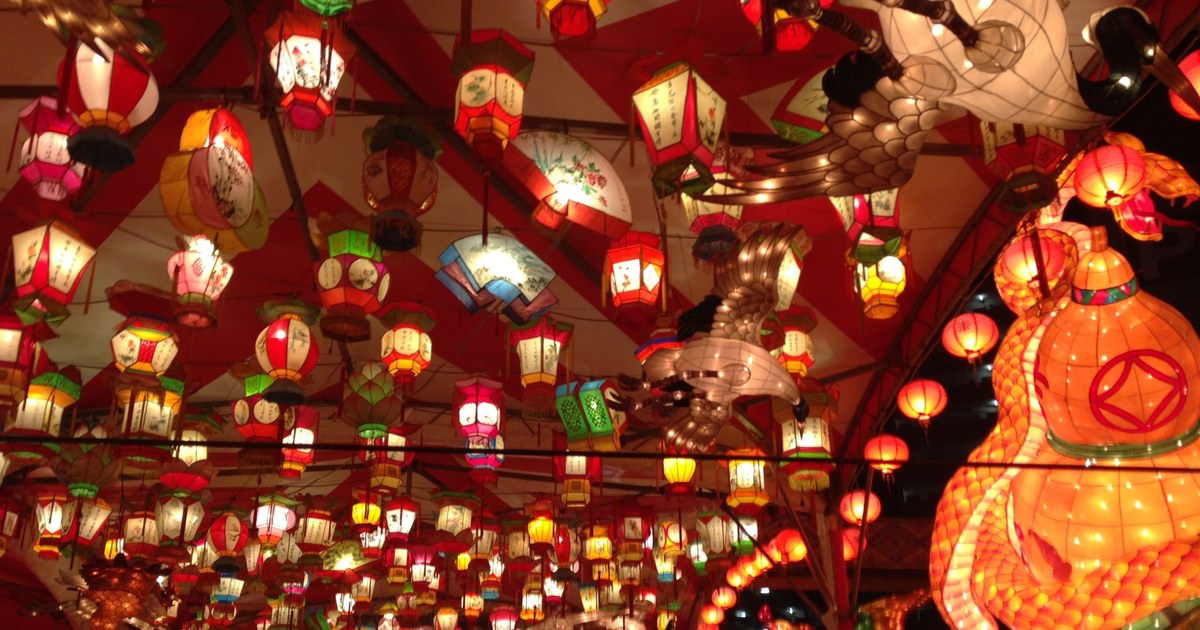
Since 2026 the Nagasaki Lantern Festival no longer follows Chinese New Year: it is fixed to seventeen days beginning on the first Friday of February. After roughly three decades of tracking the lunar calendar, a festival born out of a Chinatown Spring Festival celebration now runs on the Gregorian one. Which makes the 2027 edition — 5 to 21 February — a genuine coincidence rather than a design: Lunar New Year's Day falls on 6 February, the second day of the run. And inside that coincidence there is a trap worth knowing before you book. Both Emperor Parades are on 13 and 20 February, the two Saturdays after most Lunar New Year holidays have ended. This guide covers what the seventeen days actually contain, why "the festival is free" is only half true, and which dates and details expired when the schedule changed.
- Dates: 5-21 February 2027, seventeen days
- It no longer follows the lunar calendar. Fixed to seventeen days from the first Friday of February, from 2026 onward
- Emperor Parades: 13 and 20 February. Mazu processions: 7 and 14 February. Dragon dance: every day
- The parade runs 14:00-16:30 and the lanterns light at 17:00 (2027 provisional time)
- Free, but not entirely: Confucius Shrine ¥880, Kofukuji ¥500, Sofukuji ¥500
- Every venue is within a 20-minute walk — this festival needs sequencing, not transport planning
📖 Contents
- 1. The festival no longer follows the lunar calendar
- 2. What is actually scheduled for 2027
- 3. The parade is an afternoon event
- 4. Two Mazu processions, running in opposite directions
- 5. Six venues, one twenty-minute circle
- 6. "Free" is only half true
- 7. Three details that help on the ground
- 8. Getting there and getting around
- 9. Bad information worth intercepting
- 10. Where to stay, and how early
- 11. How I would build the trip
- 12. Frequently asked questions
The festival no longer follows the lunar calendar
From 2026 the festival is fixed to seventeen days from the first Friday of February.
The historical pattern is real: 2023 and 2025 both opened on Lunar New Year's Day and 2024 opened on Lunar New Year's Eve. So the festival genuinely was lunar for its whole modern history, and then it wasn't. Two practical consequences follow.
First, 2027 is a lucky year. Lunar New Year drifts across nearly a month of the Gregorian calendar while the festival is now anchored to early February. In 2027 they land on top of each other — Lunar New Year's Day on 6 February, the second day of the festival. Whether they land together again in 2028 is not knowable yet, because those dates are not out.
Second, "go for Chinese New Year in Japan" is no longer a rule. That framing was accurate through 2025 and is now a coincidence that has to be re-checked annually.
Who started it
The festival was started by the people of Nagasaki's Shinchi Chinatown, who expanded the Spring Festival celebrations they had long held into the "Nagasaki Lantern Festival" from 1994 as a way of revitalising the district. The subject is the Chinatown community — not Tojin Yashiki. Tojin Yashiki, the walled Chinese residential quarter of the Edo period, is one of the venues and comfortably the most atmospheric one, but it is not where the festival came from.
There is also a nice piece of cultural precision: the lanterns themselves derive not from Spring Festival but from Lantern Festival — the fifteenth day of the first lunar month, when people began to walk the streets carrying lit lanterns so that the spirits overhead could be seen even through cloud and mist. So the "New Year" in this festival comes from Spring Festival, the "lantern" comes from the fifteenth day, and as of 2026 it follows neither.
What is actually scheduled for 2027
These are the dates the organisers have fixed for 2027:
| Event | 2027 dates (official) | What it is |
|---|---|---|
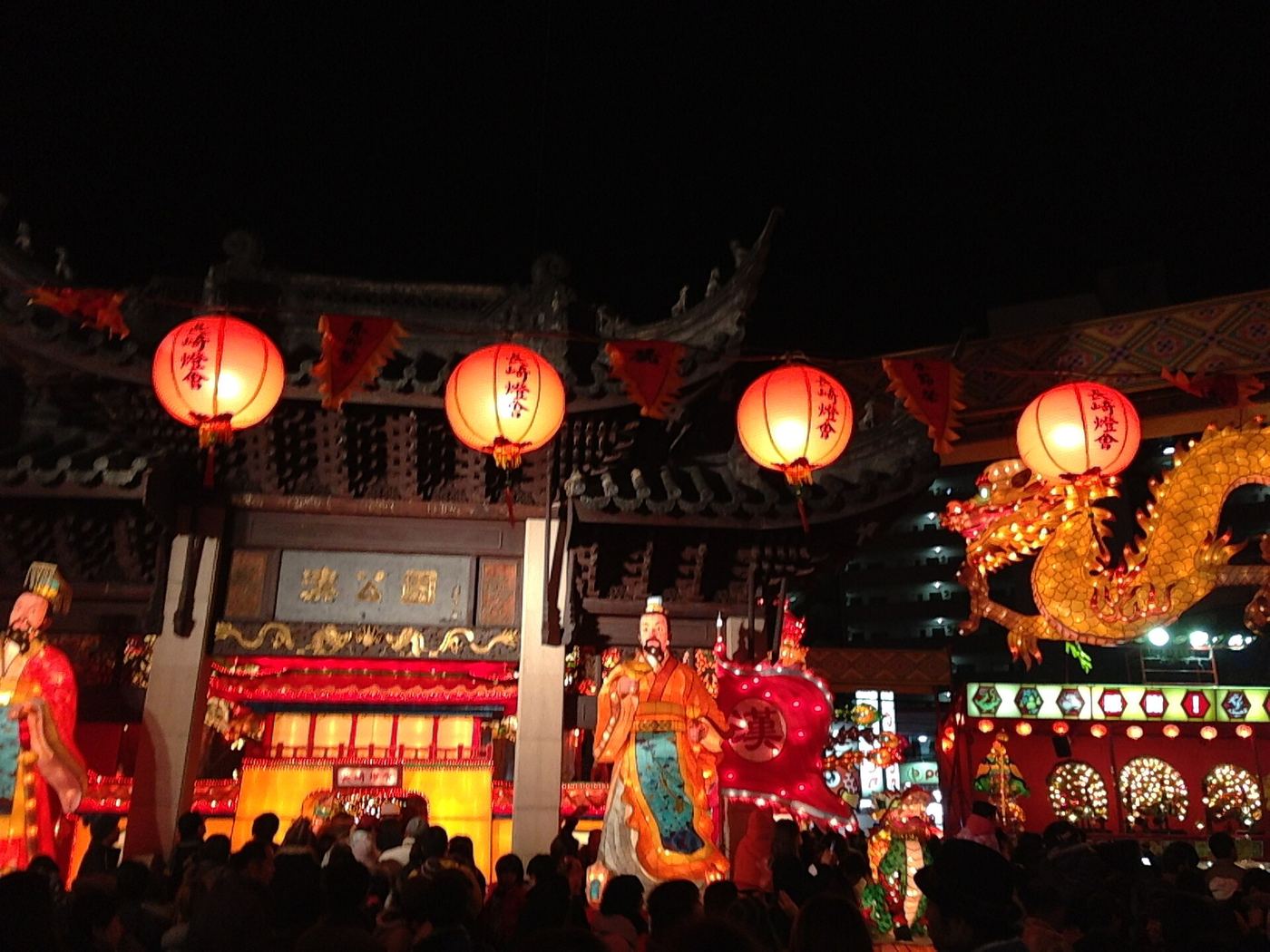
| Emperor Parade | Sat 13 Feb, Sat 20 Feb | A re-creation of a Qing-dynasty emperor and empress processing through town at New Year, palanquins at the centre, banner corps in train |
| Mazu Procession | Sun 7 Feb, Sun 14 Feb | A re-enactment of Chinese crews escorting the sea goddess Mazu to be enshrined in a Chinese temple's Mazu hall |
| Dragon dance | Every day of the run | Performers in Tang costume working a dragon body of roughly twenty metres |
Roughly 100 to 150 people take part. The 2027 emperors: Nagasaki governor Ken Hirata on 13 February and singer Kiyoshi Maekawa on 20 February.
If you are travelling on Lunar New Year leave, read this bit twice
In Taiwan, Lunar New Year's Eve and the New Year holiday run from Thursday 4 February to Wednesday 10 February 2027, seven days. Lay that over the festival:
| Date | Day | Holiday status (Taiwan) | At the festival |
|---|---|---|---|
| 4 Feb | Thu | Holiday day 1 | Not open yet |
| 5 Feb | Fri | Lunar New Year's Eve | Opening day and lighting ceremony |
| 6 Feb | Sat | Lunar New Year's Day | Day 2 |
| 7 Feb | Sun | Day 2 of the new year | Mazu Procession (first) |
| 8-10 Feb | Mon-Wed | Holiday continues | Dragon dance daily |
| 13 Feb | Sat | Back at work | Emperor Parade (first) |
| 14 Feb | Sun | Back at work | Mazu Procession (second) |
| 20 Feb | Sat | Back at work | Emperor Parade (second) |
| 21 Feb | Sun | Back at work | Closing day |
Two things fall out of that table. The seven-day holiday covers only six festival days, because the festival opens on the 5th. And more importantly, the biggest set-piece events sit outside the holiday entirely. If you are constrained to Lunar New Year leave you get six evenings of lanterns, the opening ceremony, a daily dragon dance and one Mazu procession — which is a perfectly good trip, and as the next-but-one section argues, the procession you can reach is arguably the better of the two. If what you specifically want is the Emperor Parade, you have to take leave in the week after, and the compensation is that flights and hotels in mid-February are materially easier than in holiday week.
There is one more diary quirk that makes 2027 unusual. Taiwan's Lunar New Year's Day is 6 February; Japan's is 7 February. The new moon falls at 00:56 on 7 February, Japan Standard Time. Lunar New Year's Day is whichever local day contains the new moon, and at UTC+8 that same instant is 23:56 on 6 February. Fifty-six minutes splits the two countries onto different days. It has no effect whatsoever on the festival, which no longer looks at the lunar calendar at all — it only affects which evening you wish someone a happy new year.
The parade is an afternoon event
Both 2027 parades are scheduled for 14:00-16:30 (provisional), on the same route as 2026. The stop-by-stop times are not out yet, so the table below is the 2026 one, to show the shape of the event.
The Emperor Parade is not a fixed-time show at one spot. It is a route that takes two and a half hours, with a separate passing time at each venue:
| Stage | Location | 2026 passing time |
|---|---|---|
| 1 | Chuo Park (departure) | 14:00-14:20 |
| 2 | Hamanmachi arcade | 14:30-14:50 |
| 3 | Kajiichi | 14:50-15:10 |
| 4 | Hamanmachi again, on the return leg | 15:30-15:50 |
| 5 | Shinchi Chinatown, Minato Park (finish) | 16:00-16:30 |
Now put that against the lighting schedule: lanterns come on at 17:00. The parade is over roughly thirty minutes before the festival's defining visual even starts.
This explains something that confuses a lot of first-time visitors. The image most people carry in their heads — imperial palanquins moving beneath a ceiling of glowing red lanterns — does not really happen, because the procession finishes in daylight. On the official schedule the parade and the illumination are two separate time slots.
The practical fix is easy, and it is one of the few places where I would give a firm instruction rather than options: do not chase the start at Chuo Park. Position yourself at the finish, Minato Park in Chinatown. Two reasons. The crowd spreads itself along a two-and-a-half-hour route, so the finish is not automatically the worst spot; and when the procession arrives at 16:30 you are already standing in the main venue, thirty minutes before the lights go on. You never have to move again.
On lighting itself: 17:00 to 22:00 daily, with Shinchi Chinatown and the Hamanmachi arcade lit from 12:00 — the arcade is roofed and dim enough that daytime lanterns still read. On opening night, Friday 5 February, the provisional plan is an erhu performance at 17:10 and the lighting ceremony at 17:40-18:00 at the Chinatown venue, with Chuo Park running its own at 17:30-18:00 — two ceremonies at the same time in two venues, so there is no wrong choice. That evening the lanterns come on at 18:00, after the ceremony, not at the usual 17:00.
Two Mazu processions, running in opposite directions
The two Mazu processions are not one event repeated. Their official names give it away:
| Occasion | Official name | Direction | 2027 (provisional) | 2026 stop-by-stop |
|---|---|---|---|---|
| First | Bosatsu-age — bringing the goddess ashore | Tojin Yashiki to Chuo Park | Sun 7 Feb, 13:50-16:15 | Tojin Yashiki 13:40-14:10, Chinatown 14:20-14:45, Hamanmachi 14:55-15:05, Chuo Park arrival ceremony 15:45-16:05 |
| Second | Bosatsu-nose — returning her to the ship | Chuo Park to Tojin Yashiki | Sun 14 Feb, 13:15-15:50 | Chuo Park 13:15-13:40, Hamanmachi 14:20-14:30, Chinatown 14:40-15:05, Tojin Yashiki 15:15-15:40 |
Both 2027 windows differ from 2026, so wait for the current year's timetable for the stops instead of shifting the right-hand column.
They run in opposite directions because they are a departure and a return. The first carries Mazu, protector of sailors, from the "ship" — Tojin Yashiki, where the crews of Chinese trading vessels actually lived — up into the city to be enshrined for the duration. The second, near the end of the run, takes her back down. It re-enacts something the crews genuinely did; it is not a modern invention.
Which means the one you can reach during Lunar New Year leave in 2027 — Sunday 7 February — is the arrival. If you only see one, see that one. The narrative arc of the first procession is complete in itself; the second is the epilogue.
Six venues, one twenty-minute circle
Here is what structurally separates this festival from most Japanese winter illuminations, which tend to be one site an hour outside a city: everything is inside a twenty-minute walking radius. The official walking times:
- Chinatown to Chuo Park: 10 minutes
- Chinatown to Hamanmachi: 5 minutes; Hamanmachi to Chuo Park: 5 minutes
- Chinatown to Tojin Yashiki: 5 minutes
- Chinatown to Meganebashi: 15 minutes; Chuo Park to Meganebashi: 5 minutes
- Chinatown to the Confucius Shrine: 10 minutes; to Sofukuji: 12 minutes
So "how do I get there" is not the hard question. "What order" is. The venues have genuinely different characters:
| Venue | Role | Who it suits |
|---|---|---|
| Shinchi Chinatown / Minato Park | The year's main lantern object, a daily stage programme, food stalls, and the only place selling official festival merchandise | If you see one venue, see this one. The organisers call it a must for first-time visitors |
| Chuo Park | Animal-shaped lanterns, playground equipment, plenty of benches, and the second opening ceremony | Best with children. The organisers call it the hidden-gem venue and suggest starting your evening here to dodge the crowd |
| Tojin Yashiki | Surviving halls and streetscape of the old Chinese quarter; a distinctly different atmosphere from the other venues | Photographers and anyone who prefers mood to spectacle. The one paid experience is here |
| Hamanmachi arcade | Lanterns filling the entire ceiling of a covered shopping street | The rain answer. Many shops extend to 21:00 at weekends. The matchmaking deity Yuelao is here |
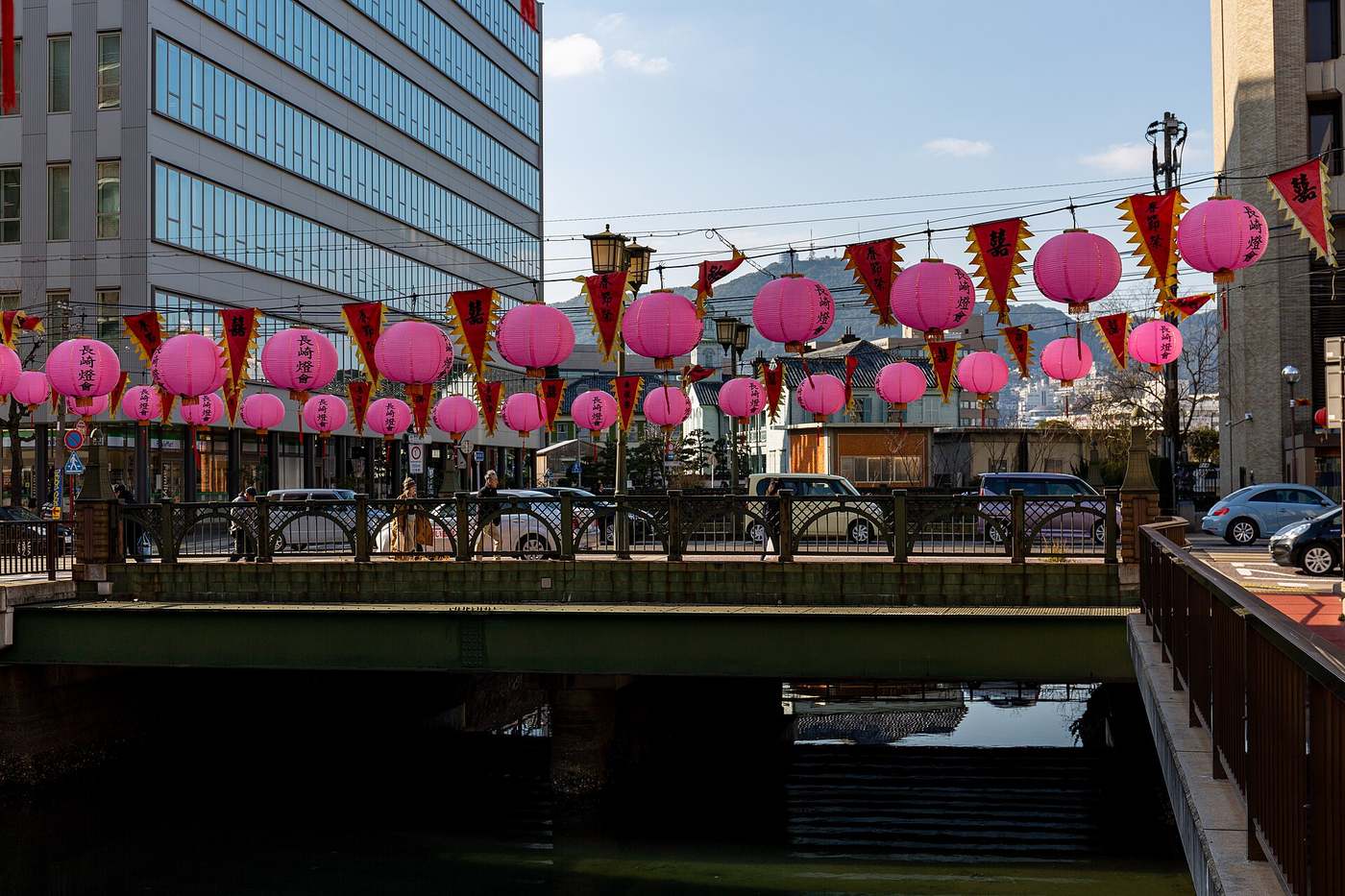
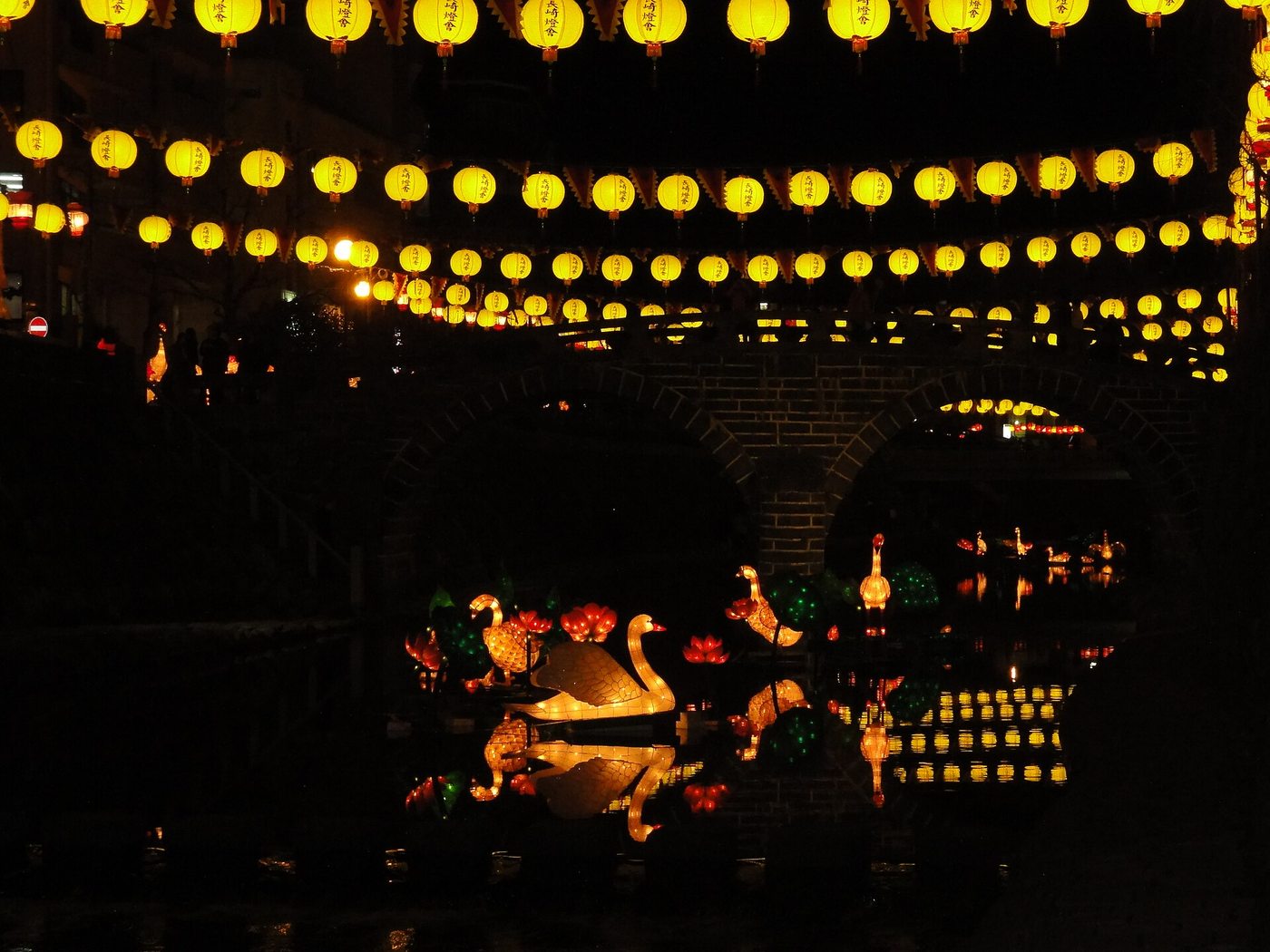
| Nakashima River Park / Meganebashi | Lantern light reflected in the river beside the old spectacles bridge | The photograph. Colours are venue-specific: yellow at the bridge, pink in Chinatown |
| Kajiichi | Programmed only on Emperor Parade days | Skip it on a normal evening |
If I had one evening, I would walk Chuo Park to Meganebashi to Hamanmachi to Chinatown. The logic: the organisers themselves recommend starting at Chuo Park; Meganebashi is five minutes away and is the best photograph of the night; the arcade gives you a roofed middle section; and you finish in the busiest venue rather than fighting through it early. You are moving with the flow of people rather than against it.
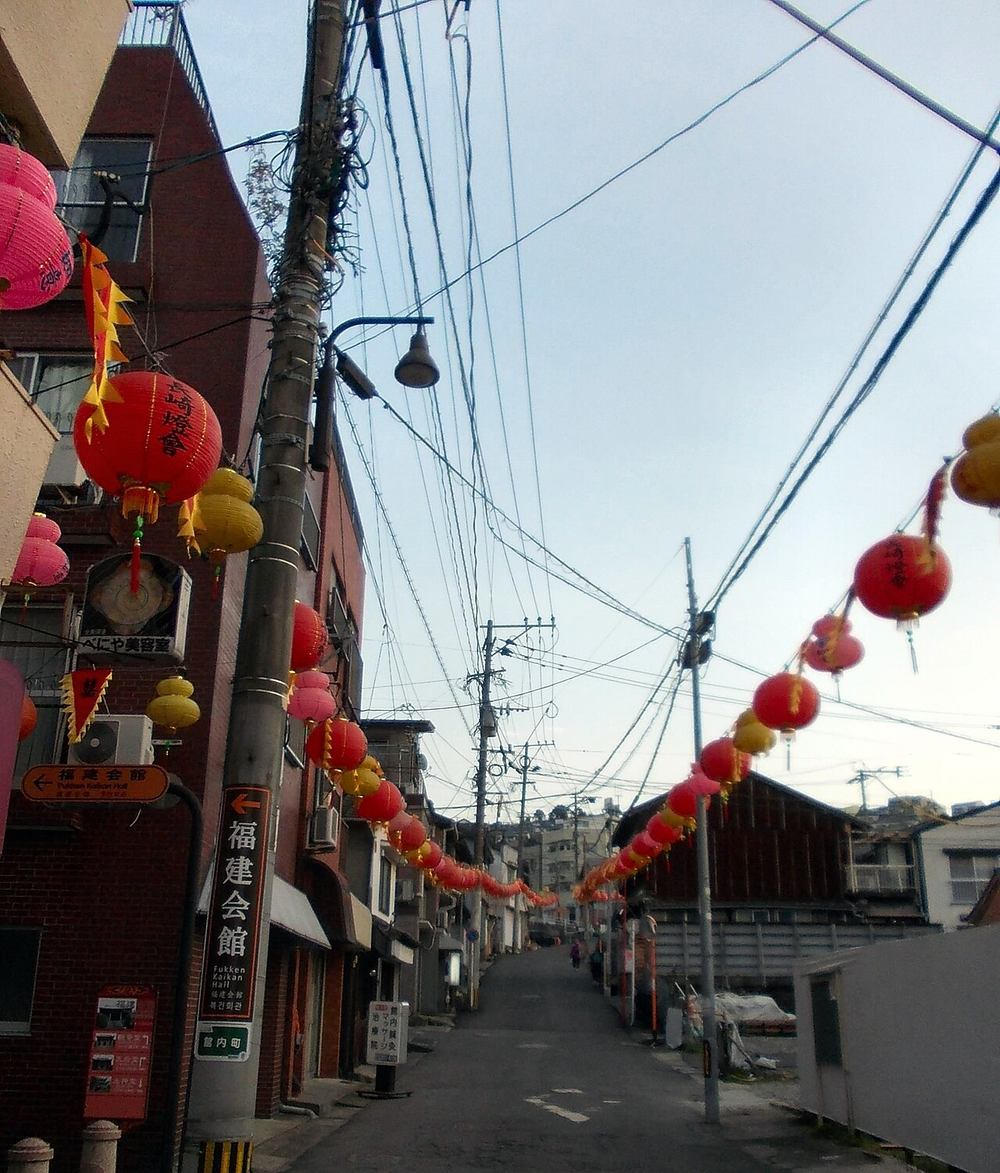
One easily missed extra: the Dozagawa stretch immediately north of Chinatown's gate is hung with pink lanterns and sits directly on that route. No separate planning needed — you will walk through it.
"Free" is only half true
The true half first. The festival costs nothing. Lanterns, the Emperor Parade, the Mazu processions, the dragon dance — all free to watch. And, importantly for anyone planning around a fixed holiday window: there is no paid seating at all. The parades are street processions: stand at the roadside, no ticket, no reservation.
The single exception was the 2024 anniversary parade, run by public ballot for around 20,000 places, with the actor Masaharu Fukuyama as the emperor — and it was free too. None of it applies to 2027.
Now the half that is not free
Three Chinese temples continue to charge admission during the festival — they are not thrown open:
| Site | Adult | Students | Festival-period hours |
|---|---|---|---|
| Confucius Shrine & Museum of Chinese History | ¥880 | High school ¥550 / elementary and junior high ¥440 | 09:30-18:00, last entry 17:30 |
| Kofukuji | ¥500 | Junior/senior high ¥200 / elementary ¥100 | Gates close 21:00 during the festival |
| Sofukuji | ¥500 | Junior/senior high ¥400 / elementary ¥300 | Lights off 20:45, gates close 21:00 (normally 17:00) |
⚠️ The Kofukuji and Sofukuji prices and evening hours are the 2026 figures. The 2027 ones have not been published yet; confirm before you go.
All three together come to 1,880 yen. Worth it? I would split the decision:
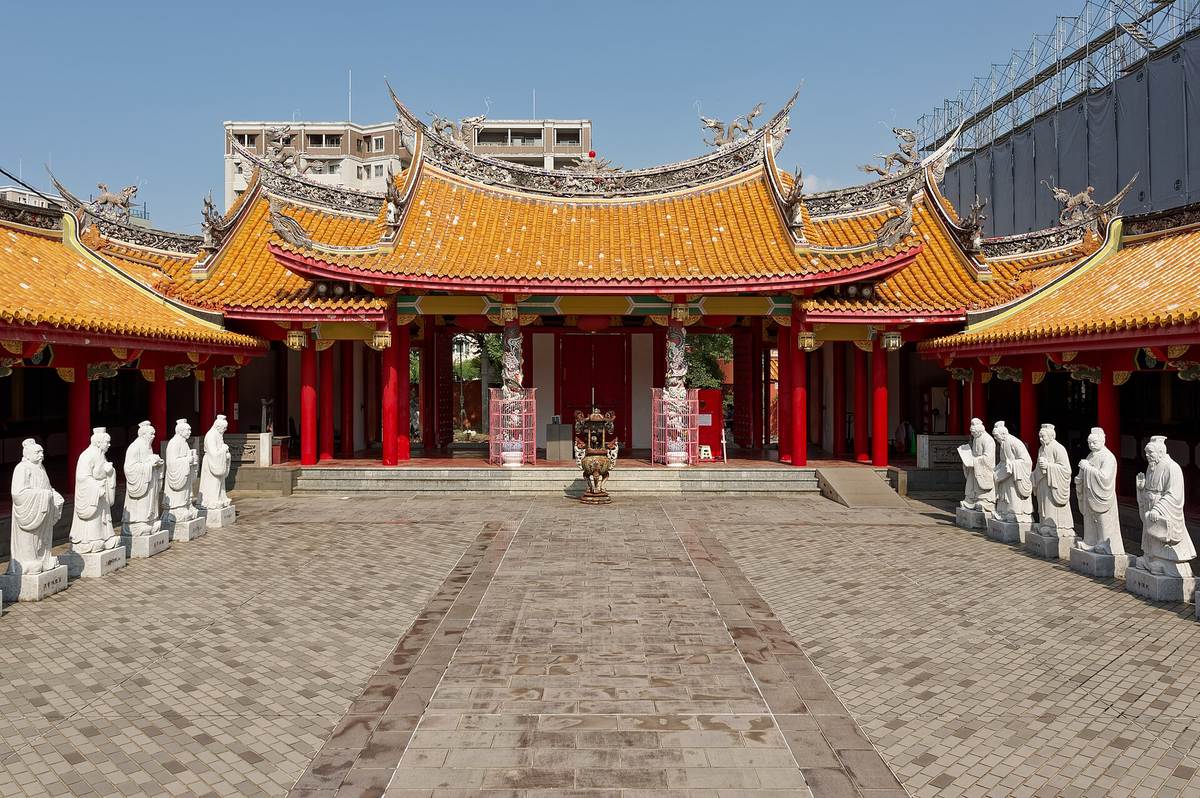
- The Confucius Shrine earns its money. It is the only authentic Chinese-style Confucian shrine in Japan built by Chinese residents themselves, the halls are decorated and lit during the festival, New Year worship is permitted at the main hall, and the Chinese face-changing show is staged here — no booking needed, just the day's admission. One warning: no re-entry. Step outside and you pay again.
- Sofukuji depends on how you feel about national treasures. Its main hall and first gate carry that designation. Note also that the organisers described 2026 as the first time in over a decade that lanterns were installed at Sofukuji — a revival rather than a fixture. ⚠️ Whether it happens again in 2027 has not been announced.
- Kofukuji is the most skippable of the three, unless you specifically want Nagasaki's oldest Chinese temple, whose vermilion gate is genuinely striking.
There are also paid festival experiences: the candle prayer pilgrimage of four halls at Tojin Yashiki, ¥1,000 including a keepsake, 11:00-21:00, registering at the Dojindo hall (from 10:00 at weekends and on holidays); a red-thread charm from the Yuelao shrine in the arcade at 100 yen; and a love lantern, 1,000 yen in 2026, on Bernard Kanko-dori. There is also a free hand-made lantern corner on Sunday 7 and Sunday 21 February at Bernard Kanko-dori — limited numbers, times not yet set.
One fixed cost people forget: Nagasaki City has levied an accommodation tax since 1 April 2023 — 100 yen per person per night under 10,000 yen, 200 yen from 10,000 to under 20,000, and 500 yen above that. Rates differ by municipality across Japan; our guide to Japan's lodging taxes has the full comparison.
Three details that help on the ground
1. The organisers hang upside-down "fortune" lanterns as waymarkers
On the walk from Minato Park to Chuo Park, follow the lanterns on which the character for fortune is printed upside down and you will not go wrong.
The ten-minute walk between the two main venues threads through shopping streets and side alleys with a fair number of junctions, so the organisers have marked the route with lanterns bearing an inverted 福. For Chinese-reading visitors this is a one-second joke — inverted "fortune" is a homophone pun meaning fortune has arrived, a standard New Year decoration. For everyone else it is simply a reliable trail. Watch the orientation of the characters as you walk; it beats staring at a phone.
2. There is a free-standing viewpoint on the 19th floor of City Hall
Nagasaki City Hall has an observation floor on the 19th storey, open 08:15-21:30. City Hall sits beside the Chuo Park venue, at the Shiyakusho tram stop, and 21:30 is only half an hour before the lanterns go out — enough time to go up and look down on the whole lit basin.
⚠️ No charge is listed, so treat the floor as open to visitors rather than confirmed free. It was also a 2026 arrangement — check it again for 2027.
3. Road-closure times are a crowd forecast in disguise
In 2026 the Chinatown venue was closed to traffic from 16:00 on opening day, from 15:00 or 18:00 on ordinary days, and from 13:30 on the two Mazu procession days; the Chuo Park venue was closed daily 10:00-22:00 for the whole run.
Read that as a forecast rather than a restriction: the hour the city closes a street is the hour the city expects the crowd. If you want the empty-street photograph, be there in the two hours before closure begins. ⚠️ 2026 figures; the 2027 hours are expected in January 2027.
The trams run as normal; it is the buses that get diverted. Nagasaki Bus publishes a diversion notice each January listing rerouted sections and suspended stops, and diversions begin earlier than the posted traffic-control hours. Trams run on their own right of way and are unaffected.
Getting there and getting around
From Fukuoka
The route is Limited Express Relay Kamome from Hakata to Takeo-Onsen, then the Nishi-Kyushu Shinkansen Kamome to Nagasaki, changing across the same platform. Best time is 1 hour 25 minutes; most services run 1:25 to 1:47. All prices below reflect JR Kyushu's 1 April 2025 fare revision:
| Ticket | Price | Notes |
|---|---|---|
| Unreserved seat | ¥5,960 | Same all year |
| Reserved, normal season | ¥6,490 | — |
| Reserved, peak season | ¥6,690 | A Lunar New Year holiday week is peak |
| Kamome Net Kippu | ¥4,500 | Online booking only. Cheaper than unreserved |
| Kamome Net Hayatoku 3 | ¥3,850 | 3 days ahead |
| Kamome Hayatoku 7 | ¥3,400 | 7 days ahead |
The line worth staring at is the fourth one. The Kamome Net Kippu costs 1,460 yen less than an unreserved seat and comes with a booked place. Which means the usual budget instinct — take the unreserved car to save money — is simply wrong on this route. In a holiday week the unreserved cars fill; there is no reason to stand for eighty-five minutes to pay more.
For the genuinely lowest fare, the Kyushu-go highway bus is ¥2,900 one way, Fukuoka Tenjin to Nagasaki Station in about 2 hours 7 minutes to 2 hours 23 minutes on the non-stop service. It is a reservation route, but you may board without a booking if seats remain on the day — just do not gamble on that in holiday week. A return ticket is ¥5,400 (2,700 yen each way) and a four-ride online coupon book is ¥9,000 (2,250 yen each way).
If Nagasaki is one stop in a wider Kyushu trip, our three-day Kyushu rail itinerary shows where the westward day fits; for the Fukuoka end specifically, see what to do and where to eat in Fukuoka.
From Nagasaki Airport, the main venue beats the station
The airport bus to the city (jointly operated by the prefectural and Nagasaki bus companies via the Dejima expressway) costs ¥1,400 for adults and ¥700 for children, requires no reservation — just queue in order — and is paid on arrival.
The stopping order is: Nagasaki Airport, then via the Dejima expressway to Shinchi Chinatown, Chuobashi, Ohato, Gotomachi, and finally Nagasaki Station. So the festival's main venue comes about eight minutes before the station — roughly 35 minutes versus 43. If your hotel is in the Shianbashi or Hamamachi area, get off at Chinatown and skip the backtrack entirely.
⚠️ Two caveats: Hamamachi has no airport bus stop — the nearest are Shinchi Chinatown and Chuobashi. And since 1 April 2026, airport-bound departures no longer call at Edomachi.
Trams: the day pass is a bad deal for most visitors
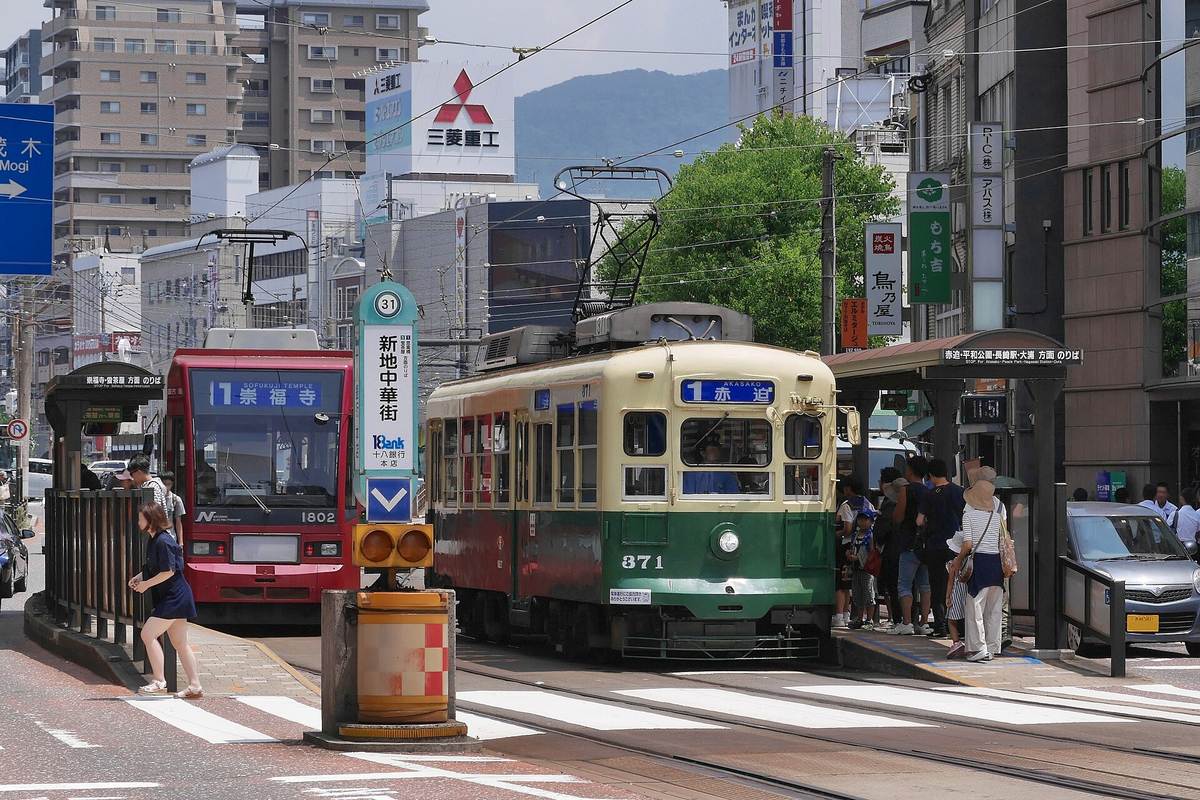
Nagasaki's trams use a flat fare: ¥150 for adults, ¥80 for primary-school children. Pay electronically and travel within two sections and the short-hop discount brings it to ¥110. The one-day pass is ¥600 for adults and ¥300 for children.
The organisers recommend the day pass. I will argue the opposite: for most festival visitors it does not pay for itself. The arithmetic is one line — 600 yen divided by a 150 yen fare is four rides — and as established above, every venue is within a twenty-minute walk. Unless you are also going up Mount Inasa for the night view or across to Glover Garden, you will not make four rides. Tap for single fares instead.
🔴 One trap that catches people: the one-day pass is not sold on board. You must buy it in advance at a designated outlet — Shinchi Chinatown, Nagasaki Station, Kanko-dori and the Hamamachi arcade among them. If you have decided you want one, detour to buy it first.
And one for families: in August 2026 the tram operator introduced free travel for primary-school children and younger on the third Sunday of every month. The third Sunday of February 2027 is 21 February — the festival's closing day. ⚠️ The scheme only started in August 2026, so confirm it still runs before counting on it.
Bad information worth intercepting
1. The .com address starting with "nagasaki-lantern" is not official
A search may turn up a .com address beginning with "nagasaki-lantern". It is not the official site, and there is no need to open it. The two official pages to use are listed under Official information at the end.
2. The Confucius Shrine opens at 09:30, not 09:00
The Confucius Shrine raised its prices in April 2026: adults ¥880, high school students ¥550, younger ¥440. For opening time, trust the shrine's own site — 09:30-18:00. The prefecture's festival feature page says 09:00, which would have you waiting at the gate.
An official tourism site is not the same thing as the operator's own site, and when they disagree, the party selling the tickets wins.
3. The "57% collapse in attendance" is a base-year illusion
Nagasaki City's statistics put festival attendance like this:
| Year | Attendance (estimated visits) | Economic impact |
|---|---|---|
| 2023 | 530,000 | about 4.35 billion yen |
| 2024 | 1,210,000 | about 10.38 billion yen |
| 2025 | 520,000 (down 57.0%) | about 5.32 billion yen |
A 57% fall looks alarming and means almost nothing. 2024 was the 30th-anniversary edition with a celebrity emperor and a 20,000-place ballot parade — a clear outlier. The 530,000 of 2023 and the 520,000 of 2025 are the normal range. The festival is not in decline; one year was exceptional.
The figure is also an estimate of visits across six venues over the run, not a headcount. One person visiting three venues counts three times. Which is exactly why you should not divide it by the city's hotel capacity and call the result an occupancy rate.
Where to stay, and how early
The festival organisers sort accommodation by what you want rather than by price:
- To stay out late near the venues — the Shianbashi and Hamamachi area
- For transport convenience — around JR Nagasaki Station
- For the night view as well — Mount Inasa or the Tateyama area
They also warn that nights before holidays, weekends and public holidays fill early. If you are travelling on Lunar New Year leave in 2027, weekends are all you have, so you are walking straight into that sentence.
How early? The organisers give no number. But two official figures placed side by side make the point: Nagasaki City's own capacity statistics list 223 lodging facilities, 7,436 rooms, capacity 18,752 people; the festival's seventeen-day attendance estimate is around 520,000 visits. Those two numbers cannot be divided — visits are not overnight stays, and a large share of attendance is same-day travel from within the prefecture — but even after a very generous discount the shape is clear: this city's bed stock was not built for this festival.
For room rates, price your own dates on the booking sites.
How I would build the trip
- Decide first whether you want the lanterns or the Emperor Parade. If it is the parade, target Saturday 13 or 20 February and accept that it is not a holiday week. If it is lanterns and atmosphere, the first week is plenty.
- The opening night, 5 February, already works. Two venues run simultaneous lighting ceremonies — the only night of the run with two. (Provisionally Chinatown 17:40-18:00, Chuo Park 17:30-18:00; lanterns on at 18:00.)
- Sunday 7 February is the only major procession inside Lunar New Year leave, and it is the arrival, the better of the two. It is scheduled for 13:50 to 16:15 (provisional), and in 2026 street closures began earlier that day than on ordinary days — the crowd comes early too.
- Give one afternoon to the temples. The Confucius Shrine has last entry at 17:30, so go in daylight; the two Chinese temples stay open to around 21:00 during the festival, so they slot in nicely after the lanterns come on. Budget 1,880 yen for all three.
- Rain plan: the Hamanmachi arcade. Roofed, lanterns across the whole ceiling, shops open to 21:00 at weekends.
- Skip the tram day pass unless you are also doing Mount Inasa. It needs four rides to break even and everything is walkable.
- Get off the airport bus at Shinchi Chinatown, not Nagasaki Station. Eight minutes earlier and no backtracking.
- Re-check the official pages in January 2027. Four things are still unpublished: the day-by-day stage programme, the parade's stop-by-stop times, the traffic-control hours, and whether the two Chinese temples will be lit.
If you have a spare day, Nagasaki itself repays it — the Mount Inasa night view, Glover Garden and Gunkanjima are the standard set, and our Nagasaki city guide strings them together. And if this is your first trip during a Japanese new-year period, note that Japan's own new year is on 1 January by the Gregorian calendar: what closes, what opens and how transport behaves is covered in our new year opening hours guide. Lunar New Year is very much a minority observance in mainland Japan, which is part of what makes Nagasaki in February feel like nowhere else in the country.
Conclusion: three sentences
One: 2027 is a year when Lunar New Year and the Nagasaki Lantern Festival genuinely overlap — but the biggest events sit just outside the holiday. The festival runs 5 to 21 February; Taiwan's holiday runs 4 to 10 February; the overlap is six days. Both Emperor Parades (13 and 20 February) and the second Mazu procession (14 February) fall after most people are back at work. What you can reach is the 7 February procession, the arrival — and it is the better story of the two.
Two: that overlap is a coincidence and will not repeat reliably. The organisers have fixed the run to seventeen days from the first Friday of February from 2026 onward, ending three decades of lunar scheduling. Nobody can promise the two calendars will line up again soon, which is a decent argument for going in 2027 if you have been meaning to.
Three: check the right source, and check it late. The 2027 daily programme, stop-by-stop times and traffic-control hours are still unpublished; the parade and procession times are provisional, and the per-stop times are still the 2026 shape. The prefecture's tourism page gives the Confucius Shrine a 09:00 opening; the shrine itself says 09:30.
Official information
For updates, two official pages are enough: the Nagasaki Prefecture tourism federation's festival feature carries the ceremony, parade and venue times, and Nagasaki City's festival page posts announcements such as dates and the emperor roles. Both are in Japanese; the day-by-day programme is expected in January 2027. Prices and times follow the latest official notices.
Frequently Asked Questions
- Q1:When exactly is the Nagasaki Lantern Festival in 2027?
- 5 February (Fri) to 21 February (Sun) 2027 — seventeen days. The opening ceremony (evening of 5 February), the Emperor Parades (13 and 20 February, 14:00-16:30) and the Mazu processions (afternoons of 7 and 14 February) now have provisional 2027 times. Still unpublished: the day-by-day stage programme, the stop-by-stop passing times and the official booklet — the 2026 edition only appeared in January.
- Q2:Is the festival timed to Chinese New Year?
- Not any more. From 2026 the festival is fixed to seventeen days from the first Friday of February. Historically it really did track the lunar calendar — 2023 and 2025 both opened on Lunar New Year's Day and 2024 opened on Lunar New Year's Eve. From 2026 it follows the Gregorian calendar. So the 2027 overlap with Lunar New Year is a coincidence, not a rule, and future years are not guaranteed to line up.
- Q3:What time do the lanterns come on, and is the Emperor Parade at night?
- Lanterns are lit from 17:00 to 22:00, with two venues — Shinchi Chinatown and Hamanmachi arcade — lit from 12:00; on opening night, 5 February, they come on at 18:00 after the lighting ceremony. The Emperor Parade is an afternoon event, not an evening one, which is the single easiest way to miss it. Both 2027 parades are scheduled for 14:00-16:30 (provisional), Chuo Park to Minato Park. Stop-by-stop times are not out yet; in 2026 the procession left Chuo Park at 14:00, passed Hamanmachi at 14:30, reached Kajiichi at 14:50, came back through Hamanmachi at 15:30 and arrived at Minato Park in Chinatown at 16:00-16:30. It is finished roughly half an hour before the lanterns are switched on, which is why the photo everyone imagines — Qing-dynasty palanquins under a canopy of glowing lanterns — barely exists. Plan it as parade in the afternoon, lantern-lighting at dusk. Caution: the stop-by-stop times are from 2026, so check the current year's timetable before you travel.
- Q4:Does the festival cost anything? Can I buy a grandstand seat for the parade?
- The festival itself is free, and there are no paid viewing seats of any kind. The parades are street processions: stand at the roadside, no ticket, no reservation. The 2024 ballot was a one-off anniversary edition and was also free. However, "free festival" only goes so far: three Chinese temples still charge admission — the Confucius Shrine at 880 yen, Kofukuji at 500 yen and Sofukuji at 500 yen.
- Q5:How many venues are there and in what order should I visit them?
- The main sites are Shinchi Chinatown (Minato Park), Chuo Park, Tojin Yashiki, the Hamanmachi arcade, Nakashima River Park at Meganebashi and Kajiichi, plus the Confucius Shrine and the Sofukuji and Kofukuji temples. The important structural fact is that they are all within a twenty-minute walk of each other: Chinatown to Chuo Park is ten minutes, to Hamanmachi five, to Tojin Yashiki five, to Meganebashi fifteen. This festival does not require transport planning, only sequencing. The organisers themselves suggest starting at Chuo Park to avoid the crush, and Chuo Park is also the only second venue with its own opening ceremony. Hamanmachi is the wet-weather answer because it is a covered arcade. Meganebashi is the photography pick, and the lantern colours are venue-specific by design: yellow around the bridge, pink in Chinatown.
- Q6:What is the difference between the two Mazu processions?
- They are not the same event staged twice — they run in opposite directions. The official schedule names them separately. The first, held on a Sunday early in the run, is the bosatsu-age, carrying the sea goddess Mazu from Tojin Yashiki (the Edo-period Chinese residential quarter, standing in for the ship) up into the city to be enshrined at Chuo Park. The second, on a Sunday near the end, is the bosatsu-nose, taking her back down to Tojin Yashiki. Together they re-enact what Chinese crews arriving in Nagasaki actually did — the organisers describe it as a procession the sailors genuinely performed, not a later invention. In 2027 the dates are 7 February and 14 February. If you can only see one, the first is the more complete story: an arrival rather than a departure.
- Q7:How do I get to Nagasaki from Fukuoka, and is the train or the bus better?
- By rail it is the Limited Express Relay Kamome from Hakata to Takeo-Onsen, then the Nishi-Kyushu Shinkansen Kamome to Nagasaki, with one cross-platform transfer — 85 minutes at best, typically 85 to 107. Unreserved seating costs 5,960 yen year-round. Reserved seating has two tiers: 6,490 yen in normal season and 6,690 yen in peak season, and a Lunar New Year holiday week is certainly peak. But the ticket actually worth buying is the online-only Kamome Net Kippu at 4,500 yen, which is 1,460 yen cheaper than an unreserved seat and comes with an assigned place; the 3-day and 7-day advance versions are 3,850 and 3,400 yen. The Kyushu-go highway bus is 2,900 yen one way and takes about 2 hours 7 minutes to 2 hours 23 minutes on the non-stop service. It is a reservation route, though the operator states that you may board without one if seats remain on the day. Verdict: if you can plan ahead, the Net Kippu beats everything; take the bus only for the lowest possible fare.
- Q8:Where is the official information for the festival?
- Two official pages are enough. The Nagasaki Prefecture tourism federation's festival feature carries the ceremony, parade and venue times, and Nagasaki City's festival page posts announcements such as dates and the emperor roles. Both are in Japanese; the day-by-day programme is expected in January 2027. A search may also turn up a .com address beginning with "nagasaki-lantern" — that is not the official site and there is no need to open it.