Noboribetsu and Lake Toya are the two onsen towns in southern Hokkaido most worth pairing — a JR limited express from Sapporo reaches Noboribetsu in about 70 minutes. Noboribetsu has one of Japan's great free volcanic spectacles, "Hell Valley" (Jigokudani), the sulfur-steaming Oyunuma pond, and a natural riverside foot bath you can soak in for free. Less than an hour west, Lake Toya offers Showa Shinzan — a volcano that literally rose out of a wheat field in 1943 — the Usuzan ropeway over the lake, and long-run fireworks nearly every night from late April through October at around 20:45. The one key thing up front: these two sit in different directions, and the smartest way to plan them is as a single one-night onsen trip out of Sapporo, not crammed into a day. This guide covers Noboribetsu Hell Valley, the Oyunuma foot bath, the Usuzan ropeway and Showa Shinzan, Lake Toya fireworks and cruises, and the bus access to both. Bookend it with Sapporo and Hakodate (for the night view, see Mt. Hakodate Ropeway hours).
- 70 minutes from Sapporo: JR limited express to Noboribetsu Station, then ~15 min by Donan Bus up to the onsen town
- Noboribetsu Hell Valley is free: a ~450 m crater, source of ten spring types; 1.5–2 hrs out to the Oyunuma foot bath
- Oyunuma River foot bath is free: soak your feet in a sulfur stream — the best finish to the Hell Valley walk (bring a towel)
- Lake Toya = volcanoes + fireworks: Usuzan ropeway ¥2,000 round trip for Showa Shinzan; long-run fireworks Apr 28–Oct 31 nightly at ~20:45
- Best plan: one night from Sapporo — Day 1 Noboribetsu soak, Day 2 Lake Toya lake and fireworks
📖 Contents
- 1. Why pair Noboribetsu with Lake Toya
- 2. Noboribetsu Hell Valley: free volcanic hell
- 3. Oyunuma & the natural foot bath
- 4. Noboribetsu Onsen & day bathing
- 5. Lake Toya: a caldera lake & geopark
- 6. Showa Shinzan & the Usuzan ropeway
- 7. Lake Toya long-run fireworks & cruises
- 8. Transport & lodging (from Sapporo)
- 9. A one-night plan
- 10. FAQ
Why pair Noboribetsu with Lake Toya
Plenty of Hokkaido trips do Sapporo, Otaru, and Furano and skip the south entirely — which is a shame. The shared theme down here is volcanoes and onsen, but the two towns have opposite personalities. Noboribetsu runs the "hell" angle: a steaming crater, thick sulfur in the air, and hardcore traditional bathhouses — the kind of place where you immediately feel this is a genuine active-volcano onsen. Lake Toya runs the "soothing" angle: a calm caldera lake, six months of nightly fireworks on the water, and a ropeway with the whole lake at your feet. One is intense, one is laid-back, and stitched across two days they balance each other nicely.
The practical reason is geography: both sit on the north–south corridor between Sapporo and Hakodate, Noboribetsu to the east and Lake Toya to the southwest, close enough to fold into a single one-night loop with Sapporo or Hakodate on either end. My framing is simple: if you want a "volcano + onsen" theme on this Hokkaido trip, Noboribetsu plus Lake Toya is the most concentrated version of it — no need to greedily spread it over three days; two is right.
Noboribetsu Hell Valley: free volcanic hell
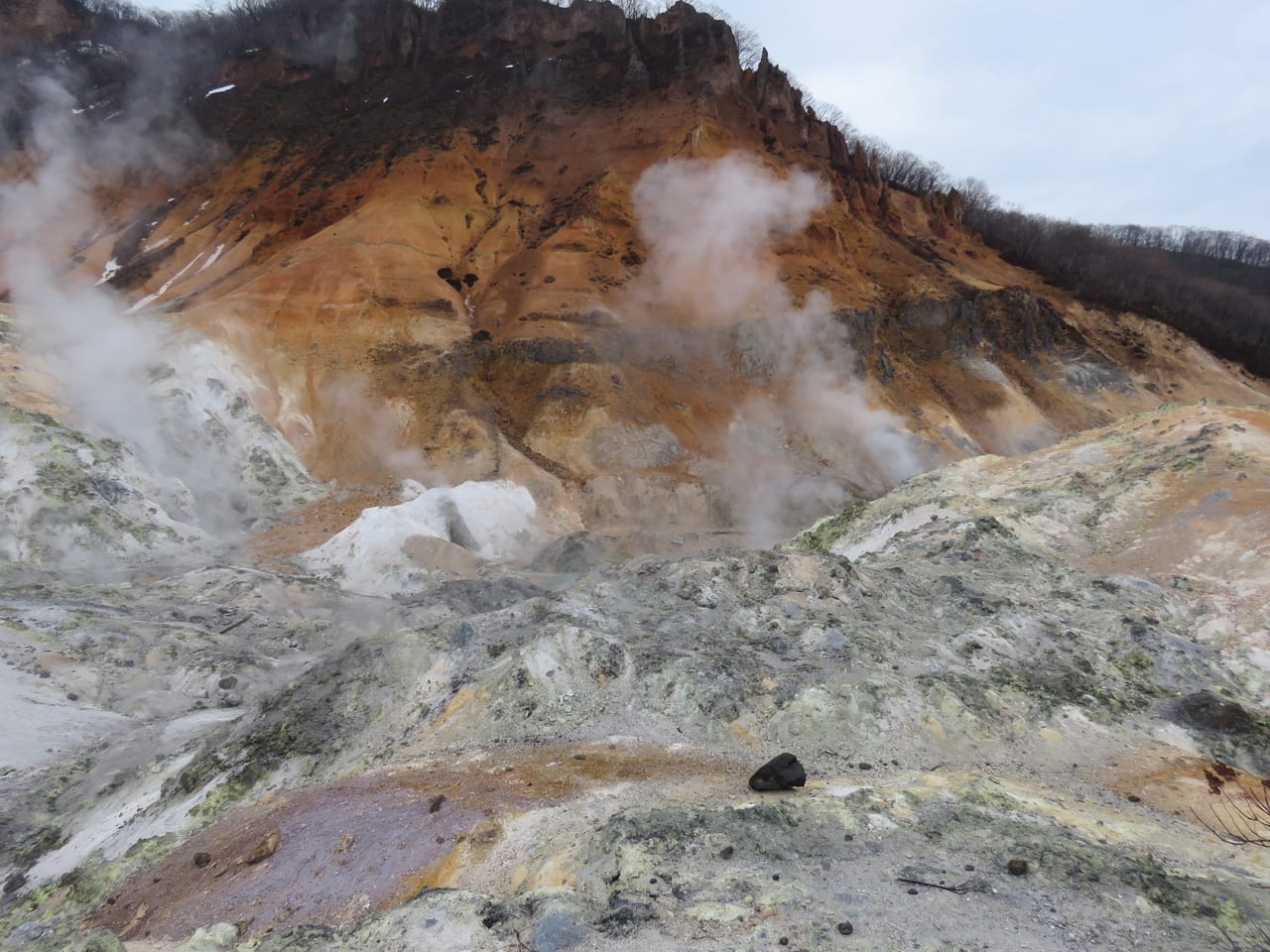
The soul of Noboribetsu is the Hell Valley (Jigokudani) at the top of the onsen street. It is a volcanic crater roughly 450 meters across, the ground a pale gray expanse venting white steam everywhere and reeking of sulfur — from a distance it genuinely looks the part. The key thing: it is completely free, and it is the place to spend your time here. Hell Valley is the source of the entire Noboribetsu onsen — the various waters welling up here (roughly ten different spring qualities, per official sources) are piped down to the ryokan below, so the bath you soak in at your hotel originates in this steaming crater.
How you do it is flexible. If you just want a look, the outer boardwalk loop runs about 30 minutes, and the overlook across the whole venting field is plenty. If you are up for more, you can continue from Hell Valley out to Oyunuma, Okunoyu, and the Oyunuma River natural foot bath — a 1.5–2 hour forest round trip and Noboribetsu's most underrated stretch. A few cautions: the volcanic gases are concentrated, so do not linger if you feel off, and stay on the boardwalk; it gets slick after rain and at night. The site is open around the clock with some lit sections in the evening, but after dark, use judgment.
Oyunuma & the natural foot bath
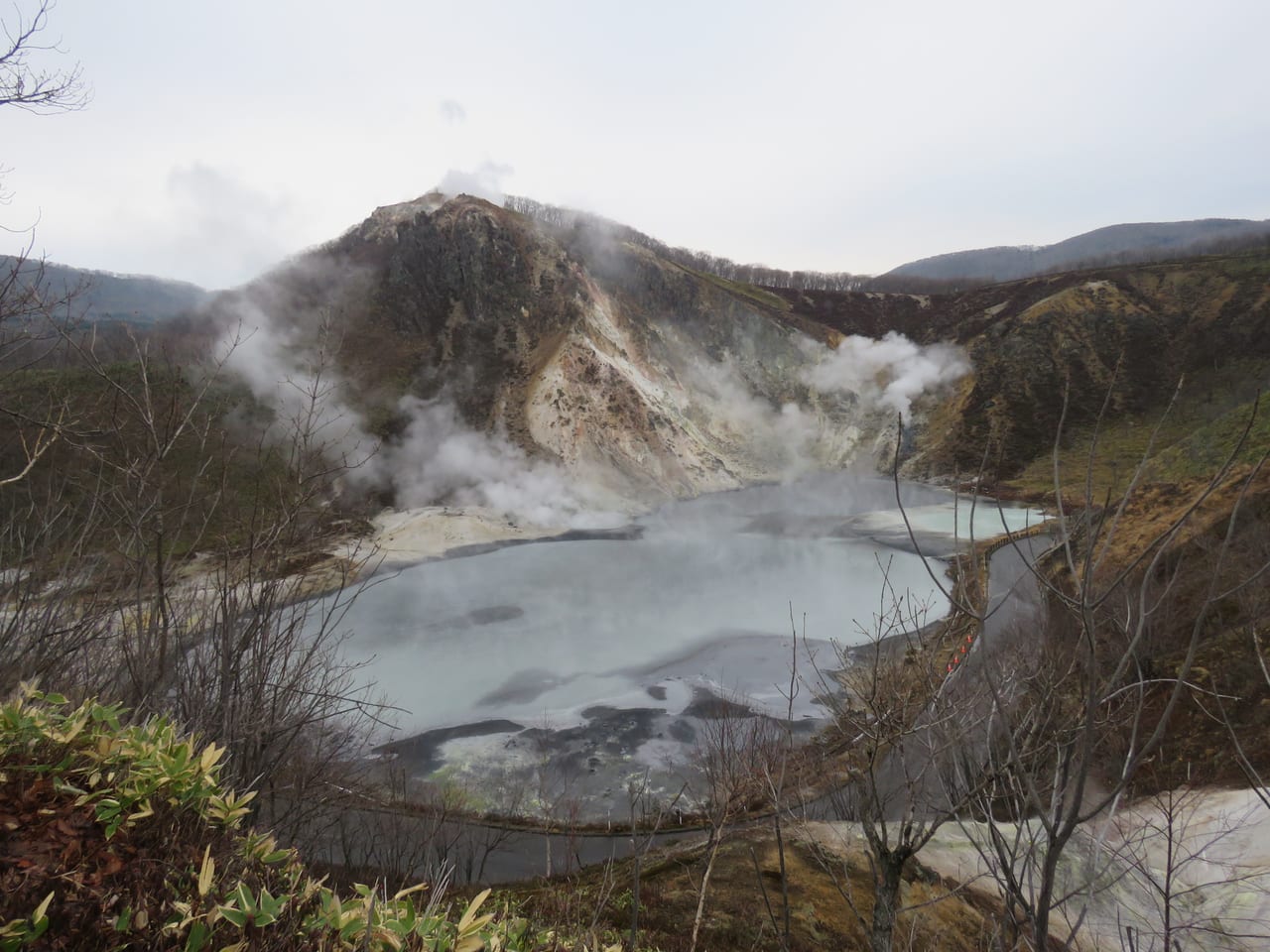
Push further in from Hell Valley and you reach Oyunuma — a dark grayish hot pond formed in a volcanic vent, its surface around 50°C and hotter at depth, the whole thing breathing sulfur steam. It is a rawer jolt than Hell Valley. You cannot bathe in Oyunuma itself (far too hot), but its outflow forms the "Oyunuma River," which cools as it runs downhill until, at one stretch, it hits a perfect foot-soaking temperature.
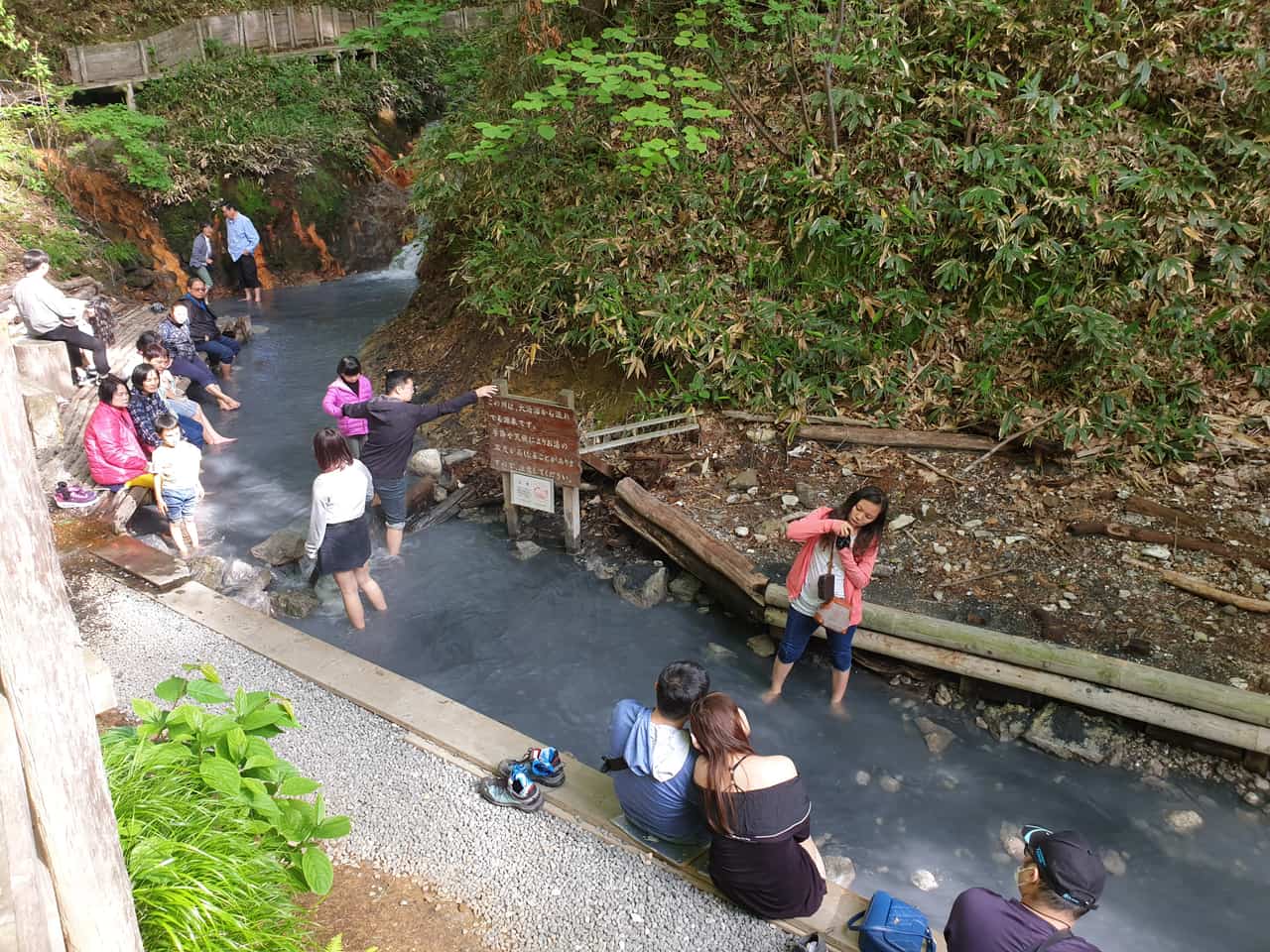
That is where the town has built the Oyunuma River natural foot bath: a boardwalk and benches along the stream where you take off your shoes, sit, and dip your feet straight into the warm, faintly sulfurous water. It is completely free with open seating, and after the Hell Valley boardwalk it is the most relaxing finish of the whole trip — riverbed stones underfoot, forest canopy overhead, with more character than any paid foot bath. The one thing to remember is to bring your own towel — none is sold on site. This is exactly why I would push you not to walk only the outer Hell Valley loop but to go deep, all the way to Oyunuma.
Noboribetsu Onsen & day bathing
Once you have seen the "source," it is time to go down and soak. Noboribetsu Onsen is nicknamed the "department store of hot springs" because, within such a small footprint, it concentrates around ten different spring qualities (sulfur, salt, iron, Glauber's salt, and more) — experiencing that many types in one onsen town is genuinely rare in Japan. The town itself is small, walkable end to end in fifteen-odd minutes, and the "Gokuraku-dori" shopping street is good for souvenirs and onsen manju, with various demon (oni) statues on the corners — Noboribetsu leans all the way into the "hell" theme, right down to its mascots being demons.
If you are not staying overnight, use a ryokan's day-bathing (higaeri) option: the landmark Dai-ichi Takimotokan is large, has many spring types, and opens for day visitors — the easiest way to sample Noboribetsu's range — and most of the big onsen ryokan run day-use windows too. Note that day-use hours and fees vary by property and may shift in peak season, so check the official notice before you go. If you want to plan the ryokan experience more carefully, our best onsen ryokan guide helps you choose a style.
Lake Toya: a caldera lake & geopark
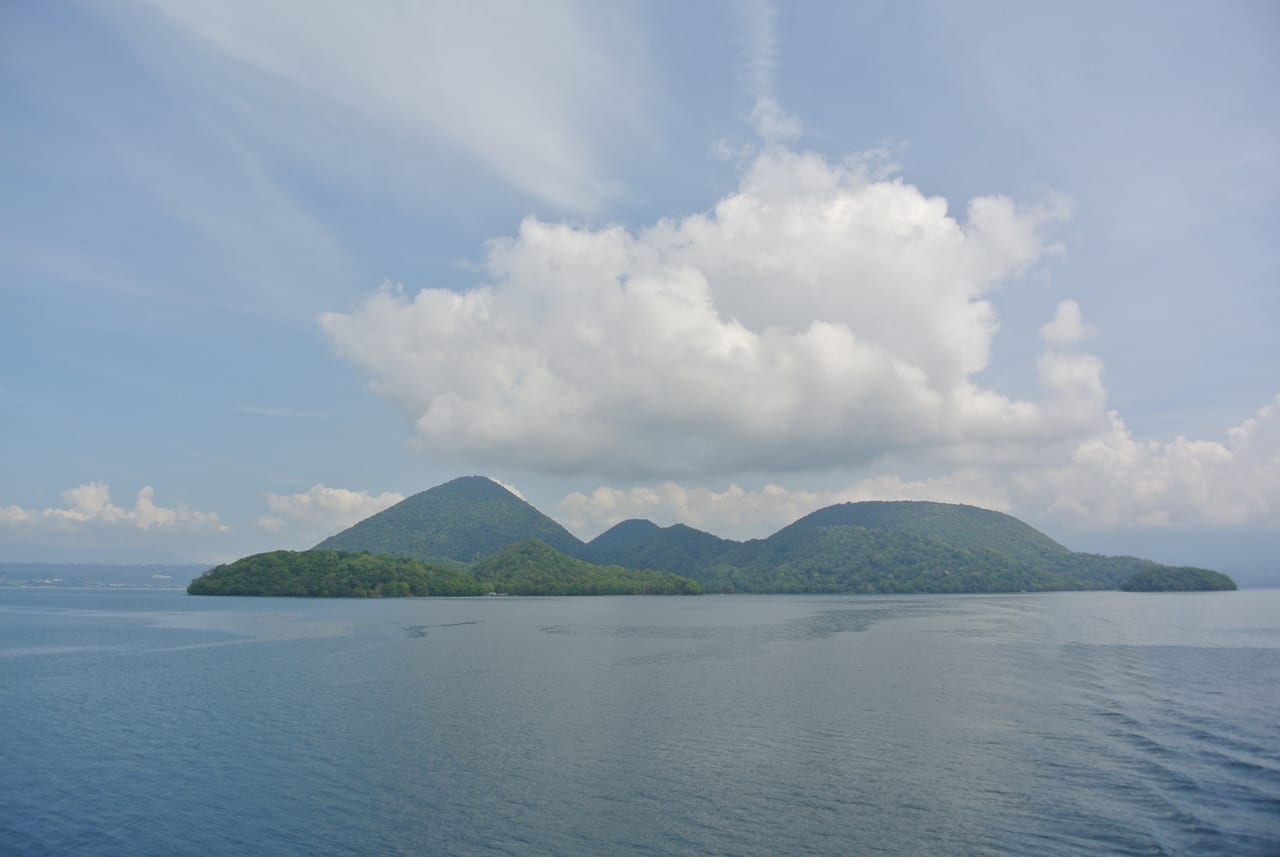
Head southwest from Noboribetsu and you reach Lake Toya — a caldera lake formed by a volcanic eruption and collapse roughly 110,000 years ago, nearly circular, with the "Nakajima" islands floating at its center. It is one of the rare Hokkaido lakes that does not freeze in winter. The biggest contrast with Noboribetsu is that open, soothing feeling: stand on the onsen lakefront with the still water in front and the still-smoking Mt. Usu behind, and the calm-versus-active tension is striking.
The whole Lake Toya, Mt. Usu, and Showa Shinzan area is certified as the Toya-Usu UNESCO Global Geopark — Mt. Usu is one of Japan's most frequently active volcanoes (it erupted four times in the 20th century, most recently in 2000), making the entire landscape a living volcanology textbook. For travelers who like geography and geology, there is more here than just a lake view: at close range you can take in a caldera lake, a young volcano, and eruption scars all at once.
Showa Shinzan & the Usuzan ropeway
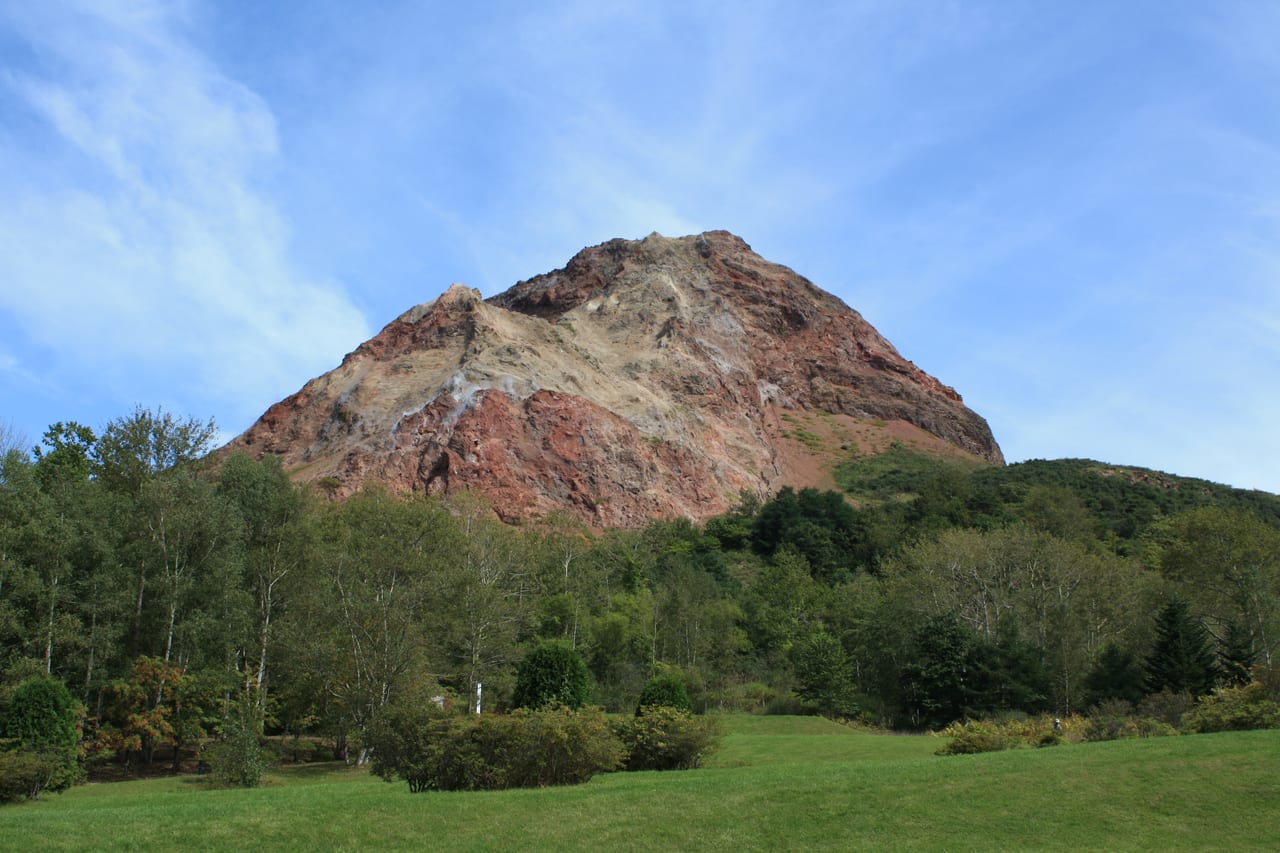
The most improbable sight around Lake Toya is Showa Shinzan — a reddish, still-smoking little volcano. What makes it special? Between 1943 and 1945, it pushed up out of a flat wheat field as an entirely new volcano. Through the war years, local postmaster Masao Mimatsu defied the skeptics to observe and chart the mountain growing taller day by day, leaving behind a precious record of a volcano's birth (later known as the "Mimatsu Diagram"). Few places on Earth let you stand and look at a volcano younger than your grandfather.
For the panorama over Showa Shinzan and the Usu crater, ride the Usuzan Ropeway. From the base station beside Showa Shinzan, the roughly 6-minute one-way ride lifts you to the crater-rim observation area, where you can take in Lake Toya, Showa Shinzan, the Usu crater, and distant Uchiura Bay in one sweep. On fares, per the operator's 2026 info it is ¥2,000 round trip for adults and ¥1,000 for elementary children (confirm on site). Note that the ropeway runs on a seasonal and weather basis — strong wind or volcanic conditions can suspend it, so check the official site first. From the summit you can also walk a short trail to the Usu crater overlook for a closer look at the scars of the 2000 eruption.
Lake Toya long-run fireworks & cruises
Lake Toya's signature — and the reason to stay a night — is the Toyako Long-Run Fireworks. Most Japanese fireworks festivals are a single night; Lake Toya runs them for about half a year, nearly every night. Per the Toyako Onsen tourism association, the 2026 edition is the 45th, running from April 28 to October 31, each night from around 20:45 for about 20 minutes. The standout detail is how they are launched: from a moving boat that tracks across the lake in front of the onsen district, so you can see them from the lakeshore, the onsen streets, even your room or open-air bath — which is the single biggest selling point of the lakeside ryokan, where lake-view rooms book up precisely for "soak and watch fireworks."
Watching is completely free, and they run rain or shine, though unstable wind can cancel a given night, so go by the day-of notice. By day, Lake Toya offers a cruise out to Nakajima — the central islands have a forest museum and walking trails, and in summer you can land and hike (some seasons circle the islands without landing, per the operator). Pairing "daytime cruise on the lake, then soak and wait for fireworks at dusk" is the fullest way to do Lake Toya.
Transport & lodging (from Sapporo)
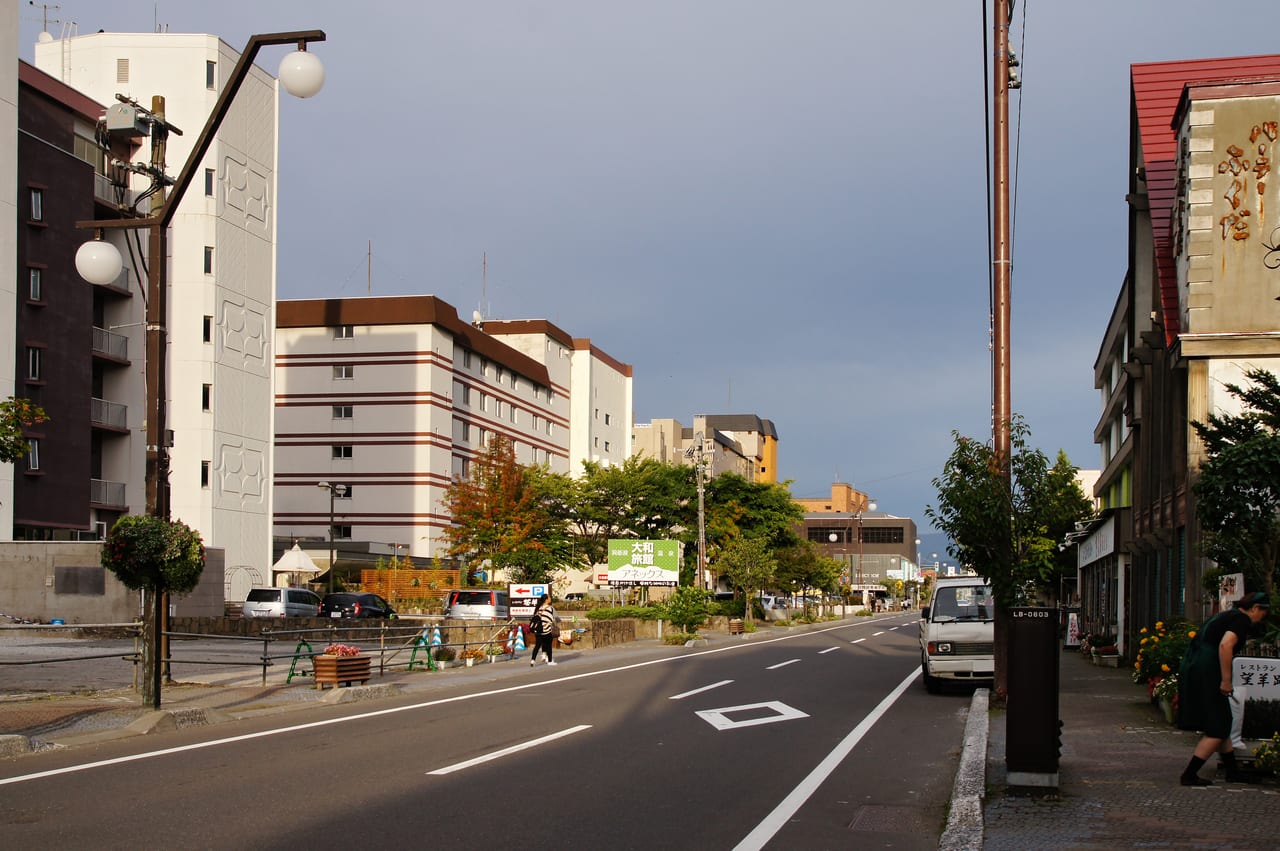
You can do all of this without a car, but both towns share the same structure — the station is down on the flat, the sights are up at the onsen town — so you transfer to a bus after arriving. Keep that in mind.
- Sapporo → Noboribetsu: a JR limited express (Hokuto and others) reaches Noboribetsu Station in about 70 minutes. From there, a Donan Bus up to Noboribetsu Onsen takes about 15 minutes (the onsen town is up the hill; the station is on the coast). The Hell Valley and Oyunuma trailheads are just above the onsen street, within walking distance.
- Noboribetsu → Lake Toya: the two connect by JR plus bus (transferring via the Oshamambe or Muroran direction, depending on the timetable); service is not frequent, so check ahead. Self-driving the Doo Expressway is far more flexible.
- Sapporo → Lake Toya: a JR limited express to Toya Station, then a Donan Bus to Toyako Onsen in about 20 minutes. There are also direct highway buses from Sapporo to Toyako Onsen.
If the wider Hokkaido trip leans heavily on JR limited expresses, run the break-even with our Hokkaido JR Pass guide first — but note the Donan Buses up to both onsen towns are not covered by the pass and are paid separately. For lodging, stay right on the onsen street: in Noboribetsu Onsen, a night soaking the many spring types and then hitting the Hell Valley trail first thing the next morning flows best; in Toyako Onsen, be sure to book a lake-view room, because soaking in the open-air bath while the fireworks go off is the whole point. Peak season (the summer fireworks run, long holidays) gets tight, so book early. For pre-trip weather and packing — Hokkaido's day-night temperature swing in particular — see our Japan packing & weather guide.
A one-night plan
Here is the same content shaped into a route from Sapporo that flows:
- Day 1 (Noboribetsu: volcanoes + soak): JR limited express from Sapporo to Noboribetsu Station → Donan Bus up to Noboribetsu Onsen → drop bags, walk the Hell Valley boardwalk → push on to Oyunuma and the Oyunuma River natural foot bath (free foot soak) → back to the onsen street for Gokuraku-dori and the demon statues → check into a Noboribetsu onsen ryokan and soak the many spring types that evening.
- Day 2 (Lake Toya: lake + fireworks): morning transfer from Noboribetsu to Toyako Onsen → ride the Usuzan ropeway for Showa Shinzan and the crater panorama → afternoon Lake Toya cruise to Nakajima or a lakeside stroll → check into a lake-view room → soak and watch the long-run fireworks at 20:45 (during the Apr 28–Oct 31 run).
If you only have one day and cannot stay over, pick one: Noboribetsu as a day trip for the hardcore sulfur baths and volcanic hell, or Lake Toya for the born-from-a-field volcano and lakeside fireworks (but the fireworks are at night, so a day trip is rushed — try to stay over). Both towns sit on the southbound corridor from Sapporo, so loop back via the Sapporo guide to the north or extend south to Hakodate and ride up Mt. Hakodate (closure dates and winter access in our Mt. Hakodate Ropeway closures guide) for a well-rounded southern-Hokkaido onsen run.
FAQ
- Q1:Can you do Noboribetsu and Lake Toya in one day, or do you need to stay over?
- Honestly, they sit in different directions and each deserves half a day or more, so cramming both into one day is rushed. The smart play is a one-night onsen trip out of Sapporo: day one for Noboribetsu (Hell Valley, Oyunuma, a soak) staying in Noboribetsu Onsen, day two over to Lake Toya (the Usuzan ropeway for Showa Shinzan, a lake cruise, and fireworks at dusk). If you truly only have one day, pick one — Noboribetsu for the hardcore sulfur baths, Lake Toya for volcanoes and lakeside fireworks. Both sit on the Sapporo–Hakodate corridor, so you can carry on south to Hakodate for the night view from Mt. Hakodate (ropeway hours and closures in our Mt. Hakodate Ropeway guide) or loop back via the Sapporo guide.
- Q2:Is Noboribetsu Hell Valley (Jigokudani) free, and how long does it take?
- Hell Valley itself is free and is the single best use of your time in Noboribetsu. It is a volcanic crater roughly 450 meters across, the ground venting white steam and reeking of sulfur, with a full boardwalk loop around it — and it is the source of the roughly ten different spring qualities the town pipes to its ryokan. The outer boardwalk loop runs about 30 minutes; pushing on to Oyunuma and the Oyunuma River natural foot bath is a 1.5–2 hour round trip on forest trail, so wear decent shoes. The site is open around the clock with some lit sections at night, but the boardwalk gets slick after dark and the volcanic gases warrant care — per official advice, do not linger if you feel unwell.
- Q3:What is the Oyunuma River natural foot bath, and is it really free?
- Yes, and it is one of the best free things in Noboribetsu. Oyunuma is a sulfur hot pond whose surface runs around 50°C (hotter at depth); its outflow forms the "Oyunuma River," which cools downstream to a comfortable foot-soaking temperature. The town has set up a natural foot bath along the riverbank with boardwalk and benches — free, open seating — where you slip your feet into the warm, sulfur-scented stream. After the Hell Valley boardwalk, it is the most relaxing way to finish. Just bring your own towel (none sold on site). Reaching it on foot through the forest from Hell Valley is Noboribetsu most underrated stretch.
- Q4:How much is the Usuzan ropeway, and what is Showa Shinzan?
- The Usuzan Ropeway is ¥2,000 round trip for adults and ¥1,000 for elementary children (per the operator official 2026 info — confirm on site), a roughly 6-minute one-way ride up to the crater observation area with a sweeping view over Lake Toya and Uchiura Bay. Showa Shinzan is the reddish, still-smoking little volcano beside the base station — and it is remarkable because it pushed up out of a wheat field as an entirely new volcano between 1943 and 1945. It is one of the few places on Earth where the birth of a volcano was documented, famously charted by local postmaster Masao Mimatsu. The whole Usuzan and Showa Shinzan area belongs to the Toya-Usu UNESCO Global Geopark.
- Q5:When are the Lake Toya fireworks, and do they cost anything?
- Lake Toya signature draw is the Toyako Long-Run Fireworks. Per the Toyako Onsen tourism association, the 45th edition in 2026 runs from April 28 to October 31, nearly every night from around 20:45 for about 20 minutes — a rare half-year-long fireworks run. Watching is free: the fireworks are launched from a moving boat tracking across the lake in front of the onsen district, so you can see them from the lakeshore, the onsen streets, even your room or open-air bath — which is exactly why lake-view ryokan rooms here are so prized. They run rain or shine, but unstable wind can cancel a given night, so check the day-of notice.
- Q6:How do I get to Noboribetsu and Lake Toya from Sapporo? Do I need a car?
- No car needed. Noboribetsu: a JR limited express (Hokuto and others) from Sapporo reaches Noboribetsu Station in about 70 minutes, then a Donan Bus up to Noboribetsu Onsen takes about 15 minutes (the onsen town is up the hill; the station is down on the coast). Lake Toya: a JR limited express to Toya Station, then a Donan Bus to Toyako Onsen in about 20 minutes. The two towns connect by JR plus bus as well, but service is not frequent, so without a car, lock in the train and bus times in advance. If the wider trip leans on JR, run the break-even math with our Hokkaido JR Pass guide; to fit both into a longer winter trip, see the Hokkaido winter 7-day itinerary.
Related reading:
Sapporo Travel Guide 2027: Odori Park, Snow Festival & Mt. Moiwa
Hokkaido's gateway and food capital — Odori Park and the Snow Festival, the Clock Tower, Mt. Moiwa's night view, miso ramen, Genghis Khan and soup curry.
Mt. Hakodate Ropeway 2026: Hours, Closure Dates & Winter Access
Closed Oct 20–Nov 8, 2026, and the only way up once the road shuts on Nov 9 — hours, weather checks, night-view crowds and every way up by month.
Hokkaido Winter 7-Day Itinerary 2026
Sapporo → Otaru → Biei → Hakodate over 7 days, with JR Pass math, how to reach the Furano slopes, and a real two-person budget.