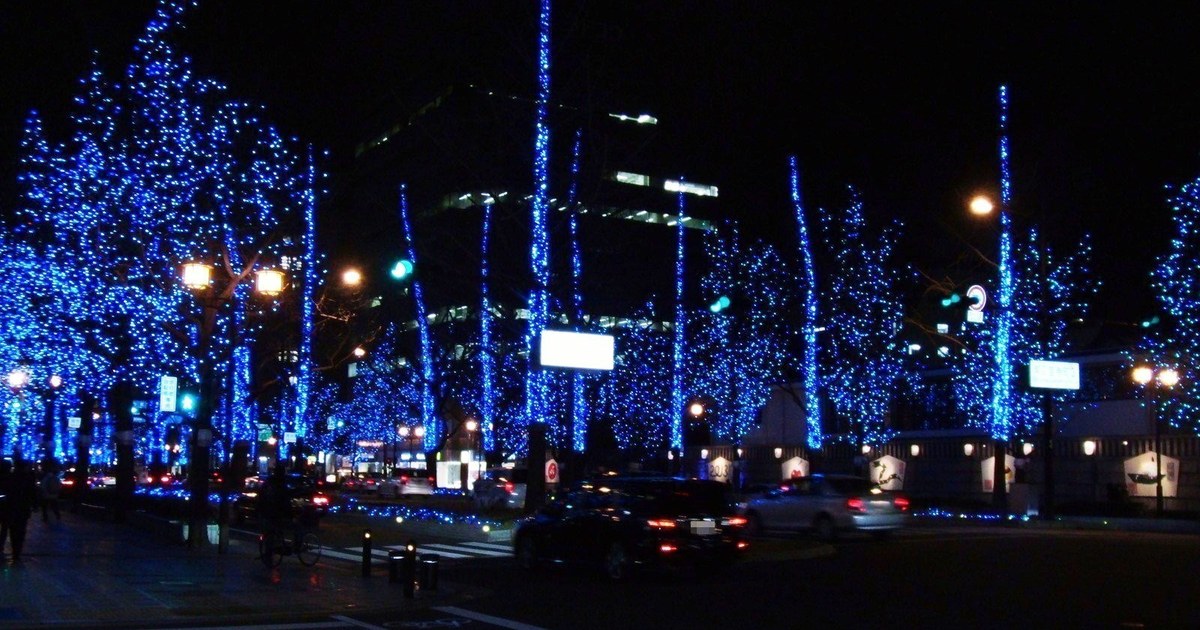
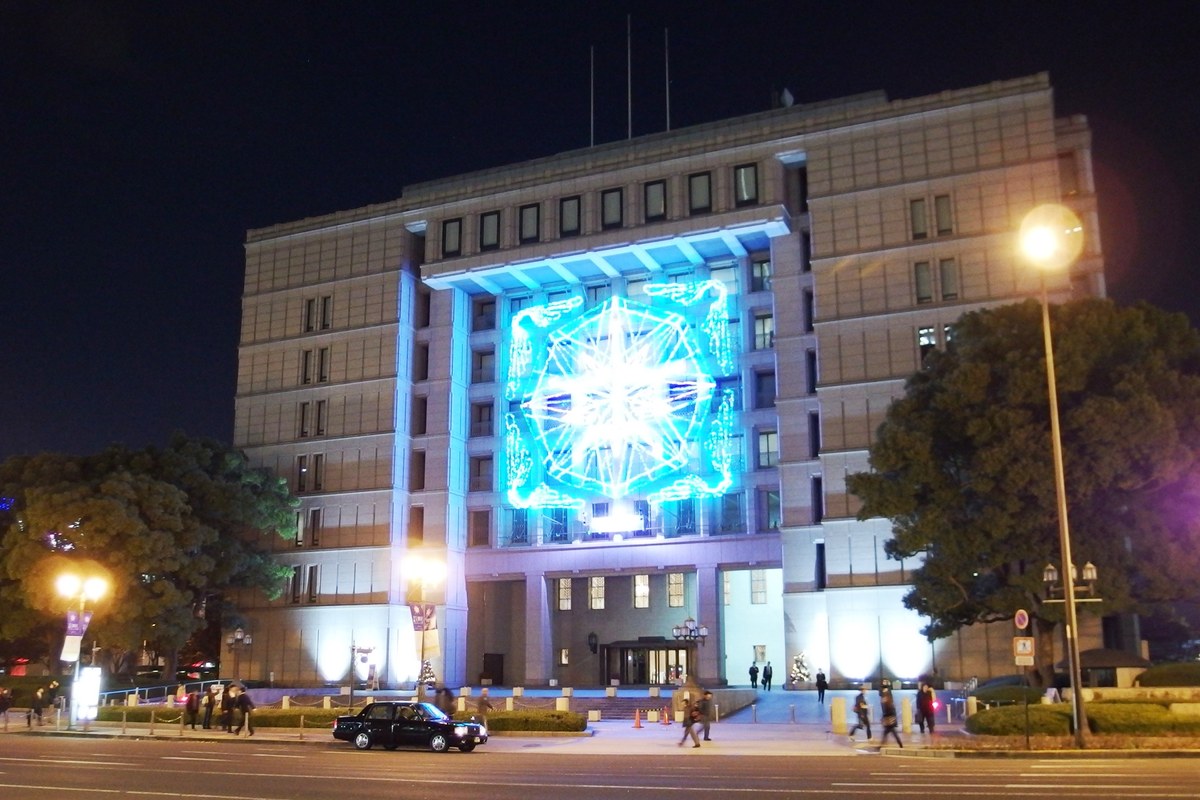
The photograph that made you search for this — Nakanoshima, reflections on the water, Osaka City Central Public Hall wrapped in projection — comes from an event that runs for 15 days a year. It is called OSAKA Hikari no Renaissance, and its official 2026 dates are 11 to 25 December. That is the whole run. Meanwhile the Midosuji Illumination, filed under the exact same umbrella name, runs 59 nights (3 November to 31 December), and the umbrella festival itself is billed at 90 days (3 November to 31 January). A six-fold spread between three things the official programme files under one name. This guide answers a single question: on the nights you are actually in Osaka, what will be lit? Along the way it kills three assumptions that cost people entire evenings — the ginkgo leaves are gone by mid-December, the core programmes all stop on 1 January, and Kobe Luminarie does not open until 29 January.
- Three different runs: umbrella 90 days / Midosuji 59 days (3 Nov–31 Dec) / Hikari no Renaissance only 15 days (11–25 Dec)
- Nakanoshima has two layers: the Illumination Street and City Hall facade run to 31 December, but from 26 December those two are all that is left
- Golden ginkgo plus lights overlap for about two weeks: late November to early December, then bare branches
- 31 December is the final night, lit until 01:00 on 1 January; nothing core survives into January, and Kobe waits until 29 January — 1 to 28 January is a four-week gap in street illuminations; for lights, go to Osaka Castle Illuminage (ticketed, until 14 Feb)
- Free, no paid seating, no reservations; hours are around 17:00 to 25:00, not a 23:00 finish
📖 Contents
- 1. One table: why three runs differ six-fold
- 2. What is lit on your dates
- 3. Ginkgo and lights: the only two-week overlap
- 4. Nakanoshima’s two layers
- 5. New Year’s Eve, and what is still lit in January
- 6. Free entry: no tickets, no paid zones, no reservations
- 7. Walking 4 km: route, timing, and the day-pass question
- 8. The numbers trap: Guinness, 45 million visitors, and unpublished bulb counts
- 9. What is still unannounced for 2026
- 10. FAQ
One table: why three runs differ six-fold
Start with the structure, because everything else follows from it. “Osaka Hikari no Kyoen” — Festival of the Lights in Osaka — is an umbrella name, not an event. Underneath it sit programmes of wildly different scale and duration, coordinated by an executive committee that includes Osaka Prefecture, Osaka City, the Osaka Convention and Tourism Bureau and regional business associations. Here is what is officially confirmed for 2026:
| Programme | 2026 dates | Length | Hours | Where |
|---|---|---|---|---|
| Osaka Hikari no Kyoen 2026 (umbrella) | 3 Nov 2026 – 31 Jan 2027 | 90 days | Varies by programme | Across Osaka City |
| Midosuji Illumination 2026 | 3 Nov – 31 Dec 2026 | 59 days | Around 17:00 – 25:00 | Midosuji, Hanshin-mae to Namba Nishiguchi |
| OSAKA Hikari no Renaissance 2026 | 11 – 25 Dec 2026 | 15 days | Varies by programme (projection 17:30–21:30, Hikari no Marché 16:00–22:00) | Around City Hall to Nakanoshima Park |
| Nakanoshima Illumination Street + City Hall illuminated facade | 3 Nov – 31 Dec 2026 | 59 days | Around 17:00 – 25:00 | Nakanoshima, around City Hall |
| Area programmes | Within the umbrella run; from 1 Jan, these are all that remain | Set individually | Announced individually | Commercial venues; 2026 list unpublished |
That table is the spine of this guide, and also the source of every misunderstanding about it. Alongside the umbrella dates, the city adds one clarifying line: from 1 January 2027, only some area programmes will operate. Translated: 90 days is the length of the name, not the length of anything you would travel to see. For those 31 days in January, both Midosuji and Hikari no Renaissance have already closed.
What is lit on your dates
Here is that table converted into the only form that matters when you already hold flights: five date bands, and what each one actually gets you.
| Your dates | Lit | Not lit | My verdict |
|---|---|---|---|
| 3–20 Nov | All of Midosuji, Nakanoshima Illumination Street, City Hall facade | Hikari no Renaissance; ginkgo mostly still green | The quietest stretch. Good if you want photographs without crowds |
| 🟢 21 Nov – 10 Dec | All of Midosuji plus golden ginkgo, both Nakanoshima items | Hikari no Renaissance | The best-looking window. One visit only, and you want the picture? Book here |
| 🟢 11–25 Dec | Everything: Midosuji, Hikari no Renaissance, both Nakanoshima items | Ginkgo largely past its peak | The fullest programme, and the busiest two weeks. The Nakanoshima headline show exists only here |
| 26–31 Dec | Midosuji, Nakanoshima Illumination Street, City Hall facade | Hikari no Renaissance (closed 25 Dec); leaves gone | Lights yes, Nakanoshima reduced to two items. 31 Dec is the final night, lit to 01:00 |
| 🔴 1–31 Jan | “Some area programmes” only — commercial venues | Midosuji and Hikari no Renaissance both finished | No street illuminations; for lights, go to the ticketed Osaka Castle Illuminage (until 14 Feb). Kansai’s next street-scale display is Kobe on 29 Jan |
If you can only pick one band, pick 11–25 December. Not because there is more to see — that would be a lazy reason — but because Midosuji is available on any of 59 nights while the Renaissance gives you 15, and a missed 15-day window is simply missed. The corollary matters just as much: if you are travelling for the photograph of golden trees under lights, do not try to have both. That image is essentially gone after 11 December. The only crack where the two might coincide is roughly 11 to 15 December in a season where the leaves hold late — a gamble, and you should at least know you are placing one.
Ginkgo and lights: the only two-week overlap
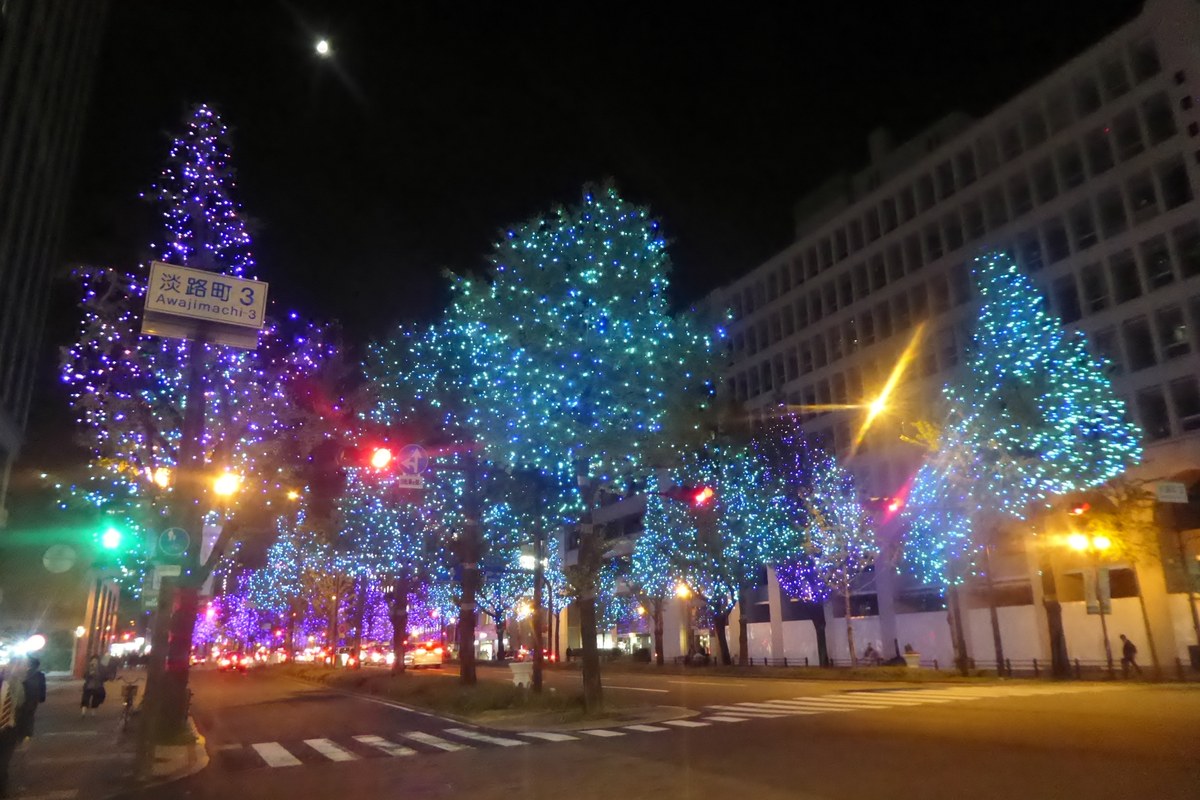
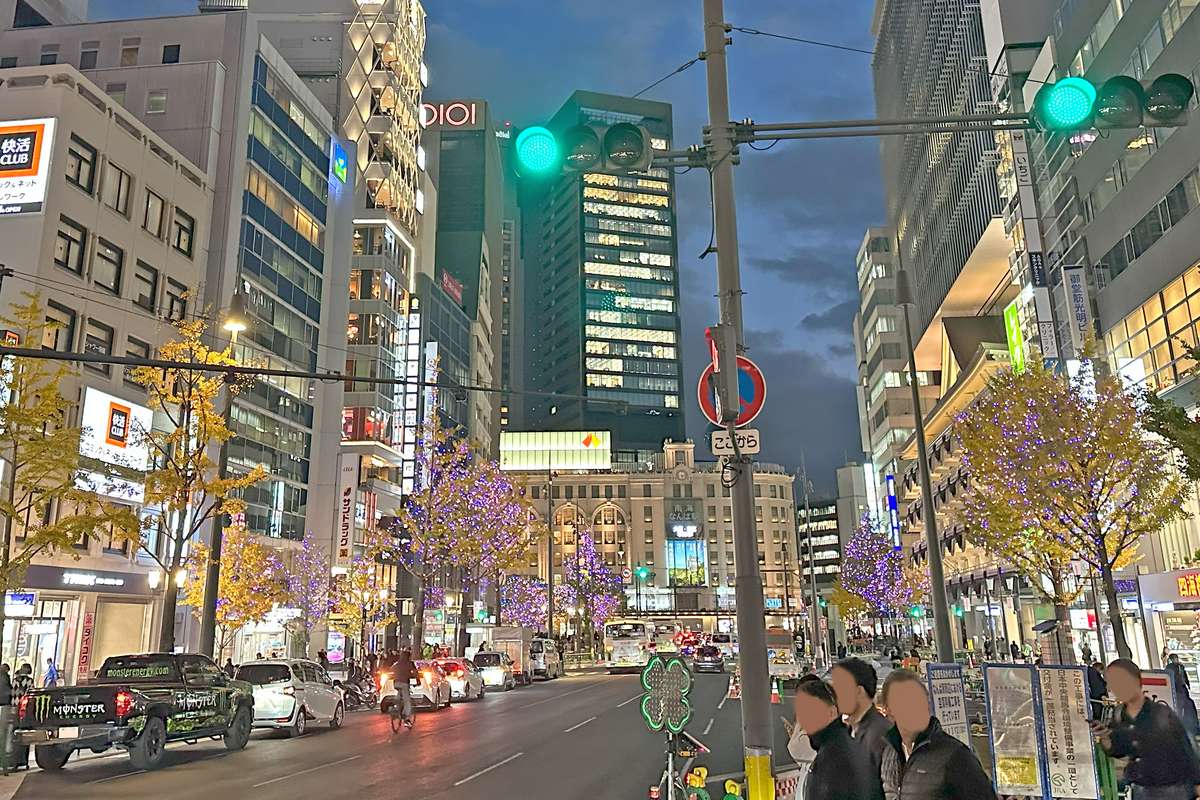
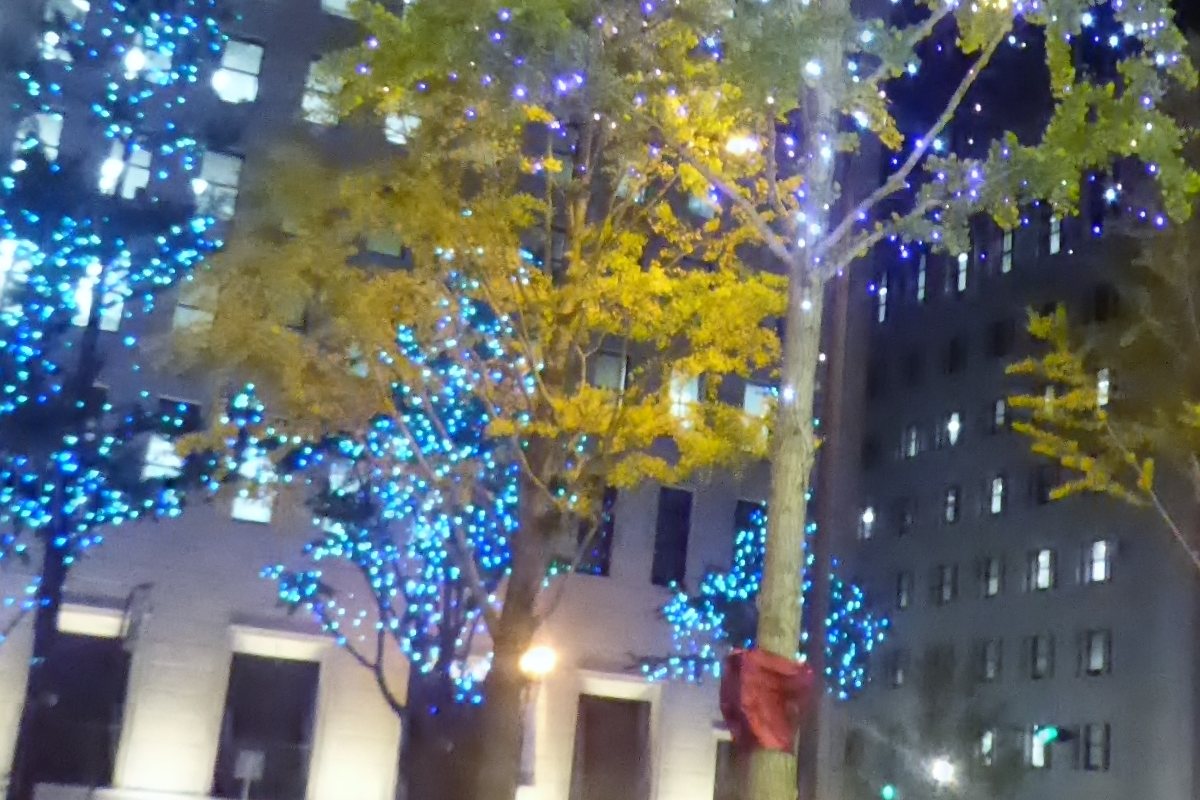
This is the sort of thing people notice only after they have taken the photos: the Midosuji lights are wound around the street trees themselves, not mounted on poles or frames. And those trees are Osaka’s best-known ginkgo avenue.
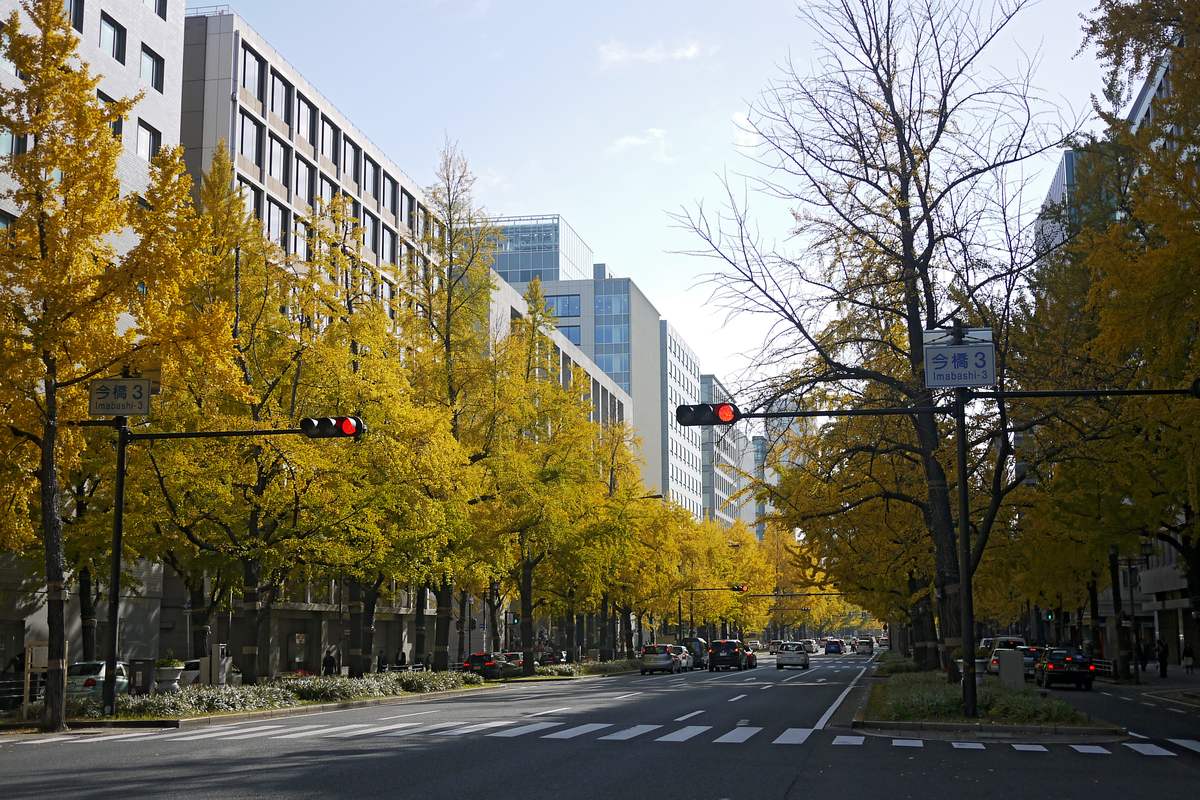
Per Osaka city records, ginkgo planting on Midosuji began in 1933 and 928 trees had gone in by its completion in 1937, in four rows along a 44-metre-wide boulevard. The practical consequence is that the same trees give you three completely different scenes depending on the date:
- Early to mid November: lights already on (from 3 November), leaves still green or barely turning. Light strings inside green foliage look a bit muddled.
- Late November to early December: gold leaves and light strings together. By day a continuous golden tunnel; after dark the lights come up while the leaves are still there catching them. This is the only overlap of the season, and it lasts roughly two weeks.
- Mid December onward: leaves down. What is left is bare branches carrying the lights — clean lines, pure colour, genuinely photogenic, but nothing like the golden avenue if that is what you flew for.
The ginkgo peak is a probability window, not a guarantee. There is no official annual forecast for “late November to mid-December” — the Japan Meteorological Agency does not run a phenological observation for Midosuji ginkgo. A mild autumn pushes it later, an early cold snap strips the trees sooner. Check current photos from central Osaka in the week before you fly.
For the daytime version of these trees — how to combine the Midosuji ginkgo with Osaka Castle and Nara Park in one day — see our Osaka and Nara autumn foliage guide. Same trees, opposite half of the clock.
Nakanoshima’s two layers
Everything above is a calendar problem. This next one is structural.
Nakanoshima carries two separate layers of winter lighting, and their runs differ by a factor of four:
- The long layer (3 Nov – 31 Dec, 59 days, around 17:00–25:00): the Nakanoshima Illumination Street and the illuminated facade of Osaka City Hall. These open and close in lockstep with Midosuji.
- The short layer, i.e. OSAKA Hikari no Renaissance itself (11–25 Dec, 15 days): this is where the photograph comes from. Projection programmes and the light markets — the labour- and space-hungry content — all sit in this layer. Hours differ by programme; the projection and market times are listed further down this section.
The cost of conflating them is concrete: people plan a late-December Osaka trip, read that the festival runs to 31 January and that Nakanoshima has lights, assume the projections and markets are still on, arrive on 26 December, and find a lit walkway and a floodlit city hall. Both are worth seeing. Neither is what they came for.
So treat Nakanoshima as a binary. If your dates fall inside 11–25 December, it is a must, and it deserves a whole evening. If they do not, demote it to a walk-through: it is a few minutes on foot from the northern end of Midosuji, so look at the city hall facade and carry on. Do not reserve an evening for it.
The nearest stations are Yodoyabashi and Kitahama (Osaka Metro and Keihan) plus Naniwabashi and Oebashi on the Keihan Nakanoshima Line — all within walking distance, and Yodoyabashi also sits on the Midosuji Line, which is precisely why the walk-through costs you nothing.
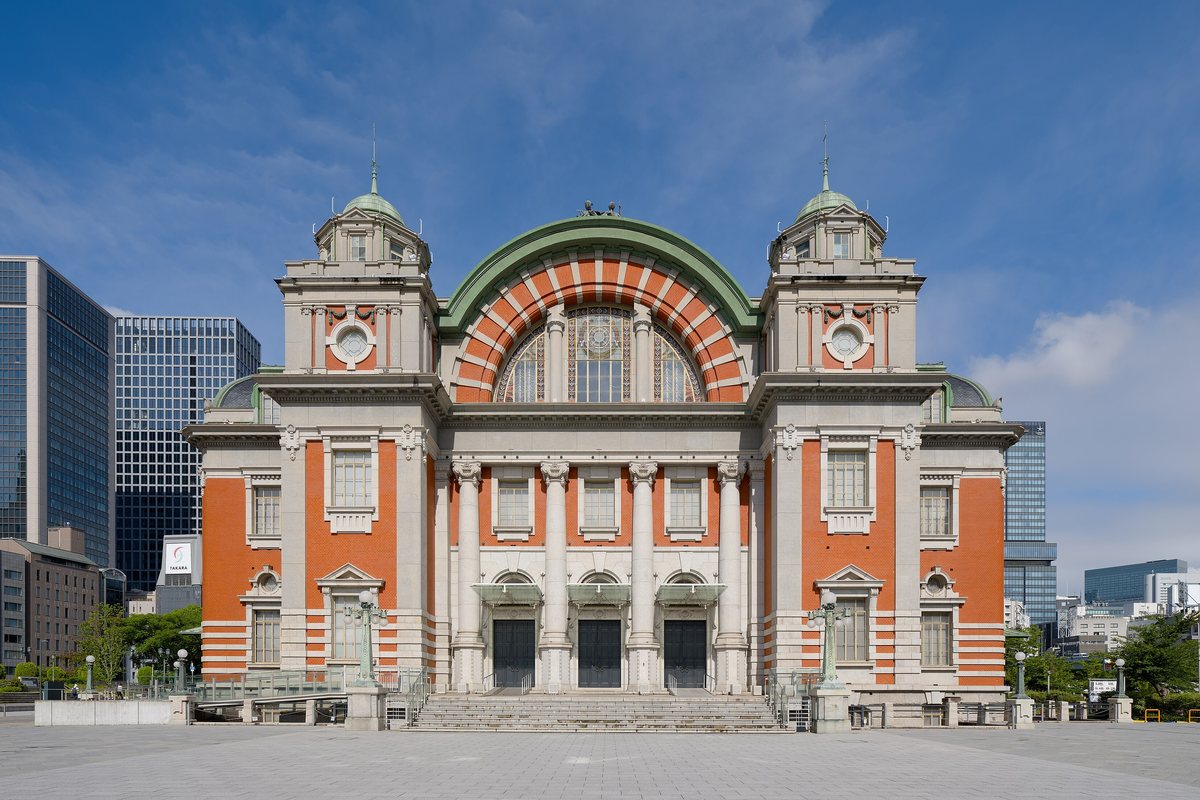
Hikari no Renaissance has nine items in all. Two start early — the City Hall facade and the Illumination Street, 3 November to 31 December, 17:00–25:00. The rest run 11–25 December only: the Central Public Hall projection (17:30–21:30, every 12 minutes, last showing 21:20); Hikari no Marché (food stalls and mulled wine), 16:00–22:00, around Naniwabashi Station; a concert at the City Hall front entrance (17:30, 18:30, 19:30 and 20:30); the Christmas Handmade Marché and a riverside illumination on the riverbank by the water stage (both 17:00–22:00); a giant snowman near Naniwabashi Station (17:00–22:00); and student works from Osaka University of Arts on the west side of the rose garden (17:00–21:30, to 20:00 on 25 December).
New Year’s Eve, and what is still lit in January
“Can I see the lights if I go to Osaka for New Year?” has an unusually precise answer: yes on 31 December, no from 1 January.
31 December: the final night, and it crosses midnight
The published Midosuji run is “3 November to 31 December (59 days)”, with hours “around 17:00 to 25:00”. In Japanese timetable convention 25:00 is 01:00 the next morning, which means the 31 December session runs past midnight and into 1 January 2027.
The organisers treat it the same way: their news archive still carries a notice published on 4 January 2023, apologising for the illumination not being lit after 24:00 on 31 December 2022.
How to use this: New Year crowds in Osaka concentrate on Dotonbori and at Universal Studios Japan, while all 4 km of Midosuji is lit and stays lit until 01:00. If the density at Ebisubashi is not for you, walking north up Midosuji from Shinsaibashi is a completely different version of the same night — same date, same lights, a fraction of the people. The full New Year picture (the USJ ticket lottery, the three shrines for hatsumode, and which lines actually run all night) is in our Osaka New Year, hatsumode and Toka Ebisu guide; that night is precisely where the two articles divide.
From 1 January: core programmes gone, Kobe not until 29 January
After 1 January, the official note reads simply: only some area programmes operate. Midosuji is off; Hikari no Renaissance ended a week earlier.
What is left? Going by last season — the 2026 line-up has not been announced — programmes such as the Nakanoshima EAST waterside walk to 31 January and the Dramatic Minami Illumination at Namba Parks and Takashimaya Osaka to 15 February. They are genuinely running — but they are commercial-property installations, not remotely the same order of magnitude as a 4 km boulevard, and they should not be used to claim that January in Osaka still has lights.
Then there is the regional problem. Kobe Luminarie moved its run from December to late January starting with its 29th edition in 2024, and the 32nd edition is officially 29 January to 7 February 2027. Put the two facts together:
Kobe’s own rules (which of the three sites are free, timed tickets for the paid area at Meriken Park, and the 100-yen contribution) are in our Kobe Luminarie 2027 guide. The short version: December in Kansai means Osaka; Kobe’s turn comes in late January.
Free entry: no tickets, no paid zones, no reservations
This section is short but it will save you a lot of searching: both of Osaka’s core programmes are free, with no paid seating, no paid viewing area and no reservation system.
The official FAQ puts it as free in principle, with an entry fee only at some area programmes; the Central Public Hall projection is free to watch and Hikari no Marché is free to enter. Midosuji is a public road; the concept of a ticket gate does not apply.
The reason anyone asks is that Kobe took the opposite route — a voluntary 100-yen contribution per person, and a light corridor that sits inside a paid, timed-ticket area at Meriken Park. Two cities, two opposite answers to the same question:
| Item | Osaka (Midosuji, Hikari no Renaissance) | Kobe Luminarie |
|---|---|---|
| Admission | Free | Higashi Yuenchi Park and the former settlement are free; a voluntary 100-yen contribution per person is requested |
| Paid viewing area | None | Yes — Meriken Park, with the light corridor inside it |
| Reservations | None | Timed tickets for the paid area (sales scheduled from 1 November 2026) |
| Run length | Midosuji 59 days / Renaissance 15 days | 32nd edition, 10 days (29 Jan – 7 Feb 2027) |
| Flow | Open; walk in and out at will | Three sites in any order; the paid area admits by ticket time slot |
Osaka’s only paid route in is a donation: the Midosuji Illumination Fund’s “My Message Tree”. Course A is 10,000 yen or more per plate; course B runs 35,000 yen for two plates, 52,500 for three, 70,000 for four and 87,500 for five, capped at five. What you get is not access but a 12 × 17 cm resin plaque (message up to 20 characters plus a name up to 15), installed 3 November to 31 December on the pavement side of a Midosuji ginkgo trunk. Applications for 2026 opened on 1 June and closed on 31 July, so that ship has sailed — but it does add a small pleasure to the walk: those little plaques on the trunks are not decoration, they are other people’s messages.
Walking 4 km: route, timing, and the day-pass question
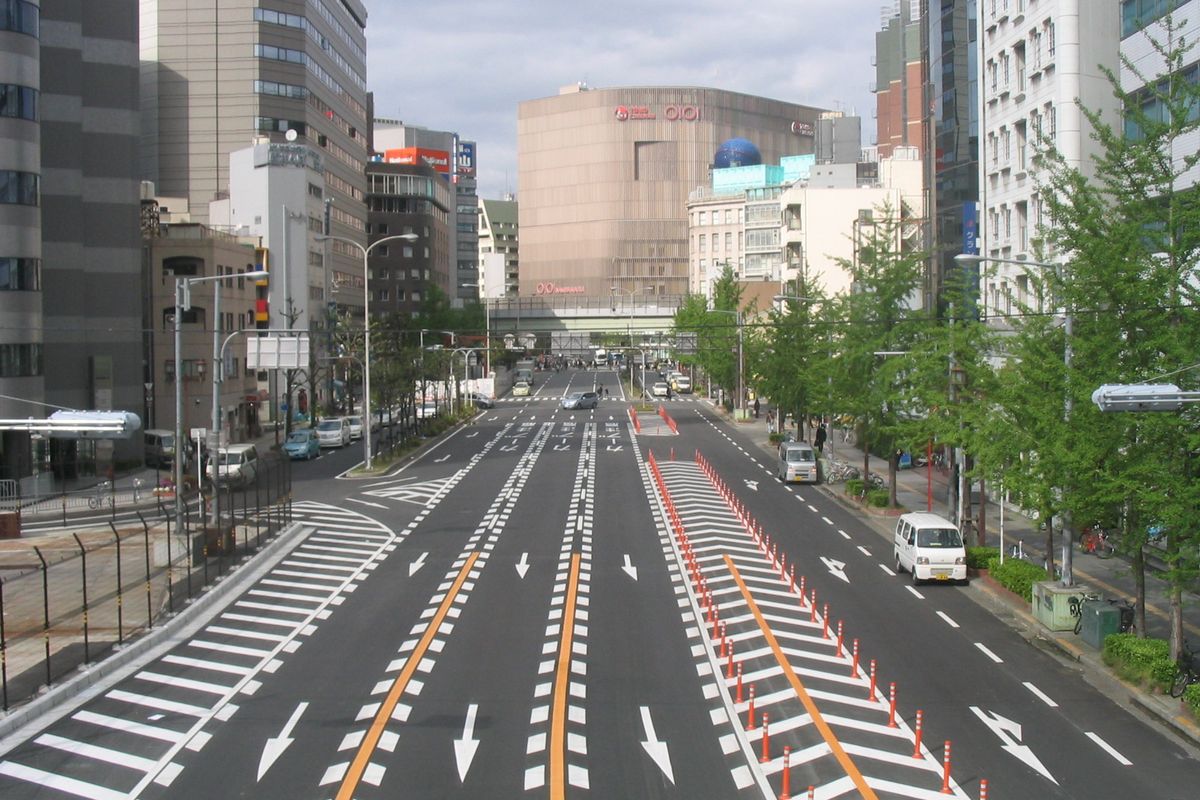
The official route is stated as Hanshin-mae intersection in Kita Ward to Namba Nishiguchi intersection in Chuo Ward, and the organisers describe the lit section as “Midosuji 4 km”. The great virtue of this walk is how absurdly simple its structure is: one straight boulevard with the Osaka Metro Midosuji Line running directly underneath it — Umeda, Yodoyabashi, Hommachi, Shinsaibashi, Namba, stop by stop, tracking the street above.
Hanshin-mae at the north end sits directly below Umeda; Namba Nishiguchi at the south end is Namba. So there is exactly one decision: north to south, or south to north.
- I would walk north to south (Umeda → Namba). You finish in Namba with dinner, Dotonbori and the Shinsaibashi arcade at your feet — a natural ending. Reverse it and you finish in Umeda, where the illumination density is actually lower; as a finale it deflates.
- Full walk: roughly 50 to 60 minutes (4 km at 4–4.5 km/h); crossings and crowds will stretch it.
- You can quit at any point, which is this route’s best feature. Tired, cold, travelling with children? Turn at any intersection, walk a few dozen metres, and there is a Midosuji Line entrance. There is no prize for finishing — do not grind it out.
- Timing: the official window runs to 25:00. Pressed for time, go 18:00–20:00; for unhurried photographs I would go after 22:00, with three hours of light still left.
Is a day pass worth it? No
This is a decision people get talked into by the "it must be better value" reflex. On an illumination evening you almost certainly will not use one.
The Osaka Metro Enjoy Eco Card costs ¥820 for an adult on weekdays, ¥620 at weekends and on public holidays, and ¥310 for children. A single Metro ride within the city runs roughly ¥190 to ¥240 — so the weekday pass needs four rides to break even. But the whole point of Midosuji is that you walk it: realistically you take one ride out to Umeda and one back from Namba. Two. Buying the pass means paying for headroom you will not touch.
When should you buy something? If your daytime already includes paid attractions — Osaka Castle, Tsutenkaku, a Dotonbori river cruise — then the calculation is about the Osaka Amazing Pass, not a transport day ticket, and the admissions do the heavy lifting. Buying a transport pass purely to look at lights does not add up. I would not.
Worthwhile stops along the way
- Five colour zones: the 2026 theme is “LINK”, ahead of the 90th anniversary of Midosuji’s opening in May 2027, and the 4 km runs from the 1940s to the 2020s in light, north to south: candle colour in the north zone (Umeda down to around Oebashi), champagne gold through the northern half of Semba (south of Yodoyabashi), mixed colours through the southern half of Semba, a “water-city blue” mix through the Minami zone as far as Namba, and white with a five-colour mix on the last short stretch from Namba to Namba Nishiguchi. The boundaries are approximate. Walking the full length means seeing all five, which is the most concrete argument for doing so.
- Honganji Tsumura Betsuin (the North Mido temple): interactive digital art this year — the light and images respond as you move. Open from around 17:00 to 23:00, unlike the street’s 25:00, and not held on 17–24 November or 11 December.
- Building facade lighting: the organisers list five buildings — Urbannet Midosuji Building, Midosuji MTR Building, Osaka Metro Building, Hommachi Minami Garden City and Hotel Nikko Osaka.
- The Umeda ventilation tower: the northern starting point, floodlit in full-colour changes on a candle-colour base.
The SKY VISTA bus, and the 23 November road closure
If you would rather ride than walk, the open-top OSAKA SKY VISTA sightseeing bus runs a special illumination route from JR Osaka Station every evening from 3 November to 31 December: departures at 18:00 (back 18:45) and 19:40 (back 20:25), ¥2,000 for adults and ¥1,000 for children. Seats must be reserved in advance, the special route has no multilingual guide system, and no buses run on 23 November. Details are on the Kintetsu Bus notice.
That 23 November exception is the lighting ceremony: on Monday 23 November (a public holiday), 17:00–19:00, Midosuji is opened to pedestrians between the Yodoyabashi and Semba-chuo 3 intersections, following the Midosuji Runway event on the same stretch from 14:00 to 16:00. That stretch is closed to traffic from about 11:30 to about 19:15, along with Goryo-suji, Shinsaibashi-suji and other streets, so a car or taxi cannot get through — use the Metro that day. 3 November is still the first night the lights are on.
Where to stay
For this specific purpose the requirement is minimal: be on the Midosuji Line. Either end works. Choose Umeda if your days lean toward Kyoto and Kobe (JR Osaka Station is right there), Namba if you are mostly in the city or shuttling to Kansai Airport (the Nankai line runs direct). Shinsaibashi splits the difference and puts you in the middle of the lit section on foot. Osaka rooms tighten noticeably across 11–25 December, especially Fridays and Saturdays, and New Year is the yearly peak. Compare Osaka hotels on Trip.com. For which airport train suits a Namba or Umeda base, see our HARUKA vs Nankai comparison.
The numbers trap: Guinness, 45 million visitors, and unpublished bulb counts
Now an unglamorous point: most of the figures circulating about Midosuji’s scale cannot be used. Here is the line between what can be stated and what cannot.
✅ Usable: the Guinness record, still held by Osaka
The record is “Most illuminated trees on a single street”, set at 606 trees, held by the Festival of the light in Osaka Executive Committee, on Midosuji street, Osaka. Guinness records the achievement date as 9 January 2015; the organisers describe it as certified in January 2015.
Osaka still holds the record.
🚫 Not usable: current tree and bulb counts
Three numbers get mixed up here, and they describe three different things:
| Number | What it actually is | Usable as current? |
|---|---|---|
| 606 trees | The lit count at certification in 2015, when the section ran roughly 3 km from Yodoyabashi to Namba Nishiguchi | ❌ Only as "the record figure" |
| 928 trees | The ginkgo planted by Midosuji’s completion in 1937 (Osaka city records) | ❌ That is a 1937 planting figure, not the lit count |
| Current lit count | — | 🚫 Not published |
| "~700 trees / 660,000 bulbs" | A variant of the 2015 set, describing the old 3 km section | ❌ Not current |
| "~1 million bulbs" | Not an official figure | 🚫 This year’s official announcements give no bulb count |
The logic is simple. The section officially quoted today is 4 km — the northern end extended from Yodoyabashi up to Hanshin-mae, adding about a kilometre since 2015 — so the current lit count must exceed 606. The organisers have never published the new figure.
⚠️ Usable with caveats: visitor numbers
On 27 March 2026 Osaka City published visitor figures and economic impact for the 2025 festival. The numbers are impressive, and two caveats are mandatory.
| Metric | 2025 season | 2024 season |
|---|---|---|
| Midosuji Illumination (3 Nov – 31 Dec) | approx. 7.15 million | approx. 6.11 million |
| OSAKA Hikari no Renaissance | approx. 4.35 million | approx. 3.88 million |
| Area programmes (3 Nov – 31 Jan) | approx. 16.15 million (24 groups, 25 programmes) | approx. 18.76 million |
| Economic impact, core + area (3 Nov – 31 Jan) | approx. ¥185.2 billion | approx. ¥121.5 billion |
| Satisfaction | approx. 93% answered "very good" or "good" | — |
- Caveat one: these counts include commuters. The city notes that visitor numbers are calculated from pedestrian traffic surveys and similar. Midosuji is a commuting artery carrying enormous daily footfall regardless — 7.15 million is not 7.15 million people who came for the lights.
- Caveat two: do not quote the 45 million figure. The 2025 season total was around 45 million visitors and ¥803.2 billion in economic impact, which sounds spectacular, but that is an Expo-year number: because of the Osaka-Kansai Expo, 2025 ran a special lighting programme from 9 April, and the 9 April to 2 November stretch alone accounted for roughly 17.35 million. The comparable pair is Midosuji’s 7.15 million against 6.11 million — same 3 November to 31 December basis.
Which also means 2026 will be the first normal season after the Expo, and its figures will be the ones worth citing long-term (the 2025 figures came out on 27 March 2026).
What is still unannounced for 2026
Three things. The dates, Midosuji’s five zones, the Nakanoshima programme, the lighting-ceremony date and the sightseeing-bus timetable are all out.
| Item | Status | When it came out last year |
|---|---|---|
| 2026 area programme list (which decides what is lit in January) | Not out. Originally due at the end of September; the organisers now say it will be posted on the official site as it is ready | 30 September 2025 (24 groups, 25 programmes) |
| Official site programme pages switched to 2026 | The homepage is 2026; the Midosuji and Renaissance programme pages still show last year | Around 28 October 2025 |
| Lighting-ceremony guests and programme | Not out; the organisers say details will follow | In 2025 the guests were announced on the day |
For 2026 detail, use the organisers’ press release of 24 September. Until the site is switched over, its Midosuji and Renaissance pages show 2025 content — and 2025 was the Expo year, when the lights came on from 9 April.
One more thing worth knowing, though it cannot be predicted for 2026: the organisers posted several notices during the 2025 season about wiring faults and weather-related shutdowns (11 and 13 June, 2 July, 6 August and 20 October 2025). Partial outages are not a zero-probability event, so it is worth glancing at the official news page on the day you go.
Three sentences to take away
One: ignore the 90-day headline. Midosuji runs 59 nights and Hikari no Renaissance runs 15 (11–25 December) — and the Nakanoshima show you saw in the photograph lives entirely inside those 15 days. If you want it, the dates are not negotiable.
Two: for golden ginkgo under lights, target late November to early December. The lights are wrapped around the ginkgo trees, and the two states overlap for about two weeks. After mid-December it is bare branches carrying lights — lovely, but not the same photograph.
Three: New Year’s Eve works; 1 January does not. 31 December is the final night and runs to 01:00. From 1 January nothing core is lit, and Kobe Luminarie does not open until 29 January — 1 to 28 January is a four-week gap in street illuminations across Kansai. For lights in those weeks, go to Osaka Castle Illuminage, which runs until 14 February.
Frequently Asked Questions
- Q1:Are Osaka Hikari no Kyoen, Midosuji Illumination and OSAKA Hikari no Renaissance the same event?
- No, and this is the single most common misunderstanding. “Osaka Hikari no Kyoen” (Festival of the Lights in Osaka) is an umbrella name covering programmes with completely different runs. For 2026 the official dates are: the umbrella festival 3 November 2026 to 31 January 2027 (90 days), Midosuji Illumination 3 November to 31 December (59 days), and OSAKA Hikari no Renaissance just 11 to 25 December (15 days). That is a six-fold spread. The three-month figure you see quoted everywhere is technically correct, but the window where both core programmes are actually running is those two weeks in December. The organiser is the Osaka Hikari no Kyoen Executive Committee (Osaka Prefecture, Osaka City, the Osaka Convention and Tourism Bureau and business associations).
- Q2:Do Osaka’s winter illuminations charge admission, or have paid viewing areas?
- No. Both core programmes are free, with no paid viewing zone and no reservation system. The official FAQ says admission is free in principle, with a fee only at some area programmes; the Central Public Hall projection is free to watch and Hikari no Marché is free to enter. Midosuji is a public boulevard — there is no gate to sell tickets at. Two things do cost money: a seat on the OSAKA SKY VISTA special bus service (reservation required), and a donation scheme, the Midosuji Illumination Fund “My Message Tree” (course A starts at 10,000 yen per plate), which buys you a name plaque on a tree trunk rather than any viewing right; 2026 applications closed on 31 July. Kobe Luminarie does the opposite: it asks a voluntary 100-yen contribution per person, and its light corridor sits inside a paid area at Meriken Park.
- Q3:Will the Midosuji lights still be on if I go to Osaka for New Year’s Eve?
- Yes on 31 December — it is the final night of the season — and no from 1 January. The published lighting window is “around 17:00 to 25:00”, and 25:00 means 01:00 the following morning, so the 31 December session runs past midnight into 1 January. The organiser even published an apology on 4 January 2023 when the lights failed to stay on after 24:00 on 31 December 2022. From 1 January, though, the official note is explicit: only some area programmes continue — both Midosuji and Hikari no Renaissance have finished. For the rest of the night, see our Osaka New Year guide.
- Q4:Is there any major street illumination in Kansai in January?
- Between 1 and 28 January, no — that is a four-week gap across the whole region. In Osaka, Midosuji switches off on 31 December and Hikari no Renaissance ended on 25 December; what remains in January is what the city calls “some area programmes”. Based on the 2025 season, those were things like the Nakanoshima EAST waterside walk (to 31 January) and the Dramatic Minami Illumination at Namba Parks and Takashimaya Osaka (to 15 February) — commercial-property installations, not street-scale displays. In Kobe, Luminarie moved its entire run to late January from its 29th edition in 2024, and the 32nd edition is 29 January to 7 February 2027. Ticketed garden-style shows are a different matter: Osaka Castle Illuminage, a ticketed light show in the castle’s Nishinomaru Garden, runs until 14 February, as does its sister show in Kobe. If you are in Kansai in early or mid January and want lights, that is where to go.
- Q5:When can I see the golden ginkgo and the illumination at the same time?
- Late November to early December — roughly two weeks, and only once per season. The reason is structural: the Midosuji lights are wrapped around the street trees themselves, and those trees are Osaka’s famous ginkgo avenue (planted in four rows along a 44-metre boulevard from 1933, with 928 trees in the ground by completion in 1937). The lights come on from 3 November, but the ginkgo peaks roughly late November to mid-December, so the two states only overlap at the edges. Arrive in early November and you get lights on green leaves; arrive after mid-December and the leaves have dropped, leaving bare branches strung with lights — striking in its own way, but not the golden avenue you came for. For the daytime version of the same trees paired with Osaka Castle and Nara, see our Osaka and Nara autumn guide.
- Q6:What time do the Midosuji lights come on and go off?
- Officially, “around 17:00 to 25:00” for 2026. If you have seen “17:00–23:00”, that 23:00 belongs to one individual venue along the route — the interactive digital art at Honganji Tsumura Betsuin, the North Mido temple — not to the boulevard. Believing the lights die at 23:00 costs you the last two hours of lit avenue, from 23:00 to 01:00. The two long-running Nakanoshima items — the Illumination Street and the illuminated facade of Osaka City Hall — share the dates (3 November to 31 December) and run 17:00 to 25:00. Hikari no Renaissance itself runs on per-programme hours: the Central Public Hall projection 17:30–21:30, Hikari no Marché 16:00–22:00.
- Q7:How many trees and how many bulbs are actually lit on Midosuji?
- The current figures are not published. What is confirmed: the Guinness World Record for “Most illuminated trees on a single street” stands at 606 trees, held by the Osaka Hikari no Kyoen Executive Committee, achieved in January 2015 — and the record is still held by Osaka. But 606 was the count at certification, when the lit section ran roughly 3 km from Yodoyabashi to Namba Nishiguchi. The section officially quoted today is 4 km, extended north to the Hanshin-mae intersection, so the current count must exceed 606 — the organisers have simply never published an updated number. The “roughly 700 ginkgo trees and 660,000 bulbs” figure circulating online is a variant of that 2015 set, and this year’s official announcements give no bulb count at all, “about a million bulbs” included.
- Q8:Is the programme detail I find online (such as Midosuji lighting up in April) the 2026 version?
- The April start applies to 2025 only. Because of the Osaka-Kansai Expo, that season ran a “special Expo lighting” that began on 9 April; 2026 is back to a 3 November start. This year’s Midosuji detail is already out: five colour zones (seven last year), interactive digital art at the North Mido temple, and a sightseeing-bus special service running twice every evening from 3 November to 31 December (not on 23 November). The Midosuji and Renaissance programme pages on the official site hikari-kyoen.com still carry last year’s content, so for 2026 detail rely on the organisers’ press release of 24 September.