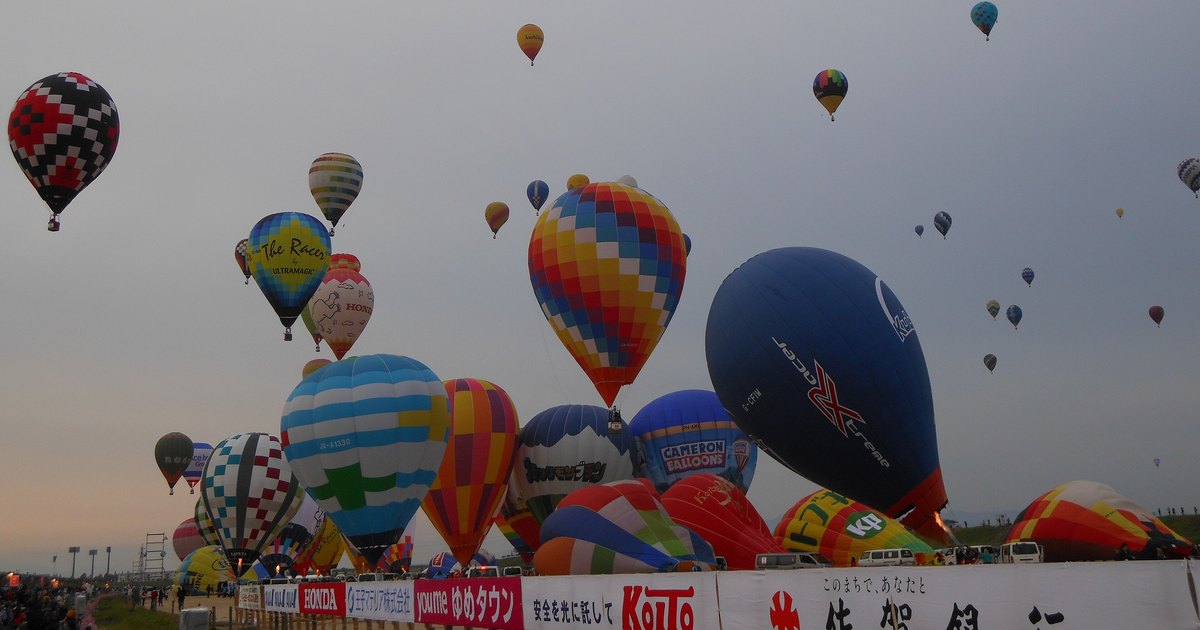
The morning competition was cancelled 4 times out of 20. The afternoon competition was cancelled 10 times out of 20 — counted from the organisers' own daily notices for the 2019, 2022, 2023 and 2025 editions, in which the stated reason was wind every single time, never rain. The Saga International Balloon Fiesta 2026 runs from Friday 30 October to Tuesday 3 November, admission is free, there is no ticket, and everyone watches standing on the riverbank. That makes the decision you face here completely unlike Gion Matsuri or the Nebuta festival. You are not choosing a seat. You are choosing what time to get up, whether to bet on the morning or the afternoon, and which account to refresh at six in the morning. This guide settles all three, explains why arriving at 10:30 means seeing nothing at all, and shows why the glowing night balloons only happen on weekdays.
- Be there before 7am. Competition runs 7:00–9:00, the Balloon Fantasia is scheduled until about 10:30, and in past years it has actually finished anywhere between 9:30 and 10:30. Arrive at 10:30 and there is nothing left.
- A 6am meeting decides whether it flies. The verdict goes out on the official X account — not LINE, not Instagram.
- If you must pick one slot, pick the morning. Across four editions and forty flights: 20% of mornings scrubbed, 50% of afternoons, and wind every single time.
- A cancelled competition is not a wasted day. In four editions there is no case of the competition being cancelled and the Balloon Fantasia going with it.
- The night mooring runs only on 2 and 3 November. No night mooring on the Saturday or the Sunday. Those are also the only two evenings with late trains: the last service from Balloon-Saga toward Saga is 21:52, against 18:56 on the other three days.
📖 Contents (tap to expand)
- What time should you arrive?
- Who decides whether it flies, and when?
- The organisers archive every flight decision — here are four editions counted
- Mass ascension and fly-in are two completely different photographs
- What is left on a cancelled day
- The night mooring runs on two evenings, neither of them a weekend
- Balloon-Saga: a station that opens five days a year
- Entry is free. Parking is not.
- Can you ride in one?
- How cold is Saga at 7am?
- What should you re-check before you leave?
- If you only get one day
- Appendix: official Japanese wording
What time should you arrive?
Before 7am. Arrive after 10:30 and there will not be a single balloon on the field.
Start with the timetable. The balloon programme is the same on all five days of 2026: competition flying from 7:00 to 9:00, then the non-competitive Balloon Fantasia from 9:00 to about 10:30, and a second competition flight from 15:00 to 17:00 — replaced on 3 November by the Key Grab Race. Only four items differ from day to day:
| Item | Which days | Time |
|---|---|---|
| Night mooring | Mon 2 Nov, Tue 3 Nov (holiday) | From 18:30 |
| Key Grab Race (replaces the afternoon competition) | Tue 3 Nov (holiday) | 15:00–17:00 |
| Honda trial bike show | Mon 2 Nov, Tue 3 Nov (holiday) | 11:00–11:30 and 14:00–14:30 |
| Sky lanterns (paid event, not balloons) | Sat 31 Oct | Reception 17:00, release 18:00 |
There is also a walk-up balloon classroom every day from 13:00 to 14:00 on the south side of the Balloon Plaza (no reservation, and no going up in a balloon), and Monday 2 November is the Yakult Kids' Day, which individual families can join without applying ahead. The eve-of-festival parade on Thursday 29 October, 18:00 to 21:00, takes place on Symbol Road in central Saga, not at the venue.
The whole morning programme is done by half past ten at the latest. Across past years the organisers' daily notices put the Fantasia's finish anywhere from 9:30 to 10:30; published end times include 10:00, 10:30, 10:20, 9:45 and 9:30. Which means a conventional sightseeing rhythm — leave the hotel after breakfast, reach the site mid-morning — delivers you to a riverbank that has just been packed up.
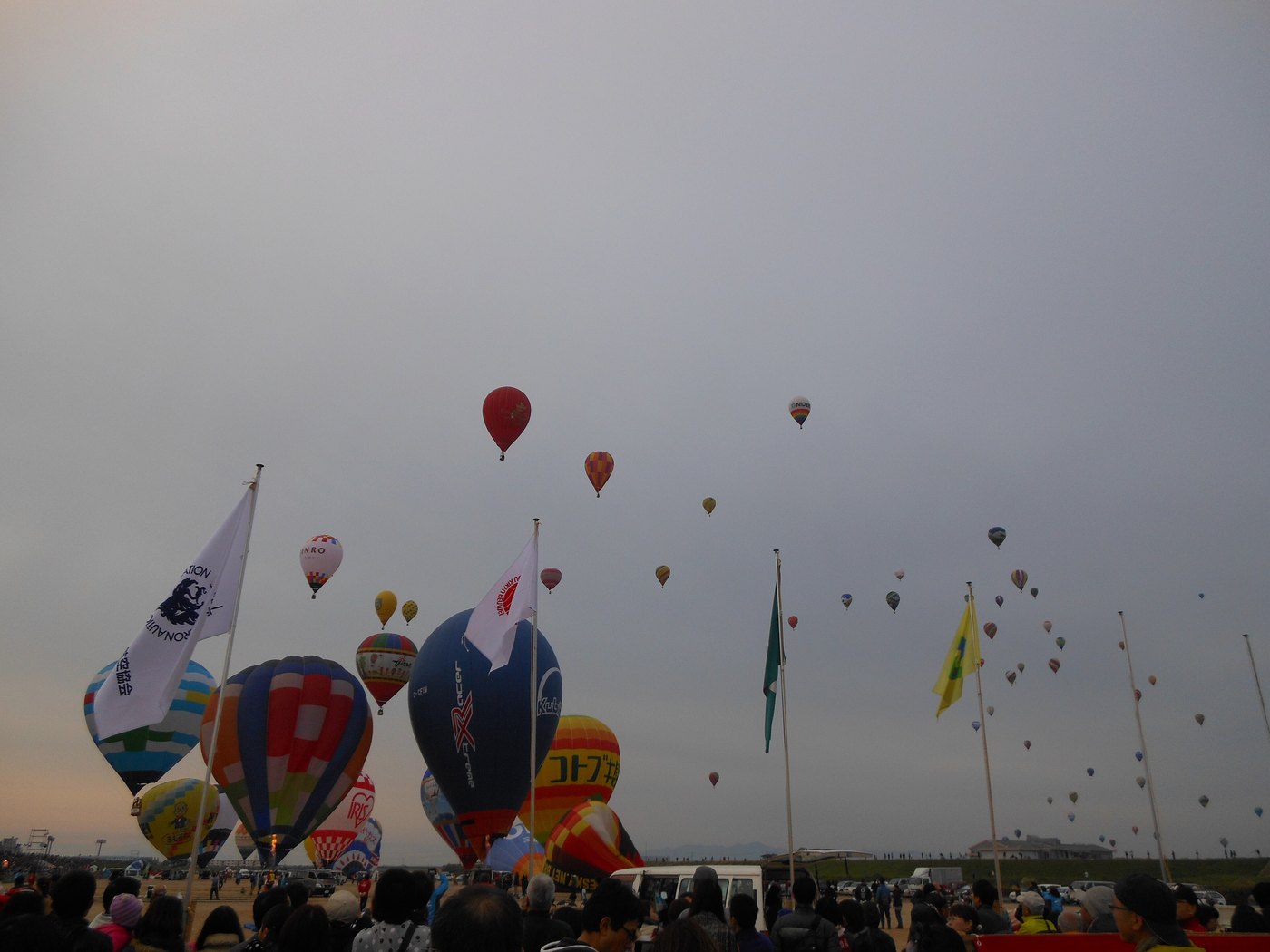
There is a second reason the 7am slot is the main event. The organisers explain that when the day's task is a mass ascension, roughly 80 balloons lift off together about thirty minutes after competition begins. That is the image everybody comes for, and it happens around 7:30.
Who decides whether it flies, and when?
A meeting at 6am decides the 7am flight, and the verdict is published on the official X account.
The organisers document the process in full. Before each competition flight they survey the weather conditions for the scheduled window — rain, wind and so on — and hold a briefing at which organisers and pilots agree whether competition can be flown safely in that flight area. Only after deciding to fly do they choose the day's task. Those briefings take place at 6:00am and 2:30pm.
The outcome goes out through four channels: venue announcements, the latest-information block on the official homepage, the official X account, and the official Facebook page. Follow X. The organisers also run a LINE account and an Instagram account, but neither appears on that list, so add the X account to your feed before you travel rather than waiting for a notification that will not come.
One inconsistency deserves recording rather than resolving: the press notice says 6:00am, while two separate answers on the same official FAQ page give 6:00 and 6:30. Thirty minutes apart. Set the alarm for six.
Can you find out the night before?
No, and the organisers admit it. Their published answer to the question is essentially that the balloons might fly and might not, delivered with an apology for how vague that is and a note that it is the question they receive most often each year. They do offer two rules of thumb: even in clear weather, strong wind can stop the flying; and in most years the calm morning flights tend to go ahead while the afternoon, as the wind builds, tends not to.
The organisers archive every flight decision — here are four editions counted
Mornings were scrubbed 4 times in 20. Afternoons were scrubbed 10 times in 20.
The record sits in the news archive on the official site: for every flight of every day, the organisers post a notice saying whether it went ahead, and those notices stay online. Read end to end across the 2019, 2022, 2023 and 2025 editions, they produce the following.
| Edition | Morning cancelled | Afternoon cancelled | Reason given |
|---|---|---|---|
| 2019 (31 Oct – 4 Nov) | 1 / 5 | 2 / 5 | Cancelled due to wind |
| 2022 (2–6 Nov) | 1 / 5 | 4 / 5 | Cancelled |
| 2023 (1–5 Nov) | 0 / 5 | 2 / 5 | Cancelled from the effects of wind |
| 2025 (30 Oct – 3 Nov) | 2 / 5 | 2 / 5 | Cancelled from the effects of wind |
| Total | 4 / 20 = 20% | 10 / 20 = 50% | Wind in every case across four editions; never rain |
State the method plainly: 2021 was held without spectators and the 2024 notice list is missing two days, so both editions are excluded. The 20% and 50% figures are counted from the official per-flight notices; they are not a statistic the organisers publish. No official cancellation rate exists.
Three planning conclusions fall straight out of that table.
First, if you can only attend one slot, attend the morning. Roughly eight mornings in ten fly; only half of afternoons do. Choosing the afternoon so you can sleep in means making the worst-odds slot your main course.
Second, read the wind forecast, not the rain forecast. Every documented cancellation across four editions was wind. A cloudless day with a zero percent chance of rain can still lose the whole flight, which runs directly against the instinct most festivals train into you.
Third, the variation between years is larger than the variation between slots. In 2022 four of five afternoons were lost; in 2023 all five mornings flew. Given how wide that year-to-year spread is, budgeting two days beats picking the single best day — because there is no best day, and the organisers do not pre-plan one.
Not seeing balloons is not bad luck. Between a fifth and a half of slots do not fly by design. Treat the trip as a bet and the experience improves considerably.
Mass ascension and fly-in are two completely different photographs
The shot you are picturing may or may not exist on your day, and the organisers only find out that morning.
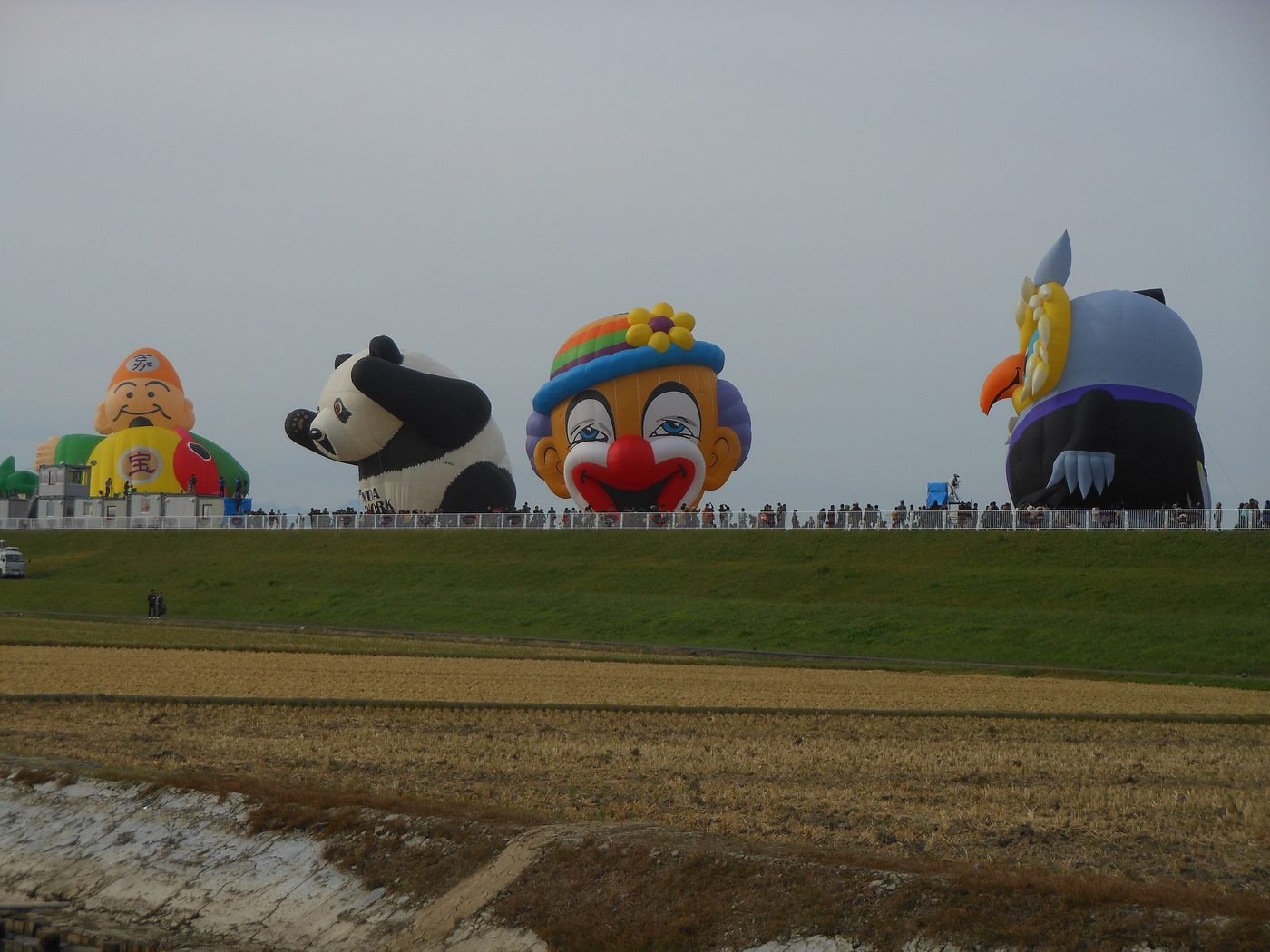
Competition tasks vary, and the pictures they produce vary enormously. The organisers describe two archetypes. In a mass ascension, every balloon takes off from the venue together, with roughly 80 airborne within about thirty minutes of the competition starting. A fly-in is the reverse: balloons launch from scattered points outside the venue and fly toward a target on the field, arriving gradually over one to two hours.
So the ideal arrival time differs by about an hour. A mass ascension requires you standing in place before 7:00, and missing those thirty minutes means missing everything. A fly-in rewards patience instead — turn up after eight and you will still watch balloons drifting in one by one.
Now the part that matters: nobody can tell you which day will be which. The organisers state in writing that they do not schedule tasks in advance by day, and that no one knows which day a given task will appear on. So a claim that one particular day of the festival is the best chance of a mass ascension has no organiser document behind it.
There is only one move available: be there before 7, and you catch either. Betting on a mass ascension and arriving late gets you nothing. Arriving early on a fly-in day costs you an extra hour standing on a riverbank.
What is left on a cancelled day
The balloons still stand up.
A cancelled competition does not mean an empty field. The Balloon Fantasia that starts at 9:00 is a display, not a race, and across four editions of implementation notices there is no case of the competition being cancelled and the Fantasia cancelled with it.
The sharpest example is 1 November 2025. The morning competition was wiped out completely, and the organisers still announced that the Balloon Fantasia would run from shortly after 8am — held, and moved earlier.
Beyond that, the official material confirms that activities at the Balloon Plaza and the Relaxation Plaza continue all day. The venue also hosts a regional food market and a stage programme across all five days. A blank in the competition slot still leaves you food, balloons on the ground, and somewhere to spend the morning.
The Fantasia carries the same weather note as every other line on the schedule, warning that times may shift or the item may be cancelled. Four editions without a cancellation is a record, not a promise.
The night mooring runs on two evenings, neither of them a weekend
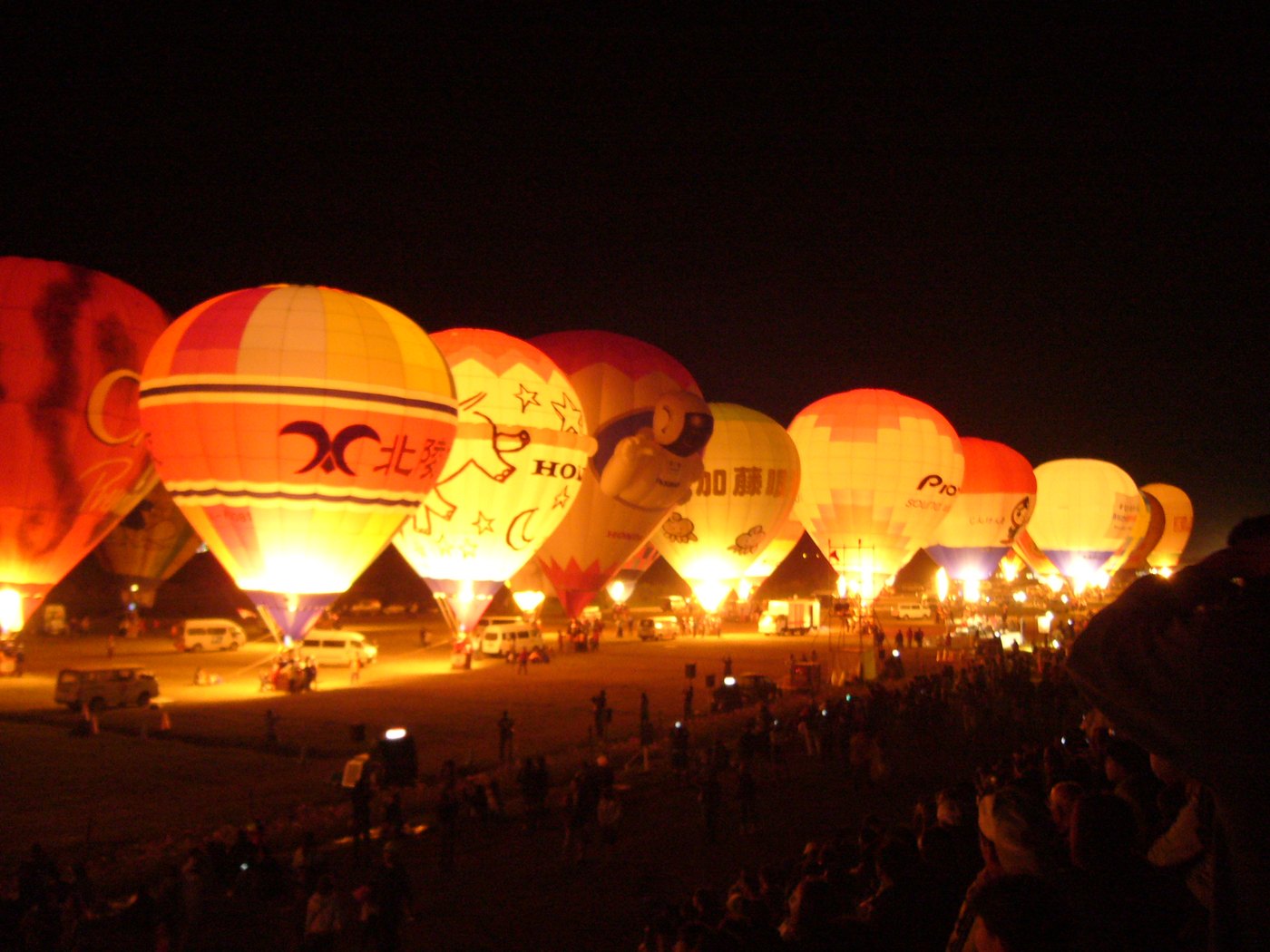
Monday 2 November and Tuesday 3 November, from 18:30. Nothing on the Saturday or Sunday.
Get the name right first. The official name is the night mooring La Montgolfier Nocturne. If you have been searching for "balloon illumination", that phrase appears nowhere on the official pages.
The 2026 dates are 2 and 3 November, starting at 18:30, with a note from the organisers that the start may move with the weather. Saturday 31 October and Sunday 1 November have no night mooring.
The organisers state the reason outright: the night mooring is held only on the fourth day and the final day out of consideration for the load on competitors, and not on any other date. That closes off the obvious fallback of shifting to a different evening.
Plan a weekend trip and you miss the picture entirely. Seeing the night mooring requires the evening of 2 or 3 November in your itinerary.
Can you get back afterwards?
On 2 and 3 November, yes: the last train from Balloon-Saga toward Saga leaves at 21:52. On the other three days the last one leaves at 18:56.
This is the easiest way to get stranded on the riverbank all week. On 30 October, 31 October and 1 November, the station stops sending trains toward Saga less than two hours after the afternoon competition ends at 17:00. No limited express toward Hakata stops here on any day, so the way back to Fukuoka always starts with a change at Saga or Tosu.
The lanterns on Saturday 31 October are not balloons
The 2026 schedule adds a "Sky Lantern in Balloon Fiesta" event on Saturday 31 October: reception from 17:00, countdown at 17:40, release at 18:00. The lanterns are LED and stay tethered. It is a paid event at ¥4,000 per lantern (up to four people share one), capped at 500 lanterns, with advance bookings given priority and payment inside the STLOCAL app. Only lantern buyers are admitted; there is no entry just to watch. A cancellation for strong wind or heavy rain is refunded in full; cancelling yourself is not.
Work out the trip home before you buy: the release is at 18:00, and the last train from Balloon-Saga toward Saga that day is 18:56. Miss it and there is no further train toward Saga from this station that night.
Even then you might only get fire
In rain or strong wind the organisers keep two options: cancel outright, or run a burner version in which the envelopes are never inflated and only the burner flames fire. All eight sessions across the four editions went ahead, but the one on 4 November 2019 was a burner version.
Two practical points for the evening. Venue lighting is switched off during the performance and the organisers ask you to watch your footing. And they state clearly that lost-child announcements cannot be broadcast while the night mooring is running. If you are bringing children, agree a meeting point before you go in.
Balloon-Saga: a station that opens five days a year
Take the train. Driving is the worst option here.
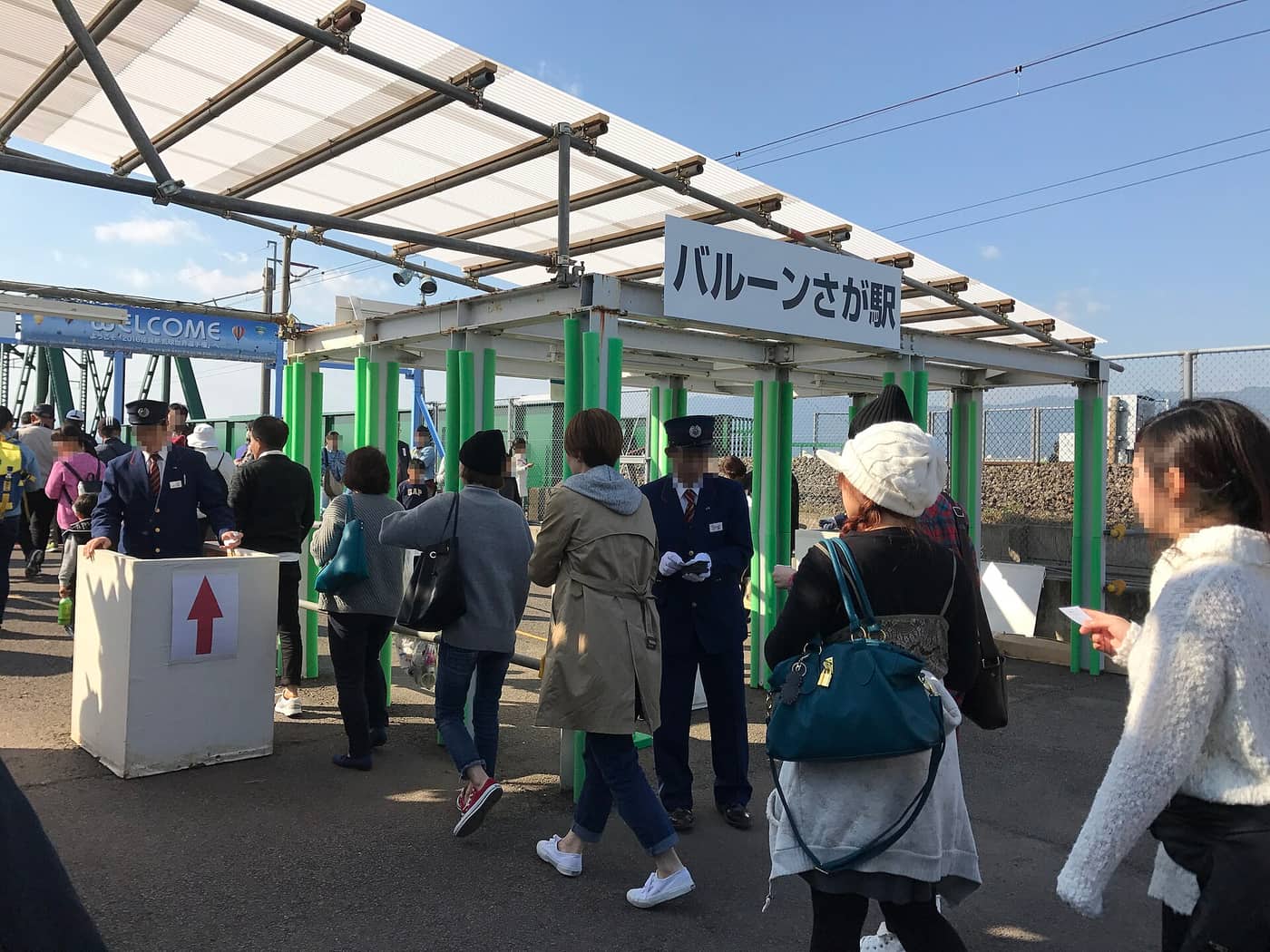
During the festival JR Kyushu opens a temporary station called Balloon-Saga on the Nagasaki Main Line, between Nabeshima and Kubota stations, with the venue directly outside. It exists for these few days a year and no others.
From Fukuoka, a limited express covers Hakata to Saga in about 40 minutes. Under JR Kyushu's 2026 announcement, three extra early-morning limited expresses run direct to Balloon-Saga on each of the five days, specifically so people can reach the 7:00 competition:
| Service (2026) | Dep. Hakata | Dep. Saga | Arr. Balloon-Saga |
|---|---|---|---|
| Kasasagi 91 | 5:03 | 5:43 | 5:47 |
| Kasasagi 93 | 5:35 | 6:18 | 6:22 |
| Kasasagi 95 | 6:10 | 6:53 | 6:57 |
Counting those three, six limited expresses call at the temporary station each day. The other three are regular services making an extra stop: Midori 7 leaves Hakata at 7:28 and arrives 8:19, Kasasagi 101 leaves at 7:55 and arrives 8:40, and Midori 11 / Huis Ten Bosch 11 leaves at 8:39 and arrives 9:23 — all after competition has started. JR Kyushu also warns that the 6:00 Relay Kamome 1 from Hakata is very crowded and requires a change at Saga. No limited express toward Hakata stops at Balloon-Saga on the way back; ride to Saga or Tosu and change there.
Local fares to Balloon-Saga are ¥240 from Saga, ¥340 from Kanzaki and ¥200 from Kubota. SUGOCA and other transport IC cards work, but routes via the Karatsu Line are excluded and credit cards cannot be used at this station, so carry cash or a topped-up IC card.
There are two limited-period discount tickets. The one-way online ticket from Hakata to Balloon-Saga costs ¥1,540 (same price reserved or non-reserved; a 760 yen saving on a non-reserved seat) and is sold only through JR Kyushu's online reservation service. The same-day return is ¥3,880 for adults and ¥1,940 for children, in non-reserved limited express seats. It carries an easily-missed restriction: it is sold only at the reserved-seat ticket machines in four stations — Hakata, Sasabaru, Minami-Fukuoka and Kasuga. Neither ticket is valid on the Kyushu Shinkansen between Hakata and Shin-Tosu.
If you are not taking the train
The Nishitetsu Wakakusu highway bus runs from Fukuoka Tenjin to Saga Station Bus Centre at ¥1,100 in 1 hour 16 minutes, no reservation required, seats allocated by capacity, 34.5 round trips on weekdays and one every 15 to 30 minutes.
The trade-off is clean: the bus costs roughly half as much and takes roughly twice as long, and it only reaches Saga Station, leaving another connection to the venue. Whether it can get you to the 7:00 slot depends on its first departure, which you will need to check on the operator's own timetable; JR, for its part, added those three early limited expresses specifically for the 7am start. If you are stitching this into a wider trip, our three-day Kyushu rail itinerary covers the days either side.
Entry is free. Parking is not.
Admission costs nothing. Riverbank parking costs ¥2,000.
The official FAQ states that admission to the Balloon Fiesta is free. General admission needs no ticket and no reservation, and standing anywhere on the riverbank costs nothing.
For 2026 there are also two paid options that must be applied for in advance, both handled by the Saga City Tourism Association and both very small:
| Option | Dates | Places | Cost | How to apply |
|---|---|---|---|---|
| Special viewing box: chartered taxi from Saga Station to the venue (outbound) plus a viewing box inside the competition area for the morning flight | 31 Oct, 1 Nov, 3 Nov | 5 groups a day (about 20 people) | Hometown tax donation of ¥50,000 per slot | Return gift under Saga City's hometown tax (furusato nozei) scheme |
| Night mooring experience tour: chartered taxi both ways from in front of Saga Station plus a dedicated viewing area inside the competition area, leaving 17:30 and back 20:30 | 3 Nov | 24 people, first come first served, high-school age and up | ¥20,000 per person | Closes at noon on Mon 26 Oct; application form plus a transfer to a Japanese bank account |
The viewing box is a return gift under Japan's hometown tax system, which overseas visitors generally cannot use, and the tour requires a transfer to a Japanese bank account. Neither is a ticket you can pick up casually, and you see the whole programme without them.
What drivers pay for is parking, charged since 2025: the riverbank lot on the north side of the venue costs ¥2,000 per car per entry, cash only, with no refund even if the event is cancelled for weather. In 2026 it is open from 0:00 on Friday 30 October to 20:00 on Tuesday 3 November.
The other temporary lots around the venue are free to park in, but each opens on different days and they rely on a shuttle bus into the site at ¥250 one way for adults and ¥130 for children, cash or transport IC card. The shuttle runs on only three days — Saturday 31 October, Sunday 1 November and Tuesday 3 November. There is none on Friday 30 October or Monday 2 November. First departure is 5:45; the last is 18:00 on 31 October and 20:00 on 3 November. For 1 November, plan around 18:00 and confirm on site.
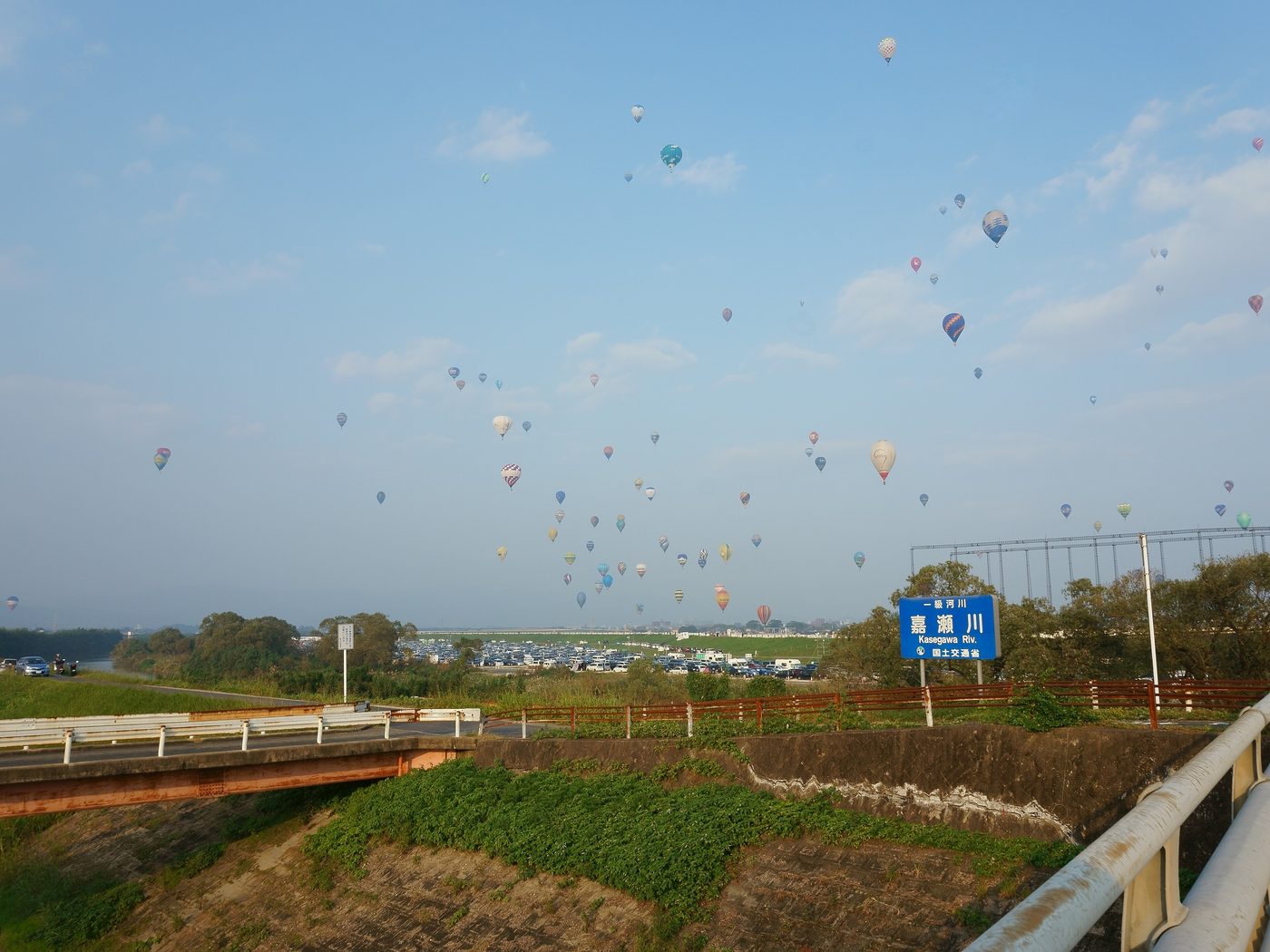
The riverbank lot holds 4,000 vehicles, about 7,600 including the surrounding temporary lots. That sounds generous until you remember that every visitor is aiming at the same 7am, and that the riverbank lot has one way in, from the Kase Ōhashi bridge (嘉瀬大橋) on Route 34, and one way out, at the 池森橋 bridge a kilometre north. The organisers' own description of a weekend is a queue of 2 km or more taking up to an hour and a half to two hours to get in, and another 30 minutes to an hour to get out — which is exactly why driving is the worst option.
If you were planning to sleep in your vehicle: the former auto-camping area has switched this year to advance application by lottery, for about 100 vehicles, and is no longer first come first served.
One more date to note: on the official practice days of 28 and 29 October, neither the riverbank parking nor the Balloon-Saga station operates. The organisers add something harsher still — not all pilots necessarily fly on practice days, and there is no announcement at all about whether flying is happening, neither at the venue nor on the website. Those two days are not worth recommending to anyone.
Can you ride in one?
Not during the festival. Tethered rides for spectators ended in 2008 — but the same riverbank offers them in winter.
The organisers state in writing that tethered ride experiences for spectators have not been offered since 2008. If riding a balloon is the reason you were planning this trip, adjust the plan.
The winter alternative sits on the same stretch of the Kase River: the SAGA Balloon Challenge Series, registered on the day on a first-come basis. Two official pages describe it differently and both versions belong here: the FAQ gives early Sunday mornings from late November to mid-February with around 20 balloons, while the dedicated ride page gives early Saturday and Sunday mornings from late November with around 30. The difference is a whole extra day of the week and ten balloons. Check the latest official notice before building a trip around it.
How cold is Saga at 7am?
The average daily minimum is 14.7°C in late October and 8.9°C in November.
Japan Meteorological Agency normals for 1991–2020 give Saga a mean of 19.1°C in October with a daily high of 24.3°C and a daily low of 14.7°C; November drops to 13.3°C, 18.2°C and 8.9°C respectively. The festival straddles both months, so the last mornings run noticeably colder than the first.
The organisers describe the clothing problem vividly: there are days that call for a winter jacket in the morning, a short-sleeved shirt in the afternoon, and a jacket again by evening. Bring a layer you can take on and off all day, and do not sacrifice morning warmth for afternoon comfort. For the broader seasonal picture, our month-by-month Japan weather and packing guide covers the rest.
Four rules on the riverbank
The embankment steps look like a grandstand, but sitting on them is against the rules. The official spectator etiquette page lists four things:
- Do not sit on the steps — they are a circulation route, not seating.
- No drones — there are dozens of crewed balloons overhead.
- Do not touch markers; leave them where they fall — they are competition targets dropped by pilots, and moving one affects a score.
- Push bicycles inside the venue, do not ride them.
What should you re-check before you leave?
Two things: how the fly-or-not decision is announced, and the last shuttle bus on 1 November.
The 6:00am and 2:30pm briefings and the four announcement channels come from last year's notice. This year's version is not out yet; last year's appeared on 27 October. Look at the latest-information block on the official homepage a few days before you travel and confirm the channels are unchanged. For the last shuttle on Sunday 1 November, go by the notice on site and do not plan around the final bus.
How big it is: 123 balloons, and 800,000 to 900,000 visitors a year
2026 is the 39th edition, with 123 balloons taking part, 25 of them from overseas.
The 800,000 attendance figure does come from the organisers: the FAQ says attendance exceeds 800,000, while the etiquette page says it approaches 800,000 — the two official statements do not agree with each other. Year-by-year figures live on the official history pages: 928,000 in 2019, 849,000 in 2022, 907,000 in 2023 and 838,000 in 2025. The 2020 edition was cancelled and 2021 was held without spectators.
The 2024 cell reads 85,000, a full order of magnitude below the years on either side — a missing digit in the official table, so do not use that year for anything.
What about 2027?
Nothing has been stated. As a timing reference only: the 2026 dates were announced on 11 March 2026, roughly seven and a half months ahead. If you are planning for 2027, check back in the middle of next March.
If you only get one day
Take Tuesday 3 November, and stay in Saga the night before.
Three reasons, all of them derived from the official material rather than from taste.
First, 3 November is the only day that has both the night mooring and the Key Grab Race, and the trial bike show runs that day too. Competition and the Balloon Fantasia are the same on all five days, which means the entire question of "which day" lives inside the handful of items that differ.
Second, it is the final day, and the night mooring only runs on 2 and 3 November. Choosing the 3rd buys you the morning competition, the food market at midday, the Key Grab Race in the afternoon and the night mooring at dusk — the densest programme of the five days, with trains home running until 21:52.
Third, staying the night before is about the 7am start. A day trip from Fukuoka means catching the 5:03 or 5:35 limited express out of Hakata. Base yourself in Saga and you skip the five o'clock train, with a taxi as the fallback if you oversleep. The organisers themselves warn that conveniently located hotels fill up fast during the festival and advise booking early. What matters is booking early and booking near Saga Station — the official recommendation is Saga, not Fukuoka.
Conversely, if the only thing you want is dozens of balloons rising together and nothing else matters, take any morning of the five and spend your effort on an early night and a 6am check of X instead. No day is better than another. The organisers do not pre-plan them.
Making a trip of it
Saga is not only these five days. The festival lands just ahead of the Kyushu autumn colour season, so the timing and routes for autumn leaves in Kyushu stitch onto this trip neatly. If you can spare an extra day in the prefecture, Arita porcelain and Ureshino Onsen sit within an hour of Saga Station. And for the nights either side, where to eat and stay in Fukuoka handles the rest.
The whole thing in three sentences
Be on the riverbank before 7am, because after 10:30 there is nothing there.
Check the official X account at six — that meeting decides whether your day has balloons in the air, and even when the answer is no, the 9am Balloon Fantasia has not been cancelled once in four editions.
To see the balloons glowing after dark, your itinerary has to include the evening of 2 or 3 November; the weekend does not have it.
Appendix: official Japanese wording (tap to expand)
The Japanese originals behind the claims above, collected here so you can check them yourself.
1. How the flight decision is made and announced
競技フライトの実施有無については、競技予定時間の気象状況(雨や風等)を調査し、当該フライトエリアで安全に競技フライトが実施できるか否かを、主催者と競技者(パイロット)が「ブリーフィング」にて協議を行い、競技フライトが実施される場合には競技種目(タスク)が決定されます。ブリーフィングは各競技フライト前の午前6時00分と午後2時30分から開催されます
ご案内方法 ①会場アナウンス ②公式サイト トップページ(最新情報) ③公式X(旧twitter) ④公式Facebookページ
2. The organisers on "will it fly tomorrow?"
明日、うーんどうでしょう。飛ぶかもしれないし、飛ばないかもしれません。天気予報が雨100%だったら飛ばないかも...毎年、皆様から最も多くいただく質問ですが、曖昧な回答で申し訳ありません。
晴れていても、風が強い場合は飛ばないこともあります。
なお、例年、風が穏やかな午前のフライト(競技)は飛ぶことが多く、逆に、次第に風が強くなる午後は飛ばないことが多いようです。
3. Tasks are not scheduled in advance
あらかじめ「○日目の午前に△△△を実施」という予定は立てておりません
誰も何日目にあるか分からないのです
4. Balloon Fantasia on a cancelled day (1 Nov 2025 notice)
バルーンファンタジアは午前8時過ぎから行われます
バルーン広場や憩いの広場でのイベントは終日行われています
5. La Montgolfier Nocturne (2026 dedicated page)
日時 2026年11月2日(月)、3日(火・祝)
時間 18:30〜 (当日の気象状況により開始時間が変わる場合あり)
天候不良の場合 雨天や強風の場合は、中止、もしくは、バルーンの球皮を膨らまさず、バーナー(炎)のみで行う"バーナーバージョン"で実施することがあります。
演出上、会場内の照明が消されます。足元に十分注意して移動ください。
夜間係留実施中は、演出上、迷子情報のアナウンスができません。
6. Why there are only two evening sessions
夜のバルーンイベントは、大会4日目と最終日の夜に実施する夜間係留「ラ・モンゴルフィエ・ノクチューン」のみです。…夜間係留は競技者への負担も考え、大会4日目と最終日のみとしております。
7. Admission and parking
バルーンフェスタの入場料は無料です!
なお、会場内の河川敷北側臨時駐車場をご利用の方へは、駐車料金2,000円が必要となります(2025年から)。
P01 嘉瀬川河川敷・バルーン会場北駐車場(駐車料金 1台1回あたり2,000円)
会場周辺駐車場(いずれも駐車料金はかかりません)
8. The official practice days (28–29 Oct)
10月28日,29日の公式練習時は河川敷内駐車場ならびにJRバルーンさが駅は利用できません。
公式練習は、全てのパイロットがフライトするとは限りません。また、当日の天候によるフライト実施の有無についての案内(アナウンス、公式サイト等)はありません。
9. Balloon-Saga station (2026 JR Kyushu release)
JR 九州は開催期間中、長崎本線 鍋島駅~久保田駅間に臨時駅「バルーンさが駅」を営業します。
そ の 他:SUGOCA 等の交通系 IC カードもご利用可能です。※唐津線を含む経路はご利用いただけません
期間中1日6本の特急列車が「バルーンさが駅」に停車します!
10. Rides ended in 2008
2008年より…観客の皆様への係留体験搭乗は行っておりません
11. Attendance (two official pages, two wordings)
大会期間中の来場者数は80万人を超えるアジア最大級の規模を誇るイベントです。
5日間の大会期間中の来場者は80万人近くとなり
Frequently Asked Questions
- Q1:When is the Saga International Balloon Fiesta 2026, and is there a ticket?
- The 2026 event runs from Friday 30 October to Tuesday 3 November, a national holiday, for five days. It is the 39th edition. The two days before it, Wednesday 28 and Thursday 29 October, are official practice days and are not part of the event proper. General admission is free and needs no ticket: the official FAQ states plainly that admission to the Balloon Fiesta is free, and everyone simply stands on the riverbank, so there is nothing to book or queue for. For 2026 the Saga City Tourism Association also handles two paid, apply-in-advance options with very few places: a special viewing box inside the competition area, offered as a return gift under Saga City's hometown tax donation scheme on 31 October, 1 November and 3 November for five groups a day, and a night mooring experience tour on 3 November for 24 people at 20,000 yen each, closing at noon on 26 October. If you drive, parking at the riverbank lot on the north side of the venue is 2,000 yen per car, cash only.
- Q2:What time should I arrive? Can I sleep in and go in the afternoon?
- Arrive before 7am, and understand that the afternoon slot carries much worse odds. Competition flights run 7:00 to 9:00, followed by the non-competitive Balloon Fantasia display from 9:00 to about 10:30, which means the entire morning programme is over by half past ten at the latest. Across past years the organiser's own daily notices put the Fantasia finish somewhere between 9:30 and 10:30 — published end times include 10:00, 10:30, 10:20, 9:45 and 9:30. Turn up at 10:30 and there will not be a single balloon in the air; you will be looking at deflated envelopes and loading trucks. The afternoon slot at 15:00 to 17:00 sounds far more civilised, but counted from the official per-flight notices, the afternoon competition was cancelled 10 times out of 20 while the morning was cancelled only 4 times out of 20. The organisers explain why themselves: even on a clear day, strong wind stops the flying, and the wind typically builds through the day. If you only get one slot, take the morning.
- Q3:How do I find out whether the balloons are flying today?
- You cannot find out the night before. The decision is made at a meeting at 6am on the day. The official announcement describes the process precisely: organisers and pilots examine the weather conditions for the scheduled flight window — rain, wind and so on — and hold a briefing to agree whether competition can be flown safely in that flight area. Only once they decide to fly is the day's task chosen. Those briefings are held at 6:00am and 2:30pm, before each respective flight. The result then goes out through four channels: venue announcements, the latest-information section on the official website homepage, the official X account, and the official Facebook page. Follow X. The organisers also run a LINE account and an Instagram account, but neither is listed as an announcement channel, so do not sit waiting for a LINE push. One inconsistency to flag: the press notice says 6:00am, while two separate answers on the FAQ page give 6:00 and 6:30 respectively. Set your alarm for six; nothing is lost by checking early. As for asking in advance, the organisers concede the point in writing — their answer to whether balloons will fly tomorrow is that they might, or they might not, and they apologise for how vague that is while noting it is the question they get most.
- Q4:If the competition is cancelled, is the day wasted?
- No. The balloons still go up on the ground. Competition flying is a contest and it gets scrubbed when the wind is wrong, but the Balloon Fantasia display that begins at 9:00 is a show rather than a race. Across the implementation notices for the 2019, 2022, 2023 and 2025 editions, there is not one instance of competition being cancelled and the Fantasia being cancelled with it. The clearest case is 1 November 2025: the morning competition was wiped out entirely, and the organisers still announced that the Balloon Fantasia would take place from a little after 8am — not only held, but moved earlier. Beyond that, the official material states that events at the Balloon Plaza and the Relaxation Plaza run all day, and the food market and stage programme operate across all five days. So a scrubbed competition slot still leaves you food, balloons and a functioning event. The Fantasia carries the same weather note as every other item on the schedule, warning that timing may shift or the item may be cancelled. Four editions with no cancellations is a track record, not a guarantee.
- Q5:When is the night balloon glow, and can I see it on the weekend?
- Not on the weekend. The evening event is formally called La Montgolfier Nocturne, a night mooring, and in 2026 it runs on exactly two evenings: Monday 2 November and Tuesday 3 November, the holiday. It starts at 18:30. Saturday 31 October and Sunday 1 November have no night mooring. The organisers spell out the reasoning: the night mooring is held only on the fourth day and the final day out of consideration for the pilots' workload. That matters enormously for planning, because the glowing night balloons read like a generic selling point of the festival rather than a two-date event — so a weekend-only trip misses the picture entirely. Saturday 31 October does have a separate paid sky-lantern event, released at 18:00 and open only to people who have bought a lantern; it is not a balloon event. The trains home split the same way: the last service from Balloon-Saga toward Saga leaves at 21:52 on 2 and 3 November, and at 18:56 on the other three days. Also set expectations for the weather: in rain or strong wind the organisers may cancel, or may run a "burner version" in which the envelopes are not inflated and only the burner flames are lit. Venue lighting is switched off during the performance, and the organisers note that lost-child announcements cannot be broadcast while the night mooring is running.
- Q6:Can I ride in a balloon?
- Not during the festival. The organisers stopped tethered rides for spectators in 2008 and say so plainly. If riding is the point of your trip, you need a different season: the same Kase River bank hosts the SAGA Balloon Challenge Series in winter, with same-day registration on a first-come basis. The official material contradicts itself here: the FAQ page describes early Sunday mornings from late November to mid-February with around 20 balloons, while the dedicated ride page describes early Saturday and Sunday mornings from late November with around 30 balloons. Check the latest official notice for dates and numbers before committing to a trip around it.
- Q7:Can I do this as a day trip from Fukuoka, and how should I travel?
- Yes, and most people do — but for the morning slot the train is the only realistic option. A limited express covers Hakata to Saga in about 40 minutes. During the event JR Kyushu opens a temporary station called Balloon-Saga on the Nagasaki Main Line between Nabeshima and Kubota stations, right beside the venue. For 2026 they are adding three early-morning Kasasagi limited expresses specifically so people can make the 7am competition, departing Hakata at 5:03, 5:35 and 6:10 and running direct to Balloon-Saga at 5:47, 6:22 and 6:57, with six limited expresses in total stopping at the temporary station each day. Mind the return: no limited express toward Hakata stops at Balloon-Saga, so you change at Saga or Tosu, and on 30 October, 31 October and 1 November the last train from Balloon-Saga toward Saga leaves at 18:56. The alternative is the Nishitetsu Wakakusu highway bus from Fukuoka Tenjin to Saga Station Bus Centre: cheaper than the train, no reservation needed, one every 15 to 30 minutes, but 1 hour 16 minutes long and only as far as Saga Station, leaving you another connection to reach the venue.
Read next
Saga Travel Guide 2026: Arita Porcelain, Ureshino & Karatsu
The birthplace of Japanese porcelain — Arita ware, the Golden Week ceramics fair, the Okawachiyama secret kilns, plus the skin-softening Ureshino Onsen, Karatsu Castle and Yayoi-era Yoshinogari. An easy day from Fukuoka.
Kyushu Autumn 2026: Mifuneyama, Unzen & Yabakei Guide
Mifuneyama 2026 illumination dates are out — Kyushu foliage is scattered, so here is the drive-vs-rail verdict.
Fukuoka Travel Guide 2027: Yatai, Hakata Ramen & Dazaifu
Kyushu's gateway and one of Japan's best food cities — yatai, Hakata ramen, and Dazaifu and Mojiko day trips.
📊 See the 2026 Price Index (JR Pass, DPA, eSIM, Airport Transport) →