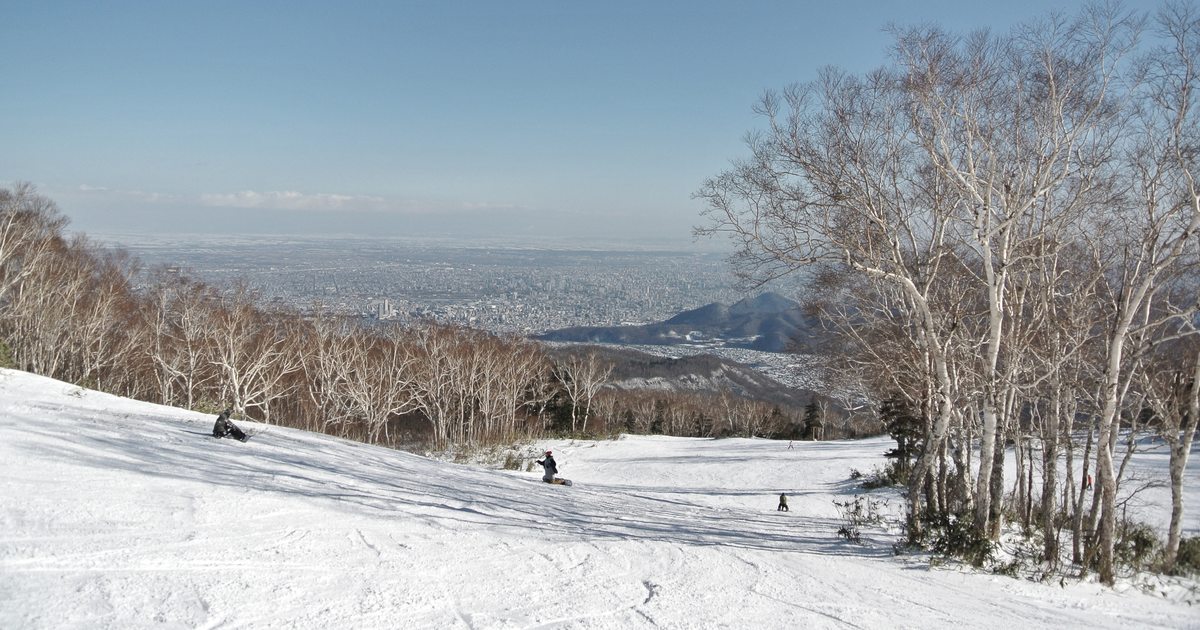
Every autumn the Sapporo District Meteorological Observatory announces the city's first snowcap of the season, and the observer is looking at one mountain: Mt. Teine, normal date 18 October on the 1991-2020 averages. In the fourteen-city table in our guide to when it starts snowing in Japan, that is the peak named in the Sapporo row. And the mountain that officially decides whether winter has arrived in Sapporo happens to carry a full-scale ski area on its back — Sapporo Teine, 683 m of vertical, a 6 km top-to-bottom run, and a postal address that reads 593 Teine-honcho, Teine-ku, Sapporo.
The resort's access page carries one memorable sentence: "from the nearest station, JR Teine, take the JR Hokkaido Bus and you are at the slopes in just 16 minutes." It is true, and it is half the story. Those 16 minutes get you to "Teine Olympia-mae". The terminus, "Teine Highland", is 28 minutes — same bus, same ¥1,000 fare. Add the 11-minute, ¥360 train from JR Sapporo and you have a 40-minute, ¥1,360 one-way trip from the middle of a city of two million to a lift queue. For contrast, the same station to Niseko is about two and a half hours, and the one-way Chuo Bus fare is ¥6,000 (2025-26 actual).
This guide covers the six things about Teine you usually only discover on arrival: the two zones are really two different seasons, there is exactly one lift back to Highland, the 2026-27 lift prices do not exist yet, gloves and goggles are genuinely rentable here, the run under your skis was an Olympic race line in 1972, and the bus that brought you up will not take a credit card. The cross-resort layer — what a rental set includes, how lesson pricing works, how backcountry gates work — lives in our guide to what skiing in Japan actually costs, and the head-to-head of the big five is in how to choose a ski resort in Japan. Everything below is Teine-specific.
- 16 minutes is to Olympia, not Highland (28 minutes) — identical ¥1,000 fare. Add JR Sapporo to Teine, 11 minutes and ¥360, for a ¥1,360 one-way total in under 40 minutes.
- The two zones are two seasons, not two slopes — 2026-27 runs 21 Nov to 5 May, but Olympia only 5 Dec to 28 Mar. For 52 of the season's 166 days the resort is open and Olympia is not — and the school, the night skiing, the beginner conveyor and the play area are all in Olympia.
- 2026-27 lift prices are unpublished — the ticket portal still says "in preparation" and the fee page is still headed 2025-2026. Every ticket, rental and lesson figure below is tagged with its season; read the tags.
- The one 2026-27 price that exists is the K-Winter Pass — the Kamori four-resort season pass, standard adult early-bird ¥95,000, and the early-bird window closes 3 Nov 2026, before the mountain even opens.
- The bus up takes cash or SAPICA/Kitaca only — no credit cards, bring coins. Inside the resort almost everything takes cards, and North Maple takes cards only.
📖 Contents (tap to expand)
- The mountain inside the city, and why it is not a token hill
- Two zones is really two seasons
- Getting there: the real numbers from JR Sapporo
- Lift tickets: 2025-26 actuals and the 2026-27 number nobody has
- K-Winter Pass: the only price you can act on today
- Rentals: you can actually rent gloves and goggles here
- Ski school and the language question
- Night skiing, the play area and bringing kids
- 1972: you are skiing the actual race lines
- "We put up as few ropes as possible": the Teine Gate
- Eating on the mountain, and one machine that refuses cash
- How I would plan the day
- FAQ
The mountain inside the city, and why it is not a token hill
"City ski area" is a phrase that makes most people mentally discount before they read the numbers — two chairlifts, one hour, done by lunch. Teine is not that. The resort's own "Sapporo Teine by the numbers" panel lays it out:
| Metric | Official figure |
|---|---|
| Courses | 15 (7 in Highland, 8 in Olympia) |
| Lifts | 8 chairlifts plus one 8-person gondola = 9 in total |
| Skiable area | 76 hectares |
| Vertical | 683 m (top 1,023 m, base 340 m) |
| Longest run | about 6,000 m |
| Total run length | 16,430 m |
| Steepest pitch | 38 degrees |
| How the resort describes itself | "the largest scale near Sapporo" |
| Parking | 2,800 spaces, all free |
One more line from the resort's own /snow/about page matters for planning: "the summit area holds enough snow that skiing is usually possible into early May" — and the 2026-27 published calendar does indeed run to 5 May. A ski area inside a designated city of roughly two million people, 15 km from the centre, that still runs into Golden Week is not a common combination in Japan.
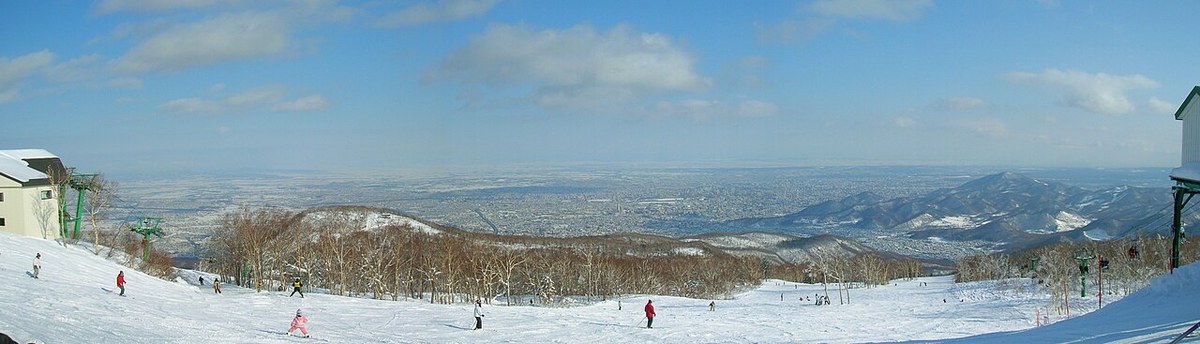
The summit view is something the resort sells too: on a clear day the Ishikari Plain, Ishikari Bay, the Mashike mountains and, at the far edge, the Daisetsuzan range. But there is a misconception to head off first — you cannot ride up to look at it unless you are carrying ski or snowboard equipment. Details in the rules section below.
Two zones is really two seasons
This is the single easiest way to get a Teine trip wrong, and the resort states it plainly — it is just buried in the small print of the course page: the season runs Saturday 21 November 2026 to Wednesday 5 May 2027, except that Olympia Zone operates only from Saturday 5 December 2026 to Sunday 28 March 2027.
Count the days. The full season is 166 days. The 14 days from 21 Nov to 4 Dec, plus the 38 days from 29 Mar to 5 May, make 52 days on which the resort is open and Olympia is closed. And the Olympia side is where the resort put the ski school, the night skiing, the beginner conveyor, the Snowland play area, the rental shop that stays open to 20:00, and the bank of gentle runs the official FAQ specifically recommends for children and beginners. Pick the wrong dates and you get none of it.
| Highland Zone | Olympia Zone | |
|---|---|---|
| 2026-27 operating dates | 21 Nov to 5 May | 5 Dec to 28 Mar |
| Courses | 7 (2 beginner / 2 intermediate / 2 advanced / 1 expert) | 8 (5 beginner / 2 intermediate / 1 advanced) |
| Bus time from Teine Station | 28 min | 16 min |
| Ski school | None | Yes — Teine Olympia Ski School |
| Night skiing | None (2025-26: two special dates only, 4 and 5 April) | Yes — Shirakaba No.1 lift, 9:00 to 20:00 |
| Beginner facilities | Paradise (beginner) plus the terrain park | Debut Escalator / Snowland / most of the gentle terrain |
| Rental shop hours | 8:30 to 16:30 | 8:30 to 20:00 |
| Steepest run | Kitakabe, 36 degrees | Seikadai Ocean Dive, 38 degrees (steepest on the mountain) |
| Food | Skadi 650 seats / Hot Cafe 1023, 40 seats | Ullr 330 seats / North Maple 80 seats / Seikadai Snack House 80 seats |
| Taxi packages | Surcharge of ¥1,500 per vehicle (round trip, regular taxi) | Included in the base fare |
| Car park hours | 7:00 to 18:00 | Seikadai 7:30 to 17:30 / Shirakaba 7:30 to 20:30 on night-ski days |
There is one way back to Highland, and in early season it stops at 15:30
The official FAQ says the two zones share a lift ticket and are "connected by the Rainbow course", which reads like free movement in both directions. In practice the link is asymmetric: from Highland you can ride Natural into Rainbow and coast all the way down to Olympia — that is the famous 6 km — but the only way back up to Highland is the Eight Gondola. The resort flags this directly on its lift-hours table:
"Please note that if you miss the last Eight Gondola, you will not be able to return to the Highland Zone."
And the gondola's closing time moves later as the season progresses (2025-26 actuals, three phases):
| Period | Eight Gondola (the only way back to Highland) | The Shirakaba lifts next to you |
|---|---|---|
| Opening to 18 Jan | 9:00 to 15:30 | Shirakaba No.2 and No.3 to 16:00; Shirakaba No.1 to 20:00 |
| 19 Jan to 31 Jan | 9:00 to 16:00 | As above |
| 1 Feb to close | 9:00 to 16:00 | As above (both zones now aligned at 16:00) |
That first row is the real trap: the fact that people around you in Olympia are still loading lifts does not mean you can still get home. In the same window Highland's Summit Express, Panorama No.1 and Panorama No.2 also stop at 15:30 (Paradise runs to 16:00 with last loading at 15:45) — and your car, the Highland rental shop (closes 16:30) and the Big Runs bus home (departs Highland at 16:00) are all on the other side of the mountain. From 19 January the gondola runs to 16:00, and only from 1 February are the two zones aligned. This is why "the two zones close at different times" is not a usable rule of thumb: it holds for the first half of the season and then stops being true.
Two facts that run against intuition
- The steepest pitch on the mountain, 38 degrees, is in Olympia, not Highland. That is the upper section of Seikadai Ocean Dive (20 degrees average); Highland's steepest, Kitakabe, is 36. So "Olympia equals beginner zone" is only half right — it does have the most beginner runs, and it also hides the meanest pitch on the hill.
- The signature 6 km descent is beginner-graded end to end. Natural is 4,000 m at 8 degrees average, officially beginner; Rainbow, which it feeds into, is 1,700 m at 5 degrees average, also beginner. The official phrasing is "a long run of about 6 km from the summit all the way to the Shirakaba slope". In other words, if you can link turns on a green run, this is yours — and it is by some distance the best thing Teine offers a beginner, not the advanced pitches.
Getting there: the real numbers from JR Sapporo
Teine's entire case rests on this section, so here is every published figure (JR fares are year-round; bus figures are 2025-26 actuals):
| Leg | Time | Fare | Notes |
|---|---|---|---|
| JR Sapporo to JR Teine | 11 min minimum | ¥360 | Hakodate Line |
| JR New Chitose Airport to JR Teine | 51 min minimum | ¥1,400 | Landing-day skiing is feasible |
| JR Otaru to JR Teine | 21 min minimum | ¥580 | Basing in Otaru also works |
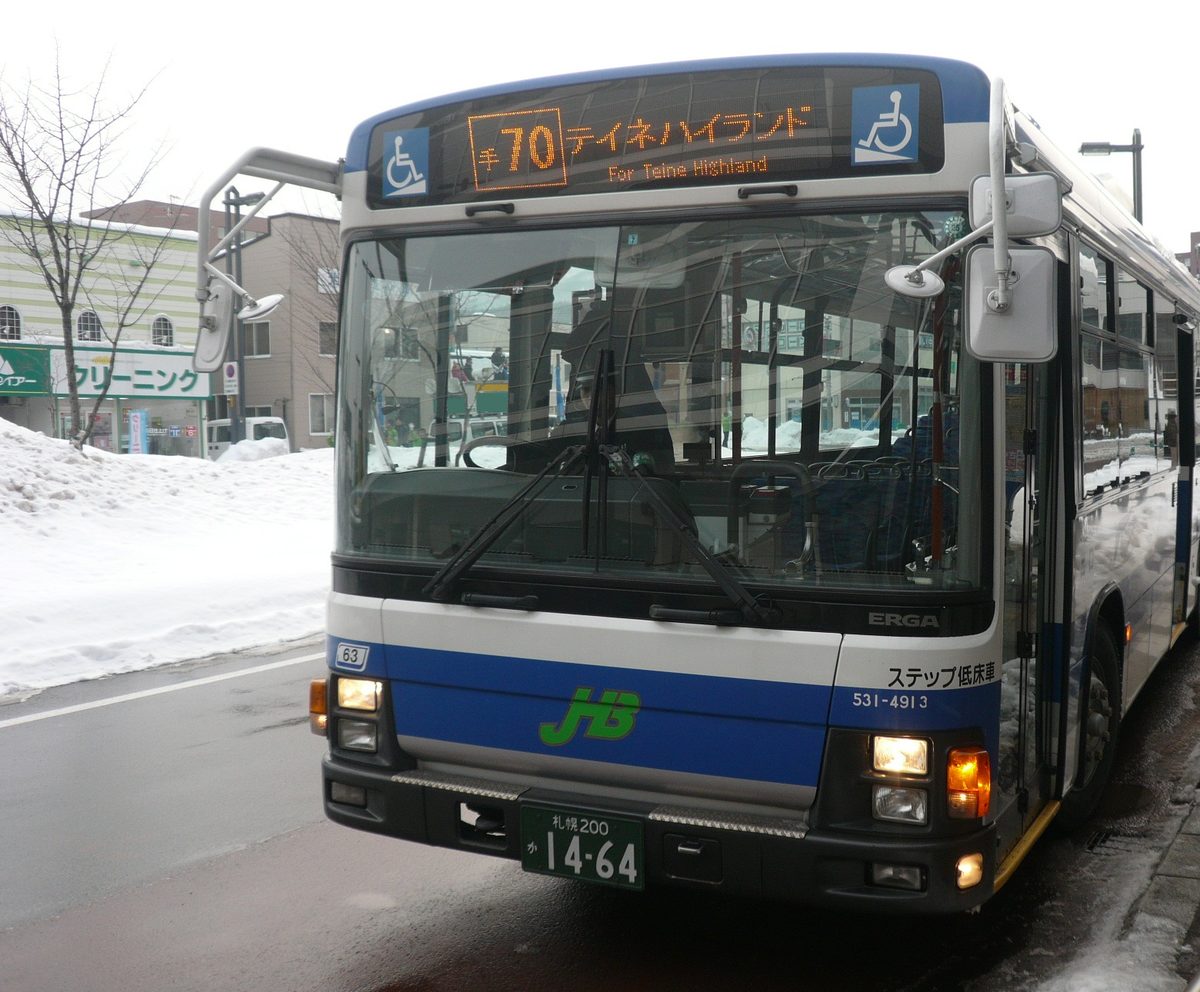
| Teine Stn South Exit stand 3 to Teine Olympia-mae | 16 min | ¥1,000 adult / ¥500 child | Teine-zan line, bus signed "Teine Highland" |
| Teine Stn South Exit stand 3 to Teine Highland | 28 min | Same ¥1,000 | Terminus of the same bus |
| Sapporo hotels to the resort (Big Runs bus) | About 50 min direct | 7-hour ticket plus return bus ¥10,500 / return bus only ¥7,800 | Reservation-only |
| Central Sapporo to the resort (taxi pack) | — | 5-hour ticket, 2 passengers, weekday: ¥14,500 per person | Highland pick-up adds ¥1,500 per vehicle |
| Driving: Teine IC to the Shirakaba base | About 7 min | Parking free | Highland base about 13 min |
| Driving: New Chitose Airport to the resort | About 60 min via expressway | — | Turn left out of Teine IC |
Three more practical notes, all from official pages:
- "There is no bus stop in front of the Seikadai ski area." The route bus does not serve that side. For the ski school or night skiing, the resort tells you to get off at "Teine Olympia-mae".
- You will not find a taxi for the ride down. Official FAQ: "taxis are not stationed here; please make your own reservation." No car and a missed bus means you are stuck on the mountain.
- The Big Runs bus comes with an arithmetic mismatch worth checking first. The published schedule arrives at Olympia 9:25 and Highland 9:35, and departs Highland 16:00 and Olympia 16:10 — while the product it sells is a "7-hour ticket". But in the opening-to-18-January window, Highland's four lifts stop at 15:30, so the actual skiing window is 9:25 to 15:30, roughly six hours. That is not the resort cheating anyone (the 7-hour clock starts when the ticket is first read, and a day pass runs until night skiing ends), but you should know before you buy. This service is reservation-only, minimum one passenger, and buses without reservations do not run and do not stop at stops nobody booked; the deadline is 18:00 ten days before, or 09:00 two days before if seats remain, and booking online rather than by phone or email saves ¥500 per person.
The taxi-pack table hides one detail that is easy to walk into: with four passengers in a regular taxi, the official chart marks ski and board loading as "×" — the car takes the people but not the gear. Three passengers is "△" (loaded inside the cabin, ask first). So if four of you are travelling and all four are renting, do not just book the cheapest per-head option; the vehicle will not hold your equipment. Only at five or more does it switch to a 9-seat jumbo taxi, which is the size that swallows everything.
Driving is out of scope here — Hokkaido winter road conditions, snow tyres and hill starts are a separate subject, covered in our guide to driving on snow in Japan. One resort-specific note: Teine lists two alternative approach roads that close in winter, so stay on the main route the official page indicates. On tyre regulations the resort's pages say nothing, and nothing is what will be invented here.
Lift tickets: 2025-26 actuals and the 2026-27 number nobody has
Most important sentence first: as of 7 August 2026, Sapporo Teine has not published 2026-27 lift prices. The fee page is still headed "2025-2026 Lift and Gondola Fares" and the online ticket portal reads "lift ticket purchase (in preparation)". Any guide quoting a specific "Teine 2026-27 day pass" figure is not getting it from the resort — most likely it has copied last season and dropped the year.
What can be quoted is the 2025-26 actuals, useful for establishing the order of magnitude, not the final number. The resort splits the season four ways:
| Season band (2025-26) | Dates | Adult day pass, online / window | Ages 4-12 |
|---|---|---|---|
| Early season | Opening to 19 Dec | ¥8,000 / ¥9,000 | ¥4,900 / ¥5,900 |
| Regular season | 20 Dec to 8 Mar | ¥8,400 / ¥9,400 | ¥5,200 / ¥6,200 |
| Spring skiing | 9 Mar to 29 Mar | ¥6,200 / ¥7,200 | ¥3,900 / ¥4,900 |
| Late spring skiing | 30 Mar to close | ¥5,700 / ¥6,700 | ¥3,600 / ¥4,600 |
Put that table in context and Teine's position becomes obvious: a regular-season adult day pass online was ¥8,400, while a Niseko United all-mountain peak-season day pass is ¥13,500 for 2026-27. Roughly 60% of the price, for 683 m of vertical, 15 runs and a 6 km descent. That ratio is the arithmetic that makes "stay in Sapporo, ski as a day trip" a real strategy rather than a compromise.
A few official rules deserve pulling out of the fine print:
- There is no half-day ticket. The flexible options are a 5-hour ticket (adult regular season online ¥6,200, but no 5-hour ticket exists in the spring or late-spring bands), a 25-hour ticket, 12- and 3-point cards, and a night pass. If you want an afternoon-only session, the 5-hour ticket is your product.
- A day pass runs until night skiing ends. The official wording is "the 1-day ticket may be used until the end of night skiing", and the FAQ repeats it. On a night-ski day (Shirakaba No.1 to 20:00 in Olympia), buying a day pass means the night session is free; you do not need a separate night ticket. This is the most underrated rule on Teine's price list.
- No deposit on IC lift tickets. Official wording: "no deposit is collected for the use of IC lift tickets." Keep the card and top it up next time, or drop it into a collection box on site. That differs from resorts that hold ¥500 against the card, and it saves you a queue at the end of the day.
- The 25-hour ticket is online only. Adult ¥27,000, deducted in one-hour units, valid across multiple days within the same season, but not shareable between people and not carried over to the next season. It suits people who come often but ski a few hours at a time.
- Point cards are sold at the window only, and not every lift costs the same: the Eight Gondola and Summit Express take 3 points, other chairlifts take 1 (12 points ¥6,900 adult, 3 points ¥2,100). They only pay off if you plan to lap the Shirakaba side.
- A ticket is required from age 4; children 3 and under ride free accompanied by a guardian. Holders of a disability certificate get ¥1,300 off a day pass (window sales only, not combinable). Senior and student rates require proof of age.
- No refunds, no replacements, no resale. The wording is blunt: "no refund will be issued for any reason after purchase."
The advice here is simple: buy online on the official site. The resort's own web discount is the difference between ¥8,400 and ¥9,400 — a flat ¥1,000, handed to you for booking in advance. Collection in Olympia is at the automatic ticket machine on 3F of the Olympia Ski Centre; on the Highland side the official pages give two different floors (one says 3F, another says 4F), so the honest instruction is "inside the Highland Ski Centre" — follow the signage when you get there.
K-Winter Pass: the only price you can act on today
Exactly one set of figures in this article is a published 2026-27 price, and it sits inside a window that expires: the Kamori Kanko four-resort season pass, the K-Winter Pass (KWP). It covers Sapporo Teine, Rusutsu Resort, Sahoro Resort and Nakayama-toge, and all four cost the same — the only choice is which you nominate as your "home ski area", which affects lockers and some perks.
| Sales window | Dates (2026-27 official) | Standard, adult | Gold, adult | Premium, adult |
|---|---|---|---|---|
| Super early | 6 Mar to 6 May 2026 (closed) | ¥90,000 | ¥114,000 | ¥181,000 |
| Early bird | 7 May to 3 Nov 2026 | ¥95,000 | ¥125,000 | ¥190,000 |
| Regular | 4 Nov 2026 to end of season | ¥119,000 | ¥153,000 | ¥212,000 |
The early-bird window shuts on 3 November, and the mountain does not open until 21 November — so if you wait for the first-snow headlines before deciding, the price has already stepped up to regular. For a standard adult that is ¥95,000 against ¥119,000, a gap of ¥24,000. Junior and senior high early-bird is ¥69,000, children ¥57,000.
Who is this for? Be clear that it is aimed at people spending a whole season in Japan or living in Hokkaido; the vast majority of short-trip visitors do not need it. Rough order of magnitude: standard adult early-bird ¥95,000 divided by a regular-season online day pass of ¥8,400 (note that this mixes a 2026-27 price with a 2025-26 one, so treat it as an estimate) comes out at a shade over 11 days to break even. Under ten days on snow and this is not your product.
The three tiers differ mostly in perks rather than access: companion lift-ticket discounts are 30% on Premium and 20% on Gold and Standard; the K Lounge is free for a Premium holder plus one guest, half price on Gold, unavailable on Standard; dedicated lockers and priority parking exist only on Premium and Gold. Three official conditions are easy to miss: a cancellation guarantee deposit of ¥11,000 per pass is charged separately and is never refunded whether or not you cancel (refunding the pass itself requires notice before 10 December 2026 with the pass entirely unused); the home ski area cannot be changed mid-season and costs ¥3,000 to change afterwards; and Nakayama-toge operates in spring only, so do not picture four resorts running all winter.
Rentals: you can actually rent gloves and goggles here
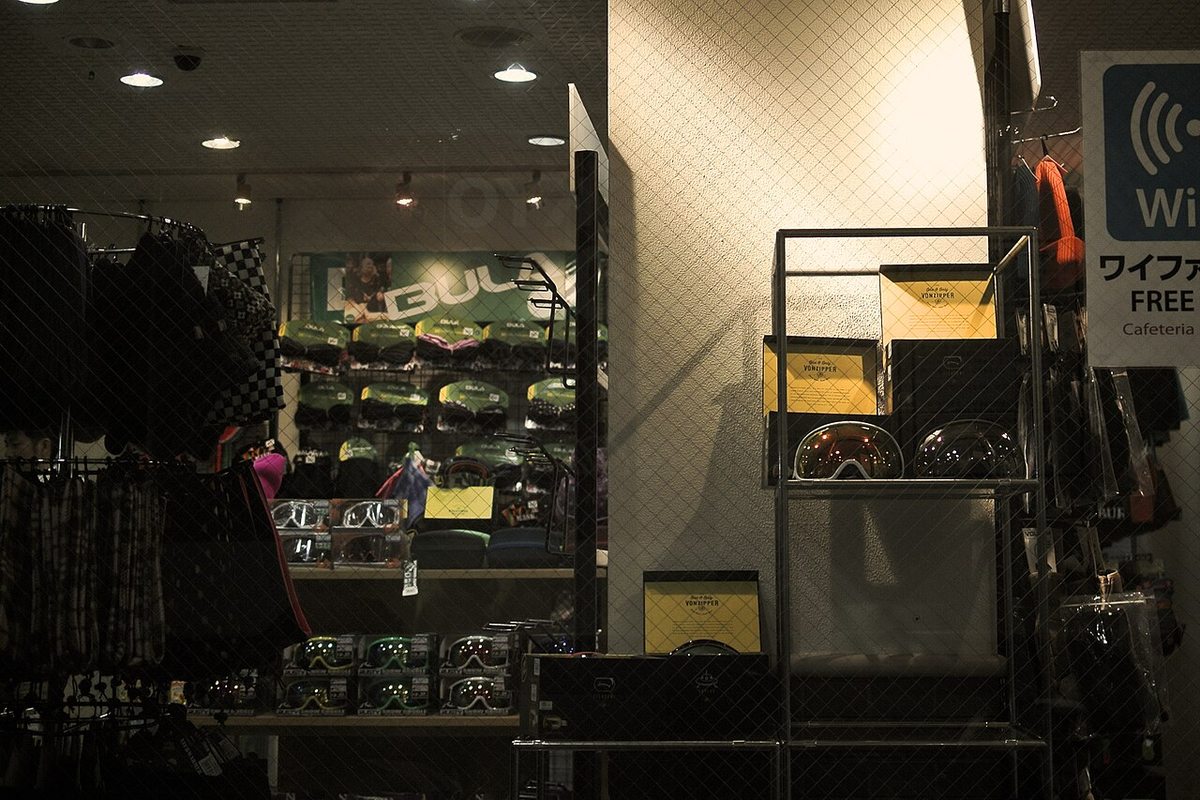
Start with the conclusion. If you have read our beginner cost guide, its finding was that gloves and goggles at GALA Yuzawa and Kiroro are retail items — you cannot rent them at all. Teine is the exception to that pattern: it bundles a beanie, goggles and gloves into an "accessory set" as a normal rental line, and will also rent them individually.
| Item (2025-26 rates) | Age 13+, 1 day | Age 12 and under, 1 day |
|---|---|---|
| Ski set (skis, boots, poles) / snowboard set (board, boots) | ¥8,700 | ¥7,100 |
| Set plus jacket and pants | ¥15,600 | ¥12,700 |
| Jacket and pants only | ¥6,900 | ¥5,600 |
| Accessory set (beanie, goggles, gloves) | ¥3,300 | Same |
| Accessory items individually | ¥1,600 | Same |
| Helmet | ¥3,100 | Same |
| Hokkaido residents' rate, set (ID required) | ¥6,100 | ¥4,800 |
| Night session, set | ¥5,900 | ¥4,500 |
| Change-free service (swap skis and board mid-day) | ¥11,000 | |
A "set" does not include outerwear — Teine is no different from anywhere else here, and it says so twice: "the set does not include small items such as gloves, hat and goggles." So an adult arriving with nothing and renting everything actually pays: set ¥8,700 plus the outerwear step-up (¥15,600 minus ¥8,700 = ¥6,900) plus the accessory set ¥3,300 = ¥18,900, and adding a helmet at ¥3,100 takes it to ¥22,000. The lift ticket that same day is ¥8,400 — the gear costs about 2.6 times the ticket.
That is the highest multiple of any resort I have checked (Hirafu about 2.0, Kiroro about 1.9, Rusutsu 1.3 to 1.8), but the reason matters: Teine's rentals are not expensive; Teine's lift ticket is cheap. In absolute terms its full rental bill sits in the same band as everyone else's. Which produces a very concrete trade-off — at Teine, every item you pack from home saves a larger share of your day's cost than at any other resort here. Bring your own outerwear and you save ¥6,900; bring gloves and goggles too and that is another ¥3,300. Together, ¥10,200 — more than the lift ticket itself.
Two operational details. The rental shops close at different times in the two zones: Highland 1F runs 8:30 to 16:30, Olympia 3F runs 8:30 to 20:00 because night skiing lives there. The official FAQ confirms you may "borrow at Highland and return at Olympia" as long as you say so when you collect — and the accompanying note that "closing times differ" is precisely a warning not to do it the other way round. If you are bringing children, check sizes first: kids' ski boots run 14.5 to 23.5 cm, snowboard boots 13.5 to 21.0 cm and outerwear 80 to 140 cm. Anything smaller is not stocked and must come from home. The resort has also announced a large intake of BURTON Step On rental boards (strapless bindings), which is genuinely good news for a first snowboard day.
Ski school and the language question
Teine Olympia Ski School carries a serious credential — the resort's own front page calls it "the first SAJ (Ski Association of Japan) certified school in Hokkaido". Reception is on 3F of the Olympia Ski Centre, direct line 011-685-7000, 8:00 to 17:00.
| Lesson (2025-26 rates) | Eligibility | Half day (2h) | Full day (4h) |
|---|---|---|---|
| Group lesson, by level | Elementary school age and up | ¥7,000 | ¥9,000 |
| Group lesson with rental (gear) | Junior high age and up | — (no half day) | ¥17,200 |
| Group lesson with rental (gear plus outerwear) | Junior high age and up | — | ¥24,700 |
| Private lesson, 1 person | Age 4 and up | ¥24,000 | ¥33,000 |
| Private lesson, 2 people | Age 4 and up | ¥36,000 | ¥43,000 |
| Kids private (skiing only, one-to-one) | Age 4 to sixth grade, strictly enforced | ¥17,000 | ¥22,000 |
Lift access during the lesson is included in the price (rental is not). That is worth flagging, because GALA Yuzawa's official page states the opposite — "lift fees are not included in the lesson price". For the same ¥7,000 headline group lesson, Teine's two hours of lift rides cost you nothing extra.
Now the part that has to be said plainly: Teine's own ski school teaches in Japanese. The official page files both group and private lessons under a "in Japanese" heading and states that "lessons are intended for people who can communicate smoothly in Japanese (bilingual Japanese speakers)", with the private-lesson section repeating that "lessons are for those capable of everyday conversation in Japanese." There are two "English lessons here" links on the page, but when checked on 7 August 2026 that English page returned a WordPress error (HTTP 500), and although the language selector offers simplified and traditional Chinese, every Chinese path tested returned 404. So the claim that "Teine has an official Chinese site and Chinese lessons" cannot be endorsed here. (This may simply be an off-season state of the website, and it is worth rechecking before the season starts.)
That splits into two routes. If your Japanese is adequate, the official school is the clear pick — SAJ certified, lift access included, and accident cover during the lesson (¥1,000 per day outpatient, ¥1,500 per day inpatient, ¥2 million for death or permanent disability; the school also recommends students carry their own insurance). If you need instruction in English, you have to look outside the resort's own school, which matches the structural finding in our beginner guide: English and Chinese instruction in Japan clusters in private lessons and third-party operators. Small-group lessons with hotel pick-up are the lowest-friction entry point:
Sapporo Teine small-group ski lesson with Sapporo hotel pick-up (Trip.com) →
A handful of booking rules will trip you up if you skip them: group lessons that include rental must be booked online two days ahead and are not accepted on the day, rental collection is at the 3F desk no later than 60 minutes before the lesson, and gear must be back by 17:00 that day. Private lessons need booking by 16:00 two days before; kids' private lessons are online only, with no phone bookings. Cancellations are taken by phone only, and cancelling after 16:00 the day before costs 100%. A plain group lesson can still be joined on the spot up to 30 minutes before the start if space remains — but arrive late and you cannot join. As for insurance, "does travel insurance cover skiing" has no one-line answer; it depends on the exclusions in your specific policy, and reading them line by line is the least worthwhile three minutes to skip. Our Japan travel insurance guide covers what to look for.
Night skiing, the play area and bringing kids
All of Teine's night skiing is in Olympia: Shirakaba No.1 lift runs to 20:00 (last loading 19:40; a separate official page gives a final gate time of 19:45, and since both numbers appear on the resort's own site, take the conservative 19:40). The open runs are Shirakaba Sunshine (beginner) and Shirakaba Sunrise (intermediate), with the Beginners Cross area opening in early January. The 2025-26 night season ran 6 Dec to 29 Mar; the 2026-27 dates have not been announced separately, and can only be assumed to sit inside Olympia's operating window (5 Dec to 28 Mar) — so no fixed dates will be stated here.
On cost, worth repeating: if you bought a day pass, night skiing is already paid for. A night ticket is only needed if you are turning up purely for the evening (2025-26 actuals: junior high and above ¥2,800 online, ¥3,800 at the window; ages 12 and under ¥1,800 / ¥2,800). Regulars have the option of a night season pass at ¥39,000 adult and ¥25,000 for ages 12 and under. Night-session rental of a set is ¥5,900 for adults, and the only food outlet still open after dark is North Maple beside Shirakaba No.1 (11:00 to 19:00, last orders 18:30).
With children, the Olympia side has two facilities that are ticketed separately — something a lot of families only discover at the till:
- Snowland (snow play area): on the Shirakaba slope, across the road from North Maple, mid-December to mid-March, 10:00 to 15:00 depending on snowfall. Admission ¥2,300; sleds are lent free, and there are snow tubes and snowshoes too. Tube age limits: 4 and up for one- and two-person tubes; the three-person tube takes children from 2 with an adult riding along, and needs no adult at all if every rider is 4 or over. Ages 3 and under are free with a guardian.
- Debut Escalator (beginner conveyor): it is not inside Snowland. The resort puts it on "Bunny Slope", on the same Shirakaba slope but beside the Shirakaba No.3 lift loading point, mid-December to mid-March, 10:00 to 16:00. Neither a day pass nor a point card is valid on it: you need a separate Debut Escalator ticket at ¥2,300 or a Snow Play Pass at ¥3,900. Any child on snow for the first time will almost certainly use it, so budget for it up front.
The two close an hour apart, and that hour falls late in the afternoon. Walk over to Shirakaba after 15:00 with a child and the play area has packed up while the conveyor keeps running to 16:00 — so finish the sledding and tubing before 15:00, and save that last hour for practice runs off the conveyor.
For non-skiing companions or younger children: Highland 2F has a nursery, "Omochabako", for ages 1 to 6, 9:00 to 16:00 with a 12:00 to 13:00 break, ¥2,000 per hour with a two-hour minimum, booked by 17:00 the previous day. Nursing and nappy-changing facilities are on 3F of the Olympia Ski Centre, and both zones have free changing rooms. Bag storage runs ¥1,500 a day, ¥2,000 overnight, ¥4,000 a week; the largest coin lockers are 60 by 60 by 60 cm, and the Highland 1F bank takes cash only.
1972: you are skiing the actual race lines
Mt. Teine was one of the venues of the 1972 Sapporo Winter Olympics, and the resort is precise about which zone did what:
"At the Sapporo Olympics held in 1972, the Highland Zone was the venue for the four technical alpine events — men's and women's giant slalom and men's and women's slalom — while the Olympia Zone housed the cauldron and was the venue for the five sled events, bobsleigh and luge."
Read that, then look back at the course list, and something clicks: the Highland run names are the event names. Joshi Daikaiten, "women's giant slalom", is 2,000 m with a 34-degree maximum, graded advanced and marked FIS-certified by the resort; Danjo Kaiten, "men's and women's slalom", is 700 m at a 34-degree maximum and 21-degree average, also advanced. These are not commemorative names — the resort's own course blurb calls them "serious courses that challenge even advanced skiers, including the FIS-certified 'Jodai', the famous Kitakabe and Danjo Kaiten." If you can handle advanced terrain, you can spend the day skiing lines that were raced half a century ago.
"Seikadai" — cauldron — on the other side is equally literal. The resort states the Olympic cauldron was installed in Olympia, and today all three runs in that pocket carry the name: Seikadai Ocean Dive, Ocean Cruise and Ocean Stream, plus the Seikadai No.1 lift, the Seikadai Snack House and the Seikadai car parks. The same page notes Teine later hosted the 1991 Winter Universiade and the 2017 Asian Winter Games.
Now the part that is not documented, stated openly rather than filled in: the resort's public pages say nothing about whether the cauldron itself still stands or can be visited, and nothing about whether any remains of the bobsleigh and luge track survive. One common error is worth blocking too — the four events described are the technical disciplines, giant slalom and slalom. Downhill does not appear anywhere in Teine's official account, so do not add it. And "Olympia House" over in Olympia is described by the resort purely as a facility for group bookings and course members, with zero Olympic history attached; it is not a museum to visit.
"We put up as few ropes as possible": the Teine Gate
Teine's rules page has an unusual tone for a Japanese resort. It opens like this:
"Sapporo Teine is a free ski area. But please understand that enjoying that freedom comes with personal responsibility."
"At Sapporo Teine we mark out-of-course areas and areas outside the managed zone with nets and ropes. However, Teine installs only the minimum of dividing nets and ropes. For tree runs and places that are obviously dangerous or obviously outside the course, we ask you to judge as a person with common sense."
What that means in practice for a visitor: do not use "roped equals closed, unroped equals open" as your decision rule. Teine is telling you outright that it deliberately puts up fewer ropes and hands the judgement back to you. At the same time it has the same institutional exit as everyone else — the "Teine Gate", beside the summit patrol hut, and it is the only one: "if you are leaving the managed area for backcountry skiing or riding, on the condition that you act at your own risk, exit is permitted only via the 'Teine Gate' next to the summit patrol." Which incidentally corrects a widely repeated claim: gate systems are not a Niseko peculiarity, they are the Japanese norm, and Teine is one more example.
Other points from the official text:
- Ducking ropes is explicitly banned: "leaving the managed area by going under a rope is strictly prohibited."
- Out-of-bounds rescue is billed at cost: "in the event of a search or rescue outside the ski area's managed zone, actual costs will be charged." Teine publishes no figure. The "minimum 100,000 yen" number that circulates online is Niseko's, written into Niseko's own rules, not Teine's, and it will not be borrowed here. Likewise, Niseko, Hakuba Valley and Kiroro all state in writing that violations mean confiscation of your lift ticket; neither of Teine's two rules pages contains that wording, so it is not claimed here either.
- Nature Zone: the resort keeps one sanctioned tree-run area, noting that "beginners are asked to refrain from skiing it, and we strongly recommend wearing a helmet just in case." It does not appear in the 15-course list or on the terrain-park page, so since the public pages do not show where it is, this guide does not say where it is or how to enter it. That single line is also the only place on the whole site where a helmet is "strongly recommended".
- Climbing inside the ski area during the winter season is prohibited in principle (on foot, on skins, by snowmobile or vehicle alike); drones are banned without special permission; and the slopes and car parks are off limits outside operating hours, when the groomers are working.
- Do not sit down on a run: the wording is "when you stop, and of course when you fall, clear the course quickly."
Eating on the mountain, and one machine that refuses cash
The resort describes itself as having "two restaurants plus two cafes"; counting the snack house it is five outlets. Hours below are 2025-26 official, prices from the 2025-26 menus:
| Outlet | Zone | Seats | Hours | What it does |
|---|---|---|---|---|
| Cafe Restaurant Skadi | Highland (Ski Centre 4F, top floor) | Up to 650 | 9:00-17:00 (orders 10:00-16:00) | Curry and ramen |
| Hot Cafe 1023 | Highland (summit, by Panorama No.2) | 40 | Not published | Early Dec to late Mar, weekends, holidays and New Year only |
| Restaurant Ullr | Olympia (Ski Centre 3F) | 330 | 9:00-16:30 | Pizza and rice bowls; the widest menu |
| North Maple | Olympia (near the Eight Gondola base) | 80 | 11:00-19:00 (LO 18:30) | Burgers; the only one open at night |
| Seikadai Snack House | Olympia (lower Seikadai area) | 80 | 9:00-16:00 | No meals served — vending and ticket machines only |
The one to head for is Skadi on Highland 4F, and not because of the location — because of how the menu is built. It carries Sapporo miso ¥1,350, Asahikawa niboshi shoyu ¥1,250 and Hakodate negi-shio ¥1,250 on the same card, which means you can compare Hokkaido's three great ramen styles in one cafeteria, and for less than they cost in the city. For a "stay in Sapporo, ski for a day" itinerary, that lunch is part of the trip rather than a refuelling stop. The menu also flags katsu curry ¥1,500 as its number one seller and Teine ramen (tonkotsu) ¥1,450 as number two; big appetites have the "jumbo" double-size range, where katsu curry runs ¥2,700.
Ullr in Olympia goes in a completely different direction and suits a group that all wants something different: pizza (margherita ¥1,700, four-cheese ¥1,800), Genghis Khan rice bowl ¥2,000, roast beef bowl ¥2,800, unagi over rice ¥4,300 (the priciest item on the mountain), plus a kids' ramen at ¥900 and kids' curry at ¥950 for elementary-age children and under. North Maple is the night-session default, with the TEINEBURGER at ¥1,150 on its own, and both the Teine coffee ¥600 and Teine beer ¥600 flagged on the menu as made with Mt. Teine spring water.
One note on etiquette: ski-area restaurants in Japan are indoors with plenty of seating (Skadi alone has 650 seats), so buy your food, sit down and finish it before you move on. Do not carry a bowl of curry or ramen around with you — the boot rooms, lifts and staircases are all circulation space, and that is doubly true at a ski area. For souvenirs each zone has a shop (Highland 3F "Ezorisu", 9:00-16:15; Olympia 3F "Ezofukurou", 9:00-16:30). If you are shipping gear ahead by Yamato, the resort asks that parcels be timed to arrive two days early.
How I would plan the day
Boiling all of the above into recommendations, here is where the trade-offs land:
- First time on snow, with kids, wanting a lesson or night skiing: Olympia only, and the date has to fall between 5 December and 28 March. Get off at "Teine Olympia-mae" — the 16-minute stop. The rental shop runs to 20:00, the school is on 3F of the same building, and the conveyor and play area are within walking distance. Not one element of that package exists at Highland.
- Already skiing confidently and after distance and vertical: go up to Highland — but treat the return trip as your first constraint, not your last: before 18 January the Eight Gondola stops at 15:30, and if you ski that 6 km down into Olympia and miss the last cabin, you cannot get back to the side where your car or locker is. Settle that before you decide how many laps you are doing.
- Where not to economise: a helmet (¥3,100), the first group lesson if this is your first day on snow (¥7,000, lift access included), and buying the ticket online (¥1,000 cheaper than the window).
- Where to economise: outerwear, gloves and goggles from your own wardrobe. At Teine those two items save ¥10,200, more than a day pass costs. Teine does rent gloves and goggles — but "available to rent" and "worth renting" are different questions.
- Dates to avoid: 27 December to 4 January, when the entire rental card jumps to high-season pricing; and the 52 days from 21 Nov to 4 Dec and 29 Mar to 5 May, when Olympia is closed, which anyone with kids or a lesson booked should route around.
- The only decision with a clock on it: if you are in Hokkaido for a long stretch this winter, or already know you will ski ten-plus days, the K-Winter Pass early-bird closes on 3 November 2026 — earlier than opening day. Everything else on this page (lift tickets, rentals, lessons) should wait for the resort's late-September to October update to the 2026-27 rates. Using last season's numbers to make this season's decisions is not a trade worth making.
Which brings this back to where it started. Teine's real value is not its size; it is that it turns skiing from a trip you have to build an itinerary around into one slot inside a Sapporo itinerary: leave the hotel in the morning, 11 minutes of train, 16 minutes of bus, and be back in the city for ramen in the evening. That is also why the lodging advice is simply to book in central Sapporo and not relocate for the skiing — and Sapporo rooms in winter are peak-of-the-peak, so book early:
Compare Sapporo winter hotel rates on Trip.com →To fold this day into a wider Hokkaido winter plan, start with our complete Sapporo guide. And if what you actually want is the other model — living at the mountain and skiing several days in a row — then the pages to read are the Niseko ski guide or the Kiroro ski guide. Both are destination resorts built on "move once, sleep on the hill", which is a completely different trip structure from Teine's day return.
Frequently Asked Questions
- Q1:How long does it take to get from JR Sapporo Station to Sapporo Teine, and what does it cost?
- About 40 minutes and ¥1,360 one way. JR Sapporo to JR Teine is 11 minutes and ¥360 on the Hakodate Line. From Teine Station South Exit, stand 3, the JR Hokkaido Bus Teine-zan line runs to "Teine Olympia-mae" in 16 minutes and continues to the terminus "Teine Highland" in 28 minutes — same bus, same fare of ¥1,000 adult / ¥500 child (2025-26 actuals; 2026-27 not yet published). The famous official line "just 16 minutes to the slopes" refers to the Olympia stop, not the summit and not Highland. Two other useful legs: JR New Chitose Airport to Teine is 51 minutes minimum and ¥1,400, and JR Otaru to Teine is 21 minutes minimum and ¥580.
- Q2:Can non-skiers ride the lifts up Mt. Teine for the view?
- No. The official FAQ answers the question "can I go up to the summit as a sightseer without skis or a board?" with "the rules require you to be wearing or carrying sliding equipment, so boarding on foot is not permitted." So a lift ride up Teine for the Ishikari Bay panorama is not something a non-skier can add to a Sapporo itinerary.If someone in your group is not skiing, the right plan is to park them at the base: Skadi in Highland seats 650, Ullr in Olympia seats 330, both zones have free changing rooms, and Highland 2F has a nursery for ages 1 to 6 (¥2,000 per hour, two-hour minimum, booked by 17:00 the previous day).
- Q3:Highland or Olympia — which zone should I pick?
- First time on snow, skiing with kids, want a lesson, want to ski at night: Olympia, all four. Go up to Highland when you want distance and pitch. This is not a matter of taste. The ski school, night skiing (Shirakaba No.1 lift runs to 20:00), the beginner conveyor "Debut Escalator", the Snowland play area and the rental shop that stays open until 20:00 are all on the Olympia side, and the official FAQ says outright that "Olympia Zone has more gentle courses than Highland Zone, so we recommend it for children and beginners." The catch is that the two zones run on different calendars: for 2026-27 the resort opens 21 Nov and closes 5 May, but Olympia only operates 5 Dec to 28 Mar. One counter-intuitive fact worth knowing: the steepest pitch on the mountain, 38 degrees, is in Olympia — the upper section of Seikadai Ocean Dive — not in Highland.
- Q4:How much is a 2026-27 lift ticket at Sapporo Teine?
- As of August 2026 the resort has not published it. The official lift-fee page is still headed "2025-2026 Lift and Gondola Fares" and the online ticket portal reads "in preparation". So any specific "Teine 2026-27 day pass" figure you come across is not coming from the resort. What can be quoted is the 2025-26 actuals: regular season (20 Dec to 8 Mar) adult day pass ¥8,400 online and ¥9,400 at the window; early season ¥8,000 online; spring skiing ¥6,200 online. The only 2026-27 price the operator has published is the K-Winter Pass, the four-resort season pass from Kamori Kanko (standard adult early-bird ¥95,000, early-bird window closing 3 Nov 2026). Buy tickets online when you do buy: the resort's own web discount is ¥1,000 on an adult day pass.
- Q5:Can I rent gloves and goggles at Teine?
- Yes, and that is not the norm in Japan. Teine bundles a beanie, goggles and gloves into an "accessory set" at ¥3,300 a day, or rents them individually at ¥1,600 each (2025-26 rates). Compare that with GALA Yuzawa and Kiroro, whose official pages list gloves and beanies as retail items only — you cannot rent them there at any price. Teine's definition of a "set" is the same as everywhere else, though: skis, boots and poles, or board and boots, with the official note that "the set does not include small items such as gloves, hat and goggles", and outerwear priced as a separate tier. The cross-resort breakdown of what a rental set does and does not include is in our guide to what skiing in Japan actually costs.
- Q6:Are there English or Chinese ski lessons at Sapporo Teine?
- Not inside the resort's own school. It teaches in Japanese, and the English page is currently broken. Teine Olympia Ski School is the first SAJ-certified school in Hokkaido, but the official page files both group and private lessons under a "in Japanese" heading and states that "lessons are intended for people who can communicate smoothly in Japanese (bilingual Japanese speakers)." The two "English lessons here" links on that page returned an HTTP 500 error when checked on 7 August 2026, and although the site's language selector lists simplified and traditional Chinese, every Chinese path tested returned 404. If you need instruction in English, the route is outside the resort's own school — either email the school before you travel (011-685-7000, 8:00 to 17:00) or book a bilingual small-group lesson through a third-party platform.
- Q7:Can I pay by card on the bus up to the ski area?
- No — and the rule reverses once you arrive. The official access page states that "please pay the fare with exact change when boarding; credit cards other than SAPICA and Kitaca-linked cards cannot be used." The Teine-zan line takes cash or SAPICA/Kitaca-family IC only, and you should carry coins. Inside the resort the situation flips: the official FAQ says cards and e-money work "for lift ticket purchases, rentals, restaurants and shops, almost everywhere", and North Maple in Olympia goes further — its meal-ticket machine is card and e-money only, no cash. One more trap from the same FAQ: "taxis are not stationed here for the return journey; please make your own reservation." Do not count on flagging a ride down at the end of the day.
Read next
Best Ski Resorts in Japan 2027: Niseko vs Hakuba vs Nozawa vs Zao
The powder is world-famous, but each resort suits a different skier — snow, terrain, access and who each is for, in one table.
Skiing in Japan for Beginners: What a Day Really Costs
A rental "set" means skis and boots, never outerwear. At Niseko for 2026-27 the jacket-and-pants hire costs more than the skis themselves.
Sapporo Travel Guide 2027: Odori Park, Snow Festival & Mt. Moiwa
Hokkaido's gateway and food capital — Odori Park and the Snow Festival, the Clock Tower, Mt. Moiwa's night view, miso ramen, Genghis Khan and soup curry.