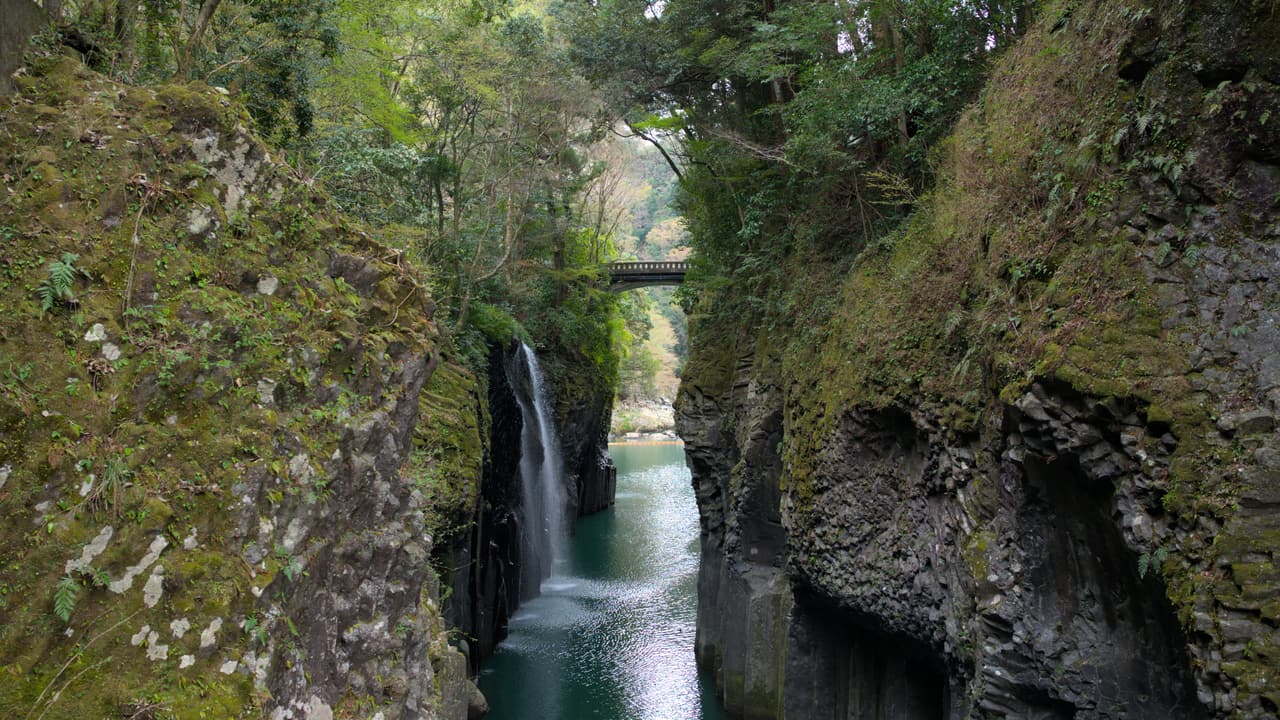
Takachiho is the stage of one of Japan's founding myths — the "descent of the heavenly grandson," where the grandson of the sun goddess Amaterasu is said to have come down to earth — which is why this mountain district is called the "home of myth." Its signature image is Manai Falls dropping into a columnar-basalt gorge, and the rental boats you can row right up beneath it — about as postcard-Kyushu as it gets. This guide covers the rental-boat price (from ¥4,100 a boat), reservations and closures, the nightly 20:00 kagura at Takachiho Shrine, Amano Iwato and Amano Yasukawara, and how to reach a town with no railway. Takachiho usually shares a trip with Aso — for the crater rules and access, see our Aso crater guide.
- Home of myth: the "descent of the heavenly grandson," a columnar-basalt gorge and Manai Falls (a "100 famous waterfalls" pick)
- Rental boats: ¥4,100 per boat / 30 min on weekdays, ¥5,100 weekends, max 3 people — reserve online
- Closures happen: suspended on high water, dam releases and safety checks — no boat ≠ no gorge; the path still looks down on it
- Night kagura: Takachiho Shrine nightly at 20:00, ¥1,000 — you need to stay over to see it
- No railway: highway bus from Kumamoto ¥2,400 / 2 hr 10 min, or drive and add Aso
📖 Contents
Why visit Takachiho
Takachiho sits in the mountains at the northern tip of Miyazaki Prefecture, on the Kumamoto border, and it has been at the heart of Japanese myth since ancient times. The Kojiki and Nihon Shoki place the "descent of the heavenly grandson" — Ninigi, grandson of Amaterasu, coming down to rule the land — in this area; the stories of Amaterasu hiding in the heavenly rock cave and the gods conferring at Amano Yasukawara are set here too. For Japanese visitors, Takachiho isn't just scenery — it's the scene of the nation's origin myth.
What carries that mythic mood is Takachiho's distinctive terrain. Around 120,000 years ago, pyroclastic flows from the Aso volcano cooled here into dramatic columnar basalt — ranks of hexagonal stone pillars — and the Gokase River has since carved a V-shaped gorge 80–100 meters deep. Myth and geological spectacle stacked together make Takachiho the inland Kyushu spot most worth a dedicated visit. It makes a neat contrast with the also-in-Miyazaki but utterly different Nichinan coast — mountain myth-gorge on one side, the washboard rocks of Aoshima, Udo Shrine and southern seascapes on the other, so you can give Miyazaki one mountain leg and one coastal leg.
The gorge and the rental boats
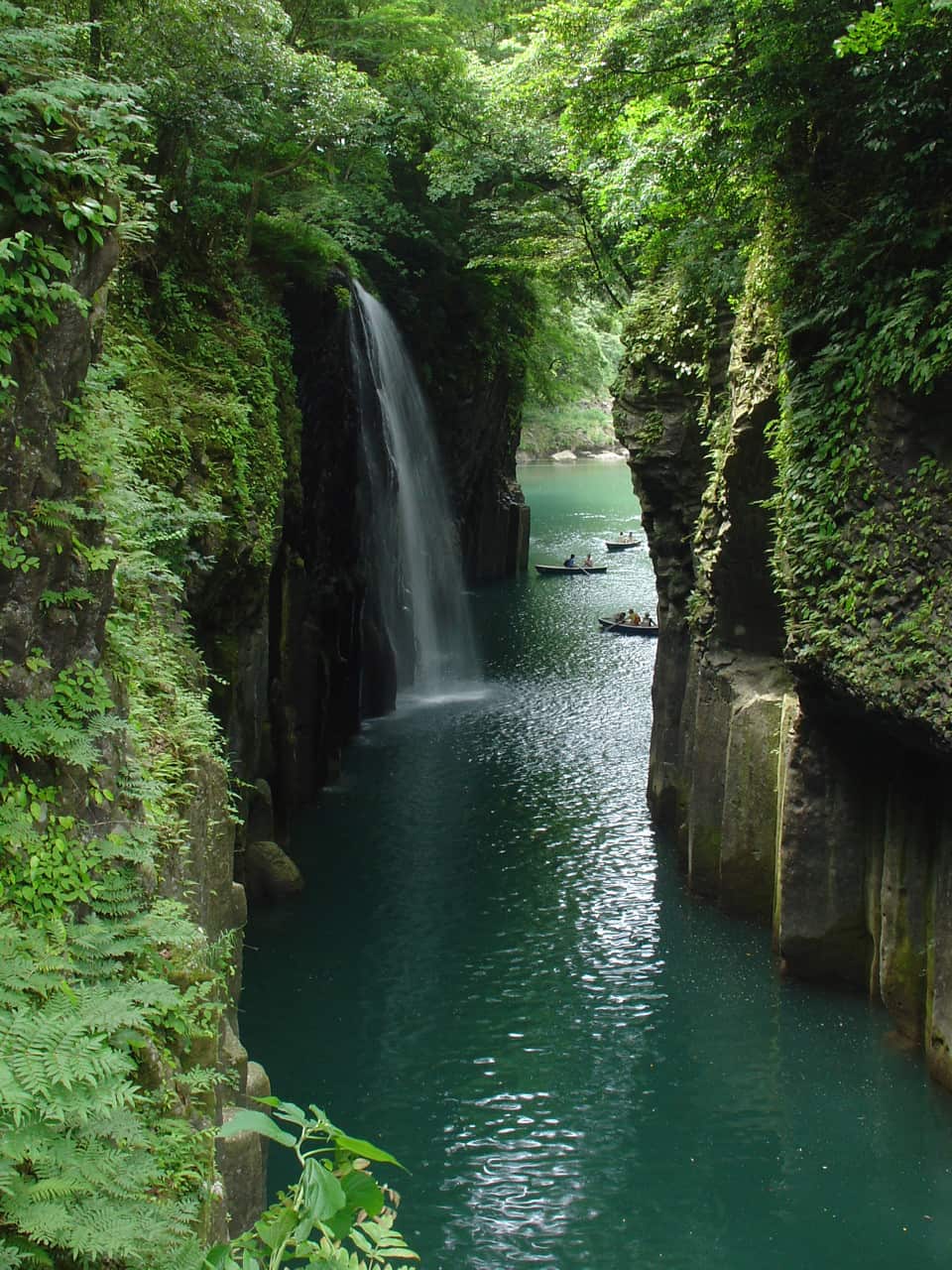
The classic way to experience Takachiho Gorge is to rent a boat and row up close to Manai Falls — a cascade dropping about 17 meters from the cliff onto the water's surface, listed among Japan's "100 famous waterfalls." The view looking up at the falls and the columnar cliffs from water level is one you can't get from the path above.
Note the practicalities first: ¥4,100 per boat for 30 minutes on weekdays, ¥5,100 on weekends and peak periods (overtime ¥1,000 per 10 minutes), up to 3 people per boat (4 with a preschooler), open 8:30–17:00 with last reception at 16:30. Reserve online — the official site opens from 2 weeks to 2 days before, and on busy days and weekends walk-ups almost never get in. You'll lean on your phone for the booking, the day's status and gorge navigation, so set up a Japan eSIM from KKday before you go.
One thing to know up front, though: the boats are suspended when the river rises, when the dam releases water, and during safety checks — not rare in rainy mountainous Kyushu. Let me be clear: not being able to row does not mean the gorge is closed. Even on a no-boat day, the gorge-side walking path still gives you Manai Falls and the columnar cliffs from above — just looking down rather than up. Treat the boat as a bonus, not the sole goal, and your plan won't be hostage to the weather.
The gorge is more than the falls, too. A roughly 1-kilometer riverside promenade runs along the top of the cliffs from the boat dock, passing viewpoints over the columnar walls, the Yaribi (spear-leap) narrows where the channel pinches to a few meters, and Onokoro Pond with its carp. Walking it takes 30–40 minutes one way and is free — so even visitors who skip or miss the boat get the gorge's best angles. If you do both, the smart order is to row first thing in the morning when the dock is quiet, then walk the promenade afterward.
Takachiho Shrine and the night kagura
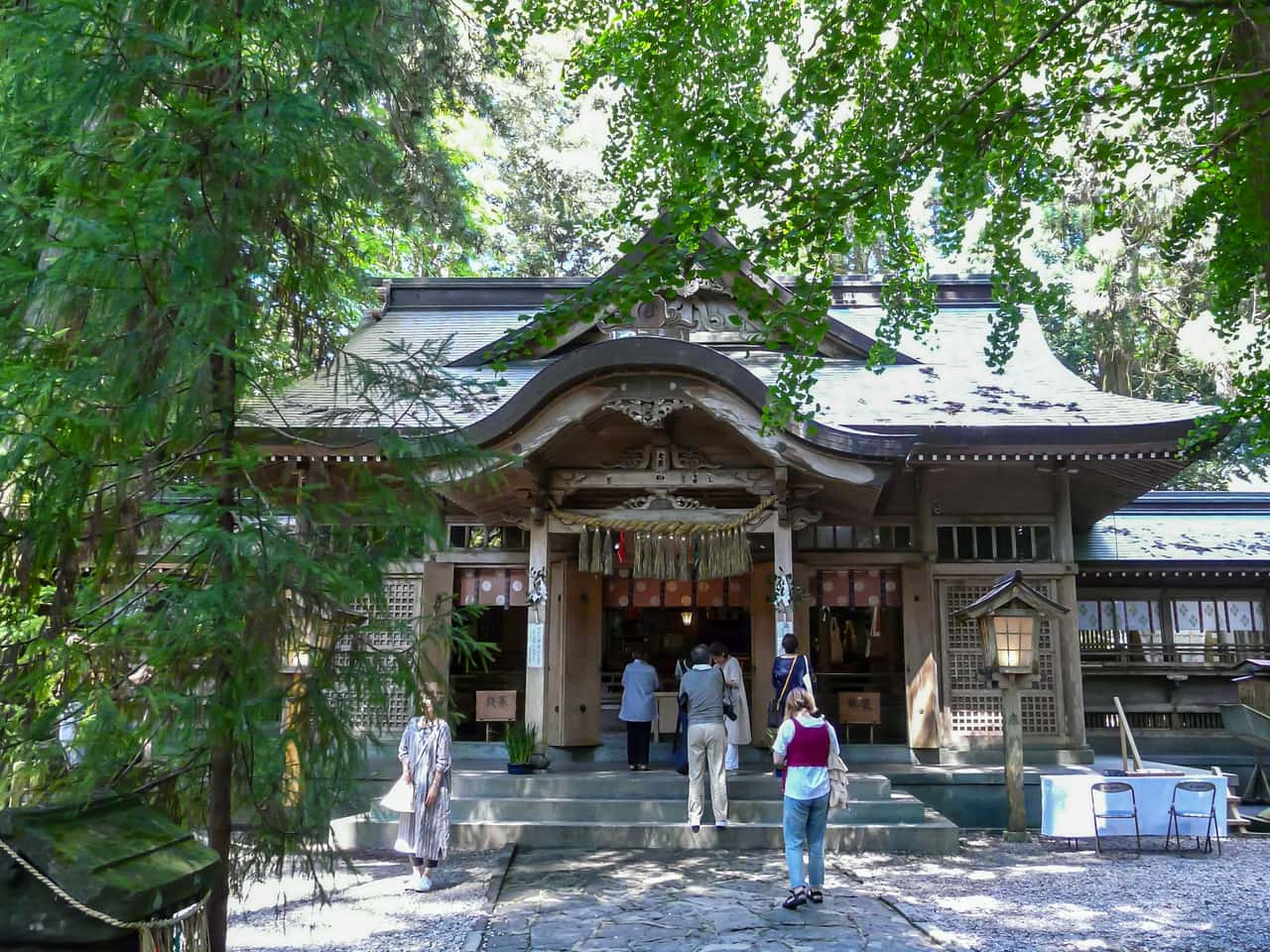
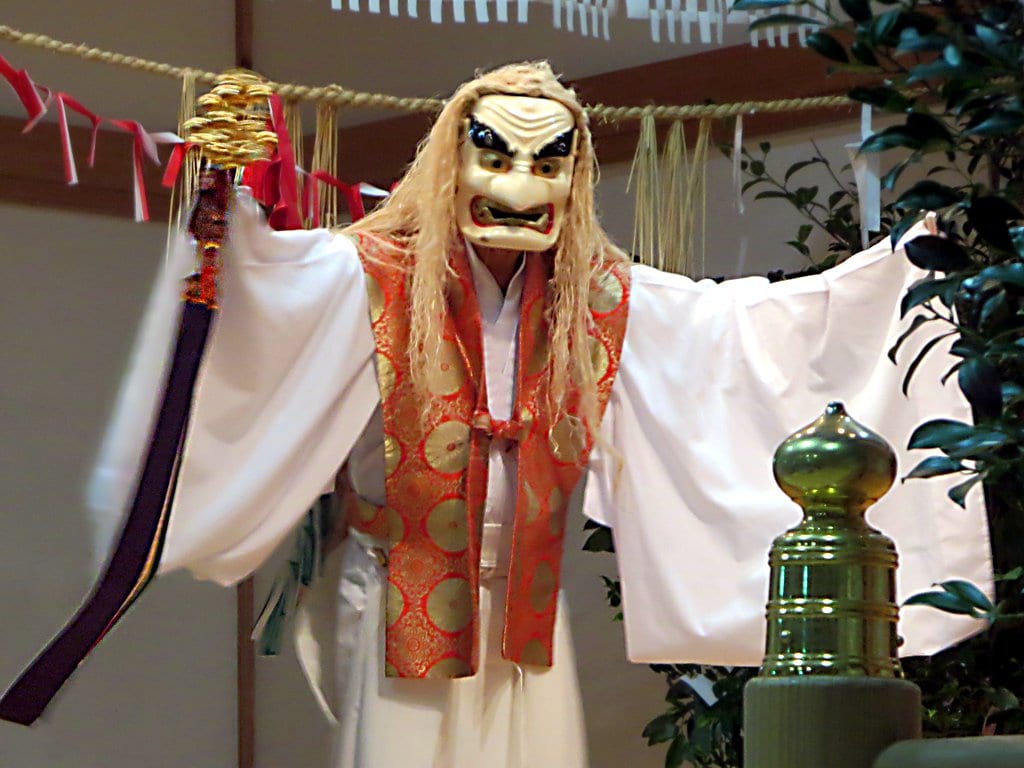
The Takachiho evening belongs to yokagura. Originally a sacred dance villages performed through winter nights to honor the gods — 33 dances from dusk to dawn — it's now made accessible to visitors: Takachiho Shrine's kagura hall stages a one-hour show nightly at 20:00, excerpting four representative dances ("Tajikarao," "Uzume," "Totori," "Goshintai") from the 33. They enact exactly the myth of Amaterasu hiding in the rock cave and the gods coaxing her out, masked dancers set to flute and drum — quietly mesmerizing.
¥1,000 for adults (¥900 for junior-high and up, and groups of 20+), reservable online (200 seats) or by same-day reception (50 seats). The shrine is worth a daytime visit too — around 1,900 years old, set among soaring cedars, with sights like the "married cedars." To catch the kagura you'll need to make Takachiho an overnight — the biggest way it differs from a typical day-trip sight.
Amano Iwato Shrine and Amano Yasukawara
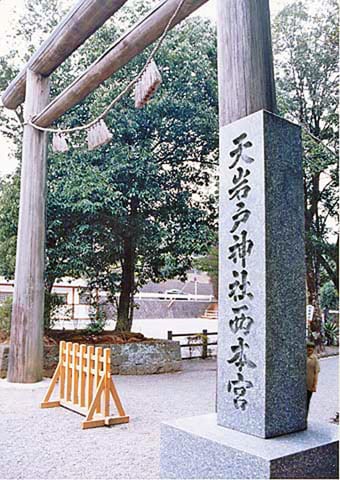
Beyond the gorge, two more mythic scenes lie east of the town center. Amano Iwato Shrine enshrines the "heavenly rock cave" where Amaterasu hid — the cave faces the rear of the main hall across the Iwato River, and as sacred ground you can only view the worship hall when led by a priest (free), so register at the shrine office.
Walk about 10 minutes up the Iwato River to Amano Yasukawara — the riverside cavern where, after Amaterasu hid, the eight million gods are said to have gathered to plan how to draw her out. Today its interior and approaches are dense with little stacked prayer-stone towers left by worshippers, an unusual and atmospheric sight. Both are within about a 15-minute drive of Takachiho Gorge, easy to pair on the same day.
When to go
Takachiho rewards different seasons differently. Mid-to-late November is peak autumn foliage, when the gorge cliffs frame red and gold maples over the green water — the most photogenic window, and also the busiest, so book boats early. Spring brings fresh greenery and mild weather. In summer, Manai Falls and the gorge are lit up in the evenings (illumination dates shift year to year — check the tourist association), a cooler time to walk the path; summer is also peak rainy season, so it's the period when boats are most often suspended by high water. Winter is cold but quiet, and atmospheric for the kagura. Whatever the season, the gorge is most peaceful right at opening before the day's crowds and tour buses arrive — another argument for staying overnight nearby.
Access: getting to a town with no train
The key thing first: Takachiho has no railway. The old Takachiho Railway was damaged by a 2005 typhoon and never reopened (part of the line now runs a tourist "Amaterasu Railway" handcart ride, but that's not transport). So there are three main ways in:
- Highway bus from Kumamoto: the "Express Takachiho" (Sanko / Miyazaki Kotsu) runs from Kumamoto's Sakuramachi Bus Terminal to Takachiho Bus Center in about 2 hours 10 minutes, ¥2,400 one way — the usual public-transport route.
- Route bus from Nobeoka: Nobeoka in Miyazaki (on the JR Nippo Line) to Takachiho takes about 1.5 hours, handy if you're coming from the Miyazaki side.
- Driving: most flexible. Kumamoto to Takachiho is about 78 km / 1.5 hours via the Kyushu Chuo Expressway and national roads, letting you fold in Aso volcano and Kusasenri to make an "Aso + Takachiho" inland route.
Once there, there's no dense transit between the gorge, the shrines and Amano Iwato, so point-to-point is most practical by car or taxi; in peak season the gorge area runs shuttle services and parking controls, so drivers should check the day's parking info. For documents, insurance and customs prep, see our Japan pre-departure essentials.
Day trip vs overnight
For the gorge alone, a day trip from Kumamoto or Aso is doable but rushed — the bus alone is 2 hours each way, and with the boat and the gorge path a single day fills fast. But half of Takachiho's magic is at night and dawn: the 20:00 kagura, and the empty gorge before the crowds arrive. So I'd say it plainly — stay a night: boat and Amano Iwato Shrine by day, kagura in the evening, the quiet gorge again at first light, for a completely different experience.
Another reason to stay over is Kunimigaoka, a hilltop viewpoint just outside town famous for its dawn sea of clouds. On calm autumn mornings (roughly September to November), after a day of rain followed by a cold, windless dawn, mist pools in the valleys below and the surrounding peaks float above a white sea — but you have to be there around sunrise, which is only realistic if you slept nearby the night before. It doesn't form every day; it needs the right conditions, so treat it as a lucky bonus rather than a guarantee.
For sequencing, Takachiho most often pairs with Aso as an "Aso volcano + Takachiho myth" two-day inland loop — day one Aso for Kusasenri and the Daikanbo lookout, drive to Takachiho for the night and the kagura, day two the gorge and shrines. For what is open at the crater and Kusasenri right now, see our Aso crater closure update, and for the wider Kyushu rail loop our Kyushu 3-day rail itinerary. Mornings and evenings get cool in the Kyushu mountains — see our Japan weather and clothing guide.
Frequently Asked Questions
- Q1:How do I book the rental boats, and what do they cost?
- The rental boats are run by the Takachiho Tourist Association: ¥4,100 per boat for 30 minutes on weekdays, ¥5,100 on weekends and peak periods (overtime ¥1,000 per 10 minutes), with up to 3 people per boat (4 if one is a preschooler). Hours are 8:30–17:00 (last reception 16:30). Book online — strongly: the official reservation site opens from 2 weeks to 2 days before your date, and on busy days and weekends walk-ups rarely get a slot. Rowing up beneath Manai Falls — one of Japan's "100 famous waterfalls" — is the classic shot.
- Q2:Can the boats be suspended on the day?
- Yes. They're suspended when the river rises, when the dam upstream releases water, and during safety checks — not unusual in rainy mountainous Kyushu, especially in the rainy season and around typhoons. Keep this in mind: "no boat tickets" does not mean "the gorge is closed." Even if rowing is off, the gorge-side walking path still lets you look down on Manai Falls and the columnar-basalt cliffs from above — you just lose the water-level angle. Check the official notice or call the tourist association (0982-73-1213) for the day's status so you don't turn up to a closed boat dock.
- Q3:What is Takachiho's night kagura, and do I need to reserve?
- Takachiho's yokagura (night kagura) is a sacred dance once performed all night through winter to honor the gods — 33 dances in full. So visitors can see it, Takachiho Shrine's kagura hall stages a one-hour show nightly at 20:00, excerpting four representative dances ("Tajikarao," "Uzume," "Totori," "Goshintai") from the 33. ¥1,000 for adults (¥900 for junior-high and up, and groups of 20+). You can reserve online (200 seats) or take same-day reception (50 seats), so it's possible without booking — but reserve in peak season. To see it, plan Takachiho as an overnight, not a day trip.
- Q4:Are Amano Iwato Shrine and Amano Yasukawara worth it?
- Very much so if you like myth and atmosphere. Amano Iwato Shrine enshrines the "heavenly rock cave" where, in myth, the sun goddess Amaterasu hid — the cave faces the rear of the main hall across the Iwato River, and because it's sacred ground you can only view the worship hall when led by a priest (free). Walk about 10 minutes up the river to Amano Yasukawara, the riverside cavern where the gods are said to have conferred on how to draw Amaterasu out; today it's packed with little stacked prayer-stone towers left by visitors — a striking sight. Both are about a 15-minute drive from the gorge, easy to pair on the same day.
- Q5:Takachiho has no train — what's the best way to get there?
- Correct — the old Takachiho Railway was damaged by a 2005 typhoon and never reopened, so there is no rail service to Takachiho. The main options are highway bus or driving: (1) from Kumamoto, the "Express Takachiho" bus (Sanko/Miyazaki Kotsu) reaches Takachiho Bus Center in about 2 hours 10 minutes, ¥2,400 one way; (2) from Nobeoka in Miyazaki, a route bus takes about 1.5 hours; (3) driving is most flexible — Kumamoto to Takachiho is about 78 km / 1.5 hours, and you can fold in Aso volcano on the way. There's no dense transit between the gorge and shrines, so point-to-point is best by car or taxi.
- Q6:Day trip or overnight, and how does it slot into a trip?
- For the gorge alone, a day trip from Kumamoto or Aso is doable but rushed (the bus alone is 2 hours each way). But half of Takachiho's magic is after dark and at dawn — the 20:00 kagura and the quiet early-morning gorge — so I'd stay a night: boat and Amano Iwato by day, kagura in the evening, then the empty gorge again next morning. On the map, Takachiho most often pairs with Aso as a two-day inland loop — "Aso volcano + Takachiho myth." To check whether the Aso crater is open right now, see our Aso crater closure guide.