Start with the single most-searched and most-misunderstood fact about this festival: the Takayama Festival has no reserved seats. Not sold out, not allocated by lottery — the organisers write it in identical words in the Q&A of both the spring and autumn official sites, that viewing seats do not exist. Everything is free and standing-room only. That puts it at the opposite end of the spectrum from a festival like Aomori Nebuta, where the planning problem is which ticket to buy and when sales open. The second fact is the calendar: Takayama is a rare double fixed-date festival — the spring Sanno Festival every April 14 and 15, the autumn Hachiman Festival every October 9 and 10, a pairing set in 1968. In 2026 the autumn dates land on a Friday and Saturday, the crowded configuration, and spring 2027 is already announced for April 14 (Wednesday) and 15 (Thursday). Below: why spring and autumn are genuinely two different festivals, the running order of both, the karakuri dedication times, the no-postponement rain rule, what to do instead of a seat, the year-round float hall, and the six-months-ahead lodging reality the organisers admit to in writing.
📍 This guide covers the festival itself and how to handle the festival days. For the old town, Takayama Jinya, the morning market, Hida beef and the day-trip versus overnight question, see our Hida-Takayama town guide; for using Takayama as a base for the gassho villages, see the Shirakawa-go winter illumination guide.
- No seats at all: official Q&A says viewing seats do not exist — everything is free standing-room, with early positioning and the official YouTube stream as the substitutes
- Two fixed dates: spring April 14–15, autumn October 9–10 every year; 2026 autumn is Fri 9 – Sat 10, and spring 2027 is confirmed for April 14–15
- Spring and autumn are different festivals: different shrine, different district, different floats (12 versus 11, of 23 surviving in total)
- Rain is never postponed: official rule is cancellation without a new date, decided on the day — but storehouse viewing and indoor karakuri are the wet-weather version
- Miss the dates: the Float Exhibition Hall shows real floats year-round, adults ¥1,000 including the Sakurayama Nikko-kan
📖 Table of contents
- Autumn 2026: what is confirmed, what is still pending
- Two festivals, not one
- Spring Sanno Festival: schedule and three karakuri
- Autumn Hachiman Festival: schedule and the Hoteitai
- The seat question and what to do instead
- Rain rules: no postponement, decided on the day
- Missed the dates? The Float Hall year-round
- Traffic control, parking and the lodging reality
- Planning spring 2027
- Is the Takayama Festival worth a special trip?
- FAQ
Autumn 2026: what is confirmed, what is still pending
As of August 2026, the autumn Hachiman Festival on October 9 and 10 is roughly two months out. Four things follow from that:
- The dates need no waiting. Autumn is a fixed-date festival held every October 9 and 10, and the tourism association notes that this schedule was set in 1968. In 2026 it lands on a Friday and a Saturday, which means a single day of leave buys the whole festival — a configuration that reliably pulls a larger crowd than a mid-week year.
- The 2026 running order is not published yet. The official special site still shows the 2025 edition, because the organisers reuse the same URL and overwrite it annually. The 2026 version is normally posted around September. Every autumn clock time below is therefore the 2025 official schedule used as a typical-year framework.
- The float count is also pending. Autumn normally fields 11 floats, but the 2025 official page stated that the Gyojintai was under repair and only 10 would appear. Whether that repair is finished for 2026 has not been announced; the September update is the authority.
- Booking now is already late. The official Q&A says town-centre lodging fills from more than six months out (see the lodging section), so the realistic search today is outlying Takayama and neighbouring cities, not the centre.
If you are researching for the spring 2027 festival instead, skip to the 2027 planning section — those dates are confirmed to the point where flights are a reasonable thing to book now.
Two festivals, not one
The Takayama Festival is not one festival held twice a year. The Float Exhibition Hall says so directly: in spring and autumn, the shrine holding the festival, the district and the floats are all completely different. "Takayama Festival" is only the umbrella name for two separate shrine rites.
| Spring Sanno Festival | Autumn Hachiman Festival | |
|---|---|---|
| Dates | April 14–15, every year (fixed) | October 9–10, every year (fixed, set 1968) |
| Shrine | Hida Sanno-gu Hie Shrine (tutelary shrine of the southern half of the old castle town) | Sakurayama Hachimangu (tutelary shrine of the lower town) |
| District | Upper town, south of Yasukawa-dori | Lower town, north of Yasukawa-dori |
| Floats | 12 (an entirely separate set) | 11 (an entirely separate set) |
| Karakuri dedication | Three floats — Sanbaso, Shakkyotai, Ryujintai — on the road at the Jinya-mae intersection | One float — Hoteitai — inside the Sakurayama Hachimangu grounds |
| Night event | Night festival (April 14 only) | Eve festival (October 9 only) |
| Floats pulled through the streets | None — officially stated not to happen in spring | Typically four floats on the afternoon of the 9th (autumn only) |
Between them, 23 floats survive today, and their heritage status comes in three layers worth keeping in chronological order. In 1960 the 23 surviving floats were designated a national Important Tangible Folk Cultural Property. In 1979 the float event itself was designated a national Important Intangible Folk Cultural Property. In 2016 the Takayama Festival float event joined 32 other float events nationwide to be inscribed on the UNESCO list as Yama, Hoko, Yatai float festivals, 33 entries in total at that point, in the Agency for Cultural Affairs press release of December 1, 2016 and its annex.
⚠️ That third layer needs a 2026 update: the 2016 inscription was itself replaced on 8 December 2025. UNESCO's 20th intergovernmental committee adopted decision 20.COM 7.b.52, an expanded inscription whose text says in so many words that it "incorporates and replaces" the 2016 entry for Yama, Hoko, Yatai float festivals (No. 01059). The same decision records that the Japanese inventory "comprises the thirty-three float festivals included in the original nomination, along with four additional festivals included between 2016 and 2021" — so 33 is the 2016 figure, not the present one. The decision does not name the four additions or state a new total. Takayama itself is unaffected: the original thirty-three were carried into the new inscription wholesale.
The other side of that list is worth one look too. Tokyo's Kanda Matsuri calls itself one of Japan's three great festivals and is not on it — and the shrine's own chief priest wrote the reason on the official site: it was not inscribed "because of the transformation wrought by disasters." Meiji-era overhead power lines pushed the floats off the streets, and the single great phoenix palanquin that replaced them burned in the 1923 Great Kanto Earthquake after one procession. A festival that documents its own omission is a sharp contrast to Takayama, which still has all 23 of its floats.
What is inscribed is the float event, not the Takayama Festival as a whole, and it is one member of a group listing (33 entries when it was inscribed in 2016) rather than a standalone entry. The same list includes the float event and kagura of the Chichibu Night Festival on December 2–3, which makes an interesting winter counterpart. As for "one of Japan's three most beautiful festivals" alongside Kyoto's Gion Festival and Chichibu, the tourism association uses that phrase on its own pages (and for the Kyoto entry, see the six days the deity leaves Yasaka Shrine) — but it is a customary tourism label, not an official designation, which is why you will see different groupings elsewhere.
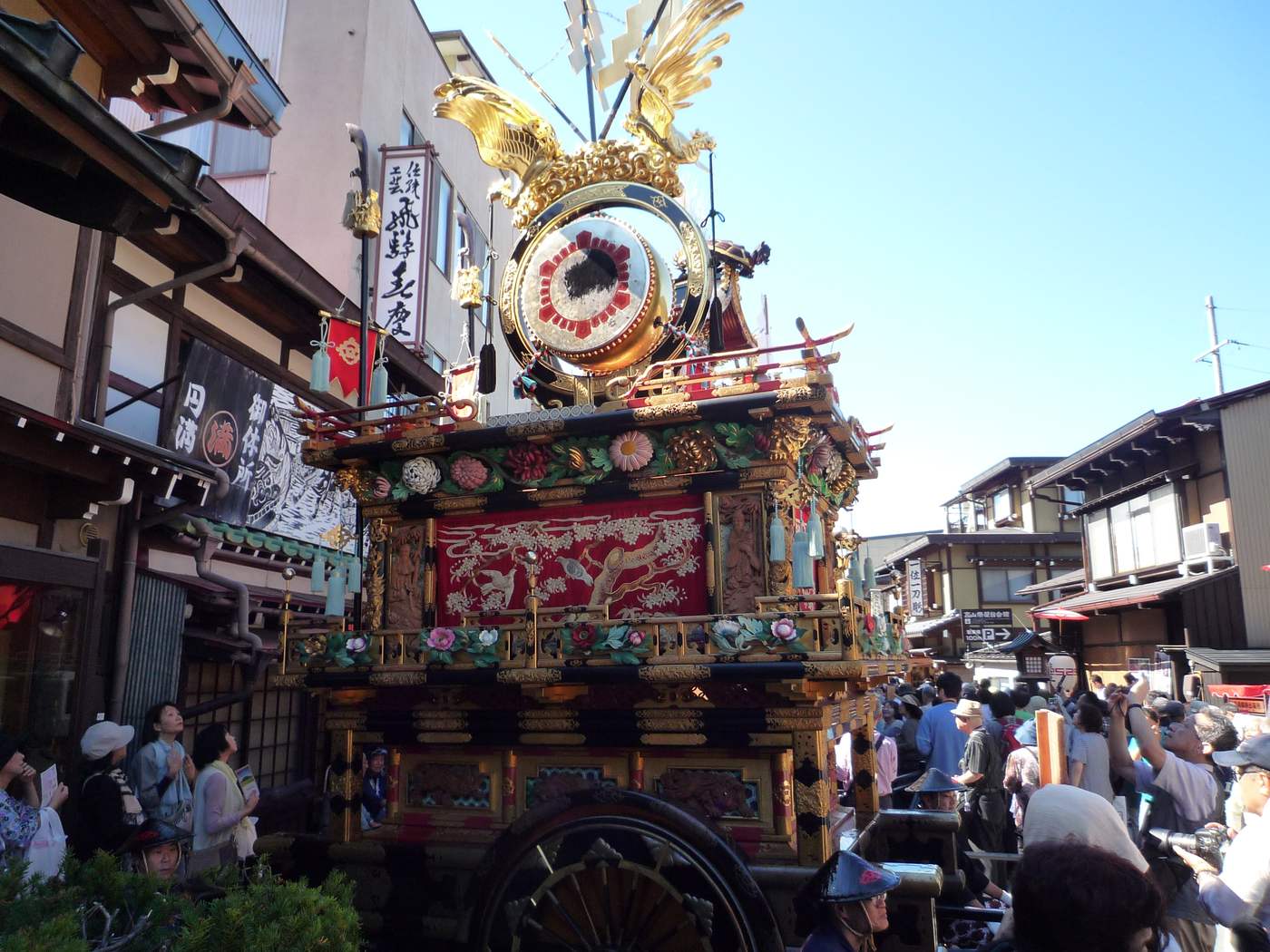
Spring Sanno Festival: schedule and three karakuri
The spring Sanno Festival is the annual rite of Hie Shrine, held every April 14 and 15. The table below is the 2026 official schedule as published on the tourism association special site, which doubles as the typical-year framework for 2027 (the organisers state that 2027 details will be announced later):
| Event | Time (2026 official) | Place |
|---|---|---|
| Float line-up | Apr 14, approx. 9:30–15:00 / Apr 15, approx. 9:30–16:00 | Shinmeimachi-dori and others (Kaguratai, Sanbaso, Shakkyotai and Ryujintai at the Jinya-mae intersection) |
| Karakuri dedication | Twice each day: 10:00–10:50 and 14:00–14:50 | Jinya-mae intersection (three floats in rotation, roughly 20 minutes each) |
| Procession (gojunko) | Apr 14, 12:45–16:00 / Apr 15, 12:30–15:30 | Throughout the festival district (several hundred participants, led by togeiraku bell dancers and shishimai lions) |
| Night festival | April 14 only, 18:00–20:30 | Jinya-mae intersection – Honmachi 1 & 2 chome – Yasukawa-dori – Kamiichinomachi |
The centrepiece in spring is the karakuri dedication at the Jinya-mae intersection: three mechanical-puppet floats performing in rotation on the road itself, each float facing the temporary shrine hall by the Nakabashi bridge, roughly 20 minutes apiece. Each has a distinct routine:
- Sanbaso: a child puppet performs an instant mask change from a boy's face to an old man's face out of a box, worked by six string handlers.
- Shakkyotai: a beautiful woman turns into a lion mid-performance. This one carries a century-long backstory — it was banned in 1892 as a corruption of public morals and stayed sealed away until it was revived in 1984. What you watch today returned to the street after 92 years off it.
- Ryujintai: a Chinese-styled child puppet summons a dragon god out of a jar, using 33 control strings — mechanically the most complex of the three.
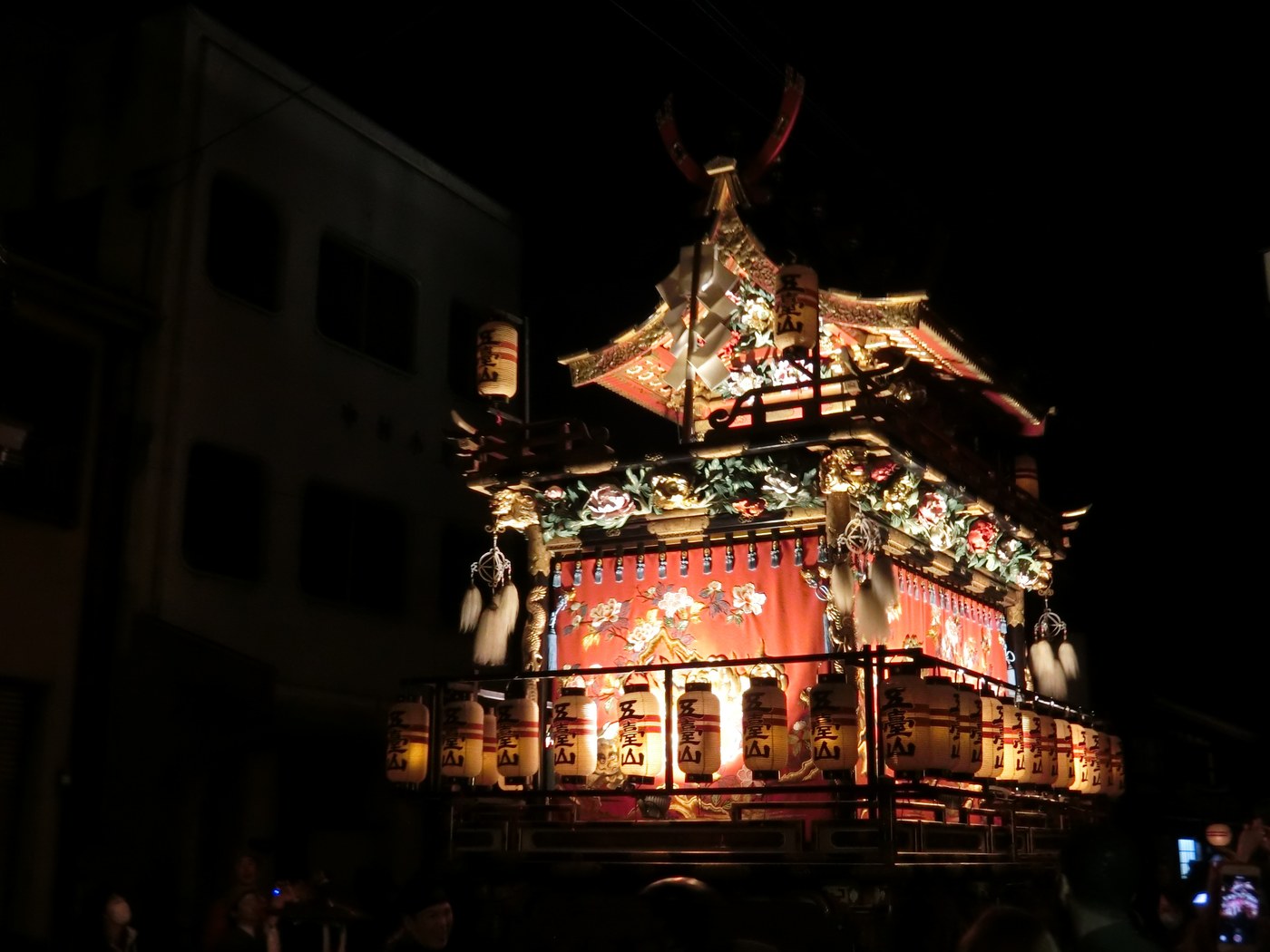
The night festival is a one-night event on April 14: each float hangs roughly 100 lanterns and moves through the dark streets, and the return leg is sung out with the parting song "Takai Yama." If lantern-lit floats are what you came for, your itinerary has to include the evening of the 14th — the 15th has no night programme at all.
One aside for anime travellers: Hie Shrine, the host of the spring festival, is also a pilgrimage site for Hyouka, serving as the model for the shrine in the series. Plenty of visitors come outside festival season for that reason alone; the wider Hida route is in our Hida anime pilgrimage guide.
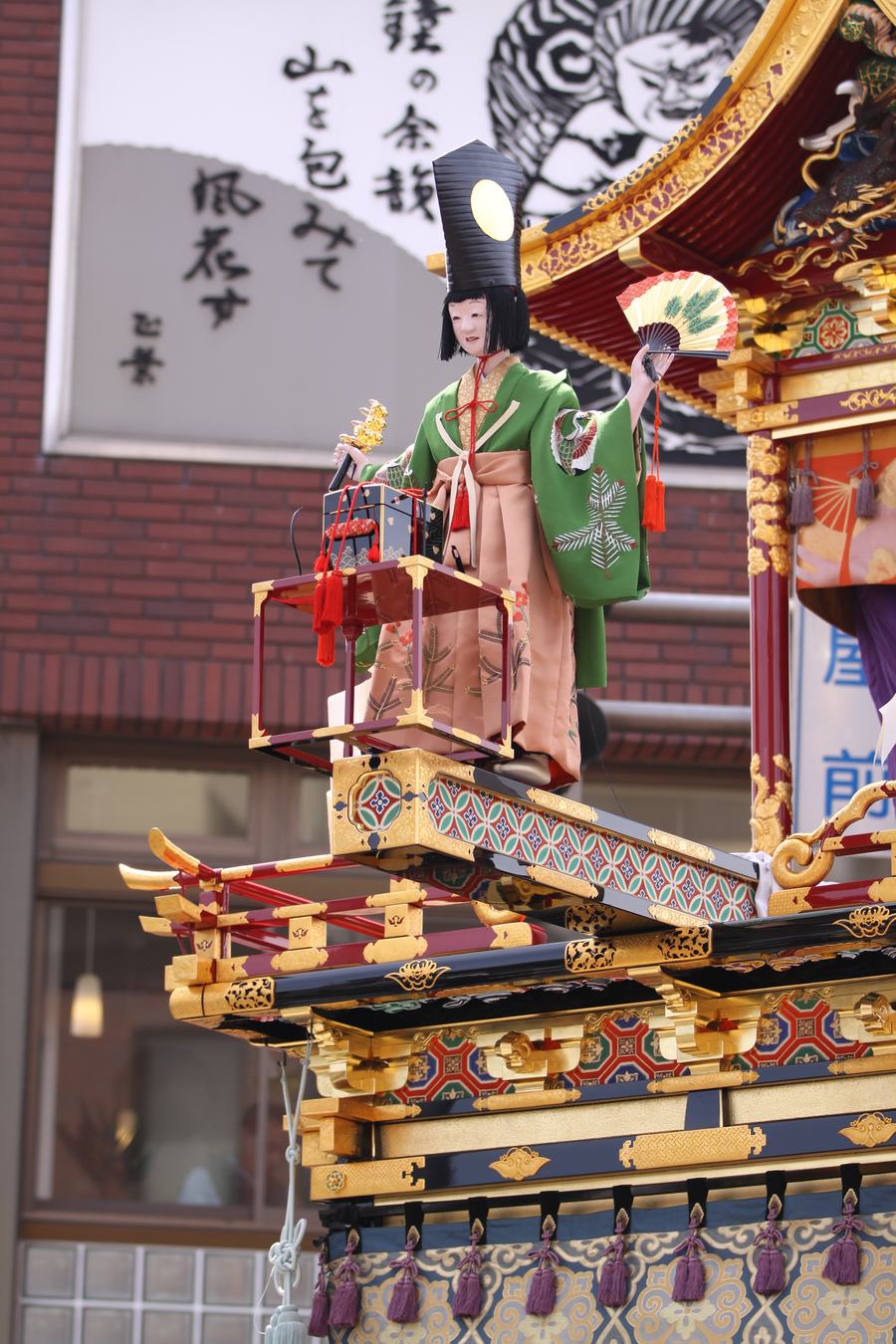
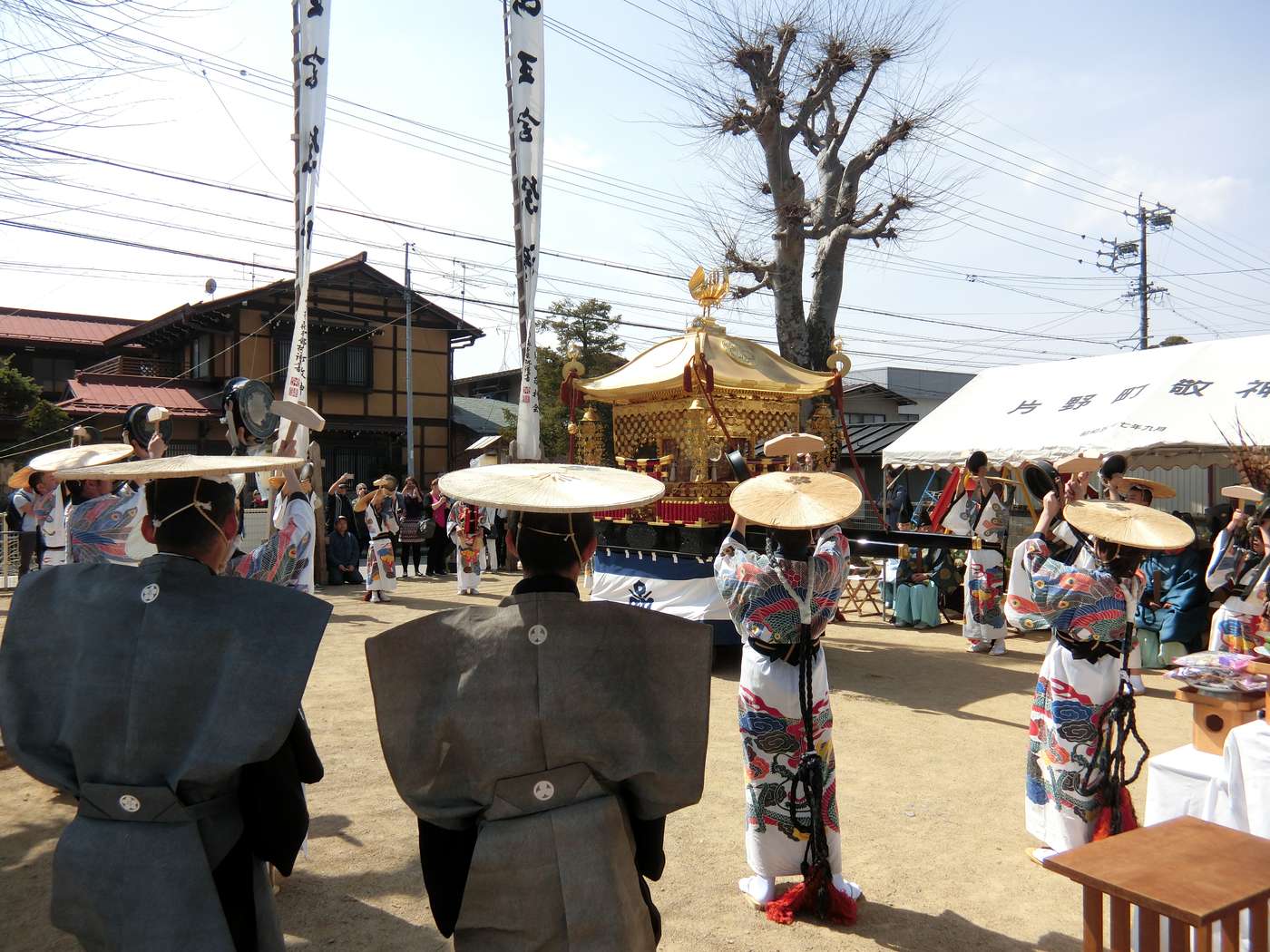
Autumn Hachiman Festival: schedule and the Hoteitai
The autumn Hachiman Festival is the annual rite of Sakurayama Hachimangu, held every October 9 and 10. The table below follows the 2025 official schedule — the 2026 special site is normally updated around September, and that version supersedes everything here:
| Event | Time (2025 official = typical-year framework) | Place |
|---|---|---|
| Float line-up | Oct 9, approx. 9:00–17:00 / Oct 10, approx. 9:00–16:00 | Sakurayama Hachimangu main approach (Hoteitai alone inside the grounds) |
| Karakuri dedication | Oct 9, approx. 12:00–12:20 and 14:00–14:20 / Oct 10, approx. 11:00–11:20 and 13:00–13:20 | Sakurayama Hachimangu grounds (Hoteitai only) |
| Procession (goshinko) | Oct 9, approx. 13:20–15:30 / Oct 10, approx. 8:30–12:00 and 13:30–16:00 | Throughout the festival district |
| Eve festival | October 9 only, approx. 18:15–20:30 | Oshinmachi – Shimoninomachi and Shimosannomachi – Yasukawa-dori – Shimoichinomachi |
Autumn fields a single karakuri float, but it is the headline act. The Hoteitai uses 36 control strings and nine handlers, and the shrine describes its detached-puppet mechanism as the finest in central Japan: the child puppets release from their supports and fly through the air onto the shoulders of the Hotei figure, entirely on the handlers' feel for the strings. Spring is three floats at 20 minutes each; autumn is one float doing one thing extraordinarily well. Different densities, different experiences.
Four autumn-specific points to read carefully:
- The procession is framed as a two-day journey by the deity — the official phrasing is that the god makes an overnight trip. The portable shrine leaves on the afternoon of the 9th, stays at the temporary shrine hall overnight, then circuits the lower town on the 10th before returning, which is why the 10th splits into a morning and an afternoon block.
- Pulling floats through the streets is autumn-only. The tourism association states that float pulling is not performed at the spring festival and belongs to the autumn festival alone, typically with four floats on the afternoon of the 9th. The 2025 special site programme did not list this item, so confirm it on the official page.
- 2025 fielded only 10 floats. The official page stated that the Gyojintai was under repair and only 10 would be shown, against a normal 11. Whether 2026 returns to 11 is pending the September update.
- The eve festival is a one-night event on October 9, roughly 18:15–20:30. As in spring, the lantern-lit floats appear on the first night only, which makes the night of the 9th the one you must have a bed for.
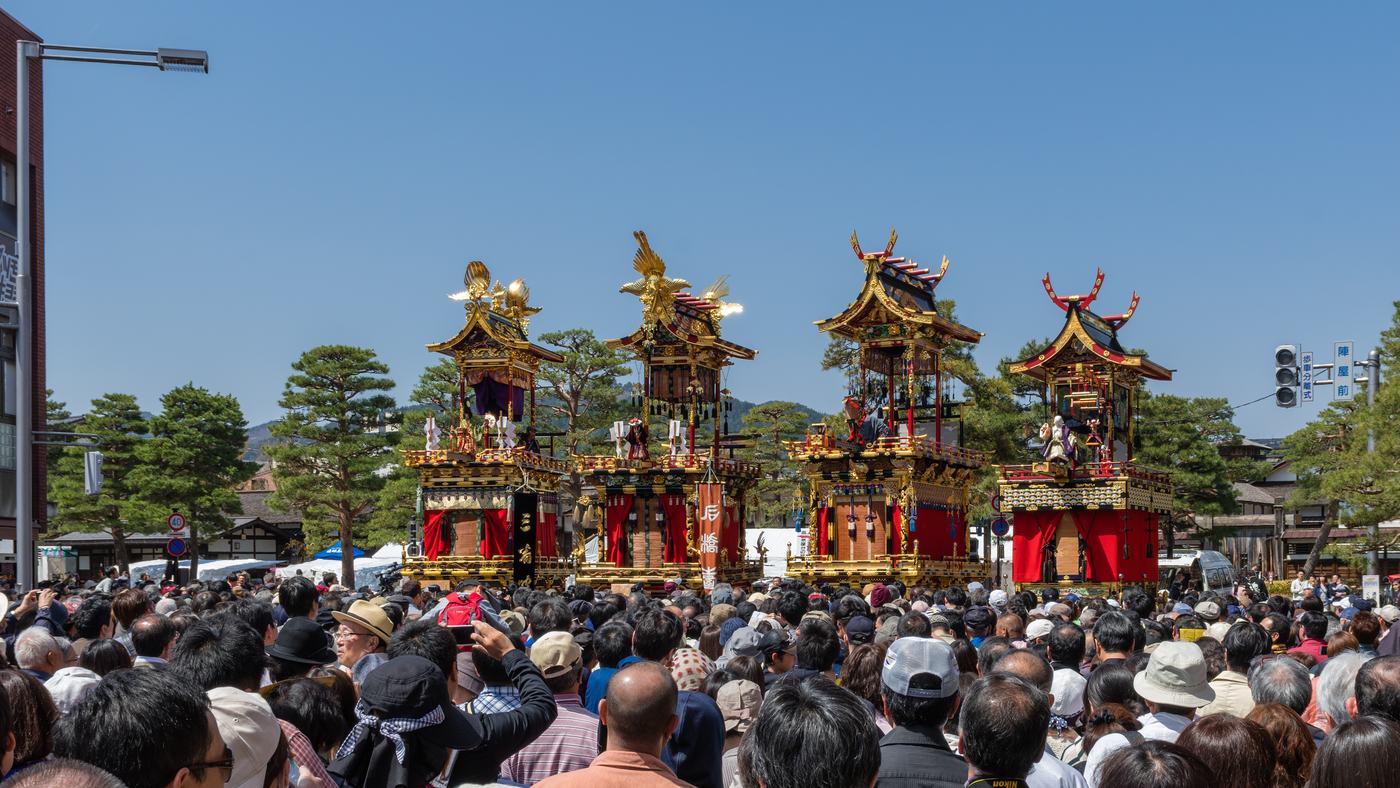
The seat question and what to do instead
Anyone searching for Takayama Festival seats gets exactly one correct answer:
🏮 Official Q&A, identical on both the spring and autumn sites: asked whether viewing seats are available, the organisers answer that there are no viewing seats.
No paid stands, no lottery seats, no sajiki boxes. Everything is free and everything is standing. It is worth holding this next to Aomori Nebuta, which runs two parallel ticketing systems for individual seats and a fireworks package: there, the planning work is knowing when sales open and how to grab a seat. Here, the planning work is what time you arrive and where you stand. Same category of event, opposite planning logic.
Three things actually work inside the official system:
- Arrive early. The karakuri dedication is the only event with a defined stage — the Jinya-mae intersection in spring, the shrine grounds in autumn — and therefore the sharpest crowd peak of the day. The organisers state that entry to the viewing area is restricted when it gets congested, which means arriving late is not a matter of standing further back, it can mean not getting in. The performance times are in the two tables above; build your own buffer from them.
- Use the official YouTube live stream. Both halves stream the karakuri dedication officially, and there is a permanent live camera at the Jinya-mae intersection. The organisers go as far as recommending the stream to anyone with health concerns. This is not a consolation prize — watching the close-up detail on a phone from the edge of the crowd is a workflow the hosts themselves suggest.
- Shift your weight to the float line-up. The line-up runs all day and spreads across the streets, unlike the karakuri which concentrates everyone at one point. If crowds are your limiting factor, walking the line-up route slowly and studying the carving, lacquer and gilt metalwork is a better use of the day than fighting for the third row at the dedication.
A few on-site rules the organisers publish explicitly: drones are strictly prohibited; bicycles and kick scooters are not allowed in the festival area, with the blunt official explanation that you will not be able to move; free rest areas are provided at Ohmasa and the Nakabashi tourist information office; and a first-aid team is stationed at the information headquarters (near the car park below the Sakurayama Nikko-kan in autumn, at the plaza in front of Takayama Jinya in spring). Since same-day programme changes and the live stream both live online, connectivity is a real dependency and mobile networks congest badly in festival crowds — sorting out a Japan eSIM before you fly is basic housekeeping, and the five-provider comparison is in our Japan eSIM guide.
Rain rules: no postponement, decided on the day
Two lines of official wording determine what your plan B has to look like:
- Events may be cancelled depending on the weather on the day, and in that case there is no postponement of the schedule — cancelled means cancelled, with no make-up date.
- Whether an event is changed is decided on the day, so no advance announcement is issued; changes are pushed through the official special site, the festival social accounts and the on-site information headquarters.
But rain does not equal a wasted trip. The organisers publish their own list of past reductions: when the float line-up is cancelled, the floats remain in their individual storehouses and are opened for viewing; the karakuri dedication moves indoors to the Sakurayama Nikko-kan in autumn, and into the float storehouses in spring with fewer performances; the processions and the night or eve festival are scaled down or cancelled. The autumn indoor version is quietly one of the better outcomes, since viewing distance shrinks dramatically.
This is not theoretical. It happened on the second day of the 2026 spring festival, April 15: the official event log for that day records the float line-up cancelled with floats viewable in their storehouses until around 16:00 to 17:00, the karakuri dedication at the Jinya-mae intersection cancelled and held instead inside the Sanbaso, Ryujintai and Shakkyotai storehouses from 10:00 and 14:00, and the procession cancelled. A fully documented wet-weather Takayama Festival ran this year: no parade in the streets, but storehouses open one after another and puppets performing inside them. The answer to "should I still go if it rains" is yes — what changes is what you see, not whether there is anything to see.
Missed the dates? The Float Hall year-round
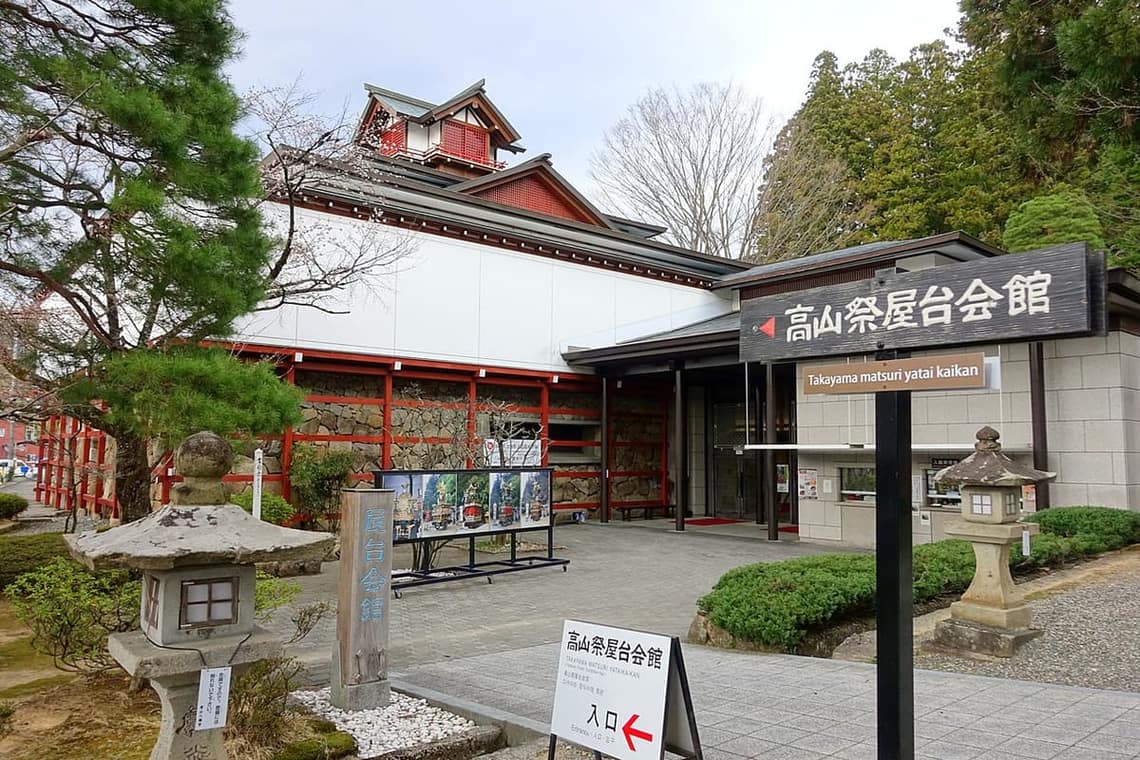
There are 364 non-festival days in a year. The good news: the Takayama Festival Float Exhibition Hall, inside the grounds of Sakurayama Hachimangu, is the only facility in Japan with real festival floats on permanent display — "only" is the shrine's own wording.
| Item | Detail |
|---|---|
| Admission (two buildings) | Adults ¥1,000 / high school ¥600 / elementary and junior high ¥500 |
| Groups (20+) | Adults ¥880 / children ¥450; visitors with disabilities ¥500 |
| Opening hours | March–November 9:00–17:00 / December–February 9:00–16:30 (no closed days listed on the official page) |
| Display rotation | Three times a year (late March, late July, mid November) |
| Tickets | Sold on site; the official page also links an online ticketing service |
| Parking | ¥300 per hour for cars (50 spaces) |
Three things about the hall. First, the floats on show change three times a year, and the most recent rotation was July 12, 2026 — so the current line-up is the freshest of the year. It includes the Hoteitai, the float that performs the autumn karakuri dedication, with an explanation of the mechanism, plus one spring festival float on special display while its storehouse is being repaired. Spring floats do not normally appear here, since this is Hachiman Festival territory, which makes that a limited bonus for the second half of 2026. The hall also displays what it bills as Japan's largest portable shrine.
Second, the ticket is valid for two buildings — the same stub covers the adjoining Sakurayama Nikko-kan, a one-tenth scale model of Nikko Toshogu built in the Taisho era by 33 craftsmen over 15 years, comprising 28 structures including the Yomeimon gate, which toured the United States after the war before returning to Japan. Anyone who has seen the real Toshogu gets far more out of it than the average visitor who walks straight past — and it is also the room the autumn karakuri moves into when it rains.
Third, on goshuin: both Hie Shrine and Sakurayama Hachimangu issue them, and neither publishes the offering amount officially, so go by the notice at the shrine office on the day. The etiquette and national conventions are covered in our Japan goshuin guide.
Traffic control, parking and the lodging reality
Traffic control is the starting premise
On both festival days the organisers state that traffic control is imposed across the main districts of the city and vehicle entry is impossible. The centre is closed to cars — that is where transport planning starts, not an afterthought. The control map and the list of restricted access points are published on each year's special site (for autumn 2026, after the September update).
The official driving route, as framed on the 2025 autumn page: the free temporary car park at Takumigaoka plus a free shuttle bus to the Takayama Civic Culture Hall (15–20 minutes' ride, every 20–30 minutes; 9:00–21:00 on the 9th, 9:00–16:00 on the 10th); nine municipal car parks (¥150 per 30 minutes during the day); the Yayoibashi car park unavailable during the autumn festival; and a temporary lot at the former Takayama police station site (¥1,000 for cars) opened only once the others fill. Spring runs the same structure, with the information headquarters at the plaza in front of Takayama Jinya.
By rail, the main artery is the Hida limited express running direct from Nagoya to Takayama, a route entirely within JR Central territory. Queried on JR Central's own fare and timetable search for a weekday in September 2026, the journey is 166.7 km and about 2 hours 24 minutes, costing ¥3,410 for the base ticket plus ¥2,530 for a reserved seat on the Hida — ¥5,940 one way. Two caveats: reserved-seat surcharges vary by season and rise in peak periods, and the fare revision of 14 March 2026 was a JR East event only — JR Central did not revise, so this section is unaffected (for what did change, see our breakdown of the JR East 2026 fare revision). Within Takayama, both festival districts are walkable from the station.
Lodging: the organisers themselves say six months ahead
The official Q&A states that accommodation in the town centre is fully booked from more than six months in advance, and advises visitors to consider lodging in the outskirts and in neighbouring municipalities. The practical sequence:
- Book the moment you commit. Around spring for the autumn festival, the previous autumn for the spring one. Searching in early August for the 2026 autumn festival means the centre is very likely gone, so starting from outlying Takayama and nearby cities is the realistic move — Check live Takayama-area rates on Trip.com → shows the spread from the centre outwards in one view.
- Commuting in is a legitimate plan. The daytime programme starts in the morning and the night event wraps around 20:30, so a same-day return from a city along the rail or bus corridors works. If you intend to stay to the end of the night festival, check the last train or bus before you commit, since festival-period timetables shift.
- Turn the lodging problem into an itinerary. Using Takayama as a node, the gassho villages lie west (see the Shirakawa-go winter illumination guide) and the old town, jinya and Hida beef are in the town itself (see our Hida-Takayama guide). Adding a day either side of the festival is more comfortable than compressing everything into the two festival days.
Planning spring 2027
The spring Sanno Festival is fixed to April 14 and 15, and the organisers have already published the next edition as Wednesday April 14 to Thursday April 15, 2027 — an unusual level of certainty for a Japanese festival, and enough to book flights against. Two qualifications:
- The same page states that details will be announced later — the 2027 timings are not out. The 2026 official schedule in the spring section above is the typical-year framework, and the structure has been stable for years (line-up, two karakuri sessions, procession, night festival on the 14th), but exact minutes belong to the 2027 special site.
- Spring 2027 falls mid-week, which theoretically thins the crowd relative to a weekend year — good news if congestion is your main worry. Against the official six-months-ahead rhythm for lodging, that means booking in autumn 2026.
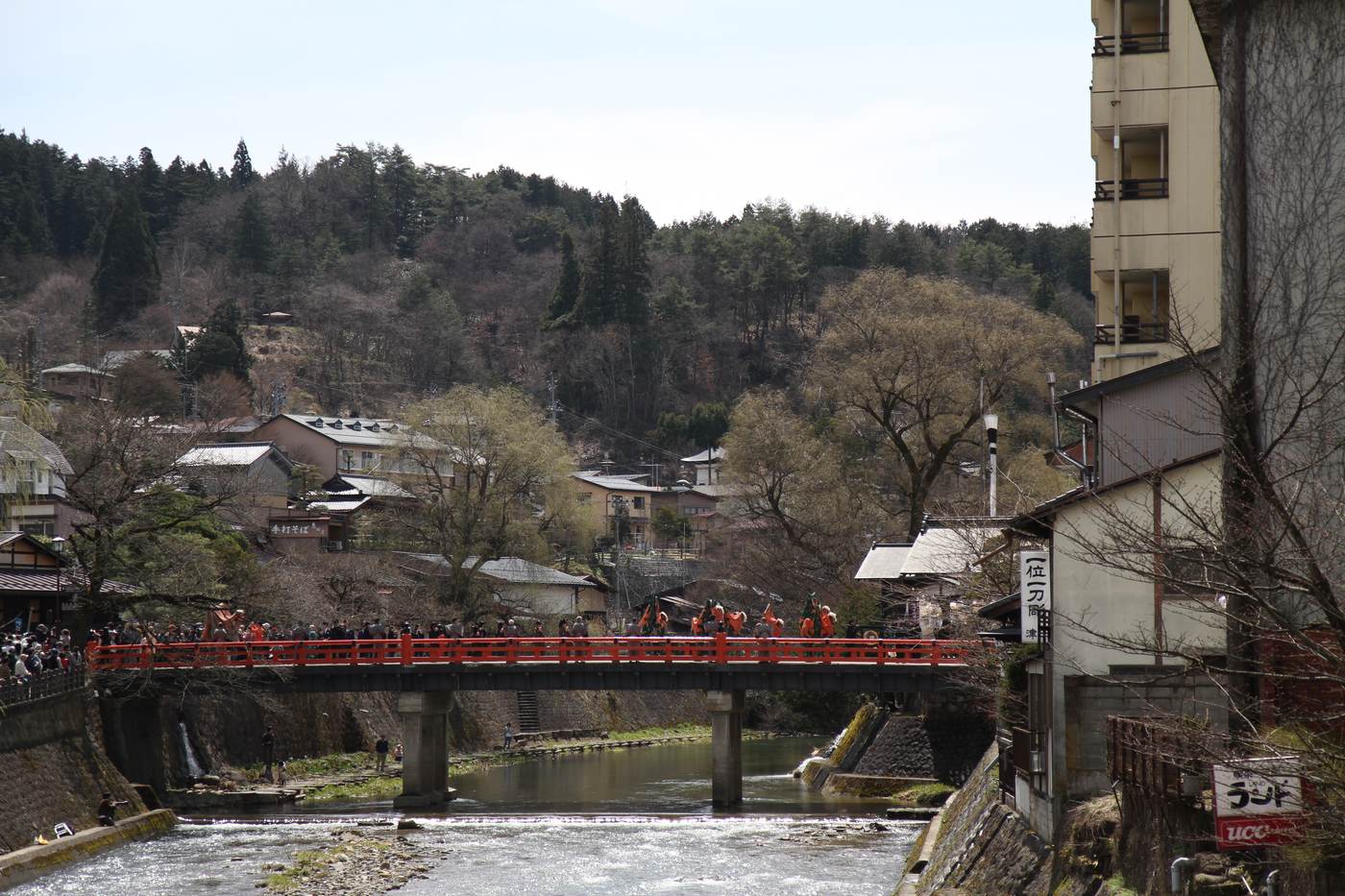
One more thing about mid-April: it is when the cherry blossom front crosses the Hida highlands, and the Nakabashi bridge framed by weeping cherries is the classic Takayama Festival poster shot. Bloom timing swings by a week or more from year to year, though, so treat "blossoms plus festival" as a lucky bonus rather than something you can plan around.
Is the Takayama Festival worth a special trip?
Take the downside first. The Takayama Festival has no seats, no ticketing and no guarantee you will see the karakuri — at peak sessions the entry restriction may keep you on the outside. Lodging in the centre is gone six months out. Rain brings cancellation without postponement, decided on the day itself. This is a festival that writes its own uncertainty into the official Q&A rather than hiding it.
But the absence of ticketing is also its best feature: it is a festival with nothing to compete for. No alarms set for a sales window, no comparing resale prices, no possibility of overpaying. What you invest is time rather than money — arrive early, and keep a spare day as weather buffer. And the payoff is genuinely unusual: 23 floats that are themselves designated Important Tangible Folk Cultural Property move through public streets, and a puppet completes an aerial handoff on 36 strings a few metres in front of you. These are not replicas built for parading; this is the heritage property itself clocking in for its annual duty.
My scheduling verdict: if you can only make one, take whichever fits your route — spring and autumn differ in content but not in quality, and detouring for the "better" one is not worth it. Protect the night, meaning April 14 in spring and October 9 in autumn, because the lantern-lit floats are the shared high point and neither event repeats on day two. Add a day on each side: one as rain buffer and for the Float Hall and old town, one for the extension to the gassho villages. And if the dates simply do not line up, the Float Hall plus Sakurayama Nikko-kan combination is open all year — frankly, studying the gilt metalwork of one float from a few steps away gets you closer to the craft than squinting at a blurred silhouette from the fifth row of a crowd.
Frequently Asked Questions
- Q1:What are the Takayama Festival 2026 dates, and is spring 2027 confirmed?
- Both halves of the Takayama Festival run on fixed calendar dates rather than a floating weekend rule, which makes this one of the easiest major Japanese festivals to book far ahead. The autumn Hachiman Festival is held every year on October 9 and 10, and the tourism association states plainly that this pairing of dates was fixed back in 1968. In 2026 that falls on a Friday and a Saturday, so expect heavier crowds and tighter rooms than in a mid-week year. The spring Sanno Festival is held every year on April 14 and 15, and the official event page has already published the next edition as April 14, a Wednesday, through April 15, a Thursday, 2027, while adding that the detailed programme will be announced later. As of August 2026 the official autumn special site still shows the 2025 edition, because the organisers overwrite the same URL each year. The 2026 running order is normally posted around September, so treat every clock time here as the typical-year framework and re-check the official page before you travel.
- Q2:Are there reserved seats or paid grandstands at the Takayama Festival?
- No. The organisers answer this in identical words in the Q&A of both the spring and the autumn special sites: the question is whether viewing seats exist, and the answer is that viewing seats do not exist. Every element of the festival — the float line-up, the karakuri puppet dedication, the two processions, the spring night festival and the autumn eve festival — is free and standing-room only. If you find a site selling Takayama Festival grandstand tickets, it is not part of the official system. The organisers offer two substitutes instead. The first is arriving early, because when the crowd builds they restrict entry to the viewing area, meaning latecomers may not get in at all rather than simply standing further back. The second is the official YouTube live stream of the karakuri dedication, which the organisers explicitly recommend to anyone with health concerns, alongside a permanent live camera at the Jinya-mae intersection. This is the exact opposite of a festival like Aomori Nebuta, which sells two separate systems of reserved seating.
- Q3:What is the difference between the spring and autumn Takayama Festival?
- They are not one festival held twice. The Float Exhibition Hall states it outright: in spring and autumn the shrine, the district and the floats are all completely different. Spring is the Sanno Festival of Hie Shrine, covering the upper town south of Yasukawa-dori, with 12 floats. Autumn is the Hachiman Festival of Sakurayama Hachimangu, covering the lower town north of Yasukawa-dori, with 11 floats. The 23 surviving floats are split between the two events and never mix. The karakuri dedication differs too: in spring three floats, the Sanbaso, Shakkyotai and Ryujintai, perform in rotation on the road at the Jinya-mae intersection; in autumn a single float, the Hoteitai, performs inside the grounds of Sakurayama Hachimangu with 36 control strings worked by nine handlers, described by the hall as the finest detached-puppet mechanism in central Japan. Each half has exactly one night event, the spring night festival on April 14 and the autumn eve festival on October 9. Float pulling through the streets is an autumn-only item.
- Q4:Is the Takayama Festival postponed if it rains?
- It is not. The official wording is that events may be cancelled depending on the weather on the day, and in that case there is no postponement to another date. There is also no advance notice: the organisers state that whether to change an event is decided on the day itself, with updates pushed through the official special site, the festival social accounts and the on-site information headquarters. That said, rain does not mean an empty trip. The published list of past reductions shows that when the float line-up is cancelled the floats stay in their individual storehouses and can still be viewed, and that the karakuri dedication moves indoors to the Sakurayama Nikko-kan in autumn, or into the float storehouses with fewer performances in spring. April 15, 2026 is a documented example: the official log for that day records the float line-up cancelled with the floats viewable in their storehouses until around 16:00 to 17:00, the karakuri dedication cancelled at the Jinya-mae intersection and held instead inside the Sanbaso, Ryujintai and Shakkyotai storehouses from 10:00 and 14:00, and the procession cancelled outright.
- Q5:Can you see the Takayama floats outside festival days?
- Yes, all year. The Takayama Festival Float Exhibition Hall inside the grounds of Sakurayama Hachimangu is, as the shrine itself puts it, the only facility in Japan with real festival floats on permanent display. Admission is 1,000 yen for adults, 600 yen for high school students and 500 yen for elementary and junior high students, and that single ticket covers two buildings, the Float Hall plus the adjoining Sakurayama Nikko-kan. Opening hours are 9:00 to 17:00 from March to November and 9:00 to 16:30 from December to February; the official page does not list closed days. The displayed floats are rotated three times a year, in late March, late July and mid November, and the most recent swap was July 12, 2026. That rotation includes the Hoteitai, the float that performs the autumn karakuri dedication, plus one spring festival float on special display while its storehouse is under repair — spring floats are not normally shown here, so that is a limited bonus for the second half of 2026. Tickets are sold on site, and the shrine site also links an online ticketing page.
- Q6:Is the Takayama Festival a UNESCO Intangible Cultural Heritage?
- Precisely stated, what is inscribed is the float event of the Takayama Festival, not the festival as a whole. The UNESCO listing made on December 1, 2016 is Yama, Hoko, Yatai float festivals, a single entry composed at the time of 33 float events across Japan, and the Takayama Festival float event in Takayama City, Gifu Prefecture is one of them. (⚠️ That 2016 entry has since been superseded: on 8 December 2025 UNESCO decision 20.COM 7.b.52 adopted an expanded inscription that "incorporates and replaces" the 2016 listing, No. 01059, and states that the Japanese inventory comprises the original thirty-three plus four festivals added between 2016 and 2021 — so 33 is the 2016 count, not the current one, and Takayama remains on the list.) The same list includes the Chichibu Night Festival float event and kagura, and the Gion Festival Yamahoko event in Kyoto. (one caveat: the Kyoto Gion Yamahoko event and Hitachi Furyumono had already been inscribed individually back in 2009, and the 2016 list is an extension built on those two — so the "not individually inscribed" point applies to Chichibu, not to Gion.) Takayama also carries two older domestic designations that are often conflated with the UNESCO one: in 1960 the 23 surviving floats were designated an Important Tangible Folk Cultural Property, and in 1979 the float event itself was designated an Important Intangible Folk Cultural Property. As for the label of one of the three most beautiful festivals in Japan, alongside the Gion Festival and the Chichibu Night Festival, the tourism association does use that phrase itself, but it is a customary tourism expression rather than an official certification scheme.
- Q7:What do you do if Takayama is fully booked over the festival?
- Start from what the organisers admit themselves. The official Q&A states that accommodation in the town centre is fully booked from more than six months in advance, and goes on to advise travellers to widen the search to the outskirts and to neighbouring municipalities. That is the host, not a booking site, saying it. The practical order of operations is: book the moment you commit, meaning around spring for the autumn festival and the previous autumn for the spring festival; if the town centre is gone, look at outlying Takayama first and then at cities along the rail and bus corridors. Commuting in for the day is a completely valid way to do this festival, because the daytime programme starts in the morning and the night event finishes around 20:30, though you should confirm return services in advance rather than assuming late trains exist. One thing you cannot solve with a car: on both festival days traffic control makes the main districts inaccessible to vehicles, so drivers use the free temporary car park and shuttle bus system rather than parking near the venue.
Read next
Hida-Takayama Guide 2027: Old Town, Jinya, Hida Beef & Festival
The little Kyoto of Hida — the Sanmachi old streets, Japan's only surviving jinya, the morning market, Hida beef and the Takayama Festival.
Shirakawa-go Illumination 2027: Dates & Booking
Four 2027 dates, 17:30–19:30, fully reservation-only.
Chichibu & Nagatoro Guide 2026: Shibazakura to Festival
About 80 minutes from Ikebukuro by Laview: Hitsujiyama moss phlox, the wolf shrine at Mitsumine, Nagatoro line-down boats and Iwadatami, and the winter night festival.
📊 See the 2026 Price Index (JR Pass, DPA, eSIM, Airport Transport) →