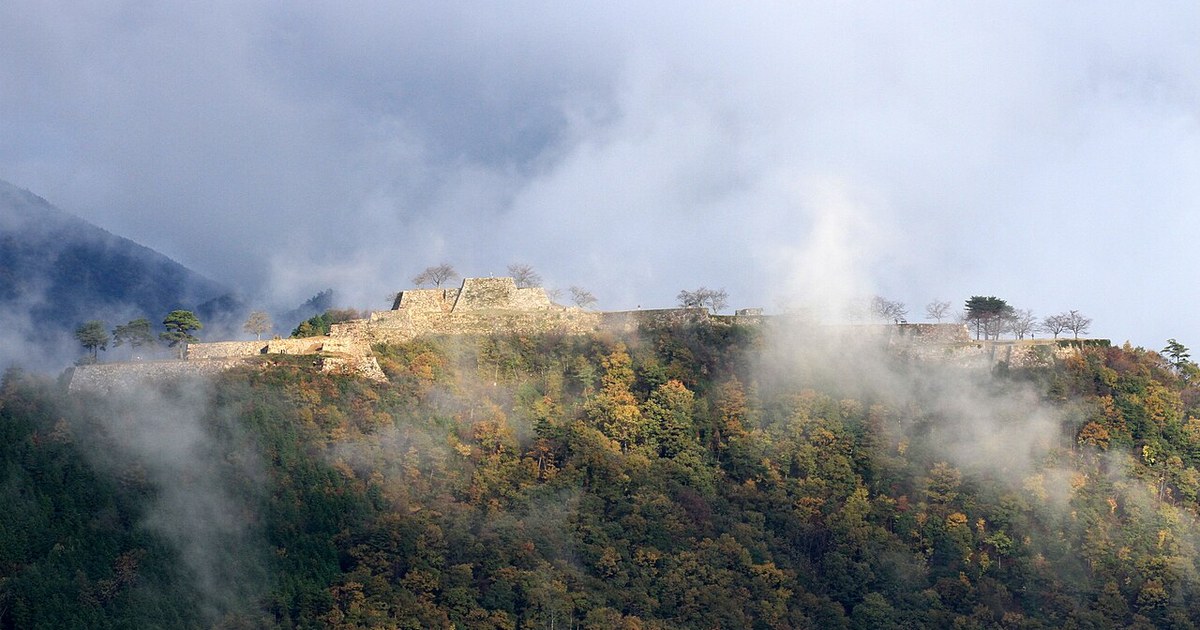
Start with the thing that reshapes the whole trip: that photograph of bare stone ramparts floating on a white sea of clouds was not taken from Takeda Castle. That is not my deduction — it is what the castle's own official notice says. The wording, verbatim, sends anyone attempting the sea of clouds outside viewing hours to Ritsuunkyo, "the mountain opposite." The second thing worth knowing before you book anything: from January 4 to the end of February the site is closed and entry is not possible, and from early December the opening time moves to 10:00, with the city adding that arriving at dawn chasing the clouds will not get you up the hill. This guide works through the four seasonal timetables, the four trailheads that each open at a different minute, the bus fares, the November-only dawn bus, and the fact that there is no toilet and no water at the top — all from Asago City, the Takeda district's Ritsuunkyo site, and Zentan Bus.
📍 Takeda Castle is in Asago, northern Hyogo. Most visitors come as a long day trip from Osaka or Kyoto, or tack it onto Kinosaki Onsen — the city's own chart puts that leg at about 50 minutes by train. For fitting it into a wider Kansai route, see our Osaka and Kyoto 5-day itinerary.
- The iconic shot is from Ritsuunkyo, the mountain opposite — the castle's official notice sends you there itself
- Closed January 4 to end of February; early December to January 3 it opens only 10:00–15:00, so no dawn visits
- Adult admission ¥500, cash or PayPay only, from a ticket machine, same day
- Nothing runs during the 5:00 opening hours; the only dawn bus is the Unkai Bus on November weekends and holidays
- No toilets and no water for sale inside the ruins; the city tells you to carry a torch and a bell for wildlife
📖 Contents
- Why the famous photo is not from the castle
- On the castle vs looking at the castle
- Four seasons, four timetables
- The four trailheads and their gate times
- Getting there and getting up
- Tenku Bus and the November-only Unkai Bus
- Ritsuunkyo in full
- Reading the sea of clouds: what is official and what is not
- Kit, rules, and what is missing at the top
- History and stonework: 1443 to 1600
- Castle seals and the 100 Famous Castles stamp
- Eating, the temple street, and side trips
- How to actually schedule the day
- FAQ
Why the famous photo is not from the castle
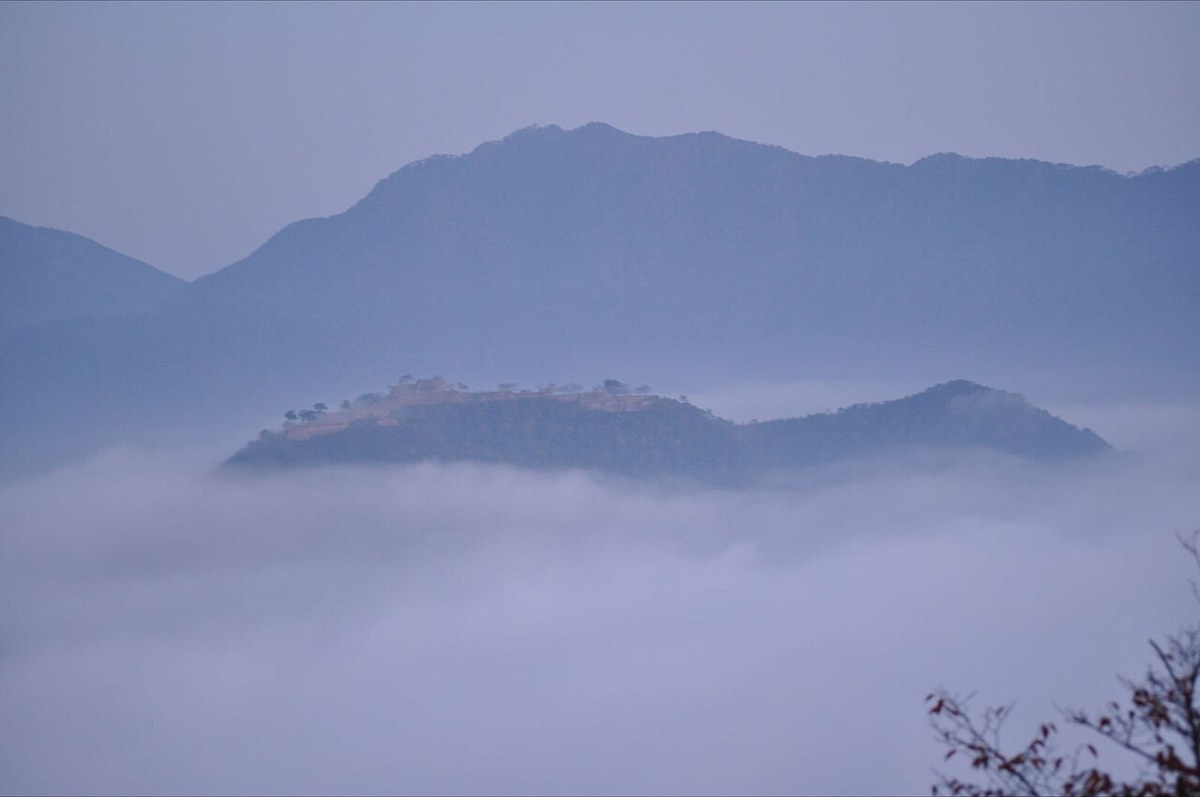
Takeda Castle's entire online identity rests on one image: a stone-walled fortress with no buildings left, riding on a white sea of clouds, distant peaks poking through like islands. Plenty of people book flights on the strength of that picture, then arrive and discover that from where they are standing, that shot is impossible.
The reason is almost embarrassingly simple. When the sea of clouds forms, the castle is inside it. Stand on the ramparts and you are in the fog looking at more fog. To get the famous composition the camera has to be higher and on the other side of the valley — partway up Mount Asago at Ritsuunkyo, separated from the castle by the old town of Takeda and the Maruyama River. The castle ruins sit at 353.7 metres; Ritsuunkyo's viewing area is on a mountain given as 757 metres above sea level. That difference is the whole trick.
What makes this worth leading with is that the officials say it themselves. The castle's winter notice tells visitors who want to attempt the sea of clouds outside viewing hours to head for Ritsuunkyo, the mountain opposite, and links straight to the Ritsuunkyo site. Asago City's own printed guide is titled for both places together, and its cover photograph is that aerial-looking view — which is to say the city has effectively conceded the point in its own publicity material.
So the first practical decision comes before anything else: if the photo is your reason for coming, your destination is Ritsuunkyo, not Takeda Castle. They are different mountains, different managing bodies, different tickets, and there is no bus between them. Everything that follows branches from that choice.
On the castle vs looking at the castle
Laid side by side, the decision usually makes itself. Every cell below comes from official sources.
| Factor | Takeda Castle Ruins (stand on it) | Ritsuunkyo (look at it) |
|---|---|---|
| Managed by | Asago City | Takeda district |
| Cost | Viewing fee ¥500 (high-school age and up) | Maintenance contribution ¥300 (high-school age and up) |
| Can you get the floating-castle shot? | No — you are inside the cloud | Yes — this is the side the city points you to |
| Opening hours | Four published seasonal sets; closed Jan 4 – end Feb | Not published by the operator (see below) |
| Buses | Tenku Bus (roughly 8:00–16:00, none in December) plus November-weekend Unkai Bus | No route bus at all |
| From JR Takeda Station | 40–60 min on foot depending on trail | About 10 min by taxi, or 40 min walk from the B1 car park |
| Parking | Private cars stop at Yamashiro no Sato (100 spaces) | Ritsuunkyo car park (40 cars, 7 microbuses) |
| Walking once there | 30–60 min around the ruins | Deck 3 in 5 min, Deck 2 in 10 min, Deck 1 about 30 min |
My call, stated plainly: if it is your first visit and the photograph is the point, make Ritsuunkyo the main event. If you care about castle architecture — the layout, the masonry — make the ruins the main event. Doing both in one day is possible but genuinely demanding: two separate mountains, two separate climbs, and if you are chasing dawn you will have started before 5:00.
One naming trap. Ritsuunkyo has a spot called the Ritsuunkyo Terrace. It has nothing whatsoever to do with the Unkai Terrace at Tomamu in Hokkaido, which is a ski-resort gondola attraction covered in our Tomamu resort guide. Similar names, opposite ends of the country — do not book the wrong one.
Four seasons, four timetables
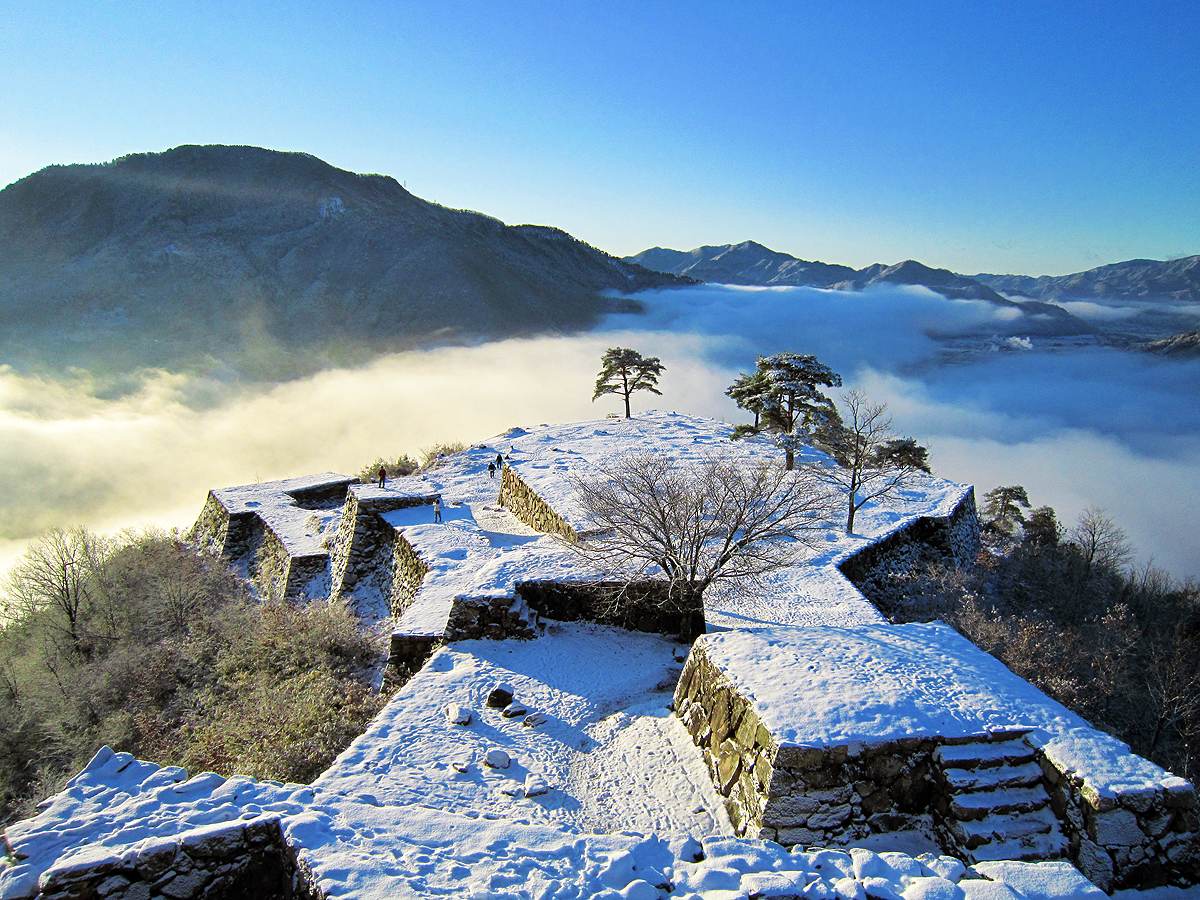
Opening hours here are not a single line. The city publishes four seasonal rule sets, each with a different final-entry time, and a fifth state where the whole site shuts. Here is the official table.
| Period | Viewing hours | Last entry | Last entry, south trail |
|---|---|---|---|
| Spring (Mar 1 – end May) | 8:00–17:00 | 16:30 | 16:00 |
| Summer (Jun 1 – mid-Sep) | 5:00–17:00 | 16:30 | 16:00 |
| Sea-of-clouds season (mid-Sep – early Dec) | 5:00–17:00 | 16:30 | 16:00 |
| Winter (early Dec – Jan 3) | 10:00–15:00 | 14:30 | 14:00 |
| Jan 4 – end Feb | Closed for winter; entry not possible | ||
Four traps worth flagging:
- Spring closes at 17:00, not 18:00. An older official access-map PDF once printed 8:00–18:00 with a 17:30 final entry for March to May. That obsolete file is still findable online. The current official web page and the February 2026 revision of the PDF both say 17:00 with a 16:30 final entry. Planning off the old version hands you an imaginary extra hour.
- "Final entry" means passing through the trailhead gate, not reaching the ruins. The official note is explicit about this. There is still a climb after the gate, so do not read 16:30 as "be at the top by 16:30."
- Winter opens at 10:00, which rules out both sunrise and the morning clouds from the castle itself. The city spells it out: arriving early to chase the sea of clouds will not get you up to Takeda Castle. That sentence exists precisely because people kept trying.
- January 4 to the end of February is a hard closure. Your options in that window are the view from the valley floor, Ritsuunkyo, or buying castle seals.
For hard dates: Asago City has announced that from June 1 to December 6, 2026, viewing hours are 5:00 to 17:00. That is the only fully dated segment currently published. The start of winter is given on the city page only as "early December" and has shifted year to year, so check the current notice before you travel rather than assuming last year's changeover date. The 2027 seasonal dates and the end of the 2027 sea-of-clouds season have not been announced.
The four trailheads and their gate times
Asago City's own notice carries the detail that decides your morning: each of the four trails opens and closes at a different time. If sunrise is your goal, this table decides which car park you use. These are Asago City's 2026 published figures for the sea-of-clouds season.
| Trail | Gate open for ascent | Final gate closing |
|---|---|---|
| West trail (from Yamashiro no Sato) | 4:30 – 16:30 | 18:30 |
| Ekiura trail | 5:00 – 16:30 | 18:00 |
| Hyomai-jinja trail | 5:00 – 16:30 | 18:00 |
| South trail | 5:00 – 16:00 | 18:00 |
The consequence is clean: only the west trail opens at 4:30; the other three wait until 5:00. The west trail starts at Yamashiro no Sato, so the correct sunrise routine is to drive or taxi up to Yamashiro no Sato first and climb from there. Park down in the old town intending to use the Ekiura trail and your earliest possible start is 5:00, plus roughly 40 minutes of climbing.
Winter runs on a different set again: west trail 9:30–14:30, south trail 10:00–14:00, closing at 16:30 and 16:00 respectively. On top of that, the Ekiura and Hyomai-jinja trails are sealed off through the winter — the official access map marks them closed from early December to the end of February because of ice. New Year's Day gets a special dispensation: for January 1, 2026 the city extended viewing to 5:00–15:00 with the west gate at 4:30 and south at 5:00 so visitors could see the first sunrise (which fell just after 7:00) — but every bus, including the Unkai Bus and shuttles, was suspended.
Getting there and getting up
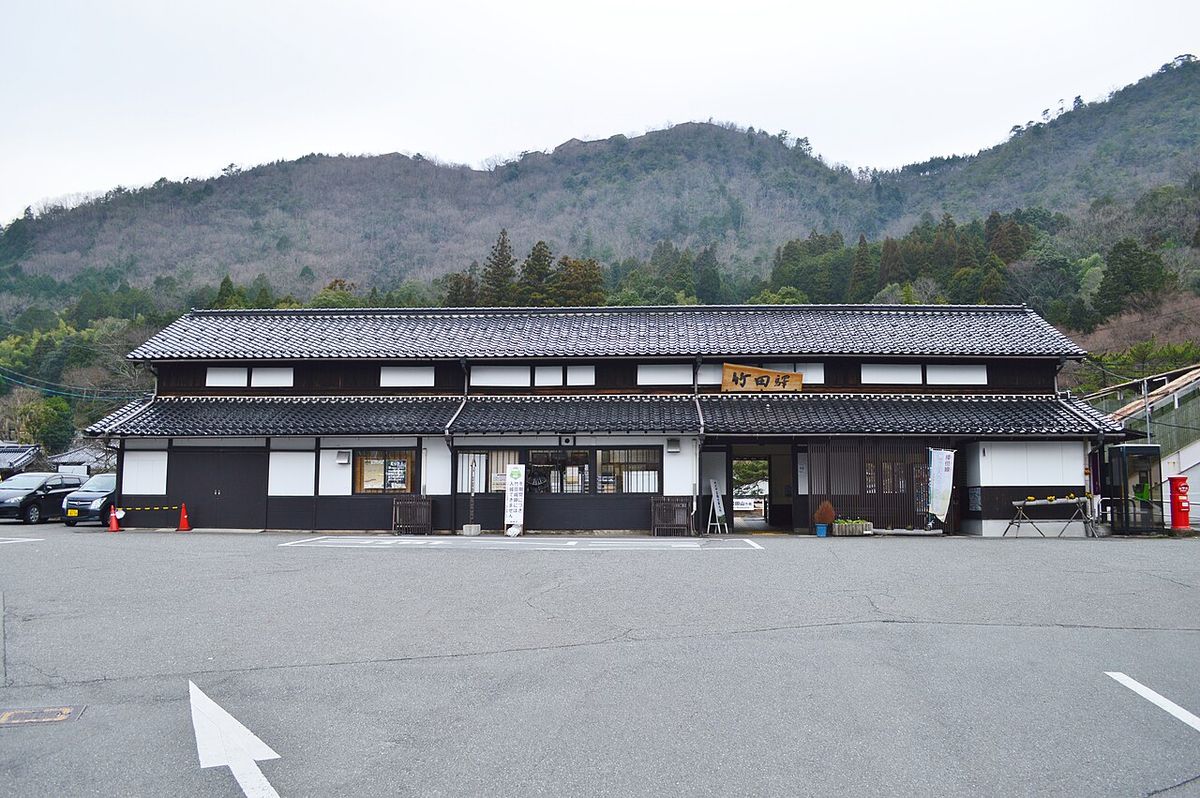
Two layers: reach JR Takeda Station (or Yamashiro no Sato), then get up the mountain.
Layer one: reaching JR Takeda Station
Journey times below, no fares. JR West's own fare lookup and Hamakaze page are both returning errors, so price your tickets on JR West's site or at the ticket window. The times come from Asago City's official access chart.
| From | Route | Journey time (excluding waits) |
|---|---|---|
| Osaka | Limited express Hamakaze via Himeji | About 120 min |
| Osaka | Limited express 120 min to Wadayama, then 7 min local | About 127 min |
| Kyoto | Limited express Kinosaki 110 min to Wadayama, then 7 min local | About 117 min |
| Kyoto | Shinkansen 15 min to Shin-Osaka, 30 min to Himeji, Hamakaze 60 min | About 105 min plus transfers |
| Kyoto | All local and rapid services via Shin-Osaka, Osaka and Himeji | About 150–210 min |
| Kinosaki Onsen | Train, changing at Wadayama | About 50 min (about 90 min by car) |
Two warnings. First, only some Hamakaze services stop at Takeda. JR West's press release of February 26, 2016 confirmed that Hamakaze 1 and 4 began stopping at Takeda Station daily from March 1 that year, with services 3 and 6 calling on some runs. The current 2026 timetable could not be verified from a primary source, so check your specific departure against JR's official timetable rather than assuming every Hamakaze stops. Asago City's chart also carries a note about carriages 1 and 3, meaning the platform at Takeda is short and only certain doors open — check your car number before boarding.
Second, Kobe is not listed separately on the official chart (only Kyoto, Shin-Osaka, Osaka and Himeji appear), so while the route is Sannomiya to Himeji and then the Bantan Line, no journey time is quoted here. Himeji is the practical hub for this whole corner of Hyogo, and pairing the two castles over two days works beautifully — one a surviving keep, one nothing but stonework. See our Himeji city guide for that side — and note the constraints there are nothing like the ones here: entry has cost ¥2,500 since March 2026 and the gate stops admitting at 16:00, which will shape a two-castle itinerary more than the price does.
Layer two: the climb
| Route | From | Distance | Time | Official warning |
|---|---|---|---|---|
| Ekiura trail | JR Takeda Station | 0.9 km | About 40 min | "Steep mountain path"; closed in winter |
| Hyomai-jinja trail | JR Takeda Station | 1.2 km | About 40 min | "Steep slope and 460 steps"; closed in winter |
| South trail | Station / Route 312 car parks | 2.1 km | About 60 min | No private vehicles; one-way system |
| West trail | Yamashiro no Sato | 2.3 km | About 40 min | No private vehicles on any part |
| Mid-slope bus stop / taxi drop-off → fee booth | — | 900 m | About 20 min | "Everyone has to walk this section" |
That last row matters more than it looks. Even arriving by bus or taxi, the final 900 metres and roughly 20 minutes of uphill are on foot for everybody — there is no vehicle access to the ruins themselves. Different official documents give this stretch as 700 m, 900 m and 1.0 km; this guide uses Asago City's web figure of 900 m and 20 minutes.
Taxis and parking
A taxi from JR Takeda Station to the mid-slope drop-off takes about 20 minutes (the city's map says 15), and about 5 minutes from Yamashiro no Sato. The return trip contains an expensive trap, described in the city's own words: because the mountain road is one-way, getting a taxi back from the mid-slope drop-off to Yamashiro no Sato means descending to the old town and looping around via the station or Route 312, so the distance and time are roughly three times the outbound leg and the fare several times higher. If you parked at Yamashiro no Sato and rode up, walk back down the west trail instead of calling a cab. No fare figures appear here because the city explicitly says to confirm fares with the taxi operators, and inventing them would be worse than omitting them.
| Ref | Car park | Spaces | Notes |
|---|---|---|---|
| A | Yamashiro no Sato | 100 (10 large, reservation required) | Last car park for private vehicles; west trailhead |
| B1 | Takeda Castle / Ritsuunkyo car park | 100 | 8 min walk to JR Takeda Station; 40 min walk to Ritsuunkyo car park |
| B2 | Takeda castle town tourist car park | 150 (5 large) | 10 min walk to station; 50 min walk to Ritsuunkyo car park |
| C1 | Takeda town centre car park | 60 | Unavailable 21:00–07:00 |
| C2 | Takeda district car park | 70 | Weekends and holidays only |
| D | Ritsuunkyo car park | 50 | 10 min by taxi to JR Takeda Station |
Drivers, memorise this: private vehicles and large coaches go no further than Yamashiro no Sato. Above it the road narrows and is closed to general traffic, with signage stating that only permitted vehicles and the Tenku Bus may pass. Both the west and south trails are closed to private vehicles along their entire length and operate one-way. The driving route from Wadayama IC: turn left, head south about 1 km, turn right at the second signal (Kato junction), continue about 2 km, pass under the Bantan expressway viaduct (Koga-jo Ohashi) and immediately turn left where a large sign stands, then 700 m to Yamashiro no Sato. General rules on licences and rentals are in our Japan self-drive guide.
One more detail deserves its own line: the C1 town centre car park is closed between 21:00 and 07:00. Anyone planning a 4:00 start for sunrise can strike it off the list — use B1, B2, or drive straight to Yamashiro no Sato.
Tenku Bus and the November-only Unkai Bus
There is exactly one public transport option up the hill: the Tenku Bus, run by Zentan Bus between JR Takeda Station, the town centre car park, Yamashiro no Sato and the mid-slope castle stop. Fares below reflect the March 1, 2025 revision.
| Section | One-way fare |
|---|---|
| JR Takeda Station ⇔ Takeda Castle (mid-slope) | ¥300 |
| Yamashiro no Sato ⇔ Takeda Castle (mid-slope) | ¥200 |
| JR Takeda Station ⇔ Yamashiro no Sato | ¥240 |
| Town centre car park ⇔ Takeda Castle (mid-slope) | ¥250 |
| One-day pass (adult / child) | ¥500 / ¥250 |
Rules that catch people out:
- Pay on exit, and cash only. The operator states outright that ICOCA, Suica and other transport IC cards cannot be used. Day passes are bought from the driver on board. Children travel at half fare, and one child under six travels free per paying passenger.
- Operating band is roughly 8:00 to 16:00, per Asago City. The only 2026 timetable currently published covers July 21 to August 31: departures from Takeda Station at 10:05, 10:40 (weekends and holidays), 11:55, 12:30, 14:05 and 15:15 — first bus 10:05.
- No service at all in December. The wording is unambiguous on both the city and operator sites: buses do not run in December, and from December 1 you walk or take a taxi.
- Last bus departs the castle stop at 16:25. After that, vehicles are barred from the Yamashiro no Sato to castle section, so missing it means walking down.
- Do not assume symmetry: Yamashiro no Sato up to the castle takes about 10 minutes, but the return leg routes via Takeda Station and takes about 25.
- Vehicles are small, around 30 seats, because of the narrow road — capacity is tight on peak weekends. Pets must travel in a carrier and only small animals are accepted (at the ruins themselves a lead is enough).
Now the fact that should govern your planning: the Unkai Bus runs only on Saturdays, Sundays and public holidays in November. Asago City describes it as an early-morning circular service convenient for dawn viewing, operating roughly 4:00 to 7:00, boardable at the castle-town tourist car park on Route 312 or at Yamashiro no Sato, and explicitly not running in December. The city also warns that the departures immediately before sunrise get extremely crowded and that every car park can fill, asking visitors to spread out onto weekdays.
Put the official opening hours next to the official bus timetable and you get this: summer and the sea-of-clouds season open at 5:00, but there is zero official transport during those first hours. The Tenku Bus starts around 8:00 at the earliest, currently 10:05 on the summer timetable, and the Unkai Bus exists only on November weekends. The one window in the whole year when a bus can carry you up for a dawn sea of clouds is a November Saturday, Sunday or public holiday. Every other date, it is your legs or a taxi.
One timing caveat: the 2026 Unkai Bus timetable is not out yet — Asago City says the details follow once Zentan Bus releases them. The autumn (September to November) Tenku Bus timetable is also still unpublished, with only the summer version live. Check Zentan Bus directly before you travel.
Checking the live camera, re-checking whether the last bus moved, watching the official Instagram for snow restrictions — a trip that starts before dawn leans on connectivity at every step, and mountain Wi-Fi is not a thing. Sorting a Japan data eSIM before departure beats queuing at an airport counter.
Ritsuunkyo in full
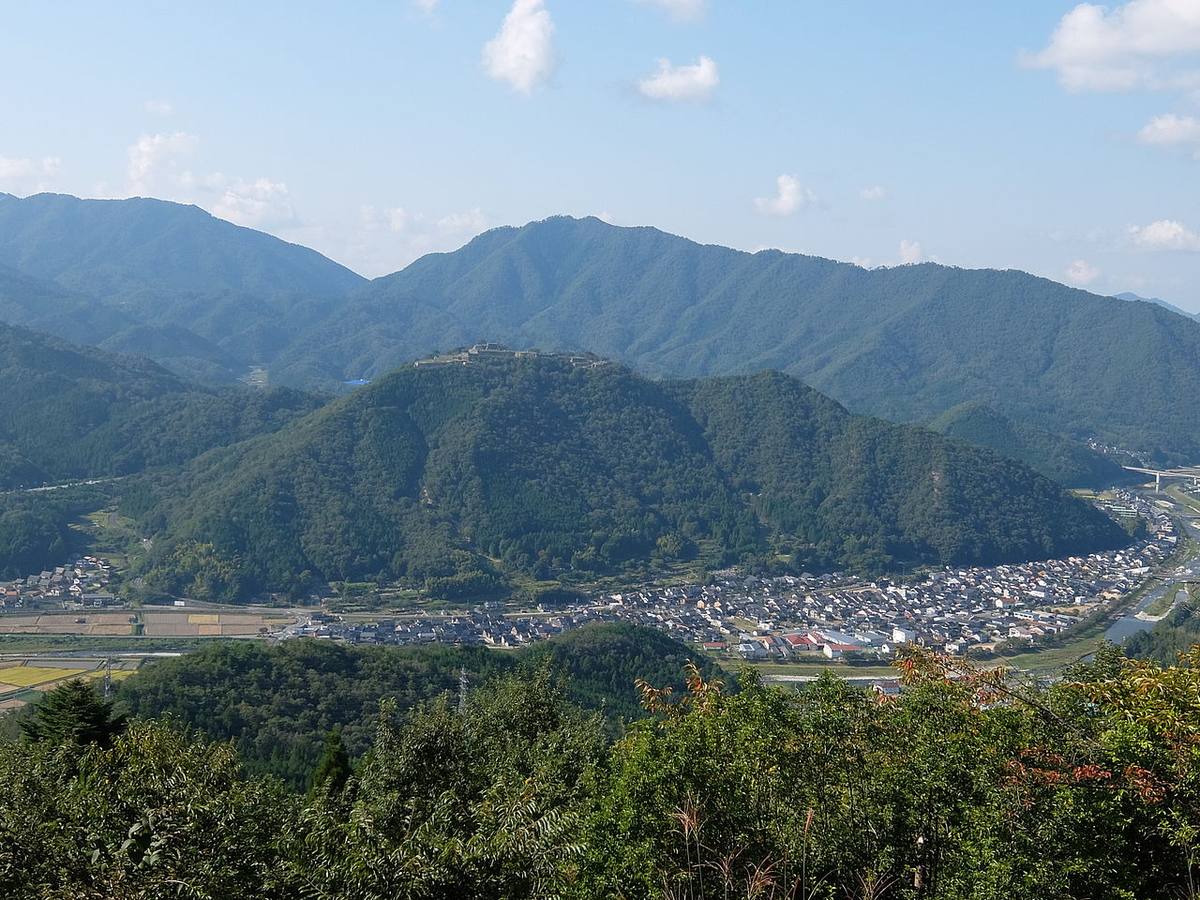
Ritsuunkyo is managed by the Takeda district, a completely separate body from Asago City. What it collects is not an admission fee but an environmental maintenance contribution: ¥300 per person for high-school age and up, ¥250 per head for groups of 20 or more, free for Takeda district residents and junior-high age and under.
The official description places it partway up Mount Asago at 757 metres above sea level, among countless strange rocks and boulders, with a colony of ancient cherry trees said to be over 300 years old. The operator calls it the finest cherry-blossom site in the Kita-Kinki region and uses the nickname "Tajima Yoshino." Ritsuunkyo is a blossom destination in its own right, not merely a camera platform — blossom is described as starting from around mid-March with an unusually long flowering period.
Deck distances and walking times, per the operator (the managing body's own figures):
| Observation deck | From car park | Time | Best for |
|---|---|---|---|
| Deck 3 | About 100 m | About 5 min | Short on time or energy; a first look |
| Deck 2 | About 220 m | About 10 min | The best effort-to-view ratio |
| Deck 1 (labelled "Hikari no Michi lookout" on the latest official map) | About 810 m | About 30 min | The full overhead composition |
The operator adds that walking speeds vary and the times are indicative. Asago City's map gives a broader "10 to 40 minutes to the decks," which does not quite match; this guide follows the managing body's 810 m and roughly 30 minutes. As for whether the Hikari no Michi lookout and Deck 1 are the same place, two official documents disagree: the February 2026 city map captions them as one and the same, while a 2023 leaflet draws them as adjacent but separate points. The newer version is used here, but it is not worth stating as settled fact.
Other marked features include the Ritsuunkyo Terrace, Ryujin Falls, Onaru Pond, Atago Shrine and the old cherry grove.
Access realities to absorb before you go:
- There is no route bus to Ritsuunkyo. It does not appear anywhere in Zentan Bus's route list, and the city map marks only parking and taxis. The official note is that the car park is about 10 minutes by taxi from JR Takeda Station.
- On foot: 40 minutes from the Takeda Castle / Ritsuunkyo car park (B1) or 50 minutes from the castle-town car park (B2) — and that only gets you to the Ritsuunkyo car park; the decks are a further climb above it.
- By car: the operator gives 2.5 km along Route 312 from Wadayama IC, left at the Takeda castle town junction, then 800 m to the trailhead entrance; the city version says about 10 minutes' drive from Wadayama IC. Parking is 40 cars and 7 microbuses (the city and tourism association tables say 50), with toilets and a drinks vending machine on site.
Ritsuunkyo's entry hours, whether it opens in winter, and what happens when the paths ice over are not stated on any of the operator's four pages. If you have seen "free parking, open 24 hours" for Ritsuunkyo, that does not come from an official page either. What is solid is that Asago City keeps directing sea-of-clouds visitors to Ritsuunkyo in its winter notices, so it is clearly not shut in winter. How the contribution and any parking charge are actually collected — cash box, staffed booth, something else — is likewise unstated, so carry cash: everything else in this valley (the castle, the bus) is cash-first.
Cherry-blossom festival dates run the same way. The most recent one Ritsuunkyo has officially announced ran March 17 to April 7, 2024; nothing was published for 2025 or 2026. Plan around a rough mid-March to early-April window announced year by year, and check the operator's news page before booking.
Reading the sea of clouds: what is official and what is not
Asago City, which manages the castle, has never published sea-of-clouds conditions, frequency rates, or a forecast. Its entire official statement on the matter is a single parenthetical: the season when the clouds are likely to appear is late autumn. No percentage, no date range, no "peak period."
If you have seen a 30 percent occurrence rate, a late-September to early-April season or a late-November to early-December peak, none of those numbers trace back to an official page. Do not let them decide whether you pay for a night in Asago and get up at 4:00.
The only official source that publishes conditions at all is Ritsuunkyo, run by the Takeda district. Its highlights page lists a period and three meteorological conditions:
- Main period: September to November (the operator notes other months are possible when conditions align)
- Condition one: temperature falling from the previous evening, with a day-to-night swing of 10°C or more
- Condition two: clear skies and no wind
- Condition three: high temperatures from the previous day
The third reads slightly in tension with the first; that is the operator's own wording. Remember also that these three conditions come from Ritsuunkyo, not from Asago City — different bodies, and it would be wrong to present them as the castle's official position.
So how do you actually judge the morning? Three channels:
- The official live camera, run by Asago City, public from 5:00 to 17:00 (after 17:00 it shows the 17:00 frame) and refreshing every five minutes. The city's own tip is counter-intuitive and useful: if the early-morning image is white, that may mean fog — a sea of clouds — has formed around the castle. The city also admits the system tends to be unstable through winter.
- Official social accounts: the castle's website, Instagram (@takeda_castle) and X. The winter notice states that entry may be restricted when there is snow and that the latest information will be on those three channels. Same-day restrictions get announced there first.
- The "Katte ni Unkai Yoho" forecast, which calculates an expectation score from the previous day's maximum temperature and humidity plus the current day's weather, temperature, wind and humidity, mainly across September to November. One thing has to be labelled: it is run by a local NPO, not by Asago City, and the site itself states that nothing is certain when dealing with nature, that it is for reference only, and that results are not guaranteed. Useful as a signal, not as a promise.
My honest position: treat the sea of clouds as a bonus rather than the objective. The masonry at the castle and the boulders and old cherries at Ritsuunkyo are worth the trip on a clear morning with no cloud at all. Build an itinerary that only works if the fog cooperates and you have handed your holiday to the weather. If you do want to gamble, a November weekend is the only date range where the season, the dawn bus, and the pre-December schedule all line up.
Kit, rules, and what is missing at the top
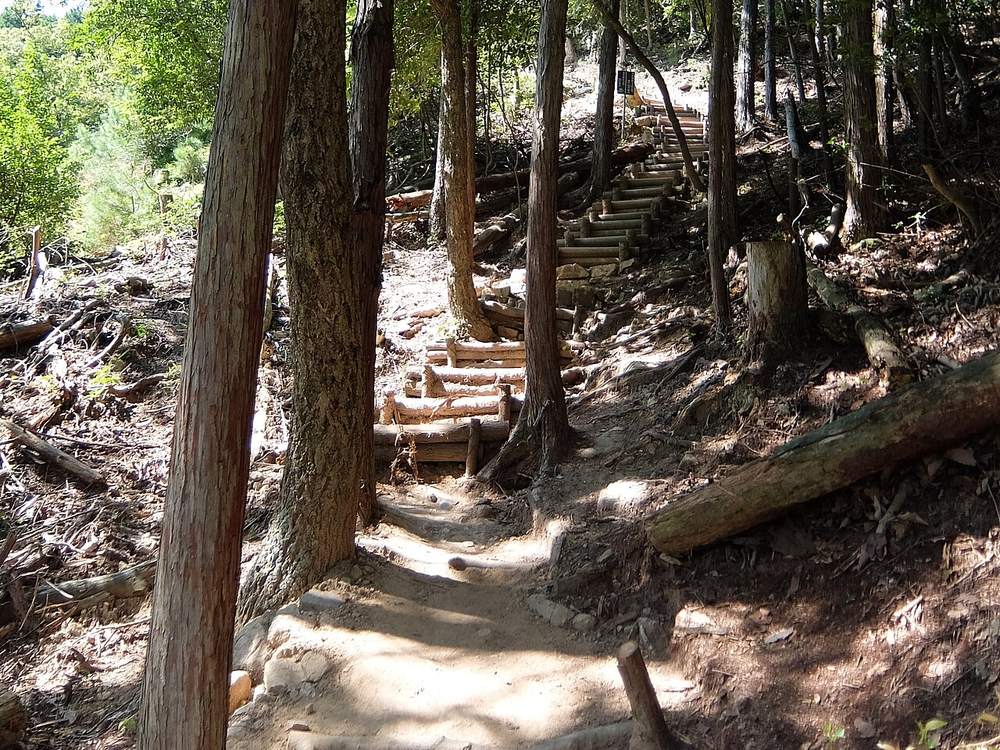
Three things the ruins do not have, in the city's own words:
- No toilets. The instruction is to go before you enter the site. Use the car parks, the station, or Yamashiro no Sato.
- No water for sale at the fee booth or anywhere inside the ruins. Bring your own; in cold weather the city suggests something hot.
- No rest facilities, only benches at Kita-senjo and a few other points.
And what the city tells you to bring. This is safety guidance, not lifestyle advice:
- A torch and a bell that makes noise — the official wording asks visitors to carry these without fail, and the kit page explains why: making noise while walking reduces the chance of running into wildlife. On an unpaved trail in the dark, both are basic equipment.
- Warm layers — the city states that the summit can drop below freezing and that cold-weather gear is essential. Dawn at the top and dawn in the valley are different climates.
- Proper shoes — heels and sandals are described as unsuitable, trainers or hiking shoes recommended, and grippy snow boots advised when there is snow.
On fitness, be realistic. The ruins stand at 353.7 metres, and the city gives the height difference from the town below as about 250 metres. This is a mountain castle: steep, unpaved, uneven underfoot. A sign at the Hyomai-jinja trailhead reads "steep slope and 460 steps." On accessibility the official position is that entry by wheelchair is extremely difficult, and the city asks anyone unsure of their fitness or feeling unwell not to attempt the climb. The 30 to 60 minutes the city quotes for touring the ruins is time after you arrive, and does not include the ascent or descent.
The rules, condensed:
- The entire area from the car parks to the ruins, trails included, is no-smoking, and all use of fire is banned.
- No erecting structures — the notice names camping tents specifically.
- No removing roof tiles, stones or other artefacts; no graffiti on the stonework and no climbing the walls.
- Roped-and-staked no-entry zones are absolutely off-limits.
- The city also asks visitors to avoid heels, and to avoid planting walking sticks or umbrellas into the ground, as these damage the historic surface and the sandbags and sheeting used during conservation work.
- Eating on site is allowed but you take your rubbish away with you, and packed lunches are to be eaten at Kita-senjo. If you do eat up there, sit down and finish before moving on rather than walking and eating — the surfaces are uneven and the paths narrow on busy days.
- Pets are permitted on a lead with waste cleared; on the Tenku Bus they must be in a carrier and only small animals are accepted.
Finally, the restrictions that can send you home empty-handed. The city lists: any heavy rain, flood or storm warning in force; typhoon approach, lightning, snowfall or icy trails; sudden violent downpours; and any time emergency vehicles are deployed, for example for a rescue or a mountain fire. Lightning gets its own dedicated page — the ruins sit on an open summit with no tall structures, so strikes can hit people directly, and entry is restricted whenever lightning is possible. Check the official Instagram or X the morning you go.
History and stonework: 1443 to 1600
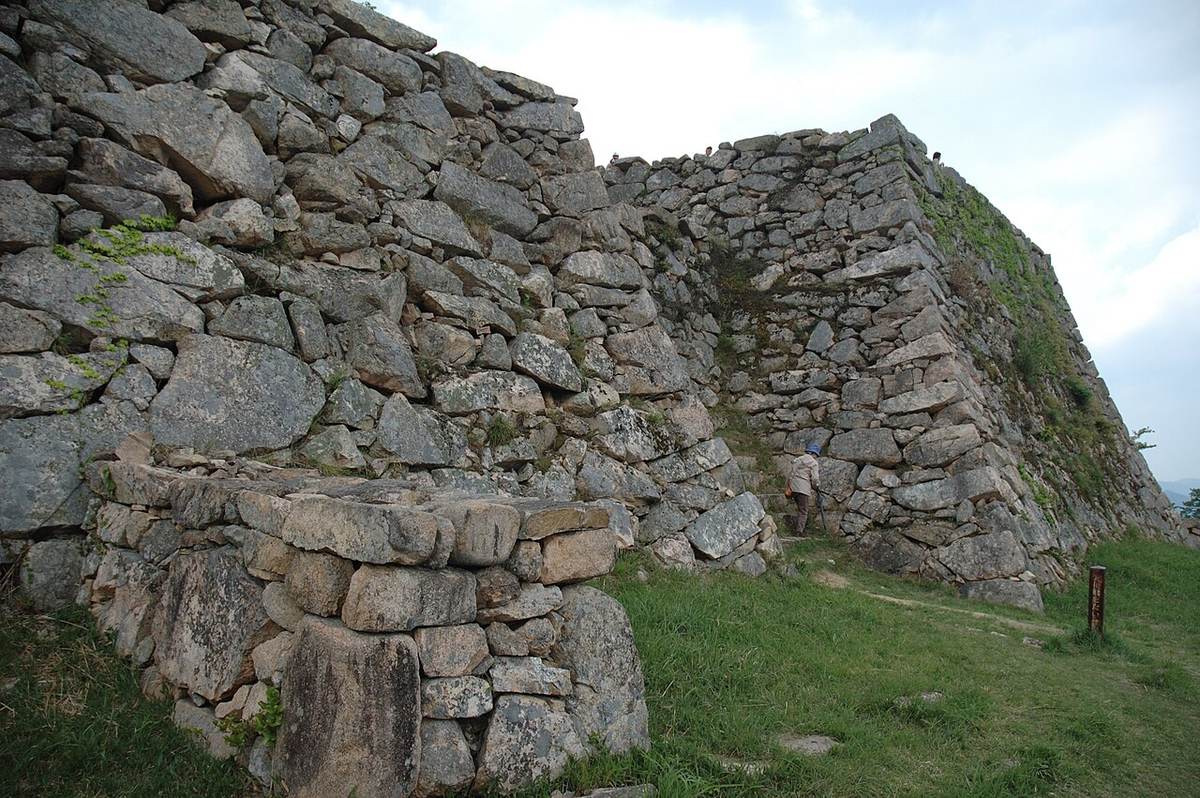
Takeda Castle's active life lasted barely a century and a half, but it was eventful. From Asago City's official chronology:
- 1431: Yamana Mochitoyo begins construction (the city marks this as oral tradition). 1443: the castle is completed, with Otagaki Mitsukage installed as first lord — also oral tradition, and the city notes an alternative account naming Otagaki Tomotomo. Seven generations of the Otagaki family follow.
- 1569: Kinoshita Tokichiro — the future Hideyoshi — invades Tajima. Per the Masuda family records, 18 castles fell in ten days between the Ikuno silver mine and Konosumiyama Castle.
- 1577–1578: after pacifying Harima, Hashiba Hideyoshi sends his younger brother Hashiba Hidenaga to take Tajima; per the Shincho Koki, Hidenaga becomes castellan of Takeda. In 1580 Hidenaga brings the castle down completely, and Kuwayama Shigeharu takes over with a 10,000-koku holding.
- 1585: Shigeharu is transferred to Wakayama and Akamatsu Hirohide becomes lord, with 20,000 koku, later 22,000. The stone fortress you see today is substantially his.
- 1600, Sekigahara: Hirohide sides with the Western army and attacks Tanabe Castle in Tango; after the defeat he joins the assault on Tottori Castle, is held responsible for a great fire, and takes his own life at Shinkyo-ji in Tottori. Takeda Castle is abandoned that same year.
- Then a long sleep: designated a National Historic Site in 1943, stonework repairs from 1971 to 1980, selection as one of Japan's 100 Famous Castles in 2006 (number 56, alternative name Torafusu-jo), and an expansion of the designated area in 2009.
There is a 2026 hook too. The NHK historical drama centred on the Toyotomi brothers has put Hashiba Hidenaga back in the spotlight, and Asago City's own leaflet is subtitled as the castle in the sky connected to Toyotomi Hidenaga, with a dedicated "places linked to Hidenaga" publication released in April 2026. If you are following the series, this is the most tangible site of Hidenaga's Tajima campaign.
Two terms will change how the visit feels. The first is the nawabari, the layout: the city describes large enclosures arranged in three directions around the keep base, spanning roughly 400 metres north to south and 100 metres east to west, every enclosure built in stone, with heavy use of the deliberate wall-angle called yokoya producing a complex plan. The enclosures in order are Kita-senjo, San-no-maru, Ni-no-maru, the honmaru and keep base, Minami-ni-no-maru and Minami-senjo, plus Hanayashiki and Hiradono. Walk it with the names in hand and you stop seeing a promenade and start seeing a defensive system.
The second is nozura-zumi: stone piled with minimal working of the natural rock, which the city notes still holds its imposing form more than 400 years after construction. The technique resembles that of the Ano-shu masons who worked on Azuchi Castle and others, which is why it is sometimes called ano-zumi. Up close the stones show almost no tool marks, yet they have stood for four centuries — worth five minutes standing at the keep base thinking about.
Two nicknames need correct attribution. "Castle in the sky" and "Japan's Machu Picchu" are not designations awarded by anyone — they are phrases Asago City itself uses in its official documents, from landscape plans and survey reports to PR material and the municipal bulletin. That the city writes them tells you the comparison has been institutionally adopted, but nobody "certified" it. The genuinely formal alternative name is Torafusu-jo, listed by the Japan Castle Foundation and the tourism association, which explains it as deriving from the castle's resemblance to a crouching tiger. The tourism association also records that in 2012 the site was certified as a "lovers' sanctuary."
Castle seals and the 100 Famous Castles stamp
Collectors should not skip this, because Takeda Castle's gojoin are officially listed and sold year-round — with one genuinely useful quirk.
| Item | Price (tax included) |
|---|---|
| Gojoin, single (Yamana crest / Akamatsu crest / combined) | 300 yen each |
| Gojoin, set of two | 500 yen |
| Gojoin, set of three | 700 yen |
| Gojoin book (brown or red) | 2,000 yen each |
They are sold at Joho-kan Tenku no Shiro (Takeda 363, Wadayama-cho) and Yamashiro no Sato (Tono 13-1), both in the valley. The quirk: the official page specifies that sales continue during the January 4 to end-of-February closed season. The castle may be off-limits, but the seals are not — so a winter trip to this corner of Hyogo is not wasted, it just becomes a valley-level pilgrimage instead of a climb. For the wider practice and which castles reliably stock seals, see our Japanese castle seal collecting guide.
The 100 Famous Castles stamp has three locations: the Takeda Castle fee booth (same hours as castle entry), Yamashiro no Sato's Koryu-no-Yakata (9:00–17:00 from March 1 to December 28, 9:00–16:00 from January 4 to end of February, closed over New Year and on Tuesdays during the closed season), and Joho-kan Tenku no Shiro (9:00–17:00, no closing days). Per the Japan Castle Foundation's July 2026 list, the castle card is sold only at Joho-kan Tenku no Shiro. Note the winter interaction: with the fee booth shut during the closure, you depend on the two valley locations, and Yamashiro no Sato closes on Tuesdays in that period.
Eating, the temple street, and side trips
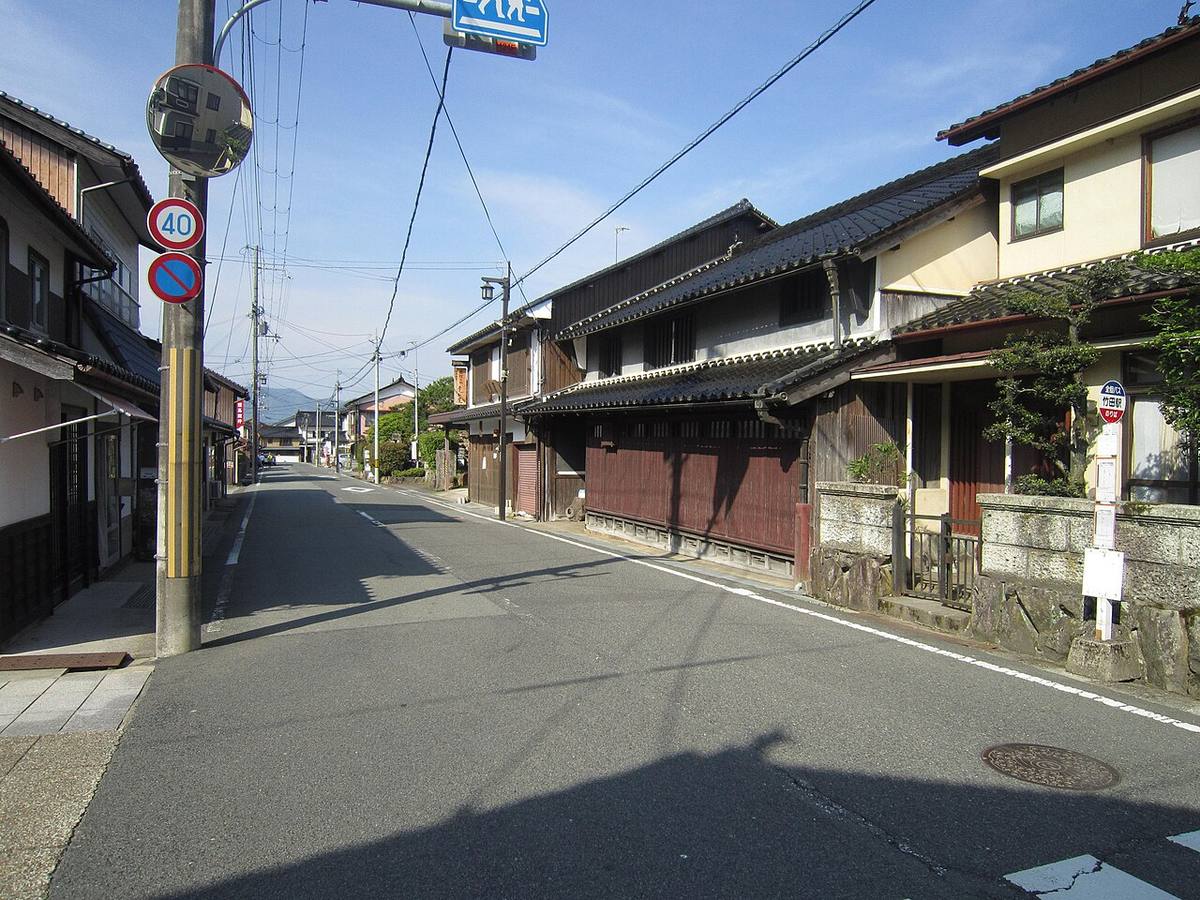
There is nothing commercial at the ruins themselves; everything is at the bottom.
- Joho-kan Tenku no Shiro (Takeda 363, Wadayama-cho; 9:00–17:00, open year-round; tel 079-674-2120) — converted from an early-Meiji sake brewery, with accommodation, a restaurant and a market hall. It is simultaneously the 100 Famous Castles stamp point, the castle card outlet, a gojoin seller and the volunteer-guide desk. If you only stop at one place in the valley, make it this one.
- Yamashiro no Sato (Tono 13-1) — west trailhead and last car park. The Koryu-no-Yakata information centre runs 9:00–17:00 year-round (tel 079-670-6518). One warning: the Tokusan-no-Yakata wing, which holds the restaurant and souvenir shop, is currently closed for facility upgrades, with the official notice saying preparations are under way for a reopening aimed at October. No firm date has been published, so confirm before you count on eating there.
- Kashiya Nanohana (Takeda 160, in an old house) — handmade baked goods using local ingredients, with seating. Open 12:00–18:00, closed Monday through Thursday, which effectively makes it a Friday-to-Sunday business. That closure pattern catches people out.
- Kani-kan Kutaro — a Japanese restaurant in the Takeda area. Opening hours could not be verified from an official source, so check before going.
- The Wadayama tourist information desk is inside JR Takeda Station — worth two minutes for a map when you arrive.
If you have time left, Teramachi-dori is the most underrated thing here. West of JR Takeda Station at the foot of the old castle mountain, the city describes it as roughly 600 metres lined with four temples and Hyomai Shrine, with a stream, white temple walls and pines along the way. Each temple carries a thread of the chronology: Hoju-ji is the family temple of Akamatsu Hirohide, the castle's last lord; Joko-ji that of first lord Otagaki Mitsukage; Shoken-ji is linked to former lord Kuwayama Shigeharu; and Zensho-ji dates to the 14th century with a tiled earthen wall. Hyomai Shrine is unusual for its semicircular stone seating and stage. Nearby are the presumed site of Hirohide's residence and Mitsukage's grave. Walk this after the climb and the chronology suddenly has addresses.
For side trips, the city's own leaflet pairs the castle with Kinosaki Onsen, quoting about 50 minutes by train or 90 by car. The combination is genuinely good: climb at dawn, soak in the afternoon. Our Kinosaki Onsen guide covers the seven public baths and where to stay. The other option is the Ikuno Silver Mine, also in Asago (Ono 33-5, Ikuno-cho; 9:10–17:20 with seasonal variation so confirm, closed over New Year and on Tuesdays from December to February; 1,200 yen adults, 600 yen students; tel 079-679-2010), about 80 minutes by train from Kinosaki Onsen. For local produce, Asago is known for Iwatsu negi leeks, though season and pricing were not verified.
Accommodation deserves more thought than usual here. Chasing the dawn clouds from an Osaka base is close to impossible — no first train reaches a 4:30 gate. The realistic options are staying in Asago itself (Joho-kan Tenku no Shiro has rooms), staying at Kinosaki Onsen, or at minimum basing yourself on the western side of Kansai to shorten the run. Compare Osaka stays on Trip.com to price the night before and decide whether it is worth moving north.
How to actually schedule the day
Stack all the official constraints together and only a handful of workable plans survive. Here they are, without hedging.
- Want the sea-of-clouds photo without a car? It has to be a November weekend or public holiday. That is the only window with a dawn bus (the Unkai Bus, roughly 4:00–7:00), and the season itself is announced through December 6. Stay in Asago or Kinosaki the night before, ride up to Yamashiro no Sato or the castle-town car park, and make Ritsuunkyo the main event. This is the single most correct day of the year.
- Want sunrise from the ramparts? Drive or taxi, and use the west trail. It is the only gate open at 4:30 and it starts at Yamashiro no Sato; the other three open at 5:00. Walk back down rather than calling a taxi from the mid-slope stop — the one-way loop makes that ride several times the price.
- Just want to see the castle properly? Spring or a summer daytime visit is easiest. Gates at 8:00 or 5:00, closing at 17:00, Tenku Bus from around 8:00, and you can sleep in. Honestly, this is what I would recommend to most first-time visitors — the stonework and the layout are the substance here, and the clouds are a bonus.
- December: possible, but accept there are no buses. Both the Tenku and Unkai services stop for the month, leaving walking or taxis; after the early-December changeover, hours compress to 10:00–15:00 and two of the four trails are sealed.
- January 4 to end of February: do not schedule it. The site is closed. If you are in Kansai anyway and want a taste, do the temple street and buy castle seals at the information centre.
One closing opinion, stated plainly: Takeda Castle is worth the journey, but not for the reason the photograph suggests. The sea of clouds is probability, weather and luck — none of it under your control. What is guaranteed is a fortress abandoned in 1600 and never rebuilt, four centuries of unworked stone still standing, and a 400-metre defensive layout you can walk end to end. Set your expectations on the second thing and this trip cannot disappoint you; bet everything on the first and you need a very good morning. If you are building the wider autumn route through Kansai, our Japan autumn foliage guide handles the timing — though to be clear, Takeda's draw is cloud, not colour, so do not schedule it as a foliage stop.
Frequently Asked Questions
- Q1:Is Takeda Castle open in winter?
- It depends which part of winter. From January 4 to the end of February the site is shut outright — the official wording is that the castle is closed for the winter and entry is not possible. Between early December and January 3 it does open, but under a completely different rule set: viewing hours shrink to 10:00–15:00, and the city adds a pointed line saying that even if you arrive at dawn hoping for a sea of clouds, you will not be able to climb up to Takeda Castle. During that window the Ekiura and Hyomai-jinja trails are also sealed off because of ice, and buses stop running entirely from December 1. One consolation: the castle seals (gojoin) are sold right through the closed season at Joho-kan Tenku no Shiro and Yamashiro no Sato, both down in the valley.
- Q2:Can you pay by card at Takeda Castle?
- No. Adult admission (high-school age and up) is 500 yen, junior-high age and under is free, groups of 20 or more pay 450 yen each, and an annual pass is 1,000 yen. The official page states plainly that payment is cash or PayPay only — no credit cards, no IC cards — bought from a ticket machine, same-day payment only. The Tenku Bus is the same story: pay on exit, cash only, and ICOCA and Suica are explicitly not accepted. Bring physical yen. Holders of a Japanese disability certificate and one accompanying carer (normally one family member) are exempt from the viewing fee.
- Q3:What time do you need to arrive to see the sea of clouds, and is there a bus?
- The opening hour and the bus timetable are published in two different places, and they do not line up. In summer and the sea-of-clouds season the castle opens at 5:00 — the city has announced 5:00 to 17:00 for June 1 to December 6, 2026 — but there is no public transport at all during those early hours. Asago City states the Tenku Bus operating band as roughly 8:00 to 16:00, and the current summer timetable has its first departure from Takeda Station at 10:05. The single exception is the Unkai (sea of clouds) Bus, which runs only on Saturdays, Sundays and public holidays in November, roughly 4:00–7:00, and does not run in December. So the only window in the entire year when a bus can actually take you up for a dawn sea of clouds is a November weekend. Every other day it is walk or taxi.
- Q4:Where is that famous photo of the castle floating above the clouds taken from?
- Not from the castle — from the mountain facing it. The castle's own official notice tells visitors that if they want to attempt the sea of clouds outside viewing hours, they should go to Ritsuunkyo, described in the same sentence as the mountain opposite. Ritsuunkyo sits partway up Mount Asago at 757 metres, well above the castle ruins at 353.7 metres, which is why it can look down on the whole site. The logic is simple: when a sea of clouds forms, the castle is inside it — stand on the ramparts and you are in the fog, not above it. Ritsuunkyo is managed by the Takeda district, not Asago City, and charges its own separate 300 yen maintenance contribution.
- Q5:Do you need to book Takeda Castle in advance?
- No. The official Q&A says outright that no reservation is required to visit the ruins. You buy a ticket from the machine at the fee booth with cash or PayPay and walk in. If a site tells you to book online well ahead, that is not how this place works. The only two things that genuinely need arranging in advance are a volunteer guide (3,000–5,000 yen per guide, requested by fax to Joho-kan Tenku no Shiro at least one week ahead) and fee-exemption applications for school groups, which must arrive one week before the visit date.
- Q6:Are there toilets at the ruins? Is it wheelchair or stroller friendly?
- Both answers are blunt, and they come straight from the official pages. There are no toilets inside the ruins — the guidance is to go before you start climbing. No drinking water is sold at the fee booth or anywhere inside the ruins, so carry your own, and in cold weather the city suggests a hot drink. There are no rest facilities either, only benches at Kita-senjo and a few other spots. On accessibility, the official line is that entering by wheelchair is extremely difficult, citing steep gradients and large stone steps; a sign at the Hyomai-jinja trailhead reads "steep slope and 460 steps." Treat this as a hike with about 250 metres of vertical gain, not a stroll around a monument.
- Q7:Does Takeda Castle sell a gojoin castle seal?
- Yes, and unusually it is officially listed and sold year-round. Three designs — the Yamana crest, the Akamatsu crest, and a combined Yamana-Akamatsu version — at 300 yen each, 500 yen for any two, 700 yen for all three, plus seal books in brown or red at 2,000 yen. They are sold at Joho-kan Tenku no Shiro (Takeda 363, Wadayama-cho) and Yamashiro no Sato (Tono 13-1), both at the foot of the mountain. The useful detail: the official page states they are sold during the January 4 to end-of-February closed season too, so a winter trip is not a total loss for collectors.
Read next
Kinosaki Onsen Guide 2026: Yukata, 7 Baths & Crab
The willow-lined town where you stroll between seven public baths in a yukata. The Yumepa pass, snow-crab season, the ropeway, and access from Kyoto and Osaka.
Himeji Day Trip 2026: Castle, Koko-en & Mt. Shosha
Thirty minutes from Shin-Osaka and fifteen from Shin-Kobe, Himeji is the easiest day trip in Kansai — how to sequence the castle, Koko-en, Engyo-ji and the zoo into a route that actually walks.
Gojoin Castle Stamps: 12 Original Keeps Guide
What gojoin are, how they differ from goshuin, plus all 12 original castle keeps mapped.
📊 See the 2026 Price Index (JR Pass, DPA, eSIM, Airport Transport) →