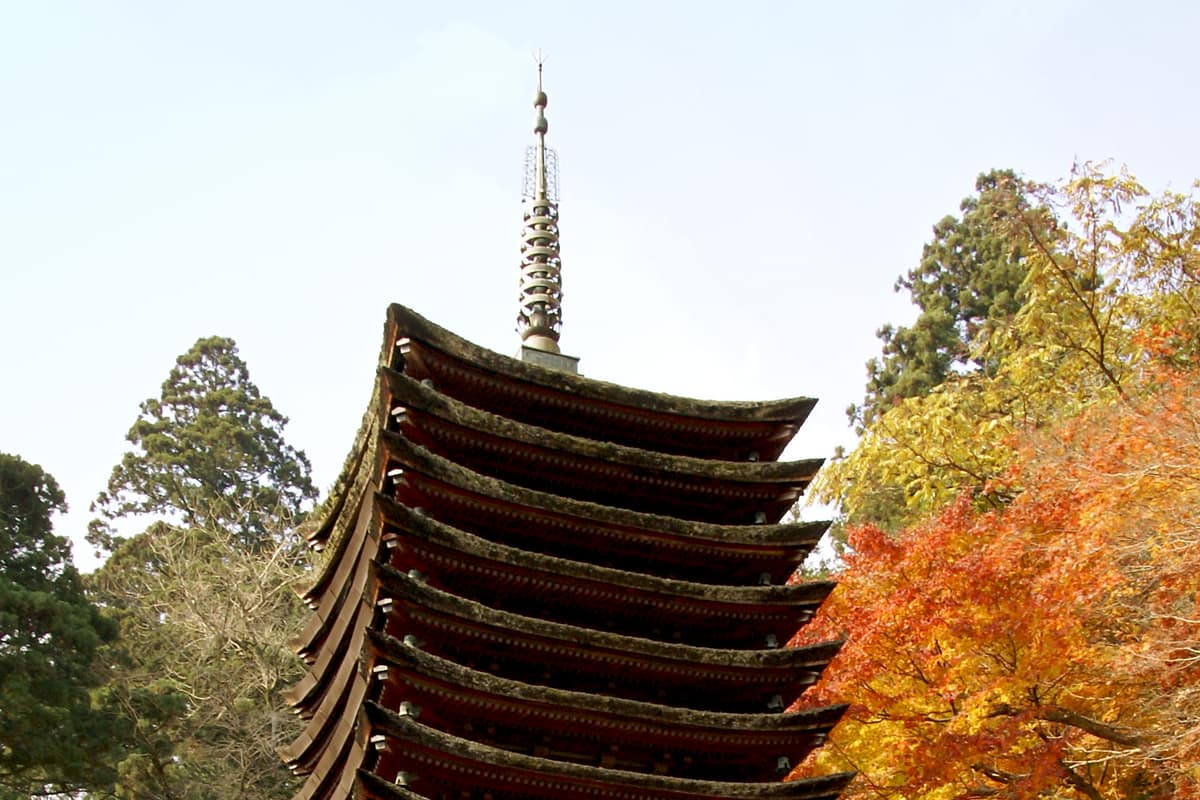
On a mountainside in Nara's Tonomine district stands the only surviving wooden 13-story pagoda in the world, and the shrine it belongs to takes its very name from a coup that reshaped Japan. Tanzan Shrine is where, some 1,400 years ago, Fujiwara no Kamatari and Prince Naka-no-Oe held their "talk" beneath wisteria blossoms and set the Taika Reform in motion — making this the only shrine in Japan named for the site of a political plot. Adult admission is ¥700 (the current rate, only just revised in April 2026), and in autumn the roughly 3,000 maples framing that Important Cultural Property pagoda make it one of Nara's premier foliage spots. But it has one fatal barrier: the only public link to the outside is a Sakurai City community bus running about once an hour, and once the 17:52 last bus is gone, there is no way down. This guide skips the tourist-brochure fluff and uses verified official sources to cover the history, admission and hours, the pagoda, the kemari festival, and goshuin — plus the thing most likely to catch you out, the bus timetable and its last-bus trap — and answers plainly: is Tanzan Shrine actually worth the detour.
📍 To slot Tanzan Shrine into a wider Nara itinerary, start with the Nara travel guide; if you are chasing autumn and want to compare its peak window and access against Nara Park and the Midosuji ginkgo, see the Osaka and Nara autumn guide — this article is the deep-dive companion to that guide's #tanzan section.
- The name = a coup-plot site: Kamatari and Prince Naka-no-Oe "talked" here to overthrow Soga no Iruka — the only shrine named for a political plot
- World's only wooden 13-story pagoda: the standing structure was rebuilt in 1532, an Important Cultural Property (not a National Treasure) — its signature scene
- Adult admission ¥700 (rate just revised in April 2026); reception 8:30–16:00, last entry 16:30
- Access is the pain point: the Sakurai bus runs ~hourly at ¥570 one-way, and the last bus is 17:52 — no ride down after the night illumination
- Goshuin price not officially posted: confirm at the offerings desk; there are 5 goshuin-book designs (the kama-gitsune one is most representative)
📖 Table of Contents (click to expand)
- What Tanzan Shrine is: a coup site on Tonomine
- The story: the "talk" beneath the wisteria and the Taika Reform
- Admission and hours
- Access: the bus timetable and the 17:52 last-bus trap
- Annual events: the kemari festival and foliage illumination
- Goshuin and goshuin books
- On the way: pairing with Miwa somen
- Is it worth a special trip? How to pair it
- FAQ
What Tanzan Shrine is: a coup site on Tonomine
Tanzan Shrine (Tanzan Jinja) sits in the Tonomine mountains of Sakurai City, Nara Prefecture, and enshrines the Asuka-period statesman Fujiwara no Kamatari (Nakatomi no Kamatari). What makes it stick in the memory among Nara's many shrines is not scale or grandeur, but two things you cannot find elsewhere: the only surviving wooden 13-story pagoda in the world, and a history tied directly to how the Japanese state began to remake itself.
Break the draws apart so you know which one you are coming for:
- The Taika Reform plot and the shrine name. This is the soul of the place. It was on this mountain that Kamatari and Prince Naka-no-Oe (the future Emperor Tenji) conspired and launched the strike against Soga no Iruka, and the name "Tanzan" comes straight from that "talk" (dan). It is the only shrine in Japan named for the site of a political plot — history buffs come for exactly this.
- The world's only wooden 13-story pagoda. This is its most recognizable visual, and an Important Cultural Property. Thirteen tiers stacked skyward, set against autumn maples, make one of Nara's classic foliage scenes.
- A foliage destination. The grounds hold roughly 3,000 maples (secondary-source estimate), and it is one of Nara's renowned autumn spots, with a night illumination during peak.
The downside, up front: it is in the mountains, and its only public link is a community bus running about once an hour with an early last run. So a big chunk of this guide is about access and timing, because how smoothly your visit goes — and whether you can get down safely — depends mostly on transit.
The story: the "talk" beneath the wisteria and the Taika Reform
This is the part of Tanzan Shrine worth slowing down for, and where it differs most from other Nara shrines. Its name is not drawn from mountains or rivers but from a political plot that changed the direction of the country.
The "talk" beneath the wisteria
Per the Tonomine Engi, Fujiwara no Kamatari (Nakatomi no Kamatari) and Prince Naka-no-Oe first met at a kemari (kickball) gathering at Asuka's Hoko-ji — an encounter that would later become the origin of the shrine's annual "kemari festival." When the prince asked how to deal with the overbearing minister Soga no Iruka, Nakatomi no Kamatari led him up "the peak of Kurahashi Mountain to the east of the castle," where the two, beneath the wisteria blossoms, "discussed the plan to set things right" — that is, they talked through the plot to overthrow him.
That discussion led to the successful strike against Soga no Iruka in 645 (the 4th year of Empress Kogyoku), opening the era of the celebrated Taika Reform. Because of that "talk," Tonomine came to be called the "peak of talk," and the name Tanzan Shrine derives from it. In other words, where you stand is the starting point of a 1,400-year-old coup — the only shrine in Japan named for the site of a political plot, and its strongest point of difference.
Founding and the 13-story pagoda
Per official records, in 678 (Hakuho 7) Kamatari's eldest son, the priest Joe, reburied his father's remains at the summit of Tonomine and built the 13-story pagoda and a lecture hall (Myoraku-ji); in 701 (Taiho 1) a "three-jo-square hall" was built to enshrine Kamatari's image, and Tanzan Shrine was formally established.
That 13-story pagoda is the one you will photograph. A few official facts to keep straight: it was first built in 678, but the structure standing today was rebuilt in 1532 (Kyoroku 5) in the Muromachi period, and the shrine states verbatim that it is "the only surviving wooden 13-story pagoda in the world." Its cultural-property grade is Important Cultural Property, not National Treasure — that is the shrine's own wording, and the two grades are not interchangeable. As for height, the official pages give no exact figure; the "about 16 meters" figure appears only in secondary sources and is unconfirmed by the shrine, so this article notes only "about 16 meters (unofficial)."
Main structures on the grounds
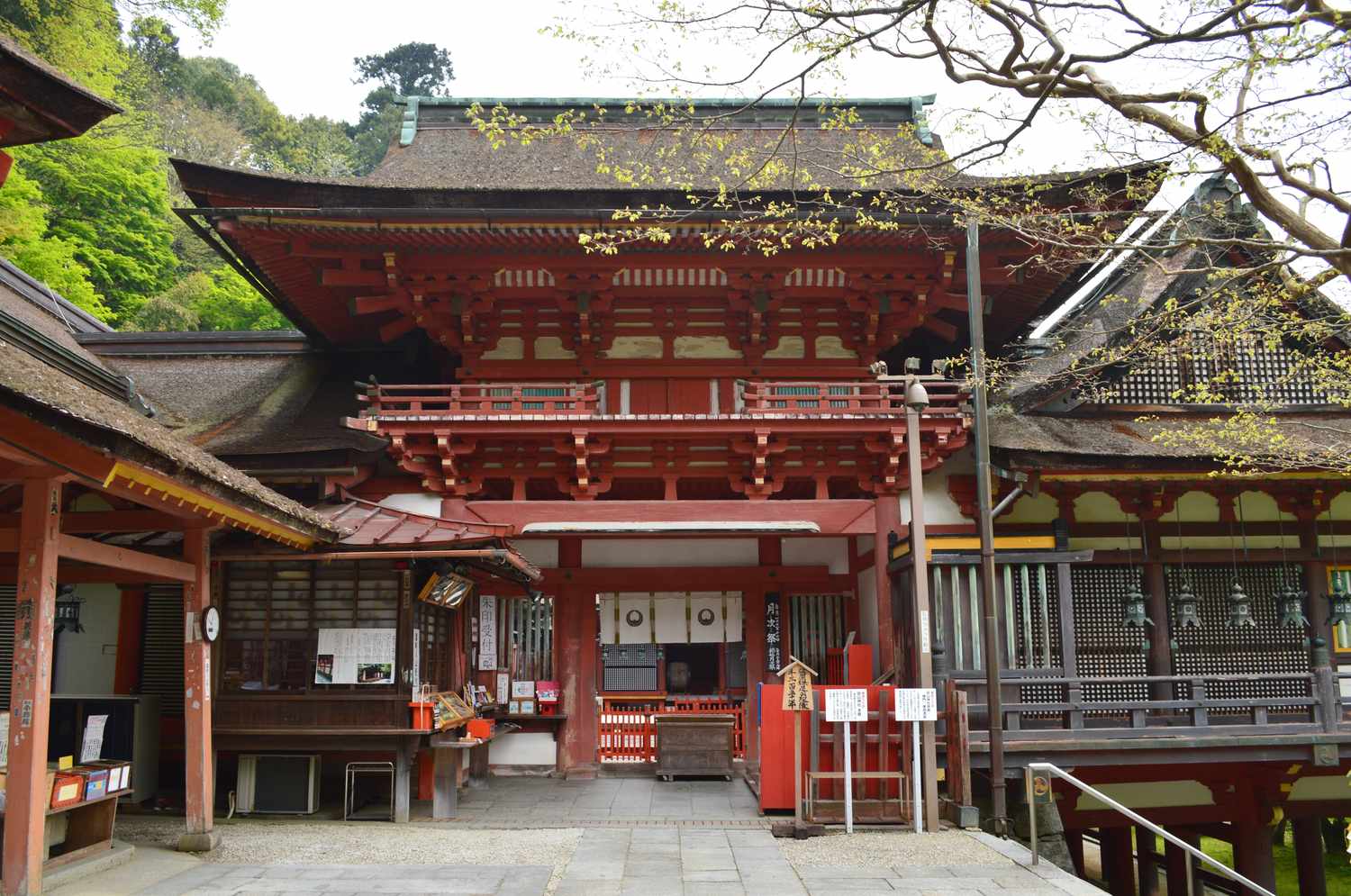
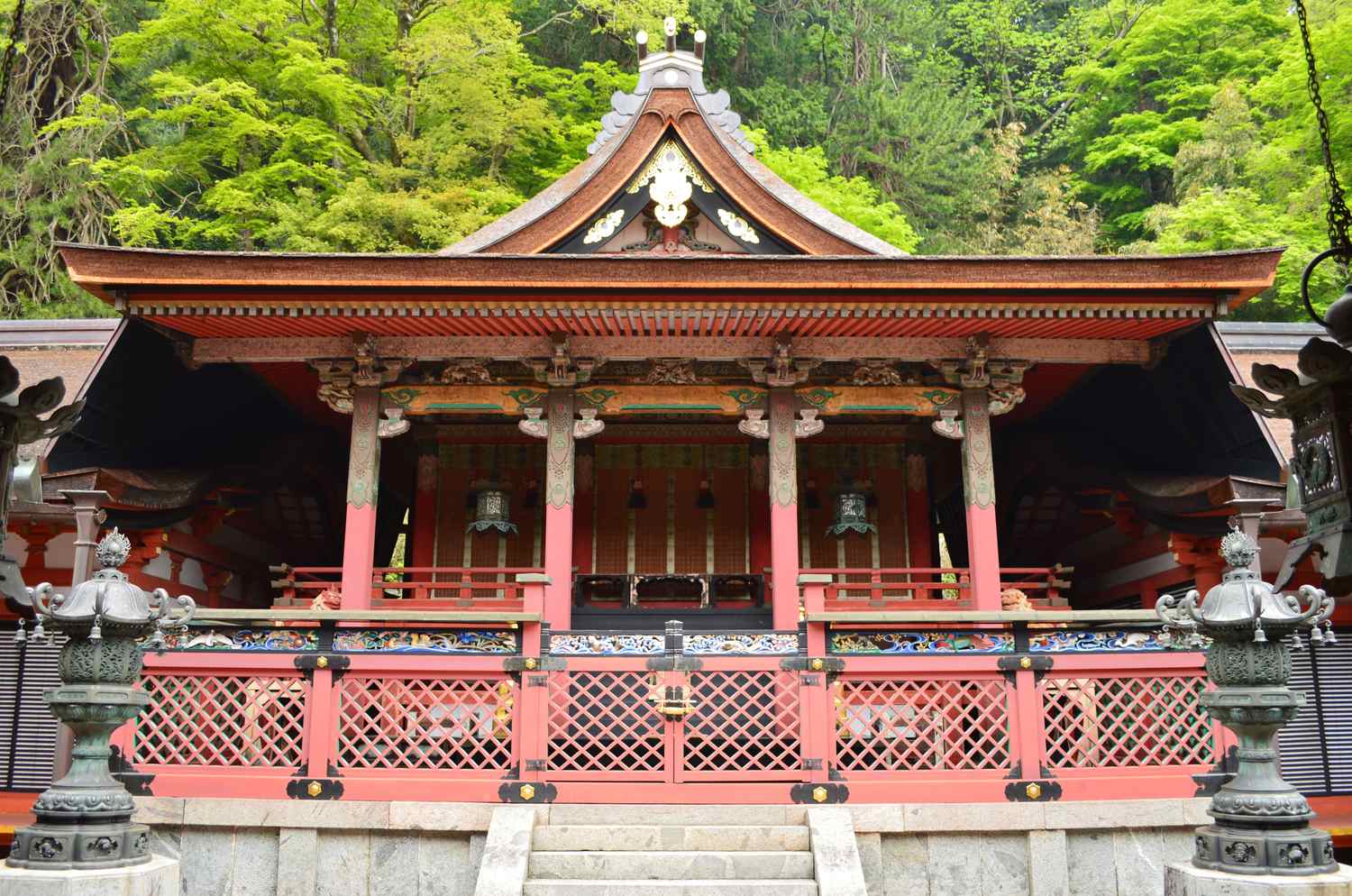
Beyond the pagoda, the grounds hold several Important Cultural Property buildings, which make it more than a "pagoda photo stop" — it is a temple-shrine complex of real historical depth:
| Structure | Standing date | Cultural property |
|---|---|---|
| Honden (main hall) | rebuilt 1850 (Kaei 3) | Important Cultural Property |
| Haiden / Romon / east-west corridors | 1520 (Eisho 17) | Important Cultural Property |
| Soja Honden | relocated 1742 (Kanpo 2) | Important Cultural Property |
| Gonden | rebuilt late Muromachi | Important Cultural Property |
| East hall (Koi-jinja) | relocated 1668 (Kanbun 8) | Important Cultural Property |
The east hall is also called Koi-jinja (the "love shrine"), another popular spot on the grounds — it enshrines Kamatari's wife, Kagami-no-Okimi, and draws visitors praying for good relationships. For more, see the official Tanzan Shrine website.
Admission and hours
Admission is ¥700 for an adult, ¥300 for an elementary-school child, and free for preschoolers. There is a timely detail worth noting: these rates only took effect on April 1, 2026 (Reiwa 8) — the official page states "revised to the new rate from April 1, 2026." Any lower figure you come across is pre-increase; go by the current rate here. (The exact old price is not preserved verbatim on the official page and secondary sources contradict each other, so this article does not pin a specific old figure — only that it was revised to the current rate in April 2026.)
Other practicalities:
- Reception 8:30 to 16:00 (last entry), last viewing 16:30. Do not leave the grounds for the last moment if you want to see them properly.
- To climb to the Goharetsan Santen Inari Shrine deep in the grounds, the cutoff is 15:00, with the mountain closing at 16:00.
- Groups of 25+ adults ¥650, 50+ ¥600; a disabled visitor plus one companion ¥350 each; school excursions (kindergarten to high school) ¥300 per person.
- The official page lists no fixed closing day and no foliage-season surcharge; various JR, tourism-association, and lodging discount coupons exist but cannot be combined.
Access: the bus timetable and the 17:52 last-bus trap
This is the section to read carefully, because Tanzan Shrine's transit is "heavy" and hides a trap that strands night-foliage visitors. First, be clear on one thing: Tanzan Shrine has no direct train, and it is not on Nara Kotsu's regular routes. Its only public link is one line — the Sakurai City community bus (Tonomine line), operated on contract by Nara Kotsu. Community buses like this depend heavily on local-government subsidy and are inherently leaner than regular routes — which is exactly why it runs "once an hour" rather than as frequently as a city bus.
The community bus basics
- Boarding: bay 1 on the south side of Kintetsu/JR Sakurai Station.
- Duration: about 25 minutes (roughly 24 to 26 in practice).
- Fare (one-way, adult): ¥570. Note that the "¥500" on the shrine's own access page is stale data from December 2023; per the Sakurai City official timetable (revised April 2025, confirmed carried over unchanged for 2026), the current fare is ¥570. The ¥360 resident cap applies only to Sakurai City residents, workers, and students — not to visitors.
Outbound times (Sakurai Station south → Tanzan Shrine)
Per the Sakurai City official timetable, outbound departures are as follows (runs marked in red do not operate on weekends and holidays, or during Obon Aug 13–15 and New Year Dec 30–Jan 3):
| Outbound departure (Sakurai Station south) | Notes |
|---|---|
| 7:05 | Red run (no service weekends/holidays/Obon/New Year) |
| 8:12 | 9:45 | 10:50 | 12:47 | Daily |
| 14:00 | 15:05 | 16:09 | 17:25 | Daily |
| 19:05 | Red run (no service weekends/holidays/Obon/New Year) |
That works out to about 10 runs on weekdays and 8 on weekends and holidays. In practice, note that on weekends and holidays the first red run at 7:05 is cancelled, so service does not settle in until the 8:12 departure — plan peak-foliage weekends around 8:12 or later, and do not assume you can catch a bus at seven in the morning.
Return times and the 17:52 last-bus trap
Return departures (Tanzan Shrine → Sakurai Station south) are below, with weekend/holiday times in parentheses:
| Return departure (Tanzan Shrine) | Notes |
|---|---|
| 6:34 | Red run (no service weekends/holidays/Obon/New Year) |
| 7:32 (weekend/holiday 7:35) | 8:40 (8:50) | Daily |
| 10:14 | 11:19 | 13:17 | 14:28 | Daily |
| 15:32 | 16:37 | Daily |
| 17:52 | Last bus (final downhill run of the day) |
⚠️ The 17:52 last bus is the single most important trap in this guide.
The autumn night illumination usually only hits its best after dark — but by then there is no bus down the mountain. Anyone wanting night foliage has just two safe options: arrange an up-and-down taxi in advance through a hotel or taxi company (downhill fare estimated at about ¥2,600 to ¥2,800, unofficial), or drive. Never stay until the lights come on only to discover there is no bus — Tonomine is a mountain area, and hailing a taxi on the spot is nearly impossible.
If you would rather not work the timetable at all, there is also a tour. A Klook day trip from Osaka (Nara Park, Akame 48 Waterfalls and Tanzan Shrine day tour) makes Tanzan the last stop after Nara Park and the Akame falls, with about an hour on site and a scheduled 20:00 return to Osaka — the bus takes you back, so the 17:52 cutoff stops mattering. Three things to know before you book: the itinerary gives no arrival time at each stop, so whether you catch any of the foliage illumination is a question for the operator (TOURSTORY JAPAN); the earliest bookable date currently shown is 9 November; and an hour is short if you want time with the thirteen-story pagoda and the grounds.
Taxi, driving, and parking
To skip the wait, a taxi up from Sakurai Station is about 15 minutes per the official page, roughly 7.7 km, with a NAVITIME estimate of about ¥2,600 (small car) to ¥2,800 (mid-size) — an estimate, not an official fare, so go by the meter.
If you drive, there are parking lots 1 through 5 near the shrine. Per official rates: the priority lot is free, lot 5 is usually ¥500 (¥1,000 during November), and lot 1 is ¥500 for passenger cars in November to December. The official page does not list capacities; peak-foliage weekends jam the mountain roads and fill the lots, so arrive early if you must drive.
Annual events: the kemari festival and foliage illumination
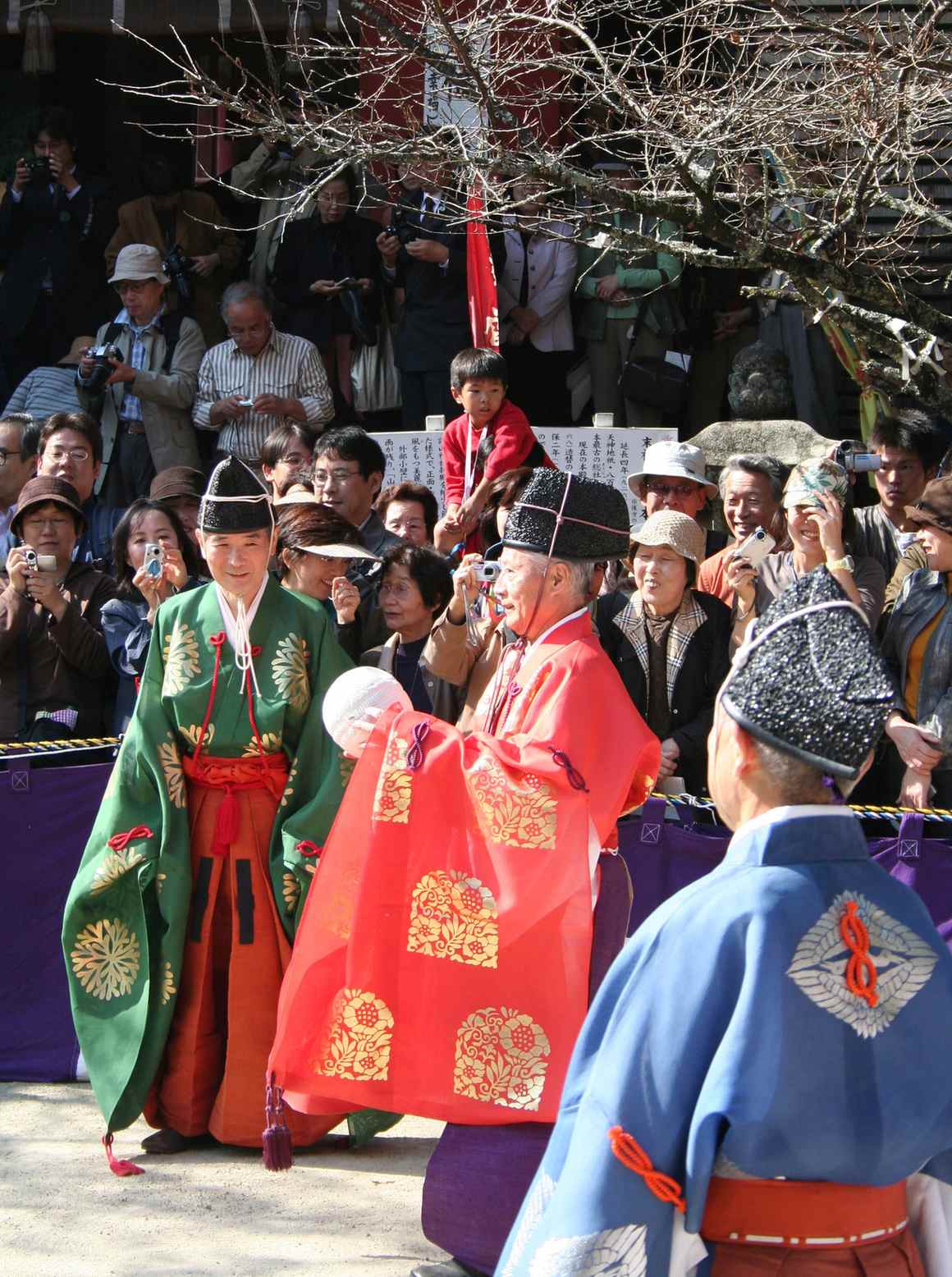
The most representative festival here, and the one that most echoes its history, is the kemari festival. As noted above, Kamatari and Prince Naka-no-Oe met at a kemari gathering, so the festival essentially re-enacts that starting point. Participants in Heian-period dress kick the ball before the main hall — a striking scene:
| Session | Date | Time | Location |
|---|---|---|---|
| Spring kemari festival | April 29 | 11:00 a.m. | Main hall |
| Autumn kemari festival | November 3 | 11:00 a.m. | Main hall |
These two are fixed-date annual events (not one-off notices), so if you want to see kemari, plan straight for April 29 or November 3. The November 3 session conveniently falls in foliage season — a chance to catch both.
Foliage and night illumination
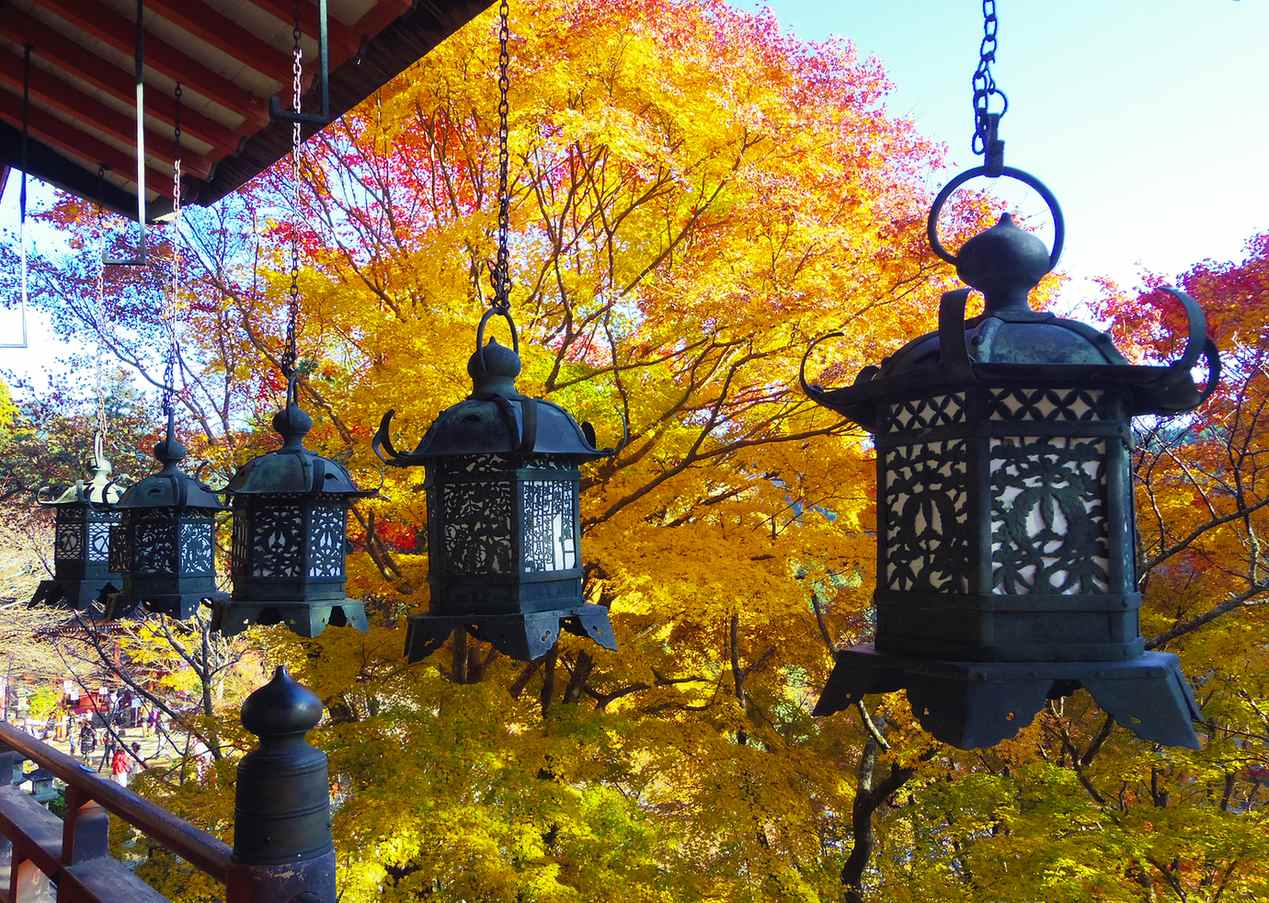
Tanzan Shrine is one of Nara's famous foliage spots. Per the official long-term average, peak foliage falls mid-November to early December. Going by the official 2025 "Momiji Matsuri" as a record: the period ran October 1 to December 7, with the night illumination on November 14 to December 7, held every evening — but the official notice only says "at night" and does not state exact start and end times, so this article does not pin the illumination hours.
As for the specific 2026 dates, as of this article's verification (July 22, 2026), the official notice list still showed no 2026 foliage or illumination announcement. The recent pattern is to announce only in September to October of the year, so read it as "typically mid-November to early December illumination, 2026 official dates not yet posted, defer to the official notice" — do not reuse last year's dates. If you plan night foliage, re-read the last-bus trap above.
Other fixed festivals worth noting: the Reitaisai on Nov 17 (10:30 a.m., with bugaku dedication, which the shrine calls its most significant rite), the Kakitsu Festival on the second Sunday of October (10:00 a.m., Muromachi-era origin, a Nara Prefecture Intangible Folk Cultural Property), and the Kento Festival on Aug 14 (6:00 p.m., with roughly 150 lanterns lit). In spring there is also the night cherry illumination (March 28 to April 19), which the shrine has officially posted for 2026 — one for cherry-blossom visitors to note.
Goshuin and goshuin books
An honest note first: Tanzan Shrine's official offerings page only shows the goshuin-book designs; it does not publish the price, reception hours, or whether the goshuin is hand-written or pre-printed. So I will not invent a figure — that is the verification line: what the shrine does not state, I do not pretend to know.
The officially confirmed part (safe to state): there are five goshuin-book designs — the kama-gitsune (sickle-fox) and karin design, a yellow design, a black-and-red design, a black (komainu) design, and a landscape-format design. The most representative is the kama-gitsune and karin design, which carries the motif of Kamatari's family crest — a design unique to this shrine and the one that best echoes its history. The official page lists no per-design prices, so confirm on site.
Secondary sources (visitor reports on goshuin platforms, unofficial) mention: the standard "Tanzan Myojin" goshuin runs about ¥300 and is hand-written, and the shrine also frequently issues Fujiwara no Kamatari-themed and seasonal or commemorative limited editions. But those designs and prices change yearly and may be discontinued, so treat them only as general reference — do not pin them as current products. Confirm the actual price at the on-site offerings desk, which you can expect to keep roughly to the 8:30-to-16:00 reception window, so do not leave it to the last minute.
If you are collecting, or want to start, the kama-gitsune book here is worth having. For the etiquette, how to choose a goshuin book, and the worship order, read our Japan goshuin collecting guide first; the correct worship sequence (temizu, two bows, two claps, one bow) is covered in our Japan shrine etiquette guide — the concepts make the visit land better.
On the way: pairing with Miwa somen
A routing reality first: Tanzan Shrine itself sits up in the Tonomine mountains on a small footprint, and dining right at the gate is limited. The "gate-front snacks" that float around online mostly have no reliable source, so this article does not invent them. Where you actually eat well is by pairing the shrine with the Miwa district in the same Sakurai City — Miwa is the birthplace of Miwa somen (over 1,200 years of history; per the Sakurai tourism association, a son of the Omiwa Shrine chief priest saw that the local soil and water suited wheat and began making somen). Three shops below have verifiable addresses, hours, and prices, all findable on Google Maps:
| Shop | Address | Hours / closed | Sample items |
|---|---|---|---|
| Senjutei (Ikeri Miwa somen teahouse) | 293 Shiba, Sakurai City, Nara | 11:00–16:00 (LO 15:00); closed 2nd/4th Thu and Fri | Chilled somen with tempura ¥1,380, mushroom nyumen ¥1,230, Senjutei lunch set ¥2,380 |
| Somen-dokoro Morisho | 535 Miwa, Sakurai City, Nara | Closed Mon & Tue (hours not officially posted; check the shop website) | Assorted Miwa somen (prices not published) |
| Miwa Yamamoto dining | 880 Hashinaka, Sakurai City, Nara | 11:00–15:00 (closed days per website) | Chilled somen, nyumen |
Of the three, Senjutei has the most complete information and makes the safest pick. Note that Miwa is around Kintetsu Miwa Station and JR Makimuku Station — it is not the "gate front" of Tanzan Shrine. Think of it as a "Tanzan Shrine ↔ Miwa" pairing rather than a somen shop waiting at the foot of the pagoda. In practice, do the pagoda and foliage up top in the morning, come down around midday, and finish with a bowl of hand-stretched somen in Miwa.
Is it worth a special trip? How to pair it
The real question about Tanzan Shrine is exactly this: is it worth the detour? My take is direct.
First, when to skip it. If this is your first time in Kansai and you are short on time, do Nara Park, Todai-ji, and Kasuga Taisha properly — that main line has easy transit and strong value, and Tanzan Shrine's roughly hourly mountain bus is a burden on a tight schedule, with an early last run that can eat half a day in waiting. First-timers really need not force it.
So who should come? Three kinds of traveler justify the trip: history buffs — this is where the Taika Reform was plotted, and the name comes straight from that coup, a meaning nowhere else can give you; goshuin collectors — the kama-gitsune goshuin book is genuinely collectible; and foliage lovers — the world's only wooden 13-story pagoda framed by a hillside of maples is one of Nara's top autumn scenes. If you fit one of the three, the transit hassle is worth swallowing.
Pairing advice (with clear trade-offs)
- Hase-dera (recommended, same direction): Hase-dera is in the same "Sakurai area" as Tanzan Shrine, with adult admission ¥500, famous for both foliage and peonies — the smoothest pairing: from Sakurai Station it's a 6-minute, ¥240 direct ride on the Kintetsu Osaka Line. See the complete Hase-dera Nara guide for the 399-step stairway, bloom calendar and goshuin.
- Miwa somen (recommended): as above, work Miwa into the route to solve the limited dining up at the shrine.
- Asuka / Ishibutai Kofun (be careful): there is no direct public transit found between Tanzan Shrine and Ishibutai; the two are mainly linked by a hiking trail, or you backtrack by bus to Sakurai Station and transfer. If you want the hike, check the official Asuka village tourism info for trail conditions and time first — do not head up on a hunch.
- Muro-ji (not recommended same day): Muro-ji is to the east, Tanzan Shrine in the southern mountains — different directions, each a half-day-plus of travel. Forcing both into one day is extremely tight, and I do not recommend it; if you really want Muro-ji, give it its own day.
If you are here for autumn and weighing spots across Kansai, the Osaka and Nara autumn guide compares the peak windows and access difficulty of Tanzan Shrine, Nara Park, the Midosuji ginkgo, and more — handy for deciding which days to do Kyoto and which to divert to Osaka-Nara. To order the wider Nara itinerary, start with the Nara travel guide.
The bottom line: Tanzan Shrine is not a "drop in because it is on the way" spot; it is a "go on purpose for a clear reason" spot. Find your reason — history, goshuin, or foliage — then set aside a half day including round-trip transit, keep the 17:52 last bus fixed in mind, and the trip will not be wasted.
Frequently Asked Questions
- Q1:Is Tanzan Shrine worth a special trip, and is half a day enough?
- It depends on who you are. If this is your first time in Kansai and you are short on time, do Nara Park, Todai-ji, and Kasuga Taisha properly first — that main line has easier transit and better value, and you need not take the roughly hourly mountain bus to Tanzan Shrine. But if you are a history buff (this is where the Taika Reform was plotted, and the shrine name comes straight from that coup), a goshuin collector, or specifically chasing autumn foliage, then Tanzan Shrine does justify a half day including round-trip transit. The grounds take about 1 to 1.5 hours to walk, and with the 25-minute one-way bus and waiting time, half a day fits. Its signature image cannot be replicated elsewhere: the world’s only wooden 13-story pagoda framed by autumn maples.
- Q2:How do I get to Tanzan Shrine from Sakurai Station? Is there a bus?
- Yes, but be prepared: this is the Sakurai City community bus (Tonomine line), operated on contract by Nara Kotsu but not a regular Nara Kotsu route. Board at bay 1 on the south side of Kintetsu/JR Sakurai Station; it is about 25 minutes to Tanzan Shrine, currently ¥570 one-way for an adult, running roughly once an hour. Outbound there are about 10 runs on weekdays and 8 on weekends and holidays, and several runs (marked in red on the timetable) do not operate on weekends, holidays, Obon, or New Year. On weekends and holidays, service does not settle in until the 8:12 departure, so plan around 8:12 or later for peak-foliage weekends. To save time you can also take a taxi from Sakurai Station — about 15 minutes per the official page, roughly ¥2,600 to ¥2,800 by NAVITIME estimate (not an official fare).
- Q3:After the autumn night illumination, is there still a bus down the mountain?
- This is the single most important trap in this guide: no. The last community bus from Tanzan Shrine to Sakurai Station departs at 17:52 (5:52 p.m.). In other words, once the autumn illumination reaches its best after dark, you no longer have a bus to get down. Anyone wanting night foliage has only two safe options: arrange a taxi up and down in advance through your hotel or a taxi company (the downhill fare is estimated at about ¥2,600 to ¥2,800, unofficial), or drive. Never stay until the lights come on only to find there is no bus — Tonomine is a mountain area and hailing a taxi on the spot is nearly impossible. Return runs also differ between weekdays and weekends, so check the day’s timetable with a transit app before you go.
- Q4:Does Tanzan Shrine have goshuin, and how much are they?
- Yes, but honestly: the shrine’s official授与品 (offerings) page only shows the goshuin-book designs. The official site does not publish the price (hatsuho-ryo), reception hours, or whether the goshuin is hand-written or pre-printed, so I will not invent a figure. Per goshuin-enthusiast platforms (visitor reports, unofficial), the standard "Tanzan Myojin" goshuin runs about ¥300 and is hand-written, and the shrine also issues Fujiwara no Kamatari-themed and seasonal limited editions — but those change yearly and may be discontinued, so treat them only as a reference. The one officially confirmed detail is the goshuin books: five designs, of which the "kama-gitsune" (sickle-fox) design carrying Kamatari’s family-crest motif is the most representative. Confirm the actual price at the on-site offerings desk, which you can expect to keep roughly to the 8:30-to-16:00 reception window.
- Q5:When is the best time for autumn foliage, and what are the 2026 illumination dates?
- Tanzan Shrine is one of Nara’s famous foliage spots, with roughly 3,000 maple trees on the grounds (a secondary-source estimate). Per the official long-term average, peak foliage falls mid-November to early December. The official 2025 "Momiji Matsuri" ran October 1 to December 7, with the night illumination on November 14 to December 7 held every evening — but the official notice only says "at night" and does not give exact start and end times. As for the specific 2026 dates, as of this article’s verification the shrine had not yet posted any 2026 notice; recent years announce only in September to October of the year, so treat it as "typically mid-November to early December, exact 2026 dates not yet posted, defer to the official notice." And if you plan night foliage, re-read the last-bus trap above.
- Q6:Is the 13-story pagoda a National Treasure? How tall is it?
- It is not a National Treasure — it is an Important Cultural Property, and the distinction matters. The pagoda was first built in 678 (Hakuho 7), but the structure standing today was rebuilt in 1532 (Kyoroku 5) in the Muromachi period, and the shrine officially describes it as "the only surviving wooden 13-story pagoda in the world" — that line is its biggest calling card. As for height, the official pages do not state an exact figure; the "about 16 meters" number appears only in secondary sources and is not confirmed by the shrine, so this article can only note "about 16 meters (unofficial)." Other main structures on the grounds — the honden, haiden, romon gate, and Koi-jinja (east hall) — are also mostly Important Cultural Properties, giving the shrine real historical weight.
Read next
Osaka & Nara Autumn 2026: Minoo Falls, Katsuoji & Deer Park
Kyoto crowds got you down? Minoo Falls, Katsuoji daruma slopes, and deer-and-maple Nara — routes and fees decoded.
Nara Guide 2026: Todaiji, the Deer Park & Kasuga Taisha
About 40 minutes by Kintetsu from Osaka or Kyoto — the Todaiji Great Buddha, feeding roughly 1,700 free-roaming deer, Kasuga Taisha lanterns, and the Kofukuji pagoda restoration status.
Goshuin Guide: Collecting Japan Shrine Stamps
How to start collecting goshuin: books, etiquette, fees, and a first-timer route.
📊 See the 2026 Price Index (JR Pass, DPA, eSIM, Airport Transport) →