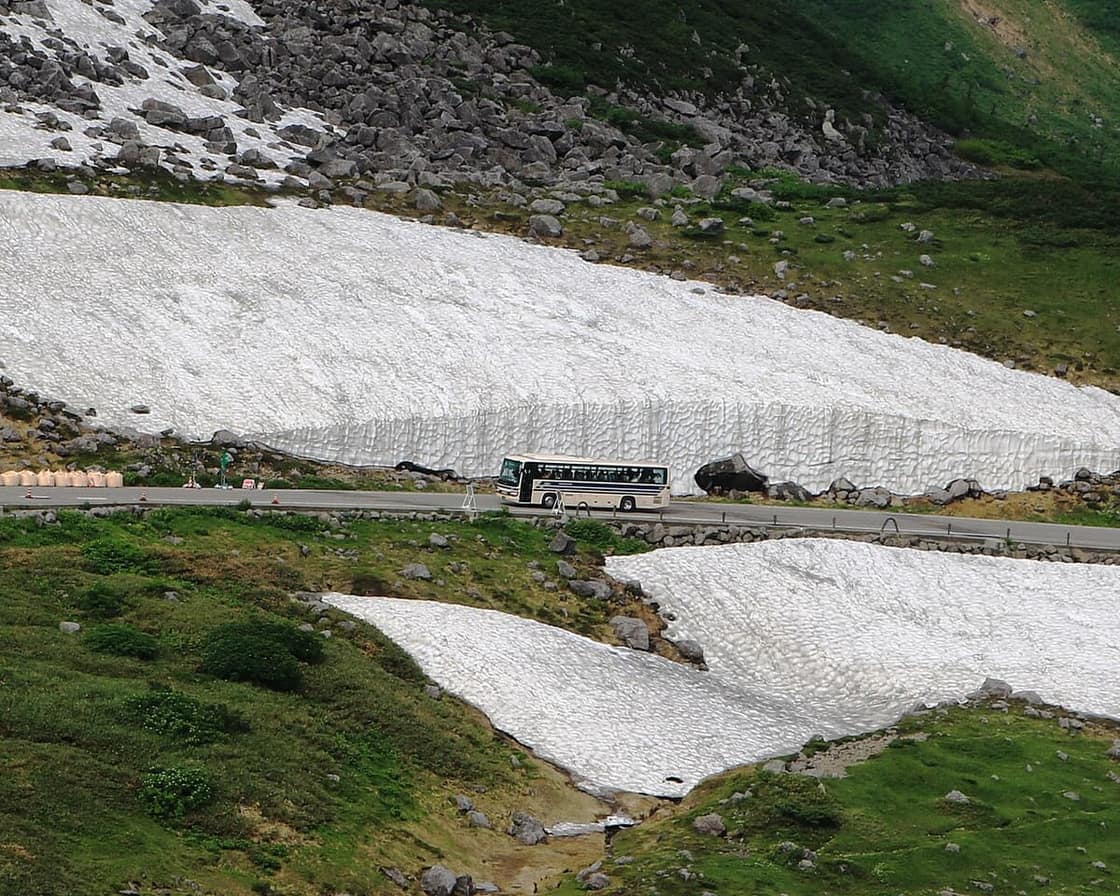
The Tateyama Kurobe Alpine Route is a high-mountain sightseeing route across the peaks of the Northern Alps — a relay of six different modes of transport (cable cars, highland buses, electric buses, a ropeway) that carries you from the foothills on the Toyama side up to Murodo at 2,450 m and down to the mighty Kurobe Dam. Its defining trait: it's open only from mid-April to late November, and the towering Snow Walls, the Kurobe Dam discharge and the autumn foliage each fall in different windows. This guide covers the season, the route and its vehicles, tickets, and both entry points. It's the alpine-route deep-dive for Chubu; the gateway is in our Nagoya guide.
- Mid-April to late November only: fully closed in winter; 2026 is Apr 15-Nov 30
- Snow Walls Apr 15-Jun 25: a corridor of walls near 20 m, early season only
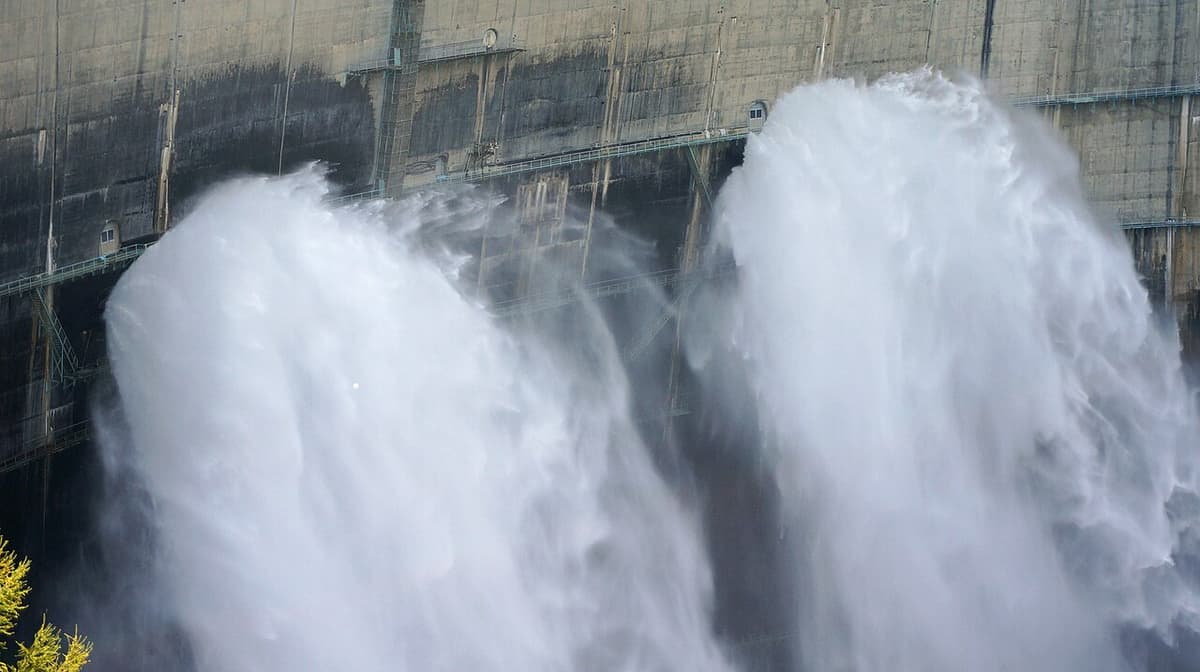
- Kurobe Dam discharge Jun 26-Oct 15: a different window from the Snow Walls — not both in one visit
- Six transport modes end to end: the trolleybuses are retired — now electric buses
- A through route: enter one side, exit the other; Tateyama-Dam round trip ~¥16,000
📖 Table of contents
What the Alpine Route is
The Tateyama Kurobe Alpine Route links Tateyama in Toyama with Ogizawa in Nagano, about 37 km across nearly 2,000 m of vertical relief in the Northern Alps. It's not a single attraction but a "sightseeing traverse" that strings together several mountain transport modes: you don't drive or trek long distances, but switch between funiculars, highland buses, electric buses and a ropeway up and over the range, past snow walls, alpine lakes, 3,000-meter peaks and a giant dam.
Because it crosses such high elevation, the route is open only in the snow-free window of mid-April to late November, and fully closed in winter. It's one of the rare places in Japan where you can stand on a 2,450 m vista with little effort — which is exactly why the Snow Walls and foliage seasons draw such crowds. Plan it as "a full day of alpine transport and grand scenery" and you'll be set.
The season and the timing of the highlights
Planning the Alpine Route starts with matching the timing, because the big three highlights fall in different windows and you can't catch them all in one trip:
- Full route open: roughly mid-April to late November (2026 is Apr 15-Nov 30).
- Snow Walls: about Apr 15-Jun 25, the towering early-season walls, taller the earlier you go.
- Kurobe Dam tourist discharge: about Jun 26-Oct 15, a thundering release of over 10 tonnes per second.
- Autumn foliage: late September into October, coloring downward from Murodo — among the earliest foliage in Japan.
In other words: for the Snow Walls go late April to early June, for the discharge go midsummer to mid-October, for foliage go in October. The Snow Walls and discharge windows barely overlap, so decide what you most want to see, then pick the month. Confirm the exact dates on the official site.
The route and its six transport modes
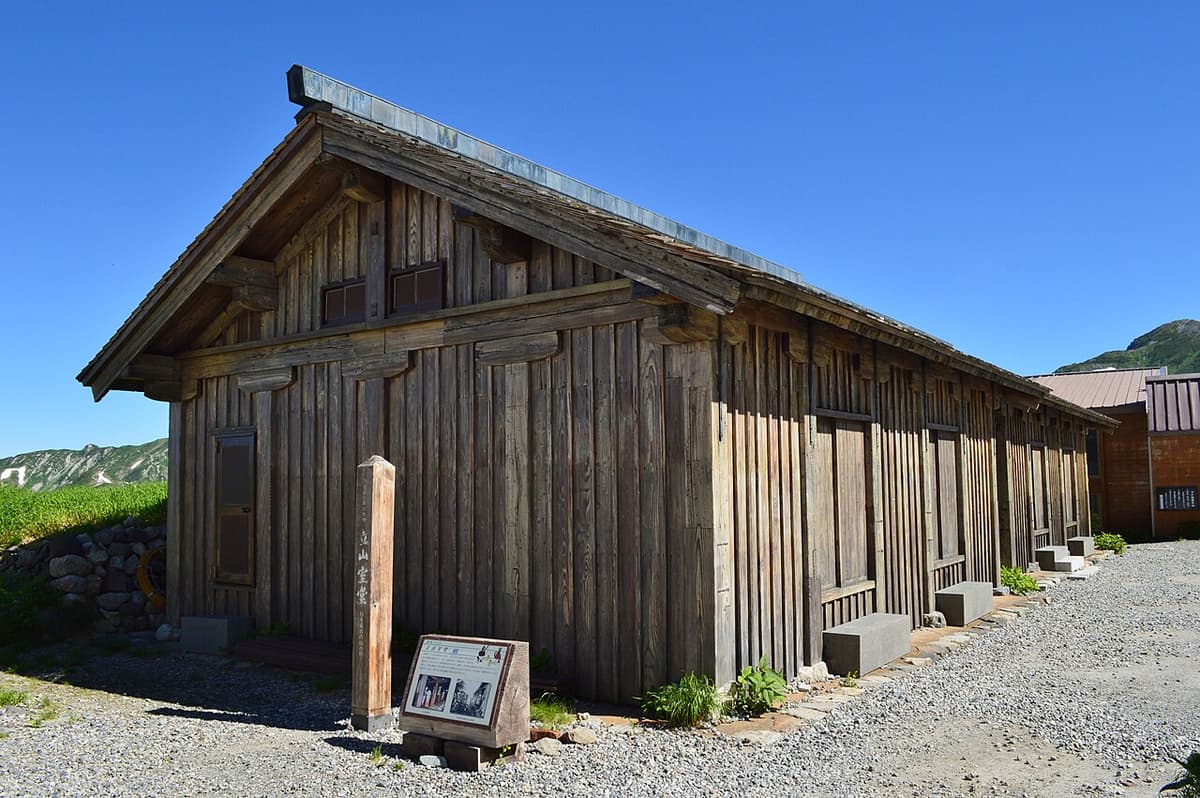
From the Toyama side (Tateyama Station) to the Nagano side (Ogizawa), you relay through six transport modes:
- Tateyama Cable Car: Tateyama Station → Bijodaira
- Highland Bus: Bijodaira → Murodo (passing the Snow Walls)
- Tateyama Tunnel Electric Bus: Murodo → Daikanbo
- Tateyama Ropeway: Daikanbo → Kurobedaira (no support towers, superb views)
- Kurobe Cable Car: Kurobedaira → Kurobeko
- Kanden Tunnel Electric Bus: Kurobe Dam → Ogizawa
One common misconception to clear up: the route once had Japan's last trolleybuses, but the Kanden Tunnel section retired in 2019 and the Tateyama Tunnel section in 2025, both now electric buses. So older guides touting "Japan's only trolleybus" are out of date — though the tunnel crossings and the views up top are unchanged. Watch each vehicle's timetable and last departures, and in peak season reserve slots with a WEB ticket.
The big three: Snow Walls, Murodo, Kurobe Dam
The Snow Walls are the early-season headliner — the highland bus plows a road flanked by walls a dozen-plus meters high, and visitors can walk between them in a set window, a sliver of sky overhead and snow towering on both sides, striking and rare, seen only around Apr 15-Jun 25.
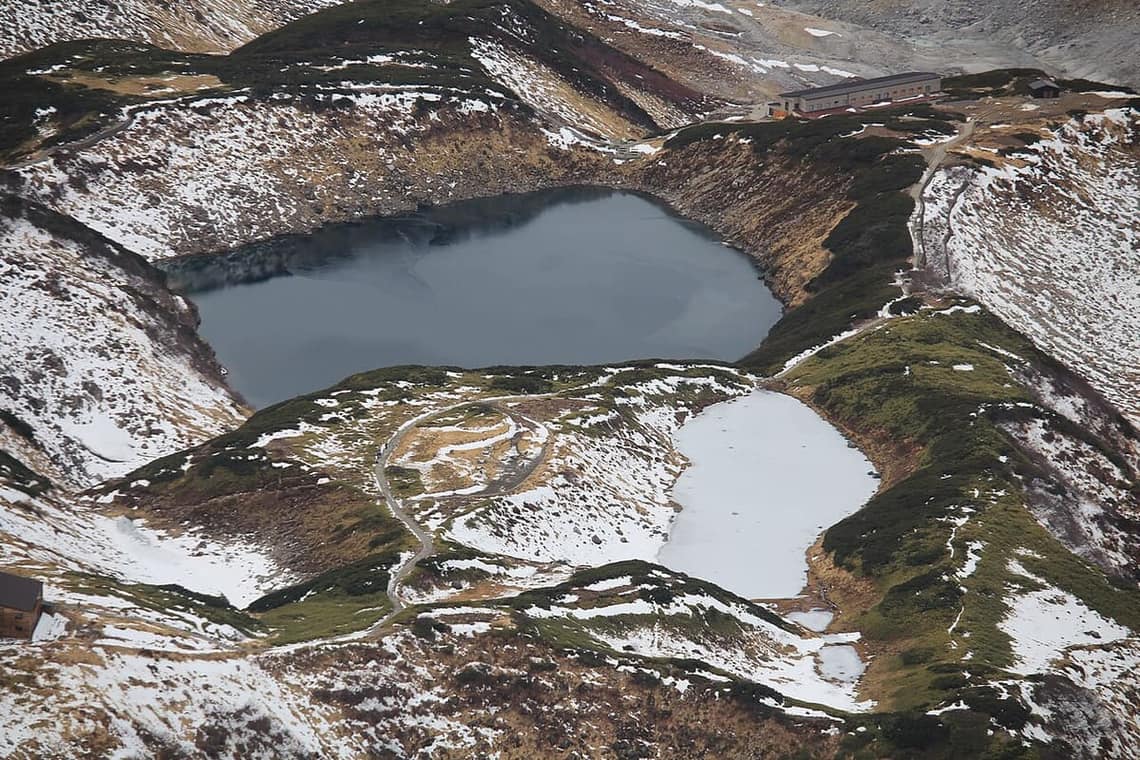
Murodo (2,450 m) is the route's highest point and its heart: besides the Snow Walls, in summer and autumn you can hike around alpine lakes like Mikurigaike, where the Tateyama range mirrors in the water on a clear day — crisp air, open vistas, a high-mountain world reached with ease. The Kurobe Dam anchors the other end — at 186 m, Japan's tallest arch dam, whose Jun 26-Oct 15 tourist discharge throws up mist and frequent rainbows, spectacular from the observation deck. To line this up with Chubu's foliage timing, see our Japan autumn foliage guide.
Tickets and booking
Fares are charged by segment and aren't cheap overall: a Tateyama-to-Kurobe Dam round trip is about ¥16,000 (2026, adult); a full one-way traverse (Tateyama to Ogizawa) is priced separately — check the official fare table. Children are roughly half price.
The single most important booking point: in peak season, buy the online "WEB ticket" in advance and reserve time slots for each vehicle. Golden Week, the Snow Walls and the foliage weeks are extremely busy, and without a reservation you can queue for hours or fail to get a same-day ticket.
No affiliate channel sells the Alpine Route's own through ticket (WEB ticket). Checked on 9 September 2026 across KKday, Klook, Trip.com and GetYourGuide: the only things that come back are wide-area JR passes and guided tours that bundle the route fare. There is no alternative to buying the WEB ticket on the official site, so don't go looking for one.
The JR Alpine-Takayama-Matsumoto Area Pass: three channels carry it
This is a different product from the route ticket — it covers the rail at each end, and only pays off on a multi-leg Chubu/Hokuriku loop. The official site, touristpass.jp, states ¥24,500 for adults, valid 5 consecutive days. The three channels price it within a few percent of each other; what genuinely differs is how the ticket reaches you:
| Channel | Price seen 9 Sep 2026 | How you get the ticket | Watch for |
|---|---|---|---|
| Official touristpass.jp | ¥24,500 (adult, 5 consecutive days) | Exchange at a designated counter in Japan | The baseline for this table |
| Klook | NT$ 4,877 | Paper exchange order posted to you free worldwide, redeemable in Japan within 90 days of purchase | You have to wait for the post — booking days before departure won't work |
| Trip.com | TWD 5,000 | Physical ticket: SF Express delivery or Akihabara pickup (a separate Taiwan-delivery listing sits at the same price) | The listing states plainly: no cancellation |
KKday is deliberately not in that table. Its listing for this pass is a single Taiwan-post option, which shows as sold out on the English store — so this link goes to the official Tourist Pass site instead, where English travellers can buy it directly.
Two things true at the time of checking that may not hold later: the Klook page carried a notice that train service between Takayama and Toyama is suspended because of infrastructure damage; and all three sell a seasonally bounded product — for 2026 that is sold 15 Mar to 6 Nov, valid 15 Apr to 10 Nov, so re-check across a year boundary.
Is it worth the money? Honestly, ¥16,000-plus is a lot for one day, and on a foggy day when the peaks never show, it can feel steep. My take: it's worth it if you go for a specific headliner in its window — the Snow Walls in spring or the foliage in October — and you build in a flexible day so weather doesn't force a do-or-die visit. If you only have a single fixed day with no margin and the forecast looks socked in, it's the kind of splurge worth deferring. Treat the fare as buying a rare, low-effort path to a 2,450 m alpine world, not just a series of bus rides, and the value makes more sense.
Entry points and day-trip vs overnight
The Alpine Route is a through route that doesn't return to the start, so decide your direction first: on the Toyama side enter at Tateyama Station via the Toyama Chiho Railway from Toyama; on the Nagano side enter at Ogizawa by bus from Shinano-Omachi or Nagano. The usual plan is to enter one side and exit the other, then connect to Toyama (Hokuriku Shinkansen, Kanazawa) or Nagano (Shinshu, Matsumoto) onward — the most efficient routing. If you exit on the Toyama side, the Kurobe Gorge trolley train and the Amaharashi coast are worth an extra day — see our Toyama, Kurobe Gorge & Gokayama guide; continuing south through Hokuriku, Fukui's Eiheiji temple and the Tojinbo cliffs make another natural add-on, in our Fukui Eiheiji & Tojinbo guide. Since you don't return to the start, use the inter-station luggage-forwarding service so you're not hauling big bags over the range.
Day-trip vs overnight: the great majority do a full-day traverse, about 6-8 hours with stops to sightsee — plenty full. For a slower pace, or to stay a night at Murodo or Midagahara for alpine sunrise and stars and to dodge the daytime crowds, you can overnight at a mountain lodge. Slot the Alpine Route into a Chubu trip alongside Takayama or Kanazawa — for how to connect, see our Hida-Takayama guide.
Fitting it into a bigger trip: because the traverse spits you out far from where you started, it pays to chain it with whatever's next rather than backtrack. A popular west-to-east flow is Toyama or Kanazawa → enter at Tateyama → exit at Ogizawa → Matsumoto (with its castle) and on toward Tokyo via the Chuo line; the reverse, Matsumoto/Nagano → Ogizawa → Tateyama → Toyama, links neatly to the Hokuriku Shinkansen and Kanazawa. Either way, the Alpine Route itself eats a full day, so treat it as the centerpiece and build a night before and after on the two endpoints. If you're combining it with Hida, note that Takayama and Toyama are close, so "Takayama → Toyama → Tateyama" makes a natural two-to-three-day arc through the mountains. Whatever the order, fix your WEB-ticket date and direction first, since the rest of the itinerary hangs off that one booked day.
Alpine weather and practical tips
The Alpine Route stands above 2,000 m, where the weather is a different world from the city — a few tips make it safer and more comfortable:
- Warmth: even in midsummer Murodo can be only in the low teens Celsius, colder morning and night, with snow on the ground in April-May. Bring a warm jacket, gloves and a hat, and layer.
- Changeable weather, views not guaranteed: high mountains fog over and shift fast, and you may arrive to clouds hiding the peaks. Treat the weather as a variable and keep the plan flexible — don't bank everything on one day with no margin.
- Footwear and sun: with snow or wet ground, wear non-slip shoes; UV is strong at altitude, so bring sunscreen and sunglasses.
- Altitude and pace: rising from the lowlands to 2,450 m, a few people feel mild altitude effects — slow down and drink water.
For what to wear by month and how to pack, see our Japan packing & weather guide.
Frequently Asked Questions
- Q1:When is the Tateyama Kurobe Alpine Route open?
- The route is open only from mid-April to late November, fully closed in winter. The 2026 season runs April 15 to November 30 (per official notice, with slight yearly shifts). The highlights each have their own windows: the Snow Walls around Apr 15-Jun 25, the Kurobe Dam tourist discharge around Jun 26-Oct 15, and autumn foliage from late September into October. Note the Snow Walls and the discharge fall in different periods — you can't see both on one visit — so check the year's official schedule first.
- Q2:When can I see the Snow Walls?
- The Snow Walls (Yuki-no-Otani) are the towering snow-corridor near Murodo, the route's highest point, formed by plowing, and open for walking only in the early-season window of about Apr 15-Jun 25, the walls reaching nearly 20 m at their tallest (depending on the year's snow, melting lower over time). For the highest walls, go from late April into early May. It's still cold up top then with snow on the ground, so wear warm, non-slip footwear.
- Q3:Can I still ride the famous trolleybus?
- No longer. The route once had Japan's last trolleybuses, but the Kanden Tunnel section converted in 2019 and the Tateyama Tunnel section in 2025, both now electric buses (EV). So today you ride electric buses through the tunnels, not trolleybuses. If older guides still tout "Japan's only trolleybus," that's out of date — but the tunnel crossings and the alpine scenery up top are unchanged.
- Q4:Can I do it in a day, or should I stay over?
- Traversing end to end is doable in a day, about 6-8 hours with stops to sightsee along the way. But it's a through route that doesn't return to the start, so decide whether to enter from the Toyama or Nagano side and exit the other, and use the luggage-forwarding service so you're not hauling big bags over the mountains. For a slower pace, or to stay a night at Murodo for the stars and sunrise, you can overnight, but most people do the full traverse in one day.
- Q5:How much are tickets, and how do I buy them?
- Fares are charged by segment and aren't cheap: a Tateyama-to-Kurobe Dam round trip is about ¥16,000 (2026, adult); a full one-way traverse (Tateyama to Ogizawa) is priced separately — check the official fare table. Peak periods (Golden Week, the Snow Walls, autumn foliage) are extremely busy, so strongly book the online "WEB ticket" in advance and reserve time slots for the vehicles, or you may queue a long time on the day.
- Q6:Where do I enter and exit?
- There's a terminus at each end: on the Toyama side you enter at Tateyama Station via the Toyama Chiho Railway from Toyama; on the Nagano side you enter at Ogizawa by bus from Shinano-Omachi or Nagano. The usual plan is to enter one side and exit the other (a traverse), then connect to Toyama/Hokuriku or Nagano/Shinshu onward. From Nagoya you reach it via Toyama or Matsumoto; for the Nagoya gateway, see our Nagoya travel guide.