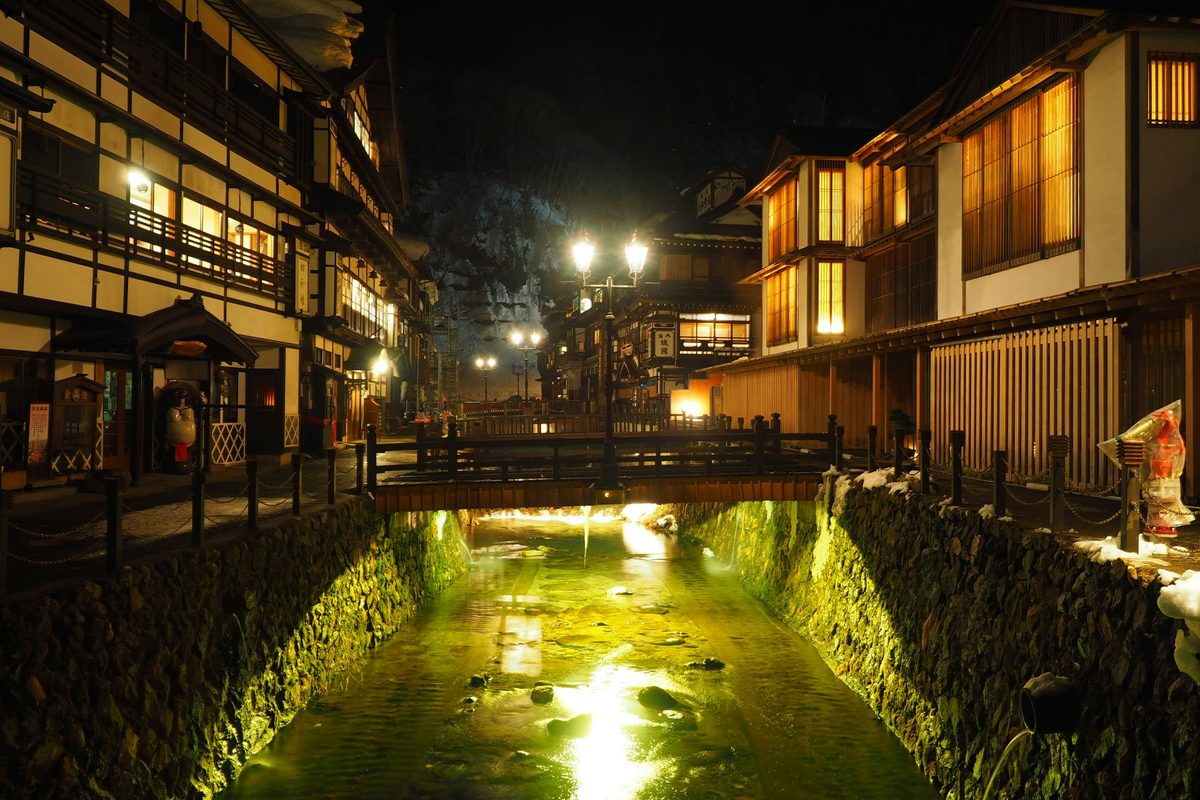
The most common mistake with a Tohoku winter trip is treating it like a scaled-down Hokkaido plan — and either missing Ginzan Onsen's gas lamps, which only come on after dark, or cramming Zao's snow monsters and the Yokote kamakura festival into the same day. This guide lays out a route that flies into Sendai, then runs through Ginzan Onsen, Zao's snow monsters, Kakunodate's snow-covered samurai district, and finishes with either Hirosaki or Yokote's snow festival, with both a 5-day core version and a 7-day extension that catches both festivals, plus which JR East Pass to buy now and why lodging needs booking now.
- Core route: Sendai to Ginzan Onsen to Zao snow monsters to Kakunodate to Hirosaki or Yokote (pick one festival) to Sendai/Shin-Aomori, all doable in 5 days
- 7-day extension: head south from Kakunodate to Yokote's kamakura festival first, then north to Hirosaki's lantern festival — both festivals, at the cost of backtracking through Akita
- Timing window: late January to mid-February puts every stop at its best, but Yokote's kamakura is now a floating date (the Friday and Saturday before Bonten; 12-13 February in 2027) — confirm exact dates with each official source every year
- Transport: this route moves daily; the Tohoku-area version was discontinued on 13 March 2026, and the current product is the JR EAST PASS covering all of JR East — 5 days at ¥35,000, and they are consecutive days
- Book lodging now: Ginzan Onsen holds about 220 guests a night village-wide; set up a KKday Japan eSIM before you land to track official updates on the go
Table of Contents (click to expand)
- 5-day core itinerary at a glance
- The key decision: Hirosaki or Yokote?
- Day 1 — Landing in Sendai, Tohoku's gateway
- Day 2 — Sendai to Ginzan Onsen, the gaslit winter street
- Day 3 — Ginzan to Zao, riding the ropeway to the snow monsters
- Day 4 — Zao to Kakunodate, snow over the samurai district
- Day 5 — Kakunodate to Hirosaki or Yokote, closing with a festival
- The 7-day extension: both festivals
- Festival and season timing at a glance
- Transport: which JR East Pass to buy now
- The snow-country lodging scramble
- Cold-weather gear for a Tohoku winter
- FAQ
5-day core itinerary at a glance
The logic behind this route is simple: head west first for Yamagata's snow-country onsen and snow monsters, then north to Akita's snow-dusted samurai town, and close with a festival in either Akita or Aomori prefecture. Every leg connects by shinkansen or limited express, with one short bus transfer for the last mile — no rental car needed, and no daily hotel-hopping except on the final festival stop.
| Day | Morning | Afternoon | Evening | Stay |
|---|---|---|---|---|
| 1 | Arrive in Sendai, settle in near the station | Aoba Castle ruins, Zuihoden Mausoleum | Grilled beef tongue set, early night | Sendai |
| 2 | Sendai to Oishida by Yamagata Shinkansen | Bus to Ginzan Onsen, walk the street | Gas lamps after dark, ryokan kaiseki dinner | Ginzan Onsen |
| 3 | Ginzan to Oishida to Yamagata, bus up to Zao | Ropeway to Jizo-sancho for the snow-monster field | Zao Onsen's strongly acidic sulfur bath | Zao Onsen |
| 4 | Zao to Yamagata, on to Kakunodate (via Omagari) | Bukeyashiki samurai street, black fences in snow | Inaniwa udon or kiritanpo hot pot | Kakunodate |
| 5 | Kakunodate south to Yokote or north to Hirosaki (pick one) | Festival grounds (kamakura or snow lanterns) | Return via Sendai or Shin-Aomori shinkansen | - |
The key decision: Hirosaki or Yokote?
By the time you reach Kakunodate, the route forks — south to Yokote for the kamakura festival, or north to Hirosaki for the snow lantern festival — two opposite directions. On the 5-day version, pick one; trying both means extra backtracking through Akita and less time everywhere else.
The case for Yokote: its kamakura festival is the image most people picture when they think "Tohoku snow festival" — roughly 3-meter snow domes across town, with local kids inside serving sweet sake and grilled rice cakes, the warmest and most family-friendly version of a snow festival on this route, and it sits south of Kakunodate with a change at Omagari, far closer than Hirosaki and the cheapest transport add-on of the two. ⚠️ Its dates are no longer the ones you remember, though — 2027 falls on 12-13 February, so check before you build the trip around it. The case for Hirosaki: the Snow Lantern Festival puts Hirosaki Castle itself inside the winter scene — the keep and moat lined with snow lanterns and ice sculptures, closer to a "castle plus snow festival" combination, and Hirosaki flows directly north to Shin-Aomori to close out the trip without backtracking. Pick Yokote if you want kids in tow or the classic snow-hut experience; pick Hirosaki if you want the castle photo and a route that keeps moving forward.
Day 1 — Landing in Sendai, Tohoku's gateway
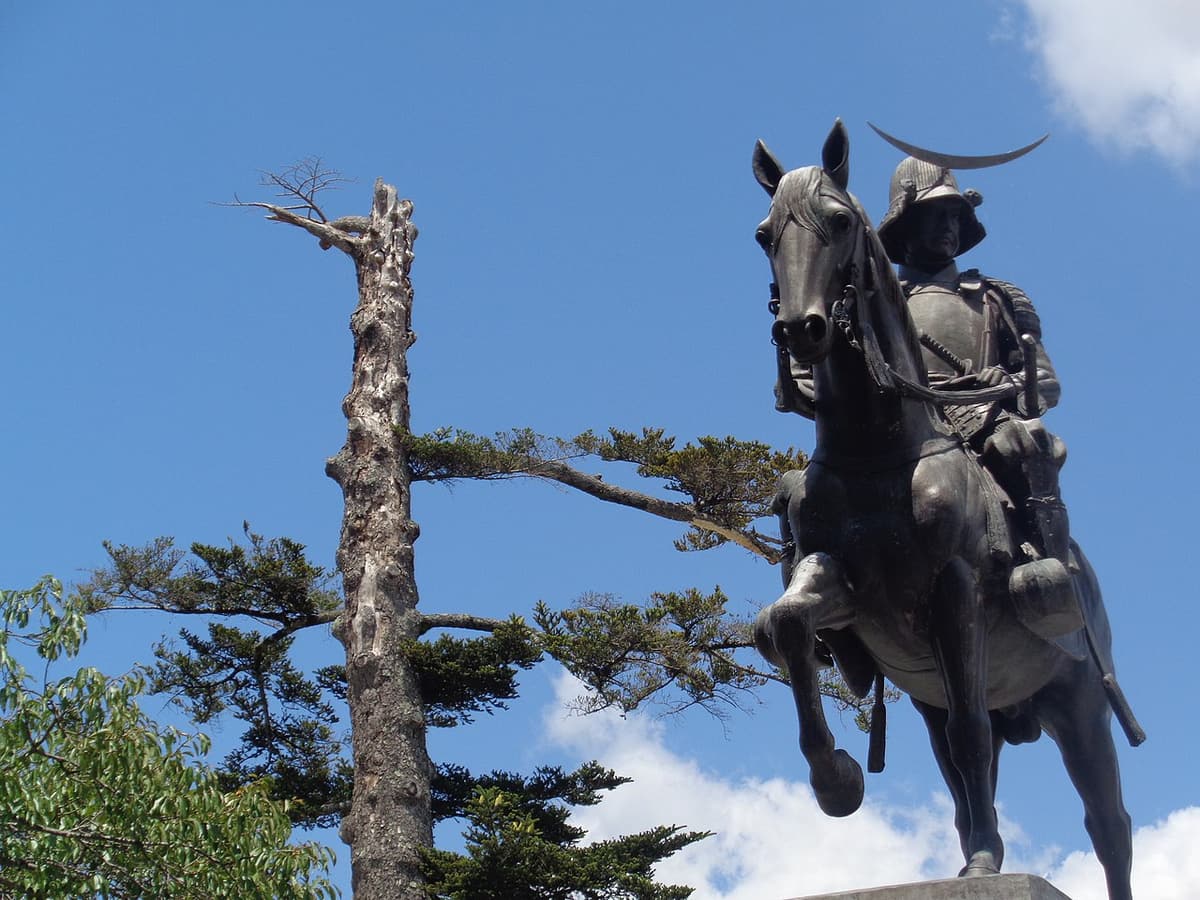
The fastest Hayabusa Tohoku Shinkansen gets you from Tokyo to Sendai in about 1.5 hours, making it the easiest gateway into Tohoku. Don't overpack the first day — drop your bags, then visit the Aoba Castle ruins for the Date Masamune equestrian statue and a view over the city (the keep itself no longer stands, but the grounds are free), then Zuihoden, the ornate Momoyama-style mausoleum of the Date family (admission about ¥570). Dinner is Sendai's signature grilled beef tongue set, and an early night is worth it — the next four days are almost entirely transit plus walking in the snow. See our full Sendai travel guide for the city's core sights and the Matsushima side trip.
If your trip happens to fall in December, Sendai's Jozenji-dori "Pageant of Starlight" illumination (a December-only event) could slot into your first evening — but most of the rest of this route's highlights (snow monsters, the festivals) fall in January and February, so the two rarely overlap. Decide up front which month you're building the trip around.
Day 2 — Sendai to Ginzan Onsen, the gaslit winter street
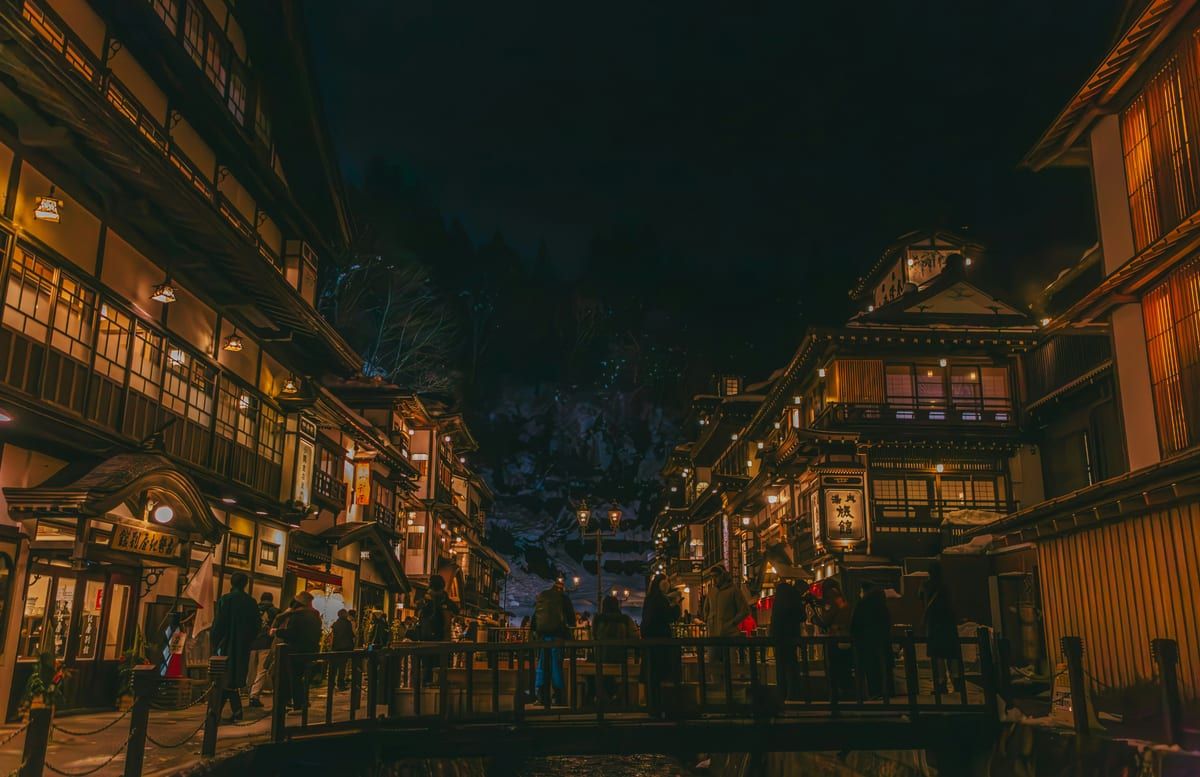
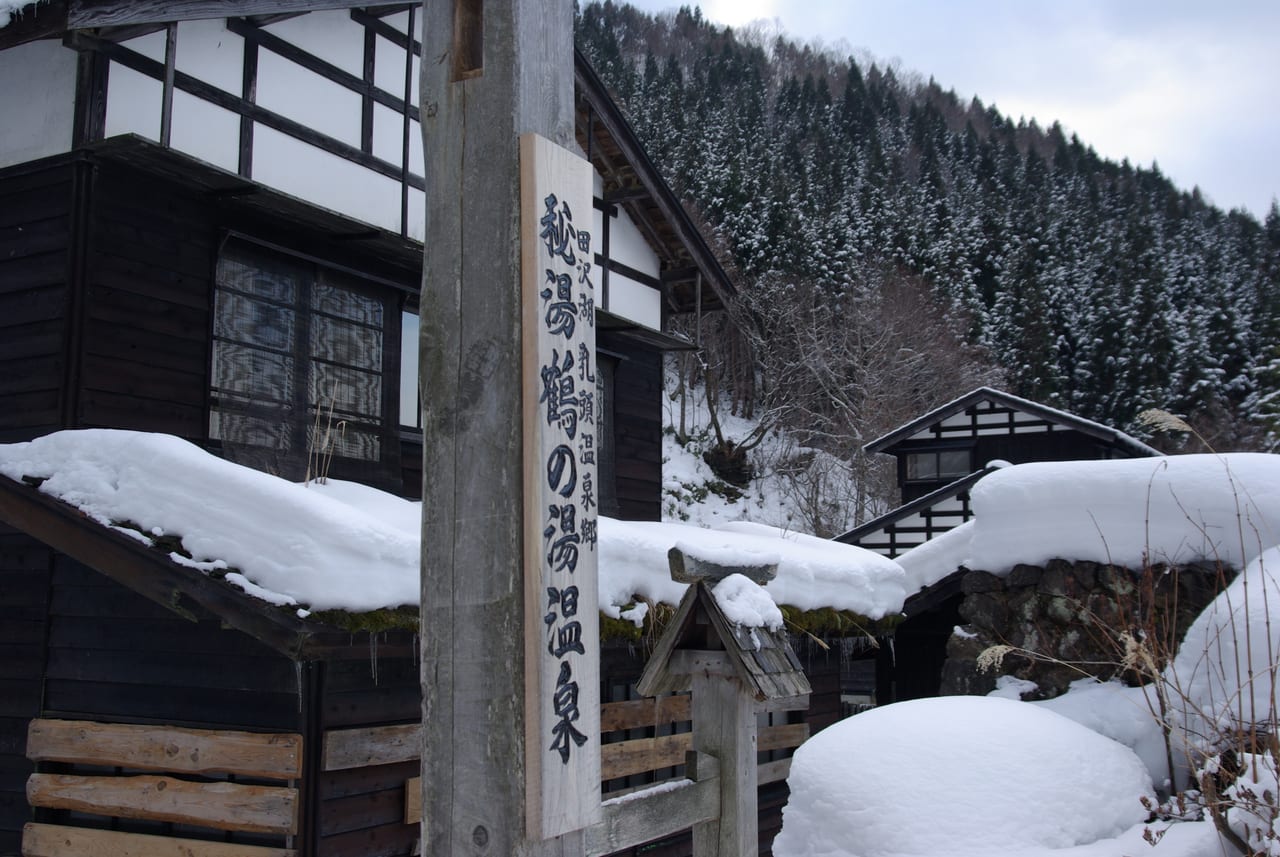
From Sendai, take a JR connection to Yamagata, then the Tsubasa Yamagata Shinkansen to Oishida Station, followed by a roughly 40-minute local bus to Ginzan Onsen — about 2.5-3 hours total including transfers. Plan to stay overnight here; don't try a day trip. Ginzan Onsen's signature moment is the gas lamps coming on after dark (the town publishes no lighting time; sunset in Yamagata is around 16:28 in late December), turning the wooden Taisho-era hot spring street into a magazine-cover scene — and the last bus back on a day trip typically departs in the afternoon, missing this window entirely. Spend the day walking the snowy street and grabbing a curry bread from the stalls along Haikara-san-dori, change into a yukata back at the ryokan in the late afternoon, and stake out a spot by the river before sunset. Dinner is a Yamagata-beef kaiseki course included with your stay. For the full day-trip-vs-overnight math and a 4-stage booking strategy, see our Ginzan Onsen day trip vs. overnight guide.
Day 3 — Ginzan to Zao, riding the ropeway to the snow monsters
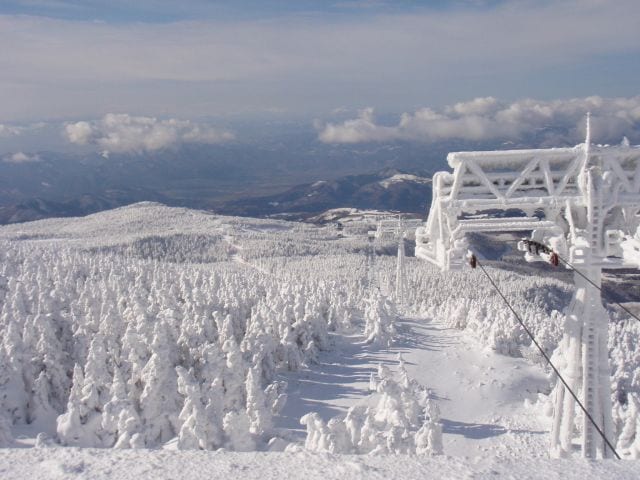
In the morning, bus back to Oishida, take the Yamagata Shinkansen to Yamagata Station, then a roughly 40-minute bus up to Zao Onsen. Per official ropeway sources and common traveler consensus, the snow monsters are at their best from late January through late February, and riding the ropeway all the way to Jizo-sancho Station (round-trip ¥4,400 for adults, ¥2,200 for children, verified against the official site as of July 2026) puts you in the middle of the most striking part of the snow-monster field. The ropeway shuts down outright in bad weather — that's simply how a weather-dependent natural phenomenon works, so check the Zao Ropeway's official site for current summit conditions before deciding how much of the day to build around it.
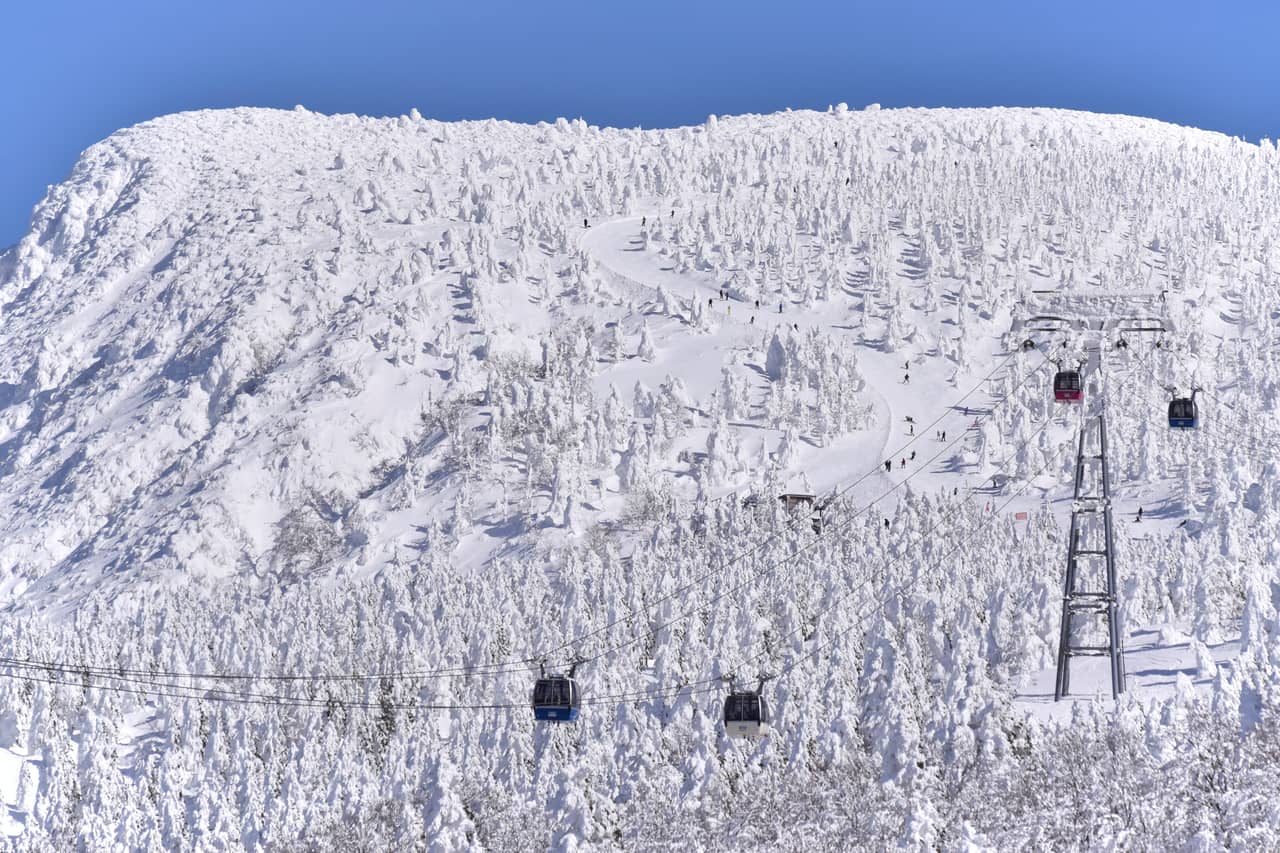
Overnight in Zao Onsen and try the strongly acidic sulfur spring (commonly cited around pH 1.25-1.6, among the most acidic hot springs in Japan). If your dates happen to overlap the snow-monster illumination season (running roughly late December through late February based on last season's pattern; the 2026-2027 season dates have not been announced yet), consider staying an extra night for the night lighting and the snowcat tour into the illuminated field. See our full Zao Snow Monsters guide for the ropeway pricing tiers, lighting schedule, and how to combine it with Okama crater lake or Yamadera.
Day 4 — Zao to Kakunodate, snow over the samurai district
From Zao Onsen, head back down through Yamagata Station and take the Akita Shinkansen Komachi (some services transfer at Omagari, others run direct) north to Kakunodate Station — about 2.5-3 hours including transfers. Kakunodate is known as Akita's "little Kyoto of the north" — its Bukeyashiki samurai street is lined with Edo-period warrior residences behind black wooden fences, and the contrast of black fences against snow is the defining image of this stop. Walking the street is free; to see inside, buy admission to the Aoyagi House (Kakunodate Historical Village, about ¥500) for samurai artifacts and a garden. Dinner is Akita's signature Inaniwa udon or a warming kiritanpo hot pot (grilled rice-paste skewers simmered with local chicken broth) — the kind of dish that hits differently on a cold winter night.
As it happens, Kakunodate has its own smaller winter festival — Hiburi Kamakura, traditionally held February 13-14, 18:00-20:00, where visitors swing straw ropes tipped with embers in a purification ritual. It's a completely different event from Yokote's kamakura festival covered later in this guide, despite both names containing "kamakura." If your overnight happens to land on those dates, it's a bonus, not a must-plan-around item on this route. With more time, Kakunodate also pairs well with nearby Lake Tazawa (Japan's deepest lake, about 15 minutes away) or the deeper snow-country hot springs of Nyuto Onsen as a buffer day on the 7-day version. For year-round Kakunodate sights and Bukeyashiki admission details, see our Kakunodate travel guide.
Day 5 — Kakunodate to Hirosaki or Yokote, closing with a festival
If you picked Yokote: head south from Kakunodate, changing at Omagari, to Yokote. Roughly 3-meter snow domes (kamakura) go up across town, with local kids inside serving sweet sake and grilled rice cakes to visitors — the image most people picture for a "Tohoku snow festival." 2027 is officially confirmed as 12-13 February, the second year of the trial that moved the festival to the Friday and Saturday before Bonten (running through February 2029). ⚠️ Bonten itself did not move — it stays fixed on 16-17 February, so the two halves no longer overlap; do not assume the whole Snow Festival shifted to the 12th and 13th. The kamakura venues also only run 18:00-21:00, with nothing in the city centre during the day — the full rule, the timing split and the on-the-ground logistics are in our Yokote Kamakura Festival guide. After the festival grounds, head back through Akita or Sendai to connect with your return shinkansen.
If you picked Hirosaki: from Kakunodate, transfer via Akita onto the limited express Tsugaru heading north, about two hours to Hirosaki. The Hirosaki Castle Snow Lantern Festival fills Hirosaki Park with snow lanterns and snow sculptures that light up after dark, and runs 10-14 February in 2027; the castle keep is under restoration, so you can see it from outside but not go in. After the festival, Hirosaki connects to Shin-Aomori by JR in about 35 minutes, straight onto the Tohoku Shinkansen for a clean exit. Worth knowing: Hirosaki Castle has two crowd peaks a year, and the other one is the Neputa festival on August 1-7 — if you come back in summer, that week squeezes lodging even harder than the lantern festival does. See our full Aomori travel guide for how the city and its surroundings tie in, and the Tohoku section of our Japan climate and clothing pillar guide for overall trip packing.
The 7-day extension: both festivals
With 7 days, you don't have to choose between Yokote and Hirosaki — fit both in, at the cost of an extra loop through Akita:
- Day 5: south from Kakunodate to Yokote, tour the kamakura festival grounds, overnight in Yokote or Akita City
- Day 6: north from Akita to Hirosaki, tour the Snow Lantern Festival, overnight in Hirosaki
- Day 7: JR from Hirosaki to Shin-Aomori, then Tohoku Shinkansen back to your starting point
This is effectively one big loop, south then north — you'll pass through Akita Station twice, adding meaningfully more pure transit time than the 5-day version, but in exchange you get two genuinely different festival experiences: Yokote's family-friendly snow huts and Hirosaki's large-scale castle-and-snow spectacle side by side on one trip. The 7-day version is also a good place to add an extra night in Kakunodate for Lake Tazawa or Nyuto Onsen, easing the daily-transit pace rather than rushing every leg.
Festival and season timing at a glance
Here's a quick reference for the seasonal events on this route — note that the snow-monster viewing window is a relatively stable natural phenomenon each year, but every festival's exact dates are announced separately by local authorities annually. The table below reflects recent-year patterns; confirm the 2027 dates on each official site before you travel rather than assuming last year's dates repeat.
| Event / phenomenon | Location | Recent-year pattern | Status |
|---|---|---|---|
| Zao snow monsters (juhyo) | Zao, Yamagata | Late Jan-late Feb peak viewing | Natural phenomenon, relatively stable year to year |
| Yokote kamakura (snow festival) | Yokote, Akita | Fixed Feb 15-16 until 2025; from 2026 moved to the Friday/Saturday before Bonten (trial through Feb 2029) | 2027: Feb 12-13 (officially announced); 2028: Feb 11-12 |
| Yokote Bonten festival | Yokote, Akita | Fixed Feb 16-17, mornings — a Shinto rite, so it did not move with the kamakura | Officially "no change to the dates" |
| Kakunodate Hiburi Kamakura | Kakunodate, Akita | Traditionally Feb 13-14, 18:00-20:00 | 2027 dates pending official announcement |
| Hirosaki Castle Snow Lantern Festival | Hirosaki, Aomori | Early February in recent years (2025: Feb 7-11; 2026: Feb 6-11) | 2027: Feb 10-14 (officially announced) |
Transport: which JR East Pass to buy now
This route moves almost every day — Sendai, Oishida, Yamagata, Kakunodate, Akita, Hirosaki and Shin-Aomori are all on the itinerary — and the JR EAST PASS 5-day version costs ¥35,000(成人 5 日(連續)) and runs for five consecutive days — JR East's own wording — not "any 5 days within a 14-day window", covering the Tohoku, Yamagata and Akita Shinkansen lines plus reserved seats on Tohoku-area JR East lines. The 5-day version has you moving almost every day, so it usually pays off; because the days now run consecutively, the old trick of activating the pass only on your heaviest travel days no longer works — the clock does not stop. To cover both festivals, step up to the 10 consecutive day version at ¥50,000(成人 10 日(連續)), or buy point-to-point tickets for the quiet stretches. Verify current fares and coverage on the official JR East site before booking.
JR EAST PASS (all of JR East)
⚠️ The Tohoku-area version was discontinued on 13 March 2026. The current product covers all of JR East: 5 days at ¥35,000, and they are consecutive days, not "any 5 within 14."
Check JR EAST PASS pricing →Local bus transfers between stations (Oishida to Ginzan Onsen, Yamagata to Zao Onsen) are not covered by the JR Pass and need separate payment — the amounts are small, but keep some cash or IC card balance on hand. If you're weighing a nationwide JR Pass instead, or plan to combine this route with Hokkaido or the Kanto region, see our JR Pass: is it still worth it for the overall decision framework.
The snow-country lodging scramble
Ginzan Onsen is the tightest stop on this route — roughly 13 ryokan line the street, and the whole village holds around 220 guests a night at most; winter's gaslight season (December through February) stacks on top of strong international demand, so book 3-6 months ahead. See our Ginzan Onsen day trip vs. overnight guide for the details. Zao Onsen has more rooms and less pressure, but weekends combining the light-up season with ski demand still sell out — book 2+ months ahead. Kakunodate sits outside its cherry-blossom peak in winter and is relatively easy to book, though rooms for the Hiburi Kamakura night still go early. Yokote and Hirosaki both hit the tightest lodging week of their year during festival dates — book the moment dates are confirmed, and fall back to a nearby station or a business hotel a stop or two out if downtown is sold out. This dates-lock-lodging squeeze peaks at Japan's most extreme winter event, the Shirakawa-go light-up — all four 2027 sessions are fully reservation-only; see the dedicated guide for times and ticket rules.
Cold-weather gear for a Tohoku winter
Tohoku's mountain areas see wide day-night temperature swings in winter, with Yamagata and Akita commonly dropping below −5°C after dark, and icy, slick sidewalks are standard — ordinary sneakers are asking for a fall at every one of these stops. Grip-soled snow boots are essential, layered with a thermal base layer, fleece and a windproof-waterproof shell, plus a beanie, gloves and hand warmers. See the Tohoku section of our Japan climate and clothing pillar guide for the full gear list. If you forget hand warmers, every convenience store along the route sells them — stock up near your hotel before heading out, and tuck one into the same pocket as your phone, since sub-zero cold drains battery fast and a hand warmer helps more than a spare power bank.
Tohoku Winter Itinerary FAQ
- Q1:Is 5 days enough for a Tohoku winter trip, or should I plan for 7?
- Five days is the minimum to cover the core route: into Sendai, then Ginzan Onsen, Zao snow monsters, Kakunodate, and out through either Hirosaki or Yokote for one snow festival. You will be moving almost every day, with one night at each stop. Seven days lets you fit both the Hirosaki lantern festival and the Yokote kamakura festival, plus a buffer day for the delays and ropeway closures that are common in Tohoku winters. If you only get one shot and have a specific festival in mind, go with the 5-day version and head straight for it; if this is your first Tohoku winter trip and you want to see as much as possible, the 7-day version pays off. One change worth knowing before you build either version: Yokote's kamakura festival and its own Bonten festival are now four days apart (kamakura moved to the Friday and Saturday before Bonten from 2026; Bonten did not move), so Yokote itself has become an either/or rather than the three-day combined event older guides describe.
- Q2:What is the best month to start this Tohoku winter route?
- Broadly, late January through mid-February is when every stop on this route is at its best — Zao's snow monsters typically peak from late January to late February per official ropeway sources and common traveler consensus, Yokote's kamakura moved from 2026 to the Friday and Saturday before its Bonten festival — 12-13 February in 2027 (a trial running through February 2029), Kakunodate's Hiburi Kamakura traditionally falls around mid-February, and the Hirosaki Castle Snow Lantern Festival runs 10-14 February in 2027 (announced by the Hirosaki tourism association), fully overlapping Yokote. Early-to-mid February is, in theory, the window where snow monsters, Kakunodate's snow scenery and one of the festivals can all line up — but each festival's exact dates are announced separately by local authorities every year, so confirm on the official tourism sites before you go rather than reusing last year's dates.
- Q3:Is Kakunodate's "Hiburi Kamakura" the same festival as Yokote's "kamakura"?
- No — both names contain "kamakura," but they are different events, and it's an easy mix-up. Yokote's kamakura (the Yokote Snow Festival) is the image most people picture — roughly 3-meter snow domes built across town (the official build spec is about 3.5 m across and 3 m high), with local children inside serving visitors sweet sake and grilled rice cakes. It ran on a fixed February 15-16 for decades, but from 2026 Yokote moved it to the Friday and Saturday immediately before the Bonten festival — 2027 falls on 12-13 February — as a trial running through February 2029. Note that Bonten itself did not move and stays fixed on February 16-17, so the two halves no longer overlap; see our Yokote Kamakura Festival guide for the full rule and what it does to your itinerary. Kakunodate's Hiburi Kamakura is a different local custom entirely — visitors swing straw ropes tipped with embers in circles, a purification ritual with a very different visual character from Yokote's snow-hut tour, traditionally held February 13-14, 18:00-20:00. If your itinerary already has you overnighting in Kakunodate, catching it is a bonus; Yokote is the "snow hut festival" most travelers actually picture, and seeing both means planning for the 7-day version.
- Q4:Do I have to choose between the Hirosaki lantern festival and Yokote's kamakura?
- On the 5-day version, yes, pick one. After Kakunodate, heading south to Yokote (same Akita prefecture, changing at Omagari) and heading north to Hirosaki (via Akita, then a limited express, over two hours) go in opposite directions — trying to do both forces extra backtracking through Akita and eats into time at other stops. The 7-day version can do both: head south from Kakunodate to Yokote first for the kamakura festival, overnight in Yokote or Akita City, then head north to Hirosaki for the lantern festival, and exit via Shin-Aomori. It is effectively one big loop — south, then north — at the cost of passing through Akita twice. In 2027 the two festivals overlap (Hirosaki 10-14 February, Yokote 12-13 February), so the 7-day loop lines up without either date getting in the way.
- Q5:When are Zao's snow monsters at their best, and how much is the ropeway?
- Per official ropeway sources and common traveler consensus, the snow monsters (juhyo) are at their most dramatic from late January through late February — they are usually still "half-formed" in December and begin collapsing by March. The ropeway runs in two sections: the lower Sanroku Line round-trip is ¥2,200 for adults and ¥1,100 for children; riding all the way to Jizo-sancho Station (the best snow-monster field) round-trip is ¥4,400 for adults and ¥2,200 for children (verified against the official site as of July 2026). The ropeway shuts down outright in bad weather — that's simply how a weather-dependent natural phenomenon works, not a booking issue. See our full Zao Snow Monsters guide for lighting-season schedules and the night snowcat tour details.
- Q6:Is the JR East Pass worth it for this route, and does the Tohoku-area version still exist?
- Start with the product change: the JR East Pass (Tohoku area) was discontinued on 13 March 2026 and folded into the JR EAST PASS covering the whole of JR East from 14 March 2026 — ¥35,000 for 5 days and ¥50,000 for 10 days. The coverage got bigger, but the validity is now consecutive days, JR East's own wording, not the old "any 5 days within a 14-day window." That changes the math: the old trick of activating the pass only on your heaviest travel days no longer works, because the clock does not stop once it starts. This route moves almost daily — Sendai, Oishida, Yamagata, Kakunodate, Akita, Hirosaki/Yokote, Shin-Aomori — so 5 consecutive days usually pays off. If you are only shuttling between Sendai and Yamagata once or twice, single tickets may be cheaper. To cover both festivals, step up to the 10 consecutive day version or buy point-to-point tickets for the quiet stretches. Always check current fares and coverage on the official JR East site before booking.
- Q7:How far ahead do I need to book lodging in Ginzan Onsen, Zao Onsen and Kakunodate?
- Ginzan Onsen is the tightest stop on this route — roughly 13 ryokan line the street, with the whole village holding around 220 guests a night at most, and the winter gaslight season (December through February) stacks its own demand on top of international interest. Book 3-6 months ahead; see our Ginzan Onsen day trip vs. overnight guide for the booking strategy. Zao Onsen has more rooms and less pressure, but weekends combining the light-up season with ski demand still sell out — book 2+ months ahead. Kakunodate is outside its cherry-blossom peak in winter and is relatively easy to book, though a room on the Hiburi Kamakura night will still get snapped up early. Yokote and Hirosaki see the tightest lodging week of their year during festival dates — book the moment dates are confirmed, and fall back to a business hotel near a nearby station if downtown is sold out.
- Q8:Should I rent a car for this Tohoku winter route, or stick to trains?
- Stick to trains for this route — we would not recommend self-driving. Icy roads and low visibility in the mountain passes between Yamagata and Akita are the norm in winter, and renting a car with studless tires plus unfamiliar snow-driving conditions adds real risk. Every stop on this route — Sendai, Oishida (for Ginzan), Yamagata (for Zao), Kakunodate, Akita, Hirosaki — is reachable by shinkansen or limited express, with one short bus transfer for the last mile. That combination is usually faster and less stressful than driving. Save self-driving for routes with sparse public transit, like Oirase Gorge or Lake Towada, not this winter trunk line.
- Q9:What happens if a snowstorm cancels a train or shuts down the ropeway?
- This is a normal risk of winter travel in Tohoku, not a rare mishap. JR East and the Zao Ropeway both post real-time weather delays and closures on their official sites — check each morning before you head out. When planning, put weather-sensitive activities like the Zao ropeway in the middle of your trip rather than on the last day, so a shutdown still leaves you a backup day. Lower-risk activities — walking Ginzan Onsen's street, visiting Kakunodate's indoor exhibits — make good swap-in options if a weather-dependent day falls through. Set up connectivity before you land so you can check official updates the moment they post.
- Q10:Roughly what should I budget for this Tohoku winter trip?
- For two people over 5 days at a mid-range budget: transport (two 5-day JR East Passes plus local bus transfers) runs roughly ¥60,000-70,000; lodging (two-meal ryokan stays at Ginzan and Zao Onsen, a standard hotel in Kakunodate) for 4 nights runs about ¥120,000-180,000; food and cold-weather gear rental or top-ups around ¥25,000-35,000; and ropeway tickets and admissions about ¥10,000. That puts a rough 2-person, 5-day total at ¥215,000-295,000, with the 7-day version running roughly 25-35% higher for the extra nights and travel segment. These are ballpark figures — actual costs shift with ryokan grade and whether you add paid extras like a night snow-monster tour.
Read next
Ginzan Onsen Day Trip vs Overnight Stay 2026
By day it is crowded; the gaslight magic happens after sunset — day trip or overnight, and is the extra night worth it?
Zao Snow Monsters 2027: Ropeway, Ski & Onsen Worth It?
Snow monsters peak late Jan–Feb; the ropeway runs ¥4,400 round trip (verified). Is the light-up, skiing and onsen combo worth the trip?
Kakunodate Guide 2027: Samurai District, Weeping Cherries & Lake Tazawa
Akita's little Kyoto of Tohoku — the black-fenced samurai district, 162 weeping-cherry natural monuments, the riverbank cherry tunnel and Japan's deepest Lake Tazawa.